
Separation Strategies for Indium Recovery: Exploring Solvent Extraction, Ion-Exchange, and Membrane Methods

Abstract
1. Introduction

| Electronic Device | Indium Content, mg/unit (ppm) | Photovoltaic Cell | Indium Content, mg/unit |
|---|---|---|---|
| Mobile Phone | 10 (330 ± 198) | CdTe | 15 |
| Smartphone | (25 ± 20) | GaInP | 120 |
| Computer | 40 | GeIn | 120 |
| Screen | 82 | CuInGaSe | 120 |
| PC Monitor | (172 ± 24) | Silicon SHJ | 47–120 (4.2–10.7 mg/W) |
| Tablet | (176 ± 93) | ||
| Notebook | (134 ± 95) | ||
| LCD TV | (166 ± 66) | ||
| LED TV | 3 | ||
| LED Light | 30 |

| Raw Material | Leaching Medium | Indium, mg/L | Base Metals, g/L | Ref. |
|---|---|---|---|---|
| Sphalerite; 230 ppm In | H2SO4 | 42 | Zn 120; Fe 9; Cu 0.6 | [23] |
| Sphalerite; 315 ppm In | Bioleaching: H2SO4 + Fe3+ | 33 | Zn 21; Fe 18; As 4; Mn 0.5; Cu 0.4; Cd 0.3 | [24] |
| Pb-Zn-S flotation tailings; 14 ppm In | 1.2 | Zn 0.7; Fe 10; As 0.5; Mn 0.2; Al 0.1; Cu 0.05 | ||
| Flotation silver concentrate *; 649 ppm In | H2SO4 | 99 | Zn 95; Fe 16; Cu 1 | [25] |
| In-Ge residue * | H2SO4 | 91 | Ge 625; Fe 10; Zn 4; Si 0.3 | [26] |
| ZnO flue dust * | H2SO4 | 2920 | Zn 16; As 10; Al 2; Fe 2; Sn 0.5; Mg 0.4 | [27] |
| Zinc smelting slag * | H2SO4 | 26 | Zn 10; Fe 3 | [28] |
| LCD panel; 205 ppm | H2SO4 | 201 | Sn 0.006 | [29] |
| LCD panel | H2SO4 | 33 | Sn 0.004 | [30] |
| LCD panel; 200 ppm | HCl | 4357 | Al 2; Fe 0.3; Sn 0.2; Cr 0.1 | [31] |
| LCD panel | HCl | 160 | Fe 2.9; Al 1.2; Sn 0.5; Mn 0.2; Zn 0.1 | [32] |
| LED screen; 107 ppm In | Bioleaching: H2SO4 + Fe3+ | 6.3 | Al 3.1; Fe 1.3; Sr 0.2 | [33] |
| CIGS solar cell; 99 ppm In | HNO3 | ~1800 | Zn 3.8; Cu 1.3; Ga 0.5 | [34] |
| CIGS solar cell; 100 ppm In | HNO3 | 41 ± 1 | Zn 0.1; Mo, 0.2 | [35] |
2. Solvent Extraction
2.1. Conventional Extractants
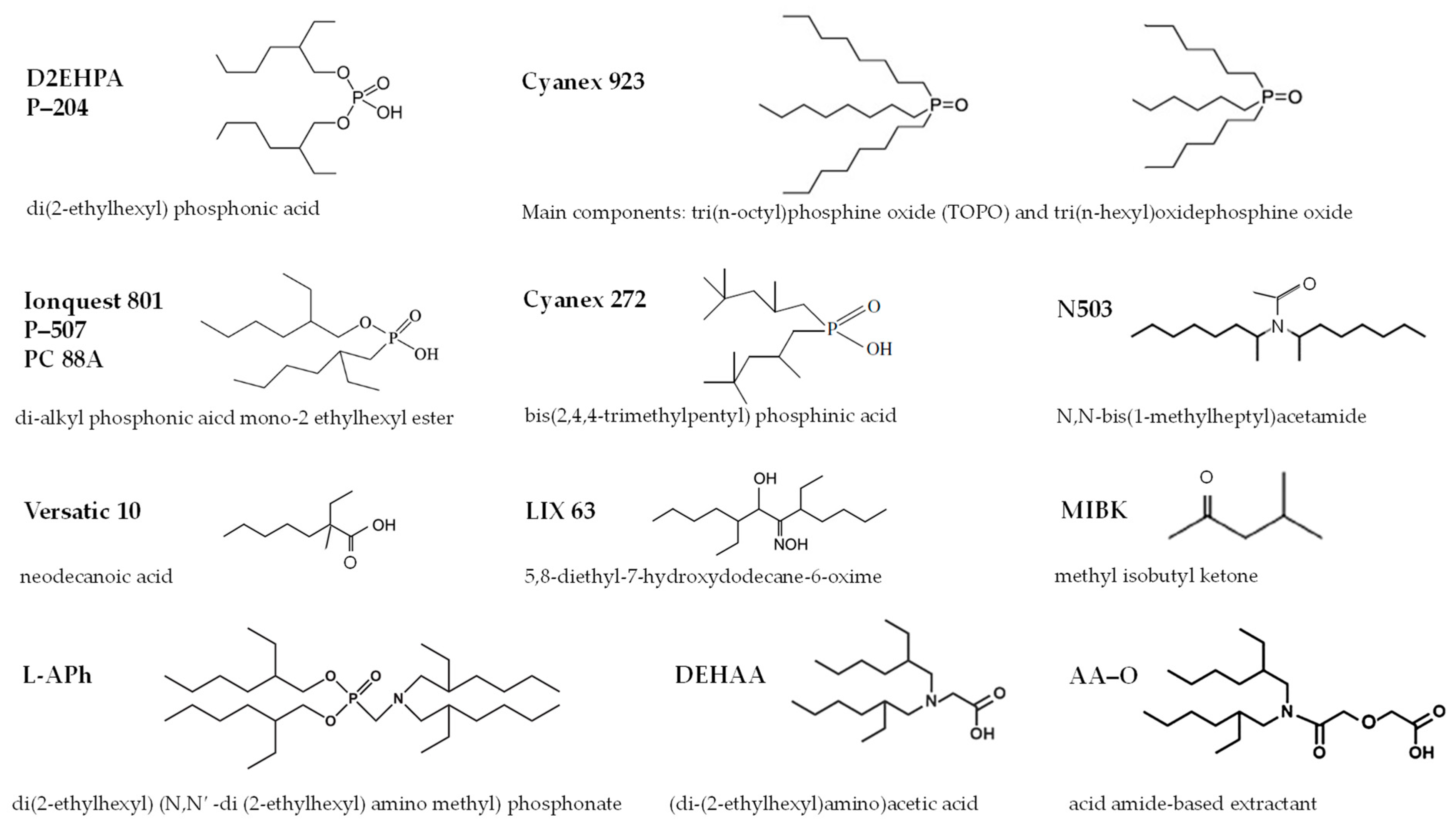
- Cationic (acidic) extractants operate via an ion-exchange mechanism, in which metal cations are transferred from the aqueous phase in exchange for H+ ions released from the extractant molecules. Representative examples include D2EHPA (P204) [26,27,30,33,35,36,37,38,39,40,41,42,43], Ionquest 801 (also known as P-507 or PC 88A) [38,44], Cyanex 272 [38] and Versatic 10 [40].
- Solvating (neutral) extractants act through solvation of the metal cation, forming electrically neutral complexes that are more soluble in the organic phase than in the aqueous phase. This group includes Cyanex 621 (TOPO) [29], Cyanex 923 (a mixture of four trialkylphosphine oxides) [45,46], N503 [47], and MIBK [48].
- Chelating extractants involve a mechanism similar to that of cationic extractants, characterized by the formation of stable chelate complexes with metal ions in the organic phase. These extractants are mainly hydroximes belonging to the LIX series, such as LIX 63 [40].
| Aqueous Phase 1 | Other Ions (In:M) 2 | Extraction Stage | In Extraction Selectivity 3 | In Extraction Efficiency | Stripping Stage | In Stripping Selectivity | In Stripping Efficiency | Ref. |
|---|---|---|---|---|---|---|---|---|
| S: HNO3 | Ga3+ (1:1), Mo (1:2) | D2EHPA in kerosene | yes, for Ga at pH 1.5 | 97% | 1 M HCl | no data | no data | [35] |
| S: H2SO4 | Ga3+ (2:1) | D2EHPA in kerosene | SGa = 900–1300 | 99.9% | HCl, pH 0.2 | no data | 95% | [36] |
| H2SO4, pH 0.2 | no data | 80% | ||||||
| L: H2SO4 (ITO) | Sn2+ (1:25) | D2EHPA in kerosene | no | 100% | 1.5 M HCl | yes | 94% | [37] |
| S: HCl | Fe3+ (1:3) | D2EHPA in kerosene | SFe = 6–61 | 95% | 2 M HCl | no | 45% | [38] |
| Ionquest 801 in kerosene | SFe = 22–26 | 95% | no | 70% | ||||
| S: H2SO4 | Ga3+ (1:1) | LIX 63 + Versatic 10 in kerosene | no | ~100% | 0.05 M H2SO4 | no | 98% | [40] |
| L: H2SO4 (Zn residue) | Zn2+(1:38), Ge4+(22:1), Fe2+(1:3) | D2EHPA in sulfonated kerosene | SZn = 1093 SGe = 1994 | 99% | 6 M HCl | no data | 98% | [43] |
| L: H2SO4 (Zn residue) | Fe2+(1:130), Zn2+(1:49), Ge4+(1:7), | D2EHPA + YW100 in sulfonated kerosene | no (Ge4+) | ~100% | 4 M HCl | yes | ~100% | [26] |
| L: H2SO4 (ZnO) | Zn, Fe, Al | P–507 in sulfonated kerosene + microwaves | yes | 97.6% | 1.5 M HCl | no data | 99% | [44] |
| S: H2SO4 | Fe3+ (1:10) | Cyanex 923 in toluene | no data | 1 M H2SO4 | 95% | [45] | ||
| S: HCl | no data | no data | no data | 97% | ||||
| S: HNO3 | no data | 97% | ||||||
| L: HCl (LCD) | Al, Fe, Cu, Y, Zn, Sn | Cyanex 923 in kerosene | no | 97 | 6 M HNO3 | no | 99% | [46] |
| S: HCl | – | N503 in sulfonated kerosene | no data | 99% | H2O | no data | 98% | [47] |
| S: HCl | Ga3+ (1:1) | Ketone MIBK | no | 99.8% | H2O | yes | 95% | [48] |
| S: HCl | Ga3+ (1:1) | L-APh in n-heptane | no | ~95% | H2O | no | 75% | [49] |
| Cextrant 230 in n-heptane | no | ~95% | no data | no data | no data | |||
| BEADP in n-heptane | no | ~30% | no data | no data | no data | |||
| L: HNO3 (CIGS) | Zn2+(1:1), Ga3+(2:1), Cu2+(1:1) | AA–O amic acid-based extractant | no | 99% | 5 M HCl | yes | 99% | [34] |
| S: NH4NO3 | – | DEHAA | possible from Ga | 90% | 1 M HNO3 | no | 96% | [50] |
| S: HCl-KCl | Fe3+, Al3+, Zn2+, Sn2+, Ca2+ | Crown ether B18C6 | yes | ~30% | 1 M HCl | no data | 98% | [51] |
2.2. Ionic Liquid Extractants
| Aqueous Phase 1 | Other Ions | Extraction Stage 2 | In Extraction Selectivity | In Extraction Efficiency | Stripping Stage | In Stripping Selectivity | In Stripping Efficiency | Ref. |
|---|---|---|---|---|---|---|---|---|
| L: HCl (LCD) | Sn2+, Cu2+ | Cyphos IL 101 in kerosene | no | ~100% | 0.1 M H2SO4 | yes | 99.7% | [53] |
| L: HCl (LCD) | Al3+, Zn2+, Cu2+ | Cyphos IL 101 in toluene | no | ~100% | 0.1 M H2SO4 | yes | 97% | [54] |
| S: HCl | – | Cyphos IL 104 in toluene | no data | 98% | 0.1 M HCl | no data | 100% | [55] |
| L: HCl (LCD) | Al3+, Ca2+, Fe3+, Sn2+, Sr2+, Zn2+, Mn2+ | Cyphos IL 104 in toluene | no | 95% | 0.001M HNO3 | yes | 99% | [32] |
| L: [Hbet][Tf2N]–H2O (LCD) | Fe2+ | [Hbet][Tf2N] | no | 98% | 0.5 M H2C2O4 | no | 95% | [56] |
| S: H2SO4 | Cr3+, Fe3+, Sn2+, Cr6+, Zn2+, Mn2+ | [PJMTH][HSO4] in Solvesso 100 | no | 94–98% | 0.1 M H2SO4 | no data | no data | [57] |
| S: HCl | Cu2+, Fe3+, Sn4+, Co2+, Zn2+, Ni2+ | [A324H][Cl] in Solvesso 100 | no | 80–100% | 0.1 M HCl | no data | 100% | [58] |
| – | Aliquat 336 in Solvesso 100 | no data | 60–100% | no data | no data | no data | ||
| S: H2SO4 | Fe2+ | [BMIm][PF6] + TBP + D2EHPA | yes | 98% | 1.5 M HCl | no data | 100% | [28] |
3. Ion Exchange
3.1. Polymeric Resins
3.2. Impregnated Polymeric Resins
| Aqueous Phase 1 | Other Ions | Sorption Stage 2 | In Sorption Selectivity | In Sorption Efficiency 3 | Elution Stage | In Elution Selectivity | In Elution Efficiency | Ref. |
|---|---|---|---|---|---|---|---|---|
| S: H2SO4 | Fe2+, Fe3+ | Ionac SR-5 (Ch) | partial | 20–40% | – | – | – | [60] |
| Ionac SR-12 (Ch) | partial | 10–20% | – | – | – | |||
| S950 (Ch) | no | 10% | – | – | – | |||
| Amberlite IR-120P (C) | no | 10% | – | |||||
| L: HCl (LCD) | Al3+, Fe3+, Sn2+, Cr3+, Zn2+, Ni2+, Cu2+, Pb2+ | no data (A) | no | 80% | HCl + NaCl (0.25 M Cl−) | yes | no data | [31] |
| L: HCl (catalyst) | Pt4+, Sn2+, Al3+ | Amberlite IRA-400AR (A) | no | EF 13 | no data | yes | no data | [61] |
| Amberlite IRA-420 (A) | no | EF 19 | 0.1 M EDTA | yes | 99% | |||
| Dowex 1 (A) | no | EF 20 | no data | yes | no data | |||
| Amberjet 4200 Cl (A) | no | EF 18 | 0.1 M EDTA | yes | 99% | |||
| S: HCl (isotope target) | Cd2+, Cu2+, Zn2+ | Diaion CR11 (C) | no | 63% | no data | no data | no data | [62] |
| Dowex 1 × 8 (A) | no | 59% | no data | no data | no data | |||
| Dowex 1 × 8 (A)/water acetone | yes | 84% | HCl | no data | no data | |||
| L: H2SO4 (LCD) | Al3+, Fe3+, Sn2+, Cr3+, Zn2+, Ni2+, Mo3+, Cu2+ | Levatit VP OC 1062 | no | 76% | 1 M HCl | yes | 74% | [64] |
| L: HNO3 (Ga–In waste) | Ge3+, Sn2+, Zn2+ | CL-P204 | no | ~100% | 3 M HCl | no | 100% | [65] |
| S: HCl | Fe3+ | Amberlite XAD-16N—[A336][I] | yes | 95% | 0.1 M H2SO4 | yes | 100% | [66] |
4. Membrane Methods
4.1. Nanofiltration
4.2. Ion-Exchange Membranes
4.3. Liquid Membranes
5. Conclusions
| Method | Advantages | Disadvantages |
|---|---|---|
| Solvent Extraction | Selective separation of target metal, versatile for many systems, adaptable to different conditions, scalable from lab to industry, low cost with simple equipment, high efficiency, easy phase separation, allows for continuous operation, enables purification to high-purity products, fast extraction kinetics | Uses flammable/toxic organic solvents, requires large solvent volumes, potential solvent loss or contamination, sometimes slow for certain systems, can generate hazardous waste, sensitive to emulsion formation, requires careful control of pH and temperature, limited effectiveness for very dilute solutions |
| Ion exchange | High selectivity for specific ions, efficient even at low concentrations, allows for continuous operation, can achieve high purity products, reversible and regenerable resins, adaptable to different pH and temperature conditions, minimal use of hazardous solvents, easy scale-up from lab to industrial processes, rapid kinetics in many systems | High cost of resins, limited capacity (requires frequent regeneration), sensitive to fouling and clogging, not applicable for very concentrated solutions, performance affected by competing ions, requires careful pH and temperature control, disposal of spent resin can be challenging |
| Membranes | High selectivity for target ions, operates at ambient conditions, minimal chemical consumption, continuous operation possible, scalable from lab to industrial scale, can concentrate and/or purify solutions, environmentally friendly with low waste generation, adaptable to different feed compositions | Membrane fouling, scaling or clogging from particulates, limited chemical/thermal stability, high initial investment, gradual loss of selectivity or permeability, sensitivity to extreme pH or oxidizing agents, frequent maintenance and cleaning needed, not always effective for very dilute solutions, limited lifetime, reducing efficiency, potential incompatibility with viscous or high-concentration feeds, high membrane cost |
Funding
Data Availability Statement
Conflicts of Interest
References
- Grohol, M.; Veeh, C. Study on the Critical Raw Materials for the EU 2023; Final Report; Office of the European Union: Luxembourg, 2023. [Google Scholar] [CrossRef]
- Xiao, L.; Wang, L.; Zhao, T.; Xu, J.; Liu, W. Indium resource industry chain status and supply and demand trend analysis. Min. Eng. 2026, 235, 109780. [Google Scholar] [CrossRef]
- Patel, J.; Sharme, R.K.; Quijada, M.A.; Rana, M.M. A review of transparent conducting films (TCFs): Prospective ITO and AZO deposition methods and applications. Nanomaterials 2024, 14, 2013. [Google Scholar] [CrossRef] [PubMed]
- Zhang, Y.; Kim, M.; Wang, L.; Verlinden, P.; Hallam, B. Design consideration for multi-terawatt scale manufacturing of existing and future photovoltaic technologies: Challenges and opportunities related to silver, indium and bismuth consumption. Energy Environ. Sci. 2021, 14, 5587–5610. [Google Scholar] [CrossRef]
- Mordor Intelligence. Indium Tin Oxide Market Size & Share Analysis—Growth Trends & Forecasts (2025–2030). Available online: https://www.mordorintelligence.com/industry-reports/indium-tin-oxide-market (accessed on 2 January 2026).
- Svedrup, H.U.; van Allen, O.; Haraldsson, H.V. Modeling indium extraction, supply, price, use and recycling 1930–2200 using the WORLD7 Model: Implication for the imaginaries of sustainable Europe 2050. Nat. Resour. Res. 2024, 33, 539–570. [Google Scholar] [CrossRef]
- Ueberschaar, M.; Schlummer, M.; Jalalpoor, D.; Kaup, N.; Rotter, V.S. Potential and recycling strategies for LCD panels from WEEE. Recycling 2017, 2, 7. [Google Scholar] [CrossRef]
- Mwenda, P.M.; Njoroge, W.; Mirenga, S.; Kinyua, D.M. Review: Advances in the CIGS thin films for photovoltaic applications. Smart Grid Renew. Energy 2022, 13, 75–87. [Google Scholar] [CrossRef]
- Persistence Market Research. CIGS Thin-Film Solar Cells Market Size, Share, and Growth Forecast, 2026–2033. Available online: https://www.persistencemarketresearch.com/market-research/cigs-thin-film-solar-cells-market.asp (accessed on 2 January 2026).
- U.S. Geological Survey. Mineral Commodity Summaries 2025; U.S. Geological Survey: Reston, VA, USA, 2025.
- Mukherjee, C.; Deng, M.; Nodjidjim, V.; Riet, M.; Mismer, C.; Guendouz, D.; Caillaud, C.; Bertin, H.; Vaissiere, N.; Luisier, M.; et al. Towards monolithic indium phosphide (InP)-based electronic photonic technologies for beyond 5G communication systems. Appl. Sci. 2021, 11, 2393. [Google Scholar] [CrossRef]
- Gómez, M.; Xu, G.; Li, J.; Zeng, X. Securing indium utilization for high-tech and renewable energy industries. Environ. Sci. Technol. 2023, 57, 2611–2624. [Google Scholar] [CrossRef]
- Market Research Future. Indium Market. Available online: https://www.marketresearchfuture.com/reports/indium-market-23618 (accessed on 2 January 2026).
- National Minerals Information Center. Indium Statistics and Information. Available online: https://www.usgs.gov/centers/national-minerals-information-center/indium-statistics-and-information (accessed on 2 January 2026).
- Strategic Metal Invest. Indium Prices. Available online: https://strategicmetalsinvest.com/indium-prices/ (accessed on 21 January 2026).
- Our World in Data. Refined Indium Reserves, 2024. BGS—World Mineral Statistics (2025)—With Major Processing by Our World in Data. Available online: https://ourworldindata.org/explorers/minerals?tab=map&time=2024&Mineral=Indium&Metric=Production&Type=Mine%2C+ruthenium&Share+of+global=false&country=OWID_WRL~AUS~CHL~CHN~USA (accessed on 2 January 2026).
- Lin, J.; Li, X.; Luo, F.; Liu, W.; Tang, X.; Wang, M.; Li, Y. Security evaluation of China’s indium industrial chain: Perspective on substance flow throughout the whole life cycle. Sustain. Prod. Consum. 2024, 47, 557–569. [Google Scholar] [CrossRef]
- Geology Survey. Final 2025 List of Critical Minerals. Fed. Regist. 2025, 90, 50494–50497. [Google Scholar]
- International Energy Agency. Critical Minerals Policy Tracker. Available online: https://www.iea.org/data-and-statistics/data-tools/critical-minerals-policy-tracker (accessed on 2 January 2026).
- European Commission Enterprise and Industry. Critical Raw Materials for the EU, Report of the Ad-Hoc Working Group on Defining Critical Raw Materials; European Commission Enterprise and Industry: Brussels, Belgium, 2010. [Google Scholar]
- Rudnick, R.L.; Gao, S. Composition of the continental crust. In Treatise on Geochemistry. The Crust; Rudnick, R.L., Ed.; Elsevier: Oxford, UK, 2005; Volume 3, pp. 1–64. [Google Scholar]
- Mejías, O.; Parbhakar-Fox, A.; Jackson, L.; Valenta, R.; Townley, B. Indium in ore deposits and mine waste environments: Geochemistry, mineralogy, and opportunities for recovery. J. Geochem. Explor. 2023, 255, 107312. [Google Scholar] [CrossRef]
- Li, C.; Wei, C.; Xu, S.S.; Li, M.; Li, X.; Deng, Z.; Fan, G. Oxidative pressure leaching of sphalerite concentrate with high indium and iron content in sulfuric acid medium. Hydrometallurgy 2010, 102, 91–94. [Google Scholar] [CrossRef]
- Martin, M.; Janneck, E.; Kermer, R.; Patzig, A.; Reichel, S. Recovery of indium from sphalerite ore and flotation tailings by bioleaching and subsequent precipitation process. Min. Eng. 2015, 75, 94–99. [Google Scholar] [CrossRef]
- Liu, Q.; Li, C.; Gu, Z.; Li, C.; Wang, Q. Study on pre-oxidation of silver concentrate and leaching behaviour of Zn, Cu and In during oxygen-pressure leaching. Hydrometallurgy 2024, 228, 106358. [Google Scholar]
- Wang, C.; Hu, J.; Zhang, K.; Zhang, S.; Li, Y. Cost effective selective separation of indium and germanium from zinc processing waste leach liquor using D2EHPA–YW100 synergistic system and selective stripping with HCl and NH4F. Hydrometallurgy 2025, 232, 106421. [Google Scholar] [CrossRef]
- Chang, J.; Zhang, L.B.; Du, Y.; Peng, J.H.; Hu, G.Y.; Chen, J.; Srinivasakannan, C. Separation of indium from iron in a rotating packed bed contactor using di-2-ethylhexylphosphoric acid. Sep. Pur. Technol. 2016, 164, 12–18. [Google Scholar] [CrossRef]
- Gao, L.; Dai, Z.; Wu, H.; Wu, C.; Wan, Y. Study on efficient extraction of indium from complex sulfuric acid solution by ‘ionic liquid + di(2-ethylhexyl)phosphoric acid + tributyl phosphate”. Sep. Pur. Technol. 2022, 288, 120670. [Google Scholar] [CrossRef]
- Rani, K.; Panda, R.; Sharma, A.; Meher, A.K.; Ambade, B.; Yoo, K.; Jha, M.K. Hydrometallurgical recovery of critical metal indium from scrap LCD panels. Minerals 2025, 15, 1084. [Google Scholar] [CrossRef]
- Pereira, E.B.; Suliman, A.L.; Tanabe, E.H.; Beruoll, D.A. Recovery of indium from liquid crystal displays of discarded mobile phones using solvent extraction. Min. Eng. 2018, 119, 67–72. [Google Scholar] [CrossRef]
- Illés, I.B.; Kékesi, T. The application of selective leaching and complex anion exchange in a novel aqueous process to produce pure indium from waste liquid crystal display panels. J. Environ. Chem. Eng. 2022, 10, 108420. [Google Scholar] [CrossRef]
- Dhiman, S.; Gupta, B. Cyphos IL 104 assisted extraction of indium and recycling of indium, tin, and zinc from discarded LCD screen. Sep. Pur. Technol. 2020, 237, 116407. [Google Scholar] [CrossRef]
- Khezerloo, S.; Nasipour, N.; Pourhossein, F.; Mousavi, S.M. Bioleaching of indium from spent light-emitting diode monitors and selective recovery followed by solvent extraction. J. Environ. Manag. 2023, 335, 117520. [Google Scholar] [CrossRef]
- Xu, X.; Wang, W.; Liu, T.; Zhao, J.; Wang, Y. Heteroatomic-scale insight into the extraction selectivity of amic acid ligands and gallium and indium recovery from spent solar panels. Sep. Pur. Technol. 2025, 355, 129639. [Google Scholar] [CrossRef]
- Theocharis, M.; Tsakiridis, P.E.; Kousi, P.; Hatzikioseyian, A.; Zarkadas, I.; Remoundaki, E.; Lyberatos, G. Hydrometallurgical treatment for the extraction and separation of indium and gallium from end-of-life CIGS photovoltaic panels. Mater. Proc. 2021, 5, 51. [Google Scholar]
- Lee, M.S.; Anh, J.G.; Lee, E.C. Solvent extraction separation of indium and gallium from sulphate solutions using D2EHPA. Hydrometallurgy 2002, 63, 269–276. [Google Scholar] [CrossRef]
- Virolainen, S.; Ibana, D.; Paatero, E. Recovery of indium from indium tin oxide by solvent extraction. Hydrometallurgy 2011, 107, 56–61. [Google Scholar] [CrossRef]
- Lupi, C.; Pilone, D. In(III) hydrometallurgical recovery from secondary materials by solvent extraction. J. Environ. Chem. Eng. 2014, 2, 100–104. [Google Scholar] [CrossRef]
- Li, X.; Deng, Z.; Li, C.; Wei, C.; Li, M.; Fan, G.; Rong, H. Direct solvent extraction of indium from a zinc residue reductive leach solution by D2EHPA. Hydrometallurgy 2015, 156, 1–5. [Google Scholar] [CrossRef]
- Nusen, S.; Chairuangsri, T.; Zhu, Z.; Cheng, C.Y. Recovery of indium and gallium from synthetic leach solution of zinc refinery rsidues using synergistic solvent extraction with LIX 63 and Versatic 10 acid. Hydrometallurgy 2016, 160, 137–146. [Google Scholar] [CrossRef]
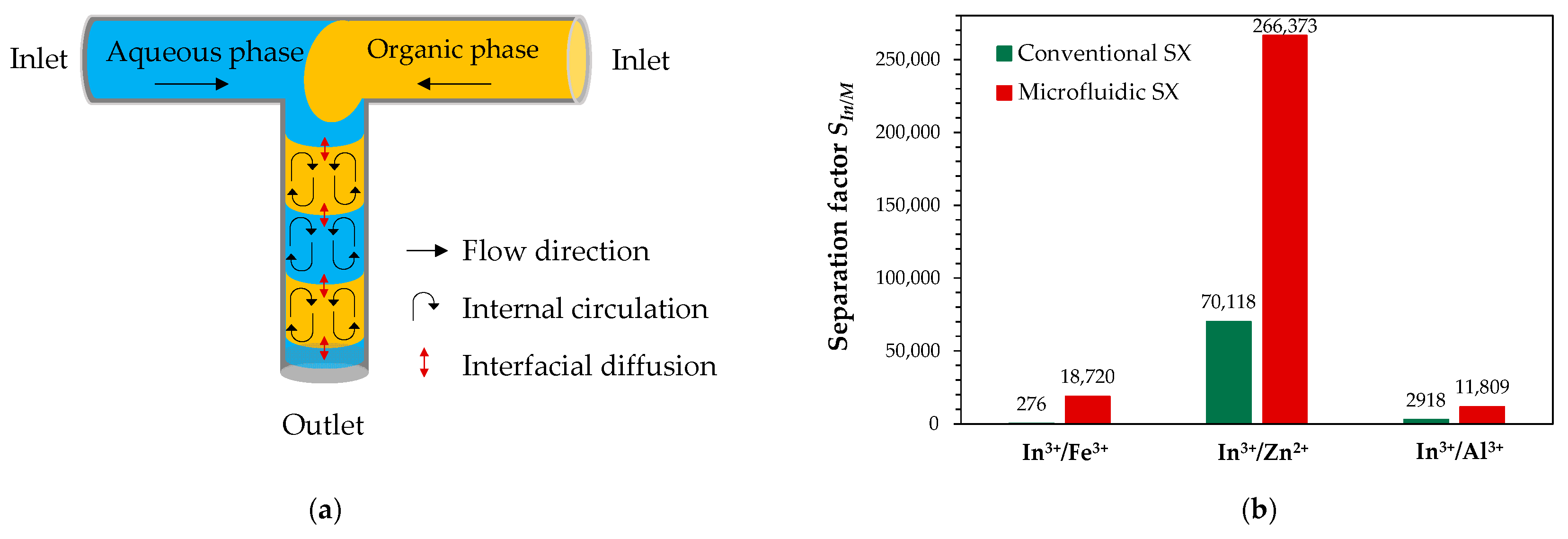
- Le, T.; Xiao, B.; Ju, S.; Peng, J.; Jiang, F. Separation of indium from impurities in T-type microreactor with D2EHPA. Hydrometallurgy 2019, 183, 79–86. [Google Scholar] [CrossRef]
- Grigorieva, N.A.; Fleitlikh, I.Y.; Tikhonov, A.Y.; Mamatyuk, V.I.; Karpova, E.V. Recovery of indium from sulfate solutions with D2EHPA in the presence of organic proton-donor additives. Hydrometallurgy 2022, 213, 105925. [Google Scholar] [CrossRef]
- Tan, Z.; Jin, X.; Zhen, Y.; Wei, C.; Li, X.; Deng, Z.; Li, M. Recovery of indium and germanium from In-Ge residue leaching solution using solvent extraction and tannin precipitation. Sep. Pur. Technol. 2023, 323, 124416. [Google Scholar] [CrossRef]
- Li, S.; Wang, H.; Wang, S.; Xie, F.; Sun, X. Selective extraction of indium from zinc oxide dust leachate by microwave-assisted solvent extraction with P507 and stripping with HCl: Thermodynamics and kinetics. Hydrometallurgy 2025, 235, 106483. [Google Scholar] [CrossRef]
- Gupta, B.; Deep, A.; Malik, P. Liquid–liquid extraction and recovery of indium using Cyanex 923. Anal. Chim. Acta 2004, 513, 463–471. [Google Scholar] [CrossRef]
- Yang, J.; Retegan, T.; Steenari, B.M.; Ekberg, C. Recovery of indium and yttrium from Flat Panel Display waste using solvent extraction. Sep. Pur. Technol. 2016, 166, 117–124. [Google Scholar] [CrossRef]
- Jian, D.; Guo, X.; Li, X.; Deng, Z.; Wei, C.; Li, M.; Fan, G. Extraction of indium with N,N-di(1-methylheptyl)acetamide, di(1-methylheptyl)methyl phosphate, and tributylphosphate by solvent extraction in hydrochloric acid solution. Min. Eng. 2020, 156, 106510. [Google Scholar]
- Stankovic, N.; Oshima, T. Two-step selective extraction of Ga(III) and In(III) from hydrochloric acid media using different ketones. Sep. Pur. Technol. 2026, 386, 136500. [Google Scholar] [CrossRef]
- Xu, Y.; Deng, B.; Kuang, S.; Liao, W. Selective extraction and separation of gallium(III) from indium(III) in chloride medium using di(2-ethylhexyl)(N,N’-di(2-ethylhexyl)aminomethyl) phosphonate and stripping with water. Hydrometallurgy 2023, 217, 106035. [Google Scholar] [CrossRef]
- Sasaki, Y.; Uto, M.; Oshima, T.; Baba, Y. Synthesis of a carboxylic acid extractant containing amino group and its selective extraction of In(III) and Ga(III). Solv. Extr. Res. Dev. Jpn. 2016, 23, 1–8. [Google Scholar] [CrossRef]
- Chen, G.; Xiong, Y.; Xu, L.; Yao, C.; Zhang, X.; Yang, C.; Tian, Y.; Zhao, Z. Recovery of indium by solvent extraction with crown ether in the presence of KCl and stripping with HCl: A mechanistic study. Hydrometallurgy 2024, 229, 106378. [Google Scholar] [CrossRef]
- Yudaev, P.A.; Chistyakov, E.M. Ionic liquids as components of systems for metal extraction. ChemEngineering 2022, 6, 6. [Google Scholar] [CrossRef]
- Nayak, S.; Devi, N. Development of hydrometallurgical process for indium recovery from waste liquid crystal display using Cyphos IL 101. Trans. Nonferrous Met. Soc. China 2020, 30, 2556–2567. [Google Scholar] [CrossRef]
- Gómez, M.; Grimes, S.; Yang, L.; Pornsirianant, T.; Fowler, G. Novel resource-efficient recovery of high purity indium products: Unlocking value from end-of-life mobile phone liquid crystal display screens. J. Environ. Chem. Eng. 2023, 11, 111327. [Google Scholar] [CrossRef]
- Nayak, S.; Devi, N. Studies on the solvent extraction of indium (III) from aqueous chloride medium using Cyphos IL 104. Mater. Today Proc. 2020, 30, 258–261. [Google Scholar] [CrossRef]
- Luo, D.; Zhu, N.; Li, Y.; Cui, J.; Wu, P.; Wang, J. Simultaneous leaching and extraction of indium from waste LCDs with acidic ionic liquids. Hydrometallurgy 2019, 189, 105146. [Google Scholar] [CrossRef]
- Alguacil, F.J.; Garcia-Diaz, I.; Escudero, E. Extraction of indium(III) from sulphuric acid medium by the ionic liquid (PJMTH+HSO4−). Sep. Pur. Technol. 2019, 211, 764–767. [Google Scholar] [CrossRef]
- Alguacil, F.J.; Escudero, E. Solvent extraction of indium(III) from HCl solutions by the ionic liquid (A324H+)(Cl−) dissolved in Solvesso 100. Hydrometallurgy 2019, 189, 105104. [Google Scholar] [CrossRef]
- Deferm, C.; Onghena, B.; Hoogerstraete, T.V.; Banerjrr, D.; Luyten, J.; Oosterhof, H.; Fransaer, J.; Binnemans, K. Speciation of indum(III) chloro complexes in the solvent extraction process from chloride aqueous solutions to ionic liquids. Dalton Trans. 2017, 46, 4412–4421. [Google Scholar] [CrossRef] [PubMed]
- Fortes, M.C.B.; Martins, A.H.; Benedetto, J.S. Indium adsorption onto ion exchange polymeric resins. Min. Eng. 2003, 16, 659–663. [Google Scholar] [CrossRef]
- Marinho, R.S.; da Silva, C.N.; Afonso, J.C.; da Cunha, J.W.S.D. Recovery of platinum, tin and indium from spent catalysts in chloride medium using strong basic anion exchange resins. J. Hazard. Mater. 2011, 192, 1155–1160. [Google Scholar] [CrossRef] [PubMed]
- Zhao, Q.; Wang, J.; Htun, A.T.; Kuang, S.; Shih, K. Enhancing indium/cadmium separation via promoting anionic indium chloro complexation in a water-acetone medium. Chem. Eng. Sci. 2026, 323, 123162. [Google Scholar] [CrossRef]
- Kwak, N.S.; Park, H.M.; Hwang, T.S. Preparation of ion-exchangeable nanobeads using suspension polymerization and their sorption properties for indium in aqueous solution. Chem. Eng. J. 2012, 191, 579–587. [Google Scholar] [CrossRef]
- Fortin-Lecomte, C.; Tran, L.H.; Rioux, G.; Coudert, L.; Blais, F. Recovery of indium from acidic leach solutions of spent LCD panels using ion exchange. Hydrometallurgy 2022, 210, 105845. [Google Scholar] [CrossRef]
- Li, Z.; Chen, Z.; Ma, W.; Cai, C.; Li, S. Efficient separation and recovery of valuable gallium and indium from gallium-based liquid metal waste. J. Clean. Prod. 2023, 408, 137053. [Google Scholar] [CrossRef]
- Roosendael, S.V.; Regadío, M.; Roosen, J.; Binnemans, K. Selective recovery of indium from iron-rich solutions using Aliquat 336 iodide supported ionic liquid phase (SLIP). Sep. Pur. Technol. 2019, 212, 843–853. [Google Scholar] [CrossRef]
- Lu, D.; Yao, Z.; Jiao, L.; Waheed, M.; Sun, Z.; Zhang, L. separation mechanism, selectivity enhancement strategies and advanced materials for mono-/multivalent ion-selective nanofiltration membrane. Adv. Membr. 2022, 2, 10032. [Google Scholar] [CrossRef]
- Wu, M.; Sun, D.D.; Tay, J.H. Effect of operating variables on rejection of indium using nanofiltration membranes. J. Membr. Sci. 2004, 240, 105–111. [Google Scholar] [CrossRef]
- Wu, M.; Sun, D.D.; Tay, J.H. Separation of indium using nanofiltration membranes: A non-steady-state study. J. Membr. Sci. 2004, 246, 215–222. [Google Scholar]
- Werner, A.; Rieger, A.; Mosch, M.; Haseneder, R.; Repke, J.U. Nanofiltration of indium and germanium ions in aqueous solutions: Influence of pH and charge on retention and membrane flux. Sep. Pur. Technol. 2018, 194, 319–328. [Google Scholar] [CrossRef]
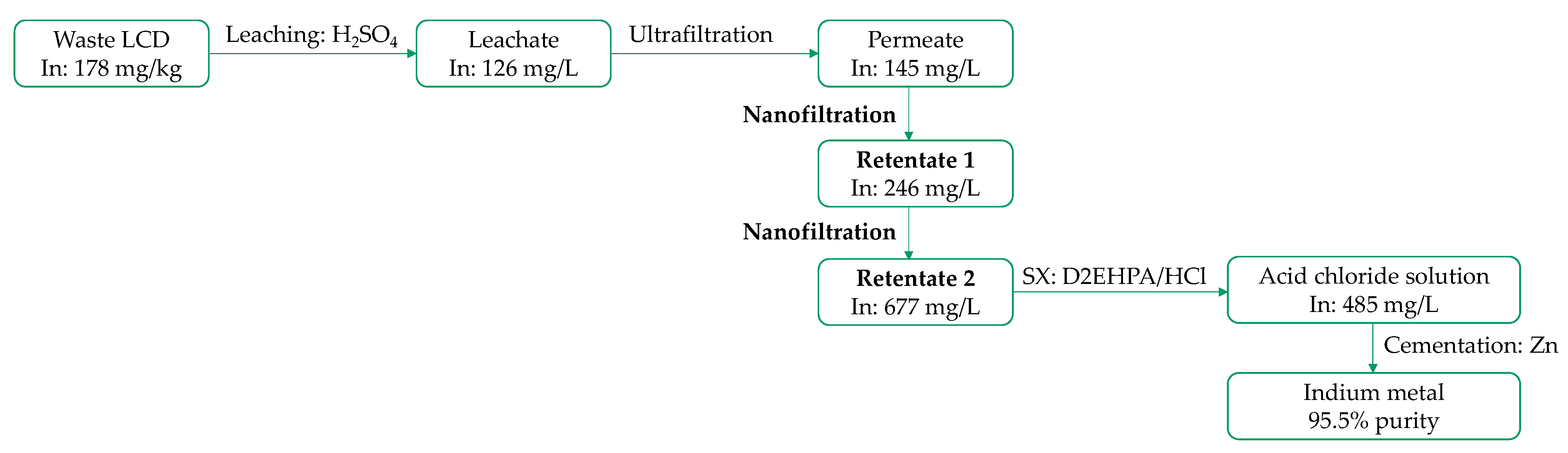
- Lahti, J.; Vazquez, S.; Virolainen, S.; Mänttäri, M.; Kallioinen, M. Membrane filtration enhanced hydrometallurgical recovery process of indium from waste LCD panels. J. Sustain. Metall. 2020, 6, 576–588. [Google Scholar] [CrossRef]
- Jiang, S.; Sun, H.; Wang, H.; Ladewig, B.P.; Yao, Z. A comprehensive review on the synthesis and applications of ions exchange membranes. Chemosphere 2021, 282, 130817. [Google Scholar] [CrossRef]
- Wang, K.; Tian, H.; Li, G.; Dai, Y.; Wang, J.; Zhou, G.; Qiu, M.; Li, W.; Wang, L. Amino-phosphorylated nanofiber membranes for highly selective and efficient separation of In(III). Sep. Pur. Technol. 2025, 377, 134346. [Google Scholar] [CrossRef]
- De-la-Cruz-Moreno, J.E.; Ceniceros-Gómez, A.E.; Morton-Bermea, O.; Hernández-Álvarez, E. Recovery of indium jarosite residues of zinc refinery by hydrometallurgical process. Hydrometallurgy 2021, 230, 105697. [Google Scholar] [CrossRef]
- Kim, Y.J.; Hwang, C.W.; Jeong, M.H.; Hwang, T.S. Design of flow through continuous deionization system from indium recovery. Sep. Pur. Technol. 2017, 176, 200–207. [Google Scholar] [CrossRef]
- Rzelewska-Piekut, M.; Regel-Rostocka, M. Liquid membranes for separation of metal ions from wastewaters. Phys. Sci. Rev. 2023, 8, 937–982. [Google Scholar] [CrossRef]
- Kondo, K.; Yamamoto, Y.; Matsumoto, M. Separation of indium(III) and gallium(III) by a supported liquid membranę containing diisostearylphosphoric acid as a carrier. J. Membr. Sci. 1997, 137, 9–15. [Google Scholar] [CrossRef]
- Kondo, K.; Matsumoto, M. Separation and concentration of indium(III) by an emulsion liquid membranę containing diisostearylphosphoric acid as a mobile carrier. Sep. Pur. Technol. 1998, 13, 109–115. [Google Scholar]
- Dang, N.T.T.; Wang, D.M.; Huang, S.Y.; Tran, K.T. Indium recovery from aqueous solution containing oxalic acid—Enhancement by using hydrophobic membranes. Sep. Pur. Technol. 2020, 235, 116300. [Google Scholar] [CrossRef]
- Huang, Y.F.; Hsia, W.N.; Lo, S.L. Ultrasound-assisted leaching and supported liquid membrane extraction of waste liquid crystal displays for indium recovery. Sustain. Chem. Pharm. 2023, 35, 101227. [Google Scholar] [CrossRef]


Disclaimer/Publisher’s Note: The statements, opinions and data contained in all publications are solely those of the individual author(s) and contributor(s) and not of MDPI and/or the editor(s). MDPI and/or the editor(s) disclaim responsibility for any injury to people or property resulting from any ideas, methods, instructions or products referred to in the content. |
© 2026 by the author. Licensee MDPI, Basel, Switzerland. This article is an open access article distributed under the terms and conditions of the Creative Commons Attribution (CC BY) license.
Share and Cite
Rudnik, E. Separation Strategies for Indium Recovery: Exploring Solvent Extraction, Ion-Exchange, and Membrane Methods. Metals 2026, 16, 156. https://doi.org/10.3390/met16020156
Rudnik E. Separation Strategies for Indium Recovery: Exploring Solvent Extraction, Ion-Exchange, and Membrane Methods. Metals. 2026; 16(2):156. https://doi.org/10.3390/met16020156
Chicago/Turabian StyleRudnik, Ewa. 2026. "Separation Strategies for Indium Recovery: Exploring Solvent Extraction, Ion-Exchange, and Membrane Methods" Metals 16, no. 2: 156. https://doi.org/10.3390/met16020156
APA StyleRudnik, E. (2026). Separation Strategies for Indium Recovery: Exploring Solvent Extraction, Ion-Exchange, and Membrane Methods. Metals, 16(2), 156. https://doi.org/10.3390/met16020156