This is an early access version, the complete PDF, HTML, and XML versions will be available soon.
Article

Fiber-Diode Hybrid Laser Welding of IGBT Copper Terminals

1
School of Materials, Shanghai Dianji University, No.300, Shuihua Road, Pudong New Area, Shanghai 200245, China
2
Heilongjiang Construction & Installation Group Co., Ltd., Harbin 150036, China
*
Author to whom correspondence should be addressed.
Metals 2026, 16(2), 139; https://doi.org/10.3390/met16020139
Submission received: 19 December 2025 / Revised: 19 January 2026 / Accepted: 21 January 2026 / Published: 23 January 2026
(This article belongs to the Special Issue Advanced Laser Welding and Joining of Metallic Materials)

Abstract

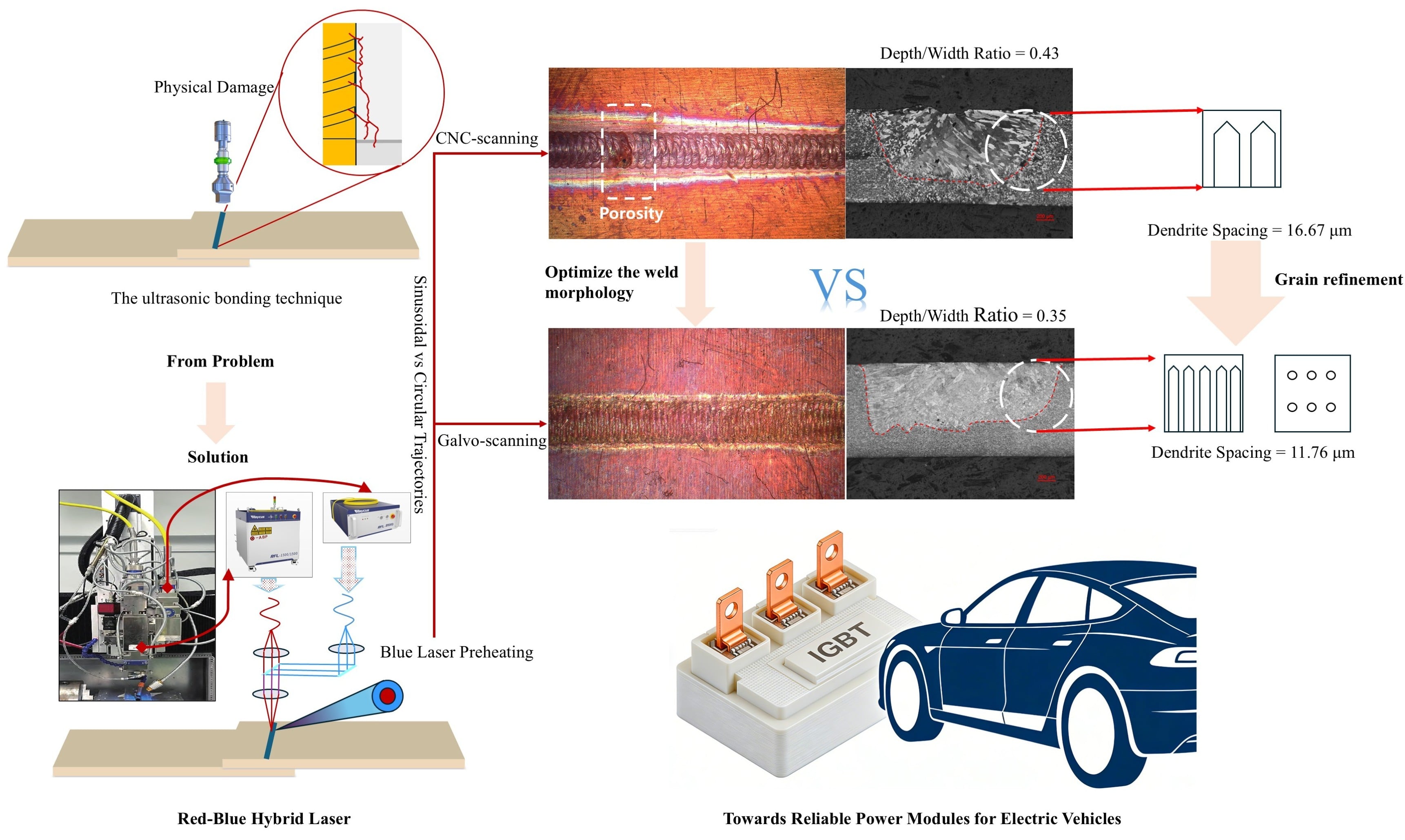
The traditional ultrasonic bonding technique for IGBT T2 copper terminals often causes physical damage to ceramic substrates, severely compromising the reliability of power modules. Meanwhile, T2 copper laser welding faces inherent challenges including low laser absorption efficiency and unstable molten pool dynamics. To address these issues, this study targets the high-quality connection of IGBT T2 copper terminals and proposes a welding solution integrating a Fiber-Diode Hybrid Laser system with galvo-scanning technology. Comparative experiments between galvo-scanning and traditional oscillation methods CNC scanning were conducted under sinusoidal and circular trajectories to explore the regulation mechanism of welding quality. The results demonstrate that CNC scanning lacks precision in thermal input control, resulting in inconsistent welding quality. Galvo-scanning enables precise modulation of laser energy distribution and molten pool behavior, effectively reducing spatter and porosity defects. It also promotes the transition from columnar grains to equiaxed grains, significantly refining the weld microstructure. Under the sinusoidal trajectory with a welding speed of 20 mm/s, the Lap-shear strength of the galvo-scanned joint reaches 277 N/mm2, outperforming all CNC-scanned joints. This research proposes a non-contact welding strategy targeted at eliminating the mechanical failure mechanism associated with conventional ultrasonic bonding of ceramic substrates. It establishes the superiority of galvo-scanning for precision welding of high-reflectivity materials and lays a foundation for its potential application in new energy vehicle power modules and microelectronic packaging.
Keywords: fiber-diode laser hybrid welding; galvo-scanning; grain size; molten pool morphology; T2 copper fiber-diode laser hybrid welding; galvo-scanning; grain size; molten pool morphology; T2 copper
Graphical Abstract