
Article

Study on Electrochemical Behavior at a Room and High Temperature at 700 °C Corrosion of Austenite, Ferrite, and Duplex Stainless Steels

1
Innovative Graduate Education Program for Global High-Tech Materials and Parts, Pusan National University, Busan 46241, Republic of Korea
2
Secondary Battery Research Division, Pohang Institute for Materials Industry, Pohang-si 37666, Republic of Korea
*
Author to whom correspondence should be addressed.
Metals 2026, 16(1), 82; https://doi.org/10.3390/met16010082
Submission received: 6 December 2025 / Revised: 4 January 2026 / Accepted: 9 January 2026 / Published: 12 January 2026

Abstract

The stainless-steel phase of austenite, ferrite, and duplex was affected by the high temperature corrosion. So, the study of corrosion behavior in high temperatures at 700 °C is important because it is connected to life and maintenance. Various stainless steels (AISI no. 409 L, 430 L, 304L, 316L, 2205, 2507) are used to identify the most suitable material for high-temperature SOFC applications. The study was checked to surface, microstructure, and corrosion behavior after corrosion at 700 °C during 120 h. The surface and microstructure are checked using FE-SEM and XRD. The electrochemical behavior and corrosion behavior are checked for open circuit potential, electrochemical impedance spectroscopy, and potentiodynamic polarization test by a potentiostat. The potentiodynamic polarization results revealed that the pitting potential (Epit) varied significantly depending on the material, with values of 0.21 V for AISI 304L and 1.14 V for AISI 2507. The breakdown behavior of the passive film exhibited material-dependent characteristics, which were found to be consistent with the observed trends in high-temperature corrosion.

1. Introduction

Solid oxide fuel cells (SOFCs) generate electricity through electrochemical reactions between hydrogen and oxygen under oxidizing conditions [1,2]. They can operate using hydrogen fuel in air; however, the operating temperature must exceed 700 °C to provide sufficient driving force for the reactions [3,4]. Such high temperatures can induce severe corrosion on metal surfaces and alter their microstructures, consequently reducing the lifespan and reliability of the system [5,6]. Although high temperature corrosion and microstructural evolution in stainless steels have been investigated in many individual studies, most of these works have treated oxidation behavior and microstructural changes as independent phenomena rather than as interrelated processes. In particular, previous studies have often focused either on phase transformations, precipitation behavior, or mechanical degradation without directly correlating oxidation behavior at 700 °C with subsequent electrochemical stability. As a result, the mechanistic linkage between phase-constitution-dependent oxidation and electrochemical performance remains insufficiently clarified.
Research on high-temperature corrosion has been relatively limited due to material constraints and safety concerns [7,8]. Nevertheless, evaluating the performance of materials under these extreme conditions is essential for high-power applications such as SOFCs [9,10]. Many previous studies have focused primarily on precipitation phenomena within the crystal structure rather than corrosion behavior at elevated temperatures [11]. For instance, researcher N Pettersson examined the precipitation behavior of secondary phases in stainless steels [12], while researcher J Michalska analyzed the formation characteristics of precipitates under similar conditions [13]. Considering these earlier works, it is indispensable to study corrosion behavior at high temperatures for the practical application of structural materials in SOFCs. While these studies provide valuable insight into microstructural evolution, they do not address how high-temperature oxidation behavior influences the electrochemical stability of stainless steels, which is a critical factor for SOFC interconnect performance. Therefore, corrosion behavior at high temperatures must be evaluated in conjunction with electrochemical characteristics to enable realistic material selection for SOFC applications.
Austenitic stainless steel (AISI 304) is commonly used as a separator and casing material in SOFC systems due to its excellent corrosion resistance under ambient conditions [14,15]. Despite these critical effects, its corrosion resistance significantly decreases above 200 °C because of its relatively high coefficient of thermal expansion (CTE) [16,17]. The degradation of stainless-steel components consequently diminishes the overall performance of SOFCs [18]. Therefore, materials used in SOFCs must exhibit superior corrosion resistance even at temperatures exceeding 700 °C.
Previous studies have generally investigated individual stainless-steel grades or limited phase types over restricted temperature ranges [19,20]. For example, several works on austenitic stainless steels have concentrated on precipitation of secondary phases and sensitization phenomena, whereas studies on ferritic and duplex grades have mainly examined phase balance, toughness, or mechanical properties under thermal exposure [21,22]. However, these investigations rarely combine long-term oxidation at 700 °C with a systematic comparison of electrochemical behavior among different phase types under identical conditions. This makes it difficult to establish a unified framework for selecting optimal interconnect materials for SOFCs [23,24]. Austenitic stainless steel has been the most extensively studied due to its widespread industrial use [25,26]. Ferritic stainless steels, although containing fewer alloying elements and showing lower corrosion resistance in ambient environments, often demonstrate improved high-temperature corrosion resistance owing to their lower CTE [27,28]. This characteristic enables their use in high-temperature components such as automotive exhaust systems. Duplex stainless steels, which combine both austenitic and ferritic phases, possess excellent resistance to both pitting and high-temperature corrosion [29,30]. Consequently, it is essential to compare the corrosion resistance of various stainless steels to identify the most suitable material for high-temperature SOFC applications.
Unlike previous studies that treated high-temperature oxidation and room temperature electrochemical behavior separately, this work provides mechanistic insight into how phase-constitution-dependent oxidation behavior influences passivation layer stability. By elucidating the combined effects of alloy composition and microstructural phase balance across different temperature regimes, this study offers a practical guideline for selecting safer and higher-performance stainless steels for SOFC interconnect applications.
However, the specific roles of phase balance, Cr and Mo partitioning, and oxide chemistry in governing oxidation behavior and electrochemical stability have not been systematically clarified. As a result, material selection for SOFC interconnects is often based on empirical considerations rather than mechanistic understanding. In this study, the corrosion behavior at 700 °C and the electrochemical characteristics at room temperature of different stainless steels are directly correlated to establish a more realistic evaluation framework for SOFC metallic interconnect materials. High-temperature corrosion tests were conducted in a furnace, and oxide-scale evolution was analyzed using FE-SEM, EPMA, and XRD, while electrochemical behaviors were assessed through OCP, potentiodynamic polarization, and EIS measurements.

2. Materials and Methods

2.1. Materials

Six commercial stainless steels with different metallurgical phases were used in this study, including ferritic (AISI 409L, 430L), austenitic (AISI 304L, 316L), and duplex grades (AISI 2205, 2507). All materials were supplied by POSCO (Pohang, Republic of Korea) (#α). The chemical compositions of the alloys are listed in Table 1 [5,31]. The materials of chemical composition and type were shown in Table 1. We compared six types of stainless steel. The type of stainless steel is austenite, ferrite, and duplex. For austenite stainless steel, we used the AISI 304L (original usage) and AISI 316L (to compare the corrosion on same phase). For ferrite stainless steel, we used the AISI 409L (highest usage to high-temperature materials in stainless steel) and AISI 430L (to compare the corrosion on same phase). For duplex stainless steel (dual-phase stainless steel of austenite (γ) and ferrite (δ)), we used the AISIS 2205 (to compare the corrosion on phase) and AISI 2507 (highest corrosion resistance material). This material was compared to select the separate plate and cell case of SOFC materials [9,32].

2.2. High Temperature Corrosion Test

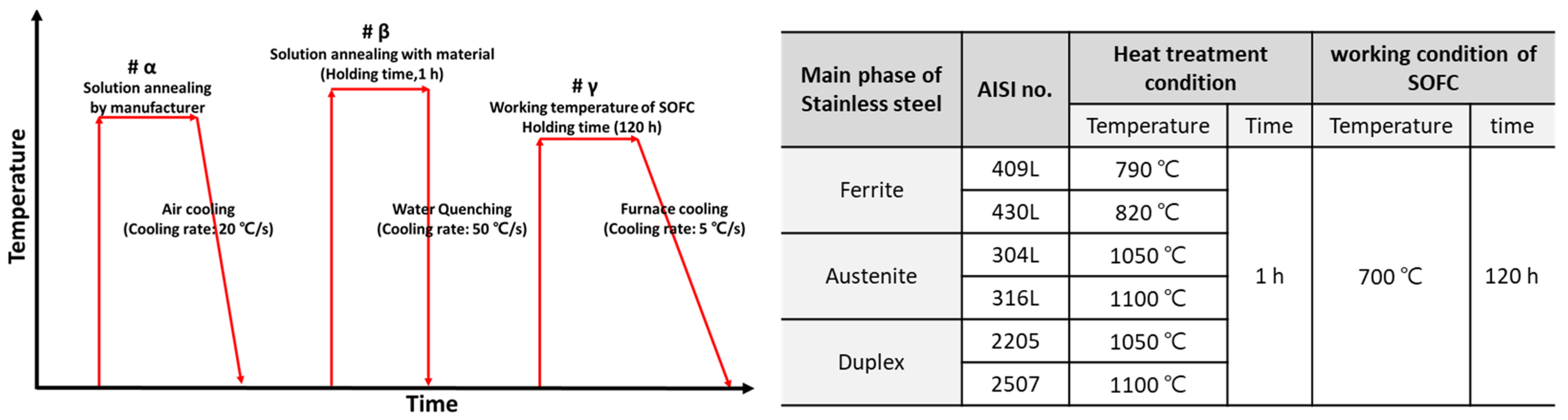
Heat treatment condition was considered for the stainless-steel manufacturing process and SOFC working conditions. Heat treatment conditions are shown in Figure 1. Figure 1 illustrates the thermal schedule applied to all stainless-steel samples (red allows show the manufacturing process). Solution annealing was conducted to homogenize the microstructure and remove any prior thermal history, followed by rapid quenching to stabilize the single- or dual-phase structure (#β). The high-temperature corrosion test was performed at 700 °C for 120 h in ambient air, which represents a typical operating temperature and oxidation environment for SOFC interconnects (#γ). These conditions were selected to accelerate oxide-scale formation and evaluate the thermomechanical stability of each alloy under severe exposure.
To check the surface (×200, ×1000) and cross-section (×10,000) of the high-temperature corrosion specimens, optical microscopy and field emission scanning electron microscopy (FE-SEM, SUPRA 40VP system, Zeiss, Oberkochen, Germany) were used. The mapping image (×1000) of chemical composition (Chrominium (Cr), Iron (Fe), Oxygen (O)) after high-temperature corrosion was checked with the electron probe microanalyzer (EPMA, SUPRA 40VP system, Zeiss, Oberkochen, Germany). Electrochemical parameters were employed to predict the relative kinetic stability of oxide scales formed on different stainless steels under SOFC-relevant conditions. This electrochemical approach does not provide absolute oxidation rate constants but enables a comparative and mechanistically meaningful prediction of time-dependent behavior.

2.3. Electrochemical Behavior

The electrochemical tests were performed using a conventional three-electrode cell connected to a potentiostat (VersaSTAT 4.0, AMETEK, Inc., Berwyn, PA, USA) to evaluate the corrosion behavior of the samples with stainless-steel types. The specimen served as the working electrode, a saturated calomel electrode (SCE, KCl electrolyte solution) as the reference electrode, and a platinum mesh (20 mm × 20 mm) as the counter electrode. The primary objective of the electrochemical analysis was to elucidate the passivation behavior, charge-transfer characteristics, and stability of surface oxide films formed on stainless steels with different phase constitutions, and to correlate these electrochemical responses with the high-temperature corrosion behavior observed at 700 °C. A saturated calomel electrode (SCE) was used as the reference electrode because all electrochemical measurements were carried out at room temperature in 3.5 wt.% NaCl solution, where the SCE provides a stable and well-defined reference potential. No high-temperature electrochemical testing was performed, eliminating concerns regarding SCE instability at elevated temperatures [33,34].
The open-circuit potential (OCP) was recorded for 1 h to monitor the potential evolution of the specimens in relation to their position in the electrochemical series (EMF series, the term EMF (electromotive force) refers to the thermodynamic potential difference between metals in the electrochemical series) and to evaluate the thermodynamic nobility and spontaneous passivation behavior [35,36]. OCP provides thermodynamic information on the relative nobility of the alloy surface but does not directly represent surface kinetics or passivation mechanisms. Therefore, OCP was used only to compare the initial corrosion tendency among the stainless steels.
Subsequently, potentiodynamic polarization tests were performed from −0.6 V to +1.2 V vs. SCE at a scan rate of 0.167 mV/s [37,38]. This test was aimed at investigating both the anodic and cathodic polarization behavior of the samples, particularly focusing on the activation-controlled anodic region to assess the kinetics of initial metal dissolution and the subsequent passivation layer formation. From the polarization curves, critical electrochemical parameters such as corrosion potential (Ecorr), corrosion current density (Icorr), and passivation behavior were derived.
Electrochemical impedance spectroscopy (EIS) measurements were conducted at the stabilized OCP over a frequency range of 106 to 10−2 Hz with a perturbation amplitude of 10 mV to assess the electrochemical stability of stainless-steel surfaces [39,40]. The impedance response was analyzed to evaluate the effectiveness and stability of the passivation layer formed on the surface. All electrochemical measurements were performed at least three times to ensure the reliability and reproducibility of the results. The impedance response was analyzed using an equivalent circuit consisting of solution resistance (Rs), charge-transfer resistance (Rct), passive-film resistance (Rp), and a constant-phase element representing the non-ideal double-layer capacitance (CPE). The values of Rct and Rp were used to evaluate the stability and protective ability of the passive film on each stainless steel.

3. Results

3.1. High-Temperature Corrosion Behaviour of Different Stainless-Steel Types

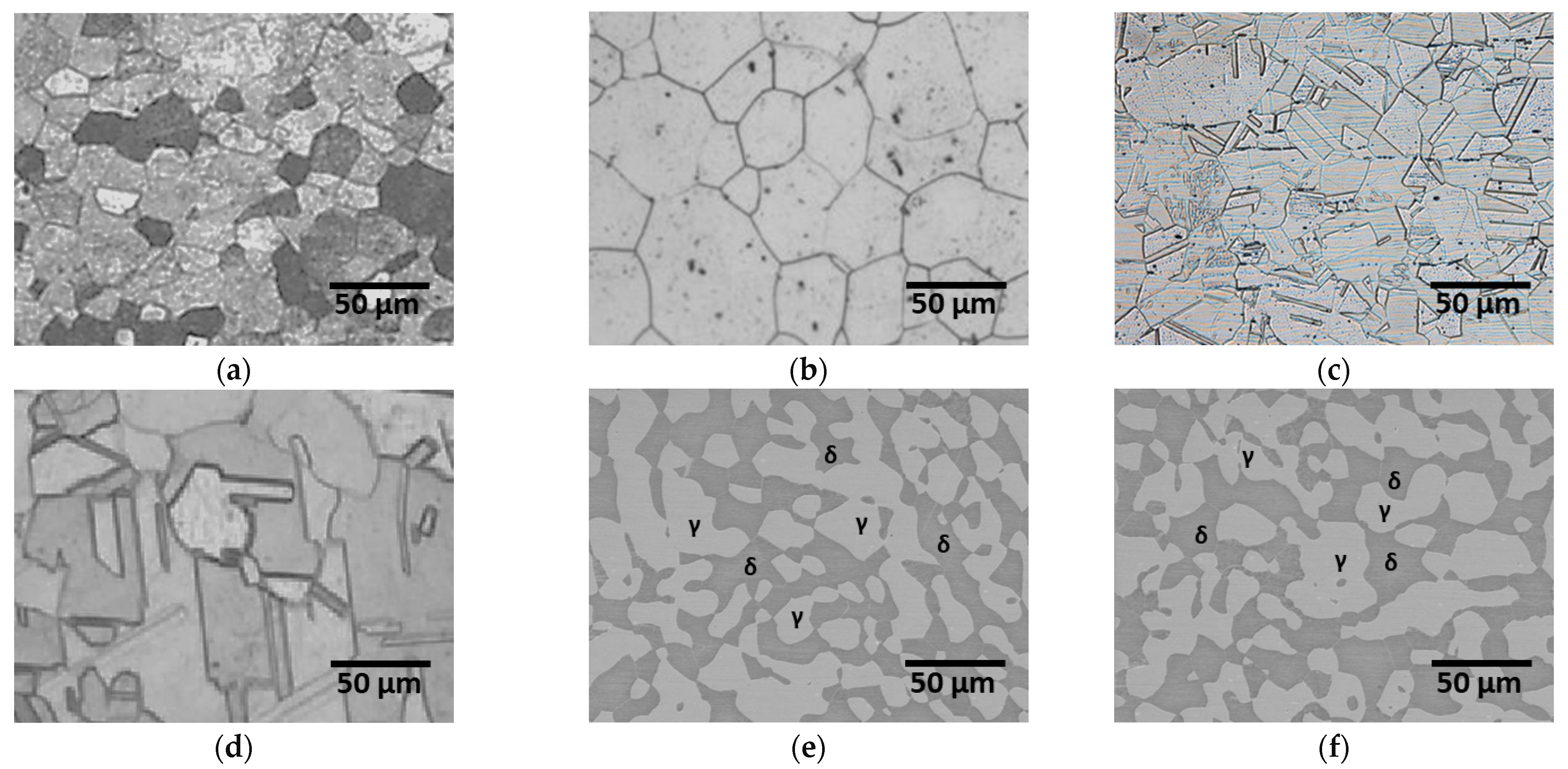
Working conditions of SOFCs with stainless steel undergo heat treatment at each temperature to make a uniform microstructure. Figure 2 shows the microstructure with stainless-steel types. Ferrite ((a) and (b)) and austenite ((c) and (d)) stainless steel had a single phase [41,42]. Duplex stainless ((e) and (f)) steel had dual phases of austenite and ferrite. This texture is the same as in existing studies [43,44].
Each material exhibits a distinct heat-treated microstructure that governs its corrosion response, and this crystal structure represents the most corrosion-resistant configuration and corresponds closely to the standard state of materials commonly used in industrial applications [5,13]. However, when welding or plastic deformation occurs, the microstructure undergoes significant changes, leading to variations in both physical and electrochemical properties.
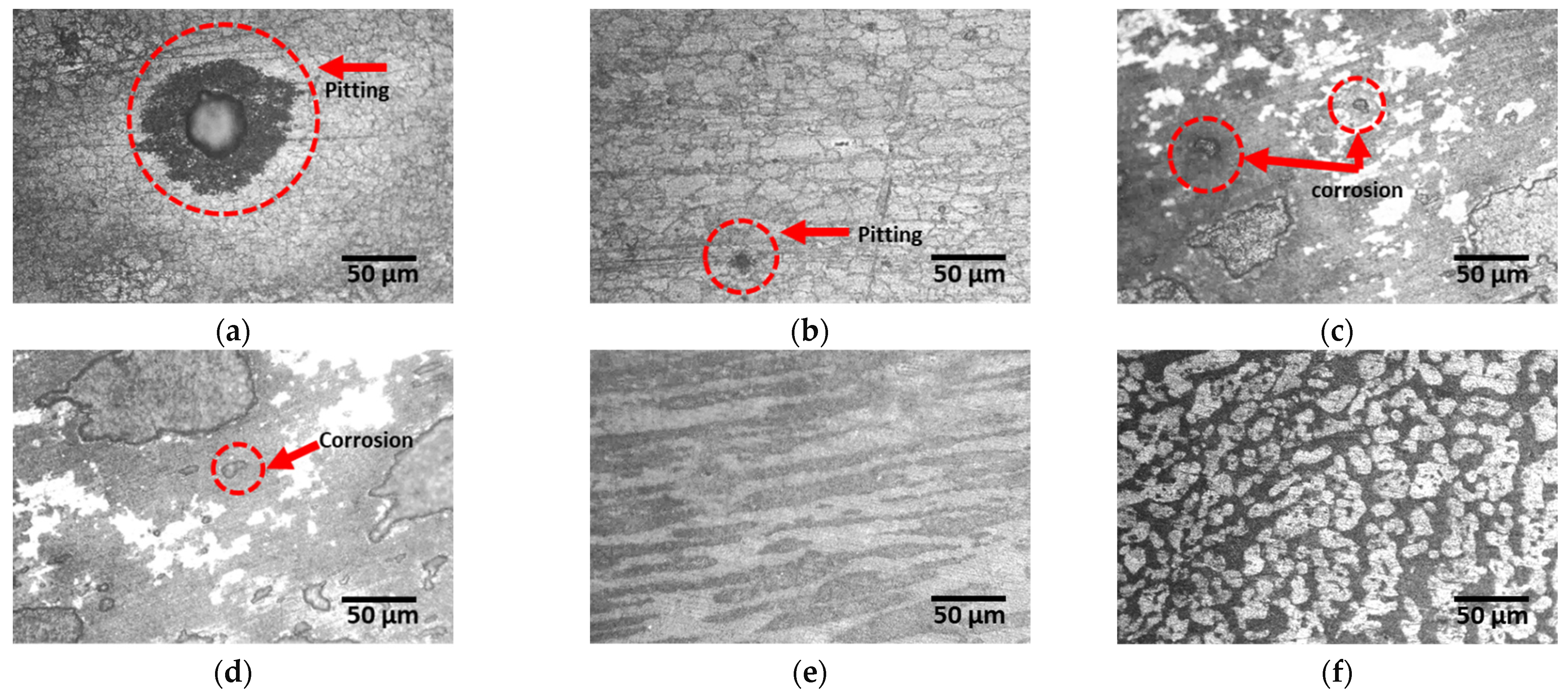
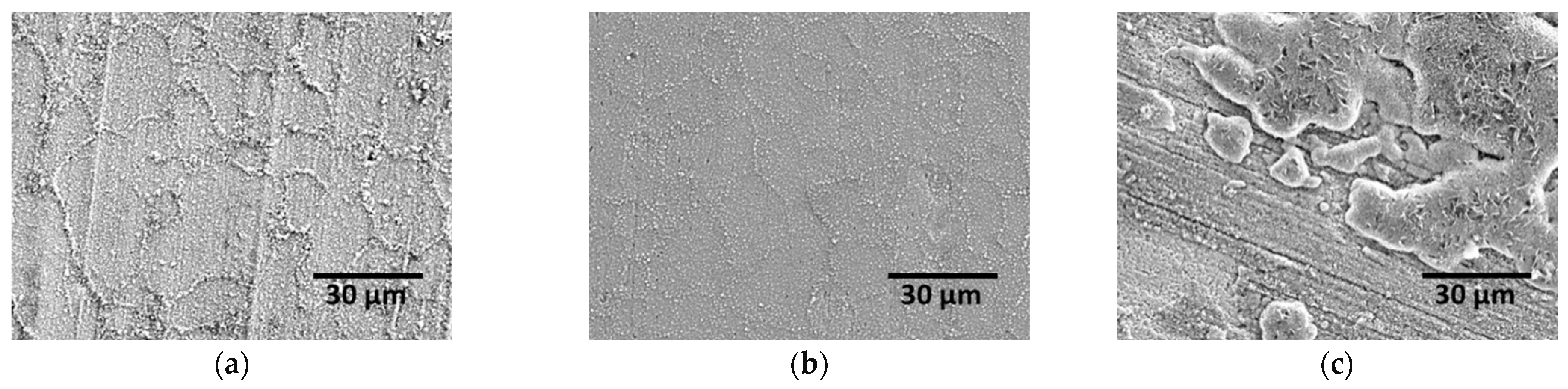
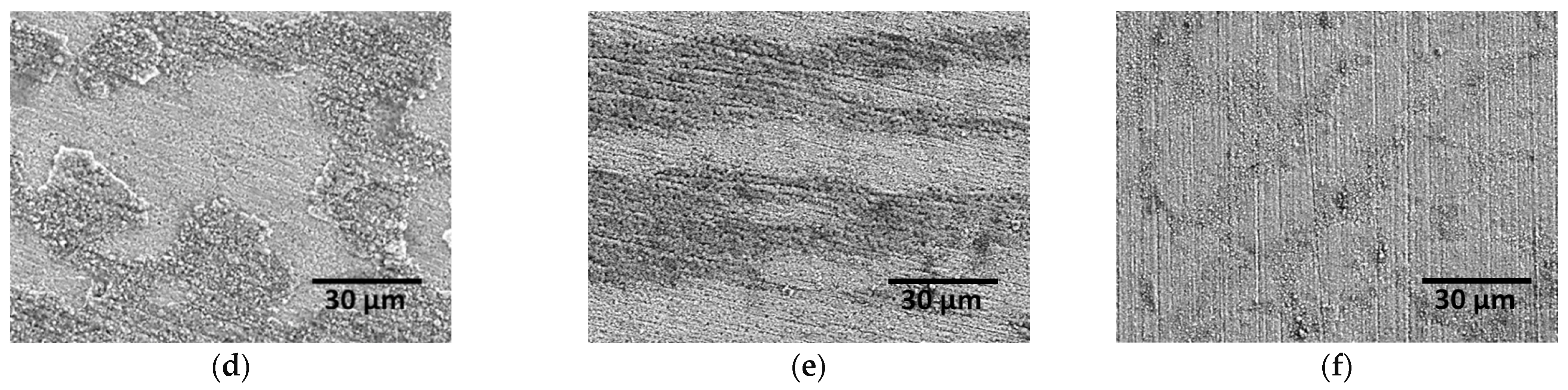
After the high-temperature corrosion tests at 700 °C, distinct corrosion morphologies were observed depending on the type of stainless steel. The corrosion behavior at 700 °C was analyzed using optical microscopy (OM) and scanning electron microscopy (SEM), and the corresponding results are presented in Figure 3 and Figure 4. Figure 3 shows an OM image revealing severe corrosion, where different corrosion modes can be identified (Red circles and allows shows the pitting morphology). In particular, AISI 409L exhibited pronounced pitting corrosion and intergranular attack [45,46].
In AISI 409L, corrosion was characterized by coarse pitting exceeding 30μm in diameter (indicated by the red dashed circles), accompanied by intergranular attack around the pits. AISI 430L exhibited fine pitting (red dashed circles) and intergranular corrosion. AISI 304L and AISI 316L showed corrosion morphologies similar to those of AISI 430L, with noticeable oxide formations (appearing as bright white regions) swelling around areas of uniform corrosion. AISI 2205 and AISI 2507 primarily exhibited intergranular corrosion, which clearly delineated the boundaries between the austenite and ferrite phases.
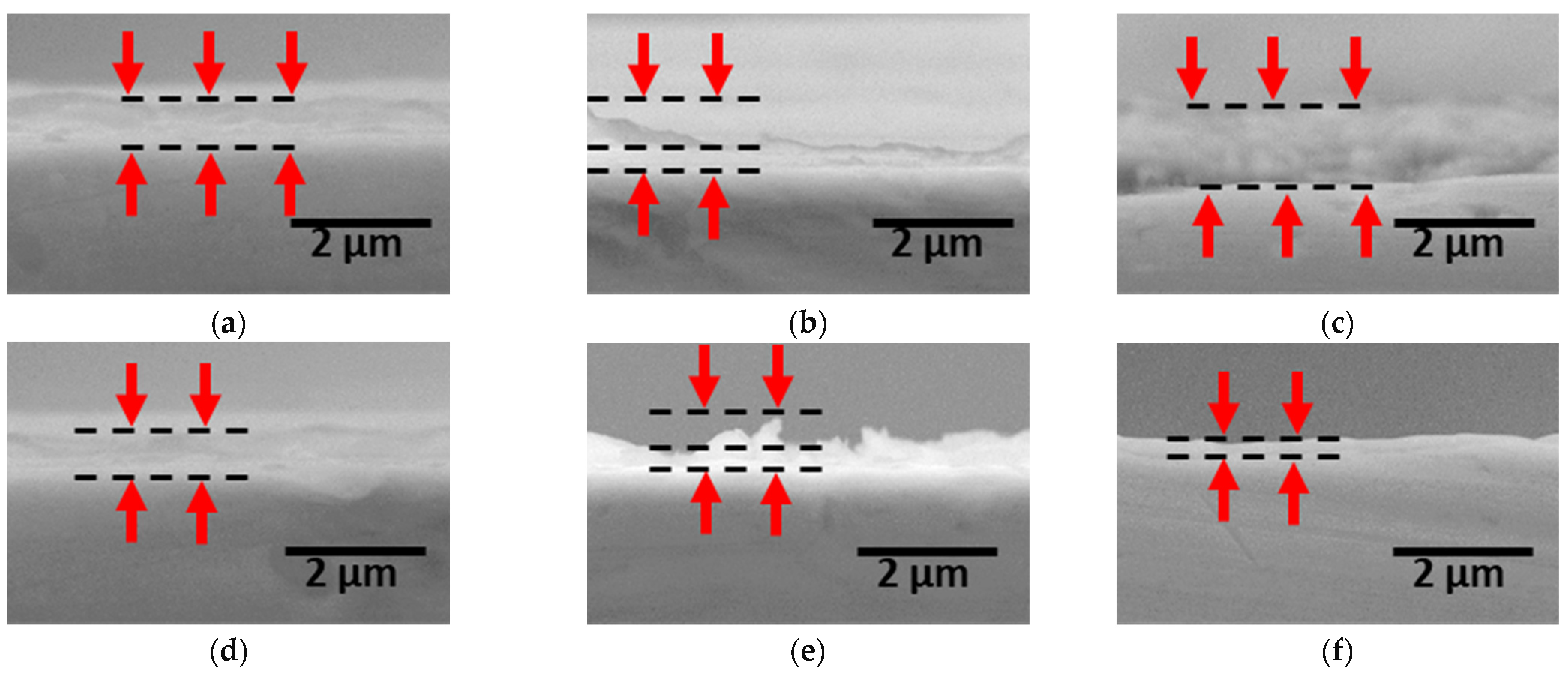
Oxide-scale thickness was measured from cross-sectional FE-SEM images, a widely adopted technique in high-temperature oxidation studies. Although AFM can provide higher topographical resolution, FE-SEM offers sufficient contrast between substrate and oxide for comparative analysis among alloys. Cross-sectional analysis was conducted to further examine the corrosion morphology, and the results are presented in Figure 5 and Table 2. Oxide-scale thickness (Arrows and dotted lines show the oxidation layer) was measured from cross-sectional FE-SEM images, a widely adopted technique in high-temperature oxidation studies. Although AFM can provide higher topographical resolution, FE-SEM offers sufficient contrast between substrate and oxide for comparative analysis among alloys. The thicknesses of the high-temperature oxide layers were measured and compared, revealing trends consistent with the surface oxidation behavior [47,48,49]. The oxide scale thickness varied depending on both metallurgical phase and alloy composition. Ferritic stainless steels developed oxide layers less than 1 μm thick, whereas austenitic stainless steels formed comparatively thicker layers, reaching up to 2 μm. In contrast, duplex stainless steels exhibited the thinnest oxide layers among the tested alloys, with thicknesses below 0.4 μm. These observations confirm that duplex stainless steels possess superior high-temperature oxidation resistance, attributable to their balanced phase structure and composition dependent passivation layer stability.
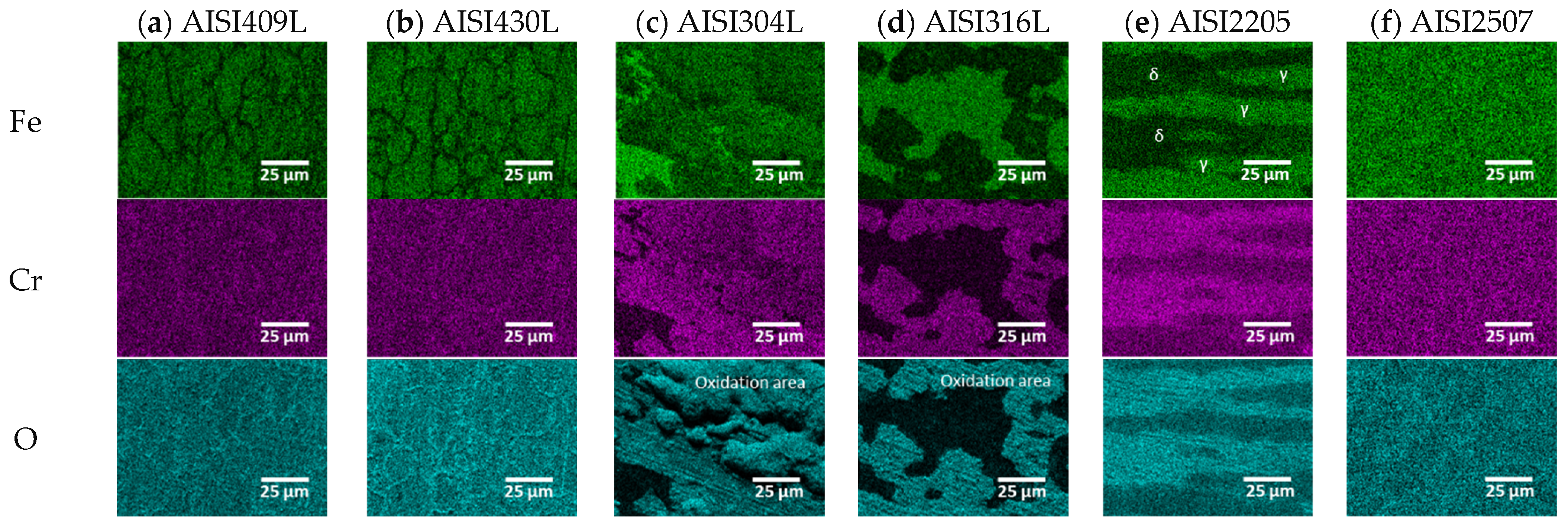
To investigate the corrosion morphology of stainless steels at elevated temperatures, compositional analysis was performed. Figure 6 shows the EPMA results after high-temperature corrosion. In ferritic stainless steels, Fe depletion was observed along the grain boundaries, while Cr maintained a uniform distribution accompanied by a local increase in oxygen concentration. This indicates the formation of Cr oxides along the grain boundaries, which corresponds to intergranular corrosion. Austenitic stainless steels exhibited similar Cr oxide formation; however, unlike the ferritic grades, the oxidation occurred within the grains rather than along the boundaries. Therefore, corrosion in austenitic stainless steels at high temperatures primarily proceeded via a uniform corrosion mechanism, with chromium oxidation inside the austenite grains being the dominant cause. In contrast, duplex stainless steel showed higher elemental concentrations in the ferrite phase, suggesting that corrosion initiated predominantly within the ferritic regions. This behavior can be attributed to galvanic interactions between the coexisting austenite and ferrite phases. Moreover, the AISI2507 exhibited minimal surface corrosion, demonstrating the highest resistance to high-temperature oxidation among the five investigated alloys.
Stainless steels exposed to 700 °C for 120 h exhibited significant high-temperature oxidation, and the resulting elemental distributions were analyzed using EPMA. The measured concentrations of Fe, Cr, and O for each alloy are summarized in Table 3. The extent of oxidation varied according to both alloy composition and metallurgical phase. Even among alloys with similar phase structures, oxygen uptake differed considerably, indicating composition-dependent oxidation behavior. Higher oxygen concentrations corresponded to more severe oxidation, and these differences were clearly reflected in the EPMA profiles. Distinct phase-dependent trends were also observed: ferritic stainless steels, despite their relatively low Cr content, showed superior high-temperature oxidation resistance compared with austenitic grades, while duplex stainless steels exhibited the highest resistance among the three categories. An increase in oxygen content across all alloys is expected because high-temperature oxidation produces Cr-rich and Fe-rich oxides. The relative decrease of Fe is consistent with outward diffusion during scale formation. Carbon was not considered in the analysis because its concentration is below the EDS detection limit and does not significantly contribute to high-temperature oxidation mechanisms, as reported in the previous literature [14,28].
The high-temperature oxidation behavior of the stainless steels was strongly influenced by both their phase constituents and alloy compositions. The three primary-phase types (ferrite, austenite, and duplex) displayed distinct corrosion morphologies. Ferritic stainless steels exhibited a mixed mode of intergranular attack and localized pitting. In contrast, austenitic stainless steels showed pronounced intragranular oxidation accompanied by swelling of the oxide layer, which further accelerated oxidation as exposure progressed. Duplex stainless steels primarily exhibited uniform oxidation, with degradation occurring predominantly in the ferrite phase. The galvanic coupling between ferrite and austenite promoted preferential oxidation of the ferrite phase, effectively reducing the corrosion rate of the austenitic phase and enhancing the overall oxidation resistance of the duplex alloys.
Phase-dependent differences in oxygen uptake were evident: austenitic stainless steels showed the highest oxygen concentrations (23.3 wt.% for AISI 304L), followed by ferritic alloys (21.4 wt.% for AISI 409L) and duplex alloys (11.6 wt.% for AISI 2205). These trends were consistent with FE-SEM surface and cross-sectional observations, as well as EPMA line-scan results. Since higher oxygen uptake generally corresponds to accelerated oxide growth and reduced protective capability, based on the combined microstructural and compositional evidence, the high-temperature oxidation resistance of the six alloys decreased in the following order: AISI 2507, AISI 2205, AISI 430L, AISI 316L, AISI 409L, AISI 304L.
The oxidation behavior was also influenced by the stability of the high-temperature oxide layer. Austenitic stainless steels developed the thickest oxide scales, whereas ferritic and duplex grades formed comparatively thinner layers. For alloys within the same phase category, higher Cr content consistently resulted in thinner, more protective oxide films, indicating improved passive-film integrity and reduced oxidation kinetics. After 120 h of exposure at 700 °C, AISI 2507 demonstrated the most stable high-temperature behavior, followed by AISI 2205 and AISI 430L. These findings suggest that careful optimization of both phase structure and alloy composition is essential when selecting stainless steels as interconnect materials for SOFC applications. To further clarify these differences, electrochemical analyses were conducted, as described in the following section.
Duplex stainless steels are characterized by a mixed microstructure (austenite and ferrite), and the phase balance directly influences their surface chemistry and high-temperature oxidation behavior. Considering the surface chemical composition and elemental partitioning, the corrosion behavior of duplex stainless steels under high-temperature conditions is strongly affected by the austenitic phase, which acts as a relatively more susceptible region during oxidation. This indicates that the high-temperature corrosion behavior of duplex stainless steels is governed by phase constitution in conjunction with alloy composition, rather than by composition alone. Furthermore, when comparing high-temperature oxidation behavior between standard-grade and super-grade duplex stainless steels, super-grade alloys exhibit more stable and uniform surface oxidation behavior. This enhanced stability demonstrates that phase balance and alloy chemistry, including Cr and Mo enrichment, act synergistically at elevated temperatures to improve oxide-scale stability.
The increase in oxide-scale thickness is primarily associated with Fe-rich oxidation behavior. Steels with higher Fe activity tend to form Fe-based oxides with relatively high diffusion rates, resulting in accelerated oxide growth and thicker oxide layers compared to Cr-rich protective oxides. This Fe-driven oxidation mechanism explains the observed differences in oxide thickness and morphology among the investigated stainless steels.

3.2. Electrochemical Behavior of Different Stainless Steel Types

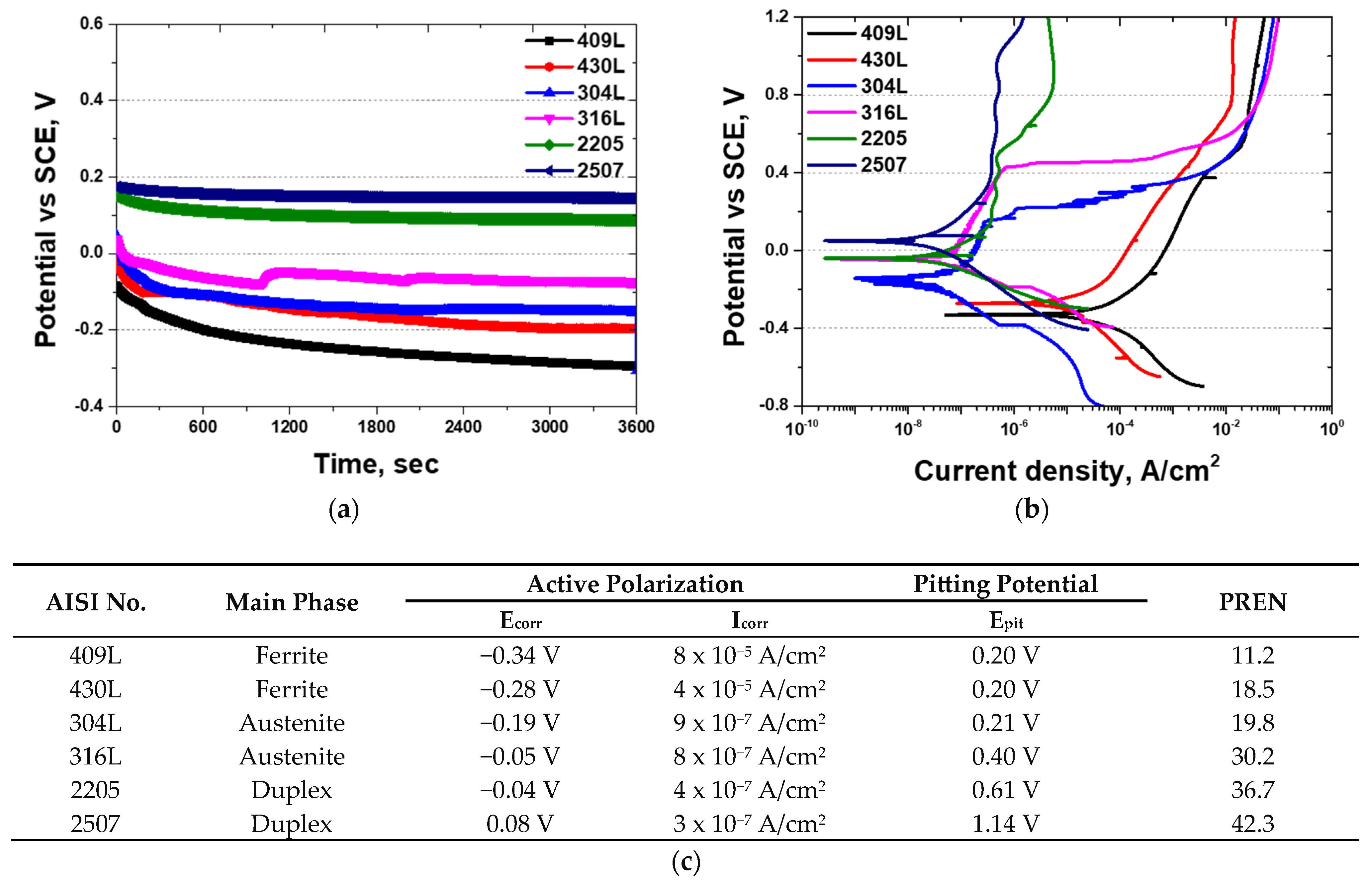
The electrochemical behavior of metals is generally predictable based on their thermodynamic stability, and the potentials of pure metals can be estimated using the EMF series [50,51]. However, in practical alloys, the presence of multiple alloying elements and microstructural defects induces galvanic interactions, resulting in open-circuit potential lower than the theoretical values (stainless steel Ecorr value from −0.3 to 0.2 V (vs. SCE)). Therefore, the corrosion potentials of stainless steels were experimentally determined through OCP measurements, and the results are presented in Figure 7a. Potentiodynamic polarization curves and key electrochemical parameters are shown in Figure 7b,c.
OCP reflects only the thermodynamic stability of the passive film rather than the actual corrosion resistance or corrosion rate. The OCP results indicated that corrosion activation increased in the order of ferritic, austenitic, and duplex stainless steels. This trend was consistent with the corrosion potentials (Ecorr) obtained from the active polarization region of the potentiodynamic polarization tests. Both techniques showed identical rankings, and the calculated corrosion rates exhibited the same ordering [52,53]. Ferritic stainless steels demonstrated the lowest corrosion resistance and the highest corrosion rate among the tested materials. Austenitic stainless steels showed active-to-passive transition behavior, but pitting occurred before reaching ~0.2 V–0.4 V, accompanied by a rapid increase in current density from 10−4 A/cm2 to as high as 10−2 A/cm2. Duplex stainless steels exhibited the most stable passivation behavior, with significantly higher pitting potentials (from 0.6 V to 1.1 V), confirming their superior pitting resistance.
Although the pitting resistance equivalent number (PREN) is often discussed in the context of chloride-induced pitting corrosion, its fundamental meaning is associated with resistance to localized breakdown of passive films. In stainless steels, corrosion generally initiates through local instability or rupture of the passivation or oxide layer, even in non-chloride environments, unless the alloy exhibits very low passivation capability, such as type 304 stainless steel. Therefore, PREN can be meaningfully used as a compositional indicator of passivation layer robustness and localized degradation resistance, rather than being strictly limited to chloride-containing environments. In this study, PREN was employed to qualitatively describe differences in alloy chemistry that influence oxide-scale stability and localized oxidation behavior.
The six stainless steels tested exhibited clearly distinguishable electrochemical responses that generally correlated with their PREN (=wt.% Cr + 3.3 wt.% Mo + 16 wt.% N) [54,55]. PREN was used to evaluate the pitting resistance of each alloy. However, deviations were observed when materials possessed similar PREN values but different metallurgical phases. AISI 430L and AISI 304L exhibited PREN values of 18.5 and 19.8, respectively (the closest among the six alloys), yet their corrosion resistances differed substantially [7,56]. These discrepancies highlight that although corrosion resistance is primarily affected by alloying elements, the metallurgical phase exerts a significant additional influence [57,58]. Duplex stainless steels demonstrated corrosion behavior similar to that of austenitic grades; however, their higher PREN values resulted in much higher pitting potentials, thereby enhancing their overall corrosion resistance.
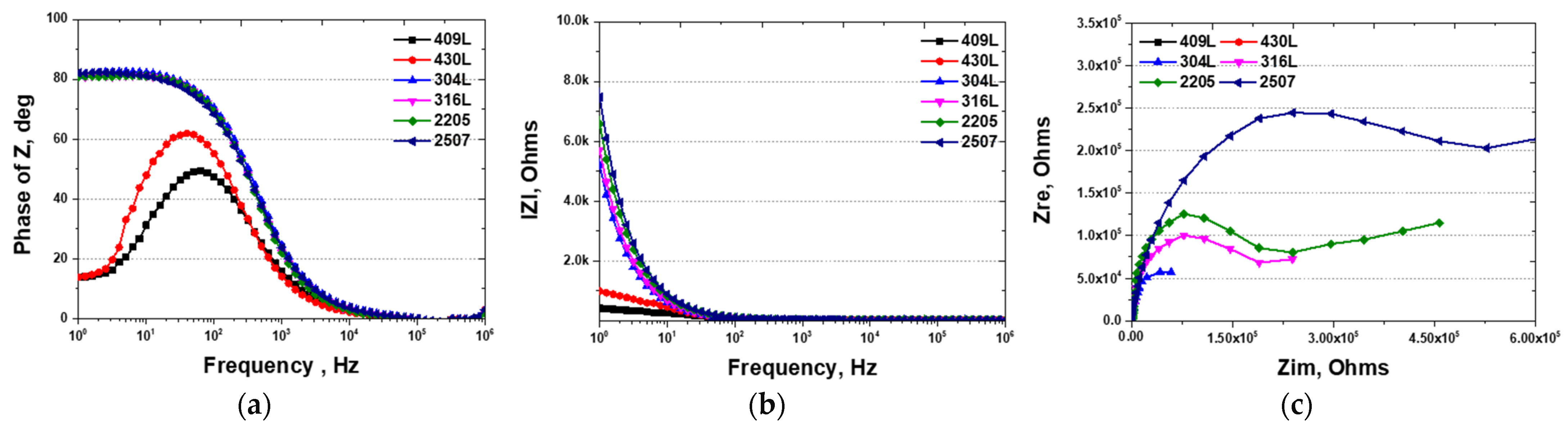
EIS was employed to evaluate passivation layer resistance and the frequency response of the oxide layer, and the corresponding Bode and Nyquist plots are presented in Figure 8. The equivalent circuit consisted of solution resistance (Rs), charge-transfer resistance (Rct), passive-film resistance (Rp), and a constant phase element (CPE). Rct and Rp were used to assess the stability and protective characteristics of the passivation layer. In the Bode magnitude plot, impedance increased at lower frequencies, while the Bode phase plot showed distinct phase shift patterns depending on the alloy type [59,60]. The impedance response generally followed the PREN ordering; however, deviations again occurred between AISI 430L and AISI 304L. AISI 304L exhibited substantially higher impedance than AISI 430L, indicating that the passive film formed on the austenitic alloy was more uniform and stable. This result supports the conclusion that passive films formed on ferritic stainless steels are more heterogeneous and, even upon repassivation, provide inferior corrosion protection compared with those formed on austenitic stainless steels.
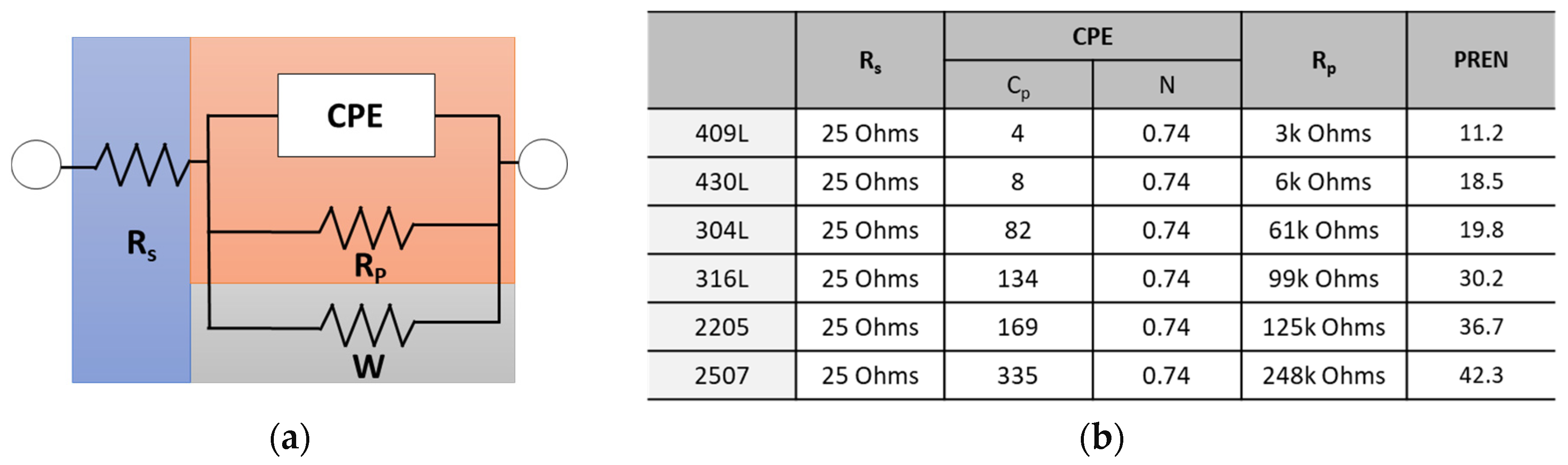
The equivalent circuit model derived from the Nyquist plots and corresponding impedance parameters is summarized in Figure 9 [2,24]. The solution resistance was approximately 25 Ω for all samples, after which the passivation layer resistance varied significantly depending on the alloy. Despite having similar PREN values, AISI 430L and AISI 304L exhibited nearly an order of magnitude difference in passive-film resistance, demonstrating that film thickness and uniformity were strongly influenced by metallurgical phase, as well as composition. This difference directly contributed to the disparity in their overall corrosion resistance.
Collectively, the electrochemical results confirm that both phase and composition govern the corrosion behavior of stainless steels. Corrosion resistance is primarily determined by the stability and integrity of the passive film, which is strongly influenced by alloying elements such as Cr, Mo, and N. However, the metallurgical phase also plays a critical role by dictating the uniformity, defect density, and re-passivation capability of the passive film. Therefore, the combined effects of phase and composition must be considered when selecting stainless steels for environments where electrochemical stability and resistance to pitting are essential.

3.3. Discussion

High-temperature corrosion tests conducted at 700 °C for 120 h revealed clear differences in the degradation behavior of stainless steels depending on their metallurgical phases and alloy compositions [32,50]. Stainless steels are broadly classified into ferritic, austenitic, and duplex grades, and each exhibits distinct corrosion mechanisms at elevated temperatures. Ferritic stainless steel showed a combination of pitting and intergranular corrosion, whereas austenitic stainless steel primarily underwent uniform intragranular corrosion. Duplex stainless steel, consisting of both austenite and ferrite phases, exhibited galvanic corrosion localized in the ferrite phase due to the electrochemical potential difference between the two phases. These findings demonstrate that the metallurgical phase plays a significant role in determining the high-temperature corrosion behavior of stainless steels.
Table 4 summarizes the coefficients of thermal expansion and high-temperature strengths associated with each phase at 700 °C [16,17]. The thermal expansion behavior varied considerably with both phase type and alloy composition: ferrite exhibited a coefficient of 10 × 10−5/°C, austenite 1.7 × 10⁻⁶/°C, and duplex stainless steel 1.4 × 10⁻⁵/°C. This distinction indicates that phase-dependent thermal expansion is a dominant factor influencing high-temperature corrosion resistance. In contrast, when comparing materials within the same phase category, alloy composition became the primary factor affecting corrosion resistance. This trend was consistently observed across all three phase types, suggesting that both phase and composition must be simultaneously considered when evaluating the high-temperature corrosion performance of stainless steels.
Electrochemical analyses conducted at room temperature further underscored the importance of both phase and composition as critical criteria for material selection [2,24]. The stability of the passive film varied with phase type, and even alloys with similar compositional indicators differed significantly when their phases differed. For example, AISI 430L and AISI 304L possess identical PREN values (19), but their ferritic and austenitic structures led to significant differences in OCP (−0.20 V vs. −0.14 V) and corrosion potentials from potentiodynamic polarization (−0.29 V vs. −0.19 V). These discrepancies were attributed to the characteristics of the passive film formed on each alloy surface. EIS results also showed clear differences in passive-film resistance and capacitance depending on both phase and composition, consistent with the trends observed from the polarization curves. This confirms that passive-film stability is strongly influenced by alloying elements but is also significantly affected by the metallurgical phase.
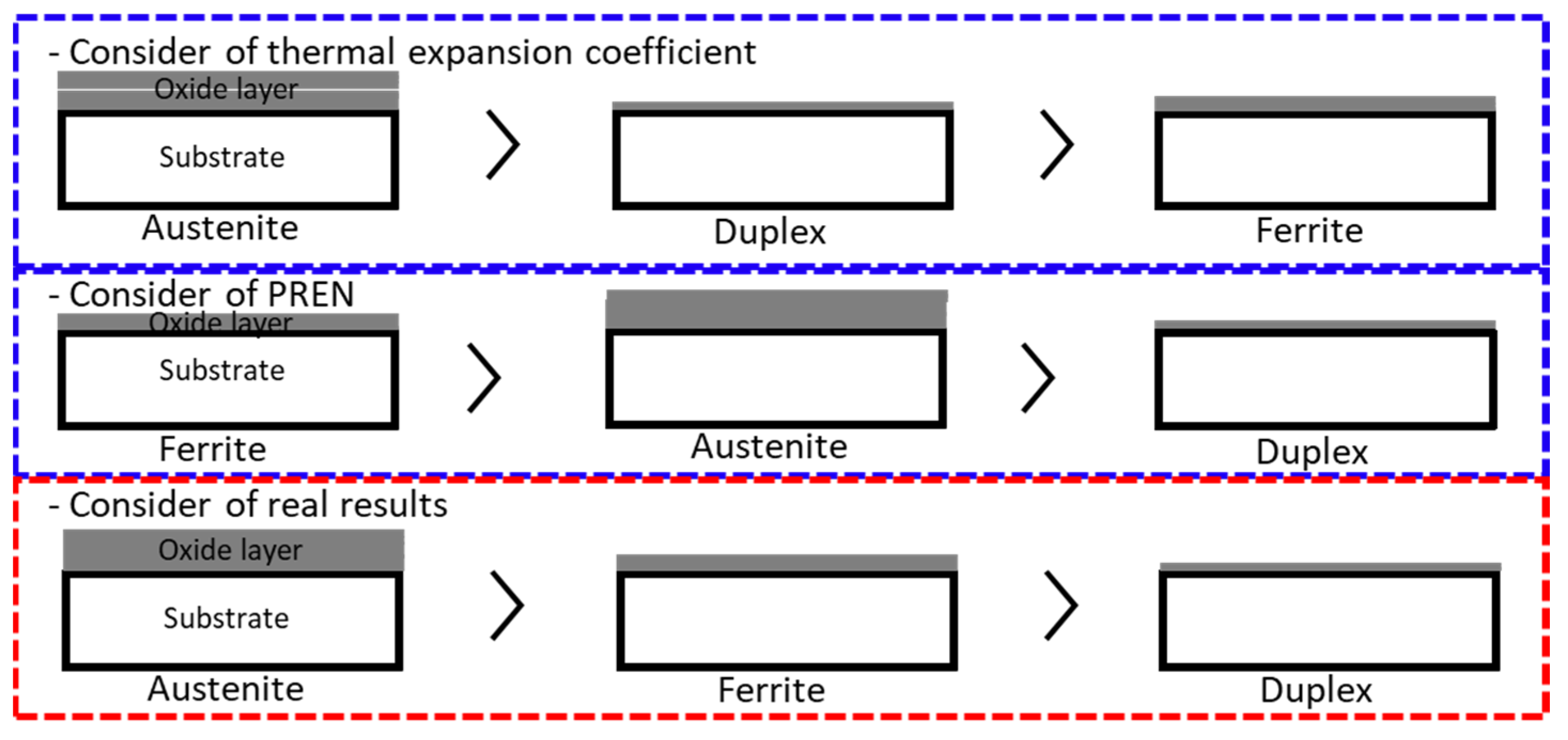
Considering that stainless steels are widely used as interconnect materials in SOFCs and are subjected to harsh high-temperature operating environments, improving their corrosion resistance is essential for mitigating performance degradation. Figure 10 summarizes the combined effects of phase and composition on high-temperature corrosion (blue dot lined box) [9,18]. Austenitic stainless steel exhibited the highest susceptibility due to its large thermal expansion coefficient, while ferritic stainless steel showed poor resistance owing to its relatively low alloy content and weak passive-film stability. Duplex stainless steel, benefiting from the balanced characteristics of both ferrite and austenite, demonstrated superior high-temperature corrosion resistance among the three categories [10,32]. Therefore, when accounting for thermal expansion behavior and alloy composition, duplex stainless steel appears to be the most suitable candidate for high-temperature SOFC interconnect applications (red dot lined box).

4. Conclusions

To ensure the reliability of metallic interconnects used in SOFCs, the high-temperature corrosion behavior of various stainless steels was systematically investigated, and the main findings are summarized as follows.
  • The high-temperature corrosion behavior of stainless steels was strongly governed by their metallurgical phases. Ferritic grades exhibited combined pitting and intergranular attack, while austenitic grades showed uniform intragranular degradation. Duplex stainless steel experienced localized galvanic corrosion due to the potential difference between ferrite and austenite. These results confirm that phase constitution plays a decisive role in determining degradation mechanisms at 700 °C and must be considered when selecting materials for SOFC interconnect applications.
  • Phase-dependent thermomechanical properties (particularly thermal expansion and high-temperature strength) significantly influenced oxidation behavior, while alloy composition further modulated passive-film stability. Variations in Cr, Mo, and N altered the electrochemical responses observed in EIS, OCP, and polarization measurements. Differences in thermal expansion also affected oxide-scale cracking and growth kinetics. These findings demonstrate that both metallurgical phase and alloy composition jointly determine high-temperature corrosion resistance, and neither parameter alone sufficiently explains the observed degradation trends.
  • For long-term SOFC interconnect operation, understanding the combined effects of thermomechanical stability, passive-film integrity, and high-temperature oxidation resistance is essential. Among the examined alloys, austenitic stainless steels showed the highest susceptibility due to their large thermal expansion mismatch, while ferritic steels exhibited limited corrosion resistance due to lower alloy content. Duplex stainless steels offered an optimal balance of phase stability and passive-film robustness, with AISI 2507 showing the best overall performance. Therefore, duplex stainless steel represents the most promising candidate for SOFC metallic interconnect applications.

Author Contributions

Conceptualization, D.K. and B.-H.S.; methodology, D.K. and B.-H.S.; software, D.K. and B.-H.S.; validation, D.K. and B.-H.S.; formal analysis, D.K. and B.-H.S.; investigation, D.K. and B.-H.S.; resources, D.K. and B.-H.S.; data curation, D.K. and B.-H.S.; writing—original draft preparation, D.K. and B.-H.S.; writing—review and editing, D.K. and B.-H.S.; visualization, D.K. and B.-H.S.; supervision, D.K. and B.-H.S.; funding acquisition, D.K. and B.-H.S. All authors have read and agreed to the published version of the manuscript.

Funding

This work was supported by grants from the BK21 FOUR program (grant number 4120200513801), funded by the Ministry of Education (MOE, Republic of Korea) and the National Research Foundation of Korea (NRF).

Data Availability Statement

The original contributions presented in the study are included in the article. Further inquiries can be directed to the corresponding author.

Conflicts of Interest

The authors declare no conflict of interest.

References

  1. Han, Z.; Ren, W.; Yang, J.; Du, Y.; Wei, R.; Zhang, C.; Chen, Y.; Zhang, G. The Deformation Behavior and Strain Rate Sensitivity of Ultra-Fine Grained CoNiFeCrMn High-Entropy Alloys at Temperatures Ranging from 77 K to 573 K. J. Alloys Compd. 2019, 791, 962–970. [Google Scholar] [CrossRef]
  2. Guerrini, E.; Cristiani, P.; Grattieri, M.; Santoro, C.; Li, B.; Trasatti, S. Electrochemical Behavior of Stainless Steel Anodes in Membraneless Microbial Fuel Cells. J. Electrochem. Soc. 2013, 161, H62. [Google Scholar] [CrossRef]
  3. Elhoud, A.M.; Renton, N.C.; Deans, W.F. Hydrogen Embrittlement of Super Duplex Stainless Steel in Acid Solution. Int. J. Hydrogen Energy 2010, 35, 6455–6464. [Google Scholar] [CrossRef]
  4. Acharyya, S.G.; Khandelwal, A.; Kain, V.; Kumar, A.; Samajdar, I. Surface Working of 304L Stainless Steel: Impact on Microstructure, Electrochemical Behavior and SCC Resistance. Mater. Charact. 2012, 72, 68–76. [Google Scholar] [CrossRef]
  5. Nilsson, J.-O. Super Duplex Stainless Steels. Mater. Sci. Technol. 1992, 8, 685–700. [Google Scholar] [CrossRef]
  6. Topolska, S.; Łabanowski, J. Effect of Microstructure on Impact Toughness of Duplex and Superduplex Stainless Steels. J. Achiev. Mater. Manuf. Eng. 2009, 36, 142–149. [Google Scholar]
  7. Lee, S.M.; Lee, W.G.; Kim, Y.H.; Jang, H. Surface Roughness and the Corrosion Resistance of 21Cr Ferritic Stainless Steel. Corros. Sci. 2012, 63, 404–409. [Google Scholar] [CrossRef]
  8. Ha, H.-Y.; Lee, T.-H.; Bae, J.-H.; Chun, D.W. Molybdenum Effects on Pitting Corrosion Resistance of FeCrMnMoNC Austenitic Stainless Steels. Metals 2018, 8, 653. [Google Scholar] [CrossRef]
  9. Ormerod, R.M. Solid Oxide Fuel Cells. Chem. Soc. Rev. 2003, 32, 17–28. [Google Scholar] [CrossRef] [PubMed]
  10. Jang, I.; SA Carneiro, J.; Crawford, J.O.; Cho, Y.J.; Parvin, S.; Gonzalez-Casamachin, D.A.; Baltrusaitis, J.; Lively, R.P.; Nikolla, E. Electrocatalysis in Solid Oxide Fuel Cells and Electrolyzers. Chem. Rev. 2024, 124, 8233–8306. [Google Scholar] [CrossRef]
  11. Singh, M.; Paydar, S.; Singh, A.K.; Singhal, R.; Singh, A.; Singh, M. Recent Advancement of Solid Oxide Fuel Cells towards Semiconductor Membrane Fuel Cells. Energy Mater. 2024, 4, 400012. [Google Scholar] [CrossRef]
  12. Pettersson, N.; Pettersson, R.F.A.; Wessman, S. Precipitation of Chromium Nitrides in the Super Duplex Stainless Steel 2507. Metall. Mater. Trans. A 2015, 46, 1062–1072. [Google Scholar] [CrossRef]
  13. Michalska, J.; Chmiela, B. Phase Analysis in Duplex Stainless Steel: Comparison of EBSD and Quantitative Metallography Methods. In Proceedings of the IOP Conference Series: Materials Science and Engineering, Warsaw, Poland, 24–25 April 2014; IOP Publishing: Bristol, UK, 2014; Volume 55, p. 012010. [Google Scholar]
  14. Metikoš-Huković, M.; Babić, R.; Grubač, Z.; Petrović, Ž.; Lajçi, N. High Corrosion Resistance of Austenitic Stainless Steel Alloyed with Nitrogen in an Acid Solution. Corros. Sci. 2011, 53, 2176–2183. [Google Scholar] [CrossRef]
  15. Soria, L.; Herrera, E.J. A Reliable Technique to Determine Pitting Potentials of Austenitic Stainless Steels by Potentiodynamic Methods. Weld. Int. 1992, 6, 959–964. [Google Scholar] [CrossRef]
  16. Faraji, H.; Yıldız, Ç.; Arshad, A.; Arıcı, M.; Choukairy, K.; El Alami, M. Passive Thermal Management Strategy for Cooling Multiple Portable Electronic Components: Hybrid Nanoparticles Enhanced Phase Change Materials as an Innovative Solution. J. Energy Storage 2023, 70, 108087. [Google Scholar] [CrossRef]
  17. Klink, J.; Hebenbrock, A.; Grabow, J.; Orazov, N.; Nylén, U.; Benger, R.; Beck, H.-P. Comparison of Model-Based and Sensor-Based Detection of Thermal Runaway in Li-Ion Battery Modules for Automotive Application. Batteries 2022, 8, 34. [Google Scholar] [CrossRef]
  18. Yousaf, M.; Lu, Y.; Akbar, M.; Lei, L.; Jing, S.; Tao, Y. Advances in Solid Oxide Fuel Cell Technologies: Lowering the Operating Temperatures through Material Innovations. Mater. Today Energy 2024, 44, 101633. [Google Scholar] [CrossRef]
  19. Isidorio, D.K.M.; da Cruz Payão Filho, J.; Uddagiri, M.; NouraniNiaki, K.; Shchyglo, O.; Steinbach, I. Super Duplex Stainless Steel Fabricated by Arc-Based Directed Energy Deposition: Microstructure Evolution and Phase Field Solidification Simulation. Mater. Des. 2025, 254, 114027. [Google Scholar] [CrossRef]
  20. Jo, H.; Ok, J.-W.; Lee, Y.-S.; Lee, S.; Je, Y.; Kim, S.; Kim, S.; Park, J.; Hong, J.; Lee, T. Impact of Ag Coating Thickness on the Electrochemical Behavior of Super Duplex Stainless Steel SAF2507 for Enhanced Li-Ion Battery Cases. Crystals 2025, 15, 62. [Google Scholar] [CrossRef]
  21. da Silva, S.P.; Abrão, A.M.; da Silva, E.R.; Câmara, M.A. Enhanced Wear Resistance and Frictional Behavior of AISI H13 Tool Steel through In-Situ Urea-Assisted EDM Nitriding and TiAlN PVD Coating. Int. J. Adv. Manuf. Technol. 2025, 138, 2459–2473. [Google Scholar] [CrossRef]
  22. Vanini, M.; Searle, S.; Vanmunster, L.; Vanmeensel, K.; Vrancken, B. Local Microstructure Engineering of Super Duplex Stainless Steel via Dual Laser Powder Bed Fusion–an Analytical Modeling and Experimental Approach. Addit. Manuf. 2025, 112, 104994. [Google Scholar] [CrossRef]
  23. Fande, A.W.; Taiwade, R.V. Welding of Super Duplex Stainless Steel and Austenitic Stainless Steel:# Xd; Influence and Role of Bicomponent Fluxes. Mater. Manuf. Process. 2023, 38, 434–448. [Google Scholar]
  24. Makhdoom, M.A.; Ahmad, A.; Kamran, M.; Abid, K.; Haider, W. Microstructural and Electrochemical Behavior of 2205 Duplex Stainless Steel Weldments. Surf. Interfaces 2017, 9, 189–195. [Google Scholar] [CrossRef]
  25. Rani, K.U.; Kumar, R.; Mahapatra, M.M.; Mulik, R.S.; Świerczyńska, A.; Fydrych, D.; Pandey, C. Wire Arc Additive Manufactured Mild Steel and Austenitic Stainless Steel Components: Microstructure, Mechanical Properties and Residual Stresses. Materials 2022, 15, 7094. [Google Scholar] [CrossRef]
  26. Köse, C. Effect of Heat Input and Post Weld Heat Treatment on the Texture, Microstructure and Mechanical Properties of Laser Beam Welded AISI 317L Austenitic Stainless Steel. Mater. Sci. Eng. A 2022, 855, 143966. [Google Scholar] [CrossRef]
  27. Seo, M.; Hultquist, G.; Leygraf, C.; Sato, N. The Influence of Minor Alloying Elements (Nb, Ti and Cu) on the Corrosion Resistivity of Ferritic Stainless Steel in Sulfuric Acid Solution. Corros. Sci. 1986, 26, 949–960. [Google Scholar] [CrossRef]
  28. Ha, H.-Y.; Jang, M.-H.; Lee, T.-H.; Moon, J. Interpretation of the Relation between Ferrite Fraction and Pitting Corrosion Resistance of Commercial 2205 Duplex Stainless Steel. Corros. Sci. 2014, 89, 154–162. [Google Scholar] [CrossRef]
  29. Tehovnik, F.; Arzensek, B.; Arh, B.; Skobir, D.; Pirnar, B.; Zuzek, B. Microstructure Evolution in SAF 2507 Super Duplex Stainless Steel. Mater. Technol. 2011, 45, 339–345. [Google Scholar]
  30. Paulraj, P.; Garg, R. Effect of Intermetallic Phases on Corrosion Behavior and Mechanical Properties of Duplex Stainless Steel and Super-Duplex Stainless Steel. Adv. Sci. Technol. Res. J. 2015, 9, 87–105. [Google Scholar] [CrossRef]
  31. Kim, M.; Ha, J.; Kim, Y.-T.; Choi, J. Stainless Steel: A High Potential Material for Green Electrochemical Energy Storage and Conversion. Chem. Eng. J. 2022, 440, 135459. [Google Scholar] [CrossRef]
  32. Desta, H.G.; Gebreslassie, G.; Zhang, J.; Lin, B.; Zheng, Y.; Zhang, J. Enhancing Performance of Lower-Temperature Solid Oxide Fuel Cell Cathodes through Surface Engineering. Prog. Mater. Sci. 2025, 147, 101353. [Google Scholar] [CrossRef]
  33. Rybalka, K.V.; Beketaeva, L.A.; Davydov, A.D. Electrochemical Behavior of Stainless Steel in Aerated NaCl Solutions by Electrochemical Impedance and Rotating Disk Electrode Methods. Russ. J. Electrochem. 2006, 42, 370–374. [Google Scholar] [CrossRef]
  34. Shin, B.-H.; Jung, S.; Chung, W. Effect of Neodymium Concentration on Electrochemical Properties of 925 Silver. J. Korean Inst. Surf. Eng. 2021, 54, 71–76. [Google Scholar]
  35. Rehman, A.U.; Lee, S.H. Review of the Potential of the Ni/Cu Plating Technique for Crystalline Silicon Solar Cells. Materials 2014, 7, 1318–1341. [Google Scholar] [CrossRef] [PubMed]
  36. Medeiros, M.H.F.; Rocha, F.C.; Medeiros-Junior, R.A.; Helene, P. Corrosion Potential: Influence of Moisture, Water-Cement Ratio, Chloride Content and Concrete Cover. Rev. IBRACON De Estrut. E Mater. 2017, 10, 864–885. [Google Scholar] [CrossRef]
  37. ASTM F2129-19a; Standard Test Method for Conducting Cyclic Potentiodynamic Polarization Measurements to Determine the Corrosion Susceptibility of Small Implant Devices. ASTM International: West Conshohocken, PA, USA, 2019.
  38. Rahman, A.; Lin, X. Li-Ion Battery Individual Electrode State of Charge and Degradation Monitoring Using Battery Casing through Auto Curve Matching for Standard CCCV Charging Profile. Appl. Energy 2022, 321, 119367. [Google Scholar] [CrossRef]
  39. Sung, C.; Kim, K.; Chung, W.; Shin, B.-H. Electrochemical Properties of UNS S 32750 and UNS S 32760 Annealed Super Duplex Stainless Steels. Int. J. Electrochem. Sci. 2022, 17, 220526. [Google Scholar] [CrossRef]
  40. Masarapu, C.; Subramanian, V.; Zhu, H.; Wei, B. Long-Cycle Electrochemical Behavior of Multiwall Carbon Nanotubes Synthesized on Stainless Steel in Li Ion Batteries. Adv. Funct. Mater. 2009, 19, 1008–1014. [Google Scholar] [CrossRef]
  41. Baghdadchi, A.; Hosseini, V.A.; Valiente Bermejo, M.A.; Axelsson, B.; Harati, E.; Högström, M.; Karlsson, L. Wire Laser Metal Deposition of 22% Cr Duplex Stainless Steel: As-Deposited and Heat-Treated Microstructure and Mechanical Properties. J. Mater. Sci. 2022, 57, 9556–9575. [Google Scholar] [CrossRef]
  42. Nishimoto, M.; Muto, I.; Sugawara, Y. Review―Understanding and Controlling the Electrochemical Properties of Sulfide Inclusions for Improving the Pitting Corrosion Resistance of Stainless Steels. Mater. Trans. 2023, 64, MT-C2023003. [Google Scholar] [CrossRef]
  43. Speidel, M.O. Nitrogen Containing Austenitic Stainless Steels. Mater. Und Werkst. Entwickl. Fert. Prüfung Eig. Und Anwendungen Tech. Werkst. 2006, 37, 875–880. [Google Scholar] [CrossRef]
  44. Saravanan, P.; Govindaraj, Y.; Khalkho, B.; Srikanth, S.; Kumar, V.; Neelakantan, L. Mechanical Properties and Corrosion Behaviour of Developed High Nitrogen High Manganese Stainless Steels. Materwiss Werksttech 2023, 54, 615–626. [Google Scholar] [CrossRef]
  45. Valiente Bermejo, M.A.; Thalavai Pandian, K.; Axelsson, B.; Harati, E.; Kisielewicz, A.; Karlsson, L. Microstructure of Laser Metal Deposited Duplex Stainless Steel: Influence of Shielding Gas and Heat Treatment. Weld. World 2021, 65, 525–541. [Google Scholar] [CrossRef]
  46. Kim, D.; Kim, K.; Park, J.; Chung, W.; Shin, B.-H. Microstructure and Corrosion Performance of High-Entropy Alloy and Austenite and Super Duplex Stainless Steels in 3.5% NaCl Solution. Int. J. Electrochem. Sci. 2023, 18, 100074. [Google Scholar] [CrossRef]
  47. Batis, G.; Pantazopoulou, P.; Tsivilis, S.; Badogiannis, E. The Effect of Metakaolin on the Corrosion Behavior of Cement Mortars. Cem. Concr. Compos. 2005, 27, 125–130. [Google Scholar] [CrossRef]
  48. Kim, S.J.; Kim, Y.I.; Lamichhane, B.; Kim, Y.-H.; Lee, Y.; Cho, C.R.; Cheon, M.; Kim, J.C.; Jeong, H.Y.; Ha, T. Flat-Surface-Assisted and Self-Regulated Oxidation Resistance of Cu (111). Nature 2022, 603, 434–438. [Google Scholar] [CrossRef] [PubMed]
  49. Bogdan, D.; Grosu, I.-G.; Filip, C. How Thick, Uniform and Smooth Are the Polydopamine Coating Layers Obtained under Different Oxidation Conditions? An in-Depth AFM Study. Appl. Surf. Sci. 2022, 597, 153680. [Google Scholar] [CrossRef]
  50. Valeriano, L.d.C.; Correa, E.O.; Mariano, N.A.; Robin, A.L.M.; Machado, M.A.G. Influence of the Solution-Treatment Temperature and Short Aging Times on the Electrochemical Corrosion Behaviour of Uns S32520 Super Duplex Stainless Steel. Mater. Res. 2019, 22, e20180774. [Google Scholar] [CrossRef]
  51. Bizeray, A.M.; Howey, D.A.; Monroe, C.W. Resolving a Discrepancy in Diffusion Potentials, with a Case Study for Li-Ion Batteries. J. Electrochem. Soc. 2016, 163, E223. [Google Scholar] [CrossRef]
  52. Isaacs, H.S.; Ishikawa, Y. Current and Potential Transients during Localized Corrosion of Stainless Steel. J. Electrochem. Soc. 1985, 132, 1288. [Google Scholar] [CrossRef]
  53. Kim, D.; Kim, K.; Chung, W.; Shin, B.-H. Effect of the Plating Time on Nickel Electroless Coating Properties Deposited on the Super Duplex Stainless Steel UNS S 32750. Int. J. Electrochem. Sci. 2022, 17, 220630. [Google Scholar] [CrossRef]
  54. Nilsson, J.O.; Wilson, A. Influence of Isothermal Phase Transformations on Toughness and Pitting Corrosion of Super Duplex Stainless Steel SAF 2507. Mater. Sci. Technol. 1993, 9, 545–554. [Google Scholar] [CrossRef]
  55. Shin, B.-H.; Park, J.; Jeon, J.; Heo, S.; Chung, W. Effect of Cooling Rate after Heat Treatment on Pitting Corrosion of Super Duplex Stainless Steel UNS S 32750. Anti-Corros. Methods Mater. 2018, 65, 492–498. [Google Scholar]
  56. Kamenskih, S.; Ulyasheva, N.; Buslaev, G.; Voronik, A.; Rudnitskiy, N. Research and Development of the Lightweight Corrosion-Resistant Cement Blend for Well Cementing in Complex Geological Conditions. In Proceedings of the SPE Russian Petroleum Technology Conference, Moscow, Russia, 19–21 September 2018; SPE: Richardson, TX, USA, 2018; p. D023S010R009. [Google Scholar]
  57. Large, D.; Scandella, F.; Robineau, A.; Dupoiron, F.; Peultier, J.; Fanica, A.; Petit, B.; Thulin, A.; Pettersson, R.; Weisang-Hoinard, F. Welding of Lean Duplex Stainless Steel Grades: Microstructure, Corrosion Resistance and Mechanical Properties. In Proceedings of the NACE CORROSION, Orlando, FL, USA, 11–15 March 2012; NACE: Houston, TX, USA, 2012; p. NACE-2012. [Google Scholar]
  58. Vukkum, V.B.; Christudasjustus, J.; Darwish, A.A.; Storck, S.M.; Gupta, R.K. Enhanced Corrosion Resistance of Additively Manufactured Stainless Steel by Modification of Feedstock. Npj Mater. Degrad. 2022, 6, 2. [Google Scholar] [CrossRef]
  59. Yoo, Y.-R.; Choi, S.-H.; Kim, Y.-S. Effect of Laser Peening on the Corrosion Properties of 304L Stainless Steel. Materials 2023, 16, 804. [Google Scholar] [CrossRef] [PubMed]
  60. Lee, Y.-S.; Park, J.; Ok, J.-W.; Kim, S.; Shin, B.-H.; Yoon, J.-H. Study of Effects of Post-Weld Heat Treatment Time on Corrosion Behavior and Manufacturing Processes of Super Duplex Stainless SAF 2507 for Advanced Li-Ion Battery Cases. Materials 2024, 17, 4107. [Google Scholar] [CrossRef]
Figure 1. Schematic diagram of the experimental workflow and comparison framework for ferritic, austenitic, and duplex stainless steels.
Metals 16 00082 g001
Figure 2. FE-SEM image with type of stainless steel (a) AISI409L (ferrite stainless steel), (b) AISI430L (ferrite stainless steel), (c) AISI304L (austenite stainless steel), (d) AISI316L (austenite stainless steel), (e) AISI2205 (duplex stainless steel), and (f) AISI2507 (duplex stainless steel).
Metals 16 00082 g002
Figure 3. Corrosion image after exposure during 120 h at 700 °C with type of stainless steel (a) AISI409L (ferrite stainless steel), (b) AISI430L (ferrite stainless steel), (c) AISI304L (austenite stainless steel), (d) AISI316L (austenite stainless steel), (e) AISI2205 (duplex stainless steel), and (f) AISI2507 (duplex stainless steel).
Metals 16 00082 g003
Figure 4. FE-SEM surface image after exposure during 100 h at 700 °C with type of stainless steel (a) AISI409L (ferrite stainless steel), (b) AISI430L (ferrite stainless steel), (c) AISI304L (austenite stainless steel), (d) AISI316L (austenite stainless steel), (e) AISI2205 (duplex stainless steel), and (f) AISI2507 (duplex stainless steel).
Metals 16 00082 g004aMetals 16 00082 g004b
Figure 5. Oxidation layer of cross-section image by FE-SEM after exposure for 100 h at 700 °C with type of stainless steel (a) AISI 409L (ferrite stainless steel), (b) AISI 430L (ferrite stainless steel), (c) AISI 304L (austenite stainless steel), (d) AISI 316L (austenite stainless steel), (e) AISI 2205 (duplex stainless steel), and (f) AISI 2507 (duplex stainless steel).
Metals 16 00082 g005
Figure 6. EPMA image of chemical composition distribution (Fe, Cr, O) after exposure during 120 h at 700 °C with type of stainless steel (a) AISI409L (ferrite stainless steel), (b) AISI430L (ferrite stainless steel), (c) AISI304L (austenite stainless steel), (d) AISI316L (austenite stainless steel), (e) AISI2205 (duplex stainless steel), and (f) AISI2507 (duplex stainless steel).
Metals 16 00082 g006
Figure 7. (a) Time vs potential curve, OCP results with stainless-steel type in 3.5 wt.% (b) NaCl. 3. Current density (A/cm2) vs potential (vs. SCE, V) curve (c) major value of potentiodynamic polarization curve, potentiodynamic polarization curve with stainless-steel type in 3.5 wt.% NaCl.
Metals 16 00082 g007
Figure 8. EIS curve with stainless steel type in 3.5 wt.% NaCl. (a) Bode plot, frequency (Hz) vs. resistance (ohms), (b) Bode plot, frequency (Hz) vs. phase of Z (degree), and (c) Nyquist plot, Zim (ohms) vs. Zre (ohms).
Metals 16 00082 g008
Figure 9. EIS results with stainless steel type in 3.5 wt.% NaCl. (a) EIS circuit with Nyquist plot, and (b) major value of EIS results.
Metals 16 00082 g009
Figure 10. Schematic representation of oxide layer characteristics of ferritic (AISI 409L, 430L) and austenitic (AISI 304L, 316L) stainless steels after exposure at 700 °C.
Metals 16 00082 g010
Table 1. Chemical composition (unit: wt.%) and main phase with type of stainless steel.
AISI No.Main PhaseCNNiMnCrMoFe
409L Ferrite 0.01 0.0 0.1 0.3 11.2 0.0 Bal
430L Ferrite 0.01 0.1 0.1 0.9 16.2 0.2 Bal
304L Austenite 0.03 0.1 9.8 1.9 18.2 0.0 Bal
316L Austenite 0.03 0.3 11.6 2.0 18.5 2.1 Bal
2205 Duplex 0.01 0.2 5.5 1.2 22.3 3.4 Bal
2507 Duplex 0.01 0.3 6.8 0.8 25.0 3.8 Bal
Table 2. Oxidation layer thickness after exposure for 120 h at 700 °C with type of stainless steel.
AISI No.409L430L304L316L22052507
Oxidation layer 1.2 ± 0.6 μm 0.8 ± 0.6 μm 1.9 ± 1.1 μm 1.6 ± 0.8 μm 0.4 ± 0.2 μm 0.2 ± 0.1 μm
Table 3. Chemical composition (Fe, Cr, O) with stainless-steel types after exposure during 120 h at 700 °C with type of stainless steel.
AISI No.TypeMain PhaseCr, wt.%Fe, wt.%O, wt.%
409L AISI409L Ferrite 25.50 ± 5.5 49.23 ± 6.5 25.27 ± 7.2
430L AISI430L Ferrite 26.27 ± 6.3 57.95 ± 6.1 15.78 ± 5.1
304L AISI304L Austenite 27.33 ± 3.5 45.23 ± 7.9 27.44 ± 8.5
316L AISI316L Austenite 18.80 ± 5.2 61.66 ± 7.6 19.54 ± 6.5
2205 AISI2205 Duplex 40.18 ± 3.4 47.02 ± 2.9 12.80 ± 5.5
2507 AISI2507 Duplex 36.44 ± 0.6 55.44 ± 1.6 8.12 ± 2.1
Table 4. Coefficient of thermal expansion with stainless steel type at 700 °C.
AISI No.Main PhaseCoefficient of Thermal ExpansionPRENStrength
409L Ferrite 1.04 × 10⁻⁵/°C 11.2 170 MPa
430L Ferrite 1.08 × 10⁻⁵/°C 18.5 220 MPa
304L Austenite 1.73 × 10⁻⁵/°C 19.8 190 MPa
316L Austenite 1.60 × 10⁻⁵/°C 30.2 170 MPa
2205 Duplex 1.37 × 10⁻⁵/°C 36.7 300 MPa
2507 Duplex 1.36 × 10⁻⁵/°C 42.3 300 MPa
Disclaimer/Publisher’s Note: The statements, opinions and data contained in all publications are solely those of the individual author(s) and contributor(s) and not of MDPI and/or the editor(s). MDPI and/or the editor(s) disclaim responsibility for any injury to people or property resulting from any ideas, methods, instructions or products referred to in the content.