


Abstract
This study employs a multilevel modeling approach to describe the deformation of specimens made from austenitic Wire Arc Additive Manufactured (WAAM) steel 308LSi. Two WAAM processing modes were investigated: (1) the Cold Metal Transfer (CMT) method and (2) Cold Metal Transfer combined with interlayer deformation strengthening (hammer peening/forging). Test specimens were cut from the deposited walls at 0° and 90° relative to the deposition direction. The grain and dendritic structures of the specimens were analyzed using optical stereomicroscopy. A statistical multilevel model has been developed, accounting for the features of the grain-dendritic and defect structures under various technological deposition modes. Parameter identification and model verification were conducted based on experimental data from uniaxial tensile tests of 308LSi steel specimens. The maximum deviation of the numerical results from the experimental data during the identification stage under uniaxial tensile loading did not exceed 3%, and during the verification stage it did not exceed 10%; the overall mean deviation did not exceed 1% for the identification stage and 2% for the verification stage. The model effectively captured the anisotropic mechanical behavior of WAAM-processed samples. The maximum calculated yield strength 360 MPa was obtained for specimens cut at an angle of 45°, while the minimum value 331 MPa was observed for vertically oriented specimens. Specimens subjected to interlayer forging (hammer peening) exhibited isotropic material properties. Explicit multilevel modeling, incorporating the presence of MnO oxide inclusions located within the austenite matrix, was performed. The results showed good correlation with experimental data and confirmed the localization of fatigue cracks at the phase boundary-matrix-oxide interface.
1. Introduction
Production of components from austenitic stainless steel 308LSi by arc wire deposition (WAAM (Wire Arc Additive Manufacturing)) represents one of the most promising and cost-effective methods for manufacturing large-scale and geometrically complex metallic structures for the aerospace industry [1,2,3]. Advancements of this technology require precise tuning of process parameters: input energy, scanning strategy, layer thickness, feed rate, and others. This is critical for obtaining products with the desired operational properties [4,5,6].
A key feature of additive manufacturing via arc welding is the formation of a unique material structure driven by directional crystallization and heat dissipation conditions during layer-by-layer fabrication [4,5,6]. This structure exhibits pronounced anisotropy, primarily due to the dominance of elongated γ-austenite columnar grains with dendritic substructure, oriented perpendicular to the layer deposition direction and possessing preferential <100> crystallographic orientation [7,8,9]. Such columnar grains can reach hundreds of micrometers in length and tens of micrometers in width [10], and are capable of penetrating through the deposited layers [11,12]. Within these grains, a dendrite-foam substructure forms with low-angle boundaries [8,9,13]. Mechanical testing of standard specimens cut at various angles to the deposition direction reveals significant variations in elastic, plastic, and strength properties [14,15]. The interlayer cold forging technology [8,16] is an effective method to reduce mechanical property anisotropy and enhance operational characteristics of WAAM products. This hybrid technology enables the refinement of the grain-dendritic structure and the dispersion of texture [17,18].
The relevance and growing adoption of WAAM technology have led to the development of a broad class of models used to describe the mechanical behavior of structures and components produced by this process. The most widely used are macrophenomenological models (see, for example, [19,20,21]). These models are computationally efficient but exhibit limited predictive capability, as they do not explicitly account for the state and evolution of the microstructure. It is well known that WAAM materials are characterized by elongated, oriented grain-dendritic structures and internal defects (lack of fusion, pores, and inclusions), which lead to anisotropy of mechanical properties. The absence of their explicit consideration reduces the predictive capability of such models.
Advancements of additive manufacturing technologies require efficient mathematical models capable of quantitatively and in-detail describing the relationship between microstructure and macro-scale material properties [4,5,6]. As noted above, the structure and properties of austenitic steel 308LSi significantly depend on the manufacturing process parameters, which determine the degree of anisotropy and substantially influence the operational characteristics of the products [22,23,24]. Precise models that can predict the behavior of products in various service conditions are essential, accounting for microstructure evolution, mechanisms of inelastic deformation, and failure [7,8].
The multilevel approach to mathematical modeling of mechanical properties effectively describes the state and evolution of the microstructure during thermomechanical loading, enabling quantitative prediction of the material’s response and its service life under different operational impacts [25,26,27]. Such models provide a physically justified account of property anisotropy, strengthening, and failure mechanisms in materials produced by additive manufacturing methods [28,29]. The advantage of the proposed approach lies in its capacity to comprehensively consider defects, morphology, and texture of grains (dendrites), allowing for the description of the macro-response of the material across a broad range of operating conditions with high reliability [9,10,13].
A wide range of multiscale models has been developed to describe specimens and structures manufactured by WAAM technology [30,31,32,33]. Among multiscale models, direct, self-consistent, and statistical approaches can be distinguished. Direct models reproduce the material microstructure with the highest fidelity and, consequently, provide the highest accuracy [30,31,32]. However, direct models require substantial computational resources and are currently not applied to full-scale boundary-value problems associated with manufacturing and in-service performance of structural components. Other widely used self-consistent models [33,34] describe the microstructure in an efficient, homogenized manner, resulting in increased computational efficiency. Nevertheless, such models do not account for local interactions between structural elements (for example, the influence of defects on the surrounding matrix), which reduces their accuracy.
A compromise solution is the development and application of statistical multiscale models. These models are computationally efficient and allow the main structural features (dendrites and grains), including those in 308LSi steel, to be taken into account with sufficient accuracy. In this work, a statistical multiscale model of a representative volume element is proposed that accounts for the state of the grain-dendritic structure. This model is an effective tool for predicting the anisotropic material response while considering the key microstructural constituents, i.e., grains and dendrites.
Finer-scale defect structures (e.g., secondary-phase particles), which form during WAAM, have a decisive influence on strength characteristics. Within the statistical framework, these defects were not explicitly modeled and were instead implicitly incorporated through the model parameters. Therefore, to describe the formation of potential fatigue crack initiation sites, a direct crystal plasticity finite element method (CPFEM) multiscale model is proposed. This class of direct models acts as a digital microscope and allows detailed investigation of other types of defects, such as porosity and lack of fusion [31,35]. This framework can be applied to individual critical regions of the material. In this way, a hierarchical modeling strategy is formed, in which each model type is used most effectively to solve its corresponding class of problems.
The aim of this work was to develop and apply a statistical multilevel material model to describe the deformation behavior of WAAM-processed steel 308LSi specimens, considering their microstructure obtained using additive and hybrid additive technologies. The developed model is intended for predicting the main anisotropic mechanical properties of the specimens under monotonic loading. The material model for the grain region was implemented within the CPFEM framework to describe the cyclic behavior of the 308LSi steel matrix containing MnO inclusions, with the aim of identifying potential regions of fatigue crack initiation.
2. Materials and Methods
2.1. Description of the Experimental Methods Used in the Study
The CMT layer-by-layer depositions of wire material and deformation treatment was implemented on one platform using a CNC machine with an integral SA7401H AIRPRO air hammer manufactured by Airpro Industry Corp. (New Taipei, Taiwan) [36]. The setup was equipped with Fronius welding (welding source, remote control setup, cooling setup, wire feeder, wire buffer, and welding torch (Fronius, Salzburg, Austria)), and forging systems (Airpro, Taichung, Taiwan). The Fronius Trans Puls Synergic 5000 welding source (Fronius, Salzburg, Austria) included an integrated feature set with digital control of CMT processing.
For the study, walls were fabricated using the CMT process and comparable walls were produced with additional interlayer deformation strengthening (hammer peening). Peening was performed using a SA7401H AIRPRO pneumatic hammer mounted on the system column and equipped with a spherical indenter with a tip radius of 15 mm. The standard operating pressure was 0.6 MPa, the indenter contact pressure was 0.2 MPa, and the feed rate was 3.3 mm/s, ensuring uniform treatment of the workpiece.
During deposition, walls with dimensions of 175 × 18 × 75 mm (length × width × height). The parameters of the CMT deposition mode are presented in Table 1.
Table 1.
Deposition parameters.
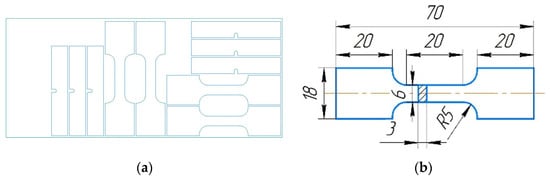
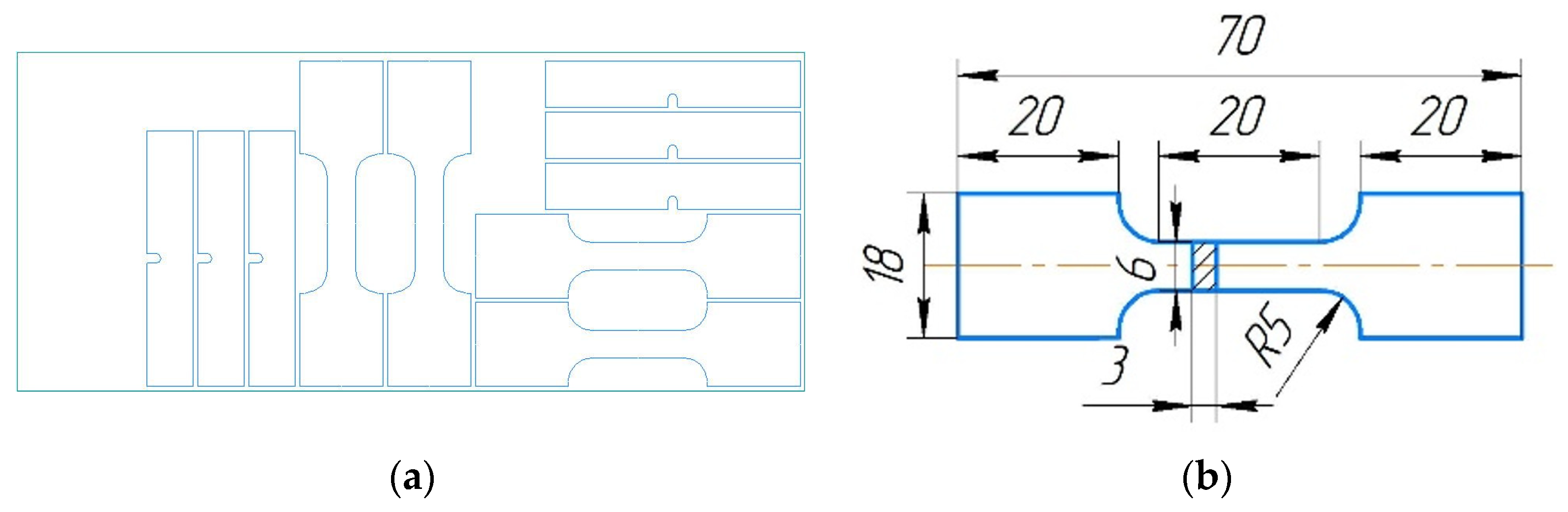
Specimens were extracted from the WAAM-deposited walls using an electrical discharge machining (EDM) process at 0° and 90° relative to the deposition direction for uniaxial tensile testing (Figure 1a) and to evaluate the anisotropy of the mechanical properties of the fabricated deposits with respect to the deposited layers. The specimen geometry is shown in Figure 1b. The experiments were performed using an Instron 8801 servo-hydraulic testing system designed for static and dynamic mechanical testing.
Figure 1.
Schematic of specimen extraction (a) and schematic of the specimen for mechanical testing (b).
Wire electrodes OK Autrod 308LSi ESAB (ESAB-SVEL Plant, Saint Petersburg, Russia) were used to produce the experimental deposits. The chemical composition of the wire is given in Table 2. Microstructural investigations were performed on cross-sectional specimens and microsections were prepared by grinding and polishing the surface. To identify the microstructure etching was carried out using a Vasiliev’s reagent composed of 500 mL hydrochloric acid, 250 mL sulfuric acid, 100 g copper sulfate, and 500 mL water. Observations were performed using an Altami CM0745-T (Altami, Saint Petersburg, Russia) optical stereomicroscope and an Altami MET 1T (Altami, Saint Petersburg, Russia) inverted light microscope with up to 1000× magnification, using Altami Studio 3.5 software (Altami LLC., St. Petersburg, Russia).
Table 2.
Chemical composition of wire and deposited specimens.
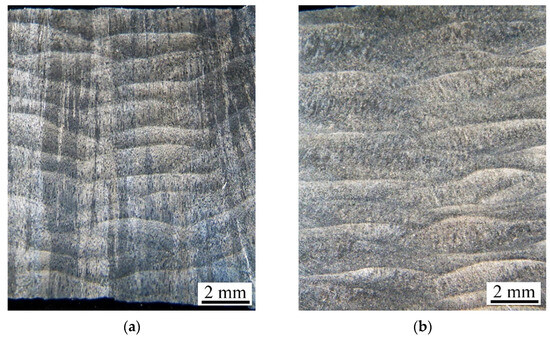
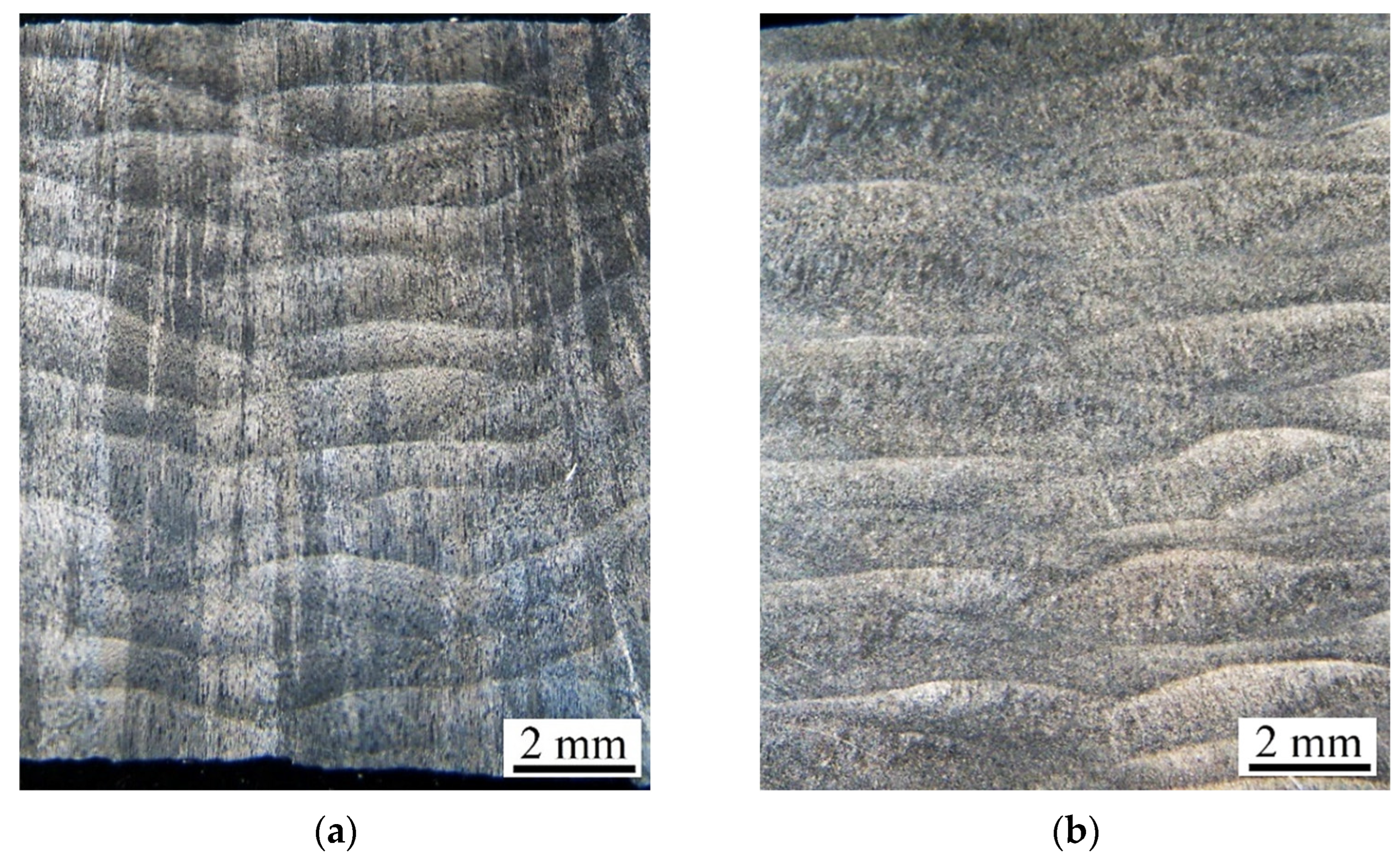
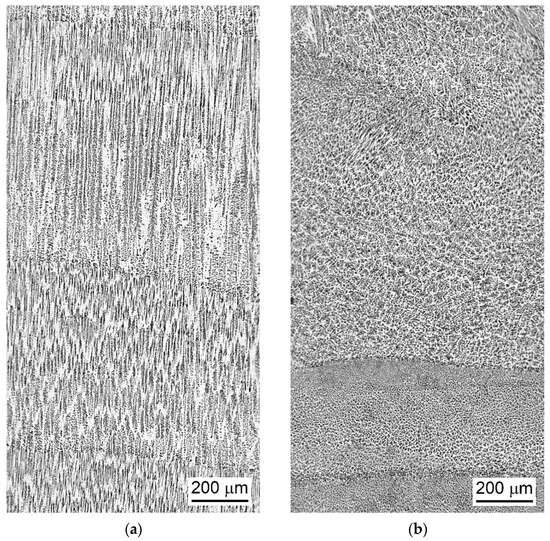
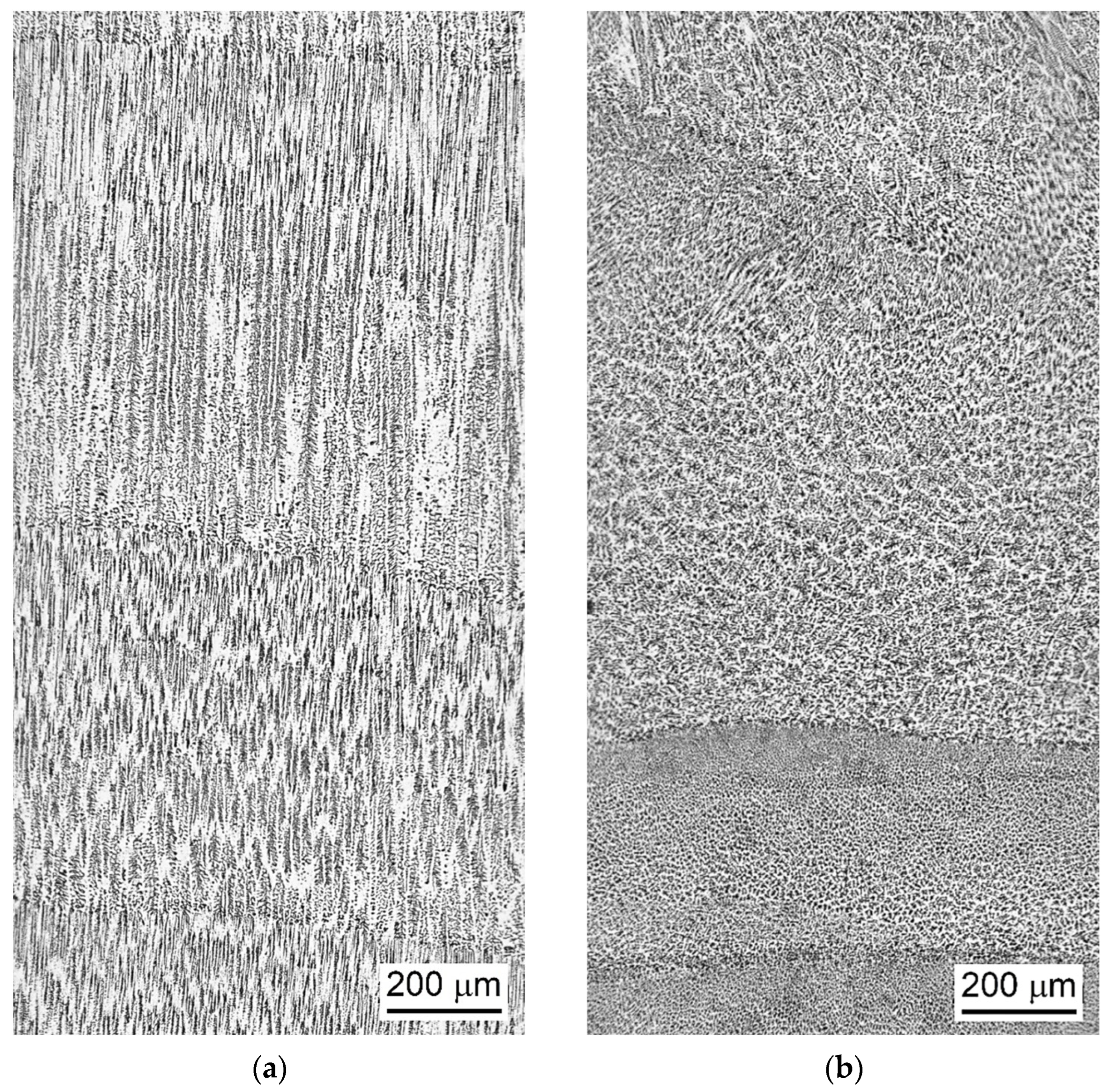
The chemical composition of the deposited metal was determined by X-ray fluorescence (XRF) analysis, and metallographic studies were conducted on the specimens. To determine the chemical composition of the deposited samples, a high-resolution (3–10 nm) scanning electron microscope (HITACHI S-3400N, Hitachi Ltd., Tokyo, Japan) equipped with a Bruker EDS XFlash 4010 detector (Bruker Corp., Billerica, MA, USA) was used at an accelerating voltage of 5 kV. The results are summarized in Table 2. The observed structures of the experimental samples after deposition are shown in Figure 2 and Figure 3.
Figure 2.
Macrostructure of the deposited metal: (a) without interlayer forging; (b) with interlayer forging.
Figure 3.
General view of the microstructure of the deposited metal: (a) without interlayer forging; (b) with interlayer forging.
Metallographic analysis indicated that deposition without interlayer deformation produced a macro- and microstructure typical of austenitic steels, consisting of long columnar grains spanning multiple layers, with a dendritic microstructure of columnar dendrites. Deposition with interlayer deformation resulted in an equiaxed dendritic structure with a small fraction of columnar dendrites in certain layers, and a reduction in microstructural size was observed.
The obtained metallographic results (presented in the following paragraphs) are fully consistent with our previous studies [8] and those of other authors [9,10,13,38,39,40,41,42,43,44,45]. Therefore, generalized data from these works were used when developing the mathematical model.
The phase composition of AM-specimens is predominantly represented by γ-austenite with an FCC lattice, in combination with δ-ferrite (BCC lattice), whose volume fraction ranges from 3 to 8%, and, according to some data, up to 12% [8,10]. Additionally, finely dispersed carbides and oxides are observed, amounting to up to 2.5% [8,41]. Hence, the steel under consideration is characterized by a multiphase structure with pronounced heterogeneity.
Within the large columnar grains, a dendritic-cellular substructure of γ-austenite with low-angle boundaries has been identified [9,42]. Epitaxial growth of dendrites occurs across the deposited layers, forming elongated columnar elements oriented transversely to the build direction [8,13]. The material structure strongly depends on processing parameters. During layer-by-layer deposition without interpass deformation, large columnar grains are formed, consisting of bundles of first- and second-order γ-austenitic dendrites. In the interdendritic regions, δ-ferrite and carbides/oxides are observed, with respective volume fractions of 5–8% and up to 2.5%. Grain boundaries are predominantly high-angle, while dendritic boundaries are low-angle; the latter, enriched with secondary phases, hinder dislocation slip and thus strengthen the material [10,43]. The height of a single deposited layer is approximately 1.5 mm, while the crystallite height reaches 5–7 layers (7.5–10.5 mm). The interdendritic spacing varies between 30 and 40 μm, dendrite width between 60 and 80 μm, and crystallite width between 300 and 720 μm [10,44].
To improve the service performance of components, the application of interlayer cold forging technology is highly relevant [8,16]. Microstructural analysis of such specimens revealed the formation of predominantly fine-grained equiaxed grains with a dispersed dendritic substructure, as well as an increased fraction of carbide particles within the interdendritic regions [8,45]. Plastic deformation induced by cold forging increases internal stresses and dislocation density. Forging also alters grain growth directions during subsequent deposition and promotes the formation of new nucleation centers, resulting in a more crystallographically uniform and fine-grained structure [8,46].
During WAAM deposition (as in other multilayer welding processes), the resulting microstructure, in terms of phase composition and relative content, primarily depends on the chemical composition of the alloy [47]. Changes in the processing parameters of the heat source (total heat input, travel speed) mainly affect the size and dispersion of the microstructural constituents. For example, 308LSi steel crystallizes into a dendritic austenitic structure with small amounts of δ-ferrite and carbides in the interdendritic regions [48]. Increasing the cooling rate over a wide range can lead to the formation of dendritic-cellular and fully cellular structures, a reduction in δ-ferrite and carbide content, and smaller constituent sizes [49]. The range of heat input parameters typically used in WAAM mainly allows adjustment of the dendrite size, and only under extreme thermal conditions can a dendritic-cellular structure be achieved [49].
2.2. Description of Theoretical Methods Applied in the Study
Within multilevel mathematical modeling, the austenitic stainless steel 308LSi is considered as a hierarchical system in which the key structural elements are γ-austenite grains with a well-developed dendritic substructure.
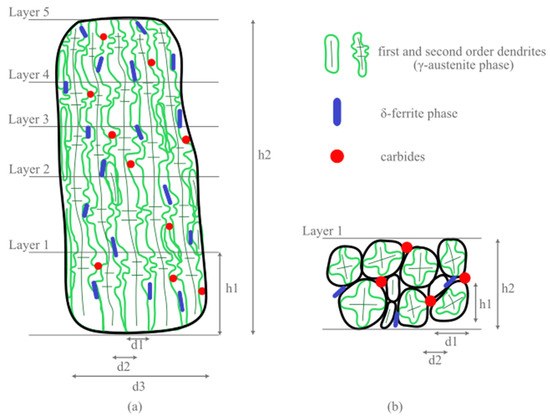
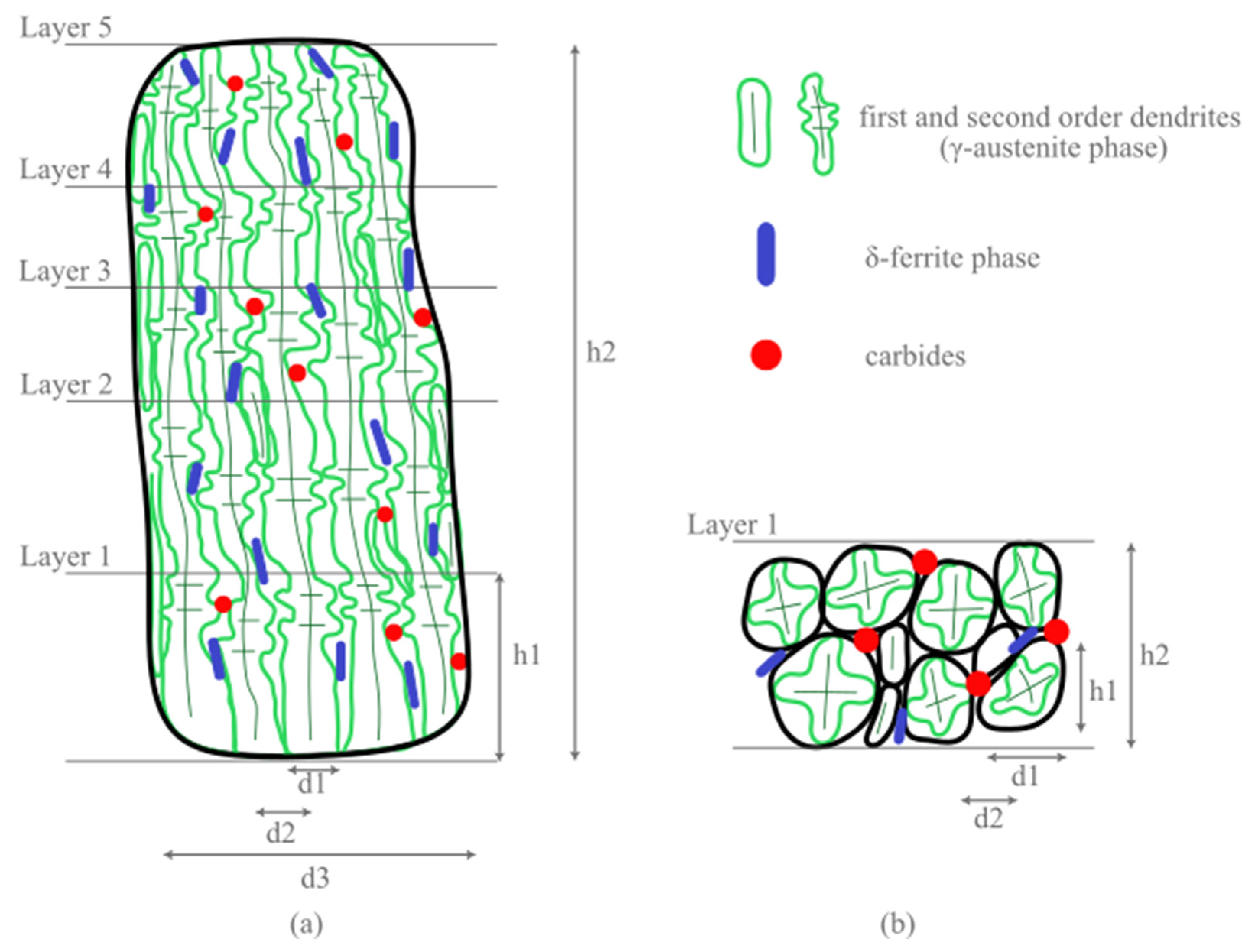
Figure 4 schematically illustrates the structural states of specimens for two technological modes: (a) without forging, and (b) with interlayer forging. In the first case, elongated columnar grains with a pronounced texture are observed, while in the second, a more dispersed structure with equiaxed crystallites and a blurred texture character is formed [8,17]. This process is accompanied by an increase in carbide fraction [8,41]. After forging, the layer height is approximately 1.2 mm, the interdendritic spacing decreases to 10–30 μm, and the grain size ranges from 20 to 60 μm.
Figure 4.
Schematic representation of typical structural elements of 308LSi steel produced by layer-by-layer deposition: (a) without forging, (b) with interlayer forging. Black shows high-angle boundaries (formed crystallites), green shows first- and second-order dendrites (γ-austenitic phase), blue shows δ-ferrite phase, red shows carbides and oxides. Here, “Layer i” denotes the deposited i-th layer of metal; “h1” is the layer height; “h2” is the grain height; “d1” is the dendrite width; “d2” is the interdendritic spacing and “d3” is the grain width.
The primary mechanism of inelastic deformation in 308LSi steel is intragranular dislocation slip [50]. The strengthening of the material is governed by the interaction of dislocations with grain, dendrite boundaries and secondary-phase particles (δ-ferrite and carbides) [28,29,51]. The texture formed during additive manufacturing induces a pronounced anisotropy of plastic flow [28,29,51]. Interlayer forging results in an additional increase in yield strength according to the Hall-Petch relationship, due to grain refinement [45]. In some cases, rearrangement of the dislocation structure and possible phase transformations (TWIP and TRIP effects) may occur. However, their manifestation is limited by thermal conditions and is not always observed in WAAM-produced specimens [52,53,54].
The microstructure and phase composition have a direct impact on fracture mechanisms. Under monotonic and cyclic loading, cracks typically initiate near hard-phase particles (δ-ferrite, carbides, and oxides) due to the mismatch in elastoplastic properties between adjacent phases [55,56]. Stress localization in these regions leads to the formation of microcracks, which usually propagate along dislocation slip bands. Crack growth is predominantly transgranular. Although the trajectory often deviates at grain boundaries, slowing further propagation [56]. Larger austenitic grains facilitate stress relaxation and crack blunting, resulting in slower crack growth [57].
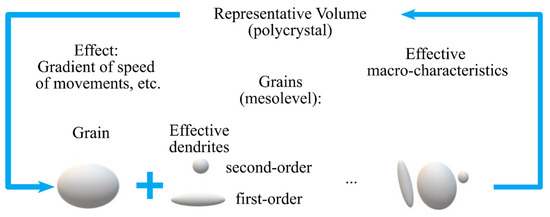
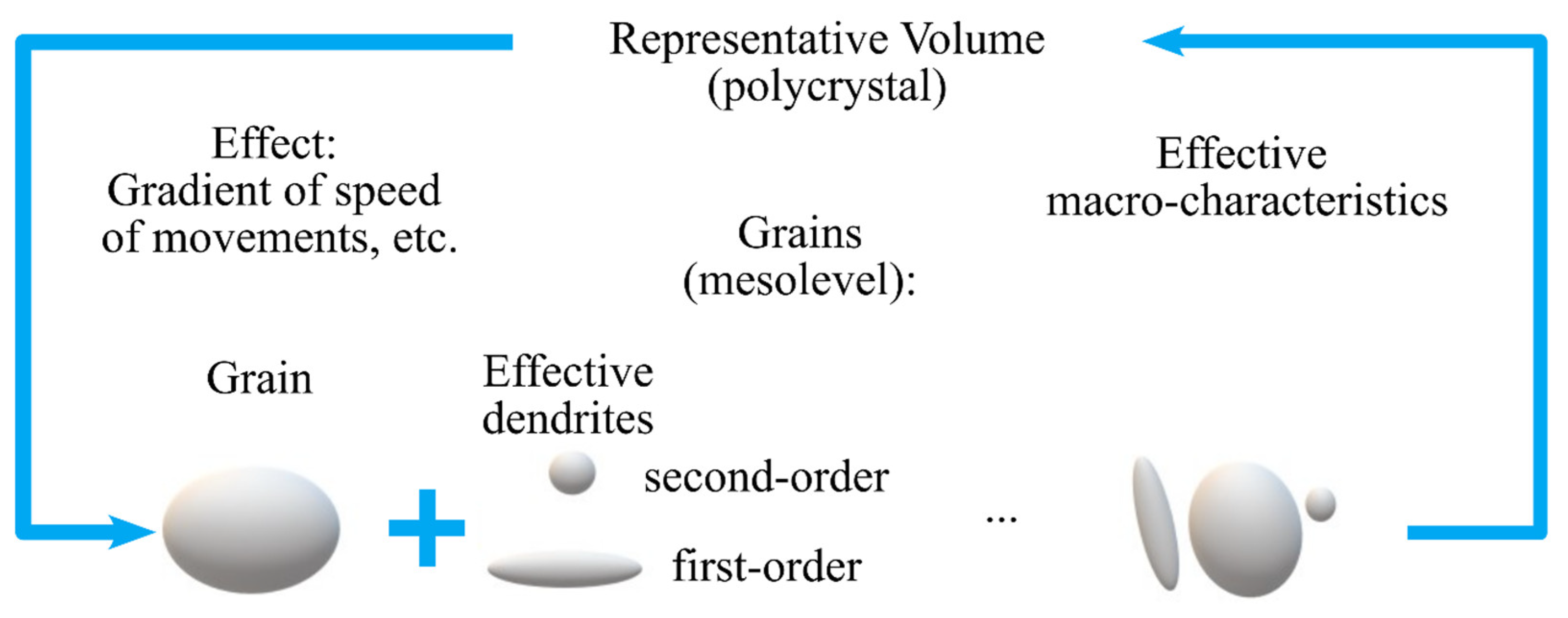
The construction of the mathematical model for inelastic deformation is based on a statistical two-level approach [27]. The schematic representation of the proposed multilevel model for the structure of 308LSi steel is shown in Figure 5. The complete mathematical formulation is detailed in [27]. At the macroscale, kinematic loading conditions, defined by the velocity gradient, are applied to the material’s RVE.
Figure 5.
Schematic of the developed multilevel model for WAAM-produced 308LSi steel specimens.
At the meso-scale (the level of individual grains), computations are performed to determine the mechanical response and internal structural variables. Effective quantities, such as stress and elastic and plastic properties, are determined by averaging over the macro-scale. This method accounts for both the state and the evolution of the microstructure under external loading.
The upper (macro-) level corresponds to the representative volume consisting of a statistically sufficient number of γ-austenitic grains, approximated as ellipsoids. For these grains, statistical laws of distribution are formulated for the lengths of principal semi-axes and their orientations, as well as for the crystallographic lattice orientations (texture).
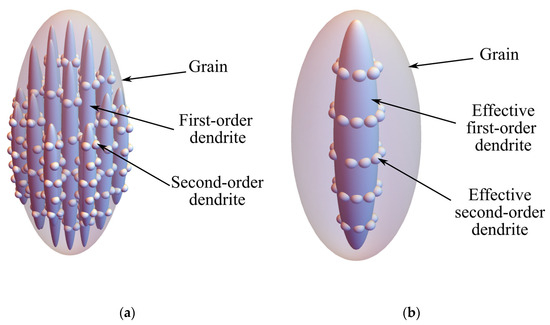
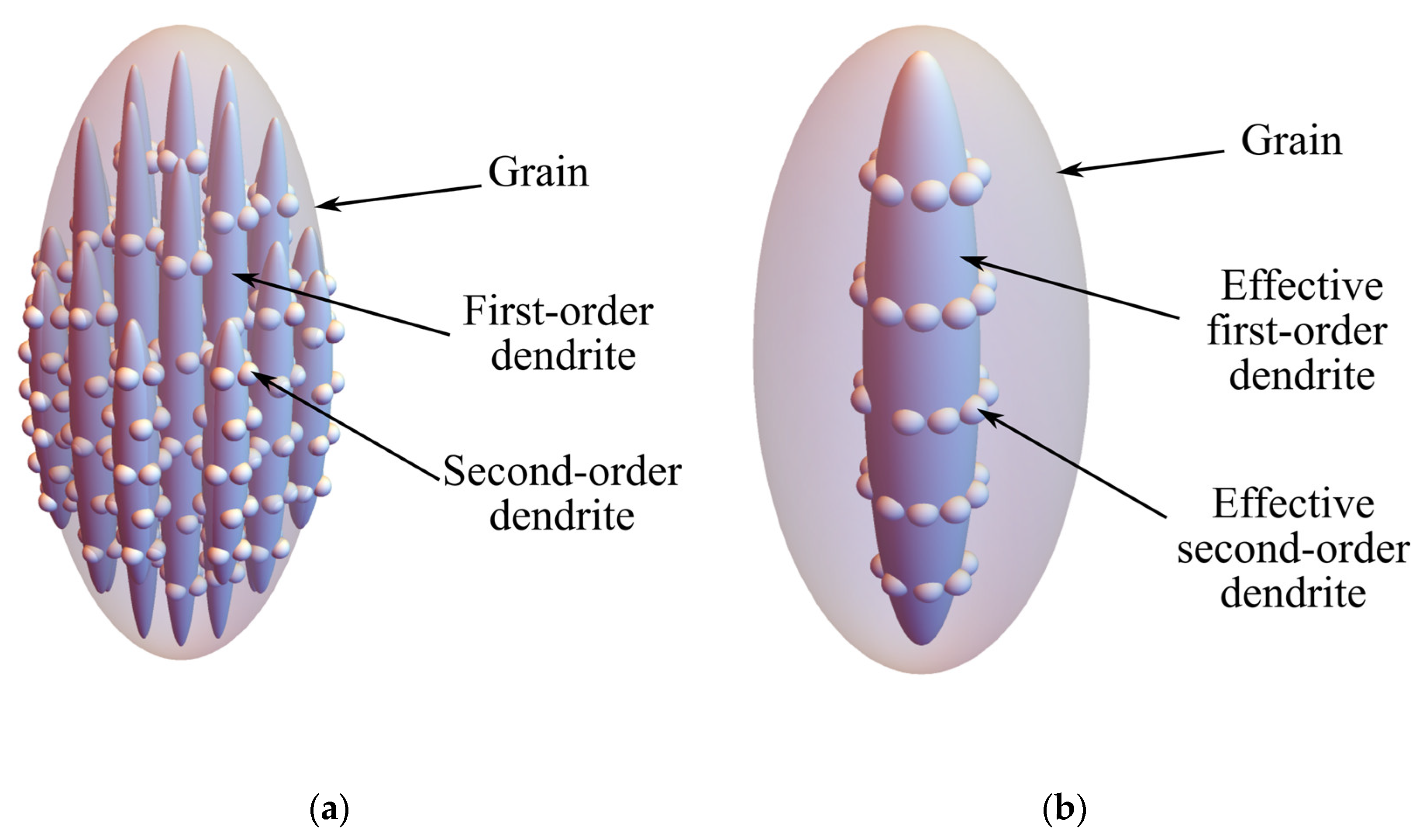
At the mesoscale, individual grains are considered; each characterized by a specific ellipsoidal shape, crystallographic lattice orientation, and an effective internal substructure of first- and second-order dendrites (Figure 6). The structure of first-order dendrites (Figure 6a) is represented by an effective (average) ellipsoid (Figure 6b). Based on the characteristic sizes of first-order dendrites and grain dimensions, the number of dendrites within grain is determined as follows:
where are the characteristic semi-axes of the grain ellipsoid, and are those of the effective first-order dendrite ellipsoid. Second-order dendrites are also described in an effective manner (Figure 6b). Their shape is assumed to be equivalent to a portion of a sphere, and, for a given dendrite surface area and surface number density the total number of second-order dendrites is calculated as follows:
Figure 6.
Schematic representation of a structure approximating real dendrites (a); illustration of their representation within the model (b).
The developed model explicitly incorporates the key physical mechanisms governing the material response: intragranular dislocation slip, interaction of dislocations with grain and dendrite boundaries as well as with secondary-phase particles, and lattice rotation within individual grains.
The formulation of the problem for describing the deformation of a representative volume element of a polycrystalline metal (alloy) using a two-level statistical model was stated as follows [27]. At each instant of time t within the considered loading interval, it is necessary to determine the macroscopic stresses K(t), the effective macroscopic elastic properties Π(t), and the mesoscopic variables that satisfy the following system of equations:
Macroscopic relations.
Mesoscopic relations.
Governing mesoscopic relations (for each crystallite , the crystallite number is omitted)
relations between mesoscopic and macroscopic variables
evolutionary and closure relations
initial conditions
under prescribed (loading) conditions .
In the formulation, uppercase letters are used to denote macroscopic variables, while corresponding lowercase letters indicate mesoscopic variables. The following notations are adopted in the equations:
- At the macroscopic level
- K is weighted Kirchhoff stress tensor at the macroscopic level, Π is tensor of effective elastic properties, is gradient of macroscopic displacement velocities ( is Hamilton operator in the current Lagrangian coordinate system, V is the macroscopic velocity vector).
- At the mesoscopic level
- is the weighted Kirchhoff stress tensor at the mesoscopic level, is its corotational derivative, is density in the reference and current configurations, σ is Cauchy stress tensor at the mesoscopic level, is gradient of mesoscopic displacement velocities (v is mesoscopic velocity vector), , is elastic and inelastic components of the transposed gradient of mesoscopic relative velocity, is material density in the reference (current) configuration, is shear rate on the k-th slip system, is shear rate when the resolved shear stress reaches the critical value, m is rate sensitivity exponent of the material, unit vectors along the k-th slip direction and normal to the slip plane, H is Heaviside function, is resolved and critical shear stresses for the k-th slip system, K is number of slip systems in the crystallite, is elastic properties tensor of the crystallite, which components are determined and constant in the basis ki of rigidly rotating local coordinate system (LCS), rotating with spin , is orientation tensor of the LCS relative to the laboratory coordinate system (LCS), is transposed gradient of displacement velocities, f is deformation gradient, is objective measure of the strain rate, is resistance to dislocation motion due to the dislocation structure [58], is resistance to dislocation motion from grain and dendrite boundaries [59], is matrix describing crystallite hardening due to dislocation-dislocation interactions, qlat is latent hardening parameter, is saturation stress for slip, h0, a are parameters describing slip system hardening, is Kronecker delta, a dot over a variable indicates the time derivative t, superscript “T” indicates tensor transposition of the corresponding second-order tensor, superscript “−1” denotes the inverse operation of the corresponding tensor, is volume averaging operator for the corresponding mesoscopic quantity, is weighted Kirchhoff stress tensor for the grain at the initial time (zero tensor for natural initial configuration), is orthogonal tensor defining the initial grain orientation, is initial resistance to dislocation motion, is initial resistance from grain boundaries, are initial slip on the slip systems (equal to zero for natural configuration).
At large plastic strains, the model also accounts for grain refinement resulting from substructural evolution. To describe the strengthening contribution of structural boundaries, a generalized Hall–Petch relationship is employed [60,61,62], where the resistance to dislocation motion depends not only on the grain size but also on the characteristic dimensions of dendritic substructures. The following modified relations, extending those formulated in [58,59], are proposed:
where the following notations are used: is volume fractions of grain boundaries; is volume fractions of primary dendrites; is volume fractions of secondary dendrites per grain; and are numbers of primary and secondary dendrites per grain, respectively; , and are surface areas of the grain and characteristic dendrites of first and second order; coefficient defining the resistance intensity of the corresponding boundaries to dislocation motion; is coefficient defining the resistance intensity of dendrite boundaries to dislocation motion; , and are initial dislocation mean free paths within the grain and dendritic structures, determined by the intersection of the Burgers vector direction with the ellipsoidal geometry of each structural element.
The evolution of grain structure under deformation is modeled in two stages: (1) a geometrical change in ellipsoidal grain shape according to the applied kinematic deformation, and (2) grain refinement, described by a modified phenomenological relationship linking grain size to accumulated plastic strain [63]. For anisotropic response, this relation is applied individually to each semi-axis of the ellipsoid. In the reference configuration, the first and third semi-axes of the ellipsoid were assumed to coincide.
The initial ellipsoidal shape of a grain is characterized by a symmetric positive-definite tensor Ag0. Its eigenvalues define the semi-axis lengths, while the eigenvectors specify their orientations. Under a deformation gradient F(t) the ellipsoidal shape evolves, and in the current configuration it is described by the following tensor:
where denotes the scalar (inner) product.
Grain refinement is described using a phenomenological relation of the form [63]:
where d is the grain size, is the limiting grain size, is the initial grain size, k, n are parameters of the material identified experimentally. To account for anisotropy, this relationship is applied separately to each semi-axis of the ellipsoidal grain:
Thus, the developed multilevel mathematical model provides a physically consistent description of the mechanical response of 308LSi polycrystalline steel, incorporating the fundamental mechanisms of inelastic deformation and the influence of both grain and dendritic substructures.
3. Results
3.1. Identification and Verification of the Multilevel Model for Describing Deformation of the Representative Volume of 308LSi Steel Samples
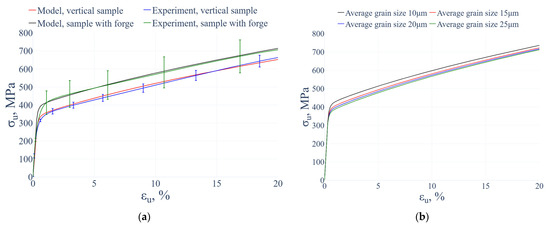
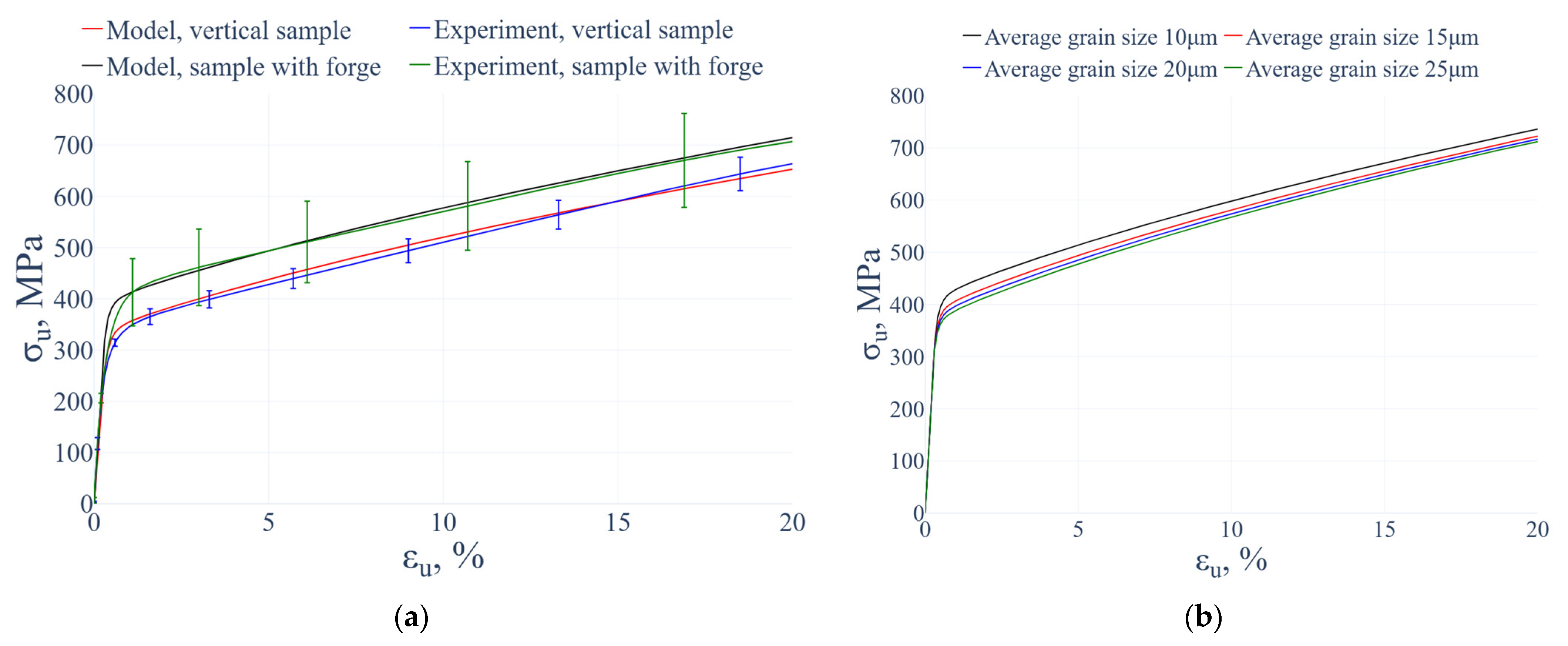
The developed multilevel constitutive model, describing the mechanical behavior of 308LSi steel, was identified based on experimental data obtained in the study (Figure 7a). For model identification, results from mechanical tests of samples without interlayer forging (with large columnar grains and dendritic structure) and with forging (refined equiaxed structure) were used (see Figure 4). In numerical experiments, three types of specimens were considered: (1) vertical specimens cut along the built direction; (2) horizontal specimens cut perpendicular to the deposited layer; (3) specimens cut at a 45° angle to the deposition axis. The sizes of structural elements in both states were determined from metallographic analysis: columnar grain width in the non-forged state was 300–720 μm, the height was 7.5–10.5 mm; the first-order dendrites were 60–80 μm wide, the height was matching corresponding grains; the second-order dendrites were 15–20 μm. The obtained data agree with the literature [10,44]. In the forged state, grain sizes decreased to 20–60 μm, and the degree of anisotropy was significantly reduced [8,45].
Figure 7.
Dependence of stress intensity on strain intensity for uniaxial tension of a 308LSi steel sample obtained without forging and with forging (a), dependence is for uniaxial tension of a 308LSi steel sample with forging with different grain sizes (b), constructed on the basis of model calculations.
Uniaxial tensile experiments at room temperature with a strain rate of 0.001 s−1 for both non-forged and forged samples are shown in Figure 7a. The model parameters were identified by minimizing the squared discrepancy between calculated and experimental stress–strain curves. Optimization was performed separately for each sample type, accounting for the specific structure and mechanical properties. The mathematical formulation is based on the foundational two-level model [27], and extended with relations (1)–(23). All identified model parameters are listed in Table 3. In a previous study, the parameters of the baseline two-level model [27] were subjected to a comprehensive analysis to assess their sensitivity to parameter perturbations and variations in the input data [64,65].
Table 3.
Identified parameters of the multilevel constitutive model.
Figure 7a presents the comparison of experimental and computed stress–strain curves for forged and non-forged samples. The maximum deviation does not exceed 3%, confirming the accuracy of identification and adequacy of the model. Series of parametric simulations were conducted for different initial grain sizes; results for forged samples are shown in Figure 7b and are consistent with the Hall–Petch relation (Equation (17)).
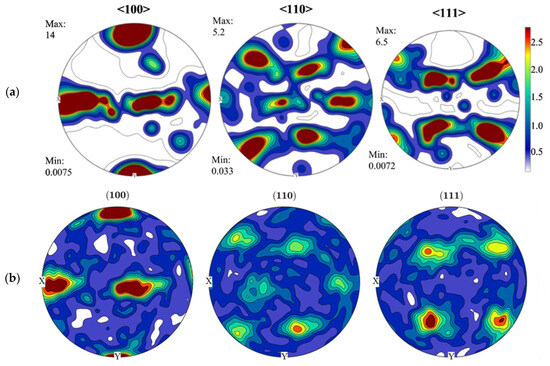
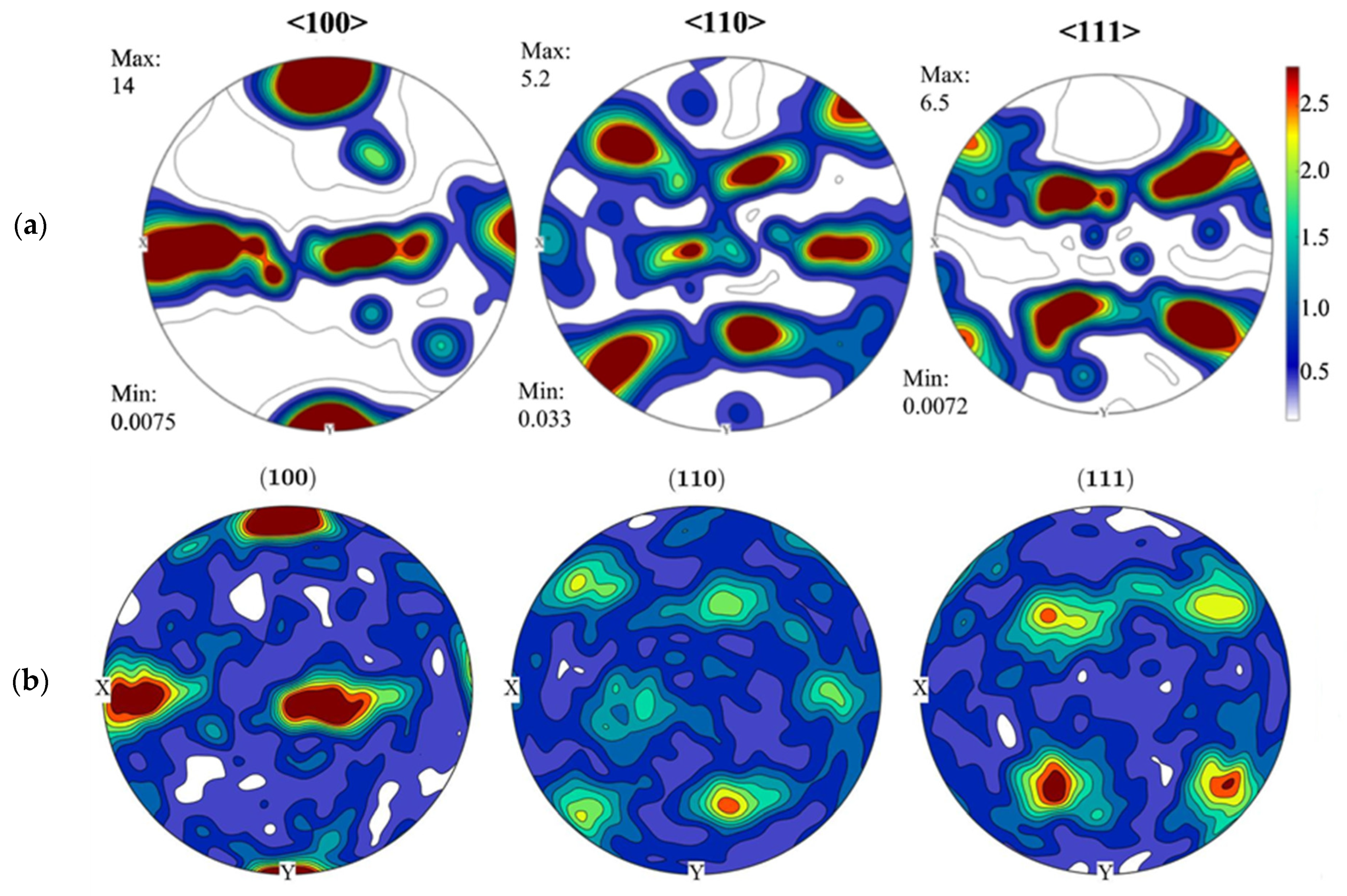
To reproduce the texture of the non-forged samples, experimental direct pole figures (DPFs) for planes (100), (110), (111) were used [7], and Monte Carlo simulations [68] generated a representative sample of grain lattice orientations (Figure 8).
Figure 8.
Pole figures for a representative volume of 308LSi steel: straight lines (a) experimental, reprinted from Ref. [7]; straight lines (b), reproduced by the orientation sample generated in the Monte Carlo approach [68].
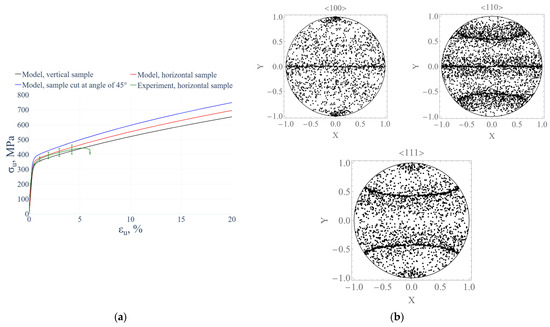
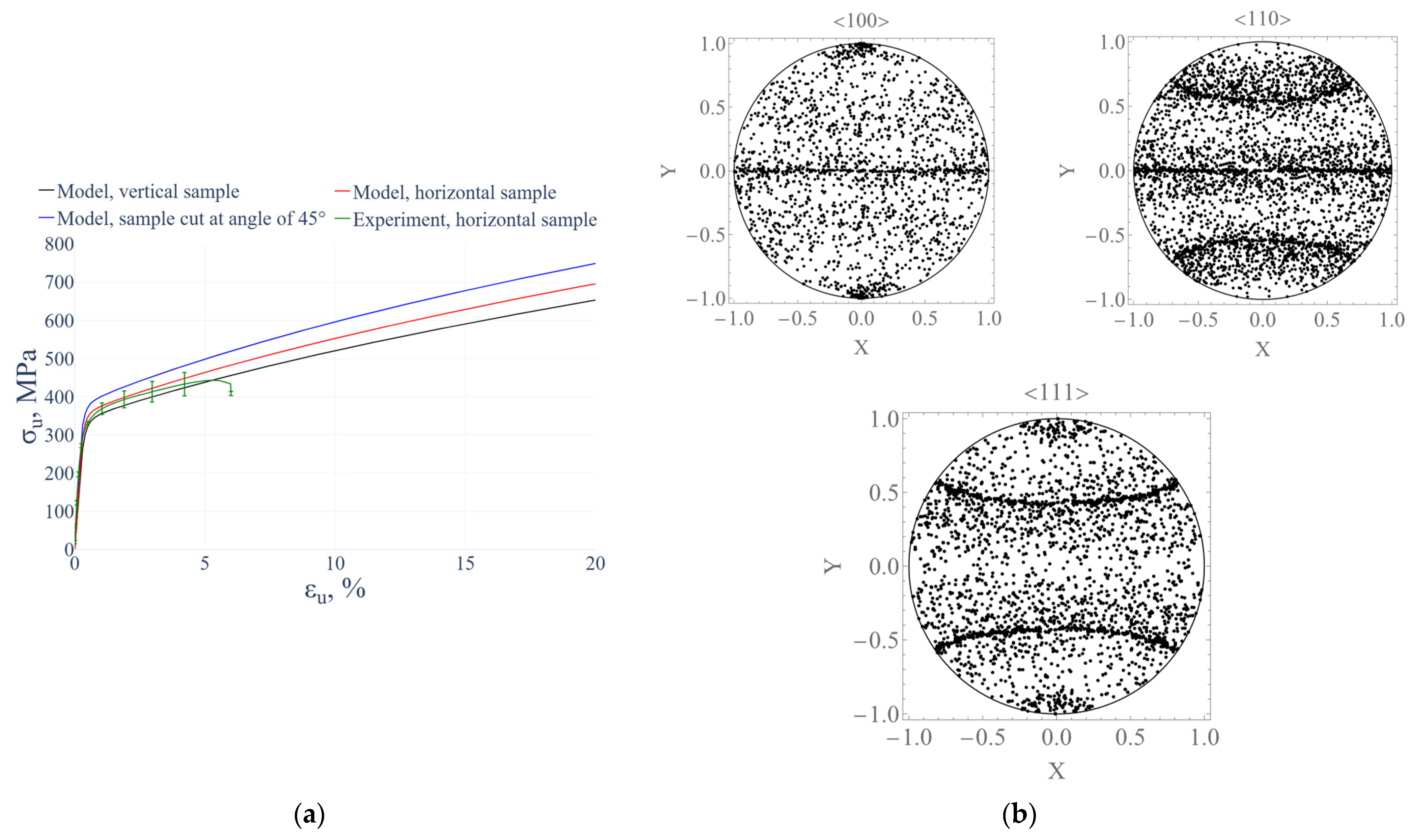
During the verification stage, the experimental and numerical results for horizontal specimens under uniaxial loading were compared (Figure 9a), with the overall mean error not exceeding 2%. Uniaxial tensile tests indicate that horizontal specimens exhibit a yield strength 5–7% higher than vertical specimens. Maximum yield strength is observed for specimens cut at 45°, which is 6–8% higher than horizontal specimens [14,69,70]. This effect is explained by differences in dislocation mean free paths in elongated grains along different loading directions. The multilevel model reproduces this anisotropy accurately: calculated flow stress for horizontal non-forged specimens is 6% higher than vertical; 45° specimens show a 6% increase relative to horizontal (Figure 9a). Figure 9b shows the calculated pole figures for the horizontal specimen, exhibiting the most pronounced texture at the end of deformation, which qualitatively agree well with the experimental data [71,72,73].
Figure 9.
Dependence of stress intensity on strain intensity for uniaxial tension of a 308LSi steel sample for samples without forging with different orientations relative to the deposition axes (a); pole figures of the polycrystalline texture after deformation for the horizontal specimen (b).
The developed two-level model demonstrates high quantitative and qualitative correlation with uniaxial tensile experiments, accounting for the influence of grain and dendritic structures, accurately describing anisotropic mechanical behavior. Verification against experimental and the literature data (discrepancy ≤ 6%) confirms the model adequacy for engineering applications. Simulation results show sensitivity of 308LSi steel mechanical properties to grain size, dendrite size, and specimen orientation relative to the loading axis, validating the model for a wide range of operating conditions.
3.2. Modeling the Behavior of 308LSi Austenitic Steel with Explicit Topological Consideration of MnO Inclusions Under Cyclic Loading
The multilevel model allows analysis of the effects of structural factors (grain size, dendrite size, crystallographic orientations) on mechanical behavior. For predicting fatigue life of WAAM-produced components, it is necessary to explicitly consider lower-scale structural elements [74,75]. A major defect type includes non-metallic oxide inclusions, which interact with the matrix creating local stress concentrations and initiating fatigue cracks [75,76].
During additive manufacturing of 308LSi steel, interaction of alloying elements with ambient oxygen forms MnO inclusions takes place [69,77,78,79]. Thermal cycles influence inclusion formation; insufficient heat reduces melt homogenization time, promoting local oxygen enrichment [80]. Inclusion clusters degrade mechanical properties, accelerate crack growth, and reduce strength [69]. Fractography confirms presence of voids and dispersed inclusions under fatigue [79,81,82]. The primary mechanism of cyclic failure involves localized stress and strain near inclusions, promoting microcrack nucleation and evolution [83].
MnO inclusions are predominantly spherical, 0.5–2 μm in diameter, most commonly ~1 μm [78,81]. As a brittle phase, MnO has elastic-plastic properties significantly different from the austenitic matrix [84,85] forming local stiff zones and microcracks at the matrix-oxide interface. MnO inclusions are treated as the primary factor reducing mechanical performance and fracture toughness under cyclic loading.
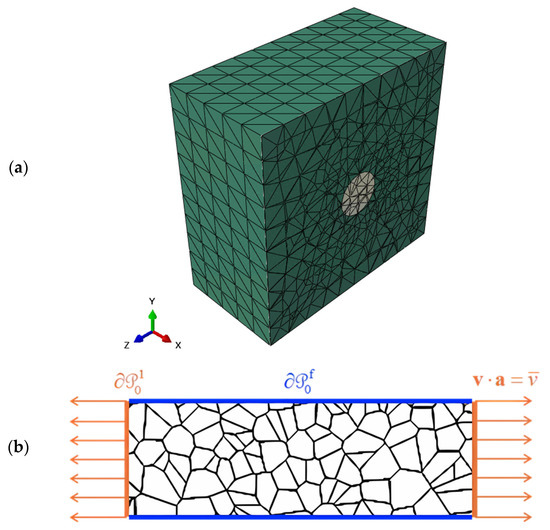
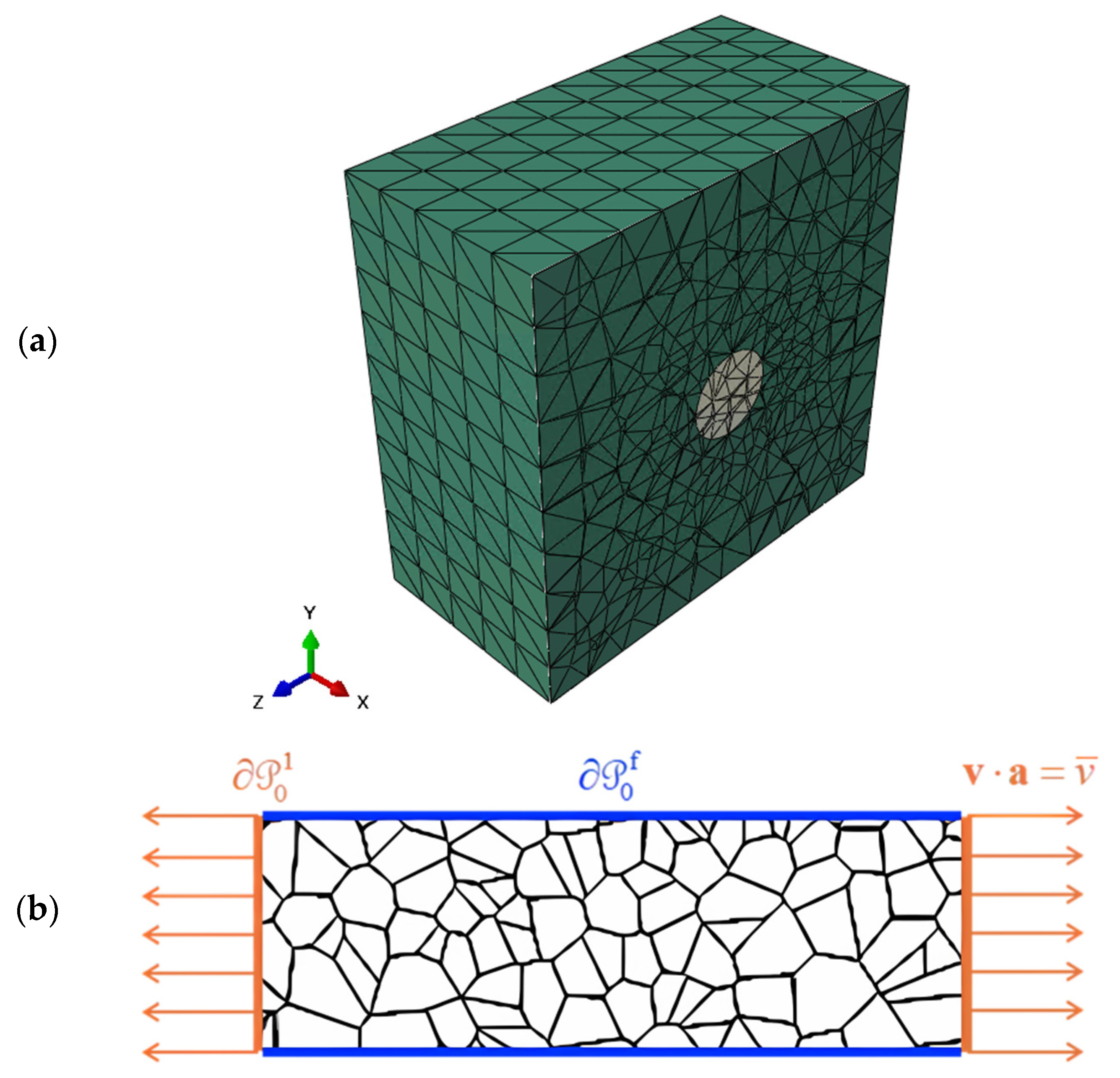
Finite element simulations in Abaqus were performed on a representative grain region containing a 1 μm spherical MnO inclusion. The domain size was ten times the inclusion diameter [69,79,86], ensuring accurate reproduction of stress–strain states near the inclusion [69,87,88] (Figure 10a). The boundary conditions were defined based on the type of applied loading program. Tension along the unit vector , illustrated in Figure 10b, corresponds to the following equations:
where and are, respectively, the loaded and free material surfaces. (, , where is boundary ); is prescribed tensile velocity along ; is unit normal vector to ; and is second-order identity tensor.
Figure 10.
Finite element discretization of the calculated region of the matrix of 308LSi steel with an oxide inclusion of MnO (half of the calculated volume of the matrix and inclusion is shown) (a), adapt from Ref. [87]; schematic representation of the polycrystal loading boundary conditions (b).
The matrix behavior employed the constitutive model described in Section 1, neglecting dendritic substructure terms. Contact between particle and matrix was ideal. Matrix properties corresponded to 308LSi austenite (Section 2), while the inclusion behaved elastically with brittle failure, ultimate strength ~3 GPa, and elastic constants consistent with BCC MnO , , [84,85]. Crystal coordinate systems of particle and matrix coincided.
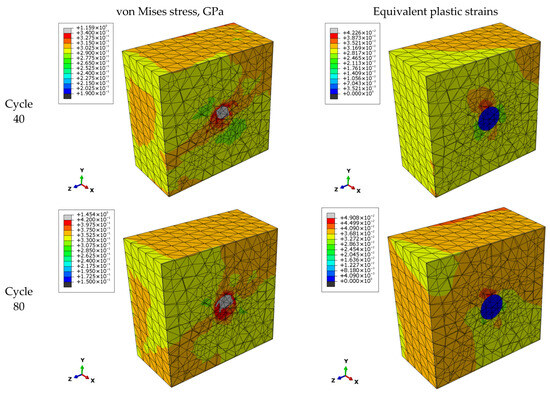
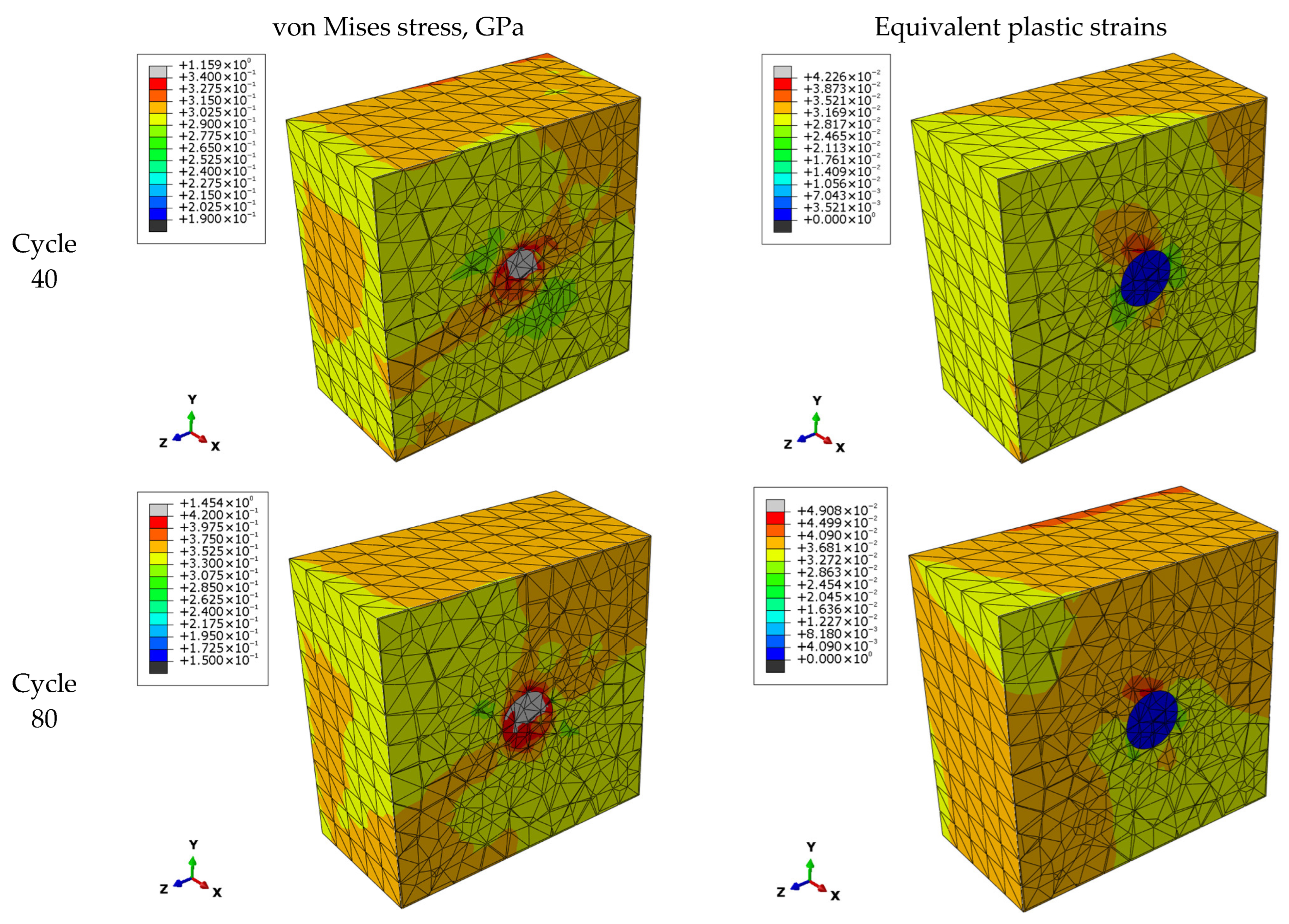
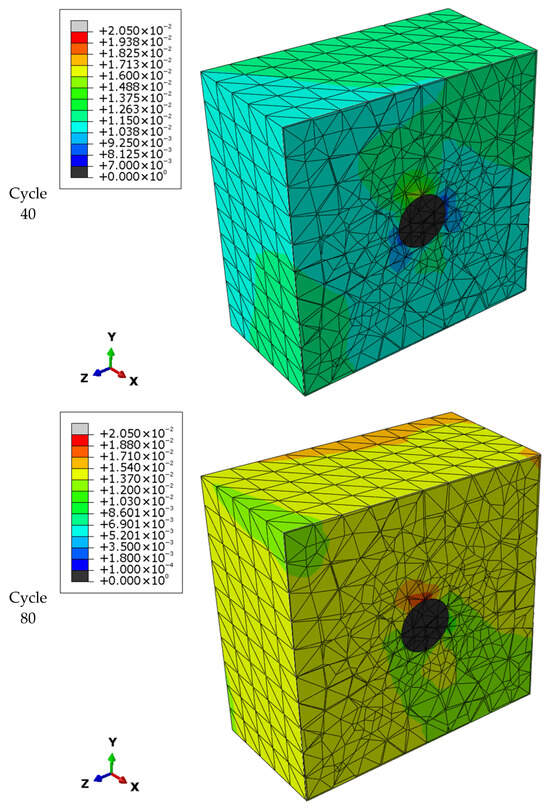
Cyclic loading was applied at the top boundary as a sinusoidal stress, amplitude near matrix yield stress, simulating realistic multicycle conditions [89]. A total of 80 cycles were simulated, sufficient for capturing microcrack nucleation and evolution [74,76,90]. Equivalent von Mises stress and plastic strain distributions after 40 and 80 cycles are shown in Figure 11.
Figure 11.
Distribution of equivalent von Mises stresses (GPa) and equivalent plastic strains in the calculated grain region of 308LSi steel with MnO oxide inclusion under cyclic loading.
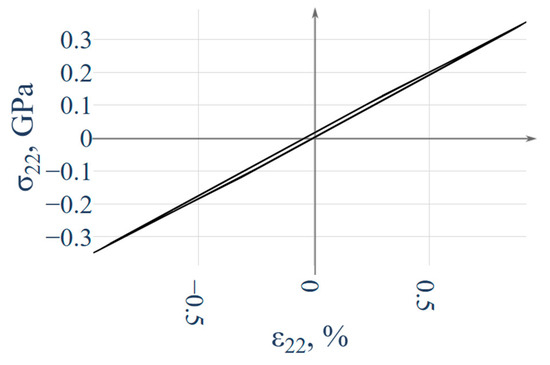
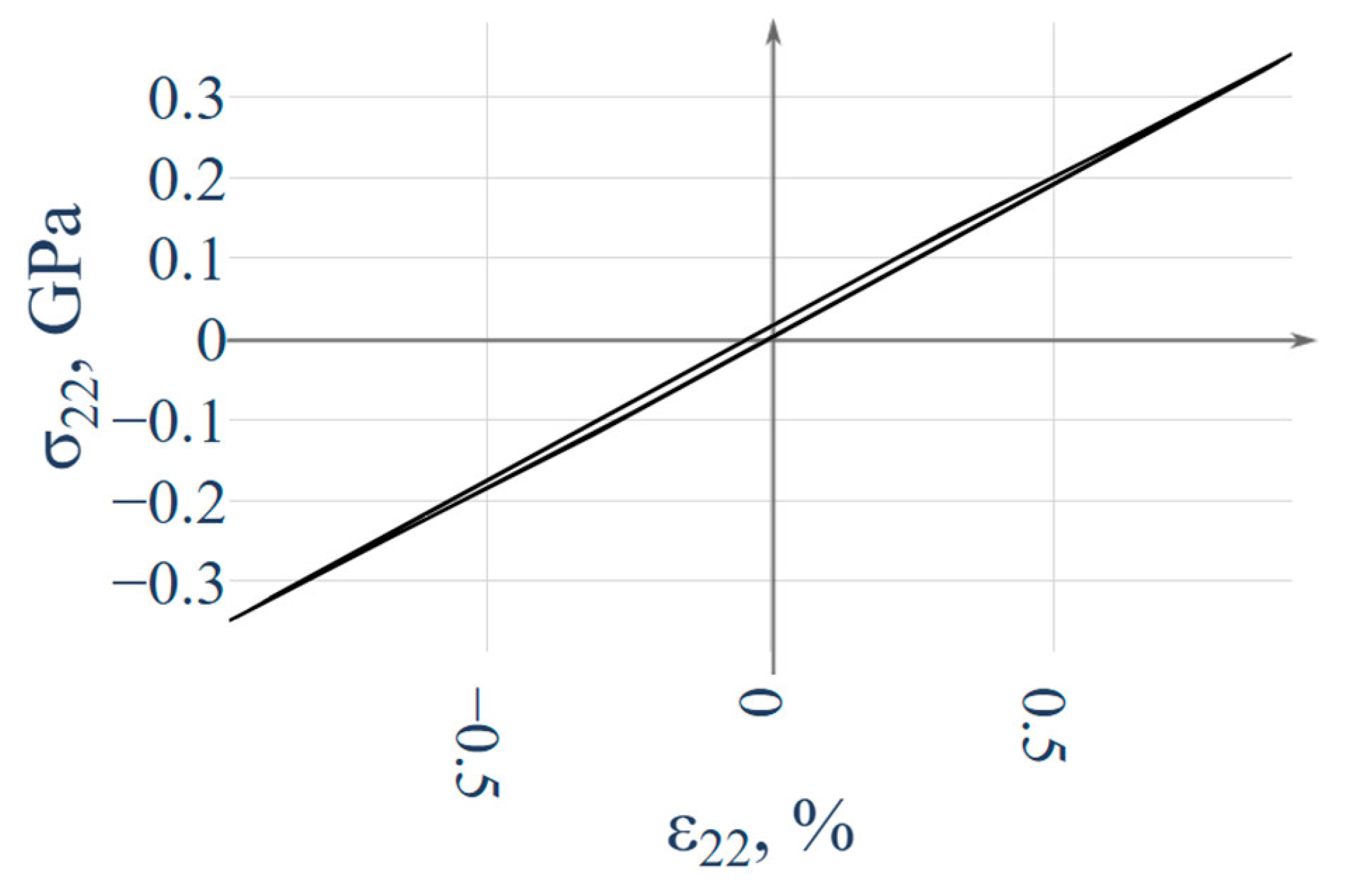
The analysis shows pronounced stress–strain heterogeneity near the stiff inclusion. Hysteresis loops averaged near the inclusion exhibit plastic strain offset, indicating energy dissipation [90], and micro-crack evolution [91] (Figure 12).
Figure 12.
Hysteresis loops—dependences of axial stress
on deformation , adapt from Ref. [91].
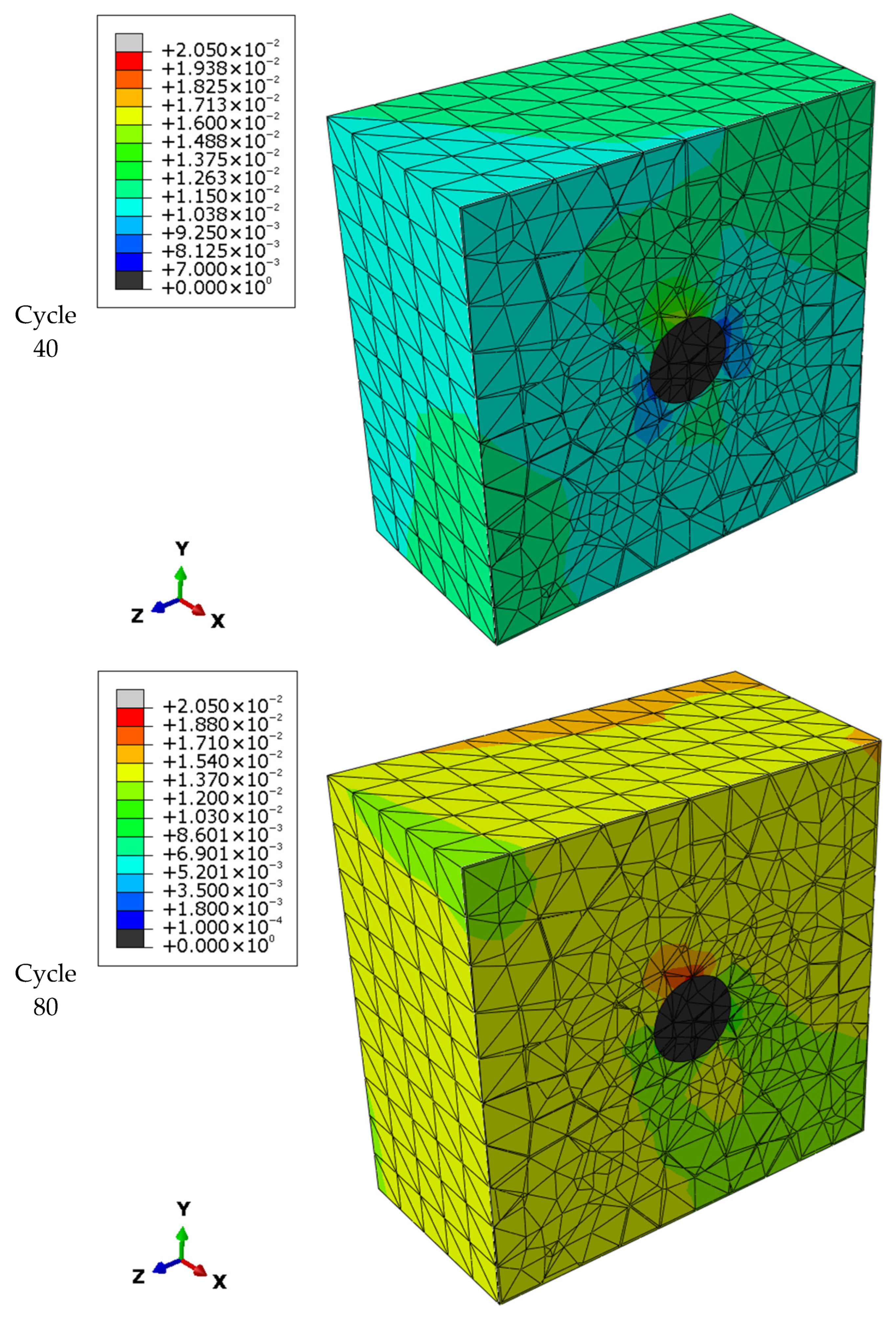
Fatigue life assessment considers local stress–strain parameters [92]. Stored energy density [74,89] is the most informative quantity for predicting fatigue crack nucleation sites. Most energy dissipates as heat; the remainder accumulates in dislocation structures [74]. The plastic strain energy per cycle is computed as follows [89]: where and are plastic stress and strain tensors, respectively, and is the fraction stored in defect structures, which was accepted to be 0.05 [74,89].
Figure 13 shows stored energy fields after 40 and 80 cycles, with maxima at matrix-inclusion interfaces along ~45° to the applied load, correlating with potential crack growth paths [74,93]. The obtained results comply well with works in [74,94].
Figure 13.
Distribution of stored energy (GPa) after 40 and 80 cycles.
4. Conclusions
For the analysis of the deformation of WAAM-fabricated 308LSi steel specimens, produced by the CMT process with and without interlayer forging, both proprietary experimental results and the relevant literature data were used. Metallographic analysis of the specimen microstructure enabled the development of a representative description, which was incorporated into a constitutive statistical material model. Based on the observed microstructure, crystallographic texture, and properties of individual structural elements, a multiscale statistical model of the material state was developed. This model describes the deformation of a representative volume (statistical ensemble of grains), accounting for the morphology and anisotropy of the grain-dendritic structure and its evolution under external loading. The model is used to determine macroscopic mechanical properties through statistical averaging. Building on the statistical model, a CPFEM model was developed and implemented for a selected region of the grain matrix, including MnO nonmetallic inclusions. The study yielded the following key findings:
- (1)
- The statistical model provided good agreement between the calculated and experimental uniaxial tensile curves, with an overall mean deviation during the verification stage not exceeding 3%. The model also captured the anisotropy of the yield strength: the maximum calculated value was obtained for specimens cut at 45° (360 MPa), while the minimum value was for vertical specimens (331 MPa).
- (2)
- The CPFEM model demonstrated that the presence of MnO inclusions leads to local stress concentrations and accumulation of plastic deformation in their vicinity, forming potentially critical zones for fatigue crack initiation.
Author Contributions
Conceptualization, N.K.; methodology, N.K. and E.S.; software, A.P.; validation, A.P., D.B. and N.K.; formal analysis, N.K. and A.P.; investigation, N.K., D.B., A.P. and T.O.; data curation, N.K., E.S., T.O. and D.T.; writing—original draft preparation, A.P.; writing—review and editing, N.K., A.P. and D.B.; visualization, A.P. and D.B.; supervision, N.K.; funding acquisition, N.K. and D.T. All authors have read and agreed to the published version of the manuscript.
Funding
The constitutive multilevel model formulation and MnO inclusion cyclic behavior simulations were supported by the Ministry of Science and Higher Education of the Russian Federation under State Assignment FSNM-2024-0002, Laboratory of Multilevel Structural and Functional Materials Modeling. Experimental data used for the calibration and validation of the model were obtained within the framework of the State Assignment “Development of scientific and technological foundations for the formation of a material-structure system with specific properties based on hybrid additive technologies”—FSNM-2024-0003.
Data Availability Statement
The original contributions presented in this study are included in the article. Further inquiries can be directed to the corresponding author.
Acknowledgments
The authors acknowledge the team of the Laboratory of Multilevel Modeling of Structural and Functional Materials: A.I. Shveykin, M.N. Baldin, A.A. Vshivkova, Ya.V. Vyatkin, K.A. Kurmoyartseva, D.S. Gribov, K.V. Ostapovich, A.V. Simonov for participation in preliminary and supporting research.
Conflicts of Interest
The authors declare no conflicts of interest.
References
- Buchanan, C.; Gardner, L. Metal 3D Printing in Construction: A Review of Methods, Research, Applications, Opportunities and Challenges. Eng. Struct. 2019, 180, 332–348. [Google Scholar] [CrossRef] [Scilit]
- Guo, N.; Leu, M.C. Additive Manufacturing: Technology, Applications and Research Needs. Front. Mech. Eng. 2013, 8, 215–243. [Google Scholar] [CrossRef] [Scilit]
- Trushnikov, D.N.; Varushkin, S.V.; Salomatova, E.S.; Koleva, E.G.; Dzharov, V.V. Wire Position Sensor for Controlling the Process of Electron Beam Layer-by-Layer Deposition: Modeling and Verification. IEEE Sens. J. 2021, 21, 3134–3142. [Google Scholar] [CrossRef] [Scilit]
- Chamim, M.; Darmadi, D.B.; Purnowidodo, A.; Widodo, T.D.; Ismail, Z. Influence of the Welding Thermal Cycle on δ-Ferrite Evolution in the First Layer of Austenitic Stainless Steel (ASS) 308L Produced by WAAM-GTAW. Case Stud. Therm. Eng. 2024, 64, 105489. [Google Scholar] [CrossRef] [Scilit]
- Dong, Z.; Torbati-Sarraf, H.; Huang, C.; Xu, K.; Gu, X.-L.; Fu, C.; Liu, X.; Meng, Z. Microstructure and Corrosion Behaviour of Structural Steel Fabricated by Wire Arc Additive Manufacturing (WAAM). Mater. Des. 2024, 244, 113158. [Google Scholar] [CrossRef] [Scilit]
- Niu, F.; Bi, W.; Zhang, K.; Sun, X.; Ma, G.; Wu, D. Additive Manufacturing of 304 Stainless Steel Integrated Component by Hybrid WAAM and LDED. Mater. Today Commun. 2023, 35, 106227. [Google Scholar] [CrossRef] [Scilit]
- Kyvelou, P.; Slack, H.; Mountanou, D.D.; Wadee, M.A.; Britton, T.B.; Buchanan, C.; Gardner, L. Mechanical and Microstructural Testing of Wire and Arc Additively Manufactured Sheet Material. Mater. Des. 2020, 192, 108675. [Google Scholar] [CrossRef] [Scilit]
- Olshanskaya, T.; Trushnikov, D.; Dushina, A.; Ganeev, A.; Polyakov, A.; Semenova, I. Microstructure and Properties of the 308LSi Austenitic Steel Produced by Plasma-MIG Deposition Welding with Layer-by-Layer Peening. Metals 2022, 12, 82. [Google Scholar] [CrossRef] [Scilit]
- Tonelli, L.; Sola, R.; Laghi, V.; Palermo, M.; Trombetti, T.; Ceschini, L. Influence of Interlayer Forced Air Cooling on Microstructure and Mechanical Properties of Wire Arc Additively Manufactured 304L Austenitic Stainless Steel. Steel Res. Int. 2021, 92, 2100175. [Google Scholar] [CrossRef] [Scilit]
- Laghi, V.; Palermo, M.; Tonelli, L.; Gasparini, G.; Ceschini, L.; Trombetti, T. Tensile Properties and Microstructural Features of 304L Austenitic Stainless Steel Produced by Wire-and-Arc Additive Manufacturing. Int. J. Adv. Manuf. Technol. 2020, 106, 3693–3705. [Google Scholar] [CrossRef] [Scilit]
- Cheepu, M.; Shanmugam, R.; Vinayagam, M.; Dennison, S. Effect of Layering Sequence on the Characteristics of Wire Arc Additive Manufactured Parts. Adv. Manuf. 2023, 3, 112918. [Google Scholar] [CrossRef] [Scilit]
- Wu, S.; Zhang, Y.; Xue, M.; Cheng, F. Grain Refinement of Flux-Cored Wire Arc Additively Manufactured Duplex Stainless Steel through in-Situ Alloying of Ti. Mater. Charact. 2024, 209, 113749. [Google Scholar] [CrossRef] [Scilit]
- Abioye, T.E.; Medrano-Tellez, A.; Farayibi, P.K.; Oke, P.K. Laser Metal Deposition of Multi-Track Walls of 308LSi Stainless Steel. Mater. Manuf. Process. 2017, 32, 1660–1666. [Google Scholar] [CrossRef] [Scilit]
- Chen, M.-T.; Gong, Z.; Zhang, T.; Zuo, W.; Zhao, Y.; Zhao, O.; Zhang, G.; Wang, Z. Mechanical Behavior of Austenitic Stainless Steels Produced by Wire Arc Additive Manufacturing. Thin-Walled Struct. 2024, 196, 111455. [Google Scholar] [CrossRef] [Scilit]
- Li, Y.; Luo, Y.; Li, J.; Song, D.; Xu, B.; Chen, X. Ferrite Formation and Its Effect on Deformation Mechanism of Wire Arc Additive Manufactured 308 L Stainless Steel. J. Nucl. Mater. 2021, 550, 152933. [Google Scholar] [CrossRef] [Scilit]
- Fang, X.; Zhang, L.; Chen, G.; Huang, K.; Xue, F.; Wang, L.; Zhao, J.; Lu, B. Microstructure Evolution of Wire-Arc Additively Manufactured 2319 Aluminum Alloy with Interlayer Hammering. Mater. Sci. Eng. A-Struct. Mater. Prop. Microstruct. Process. 2021, 800, 140168. [Google Scholar] [CrossRef] [Scilit]
- Diao, M.; Guo, C.; Sun, Q.; Jiang, F.; Li, L.; Li, J.; Xu, D.; Liu, C.; Song, H. Improving Mechanical Properties of Austenitic Stainless Steel by the Grain Refinement in Wire and Arc Additive Manufacturing Assisted with Ultrasonic Impact Treatment. Mater. Sci. Eng. A 2022, 857, 144044. [Google Scholar] [CrossRef] [Scilit]
- Zhang, T.; Li, H.; Gong, H.; Wu, Y.; Ahmad, A.S.; Chen, X.; Zhang, X. Comparative Analysis of Cold and Warm Rolling on Tensile Properties and Microstructure of Additive Manufactured Inconel 718. Arch. Civ. Mech. Eng. 2022, 22, 44. [Google Scholar] [CrossRef] [Scilit]
- Asala, G.; Andersson, J.; Ojo, O.A. Analysis and Constitutive Modelling of High Strain Rate Deformation Behaviour of Wire–Arc Additive-Manufactured ATI 718Plus Superalloy. Int. J. Adv. Manuf. Technol. 2019, 103, 1419–1431. [Google Scholar] [CrossRef] [Scilit]
- Huang, C.; Kyvelou, P.; Gardner, L. Stress-Strain Curves for Wire Arc Additively Manufactured Steels. Eng. Struct. 2023, 279, 115628. [Google Scholar] [CrossRef] [Scilit]
- Kishor, G.; Mugada, K.K.; Mahto, R.P.; Sivanandam, A.; Digavalli, R.K.; Amirthalingam, M. Constitutive Modeling of High-Temperature Deformation, Fracture Mechanisms, and Metallurgical Study of WAAM-Deposited Inconel 625 Alloy. Eng. Fail. Anal. 2025, 171, 109350. [Google Scholar] [CrossRef] [Scilit]
- Babinský, T.; Šulák, I.; Kuběna, I.; Man, J.; Weiser, A.; Švábenská, E.; Englert, L.; Guth, S. Thermomechanical Fatigue of Additively Manufactured 316L Stainless Steel. Mater. Sci. Eng. A 2023, 869, 144831. [Google Scholar] [CrossRef] [Scilit]
- Hadjipantelis, N.; Weber, B.; Buchanan, C.; Gardner, L. Description of Anisotropic Material Response of Wire and Arc Additively Manufactured Thin-Walled Stainless Steel Elements. Thin-Walled Struct. 2022, 171, 108634. [Google Scholar] [CrossRef] [Scilit]
- Singh, R.; Ajay, V.; Shrivastava, A. Insights into Fatigue Crack Propagation Behaviour of WAAM Produced SS316 Stainless Steel: Molecular Dynamics Simulation and Experimental Analysis. Eng. Fail. Anal. 2024, 165, 108754. [Google Scholar] [CrossRef] [Scilit]
- Pisarev, M.; Emelianova, E.S.; Romanova, V.A.; Zinoviev, A.; Sun, L.; Balokhonov, R.R. Microstructure-Based Mechanical Models of Materials Manufactured by Laser Powder Bed Fusion Using Stainless Steel as an Example (Review). Phys. Mesomech. 2025, 28, 569–583. [Google Scholar] [CrossRef] [Scilit]
- Shilko, E.V.; Dmitriev, A.I.; Balokhonov, R.R.; Romanova, V.A. Multiscale Modeling and Computer-Aided Design of Advanced Materials with Hierarchical Structure. Phys. Mesomech. 2024, 27, 493–517. [Google Scholar] [CrossRef] [Scilit]
- Trusov, P.V.; Shveykin, A.I.; Kondratyev, N.S.; Yants, A.Y. Multilevel Models in Physical Mesomechanics of Metals and Alloys: Results and Prospects. Phys. Mesomech. 2021, 24, 391–417. [Google Scholar] [CrossRef] [Scilit]
- Jafarzad-Shayan, M.M.; Zarei-Hanzaki, A.; Moshiri, A.; Seop Kim, H.; Haftlang, F.; Tahaghoghi, M.; Mahmoudi, M.; Momeni, M.; Abedi, H.R. Microstructural Heterogeneity and Exceptional Mechanical Properties in a Wire-Arc Additively Manufactured Stainless Steel. Mater. Sci. Eng. A 2023, 882, 145473. [Google Scholar] [CrossRef] [Scilit]
- Palmeira Belotti, L.; van Nuland, T.F.W.; Geers, M.G.D.; Hoefnagels, J.P.M.; van Dommelen, J.A.W. On the Anisotropy of Thick-Walled Wire Arc Additively Manufactured Stainless Steel Parts. Mater. Sci. Eng. A 2023, 863, 144538. [Google Scholar] [CrossRef] [Scilit]
- van Nuland, T.F.W.; Palmeira Belotti, L.; Hoefnagels, J.P.M.; van Dommelen, J.A.W.; Geers, M.G.D. Microstructural Modeling and Measurements of Anisotropic Plasticity in Large Scale Additively Manufactured 316L Stainless Steel. Eur. J. Mech.-A/Solids 2022, 96, 104710. [Google Scholar] [CrossRef] [Scilit]
- Zhang, W.; Wang, A.; Wang, J.; Wang, Q.; Li, F.; Lu, K. Advances in Fatigue Performance of Metal Materials with Additive Manufacturing Based on Crystal Plasticity: A Comprehensive Review. Materials 2024, 17, 1019. [Google Scholar] [CrossRef] [Scilit]
- Islam, S.; Jadhav, S.; Park, T.; Pourboghrat, F.; Fan, X.; Liaw, P.K.; Kim, D.B. Crystal Plasticity Approach for Predicting Mechanical Responses in Wire-Arc Directed Energy Deposition of NbZr1 Refractory Alloy. Addit. Manuf. 2024, 84, 104107. [Google Scholar] [CrossRef] [Scilit]
- Doumenc, G.; Courant, B.; Couturier, L.; Paillard, P.; Girault, B.; Pirling, T.; Cabeza, S.; Moya, M.-J.; Gloaguen, D. Investigation of Residual Stresses and Modeling of Tensile Deformation in Wire-Arc Additive Manufactured 6061 Aluminum Alloy: Diffraction and Elastoplastic Self-Consistent Model. Mater. Sci. Eng. A 2024, 890, 145891. [Google Scholar] [CrossRef] [Scilit]
- Wang, W. Multi-Scale Modelling for Materials Design in Additive Manufacturing. Ph.D. Thesis, Lancaster University, Lancaster, UK, 2023. [Google Scholar]
- Javidrad, H.; Koc, B.; Bayraktar, H.; Simsek, U.; Gunaydin, K. Fatigue Performance of Metal Additive Manufacturing: A Comprehensive Overview. Virtual Phys. Prototyp. 2024, 19, e2302556. [Google Scholar] [CrossRef] [Scilit]
- Panov, D.; Permyakov, G.; Naumov, S.; Mirontsov, V.; Kudryavtsev, E.; Sun, L.; Aksenov, A.; Stepanov, N.; Trushnikov, D.; Salishchev, G. The Effect of Post-Deposition Heat Treatment on the Microstructure, Texture, and Mechanical Properties of Inconel 718 Produced by Hybrid Wire-Arc Additive Manufacturing with Inter-Pass Forging. Metals 2025, 15, 78. [Google Scholar] [CrossRef] [Scilit]
- ISO 14343:2017; Welding Consumables—Wire Electrodes, Strip Electrodes, Wires and Rods for Arc Welding of Stainless and Heat Resisting Steels—Classification. International Organization for Standardization: Geneva, Switzerland, 2017.
- Bolderen, G. Exploration of Stability of 3D-Printed Steel Members: A Study to Buckling Behaviour of Wire and Arc Additively Manufactured Stainless Steel Tubular Columns. Master’s Thesis, Delft University of Technology, Delft, The Netherlands, 2017. [Google Scholar]
- Varbai, B.; Bolyhos, P.; Kemény, D.; Májlinger, K. Microstructure and Corrosion Properties of Austenitic and Duplex Stainless Steel Dissimilar Joints. Period. Polytech. Mech. Eng. 2022, 66, 344–349. [Google Scholar] [CrossRef] [Scilit]
- Fedorov, V.; Rygin, A.; Klimenov, V.; Martyushev, N.; Klopotov, A.; Strelkova, I.; Matrenin, S.; Batranin, A.; Deryusheva, V. Structural and Mechanical Properties of Stainless Steel Formed under Conditions of Layer-by-Layer Fusion of a Wire by an Electron Beam. Met. Work. Mater. Sci. 2021, 23, 111–124. [Google Scholar] [CrossRef] [Scilit]
- Nishimoto, K.; Mori, H.; Okazaki, T.; Matsunaga, T. Change in Microstructures of Weld Metal During Isothermal Process. Study of Reheat Cracking in FCAW Stainless Steel Weld Metal. (Report 5). Q. J. Jpn. Weld. Soc. 2000, 18, 412–421. [Google Scholar] [CrossRef] [Scilit]
- Taylor, M.; Mozumder, Y.H.; Smith, A.D.; Davis, A.; Scenini, F.; Prangnell, P.; Pickering, E.J. In-Situ EBSD Study of Austenitisation in a Wire-Arc Additively Manufactured High-Strength Steel. IOP Conf. Ser. Mater. Sci. Eng. 2024, 1310, 012001. [Google Scholar] [CrossRef] [Scilit]
- Chen, S.; Liang, T.; Ma, G.; Zheng, C.; Chen, D.L.; Ma, Y.; Liu, K. High-Temperature Plasticity Enhanced by Multiple Secondary Phases in a High-Si Austenitic Stainless Steel. Acta Metall. Sin. (Engl. Lett.) 2022, 35, 1519–1530. [Google Scholar] [CrossRef] [Scilit]
- Rahimi, A.; Yazdizadeh, M.; Ara, M.V.; Pouranvari, M. CMT Wire-Arc Additive Manufacturing of 310 Austenitic Stainless Steel: Microstructure-Properties Relationships. J. Mater. Res. Technol. 2025, 35, 881–891. [Google Scholar] [CrossRef] [Scilit]
- Abioye, T.E.; Wei, C.Y.; Zuhailawati, H.; Abdullah, A.B. Enhancing the Single-Track Deposition Quality of AISI 308L Wire Arc Additive Manufacturing via Process Optimization and Cold Forging Treatment. Proc. Inst. Mech. Eng. Part E J. Process Mech. Eng. 2023, 239, 2677–2687. [Google Scholar] [CrossRef] [Scilit]
- Blinn, B.; Hassel, T.; Viebranz, V.F.; Beck, T.; Maier, H. Influence of the Grain Orientation and δ-Ferrite on the Cyclic Deformation Behavior of an Austenitic CrNi Steel Manufactured by Wire and Arc Additive Manufacturing. Mater. Sci. Eng. A 2023, 870, 144612. [Google Scholar] [CrossRef] [Scilit]
- Lippold, J.C.; Kotecki, D.J. Welding Metallurgy and Weldability of Stainless Steels; Wiley: Hoboken, NJ, USA, 2005. [Google Scholar]
- Takalo, T.; Suutala, N.; Moisio, T. Austenitic Solidification Mode in Austenitic Stainless Steel Welds. Met. Trans. A 1979, 10, 1173–1181. [Google Scholar] [CrossRef] [Scilit]
- Long, P.; Wen, D.; Min, J.; Zheng, Z.; Li, J.; Liu, Y. Microstructure Evolution and Mechanical Properties of a Wire-Arc Additive Manufactured Austenitic Stainless Steel: Effect of Processing Parameter. Materials 2021, 14, 1681. [Google Scholar] [CrossRef] [Scilit]
- Gao, B.; Wang, L.; Liu, Y.; Liu, J.; Sui, Y.; Sun, W.; Chen, X.; Xiao, L.; Zhou, H. In-Situ TEM Investigation on Deformation Mechanisms of a Fine-Grained 316L Stainless Steel. Scr. Mater. 2023, 234, 115538. [Google Scholar] [CrossRef] [Scilit]
- Kacher, J.; Robertson, I.M. Quasi-Four-Dimensional Analysis of Dislocation Interactions with Grain Boundaries in 304 Stainless Steel. Acta Mater. 2012, 60, 6657–6672. [Google Scholar] [CrossRef] [Scilit]
- Abouchenari, A.; Jalilpour, M.J.; Yazdi, M.R.A. Additive Manufacturing of AISI 304L Stainless Steel: A Review of Processing Parameters and Mechanical Performance. Synth. Sinter. 2024, 4, 87–100. [Google Scholar] [CrossRef] [Scilit]
- Gordon, J.; Hochhalter, J.; Haden, C.; Harlow, D.G. Enhancement in Fatigue Performance of Metastable Austenitic Stainless Steel through Directed Energy Deposition Additive Manufacturing. Mater. Des. 2019, 168, 107630. [Google Scholar] [CrossRef] [Scilit]
- Zhai, W.; Liu, F.; Wang, Q.; Nai, S.M.L.; Zhou, W. Cryogenic and High Temperature Tensile Properties of 316L Steel Additively Manufactured by Laser Powder Bed Fusion. Mater. Sci. Eng. A 2024, 900, 146461. [Google Scholar] [CrossRef] [Scilit]
- Chen, X.; Li, J.; Cheng, X.; Wang, H.; Huang, Z. Effect of Heat Treatment on Microstructure, Mechanical and Corrosion Properties of Austenitic Stainless Steel 316L Using Arc Additive Manufacturing. Mater. Sci. Eng. A 2018, 715, 307–314. [Google Scholar] [CrossRef] [Scilit]
- Li, Y.; Yuan, Y.; Wang, D.; Fu, S.; Song, D.; Vedani, M.; Chen, X. Low Cycle Fatigue Behavior of Wire Arc Additive Manufactured and Solution Annealed 308 L Stainless Steel. Addit. Manuf. 2022, 52, 102688. [Google Scholar] [CrossRef] [Scilit]
- Li, Y.; Zhang, S.; Yu, W.; Li, B.; Xuan, F.; Chen, X. Multiaxial Low Cycle Fatigue Behavior and Life Prediction of Wire Arc Additive Manufactured 308L Stainless Steel. Int. J. Fatigue 2024, 183, 108241. [Google Scholar] [CrossRef] [Scilit]
- Bronkhorst, C.A.; Kalidindi, S.R.; Anand, L. Polycrystalline Plasticity and the Evolution of Crystallographic Texture in FCC Metals. Philos. Trans. R. Soc. Lond. Ser. A Phys. Eng. Sci. 1992, 341, 443–477. [Google Scholar] [CrossRef] [Scilit]
- Hansen, N. Hall–Petch Relation and Boundary Strengthening. Scr. Mater. 2004, 51, 801–806. [Google Scholar] [CrossRef] [Scilit]
- Hall, E.O. The Deformation and Ageing of Mild Steel: III Discussion of Results. Proc. Phys. Soc. B 1951, 64, 747. [Google Scholar] [CrossRef] [Scilit]
- Osipovich, K.S.; Kalashnikov, K.N.; Beloborodov, V.A. Mechanical Properties of 321 Stainless Steel Samples Obtained by Electron-Beam Additive Manufacturing. AIP Conf. Proc. 2019, 2167, 020255. [Google Scholar] [CrossRef] [Scilit]
- Singh, K.K.; Sangal, S. Mechanistic Model for Grain Size and Temperature Dependence of Flow Stress in 316L Austenitic Stainless Steel. Mater. Sci. Technol. 2001, 17, 1253–1258. [Google Scholar] [CrossRef] [Scilit]
- Odnobokova, M.; Belyakov, A.; Kaibyshev, R. Grain Refinement and Strengthening of Austenitic Stainless Steels during Large Strain Cold Rolling. Philos. Mag. 2019, 99, 531–556. [Google Scholar] [CrossRef] [Scilit]
- Shveykin, A.; Trusov, P.; Romanov, K. Stability of Crystal Plasticity Constitutive Models: Observations in Numerical Studies and Analytical Justification. Metals 2024, 14, 947. [Google Scholar] [CrossRef] [Scilit]
- Shveykin, A.; Trusov, P.; Romanov, K. Some Results of a Numerical Estimating of the Stability of the FCC Metal Two-Level Constitutive Model. Comput. Contin. Mech. 2021, 14, 127–143. [Google Scholar] [CrossRef] [Scilit]
- Eswara, V.; Jaggannadha Rao, D.V.N.J.; Seetharama Rao, Y. Finite Element Simulation of Residual Stresses in Welded Steel Butt Joints and Their Experimental Verification and Mitigation. IOP Conf. Ser. Mater. Sci. Eng. 2021, 1168, 012020. [Google Scholar] [CrossRef] [Scilit]
- Shen, Y.F.; Jia, N.; Wang, Y.D.; Sun, X.; Zuo, L.; Raabe, D. Suppression of Twinning and Phase Transformation in an Ultrafine Grained 2 GPa Strong Metastable Austenitic Steel: Experiment and Simulation. Acta Mater. 2015, 97, 305–315. [Google Scholar] [CrossRef] [Scilit]
- Ostapovich, K.V.; Trusov, P.V. On Using Monte Carlo Simulations for Sampling Crystallite Orientations from Given Texture Data. Lobachevskii J. Math. 2022, 43, 1962–1975. [Google Scholar] [CrossRef] [Scilit]
- Ayan, Y.; Kahraman, N. Investigation of Tensile and Fatigue Properties of an Austenitic Stainless Steel Part Fabricated by WAAM. Mater. Chem. Phys. 2024, 315, 128937. [Google Scholar] [CrossRef] [Scilit]
- Tankova, T.; Andrade, D.; Branco, R.; Zhu, C.; Rodrigues, D.; Simões da Silva, L. Characterization of Robotized CMT-WAAM Carbon Steel. J. Constr. Steel Res. 2022, 199, 107624. [Google Scholar] [CrossRef] [Scilit]
- Burton, C.J.; Baranow, S.; Tien, J.K. Recrystallization and Texture Development in Dispersion-Strengthened Nickel-Base Superalloys. Met. Trans. A 1979, 10, 1297–1302. [Google Scholar] [CrossRef] [Scilit]
- Kumar, B.R.; Singh, A.K.; Das, S.; Bhattacharya, D.K. Cold Rolling Texture in AISI 304 Stainless Steel. Mater. Sci. Eng. A 2004, 364, 132–139. [Google Scholar] [CrossRef] [Scilit]
- Tang, S.; Kobayashi, M. Comparison of Ultrasonic Pole Figures Based upon Ultrasonic Nondestructive Evaluation Method with Pole Figures Based upon Finite Element Polycrystal Model. JSME Int. J. Ser. A Solid Mech. Mater. Eng. 2003, 46, 76–85. [Google Scholar] [CrossRef] [Scilit]
- Cao, M.; Liu, Y.; Dunne, F.P.E. A Crystal Plasticity Approach to Understand Fatigue Response with Respect to Pores in Additive Manufactured Aluminium Alloys. Int. J. Fatigue 2022, 161, 106917. [Google Scholar] [CrossRef] [Scilit]
- Zhang, W.; Liu, J.; Xing, Y.; Ao, X.; Yang, R.; Yang, C.; Tan, J. Effects of Pore Defects on Stress Concentration of Laser Melting Deposition-Manufactured AlSi10Mg via Crystal Plasticity Finite Element Method. Materials 2025, 18, 2285. [Google Scholar] [CrossRef] [Scilit]
- Zhao, Y.; Ren, G.; Chen, L.; Gu, G.; Zhu, J.; Zhao, A. Influence of Non-Metallic Inclusions on Very High-Cycle Fatigue Performance of High-Strength Steels and Interpretation via Crystal Plasticity Finite Element Method. Metals 2024, 14, 948. [Google Scholar] [CrossRef] [Scilit]
- Ayan, Y. Wire Arc Additive Manufacturing of 310 Grade Stainless Steel Part: Characterization Microstructure, Mechanical Properties and Comparison with Wrought Counterpart. Metallogr. Microstruct. Anal. 2025, 14, 482–493. [Google Scholar] [CrossRef] [Scilit]
- Yang, D.; Fang, H.; Peng, Y.; Fan, J.; Huang, Y.; Wang, K.; Yan, D.; Li, D. Investigation of Spatters in Cold Metal Transfer + Pulse-Based Wire and Arc Additive Manufacturing of High Nitrogen Austenitic Stainless Steel. J. Mater. Eng. Perform. 2021, 30, 6881–6894. [Google Scholar] [CrossRef] [Scilit]
- Zhang, X.; Zhou, Q.; Wang, K.; Peng, Y.; Ding, J.; Kong, J.; Williams, S. Study on Microstructure and Tensile Properties of High Nitrogen Cr-Mn Steel Processed by CMT Wire and Arc Additive Manufacturing. Mater. Des. 2019, 166, 107611. [Google Scholar] [CrossRef] [Scilit]
- Liu, K.; Li, Y.; Wang, J. Microstructure and Low-Temperature Mechanical Properties of 304 Stainless Steel Joints by PAW + GTAW Combined Welding. J. Mater. Eng. Perform. 2016, 25, 4561–4573. [Google Scholar] [CrossRef] [Scilit]
- Ayan, Y.; Kahraman, N. Fabrication and Characterization of Functionally Graded Material (FGM) Structure Containing Two Dissimilar Steels (ER70S-6 and 308LSi) by Wire Arc Additive Manufacturing (WAAM). Mater. Today Commun. 2022, 33, 104457. [Google Scholar] [CrossRef] [Scilit]
- Ayan, Y.; Kahraman, N. Fabrication and Fatigue Properties of Dissimilar Steel Functionally Graded Material Structure Through Wire Arc Additive Manufacturing. J. Mater. Eng. Perform. 2023, 32, 11285–11295. [Google Scholar] [CrossRef] [Scilit]
- Wang, C.; Liu, T.; Zhu, P.; Lu, Y.; Shoji, T. Study on Microstructure and Tensile Properties of 316L Stainless Steel Fabricated by CMT Wire and Arc Additive Manufacturing. Mater. Sci. Eng. A-Struct. Mater. Prop. Microstruct. Process. 2020, 796, 140006. [Google Scholar] [CrossRef] [Scilit]
- Raju, K.M. Behavior of Ultrasonic Attenuation in MnO. Open J. Acoust. 2013, 03, 54–59. [Google Scholar] [CrossRef]
- Webb, S.L.; Jackson, I.; Fitz Gerald, J.D. High-Pressure Elasticity, Shear-Mode Softening and Polymorphism in MnO. Phys. Earth Planet. Inter. 1988, 52, 117–131. [Google Scholar] [CrossRef] [Scilit]
- Huang, C.; Zheng, Y.; Chen, T.; Ghafoori, E.; Gardner, L. Fatigue Crack Growth Behaviour of Wire Arc Additively Manufactured Steels. Int. J. Fatigue 2023, 173, 107705. [Google Scholar] [CrossRef] [Scilit]
- Balokhonov, R.R.; Romanova, V.A.; Buyakova, S.P.; Kulkov, A.S.; Bakeev, R.A.; Evtushenko, E.P.; Zemlyanov, A.V. Deformation and Fracture Behavior of Particle-Reinforced Metal Matrix Composites and Coatings. Phys. Mesomech. 2022, 25, 492–504. [Google Scholar] [CrossRef] [Scilit]
- Koschella, K.; Degel, C.; Hempel, P. Numerical Investigation on the Effect of Inclusions on the Local Fatigue Strain in Superelastic NiTi Alloy. Shape Mem. Superelasticity 2023, 9, 74–86. [Google Scholar] [CrossRef] [Scilit]
- Chen, B.; Jiang, J.; Dunne, F.P.E. Is Stored Energy Density the Primary Meso-Scale Mechanistic Driver for Fatigue Crack Nucleation? Int. J. Plast. 2018, 101, 213–229. [Google Scholar] [CrossRef] [Scilit]
- Pineau, A.; Forest, S. Effects of Inclusions on the Very High Cycle Fatigue Behaviour of Steels. Fatigue Fract. Eng. Mater. Struct. 2017, 40, 1694–1707. [Google Scholar] [CrossRef] [Scilit]
- Gu, C.; Lian, J.; Bao, Y.; Münstermann, S. A Microstructure Sensitive Modeling Approach for Fatigue Life Prediction Considering the Residual Stress Effect from Heat Treatment. Procedia Struct. Integr. 2018, 13, 2048–2052. [Google Scholar] [CrossRef] [Scilit]
- Lankford, J.; Kusenberger, F.N. Initiation of Fatigue Cracks in 4340 Steel. Met. Trans 1973, 4, 553–559. [Google Scholar] [CrossRef] [Scilit]
- Wilson, D.; Dunne, F.P.E. A Mechanistic Modelling Methodology for Microstructure-Sensitive Fatigue Crack Growth. J. Mech. Phys. Solids 2019, 124, 827–848. [Google Scholar] [CrossRef] [Scilit]
- Xu, Y.; Wan, W.; Dunne, F.P.E. Microstructural Fracture Mechanics: Stored Energy Density at Fatigue Cracks. J. Mech. Phys. Solids 2021, 146, 104209. [Google Scholar] [CrossRef] [Scilit]

Disclaimer/Publisher’s Note: The statements, opinions and data contained in all publications are solely those of the individual author(s) and contributor(s) and not of MDPI and/or the editor(s). MDPI and/or the editor(s) disclaim responsibility for any injury to people or property resulting from any ideas, methods, instructions or products referred to in the content. |
© 2025 by the authors. Licensee MDPI, Basel, Switzerland. This article is an open access article distributed under the terms and conditions of the Creative Commons Attribution (CC BY) license.