Article

The Characterization of Curved Grain Boundary in Nickel-Based Superalloy Formed During Heat Treatment


1
School of Materials Science and Engineering, Northwestern Polytechnical University, Xi’an 710072, China
2
Anhui Hangon Ultrafine Metal Technology Co., Ltd., Suzhou 234200, China
3
AECC Aviation Power Co., Ltd., Xi’an 710021, China
4
Gaona Aero Material Co., Ltd., Beijing 100081, China
*
Author to whom correspondence should be addressed.
Metals 2026, 16(1), 68; https://doi.org/10.3390/met16010068
Submission received: 4 December 2025 / Revised: 30 December 2025 / Accepted: 4 January 2026 / Published: 7 January 2026

Abstract

This study proposes a novel framework for quantifying curved grain boundaries that overcomes key limitations of existing methods. Unlike Fourier-based approaches that require labor-intensive sequential analysis of individual boundaries and selectively represent only high-amplitude regions, or spline-based methods that demand complex parameter selection for interpolation points, the proposed framework integrates curvature variance filtering with U-chord curvature calculation to enable automated, comprehensive, and noise-resistant characterization of grain boundary morphology. The curvature variance filtering adaptively determines smoothing parameters based on local curve properties, while the U-chord curvature method ensures rotational invariance and robustness against digitization errors. Four heat treatment processes were applied to GH4169 alloy, producing distinct grain boundary morphologies with mean curvature (MC) values ranging from 0.0625 to 0.1252. Controlled cooling alone (Process A) yielded predominantly straight boundaries (91.06% straight, 0.12% serrated), while re-dissolution treatment (Process D) produced the highest serration degree (58.81% straight, 3.53% serrated). The quantitative analysis reveals that dispersed δ-phase precipitation creates discrete pinning points, forming serrated boundaries with sharp curvature peaks, whereas dense, parallel δ-phase arrays at specific angles produce coordinated wavy undulations. This framework provides a reliable quantitative tool for optimizing heat treatment protocols to achieve target grain boundary configurations in nickel-based superalloys.

1. Introduction

Curved grain boundaries significantly extend creep life and enhance high-temperature ductility in alloys. Consequently, strengthening grain boundaries through controlled curvature has attracted considerable research attention [1,2]. The phenomenon of curved grain boundaries was first observed and applied in the late 1950s in the turbine blades of aircraft engines, particularly in nickel-based wrought alloys such as Nimonic-115, Nimonic-118, and Udimet-700 [3,4]. Over the years, studies have revealed that the methods for inducing curved grain boundaries differ across various materials [5,6,7]. For austenitic heat-resistant steels and alloys, techniques such as controlled cooling, re-dissolution, and isothermal treatments have been utilized to produce grain boundaries with varying degrees of curvature.
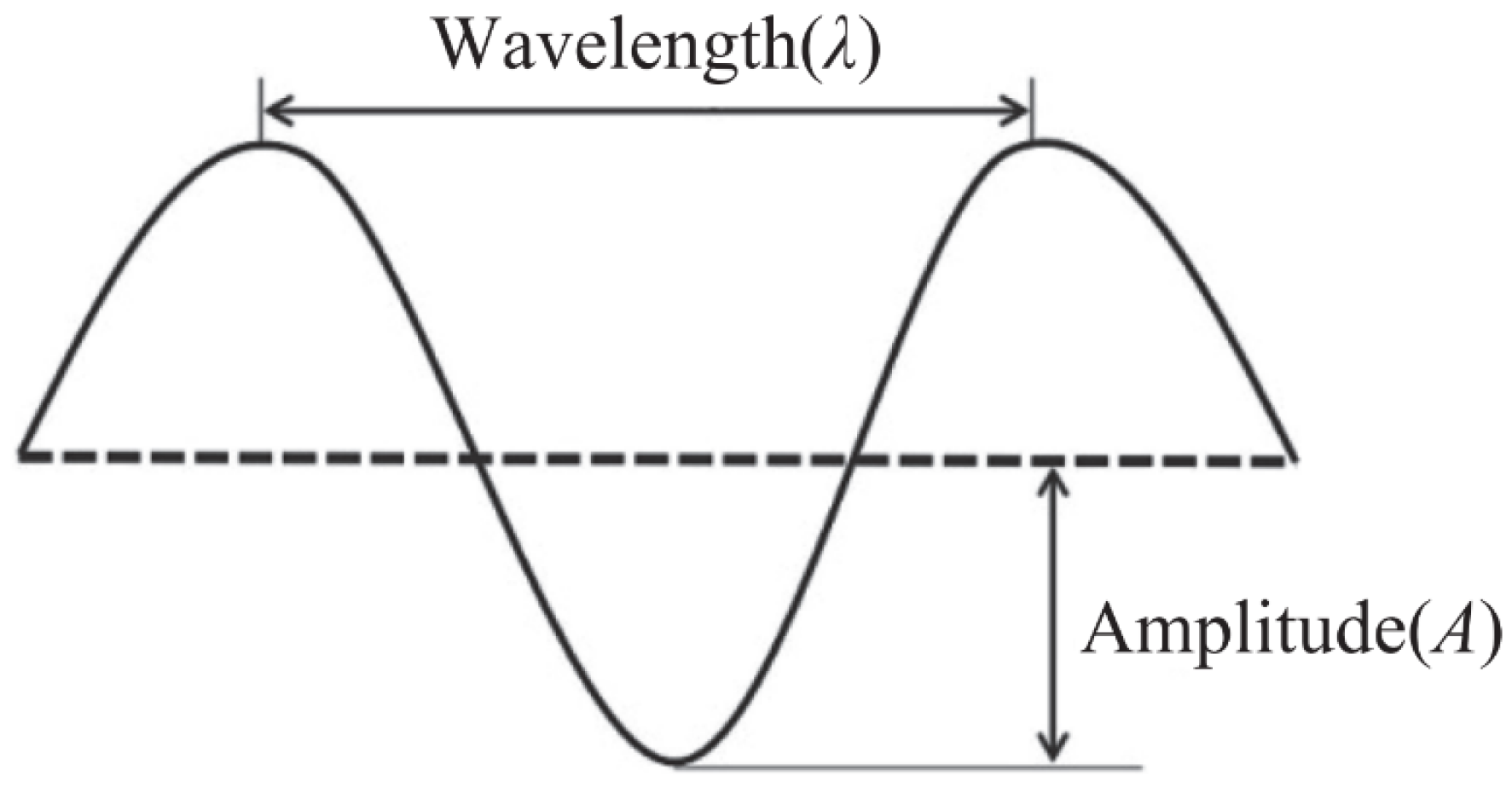
Among these methods, controlled cooling is the most effective and widely used approach for achieving curved grain boundaries In previous studies [8,9], grain boundary characteristics have been quantified in terms of amplitude and wavelength, as illustrated in Figure 1. For the In600 alloy, increasing the cooling rate simultaneously reduces both amplitude and wavelength. In contrast, for the FGH891 alloy, faster cooling rates lead to an increased wavelength and a reduced amplitude. While controlled cooling successfully introduces curved grain boundaries that enhance strength and high-temperature ductility, slower cooling rates cause the significant coarsening of second-phase particles. This coarsening weakens the intragranular microstructure and ultimately degrades overall alloy performance.
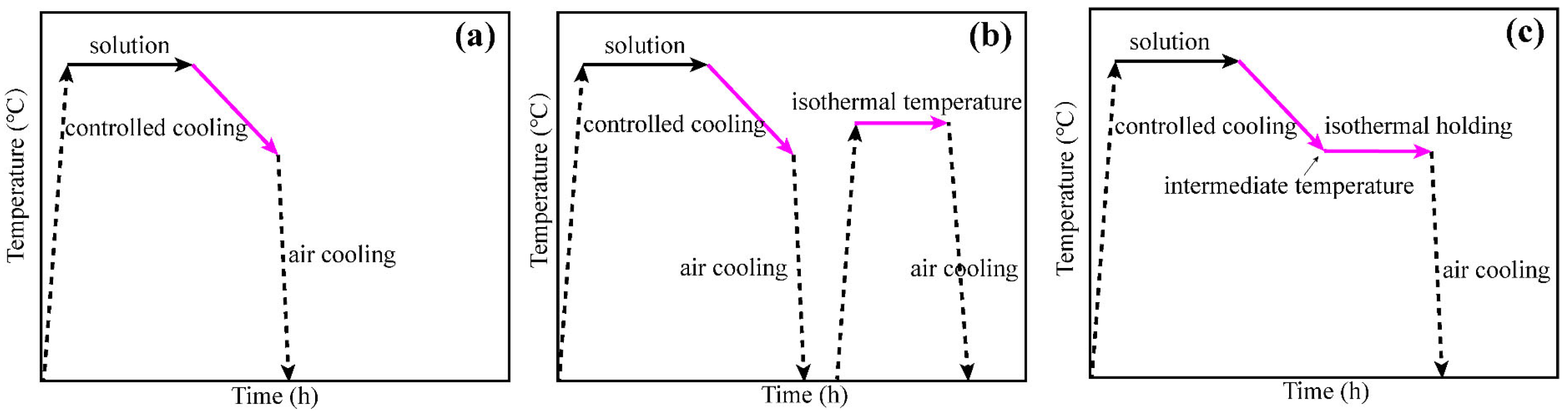
To address the limitations of the controlled cooling process, some researchers have proposed a re-dissolution heat treatment method (Figure 2b). For example, studies [8,9] attempted to apply a similar re-dissolution treatment to Inconel 600. However, the results showed that the carbides precipitated in the alloy were too fine to induce significant curvature in the grain boundaries. Moreover, due to the high cooling rate employed in the experiment and the lack of additional control tests, the effectiveness of the re-dissolution treatment in introducing curved grain boundaries remains inconclusive. As such, several critical questions need to be addressed: Can the curved morphology of the grain boundaries be preserved after re-dissolution treatment? Is it possible to achieve an optimal combination of grain boundary and intragranular microstructures? Can this process improve the overall performance of the alloy? These issues remain unexplored in the literature and require further in-depth investigation.
Tang [9] employed Fourier transform techniques to convert each curved grain boundary profile into its constituent sine waves, representing the grain boundary shape in terms of wavelength and amplitude. By integrating multiple wavelengths and amplitudes into a single scalar value and selecting the three bands with the highest amplitudes, the overall shape of the serrated grain boundary was characterized. While this method improved accuracy and precision to some extent, it did not mitigate the significant workload associated with sequentially quantifying individual grain boundaries. Furthermore, only regions with larger curvature amplitudes were selected during the calculation process, limiting a fully objective and comprehensive representation of the overall grain boundary morphology.
The precise quantification of grain boundary curvature is not merely an academic exercise but a prerequisite for systematic grain boundary engineering. Without reliable metrics, establishing quantitative relationships between processing parameters and grain boundary morphology remains impossible. Such relationships are essential for optimizing heat treatment protocols to achieve target grain boundary configurations that maximize creep resistance and high-temperature ductility.
Beyond Fourier-based methods, curve reconstruction approaches such as least squares fitting and spline interpolation have been employed for curvature calculation. However, these methods exhibit significant shrinkage at corner points or require complex parameter selection for interpolation features. Traditional discrete curvature methods, including the curvature-circle approach, suffer from poor rotational invariance due to varying pixel distances in digital images. To overcome these limitations, this study proposes an integrated framework combining curvature variance filtering with U-chord curvature calculation. The curvature variance filtering adaptively determines smoothing parameters based on local curve roughness, eliminating trial-and-error parameter selection while preserving critical boundary features. The U-chord curvature method defines support neighborhoods based on arc length rather than pixel count, ensuring rotational invariance and noise resistance. Furthermore, the integration of depth-first search segmentation enables automated batch processing of all grain boundaries, providing comprehensive and objective morphological characterization.
The primary distinction between the isothermal treatment method (Figure 2c) and the slow cooling process is the use of a lower temperature to form curved grain boundaries. This lower temperature suppresses grain growth and results in the formation of finer grains. The isothermal treatment method has been successfully applied to alloys such as GH37, GH33, GH36, GH69, and GH220, all of which have been shown to develop curved grain boundaries [10].
In the field of materials science, metallographic microstructure analysis is a vital technique [11,12]. Microstructure images of alloys provide extensive data, including information on grain shape, size, and spatial distribution, as well as the morphological characteristics and distribution of second phases. These data are crucial for understanding material properties and predicting the macroscopic performance of materials [13,14]. The integration of digital image processing techniques with stereology has enabled the quantitative characterization of alloy microstructures, facilitating the establishment of “microstructure–property” relationships and enabling more accurate performance predictions.
With the rapid advancement of computer technology, deep learning has been widely adopted in materials science. Specifically, within the framework of deep learning, innovative computer vision solutions have been introduced, significantly reducing reliance on human expertise. These methods have demonstrated excellent performance in tasks such as classification, segmentation, and detection of alloy microstructures [15,16,17]. However, there are currently no reports on the application of deep learning for grain boundary segmentation and extraction. One challenge lies in the extremely fine features of curved grain boundaries, which require a large amount of sample data to effectively train deep learning models. Another challenge is the high complexity of deep learning models, which often makes it difficult to interpret their decision-making processes, resulting in limited model interpretability [18].
At present, the morphological characterization of curved grain boundaries relies predominantly on manual measurement. There is a lack of suitable algorithms for efficiently processing microstructure images and precisely quantifying grain boundary curvature. Furthermore, the extraction of geometric information from grain boundaries and the quantitative characterization of curved grain boundary morphology remain unresolved issues. This scientific and technical gap limits the effective and accurate control of curved grain boundary morphology.
This study represents an innovative integration of established mathematical techniques—previously unexplored in the context of grain boundary characterization—with novel contributions including the coordinate transformation approach and morphology classification framework. The proposed framework distinguishes itself from existing methods in four key aspects: (1) unlike Fourier-based methods that require subjective band selection, our approach provides comprehensive local curvature characterization; (2) by preserving spatial position information, the proposed metric enables direct correlation between high-curvature regions and precipitate locations, facilitating mechanistic understanding of grain boundary pinning; (3) compared to spline-based methods requiring manual feature point identification, our curvature variance filtering adaptively determines smoothing parameters; and (4) the U-chord curvature calculation overcomes the pixel spacing sensitivity inherent in traditional curvature-circle methods. Furthermore, the spatially resolved nature of the curvature metric enables clear differentiation between serrated and wavy morphologies that may exhibit similar amplitude-wavelength characteristics but arise from distinct δ-phase precipitation patterns. Additionally, through the application of specialized heat treatment processes, this method successfully introduced “serrated” and “wavy” curved grain boundaries into the GH4169 alloy.

2. Quantitative Analysis Method of Curved Grain Boundary

2.1. Image Preprocessing

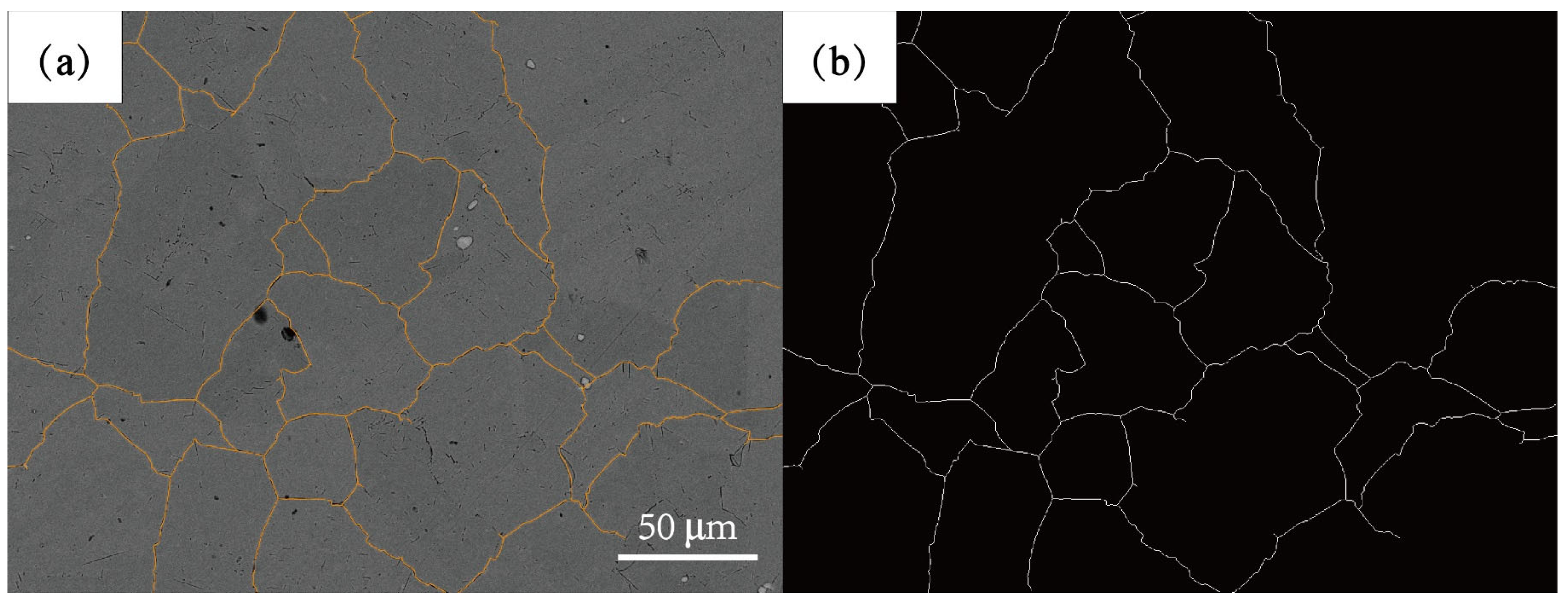
This study combines optical microscopy (OM) and scanning electron microscopy (SEM) with the widely used image analysis software, Image-Pro Plus 6.0, to quantitatively analyze the microstructural morphology and grain boundary characteristics. The extraction of geometric information from grain boundaries begins with image processing techniques designed to enhance contrast, eliminate internal precipitates or artifacts, and produce a binarized image of the grain boundaries. Manual enhancement is applied when grain boundaries are obscured by overlapping δ-phase precipitates, exhibit insufficient contrast for automated detection, or appear discontinuous due to incomplete corrosion revelation (Figure 3a). A limitation of the current study is that inter-operator reproducibility was not formally evaluated. We recommend that future implementation of this method includes reproducibility testing with multiple operators to establish confidence intervals for curvature measurements.
To simplify subsequent analysis of grain boundary morphology, the Thinning function in Image-Pro Plus 6.0 is applied to refine the binarized grain boundary image. This morphological operation iteratively removes pixels from the boundaries while preserving the connectivity and topology of the grain boundary network, ultimately reducing the boundary width from multiple pixels to a single-pixel width (Figure 3b). Such refinement ensures more accurate and efficient analysis of grain boundary features in later stages, as single-pixel-width boundaries enable unambiguous determination of boundary coordinates for subsequent curvature calculations.

2.2. Grain Boundary Geometry Information Data Extraction

Currently, quantitative evaluation of grain boundary curvature relies primarily on manual measurement of individual boundaries. This process is inefficient and complicates morphological data extraction. Given the complexity of grain boundary images, which often include numerous nodes and intricate connections, this study employs a depth-first search (DFS) algorithm to segment and extract the pixel coordinates of each grain boundary from the image.
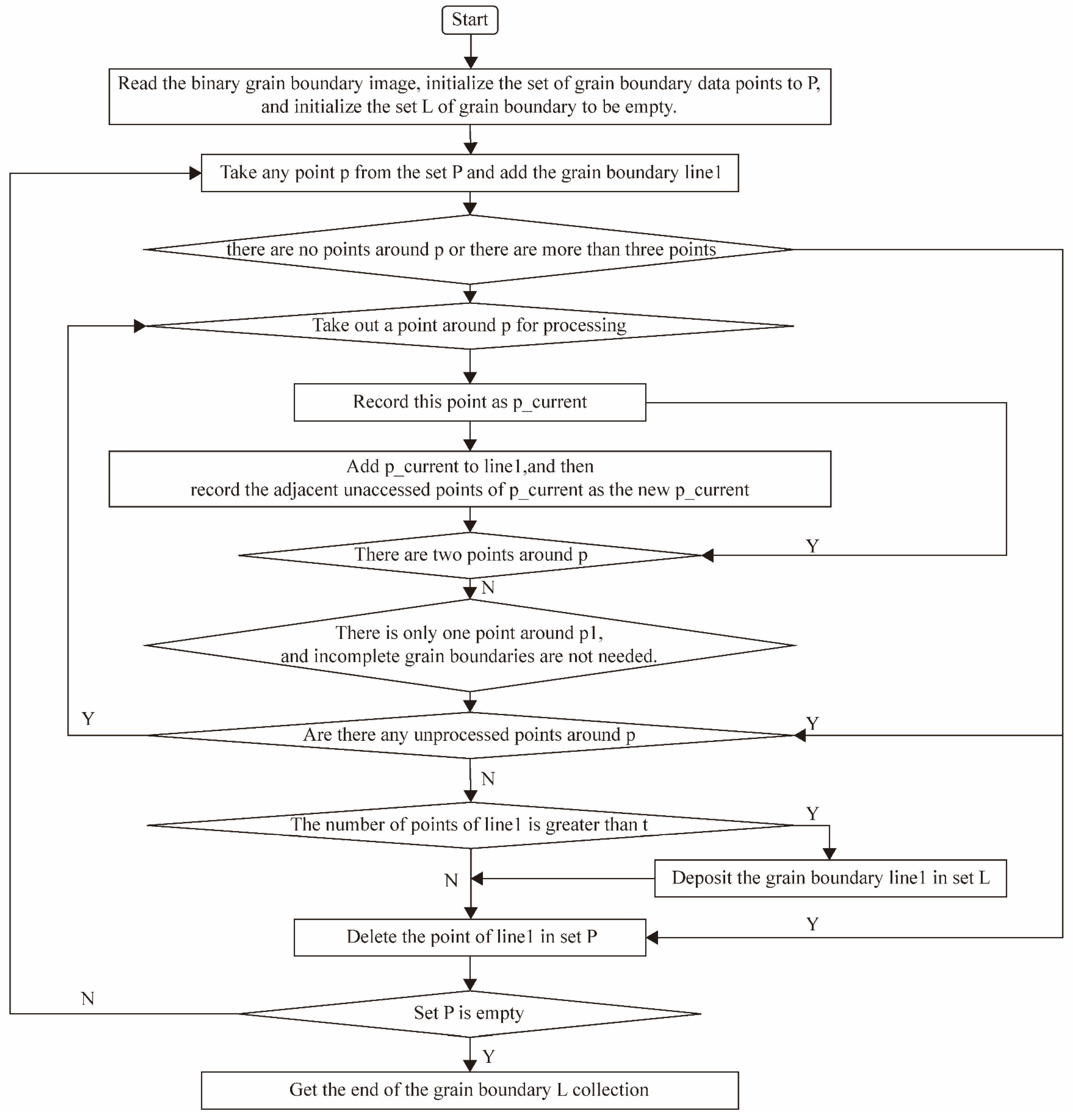
In a graph model, the depth-first search algorithm operates as follows: starting from a selected node in the graph, the algorithm marks the node and explores its adjacent nodes, recording them. It then continues traversing deeper along the current node before backtracking to explore other branches [19]. This systematic approach ensures efficient traversal and extraction of grain boundary features. The flowchart of the depth-first search algorithm is presented in Figure 4.
It is worth noting that in polycrystalline microstructures, grain boundaries frequently converge at triple junctions, where three or more grain boundaries meet. Accurate segmentation of individual grain boundaries at these complex nodes is critical for subsequent curvature analysis. The DFS algorithm employed in this study distinguishes between true triple junctions and spurious branching points caused by image noise or pixelation artifacts through a branch length probing mechanism. A junction is classified as a true triple junction only when at least three branches exceed the minimum length threshold (10 pixels in this study). Short branches below this threshold are considered noise artifacts and were excluded.

2.3. Curvature Variance Filtering Method to Reconstruct the Discrete Curve

To accurately reflect the physical significance of grain boundary curvature, it is necessary to transform the image coordinate system into a grain boundary coordinate system. In this study, the planar four-parameter method is applied to transform the extracted pixel coordinates of the grain boundary. This transformation ensures that the two endpoints of the grain boundary curve align precisely with the horizontal axis of the new coordinate system, thereby approximating the original flat state of the grain boundary as the horizontal axis.
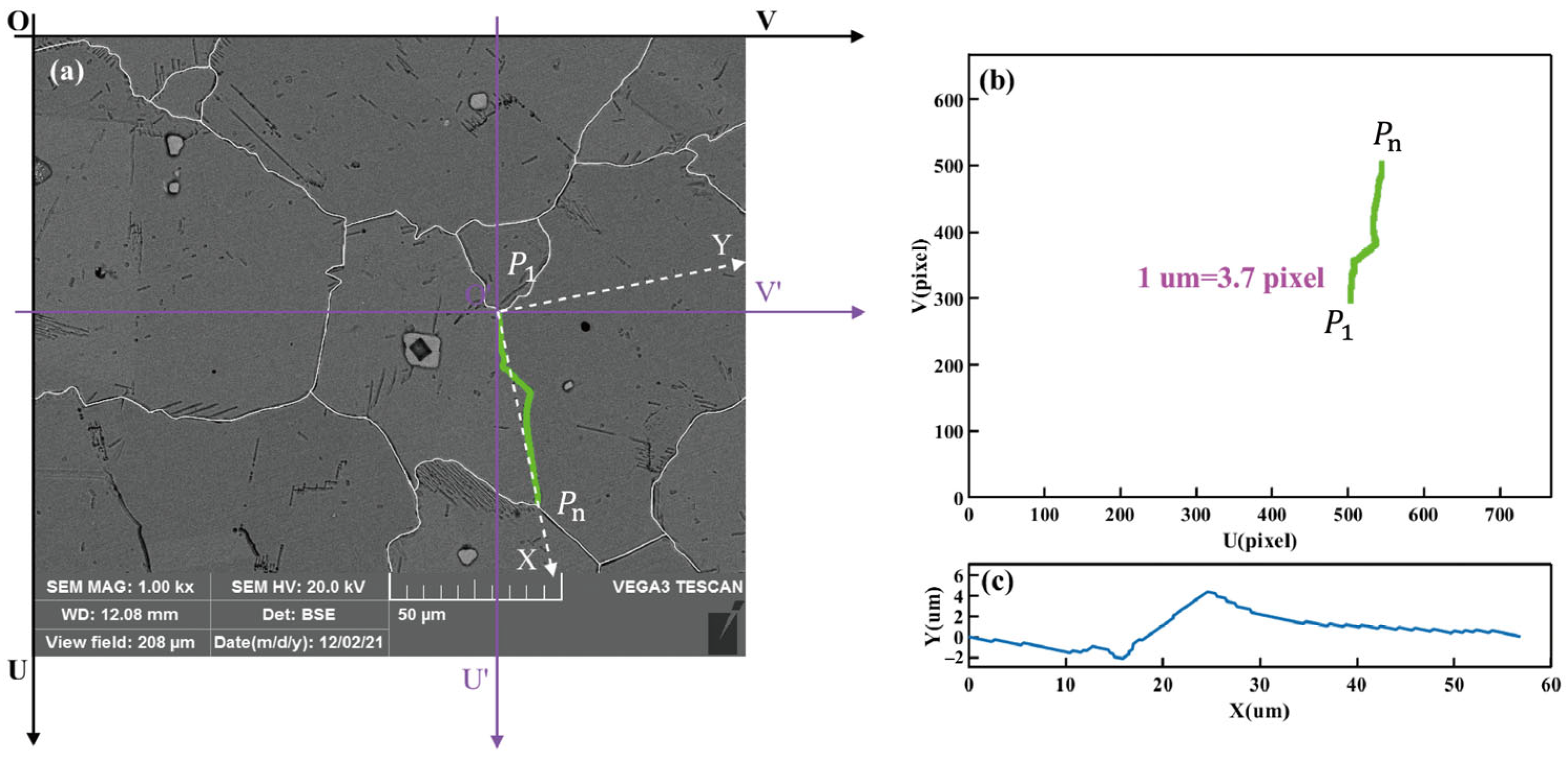
As shown in Figure 5, using the green grain boundary as an example, the coordinates of the two endpoints in the image coordinate system UOV are denoted as P 1 ( u 1 , v 1 ) and P n ( u n , v n ) . During the calculation, the rotation direction is consistently set to counterclockwise, and the point with the smaller horizontal coordinate is chosen as the origin of the grain boundary coordinate system. The transformation formula between the image coordinate system UOV and the grain boundary coordinate system XO’Y is as follows:
x y = u n u 1 u n u 1 2 + v n v 1 2 v n v 1 u n u 1 2 + v n v 1 2 v n v 1 u n u 1 2 + v n v 1 2 u n u 1 u n u 1 2 + v n v 1 2 u u 1 v v 1
Grain boundary geometric information is stored in microstructure images as pixel coordinates. During curve reconstruction, measurement errors are inevitably introduced. To restore the intrinsic characteristics of the grain boundaries and improve the accuracy and rationality of the data, it is essential to smooth the collected data. Currently, the smoothing of various types of data is primarily achieved through numerical analysis methods, which typically require one or more input parameters.
For example, in Gaussian filtering, a larger smoothing scale factor can effectively suppress noise. However, this approach not only causes the curve to shrink but also results in the loss of critical curve details. Moreover, in the absence of prior knowledge about the characteristic size of the curve, the value of the smoothing scale factor is often determined through trial and error. When a curve consists of features with varying sizes (e.g., regions with both high and low curvature), it becomes necessary to use different input parameters for regions with differing curvatures.
B. K. Ray et al. [20] proposed a method to determine the degree of smoothing for different regions of a curve based on its local properties. This method utilizes the variance of curvature within a neighborhood of points as a measure of roughness. Different regions of the curve exhibit varying levels of roughness, requiring different amounts of smoothing accordingly.
Initially, before calculating the curvature, the original data is smoothed using Gaussian filtering. The smoothing window w can be set to 3, 5, or other values, meaning that smoothing is performed using the adjacent 3 or 5 data points. Evidently, larger window sizes impart greater smoothness to the curve during Gaussian filtering.
Suppose that the coordinates of a data point on the input curve are p i = ( x i , y i ) , the smoothed coordinates are P i = ( X i , Y i ) , and i = 1, 2, … N.
X i = j = w 1 2 w 1 2 c j x i + j Y i = j = w 1 2 w 1 2 c j y i + j
where cj is the smoothing coefficient, substituting these smoothed coordinates into the curvature calculation formula, the curvature k i , w at position p i is obtained. Define the square of the curvature variance as:
σ i , w 2 = Σ κ i , w 2 / w Σ κ i , w / w 2
The smoothing window w can be increased from 3 to ensure the data is sufficiently smoothed. When the condition σ i , w 2 σ i , w 2 2 is satisfied, the smooth window stops updating. In the calculation, the maximum value of the smoothing window can also be set according to the actual situation to limit its maximum smoothness. This method avoids the loss of details caused by large-scale Gaussian filtering. This method has a small amount of calculation and is more suitable for densely distributed, noisy data obtained from digital images. It is also suitable for processing grain boundary data obtained from microstructure images. The additional calculation involved in this process is the calculation of curvature variance. The calculation method of curvature of a data point will be discussed in detail in the next section.

2.4. U-Chord Curvature to Calculate the Discrete Curvature of Grain Boundaries

Curvature is a fundamental mathematical tool for describing geometric shapes and is widely used as a geometric invariant for feature point extraction in contour analysis. While curvature has a strict mathematical definition in the continuous domain, grain boundaries in microstructure images are represented as discrete curves in computer vision and image analysis applications. During digitization, the precise information of continuous objects is inevitably lost.
Methods for calculating the curvature of discrete data can be broadly categorized into two main approaches. The first approach involves reconstructing a continuous curve from discrete data using techniques such as curve fitting or spline function interpolation [21]. The curvature of the reconstructed curve is then used as an estimate of the curvature of the original data. The second approach directly defines curvature calculation methods based on the definition and properties of curvature, ensuring that these new definitions are consistent with the mathematical definition of curvature in continuous space.
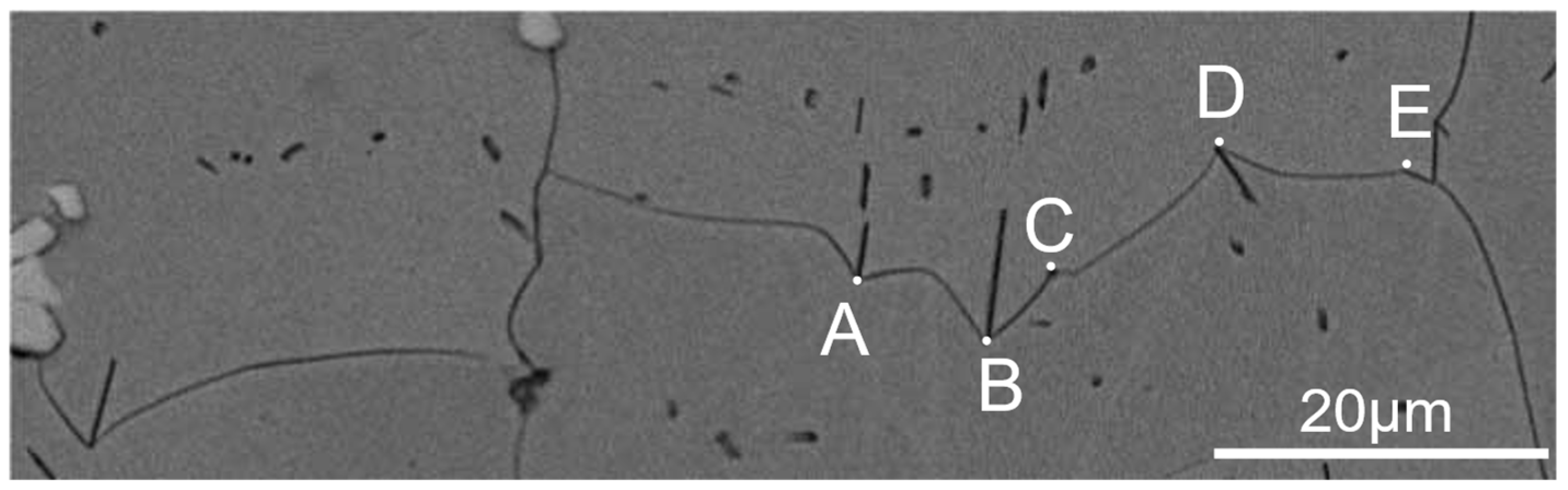
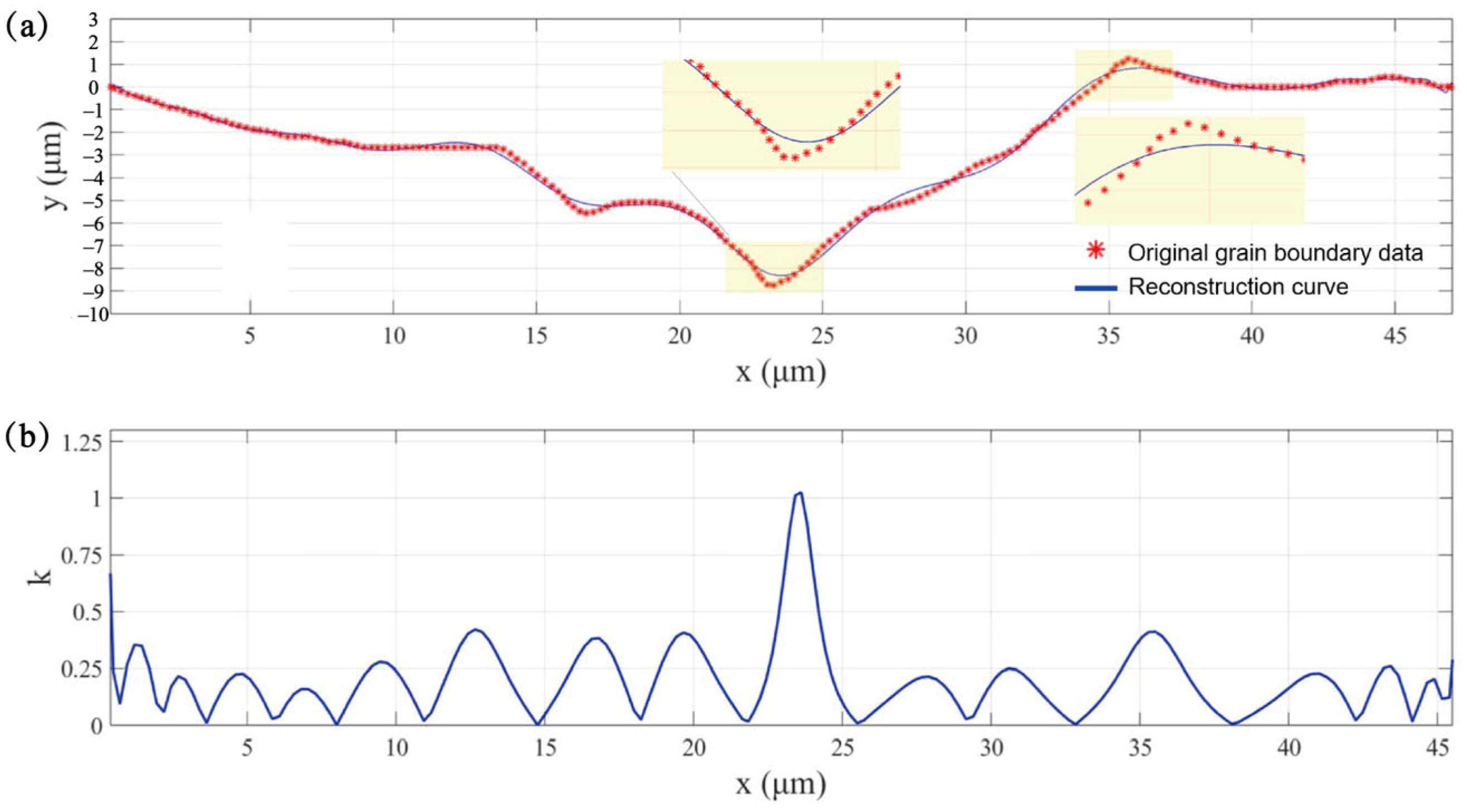
To evaluate the feasibility of these methods for calculating the curvature of grain boundaries, the first approach was applied to the curved grain boundary depicted in Figure 6. The resulting grain boundary data and curvature calculation results obtained using the least squares fitting method are shown in Figure 7. The curve approximated via least squares fitting effectively eliminates extraneous data points. However, this method exhibits significant shrinkage at corner points of the grain boundary, making it unable to accurately capture the sharp curvature changes that are critical for defining the overall trend of the grain boundary. Figure 7 demonstrates why least squares fitting is unsuitable for grain boundary curvature analysis. The upper panel compares the original grain boundary pixel coordinates (blue circles) with the reconstructed curve obtained through least squares fitting (red line). While the fitted curve effectively eliminates extraneous data points and noise, it exhibits significant shrinkage at corner points where the grain boundary changes direction sharply. The lower panel displays the curvature values calculated from the fitted curve, where peaks indicate locations of boundary deflection. However, compared with the original data in the upper panel, the curvature peaks are substantially underestimated because the fitting process smooths out the sharp transitions at corner points, as indicated by the arrows. These corner features are critical for characterizing serrated grain boundary morphology, and their loss renders least squares fitting unsuitable for this application. This limitation motivates the adoption of curvature variance filtering, which adaptively adjusts smoothing intensity to preserve corner features while eliminating noise.
The curved features of grain boundaries are extremely fine, and reconstructing a continuous grain boundary curve using the cubic spline interpolation method requires prior identification of interpolation feature points. Additionally, the calculation accuracy is influenced by the spacing of these interpolation points, which necessitates the selection of numerous parameters and thresholds. These parameters are challenging to determine systematically and automatically. Given these difficulties, this study adopts the second category of methods for calculating the curvature of grain boundaries.
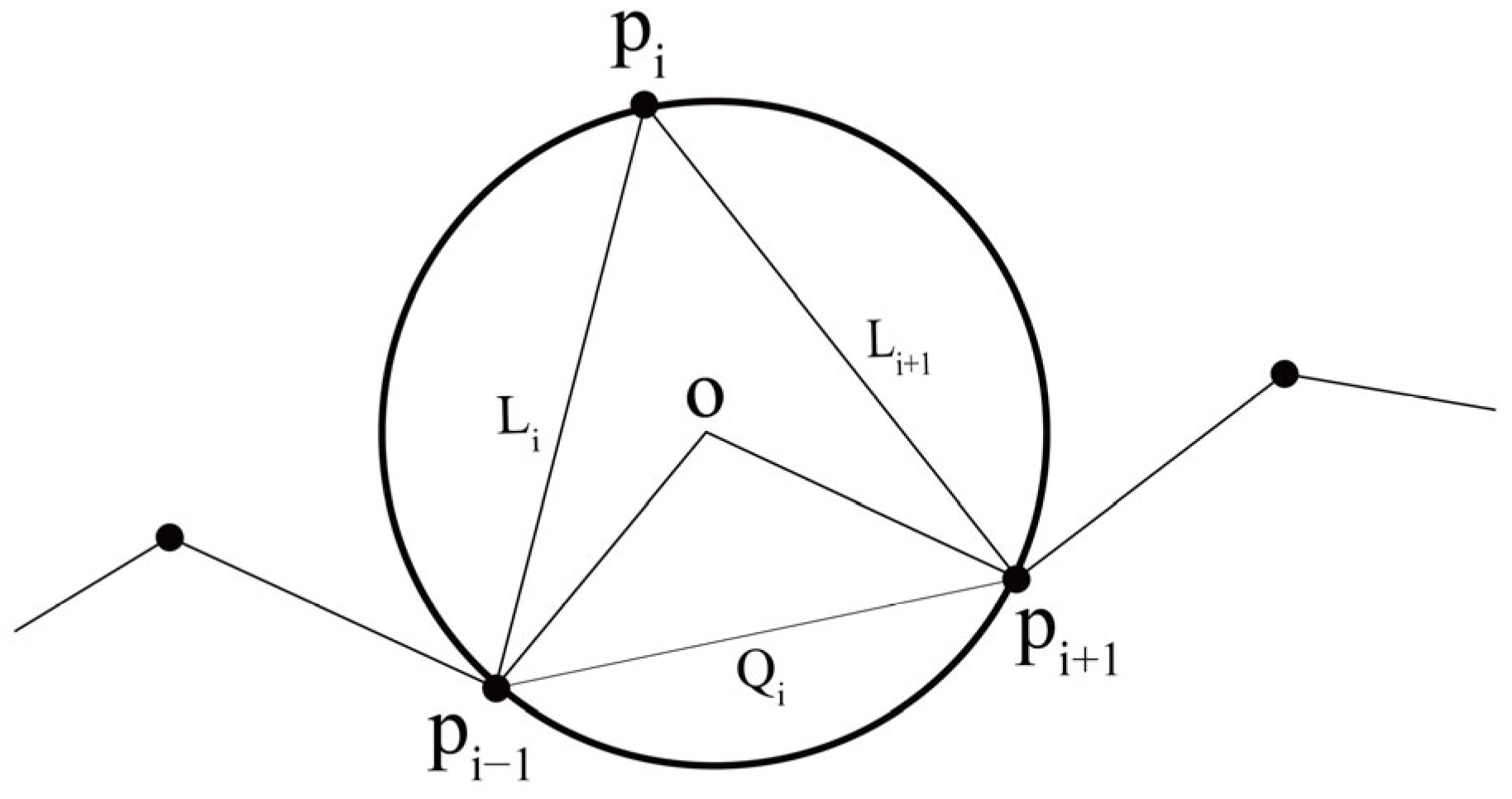
G. H. Liu [22] proposed a method for estimating curvature based on a three-point circular arc interpolation, as illustrated in Figure 8. The curvature K i at the point P i is determined by the circle determined by the adjacent three points, and the curvature of the circle is the curvature of the point P i :
K i = ± 1 R = 4 Δ P i 1 P i P i + 1 L i L i + 1 Q i
represents the Euclidean distance between two pixels.
Formula (4), L i =   P i P i 1 ,   Q i =   P i + 1 P i 1 ,   Δ P i 1 P i P i + 1 is the area of the symbolized triangle. When P i 1 , P i , P i + 1 is counterclockwise, K i is positive, indicating that P i is a convex point, otherwise K i is negative.
In curvature estimation, first-order and second-order divided differences are commonly used to approximate the first and second derivatives of the curve. These approximations are then substituted into the formula for planar curvature. Variations in the formulations of first-order and second-order divided differences result in different curvature expressions. Among these, B. K. Ray [20] proposed the following method:
Δ x i = x i + 1 + x i 1 x i + 1 + x i 1 2 + y i + 1 + y i 1 2 Δ y i = y i + 1 + y i 1 x i + 1 + x i 1 2 + y i + 1 + y i 1 2 Δ 2 x i = x i + 1 x i x i + 1 x i 2 + y i + 1 y i 2 x i x i 1 x i x i 1 2 + y i y i 1 2 1 2 x i + 1 x i 1 2 + y i + 1 y i 1 2 Δ 2 y i = y i + 1 y i x i + 1 x i 2 + y i + 1 y i 2 y i y i 1 x i x i 1 2 + y i y i 1 2 1 2 x i + 1 x i 1 2 + y i + 1 y i 1 2
The approximate curvature K i at point P i is given by:
K i = Δ x i Δ 2 y i Δ y i Δ 2 x i
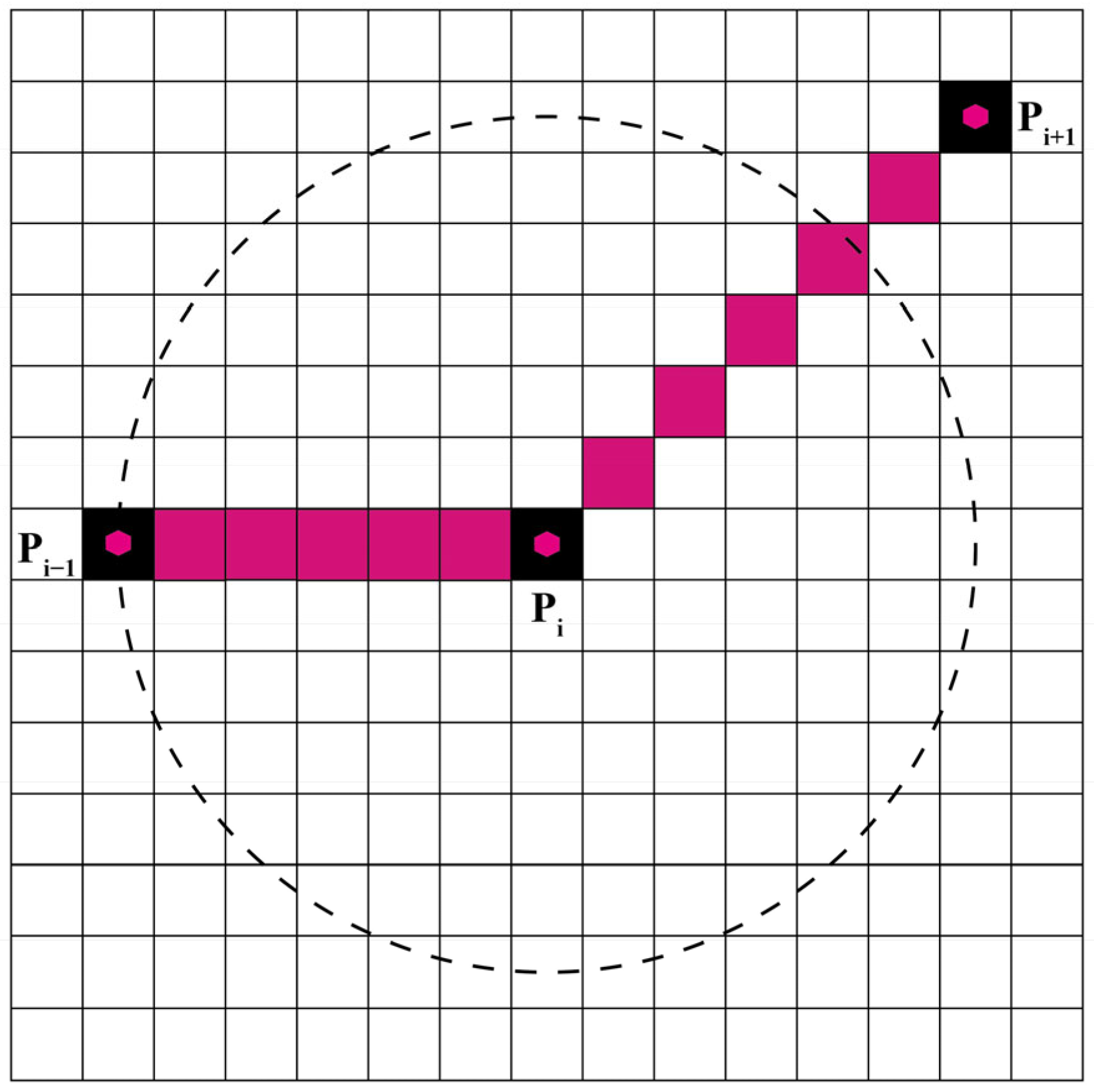
The methods described above share a common feature: they calculate the curvature at a given point using a supporting neighborhood centered on that point. The size of the supporting neighborhood is determined based on the number of pixel points. However, as shown in Figure 9, the distance between two adjacent pixel points may vary, being either 1 or 2 . Consequently, these methods exhibit poor noise resistance and rotational invariance, which can negatively affect the accuracy of curvature calculations.
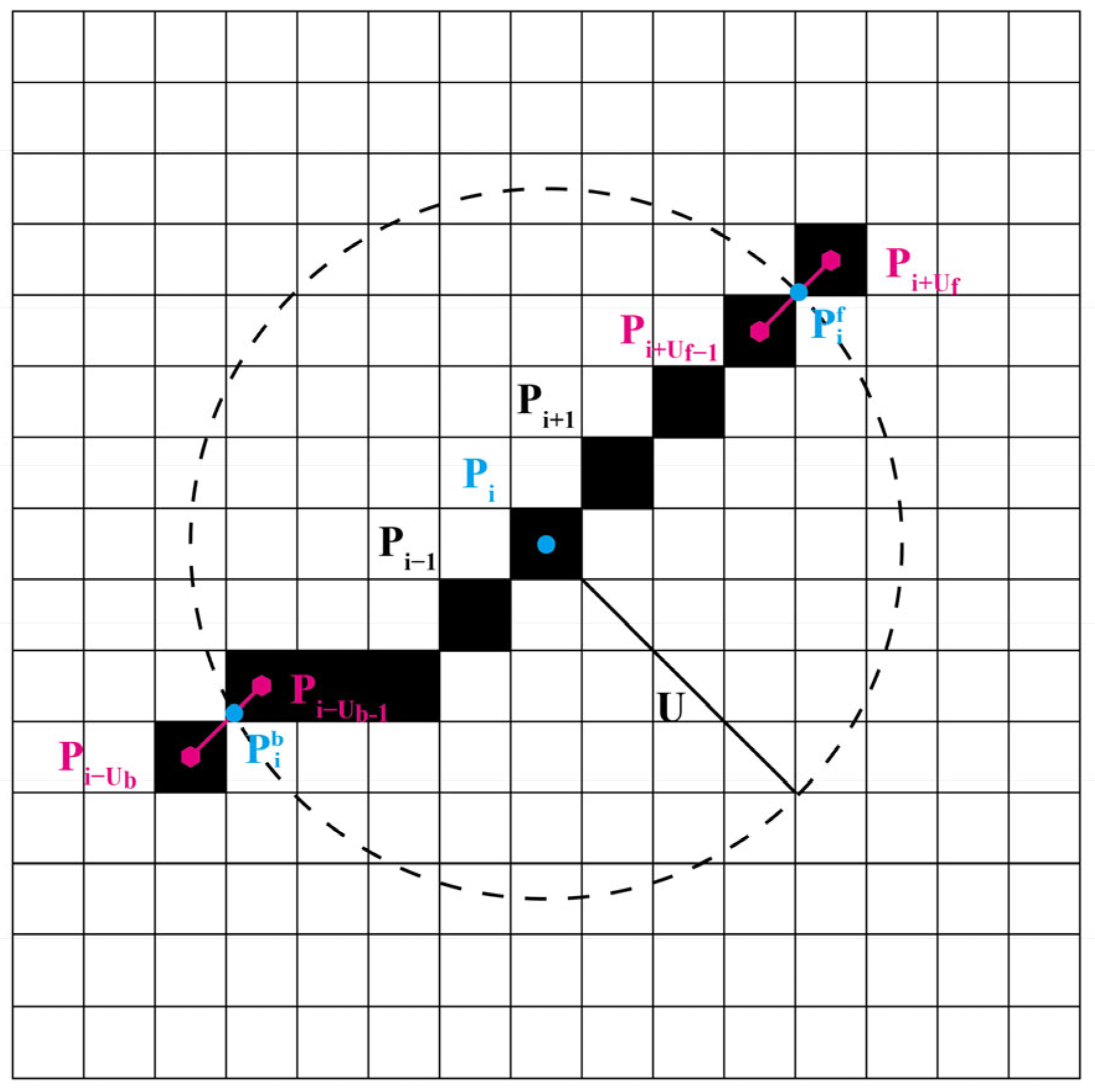
B Zhong [23] proposed an implicit refinement curve strategy based on the curve’s cumulative arc length, called L-arc length curvature. The main idea is to comprehensively consider the distance between adjacent pixels when selecting the support neighborhood. Based on this method. J.-J. Guo [24] proposed a new discrete curvature calculation method called U-chord curvature. The specific methods are as follows:
As shown in Figure 10, for the set of ordered points P = p i : x i , y i , i = 1 , 2 , , n , consider the current point p i , whose support field Ω p i = p i U b , p i + U f is determined by the constraint condition | | p i p i U b | | = | | p i p i + U f | | = U . Because of the discrete characteristics of the digital curve, the results determined by the above conditions can only be roughly satisfied. Therefore, the implicit refinement digital curve strategy is used to improve the accuracy of the calculation so that the constraints can be accurately satisfied.
p i f = u p i + U f 1 + ( 1 u ) p i + U f 1 , 0 u 1
The undetermined coefficient u is obtained according to Formula (7), and the endpoints p i f and support domain are obtained. The specific calculation formula of U-chord length curvature is:
c i = s i g n 1 D i 2 U 2
In Formula (8), D i = | | p i b p i f | | .
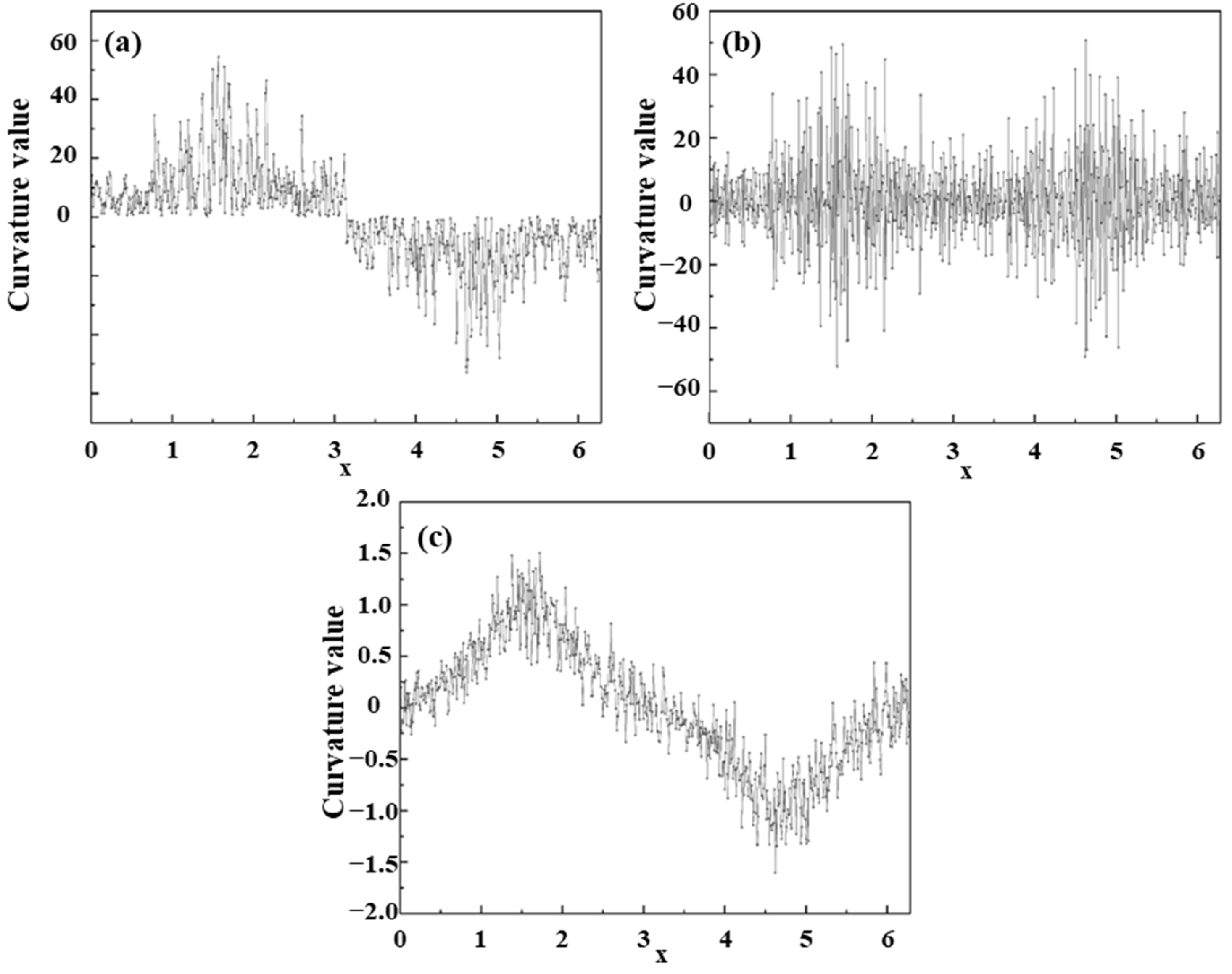
To evaluate the stability of different discrete curvature calculation methods and identify the most suitable approach for this study, a sine curve with a typical curvature distribution was selected as the standard test curve. The curve was randomly sampled at n data points within the interval [0, 2π], and Gaussian noise following a normal distribution N ( 0 , σ 2 I 2 ) was added to each point to simulate measurement errors encountered in practical applications. Figure 11 presents the curvature results calculated from the noise-contaminated sine curve using three different methods. The comparison reveals that the U-chord curvature method yields results closest to the standard noise-free curve, demonstrating superior noise resistance. In contrast, the difference method exhibits the highest sensitivity to noise, resulting in significant deviations from the true curvature values.
Based on these observations, a hybrid approach was developed that leverages the complementary strengths of different methods. Specifically, the difference method was selected for calculating curvature variance during the filtering stage, as its sensitivity to local variations enables effective detection of regions requiring different degrees of smoothing. The curvature variance filtering technique then provides adaptive smoothing without requiring predetermined parameters, automatically adjusting the smoothing intensity according to local curve characteristics. For the final grain boundary curvature calculation, the U-chord curvature method was adopted due to its demonstrated superiority in noise resistance and rotational invariance. This strategic combination ensures both accurate noise elimination and preservation of essential grain boundary features.
Quantitative benchmark comparison (Figure 11) confirms that U-chord curvature achieves the lowest mean absolute error compared to theoretical values among the three methods evaluated, validating its selection for grain boundary curvature calculation in this study.

3. Experimental Materials and Methods

3.1. Experimental Materials

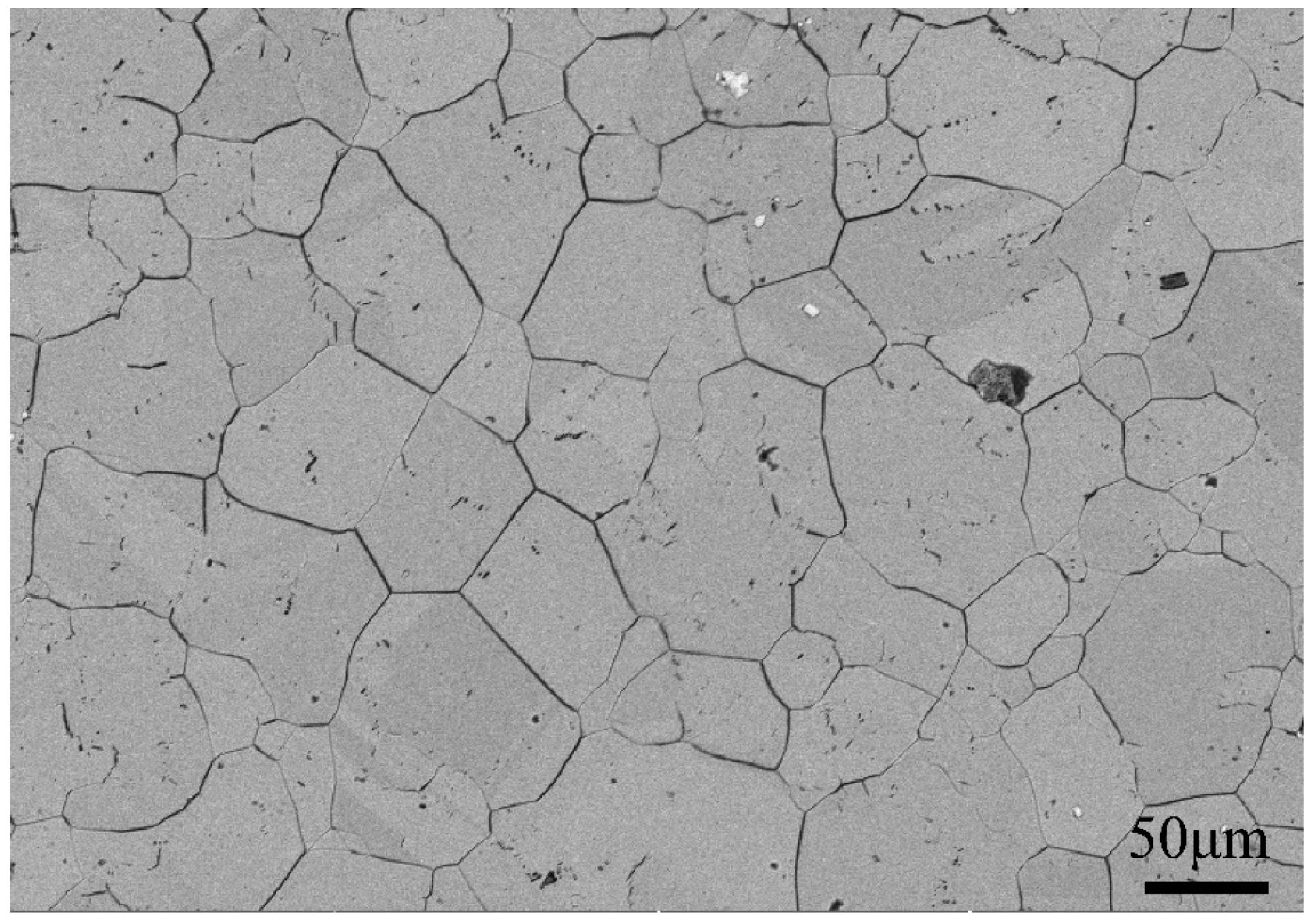
The material used in this study is the GH4169 superalloy, with its chemical composition provided in Table 1. All samples underwent solution treatment at 1040 °C for 1 h to achieve homogenization. As shown in Figure 12, after the solution treatment, the δ phase in the GH4169 superalloy was largely dissolved into the matrix, resulting in straightened grain boundaries. At this stage, the average grain size was measured to be 40 μm. Since all samples were subjected to identical solution treatment at 1040 °C, the initial microstructural state can be considered consistent across all specimens, with the δ phase substantially dissolved into the matrix and uniform average grain size established. Based on this homogeneous starting condition, one sample was prepared for each heat treatment condition. To ensure statistical reliability and minimize measurement errors, grain boundary morphology was characterized at three different locations on each sample, and the reported curvature values represent the statistical averages of these multiple observations.

3.2. Grain Boundary Bending via Heat Treatment

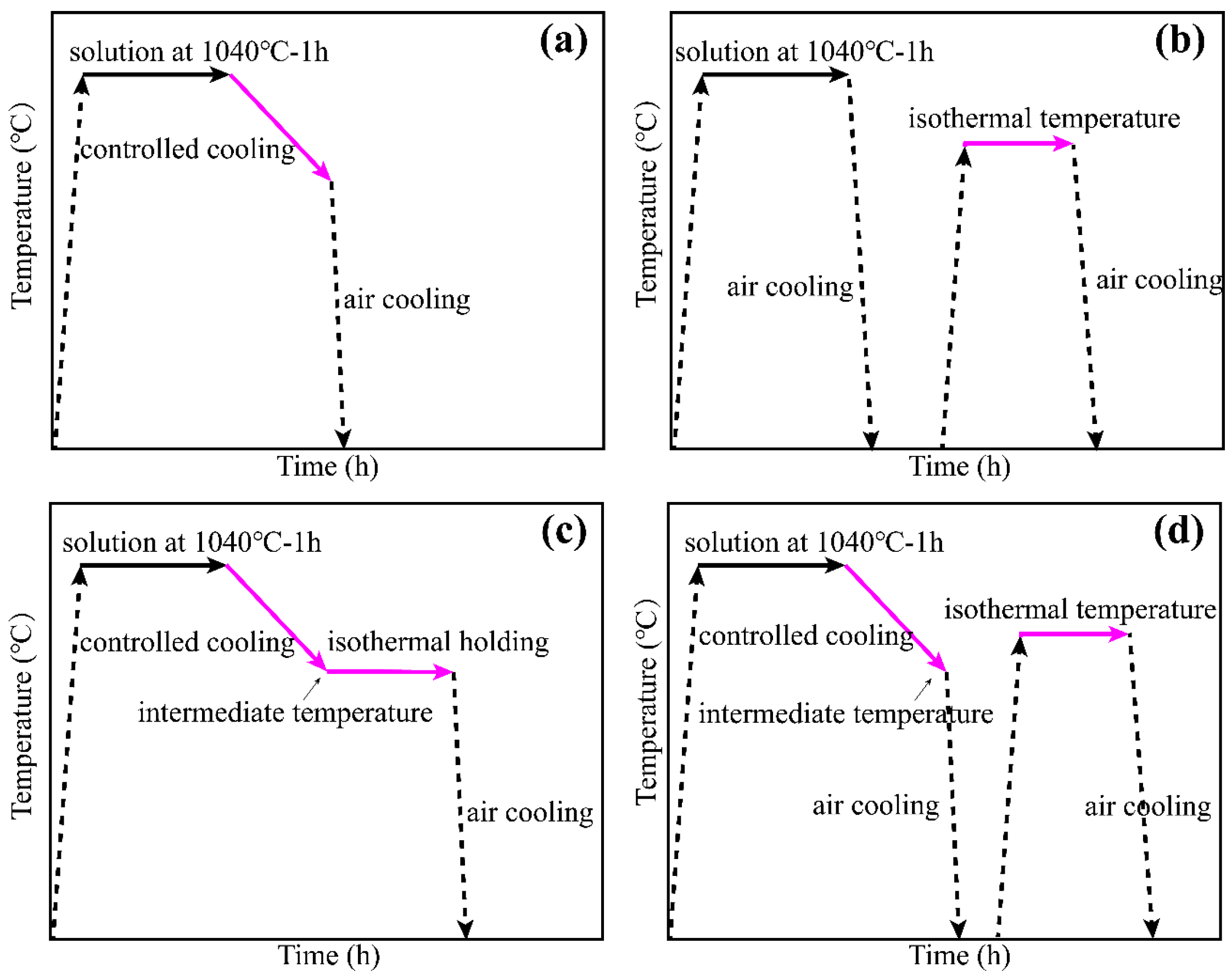
To introduce curved grain boundaries in the GH4169 superalloy, this study employed four specialized heat treatment processes, as illustrated in Figure 13. These processes include controlled cooling, isothermal treatment, a combination of controlled cooling and isothermal treatment, and solution re-treatment, labeled as Process A, Process B, Process C, and Process D, respectively. The detailed parameters for each heat treatment process are presented in Table 2.
The selection of these four heat treatment processes was guided by thermodynamic and kinetic considerations related to δ-phase precipitation in GH4169 alloy, as well as existing literature on grain boundary serration mechanisms. Previous studies have demonstrated that controlled cooling, isothermal treatment, and resolution treatment can induce grain boundary serration. Tang [8,9] systematically studied the serration of grain boundaries in Inconel 600, identifying two distinct formation mechanisms relying upon grain boundary interaction with carbides: Zener-type dragging which hinders grain boundary migration, and faceted carbide growth-induced serration. These findings provided theoretical guidance for our heat treatment design.
For GH4169 alloy specifically, the δ-phase (Ni3Nb) predominantly precipitates at specific angles on Nb-rich grain boundaries and twin boundaries, exhibiting short rod-like or needle-like morphology. According to Azadian et al. [25], δ-phase precipitation requires an incubation period, with the precipitation temperature range between 780 °C and 980 °C. Depending on Nb content, the peak precipitation temperature falls between 900 °C and 940 °C. Based on these thermodynamic and kinetic parameters, the four heat treatment processes were designed to systematically vary the δ-phase precipitation behavior and consequent grain boundary morphology evolution, enabling comprehensive investigation of the relationship between processing parameters and grain boundary serration characteristics.

3.3. Scanning Electron Microscopy-Based Characterization

The samples were prepared using standard metallographic techniques, and the grain boundaries were revealed using a high-temperature oxidation corrosion method. The specific corrosion procedure involved preparing a 20% sulfuric acid solution, bringing it to a boil, and immersing the samples in the solution. Gradually, 10 g of potassium permanganate was added to the solution, generating numerous small bubbles. After 14–18 min of high-temperature oxidation corrosion, the samples were removed and cleaned with oxalic acid while still hot to eliminate surface contaminants. The grain boundary morphology was then observed using a MIRA3XMU TESCAN field-emission scanning electron microscope (TESCAN, Brno, Czech Republic).
To further quantify the degree of grain boundary curvature, several parameters were proposed to characterize grain boundary morphology. These include:
(1)
Mean curvature of grain boundaries (MC)
The discrete curvature of each grain boundary is calculated, and the discrete curvature k i of each point in each region on the grain boundary is obtained. The average value MC is as follows:
M C = | k 1 | + | k 2 | + + | k n | n = i = 1 N | k i | n
In this context, where k i represents the discrete curvature of points on the grain boundary, n denotes the total number of points of the discrete curvature calculation.
(2)
Length ratio of grain boundaries
Data points with a curvature less than 0.15 are classified as flat grain boundary regions, those with a curvature greater than 0.15 are classified as curved grain boundary regions, and those with a curvature greater than 0.55 are classified as serrated grain boundary regions. Threshold values were determined through combined physical interpretation (curvature-to-angle relationship) and statistical analysis of curvature distributions. k = 0.15 corresponds to a boundary deflection angle of approximately 163°, below which boundaries appear visually straight. k = 0.55 corresponds to approximately 113°, marking the transition to serrated morphology. It is worth noting that for application to other nickel-based superalloys or significantly different grain sizes, the threshold values should be validated and potentially recalibrated based on visual correlation with the specific microstructural features of interest. By calculating the proportion of data points for each curvature threshold relative to the total number of data points, the length proportions of grain boundaries with different morphologies can be quantified. This provides a quantitative basis for analyzing the morphological characteristics of grain boundaries.

4. Results and Discussion

4.1. Examples of Grain Boundary Curvature Calculation

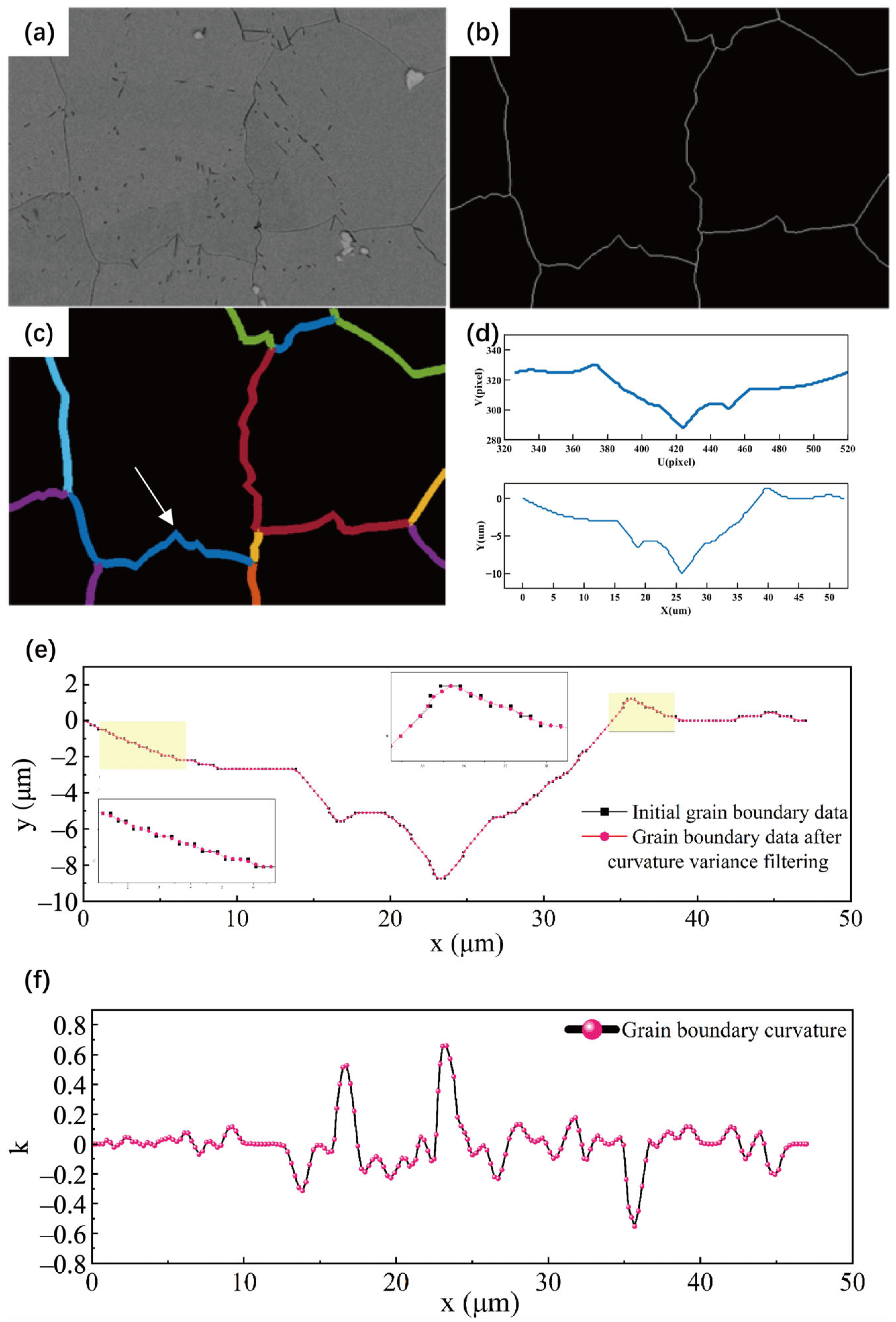
Figure 14 illustrates the effectiveness of the proposed method for grain boundary curvature calculation.
Figure 14a displays the original image of the grain boundaries. Following image preprocessing, including grain boundary segmentation and binarization, the processed result is shown in Figure 14b.
The MATLAB 2020a algorithm implements the depth-first search procedure described in Section 2.2, automatically identifying junction points and segmenting the continuous grain boundary network into individual boundary segments. Each segment is assigned a unique identifier (indicated by different colors in Figure 14c) for independent curvature analysis.
In Figure 14d, the planar four-parameter method is utilized to transform the coordinate system of the grain boundary pixel coordinates, as indicated by the white arrow. This transformation ensures that the two endpoints of the grain boundary curve lie precisely on the horizontal axis of the new coordinate system. This approach simulates the original straight morphology of the grain boundary, where the horizontal axis represents the straightened grain boundary, and the vertical coordinates of each pixel point on the curve indicate the deviation of that point from the straight grain boundary. This transformation provides a clear and accurate representation of the curvature at every point along the grain boundary.
Next, Figure 14e applies a curvature variance filtering method to smooth the grain boundary curves based on the pixel data obtained for each grain boundary. This smoothing process effectively reduces noise while preserving the essential characteristics of the grain boundary. Importantly, there is no significant shrinkage at corner points, ensuring that the morphology of the grain boundary is accurately represented.
Finally, the U-chord length curvature calculation method is applied to compute the discrete curvature of the smoothed grain boundary curves, with the neighborhood parameter U set to 2 μm. The calculation results are shown in Figure 14f, which intuitively reflects the curvature at each point on the curve. This provides an objective and realistic characterization of the overall grain boundary morphology. Additionally, the obtained curvature data can be subjected to statistical analysis to derive characteristic parameters related to grain boundary morphology.
To evaluate the computational efficiency of the proposed method, the processing time for the grain boundaries shown in Figure 14 was recorded. The manual preprocessing steps, including grain boundary enhancement and thinning operations, required approximately 5 min. The subsequent automated computational procedures, encompassing depth-first search (DFS) extraction, coordinate transformation, curvature variance filtering, and U-chord curvature calculation, were completed in less than 1 min. All computations were performed on a personal computer equipped with an Intel i7-8700 processor and 16 GB RAM.
Compared to traditional manual measurement methods, which require researchers to individually measure the amplitude and wavelength of each curved grain boundary segment, the proposed method significantly reduces the time and labor required for quantitative analysis. Once the grain boundary image is preprocessed, the algorithm can automatically extract and calculate the curvature of all grain boundaries in the image simultaneously. Furthermore, compared to deep learning-based approaches, which typically require extensive training datasets and substantial computational resources (e.g., GPU clusters), the proposed method operates efficiently on standard personal computers without the need for specialized hardware or large-scale training data. This makes the method highly accessible and practical for routine metallographic analysis in both research and industrial settings.
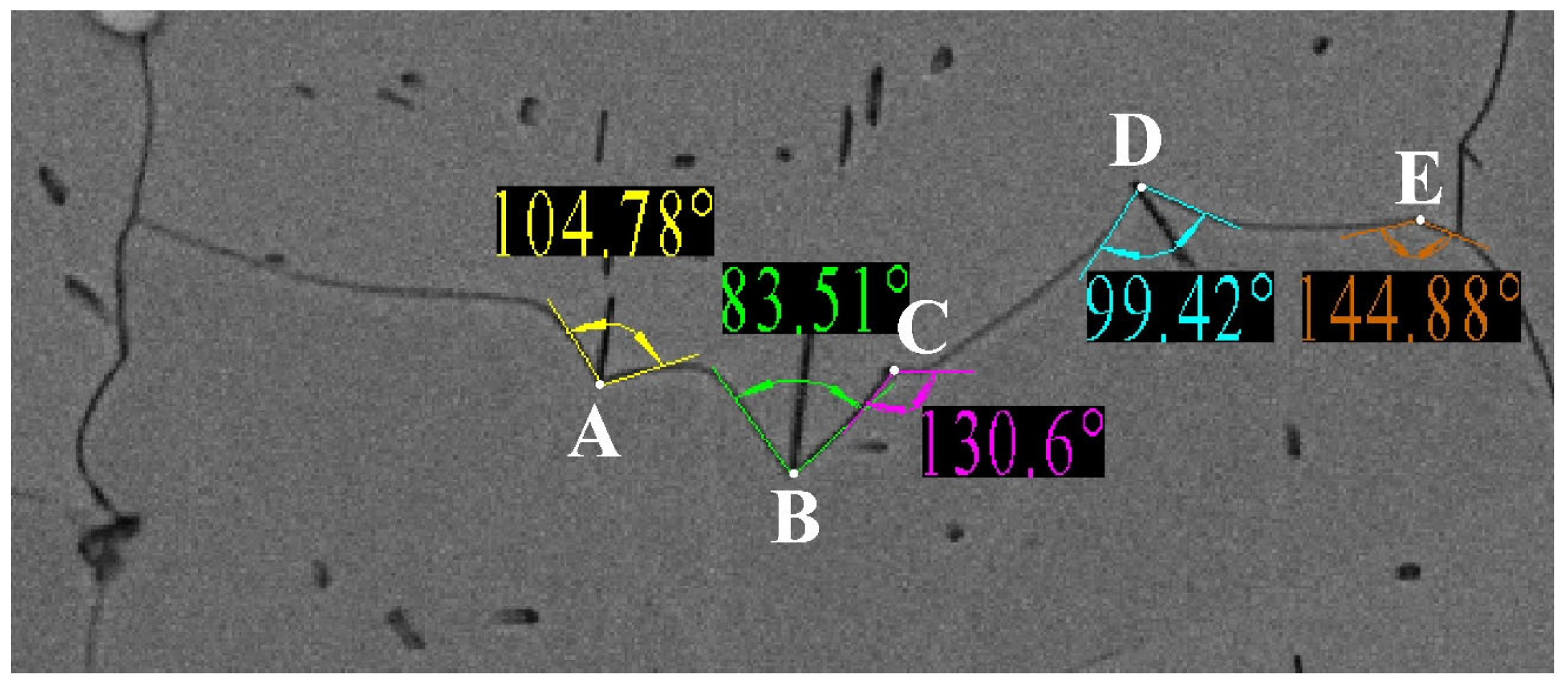
To verify the accuracy of the curvature calculation, Figure 15 employs CAXA 2024 software to measure the bending angles at the five locations with the greatest grain boundary curvature. Simultaneously, the relationship between the U-chord length curvature and angle (Equation (10)) is used to calculate the angles corresponding to the curvature at these five locations.
The calculated angles and the measured angles are presented in Table 3. It can be observed that the differences between the calculated angles and the measured angles are generally around 10°. The approximately 10° deviation between calculated and measured angles represents approximately 5–10% relative error, which is comparable to uncertainties in traditional manual measurement methods and acceptable for grain boundary morphology classification and comparative analysis. While five high-curvature locations were selected for detailed angle validation, the curvature calculation was applied to all data points along all grain boundaries. The selection of high-curvature regions for validation ensures that accuracy is confirmed where measurement precision is most critical. Future validation studies should include larger sample sizes across the full curvature range.
| ci | = cos ( θ 2 )

4.2. Effect of Heat Treatment Process Type on Grain Boundary Morphology

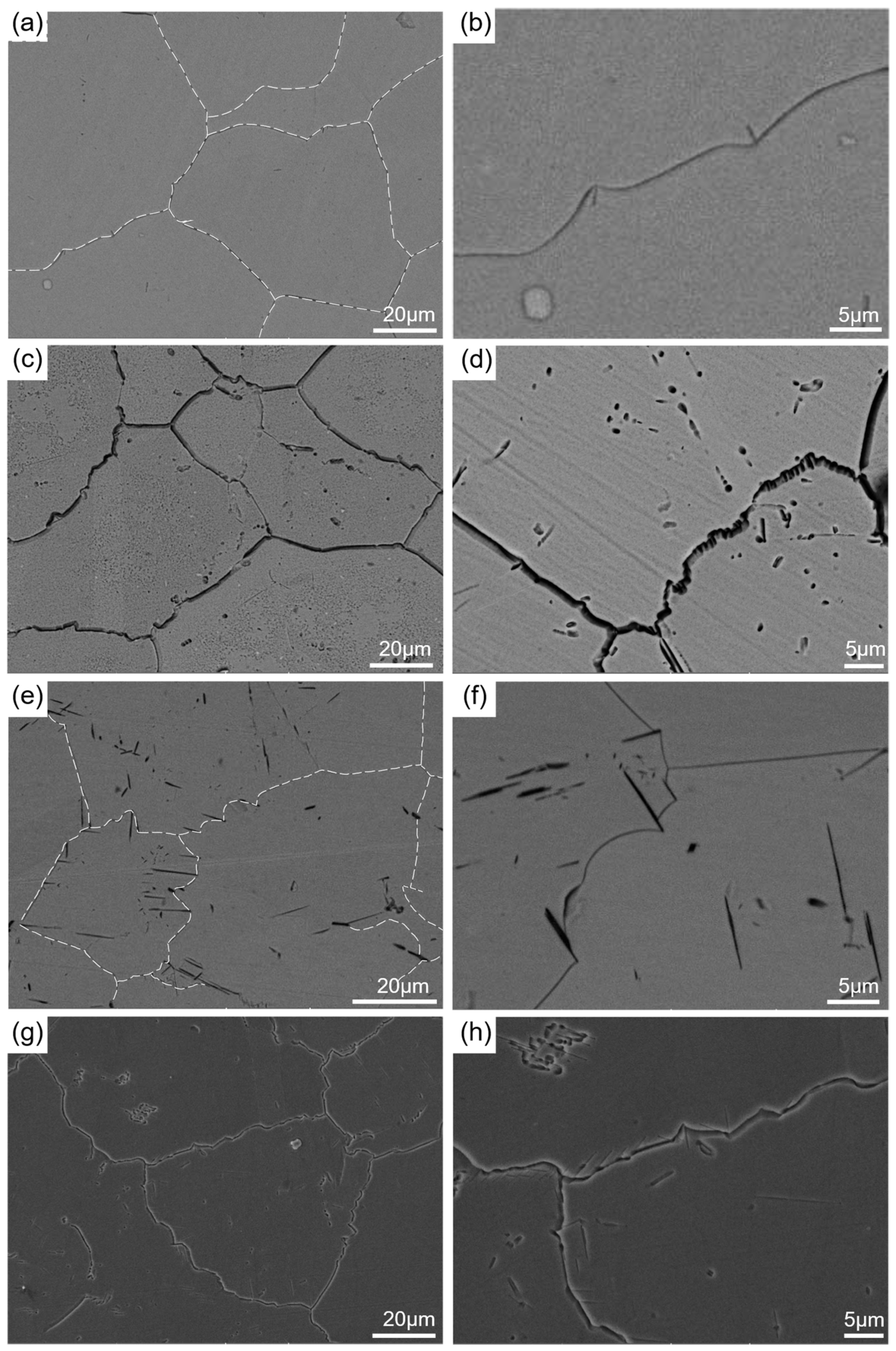
As shown in Figure 16, all four heat treatment processes successfully introduce curved grain boundaries into the GH4169 alloy, but the morphological characteristics of the grain boundaries vary depending on the process. The figure clearly shows that curved grain boundary regions are associated with δ-phase precipitates. In Figure 16b,f, corresponding to Process A and Process C, the grain boundaries protrude at the δ phase precipitation sites, forming serrated and curved morphologies with concave regions between adjacent δ phases. However, in the sample treated with Process C, the grain boundaries exhibit more abrupt transitions and a higher degree of curvature.
In Figure 16d,h, the samples treated with Process B and Process D show that most δ phases precipitate at specific angles to the grain boundaries, typically aligned on one side. Under these conditions, one side of the grain boundary is influenced by multiple δ phase precipitates. A comparison reveals that in the Process B-treated sample, the δ phases precipitate at nearly uniform angles, resulting in minimal grain boundary curvature and a predominantly wavy morphology. In contrast, the Process D-treated sample exhibits significant variation in the angles of δ phase precipitation along individual grain boundaries, with some grain boundaries displaying serrated morphologies.
To evaluate the sensitivity of the proposed quantification method to image resolution, pixel size, and SEM magnification, grain boundary characteristic parameters of Sample D were statistically analyzed at different image resolutions. The statistical results are presented in Table 4. The results demonstrate that the proposed method exhibits excellent stability across different image resolutions. This stability can be attributed to two key aspects of the proposed method. First, the curvature variance filtering method adaptively adjusts the smoothing window based on local curve properties, which effectively accommodates variations in pixel density at different resolutions. Second, the U-chord curvature calculation method employs a physical length-based neighborhood parameter (U = 2 μm) rather than a pixel-based parameter, ensuring that the curvature calculation remains consistent regardless of image resolution. These features make the proposed method robust and reliable for practical applications where imaging conditions may vary.
The results presented above also demonstrate the robustness of the proposed method across grain boundaries with substantially different curvature scales. The four heat treatment processes produced grain boundaries ranging from weakly curved to strongly serrated morphologies, providing an ideal dataset to validate the method’s applicability across a wide curvature spectrum.
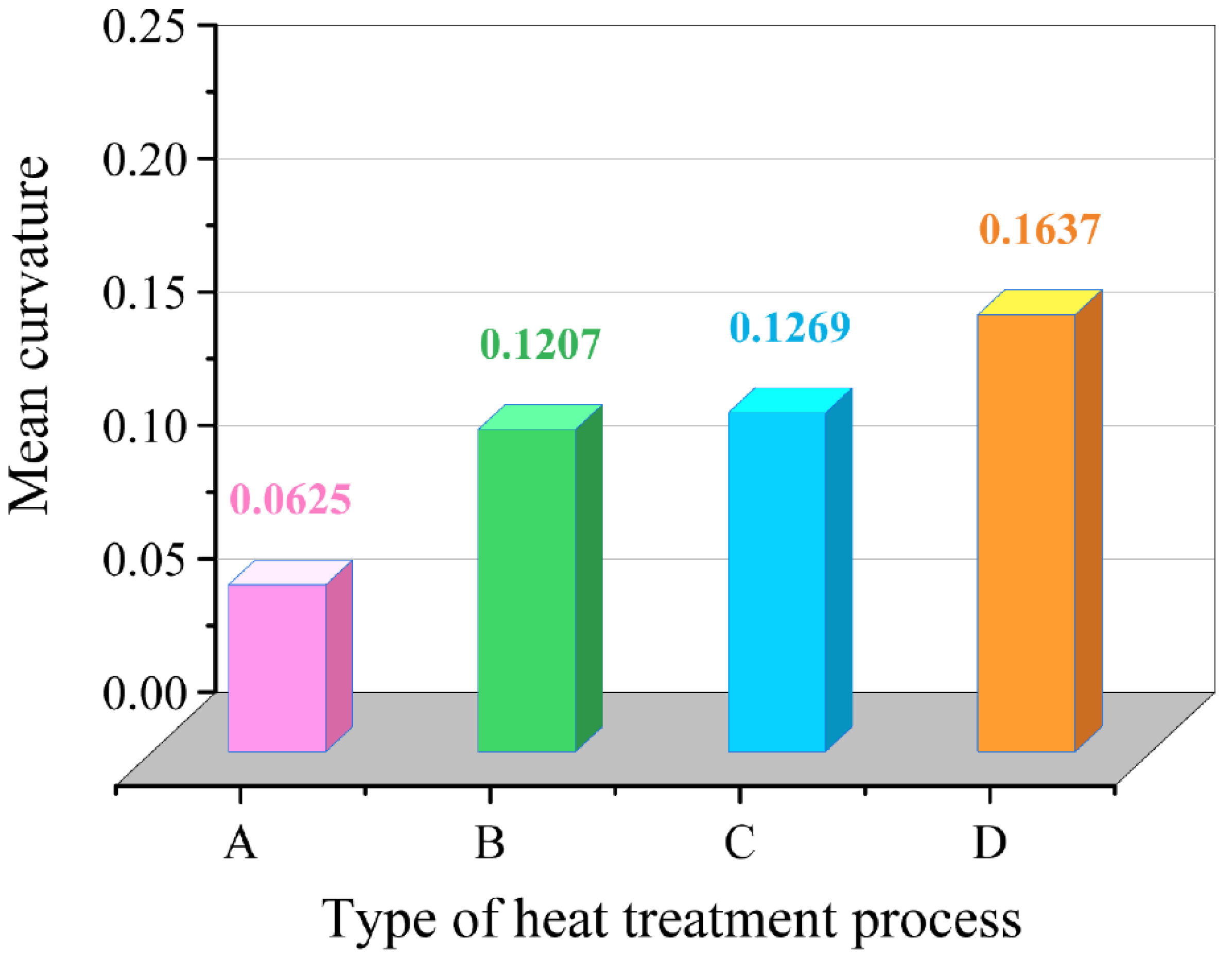
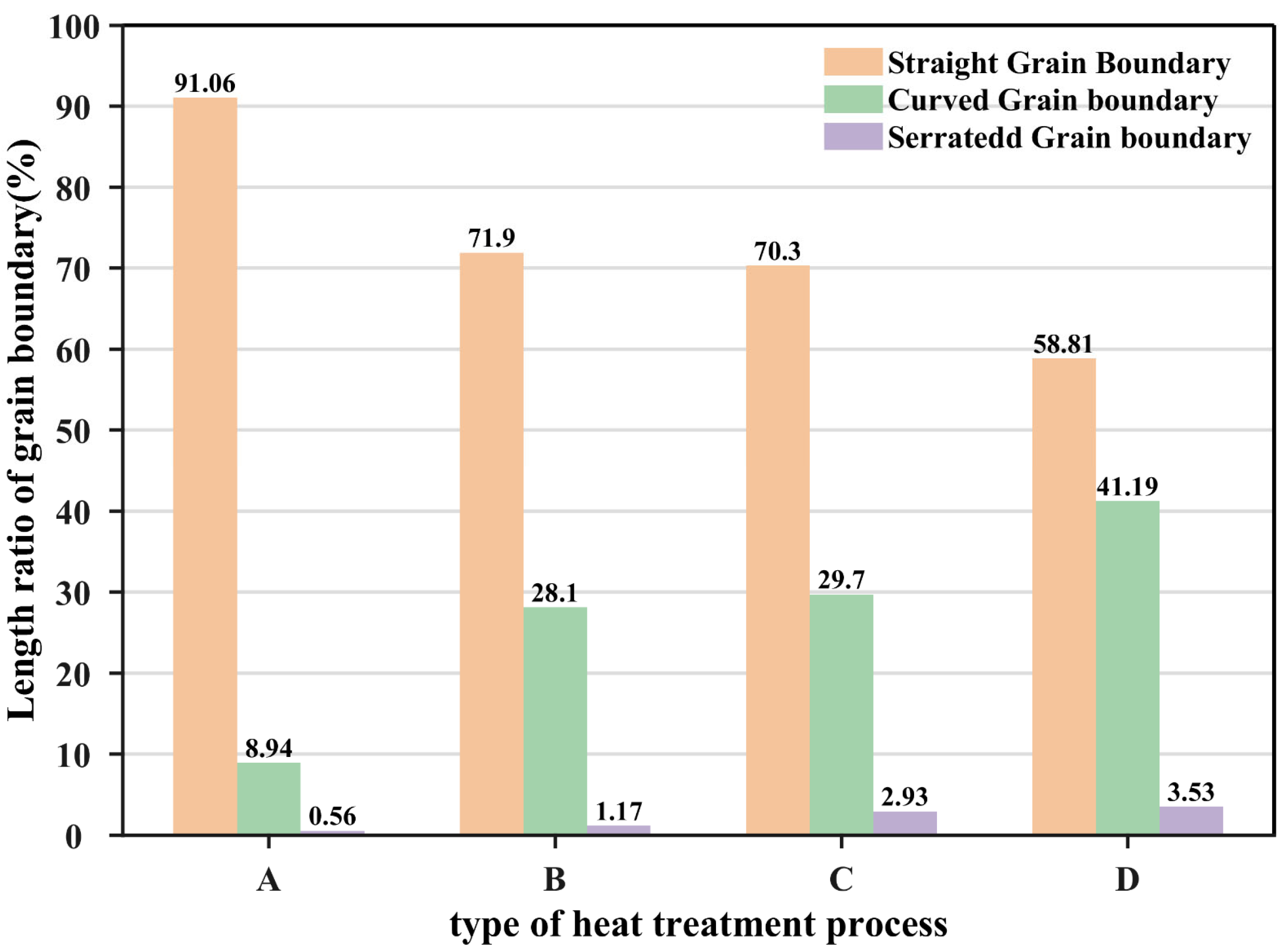
The average curvature values and length ratios presented in Figure 17 and Figure 18 were calculated by statistically averaging the curvature data obtained from three different observation locations on each sample, thereby providing representative characterization of the grain boundary morphology for each heat treatment condition.
As shown in Figure 17 and Figure 18, the proposed method successfully quantified and distinguished these different morphologies. Sample A, treated by controlled cooling alone, exhibited weakly curved boundaries with 91.06% straight regions and a low average curvature (MC = 0.0625). In contrast, Sample D, subjected to the most complex heat treatment involving re-dissolution, displayed a mixed morphology with 3.53% serrated regions and the highest average curvature (MC = 0.1252). Samples B and C represented intermediate cases with predominantly wavy and serrated characteristics, respectively, with similar average curvatures (MC = 0.1056 and 0.1112) but distinct morphological distributions.
The method’s robustness is further evidenced by three key observations. First, the calculated curvature distributions accurately reflect the visual observations presented in Figure 16, where the microstructural features of each sample are clearly distinguishable. Second, the length ratio analysis shown in Figure 18 produces logical and consistent differentiation between samples, with the proportion of curved and serrated regions increasing progressively from Sample A to Sample D. Third, the validation results presented in Table 3 demonstrate consistent accuracy across different curvature magnitudes, with calculated angles agreeing well with measured angles for both high-curvature (e.g., Position B with curvature 0.67) and low-curvature regions (e.g., Position E with curvature 0.22).
These findings confirm that the proposed curvature quantification method is capable of accurately characterizing grain boundaries across the entire range of curvature scales encountered in nickel-based superalloys, from nearly straight boundaries to strongly serrated morphologies.
To evaluate the robustness of the quantitative characterization results, sensitivity analysis was performed by varying the curvature thresholds by ±10% (κ = 0.15 ± 0.015 and κ = 0.55 ± 0.055). As shown in Table 5, while absolute length ratios vary by approximately 3–4% with threshold changes, the relative ranking of samples (A > B ≈ C > D for straight fraction) remains consistent under threshold variation. This confirms that the comparative conclusions regarding the effects of different heat treatment conditions on grain boundary morphology are robust.
A comparative analysis of the microstructural morphology and grain boundary characteristic parameters reveals a strong correlation between the formation of curved grain boundaries in the GH4169 alloy and the precipitation behavior of the δ phase:
Sample A: A small amount of short, rod-shaped δ phases is dispersedly precipitated, resulting in a curved grain boundary morphology that is primarily serrated.
Sample B: Many δ phases are densely and parallelly precipitated along the grain boundaries, leading to a curved grain boundary morphology that is predominantly wavy.
Sample C: A large amount of δ phases is dispersedly precipitated. Compared to Sample A, the δ phases in Sample C are significantly larger, while the curved grain boundary morphology remains serrated.
Sample D: The δ phases precipitate along the grain boundaries at varying angles, with continuously changing precipitation angles. The δ phases in Sample D are long, needle-shaped, and exhibit a high precipitation density. Consequently, the curved grain boundary morphology in Sample D is a combination of serrated and wavy.
The quantified grain boundary curvature can be directly related to δ-phase precipitation kinetics and morphology through the pinning mechanism. During heat treatment, δ-phase precipitates nucleate and grow at grain boundaries, acting as obstacles to grain boundary migration. The grain boundary bows between these pinning points, creating local curvature. The degree of curvature is determined by three key factors: δ-phase content, distribution, and morphology.
First, higher δ-phase volume fraction creates more pinning points, resulting in higher mean curvature values. This explains why Samples C and D, which contain abundant δ-phase precipitates, exhibit significantly higher mean curvature (MC = 0.1112 and 0.1252, respectively) compared to Sample A with sparse δ-phase precipitation (MC = 0.0625).
Second, the spatial distribution of δ-phase precipitates determines the morphological type of curved grain boundaries. When δ-phase precipitates are dispersed along the grain boundary, each precipitate acts as an independent pinning point, causing the boundary to bow locally and form distinct serrated features with sharp peaks and valleys. In contrast, when δ-phase precipitates are densely and parallelly aligned at specific angles to the grain boundary, multiple precipitates collectively influence the boundary migration, resulting in smooth, coordinated wavy undulations rather than sharp serrations.
Third, the morphology of individual δ-phase precipitates affects the curvature amplitude. Long, needle-shaped δ-phase precipitates (as observed in Samples C and D) exert stronger pinning effects over larger boundary segments, producing larger curvature amplitudes. Short, rod-shaped δ-phase precipitates (as in Sample A) create smaller, more localized deflections.
These observations are consistent with recent literature on grain boundary serration mechanisms. Shi et al. [26] systematically investigated grain boundary serration in laser powder bed fusion-built Inconel 718 alloy and identified three distinct formation mechanisms: (i) specific direction of δ-phase growth-induced serration, (ii) the pinning of separated δ-phase which hinders grain boundary movement, and (iii) lattice distortion resulting from element segregation-induced serration. The serrated grain boundaries observed in our Samples A and C align with mechanism (ii), where dispersed δ-phase precipitates pin the grain boundaries at discrete locations. The wavy grain boundaries in Sample B correspond to mechanism (i), where the parallel growth direction of δ-phase precipitates guides the boundary into coordinated undulations.
Similarly, Liu et al. [27] studied serrated grain boundary formation in a high γ’ phase superalloy and demonstrated that the growth and migration of primary γ’ phase at grain boundaries, along with their pinning effect, leads to serrated grain boundary formation. Although their study focused on γ’ phase rather than δ phase, the fundamental pinning mechanism is analogous to our observations. Chen et al. [28] further distinguished between Type-I serration (moderate undulation due to continuous precipitation) and Type-II serration (pronounced undulation due to discontinuous cellular precipitation) in U720Li superalloy, providing additional support for the relationship between precipitate distribution and grain boundary morphology.
The quantitative framework proposed in this study enables the precise characterization of these morphological differences. The mean curvature (MC) captures the overall degree of grain boundary deviation, while the length ratios of serrated, curved, and straight regions provide detailed morphological classification. This quantitative approach facilitates systematic investigation of the processing–microstructure relationship and enables optimization of heat treatment parameters to achieve target grain boundary configurations.
It should be noted that due to the different types of heat treatment processes employed in this study to obtain various grain boundary morphologies, and the limited sample size, it is difficult to establish a quantitative mathematical model defining critical δ-phase size, spacing, or orientation thresholds that correspond to transitions between wavy and serrated grain boundaries. Future studies will focus on systematic parametric investigations with controlled variations in δ-phase characteristics to establish such quantitative relationships.
The engineering significance of the reported curvature metrics can be interpreted through correlation with mechanical property data available in the literature for similar nickel-based superalloys. Shi et al. [26] demonstrated that in Inconel 718 (compositionally similar to GH4169), serrated grain boundaries increased creep life by 56%, creep strain by 19%, and decreased creep strain rate by 26% compared to non-serrated boundaries under 650 °C/750 N testing conditions. Chen et al. [28] reported that Type-I serrated grain boundaries in Udimet-720Li superalloy extended rupture life by 17%. The beneficial effects arise from multiple mechanisms: serrated boundaries impede grain boundary sliding during creep, force cracks to follow tortuous paths requiring more energy for propagation, and reduce local stress concentration. Hu et al. [29] further demonstrated that serrated grain boundaries in Fe-Ni based alloys exhibited higher resistance to hydrogen-induced intergranular cracking due to lower resolved tensile stress normal to the grain boundary. Additionally, Wu et al. [30] showed that serrated grain boundaries could be achieved simultaneously with fine γ’ precipitates, avoiding the traditional trade-off between grain boundary serration and intragranular strengthening. Based on these correlations, Sample D with the highest mean curvature (MC = 0.1252) and serrated ratio (3.53%) would be expected to exhibit superior creep resistance, while Sample A (MC = 0.0625, 0.12% serrated) would show minimal improvement over straight grain boundary conditions. Future work combining curvature metrics with systematic mechanical testing will enable quantitative processing–structure–property relationships for optimized heat treatment design.

5. Conclusions

This study proposes a novel method for quantifying grain boundary curvature by integrating electron microscopy analysis, image processing, and mathematical transformation techniques. The main conclusions are as follows:
  • The proposed framework combining curvature variance filtering with U-chord curvature calculation enables automated and accurate grain boundary characterization. The curvature variance filtering adaptively smooths data while preserving corner features, and the U-chord curvature ensures rotational invariance and noise resistance. Validation demonstrates that calculated angles agree with measured values within approximately 10° deviation, confirming the method’s reliability.
  • The four heat treatment processes produced distinctly quantifiable grain boundary morphologies. Controlled cooling (Process A) yielded MC = 0.0625 with 91.06% straight boundaries. Isothermal treatment (Process B) and combined treatment (Process C) achieved MC = 0.1056 and 0.1112, respectively, with Process B producing predominantly wavy boundaries and Process C generating more serrated features. Re-dissolution treatment (Process D) was most effective, achieving MC = 0.1252 with 3.53% serrated regions.
  • Grain boundary morphology is governed by δ-phase precipitation characteristics. Dispersed δ-phase precipitates create discrete pinning points that produce serrated grain boundaries, while dense, parallel δ-phase precipitation at specific angles results in wavy morphologies.
Future research should focus on (1) establishing quantitative models defining critical δ-phase thresholds for morphology transitions; (2) validating the method on other superalloy systems; and (3) correlating curvature metrics with mechanical properties to enable processing–structure–property optimization.

Author Contributions

Conceptualization, J.W. and Y.Z.; Methodology, Y.Z.; Software, J.W. and J.H.; Validation, H.R., Y.L. and J.N.; Formal analysis, D.L. and J.H.; Investigation, D.L., J.H. and M.W.; Resources, H.R., J.N., Y.L. and M.W.; Data curation, Y.Z. and J.N.; Writing—original draft preparation, J.W., Y.Z., H.R. and Y.L.; Writing—review and editing, J.W., Y.Z., D.L., H.R., Y.L., J.N. and J.H.; Visualization, J.W.; Supervision, D.L. and H.R.; Project administration, D.L.; Funding acquisition, M.W. All authors have read and agreed to the published version of the manuscript.

Funding

This research was funded by the National Natural Science Foundation of China (Grant No. 52101052) and the Advanced Materials-National Science and Technology Major Project, Grant No. 2025ZD0610001). The Article Processing Charge (APC) was funded by Jianguo Wang and Minqing Wang.

Data Availability Statement

The original contributions presented in this study are included in the article. Further inquiries can be directed to the corresponding author.

Conflicts of Interest

Author Dong Liu was employed by the company Anhui Hangon Ultrafine Metal Technology Co., Ltd. Author Junwei Huang was employed by the company AECC Aviation Power Co., Ltd. Author Minqing Wang was employed by the company Gaona Aero Material Co., Ltd. The remaining authors declare that the research was conducted in the absence of any commercial or financial relationships that could be construed as a potential conflict of interest.

References

  1. Hong, H.U.; Kim, I.S.; Choi, B.G.; Kim, M.Y.; Jo, C.Y. The Effect of Grain Boundary Serration on Creep Resistance in a Wrought Nickel-Based Superalloy. Mater. Sci. Eng. A 2009, 517, 125–131. [Google Scholar] [CrossRef]
  2. Hong, S.; Dongjoon, M.; Fleury, E. Effect of Grain Boundary Serration on the Tensile Properties of the Super 304H Heat Resistant Austenitic Stainless Steel. Mater. Sci. Forum 2010, 654–656, 170–173. [Google Scholar] [CrossRef]
  3. Smith, W.E.; Donachie, M.J.; Johnson, J.L. Relationship of Prior Creep Exposure to Strength of Wrought Udimet 700 Nickel-Base Alloy. J. Fluids Eng. 1966, 88, 4. [Google Scholar] [CrossRef]
  4. Davies, P.W.; Dennison, J.P. The Use of Heat-Treatment to Recover the Creep Properties of Nimonic 115 After High-Temperature Creep. Met. Sci. 2013, 9, 319–323. [Google Scholar] [CrossRef]
  5. Terner, M.; Lee, J.-W.; Kim, J.-H.; Hong, H.-U. First Evidence of Grain Boundary Serration in a Specifically Heat Treated Wrought Alloy 625 Ni-Based Superalloy. Int. J. Mater. Res. 2018, 109, 803–810. [Google Scholar] [CrossRef]
  6. Kim, K.J.; Ginsztler, J.; Nam, S.W. The Role of Carbon on the Occurrence of Grain Boundary Serration in an AISI 316 Stainless Steel during Aging Heat Treatment. Mater. Lett. 2005, 59, 1439–1443. [Google Scholar] [CrossRef]
  7. Jiang, L.; Hu, R.; Kou, H.; Li, J.; Bai, G.; Fu, H. The Effect of M23C6 Carbides on the Formation of Grain Boundary Serrations in a Wrought Ni-Based Superalloy. Mater. Sci. Eng. A 2012, 536, 37–44. [Google Scholar] [CrossRef]
  8. Tang, Y.T.; Wilkinson, A.J.; Reed, R.C. Grain Boundary Serration in Nickel-Based Superalloy Inconel 600: Generation and Effects on Mechanical Behavior. Met. Mater. Trans. A 2018, 49, 4324–4342. [Google Scholar] [CrossRef]
  9. Tang, Y.T.; Karamched, P.; Liu, J.; Haley, J.C.; Reed, R.C.; Wilkinson, A.J. Grain Boundary Serration in Nickel Alloy Inconel 600: Quantification and Mechanisms. Acta Mater. 2019, 181, 352–366. [Google Scholar] [CrossRef]
  10. Ye, R.; Xu, Z.; Ge, Z.; Gao, L.; Yu, T.; Zhang, R.; Li, L.; Zhang, P. Mechanism of Ziggag Grain Boundary Formation in Wrought Nickelbase Superalloys. Chin. J. Eng. 1985, 7, 29–39. [Google Scholar] [CrossRef]
  11. Luengo, J.; Moreno, R.; Sevillano, I.; Charte, D.; Peláez-Vegas, A.; Fernández-Moreno, M.; Mesejo, P.; Herrera, F. A Tutorial on the Segmentation of Metallographic Images: Taxonomy, New MetalDAM Dataset, Deep Learning-Based Ensemble Model, Experimental Analysis and Challenges. Inf. Fusion 2022, 78, 232–253. [Google Scholar] [CrossRef]
  12. Elmadagli, M.; Alpas, A.T. Metallographic Analysis of the Deformation Microstructure of Copper Subjected to Orthogonal Cutting. Mater. Sci. Eng. A 2003, 355, 249–259. [Google Scholar] [CrossRef]
  13. Yang, Z.; Li, X.; Catherine Brinson, L.; Choudhary, A.N.; Chen, W.; Agrawal, A. Microstructural Materials Design via Deep Adversarial Learning Methodology. J. Mech. Des. 2018, 140, 111416. [Google Scholar] [CrossRef]
  14. Ryan, K.; Lengyel, J.; Shatruk, M. Crystal Structure Prediction via Deep Learning. J. Am. Chem. Soc. 2018, 140, 10158–10168. [Google Scholar] [CrossRef]
  15. Ma, W.; Kautz, E.J.; Baskaran, A.; Chowdhury, A.; Joshi, V.; Yener, B.; Lewis, D.J. Image-Driven Discriminative and Generative Machine Learning Algorithms for Establishing Microstructure–Processing Relationships. J. Appl. Phys. 2020, 128, 134901. [Google Scholar] [CrossRef]
  16. Hecht, M.D.; Webler, B.A.; Picard, Y.N. Digital Image Analysis to Quantify Carbide Networks in Ultrahigh Carbon Steels. Mater. Charact. 2016, 117, 134–143. [Google Scholar] [CrossRef]
  17. Azimi, S.M.; Britz, D.; Engstler, M.; Fritz, M.; Mücklich, F. Advanced Steel Microstructural Classification by Deep Learning Methods. Sci. Rep. 2018, 8, 2128. [Google Scholar] [CrossRef]
  18. Wang, X.; Zhang, B.; Xu, Z.; Qin, Y.; Philip Chen, C.L. An Exploration of Deep Learning for Decision Making: Methods, Applications, and Challenges. Expert Syst. Appl. 2025, 289, 128406. [Google Scholar] [CrossRef]
  19. Nakamura, K.; Sadakane, K. A Space-Efficient Algorithm for the Dynamic DFS Problem in Undirected Graphs. In Proceedings of the WALCOM: Algorithms and Computation, Chengdu, China, 28 February–2 March 2025; Poon, S.-H., Rahman, M.S., Yen, H.-C., Eds.; Springer International Publishing: Cham, Switzerland, 2017; pp. 295–307. [Google Scholar]
  20. Ray, B.K.; Pandyan, R. ACORD—An Adaptive Corner Detector for Planar Curves. Pattern Recognit. 2003, 36, 703–708. [Google Scholar] [CrossRef]
  21. Medioni, G.; Yasumoto, Y. Corner Detection and Curve Representation Using Cubic B-Splines. Comput. Vis. Graph. Image Process. 1987, 39, 267–278. [Google Scholar] [CrossRef]
  22. Liu, G.H.; Wong, Y.S.; Zhang, Y.F.; Loh, H.T. Adaptive Fairing of Digitized Point Data with Discrete Curvature. Comput.-Aided Des. 2002, 34, 309–320. [Google Scholar] [CrossRef]
  23. Zhong, B.; Li, C.; Wang, Z. Curvature Product Corner Detection in Direct Curvature Scale Space. Phys. Commun. 2011, 4, 237–243. [Google Scholar] [CrossRef]
  24. Guo, J.-J.; Zhong, B.-J. U-Chord Curvature: A Computational Method of Discrete Curvature. Moshi Shibie Yu Rengong Zhineng/Pattern Recognit. Artif. Intell. 2014, 27, 683–691. [Google Scholar] [CrossRef]
  25. Azadian, S.; Wei, L.-Y.; Warren, R. Delta Phase Precipitation in Inconel 718. Mater. Charact. 2004, 53, 7–16. [Google Scholar] [CrossRef]
  26. Shi, Q.; Zhang, S.; Dong, X.; Li, D.; Zhao, H.; Lin, X.; Huang, W. Achieving Superior Resistance to High–Temperature Creep in Laser Powder Bed Fusion of Inconel 718 via Grain Boundaries Serration. J. Mater. Res. Technol. 2024, 33, 7534–7545. [Google Scholar] [CrossRef]
  27. Liu, L.; Tan, Y.; Wang, Y.; Li, P.; Gao, Y. Effect of Heat Treatment on the Formation of Serrated Grain Boundary and Secondary Γ′ Phase in a High Γ′ Phase Superalloy. J. Alloys Compd. 2025, 1027, 180489. [Google Scholar] [CrossRef]
  28. Chen, T.-W.; Wu, B.-C.; Kang, Y.-C.; Murakami, H.; Toda, Y.; Chung, T.-F.; Kumar Misra, R.D.; Yeh, A.-C. The Impact of Grain Boundary Serration Treatments on the Creep Deformation of Udimet-720Li Superalloy. Mater. Sci. Eng. A 2025, 924, 147729. [Google Scholar] [CrossRef]
  29. Hu, H.; Zhao, M.; Song, Y.; Rong, L. Serrated Grain Boundary Formation and Its Effect on the Hydrogen Embrittlement of Fe-Ni Based Alloy. Mater. Sci. Eng. A 2025, 921, 147582. [Google Scholar] [CrossRef]
  30. Wu, Y.; Zhao, H.; Li, J.; Zhang, Y.; Liu, J.; Liu, T. An Innovative Approach towards Forming the Serrated Grain Boundaries and Refining the Γ′ Precipitates in Nickel-Based Superalloys. J. Alloys Compd. 2022, 908, 164570. [Google Scholar] [CrossRef]
Figure 1. Schematic of the wavelength and amplitude of a serrated grain boundary.
Metals 16 00068 g001
Figure 2. Diagram of unique heat treatment process for curved grain boundaries: (a) Controlled cooling treatment; (b) resolution treatment; (c) isothermal treatment.
Metals 16 00068 g002
Figure 3. Schematic diagram of grain boundary morphology extraction: (a) The original image; (b) Thinned image.
Metals 16 00068 g003
Figure 4. Flow chart of an algorithm for obtaining grain boundary data by depth-first search.
Metals 16 00068 g004
Figure 5. Example diagram of single grain boundary coordinate transformation in the metallographic image: (a) Extraction of grain boundaries by DFS segmentation; (b) grain boundary data in the image coordinate system; (c) actual geometric information data of grain boundaries after coordinate conversion.
Metals 16 00068 g005
Figure 6. SEM image of grain boundary. A~E mark the locations that were heavily smoothed during curvature calculation by least-squares fitting.
Metals 16 00068 g006
Figure 7. Application of least squares curve fitting to grain boundary data extracted from Figure 6: (a) Comparison between original grain boundary data points and the least squares fitted curve; (b) Calculated curvature distribution along the fitted curve.
Metals 16 00068 g007
Figure 8. Diagram of discrete curvature calculation method based on a close circle.
Metals 16 00068 g008
Figure 9. The calculation error of the neighborhood is supported by the digital curve.
Metals 16 00068 g009
Figure 10. The schematic diagram of U-chord curvature.
Metals 16 00068 g010
Figure 11. Comparison of discrete curvature calculation results after sine curve noise: (a) Difference method; (b) Curvature circle; (c) U-chord curvature.
Metals 16 00068 g011
Figure 12. Microstructure of raw material after 1 h solution at 1040 °C.
Metals 16 00068 g012
Figure 13. Four types of heat treatment: (a) Controlled cooling treatment; (b) Isothermal treatment; (c) Controlled cooling + isothermal treatment; (d) Resolution treatment.
Metals 16 00068 g013
Figure 14. An application example of grain boundary curvature calculation. (a) Original SEM image; (b) Binarized grain boundary image; (c) Partition and extract grain boundaries, the white arrow indicates the grain boundary used for demonstration; (d) Grain boundary data coordinate transformation; (e) Grain boundary data is filtered smoothly; (f) Grain boundary curvature.
Metals 16 00068 g014
Figure 15. Actual measurement of grain boundary bending Angle, A~E mark the locations with the greatest grain boundary curvature.
Metals 16 00068 g015
Figure 16. Grain boundary morphologies of samples treated by different heat treatment processes after solid solution: (a) Sample A1; (b) Enlarged view of A1, (c) Sample B1; (d) Enlarged view of B1; (e) Sample C1; (f) Enlarged view of C1; (g) Sample D1; (h) Enlarged view of D1.
Metals 16 00068 g016
Figure 17. Average curvature of grain boundaries under different heat treatment processes, A–D represent different heat treatment processes, and the specific parameters are listed in Table 2.
Metals 16 00068 g017
Figure 18. The length ratio of different morphology of grain boundaries, A–D represent different heat treatment processes, and the specific parameters are listed in Table 2.
Metals 16 00068 g018
Table 1. Main chemical composition of experimental GH4169 alloy (wt.%).
CrCoMoTiAlCuPNbCTaSFe
18.110.183.090.980.580.0310.0125.470.022<0.01<0.002Et.al
Table 2. Specific process parameters of different heat treatment processes.
Solution
°C & h
Cooling Rate
°C/min
Slow Cooling Termination Temperature
°C
Isothermal Treatment
°C & h
Re-Dissolution Treatment
°C & h
Cooling Method
A1040 °C-1 h1900AC
B900 °C-1 hAC
C1900900 °C-1 hAC
D1720960 °C-1 hAC
Table 3. Comparison between actual measured angle and calculated angle.
PositionActual Measurement Angle (°)Curvature Calculation ValueCalculation Angle (°)
A104.780.54114.63
B83.510.6795.87
C130.600.25151.04
D99.420.57110.50
E144.880.22154.58
Table 4. Effect of image resolution on grain boundary morphology quantification results for Sample D.
Image Resolution (Pixels)Serrated ProportionCurved ProportionStraight Proportion
1028 × 8880.03670.38630.5770
2134 × 18510.03140.38460.5841
4267 × 37010.03480.37870.5866
Table 5. Sensitivity analysis of straight grain boundary length ratios under ±10% threshold variation.
SampleStraight (κ = 0.135)Straight (κ = 0.15)Straight (κ = 0.165)
A89.13%91.06%91.52%
B68.42%71.90%74.03%
C67.17%70.30%72.97%
D54.26%58.81%62.11%
Disclaimer/Publisher’s Note: The statements, opinions and data contained in all publications are solely those of the individual author(s) and contributor(s) and not of MDPI and/or the editor(s). MDPI and/or the editor(s) disclaim responsibility for any injury to people or property resulting from any ideas, methods, instructions or products referred to in the content.