Article

Interactions Effect Among the Electrolytes on Micro-Arc Oxidation Coatings of AZ91D Mg Alloy


1
Qinghai Provincial Key Laboratory of Nanomaterials and Technology, Qinghai Minzu University, Xining 810007, China
2
School of Chemistry and Materials Science, Qinghai Minzu University, Xining 810007, China
3
State Key Laboratory of Advanced Processing and Recycling of Non-ferrous Metals, Lanzhou University of Technology, Lanzhou 730050, China
*
Author to whom correspondence should be addressed.
Metals 2025, 15(12), 1378; https://doi.org/10.3390/met15121378
Submission received: 7 November 2025 / Revised: 4 December 2025 / Accepted: 12 December 2025 / Published: 16 December 2025

Abstract

Simplex-centroid mixture design (SCMD) is applied to change the combination of Na2SiO3, KF, NaOH and NaAlO2 to examine the influences of electrolyte components and their interactions on the thickness and corrosion resistance of micro-arc oxidation (MAO) coating of AZ91D magnesium alloy. The results indicate that the obtained regression equations are very significant (p-value < 0.01) and have high prediction accuracy (R2 = 0.9893, 0.9989). Pareto analysis shows that the interactions effect between Na2SiO3, KF and NaAlO2 on the coating thickness and corrosion resistance are 70.03% and 92.35%, respectively, which quantitatively confirms that there are interactions among electrolytes. The analysis of response surface methodology (RSM) demonstrates that the optimum formula is high concentration of Na2SiO3, high concentration of KF and low concentration of NaAlO2. When Na2SiO3 is compounded with NaAlO2, the two will react to form aluminosilicate colloids, resulting in increased viscosity of the electrolyte, and the coating corrosion resistance is poor. When the main salt of electrolyte is single Na2SiO3 or NaAlO2, the corrosion resistance is better. KF can significantly improve the coating thickness and corrosion resistance. Pearson correlation coefficient (PCC) reveals that there is a remarkable relationship between thickness and the corrosion resistance in acidic media (r = 0.88927), which was determined by the corrosion mechanism of the latter.

1. Introduction

As the least dense metallic structural materials used in industry at present, magnesium and its alloys are of excessive interest in aerospace industry, automobile, optical instruments, electronics, audio materials and other fields [1,2], owing to the advantages of high specific strength and stiffness, good thermal and electrical conductivity, excellent casting performance and being electromagnetic-shielding, no-polluting and recyclable. However, magnesium and its alloys have extremely high chemical and electrochemical activities, resulting in poor corrosion resistance [3,4], which is a prominent barrier to wider applications. Micro-arc oxidation (MAO) is a surface treatment technology developed on the basis of conventional anodic oxidation, which generates a ceramic-like, inorganic and consistent oxidized coating in situ on the surface of metal matrix under the combined actions of chemical, electrochemistry, plasma chemistry and thermochemistry. This film exhibits dense structure, high hardness and strong adhesion with the matrix, which can significantly enhance the properties of the substrate [5,6].
The MAO coatings could be affected by the composition and concentration of electrolytes, electrical parameters, treatment time and the substrate [7,8,9,10,11,12]. The electrolyte particles are involved in the formation of the initial high-impedance passivation layer and MAO reactions after breakdown. Therefore, they not only affect the coating growth rate, the size and distribution of pores, but also determine the phase composition of the coating [9,10,11,12,13]. So, it is necessary to survey the impact of electrolyte constituents on the coating performance. To date, the main electrolyte systems for MAO of magnesium alloys are phosphate systems [13,14], silicate system [10,15,16], aluminate system [17] and composite electrolyte system [18,19,20].
Silicate, as an essential component of the electrolyte, serves as the primary coating-forming agent for MAO. During the initial stage of MAO, a protective layer is formed on the substrate surface to prevent further corrosion of the substrate and provide conditions for the breakdown discharge of MAO. SiO32− exhibits a strong adsorption capacity, which is easily adsorbed to the anode, thus forming the desired high-impedance layer. As the silicate concentration increases, the thickness and the density increase, and the performance improves. Therefore, the coating performance is the best when the addition amount is the highest (15 g·L−1 [21] and 56 g·L−1 [22]). However, Salami B. et al. found that excessively high concentrations (exceeding 30 g·L−1) could lead to severe breakdown and discharge, resulting in a rougher film with larger pore sizes, and the performance decreases instead [23]. Some studies have also shown that the optimal amount of sodium silicate should not exceed 10 g·L−1 [24,25]. Regarding the effect of the main salt NaAlO2, it can react with Mg to produce the chemically stable spinel phase MgAl2O4, which is favorable for the improvement of corrosion resistance. However, NaAlO2 is less stable, resulting in a thinner coating. Bian G. et al. further pointed out that, at the same treatment time, the thickness of the coating produced by the Na2SiO3 system was about 15 μm, whereas that by the NaAlO2 system was only 4 μm [26].
In terms of additives, F can play the role of a sparking initiator at the early stage of MAO, forming a stable, insoluble insulating layer on the substrate surface, which is conducive to the occurrence of breakdown discharges. Zhu et al. found that the insulating layer was mainly composed of MgO nanoparticles and insoluble MgF2 phases, and that the thickness increased with the increase in F, up to 100–200 nm [27]. Liu et al. further comparatively investigated the effect of the presence or absence of KF on the coating of magnesium alloy and found that the addition of KF contributed to the formation of the initial protective layer, and with the addition of KF, the growth rate of the coating was significantly increased, which was mainly due to the small radius and the high migration rate of F [28]. Hydroxide can not only regulate the pH of the solution and significantly increase the conductivity of the electrolyte, but also provide the required O for MAO reactions. Blawert et al. found that with the hydroxide concentration increasing, the micro-pores and porosity on the coating surface were significantly reduced, and hydroxide could promote the increase in Mg2SiO4 content in the coating. Therefore, the corrosion resistance of the coating was the best when the amount of Mg2SiO4 was the highest (10 g·L−1) [29]. However, some studies have found that increasing the hydroxide concentration (exceeding 10 g·L−1) will enhance the pore size and porosity of the coating and the optimal content is 5 g·L−1 [30].
It can be seen from the above studies that the conclusions regarding the electrolyte components are different. This is mainly because the influence of electrolytes is rather complex. The components, their concentrations and the concentrations themselves are interdependent and influence each other. The electrolyte formula test is a multi-factor experiment, and a reasonable and scientific experiment design can greatly reduce the number of tests to achieve the expected objectives. However, most of the studies for these electrolyte systems are independently designed to investigate the influence of each electrolyte composition on the coating, but there are few reports on the comprehensive study of the influence of electrolyte components and their interactions on the coating [10,31,32,33]. In addition, most of the studies focus on the effect of the electrolyte concentration on the coating, while less research on the necessity of the electrolyte for the MAO coating, especially on the necessity for the coating formation. Therefore, it is necessary to systematically study and compare the effects of the electrolyte components and their interactions on the MAO coating, especially on the necessity for the formability of the coating, and this is precisely the need for design experiments to achieve.
In this experiment, MAO coatings were prepared on AZ91D Mg alloy by varying the concentration ratios of Na2SiO3, NaOH, KF and NaAlO2 based on simplex-centroid mixture design (SCMD). The formability of the coating produced under a certain electrolyte scheme was determined by the apparent quality of the coating, the phenomena during reactions, and the change in current in the constant voltage mode. Based on SCMD, the necessity of each electrolyte for the coating formability was compared by intuitive analysis. By means of regression analysis, the regression equations between electrolyte components and the thickness and the corrosion resistance were established. The effects of electrolyte components and their interactions on the thickness and corrosion resistance were further investigated by Pareto analysis, response surface methodology (RSM), microstructure observation and the composition of the coating.

2. Experimental

2.1. Preparation

The matrix chosen for the experiment was a commercial AZ91D Mg alloy ingot with a nominal chemical composition of Al 8.3~9.7%, Zn 0.35~1.0%, Mn 0.17~0.27%, Si 0.1%, Cu 0.03%, Fe 0.005%, Ni 0.002% and the balance of Mg. It was machined by wire cutting into a 20 mm × 30 mm × 10 mm rectangular block. The specimens were polished with 150#, 400# and 800# waterproof sandpaper in sequence before the experiment and cleaned with deionized water, finally rinsed with acetone ultrasonically, and then dried with warm air prior to treatment.
The experimental equipment mainly consisted of a homemade, program-controlled MAO power source, electrolytic bath, stirring and cooling system, and the sample and a piece of stainless-steel plate were used as anode and cathode, respectively. The schematic of the MAO set up is presented in Figure 1. The maximum output voltage of the power supply is 1000 V and the maximum current is 500 A. It can provide unipolar, bipolar and mixed-pulse output modes. This study mainly explores the influences of electrolytes and their interactions on the coating. Therefore, electrical parameters (including voltage, current, frequency, duty cycle and time) as well as temperature parameters are not regarded as factors and remain constant. The treatment was conducted at a constant voltage of 400 V for 12 min. Based on the review of electrolytes Na2SiO3, NaAlO2, KF and NaOH in the introduction, it is evident that the optimal concentration of Na2SiO3 is generally high. NaAlO2, serving as the main salt, is added in lower content due to its instability. For KF, acting as a sparking initiator, higher concentrations are preferable. However, the NaOH concentration should not be excessively high. Therefore, the concentrations of each electrolyte were Na2SiO3 0–45 g·L−1, KF 0–45 g·L−1, NaOH 0–15 g·L−1, NaAlO2 0–12 g·L−1, respectively. All the reagents were supplied by Sinopharm Chemical Reagent Co., Ltd. (Shanghai, China), and of analytical grade.

2.2. Formability of MAO Coating

The macroscopic morphology of the obtained MAO coating is observed by the naked eye, and the apparent quality of the resulting coating is judged to evaluate the degree of conformity of a certain electrolyte formulation. At the same time, combined with the phenomenon of MAO process and the change in current, the final determination of the coating under the electrolyte formula is made. “1” represents if the formability is good, and the coating surface is smooth and flat. “0” means that no coating can be formed under the electrolyte formulation, the coating surface is exceedingly rough and there are “grooves” characteristic on the surface, or the substrate surface has no obvious film formed, or the MAO process is too intense, and even the phenomenon of solution splashing appears, or the current change shows a sharp rise or instability.
Formability intuitively reflects the effects of electrolytes on the coating. Therefore, the discussion of the influence of each electrolyte component on the coating in this study is based on the premise of formability. When the formability is 0, it means that the coating prepared under the electrolyte formulation is unqualified, so its corresponding performance data are replaced by that of the substrate.

2.3. Coating Characterization

The coating thickness was measured by digital gauge (TT260, Time Company, Beijing, China). Ten points were selected for each specimen to be measured, and the average value was taken as final thickness. An X-ray diffractometer with a Cu Kα target (D/Max-2400, Rigaku, Tokyo, Japan) was applied to detect the phase composition with an angle of 10°~90°, a step size of 0.02°. The surface and cross-section morphology were observed by a field emission scanning electron microscopy (SEM, JSM-6700F, Jeol, Tokyo, Japan) coupled with energy dispersive spectroscopy (EDS). According to the standard HB5061-77 [34], the spotting test was performed to appraise the coating corrosion resistance in an acidic condition. The concentration of nitric acid was doubled compared to the standard, that is, the recipe of the solution was as follows: 90 mL H2O, 10 mL HNO3 and 0.05 g KMnO4. The detailed introduction to the spotting test was reported in our previous work [35].
Potentiodynamic polarization (PDP) and cyclic voltammetry (CV) tests were carried out on an electrochemical workstation (CHI660C, Chenhua, Shanghai, China) to characterize the corrosion resistance of the coatings in a neutral environment. A three-electrode system comprising the saturated calomel reference electrode, the platinum auxiliary electrode and the specimen as the working electrode was employed. The sample was exposed to an area of 1 cm2 and immersed in a 3.5 wt% NaCl solution for 30 min. PDP measurements were performed at a range of −1.8 to −1.2 V and a sweep rate of 10 mV·s−1. CV curves were scanned at an initial potential and low potential of −1.9 V and a high potential of 0 V and the number of scanning steps was 2.
Four parallel samples and two points on each sample were selected for the corrosion resistance tests, and the average data after removing the outliers by Grubbs test was taken as the final value.

2.4. Experimental Design

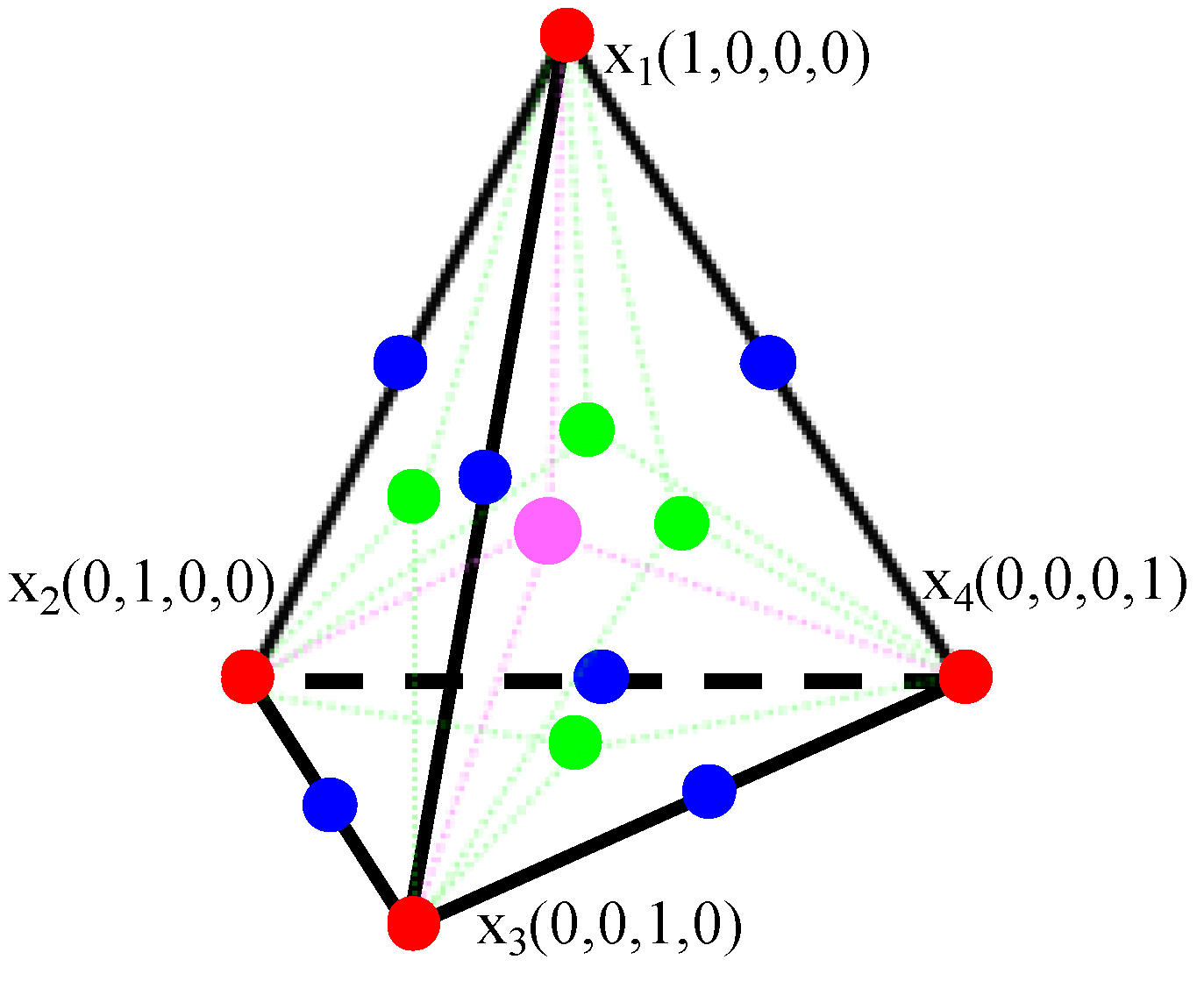
Simplex-centroid mixture design (SCMD) is one of the methods of mixture experiment design. It arranges the test points on the simplex centroid as shown in Figure 2 below, selecting a small number of points reasonably, to obtain the regression equation between the variables and responses, and further explore the inherent law between them.
In this study, the SCMD method was employed to build the relationship between the electrolyte constituents and the coating thickness and corrosion resistance, and explore the influence of electrolytes on the structure and property of the coating as well as the interactions among them. The electrolyte components Na2SiO3 (x1), KF (x2), NaOH (x3) and NaAlO2 (x4) were used as independent variables, and the thickness (y1) and spotting corrosion resistance (y2) were chosen as experimental responses. The four-component SCMD consists of 24 − 1 experimental points, namely C 4 1 permutations of (1, 0, 0, 0) (Vertex), C 4 2 permutations of (1/2, 1/2, 0, 0) (Cent Edge), C 4 3 permutations of (1/3, 1/3, 1/3, 0) (Trip Blend), and C 4 4 permutations of (1/4, 1/4, 1/4, 1/4) (Center).

2.5. Regression Analysis

For the four-component SCMD with no other constraints in the present study, the regression model between responses and variables is presented as follows [36,37]:
y ^ =   j = 1 4 b j x j + k < j b k j x k x j + l < k < j b l k j x l x k x j + b 1234 x 1 x 2 x 3 x 4
where the regression coefficient is calculated as
b j = y j b k j = 4 y k j 2 y k + y j b l k j = 27 y l k j 12 y l k + y l j + y k j + 3 y l + y k + y j b 1234 = 256 y 1234 4 j = 1 4 y j + 32 k < j y k j 108 l < k < j y l k j
According to Formulas (1) and (2), the regression equations were initially established, and the significance of the regression equation and each item was tested by analysis of variance (ANOVA). The insignificant items were excluded to obtain the final regression equations, then the importance of each coefficient was characterized by Pareto analysis. The influences of electrolytes and their mutual effects on the coating thickness and spotting corrosion resistance were further analyzed with response surface methodology (RSM).

3. Results

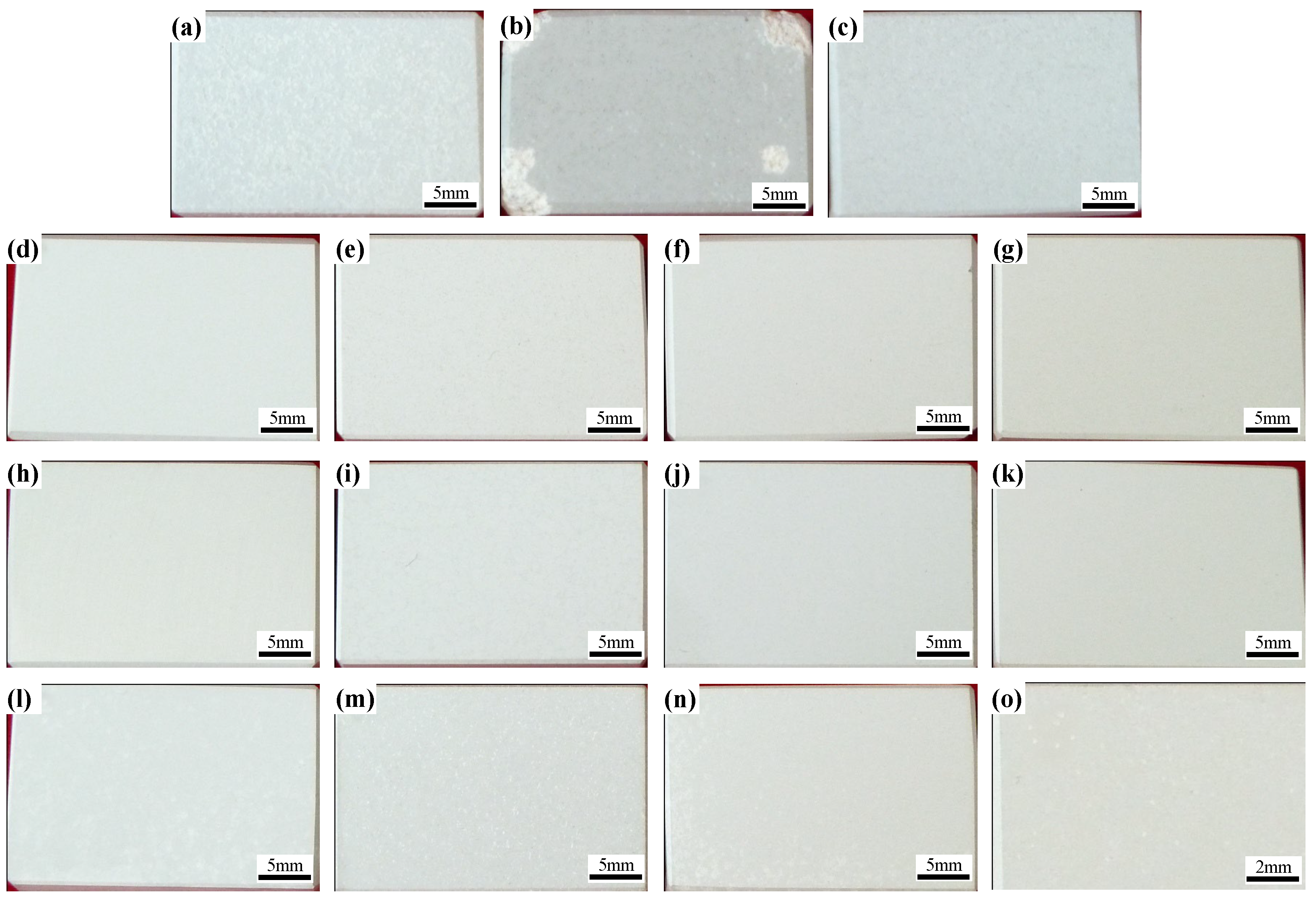
In order to further understand the influences of each electrolyte and its interaction on the coating formability, the 15 experimental schemes of the SCMD are now grouped for study. They are, respectively, No Na2SiO3-NaAlO2 system (schemes 2#, 3# and 8#), Na2SiO3 system (schemes 1#, 5#, 6# and 11#), NaAlO2 system (schemes 4#, 9#, 10# and 14#) and Na2SiO3-NaAlO2 system (schemes 7#, 12#, 13# and 15#). The macroscopic morphologies of the coatings prepared under each system are shown in Figure 3.
It can be intuitively seen from Figure 3 that the coating formability is very poor when there is no main salt in the electrolyte. The coating prepared by Scheme 2# containing only KF is the roughest and the color is uneven. Due to the high concentration of NaOH and the absence of main salt in the scheme 3#, the ablation occurred in the later stage of MAO reactions and the current continued to rise instead of falling, eventually reaching as high as 23.4 A, thus the coating formability is also very poor. With the addition of main salt, the coating formability is significantly improved, as shown in the silicate system and aluminate system in Figure 3. When the two main salts are combined, the coating surface shows uneven color again and the formability decreases, which also indicates that when main salts Na2SiO3 and NaAlO2 are compounded there is an optimal match between them.

3.1. Establishment and Analysis of Regression Model

The experimental design and results from the four-component SCMD are listed in Table 1 below. From the table, it can be seen that the coating of scheme 5# is the thickest and has the best corrosion resistance in acidic media, while scheme 11# has the second thickest coating and the corrosion resistance follows closely.
According to Formulas (1) and (2), the regression equations for the coating thickness (y1) and spotting corrosion resistance (y2) with respect to the factors (Na2SiO3 (x1), KF (x2), NaOH (x3) and NaAlO2 (x4)) are initially established. Among them, xkxj, xlxkxj and x1x2x3x4 are binary interaction terms, ternary interaction terms and quadrilateral interaction terms, respectively. To improve the significance and prediction accuracy of the models, it is necessary to remove the insignificant terms in the equations, and the final established regression equations are shown in Table 2.

3.1.1. ANOVA

The significance of the regression equation and coefficients is tested by ANOVA using F-value and p-value. The large value of F compared to the error indicates that most of the variation in the response can be explained by the regression equation. The associated p-value is used to estimate whether F is large enough to indicate statistical significance, where the variable corresponding to the equation is considered to have a highly significant effect (**) on the experimental results when p-value < 0.01, when 0.01 < p-value < 0.05, the equation corresponding variable has a significant effect (*) on the experimental results, and not significant when p-value > 0.05 [38]. The ANOVA results of regression equations are presented in Table 3. The p-values of the equations are all less than 0.01, so the obtained regression equations for the thickness and spotting corrosion resistance are all highly significant.

3.1.2. Adequacy of Equations

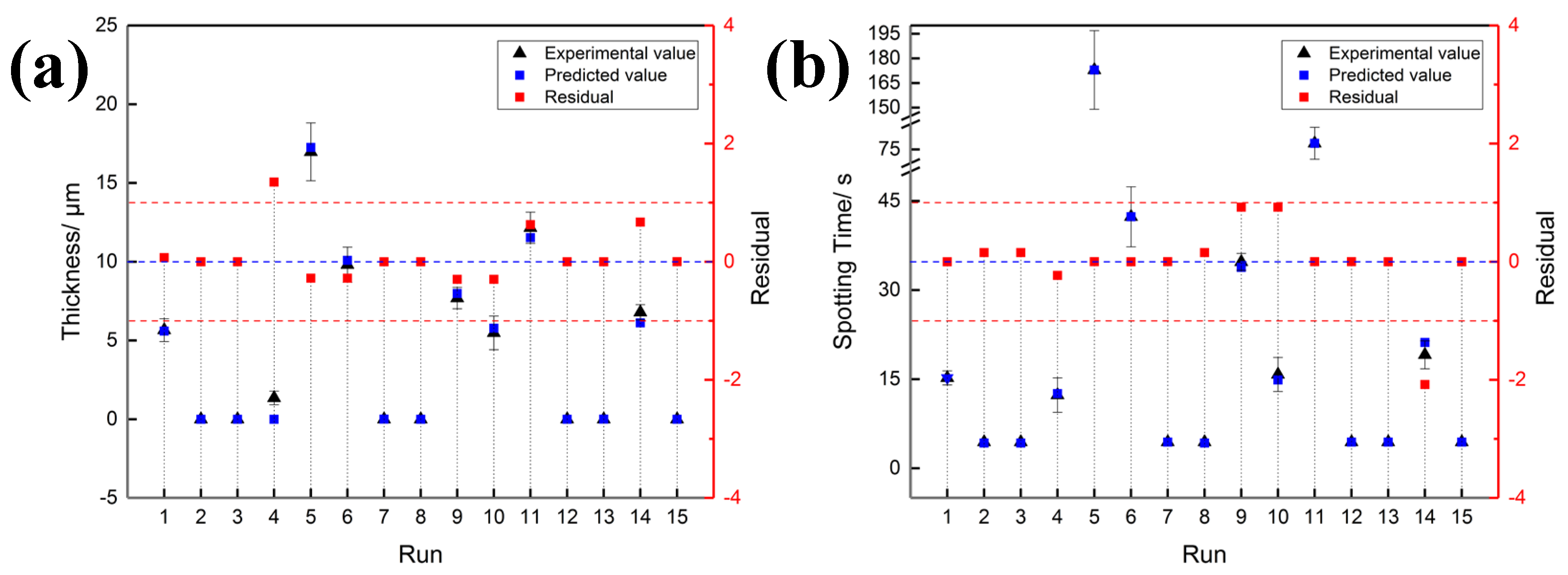
The residual distributions between the experimental and predicted values obtained by regression equations for the coating responses are analyzed. Figure 4 shows the residual and the comparison between the experimental and predicted values. And it can be seen that there is no discernible difference between the two values. The relative error between the predicted value and the measured value can be further calculated by Equation (3). The calculation results show that the relative error for both responses is less than 5%, except that 4# scheme for the thickness is 9.89% and 14# scheme for the spotting time is 10.88%, which indicates that the predicted values from regression equations are in accordance with the experimental data.
Relative   error = predicted   value   experimental   value experimental   value × 100 %
The coefficient of determination, R2, is used to quantitatively characterize the accuracy of fitting between the regression equations and the experimental results [39,40]. The adjusted determination coefficients R2 of responses are shown in Table 3 above. It can be seen that the R2 of thickness and spotting time are 0.9893 and 0.9989, respectively. In other words, there are 98.93%, 99.89% of variation in the result which can be explicated by the regression equations of the thickness and spotting time, respectively. It is further verified that the regression equations have high prediction accuracy, and the predicted values obtained by the developed models are highly close to the experimental values.

3.1.3. Pareto Analysis

The value of partial regression coefficient bi (Table 2) cannot reflect the importance of corresponding factors due to its limitation by the unit and value range of corresponding variables. Standardized regression coefficient Bi can be obtained by standardizing bi. The larger the Bi value, the more important the corresponding variable [38]. Standardized regression coefficients of the two index equations are summarized in Table 4 below.
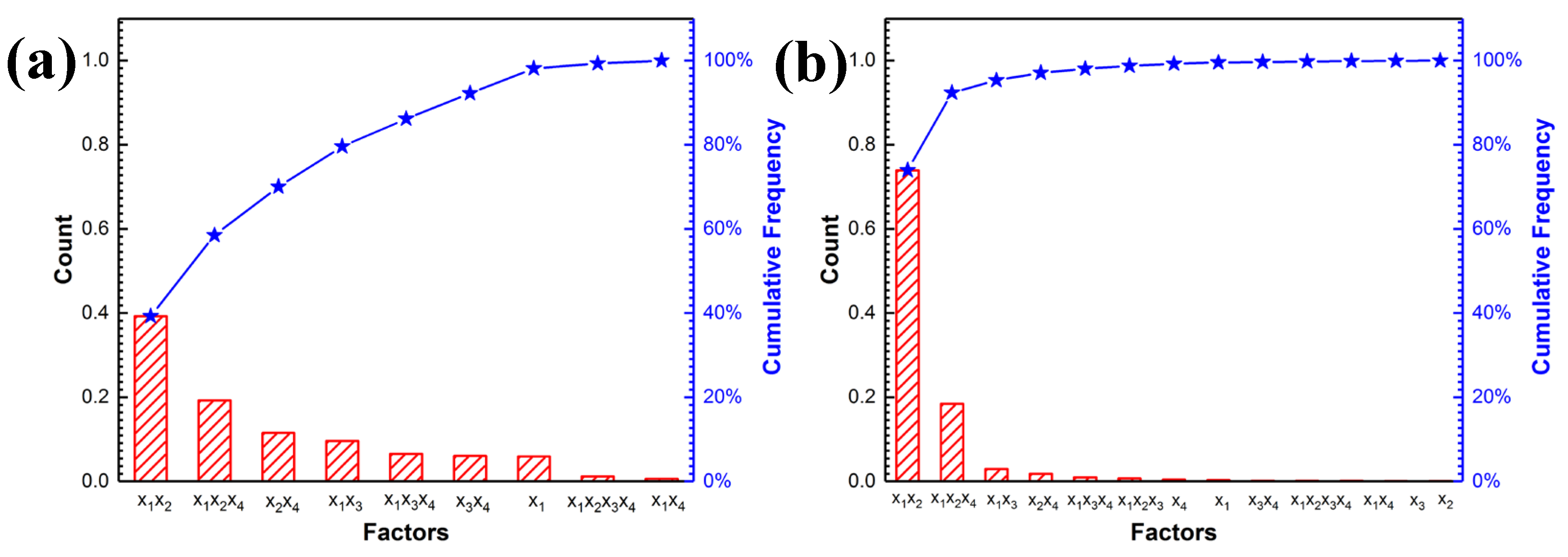
Pareto analysis is mainly applied to evaluate the weight of factors on, thus identifying the dominant factors and screening out those ones that have less significant effect on the response [41]. The influence of each factor on the thickness and spotting time can be calculated by Equation (4). Pi is the percentage of the effect of each term on the index, and Bi is the standardized regression coefficient of each term. The results of Pareto analysis are given in Figure 5.
P i = B i B i 2 × 100 %   ( i     0 )
Table 4 and Figure 5 show that not all factors have a significant effect on the coating. The interaction between Na2SiO3 and KF (x1x2) has the greatest influence on the coating thickness, followed by the interaction between Na2SiO3, KF and NaAlO2 (x1x2x4), and the interaction between KF and NaAlO2 (x2x4). The interactions among Na2SiO3, KF and NaAlO2 have an effect on the thickness reaching up to 70% (Pi = 70.03%). For spotting corrosion resistance, the effect of the interaction between Na2SiO3 and KF (x1x2) is much greater than the other factors, with the Pi value exceeding 70%, followed by the interaction between Na2SiO3, KF and NaAlO2 (x1x2x4). Ultimately, the interactions among Na2SiO3, KF and NaAlO2 even influence the spotting corrosion resistance by more than 90% (Pi = 92.35%).

3.2. Response Surface Analysis

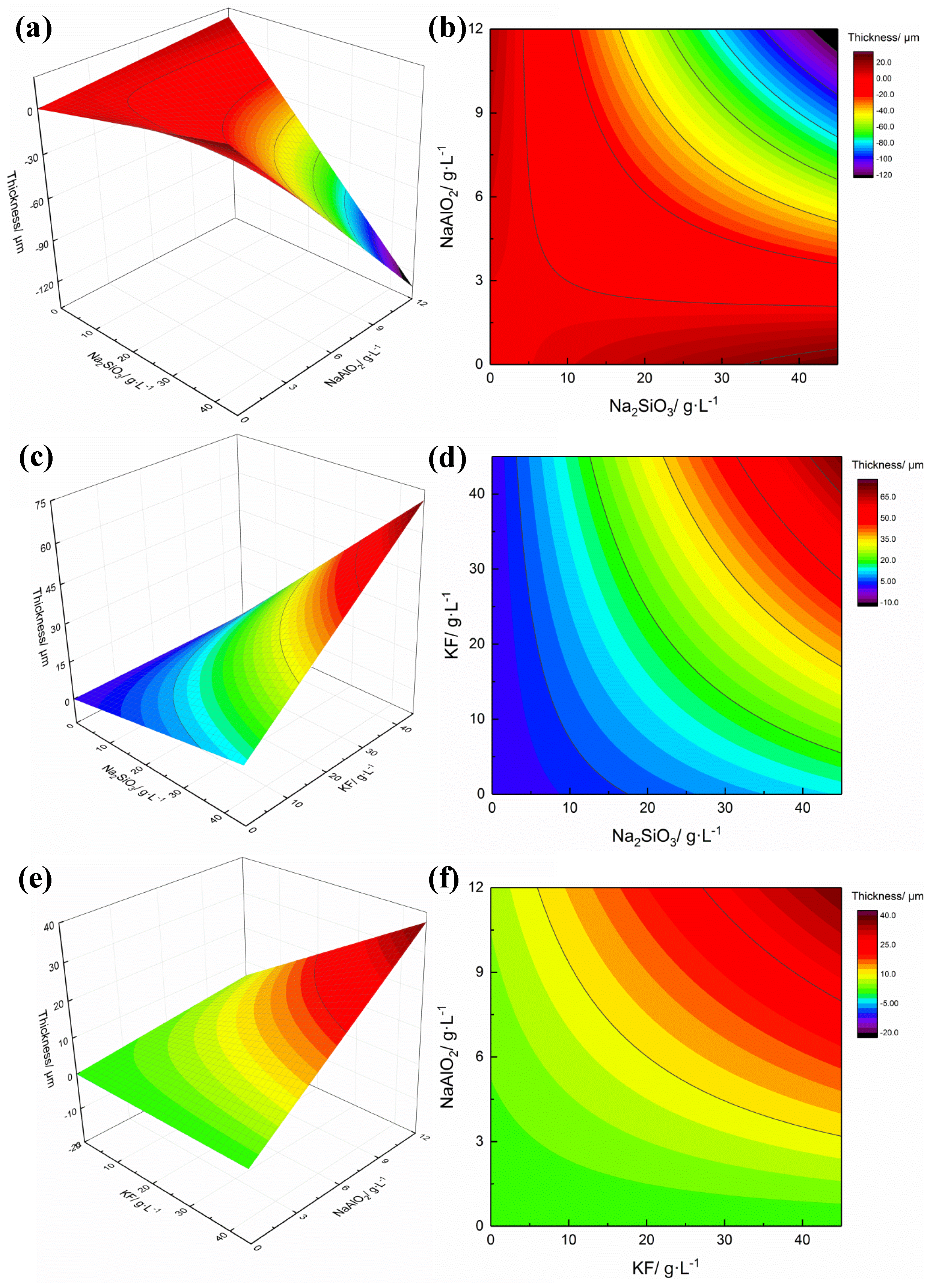
From the above analysis, it is clear that the interaction between Na2SiO3, KF and NaAlO2 has a very obvious effect on the thickness and spotting time. Figure 6a,b depicts the tendency of the influence of Na2SiO3 and NaAlO2 on the thickness with the concentration of NaOH and KF fixed at the center point. As seen in Figure 6a, the 3D response surface is approximately saddle-shaped, which further indicates that the interaction between Na2SiO3 and NaAlO2 has a significant impact on the thickness. When the Na2SiO3 concentration is low, the thickness increases slightly with an increase in NaAlO2 concentration; when the Na2SiO3 concentration is high, higher NaAlO2 concentration presents the thin thickness. In particular, the thickness reaches the lowest value when the Na2SiO3 and NaAlO2 concentration is 45 g·L−1 and 12 g·L−1, respectively. Therefore, the optimum thickness is obtained when the concentration of Na2SiO3 and NaAlO2 are tuned in opposite directions.
The effects of Na2SiO3 and KF concentrations on the coating thickness are demonstrated in Figure 6c,d. As can be seen, when the Na2SiO3 concentration is low, the thickness does not change much with increasing KF concentration; when the Na2SiO3 concentration is high, increasing KF concentration resulted in an obvious increase in thickness. The maximum thickness is obtained at higher concentrations of Na2SiO3 and KF. Similar results are observed for the 3D plots of the thickness with respect to KF and NaAlO2, as illustrated in Figure 6e,f, where the thickness increases slightly with increasing KF concentration when the NaAlO2 concentration is low, but at high NaAlO2 concentration, the thickness significantly increases with an increase in KF concentration. In addition, it is obvious from the comparison of Figure 6c–f that Na2SiO3 main salt system is more favorable for the enhancement of the thickness compared to NaAlO2 system. All in one, for the thickness, the optimum formula is obtained as high concentration of Na2SiO3, high concentration of KF and low concentration of NaAlO2.
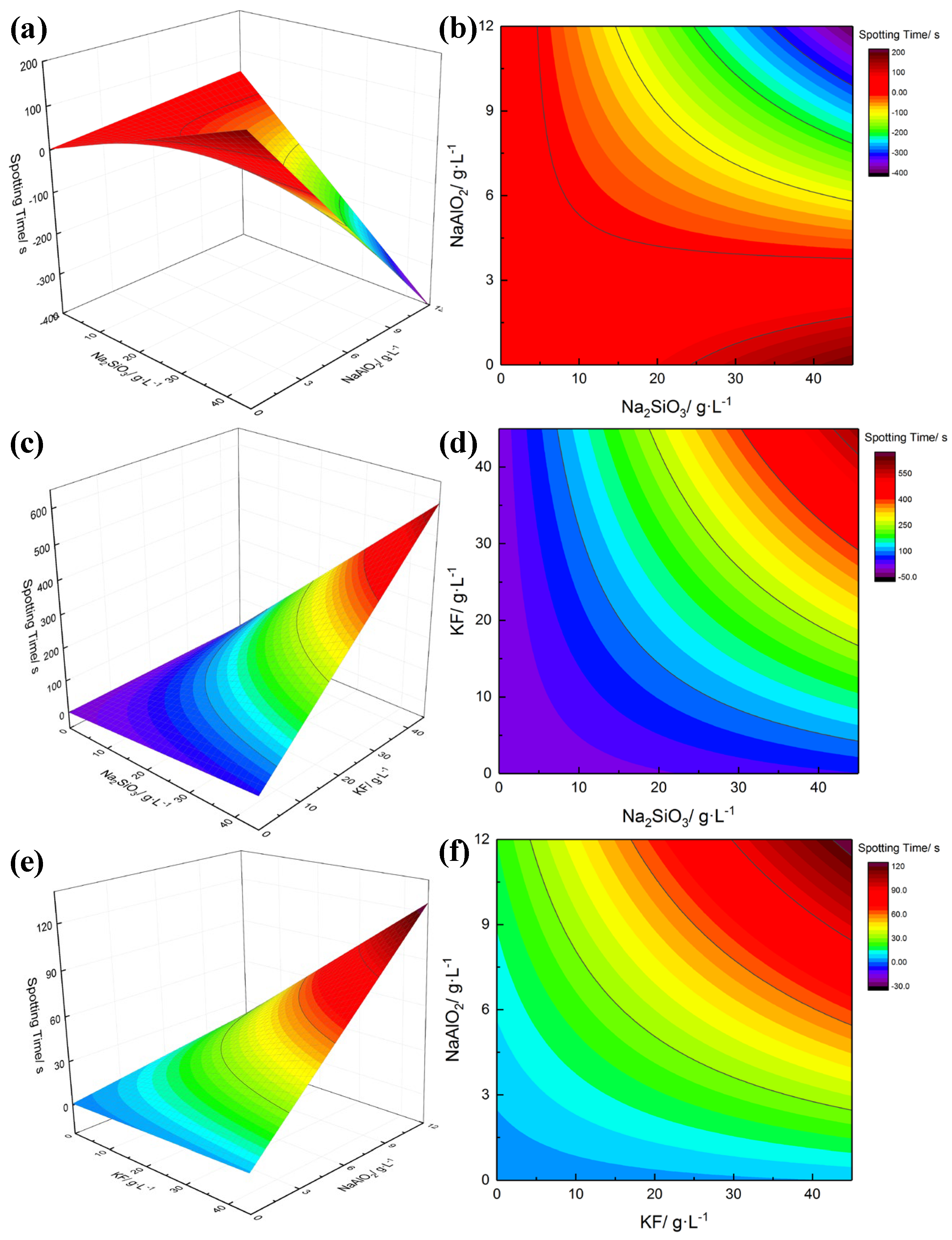
Figure 7 depicts the effects of Na2SiO3, KF and NaAlO2 on the spotting corrosion resistance. It is visible that the influence of electrolytes on the spotting time is similar to that of the thickness. Therefore, for the spotting time, the optimal combination is also high concentration of Na2SiO3, high concentration of KF and low concentration of NaAlO2.

3.3. Effect of the Interactions Among Na2SiO3, KF and NaAlO2

The outcomes of Pareto and response surface reveal that the thickness and spotting corrosion resistance are dependent on electrolyte composition, and the interactions between Na2SiO3, KF and NaAlO2 play a significant role. Therefore, the ternary experimental schemes in the original SCMD, namely the 11#–14# scheme, are selected to further explore how the electrolytes and their interactions affect the coating. Detailed information of the four schemes is given in Table 5.

3.3.1. Voltage/Current–Time Curves

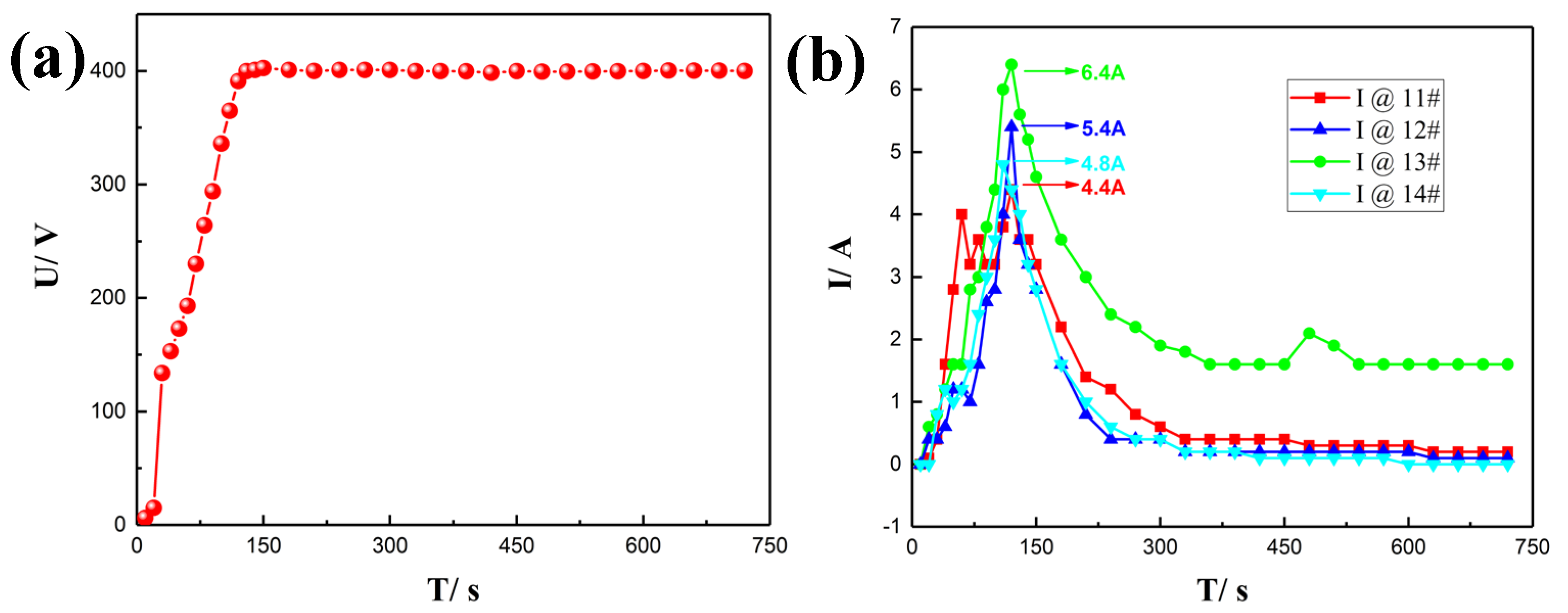
The curves of voltage–time and current–time are shown in Figure 8. In the initial stage of MAO, all the coatings show the same tendency, that is, with the increase in voltage, the current rises rapidly. This stage results from the partial dissolution of the matrix and the formation of a thin passivation film on the substrate surface. With the further increase in the voltage, reaching the breakdown voltage required for the film, the micro-arc discharge occurs locally. The breakdown voltage values of the coatings fabricated from different schemes are different, which is attributed to the breakdown voltage (Ub) mainly depending on the conductivity of the solution by Equation (5) [42], where α and β are constants for a certain substrate and electrolyte constituent, and k is the solution conductivity. From Table 5, it can be seen that Ub is in reverse order with k, which is consistent with Equation (5). Therefore, the Ub value of 11# scheme is the lowest, and 12# scheme has the highest Ub.
Ub = α + β log (1/k)
As the voltage increases, the current continues to rise and the oxide coating begins to form. When the voltage climbs to 400 V (120 s), the current also reaches its maximum value, then gradually decreases to a stable value with the gradual thickening of the coating. As shown in Figure 8, the values of the peak currents of 12# and 13# schemes are relatively high, especially the 13# scheme, which also has a higher current (1.6 A) after stabilization. Coincidentally, the temperature difference (∆T) of the electrolyte in 13# scheme is also large, as listed in Table 5.

3.3.2. Surface Morphology

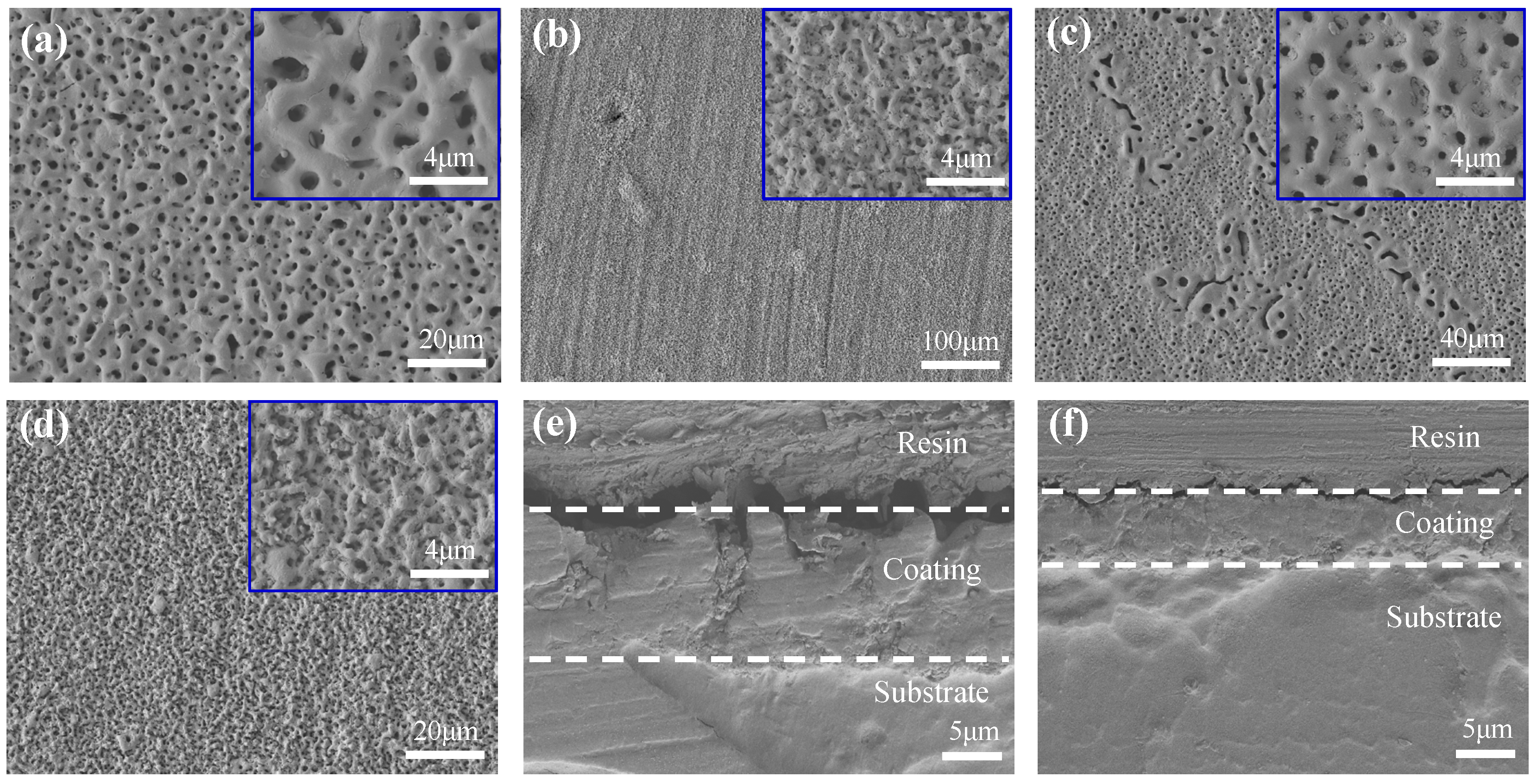
The surface and cross-sectional SEM photographs of MAO coatings are displayed in Figure 9. As can be seen, the surface of the coating with good formability obtained from only the main salt of Na2SiO3 is relatively flat and dominated by numerous irregular, crater-like micro-pores with different sizes, where there are obvious melt sinter-like traces around it (Figure 9a). The formability of the coating from the NaAlO2 main salt is also good, but the coating with small-size pores is thinner and possesses some scratches left during specimen pretreatment (Figure 9d). The surface porosity is counted quantitatively by Image J software (Version 1.8.0) on SEM images of the coating surface with good formability, and the results are listed in Table 5. It can be seen from Table 5 that the coating prepared by NaAlO2 system (8.103%) is denser than that of Na2SiO3 system (10.399%). In contrast, the formability of the coatings obtained in the Na2SiO3-NaAlO2 composite main salt is poor, unevenly distributed larger holes or protrusions, which is mainly due to the uneven breakdown discharge on the surface. The surface of 12# scheme is characterized by plenty of large pores due to the selective dielectric breakdown in the weak area (Figure 9b). A large number of protrusions and pits are visible for 13# scheme sample (Figure 9c). The EDS results show that these regions are β phase (Mg17Al12) of AZ91D Mg alloy, which is similar to the results of other researchers [43,44,45].
From the cross-sectional SEM images of MAO coatings with good formability, it is observed that the thickest coating is obtained under the Na2SiO3 system (Figure 9e), which is attributed to the Na2SiO3 electrolyte being more stable and the coating growth rate being faster. In the electrolyte of NaAlO2 main salt, the growth rate is slow, so a thin coating is obtained (Figure 9f). Na2SiO3, as a strong electrolyte, is in favor of the improvement of the electrolyte conductivity and the process of MAO reactions. While NaAlO2 is a weak electrolyte, and AlO2 in NaAlO2 solution is unstable, usually in the form of [Al(OH)4] or [Al(OH6)]3− [46], which is not conducive to the coating growth.

3.3.3. Chemical Composition

The XRD plots of the four coatings are illustrated in Figure 10. Strong diffraction peaks of Mg (PDF#35-0821) proceeding from AZ91D Mg alloy substrate were identified because the oxide layers are porous and thin that let the X-ray penetrate to the substrate. The differences in the intensity and position of Mg diffraction peaks of various schemes are caused by the internal stress of AZ91D matrix, which may originate from the material itself, wire cutting or the sample preparation process. In addition, the diffraction peaks of β phase (Mg17Al12, PDF#73-1148) also appear in all the patterns. As shown in the figure, the main components of coatings are cubic MgO (PDF#87-0653), orthorhombic Mg2SiO4 (PDF#87-0061) and cubic MgAl2O4 (PDF#99-0098), which also confirms that electrolyte components indeed participate in MAO reactions. Chemically stable magnesium olivine (Mg2SiO4) and spinel phase (MgAl2O4) contribute to enhancing the coating corrosion resistance. Furthermore, XRD did not detect any fluorine-containing phases. This may be attributed to the small ion radius and high migration rate of F, causing them to concentrate primarily within the interior of the coating [21,28,34]. The main reactions involved in the MAO process are as follows:
Mg → Mg2+ + 2e (anodic dissolution)
4OH → 2H2O + 2O(O2) + 4e
Mg2+ + O2− → MgO
2Mg2+ + SiO32− + 2OH → Mg2SiO4 + 2H2O
2Mg2+ + 2SiO32− → Mg2SiO4 + SiO2
Mg2+ + 2AlO2 → MgAl2O4
Mg2+ + 2F → MgF2
Mg2+ + OH → Mg(OH)2 + 2e
Mg(OH)2 → MgO + H2O
The EDS profiles and corresponding element content taken for the surface of coatings are summarized in Figure 11 and Figure 12 and Table 6, respectively. Generally speaking, the elements are mainly derived from electrolyte components and the substrate. The results reveal that the coating contains magnesium, oxygen, aluminum, silicon and fluorine. Magnesium comes from AZ91D Mg alloy substrate, while silicon and fluorine are attributed to the electrolyte composition Na2SiO3 and KF, respectively. Oxygen may be derived from the electrolyte or the air, and aluminum comes from two main sources: the electrolyte NaAlO2 and the β phase Mg17Al12 of matrix. The contents of Al are relatively high in the large-pore areas of 12# sample and the protrusions of 13# sample (Figure 11d and Figure 12d), which can be identified as the β phase Mg17Al12. As listed in Table 6, the coating prepared under Na2SiO3 main salt contains higher Si, and that of NaAlO2 main salt has a higher content of Al. However, the content of Si and Al in the coatings obtained under Na2SiO3-NaAlO2 system decreases, especially when the electrolyte contains KF, Si and Al decrease significantly, while the content of F increases significantly.

3.3.4. Corrosion Study

From the response surface analysis (Figure 6 and Figure 7), it is clear that the effect of electrolytes on the spotting corrosion resistance shows a similar trend with that of the thickness. Therefore, Pearson correlation coefficient (PCC, r) is applied in this experiment to evaluate the correlation between the thickness and spotting time. PCC, originated from statistical theory, is used as a popular metric to describe the strength of the linear relationship between variables x and y. It ranges from −1 to +1, and the closer the r value is to +1 or −1, the stronger the correlation between x and y. The PCC is defined as
r   ( x ,   y ) = cov ( x , y ) var ( x ) × var ( y )
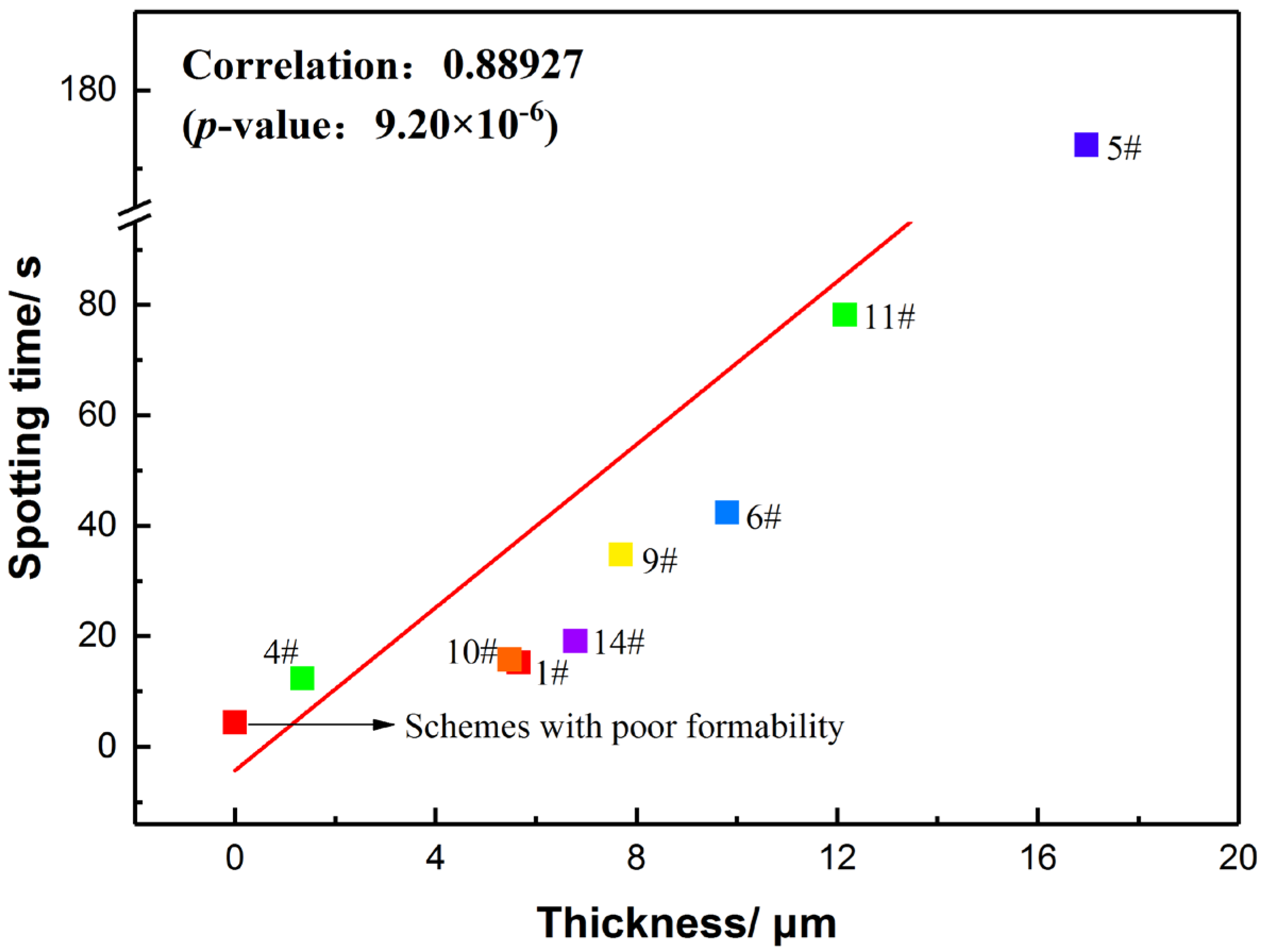
where cov is the covariance of variables and var is the variance of each variable [47,48]. Figure 13 presents the scatter plot of the thickness and spotting time, from which it can be seen that there is a linear relationship between the two indicators. The result of correlation analysis proves that there is a significant positive correlation between the thickness and spotting time (r = 0.88927, p = 9.2 × 10⁻⁶); that is, the spotting time of the sample with thinner film is generally shorter, while the spotting time with thicker film is longer.
In HNO3 medium of the spotting test, HNO3 will first undergo chemical reactions with the coating, thereby consuming the coating and subsequently corroding the substrate, so the corrosion characteristic of the coating is mainly consumable. The possible reactions are shown in Equations (16)–(18). When the coating is thicker, the time used to be consumed by HNO3 is longer, so the spotting corrosion resistance is better. Therefore, thickness is the main factor affecting the spotting corrosion resistance.
MgO + 2HNO3 → Mg(NO3)2 + H2O
Mg + 3HNO3 → Mg(NO3)2 + NO (↑) + 2H2O
2NO + 2KMnO4 → K2MnO4 + MnO2 + 2NO2
By comparison, it is obvious that the spotting corrosion resistance in the Na2SiO3 system is generally better due to the thicker film and the formation of olivine phase Mg2SiO4 (Figure 10), and that in the NaAlO2 system it is relatively poor because of the thin coating. However, the spotting corrosion resistance in the Na2SiO3-NaAlO2 system is the worst, which is attributed to the uneven breakdown leading to the formation of coarse and poor-formability coating.
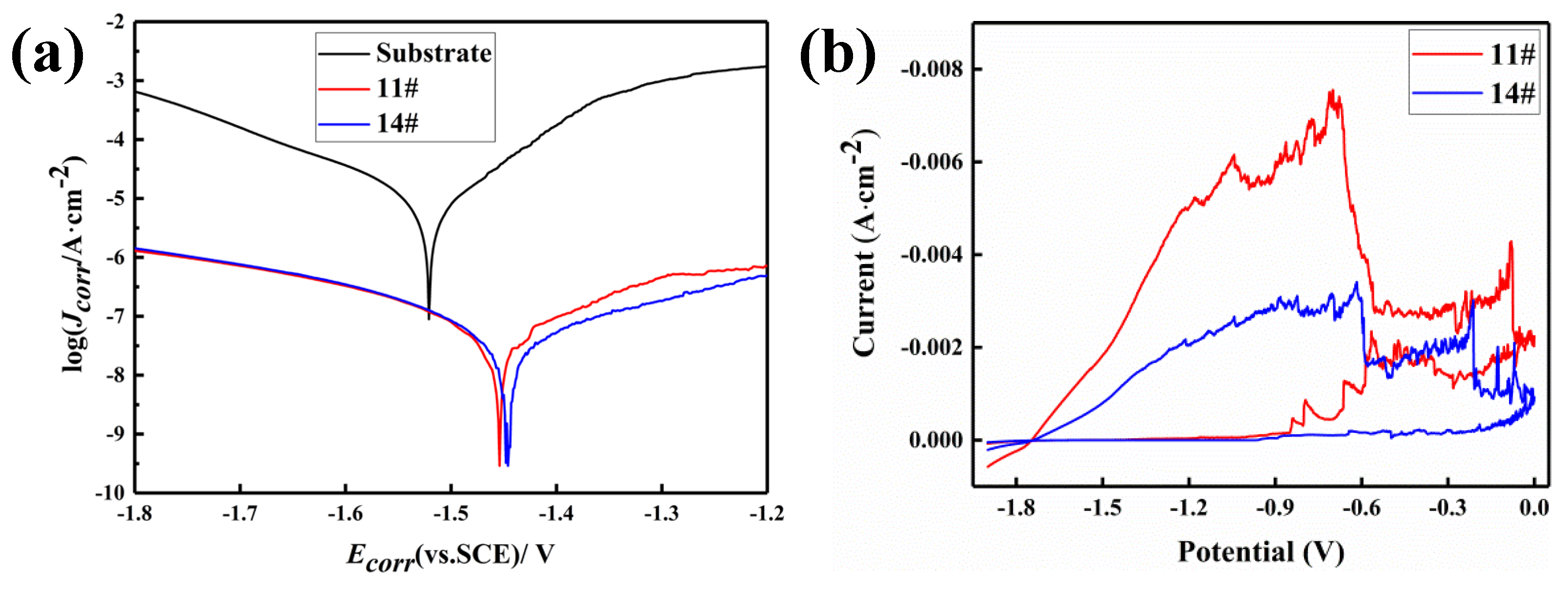
The 11# and 14# schemes with better formability are selected for the electrochemical tests. Figure 14 shows PDP, CV spectra and the fitting results are summarized in Table 7. The results of PDP curves show a positive shift in the corrosion potential (Ecorr) and a reduction in the corrosion current density (Jcorr) and polarization resistance (Rp) by approximately two orders of magnitude compared to the substrate, indicating that MAO treatment can remarkably improve the corrosion resistance of magnesium alloy. Compared to 11# scheme, 14# scheme exhibits lower corrosion current density and therefore better electrochemical corrosion resistance. The results of CV tests are consistent with PDP curves and the smaller loop area of 14# scheme means that it is more resistant to localized corrosion, as listed in Table 7. In NaCl medium of the electrochemical tests, Cl gradually permeates into the coating, thereby corroding the substrate. Consequently, the corrosion characteristic of the coating is primarily permeable. The coating’s pore size, porosity and surface defects are the key factors influencing its corrosion resistance. The smaller the micro-pore size, the lower the porosity, and the fewer the macropores and micro-cracks, the less likely the corrosive medium is to penetrate into the coating, which is more conducive to enhancing the corrosion resistance. Therefore, the electrochemical corrosion resistance of 14# surpasses that of 11# due to its microstructure and lower surface porosity (Table 5), preventing the penetration of corrosive media.

4. Discussion

The morphology, composition and property of the coating decisively depend on the electrolyte constituent. The results of Pareto and response surface analysis demonstrate that the interactions between Na2SiO3, KF and NaAlO2 have a dominant effect on the coating. Further analysis of the ternary experimental schemes in SCMD indicates that the combination of Na2SiO3 and NaAlO2 is not conducive to the growth of the coating, and when the electrolyte is single Na2SiO3 or NaAlO2 system, the coating formability is better.
It is well known that the passivation film formed at the initial step of the MAO process is the premise of breakdown discharge. As one of the most common additives, KF often acts as “sparking initiators”. Fluorine ions can react with magnesium in the substrate to produce insoluble and chemically stable substances MgF2 and Mg(OH)2-XFX [49,50], which are attached to the surface of the substrate and facilitate the formation of the insulating layer. The EDS results in this study confirm that KF indeed participates in the coating formation, as shown in Figure 10 and Table 6. Simultaneously, KF can also improve the growth rate and increase the thickness, which may ascribe to the small radius and high migration rate of F [51]. As a consequence, a high content of KF is in favor of the enhancement of coating thickness and corrosion resistance. In this experimental design, the scheme 5#, containing the main salt and the highest KF concentration, exhibits the thickest coating (16.98 μm) and the best spotting corrosion resistance (172.96 s).
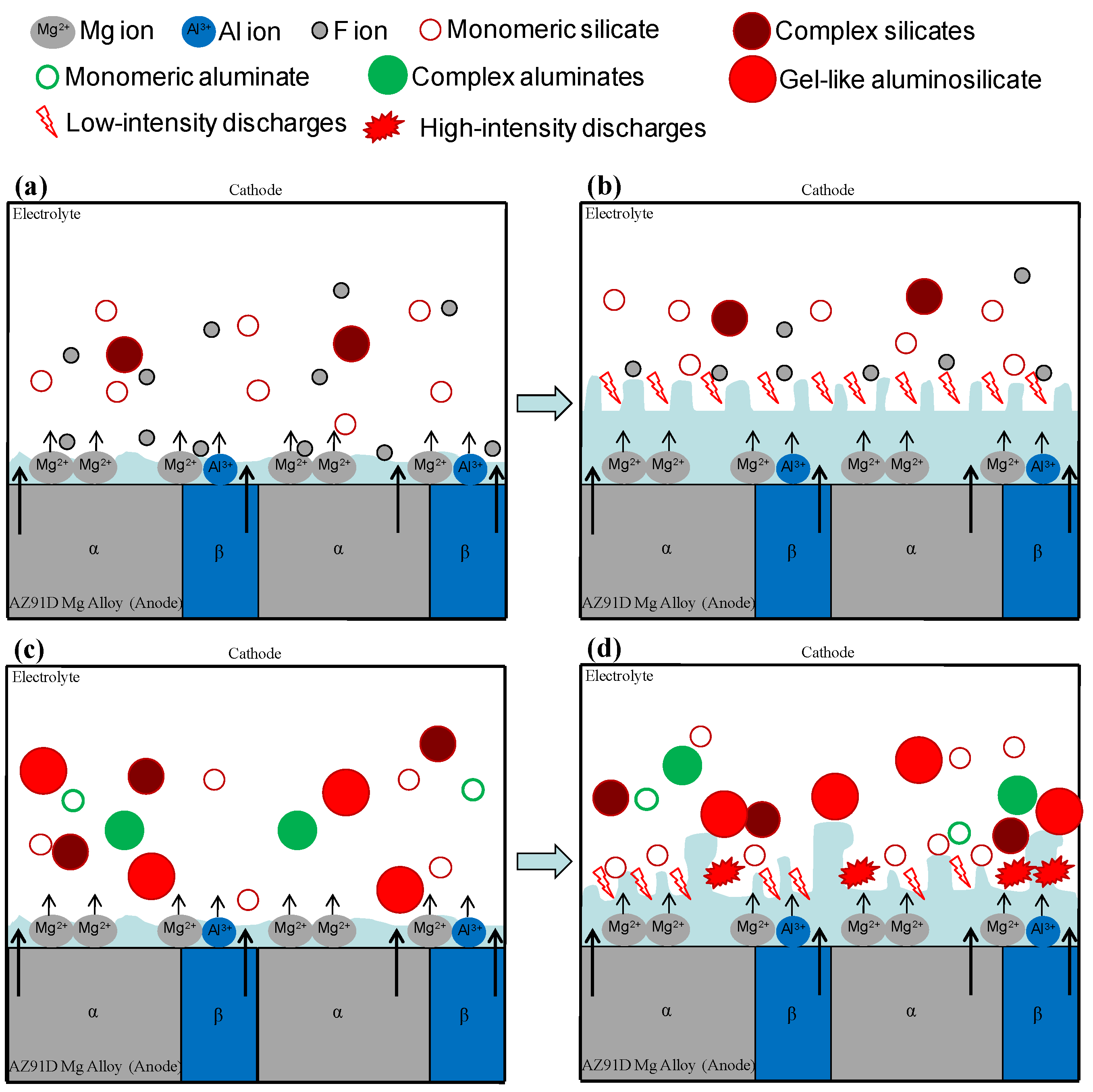
In alkaline solution of Na2SiO3-NaAlO2 system, silicate- reacts with aluminate- to give the aluminosilicate colloidal substance [31,46].
Si ( OH ) 4   +   x OH     ( OH ) 4 x SiO x x   +   x H 2 O
( OH ) 4 x SiO x x   +   Al ( OH ) 4     ( HO ) 3 AlOSiO x · ( OH ) 3 x ( x + 1 )   +   H 2 O
In addition, more complex polycondensation reactions occur at high temperature and high pressure, resulting in an increase in the viscosity of the solution. Therefore, when Na2SiO3 and NaAlO2 are added into the electrolyte, the electrolyte becomes highly viscose and is responsible for the uneven breakdown discharge.
AZ91D magnesium alloy consists of α-phase Mg and β-phase Mg17Al12, where Mg17Al12 is an intermetallic compound formed by Mg and Al. Therefore, at the early stage of MAO, the value of breakdown voltage of the passive film formed on the surface of β phase is higher than that of α phase, which eventually leads to the appearance of selective breakdown discharge [52]. In addition, under the action of electric field, β phase in substrate loses electrons into the solution in form of Al3+ and polymerizes with the silicate- in the electrolyte [53], which further aggravates the inhomogeneous breakdown discharge and eventually leads to the appearance of inhomogeneous large holes and protrusions on the β phase surface (Figure 9b,c).
The schematic illustration of the effect mechanisms of the interactions between Na2SiO3, KF and NaAlO2 is shown in Figure 15. For the 12# scheme, the migration rate of aluminosilicate gel-like substances formed by silicate- and aluminate- is slow, F in the electrolyte will migrate to the anode surface in large quantities, resulting in a high F content and a low Si and Al content in the coating (Table 6). In contrast, for the 13# scheme without F in the electrolyte, the main reaction particles in the solution can only come from the polymers (Figure 15d), so the MAO process is slower, resulting in higher peak current and higher current values after stabilization (Figure 8) and a larger temperature difference in the electrolyte (Table 5).

5. Conclusions

Based on simplex-centroid mixture design (SCMD), this work also incorporates the interactions among electrolytes into the experiment. It not only studies the influence of electrolyte components on the formability, the thickness and corrosion resistance of the coating, but also investigates the effect of interactions between electrolytes.
  • Multi-factor experimental design is the key to studying the components of electrolytes and their interactions. By comparing the experimental schemes that only contain one, two, three and four electrolytes, the influence of each electrolyte component and the interactions on the coating is analyzed.
  • Based on regression analysis, the electrolytes are linked to the final coating performances, and the regression models between the electrolyte components and the thickness and corrosion resistance are fitted. The equations are all very significant (p-value < 0.01), and have high prediction accuracy (R2 = 0.9893, 0.9989), which can be used for the optimization of the electrolyte formula and the prediction of the coating performance.
  • Pareto analysis indicates that the interactions between Na2SiO3, KF and NaAlO2 produce a great influence on the thickness and spotting time of coatings, which is quantitatively confirmed that there are interactions among the electrolytes. The analysis of response surface methodology (RSM) showed that better thickness and spotting corrosion resistance could be achieved when the ideal combination is high concentration of Na2SiO3, high concentration of KF and low concentration of NaAlO2. When Na2SiO3 is compounded with NaAlO2, both of them will form polymers through complex polymerization reactions, resulting in increased viscosity of electrolyte, reduced migration rate of the particles and poor formability of the coating with uneven surface.
  • Pearson correlation coefficient (PCC) was first applied to deal with the correlation between the thickness and corrosion resistance. The result of PCC revealed that the corrosion resistance in acidic media primarily depends on the thickness (r = 0.88927).

Author Contributions

Conceptualization, Z.W. and L.A.; methodology, Z.W. and Y.M.; software, Z.W. and L.M.; validation, Q.Z. and L.A.; formal analysis, Y.M. and L.M.; resources, Y.M. and L.M.; data curation, Z.W. and Q.Z.; writing—original draft preparation, Q.Z.; writing—review and editing, Z.W.; supervision, L.M.; project administration, Y.M. and L.A.; funding acquisition, L.M. All authors have read and agreed to the published version of the manuscript.

Funding

The authors are grateful to Top Talents of Kunlun Talents·High-end Innovation and Entrepreneurship Talents’ of Qinghai Province, and the project of the Central Government’s Guidance for Local Science and Technology Development Fund in Qinghai Province (2024ZY013).

Data Availability Statement

The raw data supporting the conclusions of this article will be made available by the authors on request.

Conflicts of Interest

The authors declare no conflict of interest.

References

  1. Shao, Y.; Han, X.; Ma, C.; Wei, Y.; Zhu, X.; Xu, J. The thermal dynamic simulation and microstructure characterization of micro-arc oxidation (MAO) films on magnesium AZ31 irradiated by high-intensity pulsed ion beam. Appl. Surf. Sci. 2025, 682, 161705. [Google Scholar] [CrossRef]
  2. Florczak, Ł.; Pojnar, K.; Ko’scielniak, B.; Pilch-Pitera, B. Preparation and Characterization of Duplex PEO/UV-Curable Powder Coating on AZ91 Magnesium Alloys. Metals 2024, 14, 733. [Google Scholar] [CrossRef]
  3. Parichehr, R.; Dehghanian, C.; Nikbakht, A. Preparation of PEO/silane composite coating on AZ31 magnesium alloy and investigation of its properties. J. Alloy. Compd. 2021, 876, 159995. [Google Scholar] [CrossRef]
  4. Udoh, I.I.; Shi, H.; Daniel, E.F.; Li, J.; Gu, S.; Liu, F.; Han, E.-H. Active anticorrosion and self-healing coatings: A review with focus on multi-action smart coating strategies. J. Mater. Sci. Technol. 2022, 116, 224–237. [Google Scholar] [CrossRef]
  5. Niedźwiedź, M.; Korzekwa, J.; Bara, M.; Kaptacz, S.; Aniołek, K.; Sowa, M.; Simka, W. The Influence of PEO Process Parameters on the Mechanical and Sclerometric Properties of Coatings on the Ultralight Magnesium Alloy LA141. Coatings 2025, 15, 961. [Google Scholar] [CrossRef]
  6. Fattah-Alhosseini, A.; Molaei, M.; Kaseem, M. A review on the plasma electrolytic oxidation (PEO) process applied to copper and brass. Surf. Interfaces 2024, 46, 104179. [Google Scholar] [CrossRef]
  7. Wang, Y.; Zhang, Y.; Wu, C.; Wang, F.; Zha, Z.; Liu, L. Effect of cathodic current density on the structure and properties of MAO coatings on 2195 Al-Li alloy. Mater. Today Commun. 2025, 46, 112776. [Google Scholar] [CrossRef]
  8. Wu, T.; Blawert, C.; Zheludkevich, M.L. Influence of secondary phases of AlSi9Cu3 alloy on the plasma electrolytic oxidation coating formation process. J. Mater. Sci. Technol. 2020, 50, 75–85. [Google Scholar] [CrossRef]
  9. Thanaa, T.T.; Fattah-Alhosseini, A.; Alkaseem, M.; Kaseem, M. Improving the surface properties of Mg based-plasma electrolytic oxidation (PEO) coatings under the fluoride electrolytes: A review. Inorg. Chem. Commun. 2024, 170, 113163. [Google Scholar] [CrossRef]
  10. An, L.; Ma, Y.; Sun, L.; Wang, Z.; Wang, S. Investigation of mutual effects among additives in electrolyte for plasma electrolytic oxidation on magnesium alloys. J. Magnes. Alloy. 2020, 8, 523–536. [Google Scholar] [CrossRef]
  11. Jiang, C.; Wang, Y.; Chen, Q.; Ying, G.; Fei, Q. Unveiling the role of SiC particle reinforcement on aluminum matrix composites surface: Insights into PEO coating growth, electrical insulation, and corrosion resistance. Ceram. Int. 2025, in press. [Google Scholar] [CrossRef]
  12. Satbayeva, Z.; Zhassulan, A.; Rakhadilov, B.; Shynarbek, A.; Ormanbekov, K.; Leonidova, A. Effect of Micro-Arc Oxidation Voltage on the Surface Morphology and Properties of Ceramic Coatings on 7075 Aluminum Alloy. Metals 2025, 15, 746. [Google Scholar] [CrossRef]
  13. Shi, W.; Li, Y.; Li, X.; Ma, M.; Shi, G.; Yuan, J.; Sun, Z.; Zhang, K.; Jin, C.; Liu, W. Fabrication and long-term in vitro corrosion behavior of MAO coating on biodegradable Mg-3Zn-0.7Mn-0.5Sr alloy. Mater. Today Commun. 2025, 47, 113220. [Google Scholar] [CrossRef]
  14. Kaseem, M.; Aadil, M.; Thanaa, T.T.; Alkaseem, M. Improving the photocatalytic performance of TiO2 coating via the dual incorporation of MoO2 and V2O5 by plasma electrolytic oxidation. Surf. Interfaces 2024, 46, 104179. [Google Scholar] [CrossRef]
  15. Wang, Y.; Zhang, J.; Wang, W.; Yu, F.; Cao, W.; Hu, S. Effect of sodium fluoride additive on microstructure and corrosion performance of micro-arc oxidation coatings on EK30 magnesium alloy. Surf. Coat. Technol. 2025, 496, 131628. [Google Scholar] [CrossRef]
  16. Wu, M. Effect of oxidation time on the microstructure, mechanical properties, and corrosion resistance of MAO ceramic film on 5B70 Al alloy. Mater. Des. 2025, 254, 114039. [Google Scholar] [CrossRef]
  17. Krit, B.L.; Mogilnaya, T.Y.; Morozova, N.V.; Ya, B.S.; Ruizhi, W.; Medvetskova, V.M.; Dolgushin, Y.V.; Petelin, N.A. Modelling of photoactivation process to plasma-electrolyte coating on magnesium alloy. Mater. Chem. Phys. 2024, 323, 129669. [Google Scholar] [CrossRef]
  18. Chen, X.; Wang, H.; Liu, C.; Wang, W.; Chen, B. Influence of additives on the macroscopic color and corrosion resistance of 6061 aluminum alloy micro-arc oxidation coatings. Materials 2024, 17, 2621. [Google Scholar] [CrossRef] [PubMed]
  19. Yang, C.; Meng, X.; Li, X.; Li, Z.; Yan, H.; Wu, L.; Cao, F. Effect of electrolyte composition on corrosion behavior and tribological performance of plasma electrolytic oxidized TC4 alloy. Trans. Nonferrous Met. Soc. China 2023, 33, 141–156. [Google Scholar] [CrossRef]
  20. Xia, Q.; Li, X.; Yao, Z.; Jiang, Z. Investigations on the Thermal Control Properties and Corrosion Resistance of MAO Coatings Prepared on Mg-5Y-7Gd-1Nd-0.5Zr Alloy. Surf. Coat. Technol. 2021, 409, 126874. [Google Scholar] [CrossRef]
  21. Dong, H.; Wang, S.; Xie, D.; Li, Q.; Zhao, D.; Guo, H.; Wu, J.; Jiang, W.; Meng, X.; An, L. Enhancing understanding of cooperation mechanism of electrolyte composition on PEO coating growth for magnesium alloys via load characteristics. Surf. Coat. Technol. 2024, 494, 131307. [Google Scholar] [CrossRef]
  22. Li, N.; Yuan, K.; Song, Y.; Cao, J.; Xu, L.; Xu, J. Plasma electrolytic oxidation of Zircaloy-2 alloy in potassium hydroxide/sodium silicate electrolytes: The effect of silicate concentration. Boletín Soc. Española Cerámica Vidr. 2021, 60, 328–336. [Google Scholar] [CrossRef]
  23. Salami, B.; Afshar, A.; Mazaheri, A. The effect of sodium silicate concentration on microstructure and corrosion properties of MAO-coated magnesium alloy AZ31 in simulated body fluid. J. Magnes. Alloy. 2014, 2, 72–77. [Google Scholar] [CrossRef]
  24. Rehman, Z.U.; Koo, B.H. Effect of Na2SiO3·5H2O concentration on the microstructure and corrosion properties of two-step PEO coatings formed on AZ91 alloy. Surf. Coat. Technol. 2017, 317, 117–124. [Google Scholar] [CrossRef]
  25. Baghdadabad, D.M.; Baghdadabad, A.R.M.; Khoei, S.M.M. Characterization of bioactive ceramic coatings synthesized by plasma electrolyte oxidation on AZ31 magnesium alloy having different Na2SiO3·9H2O concentrations. Mater. Today Commun. 2020, 25, 101642. [Google Scholar] [CrossRef]
  26. Bian, G.; Wang, L.; Wu, J.; Zheng, J.; Sun, H.; DaCosta, H. Effects of electrolytes on the growth behavior, microstructure and tribological properties of plasma electrolytic oxidation coatings on a ZA27 alloy. Surf. Coat. Technol. 2015, 277, 251–257. [Google Scholar] [CrossRef]
  27. Zhu, L.; Li, H.; Ma, Q.; Lu, J.; Li, Z. The mechanism for tuning the corrosion resistance and pore density of plasma electrolytic oxidation (PEO) coatings on Mg alloy with fluoride addition. J. Magnes. Alloy. 2023, 11, 2823–2832. [Google Scholar] [CrossRef]
  28. Liu, F.; Yu, J.; Song, Y.; Shan, D.; Han, E.-H. Effect of potassium fluoride on the in-situ sealing pores of plasma electrolytic oxidation film on AM50 Mg alloy. Mater. Chem. Phys. 2015, 162, 452–460. [Google Scholar] [CrossRef]
  29. Blawert, C.; Heitmann, V.; Dietzel, W.; Nykyforchyn, H.M.; Klapkiv, M.D. Influence of electrolyte on corrosion properties of plasma electrolytic conversion coated magnesium alloys. Surf. Coat. Technol. 2007, 201, 8709–8714. [Google Scholar] [CrossRef]
  30. Qin, Y.; Wu, G.; Atrens, A.; Zhang, X.; Zhang, L.; Ding, W. Correlation between KOH concentration and surface properties of AZ91 magnesium alloy coated by plasma electrolytic oxidation. Trans. Nonferrous Met. Soc. China 2021, 31, 913–924. [Google Scholar] [CrossRef]
  31. Chen, Y.; Yang, Y.; Zhang, T.; Zhang, W.; Wang, F.; Lu, X.; Blawert, C.; Zheludkevich, M.L. Interaction effect between different constituents in silicate-containing electrolyte on PEO coatings on Mg alloy. Surf. Coat. Technol. 2016, 307, 825–836. [Google Scholar] [CrossRef]
  32. Wang, S.; Xia, Y. Microarc oxidation coating fabricated on AZ91D Mg alloy in an optimized dual electrolyte. Trans. Nonferrous Met. Soc. China 2013, 23, 412–419. [Google Scholar] [CrossRef]
  33. Vakili-Azghandi, M.; Fattah-Alhosseini, A.; Keshavarz, M.K. Optimizing the electrolyte chemistry parameters of PEO coating on 6061 Al alloy by corrosion rate measurement: Response surface methodology. Measurement 2018, 124, 252–259. [Google Scholar] [CrossRef]
  34. HB5061-77; Quality Inspection of Chemical Oxide Coatings on Magnesium Alloys. China Aviation Industry Standardization Institute: Beijing, China, 1977.
  35. Wang, Z.; Ma, Y.; Wang, Y. Effect of V2O5 Additive on Micro-Arc Oxidation Coatings Fabricated on Magnesium Alloys with Different Loading Voltages. Metals 2020, 10, 1146. [Google Scholar] [CrossRef]
  36. Cornell, J.A. Experiments with Mixtures: A Review. Technometrics 1973, 15, 437–455. [Google Scholar] [CrossRef]
  37. Li, Y.Y.; Hu, C.R. Experiment Design and Data Processing, 3rd ed.; Chemical Industrial Press: Beijing, China, 2017. [Google Scholar]
  38. Khaskhoussi, A.; Calabrese, L.; Bouhamed, H.; Kamoun, A.; Proverbio, E.; Bouaziz, J. Mixture design approach to optimize the performance of TiO2 modified zirconia/alumina sintered ceramics. Mater. Des. 2018, 137, 1–8. [Google Scholar] [CrossRef]
  39. Talat, M.; Prakash, O.; Hasan, S.H. Enzymatic detection of As(III) in aqueous solution using alginate immobilized pumpkin urease: Optimization of process variables by response surface methodology. Bioresour. Technol. 2009, 100, 4462–4467. [Google Scholar] [CrossRef]
  40. Castro, R.J.S.; Sato, H.H. Synergistic effects of agroindustrial wastes on simultaneous production of protease and α-amylase under solid state fermentation using a simplex centroid mixture design. Ind. Crop. Prod. 2013, 49, 813–821. [Google Scholar] [CrossRef]
  41. Zarei, M.; Niaei, A.; Salari, D.; Khataee, A. Application of response surface methodology for optimization of peroxi-coagulation of textile dye solution using carbon nanotube–PTFE cathode. J. Hazard. Mater. 2010, 173, 544–551. [Google Scholar] [CrossRef]
  42. Han, I.; Choi, J.H.; Zhao, B.H.; Baik, H.K.; Lee, I.S. Micro-arc oxidation in various concentration of KOH and structural change by different cut off potential. Curr. Appl. Phys. 2007, 7, e23–e27. [Google Scholar] [CrossRef]
  43. Wang, Y.; Wang, X.; Zhang, T.; Wu, K.; Wang, F. Role of β Phase during Microarc Oxidation of Mg Alloy AZ91D and Corrosion Resistance of the Oxidation Coating. J. Mater. Sci. Technol. 2013, 29, 1129–1133. [Google Scholar] [CrossRef]
  44. Chen, Y.; Yang, Y.; Zhang, W.; Zhang, T.; Wang, F. Influence of second phase on corrosion performance and formation mechanism of PEO coating on AZ91 Mg alloy. J. Alloy. Compd. 2017, 718, 92–103. [Google Scholar] [CrossRef]
  45. Liu, C.; Xu, T.; Shao, Q.; Huang, S.; Jiang, B.; Liang, J.; Li, H. Effects of beta phase on the growth behavior of plasma electrolytic oxidation coating formed on magnesium alloys. J. Alloy. Compd. 2019, 784, 414–421. [Google Scholar] [CrossRef]
  46. Swaddle, T.W. Silicate complexes of aluminum (III) in aqueous systems. Coord. Chem. Rev. 2001, 219–221, 665–686. [Google Scholar] [CrossRef]
  47. Feng, W.; Zhu, Q.; Zhuang, J.; Yu, S. An expert recommendation algorithm based on Pearson correlation coefficient and FP-growth. Cluster. Comput. 2019, 22, 7401–7412. [Google Scholar] [CrossRef]
  48. Chang, Y.; Yang, D.; Guo, Y. Laser ultrasonic damage detection in coating-substrate structure via Pearson correlation coefficient. Surf. Coat. Technol. 2018, 353, 339–345. [Google Scholar] [CrossRef]
  49. Barchiche, C.E.; Veys-Renaux, D.; Rocca, E. A better understanding of PEO on Mg alloys by using a simple galvanostatic electrical regime in a KOH–KF–Na3PO4 electrolyte. Surf. Coat. Technol. 2011, 205, 4243–4248. [Google Scholar] [CrossRef]
  50. Bradford, P.M.; Case, B.; Dearnaley, G.; Turner, J.F.; Woolsey, I.S. Ion beam analysis of corrosion films on a high magnesium alloy (Magnox Al 80). Corros. Sci. 1976, 16, 747–766. [Google Scholar]
  51. Sun, L.; Ma, Y.; Wang, J.; An, L.; Wang, S.; Wang, Z. Preparation and corrosion resistance of hybrid coatings formed by PEN/C plus PEO on AZ91D magnesium alloys. Surf. Coat. Technol. 2020, 390, 125661. [Google Scholar] [CrossRef]
  52. Wei, F.; Zhang, W.; Zhang, T.; Wang, F. Effect of variations of Al content on microstructure and corrosion resistance of PEO coatings on Mg-Al alloys. J. Alloy. Compd. 2017, 690, 195–205. [Google Scholar] [CrossRef]
  53. Bonilla, F.A.; Berkani, A.; Liu, Y.; Skeldon, P.; Thompson, G.E.; Habazaki, H.; Shimizu, K.; John, C.; Stevens, K. Formation of Anodic Films on Magnesium Alloys in an Alkaline Phosphate Electrolyte. J. Electrochem. Soc. 2002, 149, B4–B12. [Google Scholar] [CrossRef]
Figure 1. Device diagram of MAO.
Metals 15 01378 g001
Figure 2. Test points for simplex-centroid design of quaternary mixtures.
Metals 15 01378 g002
Figure 3. Macro-morphologies of MAO coatings prepared in different electrolyte systems: No Na2SiO3-NaAlO2 system: (a) 2#, (b) 3#, (c) 8#; Na2SiO3 system: (d) 1#, (e) 5#, (f) 6#, (g) 11#; NaAlO2 system: (h) 4#, (i) 9#, (j) 10#, (k) 14#; Na2SiO3-NaAlO2 system: (l) 7#, (m) 12#, (n) 13#, (o) 15#.
Metals 15 01378 g003
Figure 4. Residual between predicted values of regression models and experimental values: (a) thickness, (b) spotting time.
Metals 15 01378 g004
Figure 5. Pareto graphic analysis of coatings: (a) thickness, (b) spotting time.
Metals 15 01378 g005
Figure 6. The 3D response surface plots of thickness: (a,b) Na2SiO3 × NaAlO2; (c,d) Na2SiO3 × KF; (e,f) KF × NaAlO2.
Metals 15 01378 g006
Figure 7. The 3D response surface plots of spotting time: (a,b) Na2SiO3 × NaAlO2; (c,d) Na2SiO3 × KF; (e,f) KF × NaAlO2.
Metals 15 01378 g007
Figure 8. Voltage-time (a) and current-time (b) curves for the schemes.
Metals 15 01378 g008
Figure 9. Surface morphologies ((a) 11#, (b) 12#, (c) 13#, (d) 14#) and cross-sectional morphologies ((e) 11#, (f) 14#) of MAO coatings fabricated in different electrolytes on AZ91D magnesium alloy.
Metals 15 01378 g009
Figure 10. XRD patterns of MAO coatings prepared in different electrolytes on AZ91D magnesium alloy.
Metals 15 01378 g010
Figure 11. Map scanning analysis of surface of 12# sample: (a) SE1; (b) Mg; (c) O; (d) Al; (e) Si; (f) F.
Metals 15 01378 g011
Figure 12. Map scanning analysis of surface of 13# sample: (a) SE1; (b) Mg; (c) O; (d) Al; (e) Si.
Metals 15 01378 g012
Figure 13. Scatter plot of thickness and spotting time of MAO coatings.
Metals 15 01378 g013
Figure 14. Electrochemical curves measured on 11# and 14# schemes: (a) potentiodynamic polarization (PDP) plots; (b) cyclic voltammetry (CV) plots.
Metals 15 01378 g014
Figure 15. Schematic illustration of the effect mechanisms of the interactions between Na2SiO3, KF and NaAlO2: (a,b) in silicate or aluminate solutions (e.g., 14# scheme); (c,d) in silicate and aluminate compound solution (e.g., 13# scheme).
Metals 15 01378 g015
Table 1. Experimental scheme and responses obtained based on simplex-centroid design.
RunSpace Point TypeCode ValuesResponses
x1x2x3x4FormabilityThickness/μmSpotting Time/s
1Vertex4500015.6615.22
2Vertex04500004.40
3Vertex00150004.40
4Vertex0001211.3512.33
5Cent Edge22.522.500116.98172.96
6Cent Edge22.507.5019.8142.35
7Cent Edge22.5006004.40
8Cent Edge022.57.50004.40
9Cent Edge022.50617.6934.75
10Cent Edge007.5615.4815.79
11Trip Blend151550112.1678.18
12Trip Blend151504004.40
13Trip Blend15054004.40
14Trip Blend0155416.7919.11
15Center11.2511.253.753004.40
Table 2. Equations of the final reduced models (models with only the significant variables with p < 0.05) for thickness (y1) and spotting time (y2).
ResponseEquation
y1/μm0.124x1 + 0.029x1x2 + 0.043x1x3 − 0.021x1x4 + 0.059x2x4 + 0.128x3x4 − 0.012x1x2x4 − 0.021x1x3x4 − 0.002x1x2x3x4
y2/s0.338x1 + 0.094x2 + 0.283x3 + 1.047x4 + 0.322x1x2 + 0.193x1x3 − 0.07x1x4 + 0.188x2x4 + 0.144x3x4 − 0.015x1x2x3 − 0.095x1x2x4 − 0.065x1x3x4 − 0.005x1x2x3x4
xn are the feedstock used in the SCMD: x1 (Na2SiO3), x2 (KF), x3 (NaOH) and x4 (NaAlO2).
Table 3. The correlation indices of ANOVA.
Dependent VariablesF-Valuep-Value
Prob > F
R2(Adj)
y1155.00<0.001 (**)0.9893
y21003.970.001 (**)0.9989
Table 4. Standardized regression coefficient of the equations: thickness (y1) and spotting time (y2).
Responsex1x2x3x4x1x2x1x3x1x4x2x4x3x4x1x2x3x1x2x4x1x3x4x1x2x3x4
y10.302---0.7770.3840.1010.4210.305-0.5440.3170.136
y20.0690.0280.0280.0821.0400.2080.0410.1620.0410.1020.5190.1180.041
Table 5. Detailed composition, pH, conductivity and corresponding characteristic values of the four electrolytes.
No.Na2SiO3
(g·L1)
KF
(g·L1)
NaOH
(g·L1)
NaAlO2
(g·L1)
pHConductivity (mS·cm1)Breakdown Voltage (V)∆T
(°C)
Surface
Porosity
11#15155013.0838.11544.310.399%
12#15150412.9228.22855.2-
13#1505412.9835.219210.4-
14#0155413.1334.71864.78.103%
Table 6. EDS results of MAO coatings.
No. (wt%)MgOAlSiF
11#42.1531.606.0814.255.92
12#50.1326.848.072.4012.57
13#38.2234.1416.6011.05-
14#45.2331.7917.23-5.75
Table 7. Derived results of electrochemical data in Figure 13.
No.Ecorr/VJcorr/(10−7 A·cm2)Rp/(104 Ohm·cm2)Loop area/(V·A)
substrate−1.52185.170.26739.641× 102
11#−1.4540.59152.337.8× 103
14#−1.4460.43685.343.36× 103
Disclaimer/Publisher’s Note: The statements, opinions and data contained in all publications are solely those of the individual author(s) and contributor(s) and not of MDPI and/or the editor(s). MDPI and/or the editor(s) disclaim responsibility for any injury to people or property resulting from any ideas, methods, instructions or products referred to in the content.