Review

Research Progress on the Corrosion Behavior of Metallic Glass and Its Composites

1
Faculty of Mechanical and Material Engineering, Huaiyin Institute of Technology, Huai’an 223003, China
2
School of Materials Science and Engineering, Jiangsu University of Science and Technology, Zhenjiang 212100, China
3
State Key Laboratory of Solid Lubrication, Lanzhou Institute of Chemical Physics, Chinese Academy of Sciences, Lanzhou 730000, China
*
Author to whom correspondence should be addressed.
Metals 2025, 15(12), 1345; https://doi.org/10.3390/met15121345
Submission received: 25 September 2025 / Revised: 18 November 2025 / Accepted: 21 November 2025 / Published: 8 December 2025

Abstract

In the context of growing demands for durable, high-performance materials capable of operating in increasingly harsh environments, metallic glasses and their composites have attracted extensive research interest. Metallic glasses and their composites exhibit remarkable advantages for structural applications in a wide range of environments due to their unique disordered atomic structure, high strength, and excellent physicochemical properties. In recent years, their corrosion behavior has garnered broad attention, with particular emphasis on corrosion resistance under complex service conditions becoming a central research focus. This review provides a comprehensive examination of the corrosion behavior of metallic glass and their composites. It surveys the reaction mechanisms and characteristic features of these materials in diverse corrosive media, analyzes the factors that govern their corrosion resistance, and summarizes strategies for optimizing their corrosion performance, with the aim of promoting their application in real-world service environments.

1. Introduction

Enhancing the service life and performance stability of materials in complex environments remains a critical challenge in modern materials science and engineering applications. In engineering applications of metallic materials, corrosion is an inevitable natural phenomenon that cannot be overlooked and also the most common failure mode in metals during service. The destructive impact of corrosion is widespread in both everyday life and across critical sectors such as transportation, logistics, chemical processing, and national defense. It not only leads to the degradation of equipment performance and a reduction in service life, but can also trigger serious safety incidents and environmental contamination [1,2,3]. In high-demand fields such as marine engineering, aerospace, energy, and biomedical technology, traditional metallic materials encounter intensified corrosion challenges under extreme environmental conditions, thereby necessitating the development of advanced materials capable of meeting stringent requirements for corrosion resistance and structural integrity. Against this background, metallic glasses and their composites, novel materials exhibiting unique structural and functional characteristics have garnered increasing attention within the materials science community.
Metallic glasses, also referred to as amorphous alloys, are materials that form an amorphous structure during rapid solidification. At room temperature, these materials are generally difficult to process. However, within the supercooled liquid region, they exhibit low viscosity, which opens up new possibilities for shaping processes [4]. Due to their long-range disordered microstructure, metallic glasses exhibit distinctive properties that differentiate them from conventional crystalline materials. Since their introduction in the 1960s, metallic glasses have been widely recognized as a class of advanced materials with extensive potential across various fields, including aerospace, defense, construction, catalysis, and biomedicine [5,6,7]. The research and development of metallic glasses have evolved from the production of thin ribbons via rapid solidification techniques to the breakthrough of bulk metallic glasses, and more recently, to the design and fabrication of metallic glass matrix composites [7,8,9,10,11]. Uwe Koester mentioned the complex evolution mechanisms of Al-, Zr-, Mg-, and Co-based amorphous alloys under various coupled scenarios such as heat, oxygen, and interfaces, which provide an important theoretical basis for material design, process optimization, and failure prevention [12,13,14,15].
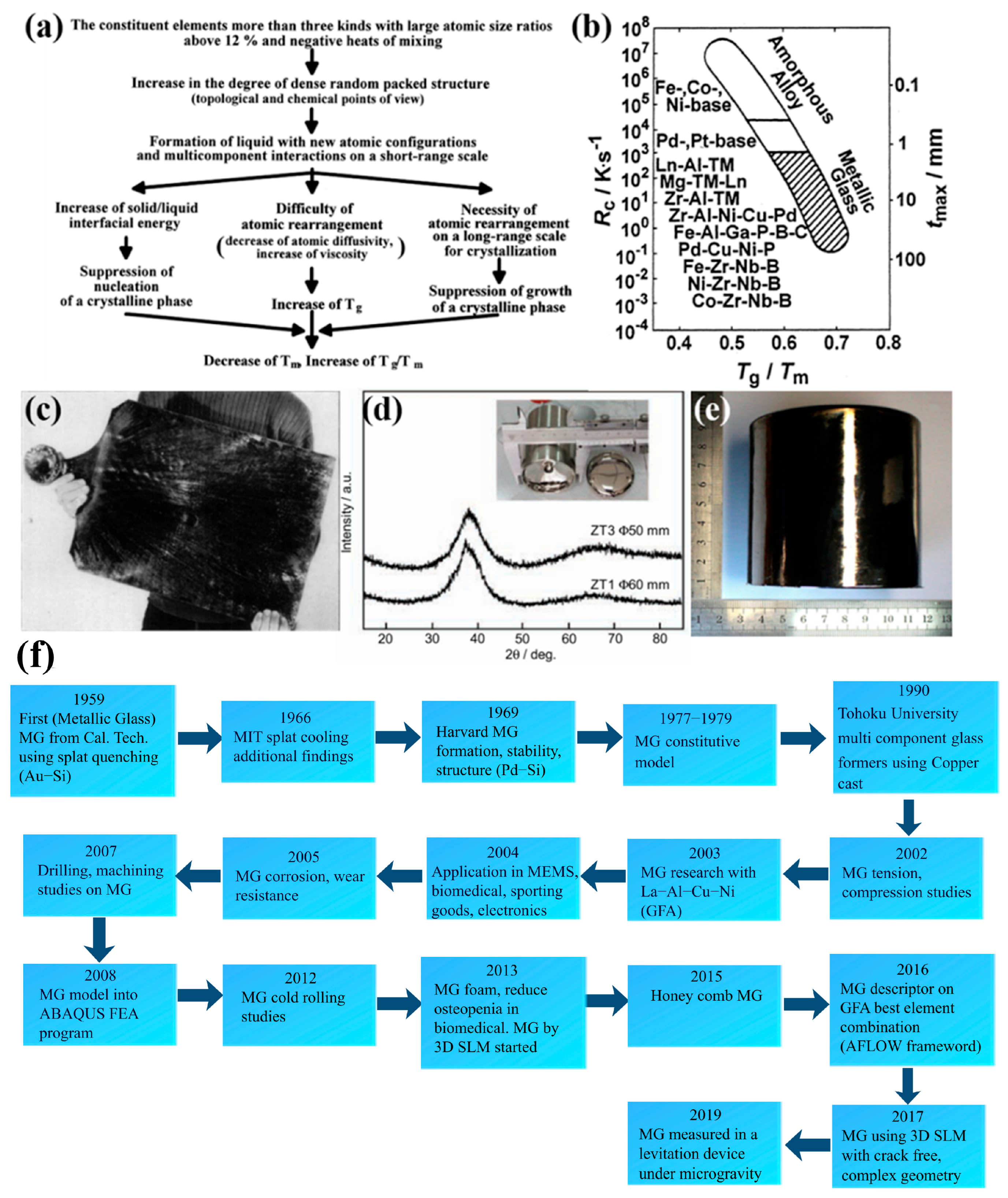
Based on the three empirical criteria for enhancing glass-forming ability proposed by A. Inoue [16], numerous metallic glass systems with high glass-forming ability have been developed, greatly extending achievable sample dimensions. In 1997, the Pd40Ni10Cu30P20 alloy designed by Inoue was shown to form fully amorphous samples thicker than 100 mm, while the Zr41.2Ti13.8Cu12.5Ni10.0Be22.5 (Vitreloy 1) alloy developed by A. Peker, with a critical cooling rate below 10 K·s−1, could be cast into fully amorphous rods up to 14 mm in diameter and plates using conventional metallurgical casting techniques without the stringent purification procedures typically required in laboratories [17], making it one of the most extensively studied bulk metallic glasses. In 2010, Ti45.7Zr33Ni3Cu5.8Be12.5 metal glass with a diameter larger than 50 mm was further manufactured [18]. Despite having been under development for just over six decades, metallic glasses have achieved substantial advancements in both theoretical understanding and practical applications, as illustrated in Figure 1. Currently, bulk amorphous alloys have evolved into more than a dozen distinct alloy systems, including Ti-based [19,20], Cu-based [21,22], Zr-based [23,24], and Fe-based [25] alloys, encompassing several hundred individual compositions.
Its most notable feature is that the atomic arrangement is in a disordered state, lacking the long-range ordered structure compared with traditional crystalline metals [28]. This unique structural feature disrupts the regular atomic arrangement typical of traditional metals, thereby endowing metallic glasses with exceptional mechanical and chemical properties, including high strength, hardness, elastic limit, excellent corrosion resistance, and favorable soft magnetic behavior [29,30,31]. This structural characteristic enables amorphous alloys to exhibit a series of advantages when dealing with corrosive environments, such as uniform surface composition distribution, extremely low defect quantity, and low interfacial energy, thereby effectively reducing the probability of corrosion occurrence. Moreover, metallic glasses are capable of forming stable and protective passive films under appropriate environmental conditions [32], effectively inhibiting further interaction with corrosive media. As a result, they demonstrate markedly enhanced corrosion resistance compared to conventional metallic alloys in aggressive environments such as acids, alkalis, and saline solutions [33,34]. These advantageous properties have not only stimulated extensive academic investigations into the underlying corrosion mechanisms of metallic glasses but have also attracted considerable industrial interest for their potential applications in high-performance sectors, including aerospace, marine engineering, biomedicine, and energy technology.
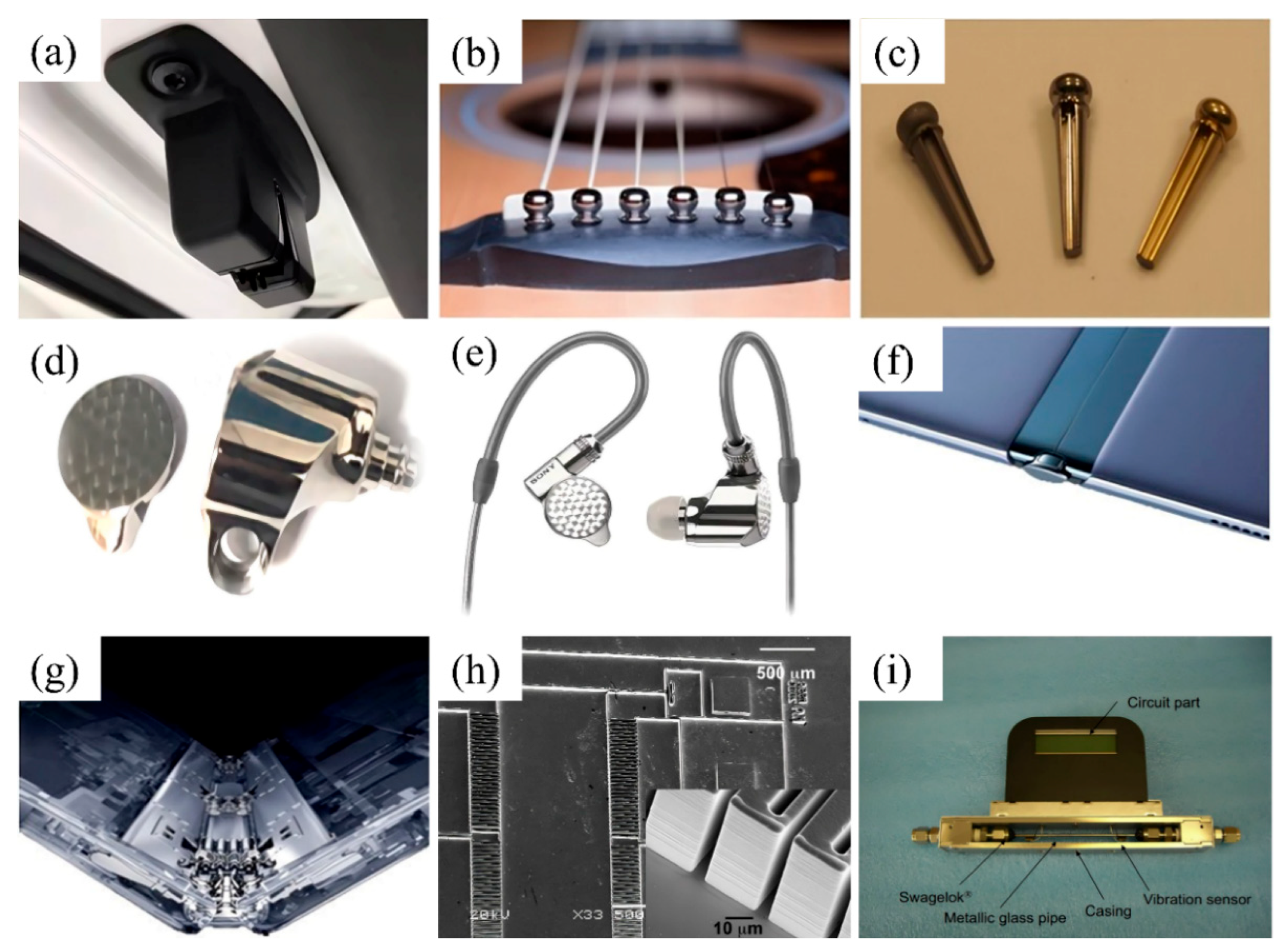
Continued investigation into this research area remains critically important due to its dual significance, both in terms of theoretical development and practical engineering applications. From a theoretical standpoint, amorphous alloys serve as a unique model system for studying corrosion behavior in the amorphous state, thereby contributing to the advancement of fundamental metal corrosion science. In practical engineering, after more than six decades of sustained research, the applications of metallic glasses and their composites have expanded considerably, as illustrated in Figure 2. Metallic glasses are widely employed in electronic and magnetic materials, particularly in low-power transformers, inductors, and magnetic heads. For instance, Fe-based metallic glasses are utilized in transformers and magnetic components due to their low magnetic hysteresis loss and high magnetic permeability [35]. In the biomedical field, metallic glasses are increasingly used for fabricating miniaturized implants that reduce patient discomfort [36]. Additionally, metallic glasses find extensive use in everyday consumer products, such as guitar tuning pegs, earplugs, Face ID brackets, lock covers, and smartphone hinges [37]. Metallic glasses also find applications in the aerospace and automotive industries, especially in the manufacturing of components that require lightweight and high performance. For instance, certain high-strength metallic glasses are used to make parts for aircraft and automotive engines. In the sports field, metallic glasses can be used to make the heads of golf clubs, due to their excellent elastic properties, high strength and hardness.
However, metallic glasses also encounter significant challenges in practical applications. One of the most significant issues is its poor room-temperature plasticity, which makes it prone to brittle fracture, thus restricting its wide application in structural engineering [41,42,43]. To this end, various strategies have been proposed that involve incorporating a secondary phase, such as metal grains, intermetallic compounds, or ceramic particles, into the amorphous matrix, resulting in the formation of metallic glass composites that exhibit enhanced mechanical properties and improved service stability [44,45,46].
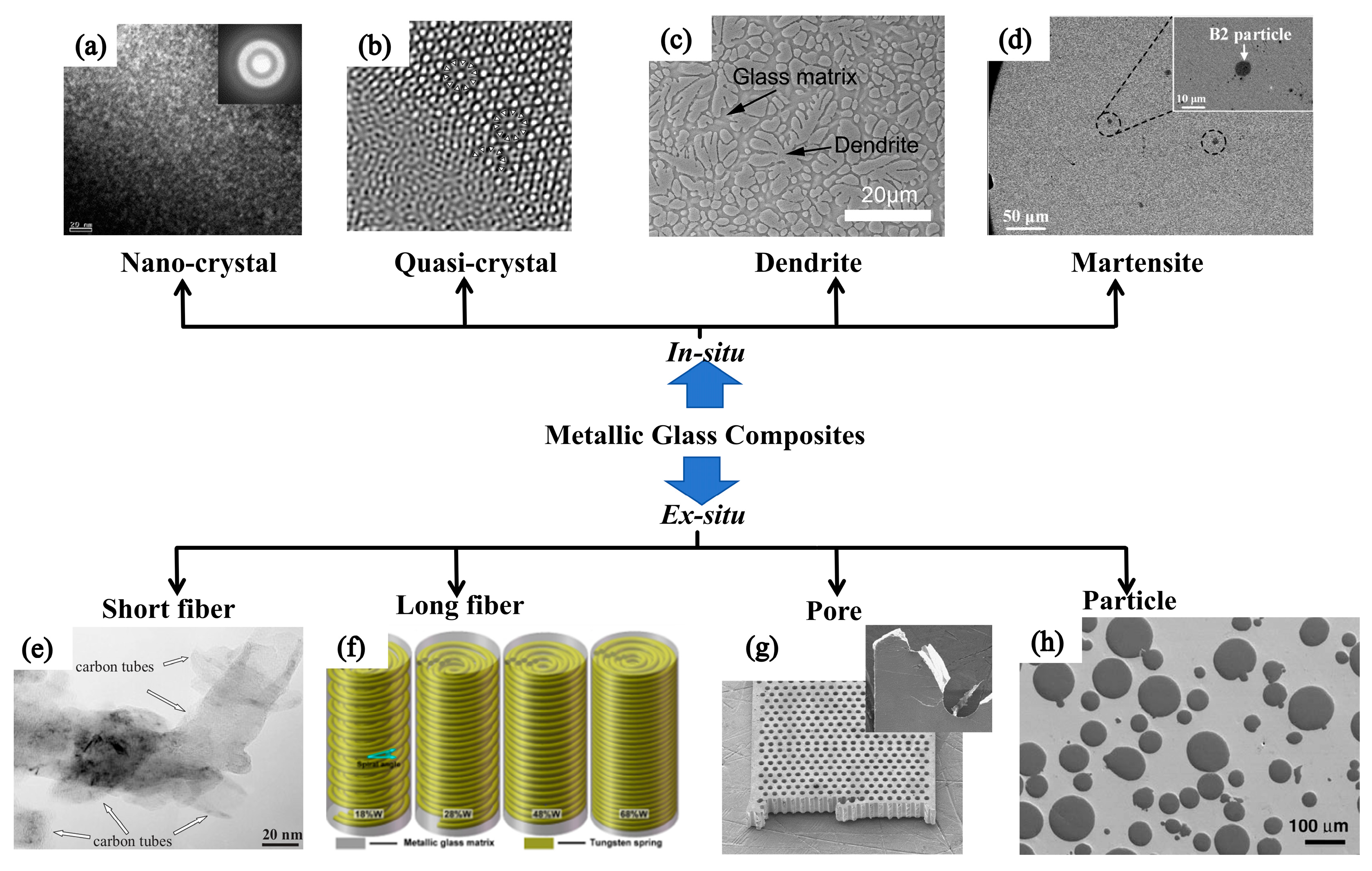
The existence of non-uniform structures at the micro-nano scale in amorphous alloys can bring certain plasticity to the amorphous alloys. However, to further achieve greater plastic deformation ability, and more importantly, the plastic deformation ability during the tensile deformation process, people have attempted to introduce heterogeneous structures into the interior of amorphous alloys by means of component design and process modification, thus forming amorphous composite materials with both amorphous matrix and other phases, known as biphasic or multiphase amorphous composites. Depending on the different methods of introducing heterogeneous structures, metallic glass composites can be categorized into in situ and ex situ types, as illustrated in Figure 3.
Based on different formation mechanisms, the intrinsically amorphous composite materials are generated through in situ reactions during the preparation process. By adjusting the composition of the alloy and controlling the cooling rate, some metal atoms grow during the solidification process to form the second phase with crystalline structure, while the others form the amorphous phase structure. The second phase mainly includes nanocrystals [47], quasicrystals [48], dendrites [49] or alternatively, the B2 phase [50], which is capable of undergoing martensitic phase transformation during deformation. Extrinsic amorphous composite materials are methods of artificially adding the crystalline second phase to the amorphous matrix through liquid infiltration or powder metallurgy methods, such as short fibers like nanotubes [51] or long fibers like tungsten wires [52], metallic particles such as pores [53] and ceramic particles [54], etc. All amorphous composite materials have their own specific advantages and application scopes. Regardless of the method used for the composite of amorphous materials, the sole purpose is to enhance the room-temperature plasticity of the alloy. This composite approach not only enhances mechanical performance, including strength and fracture toughness, but also exerts a notable influence on corrosion resistance. Key factors such as the type, spatial distribution, size, and interfacial characteristics of the secondary phase within the amorphous matrix possible can alter the reaction pathways and corrosion rates.
Due to the unique microstructure characteristics that confer superior mechanical properties, corrosion resistance, high strength, and high elasticity to metallic glass composite, they have attracted attention in various application fields. Titanium-based amorphous composite materials, because they possess the high strength of the amorphous matrix while also achieving significant plasticity [55], exhibit excellent strength-toughness combination and low-temperature wear resistance, and are used to manufacture various aerospace structural parts in defense high-end equipment and aerospace fields [56]. Zirconium-based amorphous composite materials prepared using tungsten wire long fibers can significantly increase density and ductility, and can be used as armor materials in the military field [57,58]. In addition, titanium-based amorphous composite materials can be used due to their excellent biocompatibility, high strength, and corrosion resistance for bone plates, bone screws, fixation components, and joint prostheses, etc. [59]. Copper-based amorphous composite materials prepared by combining amorphous alloys with highly conductive copper powder can improve the plasticity and electrical conductivity of the material. Magnesium-based metallic glass composite materials, due to their high strength-to-weight ratio, can be used for lightweight components in unmanned aircraft and transportation vehicles, such as shells and connectors, especially in situations where weight sensitivity and limited space are involved [60]. In daily life, amorphous composite materials can already be used in various sports equipment, including snowboards, baseball bats, etc., and can be manufactured for components of mobile phones and earphone frames, etc. [61].
As research on metallic glasses and their composites continues to advance, and as their superior mechanical properties become increasingly well understood, these materials are recognized for their substantial potential in engineering applications. Therefore, exploring the corrosion behavior of amorphous composite materials not only helps to better understand the material degradation phenomena caused by the interaction between materials and the environment, but also provides new design ideas for the practical application of amorphous materials. With the growing demand for lightweight, high-strength, and corrosion-resistant materials, particularly in sectors such as renewable energy, aerospace, and advanced manufacturing, metallic glasses and their composites, as emerging high-performance materials, are gaining prominence in corrosion research. Investigating these materials not only deepens our understanding of corrosion mechanisms in metallic systems but also provides essential theoretical foundations and experimental data for the development, optimization, and deployment of novel materials. Future research in this field urgently requires interdisciplinary collaboration to achieve a comprehensive understanding of the structure-property-application relationship. To promote the full-process application of amorphous materials from the laboratory to engineering practice.

2. Corrosion Characteristics of Metallic Glass

The academic understanding of the corrosion behavior of metallic glasses and their composites has progressed from basic phenomenological observations to a multidimensional and mechanistic analysis. Initially, research primarily focused on the corrosion performance of bulk metallic glasses in systems such as Zr-based, Fe-based, and Ti-based alloys, employing electrochemical testing to demonstrate their exceptional corrosion resistance in aggressive environments like NaCl and H2SO4 solutions [62,63,64]. Overall, compared with the summary of the electrochemical behavior of rapidly solidified amorphous materials by Archer et al. [65] in the 1980s, the review by Scully et al. [66] in 2007 has expanded the research focus to aspects such as the passivation mechanism of multi-system bulk metallic glasses, local corrosion by chloride ions, hydrogen-induced damage, and environmental fatigue. It also began to propose material design ideas for engineering applications that consider the coupling of corrosion and mechanics, achieving a leap in this field over the past two decades from ‘evaluation of corrosion resistance’ to ‘corrosion-resistance and mechanical comprehensive design’. This work has provided ideas for designers and engineers in the design process and has also improved the material-related database. With the advancement of material design and preparation technologies, more and more bulk metallic glass systems and compositions with high formability have been discovered. For instance, Ni-based, Mg-based, and Cu-based metallic glasses have been successfully developed, significantly expanding the scope and depth of amorphous material research [67,68,69].
Simultaneously, the study of metallic glass composites has transitioned from preliminary experimental investigations to a systematic phase characterized by multi-scale and multi-variable control. In recent years, rapid progress in advanced characterization techniques, such as electrochemical impedance spectroscopy [70], scanning electrochemical microscopy [71], and in situ corrosion monitoring [72], as well as computational methods like first-principles calculations [73] and molecular dynamics simulations [74], has significantly deepened the understanding of corrosion mechanisms in metallic glasses and their composites. These developments have accelerated the elucidation of structure-property relationships and facilitated the realization of functional material design and tailored applications. Early investigations mainly concentrated on comparing corrosion rates and the formation of passive films. In contrast, recent studies have increasingly emphasized the influence of microstructural features, such as structural relaxation [75,76], partial crystallization [77] and environmental parameters, such as pH levels [78] and variations in corrosive media [79,80,81], on corrosion behavior. Moreover, minor variations in processing conditions, including cooling rates, heat treatment protocols, and compositional adjustments, have been shown to exert effects on corrosion performance [82,83,84,85]. These complex interaction relationships make the study of the corrosion behavior of amorphous alloys not only involve the structural design of the material itself, but also require the integration of knowledge from multiple disciplines such as physical chemistry and electrochemistry. With respect to the role of the second phase in metallic glass composites, some studies have shown that variations in the volume fraction of the second phase can significantly affect corrosion resistance; other studies have revealed that electrochemical interactions between the amorphous matrix and second phase ions may lead to the formation of distinct surface oxide layers, thereby influencing corrosion resistance characteristics in different environments [86,87].
The corrosion behavior of metallic glass is governed by a combination of material-related factors (e.g., chemical composition, microstructural features) and environmental conditions (e.g., the nature and concentration of the corrosive medium), resulting in complex and diverse corrosion responses [88,89,90,91]. The composition of metallic glass can be modified by introducing or substituting metallic elements or adjusting the proportions of specific elements to investigate corresponding changes in corrosion resistance [92,93]. The results described in this section were all obtained through electrochemical characterization after the open-circuit potential (OCP) stabilized. The main contents include: Potentiodynamic polarization (PDP): obtaining indicators such as self-corrosion potential (Ecorr), corrosion current density (Icorr, Tafel extrapolation), pitting potential (Epit), and passivation current density (Ipass), which are used to evaluate the activation, passivation, and pitting tendencies. Electrochemical impedance spectroscopy (EIS): testing the Nyquist/Bode curves within a wide frequency range, and using equivalent circuits to extract charge transfer resistance (Rct) and CPE parameters (Q, n) etc., which are used to measure interface reactions and membrane stability. After the tests, SEM/EDS, XPS, AFM, etc., were used to conduct morphology composition characterization of the exposed surface and the passivation film, and to cross reference with the electrochemical parameters.
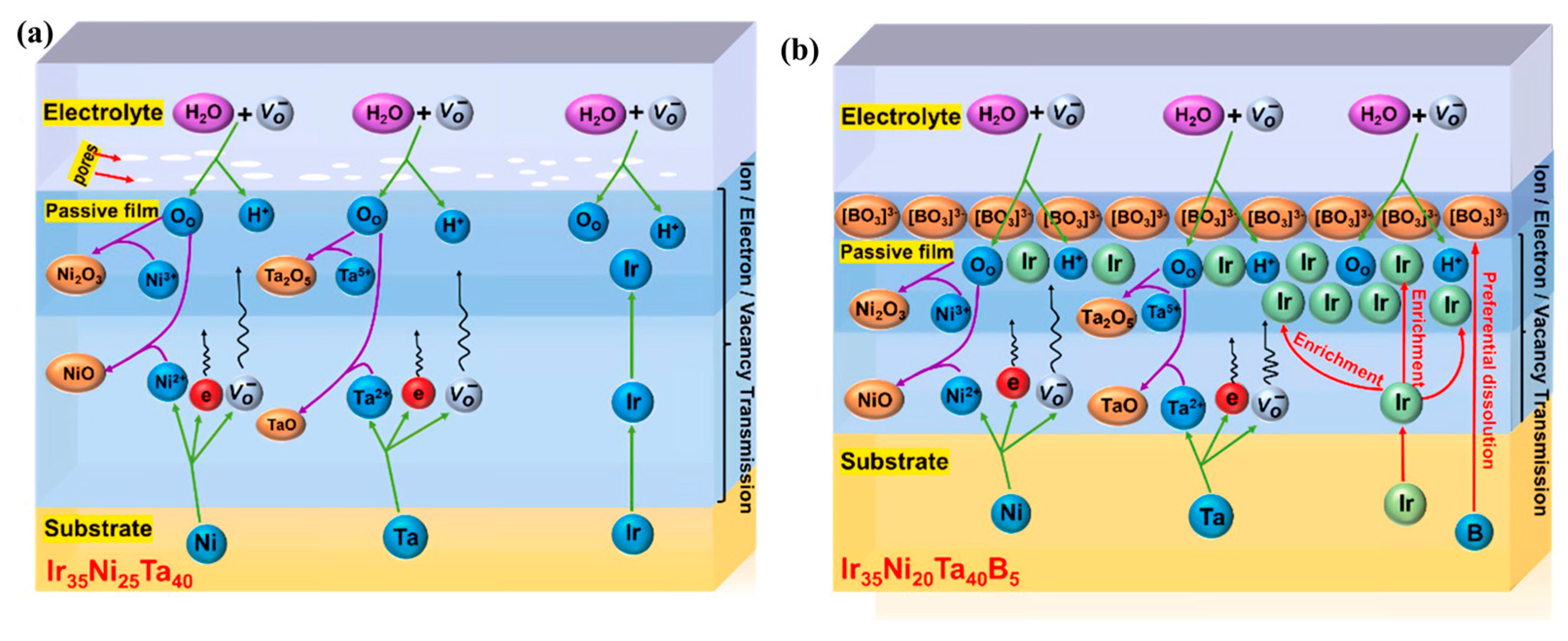
Zhou et al. [94] evaluated the corrosion resistance of (Zr46Cu46Al8)100−xCox (x = 0–4)metallic glass in 3.5% NaCl solution. Increasing the Co content significantly decreased the uniform dissolution rate and enhanced the corrosion resistance, slowed the corrosion kinetics. The addition of Co induced a redistribution of surface elements, promoting the enrichment of Zr and Al in the passive layer. This led to the formation of a more dense and stable passive film composed primarily of ZrO2 and Al2O3, further improving the corrosion resistance of the metallic glass. Yang et al. [95] investigated the corrosion behavior and underlying mechanisms of Ir-Ni-Ta-(B) metallic glass in H2SO4 solutions of varying concentrations (0.5 mol/L, 1 mol/L, and 4 mol/L). The potential corrosion mechanisms of amorphous alloys Ir35Ni25Ta40 and Ir35Ni20Ta40B5 in sulfuric acid solution are shown in Figure 4. The passivation film on the Ir35Ni20Ta40B5 surface is dense and compact, providing strong protection against surface defects. During corrosion, Ni and Ta are oxidized to Ni3+ and Ta5+, which react with oxygen ions to form a continuous oxide layer that effectively blocks SO42− and H+ penetration. The addition of B accelerates the formation of this film and suppresses active metal dissolution, thereby enhancing the alloy’s overall corrosion resistance. Table 1 presents a comparison of the corrosion resistance of the Ir-Ni-Ta amorphous alloy and other materials in different solutions. Upon the addition of B, the self-corrosion potential of the Ir35Ni20Ta40B5 sample decreased, while the pitting potential remained unchanged. However, the passivation region expanded, and the passivation current density further decreased, indicating that B significantly enhances the corrosion resistance of Ir-Ni-Ta metallic glass.
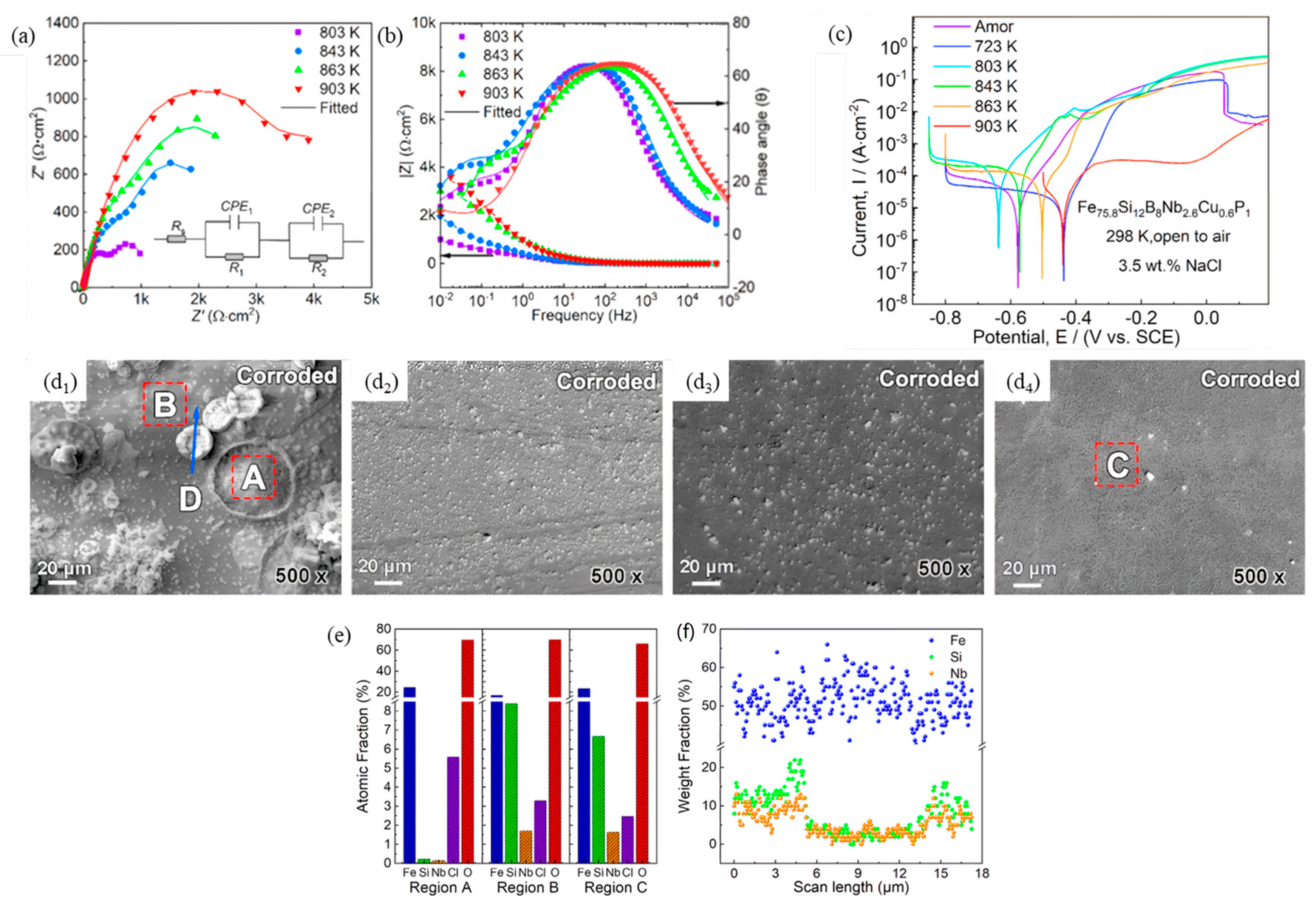
The mechanical and electrochemical properties of metallic glasses are affected by structural relaxation and crystallization processes. Metallic glasses with a fully amorphous structure demonstrate superior corrosion resistance compared to their crystalline counterparts of the same composition, which can be attributed to their unique structural characteristics and chemically homogeneous nature [114]. Therefore, investigating how the organizational structure influences the corrosion resistance of metallic glass is of critical importance. Liu et al. [115] systematically investigated the effect of isothermal annealing temperature (723–903 K) on the corrosion behavior of Fe75.8Si12B8Nb2.6Cu0.6P1 amorphous alloy. As illustrated in Figure 5 with increasing annealing temperature, the corrosion mechanism transitioned from active dissolution to a more stable quasi-passive state, particularly after annealing at 903 K. The passive current density (Ipass) decreased by two to three orders of magnitude, while both the charge transfer resistance and film resistance, derived from electrochemical impedance spectroscopy (EIS) fitting, exhibited significant increases, indicating optimal corrosion resistance at 903 K. Surface morphological and compositional analyses revealed that the corrosion products evolved from loose, particulate structures to a continuous and dense protective layer in the high-temperature-annealed samples, accompanied by noticeable enrichment of Si and Nb at the surface. From a mechanistic perspective, nanocrystallization enhanced the crystalline fraction and promoted the segregation of Si and Nb to the surface and internal interfaces, facilitating the formation of a compact composite oxide film, which effectively suppressed metal dissolution and reduced charge transfer kinetics.
Vasic et al. [116] investigated the effects of 480 °C and 640 °C heat treatment on the microstructure evolution of Fe40Ni40B12Si8 amorphous alloy and its corrosion behavior in 0.5 M NaCl solution. The results showed that the completely amorphous metallic glass had the best corrosion resistance compared to the samples after heat treatment, which could be attributed to its chemical uniformity and the absence of grain boundary defects. Corrosion mainly occurred through uniform metal dissolution, and no obvious oxide layer was formed on the surface. Guo et al. [117] investigated an corrosion resistance of an arc melting Zr62.3Cu22.5Fe4.9Al6.8Ag3.5 crystalline alloy, which was superior to that of the same composition in glassy state in simulated seawater. This enhanced corrosion resistance in the crystalline form is attributed to the formation of protective oxide films primarily composed of Zr and Al oxides, which effectively resist Cl attack. In contrast, the amorphous surface undergoes selective dissolution, resulting in Cu enrichment and the formation of CuCl and Cu2O. These reactions trigger micro galvanic corrosion and impair the alloy’s passivation ability. Chae et al. [118] examined the corrosion behavior of the Zr56Co28Al16 alloy in both its crystalline and amorphous states in 3.5% NaCl and HCl solutions. Both forms demonstrate excellent corrosion resistance, primarily due to the formation of a Zr-rich mixed oxide layer on the surface, consisting mainly of ZrO2 and Al2O3, which effectively inhibits pitting corrosion. This protective behavior is attributed to the local enrichment of Zr in the crystalline phase, which facilitates the continuous formation of a uniform and stable oxide layer.
The corrosion resistance of metallic glasses is influenced by the specific usage environment. Variations in the composition and properties of corrosive media result in differences in corrosion rates and morphologies under different environmental conditions. Extensive studies have shown that metallic glasses generally exhibit excellent corrosion resistance in non-chloride environments. However, they are more susceptible to localized corrosion in chloride-containing environments, particularly pitting corrosion [119]. Studies have demonstrated that Ti-based metallic glasses exhibit lower corrosion current density (Icorr) in NaCl solutions, indicating superior corrosion resistance compared to Mg-based and Al-based alloys [120,121,122]. In contrast, Fe-based, Cr-based, and Cu-based metallic glasses display significantly lower corrosion resistance than Zr-based metallic glasses in HCl solutions [123,124,125,126]. Additionally, Ca-based metallic glasses demonstrate poor corrosion resistance in simulated human body fluids [127]. However, metallic glasses generally exhibit favorable corrosion resistance in alkaline environments [128,129]. The corrosion resistance of metallic glasses varies significantly depending on the environmental conditions. Research indicates that chlorine-containing corrosive media, such as NaCl and HCl solutions, are particularly aggressive toward metallic glasses, predominantly inducing pitting corrosion and compromising the integrity of the passive film. Notably, Ti-based and Zr-based metallic glasses exhibit superior corrosion resistance due to the formation of stable metal oxide passive films. Nevertheless, corrosion remains a concern in high-concentration Cl environments. In chloride-rich conditions, the corrosion behavior is closely related to the stability of the passive film. Chloride ions (Cl) rapidly adsorb onto the film surface and disrupt its protective nature, thereby accelerating pitting corrosion. In contrast, in environments such as H2SO4 solutions and other strong acidic media, metallic glasses can exhibit strong passivation ability and excellent corrosion resistance under certain conditions.

3. Corrosion Characteristics of Metallic Glass Composites

Although metallic glass possesses excellent mechanical properties, such as high strength and hardness, it has a significant limitation: almost no plasticity at room temperature, which greatly restricts its application as a structural material. To improve its plastic deformation capability, researchers have developed metallic glass composites by incorporating second-phase grains through in situ or ex situ methods [130,131]. As an extension of metallic glass materials, these composites effectively address the issue of room-temperature brittleness. However, the introduction of structural heterogeneity presents new challenges to corrosion resistance. To elucidate the corrosion mechanisms and promote broader engineering applications, studies have been conducted on the corrosion behavior of metallic glass composites in various environmental conditions. The testing process of amorphous composite materials is consistent with that mentioned in chapter 2. To analyze the influence of dendrites and the matrix on the material, SEM/EDS and XPS surface characterizations are conducted to identify element enrichment, membrane composition and defects, providing microscopic basis for the electrochemical results.
Yang et al. [132] compared the corrosion behavior of Zr30.88Ti33.57Cu7Ni5.39Be23.16 metallic glass and Zr28.92Ti42.22Cu6.57Nb6Be16.29 metallic glass composite in 0.6 mol/L NaCl, 1 mol/L HCl. Both alloys exhibited passive film breakdown in NaCl and HCl solutions, leading to a sharp increase in current density. The metallic glass composite showed a higher corrosion current density, indicating greater susceptibility to pitting corrosion. In the Zr28.92Ti42.22Cu6.57Nb6Be16.29 metallic glass composite, the amorphous matrix is more vulnerable to chloride ion attack than the dendritic phase, resulting in the detachment of the dendritic phase from the matrix. The dendritic phase exhibits better corrosion resistance compared to the amorphous matrix. To investigate the corrosion characteristics of metallic glass composites in different solution types and concentrations, Yang et al. [133] employed the electrochemical corrosion behavior of Ti40Zr24V12Cu5Be19 in acidic, alkaline, and salt solutions. The results indicated that the metallic glass composite exhibited good corrosion resistance in strongly acidic environments but poor corrosion resistance in strongly alkaline environments. In alkaline solutions, the crystalline dendrites preferentially dissolved, leading to an incomplete or unstable passive layer. In chloride-containing solutions, chloride ion rapidly adsorbed onto the passive film at the initial stage of corrosion, causing localized damage to the film. Tian et al. [134] proposed that the corrosion behavior of the material is closely related to NaCl concentration, difference corrosion behavior versus NaCl concentration is related to the change of oxygen content in the salt solution. The corrosion current density reached a maximum at NaCl concentration of 5%. This was attributed to enhanced cathodic polarization resulting from reduced oxygen content with increasing NaCl concentration, as well as increased corrosion current density due to pitting corrosion induced by higher chloride ion concentrations. Corrosion primarily occurred at the interfaces between the dendritic phase and the amorphous matrix. Qiao et al. [135] compared the corrosion behavior of Ti46Zr20V12Cu5Be17 metallic glass composites of different sizes in 10% H2SO4. Both electrochemical and immersion corrosion tests demonstrated that the larger Φ6 mm samples exhibited significantly higher corrosion resistance than the smaller Φ2 mm samples, with corrosion current density, passivation current density, and corrosion rate all reduced by approximately one order of magnitude. The difference in corrosion resistance is primarily attributed to the stability of the passive film: larger samples formed a stable passive film mainly composed of TiO2 and ZrO2, whereas smaller samples contained a higher proportion of low-valent titanium oxides and zirconium species. The increased proportion of dendritic and amorphous interfaces in the smaller samples provides more potential nucleation sites for corrosion initiation. Additionally, enhanced galvanic corrosion promotes the preferential dissolution of dendrites acting as anodes, ultimately influencing the material’s resistance to sulfuric acid corrosion.
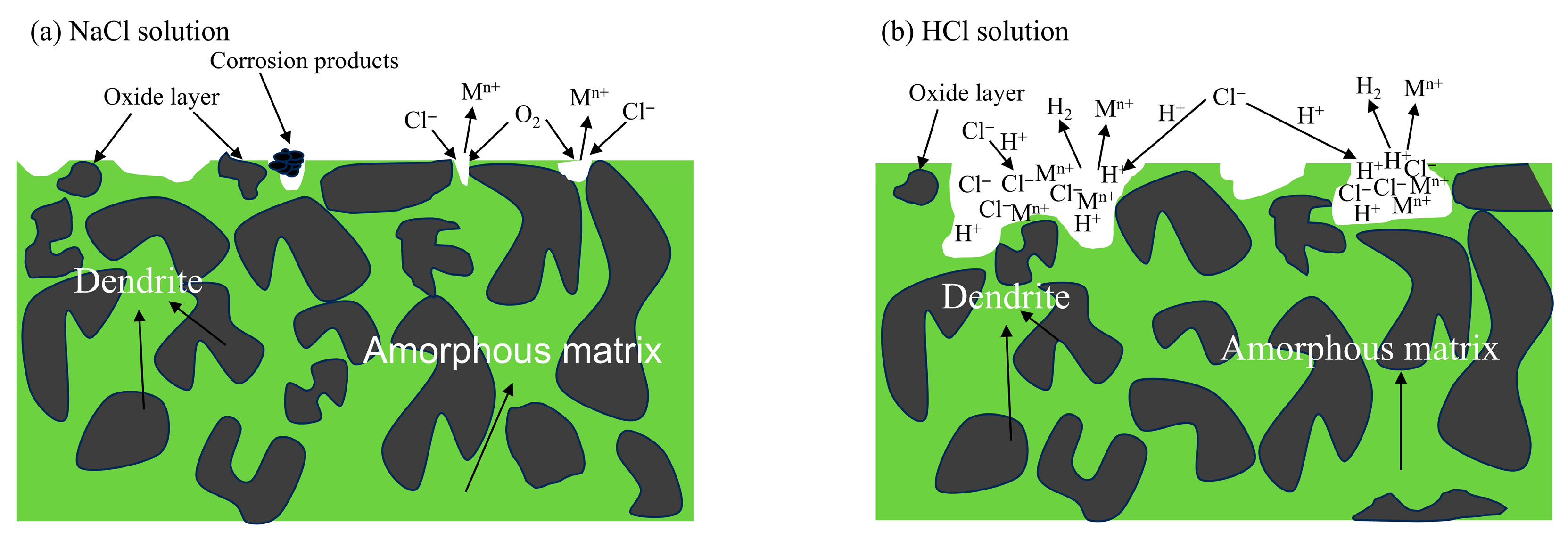
However, the influence of dendrite size on the corrosion behavior of metallic glass composites remains insufficiently studied. Based on this, Yang et al. [136] investigated the influence of dendrite size on corrosion behavior of Ti43.2Zr29.8Cu6.7Nb4Be16.3 in 3.5% NaCl solution was examined. Corrosion resistance decreases with increasing dendrite size: samples with a 3 mm diameter exhibited the best performance, showing the lowest corrosion current density of 3.6 (±0.5) × 10−8 A/cm2, and the highest pitting potential (64 mV). Corrosion primarily occurs in the amorphous matrix through selective dissolution. This behavior is attributed to the galvanic coupling between Cu-rich regions in the amorphous phase and Ti, Zr, and Nb-rich dendritic phases, which promotes the formation of soluble Cu compounds under chloride ion (Cl) attack and initiates matrix dissolution. In summary, dendrite size directly influences the corrosion resistance of metallic glass composites by modulating phase interface density, elemental distribution, and oxide film stability. Reducing dendrite size effectively suppresses chloride ion (Cl) induced pitting corrosion and enhances overall corrosion resistance. Xu et al. [137] systematically investigated the corrosion behavior of Ti62Zr12V13Cu4Be9 metallic glass composite in both chlorine-containing NaCl and HCl solutions, as well as chlorine-free NaOH and H2SO4 solutions. The results demonstrated that the composite exhibited good corrosion resistance in chlorine-free environments, which was attributed to the formation of a protective oxide layer. During the corrosion process, the inhomogeneous distribution of elements between the amorphous matrix and the dendritic phase rendered the amorphous regions more susceptible to preferential attack. In chlorine-containing solutions, the presence of Cl ions significantly accelerated the corrosion process. In NaCl solution, the cathodic reaction was partially inhibited due to oxygen consumption, thereby slowing the anodic dissolution. In contrast, in HCl solutions, the abundance of H+ ions promoted more aggressive corrosion. Moreover, the low pH of HCl further intensified chloride ion (Cl) attack, leading to more severe degradation. Figure 6 illustrates the corrosion mechanism of the metallic glass composite during dynamic potential polarization.
Wang et al. [138] investigated the electrochemical corrosion behavior of the in situ Zr58.5Ti14.3Nb5.2Cu6.1Ni4.9Be11 metallic glass composite in chloride-containing solutions (KCl, NaCl, CaCl2). The results demonstrated that, in electrochemical tests, CaCl2 exhibited the highest pitting potential and the lowest corrosion current density, which was attributed to the small ionic radius of Ca2+, indicating superior pitting resistance. The ionic radius was found to influence the susceptibility to chloride-induced pitting corrosion and the long-term stability of the protective oxide film by affecting competitive adsorption and site occupation at defects within the surface oxide layer. This study clarifies the discrepancies between electrochemical and chemical corrosion behavior and highlights the importance of environmental factors and underlying mechanisms when evaluating corrosion resistance. Yang et al. [139] studied corrosion behavior of the in situ Ti-based bulk metallic glass matrix composites Ti42.3Zr29.1Cu6.6Nb6Be16 was in HCl and H2SO4 solutions with different concentrations. In HCl solution, the metallic glass composite exhibited significant pitting corrosion, particularly at low corrosion potentials. As the acid concentration increased, so did the corrosion current density. In H2SO4 solution, good passivation behavior was observed at low concentration. The oxides of Ti, Zr, and Nb play a crucial role in the formation and stability of the passive film, while the dissolution of Cu may contribute to localized corrosion. Pitting and selective dissolution primarily occur at the interface between the dendritic phase and the amorphous matrix.
Lin et al. [140] investigated the corrosion behavior of Ti43Zr27Mo5Cu10Be15 in NaCl, HCl, H2SO4, and NaOH solutions. In NaCl and HCl solutions, the inhomogeneous elemental distribution between the dendritic phase and the amorphous matrix induced selective dissolution. Chloride ion (Cl) disrupted the passive film, leading to localized pitting corrosion, in HCl, the synergistic effect of H+ further accelerated the corrosion process. In H2SO4 solution, a stable passive film formed on the surface of the metallic glass composite, resulting in excellent corrosion resistance. In contrast, the metallic glass composite exhibited the poorest corrosion resistance in NaOH solution, where uniform corrosion occurred due to the absence of a protective passive film. As the solution concentration increased, the corrosion potential decreased gradually. In NaOH solution, no passive film formed, resulting in widespread uniform corrosion. The selection of metallic glass materials for practical applications should be based on the specific corrosive environment to ensure optimal performance.
Wang and Tian et al. [141,142] found that the in situ Zr58.5Ti14.3Nb5.2Cu6.1Ni4.9Be11.0 metallic glass composite exhibited pronounced pitting corrosion in NaCl and HCl environments. Chloride ion (Cl) preferentially adsorbed at the interfaces between the amorphous matrix and dendritic phases, initiating selective dissolution of the amorphous regions. This process replaced oxygen sites with soluble metal chlorides, leading to a significant reduction in Nb content and an increase in Cu and Ni contents within the passive film. The Cu and Be enriched amorphous matrix thereby became more susceptible to corrosion. The dissolution of Be initiated the breakdown of the passive film, while Chloride ion (Cl) reacted with Cu to form porous CuCl, which subsequently transformed into Cu2O and CuO, induced galvanic corrosion and accelerated the dissolution of the substrate. Yang et al. [143] prepared Fe77Mo5P9C7.5B1.5 in situ dendritic metallic glass composites and corresponding single-phase metallic glasses via protected arc melting, and compared their corrosion behavior with that of 304 L and 2304 L stainless steels in 10% H2SO4 solution. The results indicated that the corrosion resistance of the metallic glass composite was significantly lower than that of both stainless steels and the single-phase metallic glass. The corrosion mechanism was primarily attributed to the interface between α-Fe dendrites and the amorphous matrix, which acted as a preferential corrosion path, with the galvanic effect exacerbating localized dissolution. Metallic glass composites exhibit corrosion primarily driven by interfacial inhomogeneity and the electrochemical activity introduced by the dendritic phase.
Metallic glass composites offer enhanced mechanical properties by overcoming the ductility limitations of traditional metallic glasses, while maintaining good corrosion resistance. However, their corrosion behavior is more complex, as the underlying mechanisms are influenced not only by the matrix and phase structure but also by elemental distribution, phase interfaces, and grain morphology. External factors such as the concentration of corrosive media, temperature variations, and alloy microstructure can significantly affect the corrosion process, either accelerating or retarding degradation. As the application scope of metallic glasses and their composites expands into demanding fields such as aerospace, marine engineering, and biomedicine, the requirements for corrosion resistance will become increasingly stringent. Therefore, future research should focus on achieving a deeper understanding of corrosion mechanisms and optimizing alloy composition and microstructure through advanced material design to improve corrosion resistance in harsh environments. Further studies should also aim to elucidate the structure and stability of passive films, investigate the combined effects of multiple environmental and structural factors on material performance, and develop innovative surface engineering technologies to enhance the durability of metallic glasses and their composites under extreme conditions.

4. The Influencing Factors of Corrosion Resistance of Metallic Glass and Its Composites

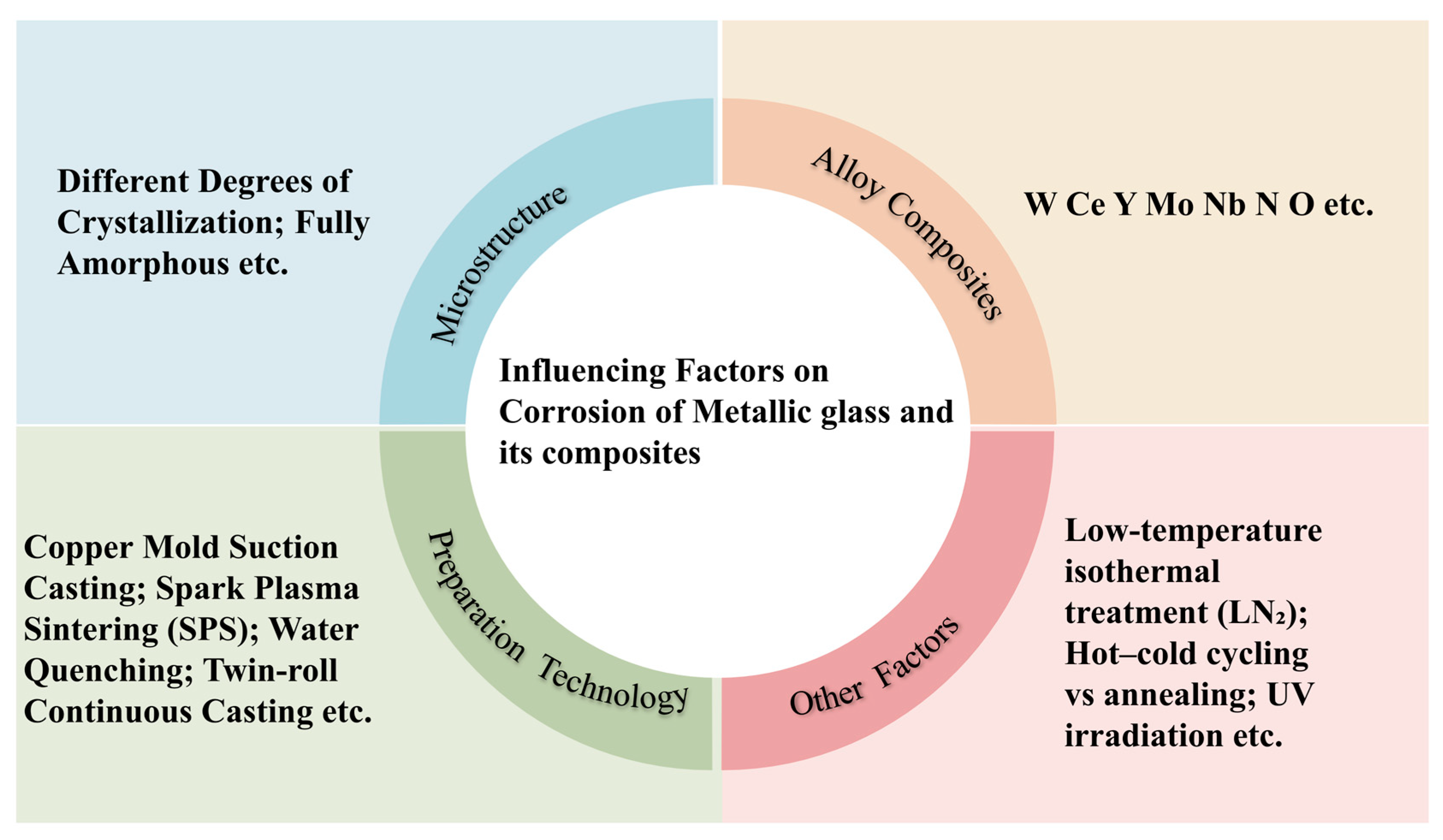
The corrosion resistance of amorphous alloys and their composites is not determined by a single factor, but is the result of the combined effect of various factors such as alloy composition, alloy structure characteristics, preparation process conditions, and other factors. As shown in Figure 7, on one hand, the types and contents of each component in the alloy directly affect the formation and stability of the passivation film, thereby changing the alloy’s sensitivity to different corrosive media; on the other hand, the microstructure also has a significant impact on corrosion resistance. Moreover, different preparation processes (such as copper mold casting, discharge plasma sintering, water quenching, and double-roll casting, etc.) and their process parameters will further shape the corrosion behavior of the material in specific service environments by altering the microstructure and interface characteristics of the material. Therefore, this section will review and summarize the research progress on the corrosion resistance of amorphous alloys and their composites by focusing on alloy composition design, structure feature regulation, preparation process differences, and other key influencing factors, in order to provide systematic theoretical references for the optimization of corrosion resistance and engineering applications of related materials. This chapter continues the methodological framework of Chapters 2 and 3, focusing on comparing the changes in Ecorr, Icorr before and after the influence of various factors. Additionally, in conjunction with the SEM/EDS and XPS evidence of the surface film, it discusses the regulatory mechanisms of various factors on the corrosion process.

4.1. Influence of Alloy Composition

Research indicates [144,145] that the corrosion resistance of metallic glasses is strongly correlated with their composition. The incorporation of specific alloying elements can significantly enhance their corrosion resistance. For instance, the addition of Cr facilitates the formation of a protective passive film, while the inclusion of P promotes the stability and integrity of this film, thereby further improving the material’s corrosion resistance. Appropriate additions of Cr, Nb, and Ni have been shown to effectively promote the formation of a stable passive film on the alloy surface [146,147,148], a process commonly referred to as spontaneous passivation. This passive film acts as a barrier that prevents the corrosive medium from reaching and attacking the underlying alloy substrate, thereby significantly enhancing its corrosion resistance [149]. As a result, alloys containing these alloying elements exhibit markedly improved service life and reliability across a wide range of corrosive environments.
In recent years, researchers have systematically elucidated the evolution of corrosion resistance in amorphous alloys and bulk metallic glasses through precise regulation of the type and concentration of minor alloying or impurity elements. Zhang et al. [150] demonstrated that the addition of W to the Fe36Cr23Mo18−xWxC15B6Y2 amorphous alloy significantly reduces the corrosion current density. The incorporation of W promotes the formation of WO3 and MoO2 within the passive film, effectively suppressing both the initiation and propagation of pitting corrosion, thereby markedly enhancing the corrosion resistance of iron-based metallic glasses. Subsequently, Zhang et al. [151] reported that an appropriate doping level of Ce (4 at%) in Al–Co–Ce amorphous alloys decreases the passivation current density and facilitates the formation of a denser, more protective passive film, leading to improved corrosion resistance in NaCl solution. However, excessive Ce content results in a deterioration of corrosion performance. Wang et al. [152] investigated the Al86Ni6Co2Y4.5La1.5−xCex (x = 0, 0.5, 1.0, 1.5) aluminum-based amorphous alloys and observed a progressive decline in pitting corrosion resistance in 0.1 M NaCl with increasing Ce content (La1.5Ce0 > La1.0Ce0.5 > La0.5Ce1.0 > La0Ce1.5). This trend was attributed to the synergistic influence of La and Ce on the stability of the passive film and the dissolution kinetics of the matrix. Specifically, La enhances passive film density and strengthens atomic bonding, thereby effectively retarding pitting propagation. Yu et al. [153] indicated that in (Zr58Nb3Cu16Ni13Al10) 100−xYx (x = 0, 0.5, 2.5) bulk metallic glasses, a stable surface passive film primarily composed of ZrO2 and Al2O3, with minor amounts of Y-, Nb-, Ni-, and Cu-containing oxides confers good corrosion resistance in 0.5 mol·L−1 H2SO4. Nevertheless, increased Y content promotes selective dissolution of Cu, leading to a slight reduction in overall corrosion resistance.
Tao et al. [154] conducted comparative studies on Zr55Cu30Ni5Al10 and (Zr55Cu30Ni5Al10)98.5N1.5, revealing that a small amount of nitrogen doping reduces the corrosion current density in 0.9% NaCl by approximately three orders of magnitude, accompanied by a slight positive shift in corrosion potential. These findings indicate that nitrogen exerts a significant beneficial effect on the corrosion resistance of Zr-based amorphous alloys. Jiang et al. [155,156] systematically investigated the differential impact of oxygen impurities (120–1800 ppm) on the corrosion behavior of Zr61Ti2Cu25Al12 bulk metallic glass across various corrosive environments. In 0.5 M H2SO4, variations in oxygen content had negligible effects, as all samples formed a self-passivating film predominantly consisting of ZrO2 and Al2O3, providing effective protection. In 0.5 M NaOH, oxygen content exceeding 810 ppm significantly enhanced corrosion resistance by reducing free volume and inhibiting cathodic reactions. In 3.5% NaCl, moderate oxygen levels (≤1200 ppm) preserved the amorphous structure while promoting short-range ordering and decreasing free volume, thus improving passive film compactness and pitting resistance. However, excessive oxygen (1800 ppm) induced localized crystallization and the formation of highly reactive crystalline phases, ultimately degrading pitting corrosion resistance.
Alloying elements and impurity elements have significant and complex effects on the corrosion resistance of amorphous alloys, and their effects highly depend on the content and service environment. By precisely controlling the types and contents of these trace elements/impurities, the properties of the passivation film and the corrosion behavior can be effectively optimized, thereby achieving the designability improvement of the corrosion resistance of amorphous alloys. A comprehensive analysis of existing research and experimental data revealed that elements such as Ti, Si, Nb, B, Ag, and Ni are capable of spontaneously forming stable oxides. For instance, TiO2 and Ag2O3 not only facilitate their own enrichment in passive films under corrosive conditions but also enhance the overall stability of metallic glass passive films by promoting the formation of additional oxide species. This enhanced film stability enables the passive layer to better resist cracking under ionic attack in corrosive environments, thereby reducing the susceptibility to pitting corrosion and improving the material’s pitting corrosion resistance [157,158,159,160,161,162].
In certain metallic glass systems, the relationship between alloying element content and corrosion resistance is non-linear. Specifically, corrosion resistance does not increase monotonically with increasing element content, but rather improves only within a specific compositional range [163]. For example, the addition of 1% Mo and Nb to Cu-Zr-Ti metallic glass enhances the alloy’s corrosion resistance. Electrochemical tests in 3.5% NaCl solution demonstrated that the alloy containing Nb exhibited the best corrosion resistance [164]. This finding underscores the importance of alloying element content in material design, where moderate additions can improve corrosion resistance, while excessive amounts may have adverse effects [165]. Zhang et al. [166] systematically varied the Cr and Mo content in the bulk metallic glass Fe80−x−yCrxMoyP10C7B3 (where x and y denote the atomic percentages of Cr and Mo) and achieved a significant improvement in its corrosion resistance in 3.5% NaCl solution. The results indicated that appropriate additions of Cr and Mo promote the formation of a dense and stable passive film on the alloy surface. Among the tested compositions, Cr15Mo4 exhibited the best corrosion resistance, with self-corrosion and passivation current densities as low as 10−8 A·cm−2 and 10−6 A·cm−2, respectively, substantially outperforming 316 L and 304 L stainless steels. However, excessively high Cr or Mo content increases the proportion of high-valent oxides in the passive film, which compromises its stability and protective capability. This study provides an effective strategy for enhancing the corrosion resistance of Fe-based metallic glasses through the optimization of Cr and Mo content.
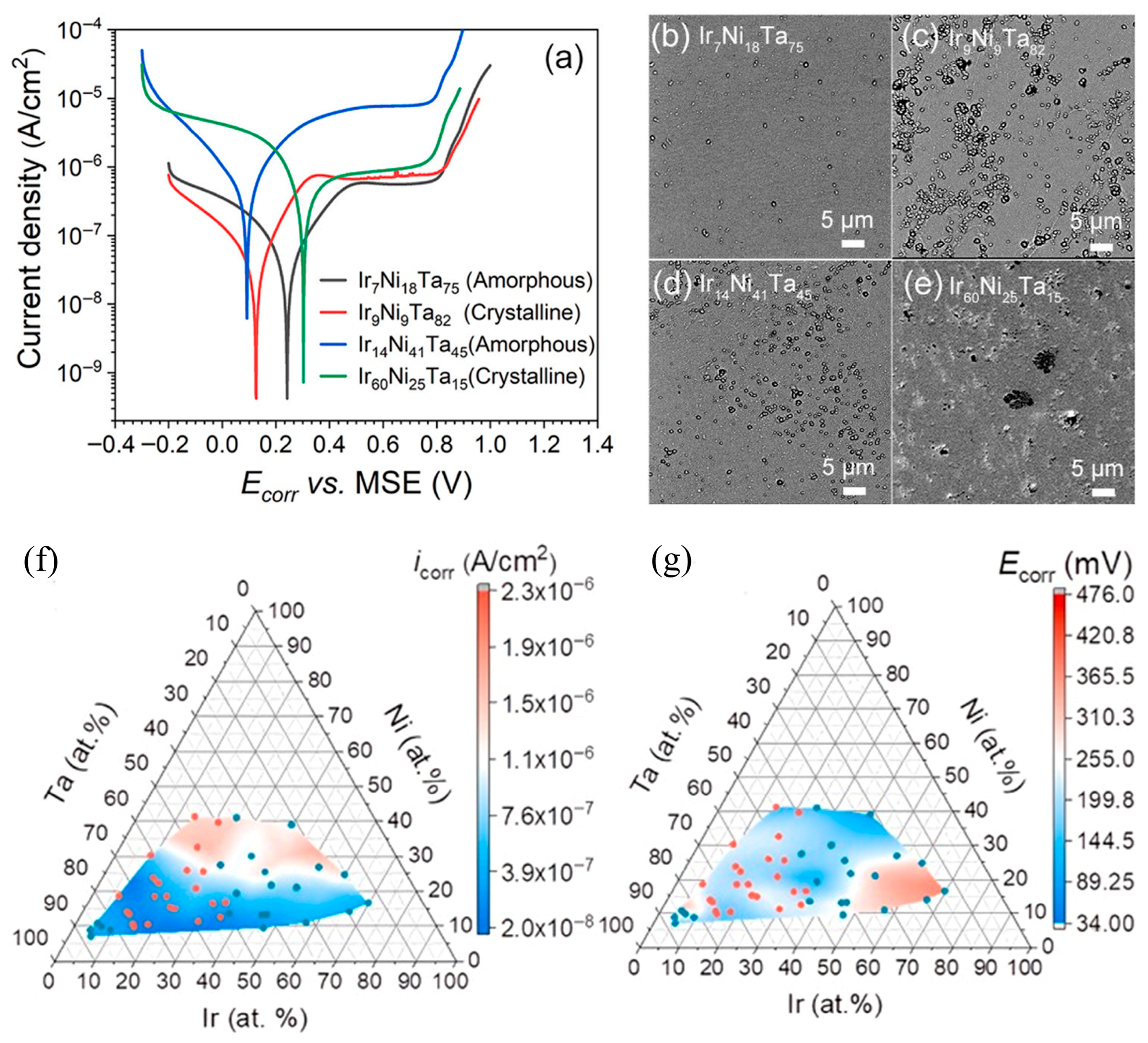
Hu et al. [167] investigated the Ir-Ni-Ta alloy system as a model system and utilized combinatorial fabrication and high-throughput characterization techniques to reveal the correlations between alloy composition and both corrosion current density and corrosion potential. As shown in Figure 8, In the Ir-Ni-Ta system, a high Ta content and amorphous structure can significantly enhance the corrosion resistance of the alloy. Among them, the amorphous material exhibits a lower corrosion current and a more positive corrosion potential, making it suitable for applications in corrosive environments. Specifically, the addition of Ta promotes the formation of a dense passive film, thereby significantly enhancing the alloy’s corrosion resistance. The high stability of Ir contributes to an increased self-corrosion potential in corrosive environments, whereas Ni, although detrimental to corrosion resistance, facilitates glass formation. From a structural perspective, studies indicate that amorphous alloys can improve corrosion resistance by forming more compact passive films, thereby exhibiting superior performance in suppressing localized corrosion.
As the number of newly developed metallic glass and composite systems continues to grow, along with an improved understanding of their excellent mechanical properties, this class of materials demonstrates broad potential for use as structural engineering materials. However, corrosion is inevitable due to the influence of the actual service environment. Therefore, studying the corrosion resistance of metallic glass composites is of critical importance. Early research on the corrosion behavior of metallic glass composites by Gebert et al. [168], who investigated the corrosion performance of Zr66.4Nb6.4Cu10.5Ni8.7Al8.0 and Zr57Ti8Nb2.5Cu13.9Ni11.1Al7.5 metallic glass composites in NaCl solution. Their findings revealed that pitting corrosion initiated preferentially at the interface between the amorphous matrix and the dendritic phase, or at surface defects, due to the selective adsorption and penetration of chloride ion (Cl) into locally distorted regions of the passive film. Once initiated, the corrosion process rapidly progressed through the selective dissolution of the amorphous matrix phase, while the crystalline bcc dendrites remained largely intact. To enhance corrosion resistance, the design of phase composition should be optimized. For example, increasing the Nb content in all phases and reducing the Cu content in the amorphous matrix can improve the stability of the passive film and decrease the reactivity of the matrix, thereby enhancing overall corrosion resistance.
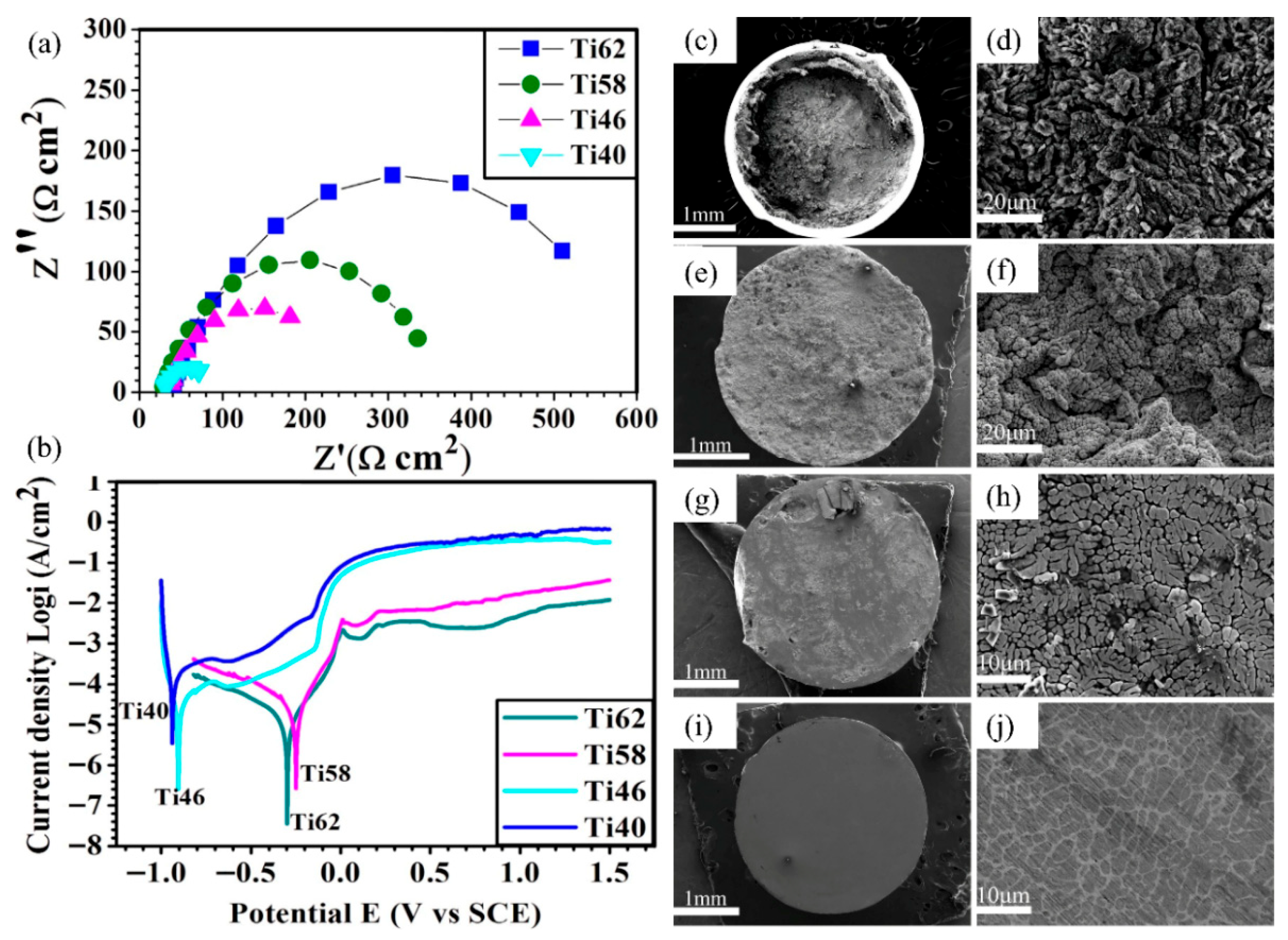
The corrosion resistance of metallic glass composites is influenced by alloying elements [169,170]. Xu et al. [171] prepared four types of Ti-based amorphous composite materials: Ti62Zr12V13Cu4Be9, Ti58Zr16V10Cu4Be12, Ti46Zr20V12Cu5Be17, and Ti40Zr24V12Cu5Be19. and performed dynamic potential polarization measurements in 3.5% NaCl solution. As shown in Figure 9, the corrosion resistance of Ti-based metallic glass composites was positively correlated with Ti content and negatively correlated with Zr and Be contents, with the Ti62 composition exhibiting the best corrosion resistance. On one hand, Ti oxides form a protective layer on the surface, contributing to enhanced passivation. On the other hand, the Ti-rich composites contain the lowest amount of the highly reactive element Be.
Niobium (Nb), as an intermediate transition metal, is widely utilized as an alloying element in various alloy systems to modify the structure and properties of metallic glass composites. Nb enhances the stability of metallic glass composites and promotes the formation of protective Nb oxides [172]. Cheng et al. [173] investigated the Ti40Zr25Ni12−xNbxCu3Be20 (x = 0, 4, 8, 12%) alloy system and observed that increasing Nb content promotes the formation of a dense surface oxide film enriched with Ti4+, Zr4+ and Nb5+. Among the compositions studied, the alloy with 12% Nb exhibited superior corrosion resistance in H2SO4 solution. Yang et al. [174] examined the electrochemical behavior of (Ti0.45Zr0.31Be0.17Cu0.07)100−x Nbx (x = 4, 6, 8, 10, 12) alloys and reported that corrosion resistance initially improves with Nb addition, reaching a maximum at x = 8, after which further Nb content leads to a decline in performance. The presence of Nb enhances pitting corrosion resistance in chloride-containing environments, while in chloride-free solutions, it facilitates spontaneous passivation. Debnath et al. [175] demonstrated that incorporating 3% Ta into the Ti40Zr29Be16Cu8Ni7 matrix results in a low passivation current density comparable to that of the conventional Ti–6Al–4V alloy. In contrast, the addition of 5% V induces quasicrystalline phase enrichment and microgalvanic coupling, leading to localized corrosion; similarly, 5% Nb exacerbates localized corrosion due to compositional heterogeneity. Overall, appropriately adding intermediate transition metals such as niobium (Nb) and tantalum (Ta) can significantly enhance the corrosion resistance of titanium-based metallic glass composites, as they can facilitate the formation of a dense protective passivating film rich in stable oxides.
Current research on the effect of alloying elements on the corrosion resistance of metallic glass and its composites primarily focuses on their role in the formation and performance of passive films. Passive films play a critical role in determining the corrosion resistance of these materials and are closely associated with the contributions of individual alloying elements. Advanced electrochemical and surface analysis techniques enable precise evaluation of passive film performance, providing a solid experimental basis for understanding how alloying elements influence corrosion resistance. The addition of trace alloying elements not only affects the formation and stability of the passive film but also significantly alters the microstructure of metallic glass and its composites, including the arrangement and local ordering of atomic clusters. These microstructural changes have a profound impact on the formability, thermal stability, and mechanical properties of metallic glass and its composites, which in turn influence their corrosion resistance. Although characterizing the microstructure of amorphous alloys and their composites presents technical challenges, investigating the influence of alloying elements from a microstructural perspective is essential for a comprehensive understanding of their corrosion behavior. Future research should focus on how alloying elements affect corrosion resistance through their influence on the microstructure of metallic glass and its composites. Such insights will provide a stronger theoretical foundation for the optimized design and practical application of these materials.

4.2. Influence of Microstructure

Metallic glass and its composites have attracted considerable attention as novel materials due to their unique microstructure and outstanding mechanical properties. However, their corrosion resistance and how it is affected by different heat treatment conditions is critical for practical applications. Therefore, investigating the corrosion behavior of metallic glass under various annealing treatments and partial crystallization conditions, as well as the underlying mechanisms, is essential for establishing a theoretical foundation for its further development and application. Zhou et al. [176] showed that isothermal annealing of Zr65Cu17.5Fe10Al7.5 at 573 K for 0.5–1.0 h promotes nanocrystal precipitation while retaining an amorphous matrix, reducing free volume and enhancing the density and protectiveness of the passive film in 3.5% NaCl solution. This improves resistance to localized corrosion and limits pit growth, whereas prolonged annealing leads to excessive crystallization, secondary phase formation, and degraded corrosion resistance. Coimbrao et al. [177] reported that the corrosion behavior of Fe68Cr8Mo4Nb4B16 strongly depends on microstructure: fully amorphous alloys exhibit excellent corrosion resistance in both acidic and alkaline media due to their structural homogeneity and rapid formation of Cr- and Mo-rich passive films. Alloys annealed at 620–700 °C show slightly increased corrosion current because of phase precipitation but still maintain protective passivation, while fully crystallized material at 850 °C suffers from element segregation and coarse grain boundaries, which provide continuous corrosion paths, increase pitting susceptibility, and ultimately destroy passivity.
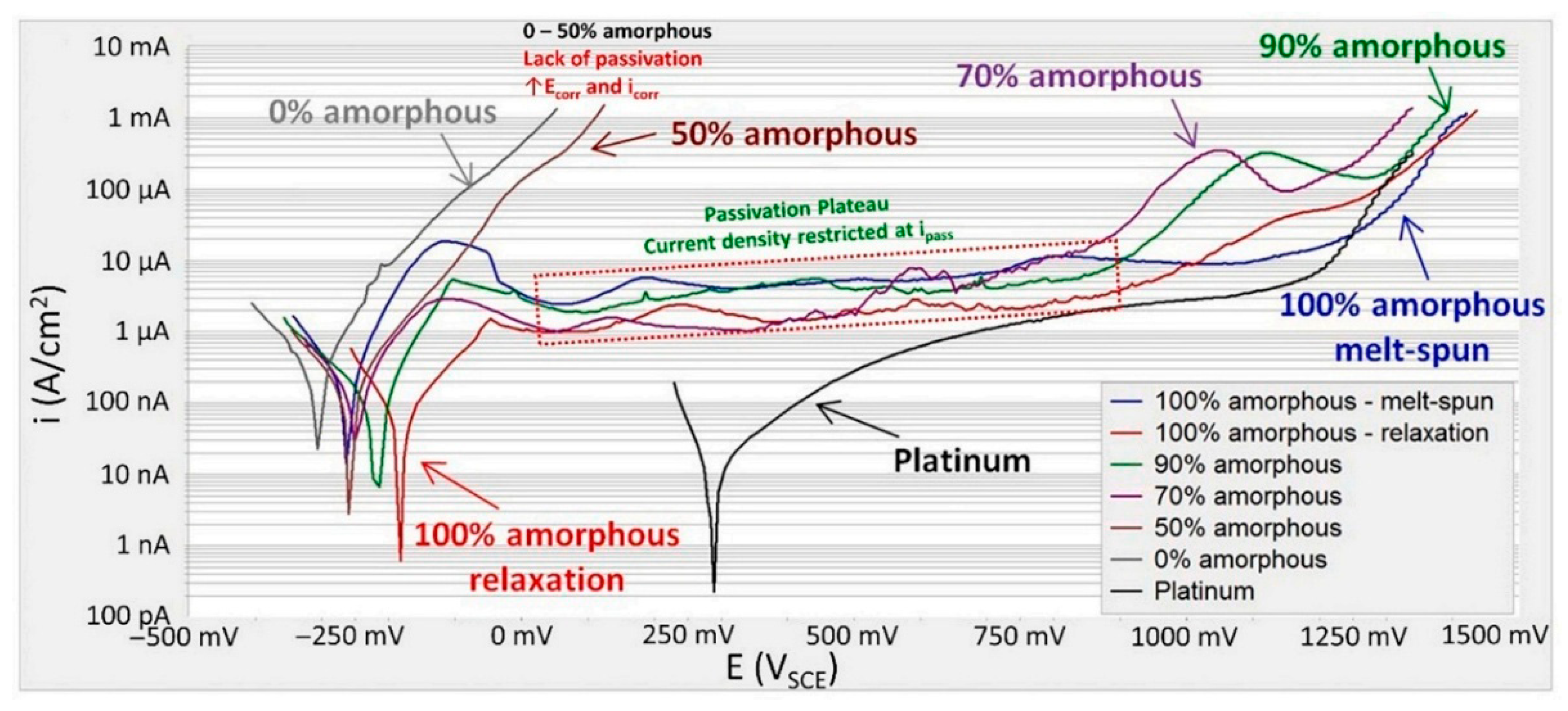
Hua et al. [178] annealed Zr68Al8Ni8Cu16 metallic glass at 673 K and 713 K, introducing roughly 10% and 70% crystalline Zr2Cu and Zr2Ni phases, respectively, and observed a gradual deterioration in corrosion resistance with increasing crystallinity, attributed to the growing fraction of reactive intermetallic compounds within the glassy matrix. Shi et al. [179] studied Zr59Ti6Cu17.5Fe10Al7.5 annealed at 573 K for 0.5–4.0 h and found that, in phosphate-buffered saline, all specimens retained excellent corrosion resistance; although annealing modified the microstructure, it did not significantly impair the integrity or protectiveness of the passive film. Berger et al. [180] investigated FeCrNiB metallic glasses and showed that partial crystallization has a dual effect: when the amorphous fraction remains around 70%, the alloys still exhibit excellent passivation and corrosion stability, and structural relaxation can further lower the corrosion rate, with some partially crystallized samples outperforming fully amorphous, unrelaxed ones. However, once the amorphous content decreases to about 50%, passivation ability drops markedly and the corrosion response approaches that of fully crystalline alloys. Figure 10 shows the potentiodynamic polarization curves for samples with varying degrees of crystallinity.
Moderate structural relaxation and partial crystallization (i.e., the dispersion of nanocrystals within the amorphous matrix) usually help to reduce free volume, enhance the density of the passivation film, and maintain good corrosion resistance; while the second-phase precipitation, element segregation, and the formation of coarse grain boundaries caused by excessive crystallization will disrupt the structural uniformity of the material, significantly weaken its passivation ability, and increase the sensitivity to local corrosion, especially pitting corrosion.
It is well established that most bulk metallic glasses (BMGs) exhibit excellent corrosion resistance and ultra-high strength, attributed to their homogeneous chemical composition and the absence of crystalline defects [181,182]. Metallic glass typically exhibits poor plasticity at room temperature, which significantly limits its widespread application. To address this limitation, a common strategy is to introduce a deformable secondary phase into metallic glass composites, thereby enhancing their room-temperature plasticity. Therefore, investigating the effect of partial crystallization on the corrosion resistance of metallic glass is of particular importance. Zhang et al. [183] prepared (Mg65Cu10Ni10Y10Zn5)91Zr9 bulk metallic glass composites reinforced by in situ NiZr intermetallic and found that secondary-phase precipitation decreases corrosion resistance due to galvanic coupling, giving slightly poorer performance than fully amorphous Mg65Cu20Y10Zn5. Nevertheless, the composite still shows much better corrosion resistance than conventional AZ31 Mg alloy, owing to the inherently corrosion-resistant amorphous matrix and the facilitated formation of a protective passive film.
Lin et al. [184] reported that the corrosion behavior of Al86Ni9La5 in 0.01 M NaCl after isothermal crystallization at 503 K strongly depends on the crystallized volume fraction: as α-Al nanocrystals form, corrosion resistance first improves and then degrades, with an optimum at 20% α-Al, where α-Al/amorphous interfaces promote rapid formation of a dense oxide film; excessive crystallization introduces defects (e.g., grain boundaries) that weaken passivation and enhance localized attack. Gu et al. [185] studied Cu47.5Zr47.5Al5 metallic glass and its composites and showed that the as-cast composite, containing uniformly dispersed CuZr nanocrystals, exhibits the highest corrosion potential and lowest corrosion current density in seawater, while the annealed composite shows the highest corrosion current density and the poorest corrosion resistance. The deterioration after annealing is attributed to aggregation of CuZr nanocrystals, which hinders protective oxide formation and promotes localized corrosion.
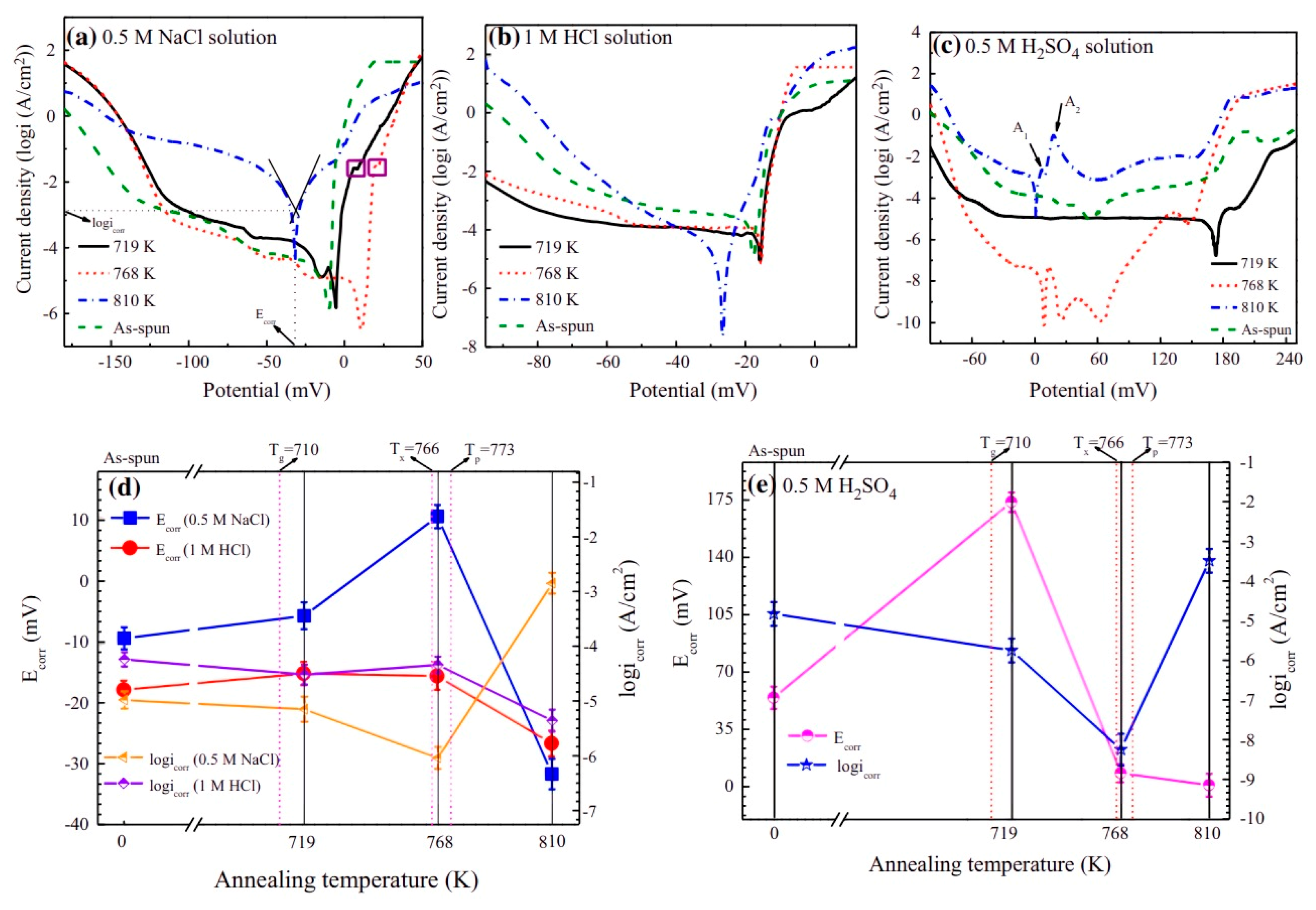
Kasturi et al. [186] fabricated Fe-based metallic glass composites containing 2.5–10% crystalline Ni through spark plasma sintering and demonstrated that all Ni-containing samples exhibited inferior corrosion resistance relative to the monolithic amorphous alloy. The composites with 2.5–5% Ni still displayed a well-defined passivation region in 1 mol/L HCl, indicating partial retention of resistance to localized corrosion. In contrast, higher Ni contents (7.5–10%) resulted in the complete absence of passivation, thereby leading to substantially degraded performance in both general and localized corrosion resistance. Ge et al. [187] examined Zr50.7Ni28Cu9Al12.3 metallic glass and its crystallized counterparts in different aqueous media and found that corrosion behavior is governed by the annealing-induced phase structure and the anion species. In Cl-containing solutions, a suitable fraction of ZrO2 nanocrystals favors the formation of a dense passive film, so that the amorphous–nanocrystalline composite state achieves more noble Ecorr, lower Icorr, and improved pitting resistance relative to both fully amorphous and fully crystalline states. In H2SO4, the relaxed amorphous state shows the best corrosion resistance, associated with a Zr-enriched layer formed via Cu-selective dissolution; overall, corrosion resistance is highest in H2SO4 and lowest in HCl, with the amorphous composite state generally performing best in chloride media. Figure 11 shows the potentiodynamic polarization curves.
Overall, the corrosion behavior of amorphous composite materials also depends on the crystalline phase or reinforcing component. Moderate-sized, finely dispersed nanocrystalline phases, as well as optimized amorphous-crystalline interfaces, can facilitate the formation of a dense and protective passivation film, and in some cases even improve corrosion resistance. On the contrary, excessive crystallization, phase mixture, or obvious galvanic corrosion will destroy the passivation effect and promote local corrosion. Therefore, the development of corrosion-resistant amorphous composite materials requires precise microstructure design within the intermediate range of crystallinity and careful adjustment of the proportion of reinforcing components.
The corrosion resistance of metallic glass and its composites follows complex and varied patterns under different heat treatment and partial crystallization conditions. Fully amorphous alloys generally exhibit excellent corrosion resistance due to their homogeneous chemical composition and disordered atomic structure. Moderate structural relaxation through annealing further improves pitting resistance by reducing free volume and lowering the chemical potential. However, as the annealing temperature increases or crystallization progresses, the precipitation of intermetallic compounds or crystalline phases introduces compositional inhomogeneity and phase boundaries. These features promote galvanic corrosion and localized dissolution, ultimately leading to a decline in overall corrosion resistance. Importantly, partial crystallization does not necessarily degrade corrosion resistance. If the precipitated nanocrystalline phases are uniformly distributed within the amorphous matrix, they can maintain effective passivation while enhancing mechanical properties. Moreover, the migration and enrichment of alloying elements such as Cr, Mo, and Zr under different corrosive environments play a significant role in the formation and stability of the passive film. Their interactions with aggressive ions like Cl and H+ collectively influence the corrosion mechanism. In summary, the corrosion resistance of metallic glasses and their composites is governed by the degree of crystallization, microstructural design, the nature of the corrosion medium, and environmental conditions. These factors provide a crucial theoretical foundation for optimizing material performance and expanding their practical applications.

4.3. Effects of the Preparation Technology

Due to continuous technological advancements, the preparation process of metallic glass and its composites has become highly mature. Currently, several efficient and reliable methods are widely employed, including copper mold casting, due to its simple structure, is a commonly used casting technique for producing various bulk metallic glass [188]; Spark Plasma Sintering (SPS) is a rapid densification technique that synergizes pulsed direct current electric fields with unidirectional pressure. Its advantages include extremely short thermal cycles, high density, and suppressed grain growth [189]; Water quenching is one of the simplest methods for obtaining the bulk metallic glass. One of the primary advantages of water quenching is the low residual stress resulting from the low cooling rate [190]; and the Twin-Roll Steel Casting technology is an alloy plate preparation technique characterized by a short process flow and rapid cooling rates [191]. Importantly, variations in preparation process parameters significantly influence the microstructure of the final products, leading to notable differences in their corrosion resistance [192].
Yang et al. [193] prepared a Ti41.4Zr28.52Cu6.44Nb8.0Be15.64 metallic glass composite using copper mold suction casting and evaluated its corrosion resistance in a 0.5 mol/L H2SO4 + x mol/L NaCl (x = 0.001–0.3 mol/L) binary salt solution. As shown in Figure 12, all the Icorr values are within the order of 10−8 A/cm2. This material exhibits excellent corrosion resistance in an acidic environment containing chloride ions. The amorphous alloy prepared by this method is less likely to form pores, avoids the oxidation process of the amorphous alloy, and is conducive to improving corrosion resistance.
The spark plasma sintering (SPS) process can achieve the preparation of large-sized and complex-shaped components at relatively low temperatures and in a short time. Its corrosion resistance is highly dependent on the sintering temperature and the degree of crystallization: Chang et al. [194] found that the corrosion resistance of Zr55Cu30Al10Ni5 prepared by SPS in 3.5% NaCl first increased and then decreased with the increase in sintering temperature. When the temperature exceeded the glass transition temperature (Tg ≈ 685 K), the corrosion performance deteriorated significantly due to the precipitation of crystalline phases, which disrupted the chemical homogeneity and film continuity of the amorphous matrix. Cai et al. [195] studied Zr48Cu47.5Al4Co0.5 and found that at about 713 K, the volume fraction and size of the crystalline phase reached the best balance, forming a dense protective film and achieving the lowest corrosion current density. However, samples with insufficient interface density due to low sintering temperatures exhibited higher corrosion rates in the same environment. Zeng et al. [196] prepared Ni71Co5Nb4P16B4 by the water quenching method. The corrosion current density in 3.5% NaCl was 3.30 × 10⁻⁸ A/cm2, which was approximately one order of magnitude lower than that of 316 L and 304 L stainless steel. Its corrosion resistance is better than austenitic 316 L and 304. The water quenching method is a simple and low-cost approach for preparing amorphous alloys. However, the cooling rate of this method is limited, making it difficult to produce large pieces of amorphous alloys. When Wang et al. [197] carried out continuous casting of thin strips from the Zr55Cu30Al10Ni5 alloy, they determined the process parameters by controlling the pouring temperature and rolling force, obtaining samples with a completely amorphous structure and samples with microcrystalline phase precipitation. The presence of these microcrystals would alter the ratio of Al2O3, ZrO2 in the surface passivation film, making the crystalline phase a weak link in selective corrosion in strong acids, strong bases, and environments containing Cl, thereby reducing the overall corrosion. The advantages of the Twin-Roll Steel Casting technology process that high cooling speed, the ability to form thin strips in one go, and the ease of obtaining large-sized fully amorphous plates. However, during the process, attention should be paid to the influence of process parameters on performance.
The corrosion resistance of metallic glasses depends not only on the uniformity of their chemical composition and the inherent advantages of their amorphous structure, but also on the interplay between the preparation process and microstructural evolution. Different processing routes establish a dynamic balance among rapid solidification, interface densification, and crystallization control, which collectively determine the stability of the passive film and localized corrosion behavior. In particular, microstructural regulation near the glass transition temperature and the selective dissolution of both amorphous and dendritic phases at interfaces in high chloride ion environments reveal the complex coupling among “structure, environment, and performance”. This indicates that future improvements in the corrosion resistance of metallic glasses will not stem from optimizing a single component, but from systematically integrating preparation process parameters, microstructure control, and service environmental conditions. This multi-scale, mechanism-integrated perspective not only enhances the understanding of corrosion mechanisms in metallic glasses, but also offers a novel theoretical foundation and practical strategy for their engineering applications under extreme conditions.

4.4. Influence of Other Factors

In addition to alloy composition, microstructure, and corrosive media, factors such as heat treatment, enthalpy relaxation, and cyclic compressive loading also influence the corrosion resistance of metallic glasses and their composites.
Various thermal–mechanical treatments and microstructural regulation strategies exert significant and diverse influences on the corrosion behavior of metallic glasses. Isothermal treatment at liquid nitrogen temperature effectively reduces structural heterogeneity, lowers defect density and free volume, and promotes the formation of dense Zr/Ti-enriched oxide films, thereby enhancing corrosion resistance, broadening the passivation region, and suppressing pitting corrosion [198]. In contrast, low-temperature cycling, short-term annealing above the glass transition temperature (Tg), deep cryogenic–thermal cycling, and high-temperature annealing under restricted atomic mobility typically result in increased free volume or hindered atomic diffusion. These changes elevate the concentration of defects within the passive film, reduce its stability, and manifest as an increased corrosion current density, a negative shift in both corrosion and pitting potentials, and intensified localized corrosion [198,199,200]. On the other hand, simple enthalpy relaxation treatment exhibits minimal impact on the electrochemical parameters of certain Zr-based bulk metallic glasses, with their superior resistance to pitting corrosion remaining largely unchanged across different treatment states [201].
Furthermore, external fields and processing parameters play a critical role in modulating corrosion performance. Pre-compression and moderate cyclic compression can significantly improve the stability of the passive film and resistance to uniform corrosion by inhibiting nanocrystalline phase precipitation, inducing beneficial phase transformations, and optimizing microstructural homogeneity [202]. Ultraviolet irradiation enhances the protective capability of the passive film and shifts the pitting potential in the positive direction by increasing the surface concentration of Zr4+ ions and suppressing chloride ion (Cl) adsorption [203]. Conversely, in powder metallurgy–processed Mg-based metallic glasses, although reducing powder particle size does not markedly alter initial transient corrosion parameters, it increases grain boundary density and promotes the formation of porous Mg(OH)2 films that are prone to cracking. This facilitates Cl penetration and leads to a significantly higher overall dissolution rate [204].
In addition to alloy composition, microstructure, and environmental conditions, thermal–mechanical treatments and external fields play a significant role in determining the corrosion behavior of metallic glasses and their composites. Processes that reduce structural heterogeneity and free volume while promoting the formation of dense, Zr/Ti-enriched passive films—such as isothermal holding at liquid nitrogen temperature, appropriate pre-compression or cyclic loading, and ultraviolet irradiation—typically enhance passivation stability, extend the passive region, and improve resistance to both pitting and uniform corrosion. In contrast, treatments that increase free volume or defect density, restrict atomic diffusion, or lead to the development of porous and unstable corrosion products—such as certain low-temperature cycling protocols, short-term annealing above the glass transition temperature (Tg), deep cryogenic–thermal cycling, high-temperature annealing under constrained atomic mobility, or powder metallurgy using ultrafine powders—generally compromise the integrity of the passive film and accelerate general as well as localized corrosion. Notably, simple enthalpy relaxation exhibits only a marginal effect in certain Zr-based bulk metallic glasses, indicating that not all thermal histories significantly influence corrosion performance. Therefore, the rational design and control of heat treatment schedules, mechanical loading histories, and processing parameters are essential for tailoring passive film properties and fully realizing the inherent corrosion resistance of metallic glass systems.

5. Optimization Strategies for the Corrosion Resistance of Metallic Glass and Its Composites

The corrosion resistance of metallic glasses and their composites can be significantly improved through surface modification, alloy design, surface lubrication, environmental control, and crystallization treatment [205]. Therefore, it is crucial to evaluate the effectiveness of each approach and integrate these strategies to harness their synergistic effects, thereby further enhancing the protective performance of metallic glasses and their composites.

5.1. Surface Treatment Methods

Surface treatment methods are effective means to enhance the performance of amorphous alloy materials. Different surface treatment techniques yield different results, and surface coating technology is one of the most common techniques. This method can enhance the corrosion resistance, wear resistance, and oxidation resistance of amorphous alloy materials by forming a protective coating on the surface of the amorphous alloy materials [206,207,208].
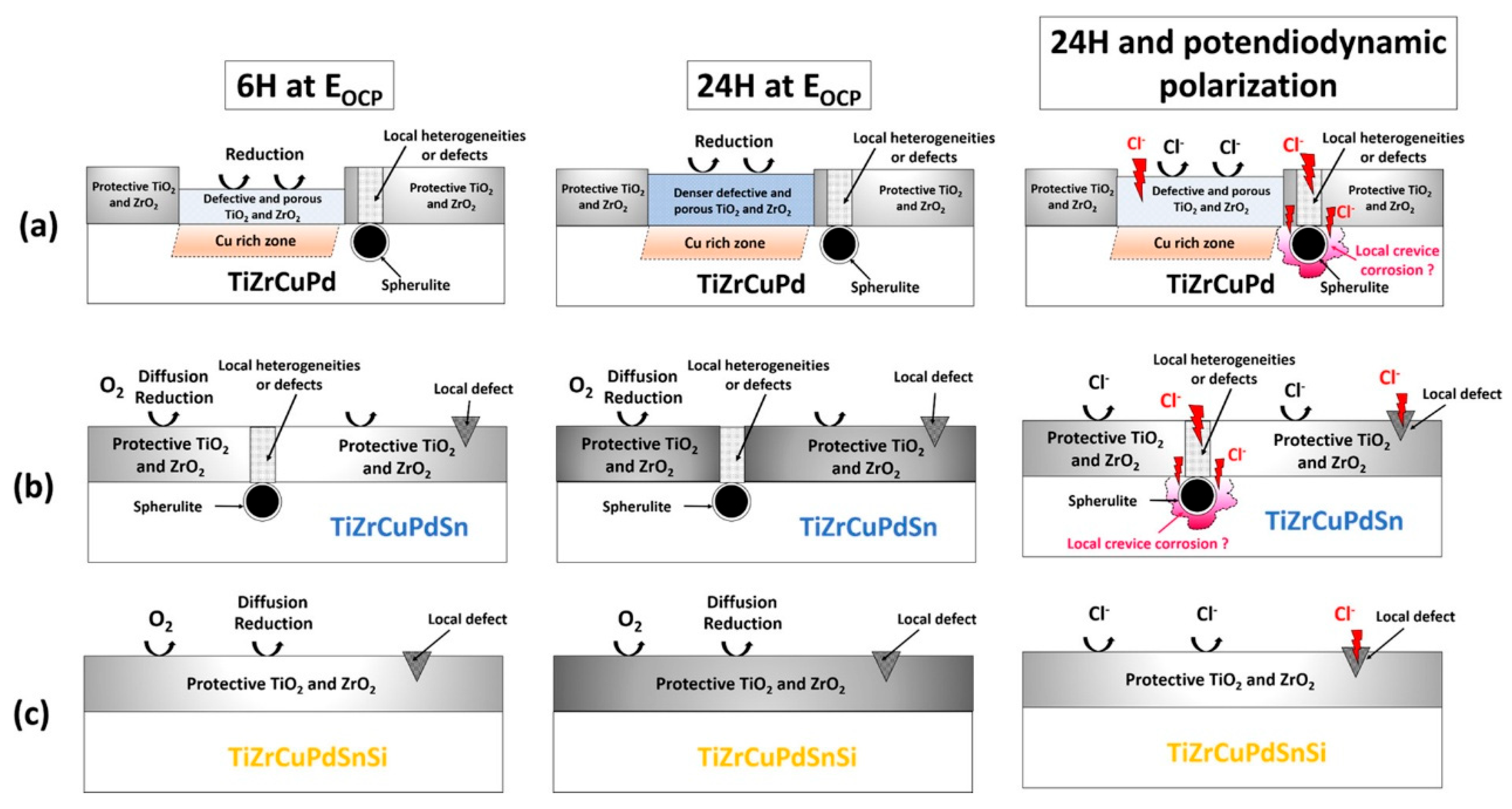
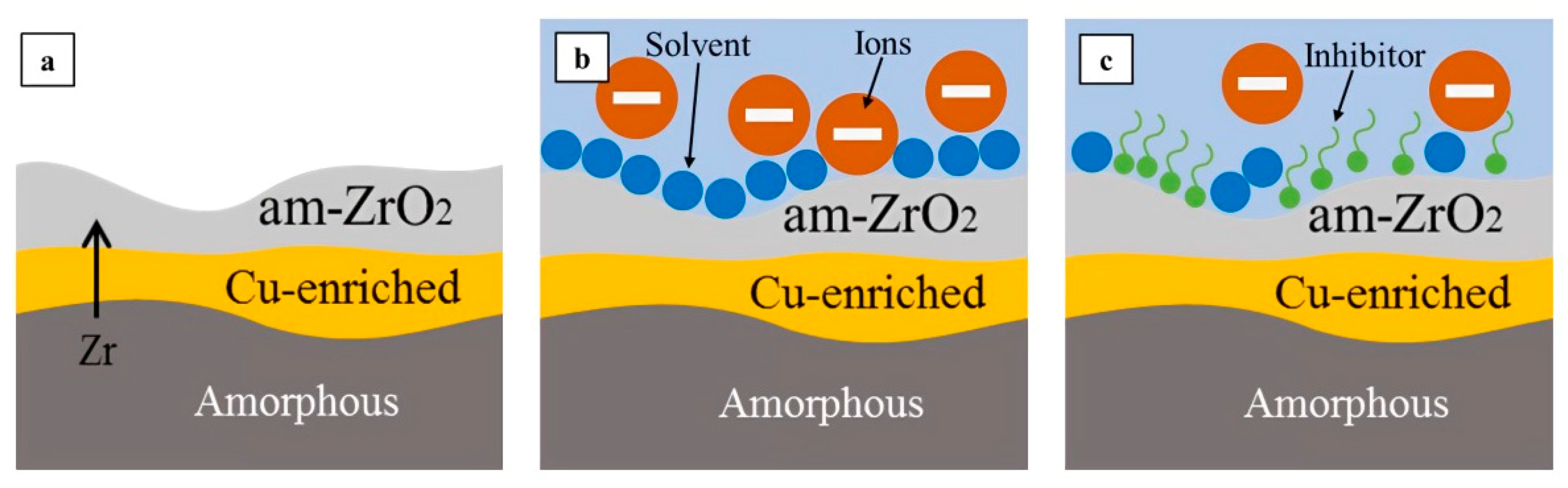
The laser remelting treatment significantly influences the microstructure and corrosion performance of Zr-Cu-Ni-Al metallic glass composite coatings, providing a critical theoretical basis and practical guidance for optimizing the performance of such coatings. As shown in Figure 13, the passive film formed on the remelted coating primarily consists of ZrO2 and Al2O3, and its formation mechanism follows the point defect model. This results in excellent protective properties, effectively reducing the corrosion tendency and pitting sensitivity [209]. Corrosion preferentially initiates at the interface between the crystalline phase and the amorphous matrix. Therefore, increasing the amorphous phase content and suppressing the formation of Cu-enriched crystalline phases can substantially enhance the corrosion resistance of these composite coatings. Corrosion preferentially initiates at the interface between the crystalline phase and the amorphous matrix. Therefore, increasing the amorphous phase content and suppressing the formation of Cu-enriched crystalline phases can substantially enhance the corrosion resistance of these composite coatings.
Functional modifications to the surface of metallic glass materials, such as improved conductivity and enhanced corrosion resistance, can be achieved by selecting appropriate coating materials and process parameters [210]. Surface heat treatment techniques modify the microstructure and properties of these materials by localized heating. For instance, laser melting and electron beam surface melting can produce surface layers with increased hardness and wear resistance, thereby improving both the wear and corrosion resistance of metallic glass materials [211]. Moreover, the crystallization behavior of metallic glasses can be controlled by adjusting thermal treatment parameters, enabling targeted property modifications. In addition, surface treatments such as etching and shot peening can alter the chemical composition and microstructure of the surface, further enhancing the corrosion resistance of these materials [212].
Overall, existing literature consistently demonstrates that surface treatment provides a versatile and effective approach for tailoring the microstructure and enhancing the service performance of metallic glass materials. Conventional coating techniques primarily improve durability by depositing dense and adherent protective layers, while advanced localized surface modification methods—such as laser remelting and electron-beam melting—offer precise control over the amorphous phase content, crystalline phase distribution, and chemical composition of passive films. Notably, in Zr-based metallic glass coatings, the formation of ZrO2- and Al2O3-rich passive films, governed by the point defect model, combined with the suppression of Cu-enriched crystalline phases at amorphous crystalline interfaces, has been shown to significantly reduce both general corrosion rates and susceptibility to pitting corrosion. Furthermore, complementary treatments including surface heat treatments, chemical etching, and shot peening enable fine tuning of surface microstructures, modulation of crystallization kinetics, and optimization of surface chemistry and residual stress profiles. These synergistic effects contribute to concurrent improvements in corrosion resistance, wear resistance, and oxidative stability. Collectively, these findings underscore that the strategic selection and integrated application of multiple surface treatment techniques, rather than reliance on any single method, are essential for achieving targeted performance enhancement of metallic glasses in demanding operational environments.

5.2. Optimization of Alloy Composition

In the design of specific components, it is necessary to comprehensively consider the synergistic effects of each element on the formation ability of amorphous materials, corrosion resistance, and mechanical behavior. Adding alloying elements to metallic glasses can modify their composition and structure, thereby enhancing both corrosion and wear resistance. Commonly used alloying elements include Mo, Cr, Ti, Nb, Si and Sn [213,214,215]. Figure 14 presents a schematic comparison of the surface passivation film structure and local corrosion behavior of the three amorphous alloys under various conditions. It demonstrates that the addition of Sn and Si to the TiZrCuPd matrix significantly enhances the density and stability of the passive film, thereby reducing susceptibility to localized corrosion. Small atoms such as B, P, and C not only enhance the glass-forming ability but also affect the composition and density of the passivation film by altering the local structural units, but excessive content may introduce brittleness, requiring a balance between corrosion resistance and ductility [216,217]. Careful selection of composition and processing parameters can further improve the corrosion and wear resistance of metallic glasses. Research has shown that factors such as alloy composition, microstructure, and preparation process significantly influence the corrosion resistance of metallic glasses [218]. The composition or microstructure of metallic glasses can be optimized by modifying the surface composition or structure to form metallic glass composites, provided that a fully amorphous structure is achieved [219,220]. Furthermore, alloying elements influence both corrosion and wear resistance through multiple mechanisms. These mechanisms include regulating the zero-charge potential of the passive film to inhibit Chloride ion (Cl) adsorption, reducing defect density via solute–vacancy interactions, and controlling pitting corrosion kinetics through solute enrichment at interfaces [221,222,223,224,225].
The influence of alloying elements on the corrosion resistance of amorphous alloys and their composites is multifaceted and systematic. First, the appropriate incorporation of alloying elements facilitates the formation of a chemically optimized, dense, and stable passive film on the material surface, effectively impeding the penetration of aggressive ions from the corrosive medium. This significantly enhances the alloy’s overall passivation capability and resistance to localized corrosion. Second, these elements play a critical role in tailoring the structural homogeneity and microstructural characteristics by improving the chemical short-range order within the amorphous matrix and suppressing the precipitation of nanocrystalline phases or elemental segregation. Such refinement promotes uniform corrosion behavior and minimizes the formation of micro-galvanic cells. Furthermore, strong synergistic interactions often occur between alloying elements and the primary constituents of the matrix. A well-balanced elemental composition can optimize the electronic structure and interfacial stability, which macroscopically manifests as reduced corrosion rates and enhanced long-term corrosion resistance. Collectively, these mechanisms contribute to a comprehensive improvement in the corrosion performance of amorphous alloys and their composite systems.

5.3. Corrosion Inhibitors

The formation of a protective film on the surface of metallic glass by corrosion inhibitors occurs through both physical and chemical adsorption. Physical adsorption involves the attachment of inhibitor molecules to the metal surface, where the resulting film is primarily governed by intermolecular forces. This layer acts as a barrier, protecting the metal from corrosion and slowing the overall reaction rate. The film forms rapidly and typically at lower concentrations of the adsorbent. Due to the relatively low adsorption enthalpy, this process is generally reversible, allowing the adsorbed inhibitor molecules to be desorbed under suitable conditions. The desorption is facilitated by electrostatic interactions and van der Waals forces [226]. The non-polar functional groups in corrosion inhibitor molecules form hydrophobic protective layers on the metal surface, which inhibit charge migration during corrosion reactions, reduce the active surface area, and consequently lower the corrosion rate [227].
Chemical adsorption involves the chemical interaction between corrosion inhibitors and metal surfaces, leading to the formation of a protective film. In the development of corrosion inhibitors, specific chemical components bind with metal ions on the surface to form stable complexes, thereby establishing a protective barrier. The resulting film effectively isolates the metal from the corrosive environment, significantly reducing the corrosion rate and enhancing overall corrosion resistance [228]. Corrosion inhibitors adsorb onto active sites on the metal surface and react with non-metallic inclusions, grain boundaries, and dislocation protrusions to form a protective layer [229]. Therefore, the application of corrosion inhibitors to metallic glass surfaces inhibits corrosion reactions and reduces the likelihood of corrosion initiation. Figure 15 presents a simplified model of this process [230]. Introducing corrosion inhibitors into the corrosive medium establishes a corrosion inhibition system that effectively slows the corrosion rate of metallic glass. In such systems, the adsorption behavior of metallic glass is typically investigated using electrochemical and chemical analytical techniques. These insights aid in the design of effective corrosion inhibition strategies to protect metallic glass materials.
Corrosion inhibitors offer a simple, efficient, and highly adaptable approach for protecting metallic glasses, serving as a complementary strategy to alloy design and surface treatment. By forming an adsorptive layer that integrates rapid, reversible physisorption with stronger and more durable chemisorption, well-designed inhibitor molecules can simultaneously reduce the active surface area, impede charge transfer, and block electrochemically susceptible sites, thereby significantly lowering both general corrosion rates and the likelihood of localized corrosion. Research on metallic glasses and conventional alloys further underscores that inhibition performance is predominantly governed by the molecular structure of the inhibitor, its adsorption thermodynamics and kinetics, and its compatibility with the substrate’s passive film and surface chemistry. In this context, systematic electrochemical characterization and adsorption modeling are essential for elucidating the interplay between physisorption and chemisorption on the disordered surfaces of metallic glasses, and for optimizing inhibitor formulations with respect to efficiency, environmental sustainability, and long-term stability. Future efforts should focus on tailoring inhibitor molecules to the specific composition and surface characteristics of metallic glasses, utilizing eco-friendly organic and coordination compounds, and incorporating responsive or self-healing functionalities, to enable robust, application-driven protection of metallic glasses in complex service environments.

6. Summary and Outlook

The disordered atomic structure and chemical homogeneity of metallic glasses give them corrosion behaviors distinct from crystalline alloys, mainly through the formation of dense, protective passive films. Over six decades of research has clarified how alloy composition, structure, processing, and environment jointly control their corrosion resistance and how this can be optimized via alloy design, microstructure control, and surface engineering.
Intrinsically, corrosion resistance is dominated by composition and structural state. Elements such as Cr, Mo, Nb, Ti and certain rare earths promote spontaneous formation of compact passive films and improve resistance to localized corrosion; minor N and O additions can further enhance passivation within suitable ranges. Fully amorphous alloys usually show superior corrosion resistance due to chemical uniformity and the absence of grain boundaries, while excessive crystallization and elemental segregation promote galvanic effects and pitting. In metallic glass matrix composites, second phases improve plasticity but complicate corrosion, as electrochemical interactions and phase interfaces often become sites for localized attack, especially in chloride media. Processing routes (e.g., casting, quenching, sintering, strip casting) and subsequent treatments (annealing, cryogenic cycling, enthalpy relaxation, mechanical loading, UV irradiation) strongly affect cooling rate, defect content, structural relaxation, and passive film characteristics. Surface modification methods such as laser remelting, amorphous or high-entropy coatings, and inhibitor systems can provide additional protection.
Despite notable progress, challenges remain in precisely controlling multicomponent compositions, mitigating processing-induced defects, and elucidating corrosion mechanisms under coupled service conditions. Addressing these issues is essential to enable the broader engineering application of metallic glasses and their composites. To address these limitations and facilitate broader engineering applications, future research should focus on the following directions:
(1) 
Data-driven composition and structure design
Elements with strong passivation potential should be strategically incorporated to promote rapid formation of stable protective films while maintaining adequate glass-forming ability. Beyond empirical approaches, data-driven methodologies including machine learning and high-throughput combinatorial screening can establish correlations between high-dimensional compositional and microstructural descriptors and electrochemical performance. These tools enable efficient identification of novel metallic glass and composite systems with superior corrosion resistance and allow for quantitative optimization of composition ranges, reducing reliance on trial-and-error experimentation.
(2) 
Integration of emerging manufacturing technologies
Advanced fabrication techniques, such as additive manufacturing, twin-roll strip casting, and advanced powder metallurgy offer new opportunities for producing components with complex geometries and large-scale dimensions. By precisely controlling process parameters (e.g., cooling rate, heat input, layer thickness, sintering temperature/pressure), it is possible to suppress unwanted crystallization, minimize porosity and oxide inclusions, and enhance interfacial integrity. Consequently, both formability and corrosion resistance are improved. Integration of in-situ monitoring and post-processing treatments (e.g., laser remelting, surface sealing) is expected to further extend service life and reduce lifecycle costs in practical applications.
(3) 
Microstructure regulation and passive film engineering
Tailoring the microstructure of metallic glasses through controlled annealing, partial crystallization, and composite design enables a balanced enhancement of mechanical properties and corrosion resistance. When conducted within appropriate thermal and temporal windows, structural relaxation and the formation of fine, uniformly distributed nanocrystals can strengthen passive films, reduce internal stresses, and hinder pit initiation and propagation. Future studies should aim to establish quantitative relationships among free volume, local atomic order, phase interface characteristics, and the composition and defect structure of passive films. Such knowledge will support the development of microstructure–corrosion property maps and guide the design of corrosion-resistant microstructures.
(4) 
Corrosion behavior under multi-factor coupling and environmentally sustainable processing
In real-world applications, metallic glasses and their composites are subjected to concurrent effects of mechanical loading, temperature fluctuations, complex ionic environments, fluid flow, wear, and biological interactions. Corrosion studies conducted under single-variable conditions are insufficient to predict long-term performance in harsh or natural environments. Therefore, future research must emphasize multi-factor interactions, including corrosion, wear, fatigue synergy, the dynamic stability of passive films, and the compatibility between specific alloy systems and intended service conditions. Concurrently, environmentally sustainable practices, such as minimizing the use of toxic alloying elements, adopting low-energy processing routes, and developing recyclable protective systems should be prioritized to ensure that the advancement of metallic glasses aligns with principles of sustainability and environmental responsibility.
Overall, metallic glasses and their composites represent a promising class of high-performance materials with significant potential for applications in marine engineering, energy systems, aerospace, biomedicine, and other demanding fields. Through integrated efforts in alloy design, microstructure control, advanced manufacturing, and multi-scale corrosion evaluation, it is anticipated that more robust, corrosion-resistant metallic glass systems will be developed and successfully transitioned from laboratory research to real-world engineering applications.

Author Contributions

Author Contributions: Conceptualization, L.L.; methodology, Q.T., Q.P. and Y.Y.; soft-ware, Y.Q.; validation, Y.Q., Z.W., Q.T. and M.W.; formal analysis, Y.Q., Z.W. and M.W.; investigation, Y.Q. and M.W.; resources, M.W. and Y.Y.; data curation, Y.Q., Z.W. and Q.P.; writing—original draft preparation, Y.Q. and Z.W.; writing—review and editing, L.L., M.W., Q.P. and Y.Y.; visualization, Q.P.; supervision, L.L.; project administration, L.L.; funding acquisition, L.L., Q.T. and Y.Y. All authors have read and agreed to the published version of the manuscript.

Funding

This work was supported by the National Natural Science Foundation of China (No. 52101140 and No. 52375217) and the National Training Program of Innovation and Entrepreneurship for Undergraduates (No. X202511049020).

Data Availability Statement

No new data were created or analyzed in this study.

Conflicts of Interest

The authors declare no conflicts of interest.

References

  1. Szewieczek, D.; Baron, A.; Nawrat, G. Electrochemical behavior of Fe78Si9B13alloy in sulphate and chloride solution. J. Mater. Process. Technol. 2006, 175, 411–415. [Google Scholar] [CrossRef]
  2. Maurice, V.; Marcus, P. Progress in corrosion science at atomic and nanometric scales. Prog. Mater. Sci. 2018, 95, 132–171. [Google Scholar] [CrossRef]
  3. Javidi, M.; Bekhrad, S. Failure analysis of a wet gas pipeline due to localised CO2 corrosion. Eng. Fail. Anal. 2018, 89, 46–56. [Google Scholar] [CrossRef]
  4. Byrne, C.J.; Eldrup, M. Bulk metallic glasses. Science 2008, 321, 502–503. [Google Scholar] [CrossRef]
  5. Sheng, H.W.; Luo, W.K.; Alamgir, F.M.; Bai, J.M.; Ma, E. Atomic packing and short-to-medium-range order in metallic glasses. Nature 2006, 439, 419–425. [Google Scholar] [CrossRef]
  6. Zhang, L.C.; Jia, Z.; Lyu, F.C.; Liang, S.X.; Lu, J. A review of catalytic performance of metallic glasses in wastewater treatment: Recent progress and prospects. Prog. Mater. Sci. 2019, 105, 100576. [Google Scholar] [CrossRef]
  7. Klement, W.; Willens, R.; Duwez, P. Non-crystalline structure in solidified gold–silicon alloys. Nature 1960, 187, 869–870. [Google Scholar] [CrossRef]
  8. Chen, H.S.; Turnbull, D. Formation, stability and structure of palladium-silicon based alloy glasses. Acta Metall. 1969, 17, 1021–1031. [Google Scholar] [CrossRef]
  9. Nishiyama, N.; Takenaka, K.; Miura, H.; Saidoh, N.; Zeng, Y.Q.; Inoue, A. The world’s biggest glassy alloy ever made. Intermetallics 2012, 30, 19–24. [Google Scholar] [CrossRef]
  10. Qiao, J.W. In-situ Dendrite/Metallic Glass Matrix Composites: A Review. J. Mater. Sci. Technol. 2013, 29, 685–701. [Google Scholar] [CrossRef]
  11. Peker, A.; Johnson, W.L. A highly processable metallic glass: Zr41.2Ti13.8Cu12.5Ni10.0Be22.5. Appl. Phys. Lett. 1993, 63, 2342–2344. [Google Scholar] [CrossRef]
  12. Schuhmacher, B.; Koster, U. Contact reactions at aluminum transition-metal interfaces. Z. Fur Met. 1991, 82, 464–469. [Google Scholar]
  13. Steinbrink, G.; Pungewitteler, B.; Koster, U. Influence of an oxygen atmosphere and surface treatments on surface crystallization of (Co,Ni)-B glassses. Mater. Sci. Eng. A-Struct. Mater. Prop. Microstruct. Process. 1991, 133, 624–629. [Google Scholar] [CrossRef]
  14. Schuhmacher, B.; Köster, U. Contact reactions at thin film Aluminium/transition metal interfaces. MRS Online Proc. Libr. 1989, 167, 323–328. [Google Scholar] [CrossRef]
  15. Jastrow, L.; Meuris, M.; Köster, U.; Froumin, N.; Eliezer, D. Oxidation of glassy and nanocrystalline Zr70Pd30 alloys. J. Metastable Nanocrystalline Mater. 2002, 13, 627–632. [Google Scholar] [CrossRef]
  16. Inoue, A. Stabilization of metallic supercooled liquid and bulk amorphous alloys. Acta Mater. 2000, 48, 279–306. [Google Scholar] [CrossRef]
  17. Johnson, W.L. Bulk glass-forming metallic alloys: Science and technology. Mrs Bull. 1999, 24, 42–56. [Google Scholar] [CrossRef]
  18. Tang, M.Q.; Zhang, H.F.; Zhu, Z.W.; Fu, H.M.; Wang, A.M.; Li, H.; Hu, Z.Q. TiZr-base Bulk Metallic Glass with over 50 mm in Diameter. J. Mater. Sci. Technol. 2010, 26, 481–486. [Google Scholar] [CrossRef]
  19. Gu, J.L.; Shao, Y.; Yao, K.F. The novel Ti-based metallic glass with excellent glass forming ability and an elastic constant dependent glass forming criterion. Materialia 2019, 8, 100433. [Google Scholar] [CrossRef]
  20. Mei, J.N.; Li, J.S.; Kou, H.C.; Fu, H.Z.; Zhou, L. Effects of Nb on the formation of icosahedral quasicrystalline phase in Ti-rich Ti-Zr-Ni-Cu-Be glassy forming alloys. J. Non-Cryst. Solids 2008, 354, 3332–3335. [Google Scholar] [CrossRef]
  21. Terajima, T. Cu metallization of the surface of Cu-Zr-based metallic glass. J. Alloys Compd. 2012, 536, S113–S116. [Google Scholar] [CrossRef]
  22. Kim, S.Y.; Park, G.H.; Kim, H.A.; Lee, A.Y.; Oh, H.R.; Lee, C.W.; Lee, M.H. Micro-deposition of Cu-based metallic glass wire by direct laser melting process. Mater. Lett. 2017, 202, 1–4. [Google Scholar] [CrossRef]
  23. Xing, L.Q.; Eckert, J.; Loser, W.; Schultz, L. Effect of cooling rate on the precipitation of quasicrystals from the Zr-Cu-Al-Ni-Ti amorphous alloy. Appl. Phys. Lett. 1998, 73, 2110–2112. [Google Scholar] [CrossRef]
  24. David, K.; Maaß, R.; Florian, H.D.T.; Jörg, F.L. Temperature-dependent shear band dynamics in a Zr-based bulk metallic glass. Appl. Phys. Lett. 2010, 96, 61901. [Google Scholar]
  25. Yao, K.F.; Zhang, C.Q. Fe-based bulk metallic glass with high plasticity. Appl. Phys. Lett. 2007, 90, 61901. [Google Scholar] [CrossRef]
  26. Lou, H.B.; Wang, X.D.; Xu, F.; Ding, S.Q.; Cao, Q.P.; Hono, K.; Jiang, J.Z. 73 mm-diameter bulk metallic glass rod by copper mould casting. Appl. Phys. Lett. 2011, 99, 51910. [Google Scholar] [CrossRef]
  27. Feng, Z.Y.; Geng, H.S.; Zhuang, Y.Z.; Li, P.W. Progress, Applications, and Challenges of Amorphous Alloys: A Critical Review. Inorganics 2024, 12, 232. [Google Scholar] [CrossRef]
  28. Wang, W.H. The elastic properties, elastic models and elastic perspectives of metallic glasses. Prog. Mater. Sci. 2012, 57, 487–488. [Google Scholar] [CrossRef]
  29. Demetriou, M.D.; Launey, M.E.; Garrett, G.; Schramm, J.P.; Hofmann, D.C.; Johnson, W.L.; Ritchie, R.O. A damage-tolerant glass. Nat. Mater. 2011, 10, 123–128. [Google Scholar] [CrossRef]
  30. Wang, W.H. Bulk Metallic Glasses with Functional Physical Properties. Adv. Mater. 2009, 21, 4524–4544. [Google Scholar] [CrossRef]
  31. Zhang, S.; Wei, C.; Yang, L.; Lv, J.W.; Zhang, H.R.; Shi, Z.L.; Zhang, X.Y.; Ma, M.Z. Formation ability, thermal stability, and mechanical properties of the Zr50Cu34Al8Ag8 amorphous alloys prepared by different mold materials. Mater. Sci. Eng. A-Struct. Mater. Prop. Microstruct. Process. 2022, 840, 142978. [Google Scholar] [CrossRef]
  32. Hashimoto, K. 2002 W.R. Whitney Award Lecture: In pursuit of new corrosion-resistant alloys. Corrosion 2002, 58, 715–722. [Google Scholar] [CrossRef]
  33. Qin, C.L.; Zhang, W.; Zhang, Q.S.; Asami, K.; Inoue, A. Electrochemical properties and surface analysis of Cu-Zr-Ag-Al-Nb bulk metallic glasses. J. Alloys Compd. 2009, 483, 317–320. [Google Scholar] [CrossRef]
  34. Guo, S.F.; Chan, K.C.; Xie, S.H.; Yu, P.; Huang, Y.J.; Zhang, H.J. Novel centimeter-sized Fe-based bulk metallic glass with high corrosion resistance in simulated acid rain and seawater. J. Non-Cryst. Solids 2013, 369, 29–33. [Google Scholar] [CrossRef]
  35. Li, H.X.; Lu, Z.C.; Wang, S.L.; Wu, Y.; Lu, Z.P. Fe-based bulk metallic glasses: Glass formation, fabrication, properties and applications. Prog. Mater. Sci. 2019, 103, 235–318. [Google Scholar] [CrossRef]
  36. Li, H.F.; Zheng, Y.F. Recent advances in bulk metallic glasses for biomedical applications. Acta Biomater. 2016, 36, 1–20. [Google Scholar] [CrossRef]
  37. Gong, P.; Deng, L.; Jin, J.S.; Wang, S.B.; Wang, X.Y.; Yao, K.F. Review on the Research and Development of Ti-Based Bulk Metallic Glasses. Metals 2016, 6, 264. [Google Scholar] [CrossRef]
  38. Inoue, A.; Takeuchi, A. Recent development and application products of bulk glassy alloys. Acta Mater. 2011, 59, 2243–2267. [Google Scholar] [CrossRef]
  39. Gao, K.; Zhu, X.G.; Chen, L.; Li, W.H.; Xu, X.; Pan, B.T.; Li, W.R.; Zhou, W.H.; Li, L.; Huang, W.; et al. Recent development in the application of bulk metallic glasses. J. Mater. Sci. Technol. 2022, 131, 115–121. [Google Scholar] [CrossRef]
  40. Schroers, J.; Nguyen, T.; O’Keeffe, S.; Desai, A. Thermoplastic forming of bulk metallic glass—Applications for MEMS and microstructure fabrication. Mater. Sci. Eng. A-Struct. Mater. Prop. Microstruct. Process. 2007, 449, 898–902. [Google Scholar] [CrossRef]
  41. Trexler, M.M.; Thadhani, N.N. Mechanical properties of bulk metallic glasses. Prog. Mater. Sci. 2010, 55, 759–839. [Google Scholar] [CrossRef]
  42. Madge, S.V. Toughness of Bulk Metallic Glasses. Metals 2015, 5, 1279–1305. [Google Scholar] [CrossRef]
  43. Huang, H.; Zhang, J.L.; Shek, C.H.; Yan, J.W. Effects of pre-compression deformation on nanoindentation response of Zr65Cu15Al10Ni10 bulk metallic glass. J. Alloys Compd. 2016, 674, 223–228. [Google Scholar] [CrossRef]
  44. Ma, H.; Xu, J.; Ma, E. Mg-based bulk metallic glass composites with plasticity and high strength. Appl. Phys. Lett. 2003, 83, 2793–2795. [Google Scholar] [CrossRef]
  45. Jang, J.S.C.; Li, J.B.; Lee, S.L.; Chang, Y.S.; Jian, S.R.; Huang, J.C.; Nieh, T.G. Prominent plasticity of Mg-based bulk metallic glass composites by ex-situ spherical Ti particles. Intermetallics 2012, 30, 25–29. [Google Scholar] [CrossRef]
  46. Shi, Y.F.; Falk, M.L. A computational analysis of the deformation mechanisms of a nanocrystal-metallic glass composite. Acta Mater. 2008, 56, 995–1000. [Google Scholar] [CrossRef]
  47. Hajlaoui, K.; Yavari, A.R.; LeMoulec, A.; Botta, W.J.; Vaughan, F.G.; Das, J.; Greer, A.L.; Kvick, Å. Plasticity induced by nanoparticle dispersions in bulk metallic glasses. J. Non-Cryst. Solids 2007, 353, 327–331. [Google Scholar] [CrossRef]
  48. Kim, Y.C.; Na, J.H.; Park, J.M.; Kim, D.H.; Lee, J.K.; Kim, W.T. Role of nanometer-scale quasicrystals in improving the mechanical behavior of Ti-based bulk metallic glasses. Appl. Phys. Lett. 2003, 83, 3093–3095. [Google Scholar] [CrossRef]
  49. Zhou, Q.; Ren, Y.; Du, Y.; Han, W.C.; Hua, D.P.; Zhai, H.M.; Huang, P.; Wang, F.; Wang, H.F. Identifying the significance of Sn addition on the tribological performance of Ti-based bulk metallic glass composites. J. Alloys Compd. 2019, 780, 671–679. [Google Scholar] [CrossRef]
  50. Hong, S.H.; Kim, J.T.; Park, J.M.; Song, G.; Wang, W.M.; Kim, K.B. Mechanical, deformation and fracture behaviors of bulk metallic glass composites reinforced by spherical B2 particles. Prog. Nat. Sci.-Mater. Int. 2018, 28, 704–710. [Google Scholar] [CrossRef]
  51. Bian, Z.; Wang, R.J.; Wang, W.H.; Zhang, T.; Inoue, A. Carbon-nanotube-reinforced Zr-based bulk metallic glass composites and their properties. Adv. Funct. Mater. 2004, 14, 55–63. [Google Scholar] [CrossRef]
  52. Chen, S.; Zhang, L.; Fu, H.M.; Li, Z.K.; Zhu, Z.W.; Li, H.; Zhang, H.W.; Wang, A.M.; Wang, Y.D.; Zhang, H.F. Compressive mechanical properties and failure modes of Zr-based bulk metallic glass composites containing tungsten springs. Mater. Des. 2018, 160, 652–660. [Google Scholar] [CrossRef]
  53. Sarac, B.; Schroers, J. Designing tensile ductility in metallic glasses. Nat. Commun. 2013, 4, 2158. [Google Scholar] [CrossRef]
  54. Madge, S.V.; Sharma, P.; Louzguine-Luzgin, D.V.; Greer, A.L.; Inoue, A. New La-based glass–crystal ex situ composites with enhanced toughness. Scr. Mater. 2010, 62, 210–213. [Google Scholar] [CrossRef]
  55. Hofmann, D.C.; Suh, J.Y.; Wiest, A.; Duan, G.; Lind, M.L.; Demetriou, M.D.; Johnson, W.L. Designing metallic glass matrix composites with high toughness and tensile ductility. Nature 2008, 451, 1085–1089. [Google Scholar] [CrossRef]
  56. Ren, Y.; Yan, T.Y.; Huang, Z.B.; Zhou, Q.; Hua, K.; Li, X.L.; Du, Y.; Jia, Q.; Zhang, L.; Zhang, H.F. Cryogenic wear behaviors of a metastable Ti-based bulk metallic glass composite. J. Mater. Sci. Technol. 2023, 134, 33–41. [Google Scholar] [CrossRef]
  57. Ma, W.F.; Kou, H.C.; Chen, C.S.; Li, J.S.; Chang, H.; Zhou, L.; Fu, H.Z. Compressive deformation behaviors of tungsten fiber reinforced Zr-based metallic glass composites. Mater. Sci. Eng. A 2008, 486, 308–312. [Google Scholar] [CrossRef]
  58. Wang, M.L.; Chen, G.L.; Hui, X.; Zhang, Y.; Bai, Z.Y. Optimized interface and mechanical properties of W fiber/Zr-based bulk metallic glass composites by minor Nb addition. Intermetallics 2007, 15, 1309–1315. [Google Scholar] [CrossRef]
  59. Xie, G.Q.; Qin, F.X.; Zhu, S.L. Recent progress in Ti-based metallic glasses for application as biomaterials. Mater. Trans. 2013, 54, 1314–1323. [Google Scholar] [CrossRef]
  60. Xu, Y.K.; Ma, H.; Xu, J.; Ma, E. Mg-based bulk metallic glass composites with plasticity and gigapascal strength. Acta Mater. 2005, 53, 1857–1866. [Google Scholar] [CrossRef]
  61. Zhang, L.; Zhang, H.F. Ti-based metallic glass composites containing β-Ti dendrites. Prog. Mater. Sci. 2025, 152, 101472. [Google Scholar] [CrossRef]
  62. Mondal, K.; Murty, B.S.; Chatterjee, U.K. Electrochemical behavior of multicomponent amorphous and nanocrystalline Zr-based alloys in different environments. Corros. Sci. 2006, 48, 2212–2225. [Google Scholar] [CrossRef]
  63. Pang, S.J.; Zhang, T.; Asami, K.; Inoue, A. Synthesis of Fe-Cr-Mo-C-B-P bulk metallic glasses with high corrosion resistance. Acta Mater. 2002, 50, 489–497. [Google Scholar] [CrossRef]
  64. Morrison, M.L.; Buchanan, R.A.; Peker, A.; Liaw, P.K.; Horton, J.A. Electrochemical behavior of a Ti-based bulk metallic glass. J. Non-Cryst. Solids 2007, 353, 2115–2124. [Google Scholar] [CrossRef]
  65. Archer, M.D.; Corke, C.C.; Harji, B.H. The electrochemical properties of metallic glass. Electrochim. Acta 1987, 32, 13–26. [Google Scholar] [CrossRef]
  66. Scully, J.R.; Gebert, A.; Payer, J.H. Corrosion and related mechanical properties of bulk metallic glasses. J. Mater. Res. 2007, 22, 302–313. [Google Scholar] [CrossRef]
  67. Ma, H.; Shi, L.L.; Xu, J.; Li, Y.; Ma, E. Discovering inch-diameter metallic glasses in three-dimensional composition space. Appl. Phys. Lett. 2005, 87, 181915. [Google Scholar] [CrossRef]
  68. Zhang, Q.; Zhang, W.; Inoue, A. Fabrication of new Cu34Pd2Zr48Ag8Al8 bulk glassy alloy with a diameter of 30 mm. Mater. Trans. 2007, 48, 3031–3033. [Google Scholar] [CrossRef]
  69. Zeng, Y.Q.; Inoue, A.; Nishiyama, N.; Chen, M.W. Remarkable effect of minor boron doping on the formation of the largest size Ni-rich bulk metallic glasses. Scr. Mater. 2009, 60, 925–928. [Google Scholar] [CrossRef]
  70. Zhao, Z.Y.; Zou, Y.; Liu, P.; Lai, Z.G.; Wen, L.; Jin, Y. EIS equivalent circuit model prediction using interpretable machine learning and parameter identification using global optimization algorithms. Electrochim. Acta 2022, 418, 140350. [Google Scholar] [CrossRef]
  71. Skaanvik, S.A.; Gateman, S.M. Probing passivity of corroding metals using scanning electrochemical probe microscopy. Electrochem. Sci. Adv. 2024, 4, 2300014. [Google Scholar] [CrossRef]
  72. Wang, T.E.; Ma, X.Q.; Gong, B.L.; Zhu, C.R.; Xue, P.Z.; Guo, L.L.; Tian, X.; Shen, X.X.; Min, Y.L.; Xu, Q.J.; et al. Bio-inspired Ti3C2Tx MXene composite coating for enhancing corrosion resistance of aluminum alloy in acidic environments. J. Colloid Interface Sci. 2024, 658, 865–878. [Google Scholar] [CrossRef]
  73. Poltronieri, C.; Brognara, A.; Bignoli, F.; Evertz, S.; Djemia, P.; Faurie, D.; Challali, F.; Li, C.; Belliard, L.; Dehm, G.; et al. Mechanical properties and thermal stability of ZrCuAlx thin film metallic glasses: Experiments and first-principle calculations. Acta Mater. 2023, 258, 119226. [Google Scholar] [CrossRef]
  74. Cao, S.; Liu, G.Y.; Huang, J.K.; Yu, X.Q.; Luo, Y.M.; Fan, D. Molecular Dynamics Study of Crystallization Behavior in the Solid State of Zr-Cu Amorphous Alloys. Metals 2023, 13, 1571. [Google Scholar] [CrossRef]
  75. Liang, D.D.; Liu, X.D.; Zhou, Y.H.; Wei, Y.; Wei, X.S.; Xu, G.; Shen, J. Effects of Annealing Below Glass Transition Temperature on the Wettability and Corrosion Performance of Fe-based Amorphous Coatings. Acta Metall. Sin.-Engl. Lett. 2022, 35, 243–253. [Google Scholar] [CrossRef]
  76. Zhang, L.M.; Zhang, S.D.; Ma, A.L.; Hu, H.X.; Zheng, Y.G.; Yang, B.J.; Wang, J.Q. Thermally induced structure evolution on the corrosion behavior of Al-Ni-Y amorphous alloys. Corros. Sci. 2018, 144, 172–183. [Google Scholar] [CrossRef]
  77. Souza, C.A.C.; Ribeiro, D.V.; Kiminami, C.S. Corrosion resistance of Fe-Cr-based amorphous alloys: An overview. J. Non-Cryst. Solids 2016, 442, 56–66. [Google Scholar] [CrossRef]
  78. Qiu, Z.W.J.; Li, Z.K.; Fu, H.M.; Zhang, L.; Zhu, Z.W.; Zhang, H.W.; Wang, A.M.; Li, H.; Zhang, H.F. Effect of pH and NaF addition on corrosion of Zr-based bulk metallic glass in Na2SO4-containing solution. Intermetallics 2021, 129, 107034. [Google Scholar] [CrossRef]
  79. Li, J.W.; Yang, L.J.; Ma, H.R.; Jiang, K.M.; Chang, C.T.; Wang, J.Q.; Song, Z.L.; Wang, X.M.; Li, R.W. Improved corrosion resistance of novel Fe-based amorphous alloys. Mater. Des. 2016, 95, 225–230. [Google Scholar] [CrossRef]
  80. Tamilselvam, K.; Saini, J.S.; Xu, D.; Brabazon, D. Corrosion behavior of new rare-earth free Cu-based metallic glasses in NaCl solution of different molarity. J. Mater. Res. Technol. 2022, 16, 482–494. [Google Scholar] [CrossRef]
  81. Hertsyk, O.M.; Hula, T.H.; Yezerska, O.A.; Nosenko, V.K.; Korniy, S.A.; Tashak, M.S. The Influence of the Composition of Amorphous Alloys on Their Corrosion Resistance in Aggressive Environments of Different Nature. Mater. Sci. 2024, 59, 546–553. [Google Scholar] [CrossRef]
  82. Jin, J.; Ji, X.L.; Cao, S.; Zhu, W.W. Effect of Cryogenic Thermal Cycling on Tribocorrosion Performance of Fe-Based Bulk Amorphous Alloy in 3.5 Pct NaCl Solution. Metall. Mater. Trans. A-Phys. Metall. Mater. Sci. 2022, 53, 3404–3417. [Google Scholar] [CrossRef]
  83. Dhawan, A.; Sachdev, K.; RoychowdItury, S.; De, P.K.; Sharma, S.K. Potentiodynamic polarization studies on amorphous Zr46.75Ti8.25Cu7.5Ni1.0Be27.5, Zr65Cu17.5Ni10Al7.5, Zr67Ni33 and Ti60Ni40 in aqueous HNO3 solutions. J. Non-Cryst. Solids 2007, 353, 2619–2623. [Google Scholar] [CrossRef]
  84. Li, Z.Z.; Zhou, S.X.; Wang, Y.G.; Xiang, R.; Zhang, G.Q. Enhancement of the soft magnetic properties and improvement of the deformation ability of a ferromagnetic (Fe0.76Si0.09B0.1P0.05)99Nb1 bulk metallic glass. Mater. Lett. 2015, 148, 99–102. [Google Scholar] [CrossRef]
  85. Shin, S.S.; Kim, H.K.; Lee, J.C.; Park, I.M. Effect of Sub-Tg Annealing on the Corrosion Resistance of the Cu-Zr Amorphous Alloys. Acta Metall. Sin.-Engl. Lett. 2018, 31, 273–280. [Google Scholar] [CrossRef]
  86. Debnath, M.R.; Kim, D.H.; Fleury, E. Dependency of the corrosion properties of in-situ Ti-based BMG matrix composites with the volume fraction of crystalline phase. Intermetallics 2012, 22, 255–259. [Google Scholar] [CrossRef]
  87. Bao, W.Z.; Xiang, T.; Chen, L.; Du, P.; Zhang, Z.W.; Xie, G.Q. Corrosion behavior of high-performance crystalline CuCrZr/amorphous CuZrAl composites in NaCl solution. J. Mater. Res. Technol. 2022, 21, 5004–5017. [Google Scholar] [CrossRef]
  88. Kawashima, A.; Ohmura, K.; Yokoyama, Y.; Inoue, A. The corrosion behaviour of Zr-based bulk metallic glasses in 0.5 M NaCl solution. Corros. Sci. 2011, 53, 2778–2784. [Google Scholar] [CrossRef]
  89. Zuo, Y.; Wang, S.L.; Huang, Y.; Wang, S.C. Corrosion Resistance of Fe-Based Bulk Amorphous Alloy with Sulfide Inclusion. In Advanced Functional Materials. CMC 2017; Springer: Singapore, 2018; pp. 309–318. [Google Scholar]
  90. Guennec, B.; Kabuchi, R.; Kuwahara, H.; Ueno, A. Analysis of Zr55Al10Cu30Ni5 bulk metallic glass pitting behavior in distilled water environment leading to fatigue-corrosion rupture. Int. J. Fatigue 2021, 143, 106026. [Google Scholar] [CrossRef]
  91. Zhang, H.Q.; Yang, Y.X.; Liu, H.; Hou, S.X.; Zhang, Z.Y.; Ma, Z.S. Effects of Cr and Mo content on the microstructure and properties of Fe-based amorphous composite coatings by laser cladding. J. Laser Appl. 2024, 36, 32022. [Google Scholar] [CrossRef]
  92. Xu, D.D.; Zhou, B.L.; Wang, Q.Q.; Zhou, J.; Yang, W.M.; Yuan, C.C.; Xue, L.; Fan, X.D.; Ma, L.Q.; Shen, B.L. Effects of Cr addition on thermal stability, soft magnetic properties and corrosion resistance of FeSiB amorphous alloys. Corros. Sci. 2018, 138, 20–27. [Google Scholar] [CrossRef]
  93. Wang, Y.; Zhang, L.; Chen, B.; Bo, W.J.; Zhou, Y.Z.; Geng, G.H. Effect of Zn on glass-forming capacity and corrosion resistance of Ca-based amorphous alloys. J. Non-Cryst. Solids 2022, 591, 121713. [Google Scholar] [CrossRef]
  94. Zhou, W.; Weng, W.P.; Hou, J.X. Glass-forming Ability and Corrosion Resistance of Zr-Cu-Al-Co Bulk Metallic Glass. J. Mater. Sci. Technol. 2016, 32, 349–354. [Google Scholar] [CrossRef]
  95. Yang, X.D.; Gao, M.; Liu, Y.H.; Li, J.L.; Huang, Y.; Wang, G.; Wang, J.Q.; Huo, J.T. Superior corrosion resistance of high-temperature Ir-Ni-Ta-(B) amorphous alloy in sulfuric acid solution. Corros. Sci. 2022, 200, 110227. [Google Scholar] [CrossRef]
  96. Wang, S.W.; Li, Y.H.; Wang, X.W.; Yamaura, S.; Zhang, W. Glass-forming ability, thermal properties, and corrosion resistance of Fe-based (Fe, Ni, Mo, Cr)-P-C-B metallic glasses. J. Non-Cryst. Solids 2017, 476, 75–80. [Google Scholar] [CrossRef]
  97. Wang, L.; Chao, Y.S. Corrosion behavior of Fe41Co7Cr15Mo14C15B6Y2 bulk metallic glass in NaCl solution. Mater. Lett. 2012, 69, 76–78. [Google Scholar] [CrossRef]
  98. Zhang, J.W.; Chen, S.; Zhang, X.P.; Xiao, S.M.; Li, L.; Guo, S.F. Fe-based bulk metallic glass with high thermal stability and corrosion resistance. J. Non-Cryst. Solids 2024, 643, 123176. [Google Scholar] [CrossRef]
  99. Qiu, Z.W.J.; Li, Z.K.; Fu, H.M.; Zhang, H.W.; Zhu, Z.W.; Wang, A.M.; Li, H.; Zhang, L.; Zhang, H.F. Corrosion mechanisms of Zr-based bulk metallic glass in NaF and NaCl solutions. J. Mater. Sci. Technol. 2020, 46, 33–43. [Google Scholar] [CrossRef]
  100. Tang, J.L.; Wang, Y.Y.; Zhu, Q.H.; Chamas, M.; Wang, H.; Qiao, J.C.; Zhu, Y.Q.; Normand, B. Passivation Behavior of a Zr60Cu20Ni8Al7Hf3Ti2 Bulk Metallic Glass in Sulfuric Acid Solutions. Int. J. Electrochem. Sci. 2018, 13, 6913–6929. [Google Scholar] [CrossRef]
  101. Pourgashti, M.H.; Marzbanrad, E.; Ahmadi, E. Corrosion behavior of Zr41.2Ti13.8Ni10Cu12.5Be22.5 bulk metallic glass in various aqueous solutions. Mater. Des. 2010, 31, 2676–2679. [Google Scholar] [CrossRef]
  102. Xu, Y.; Liang, G.X.; Wang, T.T.; Shi, H.Q.; Tang, T.; Zhan, J.M.; Guo, X.N. Enhancement of mechanical properties and corrosion resistance in Zr-based bulk metallic glasses by nanocrystal precipitation. J. Alloys Compd. 2025, 1014, 178683. [Google Scholar] [CrossRef]
  103. Dhawan, A.; Roychowdhury, S.; De, P.K.; Sharma, S.K. Potentiodynamic polarization studies on bulk amorphous alloys and Zr46.75Ti8.25Cu7.5Ni10Be27.5 and Zr65Cu17.5Ni10Al7.5. J. Non-Cryst. Solids 2005, 351, 951–955. [Google Scholar] [CrossRef]
  104. Song, Y.X.; Zhou, Y.T.; Liu, G.T.; Wang, T. Superior corrosion resistance of high-temperature annealing Cr–Co–Mo–Nb–B metallic glass in sodium chloride solution. J. Non-Cryst. Solids 2025, 665, 123620. [Google Scholar] [CrossRef]
  105. Zhou, Y.T.; Wang, T. High stability and high corrosion resistance of a class of Co–Cr–Mo–Nb–B high-entropy metallic glasses. J. Mater. Res. Technol.-JMRT 2024, 30, 256–266. [Google Scholar] [CrossRef]
  106. Yang, L.; Zhang, H.R.; Zhang, S.; Shi, Z.L.; Wei, C.; Ma, M.Z.; Liu, R.P. Corrosion behavior of Ti-based bulk amorphous alloys in acidic solutions. Trans. Nonferrous Met. Soc. China 2024, 34, 874–889. [Google Scholar] [CrossRef]
  107. Wang, T.; Wu, Y.; Si, J.J.; Cai, Y.; Chen, X.H.; Hui, X.D. Novel Ti-based bulk metallic glasses with superior plastic yielding strength and corrosion resistance. Mater. Sci. Eng. A-Struct. Mater. Prop. Microstruct. Process. 2015, 642, 297–303. [Google Scholar] [CrossRef]
  108. Gu, J.L.; Yang, X.L.; Zhang, A.L.; Shao, Y.; Zhao, S.F.; Yao, K.F. Centimeter-sized Ti-rich bulk metallic glasses with superior specific strength and corrosion resistance. J. Non-Cryst. Solids 2019, 512, 206–210. [Google Scholar] [CrossRef]
  109. Nair, A.; Prabhu, Y.; Mendonca, J.; Ryu, W.H.; Park, E.S.; Bhatt, J.; Vincent, S. An experimental case study on corrosion characterization of Cu46Zr40Ti8.5Al5.5 metallic glass. J. Non-Cryst. Solids 2019, 524, 119654. [Google Scholar] [CrossRef]
  110. Vincent, S.; Khan, A.F.; Murty, B.S.; Bhatt, J. Corrosion characterization on melt spun Cu60Zr20Ti20 metallic glass: An experimental case study. J. Non-Cryst. Solids 2013, 379, 48–53. [Google Scholar] [CrossRef]
  111. Malekan, M.; Rashidi, R.; Bozorg, M.; Birbilis, N. Tailoring the glass forming ability, mechanical properties and corrosion resistance of Cu–Zr–Al bulk metallic glasses by yttrium addition. Intermetallics 2023, 158, 107906. [Google Scholar] [CrossRef]
  112. Anuj, K.; Shashi Bhushan, A.; Bhaskar, M.; Jatin, B.; Ajeet, K.S. Corrosion Studies of Hf64Cu18Ni18 Metallic Glass in Acidic and Alkaline Media. Trans. Indian Inst. Met. 2021, 74, 949–956. [Google Scholar]
  113. Babilas, R.; Bajorek, A.; Simka, W.; Babilas, D. Study on corrosion behavior of Mg-based bulk metallic glasses in NaCl solution. Electrochim. Acta 2016, 209, 632–642. [Google Scholar] [CrossRef]
  114. Yong, L.; Zhang, T.B.; Jian, L. Electrochemical corrosion properties of Zr-and Ti-based bulk metallic glasses. Trans. Nonferrous Met. Soc. China 2011, 21, 552–557. [Google Scholar]
  115. Liu, Y.X.; Li, J.W.; Sun, Y.; He, A.N.; Dong, Y.Q.; Wang, Y. Effect of annealing temperature on magnetic properties and corrosion resistance of Fe75.8Si12B8Nb2.6Cu0.6P1 alloy. J. Mater. Res. Technol. -JmrT 2021, 15, 3880–3894. [Google Scholar] [CrossRef]
  116. Vasic, M.M.; Zák, T.; Pizúrová, N.; Simatovic, I.S.; Minic, D.M. Influence of Thermal Treatment on Microstructure and Corrosion Behavior of Amorphous Fe40Ni40B12Si8 Alloy. Metall. Mater. Trans. A-Phys. Metall. Mater. Sci. 2021, 52, 34–45. [Google Scholar] [CrossRef]
  117. Guo, S.F.; Zhang, H.J.; Liu, Z.; Chen, W.; Xie, S.F. Corrosion resistances of amorphous and crystalline Zr-based alloys in simulated seawater. Electrochem. Commun. 2012, 24, 39–42. [Google Scholar] [CrossRef]
  118. Chae, W.S.; Li, M.W.; Cao, Q.P.; Wang, X.D.; Ding, S.Q.; Zhang, D.X.; Jiang, J.Z.; Caron, A. Excellent corrosion and wear resistance of amorphous and crystalline ZrCoAl alloys. J. Alloys Compd. 2023, 968, 172055. [Google Scholar] [CrossRef]
  119. Gostin, P.F.; Oswald, S.; Schultz, L.; Gebert, A. Acid corrosion process of Fe-based bulk metallic glass. Corros. Sci. 2012, 62, 112–121. [Google Scholar] [CrossRef]
  120. Liu, S.S.; Xia, C.Q.; Yang, T.; Yang, Z.D.; Liu, N.; Li, Q. High strength and superior corrosion resistance of the Ti-Ni-Cu-Zr crystal/glassy alloys with superelasticity. Mater. Lett. 2020, 260, 126938. [Google Scholar]
  121. Hua, N.B.; Huang, Y.X.; Zheng, Z.G.; Huang, Y.T.; Su, M.Y.; Liao, Z.L.; Chen, W.Z. Tribological and corrosion behaviors of Mg56.5Cu27Ag5Dy11.5 bulk metallic glass in NaCl solution. J. Non-Cryst. Solids 2017, 459, 36–44. [Google Scholar]
  122. Wang, D.B.; Zhang, S.D.; Wang, Q.; Zhang, L.M.; Wang, J.Q. Underlying mechanism for the effects of composition and microstructure on the corrosion resistance of Al-based amorphous alloys: A review. Crit. Rev. Solid State Mater. Sci. 2024, 49, 1120–1152. [Google Scholar] [CrossRef]
  123. Xu, J.; Niu, J.Z.; Zhang, Z.T.; Ge, W.J.; Shang, C.Y.; Wang, Y. Effects of B Addition on Glass Formation, Mechanical Properties and Corrosion Resistance of the Zr66.7-xNi33.3Bx (x=0, 1, 3, and 5 at.%) Metallic Glasses. JOM 2016, 68, 682–691. [Google Scholar] [CrossRef]
  124. Liang, D.D.; Tseng, J.C.; Liu, X.D.; Cai, Y.F.; Xu, G.; Shen, J. Investigation of the Structural Heterogeneity and Corrosion Performance of the Annealed Fe-Based Metallic Glasses. Materials 2021, 14, 929. [Google Scholar] [CrossRef]
  125. Si, J.J.; Chen, X.H.; Cai, Y.H.; Wu, Y.D.; Wang, T.; Hui, X.H. Corrosion behavior of Cr-based bulk metallic glasses in hydrochloric acid solutions. Corros. Sci. 2016, 107, 123–132. [Google Scholar] [CrossRef]
  126. Yang, L.; Zhang, H.R.; Zhang, S.; Shi, Z.L.; Wei, C.; Ma, M.Z.; Liu, R.P. Effect of Cu content on the corrosion behavior of Ti-based bulk amorphous alloys in HCl solution. Mater. Lett. 2023, 337, 133742. [Google Scholar] [CrossRef]
  127. Babilas, R.; Bajorek, A.; Włodarczyk, P.; Łoński, W.; Szyba, D.; Babilas, D. Effect of Au addition on the corrosion activity of Ca-Mg-Zn bulk metallic glasses in Ringer’s solution. Mater. Chem. Phys. 2019, 226, 51–58. [Google Scholar] [CrossRef]
  128. Vasic, M.M.; Simatovic, I.S.; Radovic, L.; Minic, D.M. Influence of microstructure of composite amorphous/nanocrystalline Fe72Ni8Si10B10 alloy on the corrosion behavior in various environments. Corros. Sci. 2022, 204, 110403. [Google Scholar] [CrossRef]
  129. Li, Q.; Liu, S.S.; Wang, X.H.; Yang, T.; Dong, C.; Hu, J.T.; Jiang, Y.Q. Mechanical and corrosion properties of Ti-Ni-Cu-Zr metallic glass matrix composites. J. Alloys Compd. 2017, 727, 1344–1350. [Google Scholar] [CrossRef]
  130. Eckert, J.; Das, J.; Pauly, S.; Duhamel, C. Mechanical properties of bulk metallic glasses and composites. J. Mater. Res. 2007, 22, 285–301. [Google Scholar] [CrossRef]
  131. Guo, W.; Kato, H.; Yamada, R.; Saida, J. Fabrication and mechanical properties of bulk metallic glass matrix composites by in-situ dealloying method. J. Alloys Compd. 2017, 707, 332–336. [Google Scholar] [CrossRef]
  132. Yang, Y.J.; Jin, Z.S.; Ma, X.Z.; Zhang, Z.P.; Zhong, H.; Ma, M.Z.; Zhang, X.Y.; Li, G.; Liu, R.P. Comparison of corrosion behaviors between Ti-based bulk metallic glasses and its composites. J. Alloys Compd. 2018, 750, 757–764. [Google Scholar] [CrossRef]
  133. Yang, F.; Tian, H.F.; Lan, A.D.; Zhou, H.F.; Wang, B.C.; Yang, H.J.; Qiao, J.W. Corrosion behavior of Ti-based in situ dendrite-reinforced metallic glass matrix composites in various solutions. Metall. Mater. Trans. A 2015, 46, 2399–2403. [Google Scholar] [CrossRef]
  134. Tian, H.F.; Lan, A.D.; Wang, Y.S.; Yang, H.J.; Pan, S.P.; Qiao, J.W. Corrosion behavior of in situ dendrite-reinforced Zr-based metallic glass matrix composites in NaCl solutions of varied concentrations. Mater. Chem. Phys. 2015, 162, 326–331. [Google Scholar] [CrossRef]
  135. Qiao, J.W.; Fan, J.; Yang, F.; Shi, X.H.; Yang, H.J.; Lan, A.D. The corrosion behavior of Ti-based metallic glass matrix composites in the H2SO4 solution. Metals 2018, 8, 52. [Google Scholar] [CrossRef]
  136. Yang, Y.J.; Zhang, X.; Lv, J.W.; Wang, F.L.; Liu, S.G.; Wan, B.; Ma, M.Z. The influence of dendrite size on corrosion properties of Ti43. 2Zr29. 8Cu6. 7Nb4Be16.3 amorphous matrix composites in NaCl solution. J. Non-Cryst. Solids 2021, 557, 120576. [Google Scholar] [CrossRef]
  137. Xu, K.K.; Lan, A.D.; Qiao, J.W.; Yang, H.J.; Han, P.D.; Liaw, P.K. Corrosion behaviors and mechanisms of in-situ Ti-based MGMCs in chloride-containing and chloride-free solutions. Intermetallics 2019, 105, 179–186. [Google Scholar] [CrossRef]
  138. Wang, B.; Xu, K.K.; Shi, X.H.; Zhang, M.; Qiao, J.W.; Gao, C.H.; Wu, Y.C. Electrochemical and chemical corrosion behaviors of the in-situ Zr-based metallic glass matrix composites in chloride-containing solutions. J. Alloys Compd. 2019, 770, 679–685. [Google Scholar] [CrossRef]
  139. Yang, Y.J.; Zhang, Z.P.; Jin, Z.S.; Sun, W.C.; Xia, C.Q.; Ma, M.Z.; Zhang, X.Y.; Li, G.; Liu, R.P. A study on the corrosion behavior of the in-situ Ti-based bulk metallic glass matrix composites in acid solutions. J. Alloys Compd. 2019, 782, 927–935. [Google Scholar] [CrossRef]
  140. Lin, D.; Shang, J.; Zheng, P. Corrosion properties and mechanism of Ti43Zr27Mo5Cu10Be15 amorphous composites in various conditions. Mater. Res. Express 2024, 11, 055201. [Google Scholar] [CrossRef]
  141. Wang, Z.; Wang, B.; Zhang, M.; Guo, R.P.; Wang, X.J.; Qiao, J.W.; Wang, Z.H. Corrosion Behavior of In-situ Zr-Based Metallic Glass Matrix Composites in Aqueous Environments. J. Mater. Eng. Perform. 2024, 33, 274–282. [Google Scholar] [CrossRef]
  142. Tian, H.F.; Qiao, J.W.; Yang, H.J.; Wang, Y.S.; Liaw, P.K.; Lan, A.D. The corrosion behavior of in-situ Zr-based metallic glass matrix composites in different corrosive media. Appl. Surf. Sci. 2016, 363, 37–43. [Google Scholar] [CrossRef]
  143. Yang, F.; Guo, S.f.; Lan, A.D.; Yang, H.J.; Zhou, H.F. Corrosion behavior of Fe-based bulk metallic glass and in-situ dendrite-reinforced metallic glass matrix composites in acid solution. J. Iron Steel Res. Int. 2016, 23, 1200–1205. [Google Scholar] [CrossRef]
  144. Lu, W.B.; He, M.F.; Yu, D.; Xie, X.M.; Wang, H.; Wang, S.; Yuan, C.G.; Chen, A.Y. Ductile behavior and excellent corrosion resistance of Mg-Zn-Yb-Ag metallic glasses. Mater. Des. 2021, 210, 110027. [Google Scholar] [CrossRef]
  145. Borgioli, F.; Galvanetto, E.; Bacci, T. Corrosion behaviour of low temperature nitrided nickel-free, AISI 200 and AISI 300 series austenitic stainless steels in NaCl solution. Corros. Sci. 2018, 136, 352–365. [Google Scholar] [CrossRef]
  146. Wang, S.L.; Li, H.X.; Zhang, X.F.; Yi, S. Effects of Cr contents in Fe-based bulk metallic glasses on the glass forming ability and the corrosion resistance. Mater. Chem. Phys. 2009, 113, 878–883. [Google Scholar] [CrossRef]
  147. Zohdi, H.; Shahverdi, H.; Hadavi, S. Effect of Nb addition on corrosion behavior of Fe-based metallic glasses in Ringer’s solution for biomedical applications. Electrochem. Commun. 2011, 13, 840–843. [Google Scholar] [CrossRef]
  148. Long, Z.L.; Chang, C.T.; Ding, Y.H.; Shao, Y.; Zhang, P.; Shen, B.L.; Inoue, A. Corrosion behavior of Fe-based ferromagnetic (Fe, Ni)–B–Si–Nb bulk glassy alloys in aqueous electrolytes. J. Non-Cryst. Solids 2008, 354, 4609–4613. [Google Scholar] [CrossRef]
  149. Iqbal, A.; Iqbal, A.; Moskal, G.; Yasir, M.; Al-Mansour, A.I.; Khan, M.A.; Alam, S.; Shahbaz, M.; Zia, A.; Ejaz, A. Long-term potentiodynamic testing and tribometric properties of amorphous alloy coatings under saline environment. Molecules 2022, 27, 1421. [Google Scholar] [CrossRef]
  150. Zhang, X.P.; Lai, L.M.; Xiao, S.M.; Zhang, H.J.; Zhang, F.F.; Li, N.; Guo, S.F. Effect of W on the thermal stability, mechanical properties and corrosion resistance of Fe-based bulk metallic glass. Intermetallics 2022, 143, 107485. [Google Scholar] [CrossRef]
  151. Zhang, L.M.; Zhang, S.D.; Ma, A.L.; Umoh, A.J.; Hu, H.X.; Zheng, Y.G.; Yang, B.J.; Wang, J.Q. Influence of cerium content on the corrosion behavior of Al-Co-Ce amorphous alloys in 0.6 M NaCl solution. J. Mater. Sci. Technol. 2019, 35, 1378–1387. [Google Scholar] [CrossRef]
  152. Wang, Q.; Zhang, S.; Cui, J.; Pan, S.; Emori, W.; Wang, J. Clarifying the alloying effects of La and Ce on the pitting corrosion behaviour of Al-based metallic glasses. Corros. Sci. 2024, 230, 111925. [Google Scholar] [CrossRef]
  153. Yu, L.S.; Tang, J.L.; Wang, H.; Wang, Y.Y.; Qiao, J.C.; Apreutesei, M.; Normand, B. Corrosion behavior of bulk (Zr58Nb3Cu16Ni13Al10) 100-xYx (x= 0, 0.5, 2.5 at.%) metallic glasses in sulfuric acid. Corros. Sci. 2019, 150, 42–53. [Google Scholar] [CrossRef]
  154. Tao, P.J.; He, H.J.; Chen, Y.G.; Long, Z.Y.; Zhang, W.J.; Yang, Y.Z. Thermodynamics and corrosion properties of nitrogen doped zirconium-based bulk metallic glasses. Intermetallics 2023, 159, 107913. [Google Scholar] [CrossRef]
  155. Jiang, J.; Wang, Z.B.; Pang, S.J.; Zheng, Y.G.; Li, Y. Oxygen impurity improving corrosion resistance of a Zr-based bulk metallic glass in 3.5 wt% NaCl solution. Corros. Sci. 2021, 192, 109867. [Google Scholar] [CrossRef]
  156. Jiang, J.; Wang, Z.B.; Zheng, Y.G.; Li, Y. Effect of oxygen impurity on corrosion behavior of a Zr-based bulk metallic glass in 0.5 M H2SO4 and 0.5 M NaOH solutions. Mater. Lett. 2022, 330, 133231. [Google Scholar] [CrossRef]
  157. Panahi, S.L.; Bruna, P.; Pineda, E. Effect of Si and B on the Electrochemical Behavior of FeCoNiCr-Based High-Entropy Amorphous Alloys. Materials 2022, 15, 8897. [Google Scholar] [CrossRef]
  158. Yu, X.Y.; Xiao, Z.; Yu, Q.; Li, Z.; Lei, Q.; Dai, J. Effect of Al on Corrosion Behavior of Imitation-Gold Cu-Zn-Ni-Sn Alloys in 3.5 wt.% NaCl solution. JOM 2021, 73, 589–599. [Google Scholar] [CrossRef]
  159. Xu, Y.; Hong, Y.; Shi, H.Q.; Chen, J.J.; Tang, T.; Li, M.M.; Zhan, J.M. Improved mechanical properties and corrosion resistance of Zr-Cu-Al-Ni-Ti bulk metallic glasses by Co addition. J. Non-Cryst. Solids 2024, 632, 122937. [Google Scholar] [CrossRef]
  160. Qiu, Z.W.J.; Fu, H.M.; Zhang, H.W.; Li, H.; Li, Z.K.; Zhang, L.; Zhu, Z.W.; Wang, A.M.; Zhang, H.F. Effects of Ti addition on corrosion behavior of Zr-based metallic glass in chloride medium. J. Iron Steel Res. Int. 2018, 25, 650–657. [Google Scholar] [CrossRef]
  161. Zhang, Y.; Yan, L.; Zhao, X.Y.; Ma, L.Q. Enhanced chloride ion corrosion resistance of Zr-based bulk metallic glasses with cobalt substitution. J. Non-Cryst. Solids 2018, 496, 18–23. [Google Scholar] [CrossRef]
  162. Dan, Z.H.; Takenaka, K.; Zhang, Y.; Unami, S.; Takeuchi, A.; Hara, N.; Makino, A. Effect of Si addition on the corrosion properties of amorphous Fe-based soft magnetic alloys. J. Non-Cryst. Solids 2014, 402, 36–43. [Google Scholar] [CrossRef]
  163. Xia, C.Q.; Li, X.J.; Liu, Y.W.; Song, T.S.; Liu, S.G.; Chen, B.H.; Yang, T.; Li, Q. Effect of Co content on the microstructure, mechanical properties and corrosion behavior of Zr alloys. Mater. Charact. 2023, 203, 113067. [Google Scholar] [CrossRef]
  164. Soumen, M.; Sivakumar, B.; Yashabanta, N.S.; Nil Ratan, B.; Partha, C.; Ansu, J.K. Electrochemical Behavior of Cu60Zr25Ti15 Bulk Metallic Glass with the Addition of Nb and Mo. J. Mater. Eng. Perform. 2019, 28, 6874–6884. [Google Scholar]
  165. Shi, H.Q.; Zhou, H.; Zhou, Z.H.; Ding, Y.; Liu, W.J.; Ji, J. Improved mechanical properties and corrosion resistance of Zr-Cu-Al-Ni-Ti bulk metallic glass by Fe substitution for Ni. J. Non-Cryst. Solids 2022, 576, 121246. [Google Scholar] [CrossRef]
  166. Zhang, C.W.; Li, Q.; Xie, L.; Zhang, G.; Mu, B.X.; Chang, C.T.; Li, H.X.; Ma, X. Development of novel Fe-based bulk metallic glasses with excellent wear and corrosion resistance by adjusting the Cr and Mo contents. Intermetallics 2023, 153, 107801. [Google Scholar] [CrossRef]
  167. Hu, L.W.; Li, F.C.; Xie, W.J.; Wang, C.; Li, M.X.; Wang, G.; Liu, Y.H. Combinatorial investigation on corrosion resistance of Ir-Ni-Ta alloys. Corros. Sci. 2024, 234, 112153. [Google Scholar] [CrossRef]
  168. Gebert, A.; Kuehn, U.; Baunack, S.; Mattern, N.; Schultz, L. Pitting corrosion of Zirconium-based bulk glass-matrix composites. Mater. Sci. Eng. A-Struct. Mater. Prop. Microstruct. Process. 2006, 415, 242–249. [Google Scholar] [CrossRef]
  169. Pi, J.H.; Pan, Y.; Wu, J.L.; He, X.C. Influence of Minor Addition of In on Corrosion Resistance of Cu-Based Bulk Metallic Glasses in 3.5% NaCl Solution. Rare Met. Mater. Eng. 2014, 43, 32–35. [Google Scholar]
  170. Wang, G.; Guo, C.X.; Pang, S.J. Thermal stability, mechanical properties and corrosion behavior of a Mg-Cu-Ag-Gd metallic glass with Nd addition. Rare Met. 2017, 36, 183–187. [Google Scholar] [CrossRef]
  171. Xu, K.K.; Lan, A.D.; Yang, H.J.; Han, P.D.; Qiao, J.W. Corrosion behavior and pitting susceptibility of in-situ Ti-based metallic glass matrix composites in 3.5 wt.% NaCl solutions. Appl. Surf. Sci. 2017, 423, 90–99. [Google Scholar] [CrossRef]
  172. Qin, C.L.; Zhang, W.; Asami, K.; Kimura, H.; Wang, X.M.; Inoue, A. A novel Cu-based BMG composite with high corrosion resistance and excellent mechanical properties. Acta Mater. 2006, 54, 3713–3719. [Google Scholar] [CrossRef]
  173. Cheng, X.; Huang, Y.J.; Zhou, B.J.; Xue, P.; Fan, H.B.; Sun, J.F. Electrochemical and XPS studies of a Nb-containing Ti-based glass-forming alloy system in H2SO4 solution. Electrochem. Commun. 2015, 60, 139–143. [Google Scholar] [CrossRef]
  174. Yang, Y.J.; Fan, X.D.; Wang, F.L.; Qi, H.N.; Yue, Y.; Ma, M.Z.; Zhang, X.Y.; Li, G.; Liu, R.P. Effect of Nb content on corrosion behavior of Ti-based bulk metallic glass composites in different solutions. Appl. Surf. Sci. 2019, 471, 108–117. [Google Scholar] [CrossRef]
  175. Debnath, M.R.; Chang, H.J.; Fleury, E. Effect of group 5 elements on the formation and corrosion behavior of Ti-based BMG matrix composites reinforced by icosahedral quasicrystalline phase. J. Alloys Compd. 2014, 612, 134–142. [Google Scholar] [CrossRef]
  176. Zhou, M.; Hagos, K.; Huang, H.Z.; Yang, M.; Ma, L.Q. Improved mechanical properties and pitting corrosion resistance of Zr65Cu17.5Fe10Al7.5 bulk metallic glass by isothermal annealing. J. Non-Cryst. Solids 2016, 452, 50–56. [Google Scholar] [CrossRef]
  177. Coimbrão, D.D.; Zepon, G.; Koga, G.Y.; Pérez, D.A.G.; Paes de Almeida, F.H.; Roche, V.; Leprêtre, J.C.; Jorge, A.M.; Kiminami, C.S.; Bolfarini, C.; et al. Corrosion properties of amorphous, partially, and fully crystallized Fe68Cr8Mo4Nb4B16 alloy. J. Alloys Compd. 2020, 826, 154123. [Google Scholar] [CrossRef]
  178. Hua, N.B.; Liao, Z.L.; Wang, Q.T.; Zhang, L.; Ye, Y.X.; Brechtl, J.; Liaw, P.K. Effects of crystallization on mechanical behavior and corrosion performance of a ductile Zr68Al8Ni8Cu16 bulk metallic glass. J. Non-Cryst. Solids 2019, 529, 119782. [Google Scholar] [CrossRef]
  179. Shi, H.Q.; Tang, C.C.; Zhao, X.Y.; Ding, Y.; Ma, L.Q.; Shen, X.D. Effect of isothermal annealing on mechanical performance and corrosion resistance of Ni-free Zr59Ti6Cu17.5Fe10Al7.5 bulk metallic glass. J. Non-Cryst. Solids 2020, 537, 120013. [Google Scholar] [CrossRef]
  180. Berger, J.E.; Jorge, A.M., Jr.; Koga, G.Y.; Roche, V.; Kiminami, C.S.; Bolfarini, C.; Botta, W.J. Influence of chromium concentration and partial crystallization on the corrosion resistance of FeCrNiB amorphous alloys. Mater. Charact. 2021, 179, 111369. [Google Scholar] [CrossRef]
  181. Telford, M. The case for bulk metallic glass. Mater. Today 2004, 7, 36–43. [Google Scholar] [CrossRef]
  182. Wang, W.H.; Dong, C.; Shek, C.H. Bulk metallic glasses. Mater. Sci. Eng. R-Rep. 2004, 44, 45–89. [Google Scholar] [CrossRef]
  183. Zhang, X.L.; Sun, J.L.; Luo, J.; Wang, B.B.; Cheng, J.L. Mechanical and corrosion behaviour of in situ intermetallic phases reinforced Mg-based glass composite. Mater. Sci. Technol. 2017, 33, 1186–1191. [Google Scholar] [CrossRef]
  184. Lin, J.G.; Xu, J.; Wang, W.W.; Li, W. Electrochemical behavior of partially crystallized amorphous Al86Ni9La5 alloys. Mater. Sci. Eng. B 2010, 176, 49–52. [Google Scholar] [CrossRef]
  185. Gu, Y.D.; Zhou, Z.; Niu, S.Z.; Ge, W.J.; Wang, Y. The seawater corrosion resistance and mechanical properties of Cu47.5Zr47.5Al5 bulk metallic glass and its composites. J. Non-Cryst. Solids 2013, 380, 135–140. [Google Scholar] [CrossRef]
  186. Kasturi, H.; Paul, T.; Biswas, S.; Harimkar, S.P. Effect of nickel reinforcement on electrochemical and wear behaviour of spark plasma sintered Fe-based metallic glass composites. Mater. Res. Express 2019, 6, 25206. [Google Scholar] [CrossRef]
  187. Ge, W.J.; Li, B.Y.; Axinte, E.; Zhang, Z.T.; Shang, C.Y.; Yan, W. Crystallization and Corrosion Resistance in Different Aqueous Solutions of Zr50.7Ni28Cu9Al12.3 Amorphous Alloy and Its Crystallization Counterparts. JOM 2017, 69, 776–783. [Google Scholar] [CrossRef]
  188. Zhan, Y.Y.; Pan, J.; Jiang, X.L.; Liu, X.C.; Dong, Y.R.; Xiao, X.Y. Microstructure evolution and magnetic properties of the Nd9Fe81–xTi4C2Nb4Bx (x =11, 13, 15) bulk magnets prepared by copper mold suction casting. J. Rare Earths 2015, 33, 1081–1086. [Google Scholar] [CrossRef]
  189. Nagireddi, S.; Babu, D.A.; Srinivasarao, B.; Majumdar, B. Processing of Hf based bulk metallic glass through Spark Plasma Sintering (SPS) process. J. Alloys Compd. 2021, 876, 160057. [Google Scholar] [CrossRef]
  190. Zhang, X.C.; Zhang, Y.; Chen, X.H.; Chen, G.L. Bulk metallic glass rings prepared by a modified water quenching method. Int. J. Miner. Metall. Mater. 2009, 16, 108–111. [Google Scholar] [CrossRef]
  191. Zhang, C.Y.; Yuan, G.; Zhang, Y.X.; Liu, C.Y.; Fang, F.; Wang, G.D.; Misra, R.D.K. Cu-based amorphous alloy plates fabricated via twin-roll strip casting. Mater. Sci. Eng. A-Struct. Mater. Prop. Microstruct. Process. 2021, 828, 142123. [Google Scholar] [CrossRef]
  192. Ríos, C.T.; Souza, J.S.d.; Antunes, R.A. Preparation and characterization of the structure and corrosion behavior of wedge mold cast Fe43.2Co28.8B19.2Si4.8Nb4 bulk amorphous alloy. J. Alloys Compd. 2016, 682, 412–417. [Google Scholar] [CrossRef]
  193. Yang, Y.J.; Zhuang, C.C.; Liu, X.; Chen, L.; Zhu, Y.; Zhang, X.; Gao, M.Q.; Li, H.; Shi, Z.L.; Liang, S.X.; et al. Study on the corrosion properties of Ti41.4Zr28.52Cu6.44Nb8.0Be15.64 metallic glass-based composites in binary acid-salt solutions. J. Alloys Compd. 2025, 1017, 179133. [Google Scholar] [CrossRef]
  194. Chang, Z.X.; Wang, W.X.; Ge, Y.Q.; Zhou, J.; Dong, P.; Cui, Z.Q. Micro-mechanical properties and corrosion resistance of Zr55Cu30Al10Ni5 bulk metallic glass fabricated by spark plasma sintering. J. Alloys Compd. 2018, 780, 220–227. [Google Scholar] [CrossRef]
  195. Cai, A.H.; Zhou, G.; Li, P.W.; Ding, D.W.; An, Q.; Li, Y.X.; Yang, Q.; Mao, H. Mechanical, wetting and corrosion properties of a Zr-based amorphous alloy composite consolidated by spark plasma sintering. J. Non-Cryst. Solids 2023, 621, 122648. [Google Scholar] [CrossRef]
  196. Zeng, W.P.; Chen, Y.H.; Li, Q.; Li, H.; Mu, B.X.; Ye, J.K.; Chang, C.T. Ductile Ni-based bulk metallic glasses at room temperature. J. Mater. Res. Technol. 2023, 26, 2432–2442. [Google Scholar] [CrossRef]
  197. Wang, L.X.; Zhu, Y.P.; Zhang, C.Y.; Zhang, Y.; Kang, J.; Li, Z.G.; Yuan, G. Corrosion behavior of Zr55Cu30Al10Ni5 amorphous alloy produced by two-roll strip casting in aqueous environments. J. Mater. Sci. 2024, 59, 19693–19706. [Google Scholar] [CrossRef]
  198. Jabed, A.; Kumar, G. Effect of cryogenic cycling and above-Tg annealing on the corrosion behavior of Zr-Cu-Ti-Be metallic glass. J. Non-Cryst. Solids 2023, 608, 122260. [Google Scholar] [CrossRef]
  199. Sun, J.; Zhang, M.; Ding, G.Z.; Wang, Y.J.; Yu, M.M.; Liu, F.; Sun, Y.W.; Zhu, K.J.; Zhao, X.J.; Liu, L. Hydrophobic and corrosion resistance properties of the electrochemically etched Zr-based bulk metallic glasses after annealing and cryogenic thermal cycling treatment. Colloids Surf. A-Physicochem. Eng. Asp. 2022, 635, 128107. [Google Scholar] [CrossRef]
  200. Tang, J.L.; Yu, L.S.; Qiao, J.C.; Wang, Y.Y.; Wang, H.; Duan, M.; Chamas, M. Effect of atomic mobility on the electrochemical properties of a Zr58Nb3Cu16Ni13Al10 bulk metallic glass. Electrochim. Acta 2018, 267, 222–233. [Google Scholar] [CrossRef]
  201. Jiang, J.; Sun, H.J.; Zhou, W.H.; Wang, Z.B.; Sun, J.; Li, Y. Effect of enthalpy relaxation rejuvenation on microstructure and corrosion resistance of a Zr-based bulk metallic glass. J. Non-Cryst. Solids 2024, 646, 123259. [Google Scholar] [CrossRef]
  202. Zhai, S.C.; Wang, W.; Wang, Y. Effects of Pre-compression on the Microstructure and Corrosion Resistance of Cu50Zr50 Bulk Metallic Glass Matrix Composites. In Advanced Functional Materials. CMC 2017; Springer: Singapore, 2018; pp. 275–283. [Google Scholar]
  203. Chen, Z.; Wang, D.P.; Wang, S.; Geng, Y.X.; Guo, Y.X.; Wu, Y.C.; Liu, Z.G.; Zhang, Y.Y.; Wang, Y.X. Enhanced pitting corrosion resistance of a Zr-based metallic glass by ultraviolet light irradiation. J. Iron Steel Res. Int. 2023, 30, 1642–1649. [Google Scholar] [CrossRef]
  204. Li, K.; Li, B.H.; Du, P.; Xiang, T.; Yang, X.X.; Xie, G.Q. Effect of powder size on strength and corrosion behavior of Mg66Zn30Ca4 bulk metallic glass. J. Alloys Compd. 2021, 897, 163219. [Google Scholar] [CrossRef]
  205. Hadady, H.; Alam, A.; Khurana, I.; Mutreja, I.; Kumar, D.; Shankar, M.R.; Dua, R. Optimizing alkaline hydrothermal treatment for biomimetic smart metallic orthopedic and dental implants. J. Mater. Sci.-Mater. Med. 2024, 35, 31. [Google Scholar] [CrossRef]
  206. Xu, X.; Li, W.F.; Wan, B.B.; Jin, S.X.; Chen, K.; Su, F.H. Extremely improved the corrosion resistance and anti-wear behavior of aluminum alloy in 3.5% NaCl solution via amorphous CrAlN coating protection. Corros. Sci. 2024, 230, 111952. [Google Scholar] [CrossRef]
  207. Wang, T.; Zhou, Y.T.; Song, Y.X.; Chen, X.M.; Liu, W. Preparation and properties of ultra-high hardness Co-Cr-Mo-Nb-B high-temperature amorphous alloy coating. Surf. Coat. Technol. 2024, 494, 131474. [Google Scholar] [CrossRef]
  208. Jiang, H.; Hu, J.Z.; Luo, F.Y.; Zhao, Y.; Shi, W.Q. Fe-based amorphous reinforced CoCrFeNi HEA composite coating prepared by laser cladding. J. Mater. Res. Technol. 2024, 31, 1912–1923. [Google Scholar] [CrossRef]
  209. Zhao, L.; Hu, L.W.; Lin, B.; Wang, Y.Y.; Tang, J.L.; Qi, L.; Liu, X. Significant improvement of corrosion resistance in laser cladded Zr-based metallic glass matrix composite coatings by laser remelting. Corros. Sci. 2024, 238, 112360. [Google Scholar] [CrossRef]
  210. Li, J.; Peng, S.Y.; Zheng, Z.G.; Zuo, J.L.; Zeng, D.C.; Qiu, Z.G.; Xiao, M.; Chen, J.W.; Yu, H.Y. The degradation performance of the Fe78Si13B9 and (FeCoNi)78Si13B9 high-entropy amorphous alloy ribbons. J. Alloys Compd. 2019, 815, 152347. [Google Scholar]
  211. Wang, P.C.; Yu, J.G.; Zhang, Q.X. Nano-cutting mechanical properties and microstructure evolution mechanism of amorphous/single crystal alloy interface. Comput. Mater. Sci. 2020, 184, 109915. [Google Scholar] [CrossRef]
  212. Gouda, M.K.; Salman, S.A.; Ebied, S.; Ashmawy, A.M.; Gepreel, M.A.H.; Chiba, A. Biocompatibility and corrosion resistance of low-cost Ti-14Mn-Zr alloys. J. Mater. Res. 2021, 36, 4883–4893. [Google Scholar] [CrossRef]
  213. Liu, L.; Liu, B. Influence of the micro-addition of Mo on glass forming ability and corrosion resistance of Cu-based bulk metallic glasses. Electrochim. Acta 2006, 51, 3724–3730. [Google Scholar] [CrossRef]
  214. Ang, A.S.M.; Murty, B.S.; Yeh, J.W.; Munroe, P.; Berndt, C.C. High Entropy Alloy and Bulk Metallic Glass Coatings. J. Therm. Spray Technol. 2022, 31, 920–922. [Google Scholar] [CrossRef]
  215. Liens, A.; Ter-Ovanessian, B.; Courtois, N.; Fabregue, D.; Wada, T.; Kato, H.; Chevalier, J. Effect of alloying elements on the microstructure and corrosion behavior of TiZr-based bulk metallic glasses. Corros. Sci. 2020, 177, 108854. [Google Scholar] [CrossRef]
  216. Kong, F.L.; Inoue, A.; Wang, F.; Chang, C.T. The Influence of Boron and Carbon Addition on the Glass Formation and Mechanical Properties of High Entropy (Fe, Co, Ni, Cr, Mo)-(B, C) Glassy Alloys. Coatings 2024, 14, 118. [Google Scholar] [CrossRef]
  217. Li, X.; Zhao, X.; Liu, F.; Yu, L.; Wang, Y.X. Effect of C addition on the corrosion properties of amorphous Fe-based amorphous alloys. Int. J. Mod. Phys. B 2019, 33, 1940006. [Google Scholar] [CrossRef]
  218. Chen, K.; Qing, B.; Wang, Q.; Wang, G. Structure and toughness modulation of a Zr52.5Cu17.9Ni14.6 Al10Ti5 metallic glass by surface mechanical attrition treatment. Chin. J. Theor. Appl. Mech. 2020, 52, 400–407. [Google Scholar]
  219. Huang, B.; Zhang, C.; Zhang, G.; Liao, H.L. Wear and corrosion resistant performance of thermal-sprayed Fe-based amorphous coatings: A review. Surf. Coat. Technol. 2019, 377, 124896. [Google Scholar] [CrossRef]
  220. Chen, D.H.; Li, M.L.; Yue, X.Q.; Ji, Y.C.; Xu, Y.T.; Pan, J.S.; Dong, C.F. Correlation between pitting susceptibility and surface acidity, point of zero charge of passive film on aluminum: Influence of alloying elements. Corros. Sci. 2024, 227, 111726. [Google Scholar] [CrossRef]
  221. Parangusan, H.; Bhadra, J.; Al-Thani, N. A review of passivity breakdown on metal surfaces: Influence of chloride- and sulfide-ion concentrations, temperature, and pH. Emergent Mater. 2021, 4, 1187–1203. [Google Scholar] [CrossRef]
  222. Rossmeisl, J. Measuring the potential of zero charge. Nat. Mater. 2023, 22, 419–420. [Google Scholar] [CrossRef] [PubMed]
  223. Luo, J.; Liu, Z.R.; Li, D.Y. Electronic and strain-elimination effects of solute-vacancy interaction in molybdenum. J. Appl. Phys. 2023, 133, 125106. [Google Scholar] [CrossRef]
  224. Zhang, P.B.; Jun, Z.J.; Ting, Z.T.; Huan, L.R.; Fei, Z.P.; Ming, C.J. A review of solute-point defect interactions in vanadium and its alloys: First-principles modeling and simulation. Tungsten 2021, 3, 38–57. [Google Scholar] [CrossRef]
  225. Zhao, H.; Yin, Y.; Wu, Y.X.; Zhang, S.Y.; Mingers, A.M.; Ponge, D.; Gault, B.; Rohwerder, M.; Raabe, D. How solute atoms control aqueous corrosion of Al-alloys. Nat. Commun. 2024, 15, 561. [Google Scholar] [CrossRef]
  226. Yin, Y.T.; Rumman, R.; Chambers, B.A.; Liu, M.; Jacob, R.; Belusko, M.; Bruno, F.; Lewis, D.A.; Andersson, G.G. Corrosion interface formation in thermally cycled stainless steel 316 with high-temperature phase change material. Sol. Energy Mater. Sol. Cells 2021, 225, 111062. [Google Scholar] [CrossRef]
  227. Liu, R.H.; Han, X.Y.; Wang, F.Y.; Tan, B.M.; Zhang, N.N.; Li, W.; Zhang, S.H. Enhancing performance in copper corrosion inhibitors through molecular structural modifications: Mechanisms, design, and future pathways. J. Mol. Liq. 2024, 394, 123750. [Google Scholar] [CrossRef]
  228. Wang, Z.Y.; Huang, Y.F.; Zhou, J.; Zhang, L.; Xing, Z.G.; Wang, H.D.; Shan, D.B. Effect of Fe content on the tribological properties of Ni60 coatings applied by pulsed magnetic field assisted supersonic plasma spraying. Mater. Charact. 2022, 185, 111771. [Google Scholar] [CrossRef]
  229. Yuli Panca, A.; Fathan, B.; Agus Geter Edy, S. Selection of Inhibitor and Recent Advances in Enhancing Corrosion Prevention. Defect Diffus. Forum/Diffus. Defect Data Solid State data. Part A Defect Diffus. Forum 2024, 431, 69–76. [Google Scholar]
  230. Xie, C.Y.; Milosev, I.; Renner, F.U.; Kokalj, A.; Bruna, P.; Crespo, D. Corrosion resistance of crystalline and amorphous CuZr alloys in NaCl aqueous environment and effect of corrosion inhibitors. J. Alloys Compd. 2021, 879, 160464. [Google Scholar] [CrossRef]
Figure 1. Composition design of bulk amorphous alloys: (a) The high GFA for the multicomponent alloys which satisfy the three empirical rules, adapted with permission from Ref. [16]. 2000, PERGAMON; (b) Relationship between the Rc, tmax and Tg/Tm for amorphous alloys, adapted with permission Ref. [16]. 2000, Pergamon; (c) A commercially cast plate of Vitreloy 1 cast by, adapted with permission from Ref. [17]. 1999, The Society; (d) The water-quenched Ti45.7Zr33Ni3Cu5.8Be12.5 metallic glasses with 50 mm in diameter and the corresponding XRD patterns, reprinted with permission from Ref. [18]. J. Mater. Sci. Technol. Ref. [18]; (e) Image of a Zr46Cu30.14Ag8.36Al8Be7.5 BMG cylinder of 73 mm in diameter and 85 mm in length, adapted with permission from Ref. [26]. 2011, American Institute of Physics; (f) The development history of metallic glass, adapted from Ref. [27].
Metals 15 01345 g001
Figure 2. Applications of metallic glass: (a) door lock cover; (b,c) guitar tuning pegs; (d,e) headphones; (f,g) smartphone hinges; (h) MEMS devices; (i) appearance of a Coriolis flow meter made using a Ti−Zr−Cu−N−Sn glass−state alloy tube, adapted with permission from Ref. [38], 2001, PERGAMON. Reprinted with permission from Ref. [18]. J. Mater. Sci. Technol. Ref. [39]. Aapted with permission from Ref. [40], 2007, Elsevier S.A.
Metals 15 01345 g002
Figure 3. Types of metallic glass composite materials: (a) nanoparticles, adapted with permission from Ref. [47]; 2007, Elsevier BV; (b) nanosized quasicrystals, adapted with permission from Ref. [48]; 2003, American Institute of Physics; (c) dendrites, adapted with permission from Ref. [49]; 2019, Elsevier BV; (d) B2 particles, adapted from Ref. [50]; (e) carbon nanotube, adapted with permission from Ref. [51]; 2004, Wiley—V C H Verlag GMBH & CO. KGAA (f) tungsten springs, adapted from Ref. [52]; (g) pores, adapted from Ref. [53]; (h) particle, adapted with permission from Ref. [54]; 2010, Pergamon.
Metals 15 01345 g003
Figure 4. Schematic illustration of the transportation of various ions and electrons and the passive film formation in sulfuric acid solution, adapted with permission from Ref. [95]; 2022, Pergamon.
Metals 15 01345 g004
Figure 5. (a,b) Nyquist, equivalent-circuit, and Bode plots of Fe75.8Si12B8Nb2.6Cu0.6P1 in 3.5 wt.% NaCl. (c) Potentiodynamic polarization of the amorphous alloy in 3.5 wt.% NaCl. (d1d4) SEM images of pristine/corroded surfaces after 12 h in 3.5 wt.% NaCl for samples annealed at 803, 843, 863, and 903 K. (e,f) EDS of regions A–C and line scan of region D, adapted from Ref. [115].
Metals 15 01345 g005
Figure 6. Schematic illustrations of comparing the corrosion process of Ti62Zr12V13Cu4Be9 metallic glass composites during potentiodynamic polarization in NaCl (a) and HCl solution (b).
Metals 15 01345 g006
Figure 7. Influencing factors on corrosion of metallic glass and its composites.
Metals 15 01345 g007
Figure 8. (a) Potentiodynamic polarization curves of amorphous Ir7Ni18Ta75, crystalline Ir9Ni9Ta82, amorphous Ir14Ni41Ta45, and crystalline Ir60Ni25Ta15 alloys. (be) SEM images of the corroded surfaces for the four alloys after polarization in sulfuric acid solution. (f) Distribution of corrosion current density Icorr for the Ir-Ni-Ta alloys. (g) Distribution of corrosion potential Ecorr for the Ir-Ni-Ta alloys, adapted with permission from Ref. [167]; 2024, Pergamon.
Metals 15 01345 g008
Figure 9. Ti-Zr-V-Cu-Be metallic glass composites in 3.5% NaCl: (a) EIS, (b) Potentiodynamic polarization curves. SEM: (c,d) Ti40Zr24V12Cu5Be19, (e,f) Ti46Zr20V12Cu5Be17, (g,h) Ti58Zr16V10Cu4Be12, (i,j) Ti62Zr12V13Cu4Be9, adapted with permission from Ref. [171]; 2017, Elsevier BV.
Metals 15 01345 g009
Figure 10. Potentiodynamic polarization curves of the FeNiB + 26%Cr alloy samples with different degrees of crystallization and the platinum sample. Neutral media with 35 g/L NaCl, reference electrode: saturated calomel electrode (SCE), adapted with permission from Ref. [180]; 2004, Elsevier Inc.
Metals 15 01345 g010
Figure 11. Potentiodynamic polarization curves of the as-spun and as-annealed amorphous alloys in different solutions: 0.5 M NaCl (a) 1 M HCl (b) and 0.5 M H2SO4 (c) The variation of Ecorr and Icorr values in as a function of different annealing temperature: (d) 0.5 M NaCl and 1 M HCl (e) 0.5 M H2SO4, adapted with permission from Ref. [187]; 2017, Springer New York LLC.
Metals 15 01345 g011
Figure 12. EIS results of Ti41.4Zr28.52Cu6.44Nb8.0Be15.64 in 0.5 mol/L H2SO4 + x mol/L NaCl: (a,b) Nyquist plots; (c) Bode-phase angle plots. (d) Potentiodynamic polarization curves of Ti41.4Zr28.52Cu6.44Nb8.0Be15.64 in 0.5 mol/L H2SO4 + x mol/L NaCl. 1: x = 0.001 mol/L; 2: x = 0.01 mol/L; 3: x = 0.1 mol/L; 4: x = 0.2 mol/L; 5: x = 0.3 mol/L, adapted with permission from Ref. [193]; 2025, Elsevier BV.
Metals 15 01345 g012
Figure 13. Illustration of growth mechanism of passive films on the laser remelted Zr-Cu-Ni-Al metallic glass composites, adapted with permission from Ref. [209]; 2024, Pergamon.
Metals 15 01345 g013
Figure 14. Schematic illustrations of the surface reactivity of TiZrCuPd (a), TiZrCuPdSn (b), and TiZrCuPdSnSi (c) BMGs after 6 and 24 h immersion in 0.9% NaCl at EOCP and after the potentiodynamic measurement, adapted with permission from Ref. [215]; 2020, Pergamon.
Metals 15 01345 g014
Figure 15. Schematic of interface structure between electrode and electrolyte. (a) Native oxide layer of CuZr amorphous alloy. (b,c) Simple model for the interface between CuZr amorphous and electrolyte (b) without and (c) with inhibitor in solution, adapted from Ref. [230].
Metals 15 01345 g015
Table 1. Comparison of corrosion resistance of different materials in different solutions.
AlloysCorroding SolutionIpass (μA/cm2)Ecorr (mV)Icorr (μA/cm2)
Ir35Ni25Ta40 [95]0.5 M H2SO40.403 ± 0.001−204 ± 0.1-
1 M H2SO40.579 ± 0.002−163 ± 0.3-
4 M H2SO420.08 ± 0.04121 ± 0.1-
Ir35Ni20Ta40B5 [95]0.5 M H2SO40.098 ± 0.002−200 ± 0.1-
1 M H2SO40.135 ± 0.001−183 ± 0.1-
4 M H2SO44.63 ± 1.64−134 ± 0.2-
Fe80P12C4B4 [96]0.5 M H2SO4-−312 ± 7779 ± 15
Fe70Cr7Mo3P12C4B4 [96]0.5 M H2SO4-−13 ± 91.76 ± 0.23
Fe55Ni15Cr7Mo3P12C4B4 [96]0.5 M H2SO4-183 ± 70.481 ± 0.011
Fe50Ni20Cr7Mo3P12C4B4 [96]0.5 M H2SO4-209 ± 110.456 ± 0.019
Fe41Co7Cr15Mo14C15B6Y2 [97]3.5% NaCl-−3290.155
Fe66.6C7.1Si3.3B5.5P8.7Cr2.3Mo2.5Al2.0Co1.0S1.0 [89]1 mol/L HCl382.8−280111.2
1 mol/L H2SO4300.1−310232
1 mol/L NaCl489.8−43050.1
Fe44Cr23W10C13.5B7.5Y2 [98]3.5% NaCl-−3800.84
Fe48Cr15Mo14C15B6Y2 [98]3.5% NaCl-−4804.47
Zr52Al10Ni6Cu32 [99]0.1 mol/L NaCl-−291 ± 43169 ± 8
0.1 mol/L NaF-−225 ± 29292.1 ± 19
Zr60Cu20Ni8Al7Hf3Ti2 [100]0.1 M H2SO42.498−6053170
Zr41.2Ti13.8Ni10Cu12.5Be22.5 [101]1 M H2SO4-−4910.5393
Zr61Cu18Al9Ni7Ti5 [102]PBS-−4380.027
Zr46.75Ti8.25Cu7.5Ni10Be27.5 [103]0.5 M H2SO4-1010
Cr26Co26Mo26Nb7B15 [104]3.5% NaCl-−210428
Co26Cr26Mo26Nb7B15 [105]1 mol/L HCl-0.642.96
Ti34.3Zr31.5Cu5Ni5.5Be23.7 [106]0.5 mol/L H2SO4-−45.36 ± 13.60.0561 ± 0.0258
Ti34.3Zr31.5Cu5Ni5.5Be23.7 [106]5% HCl-−307.9 ± 8.50.034 ± 0.007
Ti32.8Zr30.2Cu9Fe5.3Be22.7 [106]5% HCl-−308 ± 7.10.043 ± 0.008
Ti46Cu27.5Zr11.5Co7Sn3Si1Ag4 [107]0.9% NaCl-−151.7201
Ti55Zr15Be20Ni10 [108]3.5% NaCl0.66−430 ± 34-
Cu46Zr40Ti8.5Al5.5 [109]0.1 mol/L HCl-−320 ± 100.0247 ± 0.001
0.1 mol/L NaCl-−260 ± 100.0013 ± 0.001
Cu60Zr20Ti20 [110]0.1 mol/L NaCl-−222.80.16612
Cu50Zr43Al7 [111]0.6 mol/L NaCl-−23512
(Cu50Zr43Al7)96Y4 [111]0.6 mol/L NaCl-−5561.5
Hf64Cu18Ni18 [112]0.5 mol/L NaOH-−3880.06
0.5 mol/L HCl-−3272.75
Mg60Cu20Y10Ni5 [113]5% NaCl-−939 ± 3078 ± 4.1
Disclaimer/Publisher’s Note: The statements, opinions and data contained in all publications are solely those of the individual author(s) and contributor(s) and not of MDPI and/or the editor(s). MDPI and/or the editor(s) disclaim responsibility for any injury to people or property resulting from any ideas, methods, instructions or products referred to in the content.