Article

Diffusion of Mg/Al Interface Under Heat Treatment After Being Manufactured by Magnetic Pulse Welding


1
Chongqing Key Laboratory of Advanced Forming Technology of Powder Metallic Materials, Chongqing Academy of Science and Technology, Chongqing 401123, China
2
School of Materials Science and Engineering, Beijing University of Technology, Beijing 100124, China
*
Authors to whom correspondence should be addressed.
Metals 2025, 15(12), 1331; https://doi.org/10.3390/met15121331
Submission received: 23 August 2025 / Revised: 19 September 2025 / Accepted: 21 September 2025 / Published: 3 December 2025

Abstract

There is limited research on dissimilar joints of RE-containing Mg alloys and Al alloys, and the diffusion of elements is fundamental for the properties of Mg/Al interfaces. In this study, samples were manufactured by magnetic pulse welding (MPW) with plates of the AA1060 aluminum alloy and the as-cast Mg–4.80Gd–1.92Zn (in wt.%) alloy, and the effects of heat treatments at 200 °C and 250 °C, from 1 h to 4 h, on the diffusion of the Mg/Al interface were investigated. The results indicated that diffusion of the Mg and Al elements occurs at 250 °C for no less than 2 h, since Gd and Zn are mainly concentrated in precipitates in the Mg–4.80Gd–1.92Zn alloy. When the heat treatment time at 250 °C is increased from 2 h to 4 h, the width of the Mg/Al interface increases from ~15 μm to ~20 μm. At positions near precipitates in the Mg alloy, the diffusion of Al atoms into the Mg lattice can be hindered by the precipitates, leading to an abnormal decrease in the width of the interface, which is also related to the difficulties of the Mg element diffusing into the Al matrix.

1. Introduction

Aluminum (Al) and magnesium (Mg) alloys are widely used in the automobile, aerospace, shipbuilding, and rail train industries because of their high specific strength, high specific stiffness, and high fuel economy [1,2,3,4,5]. However, Mg/Al dissimilar welding is not easy, since Al-Mg binary intermetallic compounds (IMCs) are brittle, thus causing the Mg–Al based alloys to be brittle [6,7]. Zhong et al. uncovered that during the friction stir welding of Mg and Al alloys, the amount and shape of IMCs may influence the properties of the Mg/Al joints manufactured through dissimilar welding [8]. In the joints, Al12Mg17 and Al3Mg2 usually form IMC layers at the weld interface [2,5]. When the AA5052 aluminum alloy and AZ31B magnesium alloy are joined by the explosive welding method, the IMC of Al12Mg17 is detected at the interface for all the attempted conditions [9]. The Mg/Al IMCs are able to construct an IMC layer of several micrometers in the Mg/Al interface after being friction stir welded [10], and after explosive welding, the IMC layer of the Al3Mg2 phase can even accumulate up to a thickness of 10 µm [4].
Many efforts have been made to decrease the negative effects of Mg/Al IMCs on the Mg/Al interfaces. Researchers have discovered that during the friction stir welding of the Al alloy to the Mg alloy, the heat input has the most significant effect on the IMC formation of Al3Mg2 and Al12Mg17 [11]. Xu et al. demonstrated that at the Mg/Al interfaces after friction stir welding [12], the formation of Mg/Al IMCs is related to the distribution of Mg and Al elements, and the main IMCs on Al and Mg sides are Al3Mg2 and Al12Mg17, respectively. It was manifested that the Zn interlayer can inhibit the formation of Mg/Al IMCs in the Mg/Al interface and then improve the combination of the joints [8,13], since Zn brings Mg–Zn and Al–Zn solid solutions [9] or new major phases, such as Mg11Al5Zn4, Mg32(Al,Zn)49, MgZn, and MgZn2 [13]. Research has also illustrated that although there is Zn element in AZ series magnesium alloys, the IMCs formed in Mg/Al interfaces are mainly the compounds of Al and Mg elements [2,5,9]. Furthermore, Ni element is also used to adjust the phases of the AZ91/AA6061 joints by the formation of Mg/Ni and Al/Ni IMCs, like Mg2Ni, Mg3AlNi2, AlNi3, Al3Ni2, Al3Ni, and their eutectic structures [14]. It seems that more elements can be considered for the suppression of Mg/Al IMCs.
Rare earth (RE) elements were reported to inhibit the formation of the Mg/Al IMCs effectively. Wang et al. discovered that in Mg–5Al–0.3Mn alloys, the increase of Ce element can bring the increase of Al11Ce3 precipitates, while the amount of Al12Mg17 is decreased [15]. After Y element is added to Mg–Al alloy, the shape of Al12Mg17 phase changes from continuous network-like to discontinuous [16]. In Mg–4Al–2RE (AE42) alloy, the IMCs are mainly Al10RE2Mn7 and Al11RE3 [17]. Zhang et al. demonstrated that when the amout of Ce in Mg–4Al–xCe–0.3Mn (x = 0–6 wt.%) alloys is enhanced, Al11Ce3 and (Al,Mg)2Ce will be the dominant IMCs, replacing the Al12Mg17 phase, which is usually principal in Mg–Al based alloys [18]. Al–Ce based IMCs, such as Al4Ce and Al11Ce3, can also be seen in Mg–3~9Al alloys with the Ce content of 0.3–1.2 wt.% [19]. Ce element is also reported to decrease the amounts of both Al12Mg17 and AlLi phases when Ce is added to Mg–16Li–5Al alloy [20]. It seems that light rare earth (LRE) element like Nd and Pr elements incline to form IMCs of Al2RE and Al11RE3 types [21,22]. When it comes to heavy rare earth (HRE) elements, such as Y and Gd, their IMCs in Mg-Al alloys are usually of Al2RE type, such as Al2Y [16,23] and Al2Gd [24]. As for Mg–Al based alloys with both LRE element of Nd and HRE element of Gd [25], Al11RE3 type IMCs will been formed by Nd, and Al2RE ones come from both Nd and Gd. Even in Al–Mg alloys, the RE element of Sc inclines to bring the IMC of Al3Sc, which is beneficial to the properties of the alloys [26].
Magnetic pulse welding (MPW) is a kind of solid state welding process performed by electromagnetic force to drive a metallic material and generate high speed collision with a target material [27,28,29,30,31]. Usually, MPW is used to form a dissimilar joint, such as Al alloys and steels [32,33,34,35,36], Cu alloys and steels [37], Al and Cu alloys [38,39], Al and Mg alloys [40,41], Al and Ti alloys [42,43], Al alloys and carbon fibre reinforced plastics (CFRPs) [44,45], and so on. Although the dissimilar joints of Mg/Al alloys are researched by many methods [46,47], these researches concern mainly on Mg–Al based alloys, like AZ31 [2,5,9,10,12,13] and AZ61 [6] alloys, since these alloys are currently of the most widely used in industries.
Until now, the dissimilar joints of RE-containing Mg alloys and Al alloys are not quite easily seen in literatures. For Mg/Al dissimilar joints, the diffusion is quite fundamental for the formation of IMCs in the interfaces [40]. It was reported that in Mg/Al interfaces [40], the diffusions, all for 1 h, at temperatures below 150 °C are not evident, and the formation of Mg/Al IMCs begins at 200 °C and prevails at 250 °C. Therefore, the diffusions of the elements are studied, at the temperatures of 200 °C and 250 °C, for up to 4 h to enable the diffusion to be sufficiently developed, in the interfaces of Mg–Gd–Zn based magnesium alloy and AA1060 aluminum alloy jointed by magnetic pulse welding.

2. Materials and Methods

The materials used in magnetic pulse welding (MPW) were an as-cast Mg–Gd–Zn alloy, prepared in our laboratory, and commercial AA1060 aluminum alloy with the dimensions of 60 mm × 20 mm × 2.5 mm and 100 mm × 20 mm × 0.8 mm, respectively. The magnetic pulse welding equipment (Model: Xtra Pulse-70) (Chongqing Pulsar Technology Co. Ltd., Chongqing, China), with the maximum voltage of 25 kV and the maximum energy storage of 72 kJ. The MPWed samples were prepared like the method described in the literature [40], and named as the as-MPWed samples. AA1060 plate being placed near the coil served as the flyer plate near the coil under the Mg plate, and the Mg plates were the target ones at the upper side, with the initial gap of 1 mm. The distance between two spacers was 20 mm, which was higher than the width of the coil, in order to not affect the welding. The schematic diagram was shown in Figure 1. Before magnetic pulse welding, both AA1060 and Mg plates were ground to 600# with SiC sand papers. The discharging energy applied in the study was 20 kJ. After the MPWed samples were prepared, six of them were heat-treated at the temperatures of 200 °C and 250 °C for 1 h, 2 h and 4 h, respectively.
The elemental compositions, determined by inductively coupled plasma-atomic emission spectrometer (ICP-AES, PerkinElmer Optima 8300) (PerkinElmer Inc., Waltham, MA, USA), of these two base metals were shown in Table 1. The as-cast Mg plates were ground with SiC sand papers up to 1600#, and then the original microstructure of the as-cast Mg alloy was analyzed by means of optical microscopy (OM, Leica DMI500M, Germany) (Leica Microsystems GmbH, Wetzlar, Germany). The etching was carried out with a picric acid solution (95 vol.% ethyl alcohol + 5 vol.% acetic acid, saturated with picric acid). After the as-MPWed and the heat-treated samples were cut by wire cut electric discharge machine, the cross-sections of the samples were ground with SiC sand papers up to 1600#. Then, the Mg/Al interfaces were analyzed by means of scanning electron microscopy (SEM, Zeiss EVO18) (Carl Zeiss Microscopy GmbH, Jena, Germany) with energy dispersive spectrometer (EDS) (Oxford Instruments plc, Oxford, UK). The Vickers’ hardness (HV, Leeb MVS-1000DE) (Leeb Instrument Co., Ltd., Chongqing, China) of the Mg–Gd–Zn and AA1060 alloys were determined at the cross-sections with the load of 100 g and the loading time of 10 s, and the hardness measurements have taken on the positions roughly locating on a line parallel to the interfaces with the distance of about 0.5 mm.

3. Results

3.1. The As-Cast Magnesium Alloy

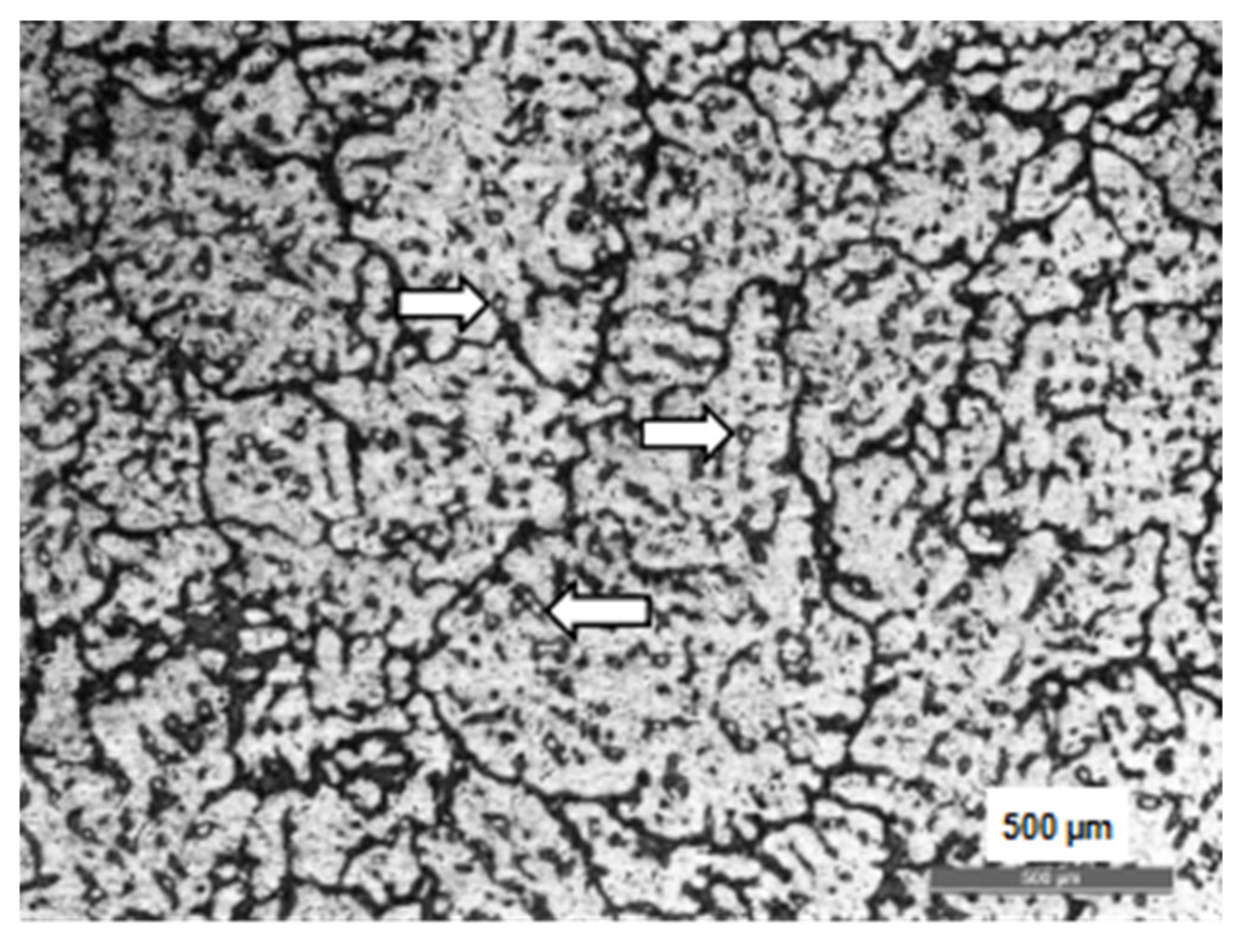
As it is seen in Table 1, in the as-cast Mg alloy, the alloying elements are mainly Gd and Zn. According to the compositions, the Mg alloy is designated as Mg–4.80Gd–1.92Zn. The microstructure of the as-cast Mg–4.80Gd–1.92Zn alloy is shown in Figure 2. It seems that the as-cast Mg alloy is made up of grains with dendrites. The relatively smaller grains present a size of about 200–300 μm, and the larger ones can reach the length of more than 1100 μm with the width of ~800 μm. The distances between dendrite spaces are about 30–60 μm. It is also demonstrated that there in the dendrite spaces are many particles, some of which are pointed out by arrows in Figure 2. These particles seem to be precipitates formed during the solidification.
According to the literature [48], the ageing temperatures of the Gd-containing Mg alloys are usually set at about 225 °C. For Mg-Zn based alloys, ZK60 alloy can reach its age-hardening peak at the temperature of 150 °C [49]. As for ZK60 alloys with RE elements, these alloys are often aged at the temperatures higher than 180 °C [50]. For the Mg/Al interfaces [40], the diffusion is not evident at the temperatures below 200 °C. It seems that for the interfaces of Mg–4.80Gd–1.92Zn and AA1060 aluminum alloys, effective heat treatments should be put into practice at the temperatures from 200 °C to 250 °C. Therefore, in this study, the heat treatments have been carried out at the temperatures of 200 °C and 250 °C.

3.2. Hardness

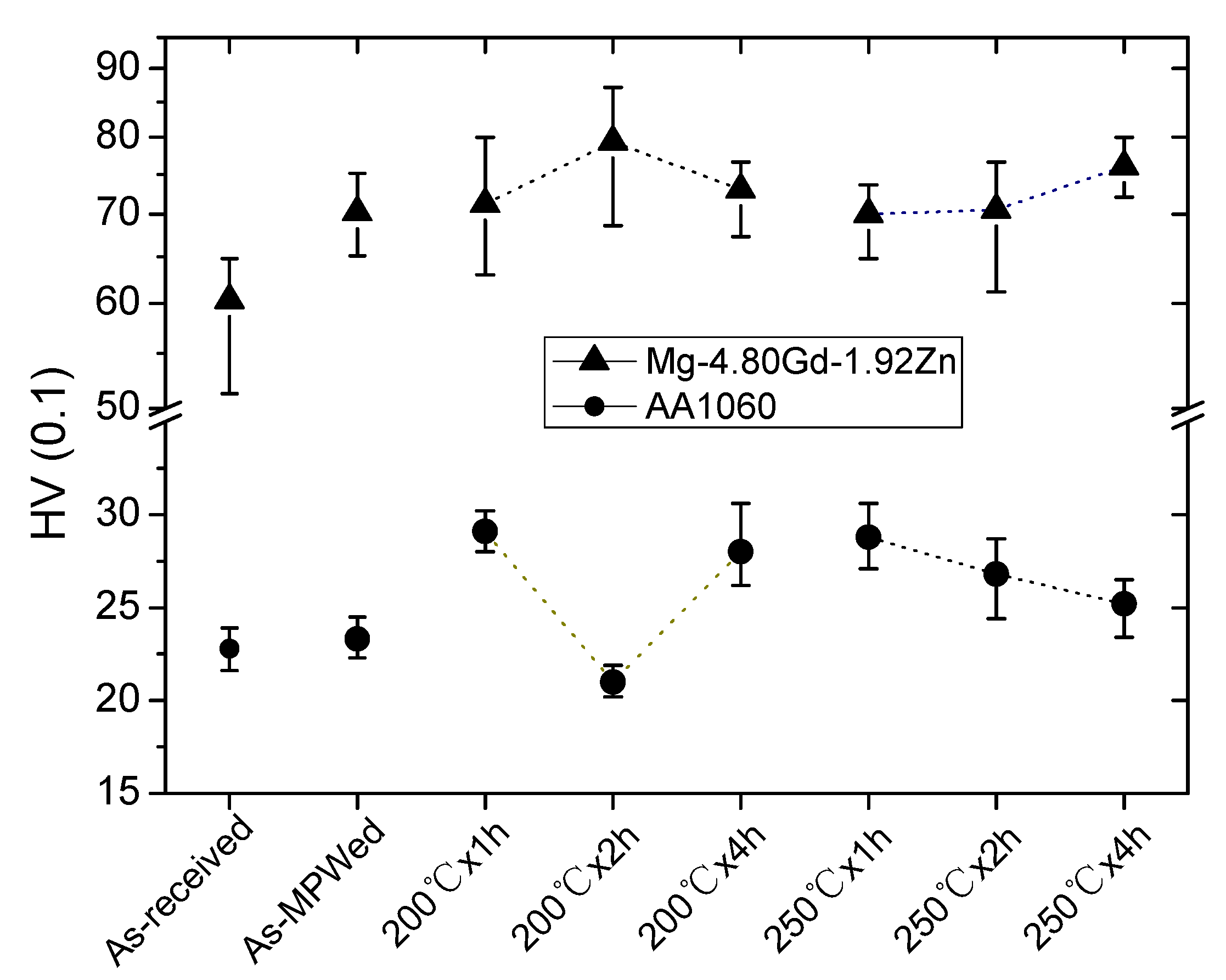
The Vickers’ hardness of Mg–4.80Gd–1.92Zn and AA1060 alloys are demonstrated in Figure 3. The as-received samples include both the as-cast Mg–4.80Gd–1.92Zn alloy and the commercial AA1060 aluminum alloy, and the others are Mg–4.80Gd–1.92Zn and AA1060 alloys in the as-MPWed and the heat-treated samples. For the as-cast Mg-Gd-Zn alloy, a distinguishable enhancement of HV hardness is acquired by the magnetic pulse welding process. The heat treatment shows to bring a little improvement on the hardness of the MPWed Mg-Gd-Zn alloy. As the value ranges are concerned, HV values of the heat-treated Mg-Gd-Zn alloys are of small differences compared with that of the as-MPWed one. It seems that magnetic pulse welding brings a distinguishable hardness improvement for the as-cast Mg–4.80Gd–1.92Zn alloy, and heat treatment shows no obvious effect on the hardness of Mg–4.80Gd–1.92Zn alloy in the as-MPWed state.
As for the AA1060 alloy, the as-received sample possesses a HV value same as that of the MPWed sample. After the MPWed sample is heat-treated, the HV values are not evidently changed. When increasing the time of the heat treatment, the hardness of the AA1060 alloy appears descendant trends at both 200 °C and 250 °C. The low hardness of the AA1060 alloy can be attributed to its lacking of alloying elements and the corresponding age-hardening effects. It can say that the changes of the hardness for the AA1060 alloy are not quite evident in this work.

3.3. SEM Results

3.3.1. Mg and Al Sides of Mg/Al Interface

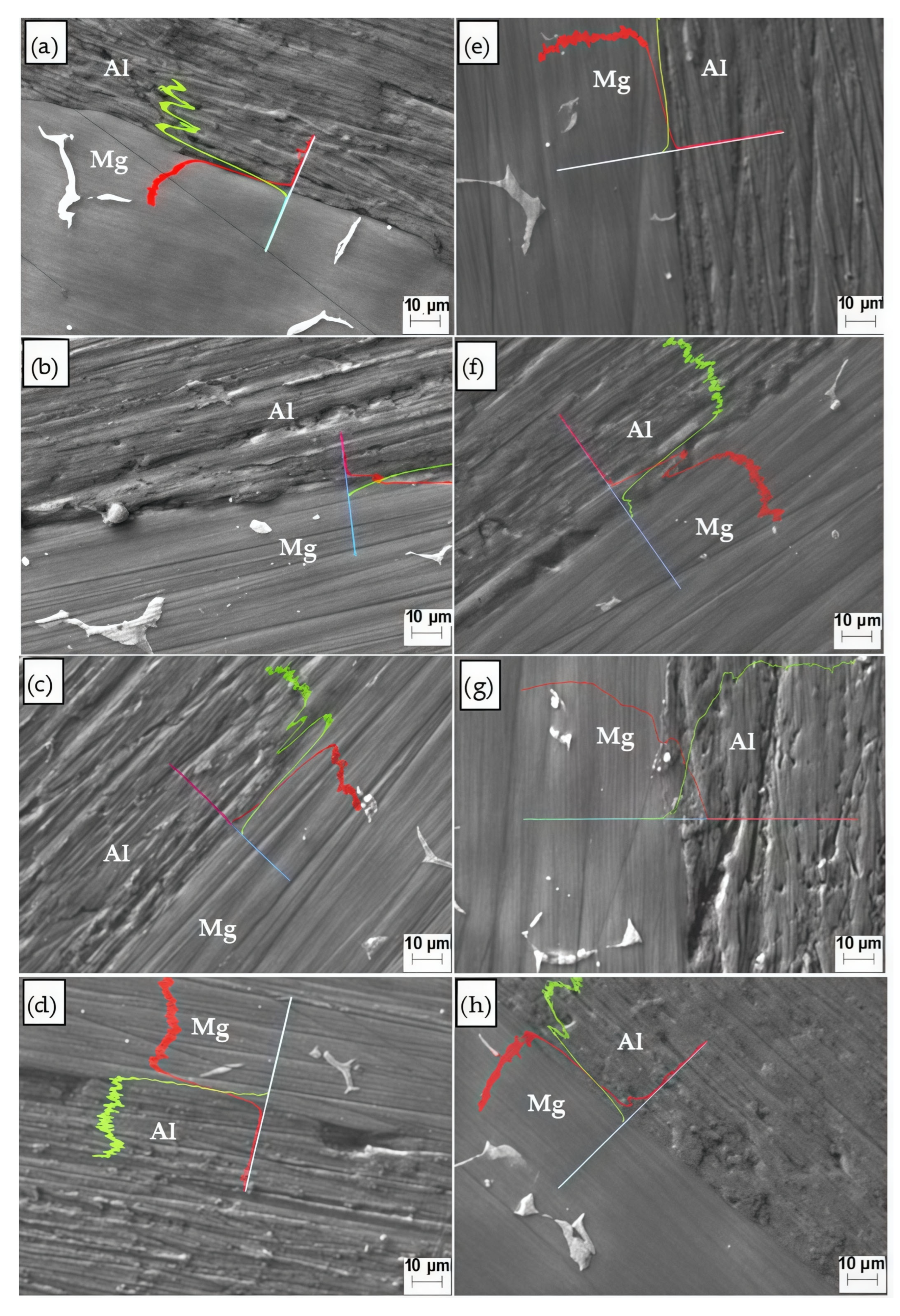
After the as-MPWed and heat-treated samples are cut by wire cut electric discharge machine, the cross-sections of the samples, where the Mg/Al interfaces can be observed, are ground. The samples have not been etched, with the consideration to minimize the effects of the erosion on different areas inherited from the differences of the compositions caused by the diffusions during the heat treatments. SEM images of the interfaces in the as-MPWed and heat-treated samples are illustrated in Figure 4. Compared with the Mg–Gd–Zn alloy, AA1060 aluminum alloy is soft and easy to be ground, which makes its surfaces to be rough. The smoother areas in these samples are the Mg–Gd–Zn alloys.
It is obvious that in all samples, there are many white precipitates, like dots and stripes, in the Mg–Gd–Zn alloy. Their compositions are examined by EDS, and typical results are listed in Table 2. In the as-MPWed sample, the elements in the white precipitates are Mg, Gd and Zn. After the MPWed sample is heat-treated at 250 °C for 4 h, Gd and Zn fractions in the precipitates are decreased. There are some Gd atoms in the Mg matrix, and Zn element is absent in the EDS detection of the Mg matrix. The difference of the Gd contents in the precipitates and in the Mg matrix was also seen in a previous work [48]. This situation can be explained by the concentration of Gd element during the solidification of Mg–Gd alloys. The eutectic of Mg–Gd binary system contains a Gd content of about 38.43 wt.%, ~8.8 at.%, and the Gd content of Mg–4.80Gd–1.92Zn alloy is lower. As Mg–4.80Gd–1.92Zn alloy solidifies, a Mg solid solution with a low content of Gd will appear firstly to form the Mg matrix, and the Gd content in the alloy melt is therefore enhanced. At the end of the solidification, the precipitates with a Gd content relatively close to the eutectic appear. The high Gd content of the white stripe in the as-MPWed sample is estimated to attribute to the rapid concentration of Gd element during the rapid solidification.

3.3.2. Mg/Al Interfaces

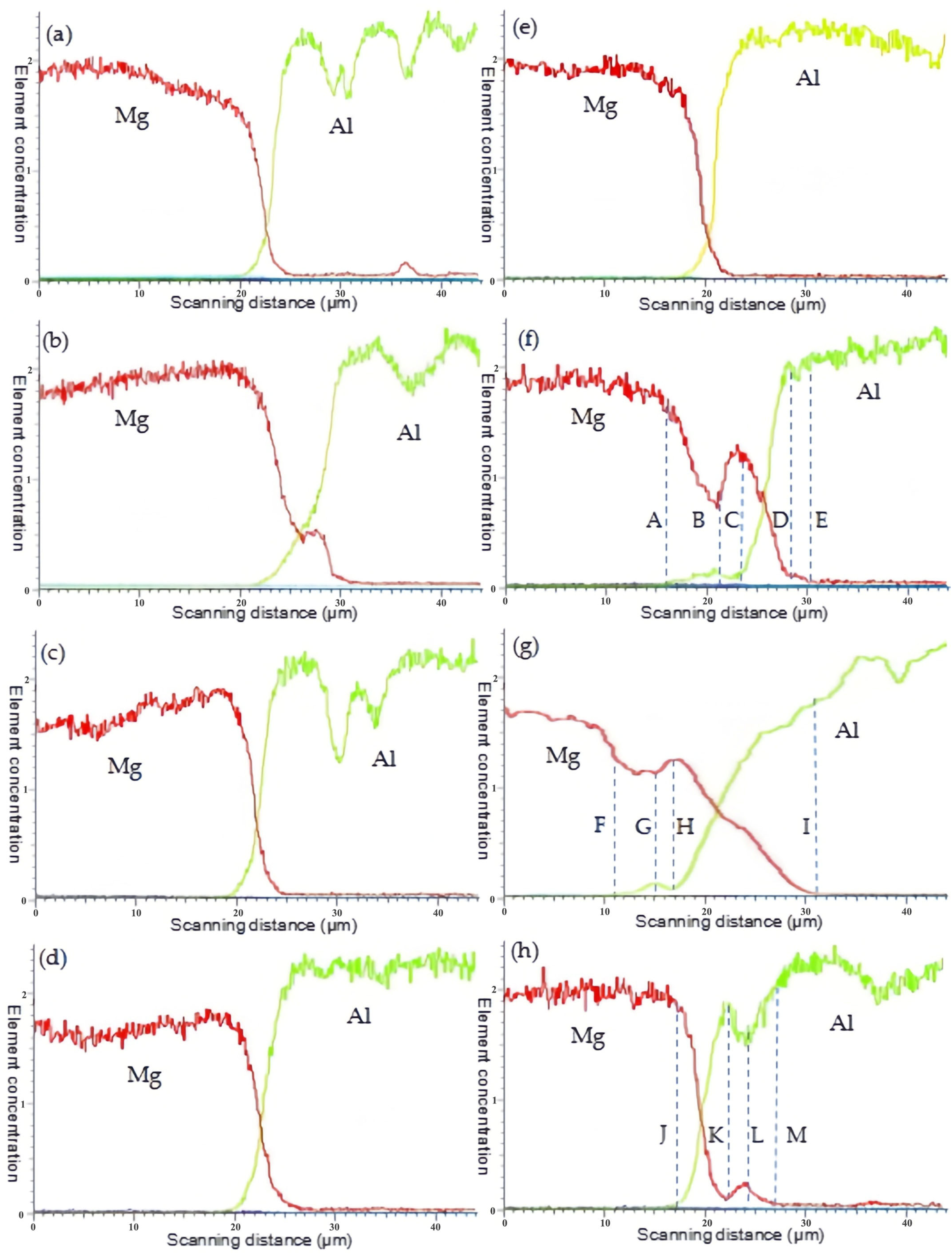
The element distributions, perpendicular to the Mg/Al interfaces, in the as-MPWed and heat-treated samples are detected by EDS line scanning, with the locations being shown in Figure 4. The line scan results are illustrated in Figure 5. It can be seen that during line scanning, the present elements are mainly Mg and Al, while Gd and Zn elements are quite difficult to be detected herein. In the Mg/Al interface of the as-MPWed sample, seen in Figure 5a, the contents of Mg and Al elements present a crossover to each other along the scanning line, which suggests a good combination of Mg–Gd–Zn and AA1060 alloys to form the interface. Sharp declines appear in the compositions of both Mg and Al elements in the interface. This manifests that Mg and Al alloys locate evidently at their local sides of the interface separately, and there is little diffusion to the opposite sides in the as-MPWed state.
In the sample heat-treated at 200 °C for 1 h, the distribution of Mg element shows a plateau in the Mg/Al interface. As for the samples heat-treated at 200 °C for 2 h and 4 h, Mg and Al elements are reluctant to diffuse into the opposite sides. It seems that the diffusions of Mg and Al elements are not evident at the temperature of 200 °C. The Mg plateau in the interface of the sample heat-treated at 200 °C for 1 h is estimated to be caused by the high-speed impact during the MPW process.
For the sample heat-treated at 250 °C for 1 h, the diffusion in its interface is almost the same as that in the as-MPWed sample, which demonstrates that there is not evident diffusion in this sample. When the sample is heat-treated at 250 °C for 2 h, the Mg/Al interface presents a diffusion zone with the width of about 15 μm, which is between the positions of (A) and (E) in Figure 5f. It is also seen that in the interface in Figure 5f, there at the position of (B) is a peak of Al element with a corresponding valley of Mg element. The Mg peak appears at the position of (C), which is close to the Al side.
As the time of heat treatment, carried out at 250 °C, is increased to 4 h, the width of the diffusion zone increases to about 20 μm, seen in Figure 5g. An Al peak with the corresponding Mg valley appears at (G) position, close to the Mg side. A Mg peak presents nearby at the position of (H). No evident Mg peak can be seen in the Al side of the interface. On the other hand, interestingly, at another EDS line scanning location with precipitates close to the scanning line, seen in Figure 5h, the width is only ~10 μm for the diffusion zone, which is narrow compared with the other position in the sample and even lower than that in the sample heat-treated for 2 h. This unusual situation is specially discussed in the following text.

4. Discussion

4.1. AA1060 Aluminum Alloy

In this study, AA1060 aluminum alloy presents to be quite soft, with the HV value of no more than 29. AA1060 alloy can not to be age-hardened, which is illustrated by the HV values shown in Figure 3, since this alloy contains only a little of alloying elements. As also seen in Figure 4, the Al side of the Mg/Al interface is fairly clear for its lacking of precipitates and second phases, like those white stripes and dots containing Gd and Zn elements in the Mg side. AA1060 aluminum alloy seems to be close to pure metal, and the Al side of the Mg/Al interface is quite a good matrix for other elements to diffuse in.

4.2. Elements in Mg-Gd-Zn Alloy

The Mg alloy used in this study possesses a Gd fraction of 4.80 wt.% with a Zn fraction of 1.92 wt.%, determined by ICP-AES. EDS results in Table 2 confirm the existances of Gd and Zn elements in the Mg alloy. In the EDS results for Mg side of the Mg/Al interface, the precipitates contain Zn element, and the Gd content herein is higher than that in the Mg matrix. It is imagined that in the Mg alloy, nearly all Zn atoms exist in the precipitates with a large amount of Gd atoms. These precipitates seem to be those in the dendrite spaces, seen in Figure 2.
As the MPWed sample are heat-treated at 250 °C for 4 h, the precipitates in the Mg side of the Mg/Al interface remain a high fraction of Gd element of 7.51 at.% and an appreciable Zn content of 2.10 at.%. This implies that even if Mg–4.80Gd–1.92Zn alloy possesses a relatively high fraction of Gd element and an obvious Zn content, there are not much alloy elements in the Mg matrix. Therefore, for the Mg side of the Mg/Al interface in this study, the diffusion to the Al matrix should focus mainly on the Mg element.

4.3. Diffusion in Mg/Al Interface

4.3.1. Diffusion of Mg and Al Elements

The sample heat-treated at 250 °C for 2 h is summoned to serve as a good example for the analysis of the diffusions of Mg and Al atoms. The effect of the diffusion can be easily seen in Figure 5f. The diffusion of Al element makes the fraction of Mg element to be decreased, leading to the Al peak and the corresponding Mg valley in the position of (B) in Figure 5f. Similar situations of Al peaks and the corresponding Mg valleys can also be seen at (G) position in Figure 5g and (K) position in Figure 5h. The diffusions of Mg and Al elements seem to result in an interchange of elements to each sides of the Mg/Al interfaces.
The diffusion frontier of Al element to the Mg matrix locates at (A) position, which is about 12 μm away from the Al matrix at the position of (D). If the original Mg/Al interface between (C) and (D) positions is concerned, the diffusion area of Al element in the Mg matrix locates between the positions of (C) and (D), with the width of about 7 μm. As for the diffusion of Mg element into the Al matrix, the frontier seems to locate at (E) position, about 8 μm away from the Mg matrix at the position of (C). If the original Mg/Al interface is deducted, the width of the diffusion area for Mg element is only between (D) and (E) positions, with the width of not more than 3 μm, which is quite lower than the diffusion of Al element to the Mg matrix. On other words, the diffusion of Mg element in the Mg/Al interface is fairly weaker than that of Al element. It was also reported by Fan et al. [51] that the diffusion of Mg element to the Al matrix is of great difficulties compared with the diffusion inclining of Al atoms into the Mg lattice.

4.3.2. Diffusion at 250 °C

As seen in Figure 5c,d, the diffusion in the interface is not quite evident at the temperature of 200 °C, even if the heat-treating time is prolonged to 4 h. Thus, for the diffusion, the samples heat-treated at 250 °C should be focused on. The diffusion behaviors of Mg and Al elements can be seen in Figure 5f,g, representing the MPWed samples heat-treated at 250 °C for 2 h and 4 h, respectively. As the diffusion frontiers of both Al and Mg elements are concerned, the total width of the Mg/Al interface in the sample heat-treated at 250 °C for 2 h is about 15 μm, between the positions of (A) and (E), seen in Figure 5f. When the heat-treating time increased to 4 h, seen in Figure 5g, the width is enhanced to ~20 μm, ranging from the position (F) to the position (I). In the Mg/Al interface of the sample heat-treated at 250 °C for 4 h, the Al peak is ~7 μm away from the Mg frontier in the Al side. While in the sample for 4 h, the distance between the Al peak and the Mg frontier is about 16 μm, roughly twice of that in the sample for 2 h. It is obvious that the diffusion of Mg/Al interface in samples heat-treated at 250 °C shows an increase when increasing the heat-treating time.

4.3.3. Hindrance of the Diffusion

It is illustrated in Figure 5h that at the position near the precipitates with the size of about 50 μm, the Mg/Al interface in the sample heat-treated for 4 h shows a low width of only ~10 μm, which is about two thirds of that for 2 h. A previous work [52] has demonstrated that in the Mg-9Y alloy, the diffusion of Li atoms can be delayed by the discontinuousity of different phases in the scale of about 50 μm, like grain and twin boundaries as well as precipitates, even at the temperature of 420 °C. Therefore, it is deduced that the diffusion in the Mg/Al interface must be hindered at this position in the sample which is heat-treated at 250 °C for 4 h.
In this study, for the Mg/Al interface exposed to 250 °C for 4 h seen in Figure 4h, the most evident difference is the existance of white precipitates, with a high fraction of Gd and Zn elements, near the EDS line scanning position. In the sample heat-treated at 250 °C for 2 h, adjacent areas around the EDS scanning line are clear, and the diffusion in the Mg/Al interface is free from hindrance. However, at the position shown in Figure 4h, the precipitates locate near the EDS scanning line. The diffusion of the interface herein seems to be hindered by these precipitates. As a result, the width of the interface at this position is evidently lower than that in the sample heat-treated for 2 h.
Compared with the diffusion of the Mg/Al interface in the sample heat-treated at 250 °C for 2 h, the abnormal decrease of the diffusion at the position in Figure 4h can be explained by the hindrance of the white precipitates in the Mg side of the Mg/Al interface, with the quick diffusion of Al atoms in the interface compared with the Mg atoms. As seen in the SEM image of Figure 4h, the white stripe-like precipitates, with a total length of about 50 μm, stand ahead of the diffusion direction of Al element to the Mg matrix. It is natural to imagine that when Al atoms diffuse into the Mg lattice, the white stripes act as obstacles, and Al atoms are blocked between the stripes and the Al matrix. This makes Al atoms to concentrate to a quite high content and to present as an Al peak at the position of (K) in Figure 5h, resulting in a low width of Mg/Al interface even if the heat-treating time being increased to 4 h.
On the other hand, there is little precipitates and other phases in the Al matrix, which will not affect the diffusion of Mg atoms into the Al lattice. If the speed of the diffusion of Mg into Al is close to that of Al into Mg, the diffusion of Mg atoms into the Al lattice will be near that of Al atoms into Mg lattice, which will lead to a symmetrical distribution of Mg and Al elements. And also, when the heat-treating time is prolonged to 4 h, the diffusion of Mg atoms into the Al lattice will lead to the width of Mg/Al interface near to that only for 2 h, even if the diffusion of Al into Mg is blocked. In fact, as seen in Figure 5f,h, when the heat-treating time is increased to 4 h, the width of Mg/Al interface near precipitates is quite lower than that for 2 h. It is therefore reasoned that when the diffusion of Al atoms are blocked by the stripes, Mg element is also difficult to diffuse into the Al matrix, which is an other reason for the lower width of the Mg/Al interface at the EDS line scanning location in Figure 4h.

5. Conclusions

The samples of Mg/Al interfaces have been manufactured by magnetic pulse welding (MPW) with plates of the as-cast Mg–4.80Gd–1.92Zn and commercial AA1060 aluminum alloys, and then the samples are heat-treated at the temperatures of 200 °C and 250 °C, with the time of 1 h, 2 h and 4 h, respectively. The microstructure and hardness of Mg and Al alloys have been investigated, as well as the diffusion of the Mg/Al interface in the heat-treated samples, by optical microscopy (OM), scanning electron microscopy (SEM), energy dispersive spectrometer (EDS) and Vicker’s hardness (HV) test. The conclusions are drawn as follows.
(1) Magnetic pulse welding demonstrates distinguishable hardness enhancement of the as-cast Mg alloy, and heat treatment shows little hardness improvement to the Mg alloy in the as-MPWed sample. The hardness of AA1060 alloy is also reluctant to be enhanced by both magnetic pulse welding and heat treatment.
(2) Although the Mg alloy shows a Gd content of 4.80 wt.% and a Zn content of 1.92 wt.%, only a little Gd atoms present in the Mg matrix near the Mg/Al interface, and Zn exists only in the precipitates with a relatively large amount of Gd. The diffusion in the Mg/Al interface should focus mainly on Mg and Al atoms.
(3) At the temperature of 200 °C, no obvious diffusion can be seen in the Mg/Al interface, even if the heat-treating time is increased to 4 h. At 250 °C, diffusion is evident at the heat-treating time of 2 h, with the diffusion width of ~15 μm, and the width is increased to about 20 μm when increasing the time to 4 h.
(4) In the Mg/Al interface, the diffusion of Mg element to the Al matrix seems to be fairly weaker than that of Al element to the Mg matrix, and Al atoms are more readily to diffuse into the Mg lattice.
(5) When the EDS scanning line locates near the precipitates in the Mg alloy, the width of the Mg/Al interface can be decreased to about 10 μm, even if the heat-treating is increased to 4 h. This abnormal decrease can be attributed to the hindrance of the precipitates in the Mg alloy, and also to the difficulties of Mg atoms diffusing into the Al lattice.

Author Contributions

Conceptualization, H.D. and K.L.; methodology, H.D. and K.L.; validation, H.D. and X.Y.; formal analysis, H.D., X.Y. and K.L.; investigation, H.D. and K.L.; resources, H.D.; data curation, H.D., X.Y. and K.L.; writing—original draft preparation, H.D. and X.Y.; writing—review and editing, H.D., X.Y. and K.L.; project administration, H.D.; funding acquisition, H.D. All authors have read and agreed to the published version of the manuscript.

Funding

This research was funded by Chongqing Natural Science Foundation (grant number: cstc2021jcyj-msxmX1215).

Data Availability Statement

The original contributions presented in this study are included in the article. Further inquiries can be directed to the corresponding authors.

Conflicts of Interest

The authors declare no conflicts of interest. The funders had no role in the design of the study; in the collection, analyses, or interpretation of data; in the writing of the manuscript; or in the decision to publish the results.

References

  1. Xie, H.; Zhao, H.; Guo., X.; Li, Y.; Hu, H.; Song, J.; Jiang, B.; Pan, F. Recent progress on cast magnesium alloy and components. J. Mater. Sci. 2024, 59, 9969–10002. [Google Scholar] [CrossRef]
  2. Choi, J.-W.; Tsuruyama, H.; Hino, R.; Aoki, Y.; Morisada, Y.; Fujii, H.; Lee, S.-J. Dissimilar linear friction welding of AZ31 magnesium alloy and AA5052-H34 aluminum alloy. Materialia 2024, 6, 102160. [Google Scholar] [CrossRef]
  3. Zhang, L.; Yuan, Q.; Tan, J.; Dong, Q.; Lv, H.; Wang, F.; Tang, A.; Eckert, J.; Pan, F. Enhancing the room-temperature plasticity of magnesium alloys: Mechanisms and strategies. J. Magnes. Alloys 2024, 12, 4741–4767. [Google Scholar] [CrossRef]
  4. Malakhov, A.; Saikov, I.; Denisov, I.; Berdychenko, A.; Ivanov, S.; Niyozbekov, N.; Mironov, S.; Kaibyshev, R.; Dolzhenko, P. Study of microstructure evolution in the aluminum—magnesium alloy AlMg6 after explosive welding and heat treatment. Int. J. Adv. Manuf. Technol. 2024, 134, 4451–4463. [Google Scholar] [CrossRef]
  5. Xiong, X.; Yang, Y.; Li, J.; Li, M.; Peng, J.; Wen, C.; Peng, X. Research on the microstructure and properties of a multi-pass friction stir processed 6061A1 coating for AZ31 Mg alloy. J. Magnes. Alloys 2019, 7, 696–706. [Google Scholar] [CrossRef]
  6. Kumar, M.; Das, A.; Ballav, R.; Kumar, N.; Sharma, K.K. Enhancing the tensile performance of Mg/Al alloy dissimilar friction stir welded joints by reducing brittle intermetallic compounds. Int. J. Mater. Res. 2024, 115, 69–80. [Google Scholar] [CrossRef]
  7. Sen, M.; Puri, A.B. Formation of intermetallic compounds (IMCs) in FSW of aluminum and magnesium alloys (Mg/Al alloys)—A review. Mater. Today Proc. 2022, 33, 105017. [Google Scholar] [CrossRef]
  8. Zhong, X.; Zhao, Y.; Pu, J.; Yan, K.; Liang, H.; Song, S. Microstructure characterization and mechanical properties of Mg/Al dissimilar joints by friction stir welding with Zn interlayer. Phys. Metals Metall. 2020, 121, 1309–1318. [Google Scholar] [CrossRef]
  9. Kumar, P.; Ghosh, S.K.; Saravanan, S.; Barma, J.D. Effect of explosive loading ratio on microstructure and mechanical properties of Al 5052/AZ31B explosive weld composite. JOM 2023, 75, 167–175. [Google Scholar] [CrossRef]
  10. Chen, S.; He, Y.; Xu, Y.; Tian, X.; Zhao, H. Effect of interlayer on interface microstructure and properties of Mg/Al friction stir welded joints. Trans. China Weld. Inst. 2025, 46, 46–54. [Google Scholar]
  11. Abdollahzadeh, A.; Vanani, B.B.; Koohdar, H.; Jafarian, H.R. Influence of variation ambient system on dissimilar friction stir welding of Al alloy to Mg alloy by the addition of nanoparticles and interlayer. Met. Mater. Int. 2024, 30, 2830–2852. [Google Scholar] [CrossRef]
  12. Xu, Y.; Ke, L.; Nie, H.; Xia, C.; Liu, Q.; Chen, S. Precipitation behavior of intermetallic compounds at the interface of thick plate friction stir welded Al alloy/Mg alloy joints under local strong cooling. Acta Metall. Sin. 2024, 60, 777–788. [Google Scholar]
  13. Dewangan, S.K.; Banjare, P.N.; Tripathi, M.K.; Manoj, M.K. Effect of vertical and horizontal zinc interlayer on material flow, microstructure, and mechanical properties of dissimilar FSW of Al 7075 and Mg AZ31 alloys. Int. J. Adv. Manuf. Technol. 2023, 126, 4453–4474. [Google Scholar] [CrossRef]
  14. Cui, M.; Zheng, Z.; Du, P.; Chang, L. A double molten pool laser welding process for joining magnesium alloys and aluminum alloys: The process, microstructure and mechanical properties of joints. Mater. Today Proc. 2023, 35, 106116. [Google Scholar] [CrossRef]
  15. Wang, J.; Liao, R.; Wang, L.; Wu, Y.; Cao, Z.; Wang, L. Investigations of the properties of Mg–5Al–0.3Mn–xCe (x = 0–3, wt.%) alloys. J. Alloys Compd. 2009, 477, 341–345. [Google Scholar] [CrossRef]
  16. Zhang, S.; Wei, B.; Cai, Q.; Wang, L. Effect of mischmetal and yttrium on microstructures and mechanical properties of Mg-Al alloy. T. Nonferr. Metal. Soc. (Eng. Ed.) 2003, 13, 83–87. [Google Scholar]
  17. Yu, L.; Nakata, K.; Liao, J. Microstructural modification and mechanical property improvement in friction stir zone of thixo-molded AE42 Mg alloy. J. Alloys Compd. 2009, 480, 340–346. [Google Scholar] [CrossRef]
  18. Zhang, J.; Leng, Z.; Zhang, M.; Meng, J.; Wu, R. Effect of Ce on microstructure, mechanical properties and corrosion behavior of high-pressure die-cast Mg–4Al–based alloy. J. Alloys Compd. 2011, 509, 1069–1078. [Google Scholar] [CrossRef]
  19. Juan, S.; Feng, G.; Huisheng, C.; Liang, L. Structural analysis of Al–Ce compound phase in AZ–Ce cast magnesium alloy. J. Mater. Res. Technol. 2019, 8, 6301–6307. [Google Scholar] [CrossRef]
  20. Liu, B.; Zhang, M. Effects of Ce on Microstructure and mechanical properties of Mg-Li-Al Alloy. Spec. Cast. Nonfer. Alloys 2007, 5, 329–331. [Google Scholar]
  21. Yang, H.; Wang, L.; Fan, R.; Feng, Y.; Zhao, S.; Fu, Y.; Pu, Z. Using multiscale second phases to fabricate high-performance Mg–3Al–3Nd–0.1Mn alloys with bimodal grain structures. Mater. Today Commun. 2024, 39, 109191. [Google Scholar] [CrossRef]
  22. You, Z.; Kang, J.; Zhang, W.; Zhang, J. Effect of Pr addition on microstructure and mechanical properties of AZ61 magnesium alloy. China Foundry (Eng. Ed.) 2014, 11, 103–107. [Google Scholar]
  23. Lee, J.U.; Lee, G.M.; Park, S.H. Bending properties of extruded AZ91–0.9Ca–0.6Y alloy and their improvement through precompression and annealing. J. Magnes. Alloys 2022, 10, 2238–2251. [Google Scholar] [CrossRef]
  24. Pourbahari, B.; Emamy, M.; Mirzadeh, H. Synergistic effect of Al and Gd on enhancement of mechanical properties of magnesium alloys. Prog. Nat. Sci. 2017, 27, 228–235. [Google Scholar] [CrossRef]
  25. Yang, J.; Wang, W.; Zhang, M.; Liu, J.; Qin, S.; Qin, Z.; Lei, C. Effects of Gd/Nd ratio on the microstructures and tensile creep behavior of Mg–8Al–Gd–Nd alloys crept at 423K. J. Mater. Res. Technol. 2021, 14, 2522–2533. [Google Scholar] [CrossRef]
  26. Zhang, H.-M.; Zha, M.; Jia, H.-L.; Tian, T.; Zhang, X.-H.; Wang, C.; Ma, P.-K.; Gao, D.; Wang, H.-Y. Influences of the Al3Sc particle content on the evolution of bimodal grain structure and mechanical properties of Al–Mg–Sc alloys processed by hard-plate rolling. Mater. Sci. Eng. A 2021, 802, 140451. [Google Scholar] [CrossRef]
  27. Aizawa, T.; Okagawa, K.; Kashani, M. Application of magnetic pulse welding technique for flexible printed circuit boards (FPCB) lap joints. J. Mater. Process. Technol. 2013, 213, 1095–1102. [Google Scholar] [CrossRef]
  28. Chen, S.; Jiang, X. Microstructure evolution during magnetic pulse welding of dissimilar aluminium and magnesium alloys. J. Manuf. Process. 2015, 19, 14–21. [Google Scholar] [CrossRef]
  29. Su, Z.; Yin, L.; Jiang, H.; Zhang, L.; Chen, Y.; Zhang, L.; Zhang, H.; Feng, W. Research progress of electromagnetic pulse welding technology: A review. J. Mater. Res. Technol. 2025, 36, 217–235. [Google Scholar] [CrossRef]
  30. Shim, J.-Y.; Kang, B.-Y.; Yun, T.-J.; Lee, B.-R.; Kim, I.-S. The present situation of the research and development of the electromagnetic pulse technology. Mater. Today-Proc. 2020, 22, 1958–1966. [Google Scholar] [CrossRef]
  31. Kapil, A.; Sharma, A. Magnetic pulse welding: An efficient and environmentally friendly multi-material joining technique. J. Clean. Prod. 2015, 100, 35–58. [Google Scholar] [CrossRef]
  32. Yao, Y.; Jing, L.; Wang, S.; Li, G.; Cui, J.; Tang, X.; Jiang, H. Mechanical properties and joining mechanisms of Al-Fe magnetic pulse welding by spot form for automotive application. J. Manuf. Process. 2022, 76, 504–517. [Google Scholar] [CrossRef]
  33. Wang, S.; Zhou, B.; Zhang, X.; Sun, T.; Li, G.; Cui, J. Mechanical properties and interfacial microstructures of magnetic pulse welding joints with aluminum to zinc-coated steel. Mater. Sci. Eng. A 2020, 788, 139425. [Google Scholar] [CrossRef]
  34. Geng, H.; Sun, L.; Li, G.; Cui, J.; Huang, L.; Xu, Z. Fatigue fracture properties of magnetic pulse welded dissimilar Al-Fe lap joints. Int. J. Fatigue 2019, 121, 146–154. [Google Scholar] [CrossRef]
  35. Yu, H.; Xu, Z.; Fan, Z.; Zhao, Z.; Li, C. Mechanical property and microstructure of aluminum alloy-steel tubes joint by magnetic pulse welding. Mater. Sci. Eng. A 2013, 561, 259–265. [Google Scholar] [CrossRef]
  36. Yu, H.-P.; Xu, Z.-D.; Jiang, H.-W.; Zhao, Z.-X.; Li, C.-F. Magnetic pulse joining of aluminum alloy–carbon steel tubes. T. Nonferr. Metal. Soc. 2012, 22, s548–s552. [Google Scholar] [CrossRef]
  37. Patra, S.; Arora, K.S.; Shome, M.; Bysakh, S. Interface characteristics and performance of magnetic pulse welded copper-Steel tubes. J. Mater. Process. Technol. 2017, 245, 278–286. [Google Scholar] [CrossRef]
  38. Raoelison, R.N.; Racine, D.; Zhang, Z.; Buiron, N.; Marceau, D.; Rachik, M. Magnetic pulse welding: Interface of Al/Cu joint and investigation of intermetallic formation effect on the weld features. J. Manuf. Process. 2014, 16, 427–434. [Google Scholar] [CrossRef]
  39. Li, J.S.; Sapanathan, T.; Raoelison, R.N.; Hou, Y.L.; Simar, A.; Rachik, M. On the complete interface development of Al/Cu magnetic pulse welding via experimental characterizations and multiphysics numerical simulations. J. Mater. Process. Technol. 2021, 296, 117185. [Google Scholar] [CrossRef]
  40. Zhu, C.; Xu, S.; Gao, W.; Meng, Y.; Lin, S.; Dai, L. Microstructure characteristics and mechanical properties of Mg/Al joints manufactured by magnetic pulse welding. J. Magnes. Alloys 2023, 11, 2366–2375. [Google Scholar] [CrossRef]
  41. Raoelison, R.N.; Sapanathan, T.; Li, J.S.; Zhang, Z.; Racine, D.; Chen, X.-G.; Marceau, D.; Rachik, M. Transformation sequence of Mg-Si precipitates towards a precipitation of Mn and Cr containing phase governed by the high strain-rate collision during magnetic pulse welding of Al-Mg-Si alloy. J. Alloys Metall. Systems 2023, 4, 100048. [Google Scholar] [CrossRef]
  42. Xie, J.; Zhang, W.; Chen, Y.; Zhang, L.; Yin, L.; Zhang, T.; Wang, S. Interfacial microstructure and mechanical properties of the Al/Ti joint by magnetic pulse welding. Mater. Charact. 2022, 194, 112462. [Google Scholar] [CrossRef]
  43. Li, Z.; Peng, W.; Chen, Y.; Liu, W.; Zhang, H. Simulation and experimental analysis of Al/Ti plate magnetic pulse welding based on multi-seams coil. J. Manuf. Process. 2022, 83, 290–299. [Google Scholar] [CrossRef]
  44. Liu, Q.; Wang, S.; Li, G.; Cui, J.; Yu, Y.; Jiang, H. A sandwich structure realizing the connection of CFRP and Al sheets using magnetic pulse welding. Compos. Struct. 2022, 295, 115865. [Google Scholar] [CrossRef]
  45. Yao, Y.; Chen, A.; Wang, D.; Wang, S.; Jiang, H.; Li, G.; Cui, J. Fatigue behavior of Al-CFRP spot-welded joints prepared by electromagnetic pulse welding. Int. J. Fatigue 2023, 174, 107715. [Google Scholar] [CrossRef]
  46. Zhu, Z.; Chen, H.; Zhu, Y.; Guo, Y.; Sun, L. Research status of Mg/Al dissimilar alloys welding. Aeronaut. Manuf. Technol. 2023, 66, 34–42. [Google Scholar]
  47. Zhu, C.; Meng, Y.; Liu, Q.; Li, G.; Cui, J. Study on Process and Mechanical Properties of Mg/Al dissimilar metal sheet joints by magnetic pulse welding. J. Netshape Form. Eng. 2021, 13, 45–51. [Google Scholar]
  48. Chen, X.; Liu, J.; Pan, F. Enhanced electromagnetic interference shielding in ZK60 magnesium alloy by ageing precipitation. J. Phys. Chem. Solids 2013, 74, 872–878. [Google Scholar] [CrossRef]
  49. Xu, D.K.; Liu, L.; Xu, Y.B.; Han, E.H. The effect of precipitates on the mechanical properties of ZK60-Y alloy. Mater. Sci. Eng. A 2006, 420, 322–332. [Google Scholar] [CrossRef]
  50. Gao, Y.; Wang, Q.; Gu, J.; Zhao, Y.; Tong, Y.; Kaneda, J. Effects of heattreatments on microstructure and mechanical properties of Mg-15Gd-5Y-0.5Zr alloy. J. Rare Earth. 2008, 26, 298–302. [Google Scholar] [CrossRef]
  51. Fan, S.; Peng, M.; Duan, Y.; Yu, Q.; Zhou, X.; Bu, H.; Li, J.; Yang, Z.; Li, M. Molecular dynamics simulation of diffusion mechanisms of Al–Mg interface. Phys. B Condens. Matter 2025, 715, 17620. [Google Scholar] [CrossRef]
  52. Dong, H.; Wang, L.; Wu, Y.; Wang, L. Electrolytic deposition and diffusion of lithium onto magnesium-9 wt pct yttrium bulk alloy in low-temperature molten salt of lithium chloride and potassium chloride. Metall. Mater. Trans. B 2009, 40, 779–784. [Google Scholar] [CrossRef]
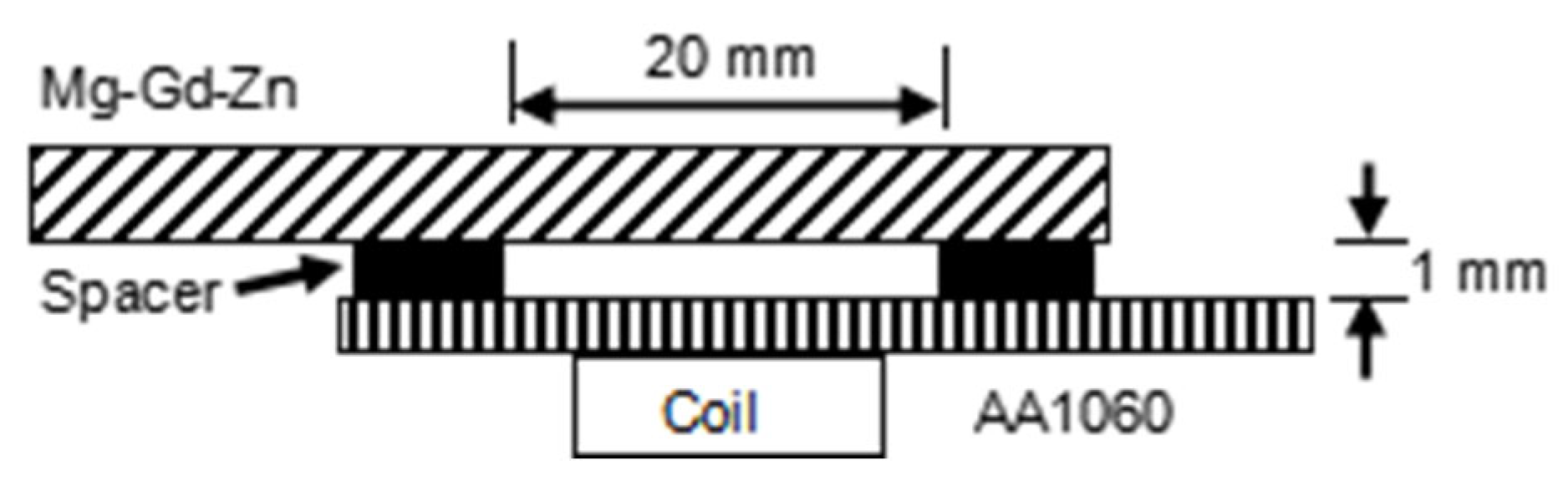
Figure 1. Schematic diagram of magnetic pulse welding.
Metals 15 01331 g001
Figure 2. Microstructure of the as-cast Mg-Gd-Zn alloy (The arrows pointing out the particles).
Metals 15 01331 g002
Figure 3. HV of Mg–4.80Gd–1.92Zn and AA1060 alloys in different states.
Metals 15 01331 g003
Figure 4. SEM images of Mg/Al interfaces and EDS scanning locations in the (a) as-MPWed, (b) 200 °C × 1 h, (c) 200 °C × 2 h, (d) 200 °C × 4 h, (e) 250 °C × 1 h, (f) 250 °C × 2 h and (g) 250 °C × 4 h samples, and (h) 250 °C × 4 h sample with precipitates ahead of EDS scanning line.
Metals 15 01331 g004
Figure 5. EDS line scanning results of Mg/Al interfaces in the (a) as-MPWed, (b) 200 °C × 1 h, (c) 200 °C × 2 h, (d) 200 °C × 4 h, (e) 250 °C × 1 h, (f) 250 °C × 2 h and (g) 250 °C × 4 h samples, and (h) 250 °C × 4 h sample with precipitates ahead of EDS scanning line.
Metals 15 01331 g005
Table 1. Chemical compositions (in wt.%) of materials used in the study.
MaterialFeSiZnMnCuGdAlMg
AA10600.180.0510.0030.0020.002——Bal.——
Mg————1.92————4.80——Bal.
Table 2. Typical atom ratios (at.%) of elements in (a) white stripe and (b) Mg matrix in the Mg side of the as-MPWed sample, and (c) white stripe in the Mg side of the sample heat-treated at 250 °C for 4 h.
(a)(b)(c)
Mg79.96 at.%98.95 at.%90.38 at.%
Gd12.59 at.%1.05 at.%7.52 at.%
Zn7.45 at.%——2.10 at.%
Total100 at.%100 at.%100 at.%
Disclaimer/Publisher’s Note: The statements, opinions and data contained in all publications are solely those of the individual author(s) and contributor(s) and not of MDPI and/or the editor(s). MDPI and/or the editor(s) disclaim responsibility for any injury to people or property resulting from any ideas, methods, instructions or products referred to in the content.