Review

Hydrometallurgical Recovery Technology for Rare Earth and Iron Separation from Spent NdFeB Magnets

1
Faculty of Materials Metallurgy and Chemistry, Jiangxi University of Science and Technology, Ganzhou 341000, China
2
Ganzhou General Inspection and Testing Institute, Ganzhou 341000, China
3
National Center of Industry Metrology and Testing for Tungsten and Rare Earths, Ganzhou 341000, China
*
Authors to whom correspondence should be addressed.
Metals 2025, 15(11), 1227; https://doi.org/10.3390/met15111227
Submission received: 11 September 2025 / Revised: 27 October 2025 / Accepted: 29 October 2025 / Published: 7 November 2025

Abstract

The recovery of rare earth elements (REEs) from the spent NdFeB magnets has great strategic significance for ensuring the security of critical mineral resources. This process requires scientifically designed separation technologies to ensure high output and purity of the obtained rare earths. Hydrometallurgy has been widely applied to extract REEs from spent permanent magnets. This paper summarizes and reviews hydrometallurgical technologies, mechanisms, and applications for the separation and recovery of REEs and iron (Fe) from the spent permanent magnets. Key methods include: The hydrochloric acid total solution method, where the spent NdFeB is completely dissolved in hydrochloric acid, iron is precipitated and removed, and then REEs are extracted. The hydrochloric acid preferential dissolution method, where spent NdFeB magnets are first fully oxidized by oxidative roasting, converting Fe2+ to Fe3+, which hydrolyzes to Fe(OH)3, and is precipitated and removed, allowing for the subsequent extraction of REEs to obtain rare earth oxides. Acid baking and water leaching, where spent NdFeB is calcined with acidification reagents, and the calcined products are dissolved in water to leach out REEs. At the same time, Fe is retained in the leaching residue. Electrolysis in aqueous solution, where Fe is electrolyzed at the anode or deposited at the cathode to separate it from REES. Organic acids leaching, where organic acids dissolve metals through acidolysis and complexation. Bioleaching, which utilizes microorganisms to recover metal through biological oxidation and complexation. Ionic liquid systems, where Fe or REEs are extracted using ionic liquid or leached by deep eutectic solvents. This paper provides an in-depth discussion on the challenges, advantages, and disadvantages of these strategies for recycling spent NdFeB magnets, as well as the leaching and extraction behavior of REEs. It focuses on environmental impact assessment, improving recovery efficiency, and decreasing reagent consumption. The future development direction for recycling spent NdFeB magnets is proposed, and a research idea of proposing a combined process to avoid the drawbacks of a single recycling method is introduced.

1. Introduction

NdFeB magnets, developed in the 1980s as the third-generation permanent magnets, possess very high residual magnetism and coercive force. Due to their excellent magnetic performance and relatively low price, NdFeB magnets are extensively used in wind power, new energy vehicles, and industrial robotics [1]. The main phase of NdFeB magnets is Nd2Fe14B, containing 60–70% Fe, 20–30% Nd, and 0.3–1% B. To enhance coercivity and Curie temperature, 0.5–7% Pr, 0.2–6% Dy, and other rare earth elements are often used to replace Nd, while 0.1–0.9% Al and 0.4–3% Co, etc., are used to replace Fe [2]. Statistics indicate that global consumption of sintered NdFeB magnets will be approximately 222,000 tons in 2024. In the foreseeable future, consumption is expected to increase at an annual rate of 5.8%, reaching 322,000 tons by 2032. It is estimated that by 2032, NdFeB magnets used in new energy vehicles will account for 32% of the total demand [3].
The lifetime of magnets and the amount of magnet waste generated vary depending on their application in consumer electronics, wind turbines, and electric vehicles. A significant amount of waste is produced after magnets are scrapped. Additionally, approximately one-third of the material becomes spent magnets in the form of sludge or waste during manufacturing [4].
With the rapid development of the NdFeB permanent magnetic materials processing and downstream application industries, secondary rare earth resources—such as grinding mud, material skins, material heads, powder, slag, and scrap products generated during NdFeB magnet processing, as well as those dismantled from retired equipment—are increasing.
Compared to producing rare earth products from raw ores, recycling rare earth secondary resources from NdFeB offers advantages such as a shorter process, lower cost, and less pollution. However, the mainstream production process for recycling NdFeB rare earth secondary resources currently involves a “long hydrometallurgical process”. This process includes demagnetization, crushing, blending, roasting, and classification of the secondary resources to obtain calcined oxide clinker. The clinker then undergoes acid dissolution, purification, impurity removal, extraction, separation, precipitation, and calcination to produce rare earth products like praseodymium-neodymium oxide. This oxide can subsequently be smelted into praseodymium-neodymium metal or alloy, which serves as a raw material for manufacturing NdFeB permanent magnetic materials, thereby achieving rare earth recycling.
Under current national export controls on the recycling and utilization of rare earth secondary resources, the recycling of NdFeB secondary resources can effectively supplement the gap in raw rare earth ore resources and ensure the security of the rare earth strategic resource supply chain.
In general, the total recycling amount of waste NdFeB magnets will increase linearly with output growth and is predicted to exceed tens of thousands of tons in the next 10 to 15 years [5]. These wastes, with relatively low pollution levels, are often recycled and reused at the production site. However, to effectively utilize REEs and other valuable metals, separate treatment of the oxidized scraps/waste is required, making this an area of great practical value and significance.
Researchers have conducted extensive studies on recycling spent NdFeB magnets, proposing technologies such as pyrometallurgy, hydrometallurgy, bio-metallurgy, and direct regeneration [6]. Emerging methods include electrochemical-assisted and mechanical–chemical-assisted recycling. The essence of these methods lies in optimizing recycling efficiency using external driving forces and reducing chemical reagent consumption [7]. Among them: (1). Direct recycling technology (e.g., Hydrogenation-Disproportionation-Desorption-Recombination, hydrogen decrepitation and re-sintering, remelting and recasting) is only suitable for clean and unoxidized magnets. (2). Pyrometallurgy includes methods like Molten Salt Extraction, Selective Chlorination, the Glass Slag Method, Vacuum Induction Melting (VIM), and Liquid Metal Extraction. While pyrometallurgy is efficient, it often suffers from low recovery rates, high roasting temperatures, and poor consideration for iron recovery.
In contrast, hydrometallurgy offers high recovery rates, high efficiency, and is easier to adapt for industrial continuous production [8]. This paper systematically introduces hydrometallurgical technologies for recovering spent NdFeB magnets, focusing on methods for separating REEs and Fe from the waste, and prospects the future development direction of this field.

2. Direct Leaching by Inorganic Acid

Hydrometallurgy is among the most promising methods because it is suitable for NdFeB magnets of different shapes and compositions. The process involves different leaching approaches: complete leaching and selective leaching.
Acids are typically used as leaching agents in hydrometallurgical recovery. By reasonably adjusting the pH value, rare earth elements and iron can be separated, and single rare earth compounds can be obtained through multi-stage extraction. Finally, rare earths are converted into salts using precipitants.
Leaching methods using inorganic acids, including hydrochloric acid, nitric acid, sulfuric acid, and phosphoric acid, are summarized in Table 1.
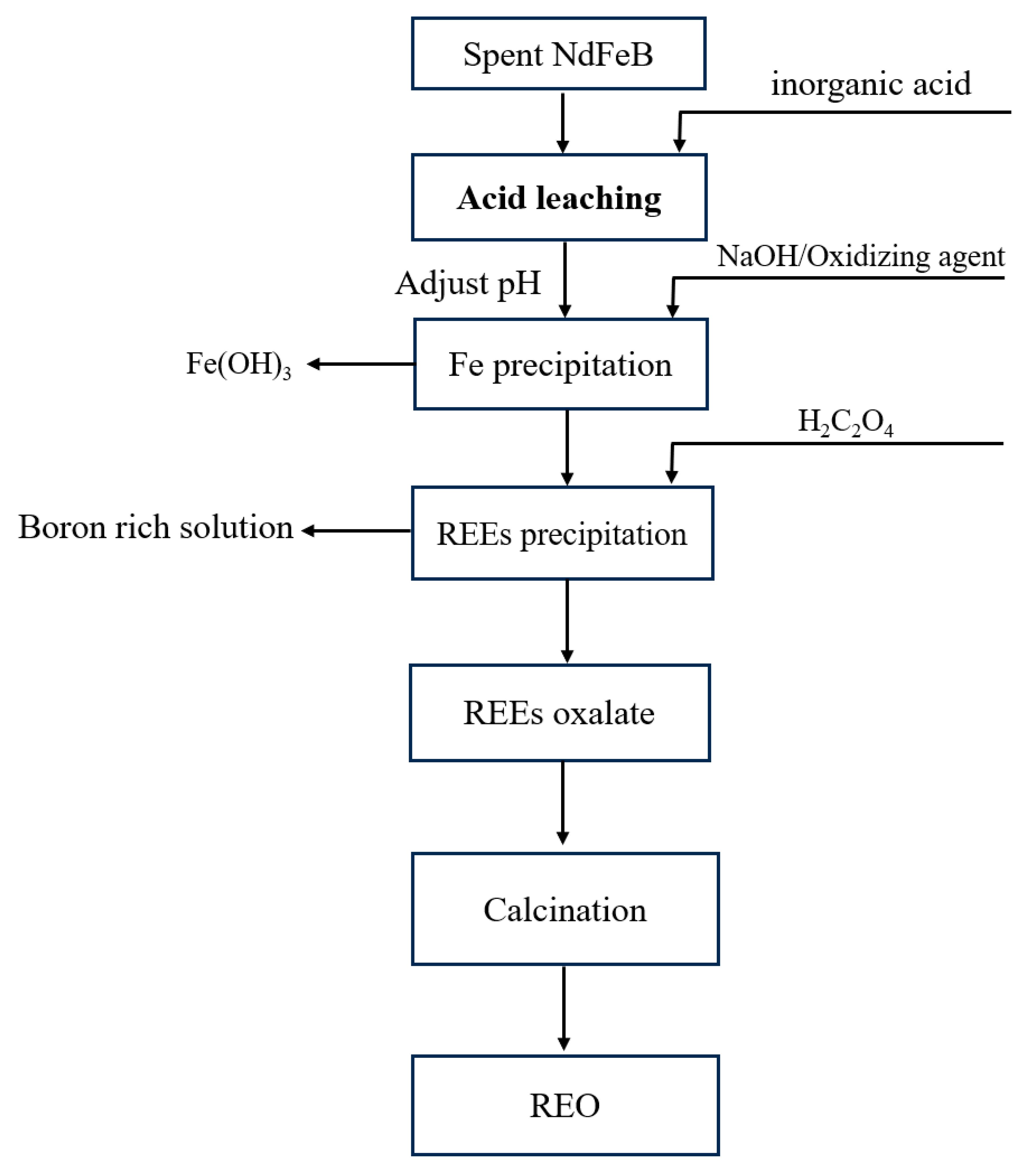
The inorganic acid direct leaching method involves completely dissolving REEs and Fe from spent NdFeB using inorganic acid, oxidizing Fe2+ to Fe3+, and then removing Fe3+ by precipitation as Fe(OH)3 by pH adjustment, before extracting the rare earth elements. A general process flowchart is shown in Figure 1.
Tian YL et al. [9] used hydrochloric acid to efficiently recover rare earths from NdFeB magnets. Under optimal leaching conditions, the recovery rate of rare earths in the leachate was 99.3%, and the iron recovery rate was 67.9%. Rabatho JP et al. [10] developed a nitric acid leaching process to effectively extract REEs from NdFeB sludge. At a leaching temperature of 80 °C and pH = 3, Fe was removed as Fe(OH)3, achieving recovery rates of 98% for Nd and 81% for Dy.
Gruber V et al. [11] used sulfuric acid leaching and solvent extraction to recover REEs from magnet scrap, achieving a yield of over 95% and a purity of individual components exceeding 99%. Conversely, He L et al. [12] utilized phosphoric acid to leach and separate REEs and Fe from waste NdFeB magnets. In this case, rare earth phosphates precipitated in the leaching residue, while ferrous phosphate remained in the leaching solution. Iron was subsequently precipitated using oxalic acid.
Therefore, the hydrochloric acid total solution method is a typical approach within inorganic acid direct leaching. It is suitable for subsequent extraction processes. However, since complete leaching lacks selectivity for iron, the purity of precipitated products is usually not high. Thus, finding methods to decrease acid consumption and increase product purity is key to optimizing the hydrometallurgical process.

3. Selective Leaching

To avoid a separate Fe removal process, “selective leaching” processes have been developed to selectively leach REEs from the spent magnet, leaving Fe in the residue.

3.1. Oxidation Roasting-Hydrochloric Acid Preferential Dissolution Method

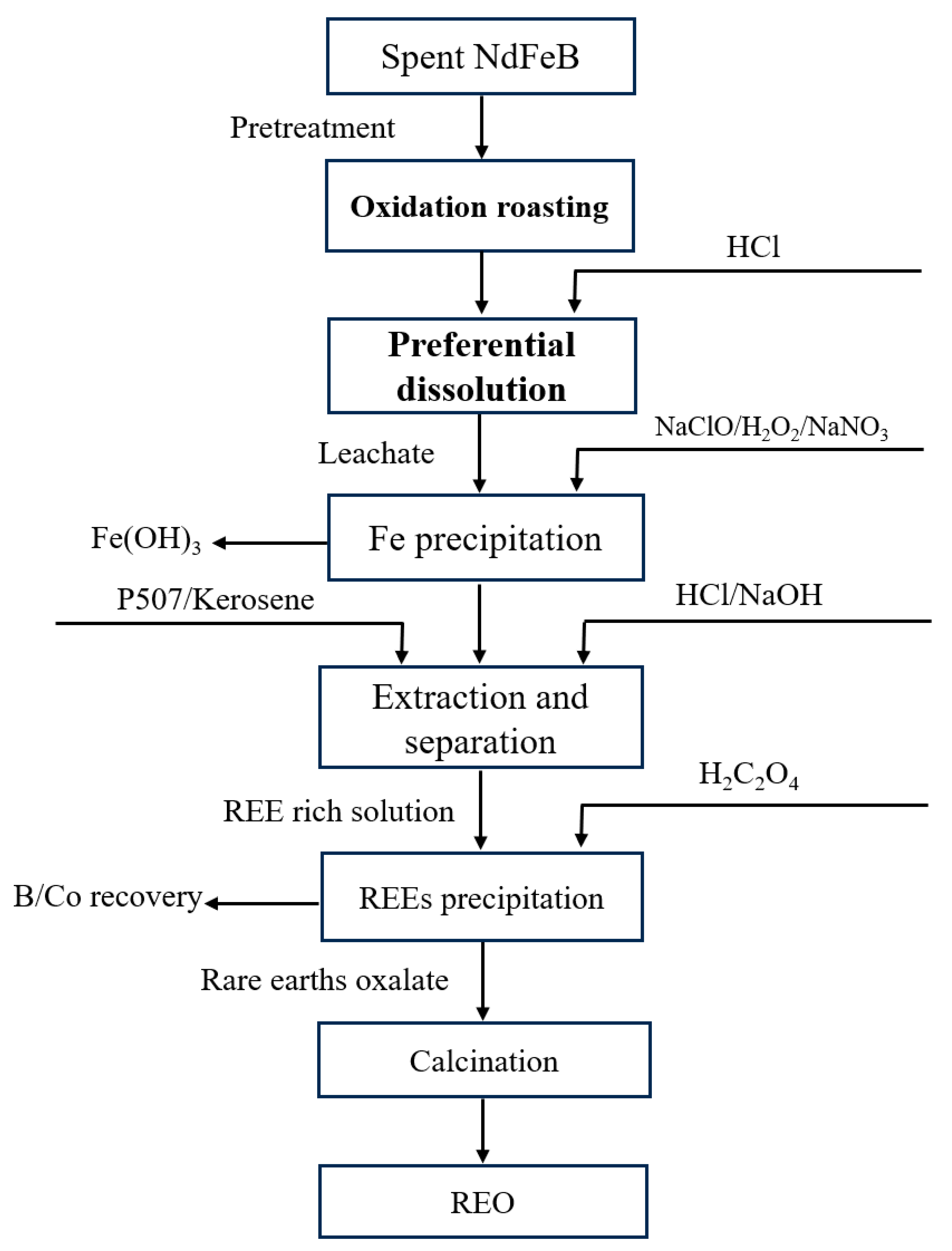
This method involves fully oxidizing spent NdFeB through oxidation roasting. The purpose of roasting is to oxidize iron and rare earth metals into Fe2O3 and RE2O3, respectively, reducing iron leaching during the subsequent acid dissolution step. According to the potential-pH diagrams of the Fe-H2O and Nd-H2O systems, selective leaching can theoretically exploit the fact that at pH 1.0 to 7.0, Nd and Fe mainly exist as Nd3+ and Fe2O3, thereby achieving selective dissolution of Nd2O3 while leaving Fe in the residue as Fe2O3. The pH value of the solution is then adjusted to allow REOs to react preferentially with hydrochloric acid, converting them to RE3+. Finally, rare earth oxides are obtained through precipitation and calcination. Methods using oxidation roasting and inorganic acid leaching are summarized in Table 2, and the process flowsheet is shown in Figure 2. The overall process can be summarized by reactions (1)–(5).
4 R E + 3 O 2 2 R E 2 O 3
4 F e + 3 O 2 2 F e 2 O 3  
R E 2 O 3 + 6 H C l 2 R E C l 3 + 3 H 2 O
2 R E C l 3 + 3 H 2 C 2 O 4 R E 2 ( C 2 O 4 ) 3 + 6 H C l
2 R E 2 ( C 2 O 4 ) 3 + 3 O 2 2 R E 2 O 3 + 12 C O 2
Kumari A et al. [13] calcined spent permanent magnet, transforming REs and Fe into their respective oxides. Under optimal conditions, REEs were selectively recovered, while Fe2O3 remained in the residue.
Niam AC et al. [14] pretreated calcined permanent magnet powder. Using the Taguchi method, 5 M HCl was determined to be the optimal leaching agent under conditions of 65 °C, 24 h, 2% S/L, 800 rpm, and 0.250 mm powder particles.
Liu FP et al. [15] used hydrochloric acid pressure leaching on calcined NdFeB powder with NaNO3 as an oxidant. Recovery rates were 99% for rare earths, 97% for B, and 0.1% for Fe. Cobalt was also recovered using a Na2S precipitation method. Similarly, Liu ZS et al. [16] roasted NdFeB sludge for 2 h. Under conditions of 6 M HCl, L/S = 5, 90 °C for 2 h, REEs were precipitated with H2C2O4. After reduction with iron powder, oxalic acid precipitated iron, achieving recovery rates of 98.28% for REEs and 94.65% for Fe.
Zhang ZH et al. [17] studied the mechanism of the hydrochloric acid preferential dissolution method, finding that the oxidation efficiency of NdFeB oil sludge increased to 99.2% with rising temperature.
Among oxidation roasting and inorganic acid leaching methods, the hydrochloric acid preferential dissolution method is the primary technique for large-scale production from NdFeB sludge in China. It is similar to the existing hydrometallurgical cascade extraction process for rare earth ores. The disadvantages of this method include high roasting temperature and energy consumption. However, iron is effectively precipitated and removed, and rare earths can be selectively leached.

3.2. Acid Baking and Water Leaching

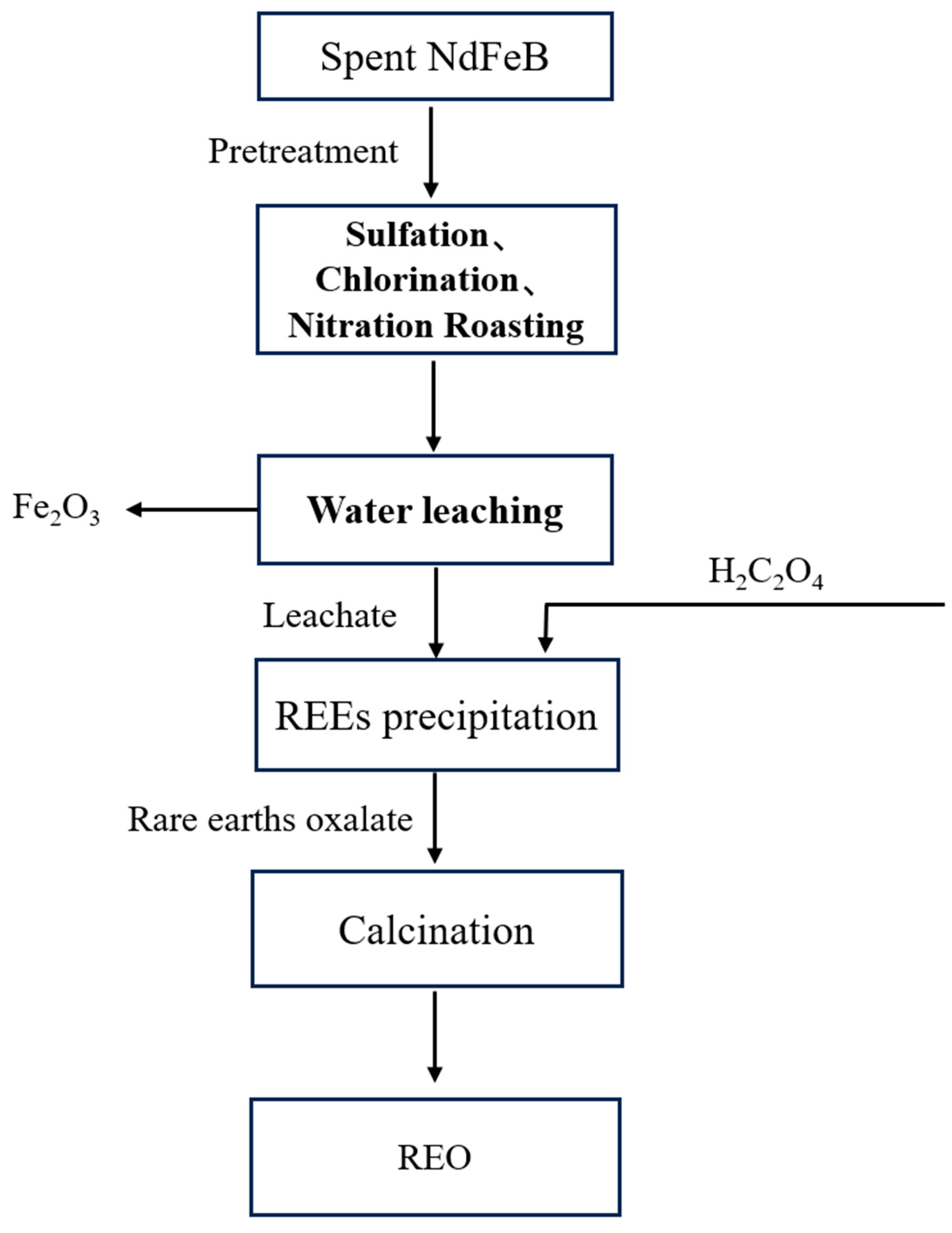
Acid baking and water leaching involve calcining spent NdFeB with acidification reagents, followed by dissolving the calcined products in water to leach out rare earth elements, while Fe is retained in the leaching residue. This includes sulfation, chlorination, and nitration roasting, followed by water leaching. The reagents used are shown in Table 3, the methods are summarized in Table 4, and the general process flow is shown in Figure 3.

3.2.1. Sulfation Roasting and Water Leaching

Sulfation roasting involves reacting spent NdFeB magnets with sulfuric acid or sulfates to convert valuable metals into corresponding sulfates, which are then recovered through water leaching and separation steps. Leaching efficiency with sulfuric acid is high, but it causes severe equipment corrosion. Ammonium sulfate roasting occurs at lower temperatures, but the recovery process is lengthy. Ferric sulfate fully recovers iron from NdFeB, but REE loss is relatively significant during iron removal. The overall process can be summarized by reactions (6)–(10).
x M + y H 2 S O 4 ( a q ) M x S O 4 y ( a q ) + y H 2
x M + 2 y H 2 S O 4 a q M x S O 4 y a q + 2 y H 2 O + y S O 2
R 2 ( S O 4 ) 3 R 2 O 2 S O 4 + 2 S O 3
R 2 O 2 S O 4 R 2 O 3 + S O 3
2 F e S O 4 F e 2 O 3 + S O 2 + S O 3
(M: metal; R: REM)
Önal M.A.R. et al. [18] studied the selective separation and recovery of rare earths using sulfation roasting and water leaching. Within a temperature range of 650 to 850 °C, magnet powder was completely converted to sulfate by calcination with H2SO4 for 15 to 120 min. The calcination products were then treated with selective water leaching to recover rare earths.
Loy S. V. and Önal M.A. R. [19] recovered valuable metals from NdFeB magnets through mechanochemically assisted ferric sulfate leaching. REEs and Co were leached from the roasting products via water leaching, achieving high leaching rates for REEs (>95%) and complete recovery of cobalt. Fe2+ was oxidized to Fe3+ using appropriate oxidants (e.g., bubbling air), thus regenerating the reagent.
Liu FP et al. [20] found that rare earths could be selectively recovered by a two-stage ammonium sulfate calcination and water leaching process. Adopting a two-stage roasting process significantly reduced the dosage of (NH4)2SO4 and enhanced the separation efficiency of rare earths.

3.2.2. Chlorination Roasting and Water Leaching

Chlorination roasting involves reacting spent NdFeB magnets with hydrochloric acid or chlorides to convert valuable metal components into corresponding chlorides. Rare earth chlorides are easily soluble in water and are recovered through water leaching and separation steps. Spent NdFeB magnets can be chlorinated and calcined with NH4Cl at relatively low temperatures. CaCl2·2H2O is a solid chlorination reagent with the advantages of being environmentally friendly, free of toxic gases, and economically efficient. Through a mechanochemical reaction with FeCl3·6H2O during low-temperature calcination, unchlorinated rare earth and cobalt are thoroughly chlorinated. Complete separation of rare earths, cobalt, boron, and iron is achieved through water leaching, further reducing acid consumption. The overall process can be summarized by reactions (11)–(15).
N H 4 C l N H 3 + H C l
F e + 3 N H 4 C l + 0.75 O 2 F e C l 3 + 3 N H 3 + 1.5 H 2 O
N d + 3 N H 4 C l + 0.75 O 2 N d C l 3 + 3 N H 3 + 1.5 H 2 O
F e + 0.75 O 2 0.5 F e 2 O 3
F e C l 3 + 0.75 O 2 0.5 F e 2 O 3 + 1.5 C l 2
Kumari A et al. [21] developed an NH4Cl chlorination calcining process to extract REEs. Using NH4Cl as the chlorination agent at a reduced calcination temperature of 300 °C, 99.2% REO was obtained, with a by-product leaching residue containing 96.4% Fe2O3.
Gahlot R. and Dhawan N. [22] used CaCl2·2H2O for chlorination roasting, followed by water leaching and acid leaching. Maximum dissolution was approximately 89% for Nd and 88% for Dy. The removal rate of Ca by water leaching after calcination was approximately 87%, and the rare earth oxalate precipitation rate was 99%, resulting in an REE extraction rate of approximately 89%.
Wu J et al. [23] studied the co-chlorination and water leaching of magnet scrap using FeCl3·6H2O to recover REEs. Under appropriate leaching conditions, 96.51% of REEs and 64.29% of Co were simultaneously leached into the leachate, yielding 92% iron oxide.
Wu J and Wang D et al. [24] adopted a mechanochemical strategy, mixing spent NdFeB magnet powder with FeCl3·6H2O, followed by grinding, calcination, and water leaching, achieving complete separation of rare earth, cobalt, boron, and iron.

3.2.3. Nitration Roasting and Water Leaching

Nitration roasting involves reacting spent NdFeB magnets with nitric acid or nitrate to convert valuable metal components into corresponding nitrates, which are then recovered through water leaching and separation steps. Nitration calcination of spent NdFeB magnet powder with Fe(NO3)3·9H2O decreases the roasting temperature and is suitable for all types of permanent magnets. This method offers high reactivity, and the relatively high solubility of rare earth nitrates facilitates downstream separation. The overall process can be summarized by reactions (16)–(21). (M: REE, Fe)
F e ( N O 3 ) 3 · 9 H 2 O F e O H ( N O 3 ) 2 · 2 H 2 O + H N O 3 + 6 H 2 O
F e O H ( N O 3 ) 2 · 2 H 2 O F e O H 2 N O 3 + H N O 3 + H 2 O
F e O H 2 N O 3 F e O O H + H N O 3
2 F e O O H F e 2 O 3 + H 2 O
2 M + 6 H N O 3 2 M ( N O 3 ) 3 + 3 H 2
M + 4 H N O 3 M ( N O 3 ) 3 + N O + 2 H 2 O
Önal M.A.R. et al. [25] found that magnet powder was completely converted into a metal nitrate mixture at room temperature within 1 h. Through calcination with Fe(NO3)3·9H2O at 200 °C and water leaching treatment, REE extraction exceeded 95%.
The acid roasting and water leaching process uses acidification reagents instead of direct inorganic acid, reducing equipment corrosion and enabling selective leaching of rare earths. The chosen acidifiers are mostly Fe sulfates, chlorides, or nitrates, fully utilizing the 60–70% Fe content in NdFeB.

4. Electrolysis in Aqueous Solution

NdFeB magnetic chips have high electrical conductivity and can be directly used as anodes, avoiding high-energy-consuming processes like crushing, grinding, and calcination. Advantages of electrolytes in aqueous solution include high solubility of metal salts, low volatility, and low cost. Recovering spent permanent magnets by electrolysis at room temperature can reduce the consumption of acids, bases, and energy.

4.1. Direct Anodic Dissolution

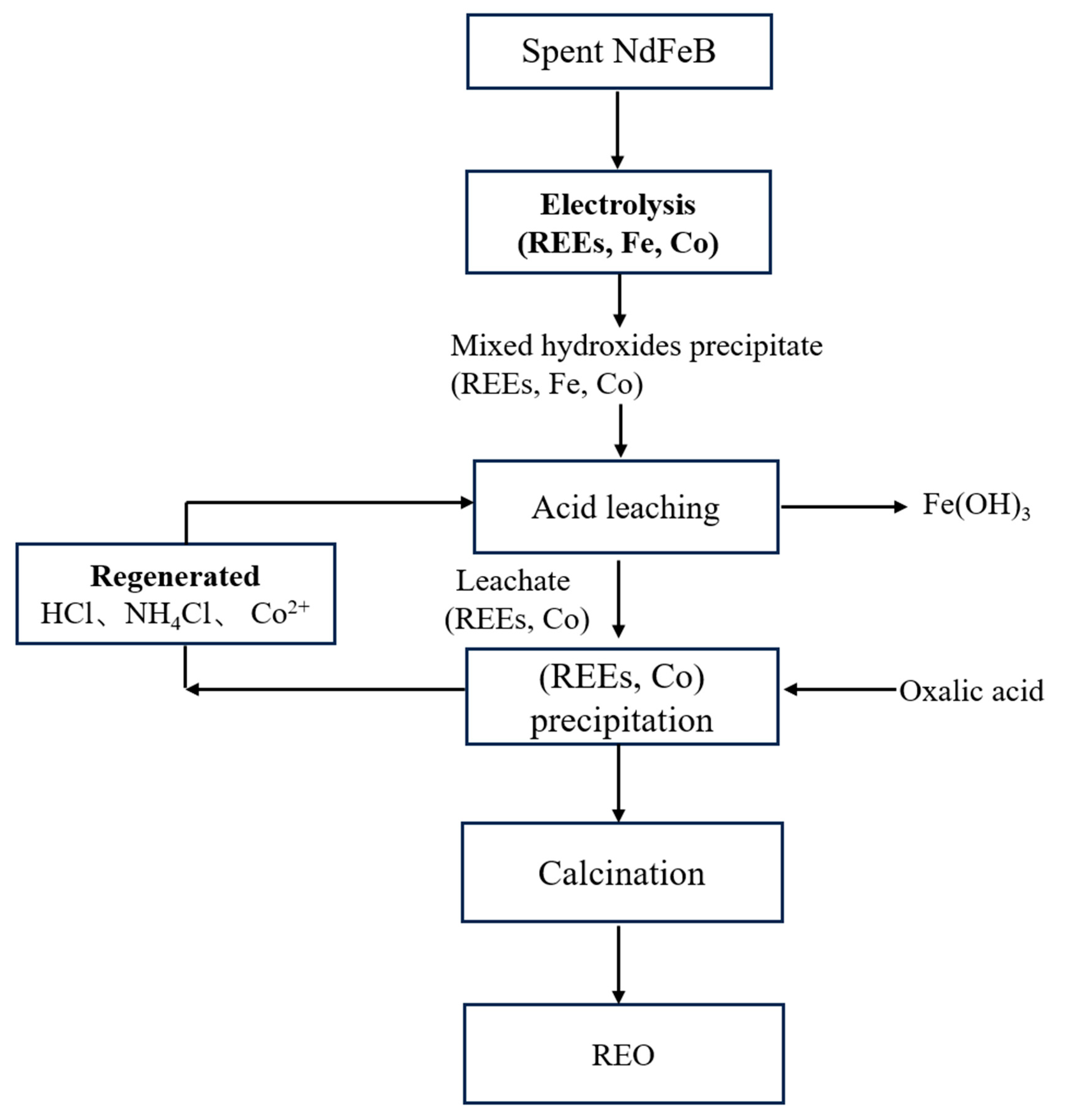
As active anodes, the magnets are directly dissolved to generate RE3+ and Fe2+. (Equations (22) and (23)). Fe2+ is oxidized at the inert anode and hydrolyzed in situ to ferric hydroxide, separating it from the rare earths. The process flowsheet is shown in Figure 4.
Venkatesan P et al. [26] electrochemically oxidized and leached NdFeB magnets directly in an NH4Cl solution using a double anode system. One anode was a large piece of NdFeB magnet scrap, while the other was an inert anode that converted Fe2+ to Fe3+ in situ via electrochemical oxidation. Rare earths were then selectively leached from the mixed hydroxide with a low HCl/REE ratio (nHCl/nREE ≤ 3.5).
Zhang ZH et al. [27] studied a double anode electrochemical system to selectively leach REEs in a ZnCl2 electrolyte solution. The NdFeB magnet acted as an active anode, generating RE3+ and Fe2+. Fe2+ was oxidized and hydrolyzed to ferric hydroxide, separating it from REEs. Subsequently, Na2SO4 was added to form RE2(SO4)3 precipitate, enabling the recycling of the ZnCl2 electrolyte. A small amount of Zn was dissolved in NaOH solution to obtain Nd(OH)3. Both Fe(OH)3 and Nd(OH)3 were calcined to obtain their respective oxides.
Xu X et al. [28] developed a method to selectively dissolve magnet scrap in an organic N, N-dimethylformamide (DMF) FeCl2 electrolyte at room temperature. By adjusting the anode current density to less than 5 mA/cm2, the selective dissolution order of the magnet’s internal phases was: first metallic Nd, then intergranular NdFe4B4, and finally the matrix phase Nd2Fe14B.
N d 2 F e 14 B 37 e 2 N d 3 + + 14 F e 2 + + B 3 +
F e 2 + e F e 3 +

4.2. Direct Depositing on the Cathode

As an alternative to anodic oxidation of Fe2+ to promote hydrolysis, direct cathodic deposition of metallic iron can be employed. (Equations (24) and (25)).
Xu X et al. [29] developed an environmentally friendly and simpler electrochemical method for recovering NdFeB permanent magnets. This method achieves selective rare earth recovery and simultaneous green chemical deposition of Fe metal, with full electrolyte reuse, creating a closed-loop process.
Yang Y et al. [30] directly recovered rare earths using a one-step precipitation in HF solution, while Fe was dissolved through electrodeposition. Nanoscale FeF2(s) and Fe(s) were cathodically deposited at pH 2.3 and pH 2.89, respectively. The process of reducing Fe3+ to Fe was investigated using cyclic voltammetry, chronopotentiometry, and open-circuit chronopotentiometry, and the hydrofluoric acid was reused.
Xiao FS et al. [31] developed a combined electrochemical-hydrometallurgical process for recovering spent NdFeB. Electrolysis was carried out at 60 °C, Fe2+ was deposited as Fe at the cathode, and Nd was recovered through crystallization to obtain Nd2(SO4)3·nH2O mixed crystals with an iron content of 0.1 wt%.
Venkatesa P et al. [32] completely leached an NdFeB magnet in hydrochloric acid. Fe2+ in the leachate was then selectively oxidized to Fe3+ by in situ electrochemical oxidation. Ammonium hydroxide was added to remove iron as Fe(OH)3. Subsequent oxalic acid precipitation recovered REEs, finally yielding a cobalt-rich solution. Electrowinning on this solution proved the feasibility of recycling pure cobalt metal.
Makarova I et al. [33] investigated the electrochemical leaching of Fe and REEs from permanent magnets in sulfuric acid and oxalic acid, using a 3D-printed titanium mesh as the anode to leach metals from the magnet surface. Oxalic acid was used to precipitate rare earths, separating the REE-oxalate precipitate at a lower battery voltage.
Makarova I et al. [34] recovered REEs via electrochemical leaching in sulfuric and oxalic acids. A dense REE oxalate layer and iron solid residue were retained for further recovery. Rare earth cathodic deposition was attributed to the electrostatic attraction of rare earth oxalate particles.
The aqueous solution electrolysis method effectively addresses the issues of high energy consumption and unsustainability in existing NdFeB recycling technologies.
Additionally, REMs in NdFeB magnets can react spontaneously with water. However, REE recovery in aqueous solutions is often limited by mass transfer. Challenges remain, such as slow reaction rates, the need for precise control of anode and cathode reactions, and scaling up the process. Designing a reasonable recovery process and appropriately utilizing the H+ generated at the in-situ anode, OH generated at the cathode, and oxidants generated during electrolysis may improve leaching efficiency and reduce the use of strong acids and bases. Methods using electrolysis in aqueous solution are summarized in Table 5.
F e 2 + + 2 e F e
2 N d 2 F e 14 B + 18 H + 4 N d 3 + + 28 F e + 2 B 3 + + 9 H 2

5. Organic Acids Leaching

5.1. Organic Acids Leaching of Spent NdFeB

The mechanism of organic acid leaching involves dissolving metals through acidolysis and complexation. In acidolysis, H+ dissolves the metal into the solution. In complexation, organic acids form stable complexes or chelates with metal ions.
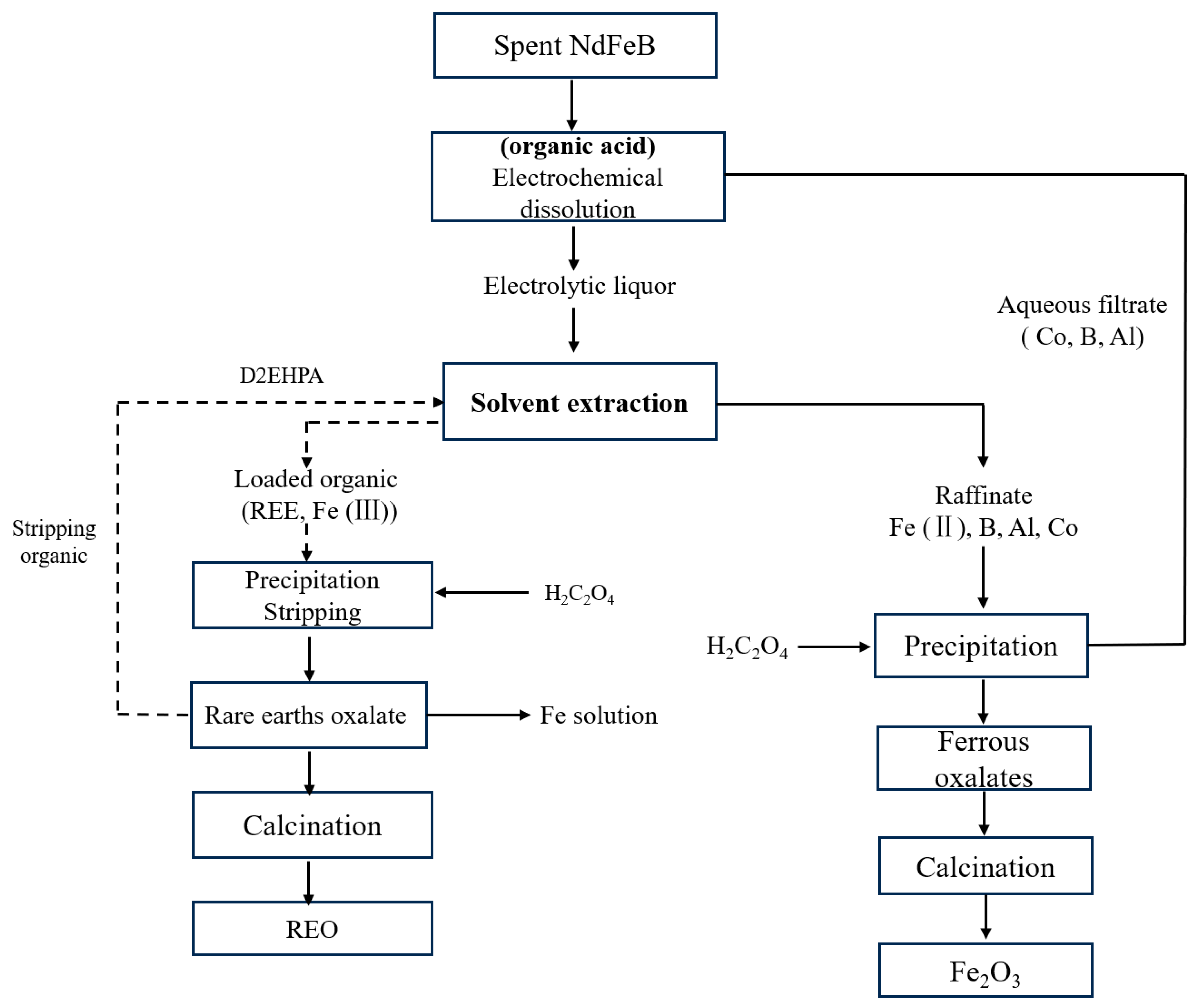
Hydrometallurgical recovery using organic acids has a lower environmental impact than inorganic acids. Therefore, the effects of various organic acids have been studied. The process flowsheet is shown in Figure 5.
Behera S. S. and Parhi PK. [35] developed a CH3COOH leaching process for RE from NdFeB scraps. Research showed that when NdFeB magnets are treated with acetic acid, Nd can be successfully leached with a rate over 99%, although iron was co-leached. Menad NE et al. [36] confirmed that acetic acid can effectively leach Nd, Dy, and Fe, but selectively does not leach the nickel from the protective layer on the magnet surface, allowing nickel recovery in the solid phase after filtration.
Belfqueh S et al. [37] studied the leaching of REEs from NdFeB magnets using different organic acids such as acetic acid, formic acid, citric acid, and tartaric acid. Acetic acid yielded the highest recovery.
Liu Q S et al. [38] developed a new method using oxalic acid to leach NdFeB magnets. Rare earth oxalate remained in the slag, while Fe(C2O4)33− remained in the leachate. The leachate was treated by reducing the iron oxalate solution with iron powder to form ferrous oxalate.
Gergoric M et al. [39] used glycolic, maleic, and ascorbic acids to leach out REEs. The leaching rate for glycolic and maleic acids (95%) was higher than for ascorbic acid (50%). Various extractants (TBP, D2EHPA, Cyanex 272, 923, TODGA) and diluents (1-octanol, cyclohexanone, hexane, pentane, dodecane) were studied in the extraction procedure, showing good potential for leaching REEs from NdFeB.
Reisdorfer G et al. [40] studied the leaching of unroasted and roasted magnets using maleic acid or citric acid. The leaching efficiencies of Nd and Fe from unroasted magnets were both higher than those from roasted magnets.
Kumari A et al. [41] investigated the electrochemical leaching of spent NdFeB magnets in citric acid, recovering REEs and valuable metals to obtain mixed oxides of Nd, Pr, Dy, and iron oxide.
These studies show that organic acids are very effective in leaching REEs. If sourced cheaply and conveniently, such as from waste streams, the total cost and environmental impact of the process can be decreased. Organic acid leaching methods are summarized in Table 6.

5.2. The Structure-Activity Relationship of Organic Acids

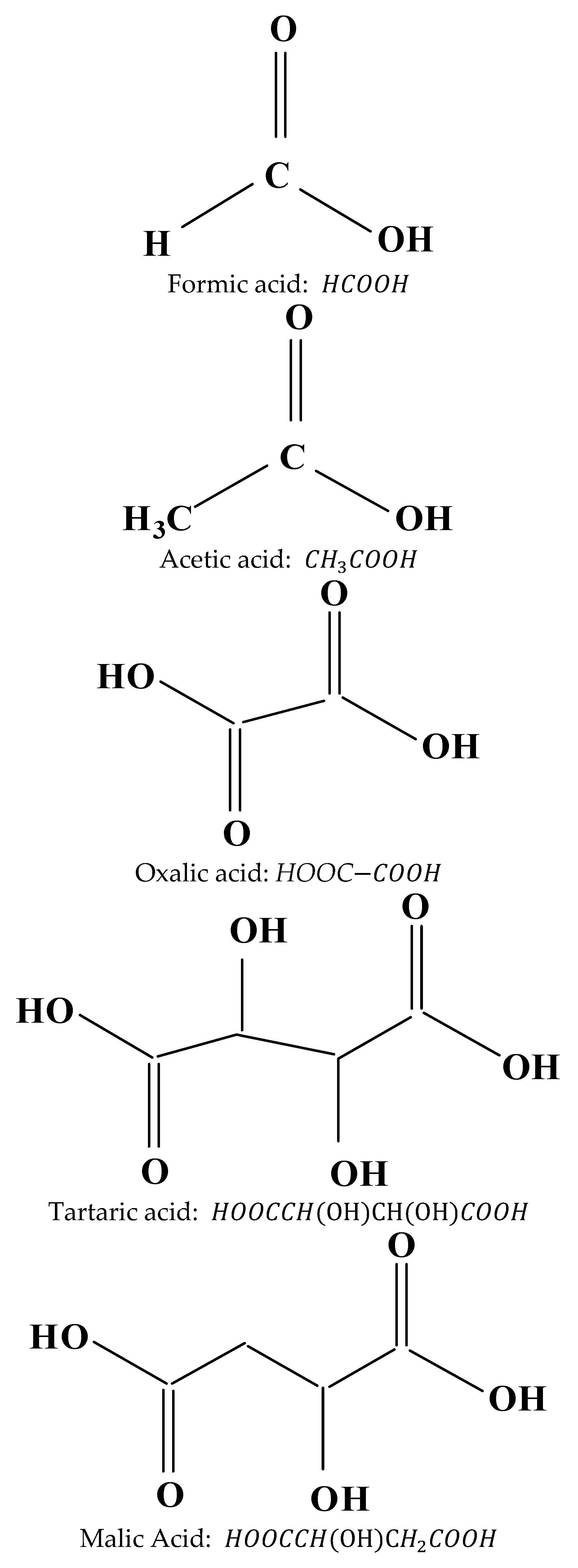
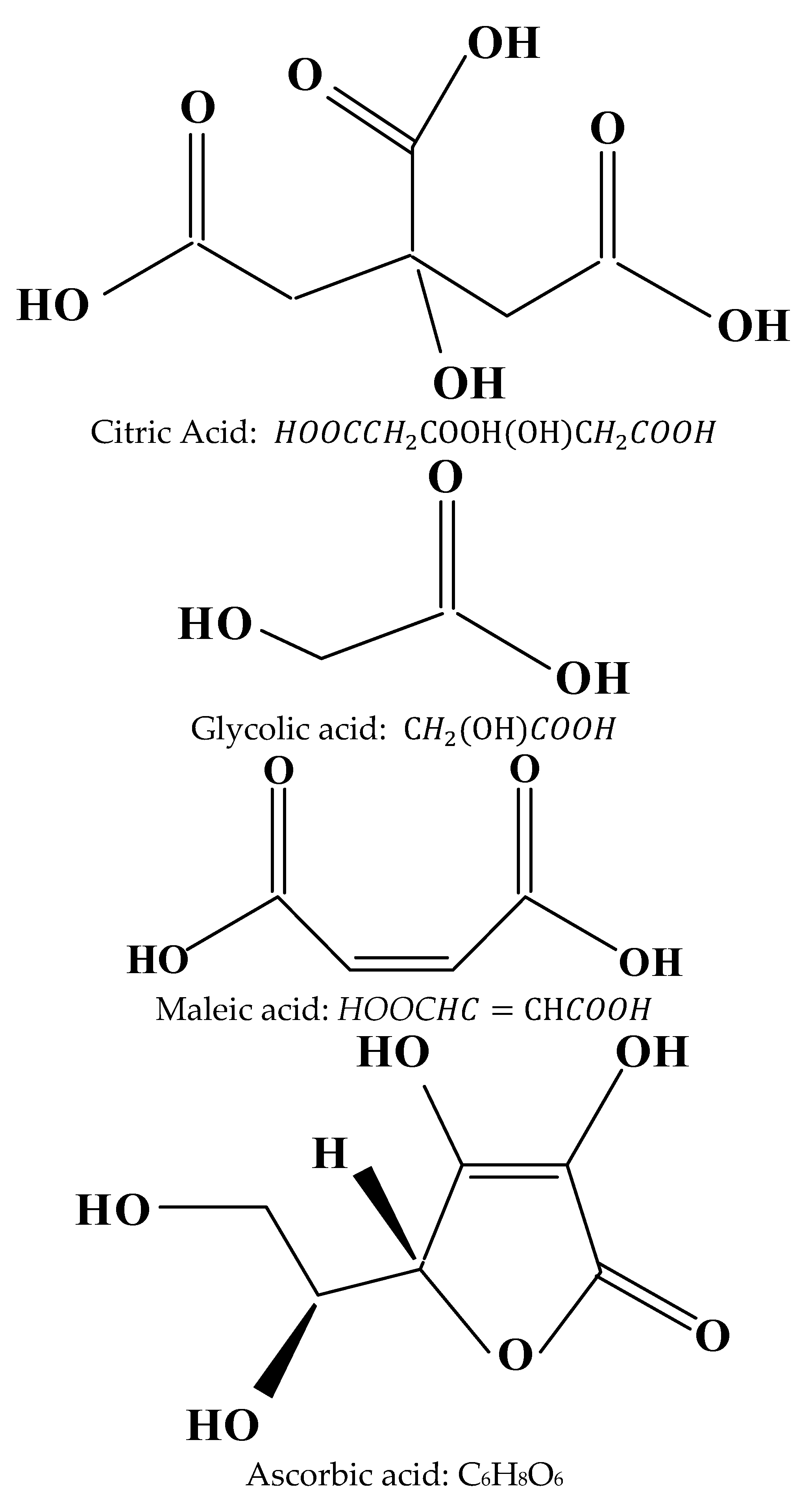
The structural formulas of organic acids are shown in Figure 6, and their formula and pKa values are summarized in Table 7.
The selection of organic acid leaching agents depends on the number of carboxyl groups, hydroxyl groups, and carbon-carbon double bonds in their molecular structure, which is reflected in their pKa values. At pH values where acid ions and anions are at equal concentrations, a lower pKa indicates a stronger acid. Their metal-dissolving ability will also differ, but most organic acids are non-toxic and environmentally friendly. For example, ascorbic acid is only corrosive at low pH values. They are often low-cost, easy to use, and composed only of C, H, and O atoms, emitting only CO2 and water upon combustion. Most are thermally stable and can form strong chelates, playing a key role in dissolving metals through acid hydrolysis and complexation. The strength of the H-O bond in carboxylic acids affects the complexation rate, and acids with more hydroxyl groups generally react more quickly [42].
Organic acids are highly efficient and environmentally friendly leaching agents for recycling spent NdFeB, causing neither secondary pollution nor significant equipment corrosion. They pose relatively low potential risks to operators and can selectively leach metals. Moreover, they are biodegradable and avoid most environmental or cost problems associated with inorganic acids. However, reaction times can be long; hence, improving leaching kinetics is an important consideration.

6. Bioleaching

The mechanism of bioleaching involves utilizing microorganisms to convert insoluble metal compounds into water-soluble forms, recovering metals through biological oxidation, complexation, and the activation of metal ions.
Auerbach R et al. [43] developed bioleaching for permanent magnets using different bacteria such as Acidithiobacillus thiooxidans, Acidithiobacillus ferrooxidans, and Leptospirillum ferrooxidans. The highest rare earth leaching efficiency (86% Dy, 91% Nd, 100% Pr) was achieved with Acidithiobacillus and Leptospirillum ferrooxidans.
Bioleaching is a sustainable, environmentally friendly, and potentially economically effective technology. Microorganisms dissolve metals from spent NdFeB magnets through acid hydrolysis and redox processes [44]. However, challenges such as long culture times, slow process kinetics, low solid–liquid ratios, and metal toxicity remain. Bioleaching primarily depends on metabolite generation, microbial tolerance to toxic metals, low-cost media, and optimization of operational parameters [45].

7. Ionic Liquid Systems

Traditionally, ionic liquids (ILs) are defined as organic salts composed entirely of organic cations and organic or inorganic anions, with a melting point below 100 °C. Deep Eutectic Solvents (DESs) are often grouped with ILs due to their similar properties, and together they are collectively referred to as ionic liquid systems.
These systems possess outstanding ion extraction and transport capabilities, as well as stable electrochemical windows, giving them broad application prospects in fields such as REE extraction, metal leaching, and the electrochemical recovery of metals.

7.1. Ionic Liquid Extraction

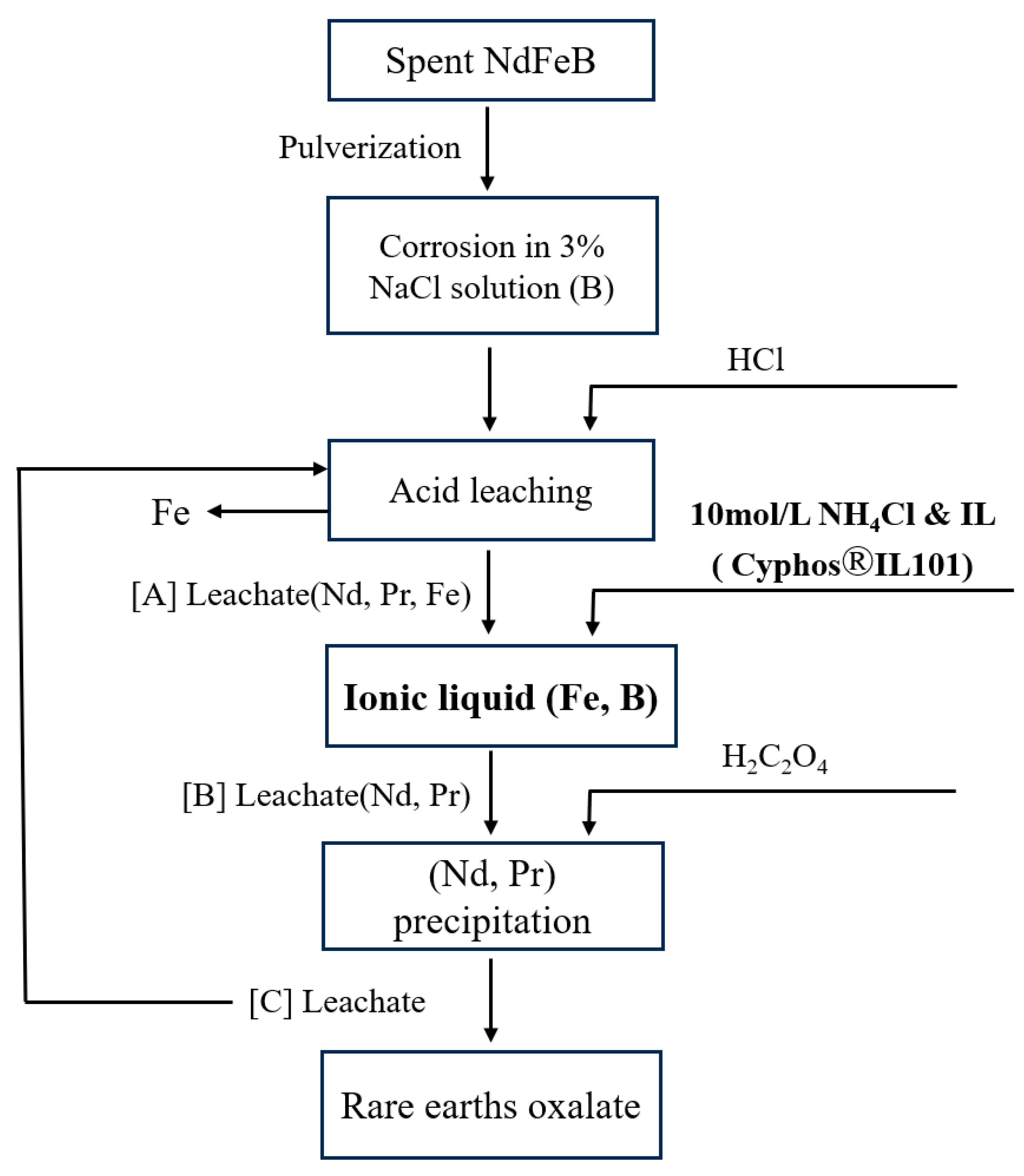
The distinct compositions of DESs and ILs lead to different primary applications in the separation and recycling of NdFeB magnets. Typically, ILs are used as extractants in liquid–liquid separation processes, while DESs are more commonly employed as direct leaching agents. The recovery and separation of REEs and Fe using ILs and DESs are summarized in Table 8, with a general process flowsheet provided in Figure 7.
Kitagawa J et al. [46] developed a method for extracting REEs from NdFeB magnets. Their process begins with a corrosion pretreatment in a 3% NaCl solution, followed by the extraction of iron from an HCl solution using the ionic liquid trihexyl(tetradecyl)phosphonium chloride ([P666,14][Cl]) (Cyphos® IL101). Finally, REEs are precipitated from the solution using oxalic acid.
Li XH et al. [47] developed a solvent metallurgical process to recover REEs and Co from spent permanent magnets. This process utilizes trihexyltetradecylphosphonium trichloride ([P666,14][Cl3]) or a mixture of [P666,14][Cl3] and the corresponding chloride ionic liquid [P666,14]Cl.
Xue WF et al. [48] synthesized two low-viscosity, carboxylic acid-based ionic liquids, [A336][BTA] and [A336][OTA], for the extraction of Nd3+ from spent permanent magnets. These ILs achieved an extraction efficiency exceeding 99%, which remained above 95% even after seven cycles of reuse.
Li JR et al. [49] investigated the electrodeposition of Nd in a novel analogous ionic liquid (AIL) based on phenyltrimethylammonium chloride and ethylene glycol (TMPAC-EG). Spectral analysis indicated that Nd3+ interacts with Cl and ethylene glycol to form a complex, [Nd(EG)6-yCl_y]3−ʸ, allowing NdCl3 to dissolve in the TMPAC-EG IL. This method successfully produced metallic Nd with various morphologies, including caterpillar-shaped, nodular, layered rock, and porous structures.

7.2. Deep Eutectic Solvents (DESs) Leaching

Commonly, the selective leaching mechanism of the spent NdFeB by DESs is due to the dissolution reaction of polyols, organic acids, and quaternary ammonium salts, polyols and acids, and urea in DESs. DESs may be due to the formation of more stable complexes between RE3+ and HBD, consequently enhancing the dissolution of Nd2O3.
Liu CY et al. [50] designed a method to recover NdFeB permanent magnets using deep eutectic solvents (DESs). The guanidine hydrochloride−lactic acid (GUC-LAC) complex DES achieved the highest separation factor (>1300) by simply dissolving the mixture of Nd2O3 and Fe2O3. The dissolved mass concentration of Nd could reach 67 g/L. The viscosity of this type of DES was 36 cP at 50 °C. After three cycles, the solubility and chemical stability of GUC-LAC DES remain unchanged.
Cheng SP et al. [51] designed a novel Deep Eutectic Solvent (DES) synthesized from tetraethylammonium chloride (TEAC) and levulinic acid (LA) and achieved selective leaching of REEs. The solubility of Nd2O3 in TEAC-LA exceeds 75.6 g/L. Its viscosity at the working temperature was 12.8 cP. After three cycles, TEAC-LA still maintains its leaching capacity and thermal stability.
Ionic liquid systems are environmentally friendly, highly purified, biodegradable, and recyclable. However, the preparation cost of ionic liquids is usually higher than that of ordinary leaching agents. In actual large-scale production and application, the preparation and synthesis cost, the impact of high viscosity on leaching efficiency, the performance after circulation, the methods of recovery and impurity removal, and the biodegradability and reduction in environmental impact should be comprehensively considered. It is becoming a green solvent, which is applied to the efficient recovery and comprehensive utilization of the permanent magnets.
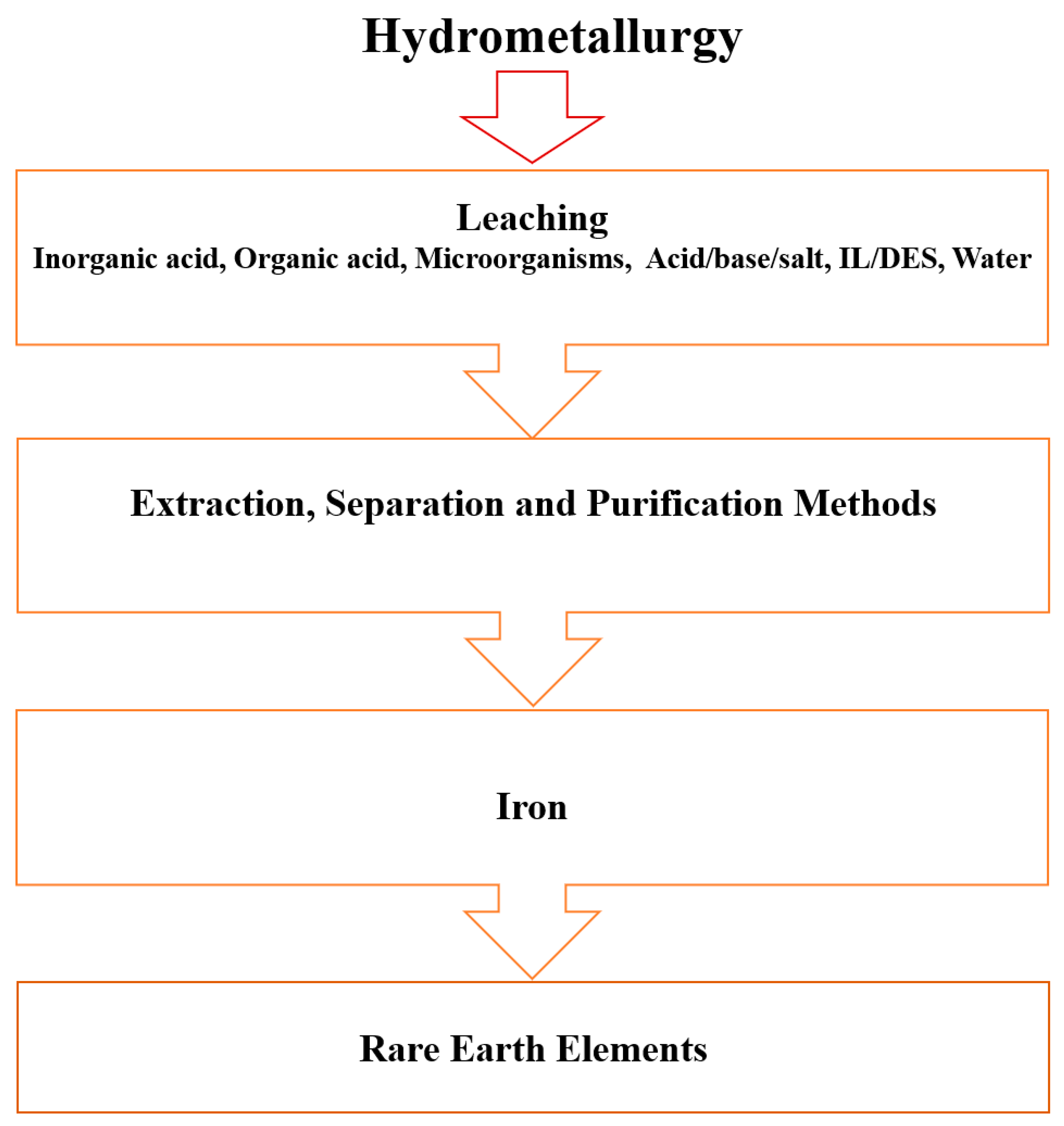
Therefore, a comparison of recycling methods for the spent permanent magnets is summarized in Table 9. and the processing for recovering rare earth elements by hydrometallurgy technology are shown in Figure 8.

8. Conclusions

Spent NdFeB magnets represent a significant secondary resource with high recycling value. For waste materials characterized by a high degree of oxidation, severe contamination, and complex composition, hydrometallurgical processing is the most suitable recycling route. The effectiveness of this approach depends on the careful selection of leaching agents and methods for extraction, separation, and purification.
Extensive research by scholars worldwide on the hydrometallurgical recovery of spent NdFeB magnets has yielded positive results. However, several challenges remain unresolved. To advance the development of short-process, sustainable, and green recycling technologies, future research should focus on the following areas:
(1)
Adoption of Combined Processes: The selection of an optimal recycling process is influenced by factors such as raw material type, chemical composition, cost, and environmental impact. A single recycling method is often insufficient; therefore, combined processes that integrate the strengths of different techniques while mitigating their individual shortcomings present a more effective solution.
(2)
Focus on Iron Recovery and Selective Leaching: The primary objectives of recycling are energy conservation, reduced consumption, and environmentally friendly technology. Given that iron constitutes 60–70% of the magnet’s weight, its recovery must be strengthened and integrated into the process. Consequently, selective leaching, which enables the separation of rare earth elements (REEs) from iron at the source, represents a crucial long-term research direction. As an alternative, the holistic recovery of iron via electrodeposition or roasting should also be comprehensively considered alongside REE recovery.
(3)
Mechanistic Studies on Pretreatment: The difficulty in controlling oxidation and roasting conditions, coupled with the slow kinetics of subsequent REE leaching, significantly limits the deep separation of REEs from Fe. Research into the mechanisms of natural and low-temperature oxidation can optimize these pretreatment steps, enabling them to be completed under low-energy and short-duration conditions. This will enhance industrial efficiency and the comprehensive utilization of other valuable elements like Boron and Cobalt.
In summary, spent NdFeB permanent magnets are a vital urban mineral resource. The recovery of key valuable metals from this waste stream is essential for achieving sustainable resource development and constitutes a critical component of the rare earth strategic supply chain, thereby supporting green manufacturing and a circular economy.
Ultimately, a holistic approach that considers cost, energy consumption, and benefit is required. The shortcomings and advantages of various methods must be evaluated to integrate iron utilization from the pretreatment and reagent selection stages, while optimizing REE recovery during leaching. The final goal is to achieve the high-value and efficient recycling of all components within spent NdFeB magnets.

Author Contributions

M.C.: Writing—review and editing, Writing—original draft, Software, Project administration, Methodology, Investigation, Formal analysis, Data curation. L.L.: Visualization, Supervision, Conceptualization. Y.X.: Writing—review and editing, Visualization, Supervision, Funding acquisition, Conceptualization. H.L.: Writing—review and editing, Methodology, Data curation. All authors have read and agreed to the published version of the manuscript.

Funding

This research was supported by the Natural Science Foundation of Jiangxi Province (20244BAB28056), the Administration for Market Regulation Program of Jiangxi Province (GSJK202409), the Bureau of Science and Technology Program of Ganzhou City (GZ2024ZSF883), and the Natural Science Foundation of Jiangxi Province (20224ACB203010).

Data Availability Statement

No new data were created or analysed in this study. Data sharing is not applicable to this article.

Conflicts of Interest

The authors declare that they have no known competing financial interests or personal relationships that could have appeared to influence the work reported in this paper.

References

  1. Kumari, A.; Sahu, S.K. A comprehensive review on recycling of critical raw materials from spent neodymium iron boron (NdFeB) magnet. Sep. Purif. Technol. 2023, 317, 123527. [Google Scholar] [CrossRef]
  2. Brião, G.V.; Silva, M.G.; Vieira, M.G. Adsorption potential for the concentration and recovery of rare earth metals from NdFeB magnet scrap in the hydrometallurgical route: A review in a circular economy approach. J. Clean. Prod. 2022, 380, 135112. [Google Scholar] [CrossRef]
  3. Yadav, J.; Sarker, S.K.; Bruckard, W.; Jegatheesan, V.; Haque, N.; Singh, N.; Pramanik, B.K. Greening the supply chain: Sustainable approaches for rare earth element recovery from neodymium iron boron magnet waste. J. Environ. Chem. Eng. 2024, 12, 113169. [Google Scholar] [CrossRef]
  4. Ju, J.; Feng, Y.; Li, H.; Xu, C.; Xue, Z.; Wang, B. Extraction of valuable metals from minerals and industrial solid wastes via the ammonium sulfate roasting process: A systematic review. J. Chem. Eng. 2023, 457, 141197. [Google Scholar] [CrossRef]
  5. Kaya, M. An overview of NdFeB magnets recycling technologies. Curr. Opin. Green Sustain. Chem. 2024, 46, 100884. [Google Scholar] [CrossRef]
  6. Cong, L.; Yu, L.; Zhou, Q.; Lu, Q.; Yue, M. Short-process recycling of Nd-Fe-B sintered magnet sludge wastes: Challenges and approaches. J. Rare Earths 2023, 41, 1467–1477. [Google Scholar] [CrossRef]
  7. Jyothi, R.K.; Thenepalli, T.; Ahn, J.W.; Parhi, P.K.; Chung, K.W.; Lee, J.Y. Review of rare earth elements recovery from secondary resources for clean energy technologies: Grand opportunities to create wealth from waste. J. Clean. Prod. 2020, 267, 122048. [Google Scholar] [CrossRef]
  8. Xu, X.; Jia, X.; Zhao, K.; Xu, P.; Jing, P.; Liu, B.; Zhang, J. Recent progress in electrochemical recycling of waste NdFeB magnets. Chem. Commun. 2025, 61, 2257–2268. [Google Scholar] [CrossRef]
  9. Tian, Y.; Liu, Z.; Zhang, G. Recovering REEs from NdFeB wastes with high purity and efficiency by leaching and selective precipitation process with modified agents. J. Rare Earths 2019, 37, 205–210. [Google Scholar] [CrossRef]
  10. Rabatho, J.P.; Tongamp, W.; Takasaki, Y.; Haga, K.; Shibayama, A. Recovery of Nd and Dy from rare earth magnetic waste sludge by hydrometallurgical process. J. Mater. Cycles Waste Manag. 2013, 15, 171–178. [Google Scholar] [CrossRef]
  11. Gruber, V.; Carsky, M. New technology for lanthanide recovery from spent Nd-Fe-B magnets. S. Afr. J. Chem. Eng. 2020, 33, 35–38. [Google Scholar] [CrossRef]
  12. He, L.; Xu, Q.; Li, W.; Dong, Q.; Sun, W. One-step separation and recovery of rare earth and iron from NdFeB slurry via phosphoric acid leaching. J. Rare Earths 2022, 40, 338–344. [Google Scholar] [CrossRef]
  13. Kumari, A.; Sinha, M.K.; Pramanik, S.; Sahu, S.K. Recovery of rare earths from spent NdFeB magnets of wind turbine: Leaching and kinetic aspects. Waste Manag. 2018, 75, 486–498. [Google Scholar] [CrossRef] [PubMed]
  14. Niam, A.C.; Fen, W.; Wei, C.; Jie, Y. Recovery of rare earth elements from waste permanent magnet (WPMs) via selective leaching using the Taguchi method. J. Taiwan Inst. Chem. Eng. 2019, 97, 137–145. [Google Scholar] [CrossRef]
  15. Liu, F.; Porvali, A.; Wang, J.; Wang, H.; Peng, C.; Wilson, B.P.; Lundström, M. Recovery and separation of rare earths and boron from spent Nd-Fe-B magnets. Miner. Eng. 2020, 145, 106097. [Google Scholar] [CrossRef]
  16. Liu, Z.; Zhou, H.; Li, W.; Luo, X.; Wang, J.; Liu, F. Separation and coextraction of REEs and Fe from NdFeB sludge by co-leaching and stepwise precipitation. Sep. Purif. Technol. 2022, 282, 119795. [Google Scholar] [CrossRef]
  17. Zhang, Z.; Wang, D.; Liu, C.; Zhi, W.; Xiao, W.; Qian, G.; Li, G. New insight into oxidative roasting and leaching for NdFeB waste. J. Environ. Chem. Eng. 2022, 10, 108946. [Google Scholar] [CrossRef]
  18. Önal, M.A.R.; Borra, C.R.; Guo, M.; Blanpain, B.; Gerven, T.V. Recycling of NdFeB magnets using sulfation, selective roasting, and water leaching. J. Sustain. Metall. 2015, 1, 199–215. [Google Scholar] [CrossRef]
  19. Loy, S.V.; Önal, M.A.R.; Binnemans, K.; Gerven, T.V. Recovery of valuable metals from NdFeB magnets by mechanochemically assisted ferric sulfate leaching. Hydrometallurgy 2020, 191, 105154. [Google Scholar]
  20. Liu, F.; Chen, F.; Wang, L.; Ma, S.; Wan, X.; Wang, J. Selective separation of rare earths from spent Nd-Fe-B magnets using two-stage ammonium sulfate roasting followed by water leaching. Hydrometallurgy 2021, 203, 105626. [Google Scholar] [CrossRef]
  21. Kumari, A.; Raj, R.; Randhawa, N.S.; Sahu, S.K. Energy efficient process for recovery of rare earths from spent NdFeB magnet by chlorination roasting and water leaching. Hydrometallurgy 2021, 201, 105581. [Google Scholar] [CrossRef]
  22. Gahlot, R.; Dhawan, N. Chloridizing roasting studies of spent NdFeB magnets for recovery of rare earth values. Process Saf. Environ. Prot. 2024, 191, 1534–1547. [Google Scholar] [CrossRef]
  23. Wu, J.; Wang, D.; Ye, C.; Wang, Z.; Hu, X. Selective extraction and separation of REEs from NdFeB magnets scrap using co-chlorination and water leaching. Sep. Purif. Technol. 2023, 306, 122452. [Google Scholar] [CrossRef]
  24. Wu, J.; Wang, D.; Zhang, Z.; Ye, C.; Wang, Z.; Hu, X. Mechanical activation induced treatment for the synergistic recovery of valuable elements from spent NdFeB magnets. Waste Manag. 2024, 178, 76–84. [Google Scholar] [CrossRef]
  25. Önal, M.A.R.; Aktan, E.; Borra, C.R.; Blanpain, B.; Gerven, T.V.; Guo, M. Recycling of NdFeB magnets using nitration, calcination and water leaching for REE recovery. Hydrometallurgy 2017, 167, 115–123. [Google Scholar] [CrossRef]
  26. Venkatesan, P.; Sun, Z.; Sietsma, J.; Yang, Y. An environmentally friendly electro-oxidative approach to recover valuable elements from NdFeB magnet waste. Sep. Purif. Technol. 2018, 191, 384–391. [Google Scholar] [CrossRef]
  27. Zhang, Z.; Wang, Z.; Wang, D.; Min, R.; Xiao, W.; Yong, L.; Li, G. An acid-free process for selective REE recovery from spent NdFeB magnets by room-temperature electrolysis. Green Chem. 2023, 25, 10653–10663. [Google Scholar]
  28. Xu, X.; Sturm, S.; Samardzija, Z.; Vidmar, J.; Scancar, J.; Zuzek, R.K. Direct Recycling of Nd-Fe-B Magnets Based on the Recovery of Nd2Fe14B Grains by Acid-free Electrochemical Etching. ChemSusChem 2019, 12, 4754–4758. [Google Scholar] [CrossRef] [PubMed]
  29. Xu, X.; Sturm, S.; Samardzija, Z.; Scancar, J.; Markovic, K.; Zuzek, R.K. A facile method for the simultaneous recovery of rare-earth elements and transition metals from Nd-Fe-B magnets. Green Chem. 2020, 22, 1105–1112. [Google Scholar] [CrossRef]
  30. Yang, Y.; Lan, C.; Wang, Y.; Zhao, Z.; Li, B. Recycling of ultrafine NdFeB waste by the selective precipitation of rare earth and the electrodeposition of iron in hydrofluoric acid. Sep. Purif. Technol. 2020, 230, 15870. [Google Scholar] [CrossRef]
  31. Xiao, F.; Hu, W.; Zhang, Z.; Bo, L.; Zhu, H. Recovery of neodymium and iron from NdFeB waste by combined electrochemical-hydrometallurgical process. Sep. Purif. Technol. 2025, 353, 128301. [Google Scholar] [CrossRef]
  32. Venkatesan, P.; Vander, T.; Binnemans, K.; Sun, Z.; Sietsma, J.; Yang, Y. Selective Extraction of Rare-Earth Elements from NdFeB Magnets by a Room-Temperature Electrolysis Pretreatment Step. ACS Sustain. Chem. Eng. 2018, 6, 9375–9382. [Google Scholar] [CrossRef]
  33. Makarova, I.; Soboleva, E.; Osipenko, M.; Kurilo, I.; Laatikainen, M.; Repo, E. Electrochemical leaching of rare-earth elements from spent NdFeB magnets. Hydrometallurgy 2020, 192, 105264. [Google Scholar] [CrossRef]
  34. Makarova, I.; Ryl, J.; Sun, Z.; Kurilo, I.; Górnicka, K.; Laatikainen, M.; Repo, E. One-step recovery of REE oxalates in electro-leaching of spent NdFeB magnets. Sep. Purif. Technol. 2020, 251, 117362. [Google Scholar] [CrossRef]
  35. Behera, S.S.; Parhi, P.K. Leaching kinetics study of neodymium from the scrap magnet using acetic acid. Sep. Purif. Technol. 2016, 160, 59–66. [Google Scholar] [CrossRef]
  36. Menad, N.E.; Seron, A.; Maât, N.; Breton, J.M.L.; Virginie, N. Process Recovery of Nd-Fe-B Permanent Magnets from Hard Disc Drives. J. Geogr. Nat. Disasters 2017, S6, 008. [Google Scholar] [CrossRef]
  37. Belfqueh, S.; Seron, A.; Chapron, S.; Arrachart, G.; Menad, N. Evaluating organic acids as alternative leaching reagents for rare earth elements recovery from NdFeB magnets. J. Rare Earths 2023, 41, 621–631. [Google Scholar] [CrossRef]
  38. Liu, Q.; Tu, T.; Guo, H.; Cheng, H.; Wang, X. High-efficiency simultaneous extraction of rare earth elements and iron from NdFeB waste by oxalic acid leaching. J. Rare Earths 2021, 39, 323–330. [Google Scholar] [CrossRef]
  39. Gergoric, M.; Barrier, A.; Retegan, T. Recovery of rare-earth elements from neodymium magnet waste using glycolic, maleic, and ascorbic acids followed by solvent extraction. J. Sustain. Metall. 2019, 5, 85–96. [Google Scholar] [CrossRef]
  40. Reisdorfer, G.; Bertuol, D.A.; Tanabe, E.H. Recovery of neodymium from the magnets of hard disk drives using organic acids. Miner. Eng. 2019, 143, 105938. [Google Scholar] [CrossRef]
  41. Kumari, A.; Dipali; Randhawa, N.S.; Sahu, S.K. Electrochemical treatment of spent NdFeB magnet in organic acid for recovery of rare earths and other metal values. J. Clean. Prod. 2021, 309, 127393. [Google Scholar] [CrossRef]
  42. Golmohammadzadeh, R.; Faraji, F.; Rashchi, F. Recovery of lithium and cobalt from spent lithium ion batteries (LIBs) using organic acids as leaching reagents: A review. Resour. Conserv. Recycl. 2018, 136, 418–435. [Google Scholar] [CrossRef]
  43. Auerbach, R.; Bokelmann, K.; Stauber, R.; Gutfleisch, O.; Schnell, S.; Ratering, S. Critical raw materials-Advanced recycling technologies and processes: Recycling of rare earth metals out of end-of-life magnets by bioleaching with various bacteria as an example of an intelligent recycling strategy. Miner. Eng. 2019, 134, 104–117. [Google Scholar] [CrossRef]
  44. Joshi, K.; Magdouli, S.; Kaur, B.S. Bioleaching for the recovery of rare earth elements from industrial waste: A sustainable approach. Resour. Conserv. Recycl. 2025, 215, 108129. [Google Scholar] [CrossRef]
  45. Roy, J.J.; Cao, B.; Madhavi, S. A review on the recycling of spent lithium-ion batteries (LIBs) by the bioleaching approach. Chemosphere 2021, 282, 130944. [Google Scholar] [CrossRef]
  46. Kitagawa, J.; Uemura, R. Rare Earth Extraction from NdFeB Magnet Using a Closed-Loop Acid Process. Sci. Rep. 2017, 7, 8039. [Google Scholar] [CrossRef] [PubMed]
  47. Li, X.; Li, Z.; Binnemans, K. Closed-loop process for recovery of metals from NdFeB magnets using a trichloride ionic liquid. Sep. Purif. Technol. 2021, 275, 119158. [Google Scholar] [CrossRef]
  48. Xue, W.; Liu, R.; Liu, X.; Wang, Y.; Lv, P.; Yang, Y. Selective extraction of Nd (III) by novel carboxylic acid based ionic liquids without diluent from waste NdFeB magnets. J. Mol. Liq. 2022, 364, 119919. [Google Scholar] [CrossRef]
  49. Li, J.; Xu, C.; Xiang, G.; Chen, W.; Gu, D.; Zhang, Q.; Hua, Y.; Li, Y. TMPAC-EG deep eutectic solvent for sustainable recovery of Nd by electrodeposition. Electrochim. Acta 2024, 501, 144817. [Google Scholar] [CrossRef]
  50. Liu, C.; Yan, Q.; Zhang, X.; Lei, L.; Xiao, C. Efficient Recovery of End-of-Life NdFeB Permanent Magnets by Selective Leaching with Deep Eutectic Solvents. Environ. Sci. Technol. 2020, 54, 10370–10379. [Google Scholar] [CrossRef]
  51. Cheng, S.; Zhang, Z.; Wang, D.; Zheng, W.; Qi, T.; Wang, Z.; Xiao, W.; Lin, Y.; Li, G. Selective leaching and recovery of rare earth from NdFeB waste through a superior selective and stable deep eutectic solvent. Sep. Purif. Technol. 2025, 353, 128498. [Google Scholar]
Figure 1. General flowchart for leaching and separating REEs and Fe from NdFeB magnets using inorganic acid direct leaching.
Metals 15 01227 g001
Figure 2. General process flow for recovering and separating REEs and Fe from spent permanent magnets using the hydrochloric acid preferential dissolving method.
Metals 15 01227 g002
Figure 3. General process flow for recovering and separating REEs and Fe using acid baking and water leaching method.
Metals 15 01227 g003
Figure 4. General process flow for REEs recovery through electrolysis in aqueous solution.
Metals 15 01227 g004
Figure 5. General process flow for recovery and separation of REEs and Fe from spent magnets using organic acids leaching.
Metals 15 01227 g005
Figure 6. Structural formulas of organic acids.
Metals 15 01227 g006aMetals 15 01227 g006b
Figure 7. General process flow for the recovery of REEs from the spent NdFeB magnet by ionic liquid extraction.
Metals 15 01227 g007
Figure 8. The processing of recovering rare earth elements and iron by hydrometallurgy technology.
Metals 15 01227 g008
Table 1. Recovery and separation of REEs and Fe from spent NdFeB magnet by inorganic acid direct leaching.
MethodsReagentsRaw MaterialsConditions/ParametersProduct/Remarks/ConclusionPros and ConsReferences
Direct leachingHydrochloric acidFlake NdFeB magnets6 M HCl/50 g/L tartaric acid, 40 °CExtraction yields: Fe > 67.99%, REEs > 99.27%; Purity: RE oxide products > 95.83%; Recovery: RE oxide products > 90.18%High efficiency, low cost, but high acid consumption, large-scale industrial production, low selectivity, complicated process[9]
Direct leachingNitric acidNdFeB magnetic sludge 1 M HNO3, 0.3 M H2O2, 5 min, 80 °C>98% Nd, 80% Dy, 99% B,99% Fe dissolved; pH = 3, Fe removed as Fe(OH)3 Oxidize Fe2+ to Fe3+, sulfuric acid double salt precipitation, rare earths, and separation from Fe, but cause environmental pollution[10]
Direct leachingSulfuric acid NdFeB scrap2 M H2SO4, 80 °C, 1–2 h, two-step solvent extractionYield > 95%; Purities: mixed Pr/Nd oxide, Dy oxide > 99%High recovery rate, but environmental pollution[11]
Direct leachingPhosphoric acidNdFeB slurry4 M H3PO4, 80 °C, L/S = 30/1, 1.5 h Recovery: Fe 98.76%, REEs 1.09%; Purity: mixed RE oxide 99.49%, FeC2O4·2H2O 97.17%Low efficiency, high cost, rare earth phosphate precipitation, high selectivity, low volatility, environmentally friendly[12]
Table 2. Recovery and separation of REEs and Fe from Spent NdFeB magnets by oxidation roasting and inorganic acid leaching.
ReagentsExperimental ConditionsConclusionReference
HCl leachingRoasting: 850 °C, 6 h
Leaching: HCl = 0.5 M, L/S = 100 g/L, 95 °C, 500 rpm, 5 h
Leaching kinetics: the mixed controlled kinetic model, Ea = 30.1 kJ/mol, 348–368 K
Precipitation: pH = 2, 1 M H2C2O4 solution
Roasting: 800 °C, 120 min
Mixed rare earth oxides purity:
>99%
[13]
HCl, H2SO4,
HNO3 leaching
Roasting: 800 °C, 2 h
Leaching: Unpretreated WPMs, 5 M HCl, 65 °C, 24 h, S/L = 2%, 800 rpm, 0.250 mm
The most influential parameter for the leaching experiment: the acid type
78% Nd, 83% Pr, and 76% Dy
p-values: 0.007, 0.01, and 0.071
[14]
HCl pressure leachingRoasting: 800 °C, 2 h
Leaching: HCl = 0.6 M, 2 g/L NaNO3 oxidant, L/S = 10 mL/g, 180 °C, 2 h
Precipitation: n(oxalic acid)/n(REEs) = 1
Extraction: 30% (EHD) and 70% sulfonated kerosene (volume ratio)
Na2S precipitation: CoS
REEs and B recovery rates: 99% and 97%, <0.1% of Fe dissolved;
The extracted REEs have >99% and 99.95% purity;
99.5% of B was recovered
[15]
HCl leachingRoasting: 400 °C, 2 h
Co-Leaching: HCl 6 mol/L, 2 h, L/S = 5, 90 °C
Precipitation REEs: H2C2O4 1 mol/L, 30 min, 60 °C
Complexation: H2C2O4 2 mol/L, 30 min, 60 °C
Reduction and Precipitation: Iron power 1 mol/L, 30 min, 30 °C—FeC2O4·H2O
Wastewater: Evaporation and crystallization
98.28% REEs recovered (RE2(C2O4)3·10H2O),
94.65% Fe recovered (FeC2O4·H2O)
[16]
HCl leachingRoasting: 400–800 °C
Leaching: 0.2 M HCl, 90 °C, 3 h
Oxidation efficiency of NdFeB oil sludge: >99.2%[17]
Table 3. Reagents of the acid baking and water leaching process.
MethodsSulfation Roasting and Water LeachingChlorination Roasting and Water LeachingNitration Roasting and Water Leaching
ReagentsH2SO4, Fe2(SO4)3, (NH4)2SO4
ZnSO4·H2O, FeSO4·7H2O
NH4Cl, CaCl2·2H2O, FeCl3·H2OFe (NO3)3·9H2O
Table 4. Recovery and separation of REEs and Fe from Spent NdFeB magnet by acid baking and water leaching.
Treatment MethodReagentsExperimental ConditionsConclusionReference
Sulfation roasting
and water leaching
H2SO4 <40 µm particle size
Acid: 60 g/L, 12–16 M at 25 °C
Drying: 24 h at 110 °C
Roasting: 750 °C for 1 h
Water Leaching: 20 g/L, 25 °C for 1 h
The extraction rate of REMs is 95–100 wt%, and that of Fe is ~0 wt%[18]
Fe2(SO4)3 Grinding: Mechanochemical grinding,
ball-to-powder ratio: 5/1 (g/g), 800 rpm, 2 min
400 rpm, 10–60 min
Calcination: 900 °C, 5 h
Leaching: L/S: 40–10 mL/g, 1–24 h at 25 °C
The rare earth leaching rate exceeds 95%, and cobalt is completely recovered[19]
(NH4)2SO4 First roasting: 1 h, 400 °C
Molar ratio: (Fe + RE)/((NH4)2SO4):1/0.6–1/3
Second roasting: 2 h, 750 °C
Molar ratio: (Fe + RE)/((NH4)2SO4):1/2
Water Leaching: L/S: 20/1, 0.5 h, 30 °C
RE extraction yields up to 96%. Fe, Al, Cu, and Co extraction yields are 0.008%, 0.27%, 1.64%, and 3.48%, respectively[20]
Chlorination roasting
and water leaching
NH4ClTemperature: 250–400 °C
Stoichiometric ratio of NdFeB/NH4Cl: 1:1–1:5
Time: 0.5– 3 h
Water leaching: 95 °C, S/L: 100 g/L, 500 rpm, 1 h.
99.2% REOs, 96.4% Fe2O3 were obtained[21]
CaCl2·2H2O600 °C, dosage (CaCl2·2H2O: NdFeB = 2:1), 90 min;
Water leaching: 90 °C, 1 h, S/L = 10;
0.5 M HCl leaching, S/L: 1/10 g/mL, 90 °C,3 h;
Oxalic acid precipitation: 60 °C, 20 min, pH = 2;
Calcination: 850 °C, 2 h.
The maximum dissolution of Nd ~ 89%, Dy ~ 88%, rare earth oxides 96% purity[22]
FeCl3·6H2O Temperature: 350–600 °C, 0.5–3 h,
n (chlorinating agent)/n(scrap): 0.5–2.5:1
Water leaching:
L/S = 10 mL/g/1, 1 h at 90 °C
REEs and Co were extracted 96.51%, 64.29%, respectively,92 wt% iron oxide was achieved[23]
FeCl3·6H2OGrinding: 0–1.5 h, 0–400 rpm, m (ball)/m(powder): 15/1
Roasting temperature: 200–600 °C, time:
10–90 min, molar ratios of N/F: 1:0–2.5
Leaching: temperature of 90 °C for 1 h, L/S = 25 g/mL
high leaching efficiencies of 98.94% for REEs, 99.99% for Co, and 93.36% for B,
96.73 wt% for iron oxide
[24]
Nitration roasting
and water leaching
Fe (NO3)3·9H2ONitration: NFB powders were converted into a mixture of nitrate metals at 25 °C for 1 h.
Calcination: 200 °C, 1 h
Water leaching: S/L ratio = 60 g/L, 1 h
Resting duration: 110 °C, 6–24 h (unnecessary); Particle size: 200 μm–500 μm, 1000 μm (ball milling avoided)
>95% for Nd, Dy, Pr, and Gd, and <1% Fe achieved [25]
Table 5. Recovery and separation of REEs and Fe from spent NdFeB magnets by electrolysis in aqueous solution.
MethodsElectrolyte/ReagentsExperimental ConditionsProcess StepsConclusionReferences
inorganic acidHCl/NH4ClThree-electrode system:
Anode: NdFeB magnet and cylindrical Ti/Pt
Cathode: Nickel wire
RE: Ag/AgCl
CE: a glassy carbon
1. Leaching of spent magnets
2. Fe2+ electrochemical oxidation
3. H2C2O4 precipitates REEs
4. Neutralization of base
(1) RE oxalate precipitation
(2) Cobalt electrodeposition
>97% of REEs precipitated, and the REOs’ purity of 99.2% obtained;
two routes: (a) Fe →FeCl3; (b) Fe →Fe (OH)3; Co: electro-winning →Pure Cobalt
[26]
chloride salt solutionZnCl2 Double anode system:
Three-electrode system:
WE: NdFeB magnets and inert anode (Pt electrodes);
RE: Ag/AgCl electrodes;
CE: Pt electrodes
1. Potentiodynamic polarization; kinetic potential polarization tests
2. Linear sweep voltammetry
3. Electrochemical dissolution
Nd2O3 and Fe2O3 are obtained[27]
chloride salt solutionnonaqueous dimethylformamide (DMF)/FeCl2Three-electrode system:
WE: NdFeB magnet and Pt wire (Anode)
Cathode: Cu
QRE (quasi-reference electrode): Another Pt wire
CE: A Pt plate
1. Electrochemical etching of the NdFeB magnet and cathodic deposition of pure Fe metal
2. Nd2Fe14B grains, REE3+, Fe2+ and REE-based particles separation
3. Hydrometallurgy Electrolysis REE metals/alloys obtained
4. REE metals/alloys with obtained Nd2Fe14B grains to make new NdFeB magnets
Nd2Fe14B particles, REE electrolyte, REE-based particles, and pure Fe metal are obtained [28]
inorganic acidH2SO4Three-electrode system:
WE: a spent NdFeB magnet and a Pt wire (Anode)
Cathode: Cu foil
RE: Ag/AgCl
CE: A Pt plate
1. Linear sweep voltammetry (LSV) test at room temperature;
2. Electrochemical leaching of the NdFeB magnets and Fe metal deposition;
3. Selective precipitations of the REEs with Na2SO4
Fe–Co, deposited on the cathode;
REEs, precipitated in the electrolyte
[29]
inorganic acidHFThree-electrode system:
CE/WE: Pt foil (99.95% purity)
RE: Hg/Hg2SO4
1. Recycling of REEs
2. The influence of pH on the electrodeposition of Fe
3. At pH = 2.89, the electrochemical behaviors of iron
(1) Cathode deposition of Nano-sized FeF2(s) and Fe(s) at pH 2.3 and pH 2.89;
(2) The relationship between the diffusion coefficient and temperature was obtained:
(3) Diffusion-activation-energy:
−15.01 kJ mol−1;
(4) Fe-Pt Gibbs energy:
ΔG = −487.53 + 0.936 T.
[30]
sulfate solutionNd2(SO4)3
FeSO4
Three-electrode system:
Anode: NdFeB waste
Cathode: Titanium sheet
RE: Hg/Hg2SO4 electrode
CE: Ti/Pt sheet
1. Electrochemical-analysis tests: polarization curves and Cyclic voltammetry (CV)
2. Electrochemical dissolution of NdFeB waste
3. Crystallization with elevated temperature of the electrolyte
Fe2+ was recovered by electrodeposition;
RE3+ recovered as Nd2(SO4)3·nH2O by elevated-temperature crystallization
[31]
chloride salt solutionNH4Cl Three-electrode system:
Anode: magnet and
Ti/Pt electrode
Cathode: Cu
RE: Ag/AgCl
CE: Cu
1. Electrochemical dissolution of spent NdFeB magnet Scrap and
2. Fe2+ oxidized→H2C2O4 precipitation.
More than 97% of REEs and
REOs of purity (99.2%) obtained;
Fe, REEs, and Co were selectively recycled
[32]
inorganic acidH2SO4
H2C2O4
Three-electrode system:
Anode: NdFeB magnet and 3D printed Ti
Cathode: Cu
RE: Ag/AgCl
CE: Pt
1. Potentiodynamic polarization scans
2. Chemical leaching and Electro-leaching
3. Leaching mechanism
RE(C2O4)3·nH2O is recycled in the cathodic deposits;
Nd-rich phase dissolved preferentially
[33]
inorganic acidH2SO4
H2C2O4
Three-electrode system:
WE: NdFeB magnet(anode) copper plate(cathode)
RE: Ag/AgCl
CE: Pt wire
1. Electrochemical leaching of NdFeB magnet in galvanostatic mode using a power supply
2. Electrochemical measurements:
3. Polarization test and Cathodic polarization curves
93% dense layer of REE oxalates on the cathode, and iron remains in solution[34]
Table 6. Recovery and separation of REEs and Fe from Spent NdFeB magnet by Organic acid leaching.
Treatment MethodReagentsExperimental ConditionsConclusionReferences
Organic acid leachingacetic acidLeaching: 800 rpm, S/L: 1% (W/V), 80 °C,
0.4 M, particle size: 106–150 μm
>99% Nd were reached, Co-leaching of Fe[35]
acetic acidLeaching: all metals except nickel are dissolved within 7 h >90% Nd, Dy, Fe were reached, 0% Ni[36]
acetic acid, formic acid, citric acid, tartaric acidLeaching: (acetic acid, formic acid, citric acid, and tartaric acid), 1.6–10 M, S/L: 0.5–10%, 60 °C>90% for Nd, Dy, and Pr were leached in acetic acid[37]
oxalic acid Leaching: 90 °C, 6 h, oxalic acid: 2 M,
L/S: 60 mL/g, ferric oxalate solution reduced using Fe powder
93.89% Fe was leached,
RE(C2O4)3·n H2O precipitation rate: 93.17%, FeC2O4·2H2O is obtained.
[38]
Oxidation roasting and organic acid leachingglycolic, maleic, ascorbic acidsRoasting: 1.5 h at 400 °C
Sieved: <355 μm particle size
Leaching: S/L ratio = 1/50 g/mL, 25 ± 1 °C,
0.6–1 M, S/L ratio = 1/30–1/80 g/mL, 1 M, 25 ± 1–70 ± 1 °C, 400–1000 rpm.
time: 100, 200, 300, 400 min, 24 h
Liquid–Liquid Extraction: TBP, D2EHPA, TODGA, Cyanex272, Cyanex923
>95% REEs were obtained, 1 M,
S/L ratio = 1/80.
[39]
malic and citric acids leachingRoasting: 900 °C, 480 min
Leaching: 30–90 °C, 0.2–1.2 mol/L,
S/L ratio: 1:10–1:50, 10–900 min
Nd from unroasted NdFeB powder reached 99%, but it is not selective. The optimal values are determined.[40]
Organic acid leachingcitric acid1. Electrochemically dissolved NdFeB magnets;
2. Using D2EHPA extract REEs;
3. Oxalic acid precipitation REEs
(Nd, Pr, Dy)2O3 99.9% purity,
Iron oxide (98.6% pure) obtained
[41]
Table 7. The formula and pKa of organic acids.
Organic AcidsMolecular FormulapKa
Formic acidHCOOH3.74
Acetic acidCH3COOH4.74
Oxalic acidH2C2O4pKa1 = 1.12
pKa2 = 4.19
Tartaric acidMetals 15 01227 i001pKa1 = 3.04
pKa2 = 4.37
Malic AcidMetals 15 01227 i002pKa1 = 3.44
pKa2 = 4.12
Citric AcidMetals 15 01227 i003pKa1 = 3.13
pKa2 = 4.76
pKa3 = 6.40
Glycolic acidCH2(OH)COOH3.8
Maleic acidMetals 15 01227 i004pKa1 = 1.9
pKa2 = 6.1
Ascorbic acidC6H8O6pKa1 = 4.2
pKa2 = 11.6
Table 8. Recovery and separation of REEs and Fe by ILs/DESs.
MethodsReagentsExperimental ConditionsConclusionReferences
ILs Ionic Liquid leachingTrihexyl(tetradecyl)phosphonium chloride (Cyphos®IL101)(1) Corrosion in 3% NaCl solution, 1 week
(2) Acid leaching: 0.2 M or 0.5 M HCl, 1–2 h
(3) IL (Fe, B): ILCyphos®IL101 (HCl/IL:4/1 V/V), 10 mol/L NH4Cl
(4) Oxalic acid: (Nd, Pr)
NaCl solution is used to separate approximately 30% of B, and acid leaching yields approximately 60% of Fe;
Recovery: Nd 99%, Pr 97%
[46]
ILs Ionic Liquid leachingtrichloride ionic liquid(1) Cl2 IL-Cl Synthesis of IL-Cl3
(2) NdFeB Leaching-Solid residue
(3) NaCl solution Stripping REE-REE
(4) NH3 solution Stripping Fe and Co-Co and Fe (OH)3 precipitate
(1) Dissolve NdFeB magnets: 50 mg powder in 1 mL the mixture of (V/V):1/1, 50 °C, 300 rpm, 1 day
(2) Rare earth and transition metals were removed with 3 M NaCl and >2 M NH3
[47]
ILs Ionic Liquid[A336] [BTA], [A336] [OTA]1 Synthesized [A336] [BTA] [A336] [OTA];
2 Extraction of Nd;
3 Separation of REEs;
4 Stripping and recycling;
Extraction efficiency: >99.1%,
[A336] [OTA] Extraction efficiency:
Still 95.6% after seven cycles
[48]
ILs Electrochemical LeachingTMPAC-EG IL(1) electrolyte preparation:
TMPAC-EG type ionic liquid;
(2) Electrochemical measurements:
(3) electrodeposition
Potential (−2.30 to −2.90 V vs. Fc+/Fc)
at (313–353 K), 3 h,
cathode: carbon paper; anode: graphite sheet
(1) Nd3+ diffusion coefficient: 10−12 m2 s−1. Nd3+ diffusion activation energy: 22.8 kJ mol−1
(2) Neodymium metal obtained with a caterpillar, nodular, layered rock, or porous structure
[49]
Oxidation roasting and DESs leachingGUC-GA/LAC/MA/EG/GLY,
AGU-GA/LAC,
DAG-GA/LAC,
Metal dissolution: S/L ratio = 1:50, 50 °C water bath, 24 h, 12,000 rpm;
NdFeB powders/(DES/GUC-LAC): 1/2, S/L ratio = 1/10, 40 °C, 6 h;
Precipitation: solid oxalic acid: Nd-loaded DESs S/L ratio = 1:100;
Calcination: 900 °C, 3 h, obtained Nd2O3 product
The separation factor > 1300,
Nd2O3 product with 99% purity
[50]
Oxidation roasting and Deep Eutectic Solvent leachingTEAC-L, TEAC-LAC, TEAC-GA, TEAC-MAMetal oxide leaching: S/L ratio (The metal oxide: DES): 4/100, 60 °Coil bath, 24 h. 10,000 rpm three times;
NdFeB leaching: S/L ratio (NdFeB: DES): 8/100, 90 °C oil bath, 9 h, centrifuged at 10,000 rpm three times
Precipitation: m(Solid oxalic acid): m(Nd-dissolved DES) = 1:100, 50 °C, 9 h; Rare earth oxalate precipitation was obtained;
Calcination: 900 °C, 3 h, obtained Nd2O3 product
The leaching rate of Nd was 97.63%, Fe < 0.435%, the separation coefficient was >9000, and the purity of Nd2O3 in the obtained product was 99.649%.[51]
Table 9. Comparison of recycling methods for the spent NdFeB magnets.
MethodsSuitable for
Types of Spent NdFeB
MechanismsAdvantagesLimitations
Hydrochloric acid total solution methodall types of spent NdFeB magnetsMagnets directly react with concentrated hydrochloric acid, and H2O2 oxidizes Fe2+ to Fe3+. REEs extracted and separatedHigh efficiency, low costREEs and Fe are completely dissolved, with high reagent consumption
Hydrochloric acid preferential dissolution methodhigh content of rare earths for NdFeB magnetSpent NdFeB fully oxidized, Fe3+ hydrolyzed to Fe(OH)3, REEs extracted, precipitatedSimilar to the existing hydrometallurgical cascade extraction process for rare earth ores Require roasting pretreatment
Acid baking and water leachingNdFeB magnets containing multiple metalsSpent NdFeB is calcined with acidification reagents, and the calcined products are dissolved in water to leach out rare earth elementsRecycle other valuable metalsComplex process, high reagent consumption
Electrolysis in aqueous solutionhighly conductive and block-shaped magnet scrapsFe is electrolyzed at the anode or deposited at the cathode to separate from the rare earthsThe high-energy consumption process is avoidedPrecise control of anode and cathode reactions, low efficiency
Organic acids leachingspent NdFeB with higher iron content and fewer impuritiesOrganic acids dissolve the metal through acidolysis and complexationGood alternative to strong mineral acids, low pollution, and biodegradableLong reaction time; leaching kinetics need to be improved
Bioleaching powder or fine particle, with high iron content, especially those of low grade, complex composition, or pre-oxidation treatmentMicroorganisms activate metal ions through biological oxidation and complexation to recover metalsLow pollution, low energy consumption complex process, long time, low leaching kinetics
Ionic Liquid Systemscontaining rare earth elements and cobalt, especially spent NdFeB after natural oxidation pretreatmentFe or REEs Extracted by ionic liquid or leached by deep eutectic solventsBiodegradability, low melting point, high chemical stability, designable propertiesHigh viscosity, high synthesis cost
Disclaimer/Publisher’s Note: The statements, opinions and data contained in all publications are solely those of the individual author(s) and contributor(s) and not of MDPI and/or the editor(s). MDPI and/or the editor(s) disclaim responsibility for any injury to people or property resulting from any ideas, methods, instructions or products referred to in the content.