Article

Analysis of Microstructure Evolution, Mechanical Properties, and Strengthening Mechanisms in Extruded 2014Al-GNP Composites

1
Innovation Platform of High-Performance Complex Manufacturing Intelligent Decision and Control, School of Mechanical and Vehicle Engineering, West Anhui University, Yueliangdao Road, No. 1, Lu’an 237010, China
2
School of Mechanical and Electrical Engineering, Hebei Vocational University of Technology and Engineering, Quannan West Road, No. 473, Xingtai 054000, China
*
Authors to whom correspondence should be addressed.
Metals 2025, 15(11), 1213; https://doi.org/10.3390/met15111213
Submission received: 27 September 2025 / Revised: 28 October 2025 / Accepted: 29 October 2025 / Published: 31 October 2025

Abstract

A 2014Al matrix composite reinforced with 0.8 wt.% graphene nanoplatelets (GNPs) was prepared by pre-dispersion and ultrasonic melt casting. Subsequently, the as-cast 2014Al-GNP composite was subjected to hot extrusion under different parameters, followed by a comparative analysis of the microstructure and properties of the various alloys. Microstructure and phase composition of the prepared samples were characterized using OM, SEM, EDS, EBSD and TEM inspections. The results indicate that the addition of GNPs effectively promoted the refinement of the as-cast matrix alloy microstructure, while hot extrusion with appropriate parameters further refined the microstructure of the as-cast matrix alloy. At an extrusion ratio of 16, the Al2Cu, Al2CuMg, and GNPs in the microstructure displayed a band-like distribution along the extrusion direction, with reduced size and enhanced uniformity. Concurrently, the dislocation density and Kernel Average Misorientation (KAM) values of the composite increased significantly, dynamic recrystallization intensified, and the texture was further enhanced. The tensile strength reached 572.1 MPa, hardness was 369.6 HV, and elongation was 11.9%, representing improvements of 89.0%, 92.0%, and 142.9%, respectively, compared to the as-cast matrix alloy. Fracture surface analysis exhibited brittle fracture characteristics in the matrix alloy, while the extruded composite with optimal parameters displayed distinct ductile fracture features. In the extruded aluminum matrix composite, the interface between GNPs and the matrix was clean, with mutual diffusion of Al and C atoms, achieving an excellent interfacial bonding state. The significant enhancement in mechanical properties of the extruded alloy was primarily attributed to grain refinement strengthening, dislocation strengthening, and load transfer strengthening by GNPs.

1. Introduction

Aluminum alloys are widely used in aerospace, automotive manufacturing, and electronic communications due to their advantages, including light weight, high specific modulus, and strength [1,2]. 2014Al is an Al-Cu-Mg alloy with excellent casting properties, and its industrial applications are extensive, encompassing the manufacturing of aircraft structures, automotive components, and spacecraft parts. However, the 2014Al alloy still has some shortcomings, primarily due to the presence of numerous coarse secondary phases in its microstructure, which significantly affect its mechanical properties [3,4]. Consequently, due to technological advancements, pure aluminum alloys sometimes fail to meet the demands of the manufacturing sector. In recent years, many researchers have enhanced the mechanical properties of aluminum alloys by adding carbon materials. As a member of carbon materials, GNPs have attracted widespread attention due to their extremely high strength and stiffness, excellent thermal conductivity, and low coefficient of thermal expansion [5,6,7]. Venkatesan et al. [8] developed graphene nanoparticle-reinforced 7050 aluminum matrix composites through stirred casting and extrusion casting. Their study revealed that at a graphene content of 0.3 wt.%, the particles were uniformly distributed within the aluminum matrix, with both casting and extrusion samples demonstrating enhanced tensile properties. Liu et al. [9] fabricated graphene nanoplate-reinforced 6061Al composites via ball milling and hot-press sintering. The research indicated that when 0.7 wt.% graphene nanoplate was added, the composite’s tensile strength and yield strength increased by 75% and 30%, respectively, compared to the base alloy. Thus, improving the microstructure and mechanical properties of 2014Al alloy through GNPs is a promising approach.
In most studies, graphene pre-dispersion is typically achieved through ball milling experiments. However, the difficulty in controlling milling parameters often leads to structural damage to graphene materials. Ultrasonic and magnetic stirring pre-dispersion methods, on the other hand, can significantly reduce structural damage to graphene nanosheets. Therefore, mixing aluminum powder with graphene nanosheets using ultrasonic and magnetic stirring techniques proves to be an effective approach. In addition, numerous studies have found that preparing metal matrix composites via high-energy ultrasonic casting often yields favorable results [10,11]. However, although high-energy ultrasonic casting can produce composites with superior properties, defects are prone to form during the casting process. Hot extrusion deformation can eliminate porosity and inclusions generated during casting while further dispersing the reinforcing phases within the microstructure [12,13,14]. Moreover, hot extrusion is a simple and rapidly developing process with significant industrial potential. Therefore, enhancing the comprehensive properties of metal matrix composites through hot extrusion deformation holds promising research value. Li et al. [15] fabricated Si3N4p/6061Al composites using hot-press sintering followed by hot extrusion. The results showed that the as-sintered ingots contained dispersed Si3N4p particles, Mg2Si phases, and numerous micropores. Hot extrusion effectively reduced the number of micropores, with Si3N4p particles exhibiting good bonding to the aluminum matrix and no defects or reaction products observed at the interface. During hot extrusion, dynamic recovery and dynamic recrystallization occurred simultaneously. The addition of Si3N4p refined the grain structure by promoting particle-stimulated nucleation. Qiao et al. [16] prepared nano-SiCp/AZ91 composites via hot extrusion and equal-channel angular pressing (ECAP). Experimental results demonstrated significant grain refinement after these processes. In the as-cast composites subjected to hot extrusion, SiC particles tended to agglomerate, forming continuous or discontinuous bands along the extrusion direction. After ECAP deformation, the agglomerated SiC particles became dispersed, and the bands tended to thin and fracture. Wang et al. [17] investigated the effects of hot extrusion on the microstructural evolution, mechanical properties, and corrosion behavior of a Cu-9Al-4.5Ni-4Fe-1Mn alloy. The study revealed that hot extrusion refined and homogenized the alloy’s grain structure while fragmenting and spheroidizing the lamellar microstructure. These microstructural changes improved the alloy’s hardness, strength, and elongation. Additionally, the reduced potential difference between phases, denser and more uniform corrosion layer, and its strong adhesion to the matrix collectively enhanced corrosion resistance, particularly under flowing conditions.
In summary, this study employs ultrasonic and magnetic stirring for graphene nanoplatelet pre-dispersion, followed by high-energy ultrasonic melt casting to synthesize GNPs-reinforced 2014 aluminum matrix composites. The as-cast 2014Al-GNPs aluminum matrix composites will undergo hot extrusion deformation with different parameters to further improve their microstructure and properties. Additionally, the reinforcement mechanism of the optimized aluminum matrix composites will be explored. This study provides theoretical support for the structural design, preparation, microstructure, and mechanical property control of graphene nanoplate-enhanced aluminum matrix composites. It holds significant theoretical and practical value for advancing the application of high-performance graphene nanoplate-reinforced aluminum matrix composites in aerospace, mechanical and electronic fields.

2. Experimental

2.1. Raw Materials

The Al-Cu-Mg series aluminum alloy, grade 2014Al, was selected as the matrix material, and its chemical composition is shown in Table 1.
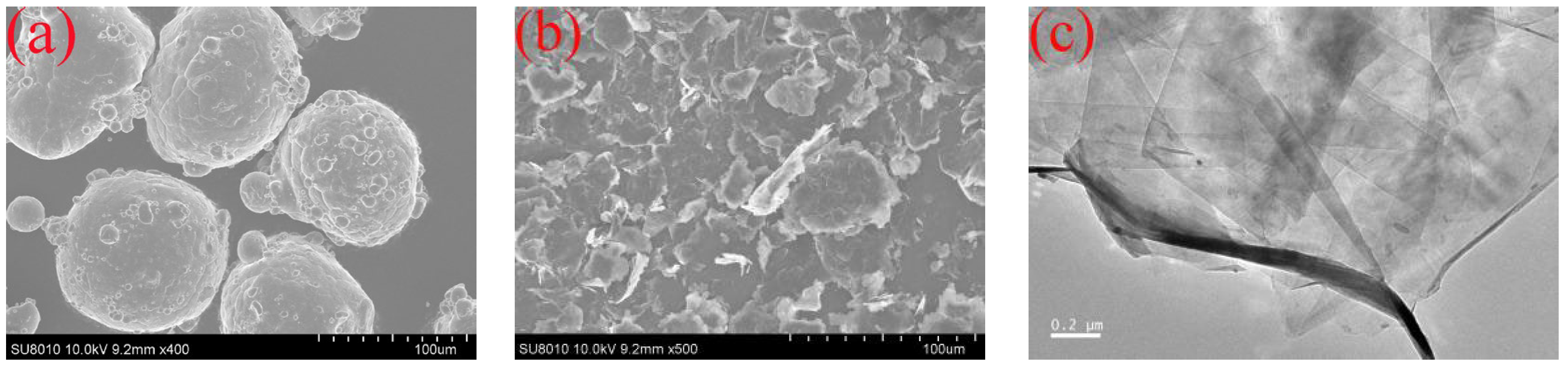
The experimental aluminum powder used was high-purity aluminum powder (purity ≥ 99%) with a particle size of 100–200 mesh. The morphology of scanning electron microscopy is shown in Figure 1a. From Figure 1a, it can be observed that most of the aluminum particles are nearly spherical in shape, with only a small number of larger particles. The majority of the aluminum particles exhibit minimal size variation, with an average particle diameter of approximately 130 μm. Figure 1b displays GNPs produced by the Chengdu Organic Chemicals Co., Ltd. (Chengdu, China) of the Chinese Academy of Sciences, with individual flake sizes ranging from 5–10 μm. As seen in Figure 1b, GNPs tend to agglomerate due to their high specific surface energy and surface area [18,19,20], which explains why the observed flakes appear as larger aggregates. Figure 1c presents the transmission electron microscopy morphology of the GNPs, clearly revealing their wrinkled sheet-like structure with multiple layers stacked together, totaling fewer than 20 layers.
To avoid direct addition of GNPs leading to burning loss during smelting, the experiment adopted the form of Al-GNPs intermediate preforms for addition. The preparation process of the preforms is as follows: GNPs were proportioned at 6 wt% of the mixed powder (aluminum powder and GNPs). First, GNPs were mixed with anhydrous ethanol in a beaker and subjected to ultrasonic dispersion for 100 min (ultrasonic power 480 W, frequency 40 kHz); aluminum powder was mechanically stirred with anhydrous ethanol in a beaker at 100 r/min for 100 min; then, aluminum powder was uniformly sprinkled into the ultrasonicated alcohol and GNPs mixture, followed by continued ultrasonic treatment and stirring for 60 min. Subsequently, the mixed powder-alcohol slurry was stirred on a constant-temperature heating magnetic stirrer (heating temperature 50 °C, stirring speed 1500 r/min) until the mixture became paste-like, at which point stirring was stopped. The mixed powder was first dried in a vacuum drying oven, then sintered in a vacuum hot-press sintering furnace (400 °C, 60 MPa) to produce an intermediate Al-GNPs preform, which was subsequently cut into small particles for further processing, which were cut into small particles for later use.

2.2. Preparation of 2014Al-GNP Composites

First, the graphite crucible is dried, and the casting mold is preheated to 200 °C in a heat treatment furnace. The 2014Al alloy is cut into small pieces for later use, while the Al-GNPs intermediate preform is cut into small granules and wrapped in aluminum foil for storage. Next, the weighed 2014Al alloy is placed into the graphite crucible, which is then heated to 780 °C in a resistance furnace and held at this temperature for 30 min. After the alloy is completely melted, hexafluoroethane is used for refining and slag removal. Subsequently, the prepared Al-GNPs intermediate preform is added to the crucible in batches from different angles. The amount of GNPs added follows the specified proportion of the total melt weight (0.0 wt%, 0.8 wt%). During the addition of GNPs, high-energy ultrasound is applied with a power of 2.8 kW, a frequency of 20 kHz, and a duration of 12 min. After ultrasonic treatment, the melt is cooled to 720 °C and then poured into the preheated metal mold. Once the molten metal solidifies and cools, the casting is removed. Throughout the entire smelting process, argon gas is introduced for protection.
Hot extrusion was performed using as-cast 2014Al-GNP composite material with a mass fraction of 0.8 wt%. Before extrusion, the cast composite is placed in the vacuum heat treatment furnace for homogenization treatment. Additionally, graphite powder was applied to the inner wall of the die to reduce friction between the blank and the die. Subsequently, the composite material was hot-extruded at different extrusion ratios, with an extrusion temperature of 435 °C and an extrusion rate of 10 mm/min. The extrusion ratios were set at 8, 12, and 16, respectively.

2.3. Performance Testing and Material Characterization

Use Archimedes’ principle to determine the actual density of the material. The microstructure morphology of the alloy samples was observed using a Nican-M300 optical microscope, with the metallographic specimens etched by a 0.5% volume fraction HF solution. The microhardness of the material was tested using an HVS-1000A microhardness tester (HST Holdings LLC., Chester, NJ, USA). The test parameters are: load 100 g, loading time 15 s, test at least 3 points for each sample, and calculate the average value. The room-temperature mechanical properties of the material were measured with a WDW-10PC controlled universal testing machine. The test parameters are: the extension gauge is 35 mm, the strain rate is 10−3 s−1, the clamping force is 5.0 MPa, the diameter of the sample is φ8 mm, and each sample is tested at least 3 times to obtain the average value. The microstructure and fracture morphology of the material were characterized and analyzed using a Zeiss SUPRA55 (Oberkochen, Germany) scanning electron microscope and an Oxford AztecX-MAX80 energy dispersive spectrometer (Thermo Fisher Scientific, Ltd., Waltham, MA, USA). The graphene nanosheet reinforcement phase was microscopically characterized with a JEM-2100 transmission electron microscope (Japan Electron Optics Laboratory Co., Ltd., Tokyo, Japan), while the microscopic interfacial structure of the composite was observed and characterized.

3. Results and Discussion

3.1. Microstructure Analysis of Al-GNPs Mixed Powder

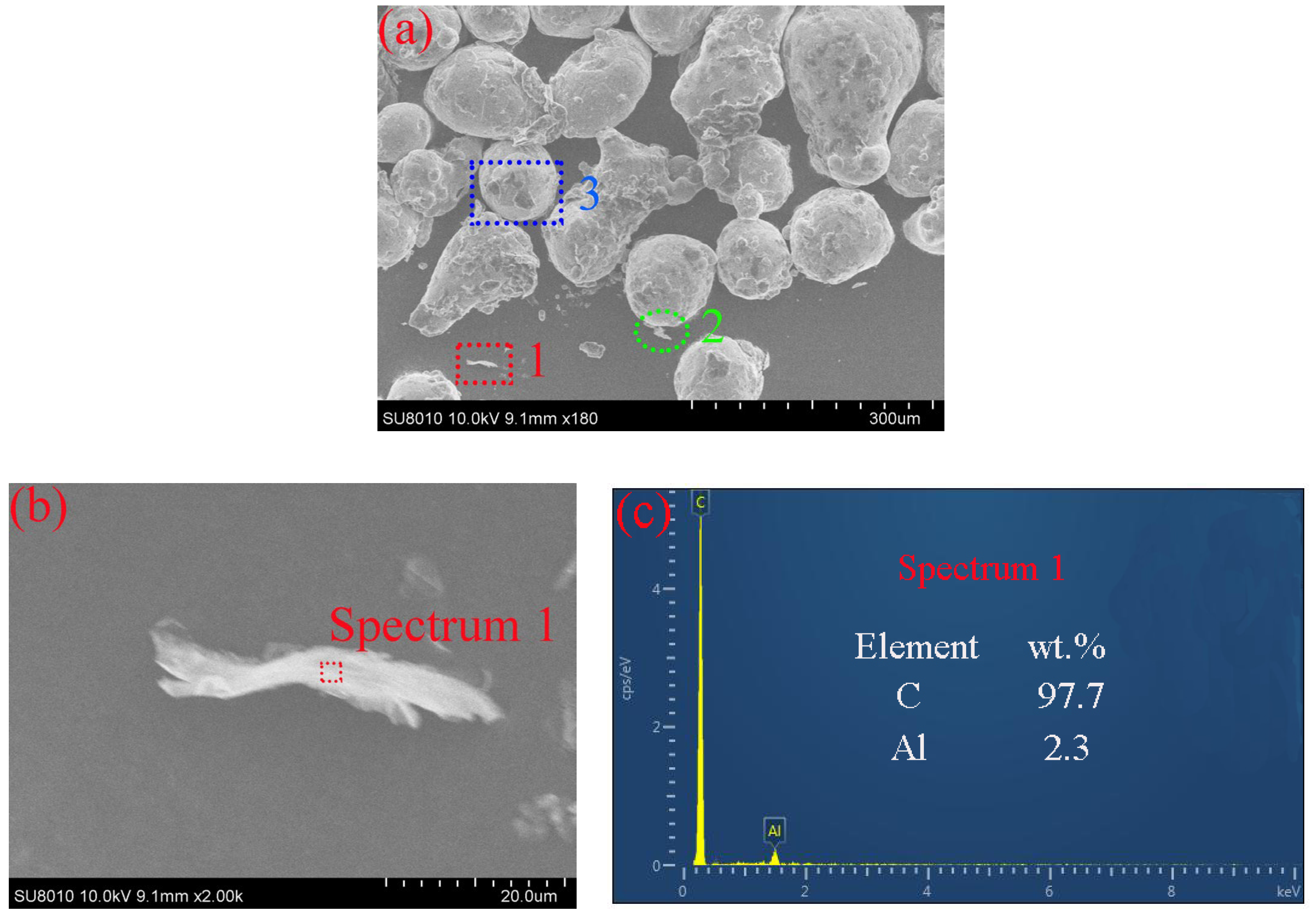
To analyze the dispersion of GNPs in the mixed powder after magnetic stirring, this study characterized the microstructure of the Al-GNPs mixed powder, with the results shown in Figure 2. Figure 2b,d,f are the locally magnified images corresponding to the red square, green circle, and blue square in Figure 2a, respectively, while Figure 2c,e,g are their corresponding energy-dispersive spectra. From Figure 2a, it can be observed that GNPs in the mixed powder exhibit three main distribution states: GNPs scattered between Al particles, as seen in Figure 2b; GNPs adhering to the edges of Al particles, as seen in Figure 2d; and GNPs coating Al particles, with some partially embedded into the interior of Al particles, as seen in Figure 2f. Additionally, no agglomerated GNPs were observed in the images, indicating that GNPs are relatively uniformly dispersed in the mixed powder.

3.2. Optical Microstructure Analysis

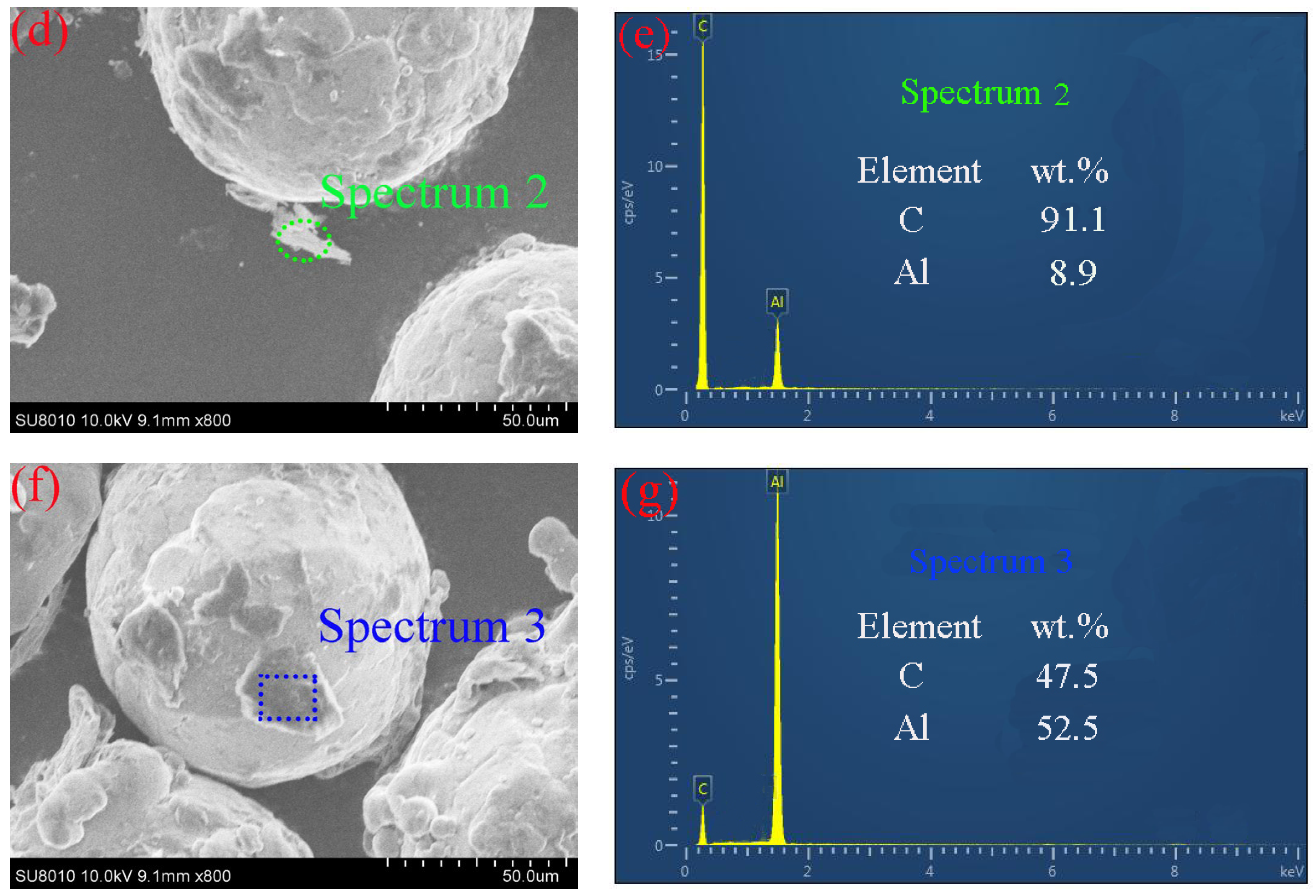
Figure 3 presents the optical microstructures of the as-cast and extruded alloys on the longitudinal section. Figure 3a displays the microstructure of the as-cast 2014Al alloy, where it can be observed that the primary α-Al grains are relatively large, with many unevenly sized grains interconnected to form larger rosette-shaped grains. The secondary phases are also coarser, primarily consisting of light gray Al2Cu phases and dark gray Al2CuMg phases [21,22]. Figure 3b shows the microstructure of the as-cast 2014Al-0.8GNP composite, revealing that the α-Al grain size is reduced, with hardly any large rosette-shaped grains visible. The secondary phase size is also refined, and some black phases appear in the structure, which are speculated to be the added GNPs. Figure 3c–e illustrate the longitudinal microstructures of the 2014Al-0.8GNP composite under extrusion ratios of 8, 12, and 16, respectively. It is evident that the as-cast composite undergoes significant microstructural changes after hot extrusion, with the secondary phases being crushed and distributed in a banded pattern along the extrusion direction under shear forces. When the extrusion ratio is small, the secondary phases in the alloy experience less force, leading to GNP agglomeration under lower extrusion pressure. Larger secondary phase sizes can still be observed, and the spacing between banded structures along the extrusion direction is relatively wide, as shown in Figure 3c. With an increased extrusion ratio, the alloy is subjected to greater extrusion forces, further reducing the secondary phase size and dispersing the agglomerated GNPs. The banded structures along the extrusion direction become denser, as seen in Figure 3d. When the extrusion ratio reaches 16, the secondary phases become even finer, with hardly any large-sized secondary phases remaining. The spacing between banded structures narrows, and the GNPs are further dispersed and more uniformly distributed under higher extrusion forces, as shown in Figure 3e.

3.3. Scanning Electron Microscopy Analysis

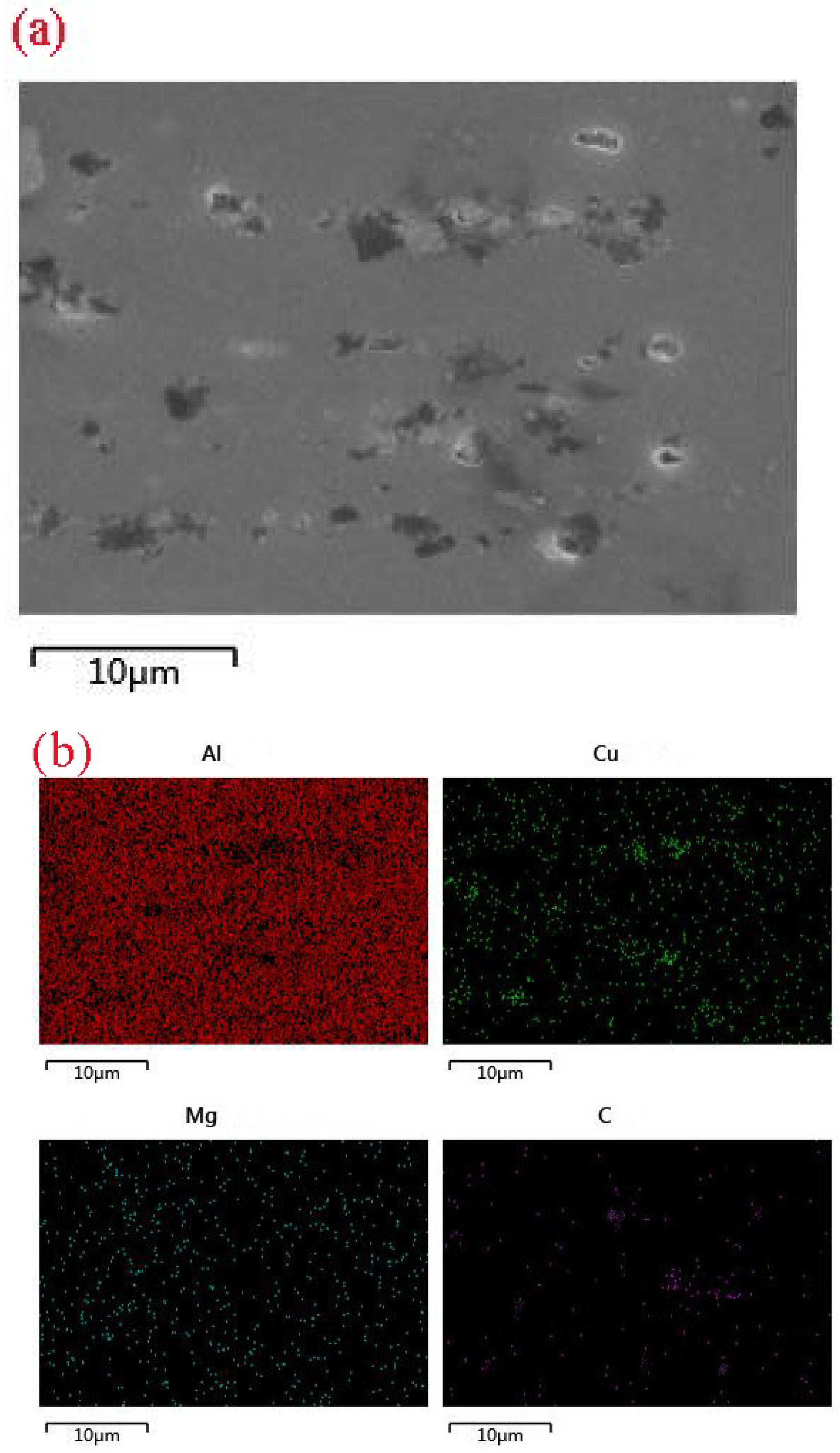
Figure 4 shows the scanning electron microscopy (SEM) microstructure of as-extruded 2014Al-0.8GNP composite at an extrusion ratio of 16. In Figure 4a, three types of secondary phases with light gray, dark gray, and deep black colors can be clearly observed in the microstructure. These phases are finely and uniformly distributed along the extrusion direction under the action of substantial extrusion force. Figure 4b presents the corresponding elemental mapping of Figure 4a. The distribution of Al and Mg elements appears relatively uniform, with both elements present throughout almost the entire region. In contrast, Cu elements are primarily concentrated in the light gray blocky phase regions. These Cu-rich areas mainly consist of Al2Cu phase, with a small amount of Al2CuMg phase dispersed around the Al2Cu phase. Meanwhile, C elements are predominantly distributed in the deep black phase regions, confirming that these deep black phases correspond to the added GNPs. These GNPs exhibit a wrinkled sheet-like morphology, with an average grain size ranging between 4~5 μm.

3.4. EBSD Organizational Analysis

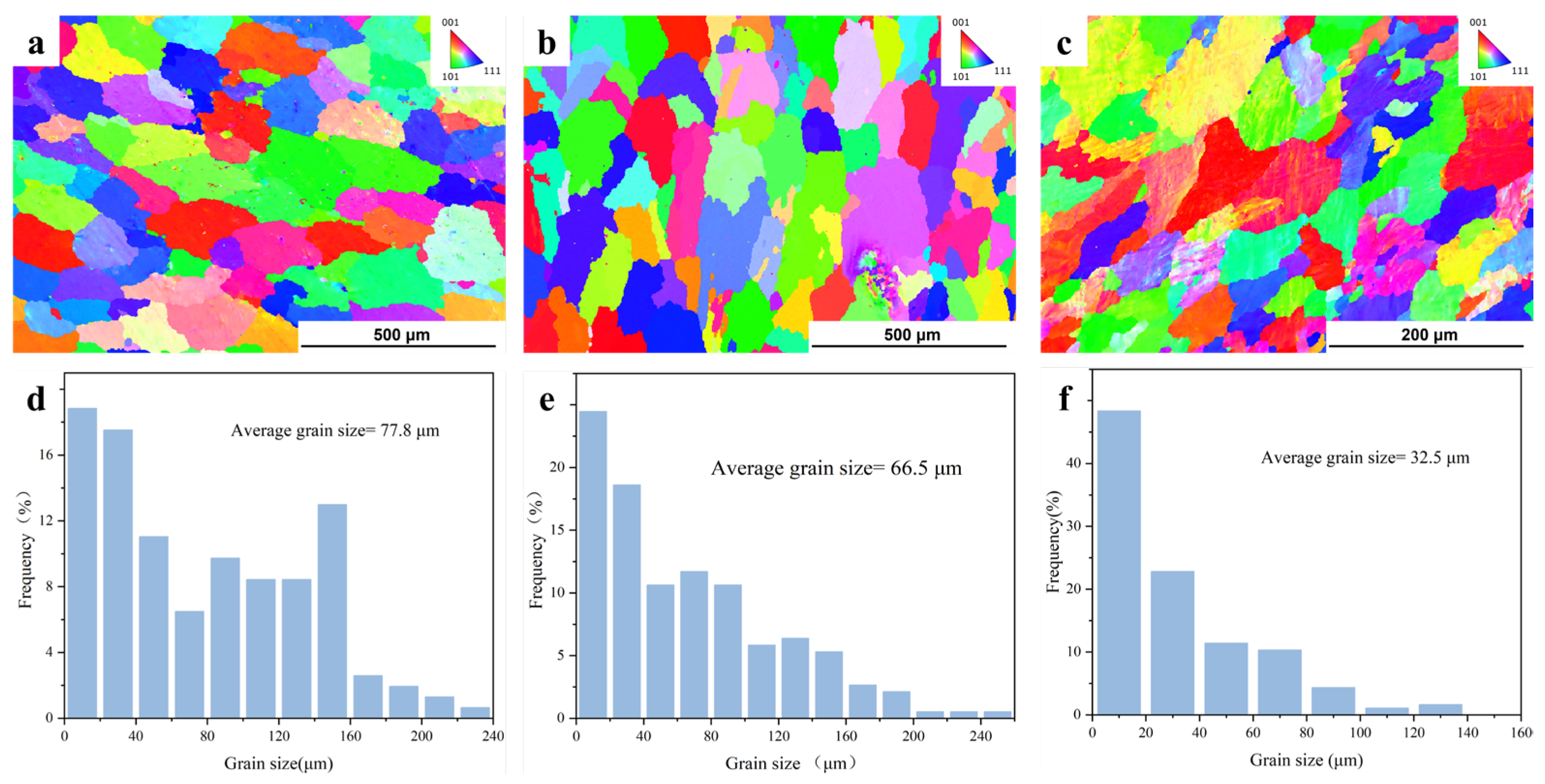
Figure 5a–c shows the EBSD IPF maps of as-cast 2014Al, as-cast 2014Al-0.8GNPs, and 2014Al-0.8GNP alloy with an extrusion ratio of 16, respectively, while Figure 5d–f presents their corresponding average grain sizes. The results indicate that the average grain size of the alloy significantly decreases with the addition of GNPs and the application of hot extrusion. Specifically, the grain size of the as-cast 2014Al alloy sample reaches up to 77.8 µm, whereas it decreases to 66.5 µm in the as-cast 2014Al-0.8GN alloy, representing a reduction of approximately 15%. This demonstrates that the addition of GNPs partially refines the alloy’s grain structure, likely due to their ability to form fine dispersed phases at the liquid-solid interface during solidification, which facilitates heterogeneous nucleation and inhibits grain growth [23]. Furthermore, after hot extrusion treatment, the grain size of the as-cast 2014Al-0.8GNP alloy material is further reduced to 32.5 µm. This further demonstrates that thermoplastic deformation and subsequent dynamic recrystallization significantly promote the generation of refined new grains, and deformation-induced dislocation proliferation provides abundant energy conditions for recrystallization [24,25].
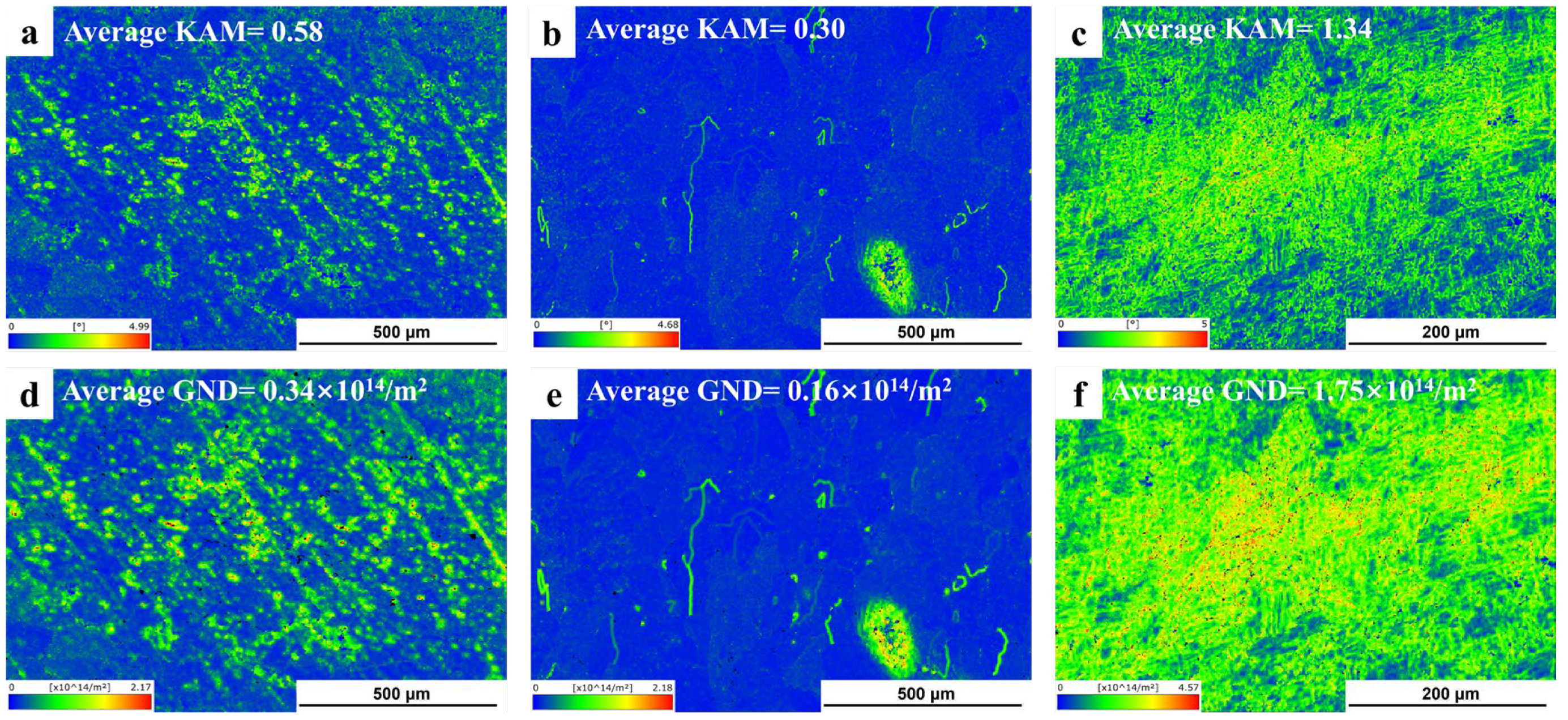
Figure 6a–c displays the average KAM values of as-cast 2014Al, as-cast 2014Al-0.8GNPs, and 2014Al-0.8GNP alloy with an extrusion ratio of 16, while Figure 6d–f show their corresponding average GND values. The KAM value is used to reflect the distribution of local misorientation and dislocation density within the crystal. The results show that the KAM value of the extruded state reaches as high as 1.34, which is higher than that of the as-cast specimens. This finding aligns with the significant increase in GND density (1.75 × 10¹⁴/m2), indicating that a large number of dislocations accumulated inside the alloy during the hot extrusion process. Concurrently, the dynamic recrystallization process continuously formed new equiaxed recrystallized grains, effectively releasing the deformation storage energy. In contrast, the KAM values of as-cast 2014Al and as-cast 2014Al-0.8GNPs are 0.58 and 0.30, respectively, suggesting that the as-cast samples exhibit smaller internal strains and more gradual local orientation changes in the absence of significant plastic deformation.
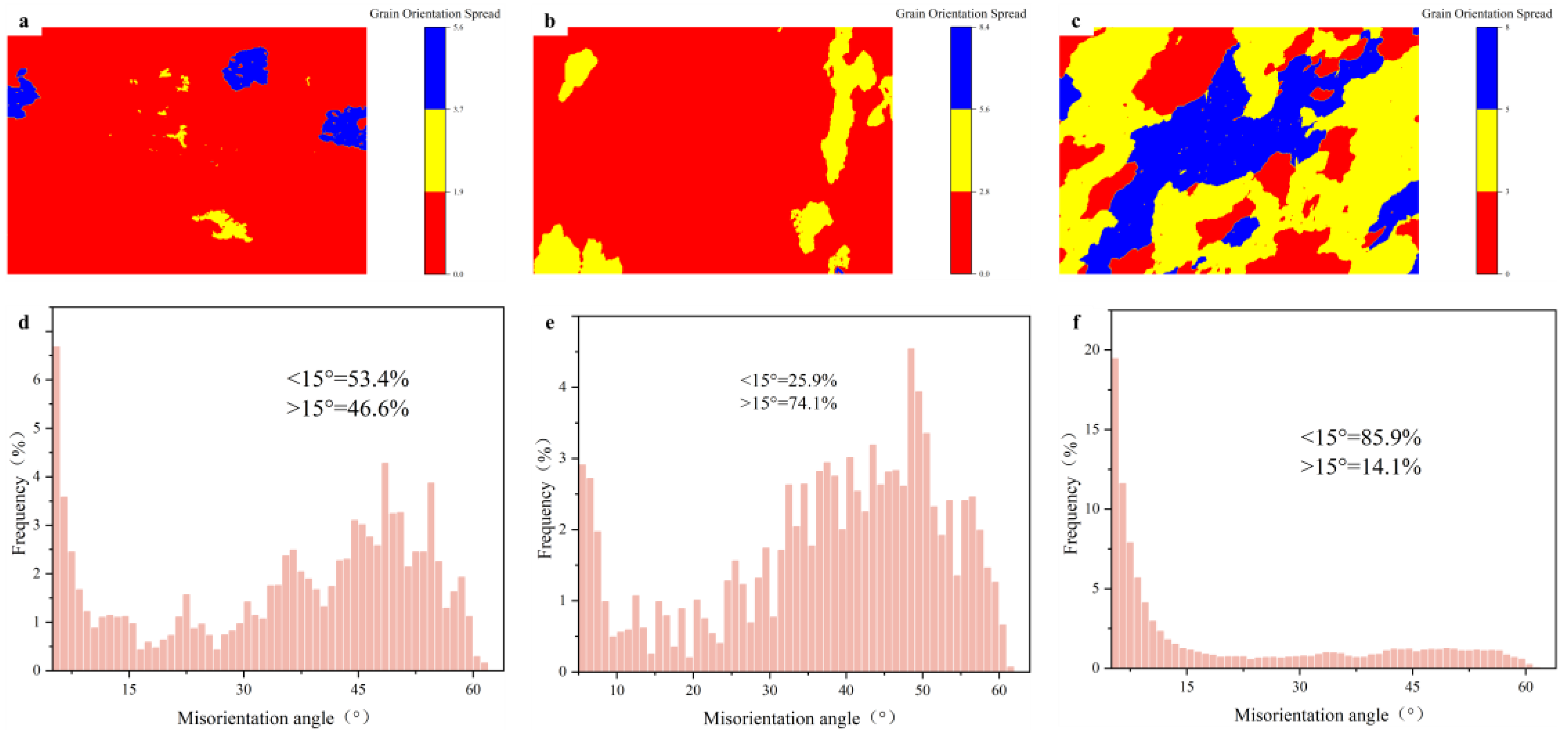
Figure 7a–c shows the grain orientation distribution of different alloys, while Figure 7d,e displays their corresponding orientation angle distributions. The proportion of high-angle grain boundaries serves as a crucial parameter characterizing material recrystallization. In as-cast 2014Al-0.8GNPs, the high-angle grain boundary ratio increased from 46.6% in the as-cast 2014Al matrix alloy to 74.1%, significantly higher than that of the GNPs-free as-cast sample. This indicates that the addition of GNPs promotes the formation of newly recrystallized grains and improves the overall grain boundary structure. The high-angle grain boundary ratio in hot-extruded 2014Al-0.8GNP alloy decreased to 14.1%, suggesting that the hot extrusion process generated numerous new low-angle grain boundaries and subgrain structures. This phenomenon may also be associated with high-density twin boundaries and subgrain structures induced by dynamic recovery [26]. Combined with crystallographic orientation analysis, the texture evolution and recrystallization mechanism of the alloy during hot extrusion have changed significantly. Furthermore, as shown in Figure 7d–f, the angular distribution histograms of both as-cast matrix and as-cast composites exhibit complex patterns, whereas those of hot-pressed composites demonstrate an approximately exponential distribution. This phenomenon may be attributed to the disruption of equiaxed crystal growth during the hot-pressing process.
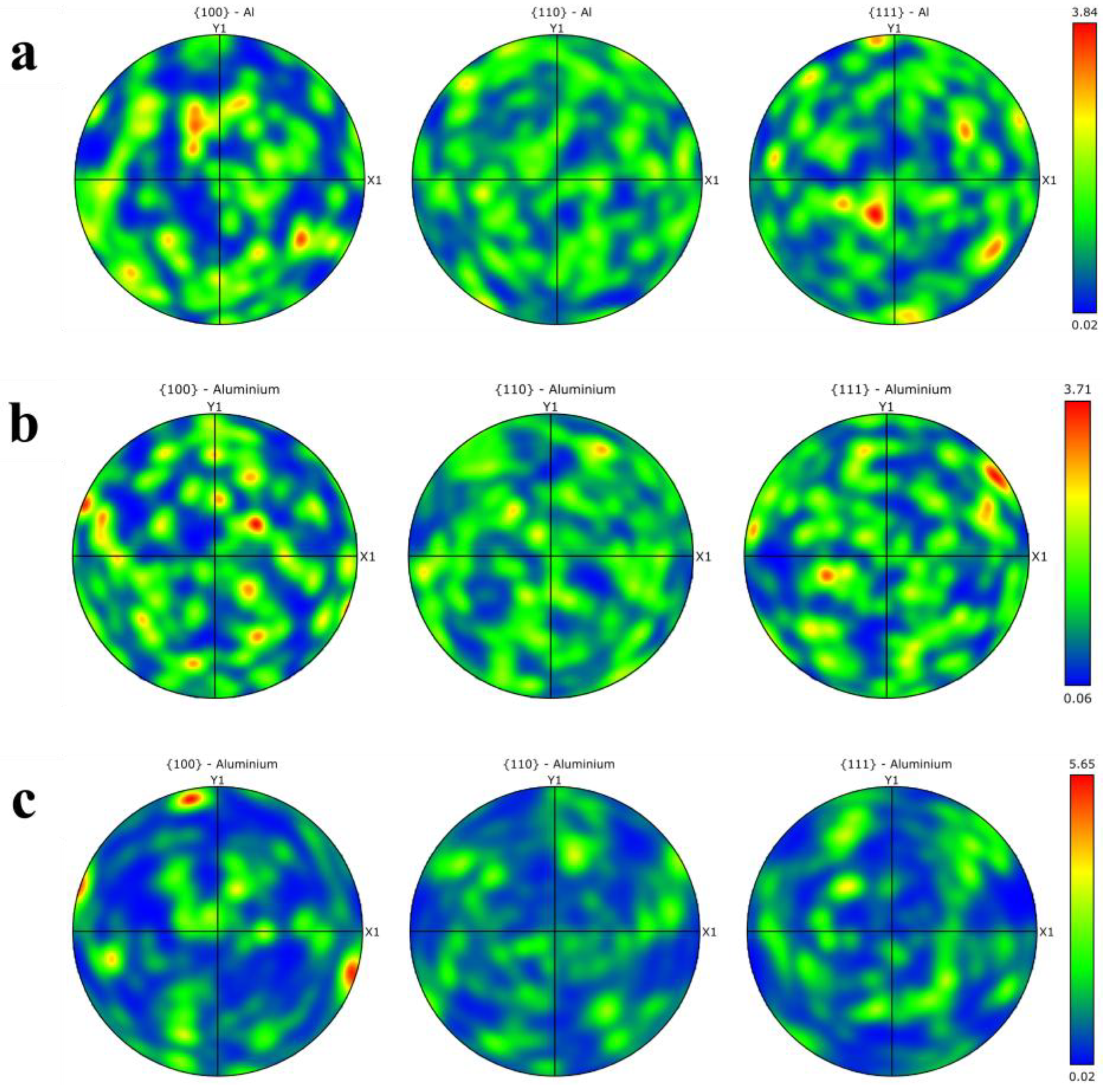
Figure 8a–c, respectively, displays the polar plots of three alloys: as-cast 2014Al, as-cast 2014Al-0.8GNPs, and extruded 2014Al-0.8GNPs. The weaker texture intensity (3.84) in the as-cast 2014Al sample reflects a relatively random grain orientation distribution during solidification under as-cast conditions, lacking a significant preferred growth direction. After introducing GNPs, the texture intensity decreased from 3.84 to 3.71, indicating a weakening of texture intensity, which may be related to grain refinement and increased grain boundaries. The precipitation of GNPs in the melt promoted nucleation, leading to a significant reduction in grain size. Due to the increased random orientation of grain boundaries, the overall preferred orientation of the texture was less likely to form, resulting in a slight decrease in texture intensity. Alternatively, certain GNPs may act as heterogeneous nucleation sites, accelerating random grain growth and consequently degrading the overall texture.
Following hot extrusion, the (001) texture intensity significantly increased to 5.65, indicating the formation of a distinct preferred crystal orientation. This may originate from the strong plastic deformation of grains during hot extrusion, where slip systems, twinning, dynamic recovery, and recrystallization promote the growth of preferred grain orientations. Particularly under hot working conditions, grain rotation and slip system activation tend to align with specific orientations, enhancing the (001) fiber texture. During dynamic recrystallization, subgrain boundaries and regions with high dislocation density become preferential nucleation sites for recrystallization, forming relatively uniform orientations and strengthening the texture [27,28]. From the perspective of texture intensity, the (001) crystal plane orientation of the hot-extruded 2014Al-0.8GNP alloy was the strongest, with a pole figure texture intensity reaching 5.65, surpassing that of the as-cast 2014Al (3.84) and as-cast 2014Al-0.8GNPs (3.71). This indicates that the hot deformation and subsequent recrystallization process significantly promoted the formation of preferred orientations. Such a strong texture contributes to improving the mechanical properties and anisotropic control of the material [29].

3.5. Transmission Electron Microscopy Tissue Analysis

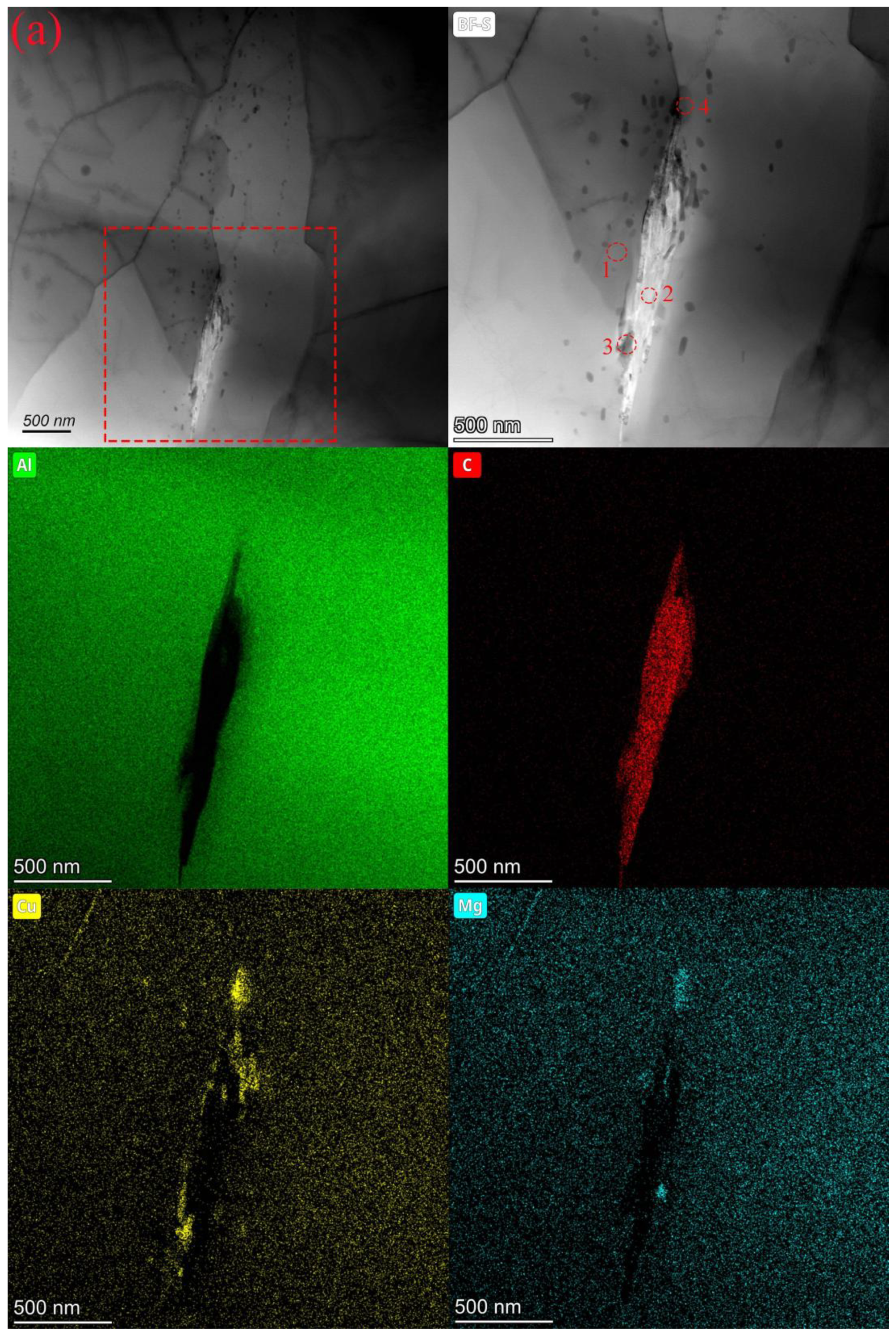
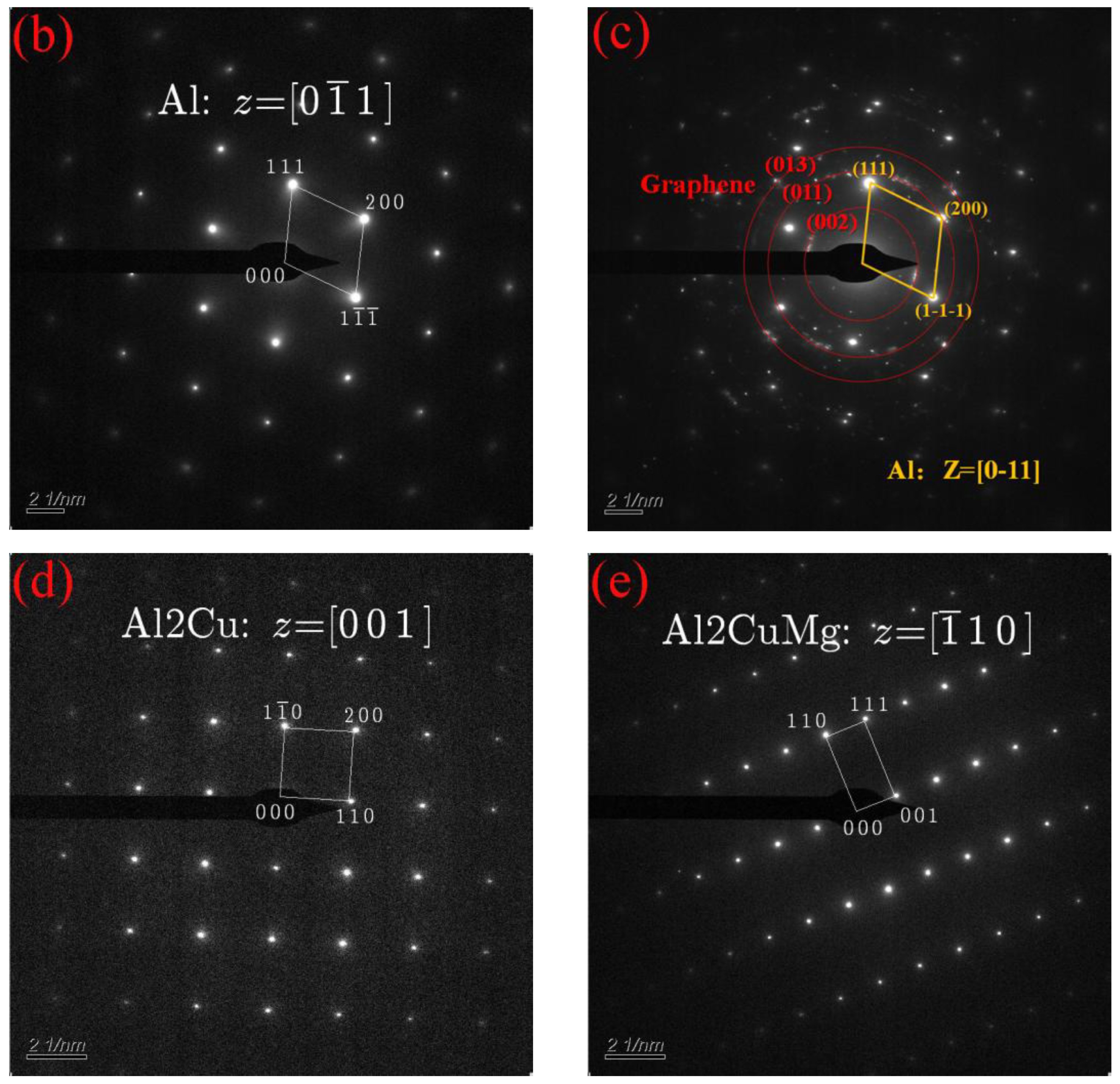
Figure 9 depicts the transmission electron microscopy (TEM) area scanning analysis of the 2014Al-0.8GNP composite under a deformation condition with an extrusion ratio of 16. Figure 9a displays the TEM area scanning morphology of the composite. The area scanning of Al elements (green regions) shows their predominant distribution, while almost no Al elements are observed in the elongated phase regions. The area scanning of C elements (red regions) precisely corresponds to the silver-white strip-like phases. Cu elements (yellow regions) and Mg elements (blue regions) exhibit partial overlap, with both adhering to the periphery of the C-rich phases. To further identify these phases, selected area electron diffraction (SAED) patterns were calibrated at points 1–4 in Figure 9a, corresponding to the phases shown in Figure 9b–e. It can thus be concluded that the silver-white phases represent the added GNPs, which distribute along grain boundaries, while the secondary phases adjacent to the graphene are identified as Al2Cu and Al2CuMg phases.
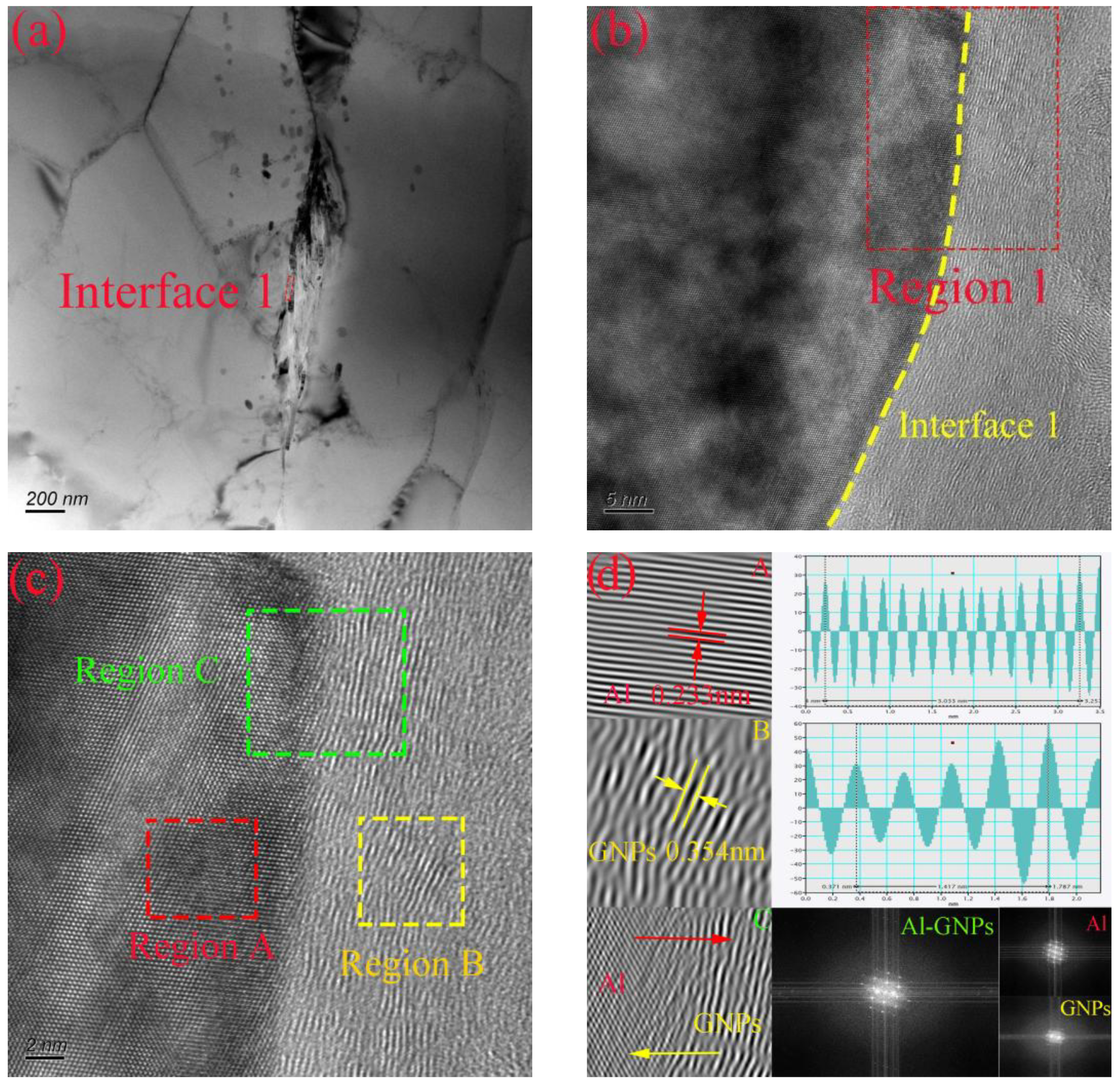
Figure 10 presents the transmission electron microscopy (TEM) interfacial bonding analysis of the 2014Al-0.8GNP composite under the given extrusion conditions. Figure 10a shows the TEM image of the GNPs region, where a gray-white phase resembling wrinkles can be observed, which corresponds to the GNPs. Figure 10b displays the high-resolution image of Interface 1 in the GNPs region from Figure 10a. It is evident that the areas on either side of Interface 1 exhibit distinct differences: the left side is the Al matrix region, while the right side is the GNPs region. To investigate the bonding state between the GNPs and the matrix, a higher magnification of Region 1 in Figure 10b was performed, as shown in Figure 10c. Figure 10c clearly reveals the lattice fringes of both the Al matrix and the GNPs. For more precise measurement of their lattice fringes, inverse Fourier transforms were conducted on Regions A, B, and C in Figure 10c, yielding Figure 10d. Region A corresponds to the lattice fringes of the Al matrix, Region B to those of the GNPs, and Region C to the lattice fringes at the interfacial bonding between the GNPs and the Al matrix. From Figure 10d, the interplanar spacings of the Al lattice and GNPs were calculated to be 0.233 nm and 0.354 nm, respectively, which closely match the standard lattice spacings of aluminum and GNPs [30]. Combined with Figure 10c,d, it can be observed that the interfacial bonding between GNPs and the matrix is remarkably clean, with mutual diffusion and penetration of Al and C atoms, and no formation of the Al4C3 phase, indicating a favorable bonding state.
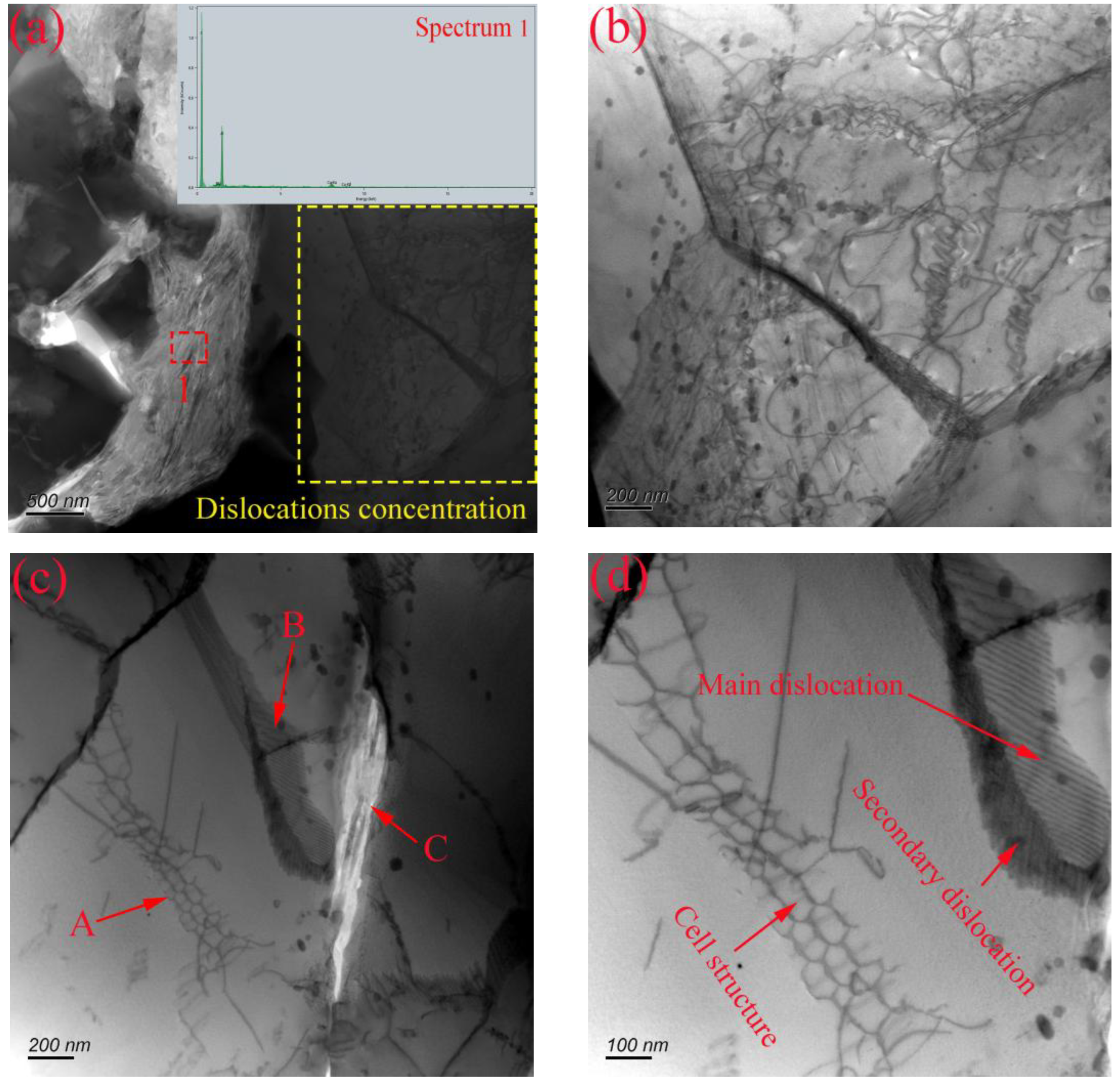
Figure 11 shows the dislocations observed in the transmission electron microscopy (TEM) microstructure of the 2014Al-0.8GNP composite at an extrusion ratio of 16. From Figure 11a, it can be observed that dislocation concentration occurs adjacent to the wrinkled flake-like phase. To determine the composition of the wrinkled flake-like phase, energy-dispersive spectroscopy (EDS) analysis was performed at point 1 of this phase, as shown in the upper right corner. The EDS analysis confirms that this phase is the addition of GNPs. Figure 11b is an enlarged view of the boxed area in Figure 11a, revealing a high density of dislocations and the phenomenon of dislocation entanglement. This is attributed to the significant difference in thermal expansion coefficients between GNPs and the aluminum matrix, which induces a large number of misfit dislocations at their interface due to coefficient mismatch [31]. As shown in Figure 11c, regions A and B exhibit distinct phase distributions resembling cellular and banana-leaf structures, respectively, while phase C corresponds to the GNPs. Figure 11d presents an enlarged image of regions A and B from Figure 11c. The cellular structure in region A forms as a result of dynamic recovery during hot extrusion, where different dislocation entanglement zones evolve into independent cellular structures. These adjacent cellular structures typically exhibit minor crystallographic orientation differences, forming low-angle grain boundaries, which facilitate subsequent dynamic recrystallization [32,33]. The banana-leaf structure in region B arises when dislocations encounter high-strength GNPs, preventing further movement due to insufficient force to overcome the obstacle. Consequently, dislocations accumulate in front of GNPs, leading to dislocation pile-up. Additionally, Figure 11d reveals secondary dislocation pile-ups adjacent to the primary ones. This occurs because as the number of piled-up dislocations from the primary source increases, the leading dislocation exerts greater force on GNPs. Once this force reaches a critical level, it activates dislocation sources in neighboring grains, resulting in secondary dislocation pile-ups [34].

3.6. Mechanical Property Testing and Fracture Surface Scanning

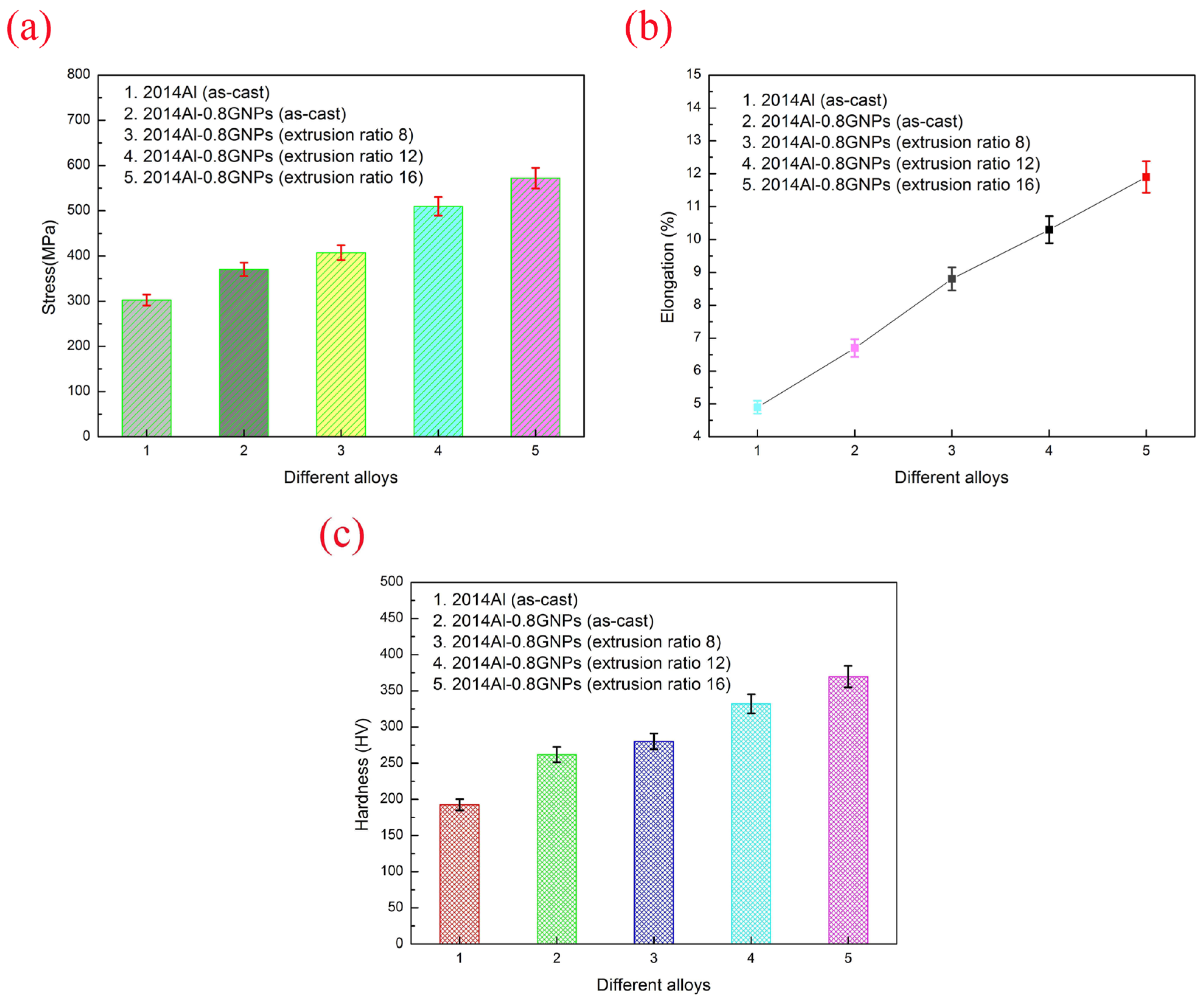
Through mechanical property testing of as-cast 2014Al alloy, as-cast 2014Al-0.8GNP alloy, and extruded 2014Al-0.8GNP alloys with different extrusion ratios, key data such as tensile strength, elongation, and hardness were obtained. These data visually demonstrate the effects of various factors on alloy performance. As shown in Figure 12a, the as-cast 2014Al alloy exhibits a relatively low tensile strength at only 302.7 MPa. When 0.8 wt.% GNPs were added to the alloy, the tensile strength of the as-cast material increased to 370.4 MPa, representing a 22.4% improvement compared to the as-cast base alloy. This enhancement is primarily attributed to the refinement of the alloy microstructure by GNPs, which increases grain boundary area and impedes dislocation motion, thereby improving tensile strength. After hot extrusion of the as-cast 2014Al-0.8GNP alloy, the tensile strength showed a continuous upward trend with increasing extrusion ratio. At an extrusion ratio of 16, the composite material achieved a tensile strength of 572.1 MPa, marking an 89.0% increase over the as-cast base alloy. This is due to the greater compactness of the alloy microstructure and more uniform dispersion of GNPs under higher extrusion forces during hot extrusion, which further enhances the load-transfer capability of GNPs. Additionally, refined grains and uniformly distributed secondary phases contribute to the improved tensile strength. In terms of elongation (Figure 12b), the alloy with GNPs also exhibited an increasing trend. The as-cast 2014Al-0.8GNP alloy showed an elongation of 6.7%, a 36.7% improvement over the as-cast base alloy. This is because the presence of GNPs improves the microstructure of the alloy and reduces the likelihood of crack formation, allowing greater plastic deformation under stress. With increasing extrusion ratio, the enhancement in elongation became more pronounced. At an extrusion ratio of 16, the elongation reached 11.9%, a 142.9% increase compared to the as-cast base alloy. This is attributed to the more uniform microstructure and elimination of internal defects through hot extrusion, which enhances the material’s plastic deformation capability and significantly improves elongation. Figure 12c compares the hardness of different alloys, showing a similar trend to tensile strength and elongation, gradually increasing with the addition of GNPs and higher extrusion ratios. The as-cast matrix alloy had a hardness of 192.5 HV, while the as-cast 2014Al-0.8GNP alloy reached 261.9 HV, a 36.1% improvement. This increase is due to the strengthening effect of GNPs and grain refinement. After hot extrusion under optimal parameters, the hardness further increased to 369.6 HV, a 92.0% improvement over the as-cast matrix alloy. This is because hot extrusion further refines the grains, ensures more uniform distribution of secondary phases, and strengthens the bonding between GNPs and the matrix, thereby significantly enhancing material hardness.
Table 2 presents the density and porosity data of various alloy materials. The experimental density and porosity of as-cast alloys are notably lower, primarily due to shrinkage cavities and porosity formation during casting, which may also introduce air into the mold cavity. The table reveals that the experimental density and porosity of as-cast 2014Al-0.8GNP composites are slightly reduced compared to the as-cast 2014Al matrix alloy. This reduction occurs because graphene nanosheets have significantly lower density than the aluminum matrix. When ultrasonically dispersed in the matrix alloy, graphene reduces the alloy’s average density. The lower porosity of as-cast composites results from graphene agglomeration, where the poor wettability between aggregated graphene and liquid aluminum leads to interfacial porosity. Additionally, the table shows that the experimental density and porosity of extruded alloys are more consistent. Within a specific range, porosity increases with higher extrusion ratios, reaching 98.12% at a ratio of 16. This improvement stems from thermal extrusion, eliminating internal porosity, shrinkage cavities, and interfacial voids caused by poor graphene-matrix bonding. Simultaneously, intense triaxial compressive stress and high temperatures induce vigorous plastic flow in the aluminum matrix, effectively filling micro-scraps between graphene nanosheets and the matrix. Consequently, thermal extrusion achieves enhanced density and significantly improves the mechanical properties of the alloy materials.
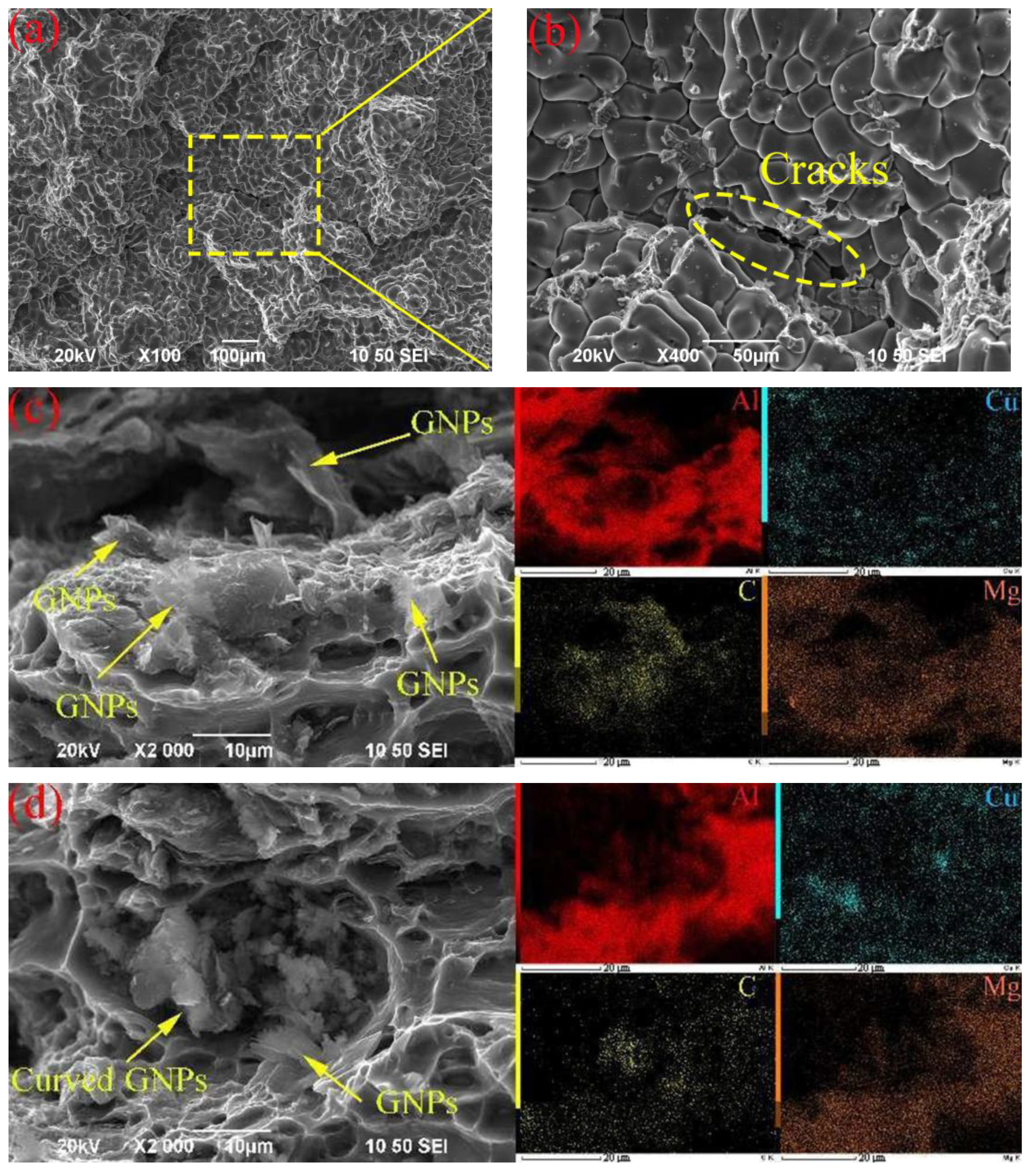
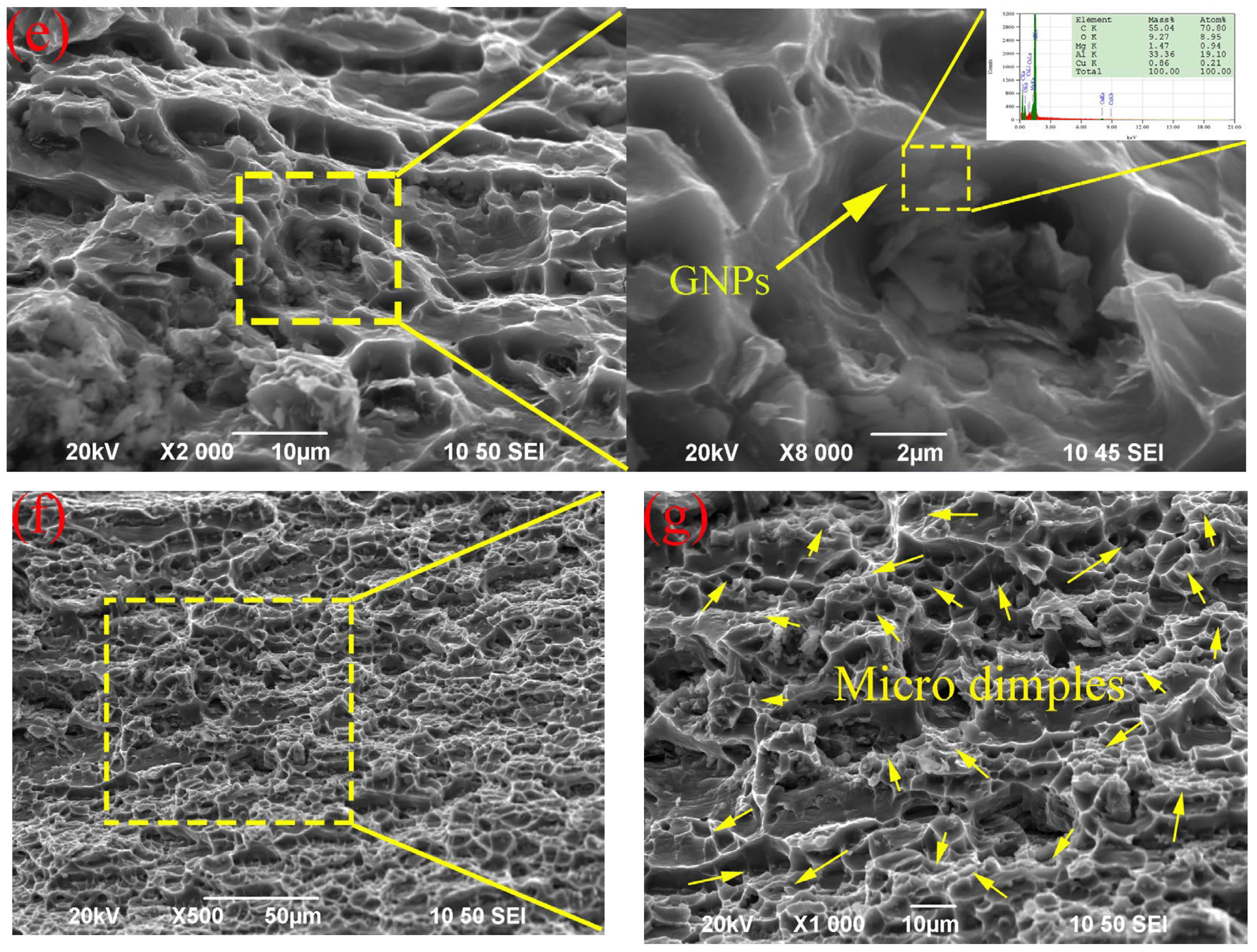
Figure 13 compares the fracture morphologies of as-cast 2014Al and 2014Al-0.8GNP alloy with an extrusion ratio of 16. Figure 13a shows a low-magnification fracture observation of the as-cast matrix alloy. It can be seen that the fracture surface exhibits large tear ridges and cleavage platforms, with almost no obvious dimple characteristics. Even larger cracks can be observed, demonstrating relatively distinct brittle fracture features [35]. Figure 13b is an enlarged view of the boxed area in Figure 13a, revealing large cracks along grain boundaries, indicating intergranular fracture characteristics. Figure 13c–e display several different states of graphene fracture observed on the fracture surface of the extruded alloy material. From Figure 13c, it can be seen that the GNPs on the fracture surface exist in two states: the first state shows GNPs being pulled out at a certain inclined angle relative to the matrix alloy, while the second state shows GNPs parallel to the matrix. When the matrix bears a certain load, multilayer GNPs are separated into fewer-layer GNPs, resulting in relatively thin GNPs lying flat on the matrix. Figure 13d exhibits curved GNPs distributed on the fracture surface. In this state, when the matrix is subjected to external force, the bending force and direct bearing capacity of the GNPs must be overcome. Figure 13e demonstrates the fracture effect of GNPs under direct tensile loading. In this state, the GNPs are generally aligned parallel to the loading direction, with their interfaces perpendicular to the matrix. When GNPs are uniformly dispersed in the matrix, the alloy material in this state can withstand higher stress, achieving better strengthening effects. Figure 13f shows a low-magnification dimple fracture scan of the extruded alloy, and Figure 13g is a high-magnification view of Figure 13f. Combining these two images, it can be observed that the fracture surface of the extruded alloy is covered with uniformly sized dimples, and the tear ridges become finer and more uniform, with almost no cleavage steps visible. Additionally, submicron or even nanoscale dimples are present near some dimples, demonstrating clear ductile fracture characteristics [36]. Thus, after hot extrusion with suitable parameters, the mechanical properties of the as-cast composite are significantly enhanced.

3.7. Mechanism Enhancement Analysis

Upon adding GNPs to the 2014Al alloy melt, the grain size exhibited a certain degree of improvement. Subsequently, after subjecting the as-cast composite to hot extrusion with optimized parameters, the grain size of the alloy was significantly refined. The grain refinement can be primarily attributed to two factors. The first factor is the further dispersion and refinement of GNPs during the hot extrusion process. The dispersed GNPs formed an extensive network along grain boundaries, effectively pinning the grain boundaries, thereby inhibiting grain growth [37]. The second factor is the substantial shear strain imposed on the aluminum alloy during hot extrusion deformation. The coarse original grains were initially elongated along the shear deformation direction, resulting in the formation of numerous dislocations within the grains and the development of dislocation tangles. As the deformation increased, extensive plastic deformation caused severe distortion of the metal crystal structure and a significant rise in dislocation density, thereby increasing the driving force for recrystallization. In regions with severe distortion, new nuclei were prone to form [38]. These fine recrystallized nuclei also contributed to reducing the average grain size of the alloy to some extent.
In addition to grain refinement strengthening, the effect of dislocation strengthening in the as-extruded 2014Al-GNP alloy is also quite significant. The thermal expansion coefficient of pure aluminum is 23.6 × 10⁻⁶ K−1, while that of GNPs is −1 × 10⁻⁶ K−1, resulting in a difference of 24.6 × 10⁻⁶ K−1 between the two. This substantial disparity in thermal expansion coefficients leads to the formation of numerous dislocations at their interfaces, thereby contributing to strengthening [39]. These dislocations are illustrated in Figure 11a,b. Furthermore, intense dislocation multiplication is more likely to occur in as-extruded alloy materials. During the loading process of the composite, when moving dislocations in the crystal encounter GNPs dispersed in the matrix, they are obstructed by the GNPs, causing the dislocation lines to bend. The greater the load, the more pronounced the bending of the dislocation lines, resulting in increased resistance to dislocation movement. Therefore, uniformly dispersed GNPs effectively hinder the free movement of matrix dislocations, leading to dislocation pile-ups in front of the GNPs, which further increases the dislocation density, as shown in Figure 11c,d.
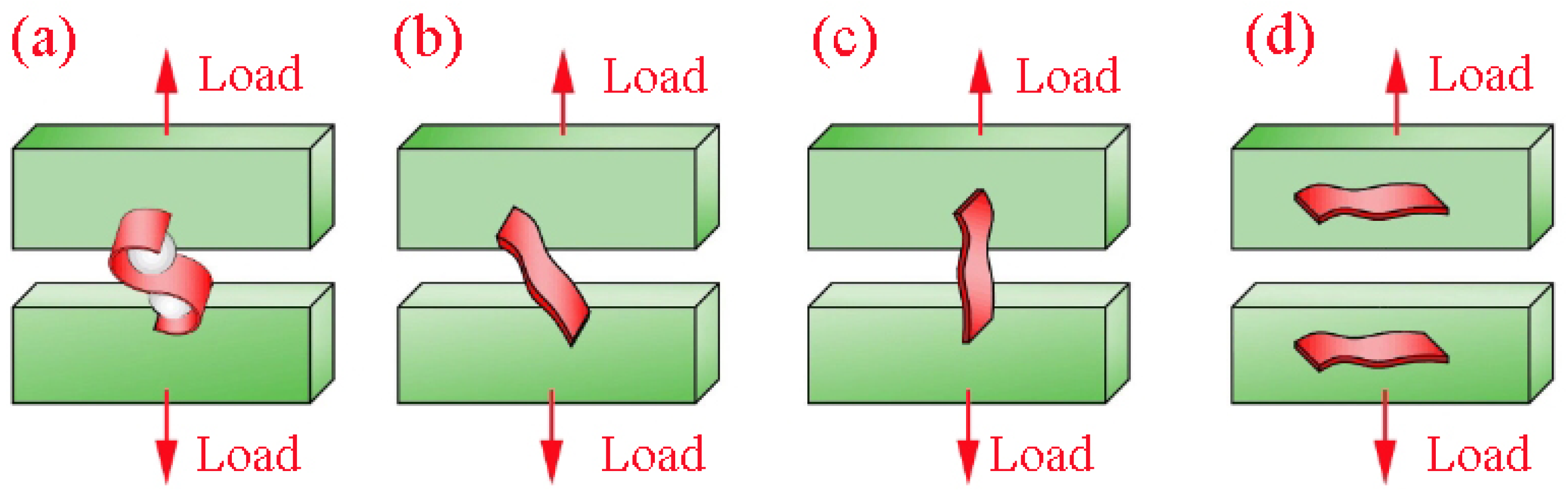
The load transfer strengthening also well illustrates the enhancement effect of graphene from a lateral perspective. Through interfacial shear stress, the load is transferred from the matrix to the GNPs reinforcement phase, fully leveraging the excellent mechanical properties of GNPs. In the 2014Al-GNP alloy material with suitable extrusion parameters, GNPs are effectively dispersed in the melt. The distribution states of dispersed few-layer GNPs in the matrix can be categorized as follows: The first state involves curved GNPs embedded with α-Al grains, as shown in Figure 14a. Under load-bearing conditions in this state, due to the excellent mechanical structure of GNPs, direct pull-out is difficult. When GNPs are pulled out, the wrinkled arrangement of GNPs in different directions easily forms mechanical interlocking with the Al matrix. During the pull-out displacement process, GNPs exert force on the matrix grains, causing grain deformation and consuming significant energy [40]. The second state is when GNPs are distributed at a certain inclined angle relative to the tensile direction of the specimen, as shown in Figure 14b. In this distribution state, GNPs absorb two types of forces decomposed along the parallel and perpendicular directions of GNPs under tensile load. The third state is when GNPs are distributed parallel to the tensile direction of the specimen, as shown in Figure 14c. In this distribution state, GNPs can absorb more load transferred from the matrix, as illustrated in Figure 14d, contributing significantly to the mechanical properties of the composite. The fourth state is when GNPs are distributed perpendicular to the tensile direction of the specimen. In this state, GNPs absorb less load transferred from the matrix, primarily overcoming the binding energy between GNPs layers and their interfacial bonding strength with the matrix. These load-strengthening effects can all be observed in the fracture surface scanning shown in Figure 13.

4. Conclusions

A 2014Al matrix composite reinforced with 0.8 wt.% GNPs was prepared through pre-dispersion and ultrasonic melt casting methods. Subsequently, the as-cast 2014Al-0.8GNP alloy was subjected to hot extrusion processing with various parameters. The microstructures and properties of various alloys were then compared. The research results indicate that:
(1)
The addition of GNPs effectively promotes the refinement of the as-cast matrix alloy microstructure. Hot extrusion with appropriate parameters further refines the microstructure of the as-cast aluminum matrix composite. When the extrusion ratio reaches 16, the alloy microstructure undergoes significant refinement, with the Al2Cu phase, Al2CuMg phase, and GNPs phase exhibiting band-like distribution along the extrusion direction, becoming finer and more uniformly dispersed.
(2)
After undergoing hot extrusion deformation with appropriate parameters, the as-cast aluminum matrix composite exhibits a significant increase in dislocation density and KAM value, intensified dynamic recrystallization, and further strengthening of the texture. At this stage, the composite material attains a tensile strength of 572.1 MPa, a hardness of 369.6 HV, and elongation of 11.9%, representing improvements of 89.0%, 92.0%, and 142.9%, respectively, compared to the as-cast matrix alloy. Fracture surface scanning also reveals that the matrix alloy fractures in a brittle manner, whereas the extruded composite material displays distinct ductile fracture characteristics.
(3)
In extruded aluminum matrix composites, the interface bonding between GNPs and the matrix is exceptionally clean, with mutual penetration and diffusion of Al and C atoms, resulting in an optimal interfacial bonding state. The significant improvement in the mechanical properties of the extruded alloy is primarily attributed to grain refinement strengthening, dislocation strengthening, and the load transfer strengthening effect of GNPs.

Author Contributions

Conceptualization, J.X., S.M., J.Z. and Y.Z.; Methodology, J.X., S.M., J.Z. and Y.Z.; Investigation, J.X., S.M., J.Z. and Y.Z.; Resources, J.X. and S.M.; Data curation, J.X., S.M., J.Z. and Y.Z.; Writing—original draft, J.X., S.M.; Writing—review & editing, J.X., S.M., J.Z. and Y.Z.; Supervision, J.X. and J.Z.; Project administration, J.X. and Y.Z.; Funding acquisition, J.X. and Y.Z. All authors have read and agreed to the published version of the manuscript.

Funding

This study was supported by the Design and Simulation of the End Effector for a Tea-Picking Robot (Grant No. AUCIEERC–2022–10) and the High-level Talents Research Project of West Anhui University (Grant No. WGKQ2022064).

Data Availability Statement

The original contributions presented in this study are included in the article. Further inquiries can be directed to the corresponding author(s).

Conflicts of Interest

The authors declare no conflicts of interest.

References

  1. Hu, J.Y.; Liu, P.; Sun, S.Y.; Zhao, Y.H.; Zhang, Y.B.; Huo, Y.S. Relation between heat treatment processes and microstructural characteristics of 7075 Al alloy fabricated by SLM. Vacuum 2020, 177, 109404. [Google Scholar] [CrossRef]
  2. Qi, Q.W.; Li, M.; Duan, Y.H.; Bu, H.Y.; Li, M.N. Effect of Solution Heat Treatment on the Microstructure and Microhardness of 7050 Aluminum Alloy. Metals 2023, 13, 1819. [Google Scholar] [CrossRef]
  3. Zhu, X.; Zhao, Y.G.; Wu, M.; Wang, H.Y.; Jiang, Q.C. Fabrication of 2014 aluminum matrix composites reinforced with untreated and carboxyl-functionalized carbon nanotubes. J. Alloys Compd. 2016, 674, 145–152. [Google Scholar] [CrossRef]
  4. Babutskyi, A.; Mohin, M.; Chrysanthou, A.; Xu, Y.; Lewis, A. Effect of electropulsing on the fatigue resistance of aluminium alloy 2014-T6. Mater. Sci. Eng. A 2020, 772, 138679. [Google Scholar] [CrossRef]
  5. Yang, J.H.; Kumar, S.; Kim, M.; Hong, H.Y.; Akhtar, I.; Rehman, M.A.; Lee, N.; Park, J.Y.; Kim, K.B.; Seo, Y.H. Studies on directly grown few layer graphene processed using tape-peeling method. Carbon 2020, 158, 749–755. [Google Scholar] [CrossRef]
  6. Dun, Y.C.; Zuo, Y. Preparation and characterization of a GPTMS/graphene coating on AA-2024 alloy. Appl. Surf. Sci. 2017, 416, 492–502. [Google Scholar] [CrossRef]
  7. Zhu, Y.; Su, L.P.; Deng, J.Y.; Liang, M.; Xu, C.J.; Jiao, Y.P.; Chen, Y.P.; Yao, Z.Y. Impact of GNP content on cure behaviors and diverse properties of epoxy composites modified with graphene nanoplatelets: A comprehensive study. Mater. Today Commun. 2023, 37, 107014. [Google Scholar] [CrossRef]
  8. Venkatesan, S.; Xavior, M.A. Tensile behavior of aluminum alloy (AA7050) metal matrix composite reinforced with graphene fabricated by stir and squeeze cast processes. Sci. Technol. Mater. 2018, 30, 74–85. [Google Scholar] [CrossRef]
  9. Liu, G.; Zhao, N.Q.; Shi, C.S.; Liu, E.Z.; He, F.; Ma, L.Y.; Li, Q.Y.; Li, J.J.; He, C.N. In-situ synthesis of graphene decorated with nickel nanoparticles for fabricating reinforced 6061Al matrix composites. Mater. Sci. Eng. A 2017, 699, 185–193. [Google Scholar] [CrossRef]
  10. Chen, X.H.; Yan, H. Effect of nanoparticle Al2O3 addition on microstructure and mechanical properties of 7075 alloy. Int. J. Cast Met. Res. 2015, 28, 337–344. [Google Scholar] [CrossRef]
  11. Yan, H.; Huang, Z.X.; Qiu, H.X. Microstructure and mechanical properties of CNTs/A356 nanocomposites fabricated by high-intensity ultrasonic processing. Metall. Mater. Trans. A 2017, 48, 910–918. [Google Scholar] [CrossRef]
  12. Deaquino-Lara, R.; Soltani, N.; Bahrami, A.; Gutiérrez-Castañeda, E.; García-Sánchez, E.; Hernandez-Rodríguez, M.A.L. Tribological characterization of Al7075-graphite composites fabricated by mechanical alloying and hot extrusion. Mater. Des. 2015, 67, 224–231. [Google Scholar] [CrossRef]
  13. Wan, S.X.; Su, H.; Shao, B.; Zong, Y.Y.; Shan, D.B.; Guo, B. Changes in microstructure and mechanical properties of 2219 Al alloy during hot extrusion and post-extrusion aging. J. Mater. Res. Technol. 2023, 24, 3453–3463. [Google Scholar] [CrossRef]
  14. Wang, W.Y.; Pan, Q.L.; Lin, G.; Wang, X.P.; Sun, Y.Q.; Wang, X.D.; Ye, J.; Sun, Y.W.; Yu, Y.; Jiang, F.Q.; et al. Microstructure and properties of novel Al-Ce-Sc, Al-Ce-Y, Al-Ce-Zr and Al-Ce-Sc-Y alloy conductors processed by die casting, hot extrusion and cold drawing. Mater. Sci. Technol. 2020, 58, 155–170. [Google Scholar] [CrossRef]
  15. Li, Z.G.; Chen, L.; Zhang, X.L.; Zhao, G.Q.; Zhang, C.S. Strengthening mechanism and anisotropy of mechanical properties of Si3N4p/Al-Mg-Si composites fabricated by sintering and extrusion. Mater. Des. 2021, 210, 110111. [Google Scholar] [CrossRef]
  16. Qiao, X.G.; Ying, T.; Zheng, M.Y.; Wei, E.D.; Wu, K.; Hu, X.S.; Gan, W.M.; Brokmeier, H.G.; Golovin, I.S. Microstructure evolution and mechanical properties of nano-SiCp/AZ91 composite processed by extrusion and equal channel angular pressing (ECAP). Mater. Charact. 2016, 121, 222–230. [Google Scholar] [CrossRef]
  17. Wang, W.Y.; Zhang, W.J.; Liu, Y.F.; Zou, J.; Mi, X.J.; Li, D.D.; Li, K.Y.; Huang, G.J. Tailoring microstructure of a nickel aluminium bronze by hot extrusion and its impact on mechanical and corrosion behaviour. Corros. Sci. 2023, 215, 111049. [Google Scholar] [CrossRef]
  18. Zheng, Z.; Zhang, X.X.; Qian, M.F.; Li, J.C.; Imran, M.; Geng, L. Ultra-high strength GNP/2024Al composite via thermomechanical Treatment. J. Mater. Sci. Technol. 2022, 108, 164–172. [Google Scholar] [CrossRef]
  19. Xavior, M.A.; Ranganathan, N.; Kumar, H.P.; Joel, J.; Ashwath, P. Mechanical properties evaluation of hot extruded AA 2024-Graphene Nanocomposites. Mater. Today Proc. 2018, 5, 12519–12524. [Google Scholar] [CrossRef]
  20. Tabandeh-Khorshid, M.; Omrani, E.; Menezes, P.L.; Rohatgi, P.K. Tribological performance of self-lubricating aluminum matrix nanocomposites: Role of graphene nanoplatelets. Eng. Sci. Technol. 2016, 19, 463–469. [Google Scholar] [CrossRef]
  21. Starink, M.J.; Gao, N.; Kamp, N.; Wang, S.C.; Pitcher, P.D.; Sinclair, I. Relations between microstructure, precipitation, age-formability and damage tolerance of Al-Cu-Mg-Li (Mn, Zr, Sc) alloys for age forming. Mater. Sci. Eng. A 2006, 418, 241–249. [Google Scholar] [CrossRef]
  22. Liu, H.J.; He, Y.Q.; Cai, Z.Y.; Peng, C.Q.; Wang, R.C.; Feng, Y. A study on hot deformation behaviors and microstructures of 10 vol% SiCP/ Al-Cu-Mg-Ag composite prepared by spray co-deposition and extrusion. J. Mater. Res. Technol. 2024, 33, 5755–5768. [Google Scholar] [CrossRef]
  23. Wang, J.Y.; Li, Z.Q.; Fan, G.L.; Pan, H.H.; Chen, Z.X.; Zhang, D. Reinforcement with graphene nanosheets in aluminum matrix composites. Scri. Mater. 2012, 66, 594–597. [Google Scholar] [CrossRef]
  24. Ren, J.; Wang, R.C.; Feng, Y.; Peng, C.Q.; Cai, Z.Y. Microstructure evolution and mechanical properties of an ultrahigh strength Al-Zn-Mg-Cu-Zr-Sc (7055) alloy processed by modified powder hot extrusion with post aging. Vacuum 2019, 161, 434–442. [Google Scholar] [CrossRef]
  25. Shao, P.Z.; Chen, G.Q.; Ju, B.Y.; Yang, W.S.; Zhang, Q.; Wang, Z.J.; Tan, X.; Pei, Y.Y.; Zhong, S.J.; Hussain, M.; et al. Effect of hot extrusion temperature on graphene nanoplatelets reinforced Al6061 composite fabricated by pressure infiltration method. Carbon 2020, 162, 455–464. [Google Scholar] [CrossRef]
  26. Mei, W.W.; Pang, H.; Li, Q.N.; Chen, X.Y. Effect of Sm on twinning behavior of Mg-Gd-Y-Zr alloy at room temperature compression. J. Mater. Res. Technol. 2023, 25, 2545–2555. [Google Scholar] [CrossRef]
  27. Li, M.; Huang, Y.C.; Liu, Y.; Wang, X.; Wang, Z. Effects of heat treatment before extrusion on dynamic recrystallization behavior, texture and mechanical properties of as-extruded Mg-Gd-Y-Zn-Zr alloy. Mater. Sci. Eng. A 2022, 832, 142479. [Google Scholar] [CrossRef]
  28. Go, J.B.; Lee, J.U.; Yu, H.; Park, S.H. Influence of Bi addition on dynamic recrystallization and precipitation behaviors during hot extrusion of pure Mg. J. Mater. Sci. Technol. 2020, 44, 62–75. [Google Scholar] [CrossRef]
  29. Ebrahimpourghandi, B.; Mahmudi, R. Improved mechanical properties of the cast Mg-2.5Gd-0.5Zr alloy via hot extrusion. J. Mater. Res. Technol. 2022, 21, 4648–4657. [Google Scholar] [CrossRef]
  30. Li, M.X.; Yang, W.K.; Tian, X.L.; Chen, L.W.; Hou, H.; Zhao, Y.H. Precipitation and refining of Al2Cu in graphene nanoplatelets reinforced 2024 Al composites. Mater. Charact. 2023, 200, 112854. [Google Scholar] [CrossRef]
  31. Yan, S.J.; Dai, S.L.; Zhang, X.Y.; Yang, C.; Hong, Q.H.; Chen, J.Z.; Lin, Z.M. Investigating aluminum alloy reinforced by graphene nanoflakes. Mater. Sci. Eng. A 2014, 612, 440–444. [Google Scholar] [CrossRef]
  32. Guo, Y.M.; Yi, D.Q.; Liu, H.Q.; Wang, B.; Jiang, B.; Wang, H.S. Mechanical properties and conductivity of graphene/Al-8030 composites with directional distribution of graphene. J. Mater. Sci. 2020, 55, 3314–3328. [Google Scholar] [CrossRef]
  33. Yang, Z.; Ni, Z.; Yan, J.; Fan, L.Y.; Zhang, J.; Chen, X.L.; Guan, R.G. Towards high performance nano multilayered graphene/5052 Al composite: In situ interfacial tailoring via accumulative roll bonding. Carbon 2025, 238, 120213. [Google Scholar] [CrossRef]
  34. Guan, C.; Chen, G.; Kai, X.Z.; Gao, X.; Huang, L.Y.; Cao, R.; Qian, W.; Zhao, Y.T. Transformation of dislocation strengthening mechanisms induced by graphene nanoplates and ZrB2 nanoparticle in nanolaminated Al matrix composites. Mater. Charact. 2023, 199, 112773. [Google Scholar] [CrossRef]
  35. Basiri Tochaee, E.; Madaah Hosseini, H.R.; Seyed Reihani, S.M. Fabrication of high strength in-situ Al-Al3Ti nanocomposite by mechanical alloying and hot extrusion: Investigation of fracture toughness. Mater. Sci. Eng. A 2016, 658, 246–254. [Google Scholar] [CrossRef]
  36. Feng, S.; Liu, W.C.; Zhao, J.; Wu, G.H.; Zhang, H.H.; Ding, W.J. Effect of extrusion ratio on microstructure and mechanical properties of Mg-8Li-3Al-2Zn-0.5Y alloy with duplex structure. Mater. Sci. Eng. A 2017, 692, 9–16. [Google Scholar] [CrossRef]
  37. Sun, J.P.; Xiu, Z.Y.; Meng, Y.X.; Xu, L.W.; Xi, P.F.; Yan, Y.; Wang, W.P.; Zhao, J.C.; Yang, W.S. Microstructure and mechanical properties of graphene nanoplatelets/Al composites with polysilazane-modulated interlocked interface. Carbon 2025, 243, 120586. [Google Scholar] [CrossRef]
  38. Wang, X.; Jiang, X.S.; Sun, H.L.; Zhang, Y.L.; Fang, Y.J.; Shu, R. Microstructures and mechanical properties of Al nanocomposites hybrid-reinforced with B4C, carbon nanotubes and graphene nanoplatelets. Mater. Sci. Eng. B 2023, 293, 116457. [Google Scholar] [CrossRef]
  39. El-ghazaly, A.; Anis, G.; Salem, H.G. Effect of graphene addition on the mechanical and tribological behavior of nanostructured AA2124 self-lubricating metal matrix composite. Compos. Part A Appl. Sci. Manuf. 2017, 95, 325–336. [Google Scholar] [CrossRef]
  40. Peng, W.X.; Sun, K. Effects of Cu/graphene interface on the mechanical properties of multilayer Cu/graphene composites. Mech. Mater. 2020, 141, 103270. [Google Scholar] [CrossRef]
Figure 1. Microstructure of the Al powders and graphene nanoplatelets: (a) SEM morphology of Al powders, (b) SEM morphology of GNPs, (c) TEM morphology of GNPs.
Metals 15 01213 g001
Figure 2. Scanning electron microscopy morphology and energy spectrum analysis of Al-GNPs mixed powders: (a) SEM of Al-GNPs, (b) GNP in the first distribution state, (c) EDS of point 1, (d) GNP in the second distribution state, (e) EDS of point 2, (f) GNP in the third distribution state, (g) EDS of point 3.
Metals 15 01213 g002aMetals 15 01213 g002b
Figure 3. Optical microstructures of as-cast and extruded alloys: (a) As-cast 2014Al alloy. (b) As-cast 2014Al-0.8GNP alloy. (c) 2014Al-0.8GNP alloy with extrusion ratio of 8. (d) 2014Al-0.8GNP alloy with extrusion ratio of 12. (e) 2014Al-0.8GNP alloy with extrusion ratio of 16.
Metals 15 01213 g003
Figure 4. Scanning electron microscope images of the as-extruded 2014Al-GNP composite: (a) High-magnification scanning microstructure. (b) Corresponding elemental mapping of different elements.
Metals 15 01213 g004
Figure 5. EBSD IPF maps and grain size distribution of different alloys: (a) 2014Al (as-cast), (b) 2014Al-0.8GNPs (as-cast), (c) 2014Al-0.8GNPs (extrusion ratio 16), (df) corresponding grain size distribution of (ac).
Metals 15 01213 g005
Figure 6. Average KAM and GND images of different alloys: (a) 2014Al (as-cast), (b) 2014Al-0.8GNPs (as-cast), (c) 2014Al-0.8GNPs (extrusion ratio 16), (df) corresponding GND value of (ac).
Metals 15 01213 g006
Figure 7. Grain Orientation Spread and misorientation angle distribution from different alloys: (a) 2014Al (as-cast), (b) 2014Al-0.8GNPs (as-cast), (c) 2014Al-0.8GNPs (extrusion ratio 16), (df) corresponding grain size distribution of (ac).
Metals 15 01213 g007
Figure 8. Pole figures of different alloys: (a) 2014Al (as-cast), (b) 2014Al-0.8GNPs (as-cast), (c) 2014Al-0.8GNPs (extrusion ratio 16).
Metals 15 01213 g008
Figure 9. Transmission Electron Microscopy Surface Scanning Analysis of the Extruded 2014Al-0.8GNP Composite: (a) Surface Scanning Morphology. (be) Corresponding to the Diffraction Spots at Points (1–4) in Figure (a), respectively.
Metals 15 01213 g009aMetals 15 01213 g009b
Figure 10. Interface bonding analysis of as-extruded 2014Al-0.8GNP composite by transmission electron microscopy: (a) GNP image. (b) High-resolution image of interface 1 in Figure (a). (c) Enlarged view of region 1 in Figure (b). (d) Inverse Fourier transform of regions A, B, and C in Figure (c), along with corresponding interplanar spacings and diffraction spots.
Metals 15 01213 g010
Figure 11. Dislocations in the microstructure of as-extruded 2014Al-0.8GNP composite: (a) Dislocation map near GNPs. (b) Enlarged view of dislocations in Figure (a). (c) Schematic diagram of dislocation accumulation and cell structure near GNPs. (d) Partial enlarged view of Figure (c).
Metals 15 01213 g011
Figure 12. Mechanical properties of different alloys: (a) tensile strength, (b) elongation, (c) hardness.
Metals 15 01213 g012
Figure 13. Fracture morphology of as-cast 2014Al matrix and extruded 2014Al-0.8GNP composite: (a) Fracture morphology of as-cast matrix alloy. (b) Magnified view of the boxed area in Figure (a). (ce) Fracture morphology of GNPs in different regions of the extruded alloy. (f) Fracture morphology of dimples in the extruded alloy. (g) Magnified view of the boxed area in Figure (f).
Metals 15 01213 g013aMetals 15 01213 g013b
Figure 14. Schematic diagram of GNPs in different states bearing tensile load in extruded aluminum matrix composites: (a) Bent state. (b) Inclined state. (c) Parallel state. (d) Perpendicular state.
Metals 15 01213 g014
Table 1. Chemical composition of 2014Al alloy (mass fraction).
ElementCuMgSiZnMnFeCrTiAl
Content (wt.%)3.8~4.91.2~1.8≤0.5≤0.250.3~0.9≤0.5≤0.1≤0.15Bal.
Table 2. Density and bulk density data of different alloy materials.
Different AlloysTheoretical Density (g/cm3)Experiment Density (g/cm3)Bulk Density (%)
2014Al (as-cast) 2.802.5089.29
2014Al-0.8GNPs (as-cast)2.782.4588.13
2014Al-0.8GNPs (extrusion ratio 8)2.782.6294.24
2014Al-0.8GNPs (extrusion ratio 12)2.782.6695.68
2014Al-0.8GNPs (extrusion ratio 16)2.782.7398.12
Disclaimer/Publisher’s Note: The statements, opinions and data contained in all publications are solely those of the individual author(s) and contributor(s) and not of MDPI and/or the editor(s). MDPI and/or the editor(s) disclaim responsibility for any injury to people or property resulting from any ideas, methods, instructions or products referred to in the content.