Article

Tuning Mechanical and Corrosion Properties in Al-Zn-Mg Alloys: The Critical Role of Zn/Mg Ratio and Microstructure


1
Institute of Intelligent Manufacturing, Suzhou Chien-Shiung Institute of Technology, Suzhou 215400, China
2
Department of Mechanical Engineering, Jiangxi Polytechnic University, Jiujiang 332007, China
3
Light Alloy Research Institute, Central South University, Changsha 410083, China
*
Author to whom correspondence should be addressed.
Metals 2025, 15(11), 1211; https://doi.org/10.3390/met15111211
Submission received: 23 September 2025 / Revised: 25 October 2025 / Accepted: 27 October 2025 / Published: 31 October 2025
(This article belongs to the Section Metal Failure Analysis)

Abstract

This study systematically investigated the correlations among corrosion behavior, tensile properties, and microstructural characteristics in Al-Zn-Mg alloys with varying Zn/Mg ratios ranging from 3.68 to 6.11. The results revealed that the tensile properties are highly dependent on the intragranular precipitation, while corrosion behavior corresponded to grain boundary precipitation characteristics. Alloys with Zn/Mg ratio of 6.11 owned a tensile strength of 394 MPa which represents a 38 MPa increase compared with alloys with a Zn/Mg ratio of 3.68. Continuous grain boundary precipitate distribution in the highest Zn/Mg ratio alloy resulted in a peak intergranular corrosion depth of 52.5 μm and stress corrosion sensitivity index of 6.1%. However, the intergranular corrosion depth and stress corrosion sensitivity index were 15.3 μm and 3.6%, respectively, in the alloy with a Zn/Mg ratio of 3.68 due to the coarse and discontinuous grain boundary precipitates.

1. Introduction

Al-Zn-Mg(-Cu) alloys represent one of the most important high-strength aluminum alloy systems widely employed in aerospace, transportation, and structural applications because of their exceptional mechanical properties and lightweight characteristics [1,2]. The high strength of these alloys is mainly attributed to the abundant ultrafine precipitates (1–10 nm) formed during aging [3,4,5]. The precipitation pathway in Al-Zn-Mg alloys typically develops in the following manner [6,7,8,9]. The microstructure evolves from a supersaturated solid solution (SSSS) by forming atomic clusters, which then transform into Guinier–Preston (GP) zones. These zones subsequently develop into the metastable η′ (MgZn2) phase, ultimately forming the stable η (MgZn2) phase. However, Yang [10] demonstrated that this precipitation pathway exhibits significant compositional dependence. Specifically, in Al-Zn-Mg alloys, the sequence progressed from clusters of Zn-rich clusters formed from SSSS, to growth into GPII zones, and finally to transformation the η′ phase. The growth kinetics of the η′ phase are predominantly controlled by Mg diffusion. Notably, the introduction of 1 wt.% Cu in high Zn/Mg ratio alloys substantially alters precipitation behavior, resulting in the following sequence: SSSS → Zn-Mg(Cu) clusters → GPη′ zones → η′I → η′II. In this case, the thickness development of the η′I phase and its subsequent transformation to the η′II phase are governed by Zn diffusion, while the growth of the η′II phase remains controlled by Mg diffusion. Although the precipitation sequence remains highly controversial, it is undeniable that the abundant metastable phase formation during aging is the key contributor to improving strength in Al-Zn-Mg alloys [11,12,13]. Minor alloying elements play a non-negligible role in governing the precipitation sequence during aging treatment [12,14,15,16]. Adding Sc and Zr elements can generate uniformly distributed nanoscale Al3(Sc,Zr) phases, which effectively pin dislocations, inhibit recrystallization, and refine grain structure [14]. The excellent thermal stability of Al3(Sc,Zr) phases imparts the alloy with superior high-temperature strength [15]. Sc promotes fine intragranular η′ phase precipitation, thereby enhancing alloy strength [16]. Alloys with a higher Zn content tend to precipitate more η′ phases, leading to greater strength [17,18,19,20].
The advancement of science and technology has imposed increasingly stringent requirements on the comprehensive performance of aluminum alloys. Simply enhancing strength can no longer meet the application demands of aluminum alloys as load-bearing structural components. A growing number of material researchers have focused on investigating the “strength + X” combined properties of Al-Zn-Mg alloys, with corrosion behavior—particularly stress corrosion resistance—being a key focus of the X properties. Yuan [21] investigated the impacts of Zn levels on grain boundary composition, strength, and stress corrosion behavior of 7XXX series alloys. A trade-off relationship was observed in which Zn content elevation enhanced mechanical strength at the expense of corrosion resistance, manifested through expanded precipitate-free zones (PFZs) and Zn-rich grain boundary phases (GBPs) that facilitated stress corrosion propagation. Furthermore, stress corrosion performance is remarkably impaired by slow quenching and pre-straining treatments, which facilitate the development of heterogeneously distributed, Cu-enriched precipitates along grain boundaries [22]. Another effective approach to improving both strength and stress corrosion resistance is microalloying combined with multi-step aging [23]. Specifically, Sc and Zr addition enhances alloy strength, while multi-step aging controls the percentage of GBPs, shifting the stress corrosion cracking (SCC) mechanism from hydrogen embrittlement to anodic dissolution, thereby improving SCC resistance.
Based on the above analysis, it can be concluded that the strength of Al-Zn-Mg alloys is predominantly governed by the characteristics of intragranular precipitates, namely size and number density. In contrast, their corrosion behavior is dictated by the spatial distribution of GBPs. Notably, both types of precipitates consist primarily of MgZn2, which exhibits a characteristic Zn/Mg mass ratio of approximately 5.4. As the principal alloying constituents, Zn and Mg critically influence the alloy’s microstructure and resultant properties. Variations in the Zn/Mg ratio directly modulate the effective solute concentrations of Zn and Mg atoms in the Al matrix, thereby altering the precipitation kinetics of strengthening phases. This, in turn, exerts a profound impact on the alloy’s mechanical strength and corrosion resistance.
The present investigation reveals the composition–structure–property correlations in dilute Al-Zn-Mg alloys, demonstrating how Zn/Mg stoichiometry controls the balance between strength and corrosion resistance for advanced alloy development.

2. Materials and Methods

The alloys observed in this study were produced by melting industrial pure Al, pure Zn, pure Mg, and Al-Cu, Al-Mn, Al-Cr, and Al-Zr intermediate alloys. When the molten aluminum reached approximately 760 °C, pre-dried master alloys, pure Zn ingots, and pure Mg ingots were added. The temperature was then lowered to 740 °C and maintained for 10 min after complete melting. High-purity argon was then introduced with an efficient refining agent for degassing. Following refinement, surface dross was removed, and the melt settled for 5~10 min before casting. The mold was preheated thoroughly prior to pouring, and the ingot was extracted after cooling. A three-stage homogenization treatment was applied: 350 °C/8 h (Stage 1) + 420 °C/4 h (Stage 2) + 470 °C/16 h (Stage 3). The homogenized ingots were extruded after preheating at 500 ± 10 °C for 1 h, and the die temperature was held at 450 ± 10 °C. Extruded materials underwent solution treatment at 480 °C for 1 h, followed by artificial aging treatment at 120 °C for different times to obtain the optimal aging treatment. The chemical components of the four alloys are listed in Table 1.
For metallographic observation, polished specimens were etched with Graff’s reagent (83 mL H2O + 1 mL HF + 16 mL HNO3 + 3 g CrO3). Microstructural characterization was performed using a scanning electron microscope (SEM, ZEISS EVO MA10, Oberkochen, Baden-Württemberg, German) equipped with an energy dispersive spectrometer (EDS). Coarse secondary phases were analyzed in backscattered electron (HDBSD) mode. The samples for analysis using a transmission electron microscope (TEM) were mechanically ground to approximately 200 μm using a polishing machine, followed by careful manual grinding to about 80 μm. The thinned sheets were then punched into Φ3 mm discs using a puncher. These discs were further thinned with an MTP-1 twin-jet electrophishing instrument to obtain stress-free thin areas. The electrolyte solution for twin-jet polishing consisted of 20% HNO3 + 80% CH3OH (volume fraction). During the electrophishing process, the electrolyte was cooled to −30 °C using liquid nitrogen, with a voltage of 15~20 V; three samples were analyzed for each alloy. Grain boundary and intragranular precipitates were observed in bright field using an FEI Tecnai G2 F20 transmission electron microscope. Phase identification and diffraction pattern analyses were conducted using a digital micrograph and image processing software.
Vickers hardness was measured using an HBS-62.5 digital microhardness tester under a 3 kgf load with a 15 s dwell time. Tensile tests were performed on a SUST CMT-5105 universal testing machine at 2 mm/min. The tensile specimen had a total length, gauge length, width, gauge width, and thickness of 160 mm, 80 mm, 25 mm, 12.5 mm, and 4 mm, respectively. The fillet radius was 20 mm. For each alloy, three parallel samples were tested, and the average value was calculated. Exfoliation corrosion (EXCO) tests were conducted in a solution of 234 g NaCl + 50 g KNO3 + 6.3 mL HNO3 per liter of distilled water at 25 °C with a sample size of 20 mm × 10 mm × 8 mm. Intergranular corrosion (IGC) testing employed a solution of 57 g NaCl + 10 mL H2O2 per liter of distilled water with a sample size of 10 mm × 10 mm × 8 mm. Both EXCO and ICG tests were subjected to constant-temperature water bath treatment in an HH-8 device. SCC susceptibility was evaluated at a strain rate of 10−6 s−1 in both air and 3.5 wt.% NaCl environments. The SCC sensitivity index (ISSRT) was calculated based on tensile strength and elongation measurements.

3. Results

3.1. Microstructures

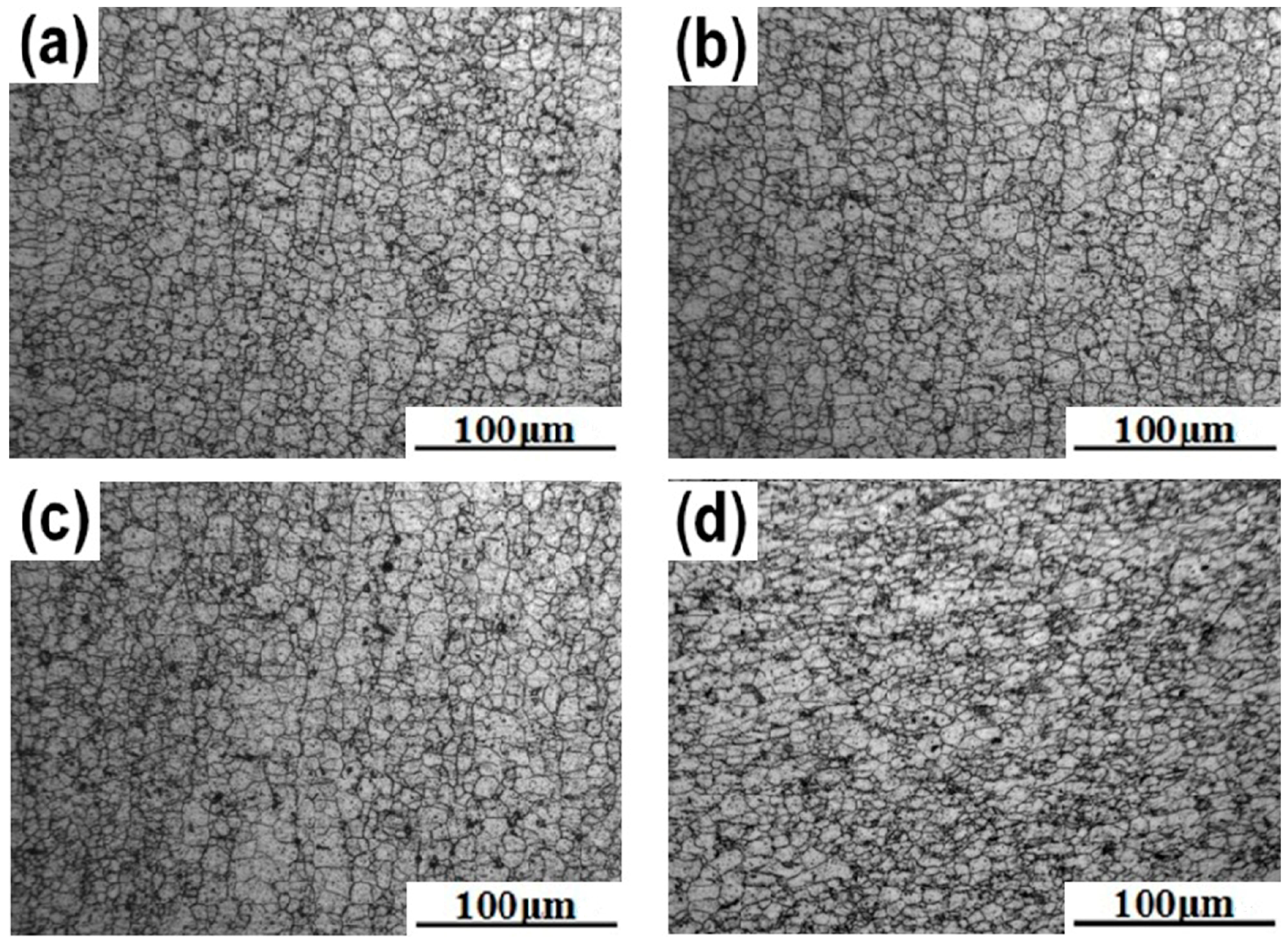
Figure 1 shows the metallographic structures of as-extruded alloy cross-sections with different Zn/Mg ratios. After etching with Graff’s reagent, the alloys exhibited clear grain boundaries, allowing for a direct observation of their metallographic morphology. All four groups of alloy profiles displayed equiaxed grain structures. The grain size differences among the four alloys were inconspicuous visually. Statistical analysis of grain sizes from multiple fields of view revealed that the average grain sizes of Alloy A, Alloy B, Alloy C, and Alloy D were 13.1 μm ± 2.3 μm, 15.3 μm ± 1.6 μm, 18.9 μm ± 1.9 μm, and 14.5 μm ± 1.5 μm, respectively.
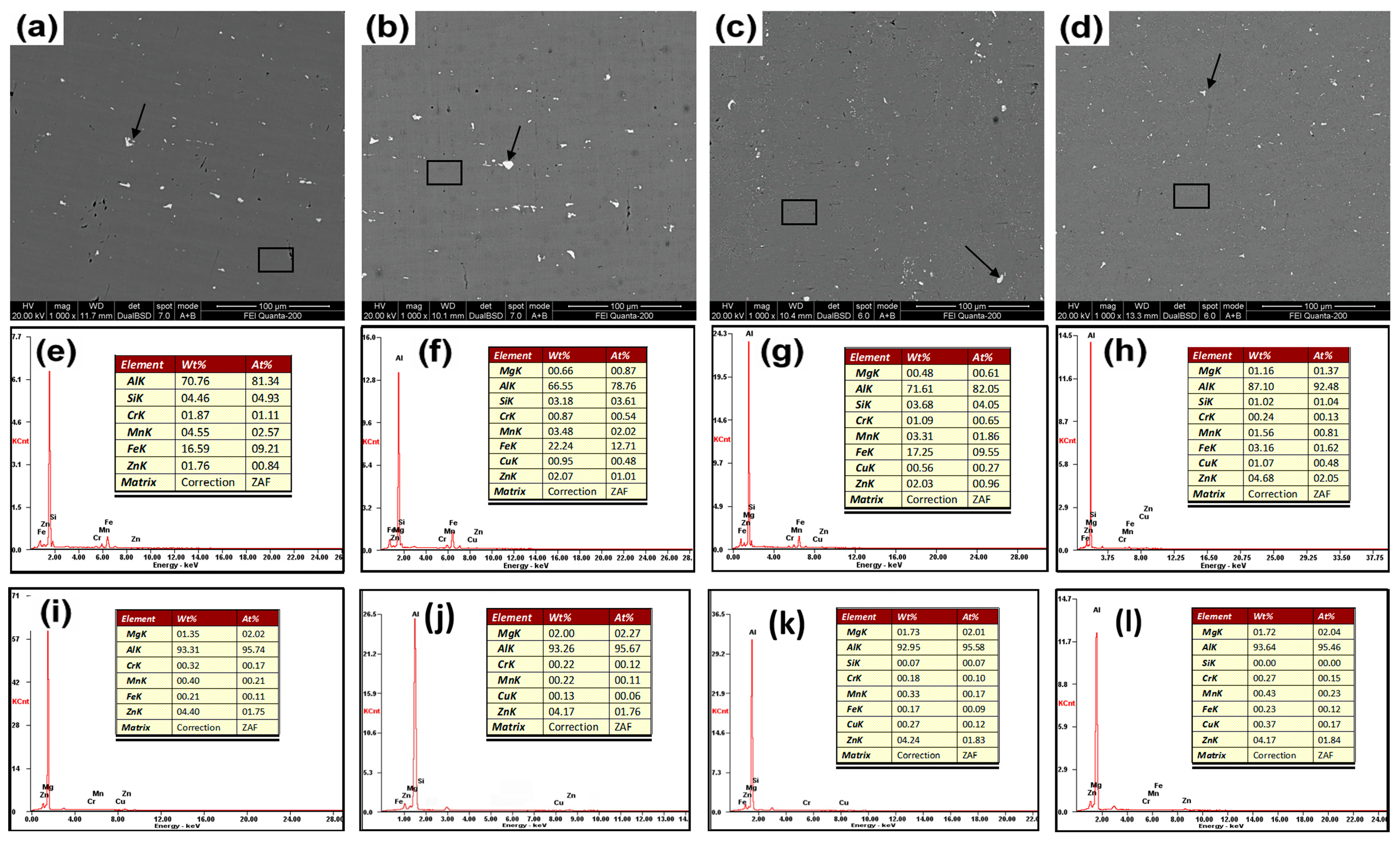
Figure 2 shows the SEM observations and EDS analysis results of the four alloys after solution treatment. Blocky secondary phases can be observed, as denoted by the markers in Figure 2a–d. EDS analysis revealed that these blocky secondary phases are enriched in Fe, Si, and Mn, with trace amounts of Mg and Zn, identifying them as insoluble AlFeMnSi phases. As the Zn/Mg ratio increased, a significant refinement of the blocky secondary phases was observed, along with a noticeable increase in their quantity. EDS analysis was performed on “clean” regions without secondary phases, as marked by the squares in Figure 2a–d. The corresponding EDS results are shown in Figure 2i–l. Statistical analyses of five test results were performed to determine the average. The Al atomic percentages of Alloys I, II, III, and IV were 95.72%, 95.68%, 95.64%, and 95.46%, respectively, corresponding to atomic solid solubility percentages of alloying elements of 4.28% ± 0.047%, 4.32% ± 0.051%, 4.36% ± 0.067%, and 4.54% ± 0.058%.
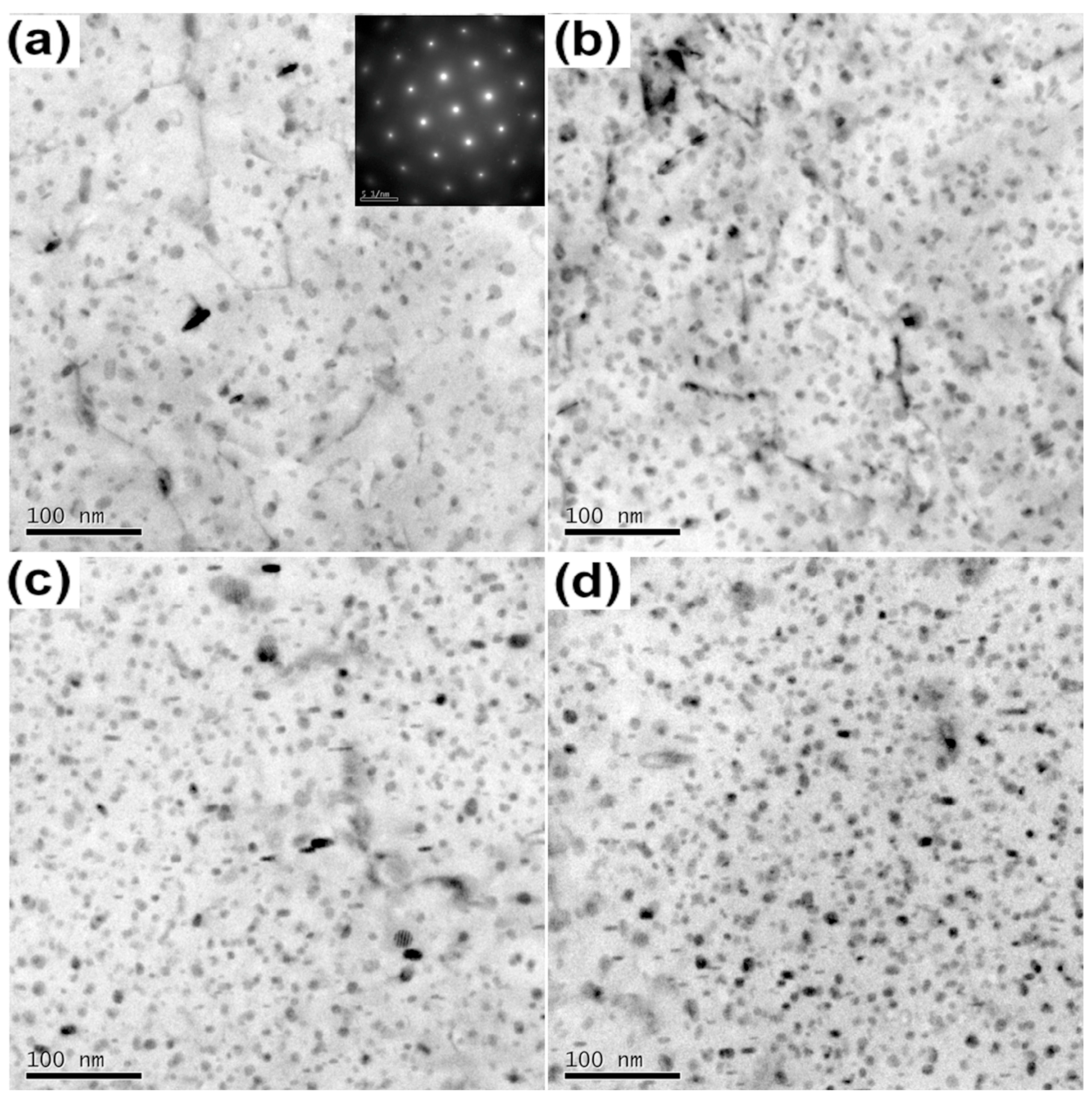
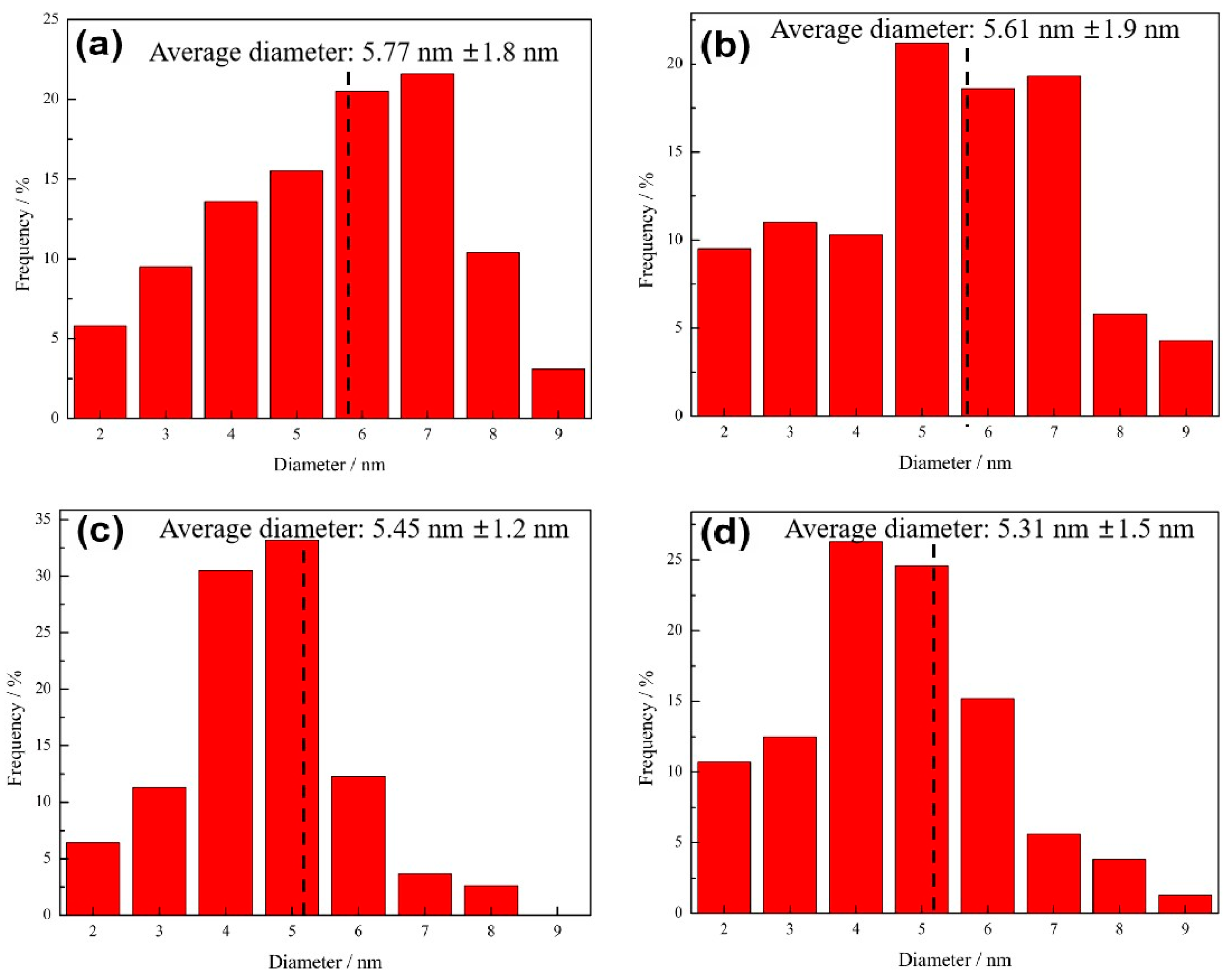
The TEM results observed along the <100> Al zone axis of the peak aging alloys are presented in Figure 3. Precipitate size, quantity, morphology, and distribution were strongly correlated with alloy strength. Tiny and disk-shaped particles uniformly appeared in all four alloys. Electron diffraction characterization revealed that these strengthening precipitates consisted mainly of the η′ phase, which maintains semi-coherent interfaces with the α-Al substrate [4]. Figure 4 shows the η′ phase sizes analyzed using Image J software across multiple regions at the same magnification. The average dimensions of the η′ phases in Alloy A to Alloy D were 5.77 nm ± 1.8 nm, 5.61 nm ± 1.9 nm, 5.45 nm ± 1.2 nm, and 5.31 nm ± 1.5 nm, respectively.
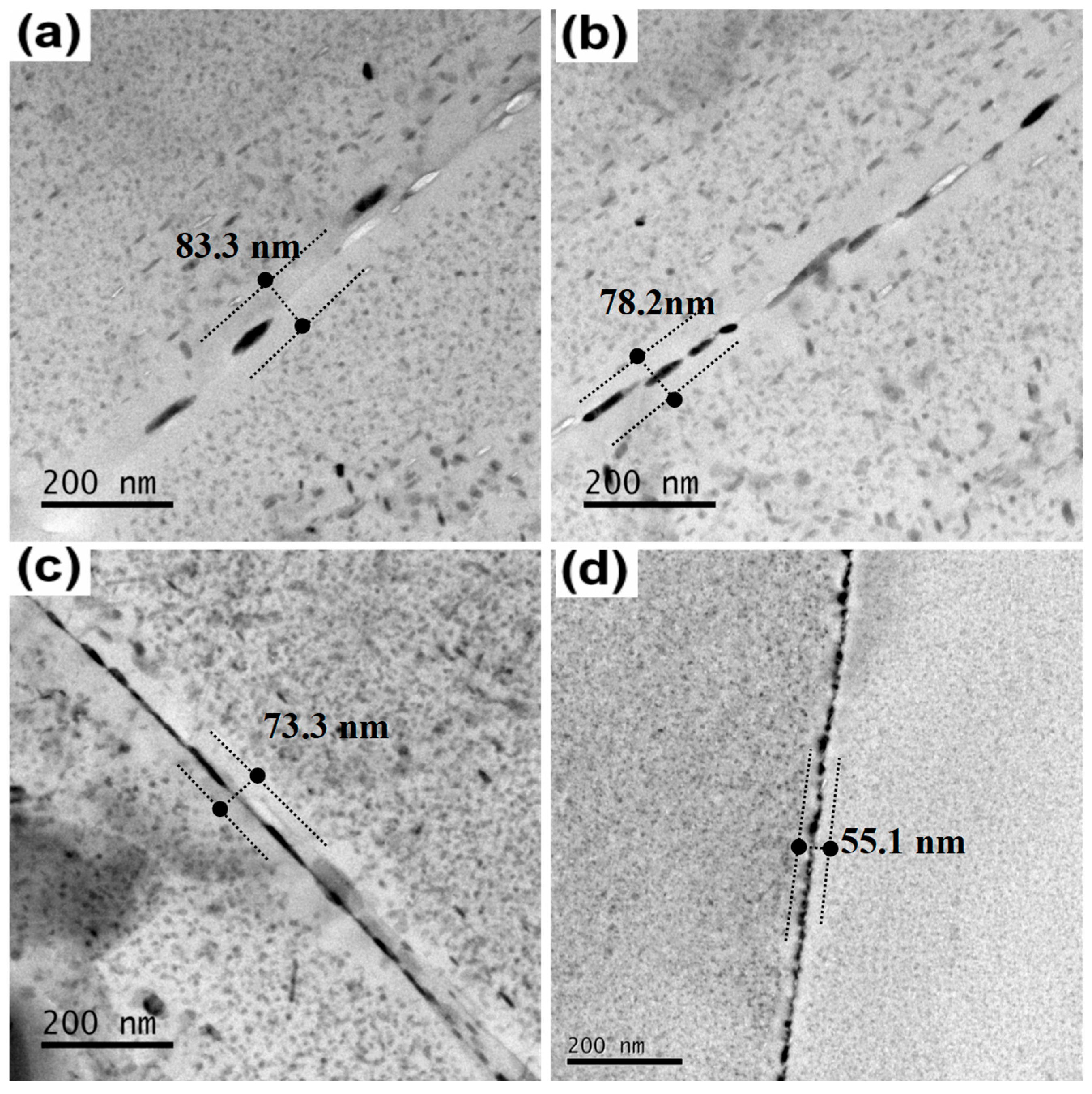
Figure 5 shows the TEM bright-field images of the grain boundary morphologies of the four alloys under peak aging conditions. Stable MgZn2 phase (η) precipitates at the grain boundaries in all four alloys were larger than the intragranular η′ phases, which typically precipitated preferentially at the grain boundaries. GBPs not only diminished in size but also adopted a more continuous distribution as the Zn/Mg ratio increased. In Alloy A and Alloy B, the GBPs appeared as large and discontinuous particles. In Alloy C, the GBPs began to transform into fine needle-like structures with a continuous distribution. In Alloy D, the GBPs exhibited a continuous distribution of fine particles. Statistical analysis of multiple TEM images of the grain boundaries of the four alloys revealed that the average GBP size decreased progressively across the alloys, with values of 68.2 nm ± 6.6 nm (Alloy A), 54.6 nm ± 4.7 nm (Alloy B), 47.3 nm ± 3.1 nm (Alloy C), and 17.2 nm ± 3.5 nm (Alloy D). A similar decreasing trend was observed for the PFZ widths, which measured at 83.3 nm ± 3.4 nm, 78.2 nm ± 3.5 nm, 73.3 nm ± 4.3 nm, and 55.1 nm ± 2.9 nm for Alloys I~IV, demonstrating that the PFZ width decreases as the Zn/Mg ratio increases.
Most Zn and Mg atoms combine to form MgZn2 precipitates in Al-Zn-Mg alloys. The mass ratio of Zn to Mg in the MgZn2 phase is 5.4, which is often used by researchers as a criterion to determine whether Zn or Mg is in excess [24]. Among the four alloys studied, only Alloy D had a Zn/Mg ratio of 6.1, indicating Zn excess, while the other three alloys exhibited Mg excess. Increasing the Zn/Mg ratio from Alloy A to Alloy C led to a reduction in excess Mg content. Mg atoms have a relatively high diffusion rate [25,26], making them prone to segregation and gathering, which promotes the formation of coarsened phases along grain boundaries. Moreover, the formation of coarse-grain boundary phases depletes solute atoms in adjacent regions and PFZs. Among the studied alloys, Alloy A demonstrated the largest GBPs and most extensive PFZs under TEM examination, corresponding to its lowest Zn/Mg ratio. Such morphological differences at grain boundaries are expected to play a critical role in determining corrosion resistance, a point that will be discussed in detail later.

3.2. Mechanical Properties

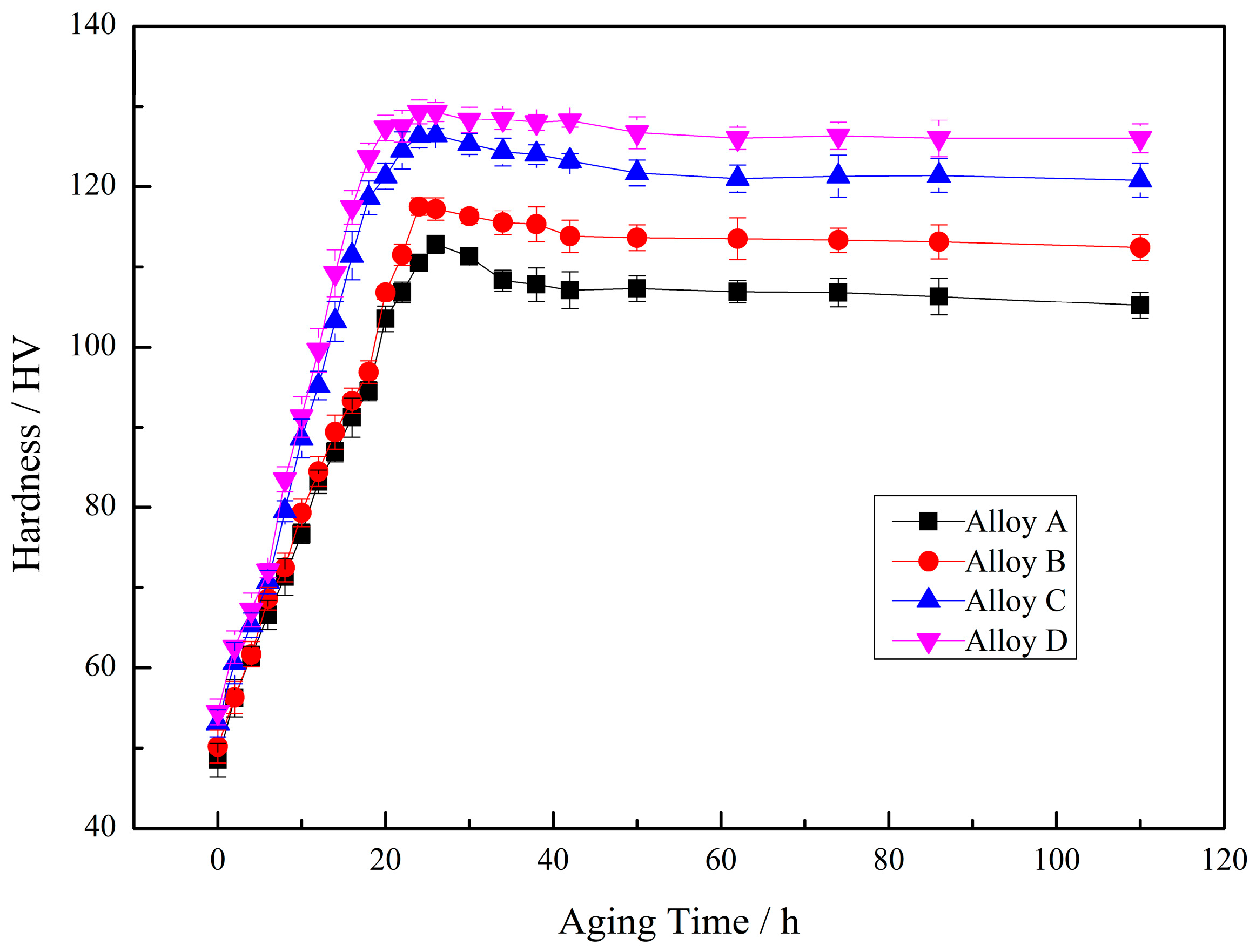
Hardness tests were carried out on samples of the four alloys following aging at 120 °C for various durations, and the resulting hardening trends are illustrated in Figure 6. The hardness values of Alloys A~D prior to aging were 48.5 HV ± 1.3 HV, 50.2 HV ± 1.6 HV, 53.1 HV ± 1.7 HV, and 54.5 HV ± 1.6 HV, respectively. The results suggest that the hardness in solid solution states increased following Zn/Mg ratio enhancement. At the early time intervals of artificial aging, the hardness values exhibited a rapid and nearly monotonic increase. All four alloys reached their peak-aged state at approximately 24 h of aging, but their peak hardness values differed significantly. The hardness values of the four alloys increased to 112.8 HV ± 1.1 HV, 117.5 HV ± 1.4 HV, 126.8 HV ± 0.8 HV, and 129.5 HV ± 1.2 HV at the peak aging state. The findings establish that enhancing the Zn/Mg ratio effectively boosts the alloy’s peak hardness.
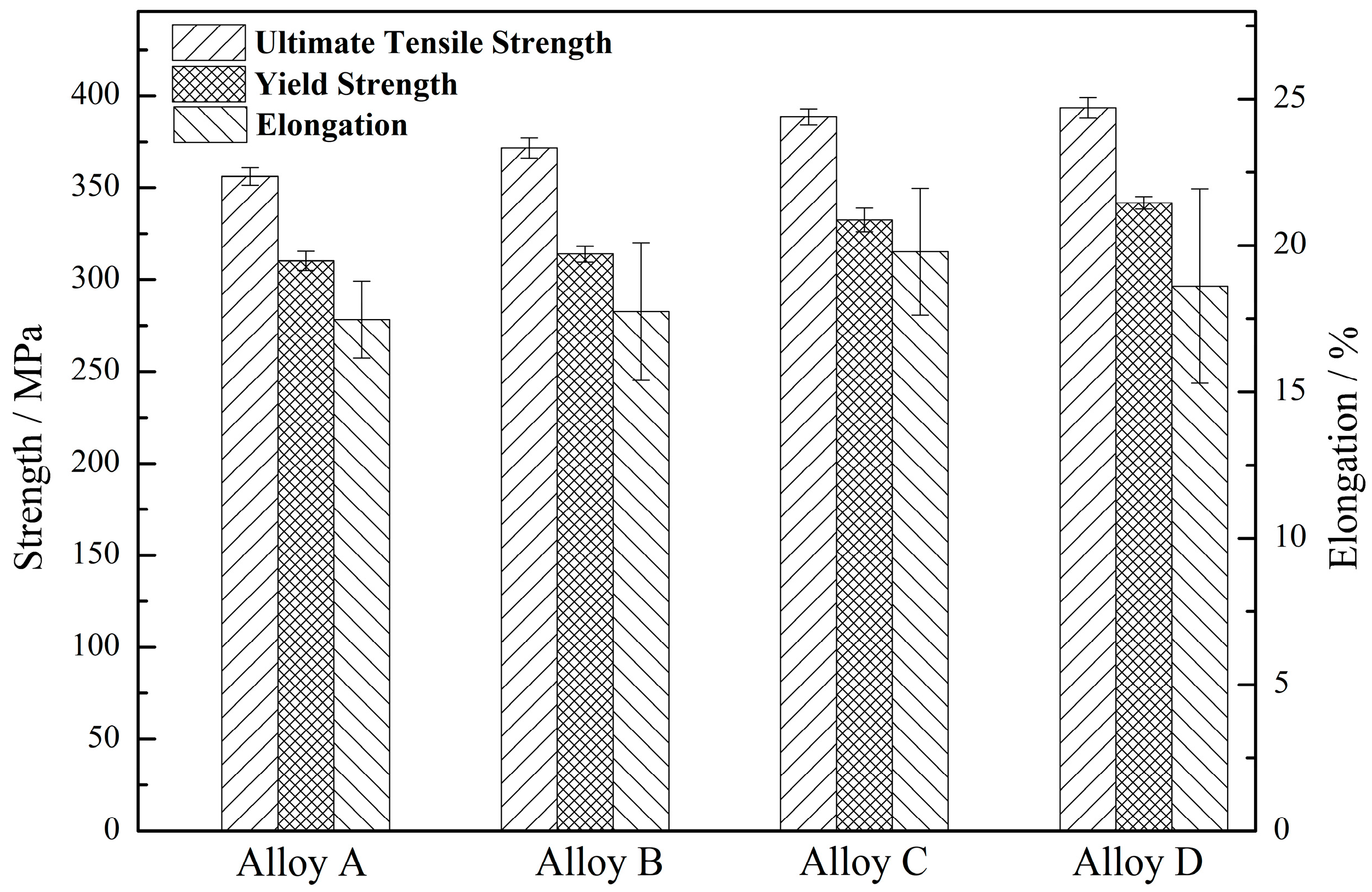
Figure 7 presents the tensile properties of the four alloys at ambient temperature at the peak aging state. The ultimate strengths of the four alloys with increasing Zn/Mg ratio were 356 MPa ± 4.7 MPa, 372 MPa ± 5.5 MPa, 388 MPa ± 4.3 MPa, and 394 MPa ± 5.6 MPa, respectively. Their yield strengths were 307 MPa ± 5.2 MPa, 314 MPa ± 4.3 MPa, 332 MPa ± 3.4 MPa, and 342 MPa ± 3.3 MPa, respectively. The elongation values of the four alloys were relatively similar, with Alloy A, Alloy B, Alloy C, and Alloy D showing elongations of 17.5% ± 1.3%, 17.8% ± 2.3%, 19.8% ± 2.1%, and 18.6% ± 3.3%, respectively. Both ultimate tensile strength and yield strength showed a clear increasing trend as the Zn/Mg ratio rose.

3.3. Corrosion Properties

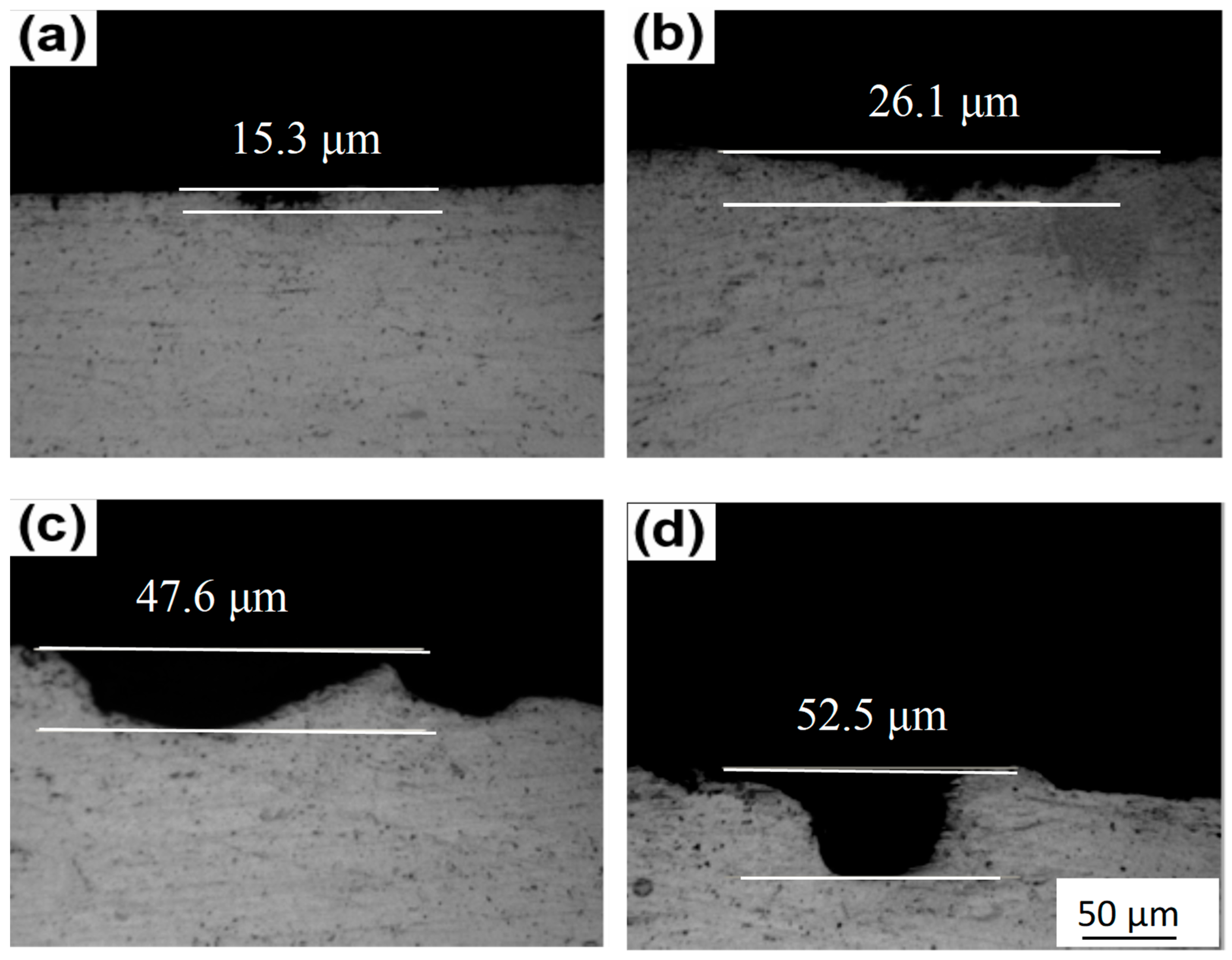
Figure 8 exhibits the morphology of the extruded T6-state (peak aging treatment) alloys after immersion in an IGC solution for 6 h. It is evident that all four alloys experienced varying degrees of IGC. The maximum corrosion depths for Alloy A to Alloy D were 15.3 μm, 26.1 μm, 47.6 μm, and 52.5 μm, respectively. The results indicate that increasing the Zn/Mg ratio reduces the IGC resistance of the extruded T6-state alloys. Notably, when the Zn/Mg ratio rose from 3.68 in Alloy B to 4.61 in Alloy C, the IGC resistance significantly deteriorated. However, further increasing the Zn/Mg ratio to 6.1 in Alloy D resulted in a maximum corrosion depth only 4 μm higher than in Alloy C, suggesting that their IGC resistance is comparable.
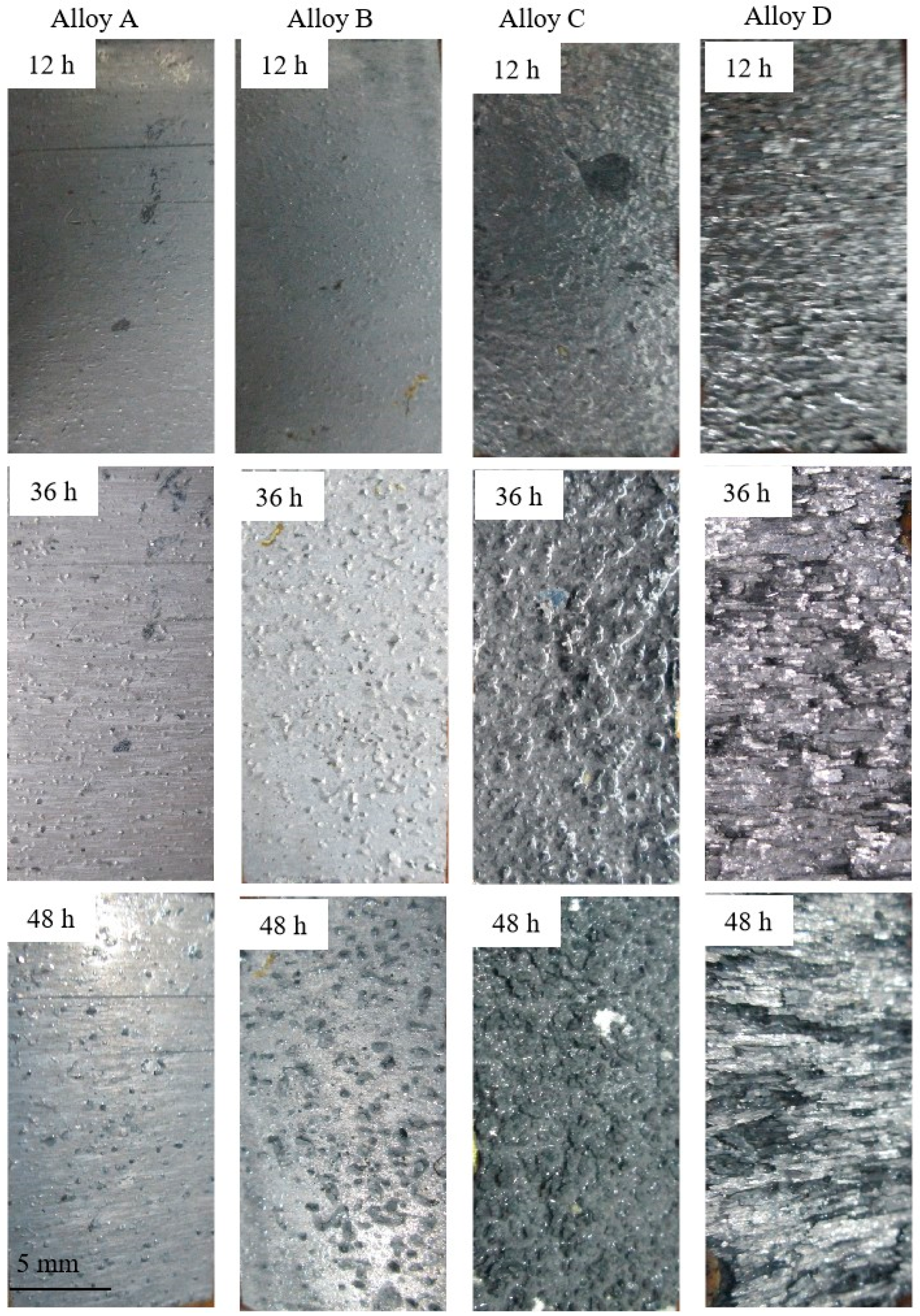
Figure 9 shows the exfoliation corrosion (EXCO) progression of the four alloys in the extruded T6-state. After 12 h of EXCO, Alloy A and Alloy B retained a metallic luster, with only localized pitting, while Alloy C showed dull surfaces and widespread protrusions, indicating uniform pitting. Alloy D lost its metallic luster entirely, suggesting severe surface corrosion. By 36 h, Alloy A and Alloy B exhibited deeper localized pitting, Alloy C showed blistering, and Alloy D displayed surface delamination. At 48 h of immersion, localized areas on the surfaces of Alloy A and Alloy B were covered with granular corrosion products, likely consisting of detached metal particles, with Alloy B showing more corrosion products than Alloy A. Nevertheless, the corrosion in Alloy A and Alloy B remained primarily on the surface, with limited penetration into the alloy depth. In Alloy C, the blistering phenomenon further evolved into “fish-scale”-like lifting, indicating the corrosion had progressed deeper into the grain interiors. Alloy D exhibited even more pronounced surface delamination, with layered corrosion products clearly visible, demonstrating the most severe corrosion among the four alloys.
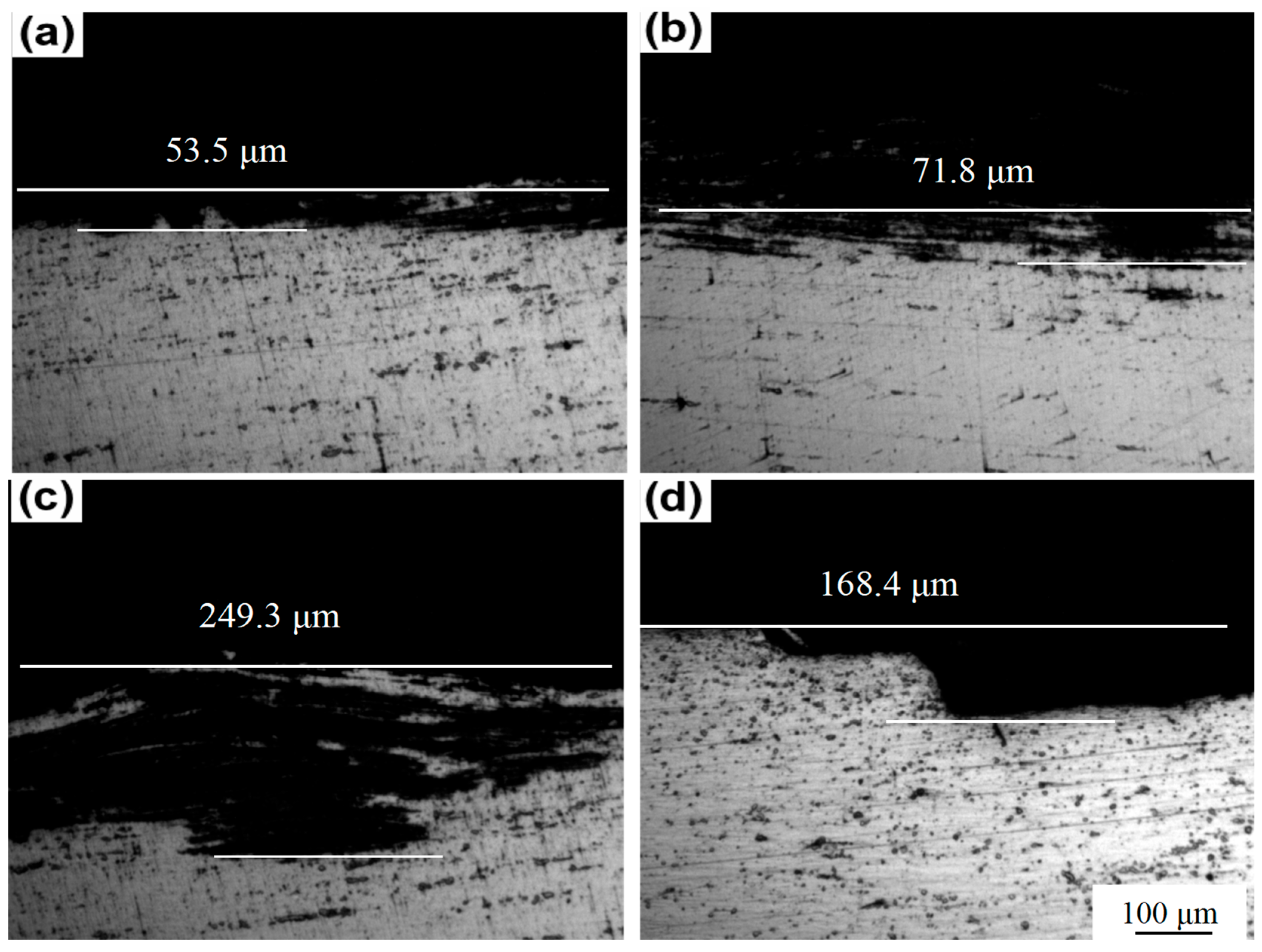
Figure 10 presents the metallographic images of the four alloys after 48 h of immersion in the EXCO solution. Alloy A and Alloy B exhibited localized exfoliation corrosion on the surface, with limited penetration into the alloy interior. The measured corrosion depths for Alloy A and Alloy B were 53.5 μm and 71.8 μm, respectively. In contrast, Alloy C showed extensive exfoliation corrosion across the entire surface, with deep penetration into the alloy, leaving large black corrosion pits. This indicates significant grain detachment from the surface, accompanied by a layered and lifted morphology, consistent with the macroscopic corrosion features observed in Figure 9. The measured corrosion depth for Alloy C was 249.3 μm. Alloy D exhibited a step-like corrosion morphology, aligning with the metal delamination observed during the corrosion progression in Figure 9. However, the measured corrosion depth for Alloy D was 168.4 μm, which was shallower than that of Alloy C. This discrepancy is likely due to the severe delamination and peeling of Alloy D during sample preparation, in which surface layer removal during cleaning and drying processes resulted in a step-like morphology with nearly 90° vertical edges rather than corrosion pits. Thus, the measured depth appeared shallower despite the severe corrosion.

3.4. SCC Performance

As load-bearing structural components, aluminum alloys are inevitably subjected to SCC. Therefore, investigating stress corrosion behavior is essential. SCC susceptibility can be calculated using the formula in [21]:
I S S R T = 1 σ f n · ( 1 + δ f n ) σ f a · ( 1 + δ f a )
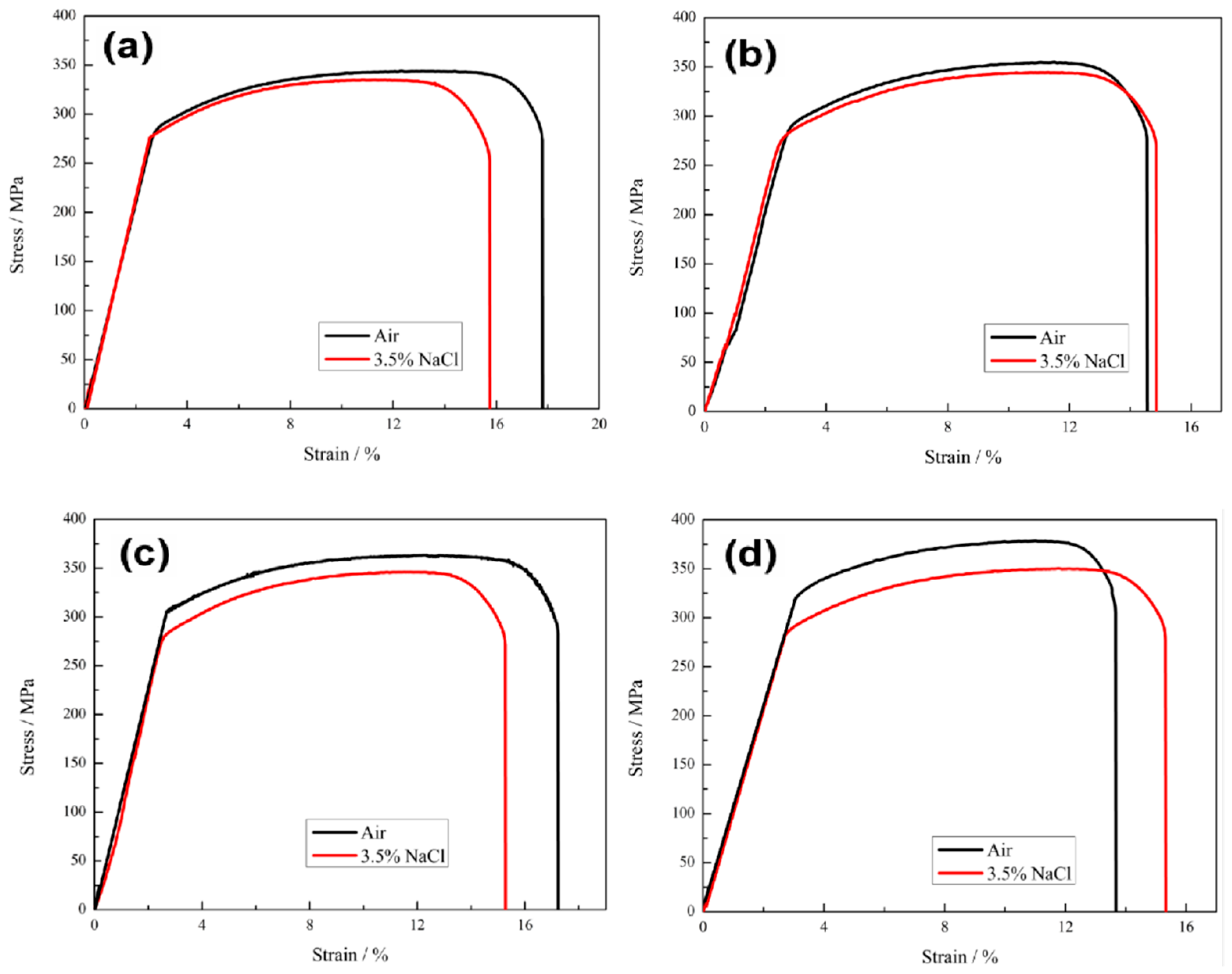
where σ f a and σ f n represent the tensile strengths measured in air and in a 3.5 wt.% NaCl solution, respectively. δ f a and δ f n are the elongations obtained in air and 3.5 wt.% NaCl solution, respectively. A higher SCC susceptibility value indicates greater susceptibility to stress corrosion cracking, meaning the alloy has poorer resistance to SCC.
The slow strain rate tensile (SSRT) behavior of the four alloys is compared in Figure 11, and the corresponding data and calculation results are presented in Table 2. Although a higher Zn/Mg ratio consistently improves the alloy strength in both air and 3.5 wt.% NaCl environments, it concurrently leads to a greater loss of strength in corrosive solutions. This trade-off was evident as the strength reduction climbed from 9 MPa (Alloy A) to 28 MPa (Alloy D). Consequently, stress corrosion cracking susceptibility ( I S S R T ) increased from 3.6% to 6.9%, demonstrating a clear decline in stress corrosion resistance with a higher Zn/Mg ratio.

4. Discussion

4.1. The Microstructure–Strength Relationship

The primary strengthening mechanisms for aluminum alloys encompass solid solution, grain boundary, dislocation, and precipitation hardening. When dislocations move within grains, solute atoms and precipitates act as obstacles, enhancing the alloy’s strength. When dislocations move from one grain to another, grain boundaries serve as the primary barrier. According to theory, the yield strength can be calculated as:
σ y = σ u + σ g + σ p + σ s + σ d
where σ u is intrinsic strength of pure Al, which is reported to be 20 MPa [27]. σ g , σ p , σ s , and σ d represent the contributions of grain boundaries, precipitations, solid solutions, and dislocations to strength.
In this study, dislocation strengthening was introduced through extrusion processing. However, after extrusion, the alloys underwent high-temperature heat treatment (480 °C/1 h) and prolonged aging (120 °C/24 h), during which the dislocations generated by extrusion were annihilated. Therefore, σ d can be neglected under the study’s experimental conditions.
Furthermore, the microstructural evolution of the alloys during heat treatment primarily included following stages: (i) Initial phases dissolution during solution heat treatment. (ii) Solute atom diffusion in the early stages of aging. (iii) The precipitation of phases during aging. (iv) The distribution of precipitates after prolonged aging. In other words, during this series of microstructural transformations, the solute atoms almost entirely precipitated into uniformly distributed nanoscale η′ precipitates within grains and micron-scale η precipitates at grain boundaries. The influence of solute atoms on yield strength is nearly negligible [6,28,29]. Therefore, grain boundary and precipitation hardening are the key factors controlling theoretical yield strength.
The Hall–Petch equation [30] is used to refer to the relationship between grain size and strength:
σ g = k y D 1 / 2
where k y is constant, and D is the mean grain size of the alloy, which can be determined from the metallographic results shown in Figure 1. Following the increase in the Zn/Mg ratio, the D values of the four alloys were 13.1 μm ± 2.3 μm, 15.3 μm ± 1.6 μm, 18.9 μm ± 1.9 μm, and 14.5 μm ± 1.5 μm. As the Zn/Mg ratio increases, the grain size of the alloy first increased and then decreased, indicating that grain boundary strengthening contributes significantly to the yield strength of Alloy A but less to that of Alloy C. According to the tensile test results, Alloy A exhibits the lowest yield strength, clearly demonstrating that grain boundary strengthening is not the primary factor influencing the yield strength of these alloys.
Precipitation strengthening can be expressed using the following formula [31,32]:
σ p = M 0.4 b G π 1 v · l n ( 2 ( 2 / 3 ) r / b ) λ p
The material constants used for aluminum are a shear modulus (G), a Taylor factor (M), a Poisson ratio ( v ) and a Burgers vector (b). λ p and r are the mean edge-to-edge spacing and average radius of intragranular precipitates.
The λ p and r of precipitaes are both related to the nucleation rate ( N ˙ ) [33]:
N ˙ = N f e x p G K k T e x p G A k T
Among them, N is the number of atoms per unit volume of the matrix, f is the atomic vibration frequency, G K is the nucleation energy, G A is the diffusion activation energy, k is the Boltzmann constant, and T is the temperature. It is clear that the N ˙ is directly proportional to the N . According to the results shown in Figure 2, the number of solid solution atoms in the matrix continuously increases as the Zn/Mg ratio increasing, result in a higher nucleation rate in high Zn/Mg ratio alloy during the aging process. The lower nucleation rate in low Zn/Mg ratio alloy leads to the continuous migration and diffusion of solid solution atoms towards precipitated phase, resulting in the continuous growth of nucleated precipitates, ultimately leading to coarsening of precipitates. Furthermore, atomic migration leads to the formation of denuded zones, which further reduces the nucleation rate. This vicious cycle results in a larger λ p in alloys with low Zn/Mg ratios compared to those with high Zn/Mg ratios. Consequently, high Zn/Mg ratio alloys, such as Alloy D, exhibit superior precipitation strengthening effects, contributing significantly to the yield strength.

4.2. The Microstructure–Corrosion Performance Relationship

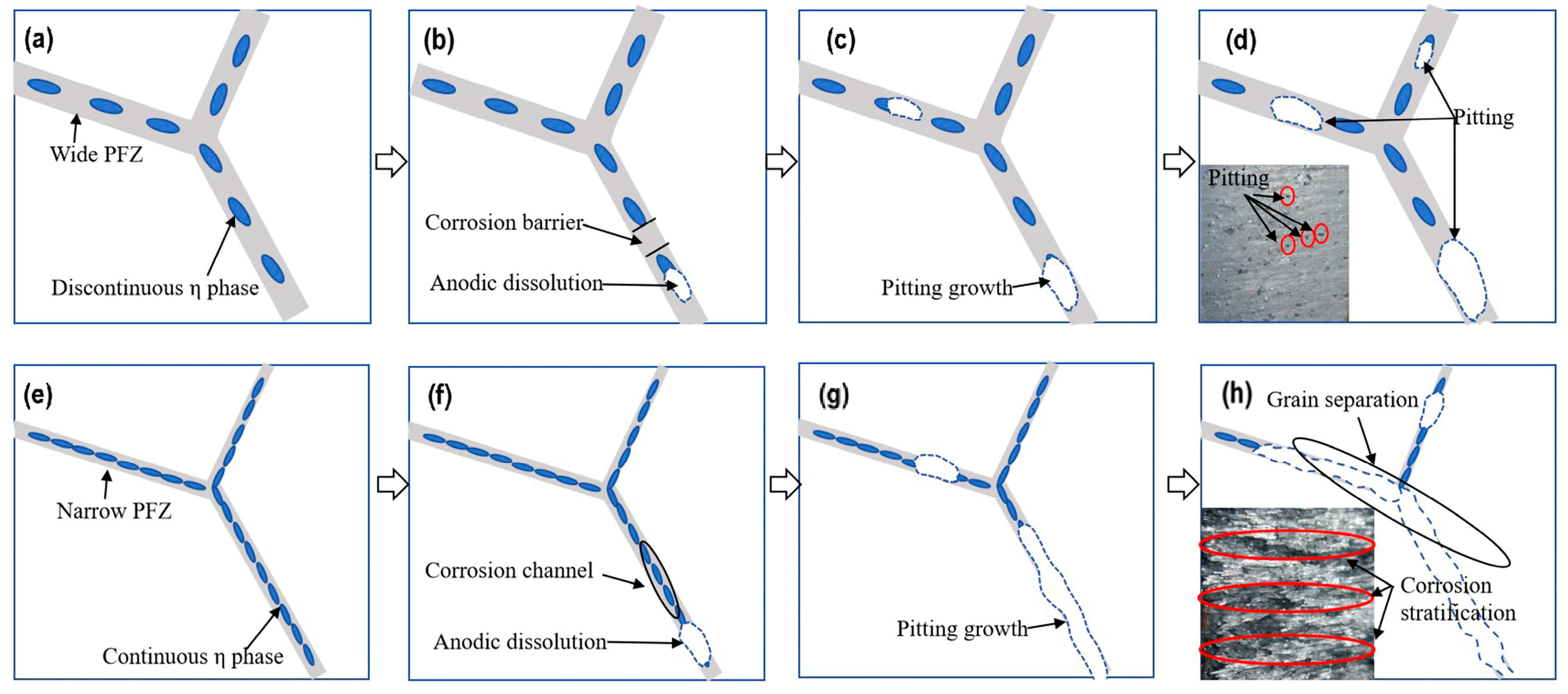
IGC and EXCO are fundamentally electrochemical processes driven by potential differences [34]. The grain boundary microstructure of Al-Zn-Mg alloys is predominantly characterized by the morphology and distribution of GBPs and PFZs. The self-corrosion potentials in corrosive media are −1044.7 mV for GBPs and −685.8 mV for PFZs [35]. A micro-galvanic corrosion cell originates from the potential difference between PFZs and GBPs. GBPs typically undergo preferential anodic dissolution. Continuously distributed GBPs can form a coherent corrosion pathway intergranularly, accelerating IGC propagation. Figure 12 shows a schematic of the corrosion process under varying PFZ and GBP morphologies. Alloy A, with the lowest Zn/Mg ratio, exhibited the largest spacing between GBPs, serving as a barrier to corrosion, as shown in Figure 12b; the alloy exhibited only slight pitting corrosion, as presented in Figure 12d. Elevating the Zn/Mg ratio led to a continuous GBP transition. Interconnected GBPs provided a continuous corrosion channel for Alloy D, as shown in Figure 12f, which possessed the highest Zn/Mg ratio. The corrosion propagated preferentially along grain boundaries, and the corrosion front from two adjacent grains intersected at triple junctions, leading to grain dropping. Macroscopically, this phenomenon manifested as exfoliation corrosion, as illustrated in Figure 12h. However, the width of PFZs at the grain boundaries gradually decreased with increasing Zn/Mg ratio, partially mitigating the rate of IGC propagation. Alloy D exhibited the poorest IGC resistance, as shown in Figure 8, indicating that continuous GBP distribution had a more significant impact on corrosion than PFZ narrowing.

4.3. Microstructure-Dependent SCC Behavior

The effect of the Zn/Mg ratio on stress corrosion resistance is mainly controlled by the synergistic mechanisms of anodic dissolution and hydrogen embrittlement. During SCC, the aluminum substrate acts as a galvanic cathode in the corrosive environment, undergoing the following electrochemical reactions [36]:
Anodic reactions:
2 Al + 3 H2O→Al2O3 + 6 H+ + 6 e; Al→Al3+ + 3 e;
Cathodic reaction:
H+ + e→[H]
Hydrogen generated via cathodic reduction partially evolves as gas, while the remaining portion adsorbs onto the material surface and subsequently diffuses into the metal matrix. At grain boundaries (GBs), atomic hydrogen reduces cohesive energy, promoting the nucleation and propagation of intergranular cracks. Within grain interiors, hydrogen accumulation at lattice defects can induce matrix decohesion and hydrogen-assisted cracking upon reaching a critical concentration.
GBPs typically serve as irreversible hydrogen traps [37]. When the size of GBPs exceeds 20 nm, these coarse secondary phases act as effective hydrogen-trapping sites, absorbing atomic hydrogen and recombining it into molecular hydrogen (H2), resulting in hydrogen enrichment mitigation at grain boundaries. Alloys A, B, and C exhibited GBPs larger than 20 nm (68.2 nm, 54.6 nm, and 47.3 nm, respectively), effectively reducing localized hydrogen concentration. In contrast, Alloy D contained finer GBPs (17.2 nm), which exhibited negligible hydrogen-trapping capability, leading to elevated hydrogen accumulation and increased susceptibility to hydrogen-induced cracking. Furthermore, the continuous distribution of GBPs in Alloy D provided a preferential pathway for crack propagation, exacerbating its SCC susceptibility. Conversely, Alloy A, characterized by coarse and discontinuously distributed GBPs, demonstrated superior SCC resistance due to diminished hydrogen trapping and crack propagation efficiency.

5. Conclusions

  • The difference in yield strength among the four alloys with varying Zn/Mg ratios stems from the combined effects of grain boundaries and precipitates. The contribution of grain boundaries to yield strength first decreases and then increases with the rising Zn/Mg ratio. In contrast, the yield strength demonstrates a notable overall increase from 307 MPa to 342 MPa as the Zn/Mg ratio rises from 3.68 to 6.11. This trend indicates that precipitation strengthening, despite the varying grain boundary contribution, is the dominant factor influencing the yield strength.
  • Grain boundary structures substantially influence intergranular corrosion resistance. A higher Zn/Mg ratio results in a narrower PFZ, which contributes positively to corrosion resistance. Conversely, this compositional shift promotes continuous precipitation at the grain boundary, adversely affecting corrosion performance. The highest Zn/Mg ratio of 6.11 exhibits the greatest corrosion depth, demonstrating that GBPs exert a more dominant influence on intergranular corrosion resistance than PFZ width.
  • Higher Zn/Mg ratios exhibit notably finer grain boundary precipitates, which are unable to serve as effective hydrogen-trapping sites during stress corrosion. Consequently, these alloys demonstrate higher ISSRT values and poorer stress corrosion cracking resistance.

Author Contributions

Conceptualization, L.G. and J.W.; methodology, L.G. and F.J.; software, F.J. and L.F.; formal analysis, L.G. and J.W.; investigation, L.G. and Y.W.; data curation, Y.W. and L.F.; writing—original draft preparation, L.G.; writing—review and editing, J.L. and X.Z.; funding acquisition, L.G. All authors have read and agreed to the published version of the manuscript.

Funding

This research was funded by the Start-up Fund for New Ph.D. Researchers of Suzhou Chien-Shiung Institute of Technology (2022), Natural Science Foundation of the Jiangsu Higher Education Institutions (25KJD460008), the Innovative Team for multi-scale material forming and testing technology of aviation components (2023JXKYTD02) and the Taicang Basic Research Program (TC2024JC27).

Data Availability Statement

The original contributions presented in this study are included in the article. Further inquiries can be directed to the corresponding author.

Conflicts of Interest

The authors declare no conflicts of interest.

References

  1. Chen, M.; Liu, S.; He, K.; Zheng, X.; Zhang, Y.; Tang, J. Hydrogen-induced failure in a partially-recrystallized Al-Zn-Mg-Cu alloy with different aging conditions: Influence of deformation behavior dominated by microstructures. Mater. Des. 2023, 233, 112199. [Google Scholar]
  2. Li, S.; Dong, H.; Shi, L.; Li, P.; Ye, F. Corrosion behavior and mechanical properties of Al-Zn-Mg aluminum alloy weld. Corros. Sci. 2017, 123, 243–255. [Google Scholar] [CrossRef]
  3. Mei, L.; Yang, M.J.; Chen, X.P.; Jin, Q.Q.; Wang, Y.Q.; Li, Y.M. Precipitate evolution and properties of an Al-Zn-Mg-Cu alloy processed by thermomechanical treatment. Mater. Sci. Eng. A 2023, 867, 144716. [Google Scholar] [CrossRef]
  4. Tang, P.; Pang, R.; Chen, H.; Ren, Y.; Tan, J. Optimization of Microstructure and Mechanical Properties in Al-Zn-Mg-Cu Alloys Through Multiple Remelting and Heat Treatment Cycles. Metals 2025, 15, 234. [Google Scholar] [CrossRef]
  5. Khan, M.A.; Xu, C.; Hamza, M.; Afifi, M.A.; Qaisrani, N.A.; Sun, H.; Wang, B.; Khan, W.Q.; Yasin, G.; Liao, W.B. Enhanced tensile strength in an Al-Zn-Mg-Cu alloy via engineering the precipitates along the grain boundaries. J. Mater. Res. Technol. 2023, 22, 696–705. [Google Scholar]
  6. Yang, M.; Liu, S.; Zhang, Y.; Tang, J.; Zhang, M. Mechanism for enhanced precipitation strengthening due to the addition of copper to Al-Zn-Mg alloys with high Zn/Mg ratio. Mater. Des. 2023, 234, 112295. [Google Scholar] [CrossRef]
  7. Shah, S.; Thronsen, E.C.; Hatzoglou, S.; Wenner, C.D.; Marioara, R.; Holmestad, B. Effect of cyclic ageing on the early-stage clustering in Al-Zn-Mg (-Cu) alloys. Mater. Sci. Eng. A 2022, 846, 143280. [Google Scholar] [CrossRef]
  8. Berg, L.K.; Gjønnes, J.; Hansen, V.; Li, X.Z.; Knutson-Wedel, M.; Waterloo, G.; Schryvers, D.; Wallenberg, L.R. GP-zones in Al-Zn-Mg alloys and their role in artificial aging. Acta Mater. 2001, 49, 3443–3451. [Google Scholar] [CrossRef]
  9. Khalfallah, A.; Raho, A.A.; Amzert, S.; Djemli, A. Precipitation kinetics of GP zones, metastable η′ phase and equilibrium η phase in Al-5.46wt%Zn-1.67wt%Mg alloy. Trans. Nonferrous Met. Soc. China 2019, 29, 233–241. [Google Scholar]
  10. Yang, M.; Wang, S.; Zhang, M.; Liu, S.; Ye, L. Aging hardening and precipitation behavior of high Zn/Mg ratio Al-Zn-Mg alloys with and without Cu. J. Alloys Compd. 2025, 1022, 180017. [Google Scholar]
  11. Chen, W.L.; Lee, R.S. Novel Aging Warm-Forming Process of Al-Zn-Mg Aluminum Alloy Sheets and Influence of Precipitate Characteristics on Warm Formability. Metals 2024, 14, 844. [Google Scholar] [CrossRef]
  12. Nicolas, C.; Olivier, D.; Armel, D.M.; Jean, C.; Olivier, B.; Joel, A. Influence of Heat Treatments on Microstructure and Hardness of a High-Strength Al-Zn-Mg-Cu-Zr Alloy Processed by Laser Powder Bed Fusion. Metals 2023, 13, 1173. [Google Scholar]
  13. Liu, S.; Li, C.; Zhang, X. Effect of natural aging on quench-induced inhomogeneity of microstructure and hardness in high strength 7055 aluminum alloy. J. Alloys Compd. 2015, 625, 34–43. [Google Scholar] [CrossRef]
  14. Jiang, K.; Zhang, Z.; Zhu, W.; Pan, Q.; Deng, Y.; Bin, X. Influence of Sc and Zr additions on microstructure and properties evolution of Al-Zn-Mg alloy. J. Mater. Sci. 2022, 57, 2208–2228. [Google Scholar] [CrossRef]
  15. Cao, R.; Kai, X.; Xing, Y.; Bao, W.; Qian, W.; Zhao, Y. Effect of Sc and Zr co-microalloying on microstructure evolution and mechanical properties of 7085Al alloy. Mater. Charac. 2025, 225, 115200. [Google Scholar] [CrossRef]
  16. Zhu, Y.; Pan, W.; Fan, J.; Huang, X.; Shuai, L.; Godfrey, A.; Huang, T.; Zhang, M.; Zhang, Y.; Huang, X. Role of Sc/Zr in enhancement of η’ precipitation and control of microstructure evolution during selective laser melting of Al-Zn-Mg alloys. J. Mater. Sci. Technol. 2026, 243, 45–58. [Google Scholar] [CrossRef]
  17. Wei, S.; Ma, X.; Xie, J.; Xie, Y.; Zhang, Y. Effects of In Situ Electrical Pulse Treatment on the Microstructure and Mechanical Properties of Al-Zn-Mg-Cu Alloy Resistance Spot Welds. Metals 2025, 15, 703. [Google Scholar] [CrossRef]
  18. Yang, M.; Lu, F.; Zhou, S.; Liu, S.; Ye, L. Evolution of strengthening precipitates in Al-4.0Zn-1.8Mg-1.2Cu (at%) alloy with high Zn/Mg ratio during artificial aging. J. Alloys Compd. 2024, 1009, 176895. [Google Scholar] [CrossRef]
  19. Jue, W.; Faguo, L. Research Status and Prospective Properties of the Al-Zn-Mg-Cu Series Aluminum Alloys. Metals 2023, 13, 1329. [Google Scholar]
  20. Wang, Z.; Huang, S.Q.; Zhang, W.K.; Li, S.Q.; Liu Jizi, Z. Precipitation Thermodynamics in an Al-Zn-Mg Alloy with Different Grain Sizes. Metals 2024, 14, 625. [Google Scholar] [CrossRef]
  21. Yuan, D.; Chen, S.; Chen, K.; Huang, L.; Chang, J.; Zhou, L.; Ding, Y. Correlations among stress corrosion cracking, grain-boundary microchemistry, and Zn content in high Zn-containing Al-Zn-Mg-Cu alloys. Trans. Nonferrous Met. Soc. China 2021, 31, 2220–2231. [Google Scholar] [CrossRef]
  22. Yuan, D.; Chen, K.; Chen, S.; Huang, L.; Chen, G.; Chen, S. Effect of pre-strain and quench rate on stress corrosion cracking resistance of a low-Cu containing Al-Zn-Mg-Cu alloy. Mater. Sci. Eng. A 2022, 833, 14237. [Google Scholar] [CrossRef]
  23. Xiao, Q.; Xu, Y.; Huang, J.; Li, B.; Wang, B.; Liu, S.; Fu, L. Effects of quenching gents, two-step aging and microalloying on tensile properties and stress corrosion cracking of Al-Zn-Mg-Cu alloys. J. Mater. Res. Technol. 2020, 9, 10198–10208. [Google Scholar] [CrossRef]
  24. Arnoldt, A.; Österreicher, J.A.; Schiffl, A.; Höppel, H.W. Optimizing the Zn and Mg contents of Al-Zn-Mg wrought alloys for high strength and industrial-scale extrudability. J. Mater. Res. Technol. 2024, 32, 2972–2982. [Google Scholar] [CrossRef]
  25. Zhou, L.; Chen, K.; Chen, S. Correlation between stress corrosion cracking resistance and grain boundary precipitations of a new generation high Zn containing 7056 aluminum alloy by non-isothermal aging and re-aging heat treatment. J. Alloys Compd. 2021, 850, 156711. [Google Scholar] [CrossRef]
  26. Warner, T. Recently-developed aluminium solutions for aerospace applications. Mater. Sci. Forum 2006, 519, 1271–1278. [Google Scholar] [CrossRef]
  27. Xiong, Z.; Jiang, Y.; Yang, M.; Zhang, Y.; Lei, L. Achieving superior strength and ductility in 7075 aluminum alloy through the design of multi-gradient nanostructure by ultrasonic surface rolling and aging. J. Alloys Compd. 2022, 918, 165669. [Google Scholar] [CrossRef]
  28. Li, H.; Xu, W.; Wang, Z. Effects of re-ageing treatment on microstructure and tensile properties of solution treated and cold-rolled Al-Cu-Mg alloys. Mater. Sci. Eng. A 2016, 650, 254–263. [Google Scholar] [CrossRef]
  29. My, A.; Hc, A.; Ao, B. Quantified contribution of β′′ and β′ precipitates to the strengthening of an aged Al-Mg-Si alloy. Mater. Sci. Eng. A 2020, 774, 138776. [Google Scholar]
  30. Hansen, N. Hall-Petch relation and boundary strengthening. Scr. Metarialia 2004, 8, 801–806. [Google Scholar] [CrossRef]
  31. Chen, M.; Liu, S.; He, K.; Zheng, X.; Jia, G. The effect of precipitate-free zone on mechanical properties in Al-Zn-Mg-Cu aluminum alloy: Strain-induced back stress strengthening. J. Alloys Compd. 2023, 969, 172428. [Google Scholar] [CrossRef]
  32. Ma, K.; Wen, H.; Hu, T.; Topping, T.D.; Isheim, D.; Seidman, D.N.; Lavernia, E.J.; Schoenung, J.M. Mechanical behavior and strengthening mechanisms in ultrafine grain precipitation-strengthened aluminum alloy. Acta Mater. 2014, 62, 141–155. [Google Scholar] [CrossRef]
  33. Porter, D.A.; Easterling, K.E. Phase Transformations in Metals and Alloys; Van Nostrand Reinhold Company: New York, NY, USA, 1981; pp. 185–260. [Google Scholar]
  34. Sun, Y.; Lin, P.; Qiao, S. Localized corrosion behavior associated with Al7Cu2Fe intermetallic in Al-Zn-Mg-Cu-Zr alloy. J. Alloys Compd. 2019, 78, 329–340. [Google Scholar] [CrossRef]
  35. Huang, L.; Chen, K.; Song, L. Influence of grain-boundary pre-precipitation and corrosion characteristics of inter-granular phases on corrosion behaviors of an Al-Zn-Mg-Cu alloy. Mater. Sci. Eng. B 2012, 177, 862–868. [Google Scholar] [CrossRef]
  36. Liu, Y.; Pan, Q.; Li, H. Revealing the evolution of microstructure, mechanical property and corrosion behavior of 7A46 aluminum alloy with different ageing treatment. J. Alloys Compd. 2019, 792, 32–45. [Google Scholar] [CrossRef]
  37. Su, H.; Hiroyuki, T.; Ryohei, M. Influence of hydrogen on strain localization and fracture behavior in Al-Zn-Mg-Cu aluminum alloys. Acta Mater. 2018, 159, 332–343. [Google Scholar] [CrossRef]
Figure 1. Metallographic structures of extruded Al-Zn-Mg alloys in cross-sections: (a) Alloy A; (b) Alloy B; (c) Alloy C; (d) Alloy D.
Metals 15 01211 g001
Figure 2. SEM structures and EDS analysis of Al-Zn-Mg alloys in solid solution state: (a,e,i) Alloy A; (b,f,j) Alloy B; (c,g,k) Alloy C; (d,h,l) Alloy D.
Metals 15 01211 g002
Figure 3. TEM images of Al-Zn-Mg alloys after peak aging treatment: (a) Alloy A; (b) Alloy B; (c) Alloy C; (d) Alloy D.
Metals 15 01211 g003
Figure 4. Histogram of size distribution of precipitates in peak aging state: (a) Alloy A; (b) Alloy B; (c) Alloy C; (d) Alloy D.
Metals 15 01211 g004
Figure 5. TEM images of grain boundary of Al-Zn-Mg alloys: (a) Alloy A; (b) Alloy B; (c) Alloy C; (d) Alloy D.
Metals 15 01211 g005
Figure 6. Aging hardening curve of various Zn/Mg ratio alloys at 120 °C.
Metals 15 01211 g006
Figure 7. Tensile properties of the four alloys at peak aging state.
Metals 15 01211 g007
Figure 8. Intergranular corrosion morphologies of extruded T6-state alloys: (a) Alloy A, (b) Alloy B, (c) Alloy C, (d) Alloy D.
Metals 15 01211 g008
Figure 9. Evolution of exfoliation corrosion of four kinds of Al-Zn-Mg alloys.
Metals 15 01211 g009
Figure 10. Metallographic observation of the four alloys soaked in EXCO solution for 48 h: (a) Alloy A, (b) Alloy B, (c) Alloy C, (d) Alloy D.
Metals 15 01211 g010
Figure 11. The SSRT curves of the four alloys: (a) Alloy A, (b) Alloy B, (c) Alloy C, (d) Alloy D.
Metals 15 01211 g011
Figure 12. Schematic of grain boundary morphology effects on corrosion progress. (ad) alloy with low Zn/Mg ratio; (eh) alloy with high Zn/Mg ratio.
Metals 15 01211 g012
Table 1. Chemical components of the four alloys (wt.%).
AlloyZnMgMnCuCrZrZn/MgAl
A4.751.290.350.050.100.163.68Bal.
B4.671.130.360.060.100.174.13Bal.
C4.841.050.350.060.110.164.61Bal.
D5.680.930.350.040.080.206.11Bal.
Table 2. The SSRT data of the four alloys and the calculation results.
AlloyTest Environment σ f (Mpa) δ f (%)ISSRT (%)
A25 °C-Air 344 2 + 3 16.9 1.8 + 2.3 3.6 0.3 + 0.5
25 °C-3.5% NaCl 335 2 + 2 15.8 1.9 + 1.5
B25 °C-Air 357 3 + 4 14.8 1.8 + 2.3 4.7 0 + 0.9
25 °C-3.5% NaCl 340 5 + 3 15.1 2.2 + 1.4
C25 °C-Air 363 2 + 3 16.7 2.4 + 1.8 5.9 0.2 + 0
25 °C-3.5% NaCl 346 4 + 2 15.2 1.5 + 2.3
D25 °C-Air 378 2 + 3 13.7 2.7 + 3.2 6.1 0 + 0.9
25 °C-3.5% NaCl 350 5 + 3 15.3 2.2 + 2.6
Disclaimer/Publisher’s Note: The statements, opinions and data contained in all publications are solely those of the individual author(s) and contributor(s) and not of MDPI and/or the editor(s). MDPI and/or the editor(s) disclaim responsibility for any injury to people or property resulting from any ideas, methods, instructions or products referred to in the content.