
Concept Paper

Beyond Words and Western Frames: Participatory Arts-Based Approaches for Cross-Cultural Dementia Care Research

Department of Epidemiology and Biostatistics, College of Public Health, Temple University, 1210 W. Berks St., Philadelphia, PA 19122, USA
Societies 2026, 16(5), 159; https://doi.org/10.3390/soc16050159
Submission received: 31 March 2026 / Revised: 8 May 2026 / Accepted: 10 May 2026 / Published: 12 May 2026

Abstract

Dementia care research has been largely shaped by Western biomedical and cognitive paradigms that privilege verbal, linear, and memory-dependent methods of data collection. While these approaches have generated valuable insights, they also reproduce epistemic and ethical limitations, particularly in cross-cultural contexts. Linguistic dominance, culturally mismatched diagnostic and care frameworks, and reliance on caregivers as proxy informants can marginalize culturally and linguistically diverse communities and risk pathologizing cultural difference as cognitive deficit. In response, this conceptual paper advances a participatory arts-based framework for cross-cultural dementia care research that centers multiple ways of knowing beyond language. Drawing on principles of co-creation, shared decision-making, reflexivity, power-sharing, and relational ethics, the framework positions people living with dementia as collaborators rather than subjects. It articulates five interrelated dimensions: (1) modes of expression (visual, embodied, sensory, and performative); (2) forms of participation (co-design, co-creation, and co-analysis); (3) cultural situatedness of meaning-making; (4) relational ethics, including ongoing assent, trust, and reciprocity; and (5) intersectionality across culture, gender, migration, class, and caregiving roles. The paper illustrates how participatory arts-based methods, such as photovoice, body mapping, collaborative art-making, and sensory storytelling, can enable culturally resonant engagement across stages of dementia while addressing power asymmetries inherent in conventional research designs. By foregrounding embodied, sensory, and culturally grounded forms of expression, this framework offers a critical reorientation of dementia care research toward more inclusive, ethical, and culturally responsive knowledge production in diverse care contexts.

1. Introduction

Dementia is increasingly recognized as one of the most significant public health challenges of the twenty-first century. Globally, an estimated 57.4 million people were living with dementia in 2019, a number projected to rise to 152.8 million by 2050—nearly a threefold increase that will place substantial demands on healthcare systems, families, and communities [1]. In response, dementia care research has expanded rapidly over the past few decades, generating important insights into cognitive decline, disease trajectories, caregiving burdens, and psychosocial and technology-enabled care (e.g., assistive technologies, social support interventions, caregiver training) [2]. Despite these advances, the dominant epistemological foundations of dementia research remain grounded in Western biomedical and neurocognitive paradigms, which privilege particular forms of knowledge production.
Conventional research approaches, including structured interviews, standardized cognitive assessments, and survey instruments, rely heavily on linguistic articulation, requiring participants to provide detailed, coherent verbal accounts of their experiences [3]. These methods assume linear, temporally ordered narratives; stable memory recall; and the use of grammatically structured, clinically legible language [3]. However, such expectations may be difficult to meet for people living with dementia, whose communication abilities, memory recall, and executive functioning can fluctuate or decline over time [3]. As a result, individuals whose expressions are non-linear, embodied, or non-verbal may be unintentionally excluded or misunderstood [3]. In fact, widely used cognitive screening tools and interview-based methods demonstrate systematic bias related to educational attainment, with individuals with lower levels of education and those from non-dominant linguistic backgrounds more likely to be misclassified within diagnostic categories and underrepresented in research samples [4]. In addition, the frequent reliance on proxy informants, such as caregivers or healthcare professionals, while valuable, risks marginalizing the perspectives of people living with dementia themselves and reinforcing assumptions that they cannot meaningfully contribute to knowledge production [5,6].
These limitations are further amplified in cross-cultural contexts. Dementia research increasingly engages culturally and linguistically diverse populations, including migrants, refugees, and Indigenous communities, whose ways of understanding and expressing illness, cognition, health care, and social support may not align with dominant Western frameworks. For example, cognitive changes may be interpreted as a normal part of aging, a spiritual transition, or the result of social or environmental imbalance, rather than a biomedical condition [7,8]. In addition, concepts such as independence, individual autonomy, or narrative selfhood may not translate easily across cultural contexts [7,8]. Individuals may communicate memory loss indirectly through metaphor, storytelling, or references to relational changes, rather than using clinical terminology such as “dementia” or “cognitive decline” [7,8]. Similarly, distress may be expressed through somatic symptoms (e.g., fatigue, pain) or shifts in social roles rather than explicitly verbalized cognitive or emotional concerns [7,8].
In some cultural contexts, caregiving is understood as a collective family responsibility rather than an individual burden, and discussing illness openly may be discouraged to preserve dignity or avoid stigma [7,8]. Expectations of narrative coherence, such as providing a linear, chronological account of symptom onset and progression, may also not reflect culturally normative storytelling practices, which may be cyclical, fragmented, relational, or oriented around shared rather than individual experiences [7,8]. As a result, participants may struggle to articulate their experiences within the formats provided by researchers, not because their experiences lack meaning, but because the research framework fails to accommodate culturally situated ways of knowing and expressing meaning. Given that diagnostic categories, caregiving norms, and communication practices are shaped by specific cultural assumptions, without careful attention to these differences, researchers risk misinterpreting participants’ expressions or overlooking meaningful aspects of their lived experiences.
At the same time, engaging people living with dementia raises complex ethical considerations related to consent, capacity, and representation. Traditional ethical models often use procedural, one-time consent, which may be insufficient in the context of cognitive change and evolving relational dynamics [9]. Dementia research instead calls for more flexible, process-oriented, and relational approaches to ethics that recognize participants as active contributors over time [9].
Participatory arts-based research offers a promising alternative to these challenges. Arts-based methods emphasize embodied, sensory, and performative forms of expression that may remain accessible even when verbal language becomes limited [10,11]. In doing so, they challenge logocentric assumptions that equate valid knowledge with coherent speech or written narrative. Importantly, participatory arts-based research is not simply a creative data collection technique. It represents a broader epistemological and ethical orientation that emphasizes collaboration, shared authority, and mutual learning between researchers and participants, rather than positioning participants as passive subjects [10,11].
Despite growing interest in these approaches, their application in dementia research remains conceptually fragmented and methodologically inconsistent. Participatory arts-based methods are often incorporated on an ad hoc basis (e.g., to enhance engagement or data richness) without a clearly defined epistemological rationale or theoretical guidance on how they reshape knowledge production, researcher–participant relationships, ethical practice, and cultural responsiveness [12]. A conceptual framework is therefore needed to clarify how participatory arts-based approaches can be systematically and ethically applied in cross-cultural dementia care research.
This conceptual paper aims to address this gap by proposing a framework that positions participatory arts-based methods not as supplementary or decorative elements within dementia research design, but as core epistemological and ethical strategies for inclusive knowledge production. Specifically, the framework seeks to address three persistent and interrelated challenges within the field: (1) linguistic barriers to conventional research methods; (2) cultural misinterpretation; and (3) ethical complexities associated with engaging people living with dementia as active contributors to knowledge.

2. Core Dimensions of the Framework

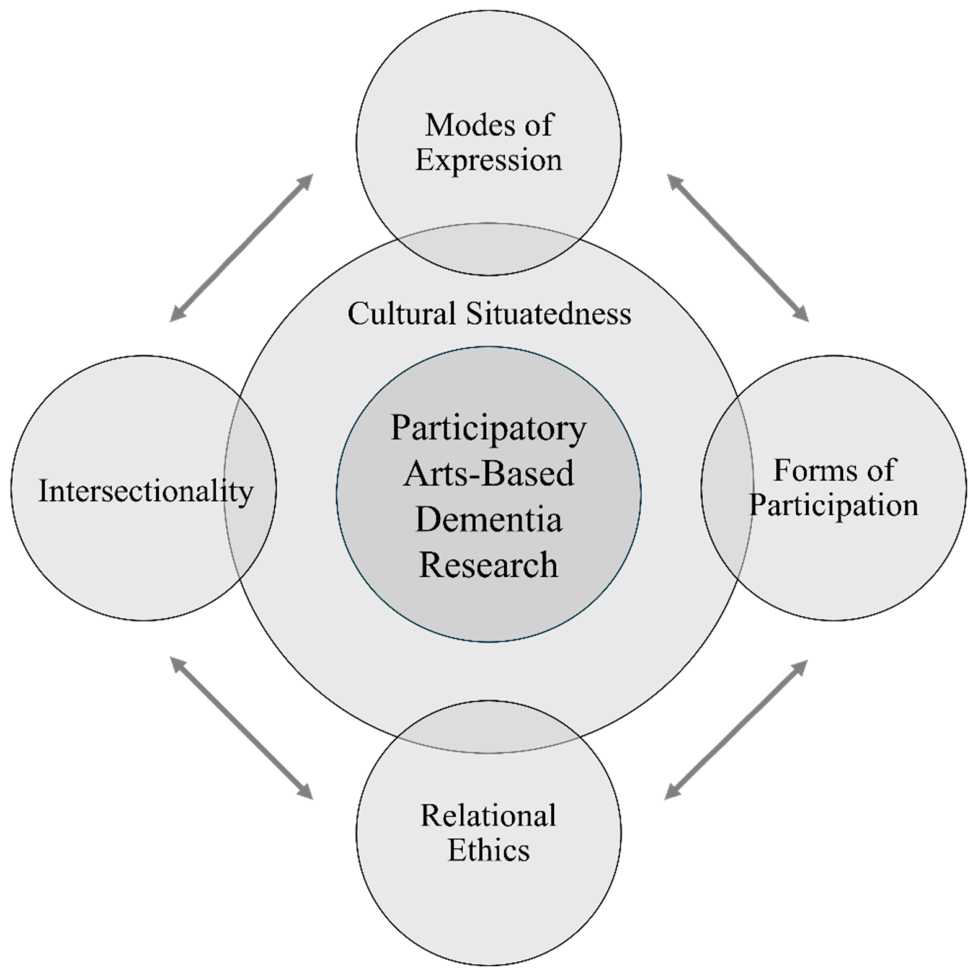
The proposed framework comprises five interrelated dimensions (modes of expression, forms of participation, relational ethics, intersectionality, cultural situatedness) that shape the design, implementation, and interpretation of participatory arts-based research in cross-cultural dementia care contexts (see Figure 1). These dimensions do not operate as sequential stages; rather, they interact dynamically throughout the research process. Importantly, culture is not treated as a separate or supplementary consideration within the framework. Instead, each dimension is understood as culturally situated, shaped by differing assumptions about communication, participation, and meaning-making.

2.1. Modes of Expression

The first dimension foregrounds the plurality of communicative modes through which people living with dementia can express meaning, identity, and emotion. Conventional research approaches often privilege verbal expression as the primary indicator of meaningful communication; however, human communication extends far beyond spoken language. Visual images, bodily gestures, sounds, textures, and symbolic performances all carry meaning within social and cultural contexts [11]. Arts-based research recognizes and values these diverse modes of expression, operationalizing this through the intentional design of low-language, failure-free environments in which there is no “right” or “wrong” response [11]. For example, participants may communicate through abstract drawing, collage, photography, textile work, movement, music, storytelling, and collaborative art-making [13,14].
Expanding modes of expression also broadens what counts as research data. Rather than limiting analysis to verbal transcripts, researchers may engage with images, performances, and sensory experiences as meaningful sources of knowledge. Interpretation therefore becomes a collaborative and reflexive process that attends to symbolic, emotional, and relational dimensions of expression. Within this context, facilitators and researchers should be trained to focus on participants’ remaining strengths rather than deficits [13]. To address linguistic barriers, several practical strategies can be employed: (1) using open-ended, sensory-based prompts (e.g., “What does the sun feel like on your skin?”) rather than memory-based questions (e.g., “Do you remember…?”); (2) incorporating call-and-response techniques, in which participants repeat or echo words, phrases, or sounds to support engagement even with limited language capacity; (3) embedding multi-sensory cues (e.g., touch, scent, sound, visual props) to explain ideas to participants or elicit their responses; and (4) encouraging improvisation and spontaneity, which reduce cognitive demands and support non-linear forms of expression [14].
Importantly, the use of non-verbal or “low-language” approaches should not automatically be assumed to be culturally appropriate or universally accessible. All expressions are culturally situated, including norms surrounding storytelling, gesture, silence, emotional expression, memory sharing, and public self-disclosure [15,16]. Researchers must therefore critically examine which forms of expression are being privileged, which communicative norms are being assumed, and how particular activities may resonate differently across cultural contexts. While artistic practices such as music, storytelling, poetry, visual arts, and movement are present across all communities, their forms, symbolism, and social meanings vary significantly [15,16]. As such, what may appear abstract, fragmented, or ambiguous within a dominant Western perspective may hold coherent and deeply layered meaning within a participant’s cultural context.
For example, abstract self-expression through individual art-making may align with Western assumptions about individuality and autobiographical disclosure, but may feel unfamiliar or uncomfortable in contexts where expression is more communal, relational, spiritually grounded, or structured through collective traditions [16,17,18]. Therefore, integrating cultural context into low-language approaches requires researchers to adapt activities to reflect locally relevant traditions, such as emphasizing communal singing over solo performance or incorporating call-and-response practices commonly used in religious or community settings [16,17,18].

2.2. Forms of Participation

The second dimension conceptualizes participation as a continuum rather than a binary distinction between researcher and participant, emphasizing relational and scaffolded engagement rather than equal involvement at all stages [19]. Participatory research seeks to redistribute authority across the research process by recognizing participants as active contributors to knowledge production [19].
Participation can occur across multiple stages of the research life cycle. In co-design, participants collaborate with researchers to shape research questions, methods, and priorities [15]. Integrating culturally familiar practices into research design may involve framing activities in culturally meaningful and non-clinical ways, such as a “poetry club”, “tea party”, or “story circle” rather than an “intervention” [16,17,18]. This can provide an accessible and recognizable structure for participation while reducing stigma and fostering a sense of comfort and belonging [16,17,18]. Cultural responsiveness should also extend to the development of interview questions. Rather than relying on abstract or decontextualized items, researchers can anchor engagement in culturally meaningful domains such as everyday routines, food practices, local environments, family roles, home life, and community connections [16,17,18].
In co-creation, participants engage in producing artistic outputs that reflect their experiences [19]. This may involve prompt-based approaches, in which participants contribute partial ideas/prompts (e.g., keywords, gestures, or sounds) rather than fully formed narratives [20]. Facilitators can then support the development of these contributions into expanded or collective artistic outputs [20]. Here, it is important to note that participation itself is culturally mediated. Dominant Western participatory approaches often emphasize individual voice, direct contribution, and explicit self-expression as markers of meaningful engagement; however, these assumptions may not align with cultural contexts where communication and decision-making are based on collective dialogue and intergenerational exchange [21]. In such contexts, direct emotional expression or public self-disclosure may feel inappropriate or unsafe. Participatory processes should therefore remain flexible—for example, participation may be structured as a group-based process involving family members, caregivers, artists, healthcare providers, spiritual leaders, or community members [21]. These collaborators can support the interpretation of certain prompts while ensuring that the perspectives of people living with dementia remain central [21].
Co-analysis further extends participation by involving participants in interpreting the final artistic outputs and reflecting on their meanings [20,21]. In this stage, participants may respond to the artwork through gestures, repeated words or phrases, or emotional reactions, rather than providing explicit verbal explanations [20,21]. These responses should be recognized as meaningful forms of interpretation as they may indicate recognition, resonance, or disagreement with the meanings being discussed [20,21]. Researchers should therefore avoid translating participants’ expressions into clinical categories without preserving their cultural meaning. Instead, meaning should be co-constructed through ongoing dialogue with the participants, and where appropriate, with cultural brokers or community knowledge holders who can help clarify metaphors, symbolism, and other forms of indirect communication [20,21]. This helps mitigate the risk of epistemic injustice, whereby participants’ expressions are misunderstood or dismissed because they do not conform to dominant expectations of coherence or clarity [20,21].
Together, these forms of participation shift research away from extractive models of data collection toward relational processes of knowledge production, in which meaning emerges through interaction and shared experience [19]. By positioning participants as collaborators rather than subjects, participatory approaches foster reciprocity, mutual learning, and more inclusive forms of inquiry grounded in lived experience [19].

2.3. Relational Ethics

Relational ethics in participatory arts-based dementia research extends well beyond formal consent procedures, emphasizing ethical engagement as an ongoing, responsive process [22]. Rather than treating consent as a one-time event, researchers must remain attentive to participants’ comfort, dignity, and autonomy throughout the research encounter [22]. This is especially important given that people living with dementia may experience fluctuating cognitive capacities that affect their ability to provide informed consent at a single point in time [22].
Proxy consent from legally authorized representatives or caregivers can be sought after if individuals living with dementia are unable to provide informed consent independently. However, proxy consent should never be treated as a substitute for the participant’s own voice [23]. Even in these circumstances, individuals living with dementia should be directly engaged in the consent process to the greatest extent possible, using accessible, developmentally appropriate, and context-sensitive communication strategies (e.g., simplified language, multisensorial prompts, call-and-response techniques) [23]. Ethical practice in this context requires ongoing process consent, carefully attending to verbal and nonverbal cues that signal willingness, hesitation, or distress, and treating these expressions as authoritative [23]. Any indication of discomfort or refusal, whether spoken or expressed behaviorally throughout the research process, should be respected even when there is prior caregiver consent [23].
Central to relational ethics are trust and reciprocity. Building trust often requires sustained presence, transparency, and respectful, person-centered communication [22]. Reciprocity, in turn, involves ensuring that participation offers meaningful value to individuals, whether through enjoyment, opportunities for creative expression, social connection, or recognition of their contributions [22]. Here, researchers must remain mindful that participatory approaches are not inherently empowering. Power imbalances between researchers and participants may persist, even within collaborative frameworks, and require ongoing critical reflection and negotiation [22]. This may involve reminding participants that they are not positioned as passive subjects but as active contributors. Researchers should create supportive environments that enable choice, such as offering opportunities to pause, withdraw, or modify participation without consequence [22]. Researchers can regularly check in with participants during and after sessions using simple, accessible questions (e.g., “Did you enjoy this activity?”, “Would you like to do this differently next time?”). Importantly, feedback should not be extractive but action-oriented. Researchers should demonstrate responsiveness by adapting activities, pacing, or levels of participation based on what the participants express or exhibit [22].
These ethical considerations extend to issues of authorship, representation, and interpretation. Artistic outputs may be shared or exhibited publicly, raising important questions about ownership, consent, and how participants’ voices are represented [23,24]. Relational ethics therefore requires that participants retain agency in determining how their creative work is used and disseminated. This also highlights the importance of researcher positionality: scholars must critically examine their own cultural assumptions, institutional privileges, and interpretive authority, particularly when working in cross-cultural contexts [22,23,24]. Engaging in collaborative partnerships with community organizations, artists, and cultural brokers can help mitigate these asymmetries and support more equitable research relationships [23,24]. For example, this may involve engaging these partners in co-designing the research process, co-interpreting artistic outputs, advising on culturally appropriate forms of representation, and guiding decisions about how and where the participants’ work is shared with broader audiences [23].
Finally, relational ethics recognizes the emotional dimensions of participatory arts-based work. Creative engagement can evoke memories, surface vulnerabilities, and foster moments of connection [24]. Researchers must approach these experiences with care, sensitivity, and responsiveness, prioritizing the participants’ well-being at all times. While arts-based approaches can generate meaningful insights and enhance quality of life, they should also be situated within broader efforts to address structural inequities in dementia care, including disparities in healthcare access, social support, and caregiving resources.

2.4. Intersectionality

The final dimension adopts an intersectional perspective, recognizing that people living with dementia are not a homogeneous group but are situated within overlapping systems of social identity, structural inequality, and lived experience [25,26]. Dementia is thus not only a neurocognitive condition, but a socially embedded process shaped by intersections of culture, language, migration history, socioeconomic position, gender, and family roles [25,26].
In dementia contexts, these intersections are often amplified, as cognitive changes interact with existing social vulnerabilities. For instance, older adults from migrant or refugee backgrounds may experience dementia alongside language attrition, disrupted cultural continuity, and limited access to culturally responsive care [25]. Socioeconomic inequities further shape engagement with dementia-related services through constraints such as transportation barriers and competing time demands [25]. Intersectionality is also critical for understanding caregiving dynamics: gendered expectations often position women, particularly daughters or spouses, as primary caregivers, shaping both the distribution of care labor and emotional burden [26]. In participatory arts settings, these dynamics may surface through joint creative activities (e.g., co-created memory books or intergenerational art projects) that reveal tensions between obligation, identity, and relational intimacy [26].
An intersectional lens also foregrounds how structural inequities (e.g., racism, sexism, ageism, ableism) shape research participation [25]. Racialized older adults living with dementia, for example, may experience compounded marginalization in healthcare settings, contributing to mistrust or disengagement from research [25]. Participatory arts-based methods can help mitigate these barriers by fostering culturally safe, relational spaces in which symbolic and embodied forms of expression support the articulation of experiences that may be difficult to verbalize [25]. Approaches such as visual storytelling, culturally grounded music, and memory-based collage offer multiple, accessible pathways for expressing these complex, layered experiences while also promoting identity affirmation, emotional processing, and collective meaning-making [26]. At the same time, it is essential for researchers to remain attentive to within-group diversity, as individuals from the same cultural background may nonetheless engage differently with arts-based activities depending on factors such as stages of dementia, other chronic comorbidities, socioeconomic status, gender roles, and prior exposure to participatory research [26].

3. Conclusions

Conventional dementia research has generated critical insights into the pathology of cognitive decline, as well as related medical treatments and caregiving practices; however, its reliance on verbal articulation, standardized assessments, and Western epistemologies can reproduce epistemic exclusions, particularly in cross-cultural contexts. These approaches may inadvertently marginalize people living with dementia whose experiences are expressed through non-linear, embodied, or culturally specific forms of communication.
Participatory arts-based research offers a critical reorientation by centering plurality, collaboration, and relational engagement. As outlined in this framework, inclusive knowledge production is facilitated through diverse modes of expression, flexible forms of participation, cultural situatedness, relational ethics, and intersectional awareness. Importantly, these approaches do not simply expand methods of data collection; rather, they reconfigure the conditions under which knowledge is produced by recognizing people living with dementia as active contributors rather than passive subjects.
Within dementia care contexts, culturally grounded artistic practices tend to remain accessible even in later stages of cognitive decline and have been associated with improved quality of life among people living with dementia by refreshing memories, evoking emotions, and revitalizing identities [27]. By integrating culturally resonant forms of expression and interpretation, participatory arts-based research can create spaces in which participants feel recognized, valued, and meaningfully engaged, while also producing knowledge that more accurately reflects the cultural contexts of their lived experiences [27].
By creating spaces for visual, sensory, embodied, and performative expression, participatory arts-based approaches challenge assumptions that communicative absence equates to cognitive impairment. Instead, they foreground the capacity of individuals to express identity, emotion, and meaning beyond the constraints of language while also fostering connection, recognition, and reciprocity within the research process.

Funding

This research received no external funding.

Institutional Review Board Statement

Not applicable.

Informed Consent Statement

Not applicable.

Data Availability Statement

No new data were created or analyzed in this study.

Conflicts of Interest

The author declares no conflicts of interest.

References

  1. Nichols, E.; Steinmetz, J.D.; Vollset, S.E.; Fukutaki, K.; Chalek, J.; Abd-Allah, F.; Abdoli, A.; Abualhasan, A.; Abu-Gharbieh, E.; Akram, T.T.; et al. Estimation of the global prevalence of dementia in 2019 and forecasted prevalence in 2050: An analysis for the Global Burden of Disease Study 2019. Lancet Public Health 2022, 7, e105–e125. [Google Scholar] [CrossRef] [PubMed]
  2. Ma, Y.; Zhang, Y.; Nordberg, O.E.; Rongve, A.; Bachinski, M.; Fjeld, M. State-of-the-Art HCI for Dementia Care: A Scoping Review of Recent Technological Advances. J. Dement. Alzheimer’s Dis. 2025, 2, 41. [Google Scholar] [CrossRef]
  3. Banovic, S.; Zunic, L.; Sinanovic, O. Communication Difficulties as a Result of Dementia. Mater. Socio-Medica 2018, 30, 221–224. [Google Scholar] [CrossRef] [PubMed]
  4. Ramos-Henderson, M.; Calderón, C.; Domic-Siede, M. Education bias in typical brief cognitive tests used for the detection of dementia in elderly population with low educational level: A critical review. Appl. Neuropsychol. Adult 2025, 32, 253–261. [Google Scholar] [CrossRef] [PubMed]
  5. Arons, A.M.; Krabbe, P.F.; Schölzel-Dorenbos, C.J.; van der Wilt, G.J.; Rikkert, M.G.O. Quality of life in dementia: A study on proxy bias. BMC Med. Res. Methodol. 2013, 13, 110. [Google Scholar] [CrossRef]
  6. Gilbert, A.S.; Antoniades, J.; Hwang, K.; Gonzalez, E.; Hlavac, J.; Enticott, J.; Lin, X.; Woodward-Kron, R.; Low, L.-F.; LoGiudice, D.; et al. The MINDSET Study: Co-Designing Training for Interpreters in Dementia and Cognitive Assessments. Dementia 2023, 22, 1604–1625. [Google Scholar] [CrossRef]
  7. Kaplan, F.; Bentwich, M.E. Do differences exist in cross-cultural caregivers’ respect for the autonomy/dignity of people with dementia? Real-time field observations in nursing homes. Dementia 2023, 22, 935–963. [Google Scholar] [CrossRef]
  8. McCarthy, M.J.; Remiker, M.; Garcia, Y.E.; Williamson, H.J.; Baldwin, J. Cultural Factors Predict Positive Caregiving Appraisal Among Racially and Ethnically Diverse Dementia Family Caregivers. J. Gerontol. Soc. Work. 2025, 68, 279–296. [Google Scholar] [CrossRef]
  9. Campbell, S.; Dowlen, R.; Fleetwood-Smith, R. Embracing Complexity Within Creative Approaches to Dementia Research: Ethics, Reflexivity, and Research Practices. Int. J. Qual. Methods 2023, 22, 16094069231165932. [Google Scholar] [CrossRef]
  10. Sugiyama, M.; Edahiro, A.; Takako, U.; Akiko, F.; Miyamae, F. Community-Based Participatory Research on Art Engagement for People with Dementia in Japan. Innov. Aging 2025, 9, igaf122.3241. [Google Scholar] [CrossRef]
  11. Boyd, C.; Barry, K. Arts-based research and the performative paradigm. Methods Psychol. 2024, 10, 100143. [Google Scholar] [CrossRef]
  12. Boydell, K.M.; Gladstone, B.M.; Volpe, T.; Allemang, B.; Stasiulis, E. The Production and Dissemination of Knowledge: A Scoping Review of Arts-Based Health Research. Forum Qual. Soc. Res. 2012, 13, 32. [Google Scholar]
  13. Swinnen, A.; de Medeiros, K. Participatory arts programs in residential dementia care: Playing with language differences. Dementia 2018, 17, 763–774. [Google Scholar] [CrossRef] [PubMed]
  14. Curtis, A.; Gibson, L.; O’Brien, M.; Roe, B. Systematic review of the impact of arts for health activities on health, wellbeing and quality of life of older people living in care homes. Dementia 2018, 17, 645–669. [Google Scholar] [CrossRef] [PubMed]
  15. Ward, M.C.; Milligan, C.; Rose, E.; Elliott, M.; Wainwright, B.R. The benefits of community-based participatory arts activities for people living with dementia: A thematic scoping review. Arts Health 2020, 13, 213–239. [Google Scholar] [CrossRef]
  16. Zeilig, H.; Killick, J.; Fox, C. The participative arts for people living with a dementia: A critical review. Int. J. Ageing Later Life 2014, 9, 7–34. [Google Scholar] [CrossRef]
  17. Glazner, G.; Kaplan, D.B. The Alzheimer’s poetry project. JAMA 2018, 320, 2294. [Google Scholar] [CrossRef]
  18. Friedman, J.K. The Songwriting WorksTM Model: Enhancing Brain Health and Fitness Through Collaborative Musical Composition and Performance. In Enhancing Cognitive Fitness in Adults; LaRue, A., Hartman-Stein, P.E., Eds.; Springer: New York, NY, USA, 2011; pp. 325–358. [Google Scholar]
  19. Cousins, E.; Tischler, V.; Garabedian, C.; Dening, T. A taxonomy of arts interventions for people with dementia. Gerontologist 2020, 60, 124–134. [Google Scholar] [CrossRef]
  20. Levenberg, K.; George, D.R.; Lokon, E. Opening minds through art: A preliminary study evaluating the effects of a creative-expression program on persons living with dementia and their primary care partners. Dementia 2021, 20, 2412–2423. [Google Scholar] [CrossRef]
  21. Kaplan, D.B.; Glazner, G.; Drake, C. Group-based participatory arts interventions validate personhood for those living with dementia. Adv. Soc. Sci. Cult. 2023, 5, 1–16. [Google Scholar] [CrossRef]
  22. Brijnath, B.; Rao, R.; Baruah, U.; Antoniades, J.; Loganathan, S.; Varghese, M.; Cooper, C.; Kent, M.; Dow, B. Relational Solidarity and Conflicting Ethics in Dementia Care in Urban India. J. Gerontol. Ser. B Psychol. Sci. Soc. Sci. 2024, 79, gbae079. [Google Scholar] [CrossRef] [PubMed]
  23. Jonas-Simpson, C.; Mitchell, G.; Dupuis, S.; Donovan, L.; Kontos, P. Free to be: Experiences of arts-based relational caring in a community living and thriving with dementia. Dementia 2022, 21, 61–76. [Google Scholar] [CrossRef] [PubMed]
  24. de Kock, L.; Groot, B.C.; Lindenberg, J.; Struiksma, G.; Abma, T.A. Making invisible care visible. Ethics and aesthetics of care in participatory arts practices in times of COVID-19. Res. Drama Educ. 2023, 28, 506–526. [Google Scholar] [CrossRef] [PubMed]
  25. Kapilashrami, A.; Kokkinidis, G.; Checchi, M. Rethinking mental healthcare: Operationalising intersectionality through a community-driven social clinic model. J. Glob. Health 2025, 15, 03034. [Google Scholar] [CrossRef]
  26. Birnkammer, S.; El-Haj-Mohamad, R.; Calvano, C. Participatory development and proof-of-concept of an intersectionality-informed art-based group intervention for BIPoC girls. Sci. Rep. 2026, 16, 6710. [Google Scholar] [CrossRef] [PubMed]
  27. Vigliotti, A.A.; Vernon, M.C.; George, D.R. Evaluating the benefits of the TimeSlips creative storytelling program for persons with varying degrees of dementia severity. Am. J. Alzheimer’s Dis. Other Dement. 2019, 34, 163–170. [Google Scholar] [CrossRef]
Figure 1. Conceptual framework for participatory arts-based dementia research.
Societies 16 00159 g001
Disclaimer/Publisher’s Note: The statements, opinions and data contained in all publications are solely those of the individual author(s) and contributor(s) and not of MDPI and/or the editor(s). MDPI and/or the editor(s) disclaim responsibility for any injury to people or property resulting from any ideas, methods, instructions or products referred to in the content.