Article

Curiosity as a Key Pathway Linking Future Time Perspective to Earlier Financial Preparation Timing

Institute of Creative Industries Design, National Cheng Kung University, Tainan City 701, Taiwan
*
Authors to whom correspondence should be addressed.
Societies 2026, 16(5), 157; https://doi.org/10.3390/soc16050157
Submission received: 4 March 2026 / Revised: 3 May 2026 / Accepted: 7 May 2026 / Published: 11 May 2026
(This article belongs to the Section The Social Nature of Health and Well-Being)

Abstract

As Taiwan faces rapid population aging and increasing longevity, individuals are expected to assume greater responsibility for their own financial security in later life. Future Time Perspective (FTP) is a well-established cognitive-motivational construct associated with long-term planning, while curiosity has been linked to adaptive functioning and sustained cognitive engagement across the lifespan. However, its role in shaping perceived timing of financial preparation remains underexplored. This study examined the associations among FTP, joyous exploration (JE), and perceived timing for financial preparation, and tested whether curiosity mediates this relationship. Cross-sectional data from 435 adults in Taiwan (aged 31–89 years) were analyzed. Participants completed validated measures of FTP, JE, and perceived timing for initiating financial preparation. OLS regression and mediation analyses were conducted, controlling for age, sex, education, and health. FTP was positively associated with JE. JE predicted earlier perceived financial preparation timing. Although the direct effect of FTP indicated endorsement of later preparation ages when controlling for JE, a significant negative indirect effect demonstrated that higher FTP was linked to earlier preparation ages through increased JE, reflecting inconsistent mediation. JE may represent a modifiable psychological pathway for promoting earlier and more proactive financial preparation in super-aging societies such as Taiwan.

1. Introduction

By 2050, over 2.1 billion people worldwide will be over 60, fundamentally reshaping how societies must approach financial preparation for later life [1]. In 2026, Taiwan was officially classified as a “super-aged society”, with over twenty percent of its population aged 65 and older [2]. This unprecedented demographic transformation has generated both and far-reaching benefits and challenges for institutions, prompting an urgent need to understand the complex interplay of psychological and temporal cognitive mechanisms that shape when and how individuals prepare financially for later life.

1.1. Population Aging Trend: Increasing Longevity and the Individualization of Retirement Risk in Taiwan

Increased longevity reflects significant epidemiological and socioeconomic progress, including advances in healthcare, improved living conditions, and declining mortality rates [3,4]. However, it also poses considerable challenges to pension systems, which must adapt to finance increasingly prolonged retirement periods. Consequently, there has been a notable global trend implementing labor market and pension reforms that shift greater responsibility onto individuals to alleviate financial pressure on public retirement systems [1,5]. Trends in these reforms generally include: 1. Reductions in mandatory public pension generosity to incentivize private retirement savings, 2. Shifts from defined benefit (DB) to defined contribution (DC) private pension schemes, 3. Expansion of individualized pension accounts that grant beneficiaries greater autonomy in determining contribution rates, and payout or decumulation options, and 4. Introduction of reforms such as the Active Aging framework and other delayed retirement incentives to enhance labor force participation among older adults, and mitigate the fiscal pressures associated with demographic aging.
In general, Taiwan follows a similar structural framework. Formally employed individuals are primarily covered by the Labor Insurance system and the Labor Pension system [5,6]. The Labor Pension system operates under a defined DC model, whereby employers are required to contribute at least six percent of an employee’s monthly wage into an individual pension account, while employees may voluntarily contribute up to an additional six percent [7,8,9]. Upon reaching age 60, the accumulated principal and accrued investment returns may be withdrawn either as a lump sum or converted into monthly payments. These contribution requirements also apply to individuals who are re-employed after retirement [10].
Despite this structured system, concerns regarding retirement adequacy remain. First, the average monthly Labor Insurance pension is approximately NT$18,000, which falls below average per capita monthly living expenses [11]. This insufficiency may become particularly exacerbated in high-cost urban cities such as Taipei and Taichung, increasing financial strain among retirees [12].
Second, the DC design of the Labor Pension system shifts investment and longevity risk onto individuals, making retirement income contingent upon accumulated contributions and market performance. This structure may increase retirees’ vulnerability to macroeconomic inflationary pressures, which erode the real value of pension income over time [1]. In addition, individuals must rely more heavily on precautionary savings to buffer against unexpected medical or financial shocks [13,14]. Concurrent sociocultural shifts in Taiwan, such as the decline of traditional multigenerational co-residence, may further reduce informal family-based support and increase living costs, intensifying the need for individual financial preparedness [15,16]. Public perception also reflects these structural pressures. A recent survey conducted by Taiwan’s Hondao Senior Citizen’s Welfare Foundation found that 84% of near and recent retirees believed they lacked sufficient retirement savings and expressed concerns about long-term care, medical, and unexpected future expenses [11,13]. Collectively, these structural dynamics highlight an impending urgency to comprehensively understand the mechanisms that support proactive financial planning for later life, particularly within Taiwan’s rapidly aging and socioeconomically transforming context.

1.2. Curiosity

Curiosity has been described as the recognition, pursuit, and desire to explore novel, uncertain, complex, or ambiguous information and experiences [17]. In this aspect, curiosity functions as an epistemic motive: it drives individuals to seek out relevant information, reduce uncertainty, and update their behavioral strategies in anticipation of future demands. Growing evidence suggests that curiosity also plays a key role in adaptive aging by supporting cognitive functioning, well-being, and physical health in older adults [18,19].
Several theoretical frameworks have sought to conceptualize how curiosity is embedded in human cognition [17,20,21]. At present, the five-dimensional curiosity scale is a conceptually robust and comprehensive attempt to synthesize this multidimensional construct [17]. The proposed model identifies five distinct dimensions of curiosity: Joyous Exploration (JE), deprivation sensitivity, stress tolerance, social curiosity, and thrill seeking.
JE captures the intrinsic enjoyment of discovering novel information and experiences, emphasizing growth over predictability. Deprivation sensitivity reflects the urgent drive to resolve knowledge gaps due to the discomfort of not knowing [17]. Thirdly, stress tolerance captures the capacity to embrace the uncertainty and ambiguity often involved in exploration, rather than avoiding it. The fourth component, social curiosity, describes the interest in knowing how other people think, behave, or feel, which may involve both overt questioning and covert observation. Finally, thrill seeking reflects the belief that a fulfilling life involves pursuing excitement and adventure, particularly in situations that involve physical, social, or legal risks.
Among the five curiosity dimensions, JE has demonstrated the strongest association with positive psychological functioning and adaptive life outcomes [17]. At its core, it reflects a dispositional, trait-like tendency toward intrinsically motivated learning, openness to experiences, personal growth, and the pursuit of meaning through novel experiences [22]. Empirical evidence has consistently linked curiosity with indicators of well-being, including happiness, meaning in life, and the satisfaction of core psychological needs. Given its empirical and theoretical comprehensiveness in capturing curiosity as a trait conducive to adaptive psychological functioning, JE was selected as the focal subcomponent in the present study.

1.3. Linking the Constructs: FTP, Curiosity and Perceived Timeline for Financial Preparation

The integration of these constructs is best understood through the lens of Socioemotional Selectivity Theory (SST). SST posits that individuals are inherently agentic and selectively pursue goals based on their anticipated utility. FTP therefore operates as a central cognitive-motivational construct shaping how individuals prioritize goals and allocate effort across time: when future time is perceived as limited, individuals tend to shift toward emotionally meaningful and present-focused goals [23,24]. In contrast, when future time is perceived as expansive, the expected value of long-term, knowledge-oriented goals increases. This is because the benefits of these investments can be realized over an extended time horizon.
Within this goal-setting process, curiosity functions as a key exploratory catalyst. Achieving long-term goals requires the acquisition of new information to facilitate the development of competencies to effectively support future goal attainment. As future time is perceived as more expansive, individuals place greater value on long-term goals, thereby increasing the demand for information relevant to those goals [25]. This heightened informational demand may be linked to higher curiosity to support exploration and learning [18,26].
Life-History Theory (LHT) further situates this as a supplementary contextual lens for understanding long-term investment and resource allocation. It suggests that individuals adaptively calibrate their behavior along a continuum of ‘fast’ versus ‘slow’ strategies, depending on environmental stability and resource availability [27,28]. In stable and predictable environments, individuals are more likely to adopt expansive FTP, where managing current resources toward future outcomes becomes an adaptive strategy [29]. Harsh and unpredictable environments, generally characterized by low socioeconomic status and high mortality, tend to promote “fast” life-history strategies which are more present-focused, prioritizing immediate gratification [27,28].
However, financial decision-making, especially in the context of retirement planning, is inherently complex and influenced by a multitude of psychological and socioeconomic factors [30,31,32,33]. Behavioral economic perspectives including the prospect theory and the disposition effect suggest that financial preparation is not simply a rational planning process, but one shaped by uncertainty, loss aversion, emotional regulation, and self-control [34,35]. As a result, decision-making may deviate from long-term optimal strategies, particularly in the presence of financial risk [33].
In this context, curiosity may represent a critical, yet underexplored, mechanism. While FTP has been consistently linked to more successful financial goal attainment, including reduced impulsive spending and more proactive retirement preparation [30,36,37], the role of curiosity appears to be more complex. On one hand, curiosity has been empirically linked to improved financial literacy, lower tolerance for financial risk-taking [38], and a range of adaptive developmental outcomes, including enhanced cognitive functioning, psychological resilience, goal-directed behavior, and overall well-being [19,39,40,41]. On the other hand, curiosity shares neural and behavioral overlap with impulsivity and has been linked to impulsive buying behaviors that may undermine long-term financial goals [42,43,44]. Emerging evidence also suggests that curiosity may function as an emotion regulation mechanism, enabling individuals to reframe uncertainty by shifting from evaluative to exploratory processing [26,45,46]. This cognitive shift can reduce negative affect and enhance psychological flexibility, thereby supporting sustained engagement with new information [19].
This duality positions curiosity as a meaningful pathway linking FTP to financial preparation behaviors. Across contexts, curiosity functions as both a driver of exploratory behavior and a regulatory mechanism that may facilitate sustained engagement with long-term financial planning [44,45]. This raises an important question: to what extent is curiosity associated with the relationship between one’s future time orientation and their perceived readiness for initiating financial preparation in later life?
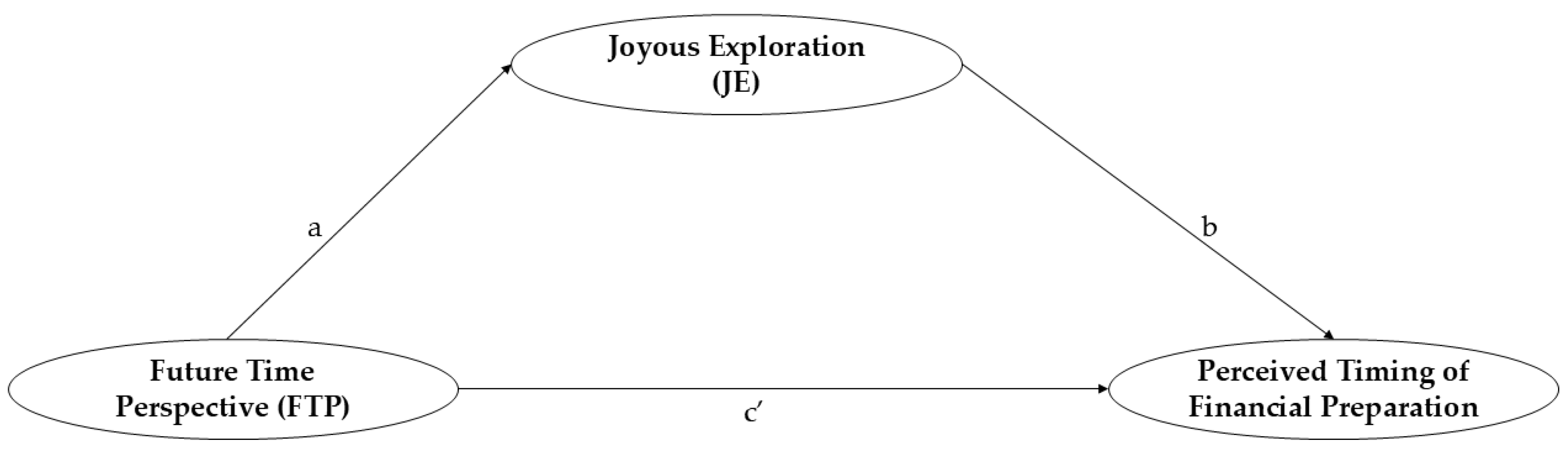
The present study has three aims. First, we examine the association between FTP and JE. Second, we investigate the independent associations of both FTP and JE with perceived optimal timing for initiating financial preparation. Third, we test whether JE mediates the relationship between FTP and perceived timing for financial preparation. From the theoretical integration above, we hypothesize that individuals who perceive their future as more expansive and opportunity-rich will exhibit higher levels of curiosity, which in turn facilitates earlier perceived engagement with financial preparation. The conceptual pathway is illustrated in Figure 1 below.

2. Materials and Methods

2.1. Participants/Setting

The data were derived from a Taiwanese sample participating in the 2018 Aging as Future online survey study [47]. Participants were recruited through online platforms and completed a centrally administered, structured web-based questionnaire as part of the project framework. A more comprehensive description of the study procedures and sampling strategy can be found in [47].
After excluding 11 respondents due to missing or incomplete responses, the final sample included N = 435 participants. Sociodemographic characteristics for the entire sample population are shown in Table 1 below.

2.2. Measures

2.2.1. Future Time Perspective

FTP was assessed using a 10-item scale developed by Carstensen and Lang (1996) [48]. This scale evaluates perceptions of remaining lifetime and their influence on motivation, cognition, and emotions. Sample items included “Many opportunities await me in the future”, “My future seems infinite to me”, and “As I get older, I begin to experience time as limited” using a 5-point scale of agreement ranging from ‘does not apply’ to ‘applies very much’ (see Table A1).

2.2.2. Joyous Exploration

JE was measured using subscale of the Five-Dimensional Curiosity Scale [17]. This subscale consisted of five questions designed to capture one’s preference for new information and experiences, as well as a valuing of self-expansion over security. Participants responded to statements such as, “I am always looking for experiences that challenge how I think about myself and the world” and “I enjoy learning about subjects that are unfamiliar to me”, using a 7-point scale of agreement ranging from ‘does not apply at all’ to ‘applies completely’ (see Table A2).

2.2.3. Perceived Timing for Financial Preparation

Perceived timing for financial preparation was assessed using the timing subdimension of the Provision Making Scale, which captures individuals’ subjective perceptions regarding when preparation for later life should begin [47,49]. The measure assessed the earliest acceptable age for initiating financial preparation. Using a graphical life course scale from 0 (beginning of life) to 100 (end of life), participants answered questions such as: “When is, in your opinion, the earliest (good) point in time that one should start preparing for financial security in old age?” (see Table A3).

2.2.4. Covariates

Age, sex (coded as male = 0, female = 1), education level (measured on an 8-point scale, where 1 = primary education and 8 = doctoral or equivalent), and self-rated health status (measured on a 5-point scale, where 1 = very good and 5 = bad) were included as covariates, as prior research has demonstrated their associations with JE, FTP, and aging-related planning behaviors [18,50,51].
The full survey items corresponding to the variables used in this study are provided in Appendix A.

2.3. Design & Procedure

This study employed a cross-sectional design using data from Wave 4 (2018) of the Aging as Future survey, as described in Section 2.1.
Ethical approval for the study was obtained from the National Cheng Kung University Human Research Ethics Committee (NCKU-HREC No. 107-311). All participants provided informed consent prior to participation.

2.4. Statistical Analyses

Data processing and statistical analyses were conducted using Jupyter Notebook 6.5.2 with Python 3.13.9. Data were first cleaned and continuous predictors were mean-centered prior to regression analyses.
We conducted a bivariate Pearson correlation analysis to assess associations between all variables. To assess multicollinearity among predictors, we calculated Variance Inflation Factor (VIF) scores. High multicollinearity, indicated by VIF values exceeding 5 to 10, can lead to unstable regression coefficients and was therefore examined before mediation analysis [52]. Statistical significance was determined at alpha level of p < 0.05 (two-tailed).
Mediation analyses were conducted using ordinary least squares (OLS) regression models implemented in the statsmodels package in Python. In the primary mediation model, FTP was specified as the predictor (X), JE as the mediator (M), and perceived financial preparation start age as the outcome (Y). All mediation models were estimated while adjusting for the covariates described above. Statistical inference for the indirect effect was based on nonparametric bootstrap resampling with 3000 iterations to generate 95% confidence intervals. An indirect effect was considered statistically significant if the bootstrap confidence interval did not include zero. Direct, indirect, and total effects were reported.

3. Results

3.1. Descriptive Statistics and Bivariate Correlations

Table 2 presents the means, standard deviations, and Pearson correlation coefficients among the study variables. VIF values were all below 2.1, indicating low multicollinearity among the variables.
The correlation coefficients revealed a significant positive association between FTP and JE, indicating that these traits are closely related. JE was significantly associated with earlier perceived financial preparation timing. Although FTP showed a negative association with preparation timing, this relationship was not statistically significant.

3.2. Aim 1: To Examine the Relationship Between FTP and JE

To examine whether FTP was associated with JE, an OLS regression analysis was conducted with JE as the dependent variable. Controlling for age, sex, health, and education, FTP was a significant positive predictor of JE, b = 0.068, SE = 0.005, t = 12.90, p < 0.001. The overall model was significant, F(5, 429) = 75.58, p < 0.001, explaining 46.8% of the variance in JE (R2 = 0.468).

3.3. Aims 2 and 3: Direct and Indirect Effects of FTP on Perceived Timing for Financial Preparation

To examine whether FTP was associated with perceived optimal timing for financial preparation and whether this association was mediated by JE, a mediation analysis was conducted (see Table 3).
Regarding the independent associations specified in Aim 2, JE was significantly associated with perceived preparation timing, b = −1.573, SE = 0.608, t = −2.59, p = 0.010, such that higher JE predicted earlier perceived preparation ages. When JE was included in the model, FTP significantly predicted preparation timing, b = 0.185, SE = 0.078, t = 2.37, p = 0.018. However, the total effect of FTP on preparation timing was not statistically significant, b = 0.078, SE = 0.067, t = 1.17, p = 0.242.
Addressing Aim 3, the indirect effect of FTP on preparation timing through JE was statistically significant (a × b = −0.107), with a 95% bootstrap confidence interval of [−0.191, −0.023], indicating that the interval did not include zero (see Table 4). This pattern reflects inconsistent partial mediation, whereby the indirect effect operated in the opposite direction of the direct effect.

4. Discussion

This study employed a combination of OLS and mediation analysis to examine the associations of FTP and JE with perceived timing for financial preparation in later life. While FTP has been consistently associated with more proactive financial planning and goal-directed behavior [30,36,37], the role of curiosity within this framework remains both theoretically and empirically underexplored. Therefore, the goals of the present study were to examine (a) the relationship between FTP and JE, (b) the independent associations of FTP and JE with perceived timing for financial preparation, and (c) the mediating role of JE in the association between FTP and perceived preparation timing. To our knowledge, this study represents the first empirical investigation to jointly examine FTP and JE in relation to perceived timing of financial preparation.
The findings provided clear support for the first aim: FTP was significantly associated with higher JE. Findings related to the second aim showed an interesting pattern. JE was significantly associated with earlier perceived timing for initiating financial preparation, indicating that individuals higher in JE tended to endorse younger ages for initiating financial planning. However, the direct association of FTP with financial preparation timing was positive and statistically significant. This suggests that independent of JE, individuals with a more expansive FTP tended to endorse later ages for initiating financial preparation.
Despite this divergence, findings related to the third aim provided evidence of a significant indirect association through JE. FTP was associated with higher JE, and higher JE was associated with earlier perceived financial preparation timing. This pattern reflects competitive mediation, where the indirect and direct effects operate in opposite directions. The non-significant total effect suggests that these opposing pathways may offset one another, obscuring meaningful underlying associations.
In general, these findings are broadly consistent with extant literature [18,19,36,37,53,54] while also extending it in important ways. First, an expansive FTP appears to be significantly associated with adaptively intelligent traits such as curiosity-driven exploration, which is a foundational catalyst for sustained learning and prospective planning [17,55]. Second, JE appears to be a key psychological factor in this association, potentially reflecting how and when individuals begin to cognitively engage with financial age-related planning. That is, individuals with higher FTP may be more attuned to long-term outcomes via heightened JE, and are therefore more likely to initiate aging preparation at an earlier point in the life course.
However, the observed inconsistent mediation diverges from much of the existing literature, generally linking increased FTP with earlier planning behaviors [18,30,48,49,56]. Several statistical and psychological factors may account for this pattern. Psychologically, FTP may exhibit a dual pattern of associations with perceived preparation timing. On one hand, the indirect association through JE may reflect greater exploratory engagement and proactive planning toward preparation-related information, which corresponds to earlier perceived preparation [23,30,57]. On the other hand, independent of JE, individuals with a more expansive FTP may perceive that they have sufficient time remaining, which may attenuate the sense of urgency, corresponding with later perceived initiation timing when JE is controlled. This interpretation aligns with the principles of SST, suggesting that an expansive FTP may simultaneously encourage exploration (via curiosity) while also moderating perceived urgency [24].
Statistically, this pattern is also consistent with suppression. Because FTP and JE are conceptually and empirically related, including JE in the model may account for the curiosity-driven component of FTP. Once this shared variance is modeled through JE, the direct FTP association may more strongly reflect reduced urgency or perceived time abundance.

Limitations

Several limitations should be acknowledged. First, only the JE subscale of the Five-Dimensional Curiosity Scale was used. Given the multifaceted nature of curiosity, future research should examine other dimensions of the construct and how they interact with FTP and goal orientation. Therefore, caution is warranted when generalizing these findings to other dimensions of the construct.
Second, the outcome variable measured participants’ perceived timing for financial preparation, which reflects a subjective cognitive judgment rather than actual preparatory behavior. While such perceptions are important indicators of cognitive readiness, they may not translate directly into real-world actions. Individuals may endorse early preparation in principle but fail to engage in concrete financial behaviors due to structural, economic, or motivational constraints. This limits the extent to which the present findings can be interpreted as indicative of actual financial preparedness.
Third, the cross-sectional design precludes causal inference. Although the mediation model is theoretically grounded, the temporal ordering among FTP, JE, and perceived financial preparation cannot be definitively established. Reverse or reciprocal relationships are also plausible; for example, individuals who are already engaged in financial planning may develop greater JE or a more expansive FTP over time. Consequently, the observed mediation should be interpreted as reflecting statistical associations consistent with potential pathways rather than confirmed causal mechanisms. Future research should employ longitudinal or experimental designs to better establish directionality and examine how these relationships evolve across the life course.
Finally, the present study was conducted within a Taiwanese sample, which may limit the generalizability of the findings to other cultural contexts. Cultural norms and institutional structures surrounding financial preparation, intergenerational responsibility, and future planning may shape both the expression of JE and its association with financial decision-making. For instance, reliance on family-based support systems may reduce the perceived urgency for early individual financial preparation. Future research should examine these relationships across more diverse cultural settings, especially in cultures experiencing rapid aging (such as Japan, South Korea, and Germany), to determine whether the observed patterns hold in different sociocultural environments.

5. Conclusions

The present study offers valuable insight into the associations between FTP and JE in financial preparation for later life. To date, most research has examined the trajectory of curiosity across the lifespan and its adaptive function in older adulthood [18,19]. Far fewer studies have considered how curiosity, and specifically JE interacts with cognitive-motivational factors to prospectively shape when and how individuals perceive it appropriate to initiate financial preparation.
From a practical perspective, JE may present a malleable intervention target for encouraging proactive financial engagement. These implications are particularly salient in Taiwan, where (1) rapid population aging and evolving pension structures have shifted increasing responsibility for retirement planning onto individuals, and (2) concurrent intergenerational and demographic transitions, such as the decline of traditional multigenerational co-residence, may reduce informal family-based support while increasing individual financial burden. As such, identifying the psychological mechanisms that shape when individuals initiate financial preparation becomes not merely exploratory but increasingly urgent.
Policymakers and practitioners may benefit from designing interventions that actively stimulate exploratory engagement. For example, interactive financial education tools, scenario-based planning simulations, and personalized retirement projections may encourage individuals to explore future financial outcomes more deeply. These practical approaches may help translate abstract future-oriented thinking into concrete preparatory actions, promoting sustained financial security across the life course.


Author Contributions

Conceptualization, C.A.M. and S.L.; methodology, C.A.M.; software, C.A.M.; validation, C.A.M.; formal analysis, C.A.M.; investigation, C.A.M.; resources, S.L.; data curation, C.A.M.; writing—original draft preparation, C.A.M. and S.L.; writing—review and editing, C.A.M. and S.L.; visualization, C.A.M.; supervision, S.L.; project administration, S.L.; funding acquisition, C.A.M. All authors have read and agreed to the published version of the manuscript.

Funding

This research received no external funding.

Institutional Review Board Statement

The study was conducted in accordance with the Declaration of Helsinki and approved by of National Cheng Kung University Human Research Ethics Committee (protocol code 104-217, 21 November 2016).

Informed Consent Statement

Informed consent was obtained from all subjects involved in the study.

Data Availability Statement

The datasets used and analyzed during the current study are available from the corresponding authors on reasonable request.

Acknowledgments

The authors have reviewed and edited the output and take full responsibility for the content of this publication.

Conflicts of Interest

The authors declare no conflicts of interest.

Abbreviations

The following abbreviations are used in this manuscript:
FTPFuture Time Perspective
LHTLife-History Theory
Fin. PrepFinancial Preparation
JEJoyous Exploration
DBDefined Benefits Pension Scheme
DCDefined Contribution Pension Scheme
SESSocio-economic Status
VIFVariance Inflation Factor
OLSOrdinary Least Squares Regression

Appendix A. Survey Measures

Appendix A.1. Future Time Perspective

Participants’ future time perspective was assessed with the 10-item scale developed by Carstensen and Lang [48]. Three subcomponents of the FTP scale were computed: Future Time Oppourtunity—perceptions about what is possible in one’s remaining life time, Future Time Extension—a subjective construal of how much time remains in life, and Future Time Constraints—the awareness of constraints and barriers of one’s future time. Participants rated the items on a 7-point scale.
Table A1. FTP Scale.
LabelRatings
Many opportunities await me in the future.1 = does not apply at all to 7 = applies very much
I expect that I will set many new goals in the future.1 = does not apply at all to 7 = applies very much
My future is filled with possibilities.1 = does not apply at all to 7 = applies very much
Most of my life lies ahead of me.1 = does not apply at all to 7 = applies very much
My future seems infinite to me.1 = does not apply at all to 7 = applies very much
I could do anything I want in the future.1 = does not apply at all to 7 = applies very much
There is plenty of time left in my life to make new plans.1 = does not apply at all to 7 = applies very much
I have the sense time is running out.1 = does not apply at all to 7 = applies very much
There are only limited possibilities in my future.1 = does not apply at all to 7 = applies very much
As I get older, I begin to experience time as limited.1 = does not apply at all to 7 = applies very much
Sum score: Future Time Perspective,
FTP (ftp_1, _2, _3, _4, _5, _6, _7, _8r, _9r, _10r)
Aggregated variable—output categorical: 10 = minimum FTP to 70 = maximum FTP

Appendix A.2. Joyous Exploration

This scale is the Joyous Exploration subscale of the Five-Dimensional Curiosity Scale [17]. It captures one’s preference for new information and experiences as well as one’s valuing of self-expansion over security. Joyous exploration has been reported as an appetitive, approach motivation. Participants report on a 7-point scale agreement with each of the five items.
Table A2. JE Scale.
Table A2. JE Scale.
LabelRatings
I view challenging situations as an opportunitiy to grow and learn.1 = does not apply at all to 7 = applies completely
I am always looking for experiences that challenge how I think about myself and the world.1 = does not apply at all to 7 = applies completely
I seek out situations where it is likely that I will have to think n depth about something1 = does not apply at all to 7 = applies completely
I enjoy learning about subjects that are unfamiliar to me.1 = does not apply at all to 7 = applies completely
I find it fascinating to learn new information.1 = does not apply at all to 7 = applies completely
Mean score: Joyous Exploration, Five Dimensional Curiosity Scale (cur_1, _2, _3, _4, _5)Aggregated variable—output categorical: 1 = minimum curiosity to 7 = maximum curiosity

Appendix A.3. Provision Making: Timing, Subjective Control, and Perceived Importance

Using a time-bar, the participants mark on screen when is the earliest good, and when is the latest still good point in life for preparatory activity in life domains.
Table A3. Perceived Timing for Financial Preparation Scale.
LabelRatings
When is, in your opinion, the earliest (good) point in time that one should start preparing for financial security in old age? (START)Slider: 0 = Beginning of Life to 100 = End of life

References

  1. OECD. Financial planning and financial education for old age in times of change. In OECD Finance and Business Policy Papers; OECD: Paris, France, 2022. [Google Scholar] [CrossRef]
  2. Yu-chen, L.; Chieh-yu, L. Taiwan becomes a super-aged society. Focus Taiwan, 9 January 2026.
  3. Levantesi, S.; Nigri, A.; Piscopo, G.; Spelta, A. Multi-country clustering-based forecasting of healthy life expectancy. Qual. Quant. 2023, 57, 189–215. [Google Scholar] [CrossRef]
  4. Scott, A.J. The longevity society. Lancet Healthy Longev. 2021, 2, e820–e827. [Google Scholar] [CrossRef] [PubMed]
  5. Cheng, Y.-H.; Lin, H.-C.; Tanaka, A. Pension Reform Taiwan: A macroeconomic analysis. Taiwan Econ. Rev. 2020, 48, 1–30. [Google Scholar] [CrossRef]
  6. Hsu, C. Taiwan’s pension system graded ‘C’ in annual survey. Taipei Times, 19 October 2024.
  7. Ministry of Health and Welfare. National Pension Act. In Laws & Regulations Database of the Republic of China (Taiwan); Ministry of Health and Welfare: Taipei, Taiwan, 2026. [Google Scholar]
  8. Bureau of Labor Insurance. Characteristics of the New Labor Pension System; Bureau of Labor Insurance: Taipei, Taiwan, 2025.
  9. Li-hua, C.; Khan, F. Cabinet advances national pension reforms. Taipei Times, 22 January 2026.
  10. Bureau of Labor Insurance. Re-Employment After Retirement: Labor Pension Contributions Are Protected; Bureau of Labor Insurance: Taipei, Taiwan, 2015.
  11. Liao, G. Most Taiwanese aged 50 to 64 think they need NT$8.37 million for retirement: Survey. Taiwan News, 21 February 2023.
  12. DeAeth, D. Cost of living in Taipei surpasses Tokyo in 2026. Taiwan News, 25 January 2026.
  13. Trade Integration and Growth Network. 60% of Citizens Unprepared for Retirement Funds! Experts Suggest: Accumulate Nearly 10 Million Retirement Fund with a Monthly Investment of 5000 TWD. Taiwan Immigrants’ Global News Network (National Immigration Agency), 7 July 2024.
  14. Lin, S. VIDEO: Over 60% of retirees in Taiwan have insufficient pensions. RTI News, 27 December 2021.
  15. Madjar, K.M. Multigenerational households decline in Taipei. Taipei Times, 29 October 2025.
  16. Chen, Y.J.; Matsuoka, R.H.; Wang, H.C. Intergenerational coresidence living arrangements of young adults with their parents in Taiwan: The role of filial Piety. J. Urban Manag. 2022, 11, 437–449. [Google Scholar] [CrossRef]
  17. Kashdan, T.B.; Stiksma, M.C.; Disabato, D.J.; McKnight, P.E.; Bekier, J.; Kaji, J.; Lazarus, R. The five-dimensional curiosity scale: Capturing the bandwidth of curiosity and identifying four unique subgroups of curious people. J. Res. Personal. 2018, 73, 130–149. [Google Scholar] [CrossRef]
  18. Chu, L.; Tsai, J.L.; Fung, H.H. Association between age and intellectual curiosity: The mediating roles of future time perspective and importance of curiosity. Eur. J. Ageing 2020, 18, 45–53. [Google Scholar] [CrossRef] [PubMed]
  19. Sakaki, M.; Yagi, A.; Murayama, K. Curiosity in old age: A possible key to achieving adaptive aging. Neurosci. Biobehav. Rev. 2018, 88, 106–116. [Google Scholar] [CrossRef]
  20. Berlyne, D.E. A theory of human curiosity. Br. J. Psychol. 1954, 45, 180. [Google Scholar] [CrossRef]
  21. Collins, R.P.; Litmana, J.A.; Spielberger, C.D. The measurement of perceptual curiosity. Personal. Individ. Differ. 2004, 36, 127–1141. [Google Scholar] [CrossRef]
  22. Silvia, P.J.; Christensen, A.P. Looking up at the curious personality: Individual differences in curiosity and openness to experience. Curr. Opin. Behav. Sci. 2020, 35, 1–6. [Google Scholar] [CrossRef]
  23. Nuttin, J.R. The future time perspective in human motivation and learning. Acta Psychol. 1964, 23, 60–82. [Google Scholar] [CrossRef]
  24. Löckenhoff, C.E.; Carstensen, L.L. Socioemotional selectivity theory, aging, and health: The increasingly delicate balance between regulating emotions and making tough choices. Int. Encycl. Media Psychol. 2004, 72, 1395–1424. [Google Scholar] [CrossRef] [PubMed]
  25. Andre, L.; Vianen, A.E.M.V.; Peetsma, T.T.D.; Oort, F.J. Motivational power of future time perspective: Meta-analyses in education, work, and health. PLoS ONE 2018, 13, e0190492. [Google Scholar] [CrossRef]
  26. Sobczak, A.; Steiger, T.; Mieling, M.; Bunzeck, N. Curiosity and surprise differentially affect memory depending on age. Sci. Rep. 2025, 15, 32423. [Google Scholar] [CrossRef]
  27. Kavanagh, P.S.; Kahl, B.L. Life History Theory; Springer International Publishing: Cham, Switzerland, 2016. [Google Scholar] [CrossRef]
  28. Nettle, D.; Frankenhuis, W.E. Life-history theory in psychology and evolutionary biology: One research programme or two? Phil. Trans. R. Soc. B 2020, 375, 20190490. [Google Scholar] [CrossRef] [PubMed]
  29. Griskevicius, V.; Ackerman, J.M.; Cantú, S.M.; Delton, A.W.; Robertson, T.E.; Simpson, J.A.; Thompson, M.E.; Tybur, J.M. When the economy falters, do people spend or save? Responses to resource scarcity depend on childhood environments. Psychol. Sci. 2013, 24, 197–205. [Google Scholar] [CrossRef]
  30. Jacobs-Lawson, J.M.; Hershey, D.A. Influence of future time perspective, financial knowledge, and financial risk tolerance on retirement saving behaviors. Financ. Serv. Rev. 2005, 14, 331–344. [Google Scholar] [CrossRef]
  31. Campos-Vazquez, R.M.; Cuilty, E. The role of emotions on risk aversion: A Prospect Theory experiment. J. Behav. Exp. Econ. 2014, 50, 1–9. [Google Scholar] [CrossRef]
  32. Kerry, M.J. Psychological antecedents of retirement planning: A systematic review. Front. Psychol. 2018, 9, 1870. [Google Scholar] [CrossRef]
  33. Shefrin, H.; Statman, M. The disposition to sell winners too early and ride losers too long: Theory and evidence. J. Financ. 1985, 40, 777–790. [Google Scholar] [CrossRef]
  34. Kaustia, M. Prospect theory and the disposition effect. J. Financ. Quant. Anal. 2010, 45, 791–812. Available online: https://www.jstor.org/stable/40930477 (accessed on 29 March 2026). [CrossRef]
  35. Han, Q.; Quadflieg, S.; Ludwig, C.J.H. Decision avoidance and post-decision regret: A systematic review and meta-analysis. PLoS ONE 2023, 18, e0292857. [Google Scholar] [CrossRef] [PubMed]
  36. Polanco, F.C. Future time perspective and job satisfaction in financial planning for retirement. J. Behav. Exp. Econ. 2025, 119, 102415. [Google Scholar] [CrossRef]
  37. HC, R.H.K.; Nilmawati, N.; Gusaptono, R.H. The influence of future time perspective, financial risk tolerance, and knowledge of financial planning for retirement on the retirement saving behavior of smes entrepreneurs in sleman regency. RSF Conf. Ser. Bus. Manag. Soc. Sci. 2025, 5, 356–363. [Google Scholar] [CrossRef]
  38. Exley, J.W. Personality and Wealth: An Exploration of Big Five and Financial Outcomes. Master’s Thesis, University of Georgia, Athens, GA, USA, 2020. [Google Scholar]
  39. Feraco, T.; Sella, E.; Meneghetti, C.; Cona, G. Adapt, explore, or keep going? The role of adaptability, curiosity, and perseverance in a network of study-related factors and scholastic success. J. Intell. 2023, 11, 34. [Google Scholar] [CrossRef]
  40. McGillivray, S.; Murayama, K.; Castel, A.D. Thirst for knowledge: The effects of curiosity and interest on memory in younger and older adults. Psychol. Aging 2015, 30, 835–841. [Google Scholar] [CrossRef] [PubMed]
  41. Reio, T.G. Where Does the Curiosity Go? New Horiz. Adult Educ. Hum. Resour. Dev. 2009, 23, 3–5. [Google Scholar] [CrossRef]
  42. Chen, C.-Y.; Chou, Y.-L.; Lin, Y.-H.; Lin, Y.-K. Sport fans’ curiosity and impulsive buying: Mediation of social media use intensity. Front. Sports Act. Living 2025, 7, 1519003. [Google Scholar] [CrossRef]
  43. Strzelecki, A.; Jaciow, M.; Wolny, R. Curiosity in consumer behavior: A systematic literature review and research agenda. Int. J. Consum. Stud. 2024, 48, e70001. [Google Scholar] [CrossRef]
  44. Marvin, C.B.; Tedeschi, E.; Shohamy, D. Curiosity as the impulse to know: Common behavioral and neural mechanisms underlying curiosity and impulsivity. Curr. Opin. Behav. Sci. 2020, 35, 92–98. [Google Scholar] [CrossRef]
  45. Ham, J. Adopting a Curious Mindset Regulates Negative Emotion in the Context of a Social Threat; Psychology, Temple University: Philadelphia, PA, USA, 2024. [Google Scholar]
  46. Ham, J.; Murty, V.P.; Helion, C. Curiosity and the regulation of affective memory. Emot. Rev. 2025, 17, 153–167. [Google Scholar] [CrossRef]
  47. Lang, F.R.; Lessenich, S.; Rothermund, K. Ageing as Future–A Study by the Volkswagen Foundation; Springer: Cham, Switzerland, 2024. [Google Scholar]
  48. Carstensen, L.L.; Lang, F.R. Future Time Perspective Scale; APA PsycNet: Washington, DC, USA, 1996. [Google Scholar]
  49. Lang, F.R.; Rupprecht, F.S. Perceived personal deadlines for late-life preparation across adulthood. Eur. J. Ageing 2020, 18, 227–238. [Google Scholar] [CrossRef]
  50. Cheng, W.; Nguyen, P.N.T. Gender differences in future time perspectives and risk of being not in employment, education, or training: The mediating role of achievement goal motivations. Curr. Psychol. 2022, 42, 28180–28190. [Google Scholar] [CrossRef]
  51. Kidd, C.; Hayden, B. The psychology and neuroscience of curiosity. Neuron 2016, 88, 449–460. [Google Scholar] [CrossRef]
  52. Olivoto, T.; Souza, V.Q.d.; Nardino, M.; Carvalho, I.R.; Ferrari, M.; Pelegrin, A.J.d.; Szareski, V.J.; Schmidt, D. Multicollinearity in path analysis: A simple method to reduce its effects. Agron. J. 2017, 109, 131–142. [Google Scholar] [CrossRef]
  53. Birenbaum, M.; Nasser-Abu Alhija, F.; Shilton, H.; Kimron, H.; Rosanski, R. Perceived Quality of Life, Well-Being, and Curiosity of Older Adults. Societies 2025, 15, 224. [Google Scholar] [CrossRef]
  54. Whatley, M.C.; Murayama, K.; Sakaki, M.; Castel, A.D. Curiosity across the adult lifespan: Age-related differences in state and trait curiosity. PLoS ONE 2025, 20, e0320600. [Google Scholar] [CrossRef] [PubMed]
  55. Sternberg, R.J. A theory of adaptive intelligence and its relation to general intelligence. J. Intell. 2019, 7, 23. [Google Scholar] [CrossRef]
  56. Kim-Knauss, Y.; Lang, F.R.; Rohr, M.K.; Fung, H.H. For a better me? Or for a better us? Perceived utilities of aging preparatory activities and positive future thinking in Germany, USA and Hong Kong. Eur. J. Ageing 2020, 17, 259–269. [Google Scholar] [CrossRef]
  57. Lyu, H.; Du, G.; Rios, K. The relationship between future time perspective and self-esteem: A cross-cultural study of chinese and american college students. Front. Psychol. 2019, 10, 1518. [Google Scholar] [CrossRef]
Figure 1. Conceptual model linking FTP, curiosity, and perceived timing for financial preparation. Paths a, b, and c’ denote the FTP-JE association, the JE-financial preparation timing association, and the direct FTP-financial preparation timing association, respectively.
Societies 16 00157 g001
Table 1. Sociodemographic Table.
VariableItemTotal Sample N (%)
Age31–4058 (13.3)
41–5094 (21.2)
51+283 (65.1)
GenderMale190 (43.7)
Female245 (56.3)
Marital StatusSingle29 (6.7)
Married/Common-Law Union338 (77.7)
Separated/Divorced21 (4.8)
Widowed47 (10.8)
EducationPrimary105 (24.1)
Secondary155 (35.7)
Bachelor134 (30.8)
Master/Doctoral41 (9.4)
Income (TWD)Low (<40,000)171 (39.3)
Lower-middle (40,000–79,999)110 (25.3)
Upper-middle (80,001–199,999)95 (21.8)
High (≥200 k)9 (2.1)
Prefer not to answer50 (11.5)
Table 2. Pearson’s Correlation Matrix.
MeasureMean ± SD1234567
1.
FTP
40.43 ± 12.331
2.
JE
4.33 ± 1.540.64 ***1
3.
Fin. Prep
42.60 ± 14.64−0.04−0.15 **1
4.
Age
58.85 ± 14.89−0.36 ***−0.25 ***0.16 ***1
5.
Sex (Female)
0.56 ± 0.50−0.04−0.02−0.11 *−0.081
6.
Health
3.51 ± 1.020.50 ***−0.48 ***0.13 **0.30 ***0.021
7.
Education
3.60 ± 2.100.26 ***0.29 ***−0.14 **−0.68 ***−0.08−0.25 ***1
Significance reported at * p  <  0.05; ** p  <  0.01; *** p  <  0.001.
Table 3. OLS regression predicting JE from FTP and covariates.
MeasurebSEtp
Intercept0.5400.2781.940.053
FTP (centered)0.0680.00512.90<0.001
Age (centered)0.0150.0052.810.005
Sex (Female)0.0930.1120.830.405
Health−0.3150.062−5.07<0.001
Education0.1430.0364.01<0.001
Note. Data were drawn from the Wave 4 (2018) survey and are cross-sectional. Unstandardized coefficients (b) are reported. Sex was coded 0 = male, 1 = female. Model fit: R2 = 0.468, adjusted R2 = 0.462, F(5, 429) = 75.58, p < 0.001.
Table 4. Mediation analysis testing JE as a psychological pathway linking FTP to financial preparation timing.
MeasurebSEtp
Mediator Model (JE as DV)
FTP → JE (a)0.0680.00512.90<0.001
Outcome Model (Fin. Prep as DV)
JE → Fin. Prep (b)−1.5730.608−2.590.010
FTP → Fin. Prep (c’)0.1850.0782.370.018
Total Effect
FTP → Fin. Prep (c)0.0780.0671.170.242
Indirect Effect (a × b)−0.107
95% Bootstrap CI[−0.191, −0.023]
Note. Data were drawn from the Wave 4 (2018) survey and are cross-sectional; all variables were measured at the same time point. All models adjusted for age, sex, health, and education. Unstandardized coefficients (b) are reported with 95% bootstrap confidence intervals. Model fit: R2 = 0.064, adjusted R2 = 0.051, F(6, 428) = 4.89, p < 0.001.
Disclaimer/Publisher’s Note: The statements, opinions and data contained in all publications are solely those of the individual author(s) and contributor(s) and not of MDPI and/or the editor(s). MDPI and/or the editor(s) disclaim responsibility for any injury to people or property resulting from any ideas, methods, instructions or products referred to in the content.