1. Introduction
Between January 2016 and September 2024 there were a total of 50,928 opioid overdose deaths reported in Canada [
1]. Most of these (83%) occurred in British Columbia, Alberta, and Ontario [
1]. Overdose education and naloxone distribution programs provide training and resources for effectively responding to overdose incidents [
2]. However, there are several barriers that impact opioid overdose response. These barriers can be psychological or practical, such as: a lack of training, and the distribution, availability, and barriers to naloxone use (e.g., stigma) [
3].
Psychological barriers such as stigma, fear, and mistrust play a key role in creating practical barriers, e.g., stigma may limit attendance to training sessions which impacts upon understanding of how to use naloxone [
4]. Stigma is the biggest barrier to effective overdose response interventions but can be addressed by ongoing education [
3]. Prejudice and discrimination toward people who use substances can trigger a range of harmful outcomes, including withdrawal, self-stigma, and treatment delay or avoidance [
5]. Stigma is considered a major barrier to the distribution and effective use of naloxone, and as this is a major overdose-death prevention tool, it is particularly impactful [
6].
Harm reduction approaches play an important role in reducing deaths related to substance use [
7], specifically strategies that broadly disseminate accessible resources (e.g., naloxone training) and emphasize empathy and understanding [
5].
Health communication tools play an essential role in these approaches, and may include the use of diverse communication strategies to exchange health-related information to inform, influence, engage, empower, and support individuals and communities [
8].
The use of visuals such as illustration or animation makes health information more accessible and easier to understand for people of all literacy and education levels. It illustrated narratives are an effective way to convey health information to diverse audiences [
9], including the public and health professionals [
10]. Illustrated narratives and visual messaging elements can be effective in communicating complex health information [
10] where text is less effective. Comics are visual narratives in a visual storytelling format for sharing health-related experiences and information [
10]. Comics are an art format that “has established aesthetic elements (i.e., panels, context, text, symbols, and characters), but is flexible in ways of expression (e.g., the combination of different elements in different sequences)” [
11].
Graphic medicine is an approach that mobilizes the graphic medium of comics to communicate health-related information in a way that is approachable, accessible, and relatable, which makes comics suitable for communicating complex and sensitive health topics [
11]. It is an interdisciplinary field that intertwines the study of comics/graphic novels and healthcare, a “distinctive engagement with and performance of illness experience.” [
12]. Graphic medicine often uses comic elements that are a familiar medium to people [
11]. Iconography, a key element of comics, is often used, which can target diverse cultural identities by using recognizable icons and images that are familiar to particular cultural audiences [
11]. Additionally, comics not only are accessible and comprehensible, they give readers control over their engagement, allowing them to process messages at their own pace, but also are accessible, or comprehensible [
11]. Graphic medicine emphasizes the value of visual and narrative communication in social practice, medical education, and patient care [
12], specifically in strengthening communication skills and improving empathy skills among providers [
12,
13]. It can also be used in patient and public education materials and health literacy initiatives [
14]. “By emphasizing the role of art, relatability, and empathy in patient education materials, graphic medicine communicates the health experience in a novel way that conventional texts cannot.” [
14]. Graphic medicine also benefits patients, caregivers, and the general public by reducing stigma, reflecting on experiences, and sharing experiences with new audiences [
15]. For example, graphic medicine can be used in harm reduction approaches to inform and encourage conversation about substance use [
7]. Graphic medicine has been historically used by people who use substances to inform, educate and advocate for themselves and each other [
7]. Graphic medicine, by fictionalizing and depersonalizing the substance use issue, can address privacy and stigma, the main barriers that limit conversation around substance use [
7]. Harm reduction “organizations in many regions have supported the development and distribution of graphic medicine comics focused on aspects of substance use, including overdose prevention, wound care, risks associated with polysubstance use, and overdose-associated grief.” [
7]. Graphic medicine has proven beneficial and instrumental in addressing various health issues and concerns among diverse groups of people by enhancing patient understanding, promoting behavioral change, and facilitating better health outcomes [
16].
Another art-based approach to health communication is the use of animation to convey health information. It is a form of visual storytelling that can be used to explain complex medical concepts, share personal experiences, and raise awareness about public health issues [
17]. Animated storytelling is a communication approach that can also improve harm reduction by addressing stigma, and language, culture, and literacy barriers [
5]. Animation offers greater control over presentation, characterization, staging and timing. The flexibility of animation makes it a particularly effective tool for addressing sensitive and stigmatized topics such as drug use and overdose [
18]. Animations can be created using various formats, including video, GIF (Graphics Interchange Format), and APNG (Animated Portable Network Graphics), making them easily shareable through the internet and social media, “which, in turn, has catalyzed their widespread global application to deliver public health information and promote health behavior change” [
19].
Overall, storytelling approaches that use pictorial representations, such as animations and comics, are effective methods for communicating health information. These visual formats help simplify complex concepts, engage audiences emotionally, and improve comprehension across diverse populations, including those with limited literacy or language barriers [
20,
21].
In response to the overdose crisis, many design researchers and practitioners have developed tools and materials aimed at supporting opioid overdose prevention and response efforts, including animations, videos, and comics. These efforts include communications tools that may improve the community’s health by addressing barriers in opioid overdose response, such as those that specifically address stigma.
This study applied critical thinking as a lens for investigating the role that graphic medicine plays in the harm reduction context and explores how these different methods such as comics and animation might be used to educate care providers and the public about overdose interventions. Critical thinking was used to examine the assumptions embedded in traditional communication strategies [
22] and to understand the ethical, cultural and practical dimensions of design [
23].
The study aims to encourage critical thinking on how innovative communication tools such as comics and animations can affect health communication. In particular, we discuss how these tools challenge societal stigmas surrounding sensitive topics such as substance use. The paper examines three case studies from our work that illustrate how comics and animation (examples of graphic medicine) can be used in harm reduction, demonstrating how these techniques develop deeper understanding, empathy, and dialogue within healthcare settings. These case studies may encourage other designers and design researchers to explore the use of graphic medicine techniques such as comics and animation as a way to address stigma as an approach to harm reduction. These studies were reviewed by ethics boards at St. Michael’s Hospital, Toronto Public Health, the University of Toronto and the University of Alberta.
2. Materials and Methods
This paper uses a case study approach to explore the role of animation and graphic medicine in opioid overdose response and harm reduction [
24]. The selected cases were chosen due to their characteristics as graphic medicine tools, which provide valuable insights into implementation of design and art-based approaches in harm reduction.
Case Study 1: Addictions Don’t Discriminate: including marginalized communities in health education and awareness.
2.1. Introduction
This case study, a community-based research study in Edmonton, Alberta, aims to understand and explore how co-design methods could engage communities to increase empathy and reduce stigma toward people who experience addiction. The Addictions Don’t Discriminate Project is an interactive in-person exhibit originally exhibited in Edmonton, Alberta, that takes participants on journeys of individuals affected by addiction. The project aims to increase empathy, improve communication, and enhance access to information related to addictions and mental health research while working to reduce the stigma surrounding substance use disorders. The project was a one-year study funded by the City of Edmonton. It was a collaboration between the Design Health Research Innovation Lab, the City of Edmonton, and other partners and funders.
2.2. Methods and Materials
Data was collected through literature review, co-design workshops, and interactive exhibition, which supported results that can inform both theory and practice, especially in enhancing overdose response interventions. The study applied a comprehensive literature review of visuals related to contemporary medical communication in academic papers, as well as current examples of animation and graphic medicine in clinical and educational fields. Further, to design and develop the exhibit content, a series of co-design workshops was conducted. The main objectives of the co-design sessions were as follows:
Understand the stories of six participants who had had experience with addiction.
Analyze the six stories and understand how the themes within their stories related to each other.
Explore different visualization techniques that integrated a comic or narrative style.
Due to COVID-19, the project team pivoted the previously planned in-person interviews to online workshops in place of in-person workshops. The co-design methods were transferred into online workshops through Zoom [
25], where participants were asked open-ended questions about their experience with addiction and recovery. Six workshops were conducted over two months. Two two-hour online workshops were facilitated with People with Lived Experiences (PWLE). The first two online workshops focused on exploring the personal stories of the six storytellers and using their narratives as the foundation for the exhibit content. Through these co-design workshops with the storytellers and analysis of the journey maps, the exhibit content started to emerge. The workshops consisted of two activities. In the first activity, storytellers worked with an illustrator to indicate the major milestones in their lives and to highlight, in their own way, the challenges that they had faced growing up with substance abuse. The results varied in graphic interpretation but all of the storytellers focused on the idea of a journey. For example,
Some of the storytellers depicted a map;
Some depicted a pathway or road;
Some depicted fractured images and text with little connection;
Some depicted a sequential narrative.
In the second activity, the storyteller asked to write a letter to a friend/family member describing: What would you say to someone who may carry biases towards people experiencing addiction? How did you experience stigma when you were using substances? We recorded these experiences by taking notes and transcribing the contents of the letters. Some of the responses to the letter writing reflected themes of uncertainty and lack of control.
Four two-hour online workshops were facilitated with researchers, project stakeholders, and community members, followed by survey feedback after each exhibition. In this second workshop, we used an activity that we called “What does a future look like without stigma? We asked participants to use a camera or any type of technology that they had available to them to show us what a future without stigma could look like to them. This activity was for the purpose of gathering content for the exhibition panels. The photos and videos that were submitted via the workshop were translated into photos and videos that were used in the final exhibition.
A series of comics was developed based on the storytellers’ experiences.
Figure 1 showcases a selection of these comics.
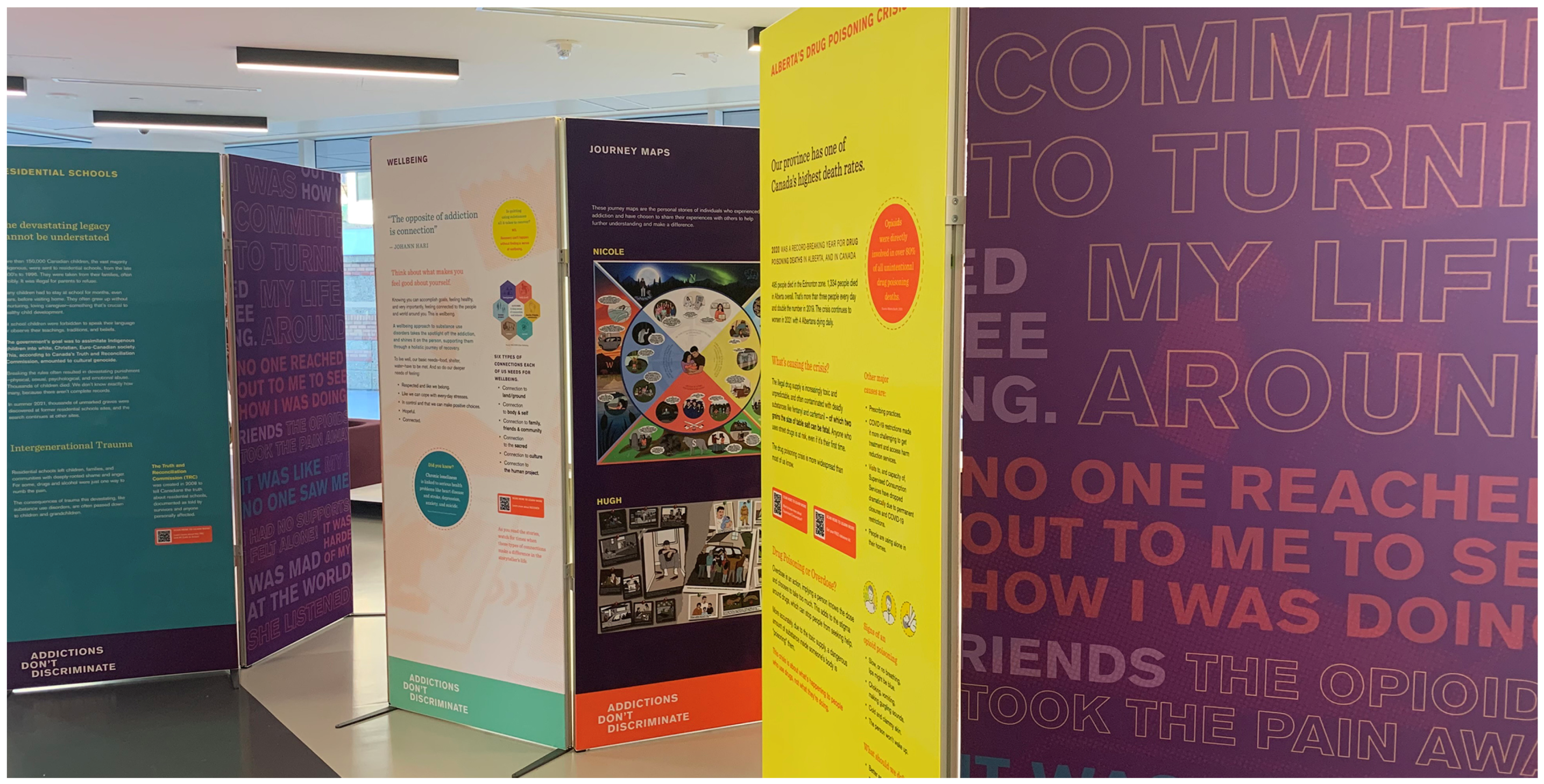
The interactive exhibit called ‘Addictions Don’t Discriminate’ was held in November 2021 at the Stanley A. Milner Library in partnership with REACH Edmonton, the City of Edmonton, Alberta Health Services, AAWEAR, City of Edmonton Youth Council, Red Deer County, Strathcona County, Primary Care Networks and other community partners. The exhibition aims to increase empathy and reduce stigma towards those experiencing addiction, create a better understanding of addiction and offer information about supports and services available in Edmonton.
Figure 2 presents a selection of photographs showing the exhibition panels.
Recognizing the participants as experts of their own stories and journeys, notes were developed throughout each interview and then used thematic analysis to identify, analyze and report these within the stories. We compiled and organized all of the stories and anecdotes that we collected through the co-design sessions and then we recorded them manually in a single spreadsheet. This information included the challenges and personal stories that participants indicated through their journeys with addiction.
Case Study 2: Co-design for Complex Health Communication: The importance of including intersectional analysis.
2.3. Introduction
To respond to rising overdose-related deaths, the Government of Canada has been engaged in efforts to increase access to a life-saving overdose response tool. Naloxone kits are designed to be used by a wide range of users, from first responders and medical professionals and people familiar with drugs and drug overdoses to community members with no medical training or knowledge about overdoses. Although Naloxone kits were designed and distributed, in many incidents they are not always used correctly, particularly among marginalized communities, likely due to a lack of confidence, limited knowledge, and the impact of stigma [
26].
In response to this crisis in Alberta, the Design Health Research Innovation Lab at the University of Alberta conducted a video project with participants from Streetworks and the assistance of the Inner City Health and Wellness Program. The project aimed to enhance empathy and understanding of overdose experiences by using animation and real voices of people with lived experiences—to convey real feelings. By using actual participant voices in the videos rather than using generic medical messaging (e.g., artificial intelligence or actors that were hired to read a script), we humanized the animations.
2.4. Methods and Materials
This project consisted of two phases: (1) a one-hour structured interview over the phone with women, (2) storyboard and design of video prototypes and feedback and iterative design of the video prototypes. To create the videos, 20 semi-structured qualitative telephone interviews were conducted with women in Edmonton who have witnessed a poisoning or have been in the presence of people who used drugs where poisonings could occur. The research question was: How might design strategies be used to make opioid poisoning information more accessible and relevant to women’s diverse experiences and contexts? Our study objectives were to:
To better understand where women access opioid related information;
To better understand the challenges to a timely first aid response for a person experiencing an opioid overdose/poisoning;
To demonstrate communication design as a tool to impact the public social and health discourse around opioid overdose/poisoning and improve opioid health messaging.
The primary means of recruitment relied on a contact person from the Harm Reduction team within Alberta Health Services. Outreach nurses introduced the study to their smaller teams through word of mouth and by circulating a poster through internal email. A secondary means of recruitment included contacts from previous research work through Educational Outreach Workers at Streetworks, AWEAR and CAPUD. Informed consent was obtained after verbal explanation of the study and assurance of confidentiality.
During the first phase, the interviewees shared and discussed their experience with using overdose kits, barriers and improvements that could be made to poisoning responses and the stigma related to responding in an emergency. All interviews will be performed by the same interviewer.
All phone interviews were transcribed and analyzed thematically. The project team used a NVivo Qualitative Software [
27] to organize the data, identify patterns, and develop key themes.
Further in the second phase, the project team created three short (30 s each) videos. The actual recordings from the telephone interviews (women’ s voices) were used as a voiceover in the videos to make them more impactful. Additionally, in the scripts for each video, the actual recordings were used as short phrases or quotes. The interviewees were kept anonymous; none of the interviewees was identified by name or location. The videos were shared with the interviewees to gather their feedback prior to publication and production.
Case study 3: Surviving opioid overdose with naloxone education and resuscitation (SOONER).
2.5. Introduction
Engaging communities in overdose response, particularly lay responders, requires a naloxone kit that is easy to use and provides a clear way to communicate the overdose response information. The SOONER project aimed to design an evidence-based Overdose Education and Naloxone Distribution (OEND) first aid toolkit, to be offered in a range of settings, that allows for ultra-brief training of overdose first aid for potential lay responders with nasal naloxone. To achieve this, the design should be easily accessible to people who use drugs, which includes using recognizable colors, highly stylish characters to avoid issues of identity or representation, and language that is non-stigmatizing and accessible for low-literacy readers.
Through collaborative dialogue and shared storytelling, seven key considerations emerged for designing naloxone distribution programs tailored to training needs and naloxone provision. These considerations include recognizing overdose, determining the appropriate naloxone dosage, addressing the impact of stigma, understanding the legal risks of responding, positioning naloxone within conventional first aid, supporting friends and family as responders, and encouraging calls to emergency services [
2].
The project is a collaboration between OCAD University, Unity Health, Inner City Health Associates, University of Toronto and Toronto Public Health. The project was funded by the Canadian Institutes of Health Research and Canadian Research Initiative in Substance Misuse. Initially, a multi-stakeholder co-design workshop was conducted to understand factors to consider for the design of naloxone distribution programs in point-of-care settings from the point of view of community stakeholders.
2.6. Methods and Materials
The study combines codesign, clinical trial and community engagement elements to develop and evaluate an effective first aid kit (Take Home Naloxone-kit (THN)) and training to reduce opioid-related stigma and inequity. It consisted of three phases: (1) a participatory codesign initiative in which scientists, design researchers and community members co-created a THN-kit and training that will be evaluated in subsequent phases, (2) a multimethods feasibility study for a randomized controlled trial, and (3) a full-scale randomized trial [
18].
The design process included extensive community and stakeholder engagement in iterative workshops over 9 months, engaging over 100 community members and clinicians. Thirteen codesign workshops were conducted to identify and address gaps in existing opioid overdose education training and THN-kits and emphasize timely response and stigma in future THN-kit design. The co-design workshops were conducted in each target setting, including family medicine, addiction medicine and the emergency department, and in community settings for people who use opioids.
Workshops were conducted over a span of 9 months.
Three advisory council workshops, addressing the training style and direction; the information and content of the training; the language, symbols, materials and color choice for the kit packaging; and refinement of design artefacts (persons and journey map for each stakeholder group).
Two co-design workshops were conducted in each setting (family medicine, addictions medicine and emergency departments), addressing twenty-four guiding questions under three main themes (training, packaging, and implementation) (see [
18] for more details).
Three co-design workshops were conducted in community settings with people who use opioids. The workshops focused on gathering design feedback and developing the training, kit packaging, and implementation components, followed by iterative design refinement after each session [
18].
The result of this phase was the development of an ultra-brief first aid training animation and the creation of a toolkit with nasal naloxone for lay response to overdose, which can be manufactured locally. Key aspects of the design process addressed the context of overdose, stigma, and marginalization. By engaging diverse groups and incorporating multiple perspectives in the design process, it enhances the adoption and sustainability of its outcomes. The study’s commitment to de-stigmatizing overdose response led to the design of the naloxone kit that emphasizes care and assistance over stigma. Additionally, a multimethods feasibility study for a randomized controlled trial was conducted among people likely to witness opioid overdose to compare the educational effectiveness of point-of-care naloxone distribution with best-available care, by observing participants’ resuscitation skills in a simulated overdose [
28].
3. Result
The final project resulted in a series of temporary, moveable museum-quality panels (21 double-sided panels) that were exhibited at the Stanley A. Milner Library in Edmonton. The exhibit presents real-life narratives of individuals impacted by addiction to familiarize viewers with the prevalence of substance use disorders. Visitors participate in an immersive experience, walking through personal stories to understand addiction from multiple story perspectives in addition to multiple angles within the exhibition space. There were other knowledge dissemination tools used including a website, a hosting toolkit, and evaluations for participants and hosts to complete QR codes throughout the panels that enabled participants to access additional information and show related video and audio content. The first exhibition had 435 attendees, 70% identified as women (of those 64% had a bachelor’s degree, trade ticket or equivalent, master’s degree, or higher and 53% were between 25 and 44 years of age).
Following the first exhibition, a feedback survey was distributed to evaluate whether the exhibition helped viewers understand substance use/addiction. Some general feedback from the 240 attendees that responded to the survey are as follows:
Many people in attendance already had a deep understanding of addiction/worked in the field/had lived experience or knew someone close to them who had lived experience;
Exhibit reinforced their already existing thoughts and beliefs and they were happy others were going to see this and potentially have more empathy;
The exhibit was most often rated “excellent” or “good”;
The reminder about language, stigma and disconnection was helpful;
The inclusion of the spectrum of substance use was helpful and eye-opening;
The people who did mention action items said that they will support supervised consumption sites and harm reduction, that they have more compassion and that they will work to break the stigma by sharing what they learned/saw and telling others about the exhibit;
The information about the current drug poisoning crisis in Alberta was informative for many;
Stories and storytellers were very diverse, and stories were humanizing and told with dignity;
Interactivity and QR codes that provided further information/stats/education were appreciated;
Lots of appreciation for the naloxone training;
Sharing information about the storytellers as individuals before addressing their history of substance use was appreciated as a good approach.
The project has received national and international recognition, including a recommendation award from the International Institute for Information Design (IIID award) in May 2023. To date, this exhibition has journeyed through over 30 small towns, using comics as a powerful medium to share stories from one community to another.
The analysis of data led to the identification of keywords, which informed the development of video themes. The keywords included stigma, fear, empathy, education, awareness, interaction anxiety and caring. The identified themes are experiencing overdose response, motivation to help, and experience of stigma in using the kit by being with someone else who is using drugs.
The project resulted in the design of three 30 s animated videos—Experience, Motivation, and Stigma—rooted in the real stories of women who have survived or witnessed opioid poisonings. Our design strategy was shaped by a commitment to honoring these lived experiences while engaging viewers through a visually compelling story. To reflect the seriousness and depth of the content, we used a black and white color palette. This choice eliminates visual distraction, heightens emotional contrast, and evokes the reality of real-life stories. The black and white color palette reflects the emotion within the stories—fear and resilience, pain and hope—and allows us to highlight key moments with color such as additional symbolic color (e.g., red to highlight the importance of the role of the naloxone kit).
The animation style uses imperfect lines, textured brushes and subtle visual noise to convey the fractured and often harsh realities of overdose and recovery. This style reinforces the authenticity of the stories and helps to communicate the heaviness and complexity of the experiences that the women share. A narrative animation style was used, with each video structured around selected quotes from interviews with women. The graphic style was kept consistent across all of the videos. The visual storytelling was developed through concept art and rough storyboarding that guided the animated sequences. The narrative was shaped around a carefully edited voiceover, composed by blending together participant recordings into a unified, multi-voiced narration. This audio adds texture, allowing viewers to feel directly connected to the people behind the stories. This consistency in the approach and focus on participant voices ensures that the final videos are not only visually distinct and emotionally moving but also ethically grounded, respectful of participants, and guided by lived experience.
Figure 3 presents a selection of frames from the Experiences, Stigma, and Motivation videos.
This research was presented at the WCHRI Conference in March 2021, and the videos have been widely shared via the DHRIL website and YouTube.
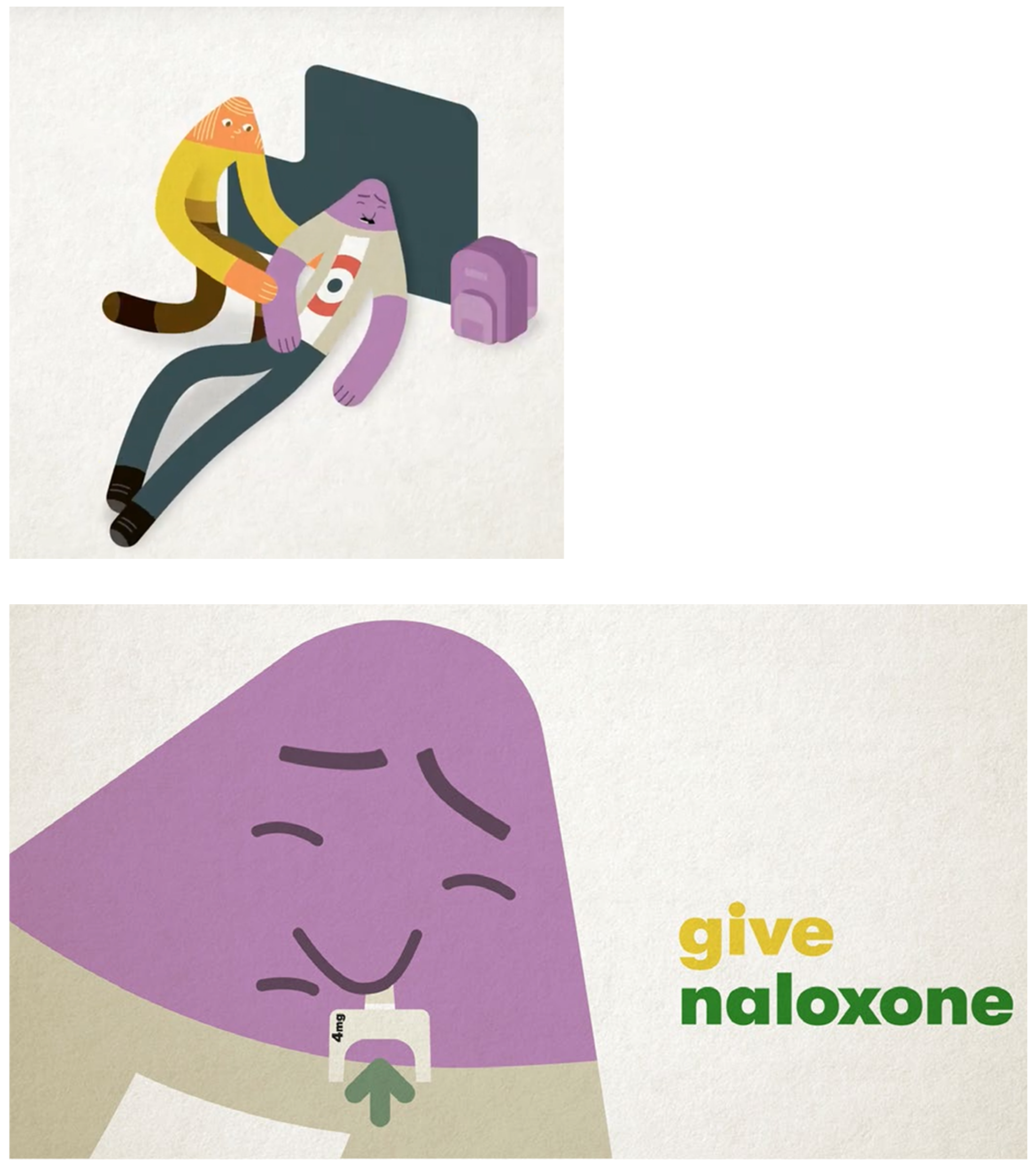
The SOONER naloxone kit and training is an inclusive, cost-effective, feasible, and user-friendly tool designed to address accessibility gaps in overdose response. The short training animation contains supportive, non-stigmatizing imagery and low-level literacy language, using three repetitions of the first aid steps (all steps, repeated steps and visual/word-based). It supports both auditory and visual cognitive styles [
18]. The kit packaging was designed to be visually identified; the physical layout provides clear infographics to support the step-by-step actions required in an overdose emergency. Additionally, to aid memory and reinforce learning, the infographic style builds on visual cues used in the training animation [
18].
Figure 4 presents a selection of frames from the SOONER training video.
The SOONER is an open-access Take Home Naloxone Kits and training that is publicly shared through the SOONER website to empower individuals and communities in responding to opioid overdose emergencies. The website provides the opportunity to order the printed version, download and create a customized version, or order customized Kits with specific Logos. It also provides access to the rapid training videos, FAQ feature, and design process and resources.
4. Discussion
This paper presents three case studies on the development of a set of comics or animations, communication designed to promote community health and wellbeing by addressing stigma as a key barrier in opioid overdose response. The case studies illustrate that the development of communication tools that prioritize accessibility, emotional response, and engagement with lived experience, while also examining how narrative, visual, and affective dissemination approaches might challenge societal stigmas surrounding sensitive issues such as substance use and overdose, and engage audiences in diverse ways. Across two case studies, nine stories of people with lived experiences were shared, six through traveling exhibitions and three through animations. Each story highlights the experience of someone who either went through an overdose or responded to one. In the third case study, we explored the role of animation in overdose response training, highlighting its effectiveness in addressing sensitive and stigmatized topics such as drug use and overdose.
Additionally, the paper highlights the dissemination strategies that enhanced the impact of these tools within communities, such as traveling interactive exhibitions that connect communities through shared stories [
29,
30], and videos that can be easily shared and distributed via the internet, apps, or social media [
19]. The traveling exhibition was an opportunity to share these stories in various locations, such as small towns and rural communities, allowing a wider audience to access these stories. To date, the Addictions Don’t Discriminate exhibition has traveled through over 30 small towns, using comics as a powerful medium to share stories from one community to another. By showcasing these stories and experiences, the exhibition plays an important role in reducing stigma and promoting empathy and understanding, specifically in the rural communities where stigma is often worse [
29]. The exhibit also provided educational resources on mental health, addiction services, and harm reduction for the visitors. The graphic medicine approach enables effective communication as well as enhances reach through its adaptability to a range of dissemination activities.
The three short videos of the second case study (Experience, Motivation, and Stigma), and SOONER training animation have been shared on various online platforms such as the WCHRI Conference, 24th International Conference on Emergency Medicine, SOONER and DROE websites, and YouTube. Different modalities shared via the internet and social media make them more accessible and impactful [
19].