Article

The Profile of the Astrotourist in Aragon—Keys to Guide Sustainable Tourism

by
Francisco Escario-Sierra
1,
Victoria Sanagustin-Fons
1 and
Jose A. Moseñe-Fierro
2,*
1
Department of Psychology and Sociology, Faculty of Business and Public Management, University of Zaragoza, 22001 Huesca, Spain
2
Department of Accountancy and Finance, Faculty of Business and Public Management, University of Zaragoza, 22001 Huesca, Spain
*
Author to whom correspondence should be addressed.
Societies 2026, 16(4), 117; https://doi.org/10.3390/soc16040117
Submission received: 3 March 2025 / Revised: 24 July 2025 / Accepted: 10 March 2026 / Published: 1 April 2026
(This article belongs to the Special Issue Embodiment and Engagement of Tourism with Social Sustainability)

Abstract

The search for sustainable practices in the tourism industry has opened new horizons in a polluting industry. This study explores astrotourism in the region of Aragon, Spain, considering Allan Schnaiberg’s environmental theory, which points out that as society becomes more industrialized, individuals become increasingly disconnected from nature and develop a sense of alienation from the natural world, leading to a longing for reconnection and deep experiences. The hypothesis postulates that astrotourists reflect the current trend of seeking knowledge-enriching, emotional, and nature-based experiences. Analyzing 407 astrotourists visiting the region’s attractions, we explore their profiles and travel motivations, uncovering subtle differences in prior knowledge, changing perspectives, and sociodemographic. The findings inform destination policies, marketing strategies, and management practices. The research outlines a structured profile encompassing sociodemographic, tourist behaviors, and assessments of Aragon’s astrotourism. This profile sheds light on astrotourists’ motivations, attitudes, and consumption patterns, serving as a foundation for future research and tailored experiences. This study contributes to understanding the dynamics of astrotourism and its implications for the evolution of astrotourists’ preferences.

1. Introduction

1.1. Astrotourism a Special Type of Tourism

Astrotourism refers to the travel activity of visiting places with clear and dark skies, primarily to observe celestial objects such as stars, planets, galaxies, nebulae, and other astronomical phenomena [1,2,3]. This type of tourism aims to offer an immersive experience that connects people with the wonders of the cosmos, and can involve stargazing, astrophotography, attending public observatory events, visiting planetariums, and participating in educational programs related to astronomy and space science [1]. Currently, interest and curiosity in astronomy and the acquisition of knowledge related to the study of the universe is widespread and democratized. The dissemination of this science is becoming an attraction for the tourism sector, astronomy as a science and its openness to share its knowledge and experiences with tourists is, thus, becoming the basis of an emerging tourism activity and an opportunity for development for the destinations where it takes place [2,3].
Given this emerging phenomenon, the main research question that guides this study is: What are the key characteristics that define the profile of astrotourists visiting Aragon, and how do these characteristics reflect contemporary social trends toward knowledge-enhancing, emotional, and nature-based experiences?
John C. Mather [4], an astrophysicist and Nobel Prize winner, discusses the potential of astrotourism as an educational tool and how it can inspire people to learn more about astronomy and science. Astronomical tourism can represent one of the most effective ways to bring tourists closer to nature, helping them to understand the physical world and their environment, promoting education in the field of astronomy, and increasing society’s awareness of the need to minimize light pollution and its negative consequences [5].
Natural resources, exemplified by the “unpolluted starry sky”; historical-artistic resources, as evidenced by “archaeological remnants” signifying the historical practice of astronomical observations at specific sites; scientific resources intertwined with the “popularization of astronomy”, encompassing “astronomical observatories”, “planetariums”, scientific outreach initiatives, and exhibitions; and lastly, accommodations, whether within urban areas boasting these ‘aforementioned assets’ or in rural settings that also afford a “comprehensive experience” due to “favorable weather and climate conditions” conducive to observations, activities, and recreational and/or educational offerings, especially the enchanting “night and its sensations. Considering that “nocturnity” refers to transformations, induced by internal and external physical changes experienced by the human body, and their cultural interpretations [6,7,8].
To understand this complex tourism phenomenon, we ask: What are the sociodemographic characteristics and tourist behavior patterns of astrotourists visiting Aragon?
Astrotourism is considered an activity belonging to rural tourism [9] as a supplementary endeavor with the potential to enhance the competitiveness and market positioning of the pre-existing product, underscored by the serenity and the excellence of its rural and natural surroundings [10]. Also, astrotourism can be considered as an activity belonging to scientific tourism [11,12,13]. Scientific tourism is a type of tourism directly related to visiting facilities where scientific research takes place [14]. In turn, we can also find research and publications on astrotourism that include it within cultural tourism [15,16], considering as cultural tourism what is proposed by the UNWTO [17] (p. 31) “cultural tourism is that form of tourism that aims, among other purposes, at the knowledge of monuments and historical-artistic sites”.
Interest in the “space economy” (and its impact, in the tourism sector too) is “skyrocketing”, as is its growth trajectory. The sector is already worth around 460 billion dollars worldwide. A figure that forecasts say will rise further over the next twenty years, at an ever faster rate: it will be worth $600 billion in 2030 and $1 trillion ten years later. Around 40% of the space economy’s revenues in 2040, a good $411 billion, will be generated by so-called “second-order impacts”, i.e., the additional revenue that will be generated in other sectors by the use of space technology (i.e., astrotourism) [18].

1.2. Sociological Approach to Astrotourism

A sociological theory that could explain the trend of astrotourism is the theory of environmentalism, as developed by sociologist Allan Schnaiberg [19]. Schnaiberg’s theory of environmentalism emphasizes the role of the environment in shaping human behavior and values. According to Schnaiberg, as society becomes more industrialized and technologically advanced, individuals become increasingly disconnected from nature and develop a sense of alienation from the natural world. This alienation can lead to a desire to reconnect with nature and seek out experiences that provide a sense of emotional and spiritual fulfillment. Astrotourism can be seen as a form of environmentalism, as it involves a desire to connect with the natural world and explore the mysteries of the universe. By participating in astrotourism, individuals can experience the awe and wonder of the night sky and gain a greater appreciation for the natural world and its place in the cosmos. Furthermore, astrotourism can also be seen as a form of environmental activism, as it promotes awareness and appreciation for the natural environment and the need to protect it from environmental degradation and pollution. By engaging with the natural world through astrotourism, individuals can develop a greater sense of responsibility and stewardship for the environment.
The generational characteristics of astrotourists align with millennial and post-millennial tourism trends, where travelers seek authentic, individualized experiences that provide personal meaning and connection with nature. This generational phenomenon, as described by Bauman’s liquid modernity theory [20], reflects a shift from traditional mass tourism toward personalized, knowledge-enhancing experiences. However, this individual-centered motivation paradoxically manifests in family and couple travel patterns, as astrotourists seek to share these meaningful experiences with loved ones, creating a bridge between individual authenticity-seeking and collective knowledge transmission.
This theoretical framework leads us to investigate: Do astrotourists demonstrate high educational levels and travel with family members to share astronomical knowledge and experiences?
Overall, the trend of astrotourism can be seen as a reflection of the theory of environmentalism, as individuals seek to reconnect with the natural world and promote environmental awareness and activism through knowledge-enhancing, emotional, and nature-based experiences. This theory is in relation to the postmodern one, specifically, Bauman [20], who characterized contemporary society as a “liquid” or fluid state in which traditional social structures and identities have dissolved. From this perspective, astrotourism can be seen as a form of “nomadic” or temporary identity construction, in which individuals seek to connect with nature and the cosmos in order to create a sense of meaning and belonging. Even more, Jean Baudrillard [21], who argued that contemporary society is defined by a proliferation of simulacra, or copies of reality that are detached from their original referents. In this context, astrotourism can be understood as the pursuit of unique and authentic experiences that take on particular significance as a means of reconnecting with the real.
Finally, to evaluate the practical outcomes of this emerging tourism form, it has been examined: How do astrotourists perceive the quality of astrotourism services offered in Aragon, and what factors influence their satisfaction levels?
So, the main hypothesis is:
Hypothesis 1 (H1).
Astrotourists demonstrate high educational levels and seek knowledge-enhancing, emotional and nature-based experiences through family-oriented travel patterns.
One of the cultural tourism types identified by Chen and Huang [22] is the so-called experience seekers who are motivated by a desire to have unique and memorable cultural experiences. They are more likely to participate in cultural events and to seek out immersive cultural experiences, such as some of the activities offered in astrotourism, mainly because they have certain knowledge about astrotourism or because they want to learn. The “Self-Determination Theory” (SDT) [23] is a psychological theory that focuses on understanding the basic human needs that drive motivation and behavior. According to SDT, individuals have three basic psychological needs: autonomy, competence, and relatedness. Autonomy refers to the need for individuals to feel in control of their own lives and decisions. Competence refers to the need to feel capable and effective in one’s actions and endeavors. Relatedness refers to the need for social connections and interactions with others. Astrotourists who have a high level of education may have a strong need for competence, as they are likely interested in developing and improving their knowledge and skills related to astronomy and cosmology. Additionally, they may have a strong need for autonomy, as they are likely interested in exploring and experiencing the cosmos on their own terms and at their own pace. Furthermore, astrotourists may also have a strong need for relatedness. They may want to share their passion and knowledge of the cosmos with their partners and children and feel a sense of connection and belonging through these shared experiences. Additionally, they may want to inspire their families to develop an interest in astronomy, passing on this knowledge to future generations. Even more, the theory of cultural capital [24,25] refers to the knowledge, skills, and cultural assets that individuals possess and can use to gain social and economic advantages. According to this theory, individuals who possess high levels of cultural capital, such as education, are more likely to participate in activities that provide opportunities to expand their cultural knowledge and experiences. Astrotourism, with its focus on deepening knowledge of the cosmos, could be seen as one such activity. Furthermore, the desire to share this knowledge with one’s family and descendants could also be seen as a way of transmitting cultural capital to the next generation. By passing on this knowledge, astrotourists are not only strengthening their own cultural capital but also providing their children with valuable cultural resources that can help them succeed in the future. Additionally, the cultural capital theory emphasizes the importance of social networks and connections in the acquisition and transmission of cultural capital. Astrotourists may be part of social networks or communities that place a high value on knowledge and experiences related to astronomy and cosmology, and participation in astrotourism activities may help to strengthen these connections and build social capital.
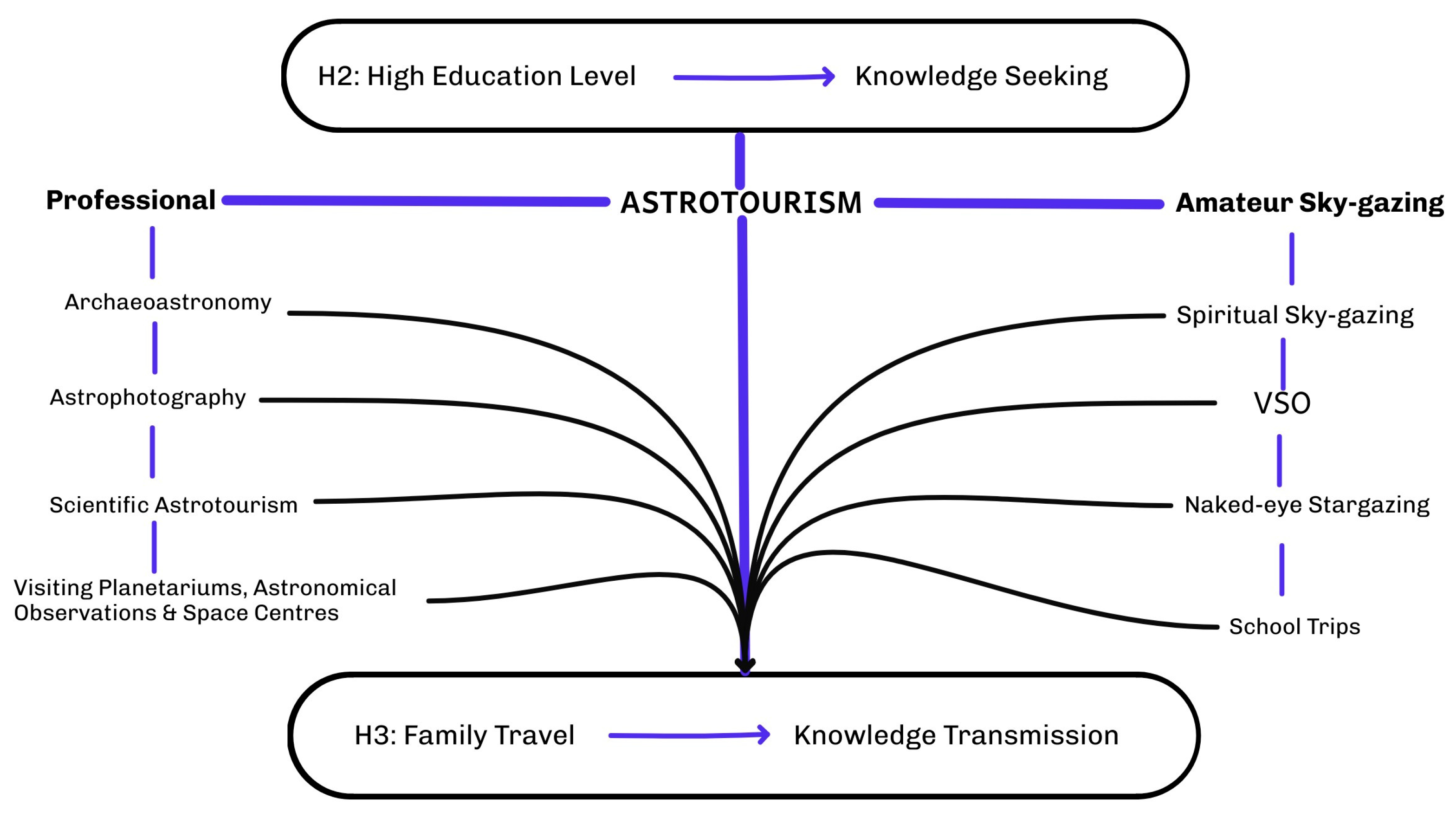
The secondary hypotheses from which this research is based are (Figure 1):
Hypothesis 2 (H2).
Astrotourists are people with a high level of education who wish to deepen, learn and improve their knowledge of the sky and cosmos.
Hypothesis 3 (H3).
Astrotourists, those who have a partner and/or children wish to travel accompanied by them so that this knowledge is also passed on to their families and descendants.
Then, considering that astrotourism in Aragon is an emerging type of tourism, we decided to use a quantitative method to know the profile of the astrotourist visiting the region, in order to verify or refute the described hypothesis.

2. Materials and Methods

2.1. Aragon, a Unique Territory in Spain

Aragon is a region located in the northeast of Spain; currently, this region presents demographic and territorial imbalances [26]. These imbalances are reflected in its territorial management strategy, this strategy literally cites that imbalances: Range from the unequal distribution of the population in the territory, whose main characteristic is the macrocephaly of Zaragoza (Spain) and its environment, which brings together more than 50% of the population of Aragon, as by the advanced process of aging of the population, an aspect that, despite the migration processes of the last decade, affects the whole of Aragon and, more intensely, the rural world [27].
To this situation, we must add the difficulty of the territorial structuring, with a very low population density, distributed in 1541 settlements, 895 with less than 100 inhabitants. This fact generates a high cost when it comes to the provision of services and equipment, an aspect to take into account given the situation of public deficit that occurs in Aragon [27]. Depopulation is one of the main challenges facing Aragon in the 21st century; this situation of low population density is linked to a rather significant territorial imbalance, concentrating the majority of the population on certain points, especially around the metropolitan area of the city of Zaragoza [28]. Nowadays, Aragon has one of the lowest population densities in Europe (24.8 h/km2), a figure significantly lower than that of Spain (78.8 h/km2) and well below the European average (116 h/km2). The number of inhabitants per square kilometre that some counties present, especially in the provinces of Huesca (Spain) and Teruel (Spain) correspond to what is known as the demographic desert, that is, areas with an average population density of less than 10 inhabitants per square kilometre [26]. This fact takes place in a total of 14 Aragonese counties, representing 47.10% of the area of Aragon [27].
To study the profile of the astrotourist, a descriptive-inferential analysis of the data coming from an ad hoc questionnaire is carried out, which provides information regarding relevant aspects in relation to our hypothesis.

2.2. Quantitative Research: Step Number 1: Survey Design

In order to study the profile of the astrotourist who visits Aragon, we have designed a survey (Profile Survey of the Astrotourist in Aragon is presented in Appendix A.) based on other works that have already been used to study the profile of this kind of tourist: (1) Customer Satisfaction Survey [2] and (2) Tourist Profile Survey in Aragon designed and applied by Sanagustín-Fons, et al. [29].

2.3. Quantitative Research: Step Number 2: Variables to Investigate

The application of the Profile Survey of the Astrotourist in Aragon as a quantitative technique chosen to develop this part of the research, this survey is based on the study of certain variables that will facilitate the acquisition of knowledge about the main sociodemographic traits of the tourists who consume astronomical products in Aragon. As well as the tourist and astrotourist behaviour of these tourists, the valuation of Aragon as an astrotourism destination and the degree of satisfaction of the astrotourist experience during their travel.
Sociodemographic variables: the sociodemographic indicators of the astrotourists in Aragon that are analyzed in this research are focused on gender, age, origin, level of studies and knowledge of astronomy.
Astrotourist behavior variables: we analyze the tourist and astrotourism behavior of visitors during their stay in Aragonese territory by collecting information from the following variables:
  • reason to travel.
  • total number of overnight stays during the stay in Aragon.
  • kind of accommodation chosen.
  • with whom the tourist makes the travel?
  • astrotourist products that the tourist carries out and will carry out.
  • first time that the tourist consumes any astrotouristic products in Aragon.
  • how the tourist was informed of the astrotouristic product chosen.
  • products and services contracted during the trip made by the astrotourist.
  • approximate average cost per day without taking accommodation into account.
Variables on the assessment and satisfaction of the astrotourism experience in Aragon: the study of these variables is oriented to the assessment that tourists give to the astronomical offer of Aragon and the degree of satisfaction that has generated their astrotourist experience. The variables studied are the following ones:
  • Will the tourist return to consume astrotouristic products in Aragon?
  • What is the degree of satisfaction of the astrotourist?
  • What is the astrotourist assessment of the astrotourism offer in Aragon?

2.4. Quantitative Research: Step Number 3: Population and Sample Size

The main consequence of the COVID-19 pandemic on tourism has been the change in certain consumer trends among tourists. Astrotourism is an example of how tourists currently prefer domestic or local tourism over international travel. They are seeking out destinations with low tourist influx rather than large capital cities or mass tourism destinations. At the same time, they are showing greater interest in sustainable destinations that minimize the environmental impact and contribute to the development of local communities [30].
The profile survey of the astrotourist in Aragon has as its target audience the visitor who consumes astronomical products in our region. The kind of sample used to carry out the research is intentional sampling; the tourists who make up the sample are chosen by the researcher [31]. The age of the astrotourists studied ranged from 18 to over 65 years. The criterion used by the researcher to select the astrotourists who form part of the sample was their participation in or consumption of astrotourism products in Aragon, within the period in which this research was conducted. To determine the size of the sample, we have tried to carry out as many surveys as possible during the time established for this part of the research, with the aim of obtaining a sample as wide and representative as possible. Finally, 407 tourists completed the survey during the established period.

2.5. Quantitative Research: Step Number 4: Pilot Test

Once the survey was designed, the variables to be analyzed were established, and the target audience was chosen, a pilot test was carried out. A pilot test is understood as an application of the survey to a small sample to identify and eliminate possible problems when it comes to being completed by the members of the sample under study [32]. The pilot test was carried out by 25 tourists who consumed astrotourist products at the Aragonese Astronomical Centre of Huesca, during the first week of February 2024. This pilot test was successfully developed by the entire sample, understanding the questions that are part of the survey and completing it without any problem.

2.6. Quantitative Research: Step Number 5: Field Work

The period in which the surveys were completed, once the pilot was successfully passed, was from 30 June 2024 to 8 August 2024. The surveys were completed by visitors who participated in astrotourism in the Aragonese territory.
Data collection took place at multiple astrotourism venues across Aragon, including the Aragonese Astronomical Centre of Huesca, various certified Dark Sky locations, planetariums, and during organized astronomical events and tours. Researchers approached visitors immediately following their participation in astrotourism activities to ensure their experiences were fresh and their responses reflected actual engagement with astronomical tourism products. This approach ensured that all respondents had direct, recent experience with the astrotourism offerings they were evaluating.

2.7. Quantitative Research: Step Number 6: Analysis of the Results Obtained in the Field Work

Once the previous phases have been completed, the results obtained were analyzed. The analysis of the results of the 407 surveys was carried out using the SPSS+ v28 statistical package in its latest version.

3. Results

3.1. Sociodemographic Profile of the Astrotourist in Aragon

The sample comprised 407 astrotourists with an average age of 42.69 years. Gender distribution was approximately equal between male and female participants (Table 1).
Regarding geographical origin, the majority of participants were Spanish nationals, with significant representation from Aragon itself, Catalonia, and the Community of Madrid. International visitors originated primarily from France, with additional representation from the Netherlands and the United Kingdo
Astronomical knowledge among participants varied considerably, ranging from professional astronomers to individuals with no prior astronomy background. The majority possessed basic to amateur-level knowledge. Educational attainment was notably high, with approximately half of the participants having completed higher education, university studies, or advanced professional training (Table 2).
Chi-squared goodness-of-fit testing revealed significant differences in educational levels (χ2 = 100.8771, df = 5, p < 2.2 × 10⁻¹⁶). University studies and higher vocational training combined represented 49.39% of participants (105 and 96 participants, respectively), substantially exceeding the expected frequency of approximately 68 participants per category (Table 3).

3.2. Tourist and Astrotourist Behavior

Travel motivations showed that 43.98% of participants visited Aragon specifically for astrotourism activities, followed by general tourism (22.13%) and holiday purposes (21.13%). Chi-squared testing confirmed significant differences in travel motivations (χ2 = 315.1, df = 4, p < 2.2 × 10⁻¹⁶) (Table 4).
Travel patterns indicated that most participants traveled in company, primarily as couples or families. Among solo travelers (n = 80), only 2.5% stayed more than three nights. Group travelers (n = 33) preferred single-night stays (60.6%), while family travelers typically spent 2–3 nights (33.05%) (Table 5).
Accommodation preferences showed significant variation (χ2 = 179.12, df = 6, p < 2.2 × 10⁻¹⁶). The most popular options were 1–3 star hotels (35.19%), followed by rural houses (24.74%) and camping facilities (18.12%). Accommodation choices clustered into rural establishments (Hotels from 1–3 * stars) (43%) and hotel (4–5 * stars) establishments (39%) (Table 6).

3.3. Service Quality Assessment

The service quality analysis reveals important insights supporting our research hypotheses. The high mean scores across all service quality dimensions (>4.0, except for information accessibility at 3.717) demonstrate that astrotourists, consistent with their high educational levels (H2), have sophisticated expectations for service quality that are being met by Aragon’s astrotourism offerings. The single dominant component explaining 66.75% of variance with high internal consistency (Cronbach’s α = 0.92874) suggests that educated astrotourists evaluate services holistically, requiring consistent quality across all dimensions (Table 7, Table 8 and Table 9).
A composite “Service Quality” construct was created by averaging the nine items. Global mean was 4.369 (SD = 0.255). Analysis by demographic factors showed minimal variation across astronomy knowledge levels, gender, and education, with slightly lower ratings among international visitors (Table 9).
ANOVA testing identified origin as the only factor with a statistically significant effect on service quality (p < 0.05), with foreign tourists showing slightly lower ratings than Spanish tourists. Non-parametric Kruskal–Wallis testing confirmed these results (Table 10).

4. Discussion

4.1. Astrotourist Profile and Theoretical Implications

The findings strongly support our primary hypothesis (H1) that astrotourists demonstrate high educational levels and seek knowledge-enhancing, emotional, and nature-based experiences through family-oriented travel patterns. The verification of H1 is demonstrated through multiple converging pieces of evidence: the high educational attainment (49.39% with university-level qualifications), the predominance of family and couple travel (indicating emotional connection-seeking), the preference for rural accommodations (nature-based experiences), and the strong motivation for astronomical knowledge acquisition (43.98% traveling specifically for astrotourism). This pattern reflects Schnaiberg’s environmental theory about reconnection with nature and aligns with contemporary trends toward experiential, educational tourism.
The verification of H2 is particularly noteworthy—astrotourism demonstrably attracts individuals with high socio-educational levels, with nearly half possessing university-level qualifications. This pattern supports the cultural capital theory, suggesting that astrotourism serves as a vehicle for expanding cultural knowledge and experiences. The strong correlation between astronomical knowledge and educational level further reinforces this connection, indicating that astrotourism appeals to intellectually curious individuals seeking to deepen their understanding of the cosmos.
The age distribution (average 42.69 years) positions astrotourists in their peak earning and family-formation years, supporting theories of experience-seeking behavior during life stages when individuals have both financial resources and motivation to pursue meaningful leisure activities. This demographic profile aligns with Chen and Huang’s “experience seekers” who are motivated by desires for unique and memorable cultural experiences.

4.2. Travel Behavior and Family Knowledge Transmission

The predominance of family and couple travel (with solo travelers representing a minority) provides partial support for H3 regarding knowledge transmission to family members. The preference for 2–3 night stays among family travelers suggests a deliberate approach to creating extended shared experiences, consistent with cultural capital transmission theories. This pattern indicates that astrotourism functions not merely as individual entertainment but as a mechanism for intergenerational knowledge sharing and family bonding around scientific interests.
The motivational analysis reveals two distinct astrotourist segments: dedicated astronomy enthusiasts (43.98% traveling specifically for astrotourism) and supplementary tourists who integrate astronomical activities into broader travel experiences (combining tourism/holiday motivations). This segmentation has important implications for destination marketing and product development, suggesting the need for differentiated offerings catering to varying levels of astronomical engagement and spending capacity.

4.3. Service Quality and Satisfaction Dynamics

The exceptionally high service quality ratings (overall mean 4.369/5.0) reflect strong satisfaction across all measured dimensions. However, the relatively lower rating for “ease of access to information” (3.717) identifies a critical area for improvement in destination marketing and communication strategies. This finding suggests that while the actual astrotourism experience exceeds expectations, initial accessibility and information provision require enhancement.
The slight but statistically significant difference between Spanish and international tourists’ quality perceptions warrants attention. International visitors’ marginally more critical assessments may reflect different cultural expectations, language barriers, or variations in prior astrotourism experiences. This finding emphasizes the importance of culturally sensitive service delivery and multilingual information provision.
The high internal consistency of quality measurements and the emergence of a single dominant factor confirm that astrotourists evaluate service quality holistically rather than as discrete components. This suggests that destination managers must maintain consistently high standards across all service dimensions, as weaknesses in any area may disproportionately impact overall satisfaction.

4.4. Implications for Sustainable Tourism Development

These findings position astrotourism as an exemplar of sustainable tourism practices that align with contemporary environmental consciousness. The preference for rural accommodations and nature-based settings demonstrates astrotourists’ commitment to environmentally sensitive travel choices. This behavioral pattern supports arguments for astrotourism as a form of environmental activism, promoting awareness of light pollution and natural resource conservation.
The geographic distribution of visitors, with significant representation from Aragon itself, suggests strong potential for domestic tourism development and regional economic impact. The presence of repeat visitors and high satisfaction levels indicates sustainable demand patterns that could support long-term destination development without over-tourism concerns.

4.5. Comparison with International Research

The findings align with international astrotourism research, particularly Brown and Simmons’ work in Chile’s Atacama Desert, which identified astrotourists as diverse, highly educated individuals motivated by nature connection and astronomical fascination. Similarly, the Chilean Government’s observatory study confirmed high educational levels and science interests among astrotourists, supporting our demographic findings.
Durbin’s emphasis on “peak experiences” that expand individual consciousness resonates with our evidence of astrotourism as a transformative leisure activity. The pursuit of meaningful, knowledge-enhancing experiences reflects broader societal shifts toward experiential consumption and conscious travel choices.

4.6. Policy and Management Recommendations

The heterogeneity in tourist preferences identified in this study necessitates segmented destination planning approaches. Destinations should develop differentiated astrotourism products catering to dedicated astronomy enthusiasts versus supplementary tourists, with corresponding variations in technical sophistication, educational content, and pricing structures.
The critical importance of information accessibility suggests prioritizing digital marketing strategies, multilingual content, and partnership development with astronomy organizations to enhance destination visibility and facilitate bookings. The strong preference for rural accommodations indicates opportunities for rural development initiatives that balance economic benefits with environmental protection.
Light pollution management emerges as a fundamental requirement for astrotourism sustainability. Policy frameworks must integrate dark sky preservation with tourism development, potentially including lighting ordinances, environmental impact assessments, and collaboration with renewable energy initiatives to create truly sustainable astrotourism destinations.

5. Conclusions

This study examined the profile of astrotourists visiting Aragon, Spain, through a quantitative analysis of 407 participants surveyed between June and August 2024. Using an intentional sampling methodology and applying Schnaiberg’s environmental theory and cultural capital theory, we investigated three main hypotheses regarding astrotourists’ characteristics, educational levels, and family knowledge transmission patterns.
Astrotourism in Aragon is currently emerging as a form of sustainable tourism, responding to new trends in the consumption of tourism products. In this northern Spanish region, this type of tourism combines night sky observation with the appreciation and conservation of natural and cultural heritage. Most of Aragon’s territory is comprised of sparsely populated rural areas, far from major population centres and industrialized zones. These conditions facilitate the existence of dark skies, conducive to astronomical observation. This quality of the sky has led to the recognition of Aragon’s astrotourism destinations for their excellent sky quality and commitment to its protection.
The findings confirm H1, as astrotourists demonstrate the predicted pattern of seeking knowledge-enhancing experiences (43.98% traveling specifically for astrotourism), emotional fulfilment through family travel, and nature-based experiences through rural accommodation preferences.
H2 is strongly supported by the demographic data showing 49.39% of participants possess university-level education, significantly exceeding expected frequencies (χ2 = 100.8771, p < 2.2 × 10⁻¹⁶), confirming that astrotourists are highly educated individuals seeking to deepen their knowledge of the sky and cosmos.
H3 receives partial support through the predominance of family and couple travel patterns, with solo travellers representing a minority, indicating the knowledge transmission motivation among astrotourists with partners and children who wish to share astronomical experiences with their families.
While this study focuses specifically on Aragon’s astrotourism context, the methodological approach and findings may have broader applications for understanding astrotourism development in other regions with similar characteristics, such as rural areas with low light pollution, cultural heritage, and astronomical resources. The survey instrument and analytical framework developed here could be adapted for comparative studies in other astrotourism destinations, contributing to a deeper understanding of this emerging tourism segment globally.

5.1. Research Limitations

This study presents several limitations that should be acknowledged. First, the research employs an intentional sampling methodology with 407 respondents, which, while substantial, may not fully represent the entire population of astrotourists visiting Spain or other international astrotourism destinations. The geographic focus on Aragon limits the generalizability of findings to other regions with different astronomical resources, cultural contexts, or tourism infrastructure.
Second, the cross-sectional nature of this study captures astrotourist profiles at a specific moment in time, potentially missing seasonal variations or evolving trends in astrotourism preferences and behaviors. The survey methodology, while comprehensive, relies on self-reported data, which may be subject to social desirability bias or recall limitations, particularly regarding spending patterns and satisfaction assessments.
Third, the study primarily focuses on quantitative analysis, which may not fully capture the depth of motivations, emotional experiences, and meaning-making processes that drive astrotourism participation. The research also does not examine the long-term impacts of astrotourism experiences on participants’ environmental consciousness or subsequent travel behaviors.
Finally, the study’s timeframe (June 2024 to August 2024) may have been influenced by specific external factors such as weather conditions, astronomical events, or tourism seasonality that could affect the representativeness of the sample and findings.
It is important to note that this study focuses specifically on the profile of astrotourists visiting Aragon and does not aim to provide a comparative analysis with astrotourists visiting other astronomical destinations or dark sky locations. The research is designed to understand the characteristics, motivations, and behaviours of visitors to Aragon’s specific astrotourism offerings, which include its particular combination of rural settings, cultural heritage, and astronomical resources. Comparative studies examining differences between astrotourist profiles across different destinations would constitute valuable future research but fall outside the scope of this investigation.

5.2. Future Research Lines

Future research could benefit from applying established tourism frameworks such as [33] cultural tourism model, which measures both the purpose/motivation of visits and the depth of experience. This framework could provide greater analytical scope for understanding astrotourism motivations and could facilitate comparative studies across different types of astronomical tourism, including aurora borealis tourism in northern latitudes, which represents another significant segment of astronomical tourism with different environmental conditions and cultural contexts. Such comparative research would enhance our understanding of astrotourism as a global phenomenon while recognizing regional specificities.
Several promising avenues for future research emerge from this study’s findings. First, longitudinal studies tracking astrotourists’ evolving preferences, repeat visitation patterns, and long-term environmental awareness development would provide valuable insights into the sustained impacts of astrotourism experiences.
Second, comparative cross-regional and international studies examining astrotourist profiles across different geographic contexts, light pollution levels, and cultural settings would enhance the generalizability of findings and identify universal versus context-specific characteristics of this tourist segment.
Third, mixed methods approaches incorporating qualitative methodologies, such as in-depth interviews, focus groups, or ethnographic observations, would deepen understanding of the emotional, spiritual, and transformative aspects of astrotourism experiences that quantitative surveys may not fully capture.
Fourth, research examining the economic impact and multiplier effects of astrotourism on rural communities, particularly in depopulated areas like those found in Aragon, would inform policy development and destination management strategies. This could include an analysis of astrotourism’s contribution to rural revitalization and sustainable development goals.
Fifth, studies investigating the relationship between astrotourism participation and subsequent environmental behaviors, conservation support, or advocacy activities would validate the theoretical connections between astrotourism and environmental activism proposed in this research.
Sixth, research focusing on the role of technology in astrotourism experiences, including mobile applications, augmented reality tools, and social media influence on destination choice and experience sharing, would address the intersection of astrotourism with digital innovation.
Finally, an investigation of astrotourism’s potential contribution to STEM education and scientific literacy, particularly among family groups and younger participants, would explore the educational impacts and societal benefits of this tourism form beyond immediate economic considerations.


Author Contributions

Conceptualization, V.S.-F.; methodology, F.E.-S. and J.A.M.-F.; software, F.E.-S.; validation, F.E.-S., V.S.-F. and J.A.M.-F.; formal analysis, F.E.-S.; investigation, F.E.-S.; resources, F.E.-S.; data curation, F.E.-S.; writing—original draft preparation, F.E.-S.; writing—review and editing, V.S.-F. and J.A.M.-F.; visualization, F.E.-S.; supervision, V.S.-F.; project administration, V.S.-F. All authors have read and agreed to the published version of the manuscript.

Funding

The APC was co-financed by the Regional Government of Aragón in the framework of the Research Group Reference number: S33_17R and the University of Zaragoza.

Institutional Review Board Statement

The study was conducted in accordance with the Declaration of Helsinki. The Ethical review and approval were waived by the Research Ethics Committee of the Autonomous Community of Aragon (CEICA) and the Data Protection Unit of the University of Zaragoza because no personally identifiable information was collected without consent, and that all data have been anonymised and securely stored in compliance with applicable data protection regulations (General Data Protection Regulation—GDPR and the Spanish Organic Law 3/2018 on Data Protection and Digital Rights—LOPD-GDD).

Informed Consent Statement

We as researchers at the University of Zaragoza declare that: (1) have obtained the oral informed consent of all individuals who participated in the survey conducted for this study; (2) prior to each survey, we clearly and comprehensively informed participants about: The objectives of the study. The voluntary nature of their participation and their right to withdraw at any time without consequences. The confidentiality and anonymity of the information provided. The intended use of the data, as well as any potential risks or benefits associated with their participation. We confirm that no personally identifiable information was collected without consent, and that all responeses have been anonymised and securely stored in compliance with applicable data protection regulations (General Data Protection Regulation—GDPR and the Spanish Organic Law 3/2018 on Data Protection and Digital Rights—LOPD-GDD). This research has been conducted in accordance with the ethical principles of social research in respect for fundamental rights, human dignity, integrity and justice, aligning with the European Code of Conduct for Research Integrity (ALLEA). The pillars include informed consent, data protection (GDPR), beneficence and independent evaluation, ensuring that research is socially responsible, transparent and trustworthy.

Data Availability Statement

The original contributions presented in this study are included in the article. Further inquiries can be directed to the corresponding authors.

Conflicts of Interest

The authors declare no conflicts of interest.

Abbreviations

The following abbreviations are used in this manuscript:
SDTSelf Determination Theory
SDGSustainable Development Goals

Appendix A. Astrotourist Profile Questionnaire

A Survey About Astrotourist Profile in Aragón
We are researchers from Zaragoza University, who are conducting a study about astrotourism in Aragón (Spain). We request your collaboration answering the following survey. The use of the information generated will be strictly for an academic research, the answers will be completely anonymous. Please answer the following questions sincerely:
Societies 16 00117 i001
Societies 16 00117 i002

References

  1. Collison, F.M.; Poe, K. Astronomical tourism: The astronomy and dark sky program at Bryce Canyon National Park. Tour. Manag. Perspect. 2013, 7, 1–15. [Google Scholar] [CrossRef]
  2. Araya-Pizarro, S. Astroturismo como alternativa estratégica de dinamización territorial: El caso de la Región Estrella de Chile. Econ. Y Soc. 2020, 25, 17–34. [Google Scholar] [CrossRef]
  3. Santos, C.M. Astrotourism: An analysis of the relationship between the night sky and sustainable tourism. J. Sustain. Tour. 2018, 26, 2112–2132. [Google Scholar]
  4. Mather, J.C. Astrotourism and education. Proc. Int. Astron. Union 2010, 5, 75–81. [Google Scholar]
  5. Fayos-Solá, E.; Marín, C.; Jafari, J. Astrotourism: No Requiem for Meaningful Travel. PASOS Rev. De Tur. Y Patrim. Cult. 2014, 12, 663–671. Available online: https://www.redalyc.org/articulo.oa?id=88132457001 (accessed on 2 February 2024). [CrossRef]
  6. Galinier, J.; Monod Becquelin, A.; Bordin, G.; Fontaine, L.; Fourmaux, F.; Roullet Ponce, J.; Zilli, I. Anthropology of the night: Cross-disciplinary investigations. Curr. Anthropol. 2010, 51, 819–847. [Google Scholar] [CrossRef]
  7. Najafabadi, S.S. Astronomical tourism (astro-tourism) in Cebu, Philippines: Essential features in selected destinations and its complementing visitor attractions. In Proceedings of the the International Conference on Trade, Tourism and Management (ICTTM’2012), Bangkok, Thailand, 21–22 December 2012. [Google Scholar]
  8. Rodrigues, A.L.; Rodrigues, A.; Peroff, D.M. The sky and sustainable tourism development: A case study of a dark sky reserve implementation in Alqueva. Int. J. Tour. Res. 2015, 17, 292–302. [Google Scholar] [CrossRef]
  9. Mitura, T.; Bury, R.; Begeni, P.; Kudzej, I. Astro-tourism in the area of the polish-slovak borderland as an innovative form of rural tourism. Eur. J. Serv. Manag. 2017, 23, 45–51. [Google Scholar] [CrossRef]
  10. Fernández-Hernández, C.; Araña, J.E.; de León, J.; León, C.J. Tourists’ Preferences for Stargazing Land Resources. Land 2022, 11, 198. [Google Scholar] [CrossRef]
  11. Robson, I. The role of the observatories. In IAU Commission 55: Communicating Astronomy with the Public; European Southern Observatory: Munich, Germany, 2005; pp. 60–70. [Google Scholar]
  12. Weaver, D. Celestial ecotourism: New horizons in nature-based tourism. J. Ecotourism 2011, 10, 38–45. [Google Scholar] [CrossRef]
  13. Belij, M.; Tadić, M. Astrotourism-possibilities for development in Serbia. Glas. Srp. Geogr. Društva 2015, 95, 59–73. [Google Scholar] [CrossRef]
  14. Molokáčová, L.; Molokáč, Š. Scientific tourism—Tourism in Science or Science in tourism. Acta Geoturistica 2011, 2, 41–45. [Google Scholar]
  15. Marin, C. Starlight Initiative and Skys capes, in “Landscape and Driving Forces: 8th Meeting of the Council of Europe Workshops for the Implementation of the European Landscape Convention”. Eur. Spat. Plan. Landsc. 2009, 93, 95–104. [Google Scholar]
  16. Ruggles, C.; Cotte, M. Heritage Sites of Astronomy and Archaeoastronomy in the Context of the UNESCO World Heritage Convention; ICOMOS: Paris, France, 2010. [Google Scholar]
  17. World Tourism Organization. Tourism and Culture Synergies; UNWTO: Madrid, Spain, 2018. [Google Scholar] [CrossRef]
  18. Morgan Stanley. Space: Investing in the Final Frontier. Available online: https://www.morganstanley.com/ideas/digital-twin-factories-2019 (accessed on 6 September 2023).
  19. Schnaiberg, A. The Environment: From Surplus to Scarcity; Oxford University Press: New York, NY, USA, 1980; p. 464. [Google Scholar]
  20. Bauman, Z. Living in the era of liquid modernity. Camb. Anthropol. 2000, 22, 1–19. Available online: http://www.jstor.org/stable/23818779 (accessed on 3 March 2024).
  21. Baudrillard, J. Simulacra and Simulation; University of Michigan Press: Ann Arbor, MI, USA, 1994. [Google Scholar]
  22. Chen, G.; Huang, S. Understanding Chinese cultural tourists: Typology and profile. J. Travel Tour. Mark. 2018, 35, 162–177. [Google Scholar] [CrossRef]
  23. Deci, E.L.; Ryan, R.M. Self-determination research: Reflections and future directions. In Handbook of Self-Determination Research; University of Rochester Press: Rochester, NY, USA, 2002; pp. 431–441. [Google Scholar]
  24. Bourdieu, P. The forms of capital. In Cultural Theory: An Anthology; Szeman, I., Kaposy, T., Eds.; Wiley-Blackwell: Hoboken, NJ, USA, 2011; pp. 81–93. [Google Scholar]
  25. Bourdieu, P. Distinction: A Social Critique of the Judgement of Taste; Routledge & Co.: Oxfordshire, UK, 2018. [Google Scholar]
  26. Bosque, M.I.A.; Navarro, V.J.P.; Pérez, L.A.S. El problema de la despoblación en Aragón: Causas, características y perspectivas. Rev. De Demogr. Histórica 2000, 18, 137–173. [Google Scholar]
  27. Decreto 46/2014, de 1 de abril, por el que se Regulan Actuaciones en Materia de Certificación de Eficiencia Energética de Edificios y se Crea su Registro, en el Ámbito de la Comunidad Autónoma de Aragón. Boletín Oficial de Aragón, 69, de 7 de abril de 2014. Available online: https://www.boa.aragon.es/cgi-bin/EBOA/BRSCGI?CMD=VEROBJ&MLKOB=786255244545 (accessed on 20 June 2025).
  28. Palacios, A.; Pinilla, V.; Sáez, L. Informe Sobre la Despoblación en Aragón 2000–2016: Tendencias, Datos y Reflexiones para el Diseño de Políticas; Centro de Estudios sobre la Despoblación y Desarrollo de Áreas Rurales: Zaragoza, Spain, 2017. [Google Scholar]
  29. Sanagustín-Fons, M.; Moseñe-Fierro, J.A.; Gómez-Patiño, M. Rural tourism: A sustainable alternative. Appl. Energy 2011, 88, 551–557. [Google Scholar] [CrossRef]
  30. Charlier, B.; Bourgeois, N. Half the park is after dark. L’Espace Géographique 2013, 42, 200–212. [Google Scholar] [CrossRef]
  31. Fricker, R.D. Sampling Methods for Web and E-Mail Surveys. The SAGE Handbook of Online Research Methods; SAGE Publications Ltd.: London, UK, 2008. [Google Scholar]
  32. Denscombe, M. EBOOK: The Good Research Guide: For Small-Scale Social Research Projects; McGraw-Hill Education: Maidenhead, UK, 2017. [Google Scholar]
  33. McKercher, B.; du Cros, H. Cultural Tourism: The Partnership Between Tourism and Cultural Heritage Management; Routledge: Oxfordshire, UK, 2020; ISBN 978-0-7890-1105-3. Available online: https://goo.su/V3kSG (accessed on 20 June 2025).
Figure 1. Astrotourism features. Source: own elaboration.
Societies 16 00117 g001
Table 1. Overall and sub-population characteristics of the age variable.
nAverageStandard DeviationC. Var.
Global Values40742.6913.2631%
Sex
Man22142.4512.7930%
Woman18642.9713.8332%
Note: Sourced by authors’ own elaboration.
Table 2. Overall percentages knowledge of astronomy.
KnowledgeFrequencyPercentage%Confidence Intervals
Professional astronomer102.46%[0.96; 3.96]
Amateur13232.43 %[27.88; 36.98]
Basic knowledge10124.82%[20.62; 29.02]
No knowledge6616.22%[12.64; 19.80]
No knowledge.
With interest
9824.08%[19.93; 28.23]
Note: Sourced by authors’ own elaboration.
Table 3. Global percentages of educational level.
Level of EducationPrimary SchoolSecondary SchoolBaccalaureateMiddle SchoolUpper
Secondary School
Higher
Education
Total
Frequency643797896105407
Percentage1.47%10.57%19.41%19.16%23.59%25.80%100%
Confidence intervals[0.3; 2.6][7.6; 13.6][15.6; 23.2][2.3; 15][19.5; 27.7][21.5; 30.1]
Note: Sourced by authors’ own elaboration.
Table 4. Overall percentages reason for travel.
Reason for the TripFrequencyPercentageConfidence Intervals
General Tourism8621.13%[17.16; 25.10]
Holidays9022.11%[18.08; 26.14]
Studies174.18%[2.24; 6.12]
Visiting family and/or friends348.35%[5.66; 11.04]
Professional10.25%[0; 0.74]
Astrotourism17943.98%[39.16; 48.80]
Note: Sourced by authors’ own elaboration.
Table 5. Overall percentages of travel mode vs. overnight stays.
Overnight StaysAloneCoupleFamilyGroupOtherTotal
0 nightFrequency25592880120
%Total6.14%14.50%6.88%1.97%0.00%29.48%
%Column31.25%33.71%23.73%24.24%0.00%-
1 nightFrequency262231201100
%Total6.39%5.41%7.62%4.91%0.25%24.57%
%Column32.50%12.57%26.27%60.61%100.00%-
2 or 3 nightsFrequency27423950113
%Total6.63%10.32%9.58%1.23%0.00%27.76%
%Column33.75%24.00%33.05%15.15%0.00%-
More than 3 nightsFrequency252200074
%Total0.49%12.78%4.91%0.00%0.00%18.18%
%Column2.50%29.71%16.95%0.00%0.00%-
TotalFrequency80175118331407
%Total19.70%43%29%8.10%0.20%100%
Note: Sourced by authors’ own elaboration.
Table 6. Overall percentages of accommodation types.
Accommodation TypeFrequencyPercentage
Camping5218.12%
Rural house7124.74%
Rented accommodation269.06%
Family and/or friends’ home165.57%
Hotel 1–3 *10135.19%
Hotel 4–5 *82.79%
Own accommodation134.53%
Total287100%
Note: Sourced by authors’ own elaboration.
Table 7. Statistical summary ITEM 10 (the astrotourists’ experience quality perceived by tourists).
ItemnMeanStd. Dev.C. V.Mín.Máx.SkewnessKurtosisConf. Int. (95%)
10.14073.7170.79521.38%252.826−4.0333.643.795
10.24074.2630.716.42%25−3.761−2.964.1954.331
10.34074.270.77918.24%25−4.993−3.2984.1944.346
10.44074.6040.54211.77%25−9.2415.5234.5524.657
10.54074.6660.7115.21%25−15.3777.9654.5974.735
10.64074.6810.66714.24%25−17.59516.1264.6164.746
10.74074.6170.5411.69%25−9.7536.234.5644.669
10.84074.2190.75517.90%25−3.747−3.6834.1454.292
10.94074.290.69816.27%25−5.273−0.3294.2224.358
Table 8. Correlations ITEM 10. (the astrotourists’ experience quality perceived by tourists).
10.110.210.310.410.510.610.710.810.9
10.1 0.78470.53750.67170.47840.35450.72320.79260.5831
(407)(407)(407)(407)(407)(407)(407)(407)
0.00000.00000.00000.00000.00000.00000.00000.0000
10.20.7847 0.71430.68380.64830.58160.56100.95350.6352
(407) (407)(407)(407)(407)(407)(407)(407)
0.0000 0.00000.00000.00000.00000.00000.00000.0000
10.30.53750.7143 0.37640.77860.65050.14750.77030.4762
(407)(407) (407)(407)(407)(407)(407)(407)
0.00000.0000 0.00000.00000.00000.00000.00000.0000
10.40.67170.68380.3764 0.66060.48090.58350.70520.6879
(407)(407)(407) (407)(407)(407)(407)(407)
0.00000.00000.0000 0.00000.00000.00000.00000.0000
10.50.47840.64830.77860.6606 0.78880.26280.74780.6136
(407)(407)(407)(407) (407)(407)(407)(407)
0.00000.00000.00000.0000 0.00000.00000.00000.0000
10.60.35450.58160.65050.48090.7888 0.35720.60870.2683
0.00000.00000.00000.00000.0000 0.00000.00000.0000
(407)(407)(407)(407)(407) (407)(407)(407)
10.70.72320.56100.14750.58350.26280.3572 0.47820.4462
(407)(407)(407)(407)(407)(407) (407)(407)
0.00000.00000.00000.00000.00000.0000 0.00000.0000
10.80.79260.95350.77030.70520.74780.60870.4782 0.7112
(407)(407)(407)(407)(407)(407)(407) (407)
0.00000.00000.00000.00000.00000.00000.0000 0.0000
10.90.58310.63520.47620.68790.61360.26830.44620.7112
(407)(407)(407)(407)(407)(407)(407)(407)
0.00000.00000.00000.00000.00000.00000.00000.0000
Table 9. Quality of service.
nMeanStd. Dev.C. V.Mín.Máx.SkewnessKurtosisConf. Int. (95%)
Global values
4074.3690.25512.65%2.335−8.1942.5834.315
Astronomy Knowledge
1104.0660.64615.89%3.3350.455−1.0473.862
21324.4150.56812.88%2.335−5.8753.2374.366
31014.3330.57113.18%2.555−3.7490.6714.276
4664.3530.59313.64%2.445−3.7141.524.28
5984.3860.46510.61%3.335−2.516−0.5914.339
Gender
12214.3940.5312.06%2.555−5.8861.2824.359
21864.3390.57813.33%2.335−5.5762.0664.297
Level of studies
164.5550.3297.24%4.22250.413−0.8654.42
2434.2270.58713.90%2.5555−2.4040.9454.137
3794.4650.50111.22%2.4445−4.9974.4254.409
4784.3840.48210.99%3.3335−2.749−0.0834.33
5964.3730.59113.53%2.5555−3.8790.634.313
61054.330.59113.65%2.3335−3.7840.5294.272
Origin
Spanish3444.3990.54712.456%2.3335−8.0292.9264.369
Others634.2090.55613.22%2.5555−2.5070.6794.139
Note: Sourced by authors’ own elaboration.
Table 10. Analysis of Variance for “Quality of Service”.
SourceSum of SquaresDfMean SquareF-Ratiop-Value
MAIN IMPACTS
A: Sex0.17862510.1786250.590.4419
B: Astronomy Knowledge0.98352640.2458810.820.5156
C: Educational Level1.7287550.3457491.150.3349
D: Origin1.6936611.693665.620.0182
RESIDUE119.0563950.301407
TOTAL (CORRECTED)124.093406
Note: Sourced by authors’ own elaboration.
Disclaimer/Publisher’s Note: The statements, opinions and data contained in all publications are solely those of the individual author(s) and contributor(s) and not of MDPI and/or the editor(s). MDPI and/or the editor(s) disclaim responsibility for any injury to people or property resulting from any ideas, methods, instructions or products referred to in the content.