
Ghanaian Girls’ Lives Beyond the Frame: Using Photovoice to Disrupt the Single Story of African Girlhood

Abstract
1. Introduction
1.1. Ghanaian Girls’ Representation in the Extant Literature
1.2. Who We Are & Why We Write
1.3. Study Context
2. Materials and Methods: Operationalizing a Strengths-Based Research Design to Elicit Nima Girls’ Voices
2.1. Methodology: Photovoice
2.2. Data Collection & Analysis Methods
So, Elicity, Richlove, Lubi-Darling, Empress Limash, Queen of Buse, Miss Niaja, all 6, took pictures that challenged the idea that they live downtrodden and sexually focused lives, as the literature suggests. And also in their descriptions of their lives in Nima and themselves, they also challenge that idea in specific ways. So, this is an important theme that cuts across all of the data. It is represented in the initial codes in each of the categories (Analytical Memo 7).
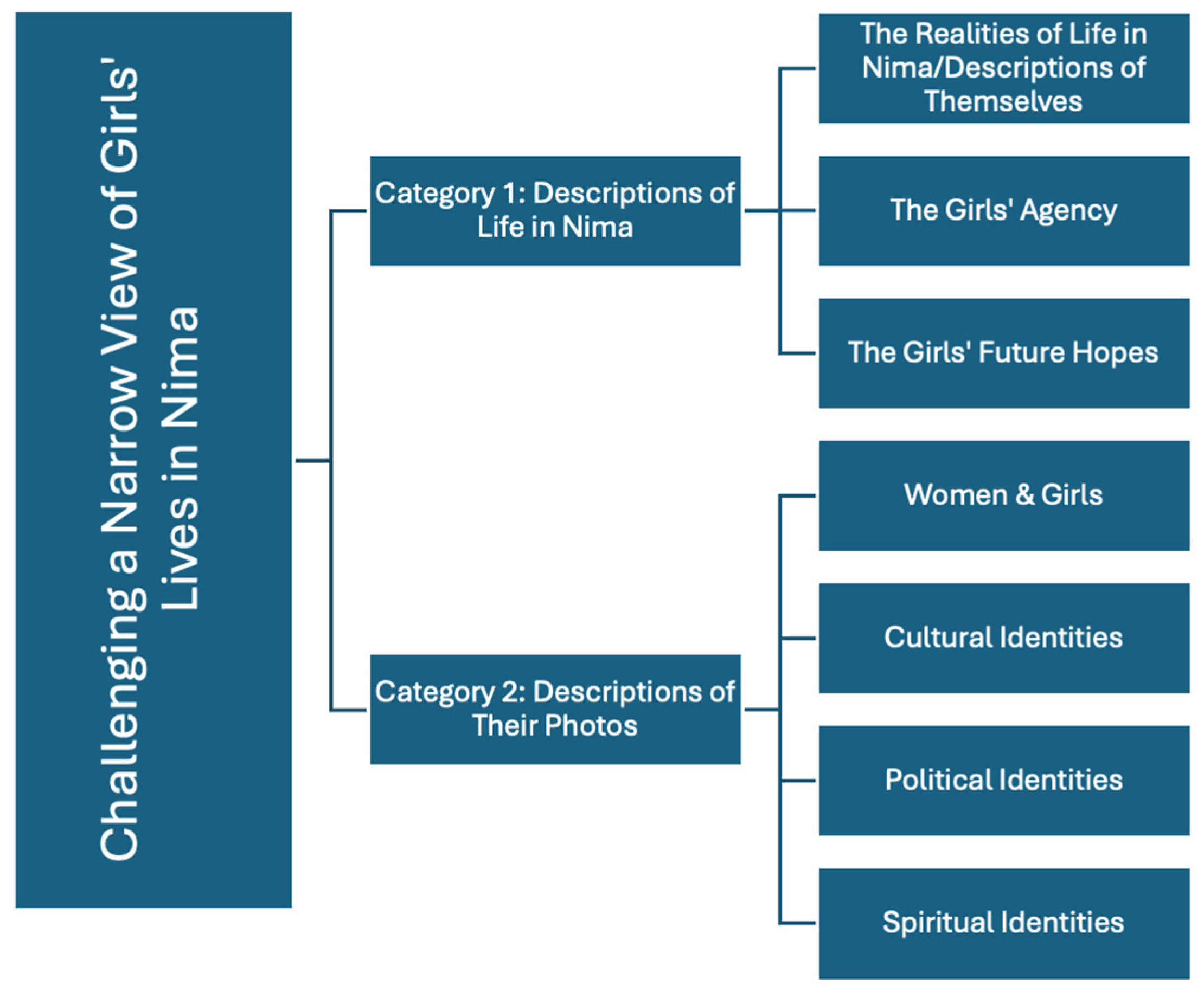
3. Results: Challenging a Narrow View of Girls’ Lives in Nima
That, as for me, I’m not bad. Yeah, because if I stay in Nima, that doesn’t mean I’m a bad girl. And Nima is not a bad place. It’s good.~Richlove
3.1. The Girls’ Descriptions of Life in Nima: Navigating Reality, Demonstrating Agency, and Sharing Future Hopes
Nima is not a quiet place. It’s a very harsh community and many people sleep there. And there are many people that try to abuse some of us. So we just pray to God that we will not fall into their trap so that we become like them. And also, Nima is nice, but you must be careful. [Outsiders] think Nima is not a good place, but Nima is a very good place. What you need is to be careful. They think we don’t know anything. We are just there doing things that are not important. But there are some girls in Nima that are very good and also very nice.
Outsiders take Nima to be a bad place but you are the person that is supposed to choose. If you choose to go to the wrong parts, it’s your own cup of tea. If you choose to go to the right part, you will be ok. I’m very proud because I see Nima to be normal. I’m growing in it, but I don’t see anything bad about it. I don’t see myself doing anything bad. [I’m] comfortable.
Some years ago I visited hospital. That time, we not even having health insurance but they collected money from us and the way the doctor used to treat the women make me angry. But at that time, I’m still young. So, since that day, I used to tell my dad that Inshallah [By the grace of God], I want to become a doctor. I don’t want to become a doctor so that I can get money, but I want to become a doctor so that I can help people.
When you are from Nima and you go to other place…when they ask “where are you from?” Then you said “Nima.” They will be surprised because they know Nima. [People outside Nima] see them that they are bad because some people think that girls in Nima wear short dress. But some people do see them like they are good. Those who think good things about them, that is fine. But those who think negative, then they have to stop that because we are human beings.
3.2. The Girls’ Descriptions of Their Photos: The Significance of Women & Girls’ Cultural, Political, & Spiritual Identity
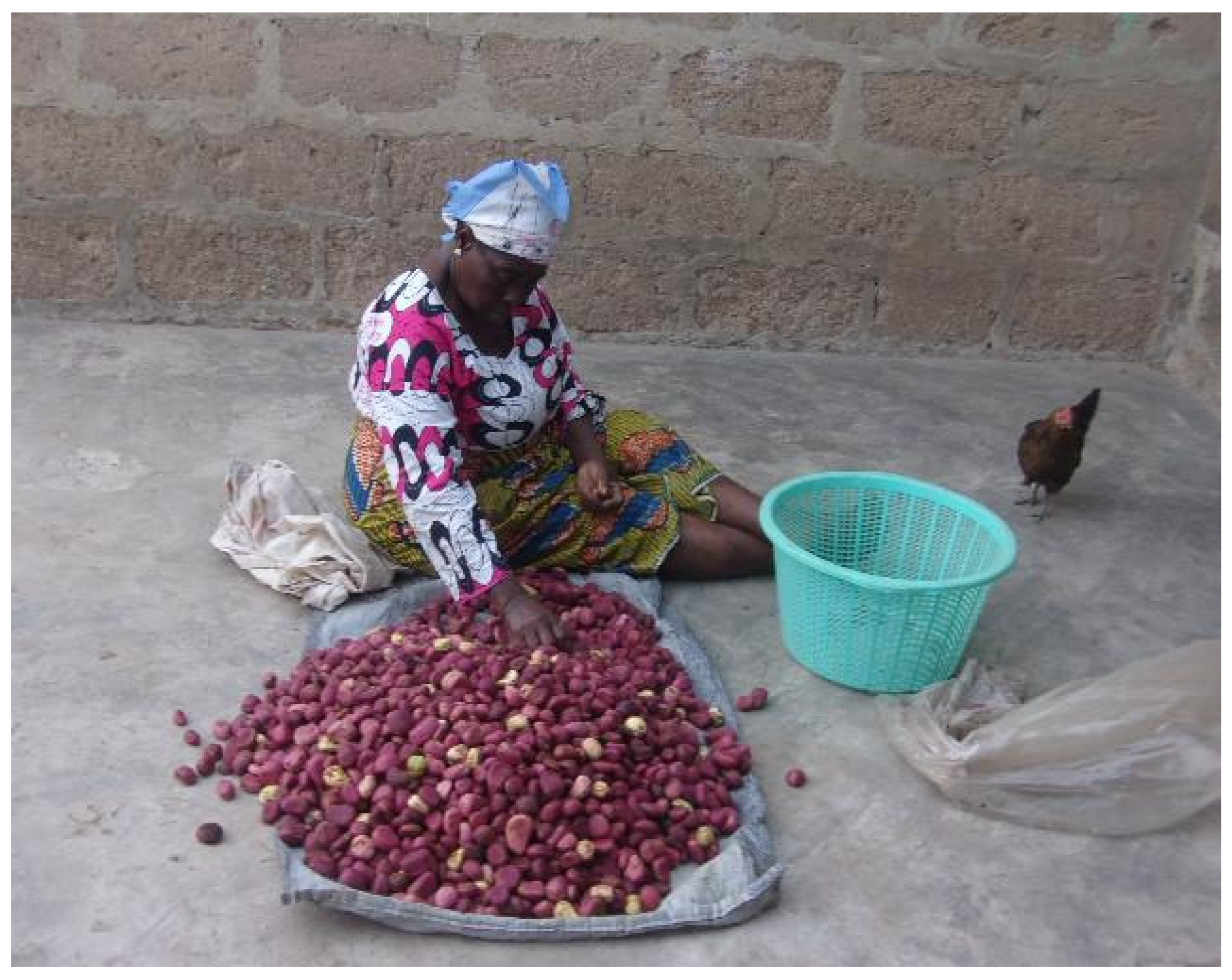
That picture is about my grandmother, especially when she’s selling kola. So, in the evening, when she brought the kola home, we used to play with them, and she would tease us, and we would run or play. So I just love it. That’s why I take a picture of her. She gives good advice, company, and income. Like if I need something, she is the only one who can help me if I’m sick. She is very close to me. She is the only person to help me.
I took this photo because I love my sister, and she is so caring and lovely. My sister is a calm and good person, and she’s hard-working. That’s what I want to learn from her…how she does everything. The way she talks to people and all that. Sometimes, when she cooks, even for the family, we won’t eat. She’ll just give it out to people who need it more.
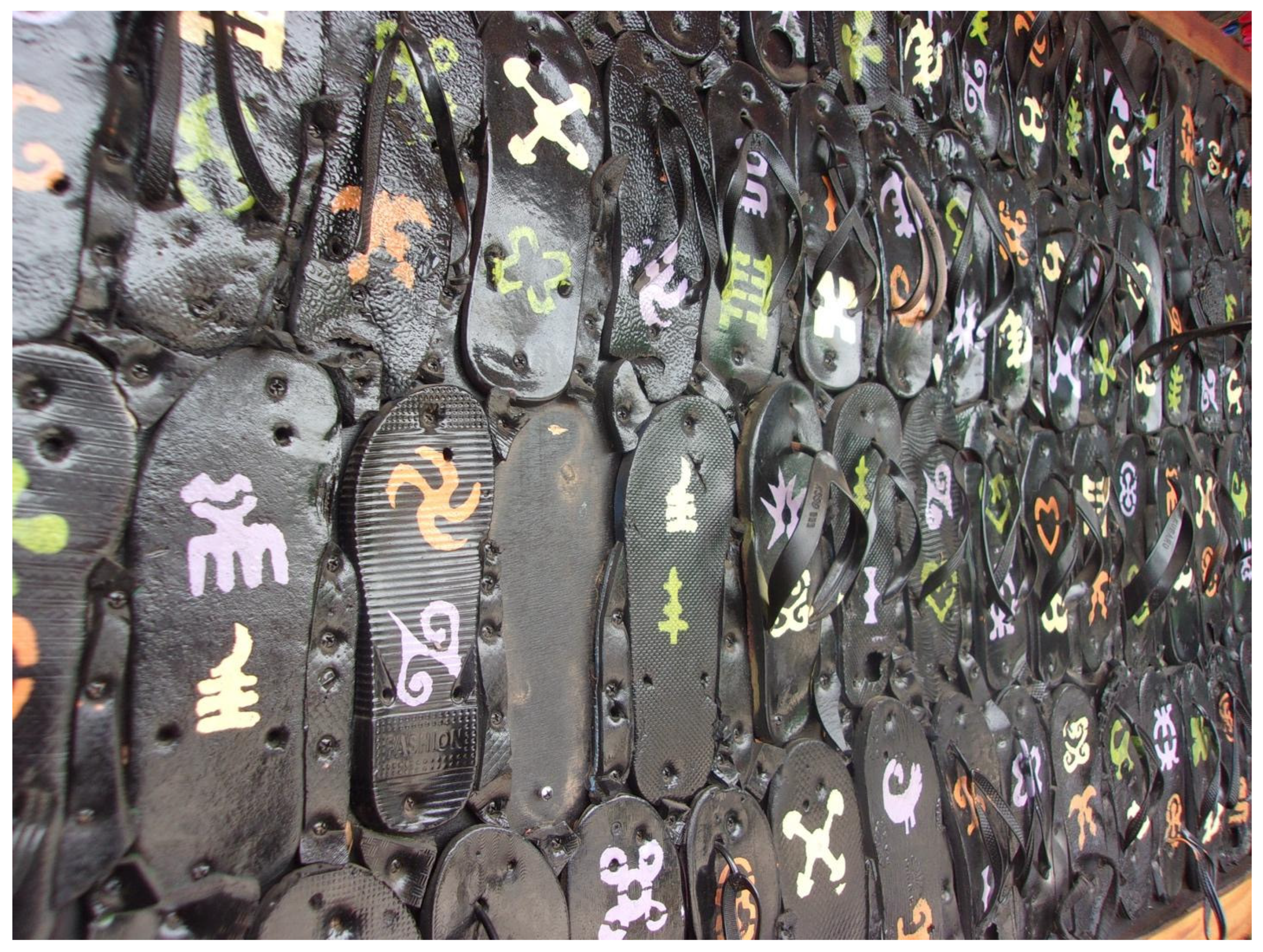
The Amazing Sneakers was about a birthday gift. My sister bought it for me. It was a surprise gift. I didn’t expect anyone to buy me a shoe. So when I saw the shoe, I danced that day. Hah. I love the shoe… I like fashion. When I wear something that is functional, it make me look good and always people praise me that I look good and I love that. It make me feel proud and big. I wish I have more so that I can give people, so that people will see that them too, they are special just like me. How I feel, I want them to feel this way I also feel, and it is because of my sister.
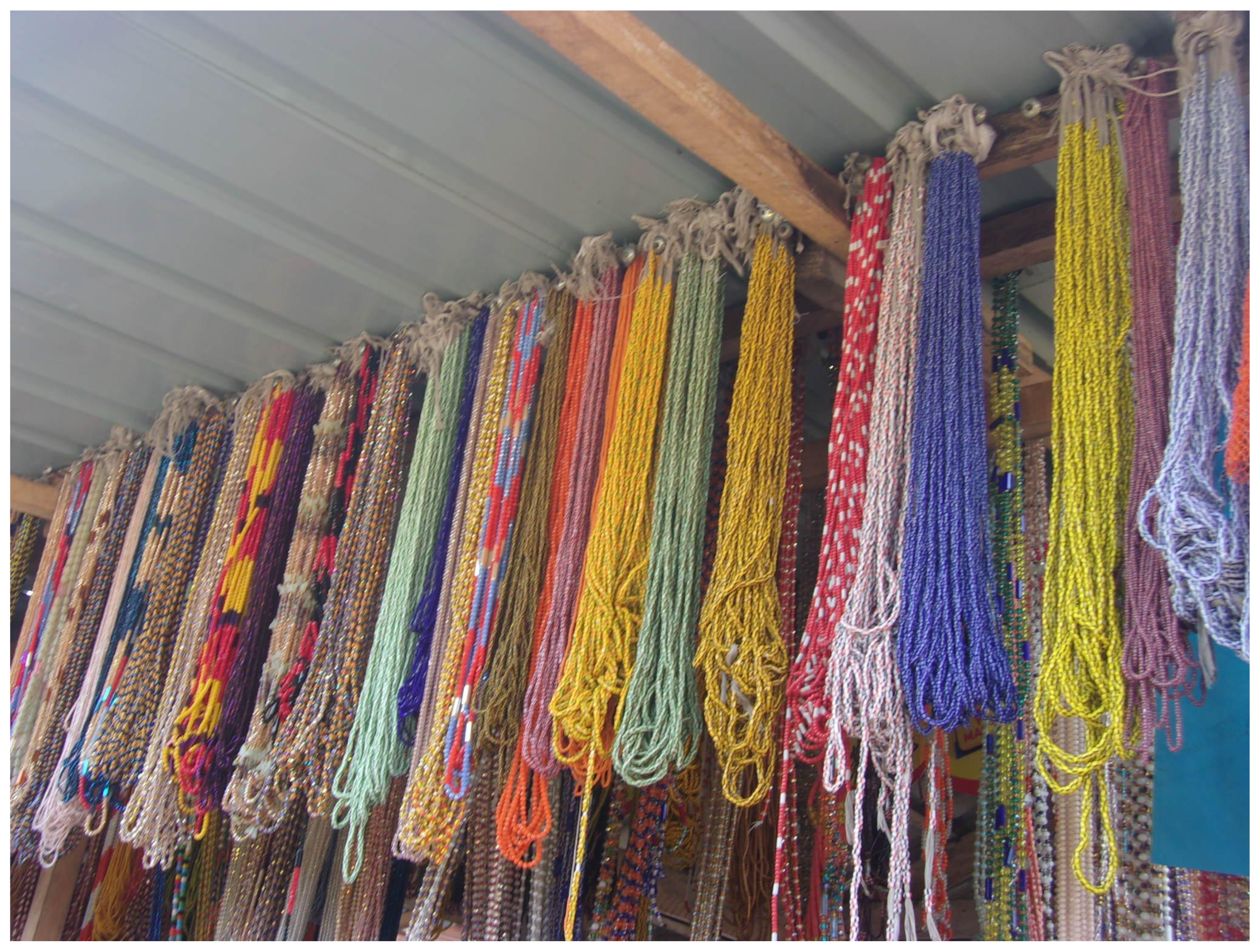
You see, Ghanaians, they love beads, especially the Krobos. When [the Krobos] wear it, I feel like wearing some. The way they paint their self and they put on their beads and they dance to their tunes. I really like it. I like how they celebrate their festival, that’s why I chose this picture. The festival is about young girls who are ready to going into adulthood and marriage. So you have to go to the festival to show that you are a mature person…. Bead is the one that I see most people use during the festival… Beads make a girl look beautiful, especially the yellow colors… So when you wear it, it draws people’s attention. They want to see where I got that from. They wish to wear the same. When I don’t wear them, I don’t feel okay. Like now, I don’t feel okay because [the beads] are not on me.
They are my cousins and they are dressed according to their tribe. The one on the left is a Fulani and the one in the middle, she’s Hausa and the one on the right is Yoruba. So they dress differently. We don’t attend the same school, but on that day, they said they should dress in their African wear. So when they are dressed, when they were about to leave for school, I took pictures of that. I am very, very proud. Africa is a very, very loving continent. If you are in Africa, with the exception of those who are more interested in maybe Europe or America. But if you are more interested in Africa, then you see the benefits of it.
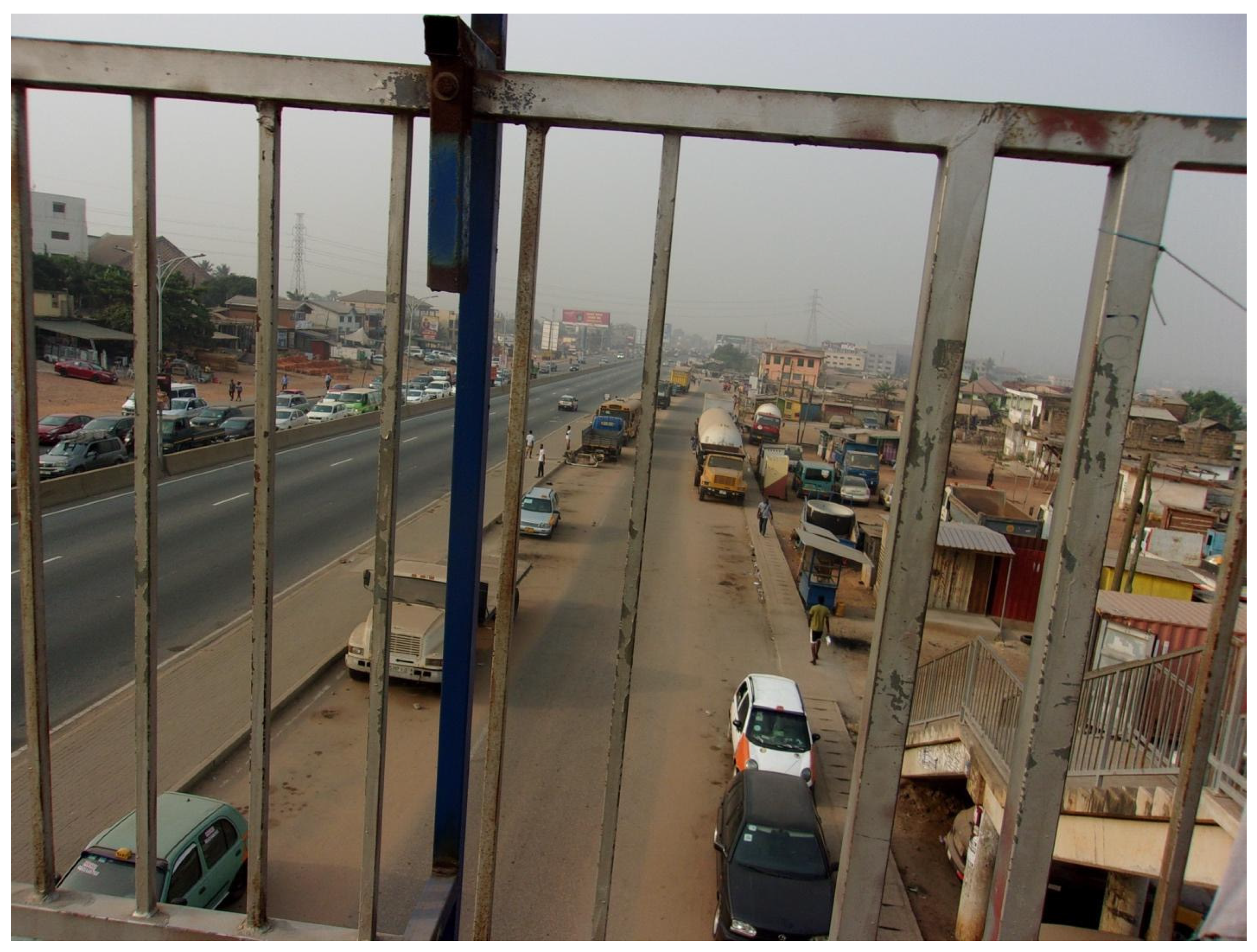
When you go to this place, as you can see, nobody is in there. But when you go there, when you are alone, you’ll sit down, and you think. You meditate. You think about what is good, also what to do in the future. You think about wise things. But when you are out there [on the street], people are making noise, you won’t be able to think. You can’t get a time to think.
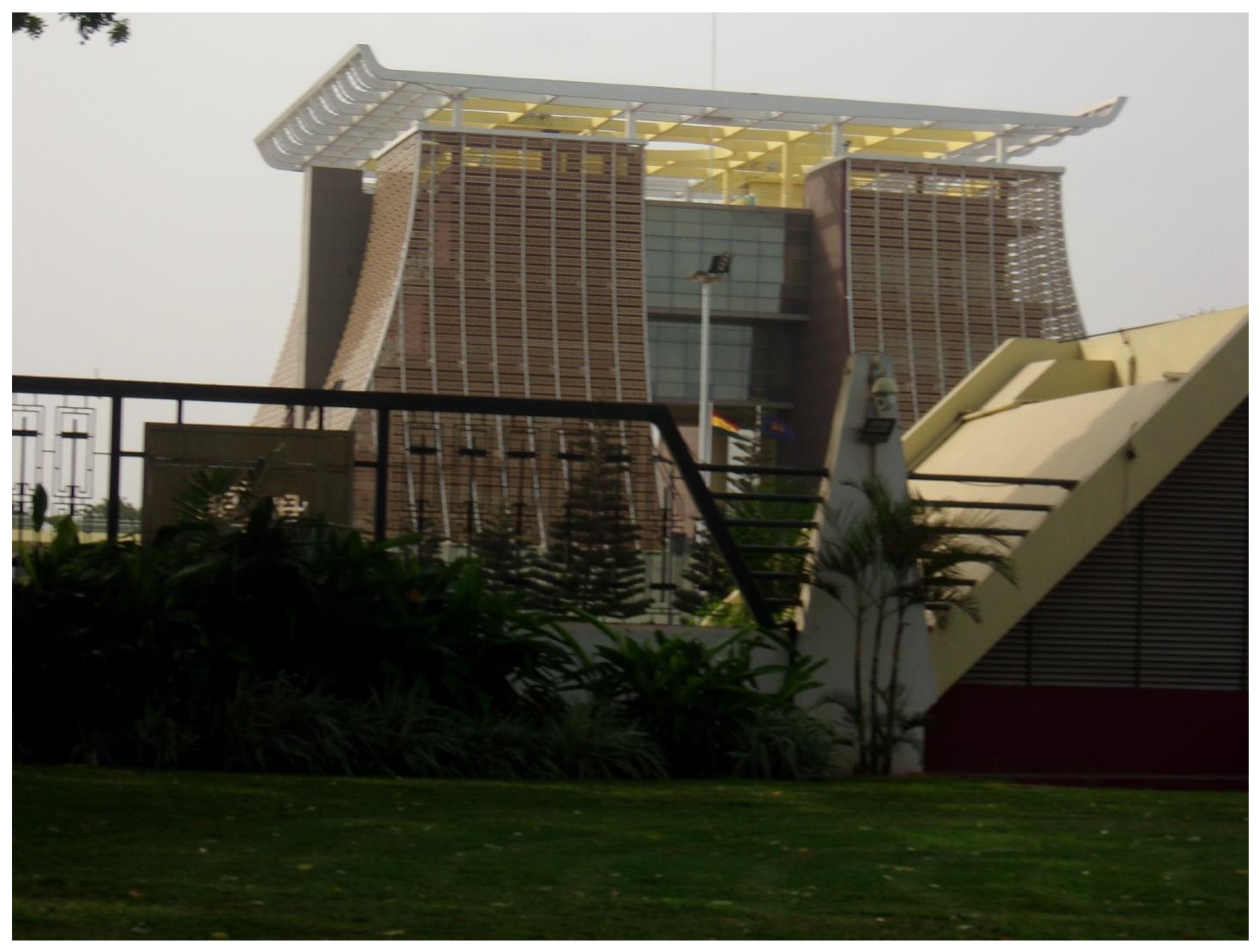
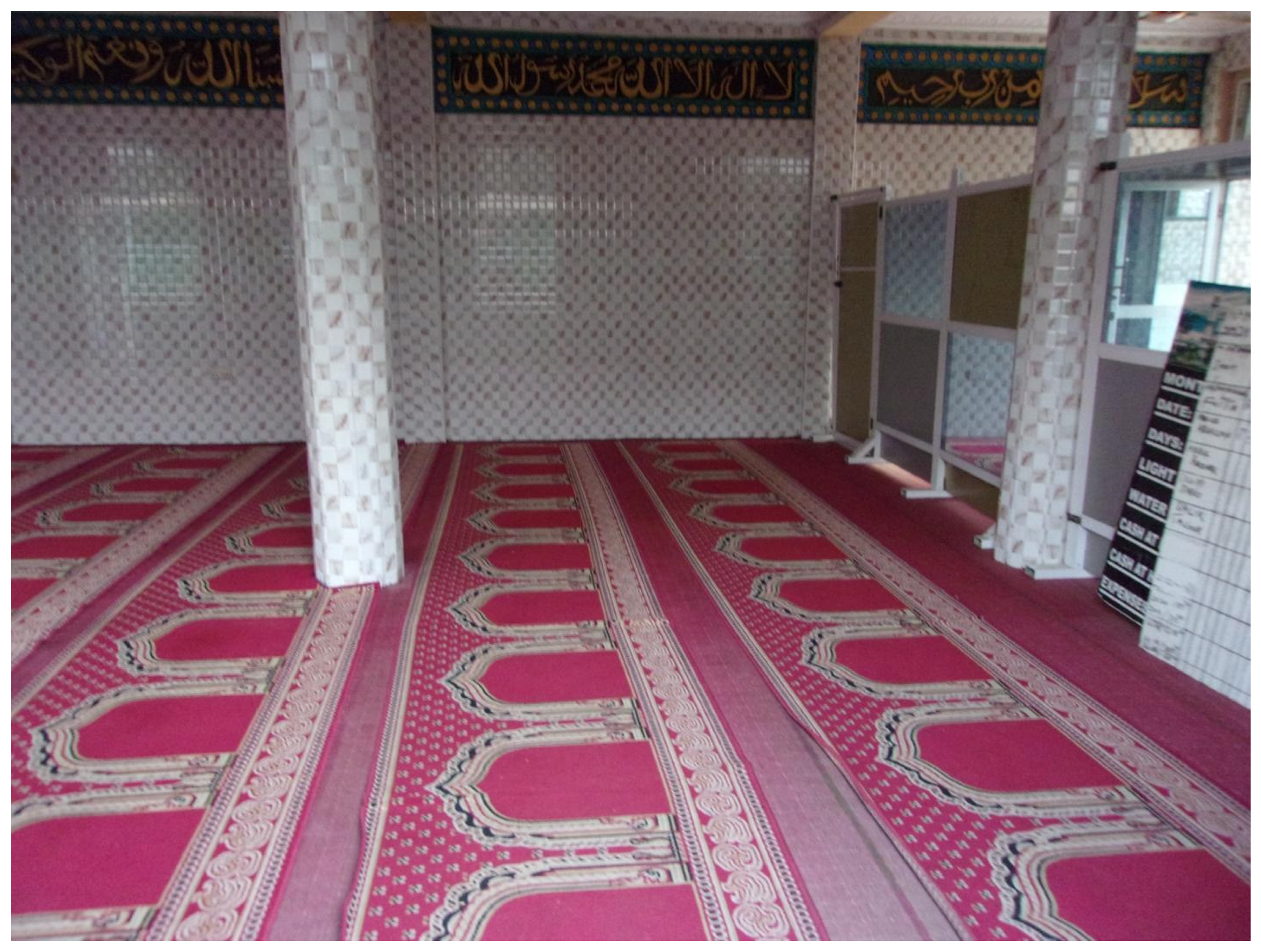
This is the beautiful Mosque in Nima. Big people, big Imams, come from far places and preach the word of God so you’ll understand it. That is a nice place. How the structure of the Mosque and how they built it. I like it. It is a tourist site. I’m happy that my area is a tourist site to meet. And I can see foreigners that I’ve never seen before [there]. Sometimes I communicate with them.
4. Discussion
5. Conclusions
Author Contributions
Funding
Institutional Review Board Statement
Informed Consent Statement
Data Availability Statement
Acknowledgments
Conflicts of Interest
Abbreviations
| BGS | Black Girlhood Studies |
References
- Appiah-Agyekum, N.N.; Suapim, R.H. Knowledge and Awareness of HIV/AIDS among High School Girls in Ghana. HIV/AIDS-Res. Palliat. Care 2013, 5, 137–144. [Google Scholar] [CrossRef]
- Rokicki, S.; Fink, G. Assessing the Reach and Effectiveness of mHealth: Evidence from a Reproductive Health Program for Adolescent Girls in Ghana. BMC Public Health 2017, 17, 969. [Google Scholar] [CrossRef]
- Gyimah, L.A.; Annan, R.A.; Apprey, C.; Edusei, A.; Aduku, L.N.E.; Asamoah-Boakye, O.; Azanu, W.; Lutterodt, H. Dietary Diversity and Its Correlates among Pregnant Adolescent Girls in Ghana. PLoS ONE 2021, 16, e0247979. [Google Scholar] [CrossRef]
- Dolan, C.S.; Ryus, C.R.; Dopson, S.; Montgomery, P.; Scott, L. A Blind Spot in Girls’ Education: Menarche and Its Webs of Exclusion in Ghana. J. Int. Dev. 2014, 26, 643–657. [Google Scholar] [CrossRef]
- Gumanga, S.K.; Kwame-Aryee, R.A. Menstrual Characteristics in Some Adolescent Girls in Accra, Ghana. Ghana Med. J. 2012, 46, 3. [Google Scholar]
- Escobar, A. Encountering Development: The Making and Unmaking of the Third World; Princeton University Press: Princeton, NJ, USA, 1995. [Google Scholar] [CrossRef]
- Switzer, H. (Post)feminist Development Fables: The Girl Effect and the Production of Sexual Subjects. Fem. Theory 2018, 19, 5–24. [Google Scholar] [CrossRef]
- Moletsane, R. Repositioning Educational Research on Rurality and Rural Education in South Africa: Beyond Deficit Paradigms. Perspect. Educ. 2014, 32, 1–8. [Google Scholar]
- Anaman, K.A.; Okailey, J.A. Extent of Awareness of Birth Control Methods and Their Use by Women in a Peri-Urban Area of Accra, Ghana. Mod. Econ. 2016, 7, 39–54. [Google Scholar] [CrossRef]
- Gyamfi, E. Knowledge, Attitude and Risk Perception on Sexual-Reproductive behaviours among Adolescents in Ejisu-Juaben Municipality, Ghana. Texila Int. J. Public Health 2019, 7, 1–8. [Google Scholar] [CrossRef]
- Boamah-Kaali, E.A.; Mevissen, F.E.F.; Owusu-Agyei, S.; Enuameh, Y.; Asante, K.P.; Ruiter, R.A.C. A Qualitative Exploration of Factors Explaining Non-Uptake of Hormonal Contraceptives Among Adolescent Girls in Rural Ghana: The Adolescent Girls’ Perspective. Open Access J. Contracept. 2021, 12, 173–185. [Google Scholar] [CrossRef]
- Hall, K.S.; Manu, A.; Morhe, E.; Dalton, V.K.; Challa, S.; Loll, D.; Dozier, J.L.; Zochowski, M.K.; Boakye, A.; Harris, L.H. Bad Girl and Unmet Family Planning Need among Sub-Saharan African Adolescents: The Role of Sexual and Reproductive Health Stigma. Qual. Res. Med. Healthc. 2018, 2, 7062. [Google Scholar] [CrossRef]
- Nauges, C.; Strand, J. Water Hauling and Girls’ School Attendance: Some New Evidence from Ghana. Environ. Resour. Econ. 2017, 66, 65–88. [Google Scholar] [CrossRef]
- Dubik, S.D.; Amegah, K.E.; Alhassan, A.; Mornah, L.N.; Fiagbe, L. Compliance with Weekly Iron and Folic Acid Supplementation and Its Associated Factors among Adolescent Girls in Tamale Metropolis of Ghana. J. Nutr. Metab. 2019, 2019, 8242896. [Google Scholar] [CrossRef] [PubMed]
- Rheinländer, T.; Gyapong, M.; Akpakli, D.E.; Konradsen, F. Secrets, shame and discipline: School girls’ experiences of sanitation and menstrual hygiene management in a peri-urban community in Ghana. Health Care Women Int. 2019, 40, 13–32. [Google Scholar] [CrossRef]
- Kumbeni, M.T.; Ziba, F.A.; Apenkwa, J.; Otupiri, E. Prevalence and Factors Associated with Menstruation-Related School Absenteeism among Adolescent Girls in Rural Northern Ghana. BMC Women’s Health 2021, 21, 279. [Google Scholar] [CrossRef] [PubMed]
- Hartman, G.H. The Fateful Question of Culture; Columbia University Press: New York, NY, USA, 1997. [Google Scholar]
- Spillers, H.J. Mama’s Baby, Papa’s Maybe: An American Grammar Book. In The Transgender Studies Reader Remix; Routledge: Oxfordshire, UK, 1987. [Google Scholar]
- Wynter, S. “No humans involved”: An open letter to my colleagues. Forum N.H.I. Knowl. 21st Century 1994, 1, 1–17. [Google Scholar]
- Adichie, C.N. The Danger of a Single Story|TED Talk. Available online: https://www.ted.com/talks/chimamanda_ngozi_adichie_the_danger_of_a_single_story (accessed on 15 February 2026).
- Jaksch, M.L.; Fourshey, C.C.; Moletsane, R. A Turn to the African Girl. Girlhood Stud. 2023, 16, vii–xv. [Google Scholar] [CrossRef]
- McPherson, K.N. Black Girls Clap Back: Intersectionality, Black Girlhood, and Inequity in the Greater Toronto Area (GTA). Ph.D. Thesis, York University, Toronto, ON, Canada, 2019. [Google Scholar]
- Owusu, G. Indigenes’ and Migrants’ Access to Land in Peri-Urban Areas of Accra, Ghana. Int. Dev. Plan. Rev. 2008, 30, 177–198. [Google Scholar] [CrossRef]
- Briggs, J.; Yeboah, I.E.A. Structural Adjustment and the Contemporary Sub-Saharan African City. Area 2001, 33, 18–26. [Google Scholar] [CrossRef]
- Larbi, W.O. Spatial Planning and Urban Fragmentation in Accra. Third World Plan. Rev. 1996, 18, 193. [Google Scholar] [CrossRef]
- Essamuah, M.; Tonah, S. Coping with Urban Poverty in Ghana: An Analysis of Household and Individual Livelihood Strategies in Nima/Accra. Legon J. Sociol. 2004, 1, 79–96. [Google Scholar] [CrossRef]
- Tamale, S. Decolonization and Afro-Feminism; Journal of Contemporary African Studies; Daraja Press: Quebec, QC, Canada, 2020. [Google Scholar]
- Katshunga, J. Contesting Black girlhood (s) beyond northern borders: Exploring a Black African girl approach. Black Girlhood Stud. Collect. 2019, 45–79. [Google Scholar]
- Wang, C.; Burris, M.A. Empowerment through Photo Novella: Portraits of Participation. Health Educ. Q. 1994, 21, 171–186. [Google Scholar] [CrossRef]
- Wang, C.; Burris, M.A. Photovoice: Concept, Methodology, and Use for Participatory Needs Assessment. Health Educ. Behav. 1997, 24, 369–387. [Google Scholar] [CrossRef]
- Wang, C.C.; Redwood-Jones, Y.A. Photovoice Ethics: Perspectives from Flint Photovoice. Health Educ. Behav. 2001, 28, 560–572. [Google Scholar] [CrossRef]
- Meyers, L. “You Know, Let Me Put My Two Cents In”: Using Photovoice to Locate the Educational Experiences of Black Girls. In Black Schoolgirls in Space: Stories of Black Girlhoods Gathered on Educational Terrain; Ohito, E.O., Muñoz de Luna, L.M., Eds.; Berghahn Books: New York, NY, USA, 2024. [Google Scholar] [CrossRef]
- Higgins, M. Placing Photovoice under Erasure: A Critical and Complicit Engagement with What It Theoretically Is (Not). Int. J. Qual. Stud. Educ. 2016, 29, 670–685. [Google Scholar] [CrossRef]
- Asamoah, E.; Amaniampong, E.-M.; Manful, E.; Gyasi-Boadu, N.; Koomson-Yalley, E.N.M. Using Photovoice to Illuminate Challenges Facing Children with Disabilities in Inclusive Education in Ghana. Soc. Work Soc. Sci. Rev. 2023, 24, 7. [Google Scholar] [CrossRef]
- Kabore, A.; Afriyie-Gyawu, E.; Awuah, J.; Hansen, A.; Walker, A.; Hester, M.; Sié, M.A.W.; Johnson, J.; Meda, N. Social Ecological Factors Affecting Substance Abuse in Ghana (West Africa) Using Photovoice. Pan Afr. Med. J. 2019, 34, 214. [Google Scholar] [CrossRef] [PubMed]
- Mitchell, C.; DeLange, N.; Moletsane, R.; Stuart, J.; Buthelezi, T. Giving a Face to HIV and AIDS: On the Uses of Photo-Voice by Teachers and Community Health Care Workers Working with Youth in Rural South Africa. Qual. Res. Psychol. 2005, 2, 257–270. [Google Scholar] [CrossRef]
- Saldaña, J. The Coding Manual for Qualitative Researchers, 5th ed.; Sage Publications: Washington, DC, USA, 2025. [Google Scholar]
- Collins, P.H. Black Feminist Thought: Knowledge, Consciousness, and the Politics of Empowerment; Routledge: Oxfordshire, UK, 2022. [Google Scholar]
- Quashie, K. The Sovereignty of Quiet: Beyond Resistance in Black Culture; Rutgers University Press: New Brunswick, NJ, USA, 2012. [Google Scholar]
- Ampofo, A.A.; Arnfred, S. African Feminist Politics of Knowledge: Tensions, Challenges, Possibilities. Afr. Stud. Rev. 2004, 47, 35–53. [Google Scholar] [CrossRef][Green Version]
- Ensor, M. African Childhoods: Education, Development, Peacebuilding, and the Youngest Continent; Springer: Berlin/Heidelberg, Germany, 2012. [Google Scholar]
- Ford, T.C. Liberated Threads: Black Women, Style, and the Global Politics of Soul; UNC Press Books: Chapel Hill, NC, USA, 2015. [Google Scholar]
- Thiong’o, N.W. Decolonising the Mind: The Politics of Language in African Literature; Heinemann: London, UK, 1986. [Google Scholar]
- Hooks, B. Sisters of the Yam: Black Women and Self-Recovery; South End Press: Brooklyn, NY, USA, 1993. [Google Scholar]
- Dillard, C.B. Turning the Ships Around: A Case Study of (Re)Membering as Transnational Endarkened Feminist Inquiry and Praxis for Black Teachers. Educ. Stud. 2016, 52, 406–423. [Google Scholar] [CrossRef]
- Lorde, A. Sister Outsider: Essays and Speeches; Clarkson Potter/Ten Speed: Berkeley, CA, USA, 1984. [Google Scholar]





| Pseydonym | Age | Ethnicity | School Level | Religion |
|---|---|---|---|---|
| Queen of Buse | 11 | Ga-Adamgbe | Primary | Christian |
| Lubi-Darling | 14 | Fulani | Junior High School | Islam |
| Empress Limash | 15 | Bakosina | Junior High School | Islam |
| Miss Naija | 17 | Fulani | Senior High School | Islam |
| Elicity | 16 | Busanga | Junior High School | Islam |
| Richlove | 17 | Did Not Disclose | Senior High School | Christian |
| Weekly Theme | Meeting 1: Activities | Meeting 2: Shooting Assignment |
|---|---|---|
| Week 1: Meet & Greet/Intro to Photography | The girls played icebreaker games, received digital cameras, and learned how to operate them. | Who I am: Photographs of people, places, and things representing who I am |
| Week 2: A Day in the Life (Street Photography) | The girls shared artifacts that represented and described who they were, reviewed and discussed photos from Week 1, and were introduced to Michael Cunningham & Craig Marberry’s photography on Black women’s wisdom. | Wisdom around Me: Photographs of beauty, knowledge, and inspiration in my community |
| Week 3: (Re)membering the Past (Portraiture & Landscape) | The girls told cultural stories of the past, reviewed and discussed photos from Week 2, and were introduced to portraiture and landscape photography through the works of James VanDerZee & Kwame Brathwaite. | The history I live: Photos that remind me of the past |
| Week 4: Walking in the Present (Contemporary Black women Photographers) | The girls told stories and wrote poems about their present realities, reviewed and discussed photos from Week 3, and were introduced to contemporary works in Mfon: Women Photographers of the African Diaspora by Adama Delphine Fawundu and Laylah Amatullah Barryn and Viewfinders: Black Women Photographers by Jeanne Moutoussamy-Ashe. | The Things I think About: Reflections on Life in Nima Today |
| Week 5: Looking Toward the Future (Afro-futurist Photography) | The girls drew and imagined their future dreams, reviewed and discussed photos from Week 4, and were introduced to Afrofuturist photography through Afropunk Black Photography and the Columbia College of Chicago’s Museum of Contemporary Photography online exhibit: In Their Own Form. | Afrofuturist Me: Pictures of Visions of my Future |
| Week 6: Exhibition Preparation | The girls reviewed and discussed their entire portfolio, gave encouraging feedback, and selected 5 photos for gallery display. | The girls prepared an artist’s statement. |
| Week 7 | Exhibition & Celebration | |
Disclaimer/Publisher’s Note: The statements, opinions and data contained in all publications are solely those of the individual author(s) and contributor(s) and not of MDPI and/or the editor(s). MDPI and/or the editor(s) disclaim responsibility for any injury to people or property resulting from any ideas, methods, instructions or products referred to in the content. |
© 2026 by the authors. Licensee MDPI, Basel, Switzerland. This article is an open access article distributed under the terms and conditions of the Creative Commons Attribution (CC BY) license.
Share and Cite
Edwards, E.B.; Cudjoe, M. Ghanaian Girls’ Lives Beyond the Frame: Using Photovoice to Disrupt the Single Story of African Girlhood. Societies 2026, 16, 95. https://doi.org/10.3390/soc16030095
Edwards EB, Cudjoe M. Ghanaian Girls’ Lives Beyond the Frame: Using Photovoice to Disrupt the Single Story of African Girlhood. Societies. 2026; 16(3):95. https://doi.org/10.3390/soc16030095
Chicago/Turabian StyleEdwards, Erica B., and Manasseh Cudjoe. 2026. "Ghanaian Girls’ Lives Beyond the Frame: Using Photovoice to Disrupt the Single Story of African Girlhood" Societies 16, no. 3: 95. https://doi.org/10.3390/soc16030095
APA StyleEdwards, E. B., & Cudjoe, M. (2026). Ghanaian Girls’ Lives Beyond the Frame: Using Photovoice to Disrupt the Single Story of African Girlhood. Societies, 16(3), 95. https://doi.org/10.3390/soc16030095