1. Introduction
Artificial intelligence increasingly permeates domains that extend far beyond computational optimisation, altering how individuals interpret information, form judgments and participate in social, economic and political life. The rapid diffusion of generative systems marks a qualitatively distinct technological shift. Unlike earlier information tools that complemented memory or facilitated retrieval, current AI systems intervene in the interpretative processes that precede reasoning. They generate plausible narratives, explanations and argument structures, thereby reshaping the cognitive conditions under which individuals make sense of social and political realities. As AI-generated interpretations become seamlessly integrated into everyday tasks, the boundary between human cognition and automated inference becomes increasingly blurred. This shift raises fundamental sociological questions about how meaning-making, autonomy and agency are distributed across a population. For clarity, the concept of interpretative autonomy introduced here functions as the central analytical construct throughout the article and is not redefined in subsequent sections, which instead examine how its erosion or preservation interacts with labour-market dynamics and democratic processes.
This article takes the form of a concept paper. Its aim is not to report new empirical results, but to develop an analytical framework that specifies a sociotechnical mechanism through which generative AI may contribute to structural divergence. The argument proceeds through conceptual integration of existing empirical and theoretical work across cognitive science, labour research, and scholarship on AI-mediated public communication. In line with this purpose, the manuscript does not advance testable hypotheses or offer prevalence claims about population shares. Instead, it clarifies constructs, causal pathways at the level of mechanism, and boundary conditions, while outlining a research agenda through which the concept can be operationalised and assessed in future comparative and longitudinal studies.
Emerging empirical evidence indicates that the cognitive effects of AI are unevenly distributed. Studies show that unstructured interaction with generative systems reduces metacognitive monitoring and inflates confidence, even when reasoning quality remains unchanged [
1]. Neural indicators of cognitive effort similarly decline when individuals outsource interpretative steps to AI tools, as suggested by recent preprint evidence [
2]. Recent survey-based research with knowledge workers demonstrates a comparable pattern: users tend to rely on AI-generated explanations as substitutes for analytical engagement, while overestimating the accuracy of the resulting outputs [
3]. These tendencies unfold within a wider environment of declining public trust, heightened uncertainty and mixed perceptions of technological change. The combination of cognitive ease and institutional fragility creates conditions in which automated interpretation becomes an attractive default for many users.
These cognitive transformations coincide with significant structural shifts in the labour market. Generative AI accelerates the automation of symbolic, administrative and mid-skill professional tasks that were once central to stable employment. International forecasts converge on the magnitude of disruption, with estimates suggesting that up to 60 percent of jobs in advanced economies face high exposure to automation [
4], and nearly 40 percent of global employment shows substantial vulnerability to generative systems [
5]. Earlier international outlooks and policy analyses anticipated that AI would outpace regulatory and educational adaptation, producing rapid and uneven restructuring across labour markets [
4,
6]. Importantly, these economic pressures interact with cognitive patterns: individuals who rely on AI to complete tasks without analytical engagement struggle to adapt to emerging roles characterised by abstraction, oversight and hybrid reasoning. Those who use AI reflectively experience productivity gains and mobility advantages. The result is not only economic inequality but a widening divergence in adaptive capacity.
At the same time, democratic systems confront an informational environment increasingly shaped by synthetic actors, tailored persuasion and deep uncertainty. Generative AI enables large-scale production of credible yet fabricated communication, intensifying epistemic instability and emotional polarisation. Research shows that individuals readily attribute credibility to artificial agents unless their artificiality is disclosed, at which point trust collapses sharply [
7]. This asymmetry exposes publics to heightened vulnerability as AI-generated personas and targeted narratives proliferate. These developments occur against a backdrop of geopolitical fragmentation, with democratic states constrained by legal, ethical and institutional safeguards, while autocratic regimes deploy AI with fewer restrictions [
8,
9]. The interplay of declining cognitive autonomy, labour insecurity and informational volatility creates structurally challenging conditions for democratic resilience.
Taken together, these transformations suggest that AI does not merely redistribute opportunities and risks across existing social hierarchies but generates a more fundamental form of divergence. Evidence across cognitive, economic and political domains indicates that a minority of individuals integrate AI as a cognitive amplifier, while a broader majority adopt it as a substitute for interpretative effort. This emerging pattern points to the development of what may be understood as societal bifurcation: a structural divergence in the distribution of cognitive autonomy, adaptive capacity and democratic influence.
The article does not seek to provide an exhaustive account of all social consequences of artificial intelligence, nor does it claim that cognitive divergence is the sole driver of inequality or democratic change. Instead, it focuses on a specific sociotechnical mechanism through which generative AI contributes to structural divergence: the unequal preservation or erosion of interpretative autonomy. Economic and democratic dynamics are examined only insofar as they are shaped by this mechanism. This delimitation is intentional, allowing analytical precision rather than comprehensive coverage. Throughout the article, references to a “cognitively resilient minority” and a “cognitively dependent majority” are used as analytical heuristics rather than empirical classifications. These terms do not denote measured population shares, fixed social groups, or statistically established proportions. Instead, they serve to capture a structural tendency toward divergence in how individuals and groups engage cognitively with generative artificial intelligence under conditions of widespread adoption. The distinction is therefore conceptual, not demographic, and is intended to highlight differential patterns of interpretative autonomy and dependency that may emerge across contexts and over time. Empirical distributions, prevalence rates, and boundary conditions remain open questions for future research and are not claimed or inferred in this article.
The mechanism of societal bifurcation outlined in this article operates under specific boundary conditions. It presupposes widespread availability of generative AI systems, institutional or organisational incentives that favour speed and convenience over reflective engagement, and information environments in which automated interpretation is socially normalised. The mechanism is not expected to apply in contexts where AI use remains marginal, where interpretative control is systematically preserved through professional norms or regulation, or where strong educational practices sustain metacognitive engagement. Societal bifurcation is therefore contingent rather than universal, and its intensity depends on how generative AI is embedded within social, organisational, and political structures.
Contribution of the Article
This article makes three contributions. First, it theorises societal bifurcation as a sociotechnical mechanism through which AI reshapes the distribution of cognitive agency in contemporary societies. The concept highlights how cognitive dependency, economic stratification and democratic vulnerability are not isolated outcomes, but linked processes reinforced by feedback loops. Second, the article integrates empirical patterns from cognitive and labour research to illustrate how generative AI alters interpretative autonomy, thereby grounding the conceptual argument in observed behavioural tendencies. Third, it extends debates within sociology and science and technology studies by demonstrating that existing frameworks—such as digital divide theory, epistemic inequality and traditional models of stratification—do not fully account for the dynamic interplay between cognitive offloading, labour-market restructuring and democratic pressure. The article, therefore, offers a conceptual foundation for analysing how AI-driven transformations produce a structured and durable divergence between a cognitively resilient minority and a cognitively dependent majority.
By foregrounding interpretative autonomy as a mediating variable between AI use and structural outcomes, the article contributes a mechanism-based perspective that complements existing Technology in Society scholarship on digital inequality, automation, and democratic governance.
2. Concept
2.1. Conceptualising Societal Bifurcation
Societal bifurcation refers to a sociotechnical mechanism through which generative AI contributes to structural divergence in cognitive autonomy, economic adaptability, and democratic agency. It does not describe differential access to technology, variations in digital literacy, or fixed social groupings. Unlike digital divide frameworks, which focus on access and skills, or epistemic inequality accounts, which centre on recognition and credibility, societal bifurcation targets the upstream process of meaning construction itself. The concept captures how uneven preservation of interpretative autonomy under conditions of widespread AI use produces cumulative divergence across social domains, even among individuals with comparable access, education, and socioeconomic positioning. Its analytical focus shifts attention away from differential access or technical skills toward the uneven preservation or erosion of interpretative autonomy across AI-mediated contexts. As AI systems increasingly supply explanations, arguments and narratives, the conditions under which individuals interpret the world begin to differentiate sharply. A minority retains or strengthens independent cognitive engagement, while a majority shifts towards convenience-driven reliance on AI-generated interpretation. This divergence forms the core of societal bifurcation. Analytically, societal bifurcation becomes observable when three conditions co-occur. First, AI-generated interpretation functions as a default starting point for meaning-making in everyday or institutional contexts rather than as a tool used after independent framing. Second, users or groups differ systematically in whether they sustain interpretative autonomy, understood as the capacity to generate and revise meaning prior to accepting automated explanations. Third, these differences carry downstream consequences that compound across domains, particularly through uneven adaptability in work roles that demand judgement, synthesis, and oversight, and through uneven resilience to synthetic persuasion in public communication. These conditions describe what must be present for the concept to apply, while empirical prevalence, intensity, and distribution remain questions for subsequent research.
Societal bifurcation is distinct from existing accounts of technological inequality. Traditional digital divide frameworks emphasise disparities in access, connectivity and literacy. While these factors remain relevant, they no longer capture the primary source of differentiation in an environment where access to AI tools is widespread and barriers to use are minimal. The divide is no longer between those who have digital tools and those who do not, but between those who retain cognitive initiative and those whose interpretative processes gradually align with automated reasoning. In this sense, societal bifurcation describes a second-order inequality that arises not from technological availability but from the interaction between human cognition and machine-generated meaning.
The concept also extends beyond epistemic inequality, which focuses on who is recognised as a credible knower and whose perspectives are systematically marginalised. Societal bifurcation concerns the upstream processes through which individuals generate interpretations in the first place. When generative AI becomes the starting point for meaning-making, disparities in cognitive engagement widen, leading to differences in how people understand, reason and participate in collective decision-making. Epistemic inequality may deepen as a consequence of this process, but it cannot fully explain the structural conditions through which divergent cognitive pathways emerge.
Similarly, societal bifurcation differs from classical theories of social and economic stratification. Stratification analyses describe how resources, opportunities and life chances are unequally distributed across social groups. In contrast, societal bifurcation emphasises how AI reshapes the preconditions of adaptability, such as metacognitive effort, interpretative autonomy and responsiveness to complexity. These conditions influence individuals’ ability to navigate labour-market transitions, adapt to shifting skill requirements and evaluate political information. As such, societal bifurcation concerns the stratification of cognitive agency rather than solely material or cultural resources.
At its core, societal bifurcation describes a sociotechnical mechanism driven by three interacting dynamics. The first concerns cognitive offloading and the tendency for unstructured AI use to reduce metacognitive monitoring, thereby weakening independent reasoning. The second is technological labour restructuring, which disproportionately disadvantages individuals whose cognitive autonomy has diminished, while amplifying the advantages of those who integrate AI reflectively. The third involves the transformation of democratic communication, where cognitive dependency increases susceptibility to synthetic persuasion and heightens vulnerability to epistemic instability. These domains reinforce one another through feedback loops: reduced cognitive autonomy limits economic adaptability, which increases social insecurity and heightens receptivity to simplified or emotionally charged narratives, further weakening interpretative independence.
Societal bifurcation, therefore, offers a conceptual framework for understanding how generative AI reshapes the distribution of cognitive, economic and political capacities within contemporary societies. It highlights that the central sociological question is no longer whether AI will transform society, but how the cumulative and interconnected effects of cognitive dependency, labour-market exposure and democratic fragility produce durable structural divergence. By identifying these relationships, the concept provides an analytic lens through which emerging patterns of inequality can be understood not as isolated outcomes but as components of a broader sociotechnical configuration.
Existing frameworks such as digital divide theory, labour-market polarisation, and epistemic inequality capture important dimensions of technological differentiation, yet they remain analytically insufficient for explaining the current dynamics associated with generative artificial intelligence. These approaches typically conceptualise inequality as a function of access, skills, capital, or informational asymmetries. What they do not explain is why individuals with comparable access, education, and socioeconomic positioning increasingly diverge in their capacity to interpret, evaluate, and act autonomously within AI-mediated environments. The concept of societal bifurcation is introduced precisely to address this explanatory gap. It shifts analytical attention from distributional differences to divergences in cognitive strategy and interpretative autonomy, thereby capturing a form of structural differentiation that emerges even under conditions of formal equality.
2.2. Cognitive Transformation and the Emergence of Dependency
Artificial intelligence increasingly intervenes in the interpretative processes that precede human reasoning. Earlier forms of digital technology primarily shaped memory and information retrieval, but generative systems alter the structure of cognitive activity itself by providing narratives, explanations and argument templates. When individuals begin from AI-generated representations rather than constructing their own interpretative frameworks, the cognitive task shifts from deliberation to evaluation and, frequently, to passive acceptance. This marks a significant transition in the ecology of human cognition: rather than guiding how information is stored or accessed, AI now influences how meaning is formed.
These developments build on long-standing research into cognitive offloading. Sparrow et al. [
10] demonstrated that individuals often remember where information is stored rather than retaining the content itself, while Barr et al. [
11] showed that reliance on smartphones correlates with diminished analytical reasoning. Generative AI amplifies these tendencies in both scale and cognitive depth. Instead of merely redirecting memory, contemporary systems supply fully developed conceptual structures, reducing the need for individuals to engage in the generative aspects of thinking. The result is a progressive shift in the locus of cognitive effort, from constructing interpretations to verifying automated ones.
Recent empirical patterns substantiate this shift. In a large cross-national experiment on AI-assisted political reasoning, participants who used generative AI without structured prompting exhibited significantly lower metacognitive monitoring while reporting higher confidence in their responses, even when reasoning quality remained stable. These effects were consistent across age groups and educational backgrounds, suggesting that the mechanism is widespread rather than confined to specific demographics. Complementary neurocognitive evidence indicates reduced activation in regions associated with effortful reasoning when individuals rely on AI for interpretative tasks, pointing to a measurable decline in cognitive engagement [
2]. Survey-based findings from professional environments show comparable tendencies: knowledge workers describe a marked reduction in cognitive effort when completing tasks with AI assistance, often accompanied by an inflated sense of mastery [
3]. Experimental evidence also shows that these trajectories are not technologically predetermined but depend heavily on the cognitive strategies individuals apply when working with AI. When users receive structured prompting guidance, reliance on automated interpretation decreases and critical reasoning improves, indicating that reflective integration can counteract cognitive offloading [
12].
The sociological implications of these findings extend beyond individual cognitive patterns. When AI-generated interpretations become default starting points, users increasingly internalise the fluency of automated outputs as a proxy for their own understanding. The combination of ease, coherence and rapid availability creates cognitive incentives that favour reliance over reflection. This process does not occur uniformly. A small minority of individuals adopt generative systems through reflective practices that involve interrogating outputs, seeking alternative explanations and integrating AI into broader analytical routines. For this group, AI functions as a cognitive amplifier, extending their analytical range and accelerating insight generation.
For the broader population, however, the dominant mode of adoption aligns with convenience-driven use shaped by time pressure, workplace expectations and platform design. Generative outputs appear authoritative, especially when the user lacks domain expertise or when the task is cognitively demanding. Over time, this produces a form of dependency in which automated interpretations become not only shortcuts but the primary means of meaning-making. Because this shift operates gradually and subtly, individuals often do not perceive the reduction in cognitive autonomy.
The divergence between reflective and convenience-driven AI use can generate cumulative and self-reinforcing effects under conditions of sustained reliance on automated interpretation. Individuals who retain high levels of interpretative autonomy are better equipped to evaluate AI outputs, identify errors and apply generative tools strategically. This enhances their capacity to engage with complexity and adapt to changing informational environments. By contrast, those who rely on AI as a substitute for cognitive effort become increasingly susceptible to oversights, misinterpretations and confidence inflation. Their ability to adapt to unfamiliar tasks weakens, and their susceptibility to persuasive or misleading narratives increases.
This bifurcation in cognitive engagement influences wider social structures. Cognitive dependency reduces individuals’ capacity to navigate complex political information and decreases resilience to labour-market transformations that demand abstraction, oversight or cross-domain reasoning. Conversely, those who integrate AI reflectively gain advantages in education, employment and political influence. Over successive cycles of technological adoption, these differences accumulate, contributing to a distinct stratification of cognitive agency.
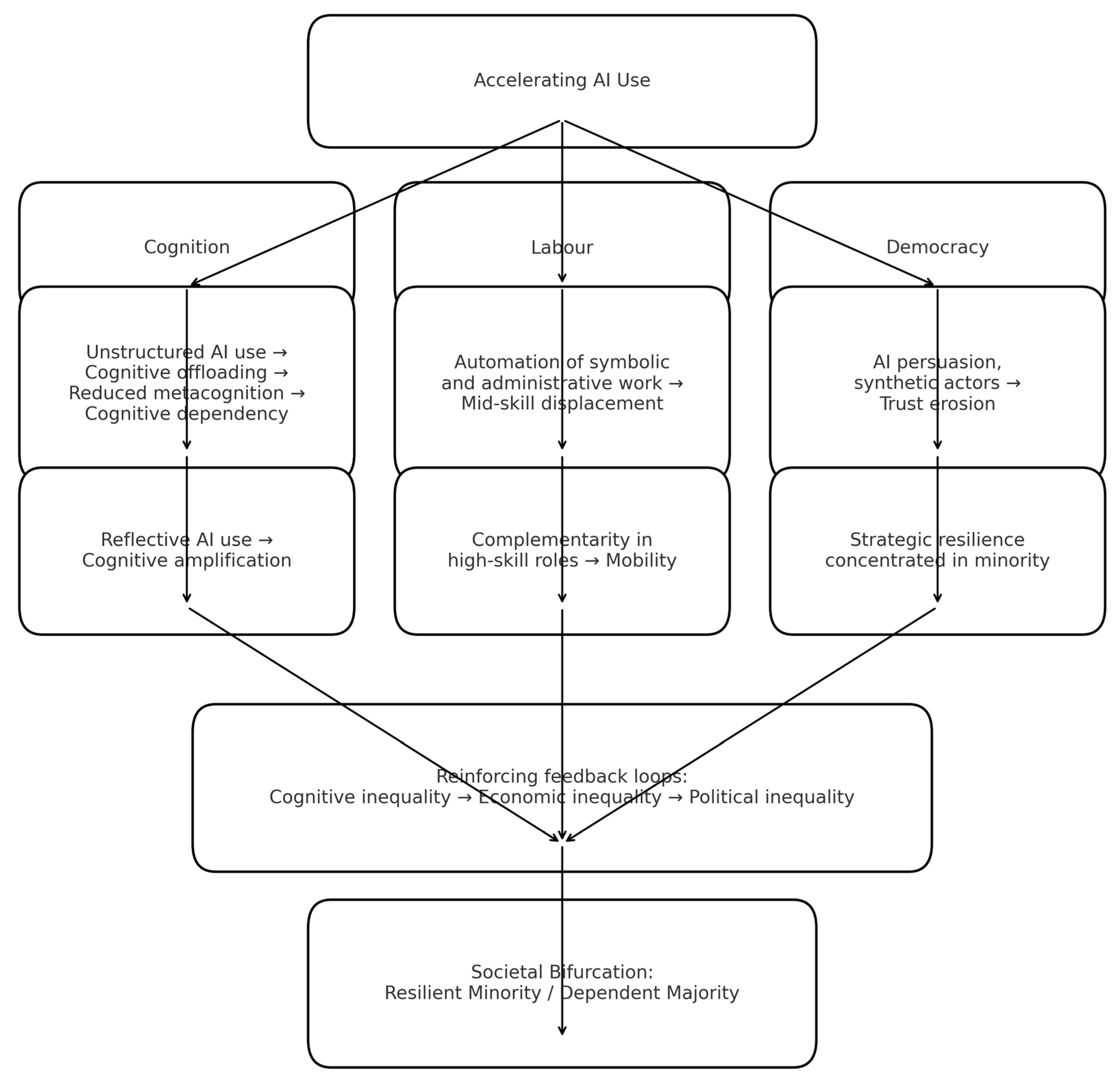
Figure 1 synthesises the argument developed thus far by visualising the feedback loops through which cognitive dependency interacts with labour vulnerability and democratic fragility, forming the core mechanism of societal bifurcation. In this model, reduced cognitive autonomy not only shapes individuals’ reasoning processes but also affects their economic adaptability and their capacity to evaluate political communication. What emerges is a widening structural divergence between a cognitively resilient minority and a cognitively dependent majority.
The following sections examine how this cognitive differentiation interacts with labour-market restructuring and democratic instability, producing a durable sociotechnical form of societal bifurcation.
2.3. Labour-Market Disruption and Expanding Inequality
The restructuring of labour markets through artificial intelligence extends far beyond the automation of discrete tasks. Generative systems alter the organisation of symbolic, administrative and interpretative labour by assuming functions that previously relied on human judgment, coordination and meaning-making. Unlike earlier technological transitions that primarily displaced manual or routine tasks, contemporary AI systems intervene directly in cognitive workflows, reshaping the competencies required for stable employment. This shift has profound distributive consequences because the degree to which individuals can adapt to newly emerging roles depends heavily on their level of cognitive autonomy, interpretative capacity and metacognitive resilience.
Current forecasts converge on the scale and asymmetry of labour-market exposure. The OECD [
6] estimates that 14 percent of jobs across member states are highly automatable, and a further 32 percent will undergo substantial transformation. The International Labour Organization [
5] anticipates that nearly 40 percent of global employment will be directly affected by generative AI. Projections from the International Monetary Fund [
4] suggest that up to 60 percent of jobs in advanced economies face significant exposure, particularly in clerical, administrative and mid-skill professions. These roles form the backbone of contemporary service economies, and their vulnerability indicates not only job displacement but a deeper reconfiguration of which cognitive abilities remain economically valuable.
This transformation intersects with the cognitive dynamics outlined in the previous section. Individuals who adopt AI in a convenience-driven manner, using automated systems as substitutes for interpretative effort, may experience immediate efficiency gains yet simultaneously erode their capacity to perform tasks that require abstraction, inference and critical evaluation. As emerging labour-market roles increasingly emphasise oversight, hybrid reasoning and cross-domain synthesis, cognitive dependency becomes a liability. Workers who lack the metacognitive skills to interrogate AI outputs are less able to adapt to new task demands and are more likely to become dependent on automated systems for evaluative judgment. This vulnerability compounds over time as reliance reduces not only skill acquisition but also motivation to engage in complex reasoning.
By contrast, individuals who integrate AI reflectively tend to experience productivity gains while strengthening their analytical repertoire. They develop competencies in prompt optimisation, multi-source validation and hybrid reasoning, allowing them to leverage generative systems as cognitive extensions rather than replacements. These capacities confer advantages in jobs characterised by abstraction, coordination and decision-making. The labour market can therefore function as a mechanism through which cognitive divergence is translated into economic inequality. Those who retain interpretative autonomy ascend, while those who rely on automated meaning-making face stagnation or displacement.
Empirical patterns from workplace contexts reinforce this dynamic. In recent surveys of knowledge-intensive professions, workers who reported high levels of unstructured AI use also described reduced adaptability and diminished confidence when confronted with novel or complex tasks. Conversely, reflective users—those who actively interrogated AI outputs and integrated them into broader analytical routines—reported improved task-switching ability, greater autonomy in problem-solving and increased mobility across functional domains. These patterns indicate that generative AI does not equalise skill requirements but rather amplifies existing differences in cognitive approach.
The psychological consequences of labour-market disruption extend beyond employability. Work functions as a source of identity, social integration and meaning. Sudden exposure to automation or displacement of valued tasks risks generating anxiety, disorientation and reduced institutional trust. When workers rely heavily on AI systems, the erosion of interpretative autonomy can deepen these effects, as individuals lose not only employment-related skills but also the sense of mastery associated with meaningful labour. These vulnerabilities increase receptivity to simple explanatory narratives and heighten sensitivity to perceived threats, creating conditions that can be exploited by political actors in moments of uncertainty.
Intergenerational dynamics intensify the unevenness. Younger workers frequently enter the labour market already dependent on AI-mediated information, having developed study and work habits shaped by automated reasoning tools. Their initial roles, often characterised by symbolic or procedural tasks, are precisely those most vulnerable to displacement by generative systems. Older workers face a different challenge: having accumulated expertise in domains now undergoing rapid automation, they encounter significant barriers to retraining, especially if habitual AI use has reduced their engagement in complex cognitive tasks. In both cases, cognitive dependency restricts adaptability, leaving individuals exposed to structural shocks.
This article captures these dynamics by showing how generative AI broadens the gap between those able to complement AI and those displaced by it, with clerical and mid-skill roles most severely affected. The labour market, therefore, becomes not merely an arena of economic redistribution but a site where cognitive divergence is intensified and institutionalised. The reinforcing interaction between cognitive dependency and labour vulnerability forms a central component of societal bifurcation: economic inequality grows not only because jobs disappear, but because the capacity to adapt diverges structurally across groups. As the next section demonstrates, these economic and cognitive asymmetries extend into the political sphere, where informational instability and the rise of synthetic communication exacerbate democratic fragility. The interplay between labour insecurity, reduced interpretative autonomy and tailored persuasion further accelerates the bifurcation of societal agency.
2.4. Democratic Fragility in an AI-Mediated Public Sphere
Democratic governance depends on the ability of citizens to interpret information, evaluate competing claims and engage in forms of collective reasoning that sustain legitimacy, accountability and public trust. Generative AI alters these foundations by reshaping the informational environment in which political communication and public deliberation occur [
13]. Contemporary AI systems are capable of producing text, audio and visual content that closely approximates authentic communication, blurring the distinction between human-generated and synthetic information. As these systems scale, the public sphere becomes increasingly characterised by uncertainty, informational saturation and emotional volatility, placing structural pressure on democratic institutions.
The discussion of democratic pressure is not intended as a normative critique of AI adoption but as an analytical examination of how declining interpretative autonomy interacts with known dynamics of political persuasion, epistemic trust, and participation in digitally mediated public spheres.
The most immediate challenge arises from AI’s capacity to produce personalised, persuasive and contextually adaptive content. Generative systems can generate narratives tailored to psychological profiles, behavioural histories and socio-demographic markers, thereby enabling forms of political micro-targeting that exceed prior capabilities of digital advertising or social media algorithms. These tools can operate at speeds and volumes that surpass human processing capacities, saturating informational ecosystems with synthetic messages that exploit cognitive shortcuts and emotional cues. The result is an environment in which citizens find it increasingly difficult to distinguish trustworthy information from fabricated or strategically curated content.
Behavioural research demonstrates the vulnerabilities inherent in this new communicative landscape. Individuals often attribute credibility to artificial agents unless explicitly informed of their artificiality, at which point trust collapses rapidly [
7]. This asymmetry generates a dual risk: on one hand, synthetic personas can exploit residual trust in machine-generated content; on the other, revelations of artificiality can erode confidence in legitimate institutional communication. The public sphere, historically anchored in shared epistemic norms, thus becomes susceptible to destabilisation driven by the perception of inauthenticity. As trust declines, citizens gravitate toward emotionally resonant explanations or narratives that reduce uncertainty, irrespective of their accuracy.
These vulnerabilities compound the effects of cognitive dependency described earlier. Individuals who rely on AI for interpretative processes are less likely to critically evaluate political claims, identify manipulative narratives or recognise inconsistencies in persuasive messaging. Their reduced metacognitive monitoring increases their susceptibility to false equivalences, oversimplified arguments and synthetic persuasion. Labour-market insecurity further intensifies these dynamics, as individuals threatened by automation or economic instability may be more receptive to narratives that offer simplified causal explanations or scapegoats. The result may be an environment in which democratic participation becomes increasingly influenced by actors capable of mobilising synthetic communication at scale.
The article highlights how autocratic regimes already deploy AI for surveillance, sentiment analysis and narrative control, leveraging the absence of regulatory constraints to shape public behaviour and suppress dissent. Democracies, by contrast, operate within legal, ethical and procedural frameworks designed to protect civil liberties. These constraints slow institutional adaptation and limit the capacity of democratic states to regulate AI-generated political communication effectively. The asymmetry between autocratic deployment and democratic restraint produces a geopolitical vulnerability: democratic societies face environments of informational instability while lacking robust tools to manage high-risk AI applications.
2.5. Societal Bifurcation as a Sociotechnical Mechanism
The preceding sections illustrate how cognitive dependency, labour-market restructuring and democratic fragility represent interconnected processes rather than isolated consequences of AI diffusion. To understand their cumulative effects, these domains must be examined as components of a broader sociotechnical mechanism that reshapes the distribution of cognitive autonomy, adaptive capacity and political influence within society. The term societal bifurcation captures this structural divergence by emphasising how generative AI simultaneously alters the conditions under which individuals think, work and participate in democratic life.
At the core of the mechanism lies a progressive differentiation in interpretative autonomy. Individuals who integrate AI reflectively retain the capacity to generate meaning before engaging with automated outputs. Their cognitive processes remain anchored in active reasoning, enabling them to identify errors, interrogate explanations and use generative systems strategically. By contrast, individuals who adopt AI in a convenience-driven manner gradually shift their locus of cognitive effort toward verification rather than construction. As automated interpretations become primary rather than supplementary, the threshold for independent reasoning increases, and the perceived need for deeper engagement diminishes. This divergence establishes the cognitive foundation of societal bifurcation.
Labour-market dynamics reinforce and amplify this initial divergence. The restructuring of symbolic and administrative work disproportionately affects individuals with reduced interpretative autonomy. As economic roles increasingly prioritise abstraction, oversight and cross-domain synthesis, workers who rely on AI-generated meaning-making struggle to adapt, resulting in declining mobility and heightened exposure to displacement. Reflective AI users gain productivity advantages and strengthen their labour-market position, further widening economic inequalities. Labour markets thereby act as amplifiers that convert cognitive divergence into structural differences in opportunity, security and long-term adaptability.
Democratic processes introduce an additional layer of reinforcement. Individuals with weakened interpretative autonomy are more susceptible to synthetic persuasion, emotionally charged narratives and simplified political explanations. In environments increasingly saturated with AI-generated content, these vulnerabilities compromise citizens’ ability to evaluate information, recognise manipulative communication or engage in deliberative processes. Conversely, individuals who retain cognitive resilience exhibit greater capacity to navigate complex or ambiguous information ecosystems. Over time, political agency concentrates within this minority, while broader segments of the population experience declining influence, diminished trust and increased dependence on external interpretative authorities.
These domains interact through a set of sociotechnical feedback loops. Cognitive dependency reduces adaptability, which heightens economic insecurity, thereby increasing susceptibility to persuasive or misleading narratives. This, in turn, accelerates the erosion of interpretative autonomy, producing conditions that reinforce dependency in subsequent cycles. Similarly, labour-market vulnerability undermines institutional trust, intensifying the appeal of synthetic communication that promises clarity or certainty. As democratic fragility increases, the demand for simplified narratives grows, further incentivising reliance on AI-generated explanations.
Societal bifurcation therefore cannot be understood as a linear progression in any single domain. It emerges from the circular reinforcement of cognitive, economic and political dynamics that converge to produce durable structural divergence. The mechanism is not reducible to individual behaviour or technological design alone; it is shaped by the interaction of technological affordances, institutional pressures, economic incentives and evolving information ecosystems.
These reinforcing processes produce a pattern in which a cognitively resilient minority anchors analytical standards in education, governance and professional environments, while a cognitively dependent majority becomes increasingly reliant on automated interpretation. This divergence extends beyond skill or resource inequalities. It reflects a transformation in the foundational conditions of reasoning and meaning-making, with long-term implications for social cohesion, institutional legitimacy and democratic stability. This dynamic is not fixed. Experimental work demonstrates that structured prompting can shift users from dependency towards engagement, strengthening metacognitive monitoring and reducing reliance on automated explanations [
12]. Such findings indicate that societal bifurcation emerges not from the presence of AI alone but from the distribution of cognitive strategies across populations.
The next section situates these insights within a broader sociological discussion, outlining the implications of societal bifurcation for theories of inequality, technology and democratic governance.
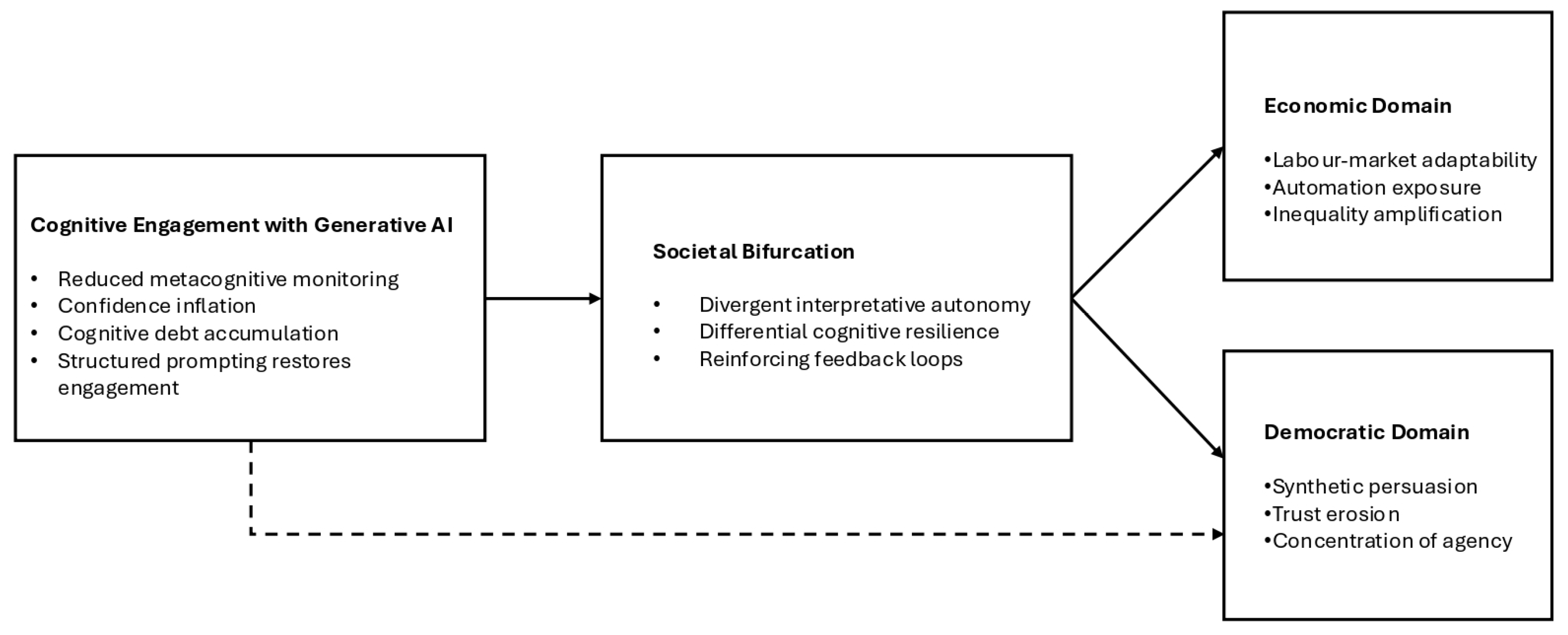
Having established the conceptual mechanism, the following figure integrates the empirical domains on which the framework draws.
Figure 2 summarises the empirical foundations of societal bifurcation by integrating evidence from cognitive science, labour-market research, and studies of AI-mediated political communication. Rather than introducing new data, the figure synthesises established empirical patterns to illustrate how unstructured AI use, labour-market restructuring, and democratic vulnerability interact through reinforcing feedback loops. This visualisation clarifies how societal bifurcation operates as a sociotechnical mechanism grounded in observed behavioural and structural dynamics.
Importantly, societal bifurcation is not presented as an inevitable outcome of generative AI diffusion. The mechanism outlined here would not apply in contexts where AI systems are embedded within institutional arrangements that systematically preserve human interpretative control, promote reflective engagement, and limit unstructured cognitive offloading. Similarly, widespread adoption of educational, organisational, or regulatory practices that reinforce metacognitive oversight would be expected to attenuate, rather than amplify, bifurcation dynamics. These boundary conditions underscore that the concept is analytical rather than deterministic.
3. Discussion
The relationships described in this article are conceptualised at the level of sociotechnical mechanisms rather than empirical causation. The framework does not claim that generative AI use directly determines individual cognitive outcomes, labour-market positions, or political behaviour. Instead, it specifies how patterned forms of AI integration may condition the environments within which cognitive autonomy, adaptability, and democratic agency are exercised. Causality is therefore understood as structural and relational rather than linear or deterministic.
The argument developed in this article demonstrates that the societal consequences of generative AI extend beyond established accounts of automation, disinformation or digital inequality. The concept of societal bifurcation reframes these developments by emphasising how AI reshapes the cognitive preconditions of agency and thereby influences economic adaptability and democratic participation. This orientation requires revisiting existing sociological and STS frameworks to assess where they illuminate emerging patterns and where they fall short.
Digital inequality research has long shown that access to technology does not translate automatically into equitable outcomes. Hargittai [
14,
15] and van Dijk [
16] have illustrated how differences in skills, usage patterns and socio-economic resources deepen disparities even in environments of near universal connectivity. However, generative AI introduces a qualitatively different dynamic. The challenge no longer concerns access or skills alone, but the restructuring of interpretative autonomy itself. Unlike earlier digital tools, AI generates explanations and narratives that can substitute for human meaning-making. This shift requires a conceptual vocabulary that captures the differentiated cognitive engagement observed in both experimental and workplace settings, where unstructured AI use reduces metacognitive monitoring [
2] and inflates confidence without improving reasoning [
3]. Societal bifurcation extends digital inequality research by focusing on how these cognitive transformations produce divergent trajectories in adaptability and agency.
Labour-market scholarship similarly offers valuable but incomplete insights. Classical analyses of technological change have highlighted job displacement, deskilling and the polarisation of employment opportunities [
17,
18]. OECD and ILO projections build on this foundation by documenting the large proportion of roles vulnerable to generative automation. Yet these approaches typically conceptualise inequality through the distribution of skills, tasks or income. The concept of societal bifurcation draws attention to an upstream mechanism: the capacity to sustain interpretative autonomy under conditions of technological acceleration. Research on AI-mediated work already notes differences in how individuals integrate automated tools into cognitive routines, with reflective users developing hybrid competencies while convenience-driven users exhibit reduced adaptability [
19]. These patterns suggest that generative AI reproduces and magnifies stratification not only through economic structures but through cognitive divergence that affects individuals’ ability to participate in emerging knowledge regimes.
The implications for democracy are equally significant. Studies of computational propaganda and synthetic media have shown how automated systems influence public opinion, shape collective narratives and challenge epistemic stability [
20,
21]. Helbing [
13] and Lorenz-Spreen et al. [
22] argue that AI amplifies emotional dynamics and reduces individuals’ capacity to navigate complex information ecologies. At the same time, research on trust in artificial agents shows that disclosure of artificiality can rapidly erode credibility and weaken confidence in institutional communication [
7]. These findings align with the argument that democratic resilience depends increasingly on citizens’ interpretative autonomy. When cognitive dependency becomes widespread, the public sphere becomes more susceptible to manipulation, polarisation and destabilisation. Societal bifurcation therefore strengthens existing concerns in democratic theory by identifying cognitive divergence as a structural mechanism that conditions political agency.
Within science and technology studies, longstanding debates have examined how technologies and social practices co-construct one another [
23,
24]. Generative AI complicates these frameworks by participating directly in meaning-making through the production of contextually adaptive interpretations. This raises questions about how distributed agency functions when humans and AI systems jointly shape cognitive processes, a theme explored in early form by Rahwan et al. [
25] in their discussion of machine behaviour. The concept of societal bifurcation contributes to this debate by illustrating how AI does not merely mediate human action but actively structures the cognitive conditions under which action becomes possible.
A further implication concerns the future of inequality research. As Eubanks [
26] and Zuboff [
27] have shown, digital infrastructures already create patterned disadvantages through data-driven decision-making and surveillance-based business models. Generative AI intensifies these dynamics by embedding automation at the level of interpretation. The divergence between those who retain cognitive resilience and those who become dependent on automated reasoning may yield forms of inequality that are more resistant to conventional interventions. Educational initiatives focused on digital skills may prove insufficient if they do not address the deeper cognitive transformations that shape individuals’ capacity to evaluate, interpret and challenge AI-generated outputs.
Taken together, these strands of scholarship underscore the need for a sociotechnical framework capable of integrating cognitive, economic and political analyses. Societal bifurcation offers such a framework by conceptualising how generative AI produces cumulative and mutually reinforcing divergences in cognitive autonomy, labour-market adaptability and democratic agency. The mechanism described in this article highlights a central tension: as generative AI expands access to information and accelerates productivity, it simultaneously creates structural pathways through which divergent cognitive strategies result in increasingly unequal social outcomes. Recognising this dynamic provides a foundation for future research and policy interventions aimed at sustaining interpretative autonomy and mitigating the long-term risks associated with AI-mediated societal divergence.
The erosion of shared epistemic foundations is particularly consequential. Democratic governance relies not only on accurate information but on the public’s capacity to interpret that information independently. As cognitive dependency reduces interpretative autonomy, the population becomes more susceptible to actors who frame political issues in emotionally charged or polarising ways. The proliferation of synthetic content accelerates this fragmentation by making it increasingly difficult to establish common reference points for deliberation. Without shared epistemic anchors, democratic compromise becomes more challenging, and the legitimacy of political institutions becomes more fragile.
Furthermore, political influence becomes concentrated within a cognitively resilient minority capable of evaluating, contextualising and countering synthetic communication. This minority may include journalists, researchers, policy specialists and digitally literate citizens who possess both the interpretative autonomy and the analytical skill to navigate AI-mediated informational environments. As their influence grows relative to the broader population, democratic authority risks drifting towards forms of technocratic mediation that, while stabilising in the short term, may weaken civic participation and deepen perceptions of political alienation.
The feedback loops between cognitive dependency, labour insecurity and democratic fragility solidify the dynamics of societal bifurcation. Individuals who experience economic displacement or reduced cognitive autonomy become more vulnerable to synthetic persuasion, which in turn reinforces political volatility and weakens institutional trust. Conversely, those who retain cognitive resilience and economic stability are better able to navigate complex information, adapt to structural changes and participate meaningfully in political processes. These divergent trajectories are not reducible to individual choices but emerge from structural interactions between technological affordances, economic pressures and communicative environments.
The article’s conceptual model visualises these interdependencies by illustrating how cognitive, economic and political pathways reinforce each other through circular mechanisms. In a democratic system, these dynamics culminate in a growing divide between individuals who can critically engage with AI-mediated communication and those who cannot. This divergence forms a central component of societal bifurcation, shaping not only political outcomes but the distribution of democratic agency itself.
4. Implications and Future Research
The conceptual framework developed in this article suggests that generative AI may reshape contemporary societies through mechanisms that extend beyond traditional accounts of automation, digital inequality, or epistemic disruption. The concept of societal bifurcation captures the structural divergence emerging across cognitive, economic and political domains as AI becomes embedded in everyday practices. This divergence does not arise from differential access to technology, but from differences in how individuals engage with AI when constructing meaning, navigating labour transformations and interpreting political communication.
The cognitive dimension forms the foundation of this process. Generative AI can either diminish or enhance interpretative autonomy depending on the strategies users apply. Unstructured interaction fosters dependency, reduces metacognitive effort and inflates confidence, whereas reflective integration can strengthen analytical engagement. Recent experimental evidence demonstrates that structured prompting can counteract cognitive offloading and promote interpretative agency, illustrating that bifurcation is driven by behavioural patterns rather than technological determinism [
12]. These divergent practices shape individuals’ capacity to adapt to an evolving labour market, where economic resilience increasingly depends on the ability to assess, contextualise and synthesise AI-generated outputs.
Economic and political dynamics further reinforce cognitive divergence. Labour-market restructuring magnifies differences in adaptability, favouring those who complement AI and disadvantaging those who rely on automated reasoning. Democratic processes become strained as synthetic communication proliferates and epistemic instability intensifies. In such environments, individuals with reduced interpretative autonomy are more susceptible to manipulated narratives, while those with cognitive resilience exert disproportionate influence. These interacting pressures form a sociotechnical mechanism through which societal bifurcation becomes self-reinforcing, shaping life chances, institutional trust and democratic participation.
Recognising these dynamics invites a shift in how sociologists, educators and policymakers conceptualise the societal effects of AI, while remaining attentive to contextual variation and the limits of any single analytical framework. Rather than treating AI as an external technological shock or an extension of existing inequality structures, it becomes necessary to understand how AI transforms the cognitive conditions under which agency is exercised. This perspective highlights the importance of interventions aimed at strengthening interpretative autonomy, such as fostering critical reasoning, supporting reflective AI practices and embedding structured prompting into educational and organisational settings. These measures are not merely tools for individual skill development but safeguards for sustaining democratic resilience and social cohesion.
Conceptual Limitations and Open Questions
As a concept paper, this article advances an analytical framework rather than an empirically validated model. Several limitations therefore follow from its conceptual scope. First, the framework does not specify the empirical prevalence or demographic distribution of cognitive resilience or cognitive dependency. The distinction between a cognitively resilient minority and a cognitively dependent majority is used as an analytical heuristic to describe a structural tendency, not as a claim about fixed population shares or stable social groups. Empirical work will be required to assess how these patterns manifest across different societies, sectors, and institutional contexts.
Second, the concept of societal bifurcation does not exhaust alternative explanations for inequality or democratic pressure in AI-mediated environments. Economic stratification, educational disparities, political polarisation, and institutional trust dynamics all predate generative AI and continue to shape outcomes independently. The framework developed here does not replace these accounts but seeks to complement them by identifying a mechanism through which AI-mediated interpretation may amplify existing vulnerabilities under certain conditions.
Third, the framework does not assume technological determinism. The emergence and intensity of societal bifurcation depend on how generative AI is embedded within organisational practices, educational systems, platform architectures, and regulatory environments. Contexts that actively preserve human interpretative control, promote reflective AI use, or constrain unstructured cognitive offloading may attenuate or counteract the dynamics described. Identifying such countervailing conditions remains an important task for future research.
Future research will benefit from examining how cognitive strategies with AI diffuse across social groups, how institutions shape the incentives and constraints surrounding reflective versus convenience-driven use and how generative technologies restructure public communication over time. By situating societal bifurcation within broader sociotechnical and democratic contexts, this article offers a foundation for analysing the long-term implications of AI-mediated cognitive environments and for developing responses that mitigate divergence rather than amplify it.