1. Introduction
There would likely be little disagreement that “the year 2020 will go down in history as extraordinary” [
1]—a watershed moment when not one, but “two pandemics,” COVID-19 and racism, “collided” [
2]. Fear of catching COVID consumed the country, misinformation was rampant, hospitals and health care delivery systems were overwhelmed, and social trust—in institutions and in one’s neighbor—was at an unprecedented low. As if to add fuel to the social/political fire that was already raging, cable news and social media delivered to the country in moment-by-moment detail the unthinkable murder of a helpless black man at the hands of white law enforcement on one of America’s city streets. Exacerbating the distress that Americans were feeling was the fact that the institutions that were supposed to keep us informed, safe, and united were stretched and strained, often beyond capacity. As the public searched for explanations and scapegoats, no major institution—not the health care system, science in general, government, law enforcement, or media, and not higher education, which is the focus of this study—was exempt from intense scrutiny and often unwarranted accusation [
3].
Prior to 2020, declining enrollments, financial pressures and, generally, the rising costs of a college education were already eroding public support for higher education, and the stresses and strains of 2020 only worsened that trend. Unprecedented challenges of delivering education to students while keeping them safe in this precarious environment seemingly left little space for higher education to serve as an “anchor of democracy,” [
4] a long-expected function of education that was badly needed at this moment in time. Citizens were especially uncertain that colleges and universities could rescue America from its current “democratic recession” [
5]. We, too, wondered whether the challenges of 2020 could derail higher education’s historical responsibility to deliver meaningful civic education in this time of crisis. Specifically, we wondered how a problematic school year such as 2020, with its twin pandemics of COVID-19 and racial unrest, affected students’ civic awareness and commitment. To gain insight into this question, we surveyed 1217 students attending college during that time, asking them how the events of 2020 had affected their thinking about citizenship, and examining whether and how their civic capacities were helped or hindered as they navigated these challenges.
As context for this study, we first review the role of higher education in a democracy, its legitimacy with the public, and its particular challenges during 2020 and beyond. We then consider the perspectives of educational philosopher, John Dewey, as to the alignment of education and democracy; his particular notions of experience and situation as they pertain to his foundational pillars of experiential learning; and how the twin pandemics of 2020 offered a challenging but potentially rich experiential environment for instruction in the moral foundation which Dewey so clearly favored for a functioning democracy.
1.1. Higher Education’s Role and Stature in a Democracy
From the beginning of the republic, democracy and higher education have been “inextricably linked” [
6]. Benjamin Franklin and Thomas Jefferson were both founders who catalyzed the movement toward higher education institutions, urging the importance of an educated citizenry as the young democracy struggled to take root. Throughout U.S. history, the vaunted stature of higher education grew and its role as the deliverer of democratic ideals became entrenched. That expectation was stated unequivocally by President Truman’s 1947 Commission on Higher Education: “The first and most essential charge upon higher education is that at all levels and in all its fields of specialization, it shall be the carrier of democratic values, ideals, and process” [
7]. Indeed, over the next few decades, higher education morphed, though sometimes in fits and starts, toward a “multiracial, multicultural site for democracy” [
8].
During the Obama administration, troubling anti-democratic trends both nationally and globally prompted a new assessment of the ties that bind education and democracy. The U.S. Department of Education commissioned a National Task Force on Civic Learning and Civic Engagement that brought together experts and practitioners for a year-long national dialog and assessment, which ultimately concluded that higher education dare not shirk its long-held duty as a site where these democratic capabilities are nurtured and preserved. At that time, the public seemed to agree. As recently as 2018, a poll reported that an overwhelming majority of Americans believed that higher education “benefits society at large through scientific advancements, the encouragement of national prosperity and development, and civic participation” [
9]. Soon thereafter, however, the rising costs of higher education began to erode the public trust.
Then, 2020 arrived and universities were forced to alter curricula, change delivery methods, purchase new technology, and alter attendance policies for the classroom, athletic, social, and artistic events [
10]. Many students and parents complained that they should not have to endure the disruptions associated with these alterations, much less continue to pay normal freight for a diluted college experience [
11]. Additionally, the favorable socio/political climate that higher education had previously enjoyed was changing dramatically around them, especially with regard to both the pandemic and racism. Ronald Daniels, president of Johns Hopkins University, noted that during the Trump administration, universities felt as though they were “in the crosshairs of the President and his surrogates” who were “channeling the critical sentiments, anxieties, and resentments that his base had toward higher education” [
5].
Clearly, many Americans had come to question higher education’s ability to help sustain democracy. Higher education institutions themselves wondered if they could survive, much less fulfill their obligation to deliver civic education. Because of the particular challenges of 2020: existential threats of life and death from the pandemic, eruption of racial tension, and in both, the fraying of the social contract, we sought the wisdom of educator and philosopher, John Dewey.
1.2. Dewey’s Unique Connection Between Education and Democracy
1.2.1. Democracy as the “Fulfillment of Human Virtue and Nobility” [12]
John Dewey is known for making one of the first and most specific arguments for the connection between education and democracy. However, his unique perspective rejected the conventional notion of democracy made up of certain logistics or political machinery, such as the right to vote, recurring elections, political parties, trial by peers, or constitutional authority [
13]. These things, to Dewey, ignore what is morally and philosophically important about democracy. Emerging from the school of pragmatism that supported the use of the scientific method to address “significant social, political, and spiritual issues of human existence,” Dewey saw education as the unique social tool capable of building “the moral foundations of society and educating consciously active youth with a strong civic position…” [
14]. For Dewey then, democracy should be regarded not so much as a system of government, but as “a way of life,” [
15] and “a mode of associated living, of conjoint communicated experience” [
16]. Democratic sensibilities are transferred communally through communication to construct what Dewey believes to be the moral foundation capable of sustaining a functioning democracy. Finally, then, according to Dewey, it is education’s role to cultivate in students, through experience and communication, “habits” of peaceable and free coexistence which render them capable of understanding and embracing a life of active citizenship.
Through his prolific writing over the years Dewey encountered detractors who considered his perspectives Education Lite, lacking in the depth and the substance of traditional educational philosophy. He remained steadfast, however, both in his commitment to the value of experience in a student’s life and in his belief that those experiences, properly directed, would provide the moral foundation for that student and, writ large, for a healthy and active citizenry.
Over time scholars, many of whom we have consulted for this study, have warmed to Dewey’s perspective. Two particular constructs have emerged that should be mentioned. “Civic competence,” although not a term that Dewey used, shares common philosophical ground with him in that it advocates for “cultivating responsible and engaged citizens… at all levels of education [
17]. This concept has taken hold in European scholarship and has largely been associated with promoting a sustainable society.
“Civic identity” may lie a bit closer to the heart of Dewey’s philosophy and the theoretical focus of this study. Han and Dawson report that, in general, researchers have defined civic identity as “the extent to which one regards civic matters as fundamental to oneself and central to one’s self-identity” [
18] (see for example, [
19,
20]). In fact, Bundick’s foundational study identified two sub-constructs to civic identity: moral identity and political identity [
13]. Subsequent studies in moral philosophy have demonstrated that indeed “moral and political identities significantly interact and intertwine” to construct civic identity, at long last affirming crucial and sometimes controversial aspects of Dewey’s formula for effective civic education [
18]. Dewey’s unique and extensive explanations of
experience and
situation allow this study to connect
moral identity and
civic education.
1.2.2. Experience as Democratic Catalyst
Dewey consistently advocated for the pedagogical strategy of
direct experience in which students interact with the subject to be learned
without having the knowledge or experience mediated for them [
16]. This is, in other words, “the difference between reading a technical description of a painting, and seeing it” [
16]. In the context of civic education, it might be the difference between hearing a lecture on the scourge of food insecurity and volunteering to work in a soup kitchen, or examining models of deliberative democracy as opposed to actually participating in a forum. In 2020 students experienced the difference between hearing lectures about the plight of disadvantaged populations in America and personally experiencing some of the disadvantageous conditions themselves. Hildebrand explains how, for Dewey, learning occurs when students
actively engage with their environments: “…experience is never merely transcribed as a report passively received from radically external, world objects; rather experience reflects the engagement of inquirers already enmeshed, selecting among competing ways that they may take the data and, hence, interact with their environment” [
13]. Dewey likely would have regarded the up close and personal experiences of 2020 forced upon students as fertile ground for activating moral sensibilities and enhanced appreciation of their civic responsibilities.
Applying this view of “inquirers already enmeshed,” Lind calls attention to a central Deweyian argument about educating for democracy: students as “beings” as opposed to “becomings.” Dewey vigorously argues for the former, according to Lind, “advocating for a view of a child as a being here and now–as a social actor in his or her own right” [
21] (p. 15). Otherwise, civic education would be only preparatory, regarding students as citizens-in-training, democratic beings somewhere in the future. In 2020, circumstances may have forced students to become “social actors” before their time. As young people were faced with unprecedented challenges, not only concerning their own lives and health, but also
if and
how they were willing to live in community with others, their role as civic actors in the present might have become clearer than ever.
1.2.3. Situation as Democratic Context
Alongside direct experience is
situation, or what Hildebrand calls the “second critical concept…with profound connections to Dewey’s corpus” [
13] (p. 82). It is also the concept that ties Dewey’s work to the democratic classroom of 2020. Dewey regards a
situation as “…a
transaction between the two factors in every experience: the objective conditions [external environment] and the internal conditions [personal habits/predispositions]” [
15] (p. 24). One’s surroundings or environment constitute the
objective conditions, while the
internal conditions, according to Dewey are best understood as “habits” of each individual that have formed over time by every experience “enacted and undergone” [
22].
Lind explains how, for Dewey, situations function, and how they can become “imbalanced” and a “problem to be solved, “as was the case for many in the situational milieu of 2020:
Situations…constitute the environment by habitually directing our attention toward some rather than other elements of our surroundings and by making these elements meaningful in certain habitual ways rather than others. Some of these transactions progress rather smoothly, while others do not. Such
indeterminate situations are those in which the transactions between the surroundings and our habitual perspectives …and ways of doing and being are out of balance; in short, where there is a problem to be solved [
21] (p. 5).
Dewey goes on to explain how a problem, such as the twin pandemics, can serve as a catalyst for student’s self-directed exploration and learning which this study revealed: “…[a] problem grows out of the conditions of the experience being had in the present, and that is within the range of the capacity of students; and secondly, it is such that it arouses in the learner an active quest for information and for production of new ideas” [
23].
Clearly, the “out of balance” conditions of 2020 disrupted traditional educational norms and, in particular, affected students’ understanding as to what exactly responsible citizenship would look like under such confusing circumstances. Many concrete and contentious issues arose, such as police brutality, vaccine uncertainty, racial inequity, and most prominently, whether a precarious health care system could hold against the pandemic’s onslaught. In short there were multiple avenues of important policy issues that could occupy students’ “quest for information…and new ideas.” However, a close reading of Dewey might suggest that in service of a teachable civic education moment, he might be more interested in a student’s mining these thorny issues for their potential to advance “human virtue and nobility” on which he believed a healthy democracy rests.
In summary, although John Dewey did not focus on the logistics of democracy—which today might include voting rights, gerrymandering, campaign finance, uncivil discourse, etc.—he very much emphasized the democratic underpinnings of education through emphasis on “teaching to” the creation and maintenance of a strong moral foundation in each and every student, which he believed, de facto, would lead to a viable and functioning democracy—one individual at a time. If, as some believe, fissures are beginning to appear in the foundations of democracy as we have known it, the appeal to civic educators of John Dewey’s emphasis on epistemology and moral development is not surprising [
13,
14,
24,
25,
26]. Dewey’s perspective and the preeminence of his twin pillars—experience and situation—offer a pathway into an understanding of what and how students may have learned about citizenship as they lived through the profound events of 2020 that was the basis of this study.
1.3. The Year 2020: An Archetypal Laboratory for the Study of Experiential Civic Education
Three distinctive issues were at work to turn 2020 into an educational aberration that favored an alternative learning experience for educating students for democracy. First, the traditional learning environment and mainstream methods of teaching were significantly altered; second, the central external events of 2020—the pandemic and heightened racial injustice—were daunting and unprecedented; and finally, the agency of students—both as learners and as active participants in the life unfolding around them—was uncharacteristically expanded.
1.3.1. Alterations in the Learning Environment
Although Dewey acknowledged the importance of the totality of how experience—both in and outside the classroom—shaped an individual student, much of his voluminous writing was directed toward advising educators as to the rationale and practice of “designing” and “delivering” the most effective educational experiences when students were under their watch. Because this transaction between teacher and student happened in the somewhat rarefied air of the classroom, instructors had greater control over the information students received and the experiences crafted for them. The events of 2020 challenged the typical modes of education that Dewey had affirmed: classrooms were adapted or abandoned; curriculum was altered; methods of delivery changed; some schools were shuttered and students sent home; and digital communication replaced face to face interaction. In short, many of the elements that comprised Dewey’s favored educational context disappeared, inadvertently forcing conditions in which experiential learning of a student’s own initiative might have played a greater role than usual.
Remote learning might have kept individuals safe from the virus, but educational difficulties ensued. For some students, access to the technology needed to do their work was limited or unavailable. Course content was reduced or drastically changed, office hours with teachers declined and/or were difficult to arrange, opportunities to cheat increased, and it was hard to focus during remote lectures. Absent the customary accountability, students often fell behind; and many felt that they did not learn as much in this new environment [
11,
27]. In short, indirect educational experiences of 2020, which of necessity had to be altered on-the-fly as frustrated teachers sought new methods and anxious students attempted to receive them, proved to be only marginally successful. In many ways, traditional classroom education was compromised.
1.3.2. A Challenging Socio-Political Context
Second, the socio/political environment surrounding students was daunting. Truillo explains: “Between alarming death tolls, prolonged shutdowns, [and] a devastating economic downturn…Americans felt the failure of the established order firsthand,” [
28] and young people were not exempt from the shockwaves. As with their adult counterparts, students across the country were faced with existential questions about life and death, institutional stability and trust, personal responsibility, and the viability of the social compact itself.
Then, with the brutal murder in May 2020 of George Floyd, Americans, already fragile and reeling from the effects of the virus, experienced a “second pandemic,” [
2] forcing a confrontation with the dark underbelly of racism simmering for years under the surface. Disproportionate effects of COVID on minority communities and the gruesome videos of the murder combined to spark wide-spread protests across the country, dwarfing past movements in size, scope, and longevity [
28]. Demonstrating Dewey’s notion of a “genuine situation,” [
23] the twin pandemics of 2020, each in their own ways, severely challenged the strength of the social contract as cracks began to appear in the heretofore vaunted structure of American democracy.
1.3.3. A Sudden Increased Agency
Finally, for the youth of 2020, civic agency and accountability were thrust upon them before their time. Ripped from the familiarity of their classrooms, the social and emotional support of their friends, and long-held expectations of safety and security, they were left to navigate the same “real life” challenges as their adult counterparts—to face “direct” experience, without buffers, in ways that John Dewey never imagined. Students who previously, consistent with Dewey’s traditional scheme, were “led” through direct learning experiences in the “purified medium” of their classrooms, [
16] were in 2020, largely left on their own to learn, up close and personal, what citizenship means when one’s own life and those of fellow human beings are on the line. In 2020, students everywhere became, themselves, the authors and finishers of learning experiences, interacting
directly with COVID-19 requirements, restrictions, and fears,
and assessing and responding to the crisis in race relations unfolding around them. No longer was direct experience simulated for them as Dewey had encouraged; now they themselves had agency in creating such opportunities. They were the main characters in their own stories, and for some of them, “social actors in their own right” way too soon.
1.4. Materials and Methods
Based on Dewey’s work, this paper explores college students’ experiential learning about citizenship as a result of the twin pandemics. We use data from a study of how academic experiences were related to these students’ experience of the crises. Critical to the current paper, these college students had gone through an atypical educational experience that, because of the quarantine and sometimes self-imposed isolation, had significantly altered their typical learning modus operandi. Additionally, external circumstances had forced them to make critical choices to which they were unaccustomed and largely unprepared about their own lives and safety as well as that of their fellow citizens. Examination of their reports of their experiences led us to consider Dewey’s notion of experiential learning and its potential as a vehicle of civic education.
3. Results
In
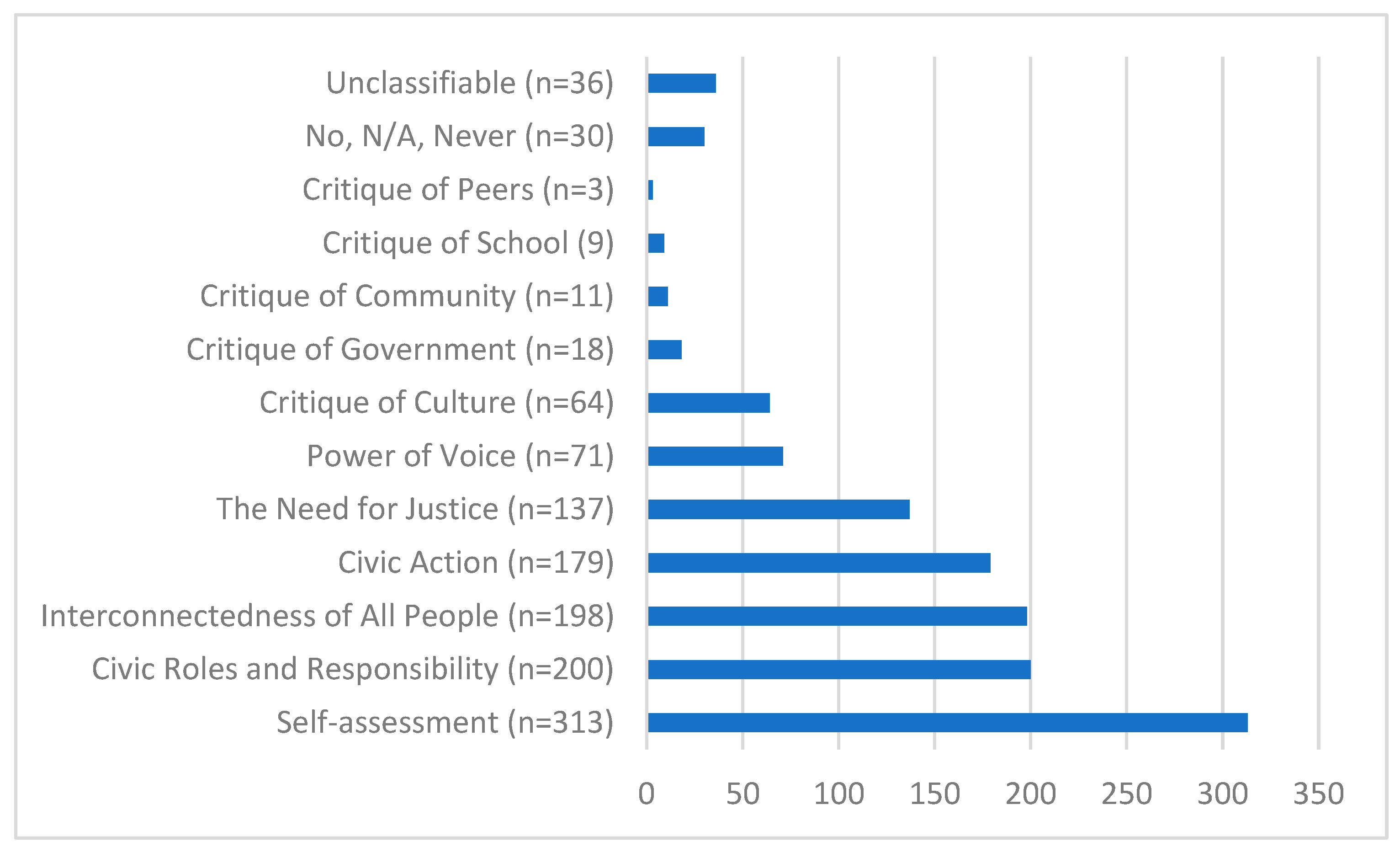
Figure 1 we display the frequency and the percentage of each of the major themes we coded for responses to the question:
Have the events of 2020 led you to reflect on your role as a citizen or community member? The most frequent response was to report engagement in “self-assessment”. Besides self-assessment, other high-frequency themes included acknowledgement of the roles/responsibilities of citizenship, the interconnectedness of individuals, the need for justice, references to civic action, and the power of voice. Less prominent themes mentioned by respondents appeared to be attributional, seeking somehow to assign blame for the events of 2020, including the wider culture, the government, and the local community—including the campus and their peers. It is important to note that responses were frequently assigned more than one code, with phrases being coded to represent all the themes present. Only 2.9% of the responses could not be coded into one of the major themes. Below we offer examples, in order of their importance in the data, of the major themes that emerged and exemplary student responses that demonstrate them. Minor themes are also noted.
3.1. Self-Assessment
One-quarter (25%) of the substantive responses indicated that events of 2020 had led to important self-assessment of their role as a citizen. Responses in this category went beyond affirmative answers to the question regarding if or how 2020 might have caused civic reflection; they spoke to how and why respondents had come to take the positions that they reported. A plethora of verbs (e.g., acknowledged, reflected upon, became aware of, realized, came to understand, was made to see) indicated (1) internal processing and (2) a reported change in attitudes/beliefs catalyzed by 2020. Sub-categories that constructed the ultimate Self-Assessment category were mindfulness, reflection, growth, educating myself, learning, acknowledgement of privilege. The comments below illustrate these sub-categories.
“I have learned the importance of educating myself on current events.”
“I actually realized the true value of a vote…”
“I am aware, now more than ever, of how my daily choices can influence the health and safety of others”
“[2020] has demonstrated to me that understanding politics and engaging in community issues is my responsibility”
“Every morning I journal with these three thoughts in mind: (1) who needs my help (2) how can I help them? (3) how can I better myself?”
The co-occurrence of this central theme with strong, civic-focused codes, chronicled below, suggested the possibility that our respondents were reporting some form of self-directed civic education. We present evidence of this co-occurrence after reviewing the individual themes.
3.2. Civic Roles and Responsibility
Another predominant theme, appearing in 16.6% of the substantive responses, had to do with a re-discovered, reinforced sense of the meaning of citizenship. One student spoke for many in describing a somewhat cavalier pre-2020 attitude: “I used to ‘not be interested in politics’ but now [after 2020] I realize the utter privilege that statement holds… it is my duty to protect the life, liberty, and pursuit of happiness of ALL people inside of the United States.”
Other responses reinforce this theme of re-discovered civic responsibility:
“…I firmly believe it is my duty as a citizen to wear a mask…”
“…I have an obligation to do what I can in order to decrease racial prejudice…”
“The events of 2020 have reshaped how I think about personal responsibility. It has forced me to realize the importance of myself in the sea of others. One person can become a mass spreader of COVID and change the lives of others around them. That singular responsibility has changed how I perceive my civic duty in preventing the spread of COVID. The same can be said about racial injustice. One person can change things or have an impact for others.”
3.3. Interconnectedness of All People
A similar percentage of substantive responses (16.5%) spoke to a renewed appreciation of the interconnectedness of all people. Many of these respondents confronted their privilege, sometimes painfully, and spoke of the dawning realization of the “butterfly effect”—that all of the human community is interconnected, and more importantly, that an individual choice or attitude has the potential to reverberate or “ripple” far beyond its origin.
“…Both the pandemic and the protests against police have led me to realize that my actions can have ripple effects throughout my community.”
“…I feel a duty as a citizen/community member to consider the good of the WHOLE and not just the good of the INDIVIDUAL (namely myself).”
“…we do not live in bubbles of complete individuality. Our inherent marriage to everyone else on this planet has become only more clear…”
3.4. Civic Action
Perhaps not surprisingly, as previous attitudes and beliefs about living in a community began to shift, these students moved from awareness to action as they began to consider what these newly found insights might require of them. Almost 15% (14.9%) of the substantive responses spoke to actions taken in 2020 (or bemoaned those they had failed to take), and projected actions they should do or planned to do in the future:
“I participated in two protests and a march around my town…also signed a few petitions.”
“I have never given money or gone to protests and rallies before this summer…”
“Have made an effort to share information on social media…also looked into supporting Black-owned businesses and tried to cut down on Amazon purchases.”
Many other respondents were more aspirational in their reports of civic action, and were divided between external participation and internal discipline and goals:
“[The events of 2020] have pushed me to put aside my own comforts in favor of the more urgent needs of others….wearing a mask, not taking unnecessary trips to the grocery store, calling my legislators even if it makes me feel nervous”
“Have encouraged me to become more active in local elections…to organize my community and bring people together.”
“…there is a lot more I can do with my white privilege than just try to be anti-racist in my actions. I can provoke conversations, sign petitions, attend rallies, contact representatives, vote and encourage others to vote—as well as continue to learn.”
3.5. The Need for Justice
Parallel with the interconnectedness finding was respondents’ relatively frequent mention (11.4% of substantive responses) of a reconsideration of our country’s state of justice: racial, social, and economic. A prominent lament of America’s justice deficit was often coupled with a respondent’s awareness of his/her own personal place of privilege. Reflection upon the disproportionate effects of COVID-19 on minority populations and the revelations of racial injustice, frequently shared by their peers, hit home.
“It is very easy for someone in my position to overlook issues of social and racial injustice as I am not being directly affected by them, but have come to realize that it is incumbent upon people in my position to advocate for change.”
“It (2020) has opened my eyes to the injustice of the world.”
3.6. The Power of Voice
Six percent of the substantive responses spoke to what was perceived to be a neglected or at least under-utilized civic tool: communication—both individual and collective. These responses reinforced a commonly held theme about the difficulty of “speaking up,” especially when one feels vulnerable and/or uncertain about the attitudes of hearers, and the importance of conversations, both formal and informal, about critical issues.
“I have realized the importance of my voice and how powerful it can be.”
“I have found myself more engaged in difficult conversations…”
“I am trying to listen more and amplify voices that have been historically silenced.”
3.7. Intersection Among Major Themes
Although code frequencies provided valuable insight into overarching themes, understanding how this strong finding of self-assessment reported by respondents had actually affected civic attitudes and behaviors required a closer look at how codes appeared alongside each other.
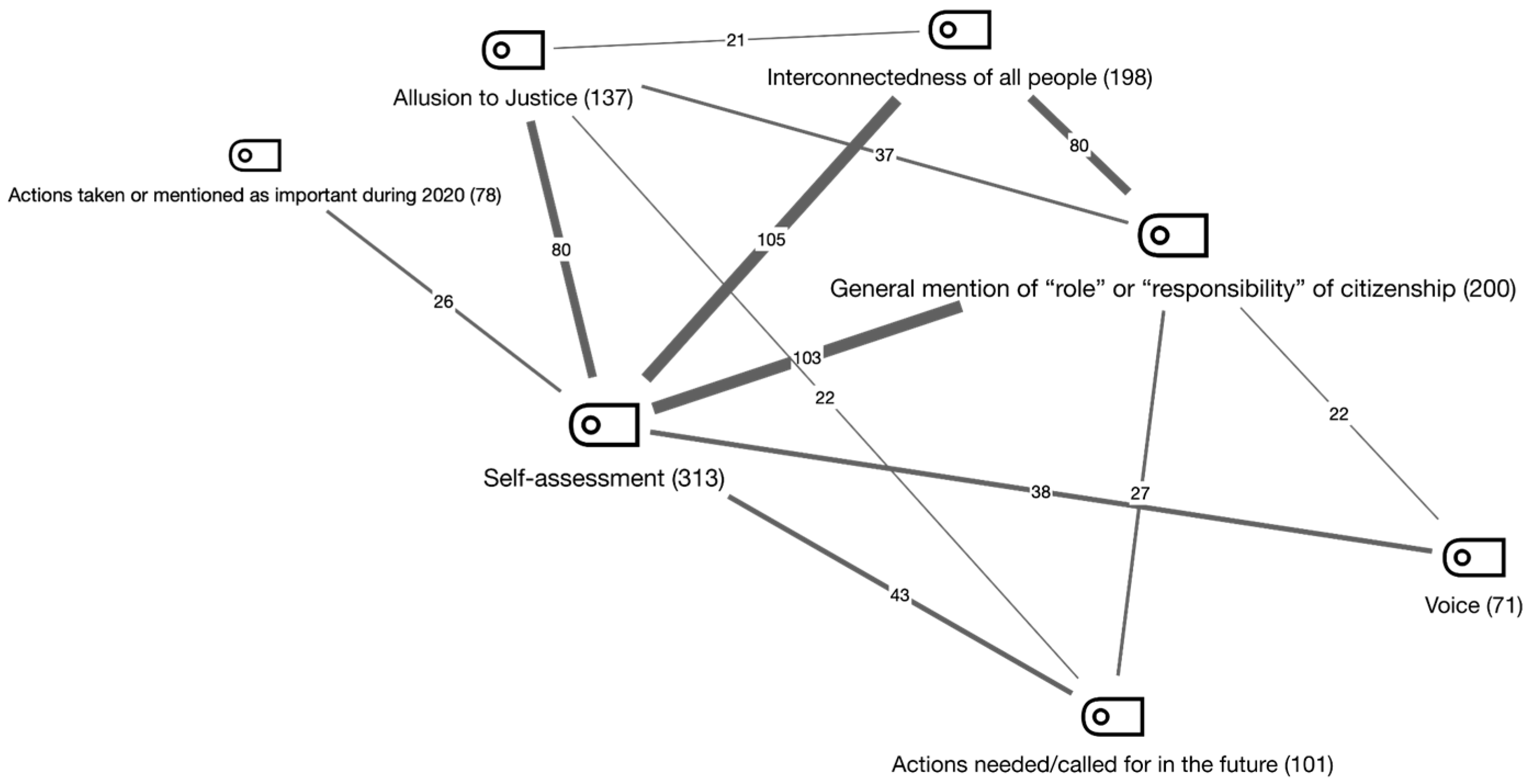
Using MAXQDA analytics, we were able to map the interconnections between codes (see
Figure 2), allowing us to ascertain the outcomes of this self-assessment process and the relative importance of emergent themes to respondents.
Figure 2 illustrates that the leading self-assessment theme occurred alongside each of the other prominent codes that demonstrated improved civic awareness and engagement. This co-occurrence suggests that students’ internal processes, at least in a large number of respondents, had
yielded a notable civic awareness in the midst of the challenging circumstances. The strongest co-occurrences were between self-awareness and (1) civic role and responsibility; (2) the interconnectedness of all people; (3) the need for justice; and (4) the importance of civic action (combined actions taken and actions proposed). Although other codes also co-occurred, no code was present more frequently alongside another than self-assessment. Furthermore, as the chart demonstrates, students’ notions of civic responsibility and interconnectedness were most often associated with student self-assessment.
3.8. Minor Themes
Several minor themes emerged less often but seem important for understanding the variety of ways that the events of 2020 affected thinking and behavior regarding citizenship and community. In general, the minor themes were more critical and attributional as students sought to make sense of the events of 2020 and who might be held responsible for them. By far the largest criticism (apparent in 5.3% of responses) was leveled at the American culture at large:
“…The individualistic mindset in this country is what got us to this crisis point, compared to the collective societies in other countries that successfully weathered COVID.”
“…Unfortunately, it [2020] has also brought to light how many people are out there working more for themselves than considering the needs or rights of other human beings.”
In a small number of responses (1%) students cast blame on own local community and peers for poor handling of both 2020 crises:
“I have taken the pandemic extremely seriously and as I watch my peers continue reckless behavior I worry about the collective health of the college and the nation.”
“…most privileged people don’t really care about social justice because they don’t think they’re affected…I doubt that anything will change about the climate of our school in the coming years.”
“More conversations need to happen on our campus…” “Our school needs to be more anti-racist than it is.”
As about two and a half percent (2.4%) of responses to the probe Have the events of 2020 led you to reflect on your role as a citizen or community member? indicated “no,” it can be understood that experiential learning in service of expanded civic education may not have occurred for every student, despite the environmental conditions being the same. Included in this percentage are responses claiming that no reflection or learning took place, as well as those writing “N/A.”
4. Discussion
In our pursuit of understanding how college students’ experience of citizenship had been affected by the events of 2020, we discovered evidence that despite extenuating circumstances that kept many college classrooms shuttered, civic sensibilities were being developed by students in a non-traditional mode of learning akin to John Dewey’s concept of “collateral learning,”—learning that might occur
alongside or adjacent to formal learning. Although Dewey offered very little in the way of definition and explanation of the term, scholars [
12,
13,
21,
24] have been intrigued by it and have come to understand that collateral learning falls into Dewey’s larger repository of experiences but refers to experiences that activate learning that is unmediated and internally occurring. Furthermore, it may also be student-initiated. As students interact generally with their environments, their “formulation of enduring attitudes” may become ubiquitous and unmonitored, and thus as Besand notes, “self-determined and fundamentally difficult to control” [
24]. Also it might be expected to occur when a student must wrestle “with the conditions of the problem at first hand, seeking and finding his own way out” [
16]. Perhaps most important is Dewey’s acknowledgment that experiences that prompt collateral learning may ultimately prove to be more important and
enduring than what students are formally taught.
Subsequent investigation of Dewey’s concept and its congruence with the aberrant educational environment of 2020 helped explain why students might have utilized it. The turn taken by this solitary, self-reflective process toward heightened civic awareness was totally unexpected and of the students’ own making. We argue that the upending of traditional classroom education in combination with the medical and social crises that literally threatened life and safety might have created a unique educational experience in a higher education setting.
4.1. An Aberrational Experiential Environment
If John Dewey had set about to construct a lab for testing experiential learning in times of crisis and social upheaval, he probably could not have found a better set of environmental circumstances than those of 2020. Hildebrand argues that direct experience and situation are two central components of Dewey’s “educating for democracy” scheme, and it is the coalescence of those elements that best explains the findings of this study. During the pandemic, students faced unfamiliar, uncomfortable circumstances in pursuit of their education; weighed critical calculations about masking, social distancing; made difficult social decisions that sometimes pitted their own personal safety and the safety of others against prevailing social norms; experienced personal illness, and illness, even death, of family and friends—all weighty issues for an eighteen-year-old accustomed to being buffered from such matters. Then as racial unrest gripped the country, young people witnessed inhumanity with their own eyes in the George Floyd murder that shook their sensibilities and their faith in a law enforcement institution expected to be fair and to keep them safe. In short, the daunting direct experiences of 2020 and the socio-political situation that gave rise to them forced a crash course in growing up quickly for America’s youth. Clearly, what students of 2020 experienced was not a classroom exercise devised in an educational lab somewhere or an activity coming straight from today’s lesson plan; rather, it called for critical internal processing about real life situations with significant consequences.
4.2. Civic Education as Moral Imperative
Not only did the profound direct experiences of the students and the charged external environment create fertile ground for a unique brand of experiential learning, student accounts demonstrated a decided turn toward civic awareness. In fact, our data provide evidence that these experiences, for at least a sub-set of our student participants, reinforced the very civic sensibilities that Dewey believed to be foundational in a democracy. London explains: “For Dewey, the ends and means of democratic life were the fulfillment of human virtue and nobility”… and he endorsed teaching “methods that would enhance moral reasoning” [
12].
To that end, our student respondents engaged most prominently in self-assessment, reporting that the events of 2020 had led to increased mindfulness, reflection, awareness of privilege, self-education, and personal growth—clearly some of the aspects of character development that Dewey attempted to instill in his future citizens. The frequent and explicit mention of self-assessment indicated a willingness for students to “take themselves on,”—to challenge long-held or previously unexamined beliefs. For example, although the process that our respondents reported was internal, the object/s of their self-assessment were largely external, directed to their fellow human beings in service of a healthy, more equitable co-existence, or as Dewey would term it, associative living. To that end, they often called themselves to increased accountability that they, at least, attributed to what they had learned from the challenging navigation of the twin pandemics.
As they spoke to us from the transcripts, they told us how the events of 2020 had:
Made them newly aware of the obligations of citizenship, that “understanding politics and engaging in community issues is my responsibility.”
Reminded them of the interconnectedness of all people, that “our inherent marriage to everyone else on this planet has become only clearer.”
Challenged them to turn tacit citizenship into active citizenship, “putting aside personal comforts in favor of the more urgent needs of others.”
Opened their eyes to the injustice in our country: racial, social, and economic, and that it is “incumbent upon people in my position…to advocate for change.”
Caused them to realize the “importance of my voice…and to amplify voices that have been historically silenced.”
Respondents also reported increases in speaking out, participating in uncomfortable conversations with family and friends, contributing to what they regarded as just causes, and for many, attending rallies and protests, sometimes for the first time.
In our view these are not the responses of young people who were cavalier and unaffected by the experiences which, as Dewey says, were “enacted or undergone” by them in the year 2020 or the suffering of their fellow citizens near and far that they witnessed or heard about. Rather their self reports consistently reveal that they believe they learned and/or taught themselves profound moral lessons that by almost any measure, especially that of John Dewey, portend a better, more committed, more morally intelligent, more engaged citizen.
Thus, we argue that the emergence of self-assessment so decisively as the primary response provides two significant answers to the research foci of this investigation: first, it confirms that, for many respondents, 2020 did indeed affect their civic understanding and growth, and second, that the circumstances of that challenging year significantly activated among these college students some exercise of “moral reasoning” and personal insights that encouraged participation in a communal life that would feature the advancement of “human virtue and nobility.” Furthermore, the strong intersection between self-assessment and the other “democratic” responses reported above—rediscovery of the responsibilities of citizenship, the interconnectedness of all people, the need to address injustices of all ilks, a call to more civic action, the discovery of one’s own voice as a civic tool—suggest a reasonably thoughtful and sophisticated process that led a number of college students to explain how their perspectives on citizenship had been altered by the events of 2020.
4.3. Strengths, Limitations, and Future Research
Our data are based on a large number of students who responded in robust ways to a question about how the crises of 2020 had affected their thinking about citizenship; it is important to note, however, as we reported earlier, that all respondents did not choose to opine about the connection between their pandemic experiences and citizenship. For those who did, their thinking was assessed at a critical time in history, when the effects of a pandemic had changed life as we know it and when the continuing brutal effects of racism in the U.S. could not be ignored. Our results are provocative and encouraging, perhaps especially given that the site of this particular learning experience was higher education that was already struggling to regain its credibility and public support.
In that regard, we cannot make the claim that the higher education setting was necessary in accounting for the accelerated experimental learning reported here. For all we know, students at all educational levels and possibly individuals completely outside the periphery of formal education were engaging in some version of collateral learning in 2020. In fact, it is possible that college students were advantaged in their ability to process the unusual experiences of 2020 by a larger (i.e., longer) “repertoire” of academic training and skills on which to draw, and perhaps those experiences allowed them to imagine a richer civic engagement and the possibility of a more just and peaceful co-existence. The learning environments most hospitable to collateral learning would be an interesting question for future research and would also help to evaluate the impact and value of higher education as a dispenser of civic education.
Evidence that civic education proceeds within a higher education setting even when, and maybe even because of, the failure or disruption in traditional structures and processes, is encouraging. Perhaps due to these very lapses in administrative and community action, both at the university and national levels, students came to view themselves more as members of a community and assumed greater civic responsibilities. Future research should examine how sociopolitical crises of any kind affect civic learning in myriad contexts, to illuminate what external and internal variables trigger it, and the mental and psychological skills necessary to implement it. Research should also address whether such learning is especially likely to occur within the formal educational contexts that most interested John Dewey, or, if as our study suggests, it is activated and thrives in more solitary learning environments.
Because the college that our students attended was one in which attempts had been made to infuse dialog into the curriculum and culture, there could have been an uptick in positive civic responses that would not be present in institutions that had not taken similar steps. Therefore, future research should explore the possibilities of collateral civic education in more and varied higher education environments and in more situations of social and educational disruptions. Student demographics must also be considered when evaluating responses. Given the private, liberal-arts nature of this university, many students came from high SES backgrounds and attended elite high schools. Thus, future research should also seek to examine student reactions and perceptions among more demographically diverse emerging adults, including those who are not pursuing higher education.
5. Conclusions
This investigation began with two overriding concerns: higher education’s current role in civic education and college students’ experience with civic education in times of crisis. It was our data in which our students reported extensive self-assessment that led us to John Dewey and a better understanding of his profound but contested connection between
morality and civic education. Our findings do not necessarily rehabilitate a wary public’s reservations about higher education or restore its vaunted position as a progenitor in the advancement of democracy [
6]. They do suggest, however, that embedded in the college experience itself, free from external forces, such as court rulings, legislative policy, or public pressure, resides the capacity of students, perhaps especially in times of crisis, to discover and to adopt important democratic capabilities. Student responses, while not all rosy, suggest what John Dewey
might call “collateral learning” [
22]: learning outcomes, unplanned and often informal, that occur based on a student’s personal experiences and/or because external events dictate the context, or as one scholar put it: “People learn when they have to learn” [
24].
We believe that these findings contribute practically to a research tradition of civic identity that is often esoteric and inaccessible. Discovering the possibility of “collateral learning” at work lends greater texture to an obscure Deweyian term that has recently generated interest and renewed theoretical exploration. We also see our findings as a hopeful sign that our students can be trusted to mine difficult experiences and situations for the moral and civic-minded truths that they might hold. Finally, we conclude that educators at all levels should endeavor to locate and nourish these subterranean civic repositories as to what makes them tick and the particular circumstances that activate them. Close reading of Dewey’s work offers a wealth of resources in that regard.