Review

Exercise-Induced Myokines in Obesity-Related Metabolic Disorders and Cardiovascular Protection: A Narrative Review


Department of Sports Science, College of Education, Zhejiang University, Hangzhou 310058, China
*
Author to whom correspondence should be addressed.
Sports 2026, 14(5), 212; https://doi.org/10.3390/sports14050212

Submission received: 22 March 2026 / Revised: 15 May 2026 / Accepted: 18 May 2026 / Published: 21 May 2026

Abstract

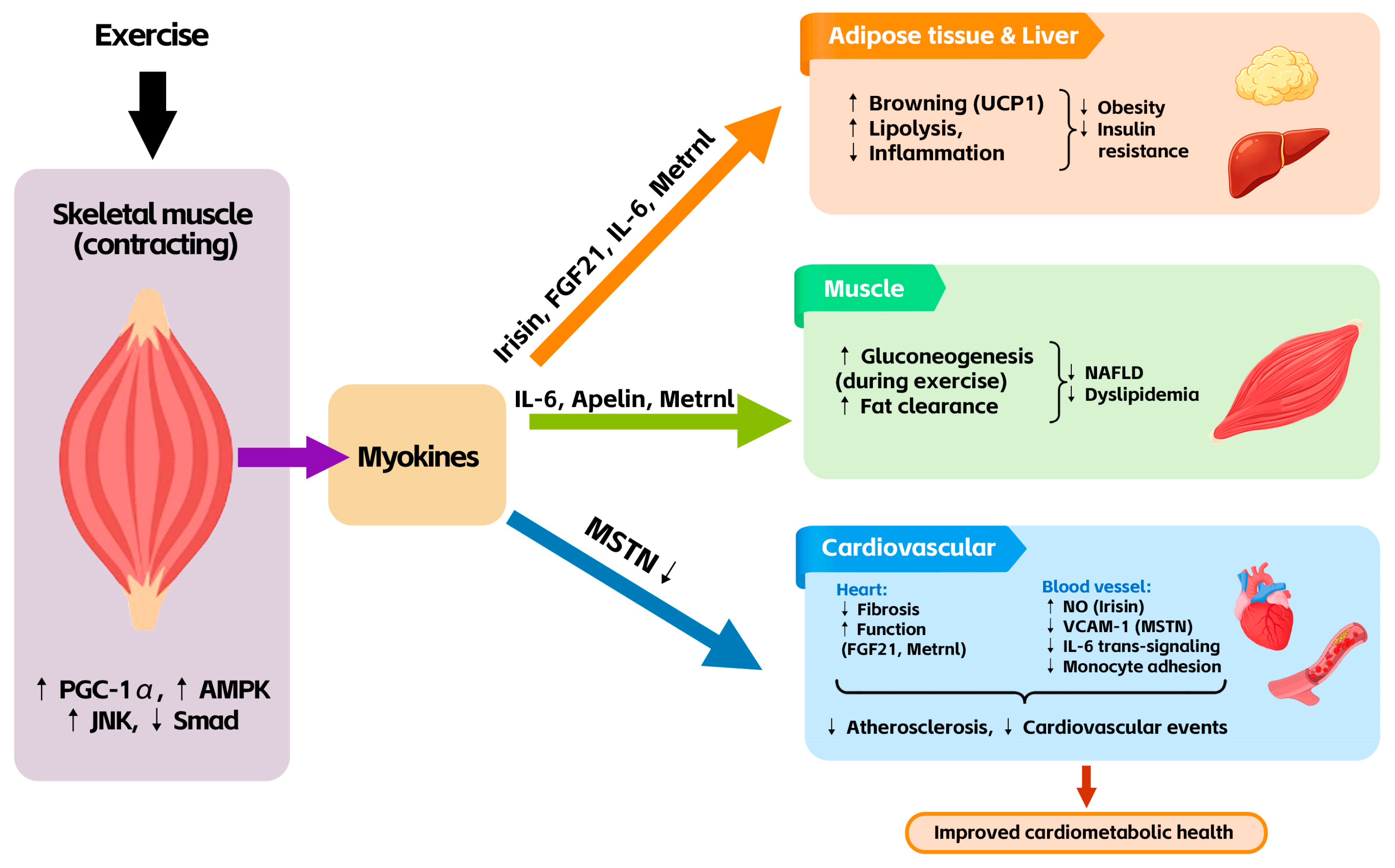
Obesity is a significant risk factor for metabolic diseases and atherosclerotic cardiovascular disease (ASCVD). Exercise exerts beneficial effects partly through myokines secreted by skeletal muscle. This narrative review summarizes current evidence on exercise-induced myokines in obesity. We searched PubMed, Scopus, and Google Scholar up to Jan 2026 using keywords “myokines”, “obesity”, “resistance training”, “aerobic exercise”, and “HIIT”. We focused on six myokines (IL-6, irisin, FGF21, myostatin, apelin, and Metrnl) that are consistently linked to metabolic and cardiovascular health. Key findings are as follows: resistance training effectively increases irisin and decreases myostatin, promoting muscle mass and fat browning; high-intensity interval training (HIIT) induces rapid IL-6 peaks and elevates Metrnl, enhancing anti-inflammatory responses and cardiac function; aerobic exercise improves FGF21 sensitivity and supports long-term metabolic homeostasis. For clinicians and exercise practitioners, a preliminary exercise framework can be suggested based on available human evidence. In obese patients, ≥3 sessions per week of resistance training (60–80% of one-repetition maximum, 8–12 repetitions, 3–4 sets) may be considered to optimize irisin/myostatin balance, combined with ≥150 min per week of moderate-intensity aerobic exercise (50–70% of maximum heart rate) or 75 min per week of HIIT (85–95% of peak heart rate, 4 × 4 min intervals) to improve FGF21 sensitivity and Metrnl levels. These suggestions should be interpreted as hypothesis-generating rather than definitive clinical guidance, given the heterogeneity of included studies and the absence of quantitative synthesis. Nevertheless, they offer a molecular basis for hypothesis-driven precision exercise prescription that requires validation in future prospective studies and randomized controlled trials.
Keywords: obesity; myokine secretion; exercise prescription; atherosclerosis; metabolic syndrome; HIIT; insulin resistance obesity; myokine secretion; exercise prescription; atherosclerosis; metabolic syndrome; HIIT; insulin resistance