


Physical Activity, Metabolic Risk and the Primary Allostatic Load Mediators: An Explorative Study


Abstract
1. Introduction
2. Materials and Methods
2.1. Study Design
2.2. Study Population
2.3. Ethical Approval
2.4. Physical Activity Assessments
2.5. Primary Mediators of Allostatic Load Assessment
2.6. Blood Pressure Measurement
2.7. Lipid and Glucose Metabolic Biomarkers
2.8. Statistical Analysis
3. Results
4. Discussion
5. Conclusions
Author Contributions
Funding
Institutional Review Board Statement
Informed Consent Statement
Data Availability Statement
Acknowledgments
Conflicts of Interest
Abbreviations
| ACTH | Adrenocorticotropic Hormone |
| AL | Allostatic load |
| ALI | Allostatic Load Index |
| BMI | Body Mass Index |
| COMT | Catechol-O-Methyltransferase |
| CRH | Corticotropin-Releasing Hormone |
| DHEAS | Dehydroepiandrosterone sulfate |
| HDL-C | High-Density Lipoprotein Cholesterol |
| HIIT | High-Intensity Interval Training |
| HOMA | Homeostasis Model Assessment Index |
| HPA axis | Hypothalamic–Pituitary–Adrenal Axis |
| LBP | Low Back Pain |
| LC/NE | Locus Coeruleus/norepinephrine System |
| LDL-C | Low-Density Lipoprotein Cholesterol |
| MiSpEx | Medicine in Spine Exercise Network |
| PA | Physical Activity |
| PSA 3 | Parallel Study 3 |
| SNS | Sympathetic Nervous System |
| VAS | Visual Analog Scale |
| WHO | World Health Organization |
References
- Kivimäki, M.; Bartolomucci, A.; Kawachi, I. The multiple roles of life stress in metabolic disorders. Nat. Rev. Endocrinol. 2023, 19, 10–27. [Google Scholar] [CrossRef]
- Kumar, R.; Rizvi, M.R.; Saraswat, S. Obesity and stress: A contingent paralysis. Int. J. Prev. Med. 2022, 13, 95. [Google Scholar] [CrossRef]
- Won, E.; Kim, Y.K. Stress, the autonomic nervous system, and the immune-kynurenine pathway in the etiology of depression. Curr. Neuropharmacol. 2016, 14, 665–673. [Google Scholar] [CrossRef]
- Ebert, S.N.; Rong, Q.; Boe, S.; Thompson, R.P.; Grinberg, A.; Pfeifer, K. Targeted insertion of the Cre-recombinase gene at the phenylethanolamine N-methyltransferase locus: A new model for studying the developmental distribution of adrenergic cells. Dev. Dyn. 2004, 231, 849–858. [Google Scholar] [CrossRef]
- Mbiydzenyuy, N.E.; Qulu, L.A. Stress, hypothalamic-pituitary-adrenal axis, hypothalamic-pituitary-gonadal axis, and aggression. Metab. Brain Dis. 2024, 39, 1613–1636. [Google Scholar] [CrossRef]
- Ring, M. An integrative approach to HPA axis dysfunction: From recognition to recovery. Am. J. Med. 2025, 138, 1451–1463. [Google Scholar] [CrossRef]
- James, K.A.; Stromin, J.I.; Steenkamp, N.; Combrinck, M.I. Understanding the relationships between physiological and psychosocial stress, cortisol and cognition. Front. Endocrinol. 2023, 14, 1085950. [Google Scholar] [CrossRef] [PubMed]
- Molina-Hidalgo, C.; Stillman, C.M.; Collins, A.M.; Velazquez-Diaz, D.; Ripperger, H.S.; Drake, J.A.; Gianaros, P.J.; Marsland, A.L.; Erickson, K.I. Changes in stress pathways as a possible mechanism of aerobic exercise training on brain health: A scoping review of existing studies. Front. Physiol. 2023, 14, 1273981. [Google Scholar] [CrossRef] [PubMed]
- Kageyama, K.; Iwasaki, Y.; Daimon, M. Hypothalamic regulation of corticotropin-releasing factor under stress and resilience. Int. J. Mol. Sci. 2021, 22, 12242. [Google Scholar] [CrossRef]
- Malhotra, N.; Sinha, P.; Rathoria, R.; Rathoria, E. Corticotropin-releasing hormone. In FOGSI Focus on Harmony of Hormones; Evangel Publishing: New Delhi, India, 2024. [Google Scholar]
- Word, K.R.; Austin, S.H.; Wingfield, J.C. Allostasis revisited: A perception, variation, and risk framework. Front. Ecol. Evol. 2022, 10, 954708. [Google Scholar] [CrossRef]
- Sterling, P.; Eyer, J. Allostasis: A new paradigm to explain arousal pathology. In Handbook of Life Stress, Cognition and Health; Fisher, S., Reason, J., Eds.; Wiley: New York, NY, USA, 1988; pp. 629–649. [Google Scholar]
- Juster, R.P.; McEwen, B.S.; Lupien, S.J. Allostatic load biomarkers of chronic stress. Neurosci. Biobehav. Rev. 2010, 35, 2–16. [Google Scholar] [CrossRef]
- McEwen, B.S.; Stellar, E. Stress and the individual. Mechanisms leading to disease. Arch. Intern. Med. 1993, 153, 2093–2101. [Google Scholar] [CrossRef]
- Bailey, A.; Payton, A.; Fleming, J.; Rager, J.E.; Jaspers, I. A novel approach for measuring allostatic load highlights differences in stress burdens due to race, sex and smoking status. PLoS ONE 2025, 20, e0323788. [Google Scholar] [CrossRef]
- Seeman, T.E.; McEwen, B.S.; Rowe, J.W.; Singer, B.H. Allostatic load as a marker of cumulative biological risk: MacArthur studies of successful aging risk. Proc. Natl. Acad. Sci. USA 2001, 98, 4770–4775. [Google Scholar] [CrossRef] [PubMed]
- Beckie, T.M. A systematic review of allostatic load, health, and health disparities. Biol. Res. Nurs. 2012, 14, 311–346. [Google Scholar] [CrossRef] [PubMed]
- Sun, J.; Wang, S.; Zhang, J.Q.; Li, W. Assessing the cumulative effects of stress: The association between job stress and allostatic load in a large sample of Chinese employees. Work Stress 2007, 21, 333–347. [Google Scholar] [CrossRef]
- Goldman, N.; Turra, C.M.; Glei, D.A.; Lin, Y.H.; Weinstein, M. Physiological dysregulation and changes in health in an older population. Exp. Gerontol. 2006, 41, 862–870. [Google Scholar] [CrossRef]
- Seplaki, C.L.; Goldman, N.; Glei, D.; Weinstein, M. A comparative analysis of measurement approaches for physiological dysregulation in an older population. Exp. Gerontol. 2005, 40, 438–449. [Google Scholar] [CrossRef] [PubMed]
- Chourpiliadis, C.; Zeng, Y.; Lovik, A.; Wei, D.; Valdimarsdóttir, U.; Song, H.; Hammar, N.; Fang, F. Metabolic Profile and Long-Term Risk of Depression, Anxiety, and Stress-Related Disorders. JAMA Netw. Open 2024, 7, e244525. [Google Scholar] [CrossRef]
- Osei, F.; Block, A.; Wippert, P.M. Association of primary allostatic load mediators and metabolic syndrome (MetS): A systematic review. Front. Endocrinol. 2022, 13, 946740. [Google Scholar] [CrossRef]
- Alberti, K.G.M.M.; Eckel, R.H.; Grundy, S.M.; Zimmet, P.Z.; Cleeman, J.I.; Donato, K.A.; Fruchart, J.C.; James, W.P.T.; Loria, C.M.; Smith, S.C., Jr. Harmonizing the metabolic syndrome: A joint interim statement of the International Diabetes Federation Task Force on Epidemiology and Prevention; National Heart, Lung, and Blood Institute; American Heart Association; World Heart Federation; International Atherosclerosis Society; and International Association for the Study of Obesity. Circulation 2009, 120, 1640–1645. [Google Scholar] [CrossRef]
- Athanasiou, N.; Bogdanis, G.C.; Mastorakos, G. Endocrine responses of the stress system to different types of exercise. Rev. Endocr. Metab. Disord. 2023, 24, 251–266. [Google Scholar] [CrossRef]
- Zhao, X.; An, X.; Yang, C.; Sun, W.; Ji, H.; Lian, F. The crucial role and mechanism of insulin resistance in metabolic disease. Front. Endocrinol. 2023, 14, 1149239. [Google Scholar] [CrossRef]
- Lambert, G.W.; Patel, M.; Lambert, E.A. The Influence of the Sympathetic Nervous System on Cardiometabolic Health in Response to Weight Gain or Weight Loss. Metabolites 2025, 15, 286. [Google Scholar] [CrossRef]
- Ziegler, K.A.; Engelhardt, S.; Carnevale, D.; McAlpine, C.S.; Guzik, T.J.; Dimmeler, S.; Swirski, F.K. Neural Mechanisms in Cardiovascular Health and Disease. Circ. Res. 2025, 136, 1233–1261. [Google Scholar] [CrossRef] [PubMed]
- Erceg, N.; Micic, M.; Forouzan, E.; Knezevic, N.N. The Role of Cortisol and Dehydroepiandrosterone in Obesity, Pain, and Aging. Diseases 2025, 13, 42. [Google Scholar] [CrossRef] [PubMed]
- Takeshita, R.S.C.; Nguyen, A.T.; Auger, A.P.; Chung, W.C.J. Cortisol, DHEAS, and the Cortisol/DHEAS Ratio as Pre-dictors of Epigenetic Age Acceleration. Biogerontology 2025, 26, 164. [Google Scholar] [CrossRef] [PubMed]
- Martínez-Vizcaíno, V.; Cavero-Redondo, I.; Reina-Gutiérrez, S.; Gracia-Marco, L.; Gil-Cosano, J.J.; Bizzozero-Peroni, B.; Rodriguez-Artalejo, F.; Ubago-Guisado, E. Comparative effects of different types of exercise on health-related quality of life during and after active cancer treatment: A systematic review and network meta-analysis. J. Sport Health Sci. 2023, 12, 726–738. [Google Scholar] [CrossRef]
- Bull, F.C.; Al-Ansari, S.S.; Biddle, S.; Borodulin, K.; Buman, M.P.; Cardon, G.; Carty, C.; Chaput, J.-P.; Chastin, S.; Chou, R.; et al. World Health Organization 2020 guidelines on physical activity and sedentary behaviour. Br. J. Sports Med. 2020, 54, 1451–1462. [Google Scholar] [CrossRef]
- Çınar, V.; Bağ, M.F.; Aslan, M.; Çınar, F.; Gennaro, A.; Akbulut, T.; Migliaccio, G.M. Impact of different exercise modalities on neuroendocrine well-being markers among university students: A study of renalase and catecholamine responses. Front. Physiol. 2025, 16, 1591132. [Google Scholar] [CrossRef]
- Bogdanis, G.C.; Philippou, A.; Stavrinou, P.S.; Tenta, R.; Maridaki, M. Acute and delayed hormonal and blood cell count responses to high-intensity exercise before and after short-term high-intensity interval training. Res. Sports Med. 2022, 30, 400–414. [Google Scholar] [CrossRef] [PubMed]
- Daniela, M.; Catalina, L.; Ilie, O.; Paula, M.; Daniel-Andrei, I.; Ioana, B. Effects of Exercise Training on the Autonomic Nervous System with a Focus on Anti-Inflammatory and Antioxidants Effects. Antioxidants 2022, 11, 350. [Google Scholar] [CrossRef] [PubMed]
- Heaney, J.L.; Carroll, D.; Phillips, A.C. DHEA, DHEA-S and Cortisol Responses to Acute Exercise in Older Adults in Relation to Exercise Training Status and Sex. Age 2013, 35, 395–405. [Google Scholar] [CrossRef] [PubMed]
- Ribeiro, D.; Petrigna, L.; Pereira, F.C.; Muscella, A.; Bianco, A.; Tavares, P. The Impact of Physical Exercise on the Circulating Levels of BDNF and NT 4/5: A Review. Int. J. Mol. Sci. 2021, 22, 8814. [Google Scholar] [CrossRef]
- D’Alessio, L.; Korman, G.P.; Sarudiansky, M.; Guelman, L.R.; Scévola, L.; Pastore, A.; Obregón, A.; Roldán, E.J.A. Reducing Allostatic Load in Depression and Anxiety Disorders: Physical Activity and Yoga Practice as Add-On Therapies. Front. Psychiatry 2020, 11, 501. [Google Scholar] [CrossRef]
- McEwen, B.S. Physiology and neurobiology of stress and adaptation: Central role of the brain. Physiol. Rev. 2007, 87, 873–904. [Google Scholar] [CrossRef]
- Osei, F.; Wippert, P.M.; Block, A. Allostatic Load and Metabolic Syndrome in Depressed Patients: A Cross-Sectional Analysis. Depress. Anxiety 2024, 2024, 1355340. [Google Scholar] [CrossRef]
- Wiltink, J.; Michal, M.; Jünger, C.; Münzel, T.; Wild, P.S.; Lackner, K.J.; Blettner, M.; Pfeiffer, N.; Brähler, E.; Beutel, M.E. Associations between degree and sub-dimensions of depression and metabolic syndrome (MetS) in the community: Results from the Gutenberg Health Study (GHS). BMC Psychiatry 2018, 18, 114. [Google Scholar] [CrossRef]
- Block, A.; Schipf, S.; Van der Auwera, S.; Hannemann, A.; Nauck, M.; John, U.; Völzke, H.; Freyberger, H.J.; Dörr, M.; Felix, S.; et al. Sex and age-specific associations between major depressive disorder and metabolic syndrome in two general population samples in Germany. Nord. J. Psychiatry 2016, 70, 611–620. [Google Scholar] [CrossRef]
- Gruenewald, T.L.; Karlamangla, A.S.; Hu, P.; Stein-Merkin, S.; Crandall, C.; Koretz, B.; Seeman, T.E. History of socioeconomic disadvantage and allostatic load in later life. Soc. Sci. Med. 2012, 74, 75–83. [Google Scholar] [CrossRef]
- Haufe, S.; Kerling, A.; Protte, G.; Bayerle, P.; Stenner, H.T.; Rolff, S.; Sundermeier, T.; Kück, M.; Ensslen, R.; Nachbar, L.; et al. Telemonitoring-supported exercise training, metabolic syndrome severity, and workability in company employees: A randomised controlled trial. Lancet Public Health 2019, 4, e343–e352. [Google Scholar] [CrossRef]
- Mayer, F.; Arampatzis, A.; Banzer, W.; Beck, H.; Brüggemann, G.-P.; Hasenbring, M.; Kellmann, M.; Kleinert, J.; Schiltenwolf, M.; Schmidt, H.; et al. Medicine in Spine Exercise [MiSpEx]—A national research network to evaluate back pain. Dtsch. Z. Sportmed. 2018, 69, 229–235. [Google Scholar] [CrossRef]
- Wippert, P.M.; Puerto Valencia, L.; Drießlein, D. Stress and Pain. Predictive (Neuro)Pattern Identification for Chronic Back Pain: A Longitudinal Observational Study. Front. Med. 2022, 9, 828954. [Google Scholar] [CrossRef]
- Wippert, P.-M.; Honold, J.; Wang, V.; Kirschbaum, C. Assessment of chronic stress: Comparison of hair biomarkers and allostatic load indices. Psychol. Res. 2014, 4, 517–524. [Google Scholar] [CrossRef][Green Version]
- Wippert, P.-M.; Niederer, D.; Drießlein, D.; Beck, H.; Banzer, W.; Schneider, C.; Schiltenwolf, M.; Mayer, F. Psychosocial Moderators and Mediators of Sensorimotor Exercise in Low Back Pain: A Randomized Multicenter Controlled Trial. Front. Psychiatry 2021, 12, 629474. [Google Scholar] [CrossRef] [PubMed]
- Niederer, D.; Vogt, L.; Wippert, P.-M.; Puschmann, A.K.; Pfeifer, A.C.; Schiltenwolf, M.; Banzer, W.; Mayer, F. Medicine in spine exercise (MiSpEx) for nonspecific low back pain patients: Study protocol for a multicentre, single-blind randomized controlled trial. Trials 2016, 17, 507. [Google Scholar] [CrossRef] [PubMed]
- Zouhal, H.; Jacob, C.; Delamarche, P.; Gratas-Delamarche, A. Catecholamines and the effects of exercise, training and gender. Sports Med. 2008, 38, 401–423. [Google Scholar] [CrossRef] [PubMed]
- Kreher, J.B.; Schwartz, J.B. Overtraining syndrome: A practical guide. Sports Health 2012, 4, 128–138. [Google Scholar] [CrossRef]
- Fiala, O.; Hanzlova, M.; Borska, L.; Fiala, Z.; Holmannova, D. Beyond physical exhaustion: Understanding overtraining syndrome through the lens of molecular mechanisms and clinical manifestation. Sports Med. Health Sci. 2025, 7, 237–248. [Google Scholar] [CrossRef]
- Chen, C.; Nakagawa, S.; An, Y.; Ito, K.; Kitaichi, Y.; Kusumi, I. The exercise-glucocorticoid paradox: How exercise is beneficial to cognition, mood, and the brain while increasing glucocorticoid levels. Front. Neuroendocrinol. 2017, 44, 83–102. [Google Scholar] [CrossRef]
- Hamer, M.; Steptoe, A. Cortisol responses to mental stress and incident hypertension in healthy men and women. J. Clin. Endocrinol. Metab. 2012, 97, E29–E34. [Google Scholar] [CrossRef] [PubMed]
- Davy, K.P.; Orr, J.S. Sympathetic nervous system behavior in human obesity. Neurosci. Biobehav. Rev. 2009, 33, 116–124. [Google Scholar] [CrossRef] [PubMed]
- Torpy, J.M.; Lynm, C.; Glass, R.M. Chronic Stress and the Heart. JAMA 2007, 298, 1722. [Google Scholar] [CrossRef]
- Lin, Y.; Fan, R.; Hao, Z.; Li, J.; Yang, X.; Zhang, Y.; Xia, Y. The Association Between Physical Activity and Insulin Level Under Different Levels of Lipid Indices and Serum Uric Acid. Front. Physiol. 2022, 13, 809669. [Google Scholar] [CrossRef]
- He, F.; Li, J.; Liu, Z.; Chuang, C.C.; Yang, W.; Zuo, L. Redox Mechanism of Reactive Oxygen Species in Exercise. Front. Physiol. 2016, 7, 486. [Google Scholar] [CrossRef]
- Bracken, R.M.; Brooks, S. Plasma catecholamine and nephrine responses following 7 weeks of sprint cycle training. Amino Acids 2010, 38, 1351–1359. [Google Scholar] [CrossRef] [PubMed]
- Ziegler, M.G.; Elayan, H.; Milic, M.; Sun, P.; Gharaibeh, M. Epinephrine and the metabolic syndrome. Curr. Hypertens. Rep. 2012, 14, 1–7. [Google Scholar] [CrossRef]
- Bird, S.R.; Hawley, J.A. Update on the effects of physical activity on insulin sensitivity in humans. BMJ Open Sport Exerc. Med. 2017, 2, e000143. [Google Scholar] [CrossRef]
- Pedersen, B.K.; Saltin, B. Exercise as medicine—Evidence for prescribing exercise as therapy in 26 different chronic diseases. Scand. J. Med. Sci. Sports 2015, 25, 1–72. [Google Scholar] [CrossRef]
- Cornelissen, V.A.; Smart, N.A. Exercise training for blood pressure: A systematic review and meta-analysis. J. Am. Heart Assoc. 2013, 2, e004473. [Google Scholar] [CrossRef] [PubMed]
- McEwen, B.S. Stress, adaptation, and disease. Allostasis and allostatic load. Ann. N. Y. Acad. Sci. 1998, 840, 33–44. [Google Scholar] [CrossRef]
- Smith, R.L.; Soeters, M.R.; Wüst, R.C.I.; Houtkooper, R.H. Metabolic Flexibility as an Adaptation to Energy Resources and Requirements in Health and Disease. Endocr. Rev. 2018, 39, 489–517. [Google Scholar] [CrossRef]
- Warburton, D.E.R.; Bredin, S.S.D. Health Benefits of Physical Activity: A Systematic Review of Current Systematic Reviews. Curr. Opin. Cardiol. 2017, 32, 541–556. [Google Scholar] [CrossRef]
- Barnett, M.J.; Doroudgar, S.; Khosraviani, V.; Ip, E.J. Multiple comparisons: To compare or not to compare, that is the question. Res. Soc. Adm. Pharm. 2022, 18, 2331–2334. [Google Scholar] [CrossRef]
- McNeil, J.; Crandell, J.; Agboola, A.; Thorpe, J.; Ward, D.S.; Girdler, S.S.; Strogatz, D.; Smith-Edwards, S.; Lightfoot, A.; Adair, L.; et al. Sleep, Health Outcomes and Body Weight (SHOW) study: A measurement burst design study on sleep and risk factors for obesity in black emerging adults in North Carolina, USA. BMJ Open 2024, 14, e087950. [Google Scholar] [CrossRef] [PubMed]
- Roelfsema, F.; van Heemst, D.; Iranmanesh, A.; Takahashi, P.; Yang, R.; Veldhuis, J.D. Impact of age, sex and body mass index on cortisol secretion in 143 healthy adults. Endocr. Connect. 2017, 6, 500–509. [Google Scholar] [CrossRef] [PubMed]
- El-Farhan, N.; Rees, D.A.; Evans, C. Measuring cortisol in serum, urine and saliva—Are our assays good enough? Ann. Clin. Biochem. 2017, 54, 308–332. [Google Scholar] [CrossRef] [PubMed]
- Seeman, T.E.; Singer, B.H.; Rowe, J.W.; Horwitz, R.I.; McEwen, B.S. Price of adaptation--allostatic load and its health consequences. MacArthur studies of successful aging. Arch. Intern. Med. 1997, 157, 2259–2268. [Google Scholar] [CrossRef]


| Variables | N | % | Median | IQR | Range |
|---|---|---|---|---|---|
| Age (years) | 45 | 97.8 | 30.00 | 15.00 | 25.00 |
| Sex | |||||
| Male | 15 | 32.6 | - | - | - |
| Female | 30 | 65.2 | - | - | - |
| Primary mediators of AL | |||||
| Cortisol (μg/12 h) | 46 | 100.0 | 113.55 | 73.70 | 238.60 |
| Epinephrine (μg/12 h) | 46 | 100.0 | 5.95 | 5.30 | 16.80 |
| Norepinephrine (μg/12 h) | 46 | 100.0 | 24.40 | 20.60 | 95.50 |
| DHEA-S (μg/mL) | 46 | 100.0 | 0.53 | 0.89 | 2.48 |
| Primary ALI | 46 | 100.0 | 1.00 | 2.00 | 4.00 |
| Anthropometry | |||||
| BMI (kg/m2) | 44 | 95.7 | 22.29 | 3.13 | 13.07 |
| Waist circumference (cm) | 45 | 97.8 | 75.20 | 13.00 | 42.30 |
| Blood pressure | |||||
| Systolic blood pressure (mmHg) | 45 | 97.8 | 100.00 | 13.75 | 50.00 |
| Diastolic blood pressure (mmHg) | 45 | 97.8 | 60.00 | 10.00 | 35.00 |
| Lipid profile | |||||
| Triglycerides (mg/dL) | 46 | 100.0 | 89.90 | 48.90 | 129.80 |
| HDL-C (mg/dL) | 46 | 100.0 | 62.25 | 17.60 | 59.50 |
| Glycemia | |||||
| Fasting blood glucose (mg/dL) | 46 | 100.0 | 86.30 | 7.40 | 29.40 |
| Lifestyle habits | |||||
| Leisure Sports (min/week) | 38 | 82.6 | 150.00 | 225.00 | 460.00 |
| Exercise (min/week) | 37 | 80.4 | 240.00 | 345.00 | 1275.00 |
| Total Physical Activity (PA) (min/week) | 43 | 93.5 | 330.00 | 453.00 | 1680.00 |
| Variables | Regular PA (n = 37) | Non-Regular PA (n = 8) | U | Z | p | ||||||
|---|---|---|---|---|---|---|---|---|---|---|---|
| N (%) | Mdn | Mean Rank | Sum of Mean Ranks | N (%) | Mdn | Mean Rank | Sum of Mean Ranks | ||||
| Age | 37 (80.43) | 28.00 | 22.07 | 816.50 | 8 (17.40) | 37.50 | 27.31 | 218.50 | 110.500 | −1.026 | 0.30 |
| Sex | |||||||||||
| Male | 14 (30.43) | - | - | - | 1 (2.17) | - | - | - | - | - | - |
| Female | 23 (50.00) | - | - | - | 7 (15.22) | - | - | - | - | - | - |
| Anthropometry | |||||||||||
| BMI (kg/m2) | 35 (76.08) | 22.34 | 22.63 | 792.00 | 8 (17.40) | 21.92 | 19.25 | 154.00 | 118.000 | −1.694 | 0.49 |
| Waist circumference (cm) | 36 (78.26) | 75.60 | 22.42 | 807.00 | 8 (17.40) | 79.10 | 22.88 | 183.00 | 141.000 | −0.091 | 0.92 |
| Primary Mediators of AL | |||||||||||
| Cortisol (μg/12 h) | 37 (80.43) | 130.60 | 25.35 | 938.00 | 8 (17.40) | 71.50 | 12.13 | 97.00 | 61.000 | −2.583 | 0.01 |
| Epinephrine (μg/12 h) | 37 (80.43) | 7.00 | 24.27 | 898.00 | 8 (17.40) | 4.40 | 17.13 | 137.00 | 101.000 | −1.396 | 0.16 |
| Norepinephrine (μg/12 h) | 37 (80.43) | 25.30 | 23.89 | 884.00 | 8 (17.40) | 19.00 | 18.88 | 151.00 | 115.000 | −0.980 | 0.32 |
| DHEA-S (μg/mL) | 37 (80.43) | 0.50 | 22.38 | 828.00 | 8 (17.40) | 0.69 | 25.88 | 207.00 | 125.000 | −0.683 | 0.49 |
| Primary ALI | 37 (80.43) | 1.00 | 23.41 | 866.00 | 8 (17.40) | 0.50 | 21.13 | 169.00 | 133.000 | −0.473 | 0.63 |
| Blood Pressure | |||||||||||
| Systolic blood pressure (mmHg) | 36 (78.26) | 100.00 | 21.68 | 780.50 | 8 (17.40) | 102.50 | 26.19 | 209.50 | 114.500 | −0.909 | 0.36 |
| Diastolic blood pressure (mmHg) | 36 (78.26) | 60.00 | 22.36 | 805.00 | 8 (17.40) | 60.00 | 23.13 | 185.00 | 139.000 | −0.167 | 0.86 |
| Lipid Profiles | |||||||||||
| Triglycerides (mg/dL) | 37 (80.43) | 87.70 | 21.58 | 798.50 | 8 (17.40) | 110.95 | 29.56 | 236.50 | 95.500 | −1.559 | 0.11 |
| HDL-C (mg/dL) | 37 (80.43) | 65.70 | 23.84 | 882.00 | 8 (17.40) | 59.55 | 19.13 | 153.00 | 117.000 | −0.921 | 0.35 |
| Glycemia | |||||||||||
| Fasting blood Glucose (mg/dL) | 37 (80.43) | 86.30 | 22.61 | 836.50 | 8 (17.40) | 86.05 | 24.81 | 198.50 | 133.500 | −0.431 | 0.66 |
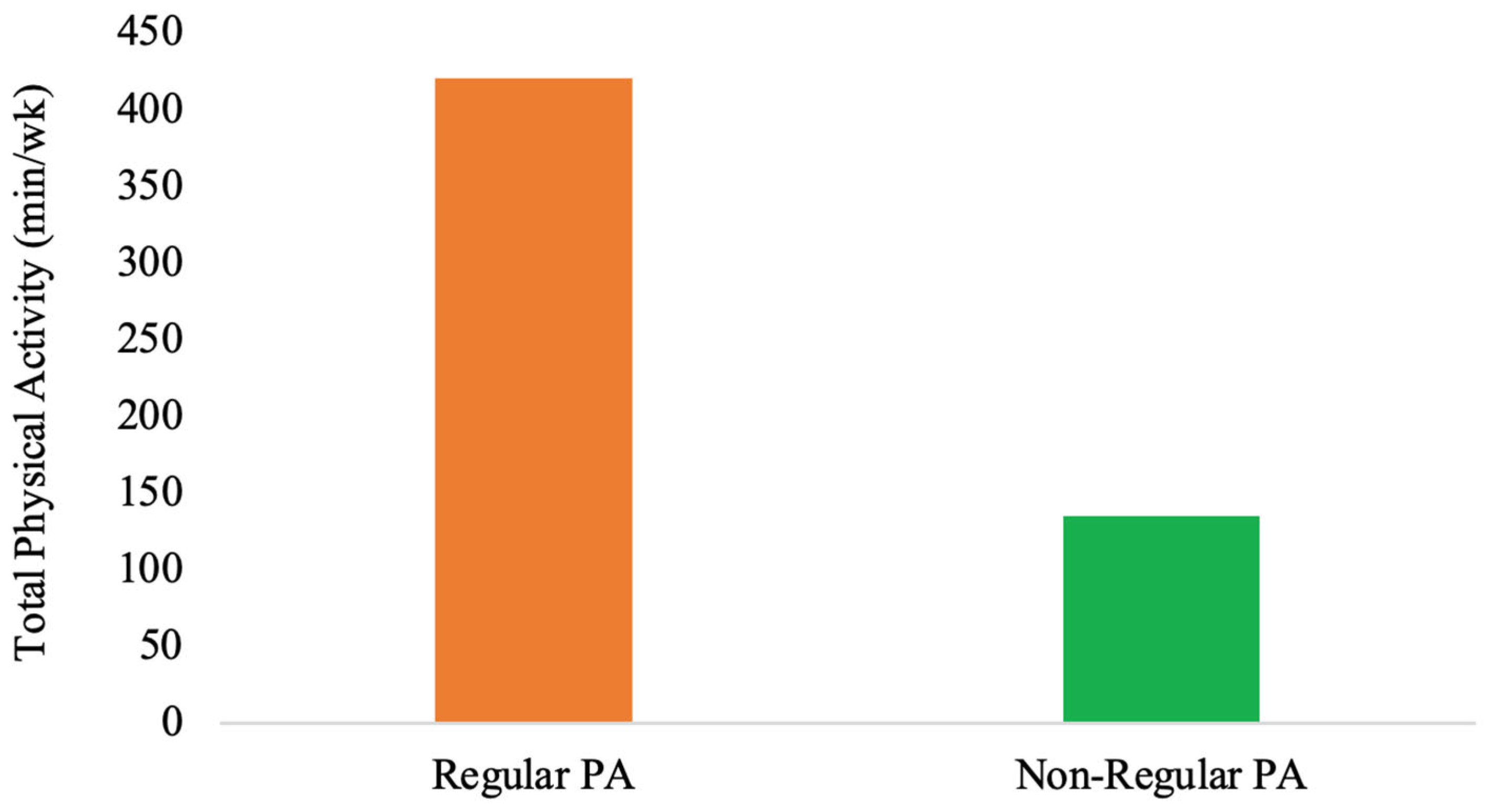
| Total Physical Activity (min/wk) | 37 (80.43) | 420.00 | 24.04 | 889.50 | 6 (13.04) | 135.00 | 9.42 | 56.50 | 35.500 | −2.648 | 0.008 |
Disclaimer/Publisher’s Note: The statements, opinions and data contained in all publications are solely those of the individual author(s) and contributor(s) and not of MDPI and/or the editor(s). MDPI and/or the editor(s) disclaim responsibility for any injury to people or property resulting from any ideas, methods, instructions or products referred to in the content. |
© 2026 by the authors. Licensee MDPI, Basel, Switzerland. This article is an open access article distributed under the terms and conditions of the Creative Commons Attribution (CC BY) license.
Share and Cite
Osei, F.; Wippert, P.-M.; Block, A. Physical Activity, Metabolic Risk and the Primary Allostatic Load Mediators: An Explorative Study. Sports 2026, 14, 107. https://doi.org/10.3390/sports14030107
Osei F, Wippert P-M, Block A. Physical Activity, Metabolic Risk and the Primary Allostatic Load Mediators: An Explorative Study. Sports. 2026; 14(3):107. https://doi.org/10.3390/sports14030107
Chicago/Turabian StyleOsei, Francis, Pia-Maria Wippert, and Andrea Block. 2026. "Physical Activity, Metabolic Risk and the Primary Allostatic Load Mediators: An Explorative Study" Sports 14, no. 3: 107. https://doi.org/10.3390/sports14030107
APA StyleOsei, F., Wippert, P.-M., & Block, A. (2026). Physical Activity, Metabolic Risk and the Primary Allostatic Load Mediators: An Explorative Study. Sports, 14(3), 107. https://doi.org/10.3390/sports14030107