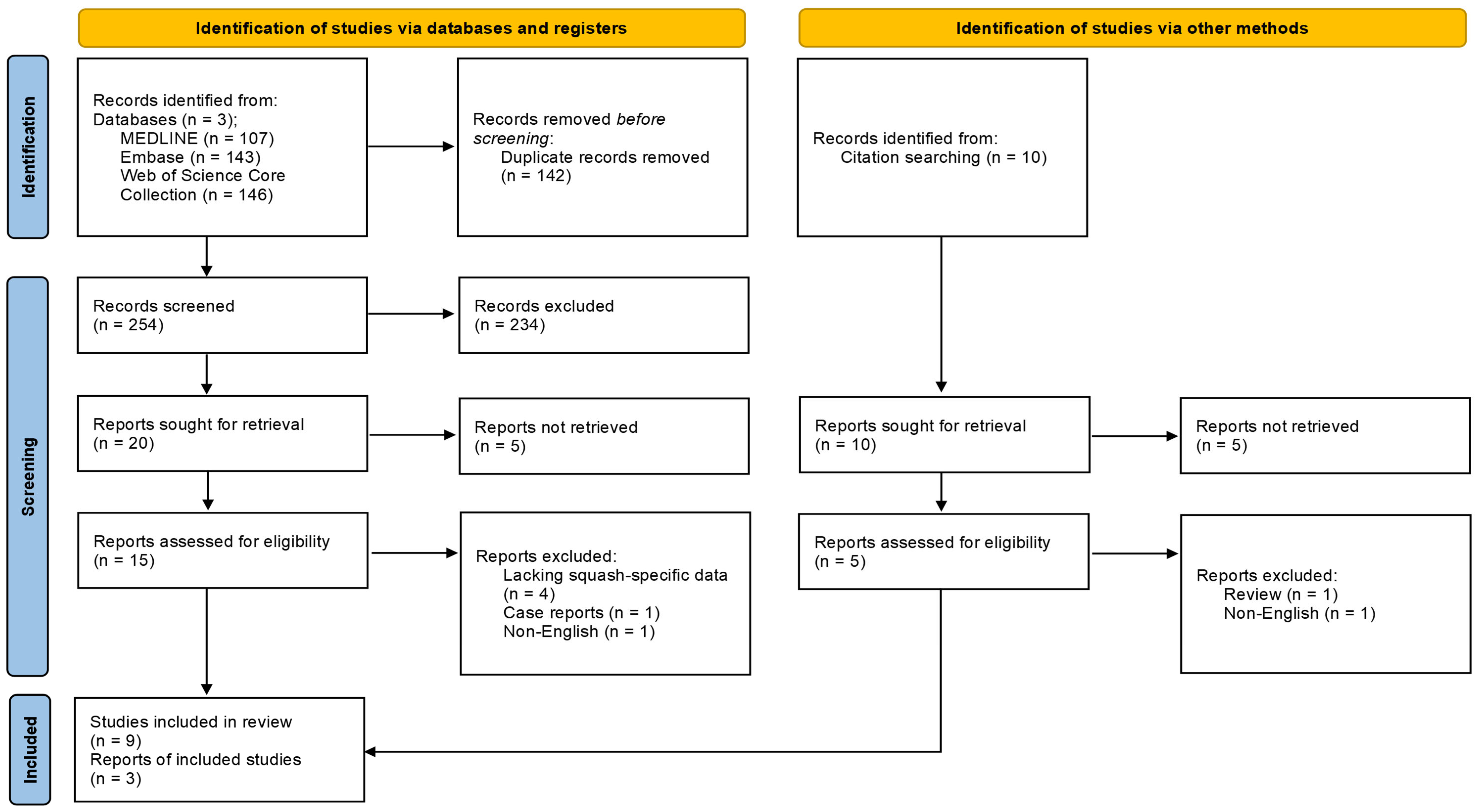

Squash Under Strain: A Systematic Review and Meta-Analysis of Injuries and Illnesses in Squash Players


Abstract
1. Introduction
1.1. Squash Overview
1.2. Squash Injuries and Illnesses
1.3. Surveillance of Sport-Related Injuries
1.4. Gaps in the Literature and Study Rationale
1.5. Study Aims and Objectives
2. Materials and Methods
2.1. Study Protocol
2.2. Study Selection and Data Extraction
2.3. Methodological Quality Assessment
2.4. Certainty of Evidence Assessment
2.5. Statistical Analysis
2.6. Equality, Diversity, and Inclusion Statement
3. Results
3.1. Overall Study Findings
3.2. Squash-Related Injuries
3.2.1. Rates of Injury Incidence
3.2.2. Types and Mechanisms of Injuries
Lower Limb Injuries
Upper Limb Injuries
Trunk and Spinal Injuries
3.2.3. Injury-Related Risk Factors
3.3. Squash-Related Illnesses
3.3.1. Cardiac Events and Mortality Risk
3.3.2. Heat-Related Illnesses
3.4. Meta-Analysis of Pooled Results
4. Discussion
4.1. Summary of Main Findings
4.2. Overall Injury Incidence and Prevalence
4.3. Statistical Contributions
- Populations: The studies investigated various demographics across all ages, such as elite professionals, elite adolescents, Indian club players, competitive Malaysian adolescents, and the general Finnish population.
- Methodologies: Some studies employed prospective cohort study designs, whereas others used retrospective surveys; others solely analysed hospital data or clinical records.
- Injury Definitions: There was great variation in what was determined an “injury” (Table 1).
- Regional Focus: While most studies focused on general MSK injuries, some were more specific to a particular body region, such as orofacial and dental injuries [20].
4.4. Comparison with Existing Literature
4.5. Anatomical Distribution of Squash Injuries
4.6. Overall Certainty of Evidence
4.7. Strengths and Limitations of This Review
4.8. Recommendations for Future Research
5. Conclusions
Supplementary Materials
Author Contributions
Funding
Institutional Review Board Statement
Informed Consent Statement
Data Availability Statement
Acknowledgments
Conflicts of Interest
Abbreviations
| CI | Confidence Interval |
| ED | Emergency Department |
| GRADE | Grading of Recommendations Assessment, Development and Evaluation |
| IOC | International Olympic Committee |
| MSK | Musculoskeletal |
| NHBLI | National Heart, Lung, and Blood Institute |
| OSICS | Orchard Sports Injury Classification System |
| PRISMA | Preferred Reporting Items for Systematic Reviews and Meta-Analyses |
| PROSPERO | International prospective register of systematic reviews |
| RR | Relative Risk |
| SNQ | Standardised Nordic Questionnaire |
| SPIDER | Sample, Phenomenon of Interest, Design, Evaluation, Research type |
| VAED | Victorian Admitted Episodes Dataset |
| VEMD | Victorian Emergency Minimum Dataset |
References
- Abuwarda, K.; Abu Zayda, A.; Akl, A.R. Muscular activity differences and mechanisms for backhand straight and backhand cross in squash. J. Hum. Sport Exerc. 2024, 19, 1026–1041. [Google Scholar] [CrossRef]
- Han, H.-P.; Chow, T.-H.; Chang, C.-C.; Lee, Y.-L. Comparative Study of Plantar Load and Foot Posture Characteristics in Male Elite Squash Players and Non-Athletes in Taiwan. Med. Sci. Monit. Int. Med. J. Exp. Clin. Res. 2025, 31, e947828. [Google Scholar] [CrossRef]
- Sankaravel, M.; Lee, A.C.; Mondam, S.; Low, J.F.L. Prevalence of Musculoskeletal Injuries Among Young Squash Players in Malaysia. J. Fundam. Appl. Sci. 2017, 9, 1132–1140. [Google Scholar] [CrossRef][Green Version]
- Talabi, A.E.; Olaitan, O.L.; Bakinde, S.T.; Onigbinde, A.T. Injury pattern of squash players in Nigeria. Int. J. Appl. Psychol. Hum. Perform. 2012, 7, 1550–1555. [Google Scholar]
- Ingram, D.V.; Lewkonia, I. Ocular hazards of playing squash rackets. Br. J. Ophthalmol. 1973, 57, 434–438. [Google Scholar] [CrossRef] [PubMed]
- Bankes, J.L.K. Squash rackets: A survey of eye injuries in England. BMJ 1985, 291, 1539. [Google Scholar] [CrossRef]
- Eime, R.M.; Finch, C.F.; Sherman, C.A.; Garnham, A.P. Are squash players protecting their eyes? Inj. Prev. J. Int. Soc. Child Adolesc. Inj. Prev. 2002, 8, 239–241. [Google Scholar] [CrossRef]
- Sinclair, J.; Bottoms, L.; Taylor, P.J.; Mahmood, K. Effects of Shoes on Kinetics and Kinematics of the Squash Forward Lunge in Male Players. Kinesiology 2017, 49, 178–184. [Google Scholar] [CrossRef]
- Eime, R.M.; Finch, C.F. Have the attitudes of Australian squash players towards protective eyewear changed over the past decade? Br. J. Sports Med. 2002, 36, 442–445. [Google Scholar] [CrossRef]
- Ihsan, M.; Kwok, V.; Wong, H.Y.; Girard, O.; James, C. Squash in Los Angeles: Heat Strain and Performance Considerations at the 2028 Olympic Games. Int. J. Sports Physiol. Perform. 2025, 20, 1017–1020. [Google Scholar] [CrossRef]
- Mousavi, L.; Seidi, F.; Minoonejad, H.; Nikouei, F. Postural control and shoulder rotators isokinetic strength in squash players with and without idiopathic scoliosis. iScience 2024, 27, 111353. [Google Scholar] [CrossRef] [PubMed]
- Horsley, I.G.D.; O’Donnell, V.; Leeder, J. The epidemiology of injuries in English professional squash; A retrospective analysis between 2004 and 2015. Phys. Ther. Sport 2020, 46, 1–6. [Google Scholar] [CrossRef]
- Jhamb, D.; Singh, S. Injuries In Indian Squash Players: A Retrospective Epidemiological Survey Among Club-Level Players. J. Pharm. Negat. Results 2022, 13, 1577–1581. [Google Scholar]
- Clavisi, O.; Finch, C. Squash injury countermeasures: A review of the literature. J. Sci. Med. Sport 2000, 3, 13–22. [Google Scholar] [CrossRef]
- Locke, S.; Colquhoun, D.; Briner, M.; Ellis, L.; O’Brien, M.; Wollstein, J.; Allen, G. Squash racquets. A review of physiology and medicine. Sports Med. (Auckl. N. Z.) 1997, 23, 130–138. [Google Scholar] [CrossRef]
- Akl, A.R.; Hassan, A.; Elgizawy, H.; Tilp, M. Quantifying coordination between agonist and antagonist elbow muscles during backhand crosscourt shots in adult female squash players. Int. J. Environ. Res. Public Health 2021, 18, 9825. [Google Scholar] [CrossRef] [PubMed]
- Okhovatian, F.; Ezatolahi, A.H. Sport injuries in squash. Pak. J. Med. Sci. 2009, 25, 413–417. [Google Scholar]
- Verow, P. Squash. Practitioner 1989, 233, 876–879. [Google Scholar] [PubMed]
- Eime, R.; Zazryn, T.; Finch, C. Epidemiology of squash injuries requiring hospital treatment. Inj. Control Saf. Promot. 2003, 10, 243–245. [Google Scholar] [CrossRef]
- Persic, R.; Pohl, Y.; Filippi, A. Dental squash injuries—A survey among players and coaches in Switzerland, Germany and France. Dent. Traumatol. 2006, 22, 231–236. [Google Scholar] [CrossRef]
- Finch, C.; Vear, P. What do adult squash players think about protective eyewear? Br. J. Sports Med. 1998, 32, 155–161. [Google Scholar] [CrossRef]
- Frankowska, E.; Brzozowski, K.; Staszewski, J.; Kolmaga, N.; Stępień, A.; Bogusławska-Walecka, R. Combined thrombolysis in posterior circulation stroke caused by bilateral vertebral artery dissection in squash player. Neurol. Neurochir. Pol. 2014, 48, 299–304. [Google Scholar] [CrossRef]
- Golden, G.T.; Fox, J.W.; Williams, G.S.; Edgerton, M.T. Traumatic Aneurysm of the Superficial Temporal Artery: Squash-Ball Disease. JAMA 1975, 234, 517–518. [Google Scholar] [CrossRef]
- Stubington, S.R.; Rigg, K.M. Traumatic arteriovenous fistula of the superficial temporal vessels: A case for protective headgear when playing squash? Br. J. Sports Med. 1995, 29, 275–276. [Google Scholar] [CrossRef] [PubMed]
- Sheehan, N.J.; Rainsbury, R.M. Inferior vena cava thrombosis following a game of squash. J. R. Soc. Med. 1987, 80, 52. [Google Scholar] [CrossRef] [PubMed]
- Eime, R.; Finch, C.; Owen, N.; Gifford, S.; Vear, P. Knowledge, beliefs and attitudes of squash venue operators relating to use of protective eyewear. Inj. Control Saf. Promot. 2004, 11, 47–53. [Google Scholar] [CrossRef]
- Eime, R.; Finch, C.; Owen, N.; McCarty, C. Do squash players accurately report use of appropriate protective eyewear? J. Sci. Med. Sport 2005, 8, 352–356. [Google Scholar] [CrossRef]
- Easterbrook, M. Eye injuries in squash: A preventable disease. Can. Med. Assoc. J. 1978, 118, 298. [Google Scholar] [PubMed]
- Cooke, A.; Smith, D.; Booth, A. Beyond PICO: The SPIDER Tool for Qualitative Evidence Synthesis. Qual. Health Res. 2012, 22, 1435–1443. [Google Scholar] [CrossRef]
- National Heart, Lung, and Blood Institute. Study Quality Assessment Tools. Available online: https://www.nhlbi.nih.gov/health-topics/study-quality-assessment-tools (accessed on 12 June 2025).
- Guyatt, G.H.; Oxman, A.D.; Vist, G.E.; Kunz, R.; Falck-Ytter, Y.; Alonso-Coello, P.; Schünemann, H.J. GRADE: An emerging consensus on rating quality of evidence and strength of recommendations. BMJ 2008, 336, 924–926. [Google Scholar] [CrossRef]
- Rejeb, A.; Johnson, A.; Vaeyens, R.; Horobeanu, C.; Farooq, A.; Witvrouw, E. Compelling overuse injury incidence in youth multisport athletes. Eur. J. Sport Sci. 2017, 17, 495–502. [Google Scholar] [CrossRef]
- Meyer, L.; Van Niekerk, L.; Prinsloo, E.; Steenkamp, M.; Louw, Q. Prevalence of musculoskeletal injuries among adolescent squash players in the Western Cape. S. Afr. J. Sports Med. 2007, 19, 3–8. [Google Scholar] [CrossRef][Green Version]
- Parkkari, J.; Kannus, P.; Natri, A.; Lapinleimu, I.; Palvanen, M.; Heiskanen, M.; Vuori, I.; Jarvinen, M. Active living and injury risk. Int. J. Sports Med. 2004, 25, 209–216. [Google Scholar] [CrossRef]
- Chard, M.D.; Lachmann, S.M. Racquet sports--patterns of injury presenting to a sports injury clinic. Br. J. Sports Med. 1987, 21, 150–153. [Google Scholar] [CrossRef]
- Berson, B.L.; Rolnick, A.M.; Ramos, C.G.; Thornton, J. An epidemiologic study of squash injuries. Am. J. Sports Med. 1981, 9, 103–106. [Google Scholar] [CrossRef] [PubMed]
- Finch, C.F.; Eime, R.M. The epidemiology of squash injuries. Int. Sport. J. FIMS 2001, 2, 1–11. [Google Scholar]
- Hawkesworth, S. An Epidemiological Study of Musculoskeletal Injuries in League Squash Players in the eThekwini Municipality. Master’s Thesis, Epidemiological Study. Durban University of Technology, Durban, South Africa, 2019. [Google Scholar]
- Northcote, R.; Evans, A.B.; Ballantyne, D. Sudden death in squash players. Lancet (Br. Ed.) 1984, 323, 148–151. [Google Scholar] [CrossRef]
- Quigley, F. A survey of the causes of sudden death in sport in the Republic of Ireland. Br. J. Sports Med. 2000, 34, 258–261. [Google Scholar] [CrossRef][Green Version]
- Nybo, L.; Rasmussen, P.; Sawka, M.N.; Pollock, D.M. Performance in the Heat—Physiological Factors of Importance for Hyperthermia-Induced Fatigue. Compr. Physiol. 2014, 4, 657–689. [Google Scholar] [CrossRef]
- Mtibaa, K.; Thomson, A.; Nichols, D.; Hautier, C.; Racinais, S. Hyperthermia-induced Neural Alterations Impair Proprioception and Balance. Med. Sci. Sports Exerc. 2018, 50, 46–53. [Google Scholar] [CrossRef]
- Saldaris, J.M.; Landers, G.J.; Lay, B.S. Physical and perceptual cooling: Improving cognitive function, mood disturbance and time to fatigue in the heat. Scand. J. Med. Sci. Sports 2020, 30, 801–811. [Google Scholar] [CrossRef] [PubMed]
- Blanksby, B.A.; Elliott, B.C.; Davis, K.H.; Mercer, M.D. Blood pressure and rectal temperature responses of middle-aged sedentary, middle-aged active and “A”-grade competitive male squash players. Br. J. Sports Med. 1980, 14, 133–138. [Google Scholar] [CrossRef] [PubMed]
- Hansen, R.D.; Brotherhood, J.R. Prevention of heat-induced illness in squash players. Med. J. Aust. 1988, 148, 100. [Google Scholar] [CrossRef] [PubMed]



| Source | Definition of Injury | Injury Classifications | Injury Measurement Unit | Calculated Squash Injury Rate |
|---|---|---|---|---|
| Jhamb and Singh (2022) [13] | No specific definition provided: injuries reported individually by participants via structured questionnaire. Injury was considered significant if the player had to miss at least two weeks of squash as a result. | If a player had sustained multiple injuries, information was only sought on the most severe injury. | Percentage of population who had sustained a squash injury requiring medical attention and two weeks off. Average time to recovery (months). | 86% of population injured (N = 104/120). Average time to recovery = 5.8 months. No exposure time to calculate rate. |
| Horsley et al. (2020) [12] | “…any musculoskeletal condition that prevented the player from participating in either training or competition for more than 24 h.” (p. 2) | Injuries were coded using a modified OSICS-10. | Injuries per athlete over the study’s duration (190 months). Percentage by body region. | 8.83 injuries per player over 11 years (N = 592/67). No exposure time to calculate rate. |
| Rejeb et al. (2017) [32] | “…a physical complaint requiring the attention of the medical staff resulting from either sports training, strengthening and conditioning training, or a competition.” (p. 497) | No time-loss injury: Medical attention required; no missed full training session or competition. Time-loss injury: Unable to fully take part in a training session or competition. Traumatic injury: Injury resulting from a specific and identifiable mechanism; acute onset. Overuse injury: Injury resulting from insidious onset without a clear mechanism. Growth condition injury: Unique to young athletes, due to increased involvement in sports activities. | Injuries per 1000 h of exposure. | 8.5 injuries per 1000 h. Highest rate of all activities investigated. |
| Sankaravel et al. (2017) [3] | “…any pain and/or disability sustained by the squash player during competitions or training sessions resulting in time lost from sports participation in the last 12 months.” (p. 1134) | Injuries were classified based on the nine anatomical sites of the SNQ: neck, shoulder, elbow, wrist/hand, upper back, lower back, hip/thigh, knee, and ankle/feet. | Percentage of players with MSK symptoms over the last 12 months. | 83.3% had symptoms over the last 12 months (N = 50/60). No exposure time to calculate rate. |
| Talabi et al. (2012) [4] | No specific definition provided: injuries were reported individually by participants via structured questionnaire. | Soft tissue (85.70%); sprain (10.30%); fracture (2.70%); others (1.30%). | Percentage of injury type, percentage by body region. | No exposure time to calculate rate. |
| Okhovatian and Ezatolahi (2009) [17] | No specific definition provided; injuries were reported individually by participants via structured questionnaire. | Detailed report of squash injuries. | Percentage of players sustaining at least one injury over the previous two years. | 79% injured within the last two years (N = 41/52); no exposure time to calculate rate. |
| Meyer et al. (2007) [33] | “…one that occurred during practice or competition resulting from a traumatic incident.” (p. 5) | “…encompassed overuse injuries not initiated by a specific traumatic incident, but causing symptoms including pain or swelling while or after playing squash.” (p. 5) | Percentage of players injured over the previous four weeks; injuries per 1000 h of participation. | 29% of players were injured in the last four weeks (N = 31/106), where 48 injuries were reported overall; 0.45 injuries per 1000 playing hours. |
| Persic et al. (2006) [20] | No specific definition was provided; orofacial injuries were reported individually by participants via structured questionnaire. | All reported injuries, self-experienced (N = 27) and observed (N = 142): • Crown fracture (N = 109); • Avulsion (N = 48); Dislocation (N = 12). | Percentage of players who have ever sustained an orofacial or a dental injury. | 4.5% suffered dental trauma (N = 27/600); 20.4% observed dental trauma (N = 133/653); no exposure time to calculate rate. |
| Parkkari et al. (2004) [34] | “…a new acute trauma or overuse injury that caused a significant complaint to the subject.” (p. 210) | Level I: No activity time lost Level II: Time lost (at least one sport/leisure activity session missed) Level III: Time lost (at least one day of work/activity missed) | Injuries per 1000 person-years; Injuries per 1000 active persons at risk, Injuries per 1000 h of exposure. | 18.3 injuries per 1000 playing hours (95% CI 11.4–29.4); highest rate of all activities investigated. |
| Eime et al. (2003) [19] | Only covered severe injuries, which were defined “…as those warranting medical treatment at a hospital setting.” (p. 245) | VAED (hospital admissions); VEMD (ED presentations). | Injured players per 100,000 players. | ED = 58.5 injured players per 100,000 players. |
| Chard and Lachmann (1987) [35] | No specific definition provided; the clinic assessed both acute (within 48 h) and chronic injuries but generally excluded lacerations, fractures, and eye and head injuries which were treated acutely by the Accident Service. | Acute traumatic injuries (80%); overuse injuries (20%). | Percentage of total injuries. | 59.0% sustained squash injuries (N = 372/631); no exposure time to calculate rate. |
| Berson et al. (1981) [36] | No specific definition provided; injuries were reported individually by participants via structured questionnaire. | Disabling injury: “Any injury which kept the player out of action for more than two weeks.” (p. 104) | Percentage of injured players; percentage of disabling injuries. | Injury rate = 44.5% (N = 69/155); no exposure time to calculate rate. |
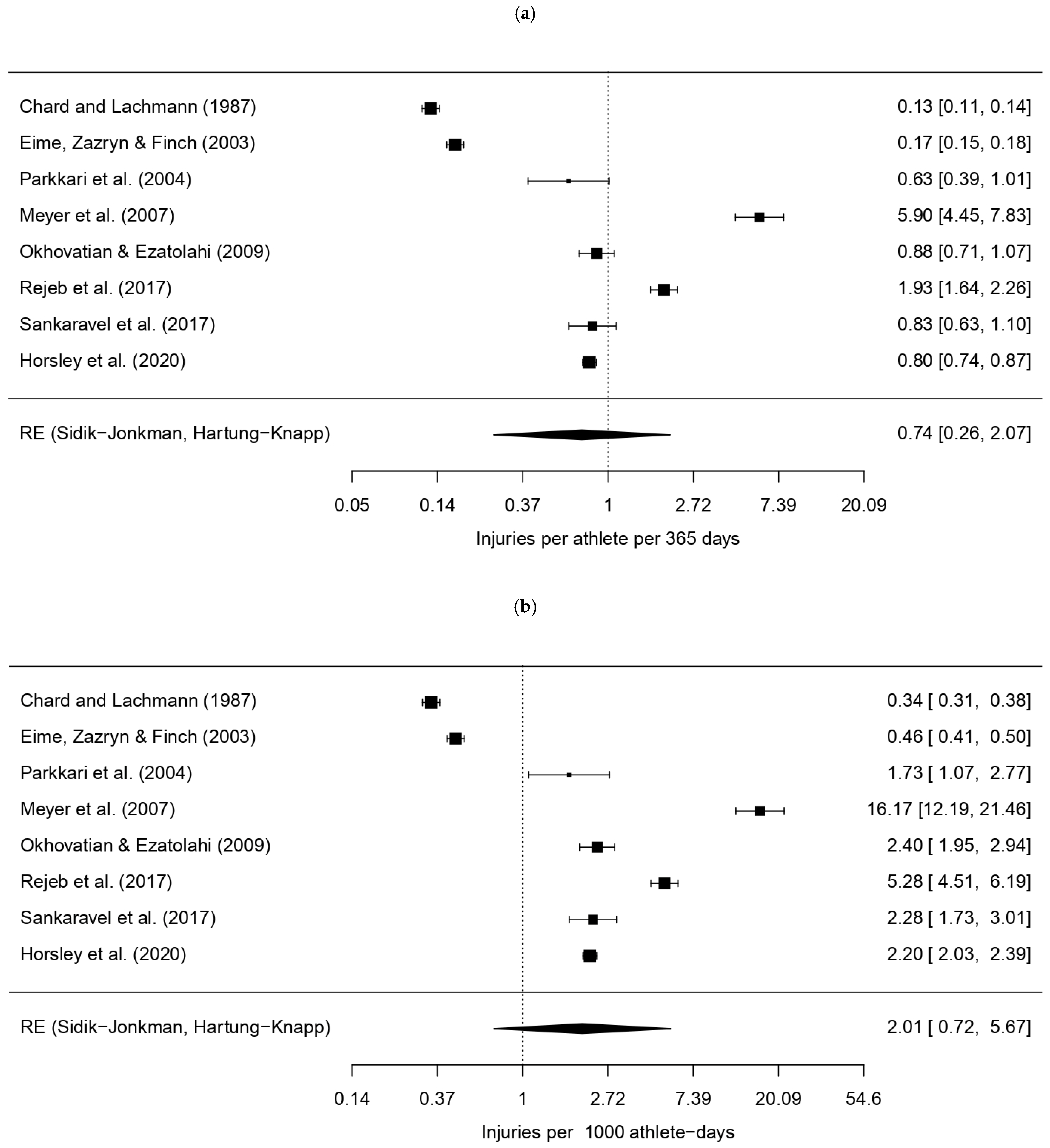
| Source | Total Number of Days | Total Number of Players | Total Number of Injuries |
|---|---|---|---|
| Horsley et al. (2020) [12] | 4015 | 67 | 592 |
| Rejeb et al. (2017) [32] | 1610 | 18 | 153 |
| Sankaravel et al. (2017) [3] | 365 | 60 | 50 |
| Okhovatian and Ezatolahi (2009) [17] | 730 | 52 | 91 |
| Meyer et al. (2007) [33] | 28 | 106 | 48 |
| Parkkari et al. (2004) [34] | 365 | 27 | 17 |
| Eime et al. (2003) [19] | 2190 | 389 | 389 |
| Chard and Lachmann (1987) [35] | 2920 | 372 | 372 |
| Symbol | Description |
|---|---|
| Number of studies included in the meta-analysis. | |
| Cochran’s Q-statistic to test heterogeneity (degrees of freedom in parentheses). | |
| Percentage of variability across studies due to heterogeneity rather than random error. | |
| Estimate of between-study variance (tau-squared). |
| Source | Study Design |
|---|---|
| Jhamb and Singh (2022) [13] | Cross-sectional observational study |
| Horsley et al. (2020) [12] | Cross-sectional survey |
| Rejeb et al. (2017) [32] | Prospective cohort study |
| Sankaravel et al. (2017) [3] | Cross-sectional study |
| Talabi et al. (2014) [4] | Descriptive cross-sectional study |
| Okhovatian and Ezatolahi (2009) [17] | Cross-sectional study |
| Meyer et al. (2007) [33] | Cross-sectional survey |
| Persic et al. (2006) [20] | Cross-sectional observational study |
| Parkkari et al. (2004) [34] | Large-scale population-based retrospective study |
| Eime et al. (2003) [19] | Retrospective epidemiological study |
| Chard and Lachmann (1987) [35] | Retrospective analysis |
| Berson et al. (1981) [36] | Retrospective survey |
Disclaimer/Publisher’s Note: The statements, opinions and data contained in all publications are solely those of the individual author(s) and contributor(s) and not of MDPI and/or the editor(s). MDPI and/or the editor(s) disclaim responsibility for any injury to people or property resulting from any ideas, methods, instructions or products referred to in the content. |
© 2026 by the authors. Licensee MDPI, Basel, Switzerland. This article is an open access article distributed under the terms and conditions of the Creative Commons Attribution (CC BY) license.
Share and Cite
McCartney, R.V.; Fallon, T.; Heron, N. Squash Under Strain: A Systematic Review and Meta-Analysis of Injuries and Illnesses in Squash Players. Sports 2026, 14, 79. https://doi.org/10.3390/sports14020079
McCartney RV, Fallon T, Heron N. Squash Under Strain: A Systematic Review and Meta-Analysis of Injuries and Illnesses in Squash Players. Sports. 2026; 14(2):79. https://doi.org/10.3390/sports14020079
Chicago/Turabian StyleMcCartney, Rachel Victoria, Thomas Fallon, and Neil Heron. 2026. "Squash Under Strain: A Systematic Review and Meta-Analysis of Injuries and Illnesses in Squash Players" Sports 14, no. 2: 79. https://doi.org/10.3390/sports14020079
APA StyleMcCartney, R. V., Fallon, T., & Heron, N. (2026). Squash Under Strain: A Systematic Review and Meta-Analysis of Injuries and Illnesses in Squash Players. Sports, 14(2), 79. https://doi.org/10.3390/sports14020079