
Size of Biceps Femoris Long Head Muscle Is Related to Running Economy in Male Recreational Runners
 ,
,  ,
,
Abstract
1. Introduction
2. Materials and Methods
2.1. Inclusion and Exclusion Criteria
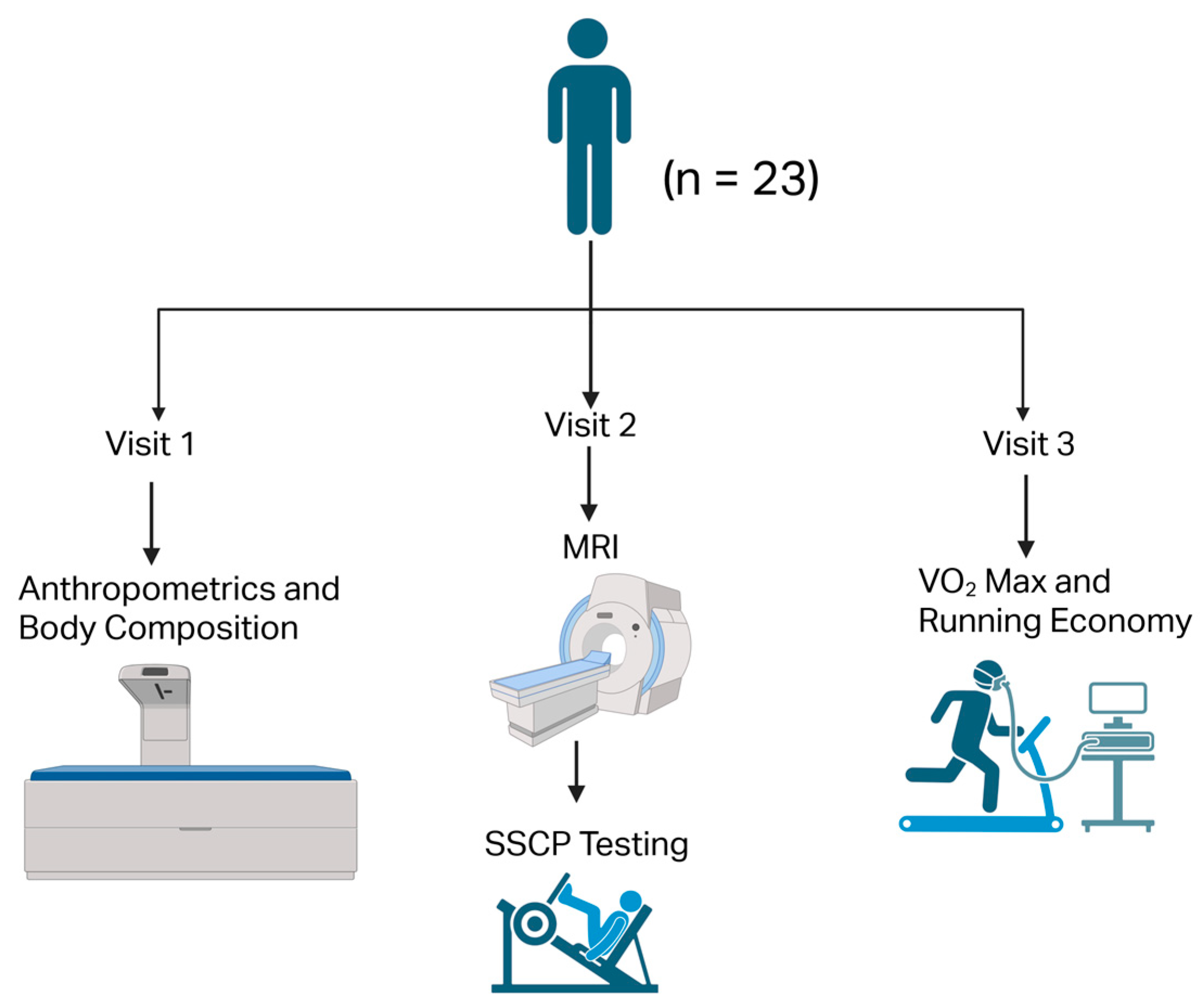
2.2. Participant Testing and Consent
2.3. Total Body Fat Percentage
2.4. MCSA Assessment
2.5. SSCP Assessment
2.6. Running Net VO2 at 11.3 km/h (NVO2Run11)
2.7. VO2max
2.8. Statistical Analysis
3. Results
4. Discussion
Limitations
5. Conclusions
Author Contributions
Funding
Institutional Review Board Statement
Informed Consent Statement
Data Availability Statement
Conflicts of Interest
Abbreviations
| MCSA | Maximum cross-sectional area |
| BF | Biceps femoris |
| SM | Semimembranosus |
| ST | Semitendinosus |
| NVO2Run11 | Net running VO2 at ~11 km/h |
| POTV10 | Potentiated leg press throw velocity at initial 10 ms of the concentric contraction |
| SSCP | Stretch shortening cycle potentiation |
References
- Barnes, K.R.; Kilding, A.E. Running economy: Measurement, norms, and determining factors. Sports Med. Open 2015, 1, 8. [Google Scholar] [CrossRef] [Scilit]
- Conley, D.L.; Krahenbuhl, G.S. Running economy and distance running performance of highly trained athletes. Med. Sci. Sports Exerc. 1980, 12, 357–360. [Google Scholar] [CrossRef]
- Hayes, P.R.; French, D.N.; Thomas, K. The effect of muscular endurance on running economy. J. Strength Cond. Res. 2011, 25, 2464–2469. [Google Scholar] [CrossRef] [Scilit]
- Jones, R.I.; Ryan, B.; Todd, A.I. Muscle fatigue induced by a soccer match-play simulation in amateur Black South African players. J. Sports Sci. 2015, 33, 1305–1311. [Google Scholar] [CrossRef] [Scilit]
- Verschueren, J.; Tassignon, B.; De Pauw, K.; Proost, M.; Teugels, A.; Van Cutsem, J.; Roelands, B.; Verhagen, E.; Meeusen, R. Does Acute Fatigue Negatively Affect Intrinsic Risk Factors of the Lower Extremity Injury Risk Profile? A Systematic and Critical Review. Sports Med. 2020, 50, 767–784. [Google Scholar] [CrossRef] [Scilit]
- Nieto Torrejón, L.; Martínez-Serrano, A.; Villalón, J.M.; Alcaraz, P.E. Economic impact of muscle injury rate and hamstring strain injuries in professional football clubs. Evidence from LaLiga. PLoS ONE 2024, 19, e0301498. [Google Scholar] [CrossRef] [Scilit] [PubMed]
- Ekstrand, J.; Bengtsson, H.; Waldén, M.; Davison, M.; Khan, K.M.; Hägglund, M. Hamstring injury rates have increased during recent seasons and now constitute 24% of all injuries in men’s professional football: The UEFA Elite Club Injury Study from 2001/02 to 2021/22. Br. J. Sports Med. 2022, 57, 292–298. [Google Scholar] [CrossRef] [Scilit] [PubMed]
- Sugiura, Y.; Sakuma, K.; Fujita, S.; Aoki, K.; Takazawa, Y. Effects of Various Numbers of Runs on the Success of Hamstring Injury Prevention Program in Sprinters. Int. J. Environ. Res. Public Health 2022, 19, 9375. [Google Scholar] [CrossRef] [Scilit] [PubMed]
- Šuc, A.; Šarko, P.; Pleša, J.; Kozinc, Ž. Resistance Exercise for Improving Running Economy and Running Biomechanics and Decreasing Running-Related Injury Risk: A Narrative Review. Sports 2022, 10, 98. [Google Scholar] [CrossRef] [Scilit]
- Nakaizumi, D.; Asai, H.; Inaoka, P.T.; Ohno, N.; Miyati, T. Measurement of the cross-sectional area of the hamstring muscles during initial and stretch positions with gravity magnetic resonance imaging. J. Phys. Ther. Sci. 2019, 31, 267–272. [Google Scholar] [CrossRef] [Scilit]
- van derMade, A.D.; Wieldraaijer, T.; Kerkhoffs, G.M.; Kleipool, R.P.; Engebretsen, L.; van Dijk, C.N.; Golanó, P. The hamstring muscle complex. Knee Surg. Sports Traumatol. Arthrosc. 2015, 23, 2115–2122. [Google Scholar] [CrossRef] [Scilit]
- Suskens, J.J.M.; Tol, J.L.; Kerkhoffs, G.M.M.J.; Maas, H.; van Dieën, J.H.; Reurink, G. Activity distribution among the hamstring muscles during high-speed running: A descriptive multichannel surface EMG study. Scand. J. Med. Sci. Sports 2023, 33, 954–965. [Google Scholar] [CrossRef] [Scilit] [PubMed]
- Kellis, E.; Blazevich, A.J. Hamstrings force-length relationships and their implications for angle-specific joint torques: A narrative review. BMC Sports Sci. Med. Rehabil. 2022, 14, 166. [Google Scholar] [CrossRef] [Scilit] [PubMed]
- Balius, R.; Pedret, C.; Iriarte, I.; Sáiz, R.; Cerezal, L. Sonographic landmarks in hamstring muscles. Skelet. Radiol. 2019, 48, 1675–1683. [Google Scholar] [CrossRef] [Scilit]
- Lee, J.W.Y.; Mok, K.M.; Chan, H.C.K.; Yung, P.S.H.; Chan, K.M. Eccentric hamstring strength deficit and poor hamstring-to-quadriceps ratio are risk factors for hamstring strain injury in football: A prospective study of 146 professional players. J. Sci. Med. Sport 2018, 21, 789–793. [Google Scholar] [CrossRef] [Scilit]
- Kellis, E.; Galanis, N.; Natsis, K.; Kapetanos, G. Validity of architectural properties of the hamstring muscles: Correlation of ultrasound findings with cadaveric dissection. J. Biomech. 2009, 42, 2549–2554. [Google Scholar] [CrossRef] [Scilit] [PubMed]
- Almutairi, M.K.; Hunter, G.R.; Lein, D.H.; Kim, S.; Bryan, D.R.; Inacio, M.; Hurt, C.P.; Reed, W.; Singh, H. Enhancement of Muscle Shortening Torque Preloaded with Muscle Lengthening is Joint-Specific. J. Hum. Kinet. 2023, 87, 11–21. [Google Scholar] [CrossRef] [Scilit]
- Hunter, G.R.; Singh, H.; Martins, C.; Baranauskas, M.N.; Carter, S.J. Stretch-Shortening Cycle Potentiation and Resistance Training-Induced Changes in Walking Economy/Ease and Activity-Related Energy Expenditure in Older Women. J. Strength Cond. Res. 2021, 35, 1345–1349. [Google Scholar] [CrossRef] [Scilit]
- Hunter, G.R.; McCarthy, J.P.; Carter, S.J.; Bamman, M.M.; Gaddy, E.S.; Fisher, G.; Katsoulis, K.; Plaisance, E.P.; Newcomer, B.R. Muscle fiber type, Achilles tendon length, potentiation, and running economy. J. Strength Cond. Res. 2015, 29, 1302–1309. [Google Scholar] [CrossRef] [Scilit]
- Maughan, R.J.; Watson, J.S.; Weir, J. Strength and cross-sectional area of human skeletal muscle. J. Physiol. 1983, 338, 37–49. [Google Scholar] [CrossRef] [Scilit]
- Franchi, M.V.; Fitze, D.P.; Hanimann, J.; Sarto, F.; Spörri, J. Panoramic ultrasound vs. MRI for the assessment of hamstrings cross-sectional area and volume in a large athletic cohort. Sci. Rep. 2020, 10, 14144. [Google Scholar] [CrossRef] [Scilit]
- Sobolewski, E.J.; Wein, L.D.; Crow, J.M.; Carpenter, K.M. Intra-rater and inter-rater reliability of the process of obtaining cross-sectional area and echo intensity measurements of muscles from ultrasound images. J. Ultrason. 2021, 21, e7–e11. [Google Scholar] [CrossRef] [Scilit]
- Quinlan, J.I.; Maganaris, C.N.; Franchi, M.V.; Smith, K.; Atherton, P.J.; Szewczyk, N.J.; Greenhaff, P.L.; Phillips, B.E.; Blackwell, J.I.; Boereboom, C.; et al. Muscle and Tendon Contributions to Reduced Rate of Torque Development in Healthy Older Males. J. Gerontol. Ser. A 2018, 73, 539–545. [Google Scholar] [CrossRef] [Scilit]
- Behan, F.P.; Maden-Wilkinson, T.M.; Pain, M.T.G.; Folland, J.P. Sex differences in muscle morphology of the knee flexors and knee extensors. PLoS ONE 2018, 13, e0190903. [Google Scholar] [CrossRef] [Scilit]
- Stenroth, L.; Peltonen, J.; Cronin, N.J.; Sipilä, S.; Finni, T. Age-related differences in Achilles tendon properties and triceps surae muscle architecture in vivo. J. Appl. Physiol. 2012, 113, 1537–1544. [Google Scholar] [CrossRef] [Scilit] [PubMed]
- Housh, D.J.; Housh, T.J.; Johnson, G.O.; Chu, W.K. Hypertrophic response to unilateral concentric isokinetic resistance training. J. Appl. Physiol. 1992, 73, 65–70. [Google Scholar] [CrossRef] [Scilit]
- Malik, A.Y.; Foster, C. The revised Declaration of Helsinki: Cosmetic or Real Change? J. R. Soc. Med. 2016, 109, 184–189. [Google Scholar] [CrossRef] [Scilit] [PubMed] [PubMed Central]
- Carter, S.J.; Rogers, L.Q.; Bowles, H.R.; Norian, L.A.; Hunter, G.R. Inverse association between changes in energetic cost of walking and vertical accelerations in non-metastatic breast cancer survivors. Eur. J. Appl. Physiol. 2019, 119, 2457–2464. [Google Scholar] [CrossRef] [Scilit] [PubMed]
- Abe, D.; Muraki, S.; Yanagawa, K.; Fukuoka, Y.; Niihata, S. Changes in EMG characteristics and metabolic energy cost during 90-min prolonged running. Gait Posture 2007, 26, 607–610. [Google Scholar] [CrossRef] [Scilit] [PubMed]
- Novacheck, T.F. The biomechanics of running. Gait Posture 1998, 7, 77–95. [Google Scholar] [CrossRef] [Scilit]
- Arnold, E.M.; Delp, S.L. Fibre operating lengths of human lower limb muscles during walking. Philos. Trans. R. Soc. B Biol. Sci. 2011, 366, 1530–1539. [Google Scholar] [CrossRef] [Scilit] [PubMed]
- Swinnen, W.; Lievens, E.; Hoogkamer, W.; De Groote, F.; Derave, W.; Vanwanseele, B. Inter-Individual Variability in Muscle Fiber-Type Distribution Affects Running Economy but Not Running Gait at Submaximal Running Speeds. Scand. J. Med. Sci. Sports 2024, 34, e14748. [Google Scholar] [CrossRef] [Scilit]
- Huygaerts, S.; Cos, F.; Cohen, D.D.; Calleja-González, J.; Pruna, R.; Alcaraz, P.E.; Blazevich, A.J. Does Muscle-Tendon Unit Structure Predispose to Hamstring Strain Injury During Running? A Critical Review. Sports Med. 2021, 51, 215–224. [Google Scholar] [CrossRef] [Scilit] [PubMed]
- Maeo, S.; Balshaw, T.G.; März, B.; Zhou, Z.; Haug, B.; Martin, N.R.W.; Maffulli, N.; Folland, J.P. Long-Term Resistance Trained Human Muscles Have More Fibers, More Myofibrils, and Tighter Myofilament Packing Than Untrained. Med. Sci. Sports Exerc. 2024, 56, 1906–1915. [Google Scholar] [CrossRef] [Scilit] [PubMed]


| Variables | Mean ± SD (n = 23) |
|---|---|
| Age (years) | 31.73 ± 4.72 |
| Height (m) | 1.80 ± 0.08 |
| Body mass (kg) | 80.13 ± 10.79% |
| Body fat percentage (%) | 17.90% ± 6.53% |
| Body mass index (kg/m2) | 25.21 ± 3.24 |
| MCSA BFlong head (mm2) (n = 18) | 1906 ± 344.66 |
| MCSA BFshort head (mm2) (n = 21) | 802.52 ± 210.58 |
| MCSA SM (mm2) (n = 21) | 1567.52 ± 346.52 |
| MCSA ST (mm2) (n = 21) | 1109.62 ± 252.81 |
| VO2 max (mL/kg/min) (n = 22) | 54.51 ± 7.36 |
| NVO2Run11 (mL/kg/min) | 38.00 ± 4.82 |
| Log10NVO2Run11 | 1.58 ± 0.05 |
| POTV10 (m/s) (n = 21) | 0.07 ± 0.06 |
| MCSA | POTV10 | LogNVO2Run11 |
|---|---|---|
| MCSA SM | r = 0.07 | r = −0.20 |
| p = 0.76 | p = 0.37 | |
| MCSA ST | r = 0.17 | r = −0.34 |
| p = 0.47 | p = 0.13 | |
| MCSA BFshort head | r = −0.02 | r = −0.21 |
| p = 0.95 | p= 0.37 | |
| MCSA BFlong head | r = −0.07 | r = −0.56 |
| p = 0.79 | p = 0.03 | |
| POTV10 | r = 1 | r = −0.44 p = 0.05 * |
| Variable | Unstandardized B | B-Coefficients | Partial r | 95% CI (Lower CI–Upper CI) | Sig. (p-Value) |
|---|---|---|---|---|---|
| Constant | 53.46 | 41.72–65.20 | <0.001 | ||
| POTV10 | −17.71 | −0.23 | −0.27 | −52.88–17.47 | 0.30 |
| MCSA BFlong head | −0.01 | 0.54 | −0.55 | −0.01–−0.001 | 0.02 |
Disclaimer/Publisher’s Note: The statements, opinions and data contained in all publications are solely those of the individual author(s) and contributor(s) and not of MDPI and/or the editor(s). MDPI and/or the editor(s) disclaim responsibility for any injury to people or property resulting from any ideas, methods, instructions or products referred to in the content. |
© 2025 by the authors. Licensee MDPI, Basel, Switzerland. This article is an open access article distributed under the terms and conditions of the Creative Commons Attribution (CC BY) license (https://creativecommons.org/licenses/by/4.0/).
Share and Cite
Yaddanapudi, S.; Singh, H.; McCarthy, J.P.; Newcomer, B.R.; Hunter, G.R. Size of Biceps Femoris Long Head Muscle Is Related to Running Economy in Male Recreational Runners. Sports 2025, 13, 403. https://doi.org/10.3390/sports13110403
Yaddanapudi S, Singh H, McCarthy JP, Newcomer BR, Hunter GR. Size of Biceps Femoris Long Head Muscle Is Related to Running Economy in Male Recreational Runners. Sports. 2025; 13(11):403. https://doi.org/10.3390/sports13110403
Chicago/Turabian StyleYaddanapudi, Srivatsav, Harshvardhan Singh, John P. McCarthy, Bradley R. Newcomer, and Gary R. Hunter. 2025. "Size of Biceps Femoris Long Head Muscle Is Related to Running Economy in Male Recreational Runners" Sports 13, no. 11: 403. https://doi.org/10.3390/sports13110403
APA StyleYaddanapudi, S., Singh, H., McCarthy, J. P., Newcomer, B. R., & Hunter, G. R. (2025). Size of Biceps Femoris Long Head Muscle Is Related to Running Economy in Male Recreational Runners. Sports, 13(11), 403. https://doi.org/10.3390/sports13110403