Article

An Hsp70 Chaperone Is Involved in Meiotic Silencing by Unpaired DNA

Division of Biological Sciences, University of Missouri, Columbia, MO 65211, USA
*
Author to whom correspondence should be addressed.
Epigenomes 2026, 10(1), 7; https://doi.org/10.3390/epigenomes10010007
Submission received: 4 November 2025 / Revised: 12 December 2025 / Accepted: 7 January 2026 / Published: 26 January 2026
(This article belongs to the Collection Feature Papers in Epigenomes)

Abstract

In the filamentous fungus Neurospora crassa, a gene not having a pairing partner during meiosis is seen as a potential intruder and is targeted by a mechanism called meiotic silencing by unpaired DNA (MSUD). MSUD employs core RNA interference (RNAi) components such as the SMS-2 Argonaute, which uses small interfering RNAs (siRNAs) as guides to seek out mRNAs from unpaired genes for silencing. In Drosophila melanogaster, the heat shock protein 70 (Hsp70) chaperone system facilitates the conformational activation of an Argonaute and allows it to load siRNAs. Here, our results demonstrate that an Hsp70 protein in Neurospora interacts with SMS-2 and mediates the silencing of unpaired genes.

1. Introduction

Transposons and other selfish genetic elements can proliferate and wreak havoc on the host chromosomes [1]. It comes as no surprise that many organisms have preserved surveillance mechanisms to protect their genome integrity. In the filamentous fungus Neurospora crassa, one such mechanism is known as meiotic silencing by unpaired DNA (MSUD) [2,3,4]. In MSUD, a gene not aligned with a homologous partner can be recognized during a direct dsDNA–dsDNA (double-stranded DNA) pairing event, presumably before meiotic recombination [5]. This pairing process may involve SAD-6 (chromatin remodeler) and REC8 (meiotic kleisin) [6,7]. An aberrant RNA (aRNA) is made from the unpaired DNA and subsequently exported to the perinuclear region, where a host of silencing-related proteins await [8]. There, in conjunction with the SAD-3 helicase, the SAD-1 RNA-directed RNA polymerase turns the single-stranded aRNA into double strands (dsRNA) [9,10]. The dsRNA is chopped up by the DCL-1 Dicer into small interfering RNAs (siRNAs), which are then loaded onto the SMS-2 Argonaute [11,12,13]. With the help of the QIP exonuclease, the passenger strand of an siRNA duplex is removed, and the guide strand is then used to direct SMS-2 to complementary mRNAs bound by nuclear cap-binding proteins NCBP1/2/3 [14,15,16]. The SAD-2 scaffold protein is responsible for anchoring SAD-1 and others to the perinuclear region [8,17,18].
Heat-shock chaperones are proteins that assist in the correct folding of polypeptides, and they are known to promote the conformational activation of Argonaute [19,20]. In Drosophila, the Hsp70 (heat shock protein 70) system pries open an empty Argonaute into an active form, which the Hsp90 system then helps stabilize [21]. Several HSP70-related proteins are found in Neurospora, including HSP70-1 [22]. HSP70-1 can protect an unfolded protein against aggregation, demonstrating its chaperoning ability [23]. In this study, we explored whether HSP70-1 plays a role in the silencing of unpaired genes in Neurospora.

2. Materials and Methods

2.1. Fungal Manipulation and Genotypes

The Neurospora protocol guide was followed during this investigation (https://www.fgsc.net/Neurospora/NeurosporaProtocolGuide.htm; accessed on 19 October 2025). Genotypes of fungal strains used are listed in Table 1. Information for hsp70-1 (NCU09602-t26_1) and other genetic loci used in this study can be found in FungiDB [24]. Various progenitor strains, including the original hsp70-1 deletion mutant [25], were obtained from the Fungal Genetics Stock Center (FGSC) [26]. Culturing and crossing media were prepared according to standard protocols [27,28].

2.2. Assays for Linear Growth, Sexual Sporulation, and MSUD Suppression

Race tubes were used to measure linear growth rates at room temperature [29]. Quantification of ascospore (sexual spore) production was performed according to Hammond et al. [10]. Assessment of MSUD proficiency was essentially as previously described [30], with crosses housed in 24-well microplates and analysis based on shot ascospores. For the above assays, the p-values were calculated using the two-tailed Student’s t-test.

2.3. Protein Tagging and Transformation

Standard molecular biology procedures were followed throughout the course of this work [31]. Green fluorescent protein (GFP) and mCherry tagging constructs were made using double-joint polymerase chain reaction (DJ-PCR) [6,32] and purified with the QIAquick Gel Extraction Kit (QIAGEN, Germantown, MD, USA). Neurospora transformation was facilitated by electroporation of conidia (asexual spores) [33]. Primers used in this study are listed in Supplementary Table S1.

2.4. Genotype Screening and Confirmation

Genomic DNA was isolated from conidia [34] or vegetative hyphae (filamentous cells) (QIAGEN DNeasy Plant Mini Kit). For PCR-based genotype screening and confirmation, the GoTaq Green Master Mix (Promega, Madison, WI, USA) or the Expand Long Range dNTPack (Roche Diagnostics, Indianapolis, IN, USA) was used. DNA sequencing service was provided by the University of Missouri (MU) Genomics Technology Core.

2.5. Bimolecular Fluorescence Complementation (BiFC) Analysis

In BiFC, the N-terminal half of the yellow fluorescent protein (YFPN) is attached to a protein of interest, while the C-terminal half (YFPC) is attached to a potential interactor of that protein [35,36]. If these two tagged proteins interact, a functional yellow fluorophore will be reconstituted. YFPN and YFPC tagging constructs were created using the method of Hammond et al. [32].

2.6. Photography and Microscopy Methods

Z-stack pictures of protoperithecia (female structures) were taken by an M205 FA stereomicroscope equipped with a DFC9000 GT camera (Leica Microsystems, Deerfield, IL, USA). To photograph perithecia (fruiting bodies), an Apple iPhone 5 with a Magnifi photoadapter (Arcturus Labs, Lawrence, KS, USA) and a VanGuard 1231CM microscope (VEE GEE Scientific, Vernon Hills, IL, USA) were employed. Images of asci (spore sacs) were captured by a BX45 microscope equipped with a DP74 camera (Olympus, Center Valley, PA, USA). For fluorescence microscopy, preparation and visualization of asci were conducted according to our established procedures [12,14], with the use of a Leica TCS SP8 system at the MU Advanced Light Microscopy Core.

3. Results

3.1. HSP70-1 Is Important for Meiotic Silencing

In Drosophila, heat shock cognate protein 70-4 (Hsc70-4) is a constitutively expressed Hsp70 protein [37,38]. The formation of an active RNA-induced silencing complex (RISC) requires this chaperone, which facilitates the opening of the Ago2 Argonaute for siRNA loading [21,39,40]. Since MSUD also utilizes an Argonaute, we asked whether HSP70-1, the closest homolog of Hsc70-4 in Neurospora, is important for silencing.
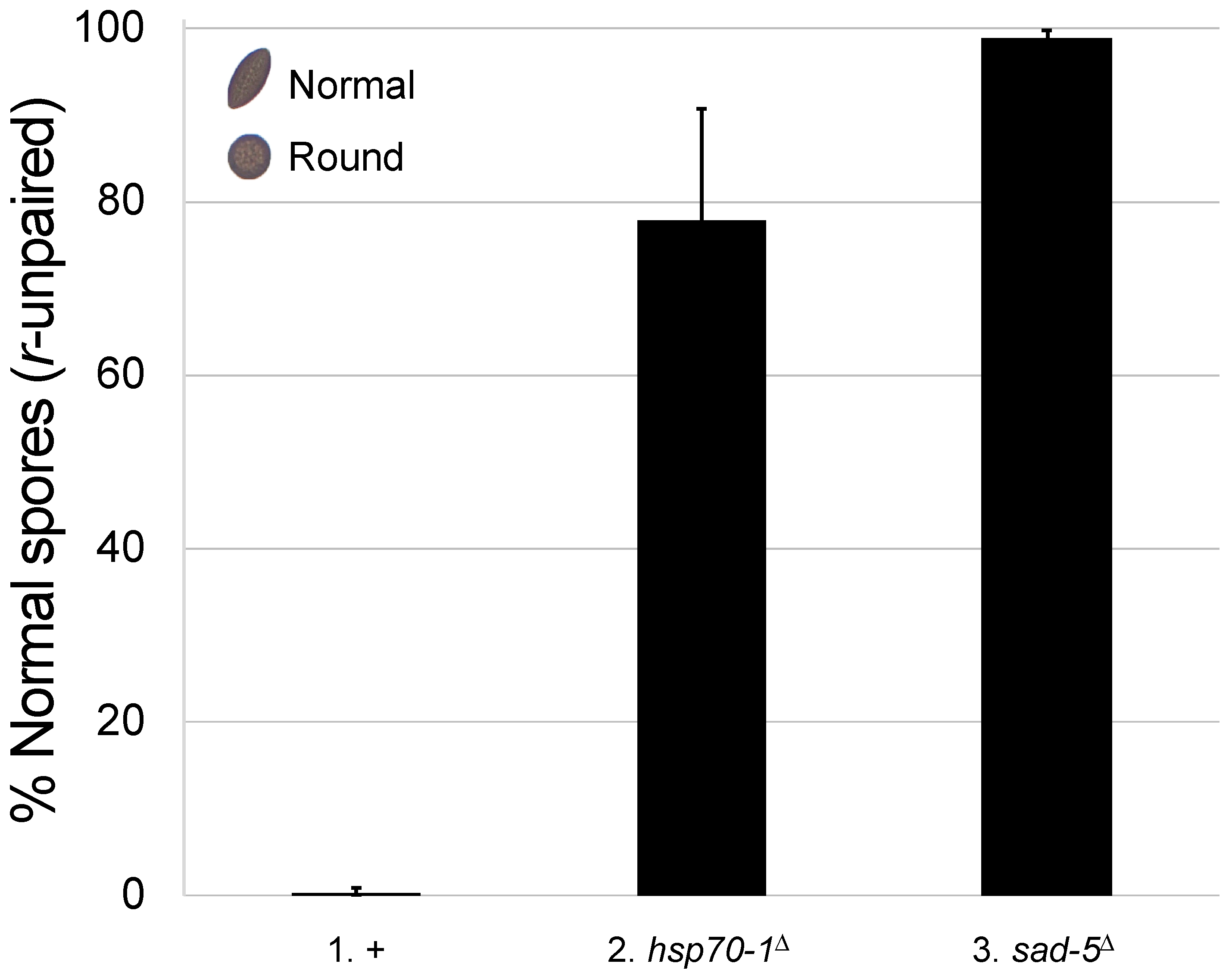
In a normal Neurospora cross, ascospores are of American football shape. However, if the round spore gene is unpaired (i.e., r+ × r), it will be subject to meiotic silencing, and the resulting progeny will become round [3]. This silencing effect can be alleviated if an MSUD protein is missing. As shown in Figure 1 (cross 2), when HSP70-1 is absent, the silencing of an unpaired r+ gene is greatly reduced, with the majority (77.8%) of the progeny appearing normal. This suggests that HSP70-1 plays a pivotal role in MSUD.

3.2. Mutation in hsp70-1 Affects Vegetative Growth

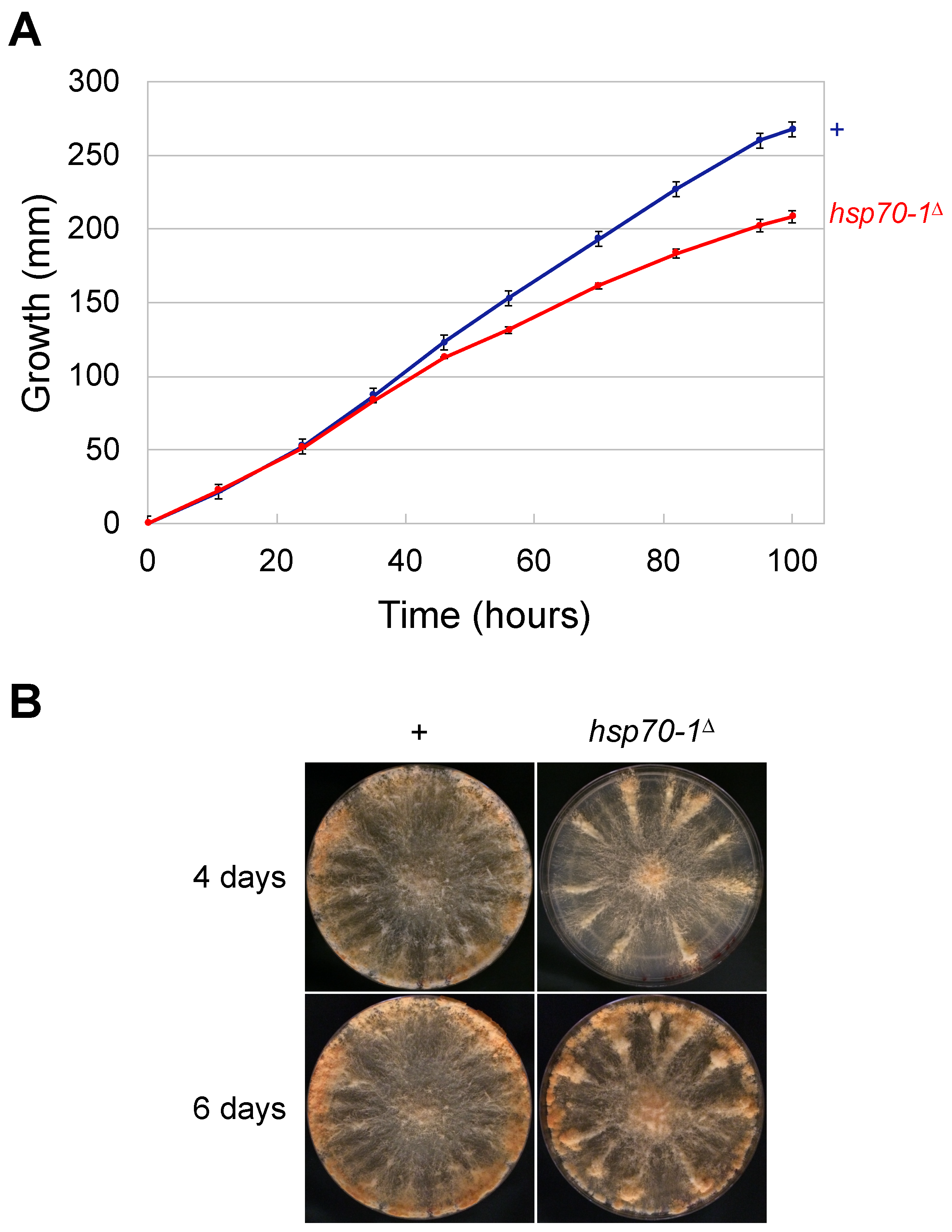
While meiotic silencing is a sexual phenomenon, certain MSUD mutations notably affect somatic growth. For example, car-1 and cgh-1 mutants are slow growers, with the latter also defective in conidiation pattern [42]. In a race-tube assay, an hsp70-1 mutant achieves only 78% of the linear hyphal growth of a wild-type strain (Figure 2A). When this mutant is grown on an agar plate, conidiation along the edge of the medium appears proficient, albeit slightly delayed (Figure 2B). A previous study on the expression profile of HSP70-1 suggests that it could play a role in conidial formation and germination [43]. In addition, it has been shown that hsp70-1 mutants have various vegetative defects, e.g., reduced branching and swollen conidia [44]. These past and present findings indicate that HSP70-1 contributes to the normal functioning of the asexual cycle.

3.3. HSP70-1 Is Crucial for Sexual Development

Many known components of the MSUD pathway are required for sexual reproduction. For example, a cross lacking dcl-1 or qip produces perithecia that are devoid of any asci [12,14]. A less severe phenotype can be observed in a cross lacking sad-1, sad-2, or sad-3, where asci develop but abort before ascospore formation [3,10,17]. In a cross homozygous for an hsp70-1 deletion, the ascospore production drops by several hundred times (Figure 3A). The mutant perithecia contain mostly abortive asci, suggesting that HSP70-1 is vital to ascus maturation (Figure 3B).

3.4. HSP70-1 Is Enriched in the Perinuclear Region

The perinuclear region, which is immediately outside of the nuclear envelope, is the center of meiotic silencing activity [8,17]. One MSUD protein stationed there is the SMS-2 Argonaute, which uses an siRNA as a guide to look for any homologous mRNAs exported from the nucleus [45]. Since Argonautes are known to have complex formation with Hsp70 proteins [39,46,47], we asked if Neurospora HSP70-1 is also found in the perinuclear region. As seen in Figure 4A–D, GFP-tagged HSP70-1 displays a diffused localization throughout the ascus, with an enrichment in the nuclear periphery (i.e., outside of the mCherry-labeled nuclear envelope). Furthermore, when expressed in the same cell, fluorescence-tagged HSP70-1 and SMS-2 colocalize in the perinuclear region, suggesting that they could be in close proximity to each other (Figure 4E–H).

3.5. HSP70-1 Interacts with the SMS-2 Argonaute

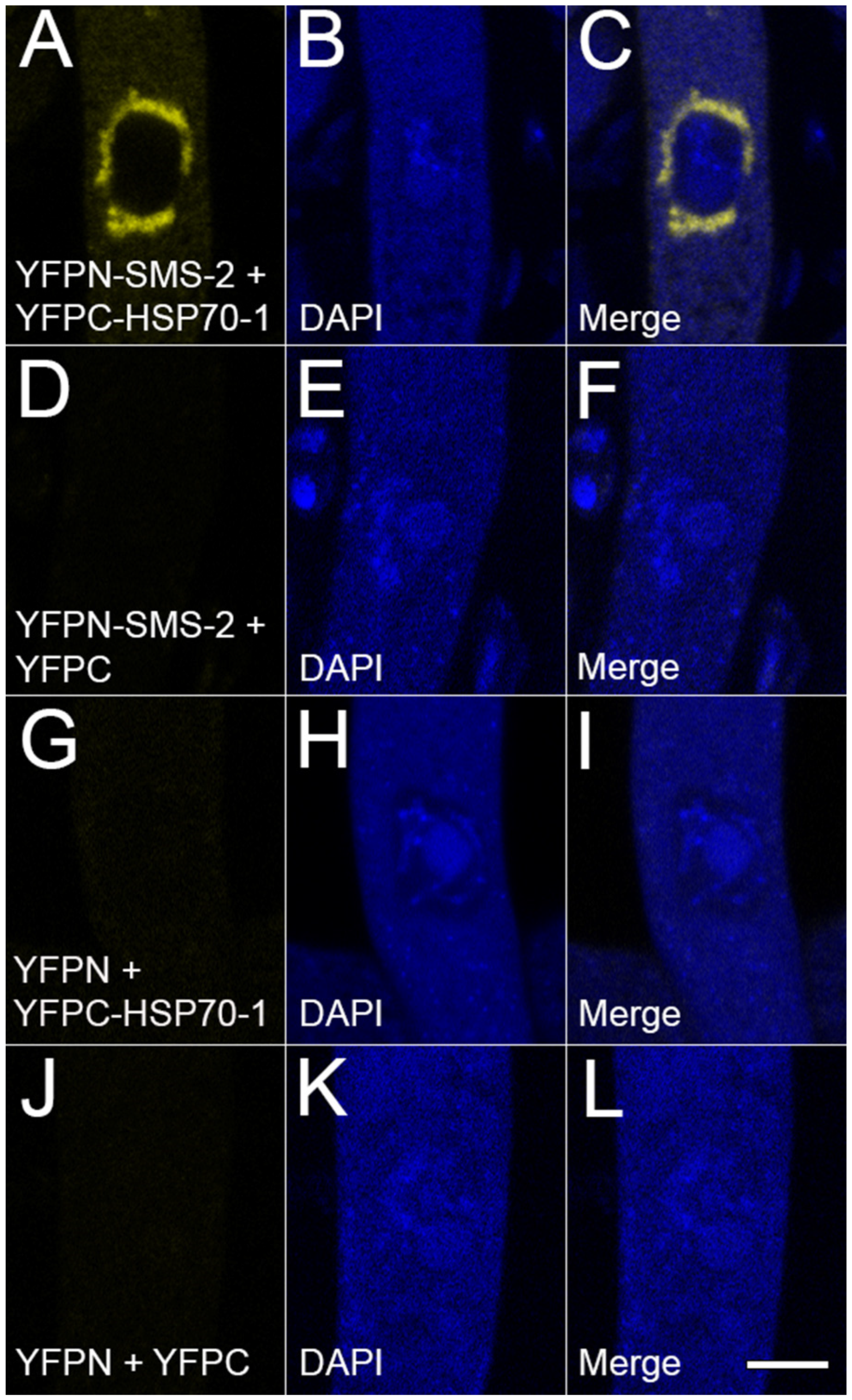
With regard to fungi, although an interaction between Argonaute and heat-shock chaperones has been speculated in Schizosaccharomyces pombe, it has yet to be demonstrated [48]. Using a BiFC assay, we tested whether SMS-2 is physically associated with HSP70-1 in Neurospora. As shown in Figure 5, SMS-2 indeed has interaction with HSP70-1 in the ascus. This result supports the notion that HSP70-1 could serve as a molecular chaperone for SMS-2.

4. Discussion

In animals and plants, the assembly of RISC appears to involve an Hsp70 protein [20]. In fungi, the importance of Hsp70 in silencing had not been established before this study. For example, while Hsp40 and Hsp90 proteins are important for silencing in S. pombe, Hsc70-4 homologs (Ssa1 and Ssa2) seem to be dispensable [48]. In the case of Kluyveromyces polysporus, purified Argonaute (KpAGO) can autonomously load an siRNA without chaperone proteins or other loading factors [49]. Naumovozyma castellii Ago1 also loads an siRNA by itself in vitro, although the loading efficiency can be enhanced by the Xrn1 exonuclease (a non-chaperone factor) [50]. In this work, we have shown that an Hsp70 protein mediates MSUD in Neurospora, establishing that it can play a role in fungal silencing.
Crosses lacking HSP70-1 still maintain roughly one-fifth of the MSUD activity. One possibility is that, like N. castellii Ago1, SMS-2 can autonomously load an siRNA in some capacity, but it can achieve optimal loading efficiency only when assisted by some helpers (i.e., HSP70-1 and its associated factors in this case). Another possibility is that a homolog of HSP70-1 [22] can partially perform its function in its absence.
While crosses homozygous for some MSUD mutations can produce an appreciable amount of ascospores [6,16,41], this is not the case for an hsp70-1 deletion. Since the SMS-2 Argonaute is required for ascus formation [51] and that HSP70-1 is its presumed chaperone, the sexual defect of an hsp70-1-null cross could be related to an SMS-2 malfunction.
During meiosis, a sequence present in one homologous chromosome but not the other could be a sign of foul play. It is not surprising that some form of meiotic silencing has evolved in various organisms [3,52,53,54,55,56,57]. Here, we have identified HSP70-1 as an additional component of the MSUD pathway. According to the Drosophila model, the Hsp70 system could help prime the SMS-2 Argonaute to accommodate an incoming siRNA in Neurospora. Since different Argonautes require different accessory proteins for small RNA loading [20], further studies on SMS-2 and its interacting partners could clarify this loading step in meiotic silencing.

Supplementary Materials

The following supporting information can be downloaded at: https://www.mdpi.com/article/10.3390/epigenomes10010007/s1. Table S1: Primers for strain construction and confirmation.

Author Contributions

V.T.S. and P.K.T.S. designed research, analyzed data, and prepared the manuscript. V.T.S., S.S.T. and H.M.T. performed research. All authors have read and agreed to the published version of the manuscript.

Funding

V.T.S. was supported by a National Institute of General Medical Sciences (NIGMS) training grant (T32 GM008396). This work was supported by the MU Research Council and the National Science Foundation (MCB1715534/2448593).

Institutional Review Board Statement

Not Applicable.

Informed Consent Statement

Not Applicable.

Data Availability Statement

Data and supporting information are contained within the article or Supplementary Materials.

Acknowledgments

We thank James Birchler and Patrice Albert for their equipment sharing and advice. We are indebted to the FGSC, the Neurospora Functional Genomics Group, the MU Advanced Light Microscopy and Genomics Technology Cores, colleagues from our community, and members of the Shiu Laboratory for their materials and assistance. We are pleased to acknowledge use of materials generated by P01 GM068087 “Functional Analysis of a Model Filamentous Fungus.”

Conflicts of Interest

The authors declare no conflicts of interest.

References

  1. Ågren, J.A.; Clark, A.G. Selfish genetic elements. PLoS Genet. 2018, 14, e1007700. [Google Scholar] [CrossRef] [PubMed]
  2. Aramayo, R.; Metzenberg, R.L. Meiotic transvection in fungi. Cell 1996, 86, 103–113. [Google Scholar] [CrossRef] [PubMed][Green Version]
  3. Shiu, P.K.T.; Raju, N.B.; Zickler, D.; Metzenberg, R.L. Meiotic silencing by unpaired DNA. Cell 2001, 107, 905–916. [Google Scholar] [CrossRef] [PubMed]
  4. Hammond, T.M. Sixteen years of meiotic silencing by unpaired DNA. Adv. Genet. 2017, 97, 1–42. [Google Scholar]
  5. Mazur, A.K.; Gladyshev, E. C-DNA may facilitate homologous DNA pairing. Trends Genet. 2023, 39, 575–585. [Google Scholar] [CrossRef]
  6. Samarajeewa, D.A.; Sauls, P.A.; Sharp, K.J.; Smith, Z.J.; Xiao, H.; Groskreutz, K.M.; Malone, T.L.; Boone, E.C.; Edwards, K.A.; Shiu, P.K.T.; et al. Efficient detection of unpaired DNA requires a member of the Rad54-like family of homologous recombination proteins. Genetics 2014, 198, 895–904. [Google Scholar] [CrossRef]
  7. Rhoades, N.; Nguyen, T.S.; Witz, G.; Cecere, G.; Hammond, T.; Mazur, A.K.; Gladyshev, E. Recombination-independent recognition of DNA homology for meiotic silencing in Neurospora crassa. Proc. Natl. Acad. Sci. USA 2021, 118, e2108664118. [Google Scholar] [CrossRef]
  8. Decker, L.M.; Boone, E.C.; Xiao, H.; Shanker, B.S.; Boone, S.F.; Kingston, S.L.; Lee, S.A.; Hammond, T.M.; Shiu, P.K.T. Complex formation of RNA silencing proteins in the perinuclear region of Neurospora crassa. Genetics 2015, 199, 1017–1021. [Google Scholar] [CrossRef]
  9. Shiu, P.K.T.; Metzenberg, R.L. Meiotic silencing by unpaired DNA: Properties, regulation and suppression. Genetics 2002, 161, 1483–1495. [Google Scholar] [CrossRef]
  10. Hammond, T.M.; Xiao, H.; Boone, E.C.; Perdue, T.D.; Pukkila, P.J.; Shiu, P.K.T. SAD-3, a putative helicase required for meiotic silencing by unpaired DNA, interacts with other components of the silencing machinery. G3 (Bethesda) 2011, 1, 369–376. [Google Scholar] [CrossRef]
  11. Lee, D.W.; Pratt, R.J.; McLaughlin, M.; Aramayo, R. An argonaute-like protein is required for meiotic silencing. Genetics 2003, 164, 821–828. [Google Scholar] [CrossRef]
  12. Alexander, W.G.; Raju, N.B.; Xiao, H.; Hammond, T.M.; Perdue, T.D.; Metzenberg, R.L.; Pukkila, P.J.; Shiu, P.K.T. DCL-1 colocalizes with other components of the MSUD machinery and is required for silencing. Fungal Genet. Biol. 2008, 45, 719–727. [Google Scholar] [CrossRef] [PubMed]
  13. Hammond, T.M.; Spollen, W.G.; Decker, L.M.; Blake, S.M.; Springer, G.K.; Shiu, P.K.T. Identification of small RNAs associated with meiotic silencing by unpaired DNA. Genetics 2013, 194, 279–284. [Google Scholar] [CrossRef] [PubMed]
  14. Xiao, H.; Alexander, W.G.; Hammond, T.M.; Boone, E.C.; Perdue, T.D.; Pukkila, P.J.; Shiu, P.K.T. QIP, a protein that converts duplex siRNA into single strands, is required for meiotic silencing by unpaired DNA. Genetics 2010, 186, 119–126. [Google Scholar] [CrossRef] [PubMed]
  15. Decker, L.M.; Xiao, H.; Boone, E.C.; Vierling, M.M.; Shanker, B.S.; Kingston, S.L.; Boone, S.F.; Haynes, J.B.; Shiu, P.K.T. The nuclear cap-binding complex mediates meiotic silencing by unpaired DNA. G3 (Bethesda) 2017, 7, 1149–1155. [Google Scholar] [CrossRef]
  16. Boone, E.C.; Xiao, H.; Vierling, M.M.; Decker, L.M.; Sy, V.T.; Kennedy, R.F.; Bonham, M.A.; Schmitz, S.F.; John, A.M.; Hammond, T.M.; et al. An NCBP3-domain protein mediates meiotic silencing by unpaired DNA. G3 (Bethesda) 2020, 10, 1919–1927. [Google Scholar] [CrossRef]
  17. Shiu, P.K.T.; Zickler, D.; Raju, N.B.; Ruprich-Robert, G.; Metzenberg, R.L. SAD-2 is required for meiotic silencing by unpaired DNA and perinuclear localization of SAD-1 RNA-directed RNA polymerase. Proc. Natl. Acad. Sci. USA 2006, 103, 2243–2248. [Google Scholar] [CrossRef]
  18. Sy, V.T.; Boone, E.C.; Xiao, H.; Vierling, M.M.; Schmitz, S.F.; Ung, Q.; Trawick, S.S.; Hammond, T.M.; Shiu, P.K.T. A DEAD-box RNA helicase mediates meiotic silencing by unpaired DNA. G3 (Bethesda) 2023, 13, jkad083. [Google Scholar] [CrossRef]
  19. Hu, C.; Yang, J.; Qi, Z.; Wu, H.; Wang, B.; Zou, F.; Mei, H.; Liu, J.; Wang, W.; Liu, Q. Heat shock proteins: Biological functions, pathological roles, and therapeutic opportunities. MedComm 2022, 3, e161. [Google Scholar] [CrossRef]
  20. Iwakawa, H.O.; Tomari, Y. Life of RISC: Formation, action, and degradation of RNA-induced silencing complex. Mol. Cell 2022, 82, 30–43. [Google Scholar] [CrossRef]
  21. Tsuboyama, K.; Tadakuma, H.; Tomari, Y. Conformational activation of Argonaute by distinct yet coordinated actions of the Hsp70 and Hsp90 chaperone systems. Mol. Cell 2018, 70, 722–729. [Google Scholar] [CrossRef]
  22. Borkovich, K.A.; Alex, L.A.; Yarden, O.; Freitag, M.; Turner, G.E.; Read, N.D.; Seiler, S.; Bell-Pedersen, D.; Paietta, J.; Plesofsky, N.; et al. Lessons from the genome sequence of Neurospora crassa: Tracing the path from genomic blueprint to multicellular organism. Microbiol. Mol. Biol. Rev. 2004, 68, 1–108. [Google Scholar] [CrossRef]
  23. Britton, M.E.; Kapoor, M. The oligomeric state, complex formation, and chaperoning activity of Hsp70 and Hsp80 of Neurospora crassa. Biochem. Cell Biol. 2002, 80, 797–809. [Google Scholar] [CrossRef] [PubMed]
  24. Basenko, E.Y.; Shanmugasundram, A.; Böhme, U.; Starns, D.; Wilkinson, P.A.; Davison, H.R.; Crouch, K.; Maslen, G.; Harb, O.S.; Amos, B.; et al. What is new in FungiDB: A web-based bioinformatics platform for omics-scale data analysis for fungal and oomycete species. Genetics 2024, 227, iyae035. [Google Scholar] [CrossRef] [PubMed]
  25. Dunlap, J.C.; Borkovich, K.A.; Henn, M.R.; Turner, G.E.; Sachs, M.S.; Glass, N.L.; McCluskey, K.; Plamann, M.; Galagan, J.E.; Birren, B.W.; et al. Enabling a community to dissect an organism: Overview of the Neurospora functional genomics project. Adv. Genet. 2007, 57, 49–96. [Google Scholar] [PubMed]
  26. McCluskey, K.; Wiest, A.; Plamann, M. The Fungal Genetics Stock Center: A repository for 50 years of fungal genetics research. J. Biosci. 2010, 35, 119–126. [Google Scholar] [CrossRef]
  27. Vogel, H.J. A convenient growth medium for Neurospora (Medium N). Microb. Genet. Bull. 1956, 13, 42–43. [Google Scholar]
  28. Westergaard, M.; Mitchell, H.K. Neurospora V. A synthetic medium favoring sexual reproduction. Am. J. Bot. 1947, 34, 573–577. [Google Scholar] [CrossRef]
  29. Turner, G.E. Phenotypic analysis of Neurospora crassa gene deletion strains. Methods Mol. Biol. 2011, 722, 191–198. [Google Scholar]
  30. Xiao, H.; Hammond, T.M.; Shiu, P.K.T. Suppressors of meiotic silencing by unpaired DNA. Noncoding RNA 2019, 5, 14. [Google Scholar] [CrossRef]
  31. Sambrook, J.; Russell, D.W. Molecular Cloning: A Laboratory Manual, 3rd ed.; Cold Spring Harbor Laboratory Press: Woodbury, NY, USA, 2001. [Google Scholar]
  32. Hammond, T.M.; Xiao, H.; Rehard, D.G.; Boone, E.C.; Perdue, T.D.; Pukkila, P.J.; Shiu, P.K.T. Fluorescent and bimolecular-fluorescent protein tagging of genes at their native loci in Neurospora crassa using specialized double-joint PCR plasmids. Fungal Genet. Biol. 2011, 48, 866–873. [Google Scholar] [CrossRef] [PubMed]
  33. Margolin, B.S.; Freitag, M.; Selker, E.U. Improved plasmids for gene targeting at the his-3 locus of Neurospora crassa by electroporation. Fungal Genet. Newsl. 1997, 44, 34–36. [Google Scholar] [CrossRef]
  34. Henderson, S.T.; Eariss, G.A.; Catcheside, D.E.A. Reliable PCR amplification from Neurospora crassa genomic DNA obtained from conidia. Fungal Genet. Newsl. 2005, 52, 24. [Google Scholar] [CrossRef]
  35. Hu, C.D.; Chinenov, Y.; Kerppola, T.K. Visualization of interactions among bZIP and Rel family proteins in living cells using bimolecular fluorescence complementation. Mol. Cell 2002, 9, 789–798. [Google Scholar] [CrossRef]
  36. Bardiya, N.; Alexander, W.G.; Perdue, T.D.; Barry, E.G.; Metzenberg, R.L.; Pukkila, P.J.; Shiu, P.K.T. Characterization of interactions between and among components of the meiotic silencing by unpaired DNA machinery in Neurospora crassa using bimolecular fluorescence complementation. Genetics 2008, 178, 593–596. [Google Scholar] [CrossRef][Green Version]
  37. Palter, K.B.; Watanabe, M.; Stinson, L.; Mahowald, A.P.; Craig, E.A. Expression and localization of Drosophila melanogaster hsp70 cognate proteins. Mol. Cell Biol. 1986, 6, 1187–1203. [Google Scholar]
  38. Perkins, L.A.; Doctor, J.S.; Zhang, K.; Stinson, L.; Perrimon, N.; Craig, E.A. Molecular and developmental characterization of the heat shock cognate 4 gene of Drosophila melanogaster. Mol. Cell Biol. 1990, 10, 3232–3238. [Google Scholar]
  39. Iwasaki, S.; Kobayashi, M.; Yoda, M.; Sakaguchi, Y.; Katsuma, S.; Suzuki, T.; Tomari, Y. Hsc70/Hsp90 chaperone machinery mediates ATP-dependent RISC loading of small RNA duplexes. Mol. Cell 2010, 39, 292–299. [Google Scholar] [CrossRef]
  40. Iwasaki, S.; Sasaki, H.M.; Sakaguchi, Y.; Suzuki, T.; Tadakuma, H.; Tomari, Y. Defining fundamental steps in the assembly of the Drosophila RNAi enzyme complex. Nature 2015, 521, 533–536. [Google Scholar] [CrossRef]
  41. Hammond, T.M.; Xiao, H.; Boone, E.C.; Decker, L.M.; Lee, S.A.; Perdue, T.D.; Pukkila, P.J.; Shiu, P.K.T. Novel proteins required for meiotic silencing by unpaired DNA and siRNA generation in Neurospora crassa. Genetics 2013, 194, 91–100. [Google Scholar] [CrossRef]
  42. Xiao, H.; Vierling, M.M.; Kennedy, R.F.; Boone, E.C.; Decker, L.M.; Sy, V.T.; Haynes, J.B.; Williams, M.A.; Shiu, P.K.T. Involvement of RNA granule proteins in meiotic silencing by unpaired DNA. G3 (Bethesda) 2021, 11, jkab179. [Google Scholar] [CrossRef] [PubMed]
  43. Fracella, F.; Scholle, C.; Kallies, A.; Häfker, T.; Schröder, T.; Rensing, L. Differential HSC70 expression during asexual development of Neurospora crassa. Microbiology 1997, 143, 3615–3624. [Google Scholar] [CrossRef] [PubMed][Green Version]
  44. Seiler, S.; Plamann, M. The genetic basis of cellular morphogenesis in the filamentous fungus Neurospora crassa. Mol. Biol. Cell 2003, 14, 4352–4364. [Google Scholar] [CrossRef] [PubMed]
  45. Kelly, W.G. Standing guard: Perinuclear localization of an RNA-dependent RNA polymerase. Proc. Natl. Acad. Sci. USA 2006, 103, 007–2008. [Google Scholar] [CrossRef]
  46. Iki, T.; Yoshikawa, M.; Nishikiori, M.; Jaudal, M.C.; Matsumoto-Yokoyama, E.; Mitsuhara, I.; Meshi, T.; Ishikawa, M. In vitro assembly of plant RNA-induced silencing complexes facilitated by molecular chaperone HSP90. Mol. Cell 2010, 39, 282–291. [Google Scholar] [CrossRef]
  47. Naruse, K.; Matsuura-Suzuki, E.; Watanabe, M.; Iwasaki, S.; Tomari, Y. In vitro reconstitution of chaperone-mediated human RISC assembly. RNA 2018, 24, 6–11. [Google Scholar] [CrossRef]
  48. Okazaki, K.; Kato, H.; Iida, T.; Shinmyozu, K.; Nakayama, J.I.; Murakami, Y.; Urano, T. RNAi-dependent heterochromatin assembly in fission yeast Schizosaccharomyces pombe requires heat-shock molecular chaperones Hsp90 and Mas5. Epigenet. Chromatin 2018, 11, 26. [Google Scholar] [CrossRef]
  49. Nakanishi, K.; Weinberg, D.E.; Bartel, D.P.; Patel, D.J. Structure of yeast Argonaute with guide RNA. Nature 2012, 486, 368–374. [Google Scholar] [CrossRef]
  50. Getz, M.A.; Weinberg, D.E.; Drinnenberg, I.A.; Fink, G.R.; Bartel, D.P. Xrn1p acts at multiple steps in the budding-yeast RNAi pathway to enhance the efficiency of silencing. Nucleic Acids Res. 2020, 48, 7404–7420. [Google Scholar] [CrossRef]
  51. Wang, Z.; Lopez-Giraldez, F.; Lehr, N.; Farré, M.; Common, R.; Trail, F.; Townsend, J.P. Global gene expression and focused knockout analysis reveals genes associated with fungal fruiting body development in Neurospora crassa. Eukaryot. Cell 2014, 13, 154–169. [Google Scholar] [CrossRef]
  52. Bean, C.J.; Schaner, C.E.; Kelly, W.G. Meiotic pairing and imprinted X chromatin assembly in Caenorhabditis elegans. Nat. Genet. 2004, 36, 100–105. [Google Scholar] [CrossRef] [PubMed]
  53. Turner, J.M.A.; Mahadevaiah, S.K.; Fernandez-Capetillo, O.; Nussenzweig, A.; Xu, X.; Deng, C.X.; Burgoyne, P.S. Silencing of unsynapsed meiotic chromosomes in the mouse. Nat. Genet. 2005, 37, 41–47. [Google Scholar] [CrossRef] [PubMed]
  54. Ferguson, K.A.; Chow, V.; Ma, S. Silencing of unpaired meiotic chromosomes and altered recombination patterns in an azoospermic carrier of a t(8;13) reciprocal translocation. Hum. Reprod. 2008, 23, 988–995. [Google Scholar] [CrossRef] [PubMed][Green Version]
  55. Ramakrishnan, M.; Sowjanya, T.N.; Raj, K.B.; Kasbekar, D.P. Meiotic silencing by unpaired DNA is expressed more strongly in the early than the late perithecia of crosses involving most wild-isolated Neurospora crassa strains and in self-crosses of N. tetrasperma. Fungal Genet. Biol. 2011, 48, 1146–1152. [Google Scholar] [CrossRef]
  56. Son, H.; Min, K.; Lee, J.; Raju, N.B.; Lee, Y.W. Meiotic silencing in the homothallic fungus Gibberella zeae. Fungal Biol. 2011, 115, 1290–1302. [Google Scholar] [CrossRef]
  57. Tsuji, K.; Kitade, Y.; Yoshimi, A.; Tanaka, C. Meiotic silencing in dothideomycetous Bipolaris maydis. Front. Fungal Biol. 2022, 3, 931888. [Google Scholar] [CrossRef]
Figure 1. HSP70-1 is important for MSUD. In a normal cross, Neurospora produces American football-shaped spores. In a round spore (r+)-unpaired cross (i.e., r+ × r), r+ is silenced, and predominantly round spores are produced (i.e., 0.38% football; cross 1). In an hsp70-1-null background, the silencing of an unpaired r+ gene becomes deficient, and significantly more normal spores are produced (i.e., 77.8% football, cross 2; p < 0.001). Suppression of silencing is nearly complete (i.e., 98.9% football, cross 3) when the cross is lacking SAD-5 (a protein required for siRNA production) [41]. An error bar indicates the standard deviation among 24 replicates. +, wild type at pertinent loci. Crosses: (1) F9-37 × P3-08. (2) F9-18 × P27-55. (3) F5-36 × P17-70.
Epigenomes 10 00007 g001
Figure 2. HSP70-1 is involved in the asexual cycle. (A) An hsp70-1Δ mutant exhibits significantly reduced linear growth when compared to a wild-type strain (208 versus 268 mm at the 100 h mark; p < 0.001). The slower growth of the mutant becomes more obvious after around 36 h. (B) Conidiation at the perimeter of an agar plate appears proficient (albeit with a small delay) in an hsp70-1Δ mutant. An error bar indicates the standard deviation among three replicates. Strains: P3-08 and P27-55.
Epigenomes 10 00007 g002
Figure 3. hsp70-1-null crosses exhibit severe sexual defects. (A) Deletion of hsp70-1 in both parents leads to a significant decrease in ascospore production (1.53 million versus 3615; p < 0.001). (B) While protoperithecial development appears proficient in an hsp70-1Δ strain, the majority of the mutant perithecia are less melanized and have underdeveloped beaks. Rampant ascus abortions can be seen in these perithecia. An error bar indicates the standard deviation among three replicates. Crosses: (1) F2-01 × P3-08. (2) F9-13 × P27-55.
Epigenomes 10 00007 g003
Figure 4. Colocalization of HSP70-1 and SMS-2 in the perinuclear region. (AD) HSP70-1 displays a diffused localization throughout the ascus, with a 1.7-fold enrichment surrounding the nuclear envelope (as marked by the NUP120 nucleoporin). (EH) HSP70-1 colocalizes with the SMS-2 Argonaute. Micrographs illustrate prophase asci expressing (AD) hsp70-1-gfp and nup120-mCherry (P19-05 × P29-68) and (EH) hsp70-1-gfp and mCherry-sms-2 (P29-71 × P29-72). The chromatin was stained with DAPI. Bar, 5 µm.
Epigenomes 10 00007 g004
Figure 5. HSP70-1 interacts with SMS-2. In a BiFC analysis, a positive interaction between two proteins reconstitutes the yellow fluorophore. (AC) Here, the interaction between HSP70-1 and the SMS-2 Argonaute can be seen in the perinuclear region. (DL) Negative controls. Micrographs illustrate a prophase ascus expressing (AC) yfpn-sms-2 and yfpc-hsp70-1 (P29-57 × P28-31), (DF) yfpn-sms-2 and yfpc (P29-57 × P31-03), (GI) yfpn and yfpc-hsp70-1 (P31-19 × P28-31), and (JL) yfpn and yfpc (P13-65 × P14-04). The chromatin was stained with DAPI. Bar, 5 µm.
Epigenomes 10 00007 g005
Table 1. Neurospora strains used in this study.
StrainGenotype
F2-01fl A (FGSC 4317)
F5-36fl; sad-5::hph a
F9-13rid; hsp70-1::hph fl A
F9-18rid r::hph; hsp70-1::hph fl A
F9-37rid r::hph; fl A
P3-08Oak Ridge wild type a (FGSC 2490)
P13-65rid his-3+::yfpn; mus-52::bar A
P14-04rid his-3+::yfpc; mus-51Δ::bar a
P17-70r::hph; sad-5::hph A
P19-05rid nup120-mCherry::hph A
P27-55hsp70-1::hph a
P28-31rid; yfpc-hsp70-1::hph; mus-51Δ::bar A (heterokaryon with P30-22)
P29-57rid; yfpn-sms-2::hph a
P29-68rid nup120-mCherry::hph; hsp70-1-gfp::hph a
P29-71rid;mus-51Δ::bar; mCherry-sms-2::nat1 A
P29-72rid; hsp70-1-gfp::hph; mCherry-sms-2::nat1 a
P30-22rid; mus-51Δ::bar A
P31-03rid his-3+::yfpc; mus-52::bar; mus-51::bar A
P31-19rid his-3+::yfpn; mus-52::bar a
Disclaimer/Publisher’s Note: The statements, opinions and data contained in all publications are solely those of the individual author(s) and contributor(s) and not of MDPI and/or the editor(s). MDPI and/or the editor(s) disclaim responsibility for any injury to people or property resulting from any ideas, methods, instructions or products referred to in the content.