Research Progress on Target Gene Screening and the Precise Control Potential of Diaphorina citri Using RNA Interference

1
College of Life Sciences, Gannan Normal University, Ganzhou 341000, China
2
Institute of Plant Protection, Jiangxi Academy of Agricultural Sciences, Nanchang 330200, China
*
Author to whom correspondence should be addressed.
Insects 2026, 17(9), 953; https://doi.org/10.3390/insects17090953
Submission received: 18 August 2026
/
Revised: 6 September 2026
/
Accepted: 10 September 2026
/
Published: 12 September 2026
(This article belongs to the Special Issue Insecticidal RNAi and Next-Generation Pest Control)
Simple Summary
Citrus Huanglongbing (HLB) is a devastating disease threatening global citrus production. The pathogen is mainly transmitted by Diaphorina citri Kuwayama. Chemical insecticides are widely used to suppress this psyllid, yet long-term application drives insecticide resistance, reduces control efficacy and causes ecological pollution. This review focuses on an environmentally friendly and precise biocontrol strategy based on RNA interference. We summarize feasible target gene screening approaches, analyze major technical constraints hindering field deployment, and outline prospects for further improvements, to facilitate sustainable management of citrus pests and diseases.
Abstract
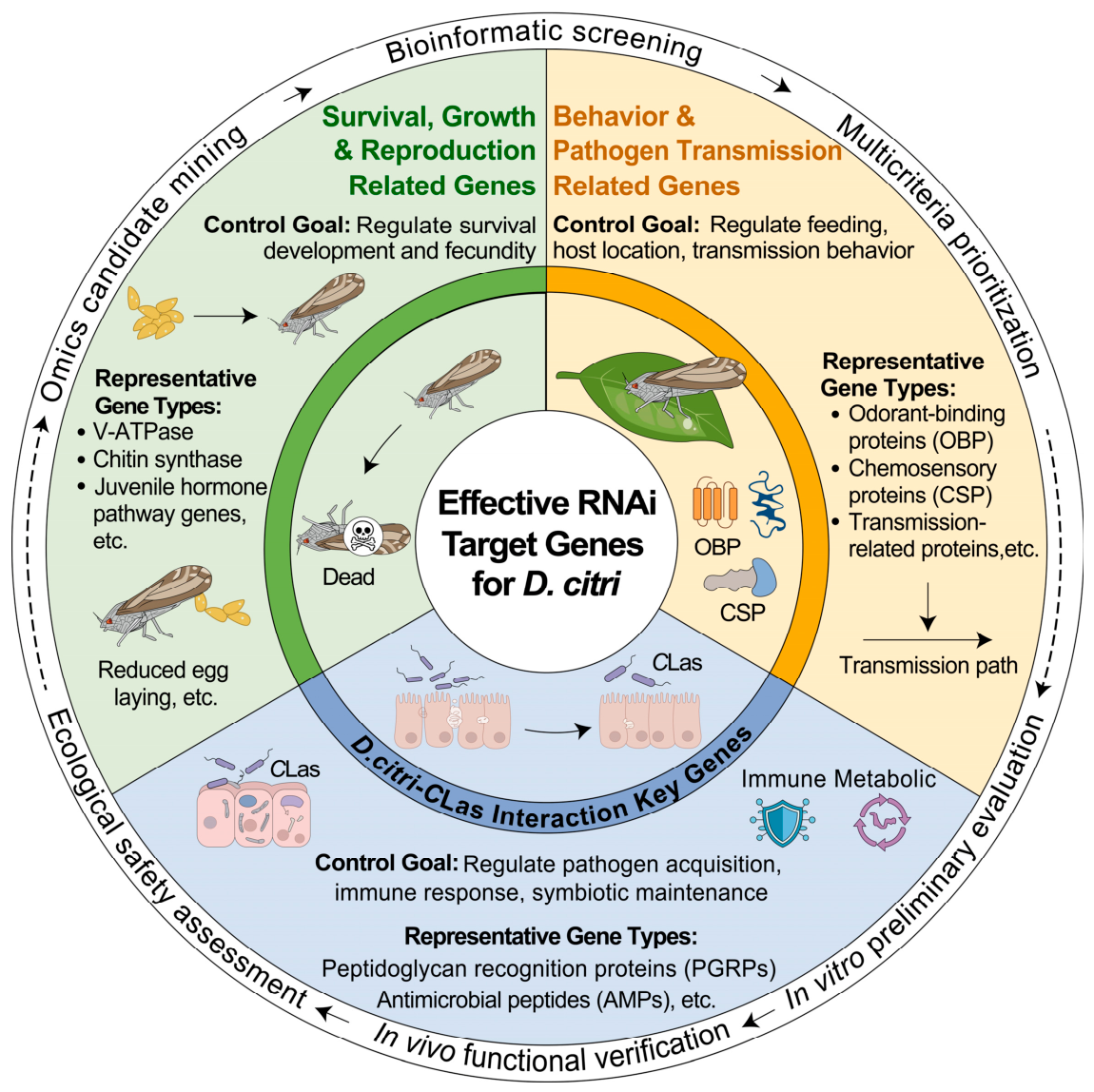
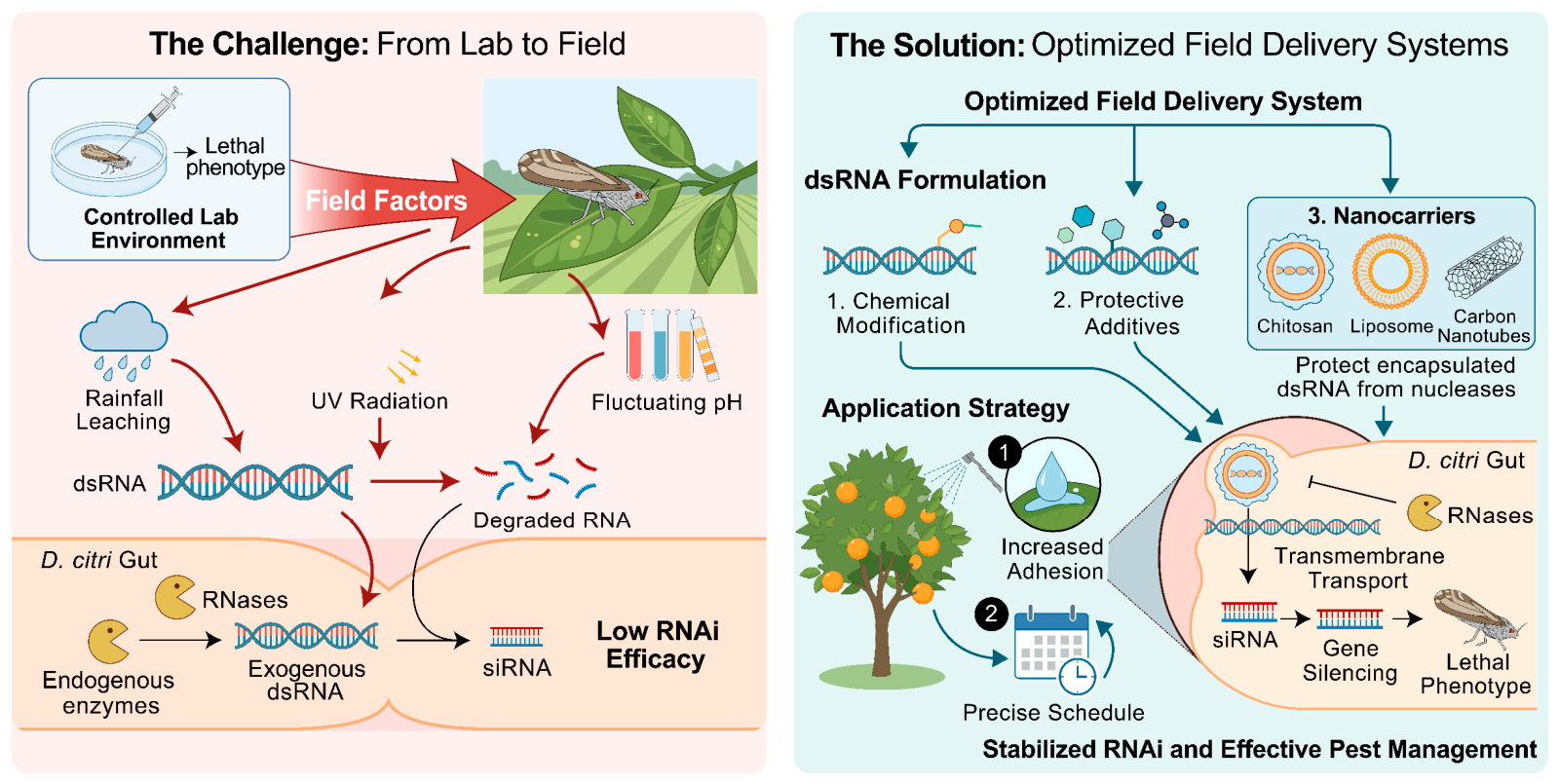
Diaphorina citri Kuwayama is the primary natural vector of citrus Huanglongbing (HLB). Prolonged use of chemical pesticides leads to insect resistance, reduces control efficacy, and causes ecological pollution. RNA interference (RNAi) enables sequence-specific gene silencing, representing a promising precision strategy for managing D. citri. This review summarizes advances in RNAi-based control of D. citri, focusing on three groups of target gene screening strategies based on essential functional genes, behavioral regulation genes, and D. citri-Candidatus Liberibacter asiaticus (CLas) interaction genes. It also compares double-stranded RNA (dsRNA) delivery systems and highlights key bottlenecks, including poor stability, inefficient delivery, off-target effects, and resistance evolution. Future research should focus on optimizing target gene screening, developing efficient delivery systems, and enhancing ecological safety assessments. Integrating RNAi technology with various environmentally friendly management strategies will advance the sustainable control of D. citri and citrus HLB.