
Five New Species of Orthosinus Motschulsky, 1863 from China—Molecular Evidence for Two Species (Coleoptera, Curculionidae, Dryophthorinae) †


Simple Summary
Abstract
1. Introduction
2. Materials and Methods
2.1. Taxon Sampling
2.2. Specimen Examination
2.3. DNA Extraction, PCR Amplification and Sequencing
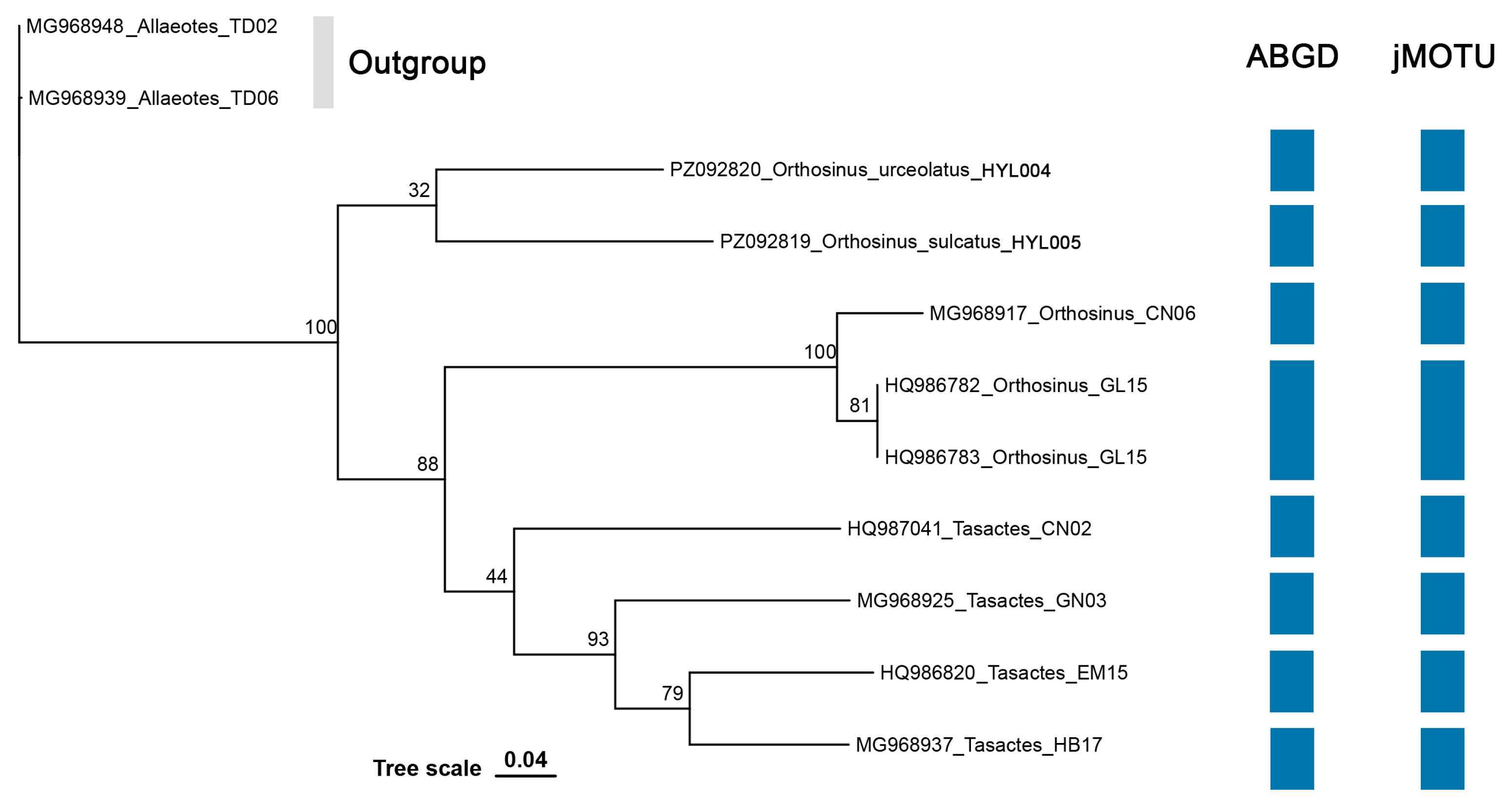
2.4. Data Analyses

| Species | Voucher Code | Sex | GenBank Accession Number | Collection Localities | Source |
|---|---|---|---|---|---|
| Orthosinus urceolatus sp. nov. | HYL004 | Female | PZ092820 | China, Xizang | This study |
| Orthosinus sulcatus sp. nov. | HYL005 | Female | PZ092819 | China, Sichuan | This study |
| Orthosinus sp. | GL15 | - | HQ986782 | China, Yunnan | Grebennikov [21] |
| Orthosinus sp. | GL15 | - | HQ986783 | China, Yunnan | Grebennikov [21] |
| Orthosinus sp. | CN06 | - | MG968917 | China, Yunnan | Grebennikov [21] |
| Tasactes sp. | CN02 | - | HQ987041 | China, Yunnan | Grebennikov [21] |
| Tasactes sp. | EM15 | - | HQ986820 | China, Sichuan | Grebennikov [21] |
| Tasactes sp. | GN03 | - | MG968925 | China, Sichuan | Grebennikov [21] |
| Allaeotes sp. | TD02 | - | MG968948 | Vietnam | Grebennikov [21] |
| Allaeotes sp. | TD06 | - | MG968939 | Vietnam | Grebennikov [21] |
3. Results
3.1. COI Sequence Analysis
3.2. Taxonomy
- Genus Orthosinus Motschulsky, 1863
- Type species: Orthosinus velatus Lacordaire, 1866 (designated by Alonso-Zarazaga & Lyal [22])
- Diagnosis. See Lü and Zhang [7]
- Distribution. China, India, Japan, Indonesia (Java), Laos, Myanmar, Nepal, Sri Lanka.
3.2.1. Orthosinus borisi Lü & Zhang sp. nov.
- urn:lsid:zoobank.org:act:A1CF48CB-1DBE-498C-919E-11E9841157E3
- Material examined. Holotype: 1♂, China, Xizang, Linzhi City, Bomi County, G318 (Tongmai Bridge), 30.0975° N, 95.0660° E, elev. 1988.02 m, 20/VII/2019, Run Zhou and Zhuo Ma leg. IOZ(E) 1965786. Paratypes: 11♂♂13♀♀, same data as holotype, IOZ(E) 1965782–1965784, IOZ(E) 1965787–1965790, IOZ(E) 1965807–1965809, IOZ(E) 1965811–1965819, IOZ(E) 1965821, IOZ(E) 1965822, IOZ(E) 1965824, IOZ(E) 1965826, IOZ(E) 1965853. 1♀, Xizang, Linzhi City, Bomi County, Tongmai Bridge (with lights under the bridge), 30.09647° N, 95.06602° E, elev. 2001 m, 30/VII/2018, collector unknown. IOZ(E) 1965807. 1♂, Xizang, Linzhi City, Bayi District, Pailong Township, Polong Gou, 30.02421° N, 95.00770° E, elev. 1923 m, 03/VIII/2018, Run Zhou leg. IOZ(E) 1965810. 1♀, Xizang, Linzhi City, Bomi County, Yigong Township (20 km along Provincial Highway S305), 30.17466° N, 94.93364° E, elev. 2323 m, 05/VIII/2018, Run Zhou leg. IOZ(E) 1965796. 4♂♂5♀♀, Xizang, Linzhi City, Bomi County, G318 (Tongmai Bridge), 30.0975° N, 95.0660° E, elev. 1988.02 m, 18/VII/2019, Run Zhou and Zhuo Ma leg. IOZ(E) 1965795, IOZ(E) 1965797, IOZ(E) 1965798, IOZ(E) 1965800–1965805. 1♀, Mêdog County, near Xirong Gorge, 62 km along the Mêdog Highway, 29.2311° N, 95.1400° E, elev. 735.88 m, 26/VII/2019, Run Zhou and Zhuo Ma leg. IOZ(E) 1965806.
- Type locality. G318 (Tongmai Bridge), Bomi County, Linzhi City, Xizang Autonomous Region, China.
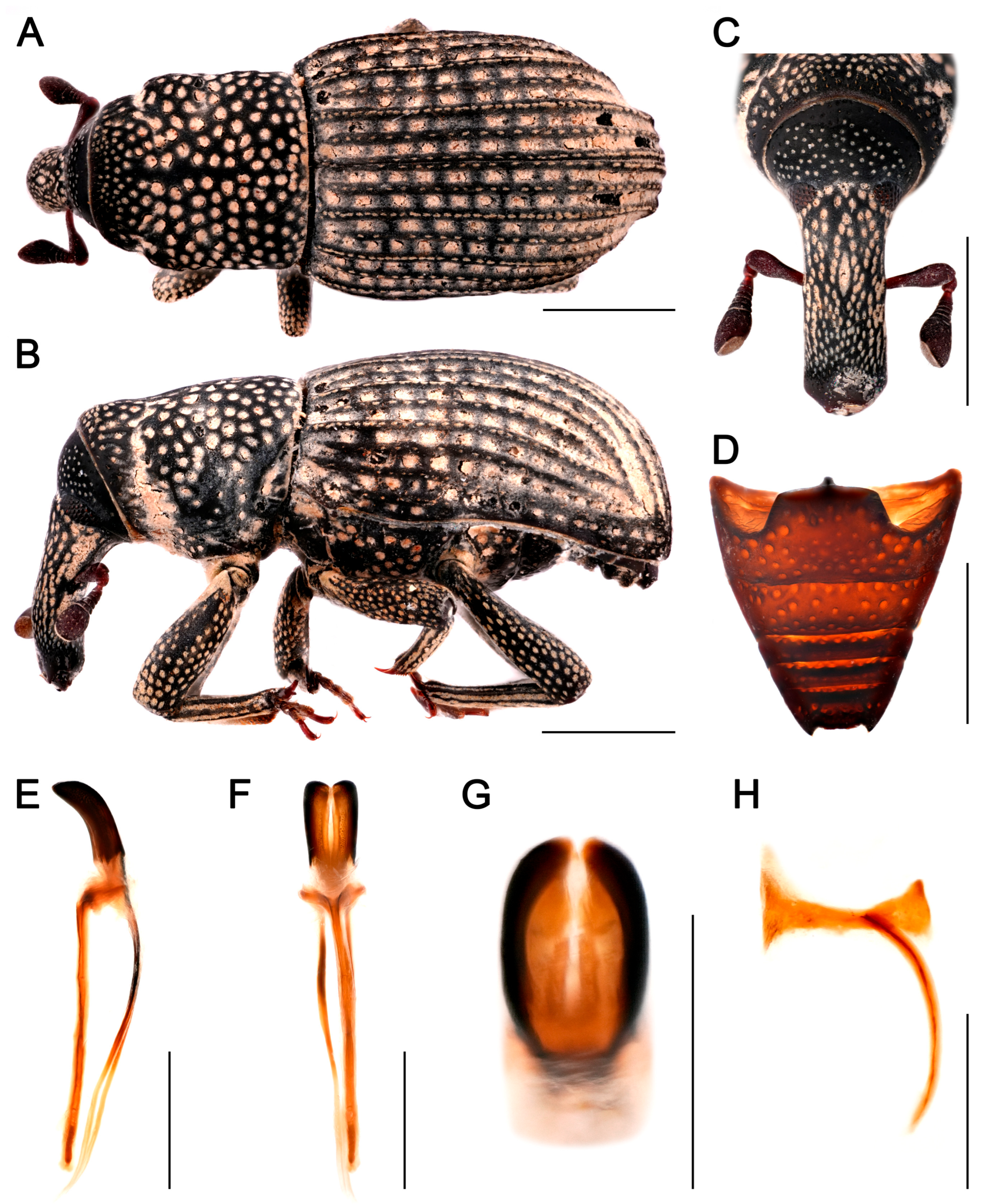
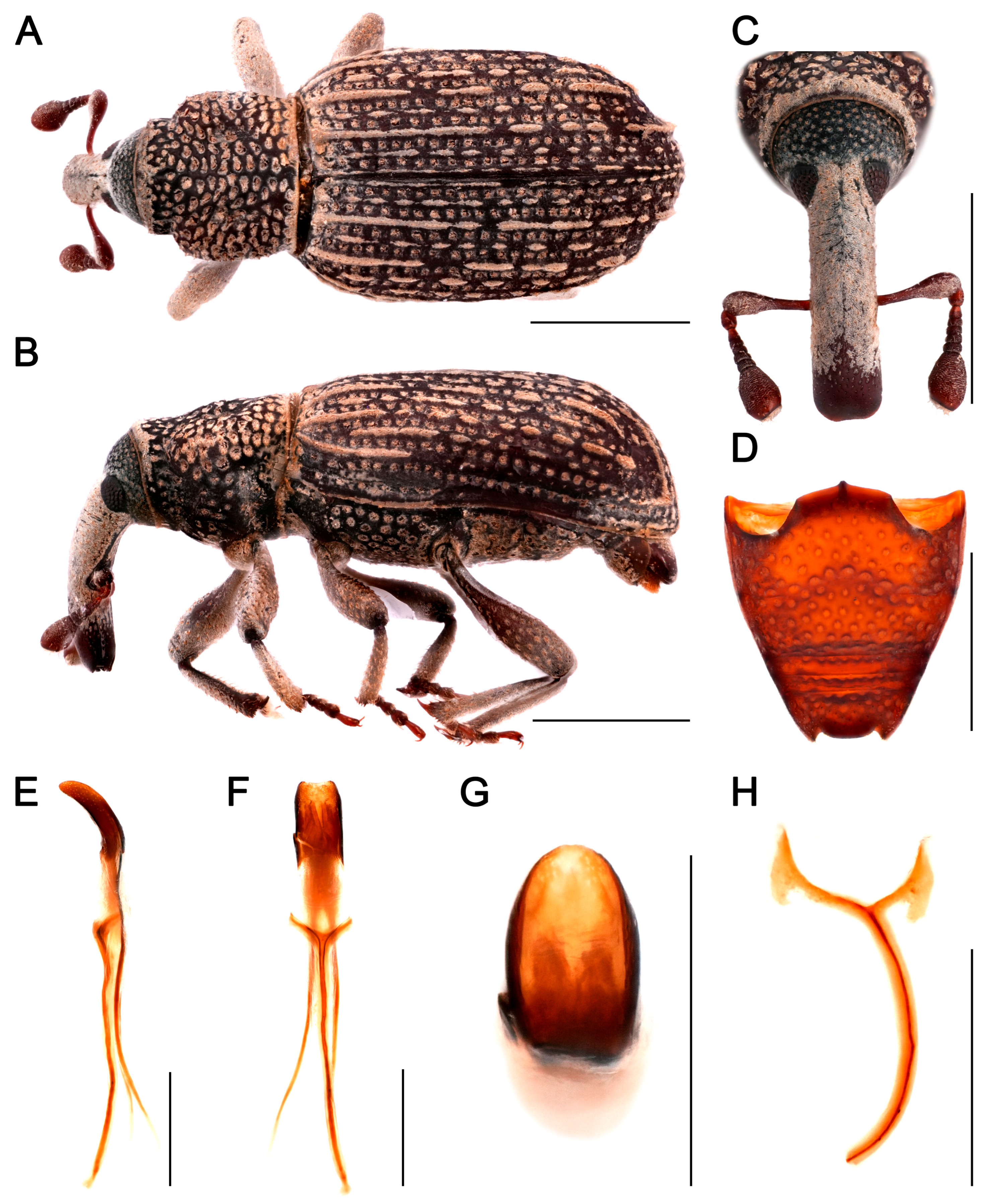
- Comparative diagnosis. O. borisi sp. nov. is most similar to O. tuberculatus Legalov, 2021 [3] but differs in the following characters: (i) smaller body (Bl: 3.50–4.30 mm vs. 5.10–5.80 mm in O. tuberculatus); (ii) antennal scape and club more slender: scape 5.0 times as long as wide, club 1.82 times as long as wide (vs. scape 4.0 times, club 1.5 times in O. tuberculatus); (iii) pronotal sides subparallel, with dense, coarse punctures (vs. sides rounded, punctures sparse, with weak median carina in O. tuberculatus); (iv) elytral interstriae as wide as striae (vs. slightly wider than striae in O. tuberculatus). O. borisi sp. nov. is geographically closest to O. medogensis and O. urceolatus sp. nov. but can be distinguished by the following characters: rostrum more slender (Rl: 1.20–1.50 mm vs. 1.05–1.40 mm in the latter two); pronotum with dense pilose pustules (vs. absent in O. medogensis and O. urceolatus sp. nov.); pilose pustules on elytral interstriae broader; and differences in male penis, female 8th sternite, and spermatheca (Figures 2E–G and 3E,H vs. Lü & Zhang [7]: Figures 1I–K, 2A–D and 3G,J for O. medogensis; and vs. Figures 8E–G and 9E,H for O. urceolatus sp. nov.).
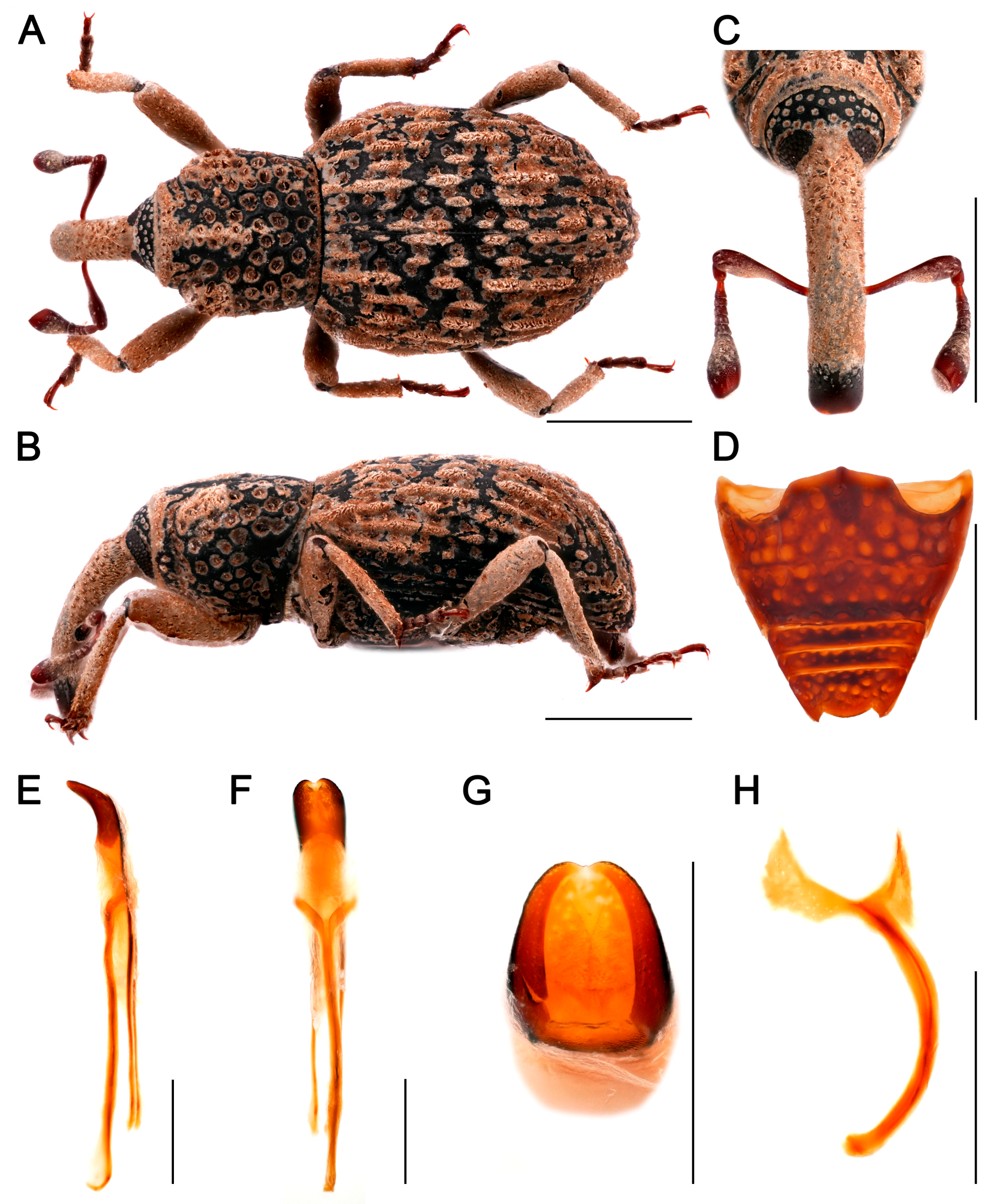
- Description. Coloration (Figure 2A,C). Body entirely black; rostral apex, antennae, and tarsomeres reddish brown.
- Head (Figure 2C). Subglobular, with dense, small punctures, with a shallow, transverse sulcus between frons and rostrum; eyes elongate-oval, widely separated ventrally; rostrum elongate (Rl/Rw 4.00), longer than pronotum (Rl/Pl 1.04), evenly curved in lateral view, base thick, with dense, short pubescence and coarse punctures from base to apical one-fourth; antennae inserted anterior to rostral mid-length; scape long (l/w 5.00), not reaching eyes, gradually broadening from base to apex, apical one-third markedly widened; funicular segments 1 and 2 elongate, segment 1 longer than wide, segment 2 funnel-shaped, length equal to combined length of segments 3 + 4, segments 3–6 transverse; club spindle-shaped (l/w 1.82).
- Pronotum (Figure 2A,B). Shorter than wide (Pl/Pw 0.95), widest at apical one-third, apical one-sixth distinctly constricted, sides rounded, gradually narrowed from apical one-third to base; disc slightly convex in lateral view, with dense, coarse punctures, distance between punctures smaller than puncture diameter, punctures sparser and smaller on constricted area than elsewhere; densely covered with short pubescence, apical with pilose pustules; postocular lobes absent.
- Scutellum. Small, subtriangular.
- Elytra (Figure 2A,B). Longer than wide (El/Ew 1.22), widest at basal one-fourth, apical one-seventh distinctly constricted, sides rounded; disc nearly flat in lateral view; interstriae slightly elevated, subequal in width, with dense, short pubescence; interstriae 1–8 bearing interrupted longitudinal pilose pustules, pustule width subequal to interstrial width; striae deep, as wide as interstriae; punctures rounded, distance between punctures subequal to a puncture diameter, punctures with dense, short pubescence.
- Abdomen (Figure 2D). Abdominal ventrites densely covered with coarse punctures, punctures on 3rd and 4th ventrites sparser than on others, punctures at margins larger than those at middle; 2nd ventrite with anterior margin slightly convex at middle, posterior margins of ventrites 2–4 rectilinear; 2nd ventrite 0.7 times length of 1st ventrite, 3rd ventrite as long as 4th ventrite, 5th ventrite 2.5 times as wide as long, deeply emarginate apically.
- Legs (Figure 2A,B). Densely covered with short pubescence; femora and tibiae with punctures; procoxae subconical, contiguous; mesocoxae narrowly separated; profemur more robust than mesofemur and metafemur; femora unarmed; profemur 4.0 times as long as wide; tibiae bearing single, long uncus; tarsi long, tarsomeres 1–3 obconical, ventrally with dense erect setae, onychium elongate; claws free, divergent.
- Male genitalia (Figure 2E–H). Pedon 0.3 times length of temones, gradually broadening from base to apical one-third, then narrowed apically, curved in lateral view, sides rounded, base symmetrical, apex thin in lateral view; temones slender, slightly curved; manubrium long, as long as temones, slightly curved from base to apex, approximately 2.0 times as wide as temones; spiculum gastrale robust, evenly curved; basal plate bifurcate, basal arms opposed, upper part of each basal arm approximately triangular, apices acute.
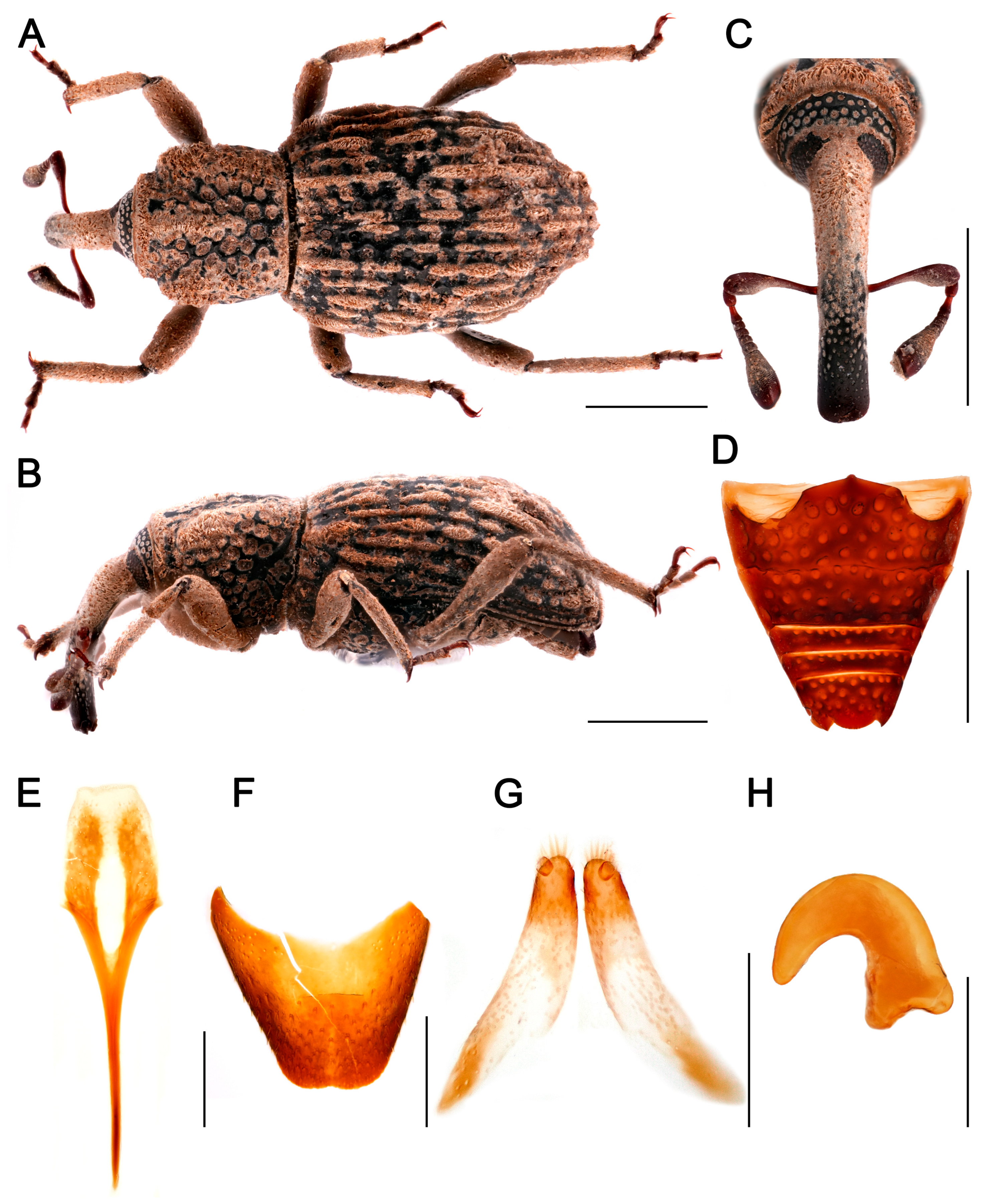
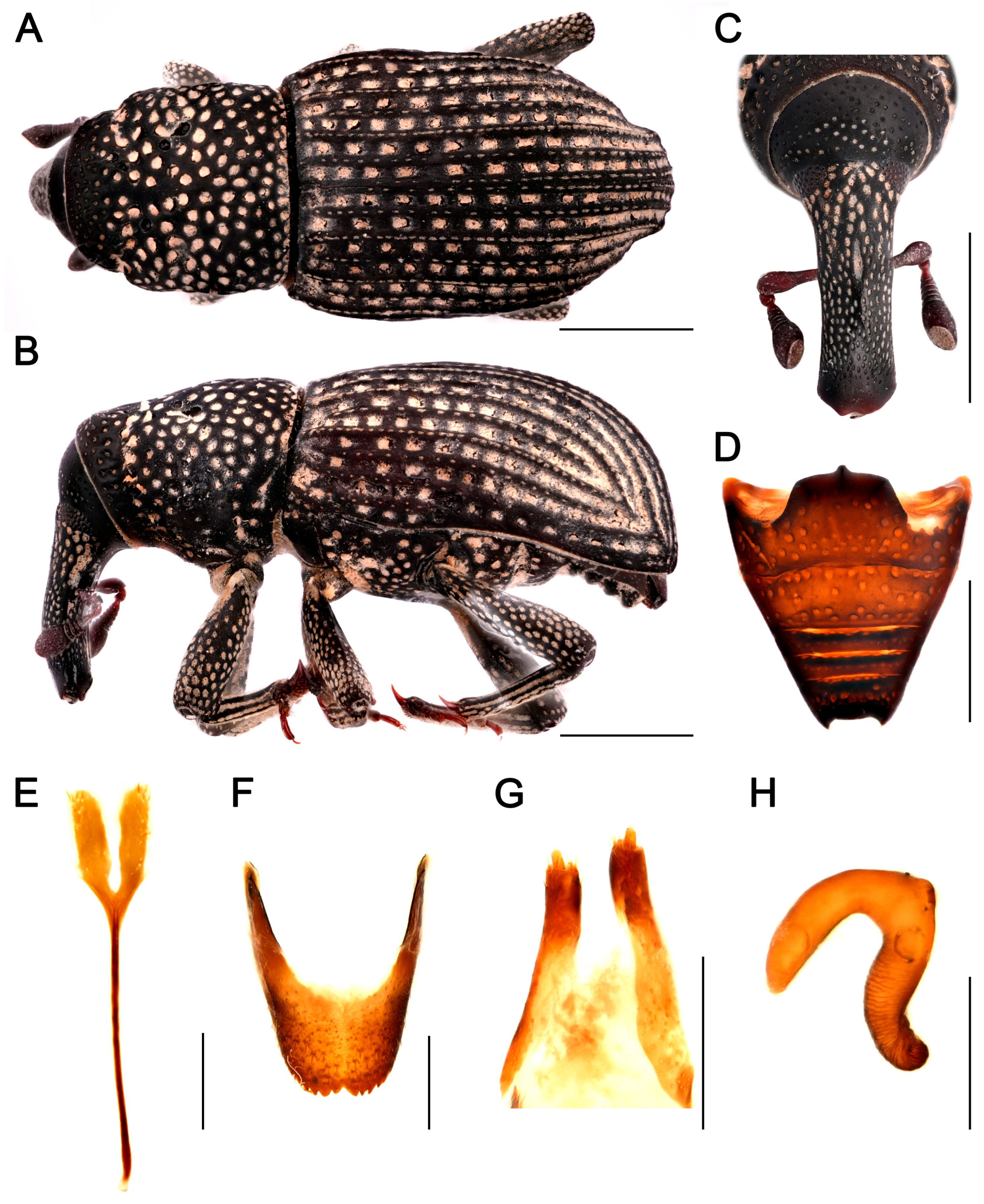
- Female (Figure 3A–H). Body larger than in male; rostrum longer, smooth and shining; antennae inserted slightly anterior to middle of rostrum; punctures on pronotum larger than in male. 8th sternite with apodeme 1.4 times length of lamina; lamina bifurcate at base, sides slightly curved, apex with setae; 8th tergite 0.9 times as long as wide, posterior margin nearly smooth, mesally deeply emarginate; surface gradually more coarsely punctate towards apex, from apical one-half to apex densely setose. Gonocoxites cylindrical, apices with dense, long setae; styli short, cylindrical, width approximately one-half width of gonocoxite apices, apices with setae; spermatheca with curved, apically rounded cornu; corpus very robust; ramus and collum weakly developed; other characters without distinct differences from male.
- Measurement (mm). Holotype. Bl: 3.55. Rl: 1.20, Rw: 0.30. Pl: 1.15, Pw: 1.20. El: 2.20, Ew: 1.80. Male paratypes. (n = 16): Bl: 3.50–4.30 (3.77). Rl: 1.23–1.50 (1.31), Rw: 0.30–0.35 (0.31). Pl: 1.10–1.40 (1.22), Pw: 1.10–1.40 (1.22). El: 2.20–2.55 (2.34), Ew: 1.70–2.20 (1.88). Female paratypes. (n = 21): Bl: 3.50–4.20 (3.81). Rl: 1.20–1.42 (1.34), Rw: 0.30–0.38 (0.34). Pl: 1.00–1.33 (1.24), Pw: 1.14–1.40 (1.26). El: 2.10–2.70 (2.36), Ew: 1.65–2.10 (1.88).
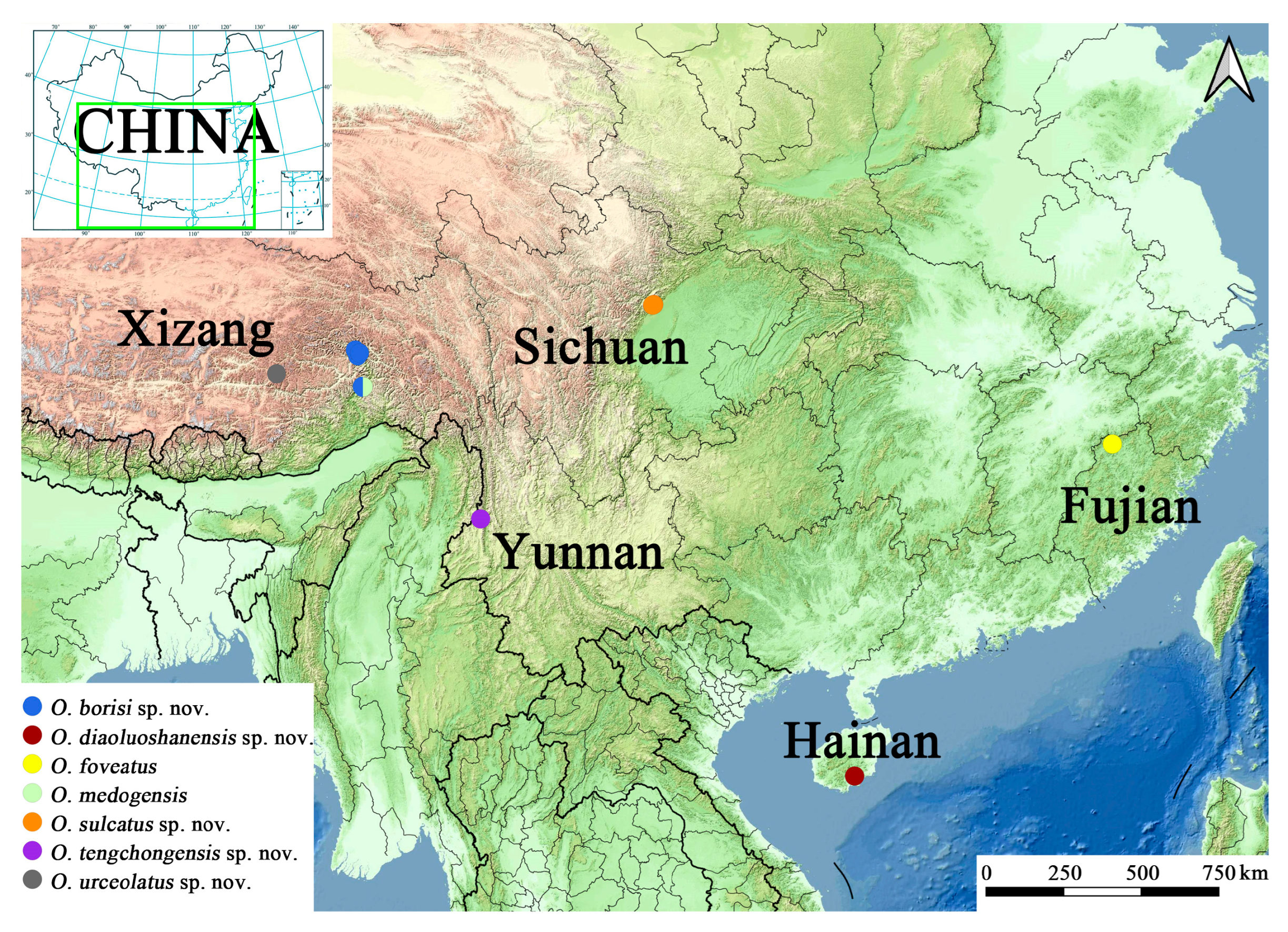
- Distribution. Bayi District, Bomi County, and Medog County, Linzhi City, Xizang Autonomous Region, China (Figure 10).
- Etymology. The specific epithet is in honor of Dr. Boris A. Korotyaev, the Russian curculionidologist who made great contributions on the taxonomy of Curculionidae and helped us in many ways.
3.2.2. Orthosinus diaoluoshanensis Lü & Zhang sp. nov.
- urn:lsid:zoobank.org:act:4DDD74CF-2040-485D-A5C2-50D72B8F1766
- Material examined. Holotype: 1♂, China, Hainan Province, Lingshui County, Diao Luo Mountain, elev. 920 m, 04/V/2007, Zongyi Zhao leg. IOZ(E) 1854450.
- Type locality. Diaoluo Mountain, Lingshui County, Hainan Province, China.
- Comparative diagnosis. O. diaoluoshanensis sp. nov. morphologically is most similar to O. foveatus, but distinguished by: (i) larger body (Bl: 4.40 mm vs. 3.50 mm in O. foveatus); (ii) rostrum shorter than pronotum (vs. subequal in O. foveatus); (iii) antennal club stouter (l/w 1.67 vs. almost 2.00 in O. foveatus); (iv) pronotum as long as wide, widest at middle, disc with coarse punctures not forming rugae (vs. longer than wide, widest at apical one-third, punctures forming longitudinal rugae medially in O. foveatus).
- Description. Coloration (Figure 4A,B). Body entirely black; antennae and tarsomeres reddish brown.
- Head (Figure 4C). Subglobular, with dense, small punctures, with a shallow, transverse sulcus between frons and rostrum; eyes oval, widely separated ventrally; rostrum elongate (Rl/Rw 3.16), shorter than pronotum (Rl/Pl 0.95), evenly curved in lateral view, base convex, with dense, short pubescence and coarse punctures from base to apical one-fourth, dorsally with short, indistinct longitudinal carina; antennae inserted posterior to rostral mid-length; scape long (l/w 3.82), not reaching eyes, gradually broadening from base to apex; funicular segments 1 and 2 elongate, segment 1 longer than wide, segment 2 funnel-shaped, length equal to combined length of segments 3 + 4, segments 3–6 transverse; club spindle-shaped (l/w 1.60).
- Pronotum (Figure 4A,B). As long as wide (Pl/Pw 1.00), widest at middle, apical one-fifth distinctly constricted, sides subparallel; disc distinctly convex in lateral view, with dense, coarse punctures, distance between punctures much smaller than puncture diameter, punctures sparser and smaller on constricted area than elsewhere; densely covered with short pubescence, anterior margin without pilose pustules; postocular lobes absent.
- Scutellum. Small, elongate-oval.
- Elytra (Figure 4A,B). Longer than wide (El/Ew 1.19), widest at basal one-third, with small arcuate tubercles laterally, distinctly constricted at apical one-fourth, sides rounded; disc distinctly convex in lateral view; interstriae elevated, subequal in width, with dense, short pubescence; interstriae 1, 3 and 5 have more continuous pubescence, from apical one-third to apex denser than on other interstriae; striae deep, wider than interstriae; punctures rounded, distance between punctures smaller than a puncture diameter, punctures with dense, short pubescence.
- Abdomen (Figure 4D). Abdominal ventrites covered with coarse punctures, punctures on 3rd and 4th ventrites sparser than on others, punctures at margins slightly larger than those at middle; 2nd ventrite with anterior margin nearly rectilinear at middle, posterior margins of ventrites 2–4 rectilinear; 2nd ventrite 0.5 times length of 1st ventrite, 3rd ventrite as long as 4th ventrite, 5th ventrite 2.4 times as wide as long, deeply emarginate apically.
- Legs (Figure 4A,B). Densely covered with short pubescence; femora and tibiae with punctures; procoxae subconical, contiguous; mesocoxae narrowly separated; profemur more robust than mesofemur and metafemur; femora unarmed; profemur 3.3 times as long as wide; tibiae bearing single, long uncus; tarsi long, tarsomeres 1–3 obconical, ventrally with dense erect setae, onychium elongate; claws free, divergent.
- Male genitalia (Figure 4E–H). Pedon 0.3 times length of temones, gradually broadening from base to middle, then narrowed apically, curved in lateral view, sides rounded, base symmetrical, apex thin in lateral view; temones slender, distinctly curved; manubrium long, slightly curved, as long as temones, approximately 1.8 times as wide as temones; spiculum gastrale robust, evenly curved, widest at middle; basal plate bifurcate, basal arms slender, opposed, apices acute.
- Female. unknown.
- Measurement (mm). Holotype. Bl: 3.60. Rl: 1.14, Rw: 0.40. Pl: 1.20, Pw: 1.20. El: 2.20, Ew: 1.85.
- Distribution. Known only from the type locality in Hainan Province, China (Figure 10).
- Etymology. The new species is named after its type locality, Diaoluo Mountain. Adjective, variable.
3.2.3. Orthosinus sulcatus Lü & Zhang sp. nov.
- urn:lsid:zoobank.org:act:A999C28C-889F-447B-BDDA-C25DB92E7F3C
- Material examined. Holotype: 1♂, China, Sichuan Province, Chengdu City, Pengzhou City, Longmenshan Township, Jiufeng Village, Group 16, Dengdengshi, 31.340591° N, 103.883525° E, elev. 1362 m, 08/VIII/2018, Xiaoliang Yang leg. IOZ(E) 1965746. Paratypes: 10♂♂5♀♀, same data as holotype, IOZ(E) 1965734–1965745, IOZ(E) 1965747, IOZ(E) 1965749, IOZ(E) 1965750. 1♂, Sichuan Province, Chengdu City, Pengzhou City, Longmenshan Township, Zushi Hall, 31.326005° N, 103.85487° E, elev. 1902 m, 09/VIII/2018, Xiaoliang Yang leg. IOZ(E) 1965748.
- Type locality. Dengdengshi, Group 16, Jiufeng Village, Longmenshan Township, Pengzhou City, Chengdu City, Sichuan Province, China.
- Comparative diagnosis. O. sulcatus sp. nov. resembles O. medogensis but differs in the following characters: (i) head with small punctures, while large in O. medogensis; (ii) rostrum with coarse punctures, dorsally with a subrhomboidal sulcus at middle, versus rugose punctures, without subrhomboidal sulcus in O. medogensis; (iii) elytral lateral margin without arcuate tubercles, versus with small arcuate tubercles in O. medogensis; (iv) pedon apically thick, medially not connate in dorsal view, whereas thin, connate in O. medogensis; (v) spiculum gastrale with furcal arm broader at base than in O. medogensis; (vi) 8th sternite with apodeme 2.3 times length of lamina, lamina sides nearly straight (vs. 1.7 times, lamina sides curved in O. medogensis); (vii) styli approximately one-third width of gonocoxite apices (vs. one-half in O. medogensis); (viii) spermatheca with corpus longer than in O. medogensis.
- Description. Coloration (Figure 5A,B). Body entirely black; antennal scape and funicle, club black; tarsomeres reddish brown.
- Head (Figure 5C). Subglobular, with dense, small punctures, with a shallow, transverse sulcus between frons and rostrum; eyes elongate-oval, widely separated ventrally; rostrum elongate (Rl/Rw 2.50), shorter than pronotum (Rl/Pl 0.73), slightly curved in lateral view, base thick, with short pubescence and coarse punctures from base to apical one-fourth, dorsally with a subrhomboidal sulcus at middle; antennae inserted at middle of rostrum; scape long (l/w 3.00), not reaching eyes, gradually broadening from base to apex; funicular segment 1 longer than wide, segment 2 funnel-shaped, length equal to combined length of segments 3 + 4, segments 3–6 transverse; club spindle-shaped (l/w 1.5).
- Pronotum (Figure 5A,B). Longer than wide (Pl/Pw 1.13), widest posterior to mid-length, apical one-fourth distinctly constricted, sides subparallel; disc slightly convex in lateral view, with dense, coarse punctures, distance between punctures smaller than puncture diameter, punctures sparser and smaller on constricted area than on lateral part; densely covered with short pubescence, anterior margin without pilose pustules; postocular lobes absent.
- Scutellum. Small, elongate-oval.
- Elytra (Figure 5A,B). Longer than wide (El/Ew 1.30), widest at middle, apical 1/6 distinctly constricted, sides rounded; disc slightly convex in lateral view; interstriae distinctly elevated, subequal in width, with dense, short pubescence; interstriae 3 and 5 with pubescence denser than on other interstriae; striae deep, as wide as interstriae; punctures elongate-oval, gradually diminishing apically, distance between punctures subequal to a puncture length, punctures with dense short pubescence.
- Abdomen (Figure 5D). Abdominal ventrites densely covered with coarse punctures, marginal punctures larger than on median area; 2nd ventrite with anterior margin slightly convex at middle, posterior margins of ventrites 2–4 rectilinear; 2nd ventrite 0.5 times length of 1st ventrite, 3rd ventrite as long as 4th ventrite, 5th ventrite 2.8 times as wide as long, deeply emarginate apically.
- Legs (Figure 5A,B). Densely covered with short pubescence; femora and tibiae with punctures; procoxae subconical, contiguous, mesocoxae narrowly separated; profemur more robust than mesofemur and metafemur; femora unarmed; profemur 3.3 times as long as wide; tibiae bearing single, long uncus; tarsi long, tarsomeres 1–3 obconical, ventrally with dense erect setae, onychium elongate; claws free, divergent.
- Male genitalia (Figure 5E–H). Pedon 0.3 times length of temones, evenly curved in lateral view, sides subparallel, base symmetrical, apex distinctly narrowed, medially not connate in dorsal view; temones slender, distinctly curved; manubrium long, shorter than temones, slightly curved, approximately 2.0 times as wide as temones; spiculum gastrale robust, evenly curved; basal plate bifurcate, basal arms opposed, each furcal arm basally broad, apices acute.
- Female (Figure 6A–H). Body larger than in male; rostrum longer and slenderer, smooth and shining; punctures on pronotum smaller than in male; antennae inserted slightly anterior to middle of rostrum. 8th sternite with apodeme 2.3 times length of lamina; lamina bifurcate at base, sides nearly straight, apex with setae; 8th tergite 1.3 times as long as wide, posterior margin serrate, mesally deeply emarginate; surface gradually more coarsely punctate towards apex, from apical one-half to apex densely setose. Gonocoxites cylindrical, apices with dense setae; styli short, cylindrical, width approximately one-third width of gonocoxite apices, apices with setae; spermatheca falciform, with curved, apically rounded cornu; corpus robust; ramus and collum weakly developed; other characters without distinct differences from male.
- Measurement (mm). Holotype. Bl: 4.65. Rl: 1.25, Rw: 0.50. Pl: 1.71, Pw: 1.51. El: 2.70, Ew: 2.08. Male paratypes. (n = 11): Bl: 3.82–4.60 (4.22). Rl: 1.08–1.26 (1.16), Rw: 0.40–0.50 (0.46). Pl: 1.40–1.70 (1.55), Pw: 1.25–1.50 (1.27). El: 2.10–2.67 (2.44), Ew: 1.73–2.05 (1.88). Female paratypes. (n = 5): Bl: 3.70–4.85 (4.35). Rl: 1.10–1.40 (1.28), Rw: 0.40–0.50 (0.45). Pl: 1.40–1.80 (1.56), Pw: 1.15–1.60 (1.39). El: 2.10–2.80 (2.55), Ew: 1.64–2.10 (1.88).
- Distribution. Known only from the type locality in Sichuan Province, China (Figure 10).
- Etymology. The species name is a Latin masculine adjective sulcatus, referring to the rostrum bearing an oval sulcus dorsally. Variable.
- DNA barcode.
- AACTCTATATTTTTTTCTCGGAACTTGGGCAGGTATAATTGGAACCTCTCTAAGATTGTTAATTCGCTTAGAACTAGGAAATCCAGGTTCATTAATTGGAAATGATCAAATCTATAATACCATCGTTACAGCTCATGCTTTTATTATAATTTTCTTTATAGTTATACCAATTATAATTGGAGGATTTGGAAACTGATTAATTCCTCTTATATTAGGAGCTCCCGATATAGCTTTTCCACGACTCAATAATTTAAGATTTTGAATTCTCCCCCCCTCTTTAATTCTTCTAGCTTCAAGAAGAGCTATCGAAAGAGGGGCAGGCACAGGATGAACTGTTTATCCTCCGCTTTTCATCTAATACAGCACATAGAGGGGCGCCAGTTGATTTAGCCATCTTCAGCTTACATATAGCAGGAATTTCTTCCATTCTGGGAGCCATTAATTTTATTTCTACAGCTATTAATATACGACCAAGAGGAATATTCTCTGAACGTTTAACACTTTTTATTTGAGCAGTTAGAATTACAGCTCTTTTACTACTTCTATCTCTCCCAGTTCTTGCAGGAGCTATTACTATGCTACTCACTGACCGAAATATTAATACTTCCTTCTTTGACCCTACAGGAGGAGGAGATCCAATTCTTTACCAACATCTATTC (GenBank accession number: PZ092819).
3.2.4. Orthosinus tengchongensis Lü & Zhang sp. nov.
- urn:lsid:zoobank.org:act:A6317B03-4BA1-4573-AFB0-5B1F69AF3386
- Material examined. Holotype: 1♂, China, Yunnan Province, Tengchong City, Jietou Township, Datang Village, 25.73939° N, 98.69633° E, elev. 2010 m, 14/V/2006, Hongbin Liang leg. IOZ(E) 1965721. Paratype: 1♂, same data as holotype, IOZ(E) 1965722.
- Type locality. Datang Village, Jietou Township, Tengchong City, Yunnan Province, China.
- Comparative diagnosis. O. tengchongensis sp. nov. morphologically is most similar to O. medogensis, but distinguished by: (i) larger body (Bl: 4.20–4.40 mm, Bw: 1.83–2.03 mm vs. Bl: 3.50–4.40 mm, Bw: 1.50–1.80 mm in O. medogensis); (ii) rostrum with coarse punctures, versus rugose punctures in O. medogensis; (iii) pronotal sides subparallel, whereas rounded in O. medogensis; (iv) elytral interstriae 1 and 3 with pubescence projecting beyond outline apically, whereas in O. medogensis not projecting; (v) pedon 0.2 times length of temones, medially convex in dorsal view, manubrium slightly shorter than temones, approximately 1.6 times as wide as temones, while pedon 0.3 times length of temones, medially nearly straight in dorsal view, manubrium as long as temones, approximately 2.0 times as wide as temones in O. medogensis.
- Description. Coloration (Figure 7A,B). Body entirely black; antennae and tarsomeres reddish brown.
- Head (Figure 7C). Subglobular, with dense, small punctures, with a shallow, transverse sulcus between frons and rostrum; eyes oval, widely separated ventrally; rostrum elongate (Rl/Rw 2.40), shorter than pronotum (Rl/Pl 0.73), slightly curved in lateral view, base thick, with short pubescence and coarse punctures from base to apical one-fourth, dorsally with short, indistinct longitudinal carina; antennae inserted at middle of rostrum; scape long (l/w 3.73), not reaching eyes, gradually broadening from base to apex; funicular segment 1 longer than wide, segment 2 funnel-shaped, length equal to combined length of segments 3 + 4, segments 3–6 transverse; club spindle-shaped (l/w 1.50).
- Pronotum (Figure 7A,B). Longer than wide (Pl/Pw 1.24), widest posterior to mid-length, apical one-fourth distinctly constricted, sides subparallel; disc slightly convex in lateral view, with dense, coarse punctures, distance between punctures smaller than puncture diameter, punctures sparser on constricted area than lateral part; densely covered with short pubescence, anterior margin with pilose pustules; postocular lobes absent.
- Scutellum. Small, subtriangular.
- Elytra (Figure 7A,B). Longer than wide (El/Ew 1.32), widest at middle, distinctly constricted subapically, sides rounded; disc nearly flat in lateral view; interstriae distinctly elevated, subequal in width, with dense, short pubescence; interstriae 1, 3 and 5 have more continuous pubescence, pubescence on interstriae 1, 3 and 5 distinctly denser than on other interstriae from apical one-third to apex; pubescence on interstriae 1 and 3 projecting beyond elytral outline apically; striae deep, as wide as interstriae; punctures elongate-oval, gradually diminishing apically, distance between punctures subequal to a puncture length, punctures with dense short pubescence.
- Abdomen (Figure 7D). Abdominal ventrites densely covered with coarse punctures, marginal punctures larger than on median area; 2nd ventrite with anterior margin slightly convex at middle, posterior margins of ventrites 2–4 rectilinear; 2nd ventrite 0.7 times length of 1st ventrite, 3rd ventrite as long as 4th ventrite, 5th ventrite 2.2 times as wide as long, deeply emarginate apically.
- Legs (Figure 7A,B). Densely covered with short pubescence; femora and tibiae with punctures; procoxae subconical, contiguous, mesocoxae narrowly separated; profemur more robust than mesofemur and metafemur; femora unarmed; profemur 2.6 times as long as wide; tibiae bearing single, long uncus; tarsi long, tarsomeres 1–3 obconical, ventrally with dense erect setae, onychium elongate; claws free, divergent.
- Male genitalia (Figure 7E–H). Pedon 0.2 times length of temones, evenly curved in lateral view, sides subparallel, base symmetrical, apex distinctly narrowed, medially convex in dorsal view; temones slender, distinctly curved; manubrium long, shorter than temones, slightly curved at basal 1/3, approximately 1.6 times as wide as temones; spiculum gastrale robust, slightly curved; basal plate bifurcate, basal arms opposed, apices acute.
- Female. unknown.
- Measurement (mm). Holotype. Bl: 4.40. Rl: 1.20, Rw: 0.50. Pl: 1.64, Pw: 1.32. El: 2.68, Ew: 2.03. Male paratype. Bl: 4.20. Rl: 1.06, Rw: 0.47. Pl: 1.58, Pw: 1.30. El: 2.46, Ew: 1.83.
- Distribution. Known only from the type locality in Yunnan Province, China (Figure 10).
- Etymology. This species is named after its type locality, Tengchong City. Adjective, variable.
3.2.5. Orthosinus urceolatus Lü & Zhang sp. nov.
- urn:lsid:zoobank.org:act:DD676314-D442-4823-8D1C-19EF8CABD658
- Material examined. Holotype: 1♂, China, Xizang, Linzhi City, Bayi District, G318 Highway (near Sejila Mountain Pass), 29.56165° N, 92.57520° E, elev. 3852 m, 29/VII/2018, Run Zhou leg. IOZ(E) 1965760. Paratypes: 5♂♂9♀♀, same data as holotype, IOZ(E) 1965751–1965756, IOZ(E) 1965758, IOZ(E) 1965759, IOZ(E) 1965761–1965764, IOZ(E) 1965766, IOZ(E) 1965767.
- Type locality. G318 Highway (near Sejila Mountain Pass), Bayi District, Linzhi City, Xizang Autonomous Region, China.
- Comparative diagnosis. O. urceolatus sp. nov. is distinctive in having an urceolate pronotum, a character unique within the genus. It is most similar to O. himalayanus (Marshall, 1931) in general morphology, but differs in the following characters: (i) body wider (Bw: 1.55–1.80 mm vs. 1.20–1.50 mm in O. himalayanus); (ii) eyes larger, longer than shortest side of club (vs. as long in O. himalayanus); (iii) rostrum shorter than pronotum in both sexes (vs. female as long, male shorter in O. himalayanus); (iv) antennal funicular segment 2 shorter than combined length of segments 3 + 4 (vs. equal in O. himalayanus); (v) elytra widest at middle (vs. basal one-third in O. himalayanus).
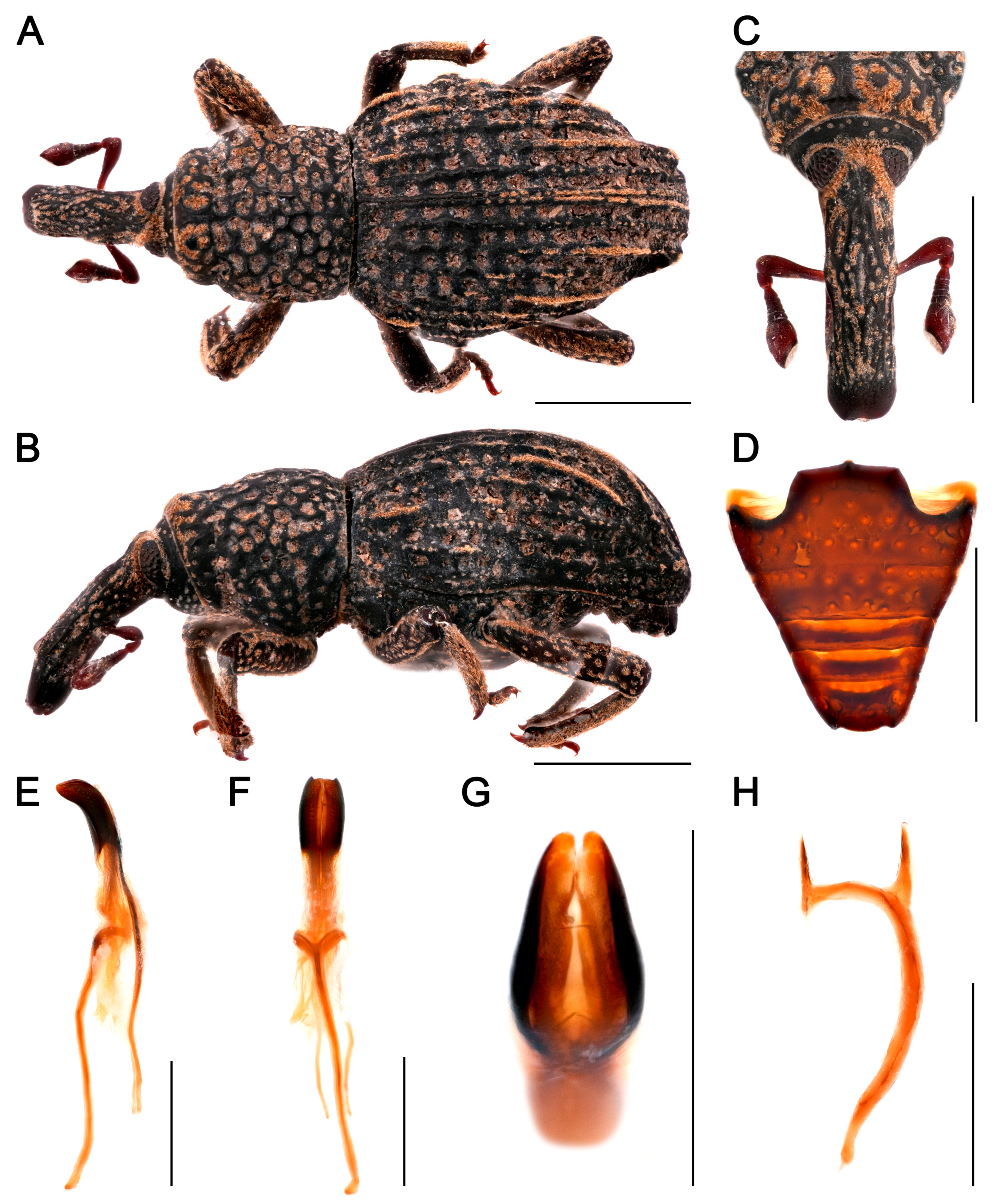
- Description. Coloration (Figure 8A,B). Body entirely black; rostral apex, pronotum, and elytra dark reddish brown; antennae and tarsomeres reddish brown.
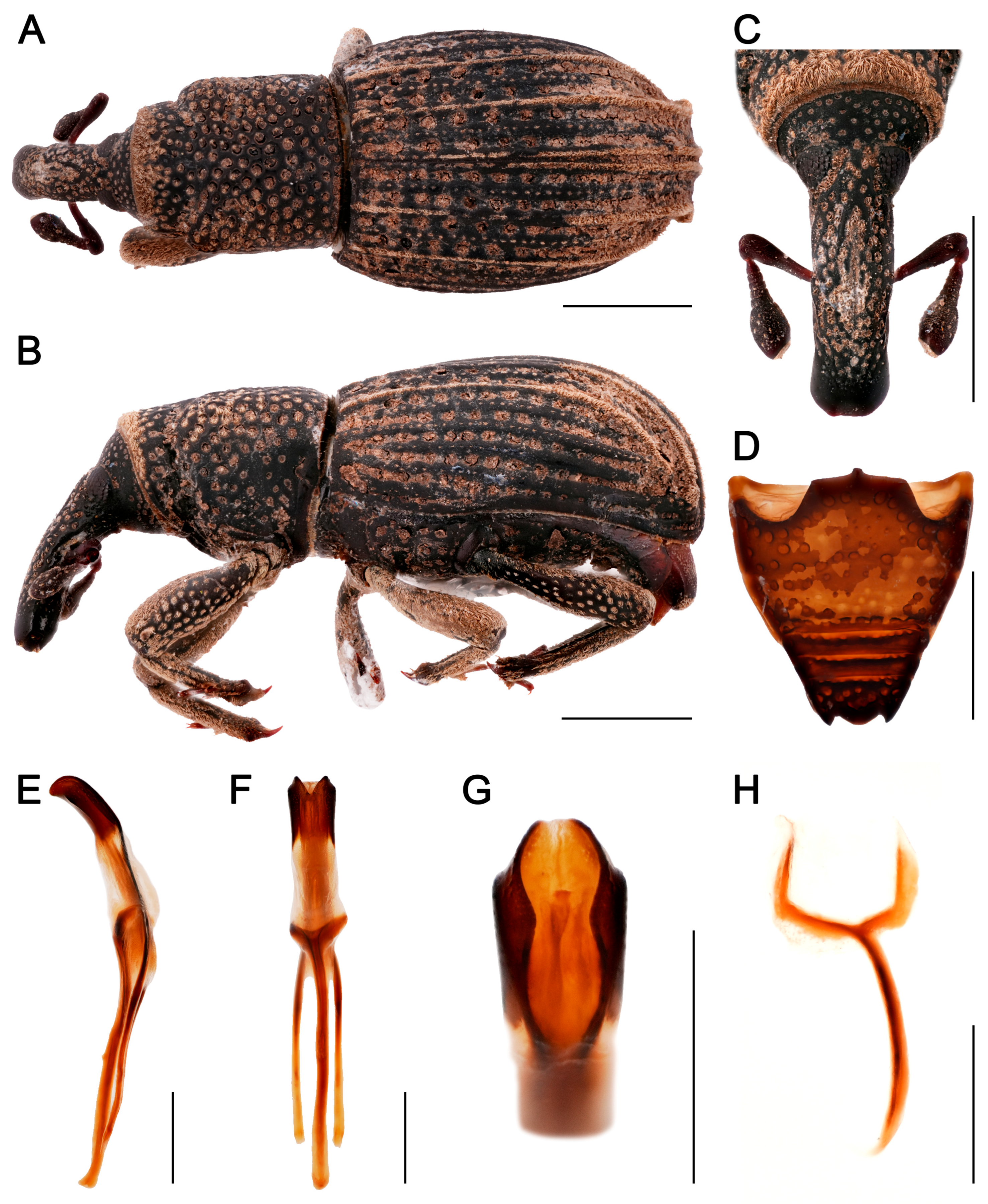
- Head (Figure 8C). Subglobular, with dense, small punctures, with a shallow, transverse sulcus between frons and rostrum; eyes oval, widely separated ventrally; rostrum elongate (Rl/Rw 2.89), longer than pronotum (Rl/Pl 1.05), curved in lateral view, base thick, with dense, short pubescence and coarse punctures from base to apical one-fourth; antennae inserted anterior to rostral mid-length; scape long (l/w 3.13), not reaching eyes, gradually broadening from base to apex; funicular segment 1 longer than wide, segment 2 funnel-shaped, length shorter than combined length of segments 3 + 4, segments 3–6 transverse; club spindle-shaped (l/w 1.50).
- Pronotum (Figure 8A,B). Shorter than wide (Pl/Pw 0.95), widest at middle, apical one-fifth distinctly constricted, gradually narrowed from apical one-third to base; disc slightly convex in lateral view, with dense, coarse punctures, distance between punctures smaller than puncture diameter, punctures sparser and smaller on constricted area than on lateral part; densely covered with short pubescence, apical with pilose pustules; with one broad oval sulcus on each side of the middle; postocular lobes absent.
- Scutellum. Small, elongate-oval.
- Elytra (Figure 8A,B). Longer than wide (El/Ew 1.46), widest at middle, apical one-seventh slightly constricted, sides rounded; disc flat in lateral view; interstriae slightly elevated, subequal in width, with dense, short pubescence; interstriae 3 and 5 with pubescence denser than on other interstriae, forming continuous pilose pustules; striae deep, as wide as interstriae; punctures rounded, distance between punctures subequal to a puncture diameter, punctures with dense, short pubescence.
- Abdomen (Figure 8D). Abdominal ventrites densely covered with coarse punctures, marginal punctures larger than on median area; 2nd ventrite with anterior margin slightly convex at middle, posterior margins of ventrites 2–4 rectilinear; 2nd ventrite 0.8 times length of 1st ventrite, 3rd ventrite as long as 4th ventrite, 5th ventrite 2.7 times as wide as long, deeply emarginate apically.
- Legs (Figure 8A,B). Densely covered with short pubescence; femora and tibiae with punctures; procoxae subconical, contiguous; mesocoxae narrowly separated; profemur more robust than mesofemur and metafemur; femora unarmed; profemur 2.8 times as long as wide; tibiae bearing single, long uncus; tarsi long, tarsomeres 1–3 obconical, ventrally with dense erect setae, onychium elongate; claws free, divergent.
- Male genitalia (Figure 8E–H). Pedon 0.3 times length of temones, evenly curved in lateral view, sides subparallel, base symmetrical, apex distinctly narrowed; temones slender, distinctly curved; manubrium long, as long as temones, distinctly curved from base to apex, approximately 1.5 times as wide as temones; spiculum gastrale robust, evenly curved; basal plate bifurcate, basal arms opposed, upper part of each basal arm approximately triangular, apices with rounded angles.
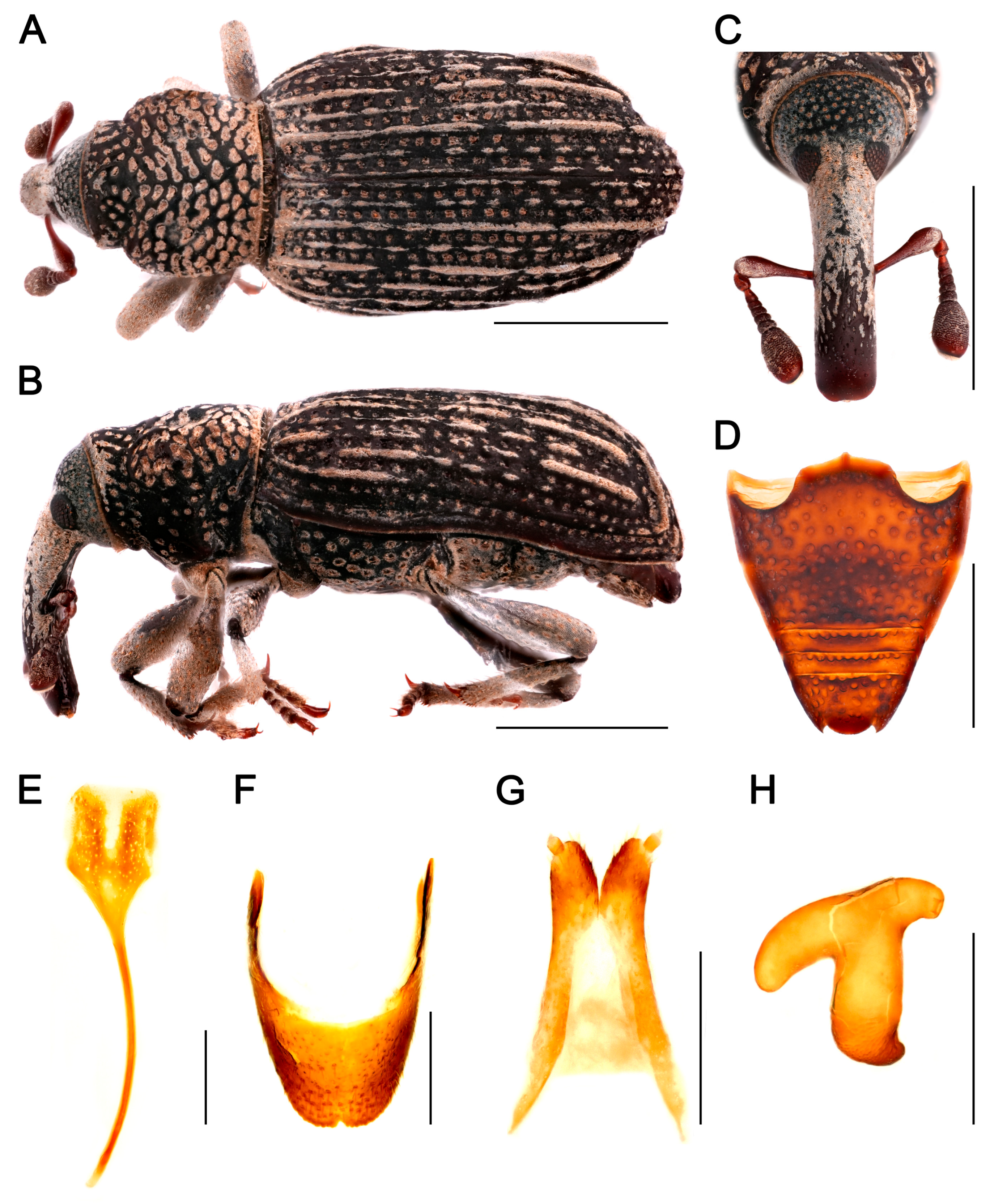
- Female (Figure 9A–H). Body larger than in male, some individuals with body coloration darker than in male, pronotum and elytra black; rostrum longer and slenderer, smooth and shining; antennae inserted slightly anterior to middle of rostrum; abdominal ventrites narrower than in male. 8th sternite with apodeme 2.5 times length of lamina; lamina bifurcate at base, sides nearly straight, apex with setae; 8th tergite 1.5 times as long as wide, posterior margin serrate, mesally deeply emarginate; surface gradually more coarsely punctate towards apex, from apical one-half to apex densely setose. Gonocoxites cylindrical, apices with dense setae; styli short, cylindrical, width approximately one-third width of gonocoxite apices, apices with setae; spermatheca falciform, with curved, apically rounded cornu; corpus very robust; ramus and collum developed; other characters without distinct differences from male.
- Measurement (mm). Holotype. Bl: 3.78. Rl: 1.10, Rw: 0.38. Pl: 1.05, Pw: 1.10. El: 2.40, Ew: 1.64. Male paratypes. (n = 5): Bl: 3.45–4.00 (3.76). Rl: 1.05–1.15 (1.07), Rw: 0.34–0.40 (0.39). Pl: 1.04–1.10 (1.06), Pw: 1.04–1.10 (1.08). El: 2.20–2.60 (2.45), Ew: 1.58–1.70 (1.63). Female paratypes. (n = 9): Bl: 3.50–4.10 (3.78). Rl: 1.08–1.25 (1.13), Rw: 0.30–0.38 (0.34). Pl: 1.00–1.15 (1.08), Pw: 1.05–1.20 (1.11). El: 2.30–2.70 (2.42), Ew: 1.55–1.80 (1.61).
- Distribution. Known only from the type locality in Xizang Autonomous Region, China (Figure 10).
- Etymology. The species name is a Latin masculine adjective urceolatus, referring to the pronotum with an urceolate shape. Variable.
- DNA barcode.
- TACCCTTTATTTTATTTTCGGGACTTGATCTGGTATAATCGGAACATCCCTAAGAATGCTTATTCGTATAGAACTAGGAAGACCAGGCTCTCTAATTGGAAATGATCAAATTTACAACACTATTGTCACAGCCCATGCCTTCATTATAATTTTTTTTATAGTTATACCCATTATGATTGGCGGCTTCGGTAATTGATTAGTACCTTTAATATTAGGAGCTCCTGATATAGCCTTTCCACGACTTAATAATATAAGATTTTGGCTCCTTCCCCCCTCCTTAATCTTACTTATTATAAGAAGAATTATTGAAAGGGGGGCAGGAACTGGATGAACAGTTTATCCTCCACTTTCATCAAACACAGCCCATAGCGGAGCTCCTGTAGATCTAGCTATTTTCAGGCTTCACATAGCAGGAATTTCCTCCATTCTAGGAGCTATTAATTTTATTTCTACAGCCATCAATATACGTCCAAGAGGTATATTTTCTGAACGTTTATCTCTATTCATTTGAGCAGTAGCAATCACAGCCCTCCTCCTACTACTTTCCCTCCCAGTTTTAGCAGGAGCAATCACCATACTTTTAACCGATCGAAATATTAATACCTCATTCTTTGATCCTACAGGAGGGGGAGACCCAATTCTCTATCAACACCTATTC (GenBank accession number: PZ092820).
3.2.6. Key to Species of the Genus Orthosinus in China
- 1. Rostrum dorsally without a subrhomboidal sulcus at middle.................................................... 2
- – Rostrum dorsally with a subrhomboidal sulcus at middle.
- Additional characters: Rostrum shorter than pronotum. Pronotum anterior margin without pilose pustules. Elytra without interrupted pilose pustules; interstrial pubescence not fasciculate. Pedon medially not connate in dorsal view. Body length 3.70–4.85 mm, width 1.25–2.10 mm.............................................................................................................................. O. sulcatus sp. nov.
- 2. Rostrum shorter than or as long as pronotum................................................................................ 3
- – Rostrum longer than pronotum.......................................................................................................... 6
- 3. Pronotum widest at middle................................................................................................................ 4
- – Pronotum widest at apical one-third.
- Additional characters: Rostrum as long as pronotum, with fine punctures. Antennal club 2.0 times as long as wide. Elytra with arcuate tubercles laterally. Body length 3.50 mm............................................................................................................................................. O. foveatus
- 4. Pronotum longer than wide.............................................................................................................. 5
- – Pronotum as long as wide.
- Additional characters: Pronotum with very coarse punctures, anterior margin without pilose pustules. Rostrum dorsally with indistinct longitudinal carina. Elytra with small arcuate tubercles laterally; disc distinctly convex in lateral view. Body length 3.60 mm, width 1.85 mm.................................................................. O. diaoluoshanensis sp. nov.
- 5. Rostrum with coarse punctures. Pronotal sides subparallel. Elytral interstriae 1 and 3 with pubescence projecting beyond outline apically. Pedon 0.2 times length of temones, medially convex in dorsal view; manubrium slightly shorter than temones, approximately 1.6 times as wide as temones. Body length 4.20–4.40 mm, width 1.83–2.03 mm................................................................................................................. O. tengchongensis sp. nov.
- – Rostrum with rugose punctures from base to apical one-third. Pronotal sides rounded. Pubescence on interstriae 1 and 3 not projecting beyond outline. Pedon 0.3 times length of temones, medially nearly straight in dorsal view; manubrium as long as temones, approximately 2.0 times as wide as temones. Body length 3.50–4.40 mm, width 1.50–1.80 mm........................................................................................................................... O. medogensis
- 6. Antennal scape 5.00 times as long as wide; club 1.82 times as long as wide. Pronotal punctures round, with longitudinal pilose pustules medially. Pilose pustules on elytral interstriae broad, some wider than interstriae. Pedon gradually broadening from base to apical one-third, apex thin in lateral view. Female 8th sternite with apodeme straight, 1.4 times length of lamina, lamina sides slightly curved. 8th tergite 0.9 times as long as wide, posterior margin nearly smooth. Spermatheca with ramus and collum weakly developed. Body length 3.50–4.30 mm, width 1.65–2.20 mm…………………………………………………………….. O. borisi sp. nov.
- – Antennal scape 3.13 times as long as wide; club 1.50 times as long as wide. Pronotal punctures elongate-oval, without pilose pustules. Pilose pustules on elytral interstriae narrow, usually narrower than interstriae. Pedon sides subparallel, apex not thin. Female 8th sternite with apodeme curved, 2.5 times length of lamina, lamina sides nearly straight. 8th tergite 1.5 times as long as wide, posterior margin serrate. Spermatheca with ramus and collum developed. Body length 3.45–4.10 mm, width 1.55–1.80 mm......................................... O. urceolatus sp. nov.
4. Discussion
Author Contributions
Funding
Data Availability Statement
Acknowledgments
Conflicts of Interest
References
- Alonso-Zarazaga, M.A.; Barrios, H.; Borovec, R.; Bouchard, P.; Caldara, R.; Colonnelli, E.; Gültekin, L.; Hlaváč, P.; Korotyaev, B.; Lyal, C.H.C.; et al. Cooperative Catalogue of Palaearctic Coleoptera Curculionoidea. Monogr. Electrón. SEA 2023, 14, 1–780. [Google Scholar]
- Grebennikov, V.V. Dryophthorinae weevils (Coleoptera: Curculionidae) of the forest floor in Southeast Asia: Illustrated over-view of nominal Stromboscerini genera. Zootaxa 2018, 4418, 121–135. [Google Scholar] [CrossRef] [PubMed]
- Legalov, A.A. A new species of the genus Orthosinus Motschulsky, 1863 (Coleoptera, Curculionidae) from Laos. Ecol. Monte-Negrina 2021, 46, 80–83. [Google Scholar] [CrossRef]
- Lü, H.Y.; Zhang, R.Z. Four new species and one new record of Stromboscerini (Coleoptera, Curculionidae, Dryophthorinae) from China. Insects 2025, 16, 1211. [Google Scholar] [CrossRef] [PubMed]
- Morimoto, K. Check-list of the family Rhynchophoridae (Coleoptera) of Japan, with descriptions of a new genus and five new species. Esakia 1978, 12, 103–118. [Google Scholar] [CrossRef]
- Morimoto, K. Supplement to the check-list of the family Rhynchophoridae (Coleoptera) of Japan, with descriptions of a new genus and four new species. Esakia 1985, 23, 67–76. [Google Scholar] [CrossRef]
- Lü, H.Y.; Zhang, R.Z. Orthosinus medogensis sp. nov. (Coleoptera: Curculionidae: Dryophthorinae) from Xizang, China, with notes on the synonymy of Xerodermus Lacordaire under Orthosinus Motschulsky. Zootaxa 2026, 5786, 664–673. [Google Scholar] [CrossRef]
- Voss, E. Über einige in Fukien (China) gesammelte Rüssler. IV. Entomol. Bl. 1953, 49, 42–82. [Google Scholar]
- Lü, H.Y.; Zhang, R.Z. Four new species of the genus Tasactes Faust, 1894 (Coleoptera, Curculionidae, Dryophthorinae) from China. ZooKeys 2025, 1256, 141–161. [Google Scholar] [CrossRef] [PubMed]
- Oberprieler, R.G.; Anderson, R.S.; Marvaldi, A.E. 3 Curculionoidea Latreille, 1802: Introduction, phylogeny. In Handbook of Zoology, Arthropoda: Insecta; Coleoptera, Beetles. Volume 3 Morphology and Systematics (Phytophaga); Leschen, R.A.B., Beutel, R.G., Eds.; De Gruyter: Berlin, Germany, 2014; pp. 285–300. [Google Scholar] [CrossRef]
- Girón, J.C.; Chamorro, M.L. Variability and distribution of the golden-headed weevil Compsus auricephalus (Say) (Curculionidae: Entiminae: Eustylini). Biodivers. Data J. 2020, 8, e55474. [Google Scholar] [CrossRef] [PubMed]
- Folmer, O.; Black, M.; Hoeh, W.; Lutz, R.; Vrijenhoek, R. DNA primers for amplification of mitochondrial cytochrome c oxidase subunit I from diverse metazoan invertebrates. Mol. Mar. Biol. Biotechnol. 1994, 3, 294–299. [Google Scholar] [PubMed]
- Maddison, W.P.; Maddison, D.R. Mesquite: A Modular System for Evolutionary Analysis. Version 3.81. 2023. Available online: http://www.mesquiteproject.org (accessed on 28 April 2026).
- Maddison, D.R.; Maddison, W.P. Chromaseq: A Mesquite Package for Analyzing Sequence Chromatograms. Version 1.60. 2023. Available online: http://chromaseq.mesquiteproject.org (accessed on 28 April 2026).
- Zhang, D.; Gao, F.; Jakovlic, I.; Zou, H.; Zhang, J.; Li, W.X.; Wang, G.T. PhyloSuite: An integrated and scalable desktop platform for streamlined molecular sequence data management and evolutionary phylogenetics studies. Mol. Ecol. Resour. 2020, 20, 348–355. [Google Scholar] [CrossRef] [PubMed]
- Nguyen, L.T.; Schmidt, H.A.; von Haeseler, A.; Minh, B.Q. IQ-TREE: A fast and effective stochastic algorithm for estimating maximum-likelihood phylogenies. Mol. Biol. Evol. 2015, 32, 268–274. [Google Scholar] [CrossRef] [PubMed]
- Minh, B.Q.; Nguyen, M.A.; von Haeseler, A. Ultrafast approximation for phylogenetic bootstrap. Mol. Biol. Evol. 2013, 30, 1188–1195. [Google Scholar] [CrossRef] [PubMed]
- Xie, J.M.; Chen, Y.R.; Cai, G.J.; Cai, R.L.; Hu, Z.; Wang, H. Tree Visualization by One Table (tvBOT): A Web Application for Visualizing, Modifying and Annotating Phylogenetic Trees. Nucleic Acids Res. 2023, 51, W587–W592. [Google Scholar] [CrossRef] [PubMed]
- Puillandre, N.; Lambert, A.; Brouillet, S.; Achaz, G. ABGD, Automatic Barcode Gap Discovery for primary species delimitation. Mol. Ecol. 2012, 21, 1864–1877. [Google Scholar] [CrossRef] [PubMed]
- Jones, M.; Ghoorah, A.; Blaxter, M. jMOTU and Taxonerator: Turning DNA Barcode sequences into annotated operational taxonomic units. PLoS ONE 2011, 6, e19259. [Google Scholar] [CrossRef] [PubMed]
- Grebennikov, V.V. Dryophthorinae weevils (Coleoptera: Curculionidae) of the forest floor in Southeast Asia: Three-marker analysis reveals monophyly of Asian Stromboscerini and new identity of rediscovered Tasactes. Eur. J. Entomol. 2018, 115, 437–444. [Google Scholar] [CrossRef]
- Alonso-Zarazaga, M.A.; Lyal, C.H.C. Addenda and corrigenda to ‘A World Catalogue of Families and Genera of Curculionoidea (Insecta: Coleoptera)’. Zootaxa 2002, 63, 1–37. [Google Scholar] [CrossRef]
- Grebennikov, V.V. Dryophthorinae weevils (Coleoptera: Curculionidae) of the forest floor in Southeast Asia: DNA analysis of two new Nephius from Vietnam and Taiwan suggests non-monophyly of Stromboscerini. Zootaxa 2018, 4500, 381–387. [Google Scholar] [CrossRef] [PubMed]




Disclaimer/Publisher’s Note: The statements, opinions and data contained in all publications are solely those of the individual author(s) and contributor(s) and not of MDPI and/or the editor(s). MDPI and/or the editor(s) disclaim responsibility for any injury to people or property resulting from any ideas, methods, instructions or products referred to in the content. |
© 2026 by the authors. Licensee MDPI, Basel, Switzerland. This article is an open access article distributed under the terms and conditions of the Creative Commons Attribution (CC BY) license.
Share and Cite
Lü, H.; Zhang, R. Five New Species of Orthosinus Motschulsky, 1863 from China—Molecular Evidence for Two Species (Coleoptera, Curculionidae, Dryophthorinae). Insects 2026, 17, 691. https://doi.org/10.3390/insects17070691
Lü H, Zhang R. Five New Species of Orthosinus Motschulsky, 1863 from China—Molecular Evidence for Two Species (Coleoptera, Curculionidae, Dryophthorinae). Insects. 2026; 17(7):691. https://doi.org/10.3390/insects17070691
Chicago/Turabian StyleLü, Heyu, and Runzhi Zhang. 2026. "Five New Species of Orthosinus Motschulsky, 1863 from China—Molecular Evidence for Two Species (Coleoptera, Curculionidae, Dryophthorinae)" Insects 17, no. 7: 691. https://doi.org/10.3390/insects17070691
APA StyleLü, H., & Zhang, R. (2026). Five New Species of Orthosinus Motschulsky, 1863 from China—Molecular Evidence for Two Species (Coleoptera, Curculionidae, Dryophthorinae). Insects, 17(7), 691. https://doi.org/10.3390/insects17070691