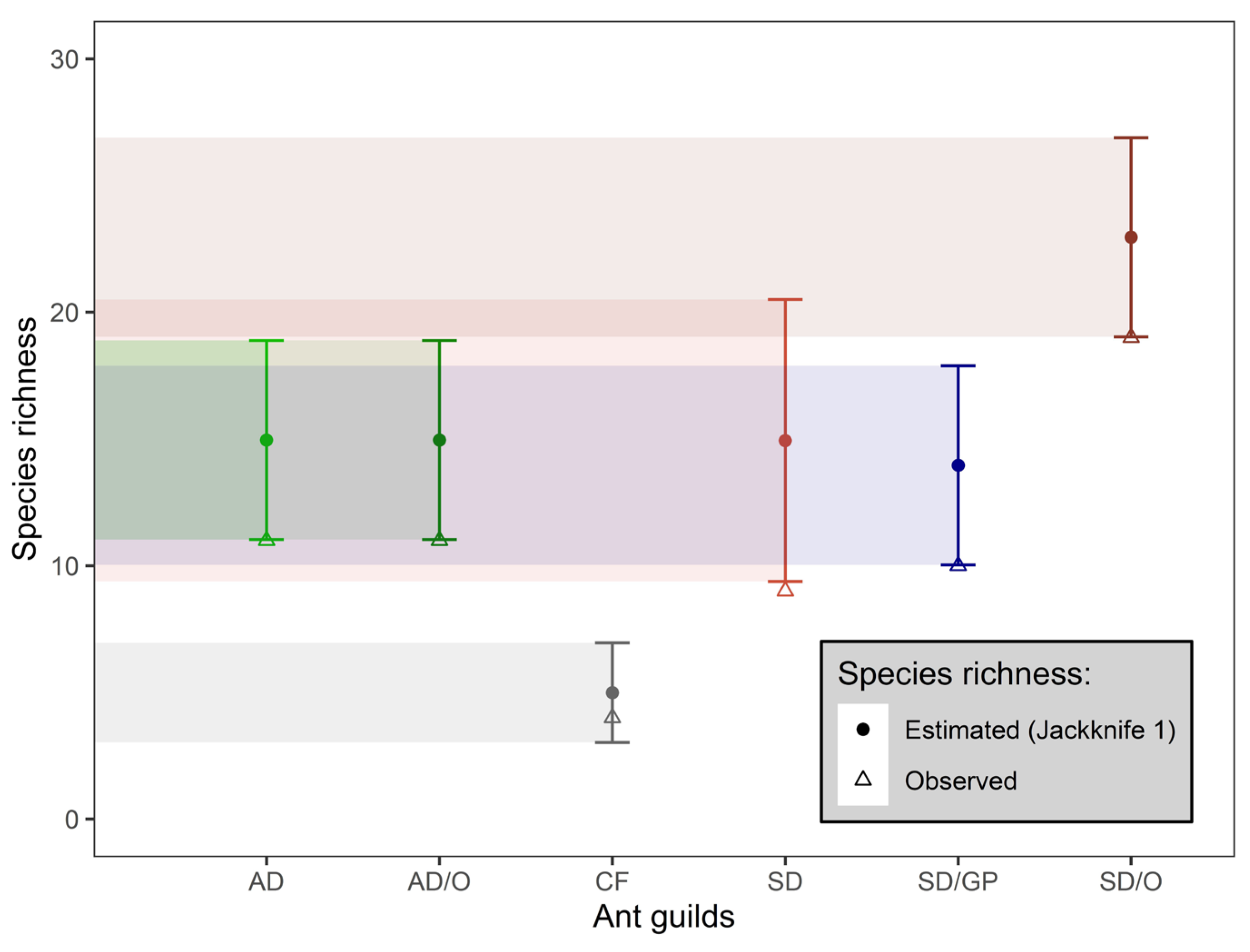
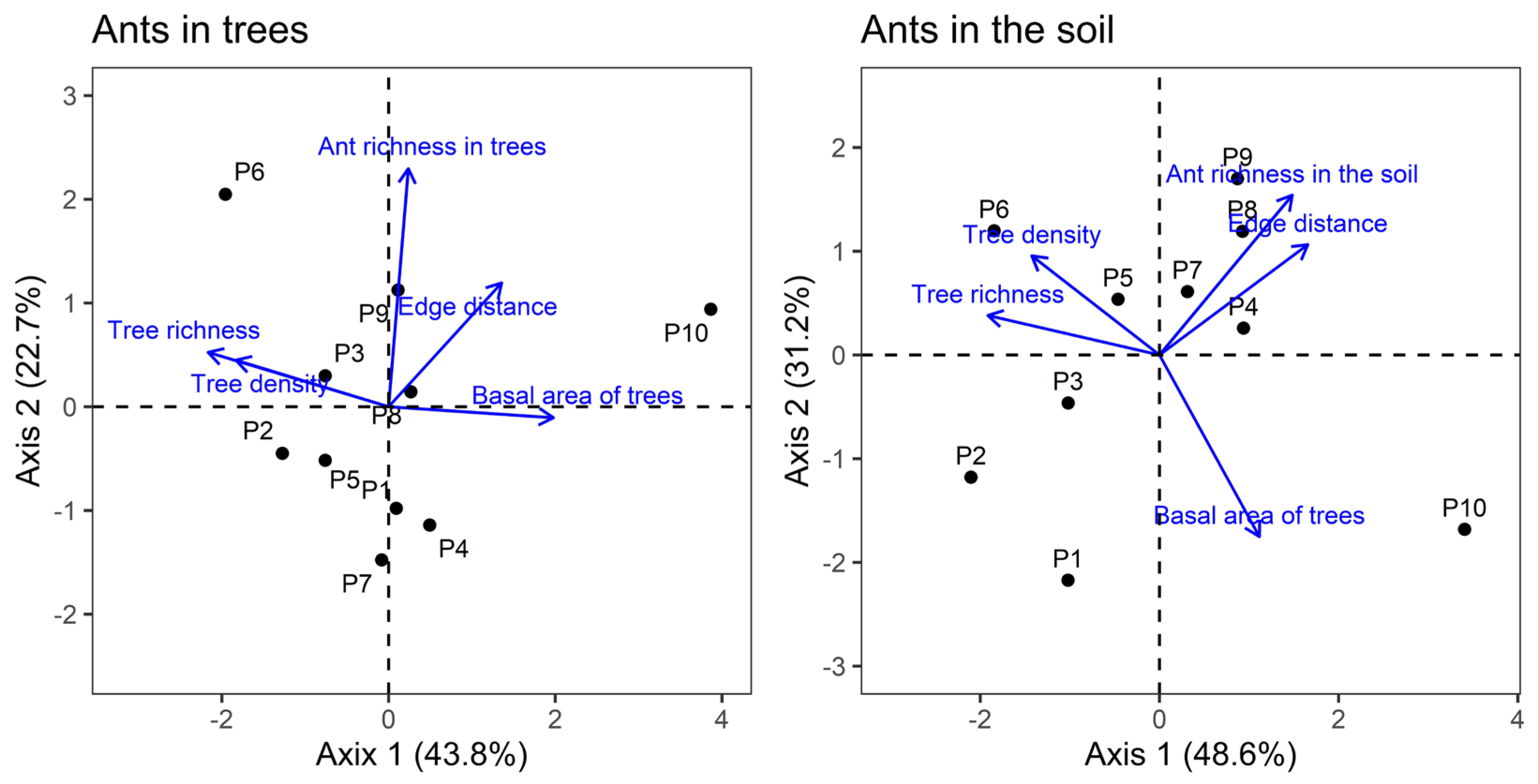
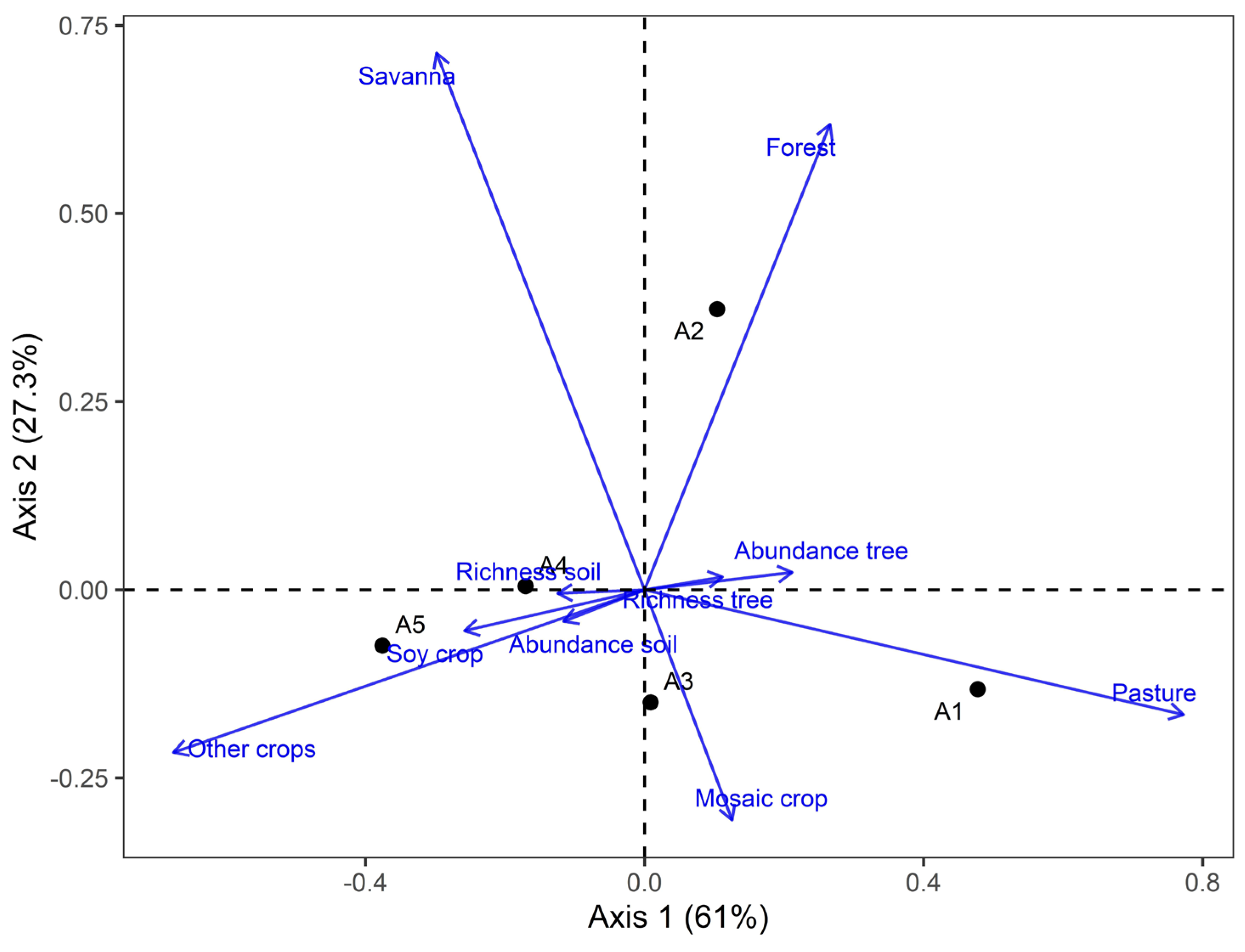
Structure of Epigeic and Arboreal Ant Communities in Forest Fragments Within Agricultural Landscapes of the Brazilian Cerrado

 , , , ,
Simple Summary
Abstract
1. Introduction
2. Materials and Methods
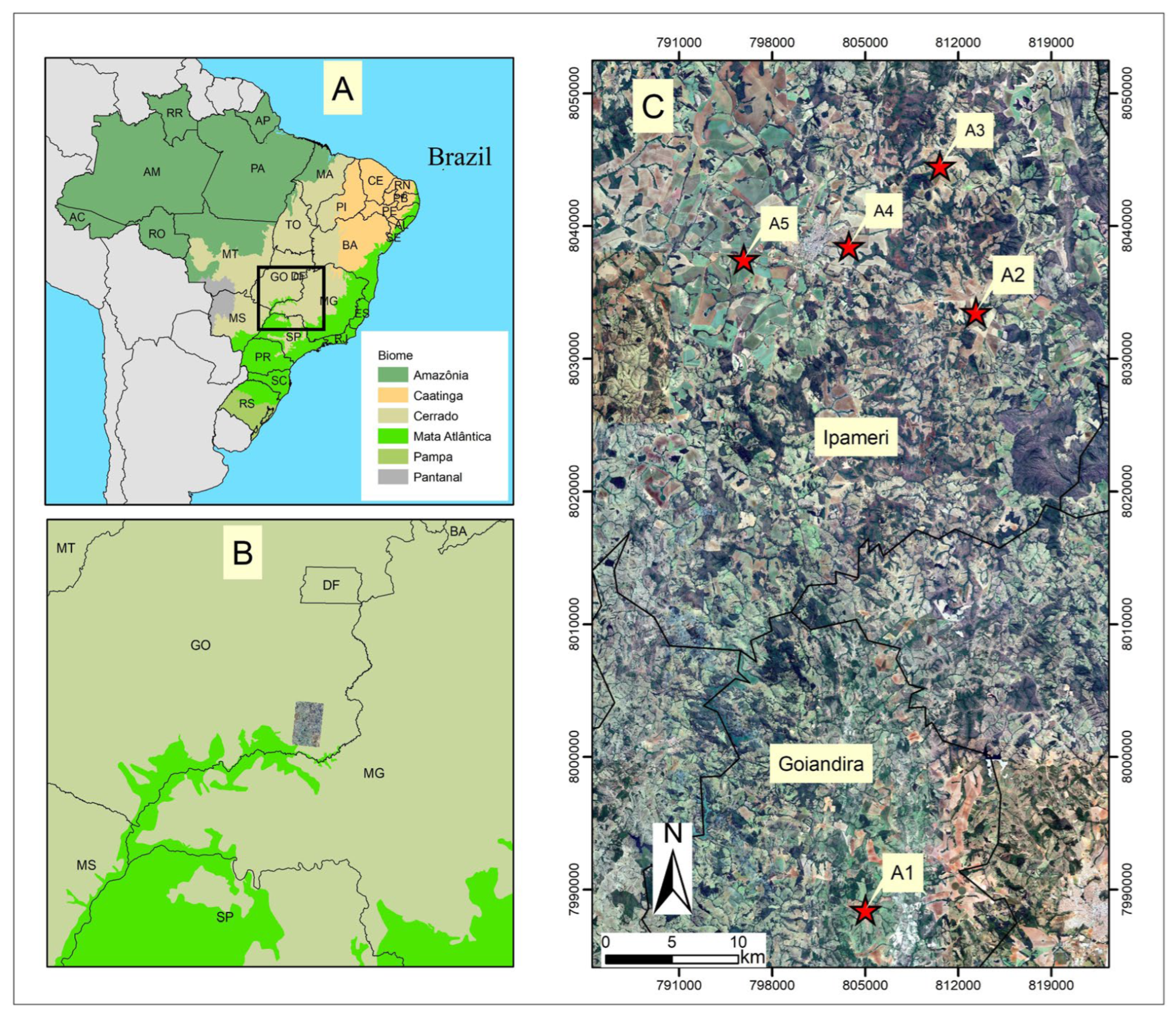
2.1. Study Area
2.2. Sampling of the Arboreal Component
2.3. Ant Sampling
2.4. Statistical Analysis
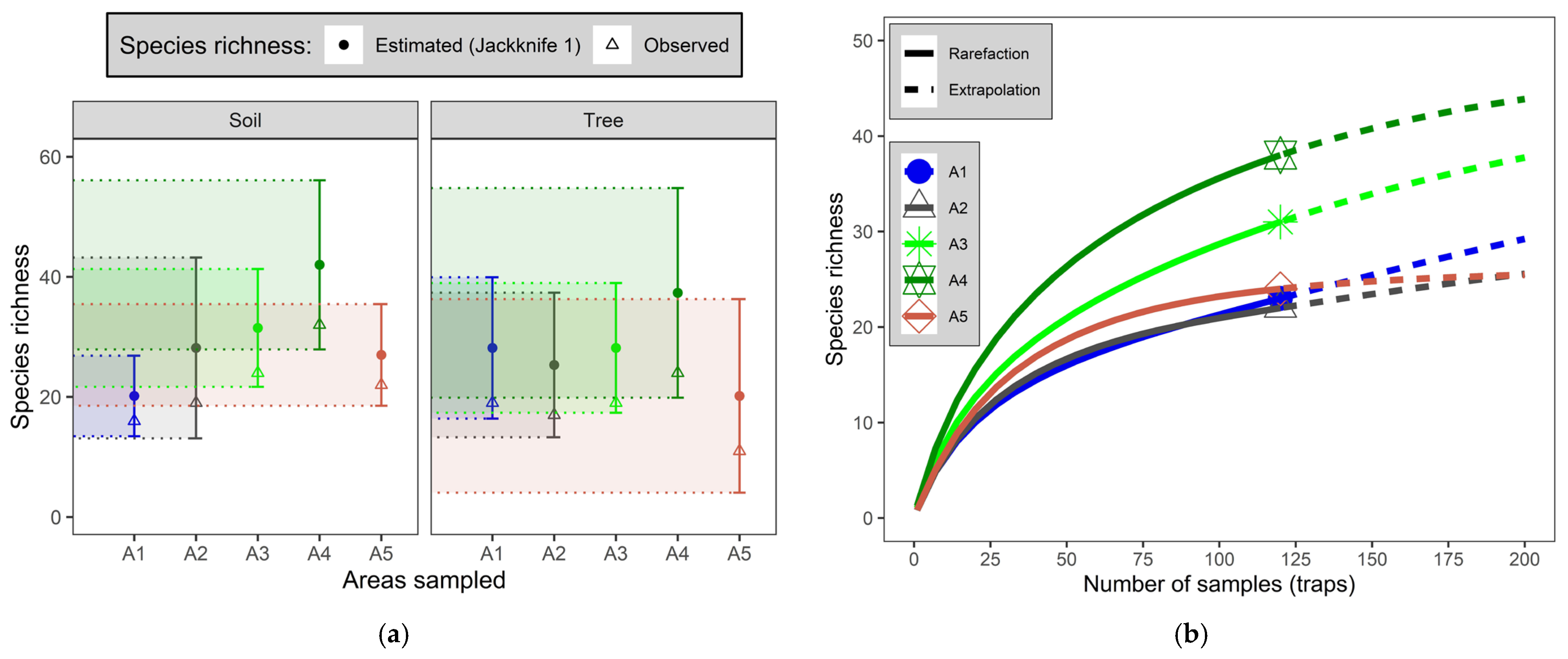
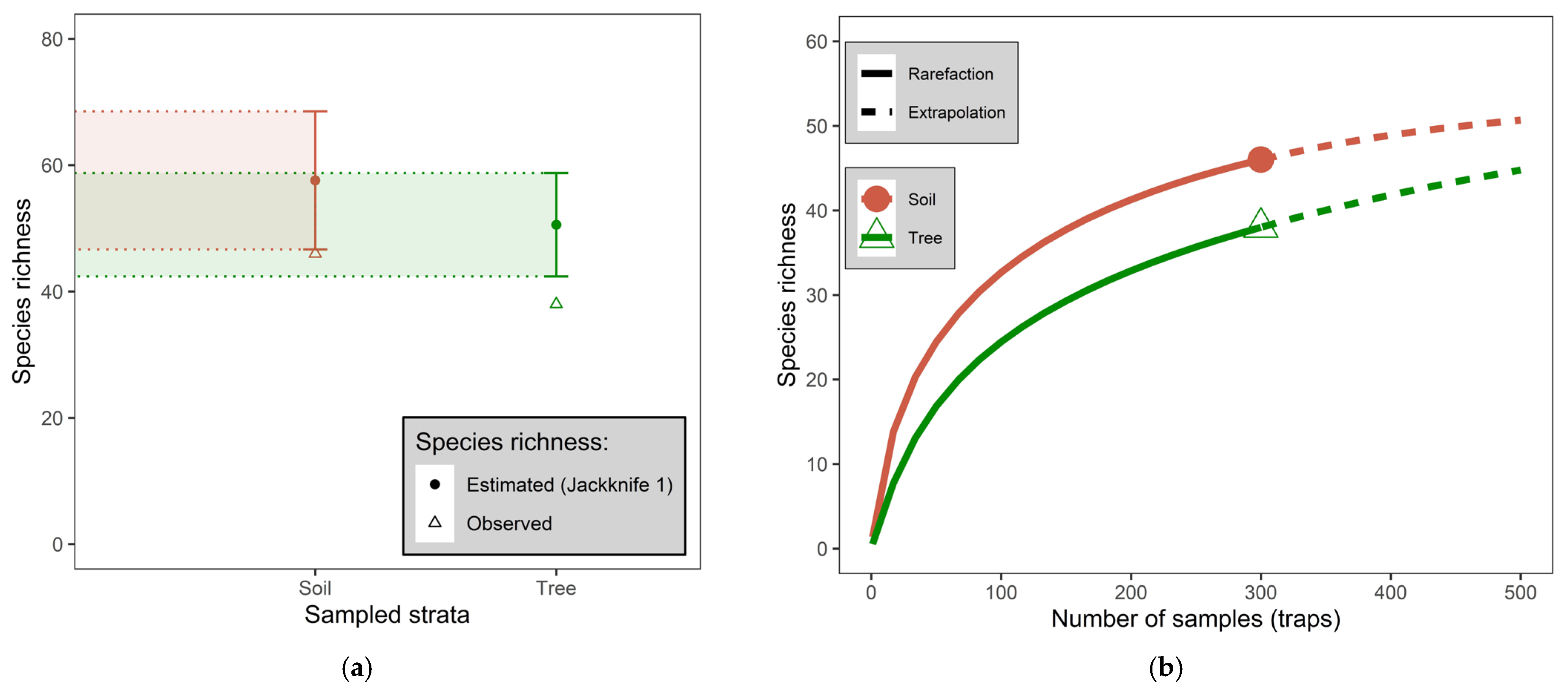
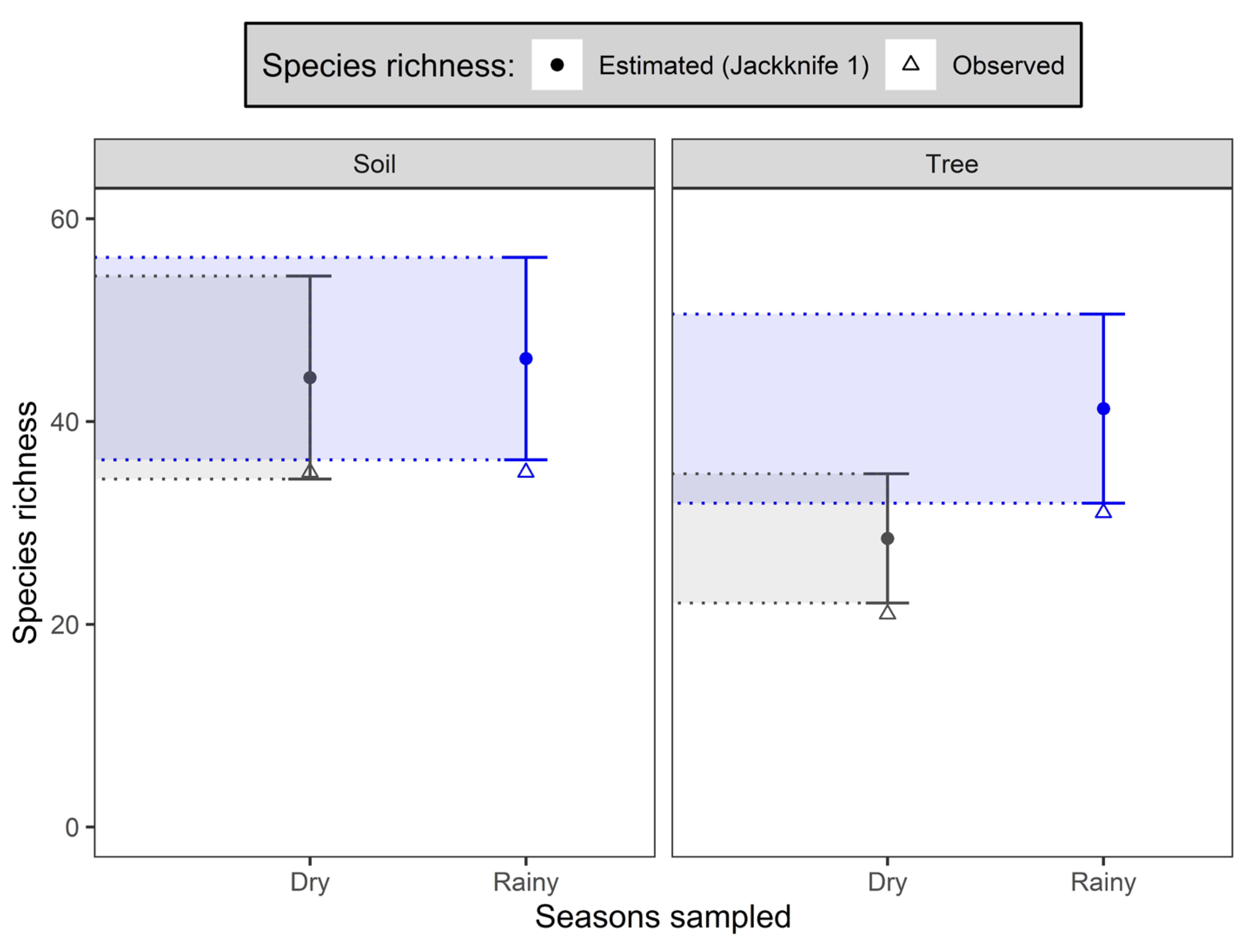
3. Results
4. Discussion
Supplementary Materials
Author Contributions
Funding
Data Availability Statement
Acknowledgments
Conflicts of Interest
References
- Santos, J.S.; Dodonov, P.; Oshima, J.E.F.; Martello, F.; de Jesus, A.S.; Ferreira, M.E.; Collevatti, R.G. Landscape ecology in the Anthropocene: An overview for integrating agroecosystems and biodiversity conservation. Perspect. Ecol. Conserv. 2021, 19, 21–32. [Google Scholar] [CrossRef] [Scilit]
- Adorno, B.R.; Santos, L.A.C.; Lima Silva, A.C.; Souza, M.M.O.; Silva-Neto, C.M. O desmatamento, o uso do solo do Cerrado e a incidência de leishmaniose visceral, malária e febre amarela no Estado de Goiás. Rev. Bras. Geogr. Física 2022, 15, 2853–2866. [Google Scholar] [CrossRef] [Scilit]
- Prado Júnior, J.A.; Vale, V.S.; Oliveira, A.P.; Gusson, A.E.; Dias Neto, O.C.; Lopes, S.F.; Schiavini, I. Estrutura da comunidade arbórea em um fragmento de Floresta estacional Semidecidual localizada na reserva legal da fazenda Iara, Uberlândia, MG. Biosci. J. 2010, 26, 638–647. [Google Scholar]
- Martello, F.; Andriolli, F.S.; Medeiros, H.R.; Barão, T.; Ribeiro, M.C. Edge contrast modulates ant community responses to edge distance in agricultural landscapes. Agric. For. Entomol. 2022, 24, 289–300. [Google Scholar] [CrossRef] [Scilit]
- Viana, V.M.; Pinheiro, L.A.F.V. Conservação da biodiversidade em fragmentos florestais. Série Técnica Ipef 1998, 12, 25–42. [Google Scholar]
- Gonçalves-Souza, T.; Chase, J.M.; Haddad, N.M.; Vancine, M.H.; Didham, R.K.; Melo, F.L.P.; Aizen, M.A.; Chiarello, A.G.; Faria, D.; Gibb, H.; et al. Species turnover does not rescue biodiversity in fragmented landscapes. Nature 2025, 640, 702–706. [Google Scholar] [CrossRef] [Scilit] [PubMed]
- Santos, J.S.; de Lima, E.L.; Silveira, P.; Lutz, B.E.; Borges-Almeida, K.; Teles, W.; Collevatti, R.G. Several small fragments can have higher species richness than a single large: The SLOSS debate in agricultural landscapes. Perspect. Ecol. Conserv. 2026; in press. [CrossRef] [Scilit]
- Strassburg, B.B.N.; Brooks, T.; Feltran-Barbieri, R.; Iribarrem, A.; Crouzeilles, R.; Loyola, R.; Latawiec, A.E.; Oliveira Filho, F.J.B.; Scaramuzza, C.A.M.; Scarano, F.R.; et al. Moment of truth for the Cerrado hotspot. Nat. Ecol. Evol. 2017, 1, 0099. [Google Scholar] [CrossRef] [Scilit] [PubMed]
- Eiten, G. Vegetação do Cerrado. In Cerrado: Caracterização, Ocupação e Perspectiva; Pinto, M.N., Ed.; UnB/SEMATEC: Brasília, Brasil, 1994; pp. 17–73. [Google Scholar]
- Lima-Ribeiro, M.S. Efeitos de borda sobre a vegetação e estruturação populacional em fragmentos de Cerradão no Sudoeste Goiano, Brasil. Acta Botânica Bras. 2008, 22, 535–545. [Google Scholar] [CrossRef] [Scilit]
- Didham, R.K.; Lawton, J.H. Edge structure determines the magnitude of changes in microclimate and vegetation structure in Tropical Forest fragments. Biotropica 1999, 31, 17–30. [Google Scholar] [CrossRef] [Scilit] [PubMed]
- Bruna, E.M.; Kress, J.W. Habitat fragmentation and the demographic structure of an Amazonian understory herb (Heliconia acuminata). Conserv. Biol. 2002, 16, 1256–1266. [Google Scholar] [CrossRef] [Scilit]
- Crist, T.O. Biodiversity, species interactions, and functional roles of ants (Hymenoptera: Formicidae) in fragmented landscapes: A review. Myrmecol. News 2009, 12, 3–13. [Google Scholar]
- Bernardes Júnior, E.J.; Rocha, E.C.; Jesus, F.G.; Oliveira, M.A.; Araújo, M.S. Dry forest fragmentation in Brazilian Cerrado and its effects on communities of ground foraging ants. Fla. Entomol. 2020, 103, 384–391. [Google Scholar] [CrossRef] [Scilit]
- Couto, M.S.D.S.; Ferreira, L.G.; Hall, B.; Da Silva, G.J.P. Identificação de áreas prioritárias para conservação da biodiversidade e paisagens no estado de Goiás: Métodos e cenários no contexto da bacia hidrográfica. Rev. Bras. Cartogr. 2010, 62, 125–135. [Google Scholar] [CrossRef] [Scilit]
- Rocha, E.C.; Sá, A.A.S.D.; Vale, V.S.D. The Effect of Habitat Amount on Species Richness and Composition of Medium- and Large-Sized Mammals in the Cerrado Biome, Brazil. Diversity 2025, 17, 83. [Google Scholar] [CrossRef] [Scilit]
- De Lima, C.A.; Alves, E.N.; Hannibal, W.; Rocha, E.C. Effects of habitat fragmentation on species richness and community composition of medium- and large-sized mammals in sugarcane-dominated Cerrado landscapes, southwestern Goiás, Brazil. Front. Conserv. Sci. 2026, 7, 1799392. [Google Scholar] [CrossRef] [Scilit]
- Jokimäki, J.; Huhta, E. Effects of landscape matrix and habitat structure on a bird community in northern Finland: A multi-scale approach. Ornis Fenn. 1996, 73, 97–113. [Google Scholar]
- Antongiovanni, M.; Metzger, J.P. Influence of matrix habitats on the occurrence of insectivorous bird species in Amazonian forest fragments. Biol. Conserv. 2025, 122, 441–451. [Google Scholar] [CrossRef] [Scilit]
- Bereczki, K.; Hajdu, K.; Báldi, A. Effects of forest edge on pest control service provided by birds in fragmented temperate forests. Acta Zool. Acad. Sci. Hung. 2015, 61, 289–304. [Google Scholar] [CrossRef] [Scilit]
- Holanda, A.C.; Feliciano, A.L.P.; Marangon, L.C.; Santos, M.S.; Melo, C.L.S.M.S.; Pessoa, M.M.L. Estrutura de espécies arbóreas sob efeito de borda em um fragmento de Floresta Estacional Semidecidual em Pernambuco. Rev. Árvore 2010, 34, 103–114. [Google Scholar] [CrossRef] [Scilit]
- Oliveira, M.A.; Gomes, C.F.F.; Pires, E.M.; Marinho, C.G.S.; Della Lucia, T.M.C. Bioindicadores ambientais: Insetos como um instrumento desta avaliação. Rev. Ceres 2014, 61, 800–807. [Google Scholar] [CrossRef] [Scilit]
- Crepaldi, R.A.; Portilho, I.I.R.; Silvestre, R.; Mercante, F.M. Formigas como bioindicadores da qualidade do solo em sistema integrado lavoura-pecuária. Ciência Rural 2014, 44, 781–787. [Google Scholar] [CrossRef] [Scilit]
- Tibcherani, M.; Nacagava, V.A.F.; Aranda, R.; Mello, R.L. Review of ants (Hymenoptera: Formicidae) as bioindicators in the Brazilian Savanna. Sociobiology 2018, 65, 112–129. [Google Scholar] [CrossRef] [Scilit]
- Rodrigues, C.A.; Araújo, M.S.; Rocha, E.C.; Silva, D.A.; Martinelli, N.M.; Delabie, J.H.C. Vertical stratification of ant assemblage in Brazilian Savanna phytophysiognomies. Bosque 2019, 40, 379–385. [Google Scholar] [CrossRef] [Scilit]
- Santiago, O.S.; Bernardes Júnior, E.J.; Rocha, E.C.; Jesus, F.G.; Oliveira, M.A.; Araújo, M.S. Ant community structure and response to disturbances in seasonal semideciduous forest and agricultural matrices in the Brazilian Cerrado. Rev. Colomb. Entomol. 2025, 51, e12822. [Google Scholar] [CrossRef] [Scilit]
- Souza Dutra, D.B.; Feitosa, R.M.; Jory, T.T.; Silva, V.F.M.; Fontenele, F.K.; Costa, M.M.S.; Schmidt, F.A. Guildas de uso de habitat das formigas respondem à mudança de floresta para pastagem no sudoeste da Amazônia. J. Insect Conserv. 2024, 28, 305–313. [Google Scholar] [CrossRef] [Scilit]
- Silva, R.R.; Brandão, C.R.F. Formigas (Hymenoptera: Formicidae) como indicadores da qualidade ambiental e da biodiversidade de outros invertebrados terrestres. Biotemas 1999, 12, 55–73. [Google Scholar]
- Alvares, C.A.; Stape, J.L.; Sentelhas, P.C.; Gonçalves, J.L.M.; Sparovek, G. Köppen’s climate classification map for Brazil. Meteorol. Z. 2013, 22, 711–728. [Google Scholar] [CrossRef] [Scilit] [PubMed]
- Silva-Neto, C.M.; Santos, L.A.C.; Bernardes, M.M.; Salas, C.; Valdés, C.; Muñoz-Quezada, M.T.; Araujo, R.O. Land use around influences the entomological community in lettuce horticultural systems. Braz. J. Biol. 2024, 84, e282077. [Google Scholar] [CrossRef] [Scilit] [PubMed]
- MapBiomas. Projeto MapBiomas—Coleção 9 da Série Anual de Mapas de Cobertura e Uso de Solo do Brasil; MapBiomas: Brasília, Brazil, 2023. [Google Scholar]
- R Core Team. R: A Language and Environment for Statistical Computing; Version 3.2; R Foundation for Statistical Computing: Vienna, Austria, 2025. [Google Scholar]
- Hijmans, R.J. terra: Spatial Data Analysis, R Package Version 1.7-29; 2023. Available online: https://cran.r-project.org/package=terra (accessed on 12 July 2023).
- Pebesma, E. sf: Simple Features for R, R Package Version 1.0-14; 2023. Available online: https://cran.r-project.org/package=sf (accessed on 12 July 2023).
- Angiosperm Phylogeny Group; Chase, M.W.; Christenhusz, M.J.; Fay, M.F.; Byng, J.W.; Judd, W.S.; Soltis, D.E.; Mabberley, D.J.; Sennikov, A.N.; Soltis, P.S. An update of the Angiosperm Phylogeny Group classification for the orders and families of flowering plants: APG IV. Bot. J. Linn. Soc. 2016, 181, 1–20. [Google Scholar] [CrossRef] [Scilit]
- Benson, W.; Harada, A.Y. Local diversity of tropical and temperature ant faunas (Hymenoptera, Formicidae). Acta Amaz. 1988, 18, 275–289. [Google Scholar] [CrossRef] [Scilit]
- Fernández, F. Introducción a Las Hormigas de la Región Neotropical; Instituto de Investigación de Recursos Biológicos Alexander von Humboldt: Bogotá, Colombia, 2003; Available online: https://www.antwiki.org/w/images/8/86/Fernandez_2003_part21.pdf (accessed on 1 April 2024).
- Baccaro, F.B.; Feitosa, R.M.; Fernandez, F.; Fernandes, I.O.; Izzo, T.J.; Souza, J.L.P.; Solar, R. Guia Para os Gêneros de Formigas do Brasil; INPA: Manaus, Brasil, 2015. [CrossRef] [Scilit]
- Andersen, A.N. A classification of australian ant communities based on functional groups which parallel plant life forms in relation to stress and disturbance. J. Biogeogr. 1995, 22, 15–29. [Google Scholar] [CrossRef] [Scilit]
- Delabie, J.H.C.; Agosti, D.; Nascimento, I.C. Litter ant communities of the Brazilian Atlantic rain forest region. In Bulletin No. 18; Agosti, D., Majer, J., Alonso, L., Schultz, T.R., Eds.; Curtin University School of Environmental Biology: Perth, Australia, 2000; pp. 1–17. Available online: https://antcat.org/references/131056 (accessed on 2 March 2024).
- Silvestre, R.; Brandão, C.R.F.; Silva, R.R. Grupos funcionales de hormigas: El caso de los grêmios del Cerrado. In Introducción a Las Hormigas de la Región Neotropical; Fernández, F., Ed.; Instituto de Investigación de Recursos Biológicos Alexander von Humboldt: Bogotá, Colombia, 2003; pp. 101–136. [Google Scholar]
- Chao, A.; Gotelli, N.J.; Hsieh, T.C.; Sander, E.L.; Ma, K.H.; Colwell, R.K.; Ellison, A.M. Rarefaction and extrapolation with Hill numbers: A framework for sampling and estimation in species diversity studies. Ecol. Monogr. 2014, 84, 45–67. [Google Scholar] [CrossRef] [Scilit]
- Hsieh, T.C.; Ma, K.H.; Chao, A. iNEXT: Interpolation and Extrapolation for Species Diversity, R Package Version 3.0.0; 2025. Available online: http://chao.stat.nthu.edu.tw/wordpress/softwaredownload/ (accessed on 20 July 2025).
- Dufrêne, M.; Legendre, P. Species assemblages and indicator species: The need for flexible asymmetrical approach. Ecol. Monogr. 1997, 67, 345–366. [Google Scholar] [CrossRef] [Scilit]
- Oksanen, J.; Simpson, G.; Blanchet, F.; Kindt, R.; Legendre, P.; Minchin, P.; O’Hara, R.; Solymos, P.; Stevens, M.; Szoecs, E.; et al. vegan: Community Ecology Package, R Package Version 2.7-5; 2026. Available online: https://CRAN.R-project.org/package=vegan (accessed on 2 June 2026).
- De Cáceres, M.; Legendre, P. Associations between species and groups of sites: Indices and statistical inference. Ecology 2009, 90, 3566–3574. [Google Scholar] [CrossRef] [Scilit] [PubMed]
- Lê, S.; Josse, J.; Husson, F. FactoMineR: An R Package for Multivariate Analysis. J. Stat. Softw. 2008, 25, 1–18. [Google Scholar] [CrossRef] [Scilit]
- Wickham, H. ggplot2: Elegant Graphics for Data Analysis; Springer: New York, NY, USA, 2016. [Google Scholar] [CrossRef] [Scilit]
- Kassambara, A.; Mundt, F. factoextra: Extract and Visualize the Results of Multivariate Data Analyses. R Package. 2020. Available online: https://cran.r-project.org/web/packages/factoextra/index.html (accessed on 12 July 2023).
- Gibson, L.; Lee, T.; Koh, L.; Brook, B.W.; Gardner, T.A.; Barlow, J.; Peres, C.A.; Bradshaw, C.J.A.; Laurence, W.F.; Lovejoy, T.E.; et al. Primary forests are irreplaceable for sustaining tropical biodiversity. Nature 2011, 478, 378–381. [Google Scholar] [CrossRef] [Scilit] [PubMed]
- Wilson, E.O. La hiperdiversidad como fenómeno real: El caso de Pheidole. In Introducción a Las Hormigas de la Región Neotropical; Fernández, F., Ed.; Instituto Humboldt: Bogotá, Colombia, 2003; pp. 363–370. Available online: http://www.bio-nica.info/biblioteca/fernandez2003hormigas26.pdf (accessed on 20 July 2025).
- Campos, E.H.; Alves, R.R.; Serato, D.S.; Rodrigues, G.S.S.C.; Rodrigues, S.C. Acúmulo de serrapilheira em fragmentos de mata mesofítica e cerrado stricto senso em Uberlândia-MG. Soc. Nat. 2008, 20, 189–203. [Google Scholar] [CrossRef] [Scilit]
- Araújo, M.S.; Della Lucia, T.M.C.; Clayton, E.V.; Nascimento, I.C. Efeito da queima da palhada de cana-de-açúcar sobre comunidade de formicídeos. Ecol. Austral 2004, 14, 191–200. [Google Scholar]
- Costa, F.V.; Blethen, N.; Viana-Junior, A.; Guerra, T. Resilience to fire and climate seasonality drive the temporal dynamics of ant-plant interactions in a fire-prone ecosystem. Ecol. Indic. 2018, 93, 247–255. [Google Scholar] [CrossRef] [Scilit]
- Brandão, C.R.F.; Silva, R.R.; Feitosa, R.M. Cerrado ground-dwelling ants (Hymenoptera: Formicidae) as indicators of edge effects. Zoologia 2011, 28, 379–387. [Google Scholar] [CrossRef] [Scilit]
- Santos, T.F.; Mesquita, V.P.; Araújo, J.S.; Baccaro, F.B. Edge effects on ant diversity and functional composition in a forest fragment in the Central Amazon. Sociobiology 2023, 70, e7657. [Google Scholar] [CrossRef] [Scilit]
- Terborgh, J.; Robinson, S. Guilds and their utility in ecology. In Community Ecology: Pattern and Process; Kikkawa, J.E., Anderson, D., Eds.; Blackwell: London, UK, 1986; pp. 65–90. [Google Scholar]
- Santos, J.T.; Cardoso, J.S. Guildas de formigas associadas à serapilheira no distrito de Brejinho das Ametistas, Caetité, BA. Braz. J. Dev. 2021, 7, 104889–104902. [Google Scholar] [CrossRef] [Scilit]
- Delabie, J.H.C.; Fowler, H.G. Soil and litter cryptic ant assemblages of Bahian cocoa plantations. Pedobiologia 1995, 39, 423–433. [Google Scholar] [CrossRef] [Scilit]
- Nascimento, I.C.; Campiolo, S.; Delabie, J.H.C. Testando o índice “valor indicador individual” de Dufrêne & Legendre sobre uma grande série de dados de formigas da serapilheira do sudeste da Bahia. Biológico 2007, 69, 49–52. [Google Scholar]
- Longino, J.T. The Crematogaster (Hymenoptera, Formicidae, Myrmicinae) of Costa Rica. Zootaxa 2003, 151, 1–150. [Google Scholar] [CrossRef] [Scilit]
- Muscedere, M.L. Pheidole ants: Sociobiology of a highly diverse genus. In Encyclopedia of Animal Behavior, 2nd ed.; Choe, J.C., Ed.; Elsevier: Amsterdam, The Netherlands, 2017; pp. 149–158. [Google Scholar] [CrossRef] [Scilit]
- Sales, T.A.; Daemon, E.; Lopes, J. Necrophagous or predators? The role of Pheidole radoszkowskii Mayr (Hymenoptera: Formicidae) on Rattus norvegicus (Berkenhout) carcasses (Rodentia: Muridae). J. Nat. Hist. 2015, 50, 971–974. [Google Scholar] [CrossRef] [Scilit]
- Lima, A.A.; Silva, G.V.; Silva, T.C.; Pereira, M.J.; Costa Santos, L.A.; De Freitas, P.V.D.X.; De Melo E Silva-Neto, C. Edaphic mite communities in different land uses. Nativa 2024, 12, 73–79. [Google Scholar] [CrossRef] [Scilit]
- Silva Neto, C.D.M.E.; Santos, L.A.C.; Souza, W.G.D.; Martins, T.D.O.; Castro e Silva, T.; de Lima, A.A.; de Souza, M.M.O. Bees in agroforestry systems in the Cerrado. J. Apic. Res. 2023, 62, 675–679. [Google Scholar] [CrossRef] [Scilit]
- Palmer, M.A.; Febria, C.M. The heartbeat of ecosystems. Science 2012, 336, 1393–1394. [Google Scholar] [CrossRef] [Scilit] [PubMed]





| Taxa | Guild * | Number of Morphospecies | Capture Frequency (%) | |||
|---|---|---|---|---|---|---|
| Rainy Season | Dry Season | |||||
| Soil | Tree | Soil | Tree | |||
| Acromyrmex | CF | 01 | 0.66 | 0 | 0 | 0 |
| Atta | CF | 02 | 0 | 0 | 4 | 2 |
| Brachymyrmex | SD/O | 01 | 6 | 4 | 4 | 3.33 |
| Camponotus | AD/O | 11 | 8.6 | 6.66 | 15.3 | 6 |
| Cephalotes | AD | 02 | 0 | 0.66 | 0 | 0.66 |
| Crematogaster | AD | 02 | 2.66 | 4.66 | 3.33 | 1.33 |
| Dorimyrmex | SD | 01 | 4.66 | 2.66 | 6 | 2 |
| Ectatomma | SD/GP | 03 | 8 | 4 | 0.66 | 0 |
| Gnamptogenys | GP | 02 | 0 | 1.33 | 0.66 | 0.66 |
| Linepthema | SD | 02 | 0 | 1.33 | 2 | 2.08 |
| Monomorium | AD | 03 | 6.66 | 2 | 2.66 | 1.33 |
| Odontomachus | SD/O | 02 | 1.33 | 0 | 0.66 | 0 |
| Pachycondyla | SD/GP | 01 | 0 | 0.66 | 0 | 0 |
| Paratrechina | SD | 01 | 1.33 | 0 | 0.66 | 0 |
| Pheidole | SD/O | 12 | 72 | 29.3 | 44.6 | 9.33 |
| Pseudomyrmex | AD | 04 | 0 | 0.66 | 2 | 2 |
| Solenopsis | SD/O | 01 | 0 | 0 | 3.33 | 0 |
| Trachymyrmex | CF | 01 | 0.66 | 0 | 0.66 | 0 |
| Xenomyrmex | SD | 01 | 10.6 | 3.33 | 2.66 | 2.66 |
| Total morphospecies | 53 | |||||
Disclaimer/Publisher’s Note: The statements, opinions and data contained in all publications are solely those of the individual author(s) and contributor(s) and not of MDPI and/or the editor(s). MDPI and/or the editor(s) disclaim responsibility for any injury to people or property resulting from any ideas, methods, instructions or products referred to in the content. |
© 2026 by the authors. Licensee MDPI, Basel, Switzerland. This article is an open access article distributed under the terms and conditions of the Creative Commons Attribution (CC BY) license.
Share and Cite
Araújo, H.H.M.; Vale, V.S.; Jesus, F.G.; Rocha, E.C.; Silva-Neto, C.d.M.; Almeida, A.C.S.; Heinzelmann, M.C.; Araújo, M.S. Structure of Epigeic and Arboreal Ant Communities in Forest Fragments Within Agricultural Landscapes of the Brazilian Cerrado. Insects 2026, 17, 656. https://doi.org/10.3390/insects17060656
Araújo HHM, Vale VS, Jesus FG, Rocha EC, Silva-Neto CdM, Almeida ACS, Heinzelmann MC, Araújo MS. Structure of Epigeic and Arboreal Ant Communities in Forest Fragments Within Agricultural Landscapes of the Brazilian Cerrado. Insects. 2026; 17(6):656. https://doi.org/10.3390/insects17060656
Chicago/Turabian StyleAraújo, Helivelton H. M., Vagner S. Vale, Flávio G. Jesus, Ednaldo C. Rocha, Carlos de M. Silva-Neto, André C. S. Almeida, Matheus C. Heinzelmann, and Márcio S. Araújo. 2026. "Structure of Epigeic and Arboreal Ant Communities in Forest Fragments Within Agricultural Landscapes of the Brazilian Cerrado" Insects 17, no. 6: 656. https://doi.org/10.3390/insects17060656
APA StyleAraújo, H. H. M., Vale, V. S., Jesus, F. G., Rocha, E. C., Silva-Neto, C. d. M., Almeida, A. C. S., Heinzelmann, M. C., & Araújo, M. S. (2026). Structure of Epigeic and Arboreal Ant Communities in Forest Fragments Within Agricultural Landscapes of the Brazilian Cerrado. Insects, 17(6), 656. https://doi.org/10.3390/insects17060656