Insects as an Alternative Protein Source: A Sustainable Approach to Future Food Security

 ,
,  , , ,
, , ,  and
and 
Simple Summary
Abstract
1. Introduction
2. Methods
3. Nutritional Value of Edible Insects
3.1. Protein Content, Digestibility, and Amino Acid Quality
3.2. Lipids, Vitamins, and Minerals
3.3. Comparison with Conventional Protein Sources
4. Environmental and Economic Benefits of Edible Insects
5. Edible Insect Species and Their Uses
5.1. Commonly Consumed Edible Insect Species
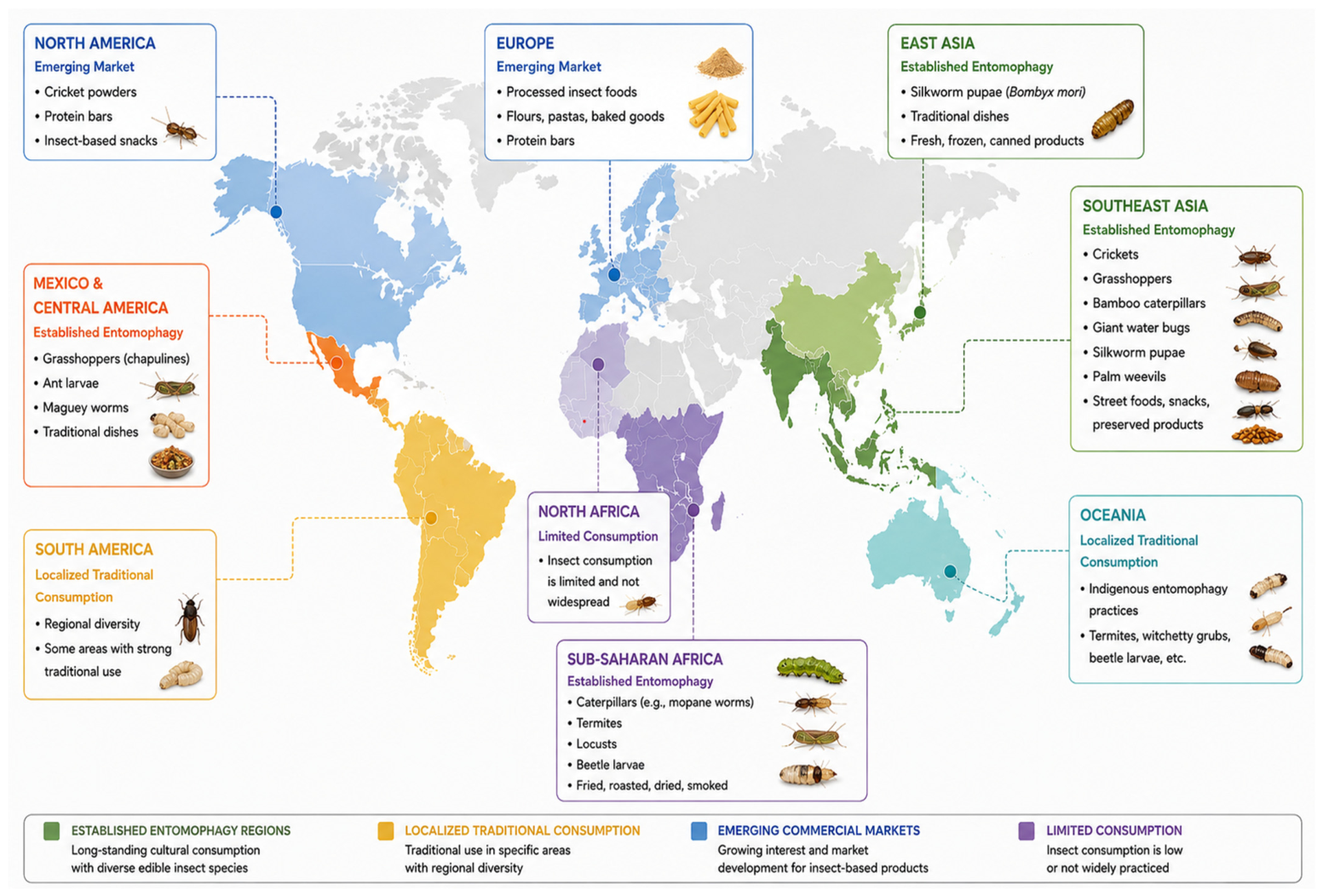
5.2. Regional Patterns of Insect Consumption
6. Processing and Product Development in Edible Insect Farming
7. Consumer Acceptance and Challenges of Edible Insects
7.1. Cultural Attitudes and Food Neophobia
7.2. Regulatory Frameworks and Food Safety Concerns
7.3. Marketing Strategies and Public Education
8. Risks, Limitations, and Safety Considerations of Edible Insects
9. Currently Available Insect-Based Protein Products
10. Future Prospects and Innovations in Edible Insect Farming
11. Conclusions
Author Contributions
Funding
Institutional Review Board Statement
Informed Consent Statement
Data Availability Statement
Conflicts of Interest
Correction Statement
References
- United Nations. Population. 2024. Available online: https://www.un.org/en/global-issues/population (accessed on 9 June 2026).
- Wegner, L.; Zwart, G. Who Will Feed the World? The Production Challenge; Rabobank International: Utrecht, The Netherlands, 2011. [Google Scholar]
- Wu, G.; Bazer, F.W.; Cross, H.R. Land-based production of animal protein: Impacts, efficiency, and sustainability. Ann. N. Y. Acad. Sci. 2014, 1328, 18–28. [Google Scholar] [CrossRef] [Scilit]
- Li, M.; Mao, C.; Li, X.; Jiang, L.; Zhang, W.; Li, M.; Liu, H.; Fang, Y.; Liu, S.; Yang, G.; et al. Edible insects: A new sustainable nutritional resource worth promoting. Foods 2023, 12, 4073. [Google Scholar] [CrossRef] [Scilit] [PubMed]
- Van Dijk, M.; Morley, T.; Rau, M.L.; Saghai, Y. A meta-analysis of projected global food demand and population at risk of hunger for the period 2010–2050. Nat. Food 2021, 2, 494–501. [Google Scholar] [CrossRef] [Scilit] [PubMed]
- Van Huis, A.; Oonincx, D.G.A.B. The environmental sustainability of insects as food and feed: A review. Agron. Sustain. Dev. 2017, 37, 43. [Google Scholar] [CrossRef] [Scilit]
- Tarhan, Ö.; Venerando, A.; Falsafi, R.; Rostamabadi, H.; Rashidinejad, A.; Capanoglu, E.; Tomas, M.; Karaca, A.C.; Lee, C.-C.; Pourjafar, H.; et al. Minimization of protein allergenicity in food products through conventional and novel processes: A comprehensive review on mechanisms, detection, and applications. Food Rev. Int. 2026, 42, 1261–1298. [Google Scholar]
- Adhikari, S.; Schop, M.; de Boer, I.J.M.; Huppertz, T. Protein quality in perspective: A review of protein quality metrics and their applications. Nutrients 2022, 14, 947. [Google Scholar] [CrossRef] [Scilit] [PubMed]
- Akdemir Evrendilek, G. Designing functional foods beyond bioactivity: Integrating processing, safety, and regulatory readiness. Appl. Sci. 2026, 16, 2999. [Google Scholar] [CrossRef] [Scilit]
- Orkusz, A. Edible insects versus meat—Nutritional comparison: Knowledge of their composition is the key to good health. Nutrients 2021, 13, 1207. [Google Scholar] [CrossRef] [Scilit] [PubMed]
- Melo, V.; Garcia, M.; Sandoval, H.; Jiménez, H.D.; Calvo, C. Quality proteins from edible indigenous insect food of Latin America and Asia. Emir. J. Food Agric. 2011, 23, 283–289. [Google Scholar]
- Kim, T.K.; Yong, H.I.; Kim, Y.B.; Kim, H.W.; Choi, Y.S. Edible insects as a protein source: A review of public perception, processing technology, and research trends. Food Sci. Anim. Resour. 2019, 39, 521–540. [Google Scholar] [CrossRef] [Scilit] [PubMed]
- Xu, X.; Feng, M.; Wei, T.; Pan, F.; Zhao, L.; Zhao, L. Edible insects as future proteins: Nutritional value, functional properties, bioactivities, and safety perspectives. Nutrients 2025, 17, 3165. [Google Scholar] [CrossRef] [Scilit] [PubMed]
- Jiménez-Pichardo, R.; Santos, E.M.; Lorenzo, J.M.; Agregán, R.; Fernández-López, J.; Sánchez-Ortega, I. Nutritional quality of edible insect protein. Food Sci. Process. 2025, 1, 5. [Google Scholar] [CrossRef] [Scilit]
- Malla, N.; Nørgaard, J.V.; Roos, N. Protein quality of edible insects in the view of current assessment methods. Anim. Front. 2023, 13, 50–63. [Google Scholar] [CrossRef] [Scilit] [PubMed]
- Nsevolo Miankeba, P.; Taofic, A.; Kiatoko, N.; Mutiaka, K.; Francis, F.; Caparros Megido, R. Protein content and amino acid profiles of selected edible insect species from the Democratic Republic of Congo relevant for transboundary trade across Africa. Insects 2022, 13, 994. [Google Scholar] [CrossRef] [Scilit] [PubMed]
- Perez-Santaescolastica, C.; De Pril, I.; Van de Voorde, I.; Fraeye, I. Fatty acid and amino acid profiles of seven edible insects: Focus on lipid class composition and protein conversion factors. Foods 2023, 12, 4090. [Google Scholar] [CrossRef] [Scilit] [PubMed]
- Hasnan, F.F.B.; Feng, Y.; Sun, T.; Parraga, K.; Schwarz, M.; Zarei, M. Insects as valuable sources of protein and peptides: Production, functional properties, and challenges. Foods 2023, 12, 4243. [Google Scholar] [CrossRef] [Scilit] [PubMed]
- Shah, A.A.; Totakul, P.; Matra, M.; Cherdthong, A.; Hanboonsong, Y.; Wanapat, M. Nutritional composition of various insects and potential uses as alternative protein sources in animal diets. Anim. Biosci. 2022, 35, 317–331. [Google Scholar] [CrossRef] [Scilit] [PubMed]
- Nachtigall, L.; Grune, T.; Weber, D. Proteins and amino acids from edible insects for the human diet—A narrative review considering environmental sustainability and regulatory challenges. Nutrients 2025, 17, 1245. [Google Scholar] [CrossRef] [Scilit] [PubMed]
- Rumpold, B.A.; Schlüter, O. Insect-based protein sources and their potential for human consumption: Nutritional composition and processing. Anim. Front. 2015, 5, 20–24. [Google Scholar] [CrossRef] [Scilit]
- Anankware, J.P.; Roberts, B.J.; Cheseto, X.; Osuga, I.; Savolainen, V.; Collins, C.M. The nutritional profiles of five important edible insect species from West Africa—An analytical and literature synthesis. Front. Nutr. 2021, 8, 792941. [Google Scholar] [CrossRef] [Scilit] [PubMed]
- Gautam, A.; Gyawali, I.; Poudel, S.; Devkota, S.; Acharya, R.; Kandel, M.; Subedi, D. Insects as food and feed source: A comprehensive review on nutritional value, food safety concerns, environmental benefits, economic potential, technological innovations, challenges, and future prospects. Food Front. 2025, 6, 2591–2646. [Google Scholar] [CrossRef] [Scilit]
- Kouřimská, L.; Adámková, A. Nutritional and sensory quality of edible insects. NFS J. 2016, 4, 22–26. [Google Scholar] [CrossRef] [Scilit]
- Kröncke, N.; Wittke, S.; Steinmann, N.; Benning, R. Analysis of the composition of different instars of Tenebrio molitor larvae using near-infrared reflectance spectroscopy for prediction of amino and fatty acid content. Insects 2023, 14, 310. [Google Scholar] [CrossRef] [Scilit] [PubMed]
- Li, X.; Rezaei, R.; Li, P.; Wu, G. Composition of amino acids in feed ingredients for animal diets. Amino Acids 2011, 40, 1159–1168. [Google Scholar] [PubMed]
- Boulos, S.; Tännler, A.; Nyström, L. Nitrogen-to-protein conversion factors for edible insects on the Swiss market: T. molitor, A. domesticus, and L. migratoria. Front. Nutr. 2020, 7, 89. [Google Scholar] [CrossRef] [Scilit] [PubMed]
- van Lieshout, G.A.; Lambers, T.T.; Bragt, M.C.; Hettinga, K.A. How processing may affect milk protein digestion and overall physiological outcomes: A systematic review. Crit. Rev. Food Sci. Nutr. 2020, 60, 2422–2445. [Google Scholar] [PubMed]
- Ishara, J.; Matendo, R.; Ng’ang’a, J.; Siddiqui, S.A.; Niassy, S.; Katcho, K.; Kinyuru, J. The contribution of commonly consumed edible insects to nutrition security in the Eastern DR Congo. Sci. Rep. 2024, 14, 16186. [Google Scholar] [CrossRef] [Scilit] [PubMed]
- Lisboa, H.M.; Nascimento, A.; Arruda, A.; Sarinho, A.; Lima, J.; Batista, L.; Dantas, M.F.; Andrade, R. Unlocking the potential of insect-based proteins: Sustainable solutions for global food security and nutrition. Foods 2024, 13, 1846. [Google Scholar] [CrossRef] [Scilit] [PubMed]
- Cong, L.; Dean, D.; Liu, C.; Wang, K.; Hou, Y. The commercial application of insect protein in food products: A product audit based on online resources. Foods 2024, 13, 3509. [Google Scholar] [CrossRef] [Scilit] [PubMed]
- Ordoñez-Araque, R.; Quishpillo-Miranda, N.; Ramos-Guerrero, L. Edible insects for humans and animals: Nutritional composition and an option for mitigating environmental damage. Insects 2022, 13, 944. [Google Scholar] [CrossRef] [Scilit] [PubMed]
- Rumpold, B.A.; Schlüter, O.K. Nutritional composition and safety aspects of edible insects. Mol. Nutr. Food Res. 2013, 57, 802–823. [Google Scholar] [CrossRef] [Scilit] [PubMed]
- Mazenda, A.; Nkosi, F.; Makofane, P.; Makgatha, V.; Sekome, K.K.; Ndarane, T. Edible insect foods and nutritional outcomes in rural African children. Discov. Public Health 2026, 23, 692. [Google Scholar] [CrossRef] [Scilit]
- Ochiai, M.; Suzuki, Y.; Suzuki, R.; Iwata, K.; Murayama, M. Low protein digestibility-corrected amino acid score and net nitrogen-to-protein conversion factor value of edible insects. Food Chem. 2024, 454, 139781. [Google Scholar] [CrossRef] [Scilit] [PubMed]
- Tabata, E.; Kashimura, A.; Kikuchi, A.; Masuda, H.; Miyahara, R.; Hiruma, Y.; Wakita, S.; Ohno, M.; Sakaguchi, M.; Sugahara, Y.; et al. Chitin digestibility is dependent on feeding behaviors, which determine acidic chitinase mRNA levels in mammalian and poultry stomachs. Sci. Rep. 2018, 8, 1461. [Google Scholar] [CrossRef] [Scilit] [PubMed]
- Chakravorty, J.; Bhadra, P.; Moyong, M.; Borah, S.; Newar, R. Edible insects as a futuristic fiber resource: Unlocking the potential of ‘entomofibers’ (chitin and chitosan) from North-Eastern India. J. Insects Food Feed 2024, 11, 1169–1186. [Google Scholar] [CrossRef] [Scilit]
- Rehman, K.U.; Hollah, C.; Wiesotzki, K.; Heinz, V.; Aganovic, K.; Rehman, R.U.; Petrusan, J.-I.; Zheng, L.; Zhang, J.; Sohail, S.; et al. Insect-derived chitin and chitosan: A still unexploited resource for the edible insect sector. Sustainability 2023, 15, 4864. [Google Scholar] [CrossRef] [Scilit]
- Rodriguez, J.; Neyrinck, A.M.; Zhang, Z.; Seethaler, B.; Nazare, J.A.; Robles Sánchez, C.; Roumain, M.; Muccioli, G.G.; Bindels, L.B.; Cani, P.D.; et al. Metabolite profiling reveals the interaction of chitin-glucan with the gut microbiota. Gut Microbes 2020, 12, 1810530. [Google Scholar] [CrossRef] [Scilit] [PubMed]
- Lopez-Santamarina, A.; Mondragon, A.D.C.; Lamas, A.; Miranda, J.M.; Franco, C.M.; Cepeda, A. Animal-origin prebiotics based on chitin: An alternative for the future? A critical review. Foods 2020, 9, 782. [Google Scholar] [CrossRef] [Scilit] [PubMed]
- Wijesekara, T.; Xu, B. New insights into sources, bioavailability, health-promoting effects, and applications of chitin and chitosan. J. Agric. Food Chem. 2024, 72, 17138–17152. [Google Scholar] [CrossRef] [Scilit] [PubMed]
- Alhasyani, T.; Ebeid, T.; Ghonimy, M.; Alharbi, S.; Hassan, M.F.; Jarallah, A.; Barakat, H. Harnessing edible insect bioactives for gut health: A comprehensive review on chitin-derived prebiotics and peptidomic insights from the black soldier fly. Foods 2025, 14, 3654. [Google Scholar] [CrossRef] [Scilit] [PubMed]
- Prashar, N.; Kapil, S.; Sharma, A.; Sharma, V.; Bagga, P.; Saini, A.; Kumari, S. Edible insect nutrition and bioinformatics-based nutritional assessment. Explor. Foods Foodomics 2026, 4, 1010149. [Google Scholar] [CrossRef] [Scilit]
- Ojha, S.; Bekhit, A.E.D.; Grune, T.; Schlüter, O.K. Bioavailability of nutrients from edible insects. Curr. Opin. Food Sci. 2021, 41, 240–248. [Google Scholar] [CrossRef] [Scilit]
- Bora, B.; Hazarika, A.K. Nutrient bioavailability in edible insects: A sustainable food source. Indian J. Entomol. 2026, 89, 326–335. [Google Scholar]
- Mwangi, M.N.; Oonincx, D.G.A.B.; Stouten, T.; Veenenbos, M.; Melse-Boonstra, A.; Dicke, M.; Van Loon, J.J.A. Insects as sources of iron and zinc in human nutrition. Nutr. Res. Rev. 2018, 31, 248–255. [Google Scholar] [CrossRef] [Scilit] [PubMed]
- Eggink, K.M.; Aalto, S.L.; Pedersen, P.B.; Lund, I.; Dalsgaard, J. Effects of dietary chitin on nutrient digestibility, cholesterol metabolism, digestive enzyme activity, and gut microbiome in rainbow trout. Anim. Feed Sci. Technol. 2025, 116447. [Google Scholar] [CrossRef] [Scilit]
- Kim, D.H.; Wang, Y.; Jung, H.; Field, R.L.; Zhang, X.; Liu, T.C.; Van Dyken, S.J. A type 2 immune circuit in the stomach controls mammalian adaptation to dietary chitin. Science 2023, 381, 1092–1098. [Google Scholar] [CrossRef] [Scilit] [PubMed]
- Aguilar-Toalá, J.E.; Vidal-Limón, A.M.; Liceaga, A.M. Advancing food security with farmed edible insects: Economic, social, and environmental aspects. Insects 2025, 16, 67. [Google Scholar] [CrossRef] [Scilit] [PubMed]
- Wang, L.; Li, J.; Chen, Y.; Zhang, Y.; Zhang, R. Insect proteins and peptides: Preparation, bioactivities, and applications. Food Sci. Anim. Resour. 2026, 46, 20. [Google Scholar] [CrossRef] [Scilit] [PubMed]
- Meyer-Rochow, V.B.; Gahukar, R.T.; Ghosh, S.; Jung, C. Chemical composition, nutrient quality and acceptability of edible insects are affected by species, developmental stage, gender, diet, and processing method. Foods 2021, 10, 1036. [Google Scholar] [CrossRef] [Scilit] [PubMed]
- Rodríguez-Rodríguez, M.; Barroso, F.G.; Fabrikov, D.; Sánchez-Muros, M.J. In vitro crude protein digestibility of insects: A review. Insects 2022, 13, 682. [Google Scholar] [CrossRef] [Scilit] [PubMed]
- Gasco, L.; Biasato, I.; Dabbou, S.; Schiavone, A.; Gai, F. Animals fed insect-based diets: State-of-the-art on digestibility, performance and product quality. Animals 2019, 9, 170. [Google Scholar] [CrossRef] [Scilit] [PubMed]
- Payne, C.L.R.; Scarborough, P.; Rayner, M.; Nonaka, K. Are edible insects more or less “healthy” than commonly consumed meats? A comparison using two nutrient profiling models developed to combat over- and undernutrition. Eur. J. Clin. Nutr. 2016, 70, 285–291. [Google Scholar] [PubMed]
- Oliveira, L.A.; Pereira, S.M.S.; Dias, K.A.; da Silva Paes, S.; Grancieri, M.; Jimenez, L.G.S.; Della Lucia, C.M. Nutritional content, amino acid profile, and protein properties of edible insects (Tenebrio molitor and Gryllus assimilis) powders at different stages of development. J. Food Compos. Anal. 2024, 125, 105804. [Google Scholar] [CrossRef] [Scilit]
- Gebreyes, B.G.; Teka, T.A. The environmental and ecological benefits of edible insects: A review. Food Sci. Nutr. 2025, 13, e70459. [Google Scholar] [CrossRef] [Scilit] [PubMed]
- Hammer, L.; Moretti, D.; Abbühl-Eng, L.; Kandiah, P.; Hilaj, N.; Portmann, R.; Egger, L. Mealworm larvae (Tenebrio molitor) and crickets (Acheta domesticus) show high total protein in vitro digestibility and can provide good-to-excellent protein quality as determined by in vitro DIAAS. Front. Nutr. 2023, 10, 1150581. [Google Scholar] [CrossRef] [Scilit] [PubMed]
- FAO. Dietary Protein Quality Evaluation in Human Nutrition. 2013. Available online: https://www.fao.org/4/i3124e/i3124e.pdf (accessed on 18 June 2026).
- Stone, A.K.; Tanaka, T.; Nickerson, M.T. Protein quality and physicochemical properties of commercial cricket and mealworm powders. J. Food Sci. Technol. 2019, 56, 3355–3363. [Google Scholar] [CrossRef] [Scilit] [PubMed]
- Azizi, R.; Baggio, A.; Capuano, E.; Pellegrini, N. Protein transition: Focus on protein quality in sustainable alternative sources. Crit. Rev. Food Sci. Nutr. 2025, 65, 3401–3421. [Google Scholar] [PubMed]
- Noyens, I.; Van Miert, S.; Brombach, C.; Rossi, M.; Haas, N.; Beckman, M.; Roosen, M. Techno-Functional Analysis of Insect Proteins and Insect-Based Products; Interreg North-West Europe ValuSect Project: Geel, Belgium, 2021. [Google Scholar]
- Aidoo, O.F.; Osei-Owusu, J.; Asante, K.; Dofuor, A.K.; Boateng, B.O.; Debrah, S.K.; Chia, S.Y. Insects as food and medicine: A sustainable solution for global health and environmental challenges. Front. Nutr. 2023, 10, 1113219. [Google Scholar] [CrossRef] [Scilit] [PubMed]
- Lange, K.W.; Nakamura, Y. Potential contribution of edible insects to sustainable consumption and production. Front. Sustain. 2023, 4, 1112950. [Google Scholar] [CrossRef] [Scilit]
- Madau, F.A.; Arru, B.; Furesi, R.; Pulina, P. Insect farming for feed and food production from a circular business model perspective. Sustainability 2020, 12, 5418. [Google Scholar] [CrossRef] [Scilit]
- Omuse, E.R.; Tonnang, H.E.Z.; Yusuf, A.A.; Machekano, H.; Egonyu, J.P.; Kimathi, E.; Niassy, S. The global atlas of edible insects: Analysis of diversity and commonality contributing to food systems and sustainability. Sci. Rep. 2024, 14, 5045. [Google Scholar] [CrossRef] [Scilit] [PubMed]
- Matandirotya, N.R.; Filho, W.L.; Mahed, G.; Maseko, B.; Murandu, C.V. Edible insects’ consumption in Africa towards environmental health and sustainable food systems: A bibliometric study. Int. J. Environ. Res. Public Health 2022, 19, 14823. [Google Scholar] [CrossRef] [Scilit] [PubMed]
- Hăbeanu, M.; Gheorghe, A.; Mihalcea, T. Silkworm Bombyx mori—Sustainability and economic opportunity, particularly for Romania. Agriculture 2023, 13, 1209. [Google Scholar] [CrossRef] [Scilit]
- Kwiri, R.; Mujuru, F.M.; Gwala, W. Nutrient composition and bioactive components of mopane worm (Gonimbrasia belina). In African Edible Insects as Alternative Source of Food, Oil, Protein and Bioactive Components; Springer International Publishing: Cham, Switzerland, 2020; pp. 241–256. [Google Scholar]
- Costa-Neto, E.M. Anthropo-entomophagy in Latin America: An overview of the importance of edible insects to local communities. J. Insects Food Feed 2015, 1, 17–24. [Google Scholar] [CrossRef] [Scilit]
- Ramos-Elorduy, J. Anthropo-entomophagy: Cultures, evolution and sustainability. Entomol. Res. 2009, 39, 271–288. [Google Scholar] [CrossRef] [Scilit]
- Olivadese, M.; Dindo, M.L. Edible insects: A historical and cultural perspective on entomophagy with a focus on Western societies. Insects 2023, 14, 690. [Google Scholar] [CrossRef] [Scilit] [PubMed]
- Raheem, D.; Carrascosa, C.; Oluwole, O.B.; Nieuwland, M.; Saraiva, A.; Millán, R.; Raposo, A. Traditional consumption of and rearing edible insects in Africa, Asia and Europe. Crit. Rev. Food Sci. Nutr. 2019, 59, 2169–2188. [Google Scholar] [PubMed]
- Bessa, L.W.; Pieterse, E.; Marais, J.; Hoffman, L.C. Why for feed and not for human consumption? The black soldier fly larvae. Compr. Rev. Food Sci. Food Saf. 2020, 19, 2747–2763. [Google Scholar] [CrossRef] [Scilit] [PubMed]
- Farkas, V.I.; Máté, M.; Takács, K.; Jánosi, A. The house cricket (Acheta domesticus Linnaeus) in food industry: Farming, technological challenges, and sustainability considerations. Appl. Sci. 2025, 15, 9494. [Google Scholar] [CrossRef] [Scilit]
- FAO/INFOODS. Food Composition Tables and Databases. Available online: http://www.fao.org/infoods/infoods/tables-and-databases/en/ (accessed on 18 June 2026).
- Van Huis, A. Potential of insects as food and feed in assuring food security. Annu. Rev. Entomol. 2013, 58, 563–583. [Google Scholar] [CrossRef] [Scilit] [PubMed]
- Wu, X.; He, K.; Velickovic, T.C.; Liu, Z. Nutritional, functional, and allergenic properties of silkworm pupae. Food Sci. Nutr. 2021, 9, 4655–4665. [Google Scholar] [CrossRef] [Scilit] [PubMed]
- Rouco, M.; Ugwu, C.C.; Reina, G.; Carlos, S. Sustainable insect-based diets in Sub-Saharan Africa: A review of prevalence, acceptability and impact on nutritional status. Nutrients 2026, 18, 1414. [Google Scholar] [CrossRef] [Scilit] [PubMed]
- Begho, T. Edible insects as sustainable protein in Sub-Saharan Africa: A review of consumption, preferences and expansion opportunities. Br. Food J. 2025, 1–17. [Google Scholar] [CrossRef] [Scilit]
- Lähteenmäki-Uutela, A.; Marimuthu, S.B.; Meijer, N. Regulations on insects as food and feed: A global comparison. J. Insects Food Feed 2021, 7, 849–856. [Google Scholar] [CrossRef] [Scilit]
- Liceaga, A.M. Edible insects, a valuable protein source from ancient to modern times. In Advances in Food and Nutrition Research; Academic Press: Cambridge, MA, USA, 2022; Volume 101, pp. 129–152. [Google Scholar]
- Ahmed, I.; İnal, F. The nutritional value of grasshoppers and locusts—A review. Ann. Anim. Sci. 2025, 25, 455–465. [Google Scholar] [CrossRef] [Scilit]
- Lu, S.; Taethaisong, N.; Meethip, W.; Surakhunthod, J.; Sinpru, B.; Sroichak, T.; Paengkoum, P. Nutritional composition of black soldier fly larvae (Hermetia illucens L.) and its potential uses as alternative protein sources in animal diets: A review. Insects 2022, 13, 831. [Google Scholar] [CrossRef] [Scilit] [PubMed]
- Kelemu, S.; Niassy, S.; Torto, B.; Fiaboe, K.; Affognon, H.; Tonnang, H.; Ekesi, S. African edible insects for food and feed: Inventory, diversity, commonalities and contribution to food security. J. Insects Food Feed 2015, 1, 103–120. [Google Scholar] [CrossRef] [Scilit]
- Halloran, A.; Flore, R.; Vantomme, P.; Roos, N. (Eds.) Edible Insects in Sustainable Food Systems; Springer: Cham, Switzerland, 2018. [Google Scholar]
- Cansee, S.; Suraporn, S.; Butwong, N. Enhancing food production by sustainable cricket farming in Thailand: Evaluating black soldier fly larvae as a cost-effective feed ingredient. Insects 2025, 16, 856. [Google Scholar] [CrossRef] [Scilit] [PubMed]
- Barragan-Fonseca, K.B.; Gort, G.; Dicke, M.; Van Loon, J.J.A. Effects of dietary protein and carbohydrate on life-history traits and body protein and fat contents of the black soldier fly Hermetia illucens. Physiol. Entomol. 2019, 44, 148–159. [Google Scholar] [CrossRef] [Scilit]
- Kozlu, A.; Ngasakul, N.; Klojdová, I.; Baigts-Allende, D.K. Edible insect-processing techniques: A strategy to develop nutritional food products and novelty food analogs. Eur. Food Res. Technol. 2024, 250, 1253–1267. [Google Scholar] [CrossRef] [Scilit]
- Gautam, M.P.; Singh, D.K.; Singh, S.N.; Singh, S.P.; Kumar, M.; Singh, S. A review on silkworm (Bombyx mori Linn.), an economic important insect. Biol. Forum Int. J. 2022, 14, 482–491. [Google Scholar]
- Batat, W.; Peter, P. The healthy and sustainable bugs appetite: Factors affecting entomophagy acceptance and adoption in Western food cultures. J. Consum. Mark. 2020, 37, 291–303. [Google Scholar] [CrossRef] [Scilit]
- Kröger, T.; Dupont, J.; Büsing, L.; Fiebelkorn, F. Acceptance of insect-based food products in Western societies: A systematic review. Front. Nutr. 2022, 8, 759885. [Google Scholar] [CrossRef] [Scilit] [PubMed]
- Ros-Baró, M.; Sánchez-Socarrás, V.; Santos-Pagès, M.; Bach-Faig, A.; Aguilar-Martínez, A. Consumers’ acceptability and perception of edible insects as an emerging protein source. Int. J. Environ. Res. Public Health 2022, 19, 15756. [Google Scholar] [CrossRef] [Scilit] [PubMed]
- Siddiqui, S.A.; Zhao, T.; Fitriani, A.; Rahmadhia, S.N.; Alirezalu, K.; Fernando, I. Acheta domesticus (house cricket) as human foods—An approval of the European Commission: A systematic review. Food Front. 2024, 5, 435–473. [Google Scholar] [CrossRef] [Scilit]
- Skotnicka, M.; Karwowska, K.; Kłobukowski, F.; Borkowska, A.; Pieszko, M. Possibilities of the development of edible insect-based foods in Europe. Foods 2021, 10, 766. [Google Scholar] [CrossRef] [Scilit] [PubMed]
- Precup, G.; Ververis, E.; Azzollini, D.; Rivero-Pino, F.; Zakidou, P.; Germini, A. The safety assessment of insects and products thereof as novel foods in the European Union. In Novel Foods and Edible Insects in the European Union: An Interdisciplinary Analysis; Springer: Cham, Switzerland, 2022; pp. 123–146. [Google Scholar]
- Larouche, J.; Campbell, B.; Hénault-Éthier, L.; Banks, I.J.; Tomberlin, J.K.; Preyer, C.; Vandenberg, G.W. The edible insect sector in Canada and the United States. Anim. Front. 2023, 13, 16–25. [Google Scholar] [CrossRef] [Scilit] [PubMed]
- U.S. Food and Drug Administration (FDA). Generally Recognized as Safe (GRAS). Available online: https://www.fda.gov/food/food-ingredients-packaging/generally-recognized-safe-gras (accessed on 18 June 2026).
- Hadi, J.; Brightwell, G. Safety of alternative proteins: Technological, environmental and regulatory aspects of cultured meat, plant-based meat, insect protein and single-cell protein. Foods 2021, 10, 1226. [Google Scholar] [CrossRef] [Scilit] [PubMed]
- Lee, S.Y.; Jeong, J.W.; Kim, J.H.; Yun, S.H.; Mariano, E.; Lee, J.; Hur, S.J. Current technologies, regulation and future perspective of animal product analogs—A review. Anim. Biosci. 2023, 36, 1465–1480. [Google Scholar] [CrossRef] [Scilit] [PubMed]
- Withers, E. Insects as food: Regulatory barriers to consuming the food of the future. Tex. Environ. Law J. 2024, 54, 175–198. [Google Scholar] [CrossRef] [Scilit] [PubMed]
- Boyd, M.C. Cricket soup: A critical examination of the regulation of insects as food. Yale Law Policy Rev. 2017, 36, 17–58. [Google Scholar]
- Niassy, S.; Omuse, E.R.; Roos, N.; Halloran, A.; Eilenberg, J.; Egonyu, J.P.; Ekesi, S. Safety, regulatory and environmental issues related to breeding and international trade of edible insects in Africa. OIE Rev. Sci. Tech. 2022, 41, 117–131. [Google Scholar] [CrossRef] [Scilit] [PubMed]
- Pinheiro, N.A.; Silva, L.J.; Pena, A.; Pereira, A.M. Entomophagy: Nutritional value, benefits, regulation and food safety. Foods 2025, 14, 2380. [Google Scholar] [CrossRef] [Scilit] [PubMed]
- EFSA Scientific Committee. Risk profile related to production and consumption of insects as food and feed. EFSA J. 2015, 13, 4257. [Google Scholar] [CrossRef] [Scilit]
- Ham, J.H.; Suh, S.M.; Cha, J.E.; Ahn, K.; Sohn, M.G.; Kim, H.Y. Global perspectives on allergen labeling: Harmonization of regulations and practices. Allergy Asthma Immunol. Res. 2025, 17, 288–302. [Google Scholar] [CrossRef] [Scilit] [PubMed]
- Barton, A.; Richardson, C.D.; McSweeney, M.B. Consumer attitudes toward entomophagy before and after evaluating cricket (Acheta domesticus)-based protein powders. J. Food Sci. 2020, 85, 781–788. [Google Scholar] [CrossRef] [Scilit] [PubMed]
- Bae, Y.; Choi, J. Consumer acceptance of edible insect foods: An application of the extended theory of planned behavior. Nutr. Res. Pract. 2021, 15, 122–135. [Google Scholar] [CrossRef] [Scilit] [PubMed]
- Alhujaili, A.; Nocella, G.; Macready, A. Insects as food: Consumers’ acceptance and marketing. Foods 2023, 12, 886. [Google Scholar] [CrossRef] [Scilit] [PubMed]
- Reese, G.; Ayuso, R.; Lehrer, S.B. Tropomyosin: An invertebrate pan-allergen. Int. Arch. Allergy Immunol. 1999, 119, 247–258. [Google Scholar] [CrossRef] [Scilit] [PubMed]
- de Gier, S.; Verhoeckx, K. Insect (food) allergy and allergens. Mol. Immunol. 2018, 100, 82–106. [Google Scholar] [CrossRef] [Scilit] [PubMed]
- De Marchi, L.; Wangorsch, A.; Zoccatelli, G. Allergens from edible insects: Cross-reactivity and effects of processing. Curr. Allergy Asthma Rep. 2021, 21, 35. [Google Scholar] [CrossRef] [Scilit] [PubMed]
- Wangorsch, A.; Jamin, A.; Spiric, J.; Vieths, S.; Scheurer, S.; Mahler, V.; Hofmann, S.C. Allergic reaction to a commercially available insect snack caused by house cricket (Acheta domesticus) tropomyosin. Mol. Nutr. Food Res. 2024, 68, 2300420. [Google Scholar] [CrossRef] [Scilit] [PubMed]
- Elieh Ali Komi, D.; Sharma, L.; Dela Cruz, C.S. Chitin and its effects on inflammatory and immune responses. Clin. Rev. Allergy Immunol. 2018, 54, 213–223. [Google Scholar] [PubMed]
- Parniakov, O.; Mikhrovska, M.; Wiktor, A.; Alles, M.; Ristic, D.; Bogusz, R.; Smetana, S. Insect processing for food and feed: A review of drying methods. Dry. Technol. 2022, 40, 1500–1513. [Google Scholar]
- Delvendahl, N.; Rumpold, B.A.; Langen, N. Edible insects as food—Insect welfare and ethical aspects from a consumer perspective. Insects 2022, 13, 121. [Google Scholar] [CrossRef] [Scilit] [PubMed]
- Mutungi, C.; Irungu, F.G.; Nduko, J.; Mutua, F.; Affognon, H.; Nakimbugwe, D.; Fiaboe, K.K.M. Postharvest processes of edible insects in Africa: A review of processing methods and implications for nutrition, safety and new product development. Crit. Rev. Food Sci. Nutr. 2019, 59, 276–298. [Google Scholar] [PubMed]
- Belluco, S.; Losasso, C.; Maggioletti, M.; Alonzi, C.C.; Paoletti, M.G.; Ricci, A. Edible insects in a food safety and nutritional perspective: A critical review. Compr. Rev. Food Sci. Food Saf. 2013, 12, 296–313. [Google Scholar] [CrossRef] [Scilit]
- Fraqueza, M.J.R.; Patarata, L.A.D.S.C. Constraints of HACCP application on edible insects for food and feed. In Future Foods; IntechOpen: London, UK, 2017. [Google Scholar]
- Gałęcki, R.; Bakuła, T.; Gołaszewski, J. Foodborne diseases in the edible insect industry in Europe—New challenges and old problems. Foods 2023, 12, 770. [Google Scholar] [CrossRef] [Scilit] [PubMed]
- Traynor, A.; Burns, D.T.; Wu, D.; Karoonuthaisiri, N.; Petchkongkaew, A.; Elliott, C.T. An analysis of emerging food safety and fraud risks of novel insect proteins within complex supply chains. npj Sci. Food 2024, 8, 7. [Google Scholar] [CrossRef] [Scilit] [PubMed]
- Modlinska, K.; Adamczyk, D.; Goncikowska, K.; Maison, D.; Pisula, W. The effect of labelling and visual properties on the acceptance of foods containing insects. Nutrients 2020, 12, 2498. [Google Scholar] [CrossRef] [Scilit] [PubMed]
- Rodríguez-Ortiz, L.M.; Hincapié, C.A.; Hincapié-Llanos, G.A.; Osorio, M. Potential uses of silkworm pupae (Bombyx mori L.) in food, feed, and other industries: A systematic review. Front. Insect Sci. 2024, 4, 1445636. [Google Scholar] [CrossRef] [Scilit] [PubMed]
- Abril, S.; Pinzón, M.; Hernández-Carrión, M.; Sánchez-Camargo, A.D.P. Edible insects in Latin America: A sustainable alternative for food security. Front. Nutr. 2022, 9, 904812. [Google Scholar] [CrossRef] [Scilit] [PubMed]
- Indelicato, S.; Lino, C.; Bongiorno, D.; Orecchio, S.; D’Agostino, F.; Indelicato, S.; Avellone, G. Cricket flour for a sustainable pasta: Increasing the nutritional profile with a safe supplement. Foods 2025, 14, 2404. [Google Scholar] [CrossRef] [Scilit] [PubMed]
- Choi, Y.W.; Lee, D.Y.; Park, J.M.; Han, D.H.; Kim, J.S.; Park, J.W.; Heo, S.J. A review on the current research and industrialization status of edible insect protein. Food Sci. Anim. Resour. 2025, 45, 981–997. [Google Scholar] [CrossRef] [Scilit] [PubMed]
- Fisher, H.J.; Collins, S.A.; Hanson, C.; Mason, B.; Colombo, S.M.; Anderson, D.M. Black soldier fly larvae meal as a protein source in low fish meal diets for Atlantic salmon (Salmo salar). Aquaculture 2020, 521, 734978. [Google Scholar] [CrossRef] [Scilit]
- Majewski, P.; Zapotoczny, P.; Lampa, P.; Burduk, R.; Reiner, J. Multipurpose monitoring system for edible insect breeding based on machine learning. Sci. Rep. 2022, 12, 7892. [Google Scholar] [CrossRef] [Scilit] [PubMed]
- Komal, J.; Desai, H.R.; Samal, I.; Mastinu, A.; Patel, R.D.; Kumar, P.D.; Bhoi, T.K. Unveiling the genetic symphony: Harnessing CRISPR-Cas genome editing for effective insect pest management. Plants 2023, 12, 3961. [Google Scholar] [CrossRef] [Scilit] [PubMed]
- Sui, Z.; Wu, Q.; Geng, J.; Xiao, J.; Huang, D. CRISPR/Cas9-mediated efficient white genome editing in the black soldier fly Hermetia illucens. Mol. Genet. Genom. 2024, 299, 5. [Google Scholar] [CrossRef] [Scilit] [PubMed]
- Grand View Research. Edible Insects Market Size & Outlook, 2030. Available online: https://www.grandviewresearch.com/horizon/outlook/edible-insects-market-size/global (accessed on 18 June 2026).
- Teixeira, C.S.; Villa, C.; Costa, J.; Ferreira, I.M.; Mafra, I. Edible insects as a novel source of bioactive peptides: A systematic review. Foods 2023, 12, 2026. [Google Scholar] [CrossRef] [Scilit] [PubMed]
- Ferrazzano, G.F.; D’Ambrosio, F.; Caruso, S.; Gatto, R.; Caruso, S. Bioactive peptides derived from edible insects: Effects on human health and possible applications in dentistry. Nutrients 2023, 15, 4611. [Google Scholar] [CrossRef] [Scilit] [PubMed]
- Guarnieri, A.; Triunfo, M.; Scieuzo, C.; Ianniciello, D.; Tafi, E.; Hahn, T.; Falabella, P. Antimicrobial properties of chitosan from different developmental stages of the bioconverter insect Hermetia illucens. Sci. Rep. 2022, 12, 8084. [Google Scholar] [CrossRef] [Scilit] [PubMed]
- Ibañez-Peinado, D.; Ubeda-Manzanaro, M.; Martínez, A.; Rodrigo, D. Antimicrobial effect of insect chitosan on Salmonella Typhimurium, Escherichia coli O157:H7 and Listeria monocytogenes survival. PLoS ONE 2020, 15, e0244153153. [Google Scholar] [CrossRef] [Scilit] [PubMed]



| Scientific Name | Common Name | Taxonomic Order | Protein Content (% Dry Matter) |
|---|---|---|---|
| Acheta domesticus | House cricket | Orthoptera | 55–77 |
| Gryllus bimaculatus | Two-spotted cricket | Orthoptera | 55–75 |
| Locusta migratoria | Migratory locust | Orthoptera | 58–77 |
| Tenebrio molitor | Yellow mealworm | Coleoptera | 38–55 |
| Rhynchophorus spp. | Palm weevil larvae | Coleoptera | 40–65 |
| Allomyrina dichotoma | Rhinoceros beetle larva | Coleoptera | 40–55 |
| Gonimbrasia belina | Mopane worm | Lepidoptera | 55–74 |
| Gynanisa maja | Emperor moth caterpillar | Lepidoptera | 55–65 |
| Macrotermes bellicosus | Termite | Isoptera | 20–66 |
| Macrotermes falciger | Termite | Isoptera | 25–60 |
| Apis mellifera (drone brood/pupae) | Honeybee pupae | Hymenoptera | 45–65 |
| Polyrhachis spp. | Weaver ants | Hymenoptera | 45–65 |
| Hermetia illucens | Black soldier fly larvae | Diptera | 36–64 |
| Musca domestica | Housefly larvae | Diptera | 45–60 |
| Belostoma spp. | Giant water bugs | Hemiptera | 40–60 |
| Periplaneta spp. | Cockroaches | Blattodea | 44–66 |
| Nutrient Category | Edible Insects (Edible Species) | Conventional Protein Sources (Commonly Reported Values) |
|---|---|---|
| Protein content | 35–67% protein (range across species; e.g., crickets, grasshoppers, mealworms, black soldier fly) | Beef: ~20% protein; chicken: ~20%; pork: ~17%; soy: ~40–45%; wheat: ~12–15% |
| Amino acid profile | Generally, contain all essential amino acids and exhibit amino acid profiles comparable to conventional animal proteins; lysine and sulphur-containing amino acid contents vary among species | Beef, chicken and pork provide complete amino acid profiles; soy contains relatively lower methionine levels; wheat is relatively low in lysine |
| Fats and fatty acids | 13–39% fat; contain substantial proportions of MUFA and PUFA, including omega-3 and omega-6 fatty acids; fatty acid composition can be influenced by feed substrate | Soybean: ~18–20% fat; beef, chicken and pork contain varying proportions of saturated and unsaturated fatty acids; soybean oil is rich in PUFA |
| Carbohydrates and fiber | 1–23% carbohydrates; 5–20% dietary fibre, primarily derived from chitin | Meat contains negligible carbohydrate and fibre; soybean and wheat contain higher carbohydrate and fibre levels but do not contain chitin |
| Minerals | Reported concentrations of Fe, Zn, Cu, Mg, P and Se vary widely among species but may contribute substantially to overall micronutrient intake. | Beef, chicken and pork provide Fe, Zn and P; soy and cereals contribute Mg and P, although mineral bioavailability may be lower in some plant sources |
| Vitamins | Several species contain vitamin B12, riboflavin (B2), pantothenic acid (B5), biotin and folate, although concentrations vary among species | Meat provides vitamin B12 and B-complex vitamins; plant sources such as soy and wheat generally contain little or no vitamin B12 |
| Metric (per 100 g Protein) | Beef (Lean) | Mealworm (Tenebrio molitor) | Cricket (Acheta domesticus) | Chicken Breast |
|---|---|---|---|---|
| PDCAAS (adults) | 0.92 | 0.64–0.79 | 0.75–0.89 | 1.00 |
| DIAAS (young children) | ≈1.00 | 0.59–0.89 | 0.40–0.92 | 1.13 (in vitro estimate) |
| Protein digestibility (%) | 94–97 | 91–99 (in vitro) | 79–93 (in vitro) | 91–99 (in vitro) |
| Limiting amino acid(s) relative to adult FAO reference pattern | Methionine | Methionine + Cystine | Methionine + Cystine | None (non-limiting AA pattern) |
| Lysine (g/100 g protein) | 8.1 | 6.5–7.5 | 7.0–8.5 | 8.0 |
| Risk Category | Processing/Control Strategies | Remarks |
|---|---|---|
| Microbial contamination | Blanching, boiling, roasting, drying, hygienic processing practices | Reduces microbial load and improves product safety; effectiveness depends on species and processing conditions |
| Allergenicity/chitin | Defatting, enzymatic hydrolysis, protein fractionation, allergen labelling | May reduce allergenic potential, but complete elimination of allergenic proteins is unlikely |
| Chemical hazards | Controlled feeding substrates, washing, GMPs, HACCP implementation, routine monitoring | Minimizes accumulation of pesticides, heavy metals and other contaminants |
| Storage-related spoilage | Refrigeration, vacuum packaging, modified-atmosphere packaging, moisture control | Enhances shelf life and reduces microbial growth during storage |
| Production variability | Standardized rearing conditions, controlled diets and traceability systems | Improves consistency in nutritional quality and safety characteristics |
| Category | Product Type | Main Insect Species | Typical Formulation/Use | Protein Content % (Dry Basis) |
|---|---|---|---|---|
| Human food products | Cricket flour/powder | Acheta domesticus | Protein bars, pasta, baked goods, snacks, tortillas | ~60–70 |
| Mealworm-based foods | Tenebrio molitor | Snacks, meatballs, bakery items | ~50–65 | |
| Grasshopper-based foods | Locusta migratoria, Schistocerca gregaria | Chips, energy bars, snacks | ~55–70 | |
| Palm weevil products | Rhynchophorus spp. | Traditional foods, snacks and regional specialty products | ~45–65 | |
| Silkworm pupae products | Bombyx mori | Fresh, frozen and canned products; snacks; flour ingredients; traditional foods in Asia | ~50–65 | |
| Animal feed applications | Black soldier fly (BSF) larvae meal | Hermetia illucens | Aquafeed (salmonids, tilapia, shrimp), poultry, and pig feeds | ~40–60 |
| Cricket-based feed | Acheta domesticus | Pet food (dog, cat), aquafeed supplements | ~55–65 | |
| Mealworm-based feed | Tenebrio molitor | Pet food, poultry, and pig feed supplements | ~50–60 | |
| BSF-based functional feed | Hermetia illucens | Functional feeds enriched with chitin, lauric acid and bioactive peptides | ~40–55 crude protein plus high fat and chitin |
Disclaimer/Publisher’s Note: The statements, opinions and data contained in all publications are solely those of the individual author(s) and contributor(s) and not of MDPI and/or the editor(s). MDPI and/or the editor(s) disclaim responsibility for any injury to people or property resulting from any ideas, methods, instructions or products referred to in the content. |
© 2026 by the authors. Licensee MDPI, Basel, Switzerland. This article is an open access article distributed under the terms and conditions of the Creative Commons Attribution (CC BY) license.
Share and Cite
Banday, M.S.; Dubey, A.; Thakur, N.; Banday, S.; Jawla, J.; Ahmad, J.; Pérez-García, E.; Saraiva, A.; Alturki, H.A.; Raposo, A. Insects as an Alternative Protein Source: A Sustainable Approach to Future Food Security. Insects 2026, 17, 655. https://doi.org/10.3390/insects17060655
Banday MS, Dubey A, Thakur N, Banday S, Jawla J, Ahmad J, Pérez-García E, Saraiva A, Alturki HA, Raposo A. Insects as an Alternative Protein Source: A Sustainable Approach to Future Food Security. Insects. 2026; 17(6):655. https://doi.org/10.3390/insects17060655
Chicago/Turabian StyleBanday, Mohd Suhail, Ambashree Dubey, Neha Thakur, Saima Banday, Jyoti Jawla, Jameel Ahmad, Esteban Pérez-García, Ariana Saraiva, Hmidan A. Alturki, and António Raposo. 2026. "Insects as an Alternative Protein Source: A Sustainable Approach to Future Food Security" Insects 17, no. 6: 655. https://doi.org/10.3390/insects17060655
APA StyleBanday, M. S., Dubey, A., Thakur, N., Banday, S., Jawla, J., Ahmad, J., Pérez-García, E., Saraiva, A., Alturki, H. A., & Raposo, A. (2026). Insects as an Alternative Protein Source: A Sustainable Approach to Future Food Security. Insects, 17(6), 655. https://doi.org/10.3390/insects17060655