Article

Interactions Between Arma chinensis and Entomopathogenic Nematodes for Biological Control of Tuta absoluta

State Key Laboratory of Agricultural and Forestry Biosecurity, Fujian Agriculture and Forestry University, Fuzhou 350002, China
*
Authors to whom correspondence should be addressed.
These authors contributed equally to this work.
Insects 2026, 17(6), 627; https://doi.org/10.3390/insects17060627 (registering DOI)
Submission received: 14 May 2026 / Revised: 11 June 2026 / Accepted: 12 June 2026 / Published: 14 June 2026
(This article belongs to the Special Issue The Role of Beneficial Insects in Pest Control)

Simple Summary

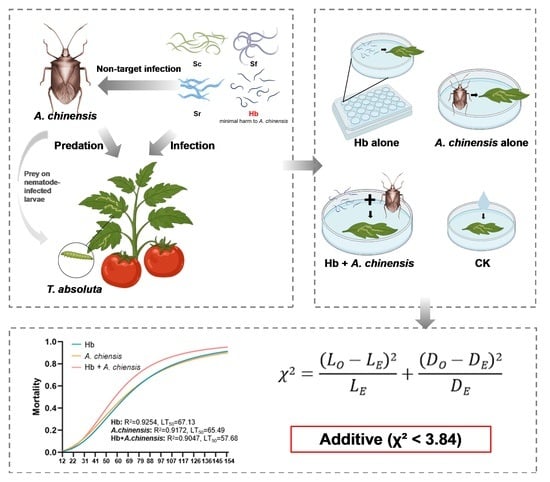
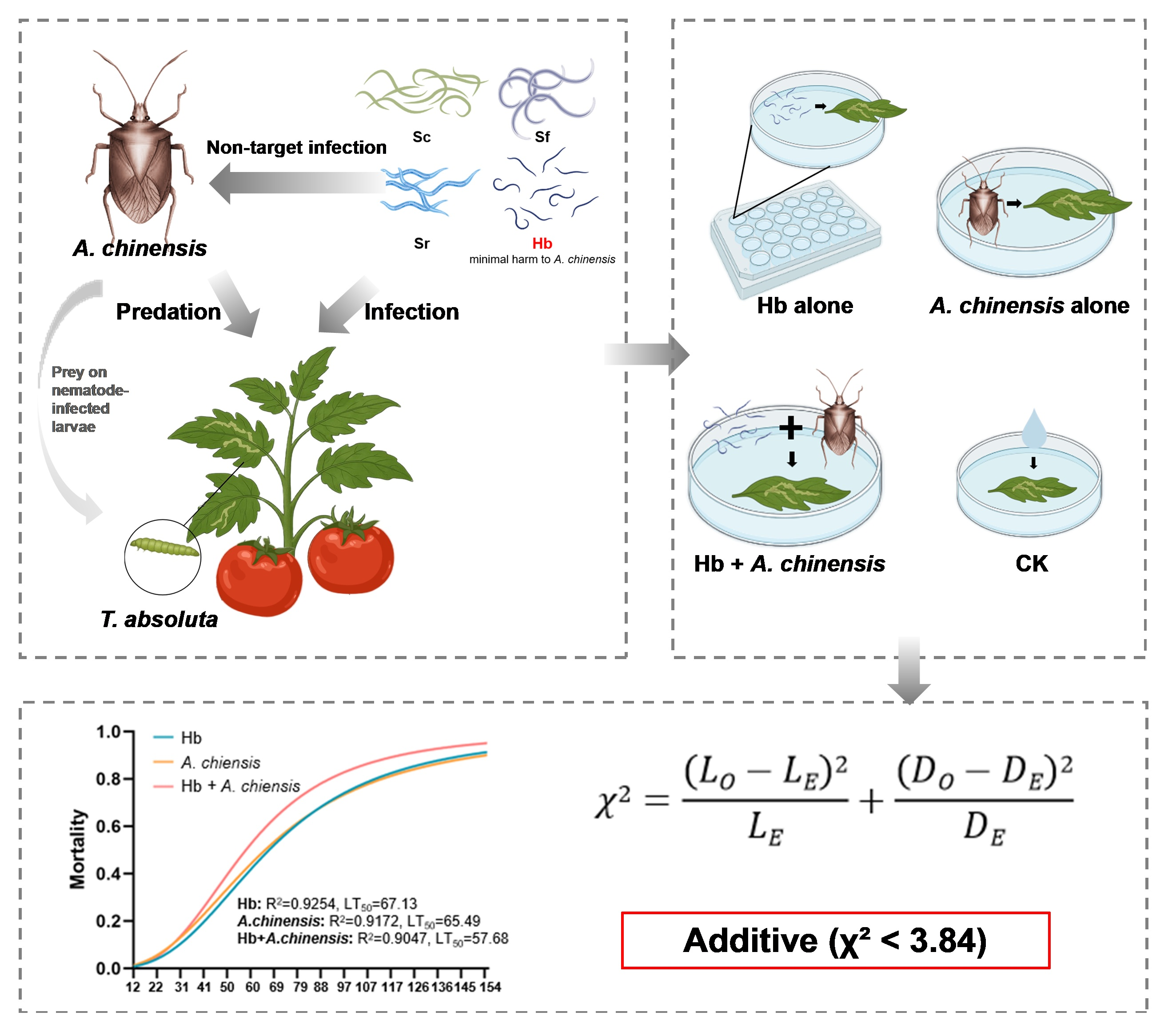
The tomato leafminer Tuta absoluta is a devastating pest that affects tomato production worldwide. Reliance on chemical insecticides raises sustainability concerns, highlighting the need for biological alternatives. In this laboratory study, we assessed the combined application of the predatory bug Arma chinensis and entomopathogenic nematodes against T. absoluta larvae. Heterorhabditis bacteriophora showed the lowest virulence against the predator among the tested nematodes. Female A. chinensis exhibited strong predation on exposed larvae, but efficiency declined against leaf-mining larvae. Heterorhabditis bacteriophora caused high mortality in early instars regardless of leaf-mining protection. Their combined application produced additive effects with reduced LT50 values. We also observed A. chinensis preying on nematode-infected larvae. These findings demonstrate that combining these natural enemies can enhance pest control, providing a basis for integrated management strategies.

Abstract

The tomato leafminer Tuta absoluta (Meyrick) is a devastating invasive pest that threatens tomato production worldwide. Reliance on chemical insecticides raises sustainability concerns, highlighting the need for effective biological alternatives. Combining predators with entomopathogenic nematodes (EPNs) represents a promising strategy, yet their interactions remain poorly characterized. Here, we conducted laboratory bioassays to assess the individual and joint effects of the predatory bug Arma chinensis (Fallou) and four EPN species, Steinernema carpocapsae, S. feltiae, S. riobrave, and Heterorhabditis bacteriophora, against T. absoluta larvae. Under these controlled conditions, H. bacteriophora showed the highest compatibility with A. chinensis, exhibiting the lowest virulence against the predator. Female A. chinensis exhibited strong predation on freely exposed second-instar larvae, but efficiency declined markedly against leaf-mining larvae. Heterorhabditis bacteriophora caused consistently high mortality in second instars regardless of protection. Their combined application resulted in additive mortality with significantly reduced LT50 values. We also observed A. chinensis preying on nematode-infected larvae and occasional infection of the predator under confined conditions. These laboratory findings demonstrate additive effects against T. absoluta, providing preliminary evidence for stage-specific integrated biological control strategies.

Graphical Abstract

1. Introduction

The tomato leafminer, Tuta absoluta (Meyrick) (Lepidoptera: Gelechiidae), is a devastating invasive pest of tomato originating from South America and now established worldwide [1,2]. Its concealed larval feeding and high reproductive capacity can result in severe yield losses if unmanaged. Chemical insecticides, the mainstay of control, have led to resistance development and non-target impacts, undermining sustainability [3,4]. With rising demands to reduce pesticide use, interest has shifted toward ecologically sound alternatives [5]. Biological control agents, such as Trichogramma parasitoids, show promise, but their field performance is constrained by climatic factors and host specificity [6,7,8]. Thus, developing robust biological control strategies is a priority in integrated pest management (IPM) for T. absoluta.
Currently, biological control of T. absoluta relies mainly on mirid predators such as Nesidiocoris tenuis (Reuter) and Macrolophus pygmaeus (Rambur), which are effective against eggs and early instars but less so against later larval stages [9,10,11]. Their use in augmentative release programs can reduce crop damage, though establishment often requires supplemental feeding [12,13]. Beyond these hemipterans, the asopine predator Arma chinensis (Fallou) has demonstrated broad efficacy against lepidopteran pests such as Spodoptera litura (Fabricius) and Plodia interpunctella (Hübner), aided by its facultative use of plant resources [14,15]. However, its potential against T. absoluta—including predation across larval instars, ability to access leaf-mining larvae, and compatibility with other biocontrol agents—remains poorly understood.
Entomopathogenic nematodes (EPNs) of the genera Steinernema and Heterorhabditis are promising biological control agents applied via soil or foliar treatments [16,17]. These nematodes vector symbiotic bacteria (Xenorhabdus spp. or Photorhabdus spp.) that rapidly kill insect hosts within 24–48 h [18,19]. Recent studies have shown efficacy against T. absoluta [20,21], and highlighted advances in foliar application through protective formulations that enhance survival and target penetration [22,23]. However, broader field performance is often constrained by environmental sensitivity, particularly ultraviolet (UV) radiation and desiccation, which can rapidly reduce nematode survival and infectivity when applied to foliage, and limited penetration of leaf-mining stages [24,25,26].
Ecological interactions between EPNs and other natural enemies range from synergistic to antagonistic. Plant-derived compounds can affect nematode virulence [27], and predatory arthropods may reduce EPN populations by consuming infected cadavers [28]. Mutualistic interactions also exist, e.g., Fusarium solani (Martius) attracts EPNs and enhances their efficacy [29,30]. Aboveground, intraguild predation among mirids and parasitoids can influence biological control [31,32]. Crucially, EPNs can have direct non-target effects on beneficial predators like N. tenuis [33,34]. This highlights the importance of assessing compatibility before integrating EPNs with other biocontrol agents within an IPM framework. Yet, despite this evidence, empirical data on interactions between hemipteran predators and EPNs, particularly regarding T. absoluta, remain scarce.
Therefore, an evaluation of their basic compatibility and joint effects is a necessary first step. Based on this, we hypothesize that certain EPNs will exhibit low virulence to A. chinensis, thereby facilitating predator attack and yielding additive or synergistic suppression of T. absoluta. To test this, we conducted a series of laboratory bioassays to (i) evaluate potential non-target effects of four EPN species on A. chinensis, (ii) quantify stage-specific predation on leaf-mining and exposed larvae, and (iii) analyze mortality dynamics in combined treatments. Our study addresses critical gaps in the integration of predators and EPNs, aiming to advance sustainable IPM strategies against this invasive pest.

2. Materials and Methods

2.1. Insect Rearing and EPN Culture

The stock culture of T. absoluta was derived from field-collected larvae infesting tomato plants (May 2024 in Yunnan, China). The moths were reared on potted tomato seedlings (cv. “Zhefen”) in climate-controlled chambers (HWS-250, Ningbo, China) at 25 ± 0.5 °C, 65 ± 5% RH, with a photoperiod of 16L:8D (light:dark) [35]. Adult moths were maintained in mesh cages (40 × 40 × 60 cm) and provided with 10% honey solution as a food source. Eggs were deposited on tomato leaves, which were replaced weekly to prevent overfeeding damage.
The A. chinensis population was purchased from Henan Jiyuan Baiyun Industrial Co., Ltd. (Jiyuan, China). All developmental stages of the predatory bugs were maintained in controlled environment chambers at 25 ± 0.5 °C, with 65 ± 5% RH and a photoperiod of 16L:8D. Arma chinensis were fed on Tenebrio molitor (Linnaeus) pupae. Experiments were conducted after two weeks of laboratory acclimatization.
Four EPN species, S. carpocapsae (All strain, Sc), S. feltiae (SN strain, Sf), S. riobrave (7–12 strain, Sr), and H. bacteriophora (H06 strain, Hb), were used in this study. The original populations of these nematodes were provided by the Research Center for Resource Insects and Bioengineering, Institute of Zoology, Guangdong Academy of Sciences, and the College of Life Sciences, Nankai University. These species have been maintained and propagated in laboratory culture for multiple years with confirmed taxonomic identities. All strains were subsequently cultured and maintained at the State Key Laboratory of Agricultural and Forestry Biosecurity, Fujian Agriculture and Forestry University. They were cultured and maintained using waxworm, Galleria mellonella (Linnaeus), larvae in 24-well plates. Plates were incubated at 25 °C until larval death (2–3 days) [36], after which cadavers were transferred to White traps [37]. Emerging IJs were collected after 8–9 days at 25 °C. The IJs were collected in 50 mL cell culture flasks, and stored in sterile distilled water at 15 °C in complete darkness for up to two weeks. Before each experiment, IJ activity was confirmed under a stereomicroscope (Nikon ECLIPSE Ts2, Tokyo, Japan).

2.2. Effects of EPNs on the Non-Target Predator A. chinensis

To assess the inherent virulence of EPNs on the non-target predator A. chinensis, a bioassay was conducted in a standardized, controlled laboratory system. The assay was conducted using 24-well plates containing 5 g of sterile quartz sand substrate (10% moisture) per well to simulate natural soil conditions. Nematode suspensions containing 25, 50, 100, or 200 IJs per well of each species were injected into the sand. One bug (second-instar, fifth-instar nymph, or adult) was placed in each well, with ten individuals per treatment. Control groups received 50 μL of distilled water. Mortality was recorded daily for 10 days. During this period, A. chinensis was provided with unlimited T. molitor pupae as food. Nematode infection was confirmed by transferring dead bugs to White traps and incubating at 25 °C for emergence observation. The experiment included five replicates and was independently conducted twice. Additionally, mortality of A. chinensis was recorded in control treatments without EPNs.

2.3. Predation Efficiency of A. chinensis on T. absoluta Larvae

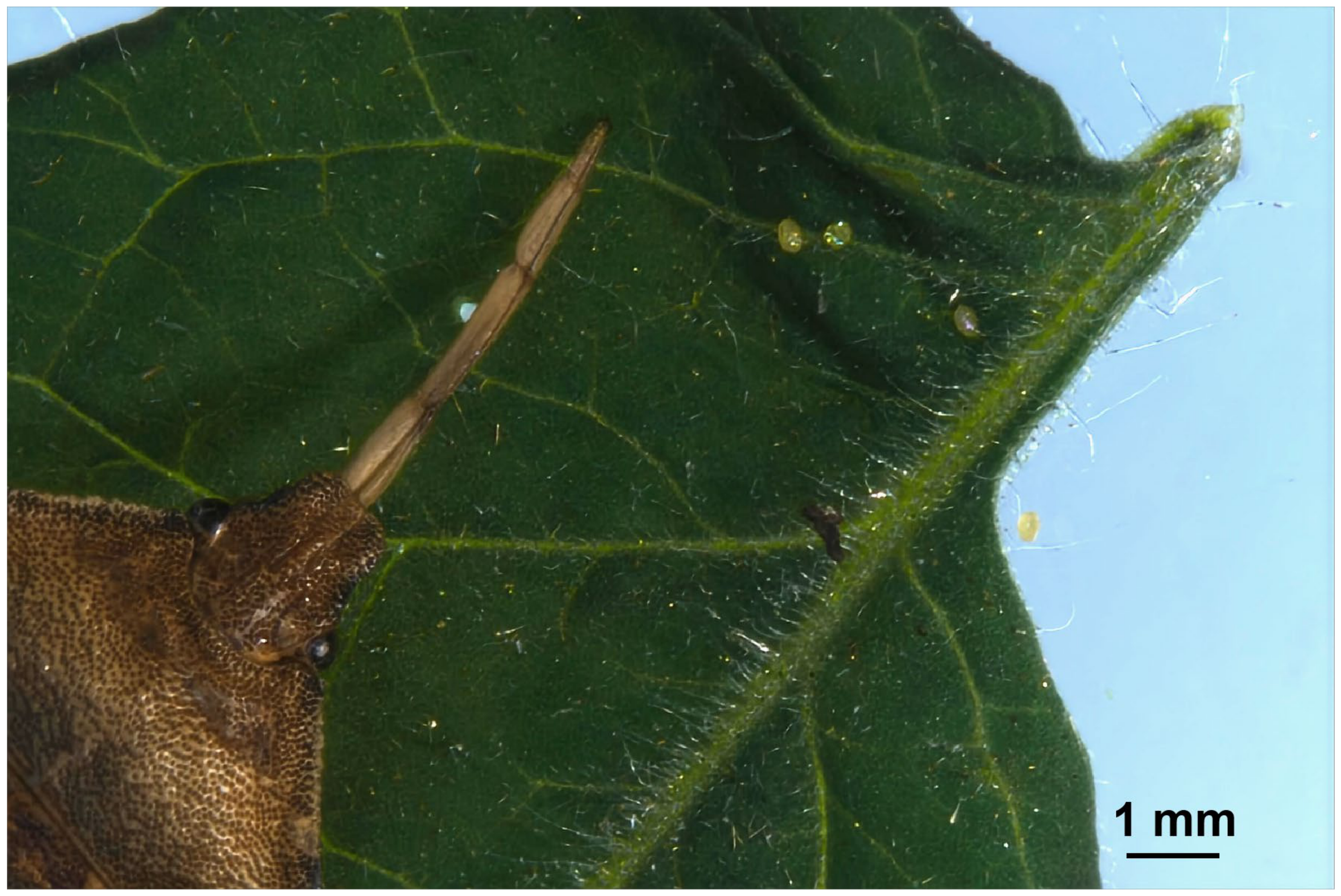
Following preliminary experiments, we excluded combinations involving A. chinensis with eggs of T. absoluta due to size mismatch (see Figure A1 for morphological comparison), as well as combinations with adult T. absoluta due to their ability to fly, which rendered them unsuitable prey. Additionally, we excluded early A. chinensis nymphs as predators, since they demonstrated low predation efficiency in our preliminary trials, corroborating the findings of Yang et al. (2023) on the performance of the predatory stink bug Picromerus lewisi (Scott) against T. absoluta [38]. Therefore, our predation bioassays focused on evaluating the intrinsic predatory capacity of actively foraging A. chinensis (fifth-instar nymphs and both female and male adults) against the key damaging larval stages of T. absoluta, including both early (second instar) and late (fourth instar) developmental phases. Furthermore, considering the leaf-mining behavior of T. absoluta, we additionally investigated predation on larvae that were either freely exposed on moist filter paper or sheltered within mined tomato leaf discs. Predation bioassays were conducted under laboratory conditions in 9 cm Petri dishes, each containing 15 T. absoluta larvae. Non-leaf-mining larvae were placed on moist filter paper, whereas leaf-mining larvae were provided with tomato leaf discs. After starving for 24 h, a single predator was introduced into each dish. Predation by A. chinensis was recorded 24 h later. The number of prey consumed was determined by counting the dead larvae that had been completely emptied of body contents. Each treatment was replicated five times in two independent trials. Control treatments without predators were included to account for natural mortality.

2.4. Effect of EPNs on T. absoluta Larvae

To assess the direct virulence of EPNs against T. absoluta larvae under standardized, no-choice conditions, a single T. absoluta larva was placed in each well of a 24-well plate and treated with 100 µL of distilled water containing 25 IJs of each EPN species. Three larval treatments were evaluated: second-instar non-mining larvae, fourth-instar non-mining larvae, and second-instar leaf-mining larvae. This design allowed for the comparison of virulence across larval stages (second vs. fourth instar) and the assessment of EPNs’ ability to infect larvae within the physical refuge of a leaf mine. For non-mining treatments, one target larva was transferred to each well along with a fresh tomato leaf fragment. For leaf-mining treatment, larvae were pre-established in tomato leaves for 24 h before assay initiation, after which the intact infested leaves containing one larva were transferred into each well. Control groups received 100 µL of sterile water without EPNs. For each treatment, 10 replicates in five trials were conducted across two independent experimental runs. Mortality was assessed at 12 h intervals for 72 h. Dead larvae displaying characteristic infection symptoms were transferred to individual White traps for nematode emergence confirmation.

2.5. Combined Effect of A. chinensis and EPNs on T. absoluta Larvae

Based on the non-target virulence assay (Section 2.2), H. bacteriophora was selected for combination trials as it showed the lowest virulence against A. chinensis and thus the highest compatibility. Combination treatments of A. chinensis adults and H. bacteriophora were conducted in a controlled, contained environment (500 mL sealed containers lined with filter paper) to assess their interactive effects on T. absoluta larvae. Ten second-instar larvae were pre-conditioned for 24 h on fresh tomato leaves to establish feeding sites prior to treatment application. Four experimental treatments were evaluated: (1) A. chinensis alone (one female adult), (2) H. bacteriophora alone (125 IJs), (3) combined A. chinensis and H. bacteriophora (one female adult + 125 IJs), and (4) distilled water control. Each treatment included five replicates, and all containers were maintained for 156 h before final mortality assessment. The entire experiment was independently conducted twice.
Additionally, a supplementary experiment was conducted to evaluate whether A. chinensis would prey on nematode-killed larvae, a potential interaction niche between the predator and the nematode. Arma chinensis adults were starved for 24 h and then individually exposed to one T. absoluta larva that had been killed by H. bacteriophora infection (24 h post-infection). Predation behavior was observed over a 24 h period in 16 replicates.

2.6. Statistical Analysis

The mortality rate was corrected using the formula of Abbott (1925) [39]: Corrected mortality = (Treatment mortality-Control mortality)/(1-Control mortality). All statistical analyses were performed with GraphPad Prism v7.0 (GraphPad Software, San Diego, CA, USA), and results with p < 0.05 were considered statistically significant. All data are presented as mean ± standard error (SE) from a minimum of five independent replicates.
For EPN virulence assays against A. chinensis, data were analyzed by two-way ANOVA with EPN species and concentration as main factors, followed by Tukey’s HSD test. For H. bacteriophora specifically, concentration-dependent mortality across developmental stages was assessed by fitting a four-parameter logistic regression model [log(inhibitor) vs. normalized response] to estimate median lethal concentrations (LC50) with 95% confidence intervals. Goodness-of-fit was assessed using R2 values. For predation assays, differences among A. chinensis developmental stages and among T. absoluta larval conditions were analyzed by one-way ANOVA followed by Tukey’s HSD test. Homogeneity of variance was verified using Levene’s test. For time-course mortality assays, data were fitted to a four-parameter logistic regression model [[agonist] vs. response—variable slope] to estimate median lethal times (LT50) with 95% confidence intervals. Differences among time-mortality curves were assessed using the extra sum-of-squares F-test. Model fit was verified by non-significant chi-square tests (p > 0.05).
For combination treatments evaluating predator–nematode interactions, we implemented Wu and Duncan (2022)’s method [40]. Expected mortality (PE) was calculated as PE = P0 + (1 − P0)(P1) + (1 − P0)(1 − P1)(P2), where P0, P1, and P2 represent control, predator-alone, and nematode-alone mortality rates, respectively. The observed mortality in the combined treatment was PC. A chi-square test (χ2 = (LOLE)2/LE + (DODE)2/DE) compared observed versus expected mortality, where LO/DO are observed dead individuals in control/combined treatments, and LE/DE are expected values. The interaction was additive if χ2 < 3.84, antagonism if χ2 > 3.84 and PC < PE, and synergism if χ2 > 3.84 and PC > PE.

3. Results

3.1. Virulence of EPNs Against A. chinensis

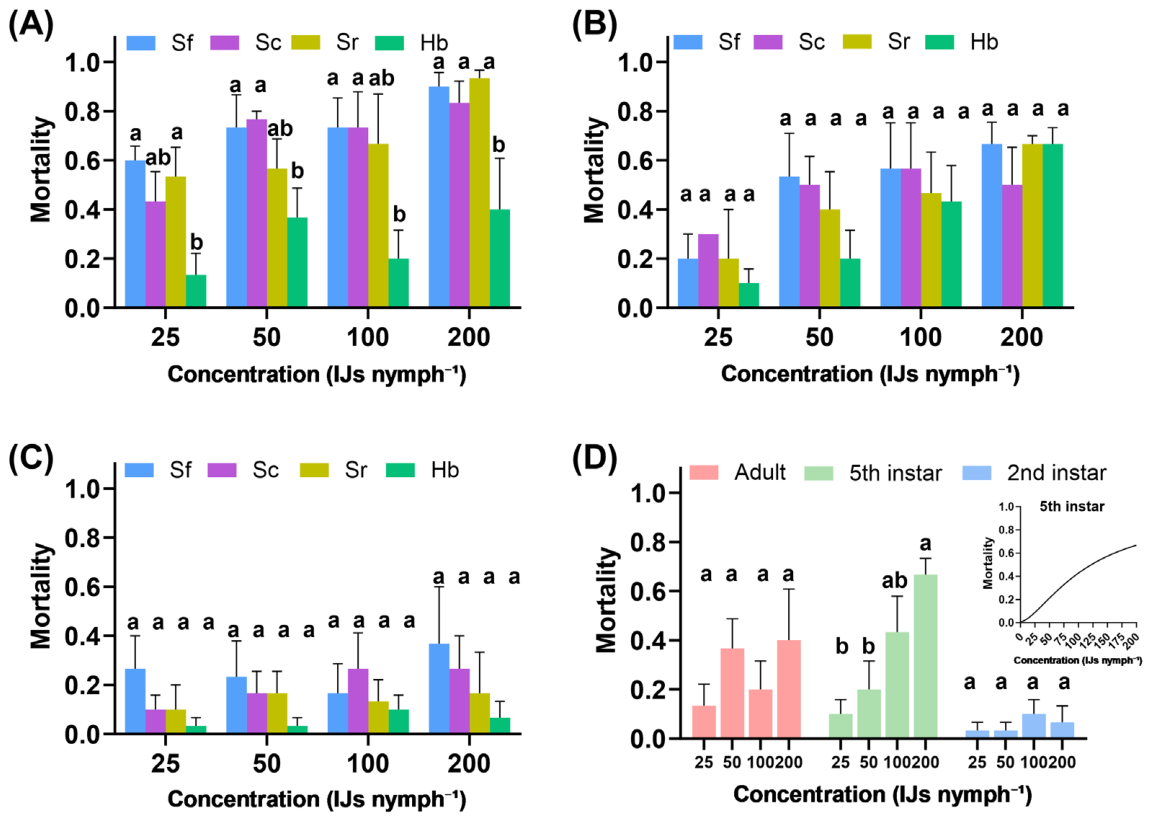
The virulence of four EPN species against A. chinensis varied significantly among developmental stages under confined laboratory conditions (Figure 1A–C, Table A1). For adult stink bugs, EPN species (F3,33 = 14.94, p < 0.0001) and concentration (F11,33 = 2.502, p = 0.0206) significantly affected mortality. Heterorhabditis bacteriophora (Hb) consistently induced the lowest mortality rates across all concentrations (p < 0.05; Figure 1A, Table A2), whereas the other three EPN species caused significantly higher but statistically similar mortality (p > 0.05). For second-instar nymphs, EPN species (F3,33 = 3.606, p = 0.0234) and concentration (F11,33 = 2.502, p = 0.0206) also significantly affected mortality (Table A1). Hb induced significantly lower mortality than S. feltiae (Sf; 0.058 vs. 0.258, p = 0.0175), but did not differ from S. carpocapsae (Sc; p = 0.1366) or S. riobrave (Sr; p = 0.5628; Table A2). For fifth-instar nymphs, only concentration significantly affected mortality (F11,33 = 3.712, p = 0.0017; Table A1).
Collectively, Hb consistently exhibited the lowest non-target virulence against all developmental stages of A. chinensis, and was therefore selected as the candidate species for subsequent combination trials with the predator. Further examination revealed that fifth-instar nymphs were the most susceptible to Hb, with mortality increasing in a concentration-dependent manner and reaching 67% at 200 IJs nymph−1 (LC50 = 115.8 IJs nymph−1; Figure 1D). In contrast, adults and second-instar nymphs exhibited relatively flat dose–responses, with mortality below 40% and 20%, respectively, and LC50 values > 200 IJs nymph−1. To minimize risk to A. chinensis, the lowest tested concentration of 25 IJs nymph−1 was selected for subsequent efficacy assays against T. absoluta, at which Hb induced only 5–13% mortality across predator stages.

3.2. Stage-Specific Predation of A. chinensis on T. absoluta

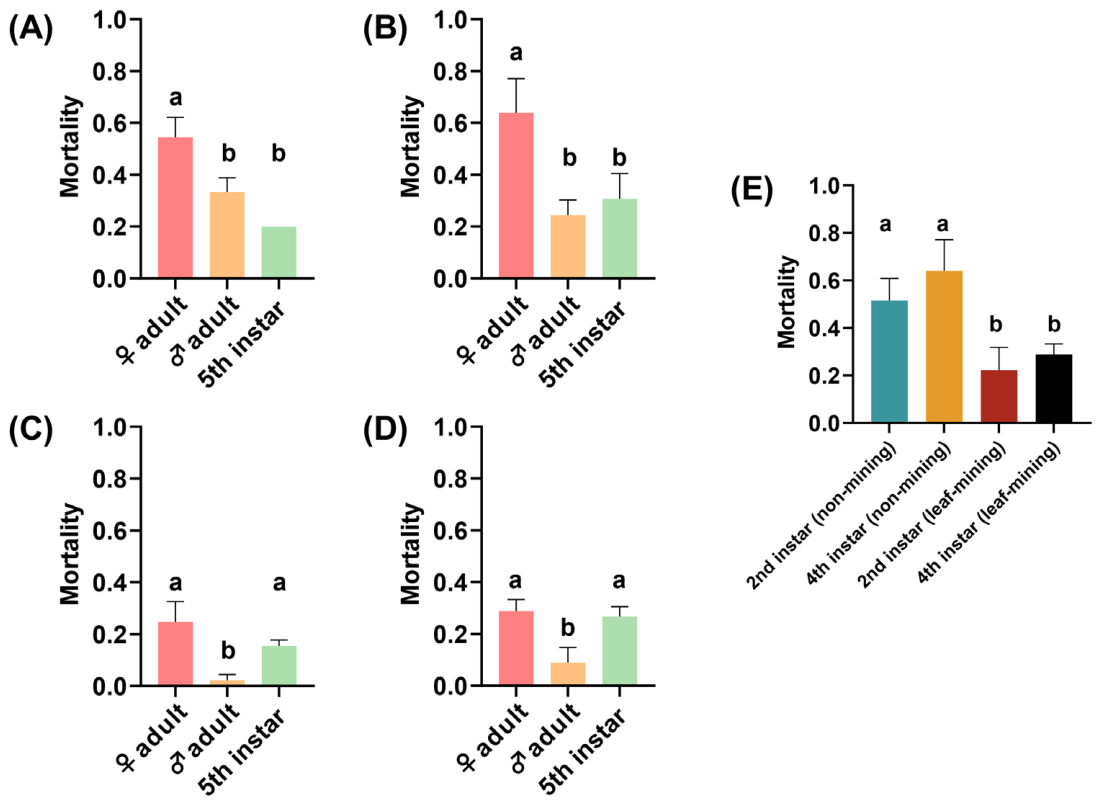
Arma chinensis exhibited significant stage-specific predation against T. absoluta larvae under our assay conditions (Figure 2). When preying on second-instar larvae without leaf protection, female adults showed the highest predation rate (0.52 ± 0.09), which was significantly greater than that of male adults (0.33 ± 0.08; p = 0.0498) and fifth-instar nymphs (0.20 ± 0.00; p = 0.0036) (Tukey’s post hoc test; Figure 2A). A similar pattern occurred with unprotected fourth-instar larvae: female adults caused significantly higher mortality (0.64 ± 0.13) than male adults (0.24 ± 0.06; p = 0.044) and fifth-instar nymphs (0.31 ± 0.09; p = 0.049; Figure 2B). In treatments with leaf protection, female adults and fifth-instar nymphs induced significantly higher mortality on second-instar larvae (0.22 ± 0.09 and 0.16 ± 0.02, respectively) than male adults (0.02 ± 0.02; p = 0.0489 and p = 0.0132, respectively; Figure 2C). Similarly, against leaf-mining fourth-instar larvae, both female adults and fifth-instar nymphs showed similar efficacy (0.29 ± 0.04 and 0.27 ± 0.04, respectively) and significantly exceeded that of male adults (0.09 ± 0.06; p = 0.026 and p = 0.040, respectively; Figure 2D). Notably, although female adults maintained higher predation rates across all treatments, their efficacy declined significantly by 57–58% against leaf-mining compared to unprotected larvae (p < 0.05; Figure 2E).

3.3. Insecticidal Efficacy of EPNs Against T. absoluta

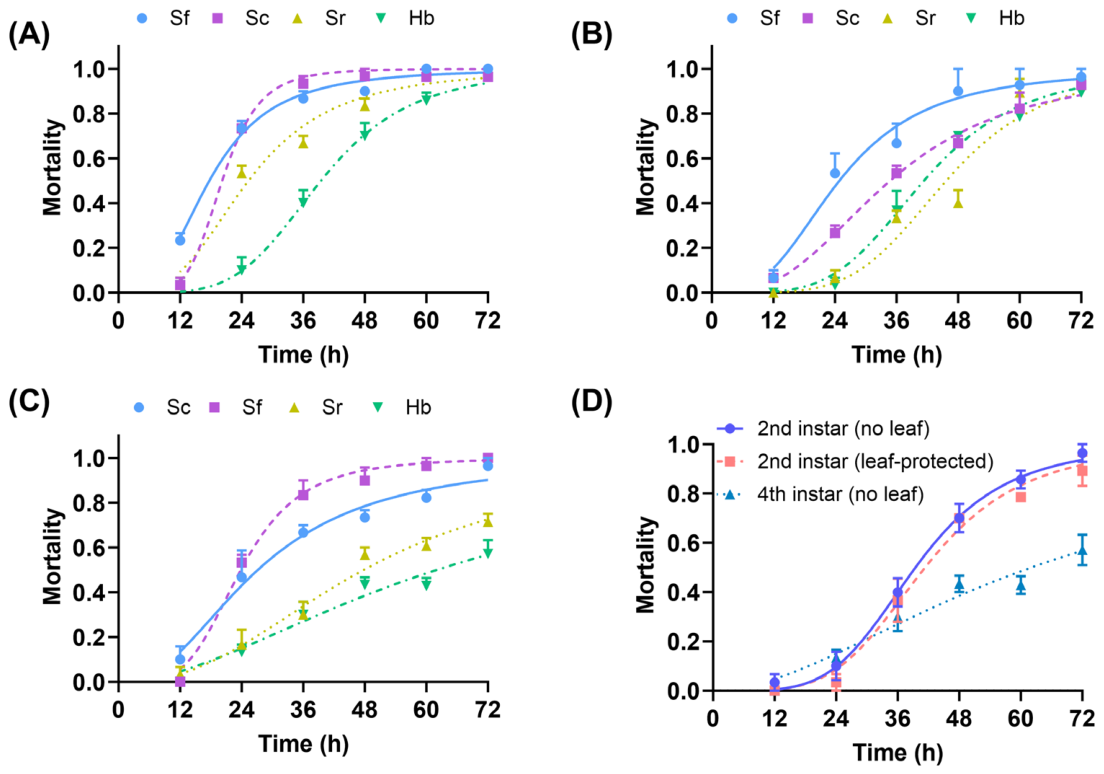
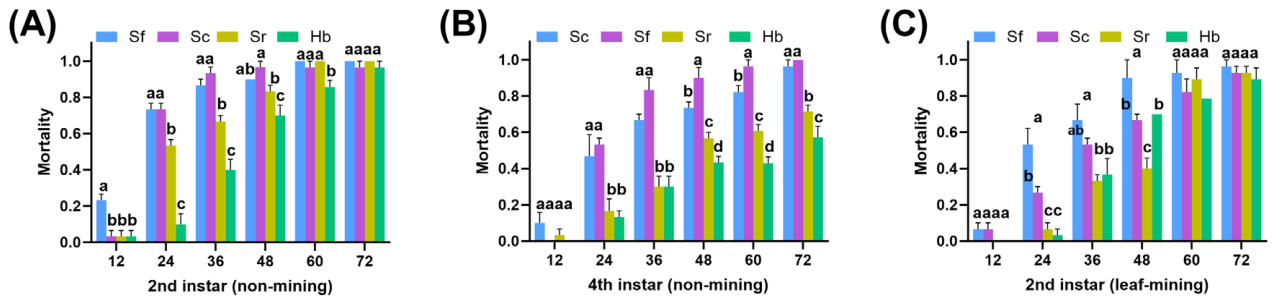
The four EPN species exhibited significant variation in the time course of mortality against T. absoluta larvae, with efficacy strongly modulated by larval instar and leaf-mining status (Figure 3 and Figure A3, Table A3). For unprotected second-instar larvae, time-course mortality increased progressively in all treatments (F6,64 = 60.46, p < 0.0001; Figure 3A). Sf achieved the fastest kill (LT50 = 17.7 h, 95% CI: 16.6–18.9 h), followed by Sc (LT50 = 20.2 h), Sr (LT50 = 25.3 h), and Hb (LT50 = 39.5 h). At 12 h, Sf induced significantly higher mortality (0.23 ± 0.03) than the other three species (p < 0.05; Figure A3). By 24 h, both Sc and Sf reached 73% mortality, significantly exceeding that of Hb, while Sr showed intermediate effects. At 60 h, Sc, Sf, and Sr maintained significantly higher mortality than Hb (p < 0.05), though by 72 h, mortality converged across all treatments (0.96–1.00, p > 0.05). Against unprotected fourth-instar larvae, overall susceptibility was reduced across all species (Figure 3B). Sf remained the most rapid (LT50 = 23.9 h, 95% CI: 22.1–25.6 h), followed by Sc (LT50 = 27.2 h), whereas Sr and Hb were substantially slower (47.8 h and 62.0 h, respectively) (F6,64 = 56.00, p < 0.0001). Hb mortality remained below 60% through 72 h (Figure A3).
Leaf-mining behavior further attenuated EPN efficacy (Figure 3C). Against leaf-mining second-instar larvae, LT50 values increased for all species, with Sf again acting most rapidly (LT50 = 24.9 h, 95% CI: 21.2–28.7 h), followed by Sc (34.8 h), Hb (41.4 h), and Sr (45.7 h) (F6,64 = 16.70, p < 0.0001). During the first 48 h, Sr and Hb caused negligible mortality (0–3%), significantly lower than that caused by Sc and Sf (p < 0.05; Figure A3). By 60 h, no significant differences in mortality rates were detected among the four species (p > 0.05), and by 72 h, all species achieved nearly complete mortality (0.79–1.00).
For Hb specifically, efficacy varied significantly across larval conditions (F4,48 = 32.20, p < 0.0001; Figure 3D). Unprotected and leaf-mining second-instar larvae showed similar susceptibility (LT50 = 39.5 h and 41.4 h, respectively), whereas fourth-instar larvae required approximately 1.5-fold longer (LT50 = 62.0 h). Thus, Hb exhibited clear stage- and context-dependent efficacy, with optimal performance against early instars.

3.4. Additive Interaction Between A. chinensis and EPNs Against T. absoluta

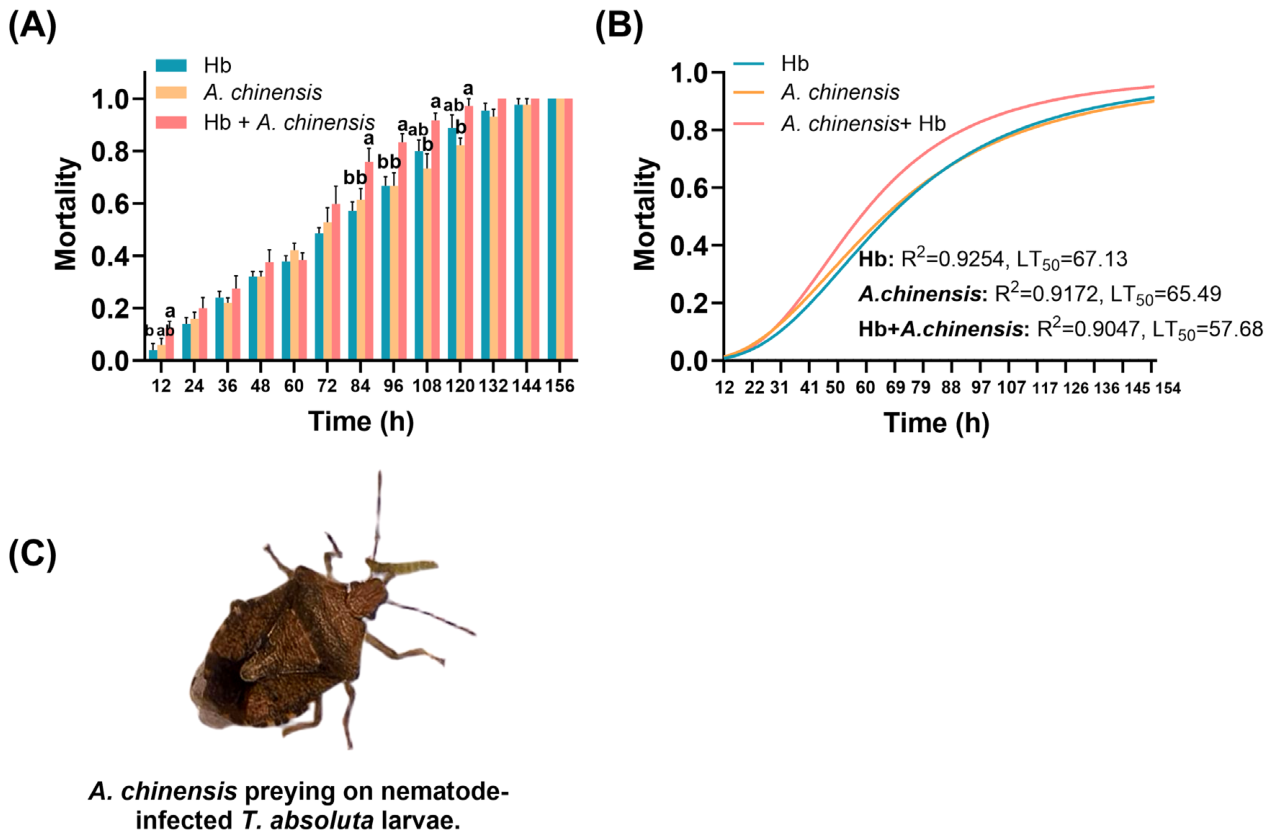
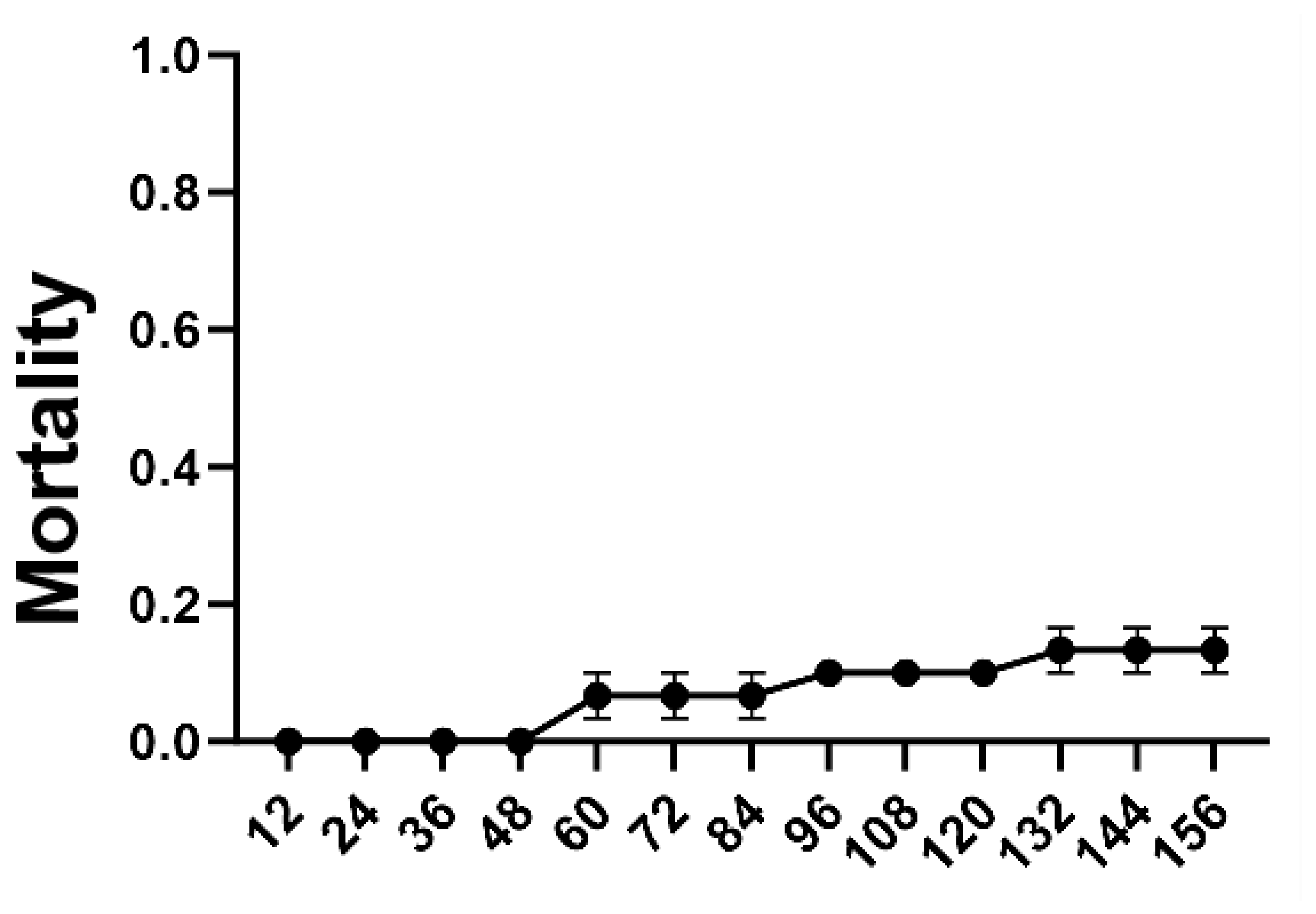
The combined application of A. chinensis and Hb exhibited a time-dependent additive effect on larval mortality of T. absoluta (Figure 4, Table 1). In the control group, the natural mortality of T. absoluta larvae remained low throughout the experiment, averaging 13% (Figure A2). At 12 h, the combined treatment caused significantly higher mortality compared to Hb alone (p < 0.05), though it did not differ significantly from A. chinensis alone (p > 0.05; Figure 4A). From 24 to 72 h, no significant differences were detected among treatments. Between 84 and 120 h, however, the combined treatment again showed significantly higher mortality than either agent applied alone (p < 0.05). All treatments eventually reached 100% mortality by 156 h. Time–mortality analysis indicated significant differences among the three treatments (F4,176 = 5.899, p = 0.0002; Figure 4B). The LT50 of the combined treatment was 57.68 h (95% CI: 53.04–62.18 h), which was significantly shorter than that of Hb alone (67.13 h, 95% CI: 63.30–70.90 h) or A. chinensis alone (65.49 h, 95% CI: 61.56–69.37 h). Interaction analysis confirmed additive effects throughout the experiment (12–156 h) rather than synergistic or antagonistic (Table 1).
Notably, one A. chinensis individual in the combined treatment was found dead due to nematode infection, as confirmed by dissection. In the separate observational assay, A. chinensis was observed preying on nematode-infected larvae in some replicates (Figure 4C), although this behavior did not alter the overall additive interaction pattern.

4. Discussion

Our laboratory evaluation of individual and combined biocontrol approaches highlights key operational considerations for future T. absoluta management strategies. The predatory bug A. chinensis exhibited strong efficacy against exposed (i.e., non-mining) larvae on leaf surfaces, regardless of instar, but showed limited effectiveness against larvae concealed within leaf mines. In contrast, H. bacteriophora achieved nearly complete control of second-instar larvae within 72 h, whether exposed or leaf-mining, but its efficacy was relatively lower against fourth-instar exposed larvae. The combined application demonstrated additive effects, producing faster overall mortality than single-agent treatments. However, two ecological interactions were noted: H. bacteriophora occasionally infected A. chinensis, and A. chinensis readily consumed T. absoluta larvae already infected by the nematodes. These findings suggest that while the combined approach accelerates pest suppression in a controlled setting, the complex interactions between these biological agents warrant careful consideration for field deployment. In practice, targeted strategies should match specific natural enemies to the most vulnerable pest stages and habitats, thereby optimizing efficacy and minimizing ecological risks.

4.1. Developmental Stage and Leaf-Mining Behavior Mediate Biocontrol Efficacy

Our results highlight the strong stage- and habitat-dependent differences in susceptibility of T. absoluta larvae to biocontrol agents. Heterorhabditis bacteriophora required approximately 1.5-fold longer to kill fourth-instar larvae than second-instar larvae, with LT50 of 62.0 h versus 39.5 h, respectively (Figure 3D; Table A3). The greater susceptibility of early instars likely reflects their thinner cuticle and weaker immune defenses, which facilitate nematode penetration and impair hemocyte-mediated defense [41]. Similar developmental resistance patterns are widely reported: early instars of S. litura and S. frugiperda are highly susceptible to H. indica and S. carpocapsae, whereas later instars or pupae are more resistant or better targeted by S. arenarium and S. longicaudum [42,43]. Pupal stages in particular often resist infection due to sclerotized integuments, as shown in Drosophila suzukii [44].
Leaf-mining behavior further mediates efficacy by providing shelter for larvae. Under laboratory conditions, A. chinensis exhibited lower predation against leaf-mining larvae (0.22–0.29) than against exposed larvae (0.52–0.64; Figure 2E). However, this limitation may be less pronounced in the field, where spatial complexity could enhance predator searching behavior. This limitation is rarely addressed in earlier studies, which typically test predation against exposed larvae. By contrast, H. bacteriophora readily penetrated mines and killed second-instar larvae, achieving LT50 values of 41.4 h for leaf-mining larvae compared to 39.5 h for exposed larvae, a modest delay that did not compromise ultimate efficacy (Figure 3C,D; Table A3). This is consistent with reports of successful EPN infections inside leaf mines [45,46,47]. Collectively, these findings illustrate the critical influence of pest stage and habitat on biocontrol efficacy, highlighting important factors to guide the design of targeted management strategies.

4.2. Biological Basis of Variation in Predator Performance

The differential efficacy of predators and EPNs against T. absoluta reflects their distinct biological traits and modes of action. Female A. chinensis consistently exhibited the highest predation rates across larval stages (Figure 2), a pattern reported in other predatory species such as D. errans, N. pseudoferus, and M. basicornis, where females consumed significantly more prey regardless of instar [48,49,50]. Similar sex-related differences are widely documented in hemipteran predators, including mirids and nabids, and are generally attributed to the elevated nutritional demands of oogenesis that promote more intensive host-searching and handling efficiency [51,52,53]. This reproductive-driven investment thus explains the consistently superior performance of females in biocontrol contexts.

4.3. Additive Effects in Predator–EPN Biological Control Systems

The combined use of A. chinensis and H. bacteriophora produced additive effects, reducing LT50 by approximately 10 h relative to either agent alone (Figure 4A,B). Such outcomes are consistent with other multi-enemy systems where additive effects occur despite intraguild predation [30,32]. This modest acceleration has limited biological significance under field conditions and should be viewed as a complementary enhancement.
However, these benefits were coupled with ecologically complex interactions (Figure 4C). Arma chinensis consumed nematode-infected larvae without discrimination, a form of intraguild predation that may reduce predator fitness [54]. Moreover, occasional infection of A. chinensis by H. bacteriophora was observed, indicating that top-down regulation can extend to natural enemies themselves [28].
These multi-trophic interactions resemble the mutualistic relationship between EPNs and Fusarium solani [29], illustrating the difficulty of extrapolating laboratory results directly to field outcomes. Instead, they establish a proof of concept and identify key interaction risks that must be managed. From an applied perspective, deployment strategies (e.g., temporal separation of releases or habitat manipulation) are needed to maximize additive effects while minimizing ecological risks, as outcomes are strongly context-dependent [27,32].

4.4. Study Limitations and Management Implications

This study, conducted under controlled laboratory conditions, may not fully capture the variability of field environments, where temperature, humidity, and vegetation structure could alter predator–entomopathogen interactions. Moreover, the controlled humidity (65 ± 5% RH) in our laboratory assays may overestimate EPN efficacy compared to field conditions, where humidity is often lower and more variable [24]. Specifically, the non-target virulence of EPNs against A. chinensis was assessed in confined arenas that prevented predator escape; therefore, the mortality rates likely represent an upper estimate of risk under forced exposure, which may be lower in a complex field habitat where predators can avoid treated zones. Moreover, we did not assess the long-term fitness effects of A. chinensis feeding on nematode-infected larvae, which could influence predator population dynamics in agricultural systems [54,55]. Field-based studies addressing these uncertainties remain essential.
Despite these limitations, our findings provide a framework for integrating EPNs and predatory bugs in T. absoluta management. Given its minimal non-target effects on A. chinensis, H. bacteriophora is a suitable nematode candidate, particularly against early instars that are highly susceptible regardless of mining status. For future foliar application, the efficacy and survival of H. bacteriophora will critically depend on the use of protective formulations to mitigate UV radiation and desiccation, as highlighted in recent research [22,23]. We hypothesize that introducing adult female A. chinensis approximately 72 h after EPN application may reduce risks of predator infection and inefficient foraging, as most larvae would have already succumbed to nematodes by this time. Complementary cultural practices, such as removing heavily infested leaves containing late-instar larvae, can further enhance overall sustainability [56].

5. Conclusions

This laboratory study evaluated the potential of combining the predator A. chinensis with EPNs for managing T. absoluta. Under the controlled conditions tested, H. bacteriophora exhibited the lowest non-target impact on A. chinensis among the evaluated EPN species. When applied individually, both agents showed efficacy against T. absoluta larvae, with their performance varying with larval stage and level of protection. Their combined use produced additive effects, reducing the LT50 by approximately 10 h compared with either agent alone. Importantly, interactions such as A. chinensis preying on EPN-infected larvae and predator mortality induced by EPN infection highlight potential ecological complexities, including intraguild predation. These findings underscore evidence of laboratory-scale compatibility between A. chinensis and H. bacteriophora, with additive effects against T. absoluta. For field application, however, ecological outcomes and practical efficacy will depend on factors beyond this controlled assay, such as environmental conditions, habitat complexity, and EPN formulation for foliar use. Future work should focus on field validation and refinement of application strategies to enhance compatibility and efficacy.

Author Contributions

Conceptualization, S.-Y.W. and Y.H.; methodology, S.-Y.W. and Y.Z.; validation, M.S., Y.J., Q.C., R.L. and W.M.; formal analysis, Y.Z.; investigation, M.S., Y.J., Q.C., R.L. and W.M.; resources, S.-Y.W. and Y.H.; data curation, Y.Z.; writing—original draft preparation, Y.Z.; writing—review and editing, S.-Y.W. and Y.H.; visualization, Y.Z.; supervision, S.-Y.W. and Y.H.; funding acquisition, S.-Y.W., Y.H. and Y.Z. All authors have read and agreed to the published version of the manuscript.

Funding

This work was funded by the International Cooperation Project of Fujian Province (2025I0009), the Fujian Provincial Natural Science Foundation (2024J01377), and the key projects of National Natural Science Foundation of China (U22A20489 and 32361143791).

Data Availability Statement

The original contributions presented in this study are included in the article. Further inquiries can be directed to the corresponding authors.

Acknowledgments

We would like to express our appreciation to the authorities of Fujian Agriculture and Forestry University for providing research facilities during this study.

Conflicts of Interest

The authors declare no conflicts of interest.

Abbreviations

The following abbreviations are used in this manuscript:
EPNEntomopathogenic nematode
IPMIntegrated pest management
IJsInfective juveniles
LT50Median lethal time
LC50Median lethal concentration
SEStandard error
ANOVAAnalysis of variance
ScSteinernema carpocapsae
SfSteinernema feltiae
SrSteinernema riobrave
HbHeterorhabditis bacteriophora

Appendix A

Table A1. Two-way ANOVA results for mortality of different developmental stages of Arma chinensis exposed to four entomopathogenic nematode species.
Developmental StageSource of VariationdfFp-Value
AdultConcentration11, 332.5020.0206
EPN species3, 3314.94<0.0001
Second-instar nymphConcentration11, 332.5020.0206
EPN species3, 333.6060.0234
Fifth-instar nymphConcentration11, 333.7120.0017
EPN species3, 331.0790.3716
Note: df, degrees of freedom (numerator, denominator).
Table A2. Mean mortality of Arma chinensis developmental stages exposed to four entomopathogenic nematode species (pooled across concentrations).
Developmental StageScSfSrHb
Adult0.692 ± 0.079 a0.742 ± 0.079 a0.675 ± 0.079 a0.275 ± 0.079 b
Second-instar nymph0.200 ± 0.064 ab0.258 ± 0.064 a0.142 ± 0.064 ab0.058 ± 0.064 b
Fifth-instar nymph0.467 ± 0.0840.492 ± 0.0840.433 ± 0.0840.350 ± 0.084
Note: Data are presented as mean ± SE (pooled across concentrations of 25, 50, 100, and 200 IJs nymph−1). Within each developmental stage, means followed by different lowercase letters indicate significant differences among EPN species (Tukey’s HSD test, p < 0.05). Absence of letters indicates no significant differences among species. Sc, Steinernema carpocapsae; Sf, S. feltiae; Sr, S. riobrave; Hb, Heterorhabditis bacteriophora.
Table A3. Median lethal times (LT50) of entomopathogenic nematodes against Tuta absoluta larvae under different exposure conditions.
Larval TypeEPN SpeciesLT50 (h)95% CI (h)R2F (DFn, DFd)p-Value
2nd instar, non-miningSf17.716.6–18.90.974F6,64 = 60.46<0.0001
Sc20.218.8–21.70.974
Sr25.323.0–27.70.953
Hb39.537.1–41.80.964
4th instar, non-miningSf23.922.1–25.60.965F6,64 = 56.00<0.0001
Sc27.223.4–31.00.891
Sr47.844.0–52.00.920
Hb62.055.7–71.60.877
2nd instar, leaf-miningSf24.921.2–28.70.880F6,64 = 16.70<0.0001
Sc34.832.1–37.50.954
Sr41.438.8–43.90.957
Hb45.741.7–49.60.917
Hb only2nd instar, non-mining39.537.1–41.80.964F4,48 = 32.20<0.0001
2nd instar, leaf-mining41.438.8–43.90.957
4th instar, non-mining62.055.7–71.60.877

Appendix B

Figure A1. Morphological comparison between the stylet of the predatory bug Arma chinensis and the eggs of the tomato leafminer Tuta absoluta.
Insects 17 00627 g0a1
Figure A2. Natural mortality of Tuta absoluta larvae over time. Mortality rates were recorded at 12 h intervals under controlled laboratory conditions (25 ± 1 °C, 70% RH). Data represent mean ± SE (n = 5). No significant differences were observed among time points by one-way ANOVA (p > 0.05).
Insects 17 00627 g0a2
Figure A3. Time-dependent mortality of Tuta absoluta larvae induced by four entomopathogenic nematode species. (A) non-mining 2nd-instar larvae, (B) non-mining 4th-instar larvae, (C) leaf-mining 2nd-instar larvae exposed to Steinernema carpocapsae (Sc), S. feltiae (Sf), S. riobrave (Sr), and Heterorhabditis bacteriophora (Hb) at 25 IJs larva−1. Data represent mean ± SE (n = 5). Different lowercase letters indicate significant differences (p < 0.05) in mortality among EPN species at each time point by one-way ANOVA.
Insects 17 00627 g0a3

References

  1. Biondi, A.; Guedes, R.N.C.; Wan, F.H.; Desneux, N. Ecology, worldwide spread, and management of the invasive South American tomato pinworm, Tuta absoluta: Past, present, and future. Annu. Rev. Entomol. 2018, 63, 239–258. [Google Scholar] [CrossRef]
  2. Han, P.; Bayram, Y.; Shaltiel-Harpaz, L.; Sohrabi, F.; Saji, A.; Esenali, U.T.; Jalilov, A.; Ali, A.; Shashank, P.R.; Wang, S.; et al. Tuta absoluta continues to disperse in Asia: Damage, ongoing management and future challenges. J. Pest Sci. 2019, 92, 1317–1327. [Google Scholar] [CrossRef]
  3. Guedes, R.N.C.; Berenbaum, M.R.; Biondi, A.; Desneux, N. The side effects of pesticides on nontarget arthropods. Annu. Rev. Entomol. 2026, 71, 381–403. [Google Scholar] [CrossRef] [PubMed]
  4. Guedes, R.N.C.; Roditakis, E.; Campos, M.R.; Haddi, K.; Bielza, P.; Siqueira, H.A.A.; Tsagkarakou, A.; Vontas, J.; Nauen, R. Insecticide resistance in the tomato pinworm Tuta absoluta: Patterns, spread, mechanisms, management and outlook. J. Pest Sci. 2019, 92, 1329–1342. [Google Scholar] [CrossRef]
  5. Van Lenteren, J.C.; Bolckmans, K.; Köhl, J.; Ravensberg, W.J.; Urbaneja, A. Biological control using invertebrates and microorganisms: Plenty of new opportunities. BioControl 2018, 63, 39–59. [Google Scholar] [CrossRef]
  6. Cabello, T.; Gallego, J.R.; Fernandez, F.J.; Gamez, M.; Vila, E.; Del Pino, M.; Hernandez-Suarez, E. Biological control strategies for the South American tomato moth (Lepidoptera: Gelechiidae) in greenhouse tomatoes. J. Econ. Entomol. 2012, 105, 2085–2096. [Google Scholar] [CrossRef]
  7. Zang, L.S.; Wang, S.; Zhang, F.; Desneux, N. Biological control with Trichogramma in China: History, present status, and perspectives. Annu. Rev. Entomol. 2021, 66, 463–484. [Google Scholar] [CrossRef]
  8. Zappala, L.; Biondi, A.; Alma, A.; Al-Jboory, I.J.; Arno, J.; Bayram, A.; Chailleux, A.; El-Arnaouty, A.; Gerling, D.; Guenaoui, Y.; et al. Natural enemies of the South American moth, Tuta absoluta, in Europe, North Africa and Middle East, and their potential use in pest control strategies. J. Pest Sci. 2013, 86, 635–647. [Google Scholar] [CrossRef]
  9. Dhanapal, R.; Singh, R.N.; Raghuraman, M.; Mohan, M.; Subaharan, K.; Hemavathi, M. Evaluation of predatory potential and prey stage preference of mirid bug, Nesidiocoris tenuis on tomato pinworm, Tuta absoluta. Biologia 2021, 76, 2965–2971. [Google Scholar] [CrossRef]
  10. Michaelides, G.; Sfenthourakis, S.; Pitsillou, M.; Seraphides, N. Functional response and multiple predator effects of two generalist predators preying on Tuta absoluta eggs. Pest Manag. Sci. 2018, 74, 332–339. [Google Scholar] [CrossRef] [PubMed]
  11. Yiacoumi, E.; Kouloussis, N.A.; Koveos, D.S. Effect of sex, age and temperature on the functional response of Macrolophus pygmaeus Ramber and Nesidiocoris tenuis Reuter (Heteroptera: Miridae) on eggs of Tuta absoluta. Insects 2024, 15, 485. [Google Scholar] [CrossRef]
  12. Mollá, O.; Biondi, A.; Alonso-Valiente, M.; Urbaneja, A. A comparative life history study of two mirid bugs preying on Tuta absoluta and Ephestia kuehniella eggs on tomato crops: Implications for biological control. BioControl 2014, 59, 175–183. [Google Scholar] [CrossRef]
  13. Perdikis, D.; Kapaxidi, E.; Papadoulis, G. Biological control of insect and mite pests in greenhouse solanaceous crops. Eur. J. Plant Sci. Biotechnol. 2008, 2, 125–144. [Google Scholar]
  14. Brugnera, R.; Grazia, J. Predatory Stink Bugs of Economic Importance as Biological Control Agents. In Stink Bugs (Hemiptera: Pentatomidae) Research and Management: Recent Advances and Case Studies; Springer: Cham, Switzerland, 2024; pp. 29–40. [Google Scholar] [CrossRef]
  15. Zheng, H.; Cai, H.; Mo, Y.; Guo, X.; Wang, W.; Yang, Z. Effects of feeding on insect larvae treated with pesticide on the biological and biochemical characteristics of Arma chinensis. Arch. Insect Biochem. Physiol. 2025, 118, e70042. [Google Scholar] [CrossRef]
  16. Liu, G.; Jiang, T.; Wu, R.; Wu, S.-Y. An integrated above–belowground biological control strategy against Phyllotreta striolata using entomopathogenic nematodes and fungi. Pest Manag. Sci. 2026. [Google Scholar] [CrossRef] [PubMed]
  17. Shapiro-Ilan, D.I.; Lewis, E.E. Formulation and application technology for entomopathogenic nematodes. In Entomopathogenic Nematodes as Biological Control Agents; CABI: Wallingford, UK, 2024; pp. 201–218. [Google Scholar] [CrossRef]
  18. Ciche, T.A. The biology and genome of Heterorhabditis bacteriophora. In WormBook; The C. elegans Research Community, Ed.; WormBook: Online, 2007. [Google Scholar] [CrossRef]
  19. Kaya, H.K.; Gaugler, R. Entomopathogenic nematodes. Annu. Rev. Entomol. 1993, 38, 181–206. [Google Scholar] [CrossRef]
  20. Campos-Herrera, R.; Vicente-Díez, I.; Galeano, M.; Chelkha, M.; Gonzalez-Trujillo, M.D.M.; Puelles, M.; Labarga, D.; Pou, A. Intraspecific virulence of entomopathogenic nematodes against the pests Frankliniella occidentalis (Thysanoptera: Thripidae) and Tuta absoluta (Lepidoptera: Gelechiidae). J. Nematol. 2021, 53, 1–4. [Google Scholar] [CrossRef]
  21. Husin, T.O.B.; Port, G.R. Efficacy of entomopathogenic nematodes against Tuta absoluta. Biol. Control 2021, 160, 104699. [Google Scholar] [CrossRef]
  22. Moisan, K.; Kostenko, O.; Galeano, M.; Soler, R.; van der Ent, S.; Hiltpold, I. The sky is not the limit: Successful foliar application of Steinernema spp. entomopathogenic nematodes to control Lepidopteran caterpillars. J. Invertebr. Pathol. 2024, 206, 108163. [Google Scholar] [CrossRef]
  23. Waweru, B.W.; Kajuga, J.N.; Hategekimana, A.; Ndereyimana, A.; Kankundiye, L.; Umulisa, C.; Nyombayire, A.; Mutumwinka, M.; Ishimwe, P.M.; Bazagwira, D.; et al. Formulation of entomopathogenic nematodes for above-ground use against tomato leaf Miner, Phthorimaea absoluta. Insects 2025, 16, 189. [Google Scholar] [CrossRef]
  24. Askary, T.H.; Abd-Elgawad, M.M. Opportunities and challenges of entomopathogenic nematodes as biocontrol agents in their tripartite interactions. Egypt. J. Biol. Pest Control 2021, 31, 42. [Google Scholar] [CrossRef]
  25. Hazir, S.; Touray, M.; Cimen, H.; Ulug, D.; Hazir, C.; Gulsen, S.H. Natural enemies and antagonists of entomopathogenic nematodes. In Entomopathogenic Nematodes as Biological Control Agents; CABI: Wallingford, UK, 2024; pp. 149–163. [Google Scholar] [CrossRef]
  26. Ha, B.; Wei, X.; Lu, P.; Qing, H.; Guo, J.; Zhang, R.; Chen, L.; Li, X.; Hu, B.; Wang, S.; et al. Natural UV protectants and humectants to improve the efficiency of Steinernema carpocapsae in controlling foliar pests. Pest Manag. Sci. 2025, 81, 1422–1431. [Google Scholar] [CrossRef] [PubMed]
  27. Mohammadi, D.; Allahverdizadeh, N.M.; Valizadeh, H.; Kary, N.E. Synergistic biocontrol of Phthorimaea operculella: Solvent-dependent interactions between entomopathogenic nematodes and Achillea millefolium extracts. Biol. Control 2025, 208, 105836. [Google Scholar] [CrossRef]
  28. Ulug, D.; Hazir, S.; Kaya, H.K.; Lewis, E. Natural enemies of natural enemies: The potential top-down impact of predators on entomopathogenic nematode populations. Ecol. Entomol. 2014, 39, 462–469. [Google Scholar] [CrossRef]
  29. Wu, S.-Y.; El-Borai, F.E.; Graham, J.H.; Duncan, L.W. The saprophytic fungus Fusarium solani increases the insecticidal efficacy of the entomopathogenic nematode Steinernema diaprepesi. J. Invertebr. Pathol. 2018, 159, 87–94. [Google Scholar] [CrossRef]
  30. Wu, S.-Y.; Duncan, L.W. Recruitment of an insect and its nematode natural enemy by olfactory cues from a saprophytic fungus. Soil. Biol. Biochem. 2020, 144, 107781. [Google Scholar] [CrossRef]
  31. Borges, I.; Oliveira, L.; Durão, A.; Arruda, P.; Soares, A.O. Feeding preference and intraguild interactions between the parasitoid Trichogramma achaeae and the predator Macrolophus pygmaeus, two biological agents of Tuta absoluta. Pest Manag. Sci. 2023, 79, 4376–4382. [Google Scholar] [CrossRef]
  32. Chailleux, A.; Bearez, P.; Pizzol, J.; Amiens-Desneux, E.; Ramirez-Romero, R.; Desneux, N. Potential for combined use of parasitoids and generalist predators for biological control of the key invasive tomato pest Tuta absoluta. J. Pest Sci. 2013, 86, 533–541. [Google Scholar] [CrossRef]
  33. Kamou, N.; Papafoti, A.; Chatzaki, V.; Kapranas, A. Exploring the effects of entomopathogenic nematode symbiotic bacteria and their cell free filtrates on the tomato leafminer Tuta absoluta and its predator Nesidiocoris tenuis. J. Invertebr. Pathol. 2024, 206, 108181. [Google Scholar] [CrossRef]
  34. Garriga, A.; Morton, A.; Garcia-Lopez, D.; Garcia-del-Pino, F. Compatibility of entomopathogenic nematodes with natural enemies for horticultural pest control. Biol. Control 2019, 138, 104050. [Google Scholar] [CrossRef]
  35. Pratissoli, D.; Fernandes, O.A.; Zanuncio, J.C.; Pastori, P.L. Fertility life table of Trichogramma pretiosum and Trichogramma acacioi (Hymenoptera: Trichogrammatidae) on Sitotroga cerealella (Lepidoptera: Gelechiidae) eggs at different constant temperatures. Ann. Entomol. Soc. Am. 2004, 97, 729–731. [Google Scholar] [CrossRef]
  36. Woodring, J.; Kaya, H. Steinernematid and Heterorhabditid nematodes: A Handbook of Biology and Techniques; Southern Cooperative Series Bulletin 331; Arkansas Agricultural Experiment Station: Fayetteville, AR, USA, 1988. [Google Scholar]
  37. White, G.F. A method for obtaining infective nematode larvae from cultures. Science 1927, 66, 302–303. [Google Scholar] [CrossRef]
  38. Yang, Y.; Sun, G.L.; Wang, W.Q.; Chang, L.S.; Xia, Z.Y.; Chen, B. Behavior and predation of Picromerus lewisi to Tuta absoluta. J. Environ. Entomol. 2023, 45, 179–188. [Google Scholar] [CrossRef]
  39. Abbott, W.S. A method of computing the effectiveness of an insecticide. J. Econ. Entomol. 1925, 18, 265–267. [Google Scholar] [CrossRef]
  40. Wu, S.-Y.; Duncan, L.W. Entomopathogenic nematode species combinations alter rates of dispersal, host encounter and insecticidal efficiency. J. Pest Sci. 2022, 95, 1111–1119. [Google Scholar] [CrossRef]
  41. Labaude, S.; Griffin, C.T. Transmission success of entomopathogenic nematodes used in pest control. Insects 2018, 9, 72. [Google Scholar] [CrossRef]
  42. Acharya, R.; Yu, Y.S.; Shim, J.K.; Lee, K.Y. Virulence of four entomopathogenic nematodes against the tobacco cutworm Spodoptera litura Fabricius. Biol. Control 2020, 150, 104348. [Google Scholar] [CrossRef]
  43. Yan, X.; Shahid Arain, M.; Lin, Y.; Gu, X.; Zhang, L.; Li, J.; Han, R. Efficacy of entomopathogenic nematodes against the tobacco cutworm, Spodoptera litura (Lepidoptera: Noctuidae). J. Econ. Entomol. 2020, 113, 64–72. [Google Scholar] [CrossRef]
  44. Hübner, A.; Englert, C.; Herz, A. Effect of entomopathogenic nematodes on different developmental stages of Drosophila suzukii in and outside fruits. BioControl 2017, 62, 669–680. [Google Scholar] [CrossRef]
  45. Batalla-Carrera, L.; Morton, A.; García-del-Pino, F. Efficacy of entomopathogenic nematodes against the tomato leafminer Tuta absoluta in laboratory and greenhouse conditions. BioControl 2010, 55, 523–530. [Google Scholar] [CrossRef]
  46. Guo, W.; Wang, X.; Li, L.; Lv, S.; Cui, H.; Song, Y.; Tan, J.; Zhang, H.; Wang, R.; Cheng, H. Pathogenicity of five entomopathogenic nematodes to Tuta absoluta. Chin. J. Appl. Entomol. 2024, 61, 741–748. [Google Scholar]
  47. Van Damme, V.M.; Beck, B.K.; Berckmoes, E.; Moerkens, R.; Wittemans, L.; De Vis, R.; Nuyttens, D. Efficacy of entomopathogenic nematodes against larvae of Tuta absoluta in the laboratory. Pest Manag. Sci. 2016, 72, 1702–1709. [Google Scholar] [CrossRef] [PubMed]
  48. Ingegno, B.L.; Ferracini, C.; Gallinotti, D.; Alma, A.; Tavella, L. Evaluation of the effectiveness of Dicyphus errans (Wolff) as predator of Tuta absoluta (Meyrick). Biol. Control 2013, 67, 246–252. [Google Scholar] [CrossRef]
  49. Mahdavi, T.S.; Madadi, H.; Biondi, A. Predation and reproduction of the generalist predator Nabis pseudoferus preying on Tuta absoluta. Entomol. Exp. Appl. 2020, 168, 732–741. [Google Scholar] [CrossRef]
  50. Van Lenteren, J.C.; Bueno, V.H.; Smit, J.; Soares, M.A.; Calixto, A.M.; Montes, F.C.; Carvalho, L.M. Predation of Tuta absoluta eggs during the nymphal stages of three Neotropical mirid predators on tomato. Bull. Insectol. 2017, 70, 69–74. [Google Scholar]
  51. Arnó, J.; Alonso, E.; Gabarra, R. Role of the parasitoid Diglyphus isaea (Walker) and the predator Macrolophus caliginosus Wagner in the control of leafminers. IOBC/WPRS Bull. 2003, 26, 79–84. [Google Scholar]
  52. Ding, H.Y.; Lin, Y.Y.; Tuan, S.J.; Tang, L.C.; Chi, H. Integrating demography, predation rate, and computer simulation for evaluation of Orius strigicollis as biological control agent against Frankliniella intonsa. Entomol. Gen. 2021, 41, 179–196. [Google Scholar] [CrossRef]
  53. Urbaneja, A.; Montón, H.; Mollá, O. Suitability of the tomato borer Tuta absoluta as prey for Macrolophus pygmaeus and Nesidiocoris tenuis. J. Appl. Entomol. 2009, 133, 292–296. [Google Scholar] [CrossRef]
  54. Flick, A.J.; Acevedo, M.A.; Elderd, B.D. The negative effects of pathogen-infected prey on predators: A meta-analysis. Oikos 2016, 125, 1554–1560. [Google Scholar] [CrossRef]
  55. Postali Parra, J.R.; Coelho, A. Applied biological control in Brazil: From laboratory assays to field application. J. Insect Sci. 2019, 19, 5. [Google Scholar] [CrossRef]
  56. Desneux, N.; Wajnberg, E.; Wyckhuys, K.A.G.; Burgio, G.; Arpaia, S.; Narváez-Vasquez, C.A.; González-Cabrera, J.; Ruescas, D.C.; Tabone, E.; Frandon, J.; et al. Biological invasion of European tomato crops by Tuta absoluta: Ecology, geographic expansion and prospects for biological control. J. Pest Sci. 2010, 83, 197–215. [Google Scholar] [CrossRef]
Figure 1. Mortality of Arma chinensis adults and nymphs infected by four entomopathogenic nematode species. (A) Adults, (B) 2nd-instar nymphs, and (C) 5th-instar nymphs exposed to Steinernema carpocapsae (Sc), S. feltiae (Sf), S. riobrave (Sr), and Heterohabditis bacteriophora (Hb) at different concentrations (25, 50, 100, 200 IJs nymph−1). (D) Concentration-dependent lethal effects of Hb across developmental stages. Data are presented as mean ± SE (n = 5). Different lowercase letters indicate significant differences (p < 0.05) among EPN species within each concentration treatment group by one-way ANOVA.
Insects 17 00627 g001
Figure 2. Predation efficacy of different Arma chinensis stages against Tuta absoluta larvae. Mortality of (A) non-mining 2nd-instar larvae, (B) non-mining 4th-instar larvae, (C) leaf-mining 2nd-instar larvae, and (D) leaf-mining 4th-instar larvae infected by different stages of A. chinensis. (E) Comparative efficacy of female adult A. chinensis against different T. absoluta stages. Data represent mean ± SE (n = 5). Different lowercase letters indicate significant differences (p < 0.05) by one-way ANOVA followed by LSD post hoc test. ♀ adult, female adult; ♂ adult, male adult; 5th instar, fifth-instar nymph.
Insects 17 00627 g002
Figure 3. Time-course mortality of Tuta absoluta larvae exposed to four entomopathogenic nematode species. (A) Unprotected second-instar larvae, (B) unprotected fourth-instar larvae, and (C) leaf-mining second-instar larvae exposed to Steinernema carpocapsae (Sc), S. feltiae (Sf), S. riobrave (Sr), and Heterorhabditis bacteriophora (Hb). (D) Efficacy of Hb against different larval stages and conditions. Data are presented as mean ± SE. Curves represent four-parameter logistic regressions. Median lethal times (LT50) are reported in Table A3.
Insects 17 00627 g003
Figure 4. Individual and combined effects of Arma chinensis female adults and Heterohabditis bacteriophora against leaf-mining 2nd-instar Tuta absoluta larvae. (A) Corrected mortality rates recorded at 12 h intervals. (B) Time–mortality response of T. absoluta larvae to individual and combined applications of H. bacteriophora (Hb) and A. chinensis. (C) A. chinensis predation on Hb-infected T. absoluta larvae. Data represent mean ± SE (n = 5). Different lowercase letters indicate significant differences (p < 0.05) among treatments by one-way ANOVA.
Insects 17 00627 g004
Table 1. Time-dependent mortality and interaction effects of Heterohabditis bacteriophora and Arma chinensis against Tuta absoluta larvae.
Time (h)MortalityInteraction Analysis
Hb AloneA. chinensis
Alone
Hb +
A. chinensis (PC)
Hb +
A. chinensis (PE)
Effect Typeχ2
120.060.040.130.10Additive effect0.09
240.160.140.200.28Additive effect0.30
360.220.240.280.41Additive effect0.72
480.320.320.380.54Additive effect1.06
600.420.380.380.66Additive effect3.52
720.530.490.600.77Additive effect1.76
840.610.570.760.85Additive effect0.58
960.670.670.830.90Additive effect0.49
1080.730.800.920.95Additive effect0.27
1200.820.890.970.98Additive effect0.06
1320.930.950.971.00Additive effect0.03
1440.980.981.001.00Additive effect0.00
1561.001.001.001.00Additive effect/
Notes: Hb, Heterorhabditis bacteriophora; PE, expected mortality; PC, observed mortality.
Disclaimer/Publisher’s Note: The statements, opinions and data contained in all publications are solely those of the individual author(s) and contributor(s) and not of MDPI and/or the editor(s). MDPI and/or the editor(s) disclaim responsibility for any injury to people or property resulting from any ideas, methods, instructions or products referred to in the content.