Eliminating Aedes aegypti from Its Southern Margin in Australia: Insights from Genomic Data and Simulation Modeling

 , ,
, ,
Simple Summary
Abstract
1. Introduction
2. Materials and Methods
2.1. Mosquito Sampling
2.2. Mosquito Genotyping
2.3. Inference of Population Structure and History
2.4. Inference of Effective Population Size and Recent Migration
2.5. Simulations in MGDrivE 2
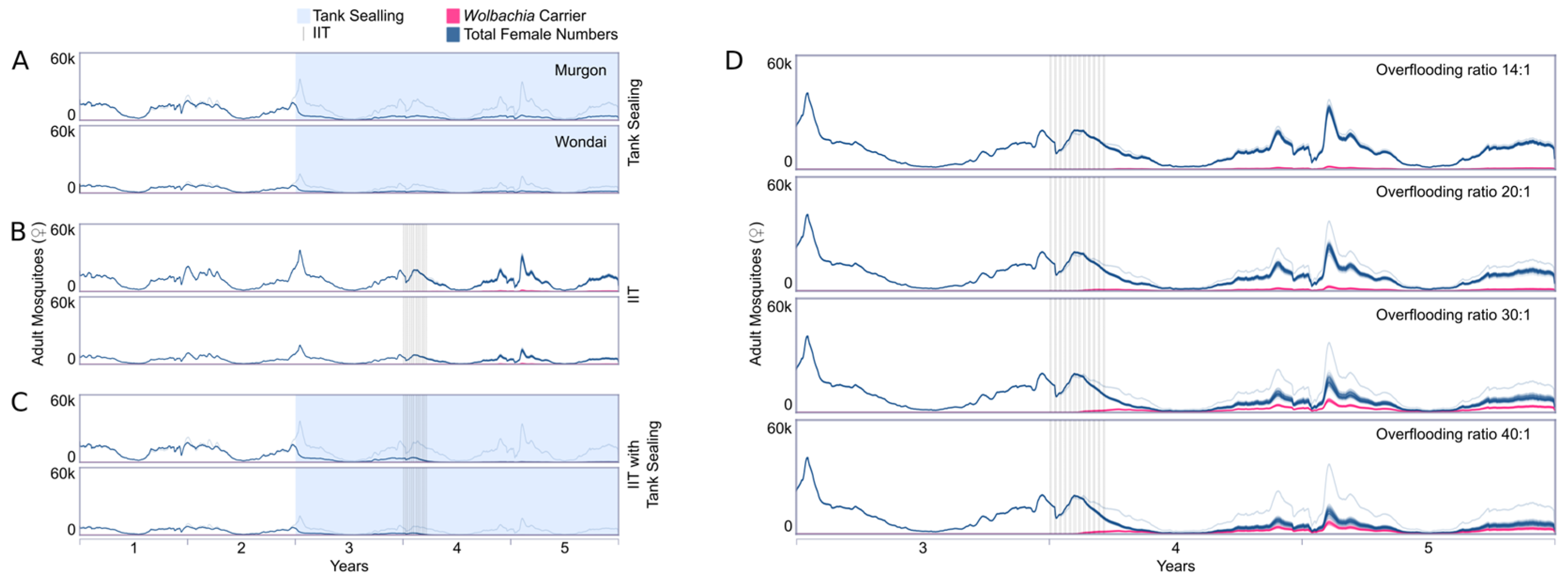
- Scenario 1: Tank sealing (removal of non-compliant rainwater tanks) at the beginning of year 3,
- Scenario 2: Releases of IIT males at the beginning of year 4, twice a week for 12 weeks, with each release containing 14–40 times the number of males present in year 1 (the “overflooding ratio” of 14:1, 20:1, 30:1, 40:1), and
- Scenario 3: A combined strategy, with tank sealing at the beginning of year 3, and IIT releases at the beginning of year 4, twice a week for 12 weeks with an overflowing ratio of 14:1 (as compared to the number of males present during the peak season in year 1).
2.6. Dispersal and Batch Migration Parametrization
3. Results
3.1. Genomic Analyses
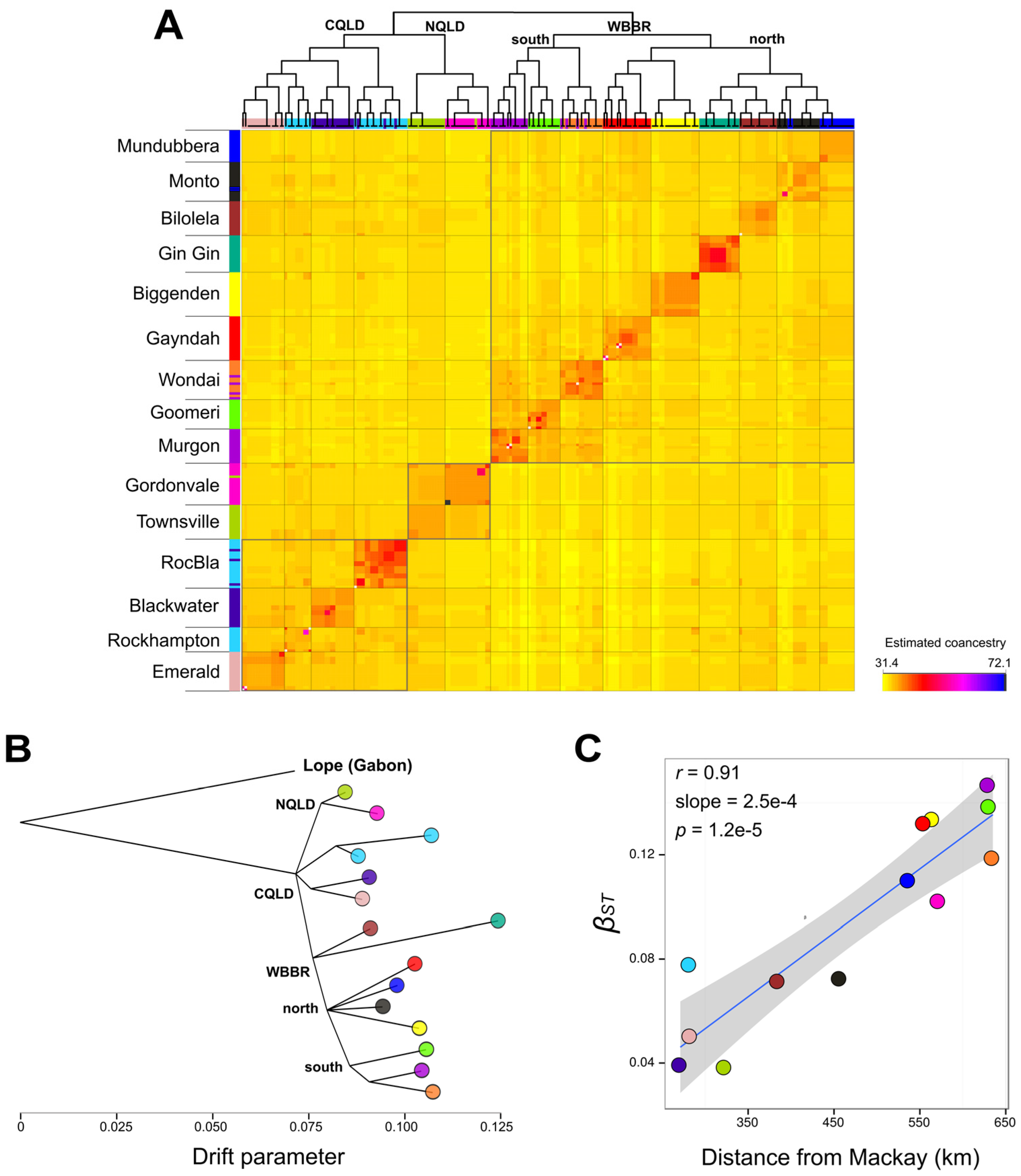
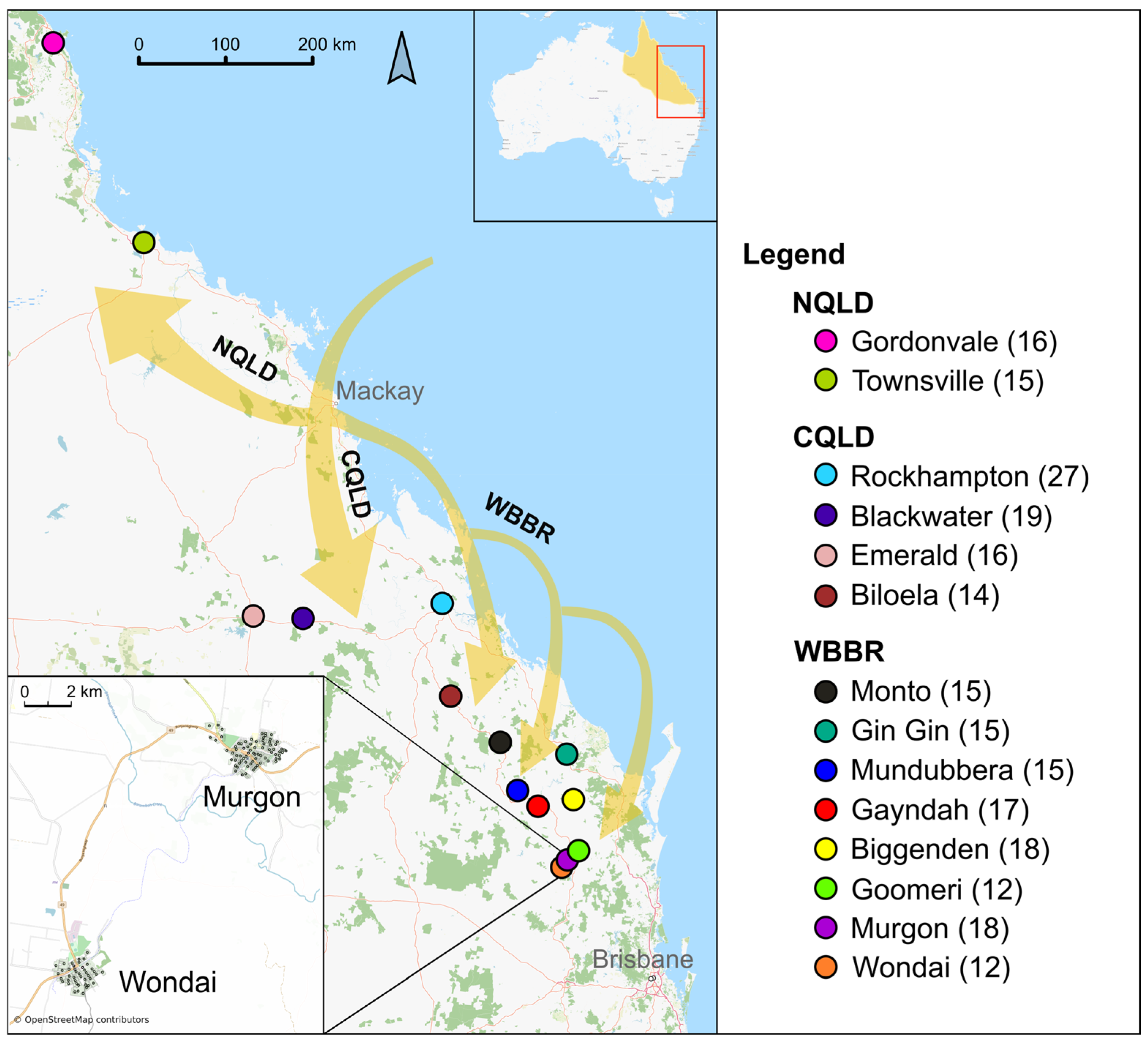
3.1.1. Genetic Structure and Demographic History of Ae. Aegypti in Australia Match Geography
3.1.2. Serial North-to-South Expansion into WBBR Is Not from Rockhampton
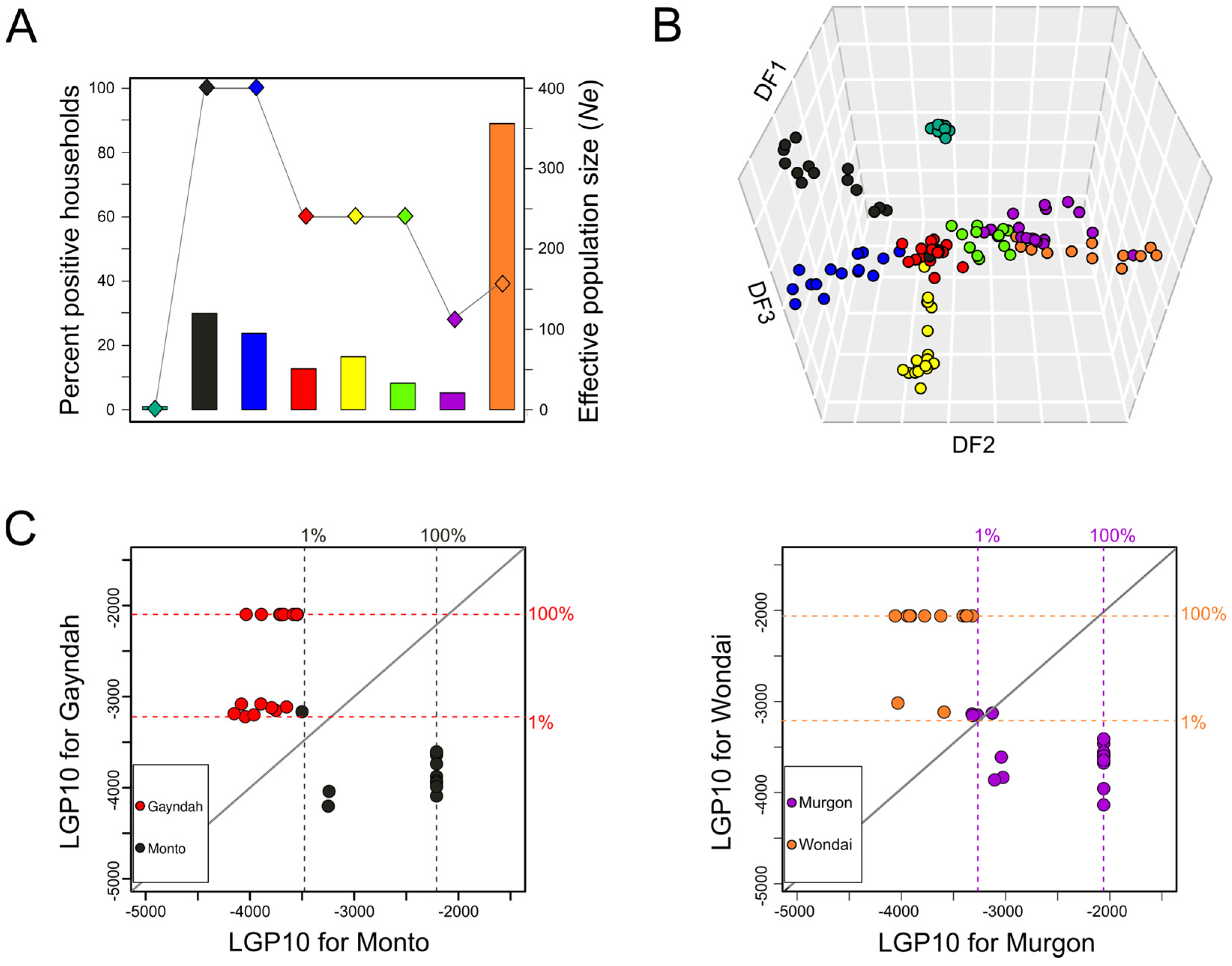
3.1.3. Most WBBR Populations Have Low Effective Population Size and High Isolation
3.2. Simulation of Elimination Campaigns
4. Discussion
Supplementary Materials
Author Contributions
Funding
Data Availability Statement
Acknowledgments
Conflicts of Interest
References
- Powell, J.R.; Gloria-Soria, A.; Kotsakiozi, P. Recent History of Aedes aegypti: Vector Genomics and Epidemiology Records. BioScience 2018, 68, 854–860. [Google Scholar] [CrossRef]
- Debenham, M.L. Nomenclature, Synonymy, Literature, Distribution, Biology and Relation to Disease: Genus Aedes, Subgenera Scutomyia, Stegomyia, Verrallina. In The Culicidae of the Australasian Region; Australian Government Publishing Service: Canberra, Australia, 1987; Volume 4. [Google Scholar]
- McBride, W.J. Dengue fever: Is it endemic in Australia? Intern. Med. J. 2010, 40, 247–249. [Google Scholar] [CrossRef]
- Bancroft, T.L. On the aetiology of dengue fever. Australas. Med. Gaz. 1906, 25, 17–18. [Google Scholar]
- Kay, B.H.; Marks, E.N.; Barker-Hudson, P. Dengue in Queensland, Australia, 1981–1983. In Proceedings of the International Conference on Dengue and Dengue Haemorrhagic Fever, Kuala Lumpur, Malaysia, 1–3 September 1983; pp. 110–123. [Google Scholar]
- Trewin, B.J.; Darbro, J.M.; Jansen, C.C.; Schellhorn, N.A.; Zalucki, M.P.; Hurst, T.P.; Devine, G.J. The elimination of the dengue vector, Aedes aegypti, from Brisbane, Australia: The role of surveillance, larval habitat removal and policy. PLoS Negl. Trop. Dis. 2017, 11, e0005848. [Google Scholar] [CrossRef]
- Trewin, B.J.; Darbro, J.M.; Zalucki, M.P.; Jansen, C.C.; Schellhorn, N.A.; Devine, G.J. Life on the margin: Rainwater tanks facilitate overwintering of the dengue vector, Aedes aegypti, in a sub-tropical climate. PLoS ONE 2019, 14, e0211167. [Google Scholar] [CrossRef]
- van Dijk, A.I.J.M.; Beck, H.E.; Crosbie, R.S.; de Jeu, R.A.M.; Liu, Y.Y.; Podger, G.M.; Timbal, B.; Viney, N.R. The Millennium Drought in southeast Australia (2001–2009): Natural and human causes and implications for water resources, ecosystems, economy, and society. Water Resour. Res. 2013, 49, 1040–1057. [Google Scholar] [CrossRef]
- Ryan, P.A.; Turley, A.P.; Wilson, G.; Hurst, T.P.; Retzki, K.; Brown-Kenyon, J.; Hodgson, L.; Kenny, N.; Cook, H.; Montgomery, B.L.; et al. Establishment of wMel Wolbachia in Aedes aegypti mosquitoes and reduction of local dengue transmission in Cairns and surrounding locations in northern Queensland, Australia. Gates Open Res. 2020, 3, 1547. [Google Scholar] [CrossRef]
- Hugo, L.E.; Stassen, L.; La, J.; Gosden, E.; Ekwudu, O.; Winterford, C.; Viennet, E.; Faddy, H.M.; Devine, G.J.; Frentiu, F.D. Vector competence of Australian Aedes aegypti and Aedes albopictus for an epidemic strain of Zika virus. PLoS Negl. Trop. Dis. 2019, 13, e0007281. [Google Scholar] [CrossRef]
- Walker, J.; Pyke, A.; Florian, P.; Moore, F.; Smoll, N.; Adegbija, O.; Khan, A.; Hasan, R.; Carroll, H.; Harris, R.R.; et al. Re-emergence of dengue virus in regional Queensland: 2019 dengue virus outbreak in Rockhampton, Central Queensland, Australia. Commun. Dis. Intell. 2018, 45, 31. [Google Scholar] [CrossRef] [PubMed]
- O’Gower, A.K. Control measures for Aedes aegypti: Surveys in northern Australia. Health 1956, 6, 40–42. [Google Scholar]
- Trewin, B.J.; Montgomery, B.L.; Hurst, T.P.; Gilmore, J.S.; Endersby-Harshman, N.M.; Crisp, G.J. Extensive public health initiatives drive the elimination of Aedes aegypti (Diptera, Culicidae) from a town in regional Queensland: A case study from Gin Gin, Australia. PLoS Negl. Trop. Dis. 2022, 16, e0010243. [Google Scholar] [CrossRef]
- Beebe, N.W.; Pagendam, D.; Trewin, B.J.; Boomer, A.; Bradford, M.; Ford, A.; Liddington, C.; Bondarenco, A.; De Barro, P.J.; Gilchrist, J.; et al. Releasing incompatible males drives strong suppression across populations of wild and Wolbachia-carrying Aedes aegypti in Australia. Proc. Natl. Acad. Sci. USA 2021, 118, e2106828118. [Google Scholar] [CrossRef]
- Laven, H. Eradication of Culex pipiens fatigans through cytoplasmic incompatibility. Nature 1967, 216, 383–384. [Google Scholar] [CrossRef]
- Crawford, J.E.; Clarke, D.W.; Criswell, V.; Desnoyer, M.; Cornel, D.; Deegan, B.; Gong, K.; Hopkins, K.C.; Howell, P.; Hyde, J.S.; et al. Efficient production of male Wolbachia-infected Aedes aegypti mosquitoes enables large-scale suppression of wild populations. Nat. Biotechnol. 2020, 38, 482–492, Erratum in Nat. Biotechnol. 2020, 38, 1000. https://doi.org/10.1038/s41587-020-0649-2. [Google Scholar] [CrossRef] [PubMed]
- Wu, S.L.; Bennett, J.B.; Sánchez, C.H.M.; Dolgert, A.J.; León, T.M.; Marshall, J.M. MGDrivE 2: A simulation framework for gene drive systems incorporating seasonality and epidemiological dynamics. PLoS Comput. Biol. 2021, 17, e1009030. [Google Scholar] [CrossRef]
- Rašić, G.; Filipović, I.; Weeks, A.R.; Hoffmann, A.A. Genome-wide SNPs lead to strong signals of geographic structure and relatedness patterns in the major arbovirus vector, Aedes aegypti. BMC Genom. 2014, 15, 275. [Google Scholar] [CrossRef] [PubMed]
- Rašić, G.; Filipović, I.; Callahan, A.G.; Stanford, D.; Chan, A.; Lam-Phua, S.G.; Tan, C.H.; Hoffmann, A.A. The queenslandensis and the type form of the Dengue Fever Mosquito (Aedes aegypti L.) Are Genomically Indistinguishable. PLoS Negl. Trop. Dis. 2016, 10, e0005096. [Google Scholar] [CrossRef] [PubMed]
- Hoffmann, A.A.; Montgomery, B.L.; Popovici, J.; Iturbeormaetxe, I.; Johnson, P.H.; Muzzi, F.; Greenfield, M.; Durkan, M.; Leong, Y.S.; Dong, Y.; et al. Successful establishment of Wolbachia in Aedes populations to suppress dengue transmission. Nature 2011, 476, 454–457. [Google Scholar] [CrossRef]
- O’Neill, S.L.; Ryan, P.A.; Turley, A.P.; Wilson, G.; Retzki, K.; Iturbe-Ormaetxe, I.; Dong, Y.; Kenny, N.; Paton, C.J.; Ritchie, S.A.; et al. Scaled deployment of Wolbachia to protect the community from dengue and other Aedes transmitted arboviruses. Gates Open Res. 2019, 2, 36. [Google Scholar] [CrossRef]
- Marks, E.N. An Atlas of Common Queensland Mosquitoes; with a Guide to Common Queensland Biting Midges by E. J. Reye; University of Queensland Bookshop: Brisbane, QLD, Australia, 1966. [Google Scholar]
- Peterson, B.K.; Weber, J.N.; Kay, E.H.; Fisher, H.S.; Hoekstra, H.E. Double digest RADseq: An inexpensive method for de novo SNP discovery and genotyping in model and non-model species. PLoS ONE 2012, 7, e37135. [Google Scholar] [CrossRef] [PubMed]
- Korneliussen, T.S.; Albrechtsen, A.; Nielsen, R. ANGSD: Analysis of Next Generation Sequencing Data. BMC Bioinform. 2014, 15, 356. [Google Scholar] [CrossRef] [PubMed]
- Malinsky, M.; Trucchi, E.; Lawson, D.J.; Falush, D. RADpainter and fineRADstructure: Population Inference from RADseq Data. Mol. Biol. Evol. 2018, 35, 1284–1290. [Google Scholar] [CrossRef] [PubMed]
- Catchen, J.; Hohenlohe, P.A.; Bassham, S.; Amores, A.; Cresko, W.A. Stacks: An analysis tool set for population genomics. Mol. Ecol. 2013, 22, 3124–3140. [Google Scholar] [CrossRef] [PubMed]
- Pickrell, J.K.; Pritchard, J.K. Inference of population splits and mixtures from genome-wide allele frequency data. PLoS Genet. 2012, 8, e1002967. [Google Scholar] [CrossRef]
- Aubry, F.; Dabo, S.; Manet, C.; Filipović, I.; Rose, N.H.; Miot, E.F.; Martynow, D.; Baidaliuk, A.; Merkling, S.H.; Dickson, L.B.; et al. Enhanced Zika virus susceptibility of globally invasive Aedes aegypti populations. Science 2020, 370, 991–996. [Google Scholar] [CrossRef]
- Jombart, T.; Devillard, S.; Balloux, F. Discriminant analysis of principal components: A new method for the analysis of genetically structured populations. BMC Genet. 2010, 11, 94. [Google Scholar] [CrossRef]
- Jombart, T. adegenet: A R package for the multivariate analysis of genetic markers. Bioinformatics 2008, 24, 1403–1405. [Google Scholar] [CrossRef]
- Weir, B.S.; Goudet, J. A Unified Characterization of Population Structure and Relatedness. Genetics 2017, 206, 2085–2103. [Google Scholar] [CrossRef]
- Rougemont, Q.; Moore, J.-S.; Leroy, T.; Normandeau, E.; Rondeau, E.B.; Withler, R.E.; Van Doornik, D.M.; Crane, P.A.; Naish, K.A.; Garza, J.C.; et al. Demographic history shaped geographical patterns of deleterious mutation load in a broadly distributed Pacific Salmon. PLoS Genet. 2020, 16, e1008348, Erratum in PLoS Genet. 2021, 17, e1009397. https://doi.org/10.1371/journal.pgen.1009397. [Google Scholar] [CrossRef]
- Kitada, S.; Nakamichi, R.; Kishino, H. Understanding population structure in an evolutionary context: Population-specific FST and pairwise FST. G3 GenesGenomesGenetics 2021, 11, jkab316. [Google Scholar] [CrossRef]
- Do, C.; Waples, R.S.; Peel, D.; Macbeth, G.M.; Tillett, B.J.; Ovenden, J.R. NeEstimator v2: Re-implementation of software for the estimation of contemporary effective population size (Ne) from genetic data. Mol. Ecol. Resour. 2014, 14, 209–214. [Google Scholar] [CrossRef]
- McMillan, L.F.; Fewster, R.M. Visualizations for genetic assignment analyses using the saddlepoint approximation method. Biometrics 2017, 73, 1029–1041. [Google Scholar] [CrossRef]
- Mordecai, E.A.; Caldwell, J.M.; Grossman, M.K.; Lippi, C.A.; Johnson, L.R.; Neira, M.; Rohr, J.R.; Ryan, S.J.; Savage, V.; Shocket, M.S.; et al. Thermal biology of mosquito-borne disease. Ecol. Lett. 2019, 22, 1690–1708. [Google Scholar] [CrossRef] [PubMed]
- White, M.T.; Griffin, J.T.; Churcher, T.S.; Ferguson, N.M.; Basáñez, M.-G.; Ghani, A.C. Modelling the impact of vector control interventions on Anopheles gambiae population dynamics. Parasites Vectors 2011, 4, 153. [Google Scholar] [CrossRef]
- Roth, I.H. The Discovery and Settlement of Port Mackay, Queensland; Cambridge University Press: Cambridge, UK, 2012. [Google Scholar]
- Filipović, I.; Hapuarachchi, H.C.; Tien, W.-P.; Razak, M.A.B.A.; Lee, C.; Tan, C.H.; Devine, G.J.; Rašić, G. Using spatial genetics to quantify mosquito dispersal for control programs. BMC Biol. 2020, 18, 104. [Google Scholar] [CrossRef]
- Guerra, C.A.; Reiner, R.C., Jr.; Perkins, T.A.; Lindsay, S.W.; Midega, J.T.; Brady, O.J.; Barker, C.M.; Reisen, W.K.; Harrington, L.C.; Takken, W.; et al. A global assembly of adult female mosquito mark-release-recapture data to inform the control of mosquito-borne pathogens. Parasites Vectors 2014, 7, 276. [Google Scholar] [CrossRef] [PubMed]
- Trewin, B.J.; Pagendam, D.E.; Zalucki, M.P.; Darbro, J.M.; Devine, G.J.; Jansen, C.C.; Schellhorn, N.A. Urban Landscape Features Influence the Movement and Distribution of the Australian Container-Inhabiting Mosquito Vectors Aedes aegypti (Diptera: Culicidae) and Aedes notoscriptus (Diptera: Culicidae). J. Med. Entomol. 2020, 57, 443–453. [Google Scholar] [CrossRef] [PubMed]
- Whelan, P.I.; Kurucz, N.; Pettit, W.J.; Krause, V. Elimination of Aedes aegypti in northern Australia, 2004–2006. J. Vector Ecol. 2020, 45, 118–126. [Google Scholar] [CrossRef] [PubMed]
- Gubler, D.J. Dengue and dengue hemorrhagic fever. Clin. Microbiol. Rev. 1998, 11, 480–496. [Google Scholar] [CrossRef]
- Lee, Y.; Schmidt, H.; Collier, T.C.; Conner, W.R.; Hanemaaijer, M.J.; Slatkin, M.; Marshall, J.M.; Chiu, J.C.; Smartt, C.T.; Lanzaro, G.C.; et al. Genome-wide divergence among invasive populations of Aedes aegypti in California. BMC Genom. 2019, 20, 204. [Google Scholar] [CrossRef]
- Marshall, J.M.; Yang, S.; Bennett, J.B.; Filipović, I.; Rašić, G. Spatial close-kin mark-recapture methods to estimate dispersal parameters and barrier strength for mosquitoes. PLoS Comput. Biol. 2025, 21, e1013713. [Google Scholar] [CrossRef]
- Rašić, G.; Marshall, J.M. Integrating mosquito genomics into simulation modeling: Opportunities for better-informed biocontrol. Curr. Opin. Insect Sci. 2026, 73, 101456. [Google Scholar] [CrossRef] [PubMed]
- Williams, C.R.; Bader, C.A.; Kearney, M.R.; Ritchie, S.A.; Russell, R.C. The extinction of dengue through natural vulnerability of its vectors. PLoS Negl. Trop. Dis. 2010, 4, e922. [Google Scholar] [CrossRef]
- Pagendam, D.E.; Trewin, B.J.; Snoad, N.; Ritchie, S.A.; Hoffmann, A.A.; Staunton, K.M.; Paton, C.; Beebe, N. Modelling the Wolbachia incompatible insect technique: Strategies for effective mosquito population elimination. BMC Biol. 2020, 18, 161. [Google Scholar] [CrossRef] [PubMed]
- Bansal, S.; Lim, J.T.; Chong, C.-S.; Dickens, B.; Ng, Y.; Deng, L.; Lee, C.; Tan, L.Y.; Kakani, E.G.; Yoong, Y.; et al. Effectiveness of Wolbachia-mediated sterility coupled with sterile insect technique to suppress adult Aedes aegypti populations in Singapore: A synthetic control study. Lancet Planet. Health 2024, 8, e617–e628. [Google Scholar] [CrossRef]
- Turley, A.P.; Zalucki, M.P.; O’nEill, S.L.; McGraw, E.A. Transinfected Wolbachia have minimal effects on male reproductive success in Aedes aegypti. Parasites Vectors 2013, 6, 36. [Google Scholar] [CrossRef] [PubMed]
- Axford, J.K.; Ross, P.A.; Yeap, H.L.; Callahan, A.G.; Hoffmann, A.A. Fitness of wAlbB Wolbachia Infection in Aedes aegypti: Parameter Estimates in an Outcrossed Background and Potential for Population Invasion. Am. J. Trop. Med. Hyg. 2016, 94, 507–516. [Google Scholar] [CrossRef]
- Lau, M.-J.; Ross, P.A.; Hoffmann, A.A. Infertility and fecundity loss of Wolbachia-infected Aedes aegypti hatched from quiescent eggs is expected to alter invasion dynamics. PLoS Negl. Trop. Dis. 2021, 15, e0009179. [Google Scholar] [CrossRef]
- Yeap, H.L.; Mee, P.; Walker, T.W.; Weeks, A.R.; Oneill, S.L.; Johnson, P.R.S.; Ritchie, S.A.; Richardson, K.M.; Doig, C.J.; Endersby, N.M.; et al. Dynamics of the “popcorn” Wolbachia infection in outbred Aedes aegypti informs prospects for mosquito vector control. Genetics 2011, 187, 583–595. [Google Scholar] [CrossRef]
- Nguyen, T.H.; Le Nguyen, H.; Nguyen, T.Y.; Vu, S.N.; Tran, N.D.; Le, T.N.; Vien, Q.M.; Bui, T.C.; Le, H.T.; Kutcher, S.; et al. Field evaluation of the establishment potential of wMelPop Wolbachia in Australia and Vietnam for dengue control. Parasites Vectors 2015, 8, 563. [Google Scholar] [CrossRef]
- Rašić, G.; Endersby, N.M.; Williams, C.; Hoffmann, A.A. Using Wolbachia-based release for suppression of Aedes mosquitoes: Insights from genetic data and population simulations. Ecol. Appl. 2014, 24, 1226–1234. [Google Scholar] [CrossRef] [PubMed]
- Lim, J.T.; Mailepessov, D.; Chong, C.-S.; Dickens, B.; Lai, Y.L.; Ng, Y.; Deng, L.; Lee, C.; Tan, L.Y.; Chain, G.; et al. Assessing Wolbachia-mediated sterility for dengue control: Emulation of a cluster-randomized target trial in Singapore. J. Travel Med. 2024, 31, taae103. [Google Scholar] [CrossRef] [PubMed]
- Lim, J.T.; Chong, C.-S.; Chang, C.-C.; Mailepessov, D.; Dickens, B.; Lai, Y.L.; Deng, L.; Lee, C.; Tan, L.Y.; Chain, G.; et al. Dengue Suppression by Male Wolbachia-Infected Mosquitoes. N. Engl. J. Med. 2026, 394, 1175–1183. [Google Scholar] [CrossRef]
- Zeng, Q.; She, L.; Yuan, H.; Luo, Y.; Wang, R.; Mao, W.; Wang, W.; She, Y.; Wang, C.; Shi, M.; et al. A standalone incompatible insect technique enables mosquito suppression in the urban subtropics. Commun. Biol. 2022, 5, 1419. [Google Scholar] [CrossRef]
- Kiware, S.S.; Chitnis, N.; Tatarsky, A.; Wu, S.; Castellanos, H.M.S.; Gosling, R.; Smith, D.; Marshall, J.M. Attacking the mosquito on multiple fronts: Insights from the Vector Control Optimization Model (VCOM) for malaria elimination. PLoS ONE 2017, 12, e0187680. [Google Scholar] [CrossRef]
- Vásquez, V.N.; Kueppers, L.M.; Rašić, G.; Marshall, J.M. wMel replacement of dengue-competent mosquitoes is robust to near-term climate change. Nat. Clim. Change 2023, 13, 848–855. [Google Scholar] [CrossRef]
- Metzger, M.E.; Hardstone Yoshimizu, M.; Padgett, K.A.; Hu, R.; Kramer, V.L. Detection and Establishment of Aedes aegypti and Aedes albopictus (Diptera: Culicidae) Mosquitoes in California, 2011–2015. J. Med. Entomol. 2017, 54, 533–543. [Google Scholar] [CrossRef]
- Mann, M.E.; Gleick, P.H. Climate change and California drought in the 21st century. Proc. Natl. Acad. Sci. USA 2015, 112, 3858–3859. [Google Scholar] [CrossRef]
- Assembly Bill No. 1750, Solorio, Chapter 537, Division 6 of the Water Code, Rainwater Capture Act of 2012. California Legislative Information. 25 September 2012. Available online: https://leginfo.legislature.ca.gov/faces/billTextClient.xhtml?bill_id=201120120AB1750 (accessed on 16 August 2021).
- Johnson, P.H.; Spitzauer, V.; Ritchie, S.A. Field Sampling rate of BG-sentinel traps for Aedes aegypti (Diptera: Culicidae) in suburban Cairns, Australia. J. Med. Entomol. 2012, 49, 29–34. [Google Scholar] [CrossRef] [PubMed]
- Otero, M.; Solari, H.G.; Schweigmann, N. A stochastic population dynamics model for Aedes aegypti: Formulation and application to a city with temperate climate. Bull. Math. Biol. 2006, 68, 1945–1974. [Google Scholar] [CrossRef] [PubMed]
- Simoy, M.; Simoy, M.; Canziani, G. The effect of temperature on the population dynamics of Aedes aegypti. Ecol. Model. 2015, 314, 100–110. [Google Scholar] [CrossRef]
- Focks, D.A.; Haile, D.G.; Daniels, E.; Mount, G.A. Dynamic life table model for Aedes aegypti (Diptera: Culicidae): Analysis of the literature and model development. J. Med. Entomol. 1993, 30, 1003–1017. [Google Scholar] [CrossRef] [PubMed]
- Fay, R.W. The biology and bionomics of Aedes aegypti in the laboratory. Mosq. News 1964, 24, 300–308. [Google Scholar]


Disclaimer/Publisher’s Note: The statements, opinions and data contained in all publications are solely those of the individual author(s) and contributor(s) and not of MDPI and/or the editor(s). MDPI and/or the editor(s) disclaim responsibility for any injury to people or property resulting from any ideas, methods, instructions or products referred to in the content. |
© 2026 by the authors. Licensee MDPI, Basel, Switzerland. This article is an open access article distributed under the terms and conditions of the Creative Commons Attribution (CC BY) license.
Share and Cite
Rašić, G.; Filipović, I.; Wu, S.L.; León, T.M.; Bennett, J.B.; Sánchez Castellanos, H.M.; Marshall, J.M.; Trewin, B.J. Eliminating Aedes aegypti from Its Southern Margin in Australia: Insights from Genomic Data and Simulation Modeling. Insects 2026, 17, 623. https://doi.org/10.3390/insects17060623
Rašić G, Filipović I, Wu SL, León TM, Bennett JB, Sánchez Castellanos HM, Marshall JM, Trewin BJ. Eliminating Aedes aegypti from Its Southern Margin in Australia: Insights from Genomic Data and Simulation Modeling. Insects. 2026; 17(6):623. https://doi.org/10.3390/insects17060623
Chicago/Turabian StyleRašić, Gordana, Igor Filipović, Sean L. Wu, Tomás M. León, Jared B. Bennett, Héctor M. Sánchez Castellanos, John M. Marshall, and Brendan J. Trewin. 2026. "Eliminating Aedes aegypti from Its Southern Margin in Australia: Insights from Genomic Data and Simulation Modeling" Insects 17, no. 6: 623. https://doi.org/10.3390/insects17060623
APA StyleRašić, G., Filipović, I., Wu, S. L., León, T. M., Bennett, J. B., Sánchez Castellanos, H. M., Marshall, J. M., & Trewin, B. J. (2026). Eliminating Aedes aegypti from Its Southern Margin in Australia: Insights from Genomic Data and Simulation Modeling. Insects, 17(6), 623. https://doi.org/10.3390/insects17060623