Article

Influence of Sublethal Carbon Dioxide on Biological Characteristics and Life Table Parameters of Cynaeus angustus (LeConte) (Coleoptera: Tenebrionidae)


Grain Storage and Logistics National Engineering Research Center, National Grain Industry (Storage Insect Pest Control) Technology Innovation Center, Henan University of Technology, Zhengzhou 450001, China
*
Author to whom correspondence should be addressed.
Insects 2026, 17(6), 576; https://doi.org/10.3390/insects17060576
Submission received: 18 April 2026 / Revised: 27 May 2026 / Accepted: 28 May 2026 / Published: 31 May 2026
(This article belongs to the Section Insect Pest and Vector Management)

Simple Summary

Carbon dioxide concentration of 0.25–4% has been measured in stored grain loaded initially or infested with pests. Understanding insect survival and developmental biology under sublethal concentrations of carbon dioxide that can be monitored in grain storage may give some biological reference in pest management, especially for fumigation or controlled atmosphere, in which carbon dioxide could synergize the effect of insect killing. Cynaeus angustus has been developing distribution around the world. The measurement of some biological parameters was carried out when C. angustus was exposed to 0.25, 0.5, 1, 2, and 4% of carbon dioxide at 23 °C and 28 °C and compared with the control treatment (ambient air). The concentration of carbon dioxide at 0.25–4% significantly affected the survival and development of C. angustus both at 23 °C and 28 °C. The generation duration, survival rate, oviposition, and life table parameters (R0, r, λ, and T) changed significantly when carbon dioxide exceeded 0.25% or 0.5%. The results indicate that variation in the survival ability, developmental duration and other biological parameters of C. angustus should broaden knowledge and inform management practices, such as fumigation and controlled atmosphere, where exposure time can be affected by survival and developmental parameters of C. angustus.

Abstract

Understanding insect survival and developmental characteristics in sublethal carbon dioxide (0.25–4%), which could exist in stored grain, is beneficial to scientific pest management. The survival, developmental duration, oviposition, and life table parameters of Cynaeus angustus (LeConte) were measured with carbon dioxide at 0.25%, 0.5%, 1%, 2%, and 4% in air, respectively, and 0.04% as a control. The developmental duration at 4% of carbon dioxide was 87 days versus 90 days in control at 23 °C, 79 days versus 85 days in control at 28 °C. The generation survival rate varied from 77% to 69% at 23 °C, and from 81% to 74% at 28 °C in the concentrations. The number of eggs laid per female reduced from 28 in the control to 19 in 4% of carbon dioxide. The sex ratio decreased from 1.19 and 1.21 to below 1.0 at 4% of carbon dioxide at the tested temperatures. Life table parameters (T, R0, r, λ) were significantly decreased at and above 0.5% carbon dioxide at 23 °C; r and λ were significantly decreased at 2% carbon dioxide at 28 °C. Carbon dioxide above 0.25% or 0.5% significantly affected the survival and development, which may affect fumigation or controlled atmosphere with this sublethal carbon dioxide.

1. Introduction

The survival and developmental biological parameters of stored product pests are the basis of scientific pest management [1,2]. Insect developmental and survival parameters especially affect the exposure time of fumigation or controlled atmosphere [3]. Life table parameters of insects may also reflect responses to abiotic factors [4]. Many studies have reported on the survival, growth, development, fecundity, and population dynamics of stored product pests and examined the effects of factors such as temperature, relative humidity, and food type (e.g., [2,5,6,7,8,9]). Insect pests in stored products can cause significant damage and losses [10,11,12], highlighting the importance of effective pest management.
The carbon dioxide in stored grain can be monitored [13,14,15], which could be utilized for insect and micro-organism monitoring, even to synergize the effect of fumigation or controlled atmosphere [16,17]. Grain, microorganisms, and insect pests can produce obvious carbon dioxide in grain mass in many cases [18,19], especially in large scale of the bulk and sealed warehouses [20]. The atmospheric carbon dioxide concentration is approximately 0.04% in ambient air usually. Carbon dioxide concentration had increased to 4.0% at 20–30 °C after 180 days of storage in wheat with 12–13% grain moisture content (m.c.) [21]. And a significant accumulation of carbon dioxide was also detected in wheat bulk with 18% m.c. [22]. Carbon dioxide reached 0.07% in soybean storage with 12.7% m.c. within 30 days [23], increased to 0.4% after 128 days, and further rose to 4.2% after 206 days in silo bags [24]. Carbon dioxide concentrations in stored corn reached 0.22% at 16% m.c. and 0.75% at 18% m.c. within 60 days [20]. The respiration rate of maize increased exponentially when the grain moisture content exceeded 16.5% at 25 °C, indicating that stored grain can produce more carbon dioxide at higher moisture contents [25].
The survival and development of insects may be influenced by carbon dioxide. For example, a significant reduction in oviposition ratios and an extension of immature developmental periods were observed in Tribolium castaneum (Herbst), Cryptolestes pusillus (Schnherr), and Cryptolestes ferrugineus (Stephens) following exposure to carbon dioxide concentrations of 7.5% or 8.6% for 1 to 3 weeks [26]. Carbon dioxide may also act synergistically with low oxygen conditions, as carbon dioxide at 2–8% combined with oxygen at 2–4% (in contrast to 21% in ambient air) significantly increased mortality and reduced pupation and adult emergence of Plodia interpunctella (Hübner) [27]. Understanding the survival and developmental characteristics of insects at sublethal carbon dioxide should help to know the survival ability of insects in the special grain bulk with carbon dioxide metabolized by biological factors and to support the synergistic use of fumigation and controlled atmosphere [28,29].
The larger black flour beetle, Cynaeus angustus (LeConte) (Coleoptera: Tenebrionidae), is a pest species whose distribution is growing, thus increasing its economic importance in the grain storage industry around the world [30,31]. In the past four decades, C. angustus has been recorded throughout the continental United States [32,33], recorded in Sweden and Finland [30], France [31], Ukraine and Russia [34], China [35], South Korea [36], Germany [37], Poland [38], the Czech Republic [39], and Romania [40]. This insect had spread throughout many countries and caused damage to stored grains, flour and related products, especially preferring maize [33].
The influence of temperature on development, movement, population dynamics, fecundity, survival, generation duration, population size, and geographic range in ambient air has been reported in many studies [33,41,42]. Low carbon dioxide (such as 0.25–4%) could be accumulated due to grain respiration and pest activity, and are increasingly used as a monitoring indicator in more and more modern grain storage facilities. The influence of sublethal carbon dioxide levels on survival, development, and population performance of C. angustus is still lacking in reports. The survival, developmental duration, oviposition, and life table parameters of C. angustus at 0.25, 0.5, 1, 2, and 4% of carbon dioxide at 23 °C and 28 °C were measured. This study provides biological characteristics of how carbon dioxide and temperature affect C. angustus, which can provide information for grain monitoring and improving fumigation or controlled atmosphere practices.

2. Materials and Methods

2.1. Measurement Device

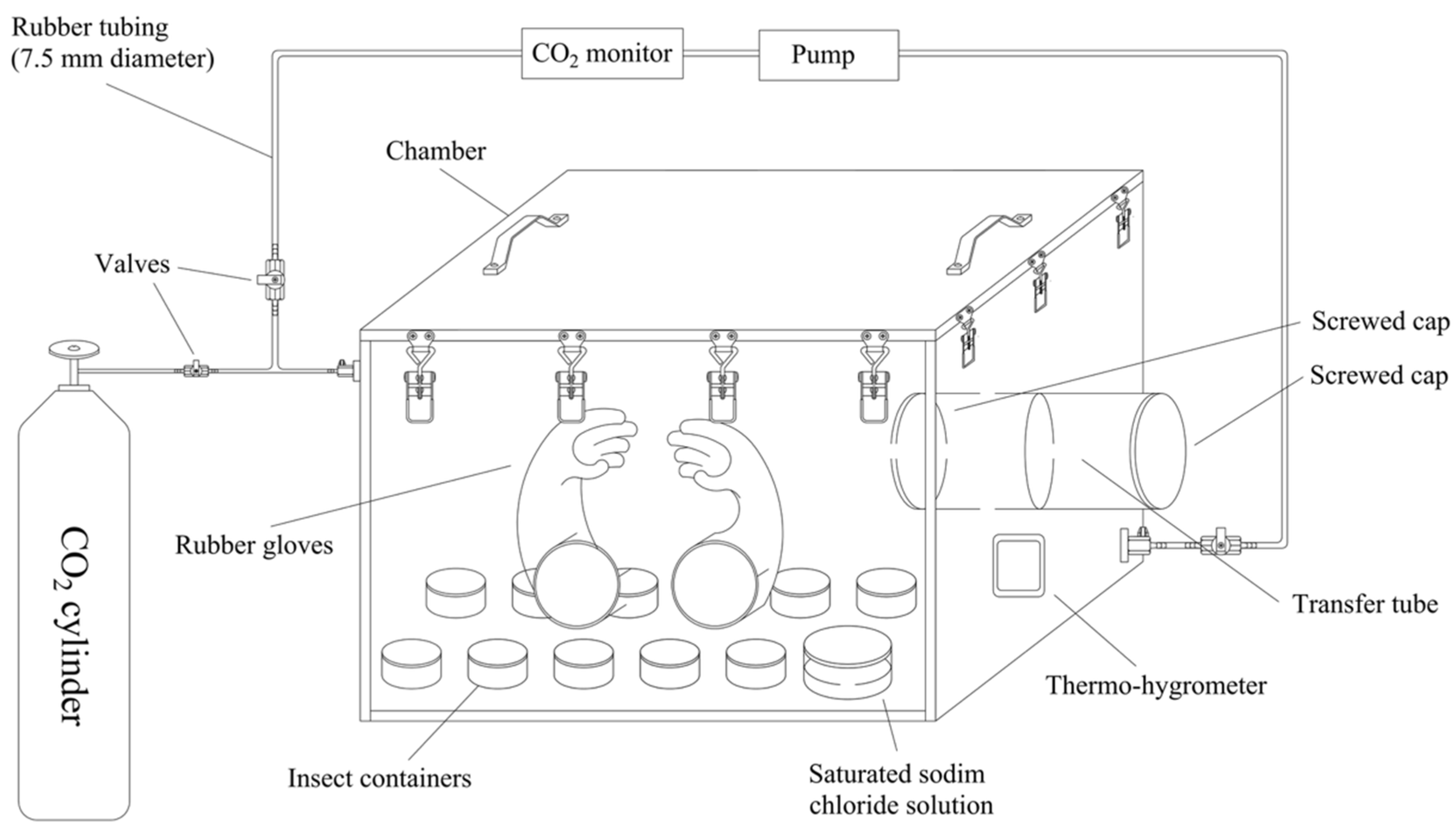
The chamber (60 cm × 35 cm × 40 cm) was made of 2 mm thick transparent acrylic plate (Figure 1) that was used to provide carbon dioxide concentrations. The half-life time from 500 Pa to 250 Pa was 180 s in airtightness tests. Two rubber gloves with 150 mm-diameter connecting holes were installed on the wall of the chamber, and were used to operate insect samples and arrange other manipulations. A transfer tube was installed through another wall of the chamber (100 mm in inner diameter × 140 mm in length). Both ends of the tube could be sealed or opened with screwed caps. Insect samples could be placed into, removed from, or raised for observation by hand through the gloves and the transfer tube. The gas in the chamber was recirculated and monitored daily using a carbon dioxide monitor equipped with a pump (MS400-XH-2; detection range: 0–20% carbon dioxide; precision: ±0.01%; Shenzhen Yiyuntian Electronics Co., Ltd., Shenzhen, China).

2.2. Insects

The population of C. angustus here was collected from a grain depot in Zhengzhou, China, reared with cracked maize sieved through a 4.0 mm mesh and yeast powder (95:5, w/w). Eggs were obtained from 100 unsexed 7-day-old adults, and the diet was provided in plastic containers (8 cm in diameter × 1.5 cm in height), where black craft paper was used to collect the sticky eggs. Each egg, stuck on a small paper piece that was cut by scissors, was placed individually into plastic containers (21.5 mm in diameter × 10 mm in height).
The insect containers placed on the bottom of the chamber were observed through the transparent acrylic using a handheld LED magnifier (40× magnification; RSJ.3008C; Zhongbang Optical Instrument Co., Ltd., Yiwu, China). Fifty one-day-old eggs were used for observation in the chamber. Each egg was individually put in a plastic container (21.5 mm in diameter × 10 mm in height), which was placed in the chamber. Three parallel chambers were used for each measurement. The 75 ± 5% r.h. in the chamber was maintained using a saturated sodium chloride solution in a 250 mL beaker. The chambers were placed in rooms where temperatures were controlled by air conditioners and continuously monitored at 23 ± 1 °C and 28 ± 1 °C, respectively.

2.3. Measurement of Survival and Development

Carbon dioxide of 0.25%, 0.5%, 1%, 2%, and 4% in air was controlled by releasing liquid carbon dioxide (99.99%) from a cylinder. The concentration was measured and adjusted daily in the process. Ambient air (carbon dioxide at 0.04%) was used as a control. Egg hatching was recorded daily. The diet (2 g in weight) was added to newly hatched larvae using a fine brush through the rubber glove operation. Each insect was observed through the top transparent plate of the chamber with a handheld LED magnifier. A small fine brush placed inside the chamber was used to gently separate the diet and the insects. During observation, the insect containers were moved up and down by hand through the rubber gloves to a clear view of each individual. Larval molting, survival, and developmental duration, pupation duration, pupal survival, eclosion duration, and adult survival were recorded daily. The generation duration was determined from egg to adult emergence. The non-moving larva or adult was confirmed to be dead when touched on the abdomen with a fine brush.

2.4. Oviposition and Sex Ratio

Adults used for oviposition assessment were obtained from the corresponding carbon dioxide treatments. For each treatment, ten pairs of newly emerged adults were selected and individually placed in separate plastic containers with a 2 g diet. The containers were kept in the same concentration and temperature as before. Eggs laid by each female were counted daily until oviposition ceased. The gender was distinguished by the caudal spine of pupae, in which the caudal spine of males is longer and sharper. The sex ratio was calculated with the number of female to male individuals.

2.5. Data Analysis

The developmental duration, survival rate, oviposition, sex ratio, and life table parameters of C. angustus were analyzed using the age-stage, two-sex life table model with the computer program TWOSEX-MSChart [42,43] (http://140.120.197.173/Ecology/Download/Twosex-MSChart.rar, accessed on 18 May 2026). The means and standard errors of these parameters were estimated using the bootstrap method with 100,000 resamplings [44], and the paired-bootstrap test was used to assess the differences among treatments. Differences between temperatures within the same carbon dioxide concentration were tested using an independent samples t-test for sex ratio.
The survival rate (%) was calculated as follows:
S u r v i v a l   r a t e   ( % ) = N u m b e r   o f   s u r v i v i n g   i n d i v i d u a l s 50 × 100 %
Generation survival rate was calculated as follows:
G e n e r a t i o n   s u r v i v a l   r a t e   ( % ) = N u m b e r   o f   e m e r g e d   a d u l t s 50 × 100 %
The following life table parameters were calculated as [45,46]:
Net   reproductive   rate   ( R 0 ) :   R 0 = Σ   l x   m x
Intrinsic   rate   of   increase   ( r ) :   r = Σ e r ( x + 1 ) · l   m = 1
Finite   rate   of   increase   ( λ ) :   e ^ ( r )
Mean   generation   time   ( T ) :   T = l n ( R 0 )   /   r
x: developmental age; lx: survival rate of C. angustus during age x; mx: number of eggs laid per female during age x. Data obtained from three independent chambers for each carbon dioxide concentration were treated as biological replicates for statistical analysis.

3. Result

3.1. Developmental Duration and Adult Longevity

At 23 °C, the egg duration was 4.12 ± 0.07 days in the control and ranged from 4.06 ± 0.48 to 3.51 ± 0.06 days in the tested carbon dioxide concentration. There were no significant differences between the control and the treatments (p > 0.05, Table 1). The developmental duration of larval instars (L1–L12) was significantly affected only by carbon dioxide at 4% compared with the control and other concentrations (p < 0.05), except for L2, which was affected by 2% and 4% of the concentration. The duration of the larval stage was significantly shortened by 8.23–10.29 days as carbon dioxide increased from 2% to 4%. This shortening indicates a cumulative effect of carbon dioxide on larval development across all larval instars (L1–L12). The pupae and the generation duration, and adult longevity were significantly decreased in carbon dioxide above 2% (p < 0.05). And no significant difference in these parameters was measured between 2% and 4% of the concentration (p > 0.05, Table 1).
At 28 °C, the egg duration was 3.15 ± 0.74 days in the control and ranged from 2.46 ± 0.65 to 2.98 ± 0.21 days in the treatments, in which the duration was shortened by about 0.97–1.14 days compared with that at 23 °C (Table 2). The difference in carbon dioxide concentration had no significant impact on the egg stage (p > 0.05). The duration of L2 to L12 varied significantly in carbon dioxide at 2% and 4% (p < 0.05). The duration of larval stages changed more in response to carbon dioxide at 28 °C than at 23 °C, except for L1. The duration of the total larval stage and the generation duration was significantly shortened in carbon dioxide at 1% (p < 0.05), whereas there were no significant differences in pupal development duration (p > 0.05). The longevity of male and female adults did not differ significantly in the control or in carbon dioxide at 0.25% to 1% (p > 0.05) but had a significant reduction in carbon dioxide above 2% (p < 0.05, Table 2). The pupal duration at 28 °C was shortened by approximately 1.35–1.82 days, and the generation duration was significantly reduced by about 6.14–8.82 days, compared with that at 23 °C. At 28 °C, the longevity had increased approximately 10.71–12.77 days for females and increased approximately 10.57–12.80 days for male adults, compared with that at 23 °C (Table 2).

3.2. Survival Rates

At 23 °C, the egg survival rate was 94.72 ± 1.02 in the control and 94.10 ± 0.96 to 91.12 ± 0.94 in the carbon dioxide concentration of 0.25% to 4%, and there was a significant decline in carbon dioxide at 2% (p < 0.05, Table 3). The survival rate of L1 to L12 was significantly affected by carbon dioxide at 0.25%, except for L1–L3, which was affected at a concentration of 0.5%. The survival rate of the total larval stages was decreased significantly when carbon dioxide was above 0.25%, while the survival rate of pupae and the generation duration were decreased significantly when carbon dioxide was 0.5% (p < 0.05, Table 3).
At 28 °C, the significant differences in survival rates were measured in the egg stage in carbon dioxide at 2% (p < 0.05). The significant differences were detected in the survival of L1–L2, L7–L9, L12, and the pupal stage in concentration of 0.5%, and were observed in the survival of L3–L6, L10–L11, and the total larval stage at 0.25% of the concentration (p < 0.05, Table 4).
The survival rates in developmental stages of C. angustus were generally higher at 28 °C than at 23 °C. Contrastively, the survival rates of the different life stages of C. angustus were affected differently under carbon dioxide ranging from 0.5% to 4% at 28 °C, with greater reductions detected at higher concentrations.

3.3. Sex Ratio

The sex ratio of C. angustus changed significantly from 1.19 ± 0.03 under the control to 0.87 ± 0.02 at 4% of carbon dioxide at 23 °C (Table 5). The sex ratio under 0.25% and 0.5% of carbon dioxide was significantly lower than that in the control (p < 0.05), and decreased further significantly under 1%, 2%, and 4% of carbon dioxide (p < 0.05, Table 5). There were no significant differences in sex ratio among the carbon dioxide at 0.25%, 0.5%, and 1%, compared with that in the control at 28 °C (p > 0.05, Table 5). The sex ratio decreased significantly under 2% carbon dioxide and was the lowest of sex ratios under 4% of carbon dioxide (p < 0.05, Table 5), which means that carbon dioxide at the tested concentrations can decrease the female ratio of C. angustus both at 23 °C and 28 °C (Table 5). The sex ratio at 28 °C was 0.09 higher than that at 23 °C at carbon dioxide of 2% and was 0.06 higher at carbon dioxide of 4% than that at 23 °C (p < 0.05, Table 5).

3.4. The Oviposition and Life Table Parameters

At 23 °C, the pre-oviposition duration was significantly prolonged at 1% of carbon dioxide compared with that in the control (p < 0.05, Table 6). The oviposition duration was significantly prolonged at 2% and 4% of the concentration (p < 0.05, Table 6). The number of eggs laid per female declined significantly at 0.25% of carbon dioxide and decreased further with increasing the concentration (p < 0.05, Table 6). The significant decrease was measured in carbon dioxide at 0.25% and more for R0, at and above 0.5% of the concentration for r, λ and T (p < 0.05, Table 6).
At 28 °C, the pre-oviposition duration was significantly prolonged at 2% of carbon dioxide compared with that in the control (p < 0.05, Table 7), and the oviposition duration was significantly prolonged at 2% and 4% of the concentration (p < 0.05, Table 7). The number of eggs laid per female declined significantly at 0.25% of carbon dioxide (p < 0.05, Table 7). Significant decline was observed at 0.25% of carbon dioxide for R0, at 2% of the concentration for r and λ, and at 0.5% of the gas for T (p < 0.05, Table 7).
Compared with 23 °C, the pre-oviposition duration at 28 °C was shortened by 1.04–1.10 days, the oviposition duration was prolonged by 1.78–2.52 days, and the number of eggs laid per female increased by 1.24–1.50. The values of R0, r, and λ at 23 °C were generally lower than those at 28 °C in all treatments (Table 6 and Table 7). The R0 value at 28 °C was 0.69–1.18 higher than that at 23 °C, while T at 28 °C was shortened by 7.30–9.20 days compared with that at 23 °C under the control and all tested concentrations (Table 6 and Table 7).

4. Discussion

The developmental duration of the generation of C. angustus was 92 days at 23 °C and 86 days at 28 °C in the control, respectively. The larval development duration was 80 days at 23 °C and 69 days at 28° in the control (Table 1 and Table 2). When carbon dioxide increased from 0.25% to 4%, the generation developmental duration decreased from 90 to 87 days at 23 °C, and from 83 to 79 days at 28 °C, respectively. The total generation developmental duration of C. angustus in the tested carbon dioxide concentrations mainly depended on the larval development at the two temperatures. The previous studies reported that larvae are the most active feeding stage and often account for the largest proportion of the immature period, thereby strongly influencing the total generation developmental duration [47,48,49].
The whole generation survival rate of C. angustus was 78% at 23 °C and 81% at 28 °C in the control, varied from 76% to 69% at 23 °C and from 80% to 74% at 28 °C, correspondingly, with carbon dioxide increasing from 0.25% to 4% (Table 3 and Table 4). The whole generation survival rate was mostly affected by the larval survival rate. Furthermore, changes in larval survival and larval developmental time can directly alter generation survival and ultimately influence population growth [50]. Which is similar to that of carbon dioxide at 18% significantly increased the mortality of L1 and L4 of Callosobruchus maculatus (Fabricius) [51]. Otherwise, the survivors suffering the sublethal concentration of carbon dioxide exhibited faster development compared to those in ambient air. The effects of carbon dioxide at 0.25–4% on C. angustus were similar to those detected under low oxygen conditions combined with elevated carbon dioxide at comparable levels [26].
Insect development and oviposition could be stressed by adverse factors such as low temperature and humidity, modified atmosphere conditions (e.g., elevated carbon dioxide or low oxygen), and exposure to insecticides or fumigants [52,53,54]. The oviposition of C. angustus females was significantly reduced in carbon dioxide at 0.25–4%, compared with that in the control. Meanwhile, the proportion of females declined under sublethal carbon dioxide, which is consistent with a previous report that insects can survive but exhibit altered biological characteristics under sublethal carbon dioxide at 2%, 5%, and 10% [55]. At a carbon dioxide concentration of 18% in a controlled atmosphere, cowpea weevil could finish their development and reproduction, but their mortality increased and oviposition decreased significantly [51]. The reason for the female ratio reduction of C. angustus in the tested carbon dioxide may be related to energy consumption or detoxification between females and males [56]. Females consumed more energy and were more susceptible to sublethal carbon dioxide than males because respiration may impose higher energetic demands. This is similar to the findings in Dendroctonus armandi, where a female-biased sex ratio was associated with energy storage and consumption [57].
Life table parameters are important indicators for evaluating insect adaptability to environmental conditions [58,59]. The innate rate of increase (r) and the finite rate of increase (λ) are parameters to measure the future trends of population increasing or decreasing [60]. Compared with Tribolium castaneum, a common species in grain storage, C. angustus has development potential but has been less reported. The finite rate of increase (λ) of C. angustus was 1.028 at 28 °C in air, which was lower than that of T. castaneum (approximately 1.03) [61]. C. angustus laid 29 eggs per female at 28 °C in ambient air, which was similar to the 28 eggs per female reported for T. castaneum [62]. The adult body size of C. angustus is larger, reaching approximately 6 mm in length, whereas T. castaneum adults are typically 3–4 mm in length [63]. The values of R0, r, and λ decreased with increasing carbon dioxide at both tested temperatures, and the lowest values of r and λ were detected at 4% carbon dioxide. The population growth potential of C. angustus was suppressed at sublethal carbon dioxide; the values of r and λ decreased, indicating a slower expected population growth rate, whereas the value of R0 decreased, indicating fewer offspring produced per generation. The developmental duration can be shortened in the tested carbon dioxide; the reproductive ability and population growth of C. angustus can be inhibited in the meantime. Although surviving individuals developed quickly, the decreases in survival and fecundity observed here reduced overall population performance. From a practical perspective, the reduced life table parameters (R0, r, λ, and T) imply a lower risk under elevated low carbon dioxide and support referring to the exposure time of fumigation or controlled atmosphere in practice.
The effectiveness of phosphine fumigation for several highly resistant stored product pests, such as Sitophilus oryzae (L.), Tribolium castaneum (Herbst), and Rhyzopertha dominica (F.) was significantly enhanced by approximately 5% carbon dioxide [4]. Exposure to 4% carbon dioxide under hypoxic conditions led to more pronounced water loss and energy reserve alterations in P. interpunctella larvae, suggesting an escalation in physiological stress [64]. The results of decreased survival and developmental duration of C. angustus at the tested concentrations of carbon dioxide may have some influence on the insect killing during fumigation and controlled atmosphere.
Temperature increasing by some degree may accelerate insect development and movement, and affect population dynamics by influencing fecundity, survival, generation duration, population size, and geographic range [41]. Undoubtedly, temperature has profound effects on biological traits at all levels of insect organization [65], but at different levels [48]. The two temperatures tested here represented a suitable developmental (28 °C) and low temperature grain storage (23 °C) that was practiced more and more in the modern grain storage industry. Our results identified the sharp difference between 23 °C and 28 °C in the survival and development of this species in the control and treatments. The shortening of developmental duration of C. angustus under sublethal carbon dioxide may be associated with prolonged spiracle opening, which could lead to increased water and energy loss and ultimately higher mortality [66]. Through increasing the respiration rate of insects, improving the penetration rate of fumigant and reducing insect tolerance to fumigant, exposure times of controlled atmosphere or fumigation should be shortened, accompanied by carbon dioxide levels similar to the tested concentration [29].
In conclusion, C. angustus can finish its whole generation from egg to adult and with a survival rate decreasing to 69% at 23 °C and 74% at 28 °C in carbon dioxide at 0.25–4%. The survival rate, development duration of larvae and total generation, oviposition rate, sex ratio and some life table parameters can obviously be decreased at 0.25% or 0.5% to 4% carbon dioxide. In which the significant changes can be affected by temperature differences. With the survival rate decreasing, C. angustus developed more quickly in an environment of 0.25% or 0.5% to 4% of carbon dioxide concentration. Notably, although the development of surviving individuals tended to be quicker under increasing carbon dioxide, the concurrent reductions in survival and reproduction indicate an overall suppression of population growth potential. These results remind us that a biological knowledge of such carbon dioxide conditions should be considered, which may inform exposure time for fumigation or controlled atmosphere strategies.

Author Contributions

Conceptualization, D.W.; methodology, D.W. and R.S.; investigation, R.S. and C.W.; data analysis, R.S. and X.Z.; resources, R.S. and H.S.; writing—original draft preparation, R.S., C.W. and Q.Z.; writing—review and editing, D.W. All authors have read and agreed to the published version of the manuscript.

Funding

This research was funded by the China Agriculture Research System of MOF and MARA, funding number: CARS-13.

Data Availability Statement

The original contributions presented in the study are included in the article, further inquiries can be directed to the corresponding author.

Conflicts of Interest

The authors declare no conflict of interest.

References

  1. Athanassiou, C.G.; Morrison, W.R.; Stejskal, V.; Riudavets, J. Monitoring of stored product insects and decision support systems at the post-harvest stages of durable agricultural commodities: A review. Entomolgia Gen. 2025, 45, 991–1015. [Google Scholar] [CrossRef] [Scilit]
  2. Baliota, G.; Morrison, W.R., III; Domingue, M.J.; Athanassiou, C.G. Influence of commodity type and temperature on the population growth of Trogoderma granarium Everts and Trogoderma variabile Ballion (Coleoptera: Dermestidae). J. Stored Prod. Res. 2026, 115, 102804. [Google Scholar] [CrossRef] [Scilit]
  3. Nayak, M.K.; Daglish, G.J.; Phillips, T.W.; Ebert, P.R. Resistance to the fumigant phosphine and its management in insect pests of stored products: A global perspective. Annu. Rev. Entomol. 2020, 65, 333–350. [Google Scholar] [CrossRef] [Scilit]
  4. Javanmard, P.; Jafari, S.; Mardani-Talaee, M. Life table parameters of Rhyzopertha dominica (F.) (Coleoptera: Bostrichidae) reared on nine rainfed barley cultivars. J. Stored Prod. Res. 2023, 104, 102195. [Google Scholar] [CrossRef] [Scilit]
  5. Bukhari, M.; Khan, H.A.A. Influence of temperature and relative humidity on the combined efficacy of insecticides and diatomaceous earth for the control of Trogoderma granarium on rough rice. J. Stored Prod. Res. 2025, 114, 102740. [Google Scholar] [CrossRef] [Scilit]
  6. Jian, L.; Yang, Y.; Xie, S.; Lou, Y.; Chen, L.; Dai, F.; Agrafioti, P.; Cao, Y.; Athanassiou, C.G.; Li, C. Life table parameters and digestive enzyme activity of Araecerus fasciculatus (Coleoptera: Anthribidae) feeding on different stored products. Insects 2025, 16, 428. [Google Scholar] [CrossRef] [Scilit] [PubMed]
  7. Lu, J.; Shen, L.; Hamadou, A.H.; Jiang, S.; Xu, B. Effect of temperature and relative humidity on the development of Sitophilus oryzae (L.) (Coleoptera: Curculionidae) reared on noodles. J. Stored Prod. Res. 2024, 105, 102213. [Google Scholar] [CrossRef] [Scilit]
  8. Yang, S.; Zhang, T.; Gao, Y.L.; Mei, X.D.; Ning, J. Effects of relative humidity on the development, reproduction and population growth of Araecerus fasciculatus (Coleoptera: Anthribidae). Chin. J. Appl. Entomol. 2016, 53, 121–127. [Google Scholar]
  9. Zafeiriadis, S.; Baliota, G.V.; Athanassiou, C.G. Effect of temperature and moisture content on population growth of Alphitobius diaperinus (Panzer) (Coleoptera: Tenebrionidae). Agronomy 2023, 13, 2535. [Google Scholar] [CrossRef] [Scilit]
  10. Donga, T.K.; Baributsa, D. Effect of temperature and insect infestation levels on oxygen depletion in hermetic storage. Insects 2023, 14, 621. [Google Scholar] [CrossRef] [Scilit]
  11. Labrot-Rhodes, L.; Campo, E.; Poujaud, P. Review of monitoring systems for stored grains in a modified atmosphere. Heliyon 2025, 11, e42347. [Google Scholar] [CrossRef] [Scilit]
  12. Li, W.; Yaninek, J.S.; Baributsa, D. Hand warmer-induced hypoxia accelerates pest control in hermetic storage. Insects 2024, 15, 821. [Google Scholar] [CrossRef] [Scilit]
  13. Santos Bilhalva, N.; Coradi, P.C.; Biduski, B.; Mallmann, C.A.; Anschau, K.F.; Müller, E.I. Early detection of quality alterations in corn grains stored in vertical prototype silos using real-time monitoring of carbon dioxide and equilibrium moisture content. Food Bioprod. Process. 2023, 140, 242–258. [Google Scholar] [CrossRef] [Scilit]
  14. Raudienė, E.; Rušinskas, D.; Balčiūnas, G.; Juodeikienė, G.; Gailius, D. Carbon dioxide respiration rates in wheat at various temperatures and moisture contents. MAPAN 2017, 32, 51–58. [Google Scholar] [CrossRef] [Scilit]
  15. Zhang, S.B.; Zhai, H.C.; Huang, S.X.; Cai, J.P. A site-directed CO2 detection method for monitoring the spoilage of stored grains by insects and fungi in Chinese horizontal warehouses. J. Stored Prod. Res. 2014, 59, 146–151. [Google Scholar] [CrossRef] [Scilit]
  16. Constantin, M.; Jagadeesan, R.; Chandra, K.; Ebert, P.; Nayak, M.K. Synergism between phosphine (PH3) and carbon dioxide (CO2): Implications for managing phosphine resistance in rusty grain beetle. J. Econ. Entomol. 2020, 113, 1999–2006. [Google Scholar] [CrossRef] [Scilit]
  17. Zhou, M.; Pan, B.; Guan, L.; Wang, Y.; Xu, K.; Wang, S.; Tang, B.; Li, C. Comparative transcriptomic and metabolomic analysis of modified atmosphere responses in Tribolium castaneum (Coleoptera: Tenebrionidae). J. Insect Sci. 2024, 24, 8. [Google Scholar] [CrossRef] [Scilit] [PubMed]
  18. Chotikasatian, C.; Chayaprasert, W.; Pathaveerat, S. Feasibility of quantifying population density of stored product insects in airtight grain storage using CO2 concentration measurements. J. Stored Prod. Res. 2017, 73, 21–29. [Google Scholar] [CrossRef] [Scilit]
  19. Neethirajan, S.; Freund, M.S.; Jayas, D.S.; Shafai, C.; Thomson, D.J.; White, N.D.G. Development of a carbon dioxide sensor for grain quality monitoring. Biosyst. Eng. 2010, 106, 395–404. [Google Scholar] [CrossRef] [Scilit]
  20. Mabasso, G.A.; Resende, O.; Souza, D.G.; de Almeida, A.B.; Siqueira, V.C.; de Oliveira, D.E.C.; Quequeto, W.D.; de Freitas, É.R. Concentration of CO2 in hermetic and non-hermetic storage and effects on insects, fungi and oil quality of corn grain. J. Food Process Eng. 2025, 48, e70186. [Google Scholar] [CrossRef] [Scilit]
  21. Abalone, R.; Gastón, A.; Bartosik, R.; Cardoso, L.; Rodríguez, J. Gas concentration in the interstitial atmosphere of a wheat silo-bag. Part I: Model development and validation. J. Stored Prod. Res. 2011, 47, 268–275. [Google Scholar] [CrossRef] [Scilit]
  22. Ramachandran, R.P. Integrated approach on stored grain quality management with CO2 monitoring: A review. J. Stored Prod. Res. 2022, 96, 101950. [Google Scholar] [CrossRef] [Scilit]
  23. Souza, D.G.; Resende, O.; Zuchi, J.; Mabasso, G.A. CO2 levels, technical breakage and quality of maize grains stored under different conditions. Rev. Bras. Eng. Agríc. Ambient. 2024, 28, e279894. [Google Scholar] [CrossRef] [Scilit]
  24. Taher, H.I.; Urcola, H.A.; Cendoya, M.G.; Bartosik, R.E. Predicting soybean losses using carbon dioxide monitoring during storage in silo bags. J. Stored Prod. Res. 2019, 82, 1–8. [Google Scholar] [CrossRef] [Scilit]
  25. Marcos Valle, F.J.; Gastón, A.; Abalone, R.M.; De La Torre, D.A.; Castellari, C.C.; Bartosik, R.E. Study and modelling of respiration of corn seeds (Zea mays L.) during hermetic storage. Biosyst. Eng. 2021, 208, 45–57. [Google Scholar] [CrossRef] [Scilit]
  26. White, N.D.G.; Jayas, D.S.; Muir, W.E. Toxicity of carbon dioxide at biologically producible levels to stored-product beetles. Environ. Entomol. 1995, 24, 640–647. [Google Scholar] [CrossRef] [Scilit]
  27. Huang, Y.; Wang, D.; Jian, F.; Zhang, M.; Liu, K. Comparison of mortality, pupation and emergence of Plodia interpunctella (Hübner) treated with 2–8% carbon dioxide mixed with oxygen at three temperatures. J. Stored Prod. Res. 2023, 104, 102204. [Google Scholar] [CrossRef] [Scilit]
  28. Lambkin, T.A. Toxicity of phosphine in combination with 5% and 10% carbon dioxide against all stages of phosphine-resistant Rhyzopertha dominica. In Proceedings of the International Conference on Controlled Atmosphere and Fumigation in Stored Products; Executive Printing Services: Clovis, CA, USA, 2001; pp. 617–623. [Google Scholar]
  29. Meenatchi, R.; Alice, R.P.S.J.; Paulin, P.P. Synergistic effect of phosphine and carbon dioxide on the mortality of Tribolium castaneum (Coleoptera: Tenebrionidae) in paddy. J. Agric. Sci. 2018, 10, 503. [Google Scholar] [CrossRef] [Scilit]
  30. Ferrer, J.; Andersson, B. Förväxling av arterna i släktet Cynaeus LeConte, 1866, i Sverige och Finland (Coleoptera: Tenebrionidae). Entomol. Tidskr. 2002, 123, 219–221. [Google Scholar]
  31. Soldati, F.; Godinat, G. Cynaeus angustus (LeConte, 1851), nouveau pour le Haut-Rhin, une espèce en nette expansion (Coleoptera: Tenebrionidae). L’Entomologiste 2013, 69, 53–55. [Google Scholar]
  32. Barak, A.V.; Dunkel, F.V.; Harein, P.K. Emergence of the larger black flour beetle as a major pest of farm-stored grain in Minnesota. J. Econ. Entomol. 1981, 74, 726–729. [Google Scholar] [CrossRef] [Scilit]
  33. Dunkel, F.V.; Barak, A.V.; Harein, P.K. Geographical distribution of Cynaeus angustus (LeConte) (Coleoptera: Tenebrionidae) and its association with stored products. J. Biogeogr. 1982, 9, 345–352. [Google Scholar] [CrossRef] [Scilit]
  34. Kovalenko, Y.N.; Drogvalenko, A.N.; Khryapin, R.A. First record of the larger black flour beetle Cynaeus angustus (Coleoptera: Tenebrionidae) from Russia. Zoosyst. Ross. 2016, 25, 291–294. [Google Scholar] [CrossRef] [Scilit]
  35. Zhang, T.; Wang, Y.-J.; Guo, W.; Luo, D.; Wu, Y.; Kučerová, Z.; Stejskal, V.; Opit, G.; Cao, Y.; Li, F.J. DNA barcoding and PCR-based identification of six Tribolium pests of stored products. Sci. Rep. 2016, 6, 28494. [Google Scholar] [CrossRef] [Scilit]
  36. Hong, K.J.; Yun, T.S. First report of the stored grain pest Cynaeus angustus (LeConte) in Korea. Korean J. Appl. Entomol. 2017, 56, 223–227. [Google Scholar] [CrossRef] [Scilit]
  37. Eichler, R.; Pütz, A. Cynaeus angustus (LeConte, 1851)—A new adventive species for Brandenburg, Germany. Märk. Entomol. Nachr. 2017, 19, 95–98. [Google Scholar]
  38. Ruta, R.; Milkowski, M.; Żuk, K. Dacne picta and Cynaeus angustus—Two beetle species new to the fauna of Poland. Wiad. Entomol. 2017, 36, 102–107. [Google Scholar]
  39. Mantič, M.; Jäch, V. Faunistic records from the Czech Republic—Coleoptera: Tenebrionidae. Klapalekiana 2017, 53, 134. [Google Scholar]
  40. Pintilioaie, A.M.; Teodorescu, M. Cynaeus angustus (Coleoptera: Tenebrionidae), a new alien beetle in Romania. Trav. Mus. Natl. Hist. Nat. “Grigore Antipa” 2021, 64, 89–94. [Google Scholar] [CrossRef] [Scilit]
  41. Battisti, A.; Larsson, S. Climate change and insect pest distribution range. In Climate Change and Insect Pests; Björkman, C., Niemelä, P., Eds.; CABI: Wallingford, UK, 2015; pp. 1–15. [Google Scholar]
  42. White, N.D.G.; Sinha, R.N. Bioenergetics of Cynaeus angustus (Coleoptera: Tenebrionidae) feeding on stored corn. Ann. Entomol. Soc. Am. 1987, 80, 184–190. [Google Scholar] [CrossRef] [Scilit]
  43. Chi, H. TWOSEX-MSChart: A computer program for the age-stage, two-sex life table analysis. Zenodo 2015. [Google Scholar] [CrossRef]
  44. Chi, H. Life-table analysis incorporating both sexes and variable development rates among individuals. Environ. Entomol. 1988, 17, 26–34. [Google Scholar] [CrossRef] [Scilit]
  45. Altunç, Y.E.; Chi, H.; Güncan, A. Life table parameters, consumption and frass production of Plodia interpunctella on Turkish hazelnut cultivars. Crop Prot. 2025, 174, 107309. [Google Scholar] [CrossRef] [Scilit]
  46. Naseri, B.; Majd-Marani, S. Different cereal grains affect demographic traits and digestive enzyme activity of Rhyzopertha dominica. J. Stored Prod. Res. 2022, 95, 101898. [Google Scholar] [CrossRef] [Scilit]
  47. Mansouri, S.M.; Naseri, B.; Bidar, F. Oviposition preference and population growth of Callosobruchus maculatus on legume grains. J. Stored Prod. Res. 2022, 99, 102011. [Google Scholar] [CrossRef] [Scilit]
  48. Hashem, A.S.; Guedes, R.N.C.; Awadalla, H.S. Feeding substrate and temperature determine infestations by Oryzaephilus surinamensis. J. Stored Prod. Res. 2021, 94, 101887. [Google Scholar] [CrossRef] [Scilit]
  49. Nika, E.P.; Kavallieratos, N.G.; Papanikolaou, N.E. Developmental and reproductive biology of Oryzaephilus surinamensis on seven commodities. J. Stored Prod. Res. 2020, 87, 101612. [Google Scholar] [CrossRef] [Scilit]
  50. Torres, E.B.; Nóbrega, R.S.A.; Fernandes-Júnior, P.I.; Silva, L.B.; Carvalho, G.S.; Marinho, R.D.C.N.; Pavan, B.E. Damage caused by Callosobruchus maculatus depends on cowpea genotype. J. Sci. Food Agric. 2016, 96, 4276–4280. [Google Scholar] [CrossRef] [Scilit]
  51. Cheng, W.; Lei, J.; Ahn, J.-E.; Wang, Y.; Lei, C.; Zhu-Salzman, K. CO2 enhances hypoxia effects on mortality and development of Callosobruchus maculatus. J. Insect Physiol. 2013, 59, 1160–1168. [Google Scholar] [CrossRef] [Scilit]
  52. Amiri-Jami, A.R.; Sadeghi, H.; Shoor, M. Performance of Brevicoryne brassicae on ornamental cabbages grown under CO2-enriched atmospheres. J. Asia-Pac. Entomol. 2012, 15, 249–253. [Google Scholar] [CrossRef] [Scilit]
  53. Lale, N.E.S.; Dudu, P.; Okiwelu, S.N. The effects of temperature and humidity on oviposition and developmental period of Oryzaephilus mercator (Fauvel). Postharvest Biol. Technol. 1996, 8, 75–79. [Google Scholar] [CrossRef] [Scilit]
  54. Kavallieratos, N.G.; Athanassiou, C.G.; Boukouvala, M.C.; Tsekos, G.T. Influence of different non-grain commodities on the population growth of Trogoderma granarium Everts (Coleoptera: Dermestidae). J. Stored Prod. Res. 2019, 81, 31–39. [Google Scholar] [CrossRef] [Scilit]
  55. Hulasare, R.B.; White, N.D.G.; Jayas, D.S. Effect of suboptimal temperatures and sublethal CO2 levels on multiplication of Tribolium castaneum (Coleoptera: Tenebrionidae), alone or competing with Cryptolestes ferrugineus (Coleoptera: Cucujidae). J. Stored Prod. Res. 2005, 41, 187–197. [Google Scholar] [CrossRef]
  56. Pascua, G.F.S.; Bayogan, E.R.V.; Salaipeth, L.; Photchanachai, S. Modified atmosphere pretreatment affects emergence of Callosobruchus maculatus. J. Stored Prod. Res. 2021, 91, 101771. [Google Scholar] [CrossRef] [Scilit]
  57. Dai, L.; Zheng, J.; Wang, Y.; Sun, Y.; Chen, H. Survival physiology and sex ratio of Dendroctonus armandi during overwintering. Bull. Entomol. Res. 2020, 110, 115–122. [Google Scholar] [CrossRef] [Scilit]
  58. Kalsa, K.K.; Subramanyam, B.; Demissie, G.; Mahroof, R.; Worku, A.; Gabbiye, N.; Workneh, S.; Abay, F. Susceptibility of ethiopian wheat varieties to granary weevil and rice weevil infestation at optimal and sub-optimal temperatures. J. Stored Prod. Res. 2019, 83, 267–274. [Google Scholar] [CrossRef] [Scilit]
  59. Chen, Z.; Luo, Y.; Wang, L.; Sun, D.; Wang, Y.; Zhou, J.; Luo, B.; Liu, H.; Yan, R.; Wang, L. Advancements in life tables applied to integrated pest management with an emphasis on two-sex life tables. Insects 2025, 16, 261. [Google Scholar] [CrossRef] [Scilit]
  60. Spratt, E.C. the effects of atmospheres containing 5–20% oxygen with and without 10% carbon dioxide on the productivity of Tribolium castaneum (Herbst) and T. confusum Du Val (Coleoptera: Tenebrionidae). J. Stored Prod. Res. 1984, 20, 199–203. [Google Scholar] [CrossRef] [Scilit]
  61. Skourti, A.; Kavallieratos, N.G.; Papanikolaou, N.E. How is fitness of Tribolium castaneum (Herbst) (Coleoptera: Tenebrionidae) affected when different developmental stages are exposed to chlorfenapyr? Insects 2020, 11, 542. [Google Scholar] [CrossRef] [Scilit]
  62. Pires, E.M.; Nogueira, R.M.; Faroni, L.R.D.A.; Soares, M.A.; Oliveira, M.A. Biological and reproductive parameters of Tribolium castaneum in Brazil nut. Fla. Entomol. 2019, 102, 76–78. [Google Scholar]
  63. Sone, S.; Miyatake, T. Comparison of flight behaviors among laboratory and field strains in Tribolium castaneum (Coleoptera: Tenebrionidae) using a simple method to measure flight ability. Appl. Entomol. Zool. 2026, 61, 45–50. [Google Scholar] [CrossRef] [Scilit]
  64. Huang, Y.; Wang, D.; Jian, F.; Meng, Z. Physiological changes of Plodia interpunctella larvae exposed to hypoxia with carbon dioxide. J. Stored Prod. Res. 2024, 108, 102358. [Google Scholar] [CrossRef] [Scilit]
  65. Kramarz, P.; Małek, D.; Naumiec, K.; Zając, K.; Drobniak, S.M. Development and body mass response of Tribolium castaneum to daily temperature fluctuations. Evol. Biol. 2016, 43, 356–367. [Google Scholar] [CrossRef] [Scilit]
  66. Sambaraju, K.R. Studies on Factors Affecting Behavior, Ecology, and Reproductive Success of the Indianmeal Moth, Plodia interpunctella (Hübner). Ph.D. Thesis, West Texas A&M University, Canyon, TX, USA, 2007. [Google Scholar]
Figure 1. Diagram of the measurement device.
Insects 17 00576 g001
Table 1. Developmental duration and longevity (days) of different life stages of C. angustus under the tested carbon dioxide concentrations at 23 °C.
Life StageControl0.25%0.5%1%2%4%
Egg4.12 ± 0.07 a4.06 ± 0.48 a3.89 ± 0.14 a3.79 ± 0.15 a3.65 ± 0.08 a3.51 ± 0.06 a
L13.82 ± 0.18 a3.73 ± 0.24 a3.63 ± 0.22 a3.52 ± 0.23 a3.34 ± 0.34 a3.17 ± 0.15 b
L25.23 ± 0.13 a5.07 ± 0.14 a4.92 ± 0.15 a4.77 ± 0.11 a4.51 ± 0.11 b4.37 ± 0.10 b
L36.62 ± 0.21 a6.44 ± 0.25 a6.26 ± 0.19 a6.14 ± 0.15 a5.93 ± 0.23 a5.55 ± 0.18 b
L46.58 ± 0.05 a6.38 ± 0.43 a6.18 ± 0.61 a5.98 ± 0.03 a5.63 ± 0.35 a5.38 ± 0.46 b
L57.07 ± 0.72 a6.86 ± 0.21 a6.65 ± 0.22 a6.45 ± 0.74 a6.39 ± 0.88 a5.87 ± 0.36 b
L66.93 ± 0.14 a6.72 ± 0.16 a6.54 ± 0.31 a6.13 ± 0.66 a5.95 ± 0.29 a4.74 ± 0.34 b
L76.67 ± 0.77 a6.46 ± 0.54 a6.25 ± 0.12 a6.05 ± 0.83 a5.65 ± 0.98 a5.44 ± 0.15 b
L88.34 ± 0.34 a8.08 ± 0.93 a7.82 ± 0.52 a7.56 ± 0.46 a7.75 ± 0.34 a6.89 ± 0.29 b
L96.86 ± 0.15 a6.65 ± 0.22 a6.44 ± 0.83 a6.24 ± 0.71 a6.02 ± 0.47 a5.62 ± 0.76 b
L107.24 ± 0.21 a7.02 ± 0.18 a6.88 ± 0.24 a6.68 ± 0.19 a6.46 ± 0.51 a6.05 ± 0.31 b
L117.31 ± 0.26 a7.09 ± 0.29 a6.87 ± 0.94 a6.47 ± 0.41 a6.22 ± 0.62 a6.01 ± 0.61 b
L126.99 ± 0.15 a6.78 ± 0.04 a6.52 ± 0.49 a6.35 ± 0.22 a6.02 ± 0.97 a5.01 ± 0.54 b
Total larval stage79.68 ± 1.15 a78.62 ± 1.01 a77.56 ± 1.05 a75.22 ± 1.23 ab71.45 ± 1.08 b69.39 ± 1.48 c
Pupa6.97 ± 0.49 a6.91 ± 0.81 a6.85 ± 0.59 a6.79 ± 0.55 a6.68 ± 0.16 b6.67 ± 0.12 b
Generation duration91.74 ± 2.11 a90.05 ± 2.05 a89.43 ± 2.58 a89.12 ± 1.95 a87.49 ± 1.87 b87.18 ± 1.82 b
Male longevity96.59 ± 0.32 a95.06 ± 0.28 a94.34 ± 0.21 a92.13 ± 0.34 a89.72 ± 0.32 b87.44 ± 0.41 b
Female longevity95.07 ± 0.29 a93.84 ± 0.31 a92.92 ± 0.27 a91.68 ± 0.23 a87.51 ± 0.36 b85.26 ± 0.34 b
Note: L1–L12 represent the 1st larval instars to the 12th larval instars. Total larval stage included total larval period (L1–L12). Generation duration was the time from egg to adult emergence. Male and female longevity refer to adult lifespan (days) after adult emergence. All data are presented as means ± SE (100,000 bootstrap resampling). Mean values followed by different letters within a row are significantly different according to the paired-bootstrap test (p < 0.05).
Table 2. Developmental duration and longevity (days) of life stages of C. angustus under the tested concentrations of carbon dioxide at 28 °C.
Life StageControl0.25%0.5%1%2%4%
Egg3.15 ± 0.74 a2.98 ± 0.21 a2.87 ± 0.17 a2.72 ± 0.34 a2.51 ± 0.23 a2.46 ± 0.65 a
L13.18 ± 0.05 a3.14 ± 0.09 a3.03 ± 0.61 a2.76 ± 0.14 a2.61 ± 0.07 a2.56 ± 0.64 a
L23.32 ± 0.31 a3.26 ± 0.14 a2.99 ± 0.12 ab2.94 ± 0.35 a2.73 ± 0.04 b2.62 ± 0.19 b
L34.89 ± 0.46 a4.68 ± 0.57 a4.49 ± 0.38 a4.29 ± 0.29 a3.88 ± 0.92 b3.82 ± 0.65 b
L45.63 ± 0.22 a5.27 ± 0.79 a5.20 ± 0.48 a5.07 ± 0.03 a4.76 ± 0.31 b4.37 ± 0.84 b
L55.16 ± 0.98 a5.15 ± 0.19 a4.93 ± 0.46 a4.59 ± 0.92 a4.48 ± 0.25 a4.19 ± 0.87 b
L65.68 ± 0.15 a5.53 ± 0.02 a5.41 ± 0.72 a5.19 ± 0.28 a4.95 ± 0.18 a4.64 ± 0.64 b
L75.25 ± 0.18 a5.24 ± 0.58 a5.01 ± 0.45 a4.88 ± 0.17 a4.56 ± 0.39 b4.51 ± 0.24 b
L85.42 ± 0.19 a5.23 ± 0.37 a5.18 ± 0.45 a5.02 ± 0.47 a4.79 ± 0.14 a4.48 ± 0.61 b
L95.68 ± 0.74 a5.31 ± 0.28 a5.26 ± 0.73 a5.09 ± 0.59 a4.68 ± 0.48 b4.46 ± 0.12 b
L106.45 ± 0.88 a6.35 ± 0.36 a6.18 ± 0.46 a5.97 ± 0.98 a5.62 ± 0.65 b5.33 ± 0.07 b
L116.59 ± 0.33 a6.48 ± 0.87 a6.31 ± 0.89 a6.11 ± 0.28 a5.72 ± 0.14 b5.44 ± 0.63 b
L126.90 ± 0.09 a6.79 ± 0.14 a6.61 ± 0.42 a6.40 ± 0.75 a6.21 ± 0.69 a5.71 ± 0.48 b
Total larval stage69.10 ± 1.03 a68.89 ± 1.34 a65.81 ± 1.29 a61.32 ± 1.27 b60.13 ± 1.26 b56.41 ± 1.24 c
Pupa5.62 ± 0.18 a5.53 ± 0.62 a5.45 ± 0.21 a5.19 ± 0.51 a5.03 ± 0.37 a4.85 ± 0.63 a
Generation duration85.54 ± 1.27 a83.91 ± 1.23 a80.77 ±1.14 ab80.30 ± 1.13 b79.24 ± 1.01 b79.09 ± 2.01 b
Male longevity108.08 ± 0.26 a107.86 ± 0.24 a105.64 ± 0.25 a103.43 ± 0.11 a101.22 ± 0.24 b98.01 ± 0.19 b
Female longevity107.72 ± 0.22 a106.61 ± 0.37 a104.58 ± 0.18 a102.39 ± 0.32 a99.28 ± 0.37 b97.17 ± 0.15 b
Note: L1–L12 represent the 1st larval instars to the 12th larval instars. Total larval stage represents the total larval period (L1–L12). Generation duration was the time from egg to adult emergence. Male and female longevity refer to adult lifespan (days) after adult emergence. All data are presented as means ± SE (100,000 bootstrap resampling). Mean values followed by different letters within a row are significantly different according to the paired-bootstrap test (p < 0.05).
Table 3. Survival rates (%) of different life stages of C. angustus in concentrations of carbon dioxide at 23 °C.
Life StageControl0.25%0.5%1%2%4%
Egg94.72 ± 1.02 a94.10 ± 0.96 a93.33 ± 0.88 ab92.67 ± 0.92 ab91.85 ± 0.86 b91.12 ± 0.94 b
L191.38 ± 0.65 a90.62 ± 0.72 a88.67 ± 0.69 b86.67 ± 0.81 bc85.01 ± 0.85 c84.65 ± 0.85 c
L289.36 ± 1.12 a88.09 ± 1.19 a85.05 ± 0.51 b84.67 ± 0.54 b84.82 ± 0.61 b83.05 ± 0.76 b
L389.21 ± 0.39 a87.16 ± 0.51 ab84.15 ± 1.26 bc83.12 ± 1.35 c82.95 ± 1.47 c82.33 ± 1.56 c
L488.94 ± 0.25 a86.40 ± 0.46 b84.21 ± 0.50 bc82.67 ± 0.55 c82.02 ± 0.47 c81.26 ± 0.18 c
L588.77 ± 0.19 a85.67 ± 0.36 b83.30 ± 0.54 bc81.88 ± 0.60 c81.09 ± 0.63 c80.82 ± 0.66 c
L688.58 ± 0.21 a85.02 ± 0.41 b84.62 ± 0.30 b80.83 ± 0.63 c80.49 ± 0.38 c79.61 ± 0.69 c
L788.04 ± 0.15 a84.85 ± 0.24 b84.43 ± 0.56 b80.56 ± 0.35 c80.33 ± 0.65 c78.18 ± 0.43 d
L887.39 ± 0.70 a84.33 ± 0.49 b83.95 ± 0.76 b79.33 ± 0.56 c78.41 ± 0.29 c77.67 ± 0.43 c
L986.52 ± 0.22 a83.62 ± 0.53 b82.43 ± 0.63 b78.92 ± 0.58 c77.33 ± 0.49 c76.82 ± 1.55 c
L1086.26 ± 0.65 a82.30 ± 0.74 b81.95 ± 0.28 b77.87 ± 1.34 c76.74 ± 1.46 c75.10 ± 1.08 c
L1185.73 ± 0.11 a81.63 ± 0.56 b79.18 ± 0.63 c76.10 ± 0.67 d75.47 ± 0.70 d74.24 ± 0.55 d
L1285.42 ± 0.16 a80.89 ± 0.58 b78.41 ± 0.62 c75.64 ± 0.70 d74.78 ± 0.76 d73.93 ± 0.82 d
Total larval stage84.67 ± 0.78 a79.84 ± 0.65 b77.48 ± 1.28 c75.39 ± 0.64 c74.56 ± 0.71 c73.25 ± 0.78 c
Pupa79.42 ± 0.13 a77.32 ± 0.66 ab75.25 ± 0.35 bc74.10 ± 0.75 c73.58 ± 0.76 c73.16 ± 0.25 c
Generation duration77.63 ± 1.15 a76.92 ± 1.21 a73.48 ± 1.28 b71.87 ± 1.34 bc70.74 ± 1.46 c69.82 ± 1.55 c
Note: L1–L12 represent the 1st larval instars to the 12th larval instars. Total larval stage represents the total larval period (L1–L12). Generation duration survival rates were the proportion of individuals surviving from egg to adult emergence. All data are presented as means ± SE (100,000 bootstrap resampling). Mean values followed by different letters within a row are significantly different according to the paired-bootstrap test (p < 0.05).
Table 4. Survival rates (%) of different life stages of C. angustus in concentrations of carbon dioxide at 28 °C.
Life StageControl0.25%0.5%1%2%4%
Egg96.55 ± 0.81 a96.87 ± 0.79 a96.21 ± 0.84 a95.52 ± 0.92 a95.27 ± 0.58 a94.16 ± 1.02 b
L194.68 ± 0.12 a93.32 ± 0.18 a92.94 ± 0.21 b92.61 ± 0.52 b92.23 ± 0.27 b90.87 ± 0.31 c
L292.21 ± 0.90 a92.94 ± 0.83 a90.68 ± 0.46 b90.25 ± 0.73 b89.91 ± 0.37 b87.58 ± 0.85 c
L392.07 ± 0.48 a90.74 ± 0.61 b89.41 ± 0.52 b88.04 ± 0.58 c87.74 ± 0.29 c84.42 ± 0.63 d
L491.98 ± 0.43 a89.61 ± 0.51 b88.62 ± 0.26 b86.21 ± 0.71 c85.84 ± 0.45 c82.65 ± 0.71 d
L591.61 ± 0.17 a89.02 ± 0.23 b87.38 ± 0.52 c86.15 ± 0.84 c84.89 ± 0.31 d82.64 ± 0.25 e
L691.33 ± 0.38 a88.87 ± 0.12 b87.91 ± 0.03 b85.84 ± 0.23 c84.68 ± 0.57 c81.51 ± 0.11 d
L790.67 ± 0.62 a88.72 ± 0.64 a86.31 ± 0.19 b84.43 ± 0.71 c82.15 ± 0.98 c80.92 ± 0.19 d
L890.51 ± 0.29 a88.56 ± 0.11 a86.28 ± 0.21 b84.01 ± 0.51 c82.28 ± 0.18 c78.05 ± 0.25 d
L989.87 ± 0.08 a88.27 ± 0.13 a85.33 ± 0.18 b83.36 ± 0.21 c81.14 ± 0.27 c78.92 ± 0.31 d
L1089.79 ± 0.16 a87.54 ± 0.18 b85.16 ± 0.20 c82.18 ± 0.63 c80.97 ± 0.31 d77.76 ± 0.35 e
L1189.33 ± 0.66 a86.55 ± 0.71 b83.21 ± 0.25 c80.85 ± 0.46 d79.48 ± 0.79 d77.23 ± 1.03 d
L1288.67 ± 0.19 a87.33 ± 0.15 a82.05 ± 0.17 b80.81 ± 0.19 c78.54 ± 0.39 c77.12 ± 0.22 d
Total larval stage88.12 ± 1.05 a84.64 ± 1.12 b81.24 ± 1.18 c80.06 ± 1.22 c77.02 ± 1.27 d75.94 ± 1.35 e
Pupa83.11 ± 0.59 a84.02 ± 0.26 a80.88 ± 0.47 b79.43 ± 0.68 b76.51 ± 0.69 c74.68 ± 0.35 d
Generation duration81.05 ± 1.41 a80.47 ± 1.32 a79.51 ± 1.42 a78.28 ± 1.51 b75.06 ± 1.64 c74.05 ± 1.72 c
Note: L1–L12 represent the 1st larval instars to the 12th larval instars. Total larval stage represents the total larval period (L1–L12). Generation duration survival rates were the proportion of individuals surviving from egg to adult emergence. All data are presented as means ± SE (100,000 bootstrap resampling). Mean values followed by different letters within a row are significantly different according to the paired-bootstrap test (p < 0.05).
Table 5. Sex ratio of C. angustus at different carbon dioxide concentrations.
CO2 (%)23 °C28 °C
Control1.19 ± 0.03 aA1.21 ± 0.07 aA
0.251.14 ± 0.03 bA1.17 ± 0.04 aA
0.51.13 ± 0.03 bA1.15 ± 0.04 aA
11.07 ± 0.04 cA1.12 ± 0.06 abA
20.99 ± 0.03 dA1.08 ± 0.09 bA
40.87 ± 0.02 eA0.93 ± 0.02 cB
Note: All data are presented as means ± SE (100,000 bootstrap resampling). Mean values followed by different lowercase letters within a column are significantly different according to paired-bootstrap test (p < 0.05). Mean values followed by different uppercase letters within a row are significantly different between temperatures within the same carbon dioxide concentration, based on an independent samples t-test (p < 0.05).
Table 6. Oviposition and life table parameters of C. angustus under different carbon dioxide concentrations at 23 °C.
ParametersControl0.25%0.5%1%2%4%
Pre-oviposition (days)8.08 ± 0.52 a8.27 ± 0.17 a8.45 ± 0.31 ab8.62 ± 0.17 b8.85 ± 0.06 b8.95 ± 0.43 c
Oviposition duration (days)26.36 ± 0.59 a25.92 ± 0.82 a25.83 ± 0.75 a25.36 ± 0.48 a24.93 ± 0.65 b24.58 ± 0.78 b
Eggs laid per female28.48 ± 0.72 a26.06 ± 0.59 b24.84 ± 0.83 bc22.63 ± 0.41 c21.52 ± 0.67 d19.02 ± 0.76 e
R012.44 ± 0.18 a10.66 ± 0.15 b9.67 ± 0.22 c8.39 ± 0.13 d7.45 ± 0.19 e6.16 ± 0.16 f
r0.0253 ± 0.0012 a0.0241 ± 0.0011 a0.0231 ± 0.0014 b0.0216 ± 0.0015 c0.0208 ± 0.0024 cd0.0194 ± 0.0015 d
λ1.0256 ± 0.0023 a1.0244 ± 0.0027 a1.0234 ± 0.0028 b1.0218 ± 0.0024 c1.0210 ± 0.0031 cd1.0196 ± 0.0026 d
T99.82 ± 1.84 a98.32 ± 2.01 ab97.88 ± 1.95 b97.74 ± 2.12 b96.34 ± 1.76 c96.11 ± 1.88 c
Note: R0: net reproductive rate, r: intrinsic rate of increase, λ: finite rate of increase, T: mean generation time. All data are presented as means ± SE (100,000 bootstrap resampling). Mean values followed by different letters within a row are significantly different according to paired-bootstrap test (p < 0.05).
Table 7. Oviposition and life table parameters of C. angustus under different carbon dioxide concentrations at 28 °C.
ParametersControl0.25%0.5%1%2%4%
Pre-oviposition (days)6.98 ± 0.13 a7.01 ± 0.08 a7.08 ± 0.14 a7.15 ± 0.20 a7.59 ± 0.15 b7.91 ± 0.72 b
Oviposition duration (days)28.88 ± 0.32 a28.15 ± 0.48 a28.04 ± 0.55 a27.29 ± 0.56 a26.82 ± 0.62 b26.36 ± 0.27 b
Eggs laid per female29.72 ± 0.81 a26.39 ± 0.62 b25.98 ± 0.79 b23.55 ± 0.36 c22.63 ± 0.68 c20.52 ± 0.85 d
R013.13 ± 0.25 a11.45 ± 0.21 b10.87 ± 0.19 b9.74 ± 0.22 c8.53 ± 0.17 d7.34 ± 0.20 e
r0.0278 ± 0.0015 a0.0268 ± 0.0017 a0.0271 ± 0.0013 a0.0260 ± 0.0019 ab0.0246 ± 0.0018 b0.0232 ± 0.0013 c
λ1.0282 ± 0.0021 a1.0272 ± 0.0026 a1.0275 ± 0.0028 a1.0263 ± 0.0034 ab1.0249 ± 0.0036 b1.0235 ± 0.0027 c
T92.52 ± 1.40 a90.92 ± 1.31 a87.85 ± 1.28 b87.45 ± 1.33 b86.83 ± 1.16 b86.91 ± 1.45 b
Note: R0: net reproductive rate, r: intrinsic rate of increase, λ: finite rate of increase, T: mean generation time. All data are presented as means ± SE (100,000 bootstrap resampling). Mean values followed by different letters within a row are significantly different according to paired-bootstrap test (p < 0.05).
Disclaimer/Publisher’s Note: The statements, opinions and data contained in all publications are solely those of the individual author(s) and contributor(s) and not of MDPI and/or the editor(s). MDPI and/or the editor(s) disclaim responsibility for any injury to people or property resulting from any ideas, methods, instructions or products referred to in the content.