Distinct Exocrine Glands Contribute to the Chemical Polymorphism Across Developmental Stages and Sexes in Riptortus pedestris

 ,
,  , , and
Simple Summary
Abstract
1. Introduction
2. Methodology
2.1. Insects
2.2. Insect Dissection, Organ Collection and Solvent Extraction
2.3. Light Microscopy
2.4. Scanning Electron Microscopy (SEM) Sample Preparation
2.5. Gas Chromatography-Mass Spectrometry (GC-MS) Analyses
2.6. Statistical Analysis
3. Results
4. Discussion
5. Conclusions
Author Contributions
Funding
Data Availability Statement
Acknowledgments
Conflicts of Interest
References
- Souza, J.P.D.; Jorge, I.; Santos, A.; Figueiredo, L.; Rosa, B.; Paladini, A.; Zarbin, P. A comprehensive survey of stink bug pheromones—Extraction, identification, synthesis, biosynthesis, and phylogenetic insights. Chem. Rec. 2024, 25, e202400140. [Google Scholar] [CrossRef]
- Aldrich, J. Chemical Ecology of the Heteroptera. Annu. Rev. Entomol. 1988, 33, 211–238. [Google Scholar] [CrossRef]
- Noge, K. Studies on chemical ecology of the heteropteran scent gland components. J. Pestic. Sci. 2015, 40, 143–145. [Google Scholar] [CrossRef][Green Version]
- Ho, H.-Y.; Kou, R.; Tseng, H.-K. Semiochemicals from the predatory stink bug Eocanthecona furcellata (Wolff): Components of metathoracic gland, dorsal abdominal gland, and sternal gland secretions. J. Chem. Ecol. 2003, 29, 2101–2114. [Google Scholar] [CrossRef]
- Noge, K.; Prudic, K.L.; Becerra, J.X. Defensive roles of (E)-2-alkenals and related compounds in Heteroptera. J. Chem. Ecol. 2012, 38, 1050–1056. [Google Scholar] [CrossRef] [PubMed]
- Millar, J.G. Pheromones of true bugs. In Topics in Current Chemistry Vol. 240: The Chemistry of Pheromones and Semiochemicals; Schulz, S., Ed.; Springer: Heidelberg, Germany, 2005; pp. 37–84. [Google Scholar]
- Dos Santos Pereira, G.; Martinez, L.C.; de Oliveira, M.S.; Zanuncio, J.C.; Serrão, J.E. Morphology of the dorsal-abdominal glands in males of the predator Podisus nigrispinus (Hemiptera: Pentatomidae). Protoplasma 2026, 263, 677–687. [Google Scholar] [CrossRef]
- Aldrich, J.R.; Blum, M.S.; Duffey, S.S.; Fales, H.M. Male specific natural products in the bug, Leptoglossus phyllopus: Chemistry and possible function. J. Insect Physiol. 1976, 22, 1201–1206. [Google Scholar] [CrossRef]
- Leal, W.S.; Higuchi, H.; Mizutani, N.; Nakamori, H.; Kadosawa, T.; Ono, M. Multifunctional communication in Riptortus clavatus (Heteroptera: Alydidae): Conspecific nymphs and egg parasitoid Ooencyrtus nezarae use the same adult attractant pheromone as chemical cue. J. Chem. Ecol. 1995, 21, 973–985. [Google Scholar] [CrossRef]
- Wu, H.; Coudron, T.A.; Zhang, L.; Aldrich, J.R.; Xu, W.; Xu, J.; Wang, H.; Zou, D. Identification and field verification of aggregation-sex pheromone from the predaceous bug, Arma chinensis. Chemoecology 2019, 29, 235–245. [Google Scholar] [CrossRef]
- Aldrich, J.R.; Lusby, W.R.; Kochansky, J.P.; Abrams, C.B. Volatile compounds from the predatory insect Podisus maculiventris (Hemiptera: Pentatomidae). J. Chem. Ecol. 1984, 10, 561–568. [Google Scholar] [CrossRef] [PubMed]
- Lim, U.T. Occurrence and control method of Riptortus pedestris (Hemiptera: Alydidae): Korean perspectives. Korean J. Appl. Entomol. 2013, 52, 437–448. [Google Scholar] [CrossRef]
- Zhang, H.; Ying, W.; Wang, Z.; Ding, W.; Xu, K.; Li, L.; Wang, Y.; Li, J.; Yang, M.; Liu, X.; et al. Modelling the current and future potential distribution of the bean bug Riptortus pedestris with increasingly serious damage to soybean. Pest Manag. Sci. 2022, 78, 4340–4352. [Google Scholar] [CrossRef] [PubMed]
- Jung, M.; Lee, D.-H. Abundance and diversity of gut-symbiotic bacteria, the genus Burkholderia in overwintering Riptortus pedestris (Hemiptera: Alydidae) populations and soil in South Korea. PLoS ONE 2019, 14, e0218240. [Google Scholar] [CrossRef] [PubMed]
- Fu, W.; Liu, X.; Rao, C.; Ji, R.; Bing, X.; Li, J.; Wang, Y.; Hao, X. Screening candidate effectors of the bean bug Riptortus pedestris by proteomic and transcriptomic analyses. Front. Ecol. Evol. 2021, 9, 760368. [Google Scholar] [CrossRef]
- Wei, Z.; Guo, W.; Jiang, S.; Yan, D.; Shi, Y.; Wu, B.; Xin, X.; Chen, L.; Cai, Y.; Zhang, H.; et al. Transcriptional profiling reveals a critical role of GmFT2a in soybean staygreen syndrome caused by the pest Riptortus pedestris. New Phytol. 2022, 237, 1876–1890. [Google Scholar] [CrossRef]
- Li, K.; Zhang, X.; Guo, J.; Penn, H.; Wu, T.; Li, L.; Jiang, H.; Chang, L.; Wu, C.; Han, T. Feeding of Riptortus pedestris on soybean plants, the primary cause of soybean staygreen syndrome in the Huang-Huai-Hai river basin. Crop J. 2019, 7, 360–367. [Google Scholar] [CrossRef]
- Xu, H.; Zhao, J.; Li, F.; Yan, Q.; Meng, L.; Li, B. Chemical polymorphism regulates the attractiveness to nymphs in the bean bug Riptortus pedestris. J. Pest Sci. 2021, 94, 463–472. [Google Scholar] [CrossRef]
- Xu, H.; Chen, S.; Wang, Y.; Pan, J.; Liu, X.; Wang, C.; Wang, X.; Cui, X.; Chen, X.; Li, J.; et al. A Faboideae-specific floral scent betrays seeds to an important granivore pest. J. Agric. Food Chem. 2023, 71, 12668–12677. [Google Scholar] [CrossRef]
- Park, C.-G.; Baek, S.; Lee, S.-K.; Park, Y.-L. Landscape-scale spatial dynamics of Riptortus pedestris (Hemiptera: Alydidae): Implications for areawide management. J. Asia-Pac. Entomol. 2016, 19, 969–975. [Google Scholar] [CrossRef]
- Shin, H.S.; Ryu, T.H.; Kwon, H.R.; Seo, M.J.; Yu, Y.M.; Aoki, C.; Yasunaga, C.; Youn, Y.N. Aggregation pheromone secretion change of Riptortus pedestris (Hemiptera: Alydidae) depending on diet. J. Fac. Agric. Kyushu Univ. 2015, 60, 357–362. [Google Scholar] [CrossRef]
- Xu, H.; Wang, C.-W.; Zhang, R.; Liang, Y.; Li, M.-Q.; Ci, T.-T.; Wang, Y.-Y.; Wang, W.-J.; Zhang, Y.-N.; Pan, Z.-J.; et al. Harnessing Leguminosae typical scents for a more effective and eco-friendly pheromone trapping of pest. J. Agric. Food Chem. 2025, 73, 17519–17528. [Google Scholar] [CrossRef]
- Lenth, R.V. Least-squares means: The R package ismeans. J. Stat. Softw. 2016, 69, 1–33. [Google Scholar] [CrossRef]
- Yasuda, T.; Mizutani, N.; Endo, N.; Fukuda, T.; Matsuyama, T.; Ito, K.; Moriya, S.; Sasaki, R. A new component of attractive aggregation pheromone in the bean bug, Riptortus clavatus (Thunberg) (Heteroptera: Alydidae). Appl. Entomol. Zool. 2007, 42, 1–7. [Google Scholar] [CrossRef]
- Endo, N.; Wada, T.; Mizutani, N.; Moriya, S.; Sasaki, R. Ambiguous response of Riptortus clavatus (Heteroptera: Alydidae) to different blends of its aggregation pheromone components. Appl. Entomol. Zool. 2005, 40, 41–45. [Google Scholar] [CrossRef][Green Version]
- Hu, B.; Feng, X.; Xu, M.; Huang, Y.; Guo, C.; Yuan, R.; Li, Y.; Wei, Z.; Chen, J.; Sun, Z. A pentatomomorpha-specific salivary protein activates plant immunity and is critical for insect feeding. Proc. Natl. Acad. Sci. USA 2025, 122, e2425190122. [Google Scholar] [CrossRef]
- Weirauch, C. Dorsal abdominal glands in adult Reduviidae (Heteroptera, Cimicomorpha). Dtsch. Entomol. Z. 2006, 53, 91–102. [Google Scholar] [CrossRef]
- Eliyahu, D.; Ceballos, R.A.; Saeidi, V.; Becerra, J.X. Synergy versus potency in the defensive secretions from nymphs of two pentatomomorphan families (Hemiptera: Coreidae and Pentatomidae). J. Chem. Ecol. 2012, 38, 1358–1365. [Google Scholar] [CrossRef] [PubMed][Green Version]
- Xu, H.; Hu, T.; Li, X.; Song, L.; Yang, S.; Meng, L.; Turlings, T.C.J.; Li, B. Adaptive changes in pheromone production and release under rearing conditions in stink bugs. Pest Manag. Sci. 2025, 81, 7302–7313. [Google Scholar] [CrossRef] [PubMed]
- Calam, D.H.; Youdeowei, A. Identification and functions of secretion from the posterior scent gland of fifth instar larva of the bug Dysdercus intermedius. J. Insect Physiol. 1968, 14, 1147–1158. [Google Scholar] [CrossRef]
- Pasteels, J.M.; Grégoire, J.C.; Rowell-Rahier, M. The chemical ecology of defense in arthropods. Annu. Rev. Entomol. 1983, 28, 263–289. [Google Scholar] [CrossRef]
- Aldrich, J.R.; Waite, G.K.; Moore, C.; Payne, J.A.; Lusby, W.R.; Kochansky, J.P. Male-specific volatiles from nearctic and Australasian true bugs (Heteroptera: Coreidae and Alydidae). J. Chem. Ecol. 1993, 19, 2767–2781. [Google Scholar] [CrossRef] [PubMed]
- Marques, F.D.A.; McElfresh, J.S.; Millar, J.G. Female-produced sex pheromone of the predatory bug Geocoris punctipes. J. Chem. Ecol. 2000, 26, 2843–2855. [Google Scholar] [CrossRef]
- Ishiwatari, T. Studies on the scent of stink bugs (Hemiptera: Pentatomidae): II. aggregation pheromone activity. Appl. Entomol. Zool. 1976, 11, 38–44. [Google Scholar] [CrossRef]
- Yasuda, T.; Mizutani, N.; Honda, Y.; Endo, N.; Yamaguchi, T.; Moriya, S.; Fukuda, T.; Sasaki, R. A supplemental component of aggregation attractant pheromone in the bean bug Riptortus clavatus (Thunberg) (Heteroptera: Alydidae), related to food exploitation. Appl. Entomol. Zool. 2007, 42, 161–166. [Google Scholar] [CrossRef][Green Version]
- Aldrich, J. Chemistry and Biological Activity of Pentatomoid Sex Pheromones. ACS Symp. Ser. 1988, 380, 417–431. [Google Scholar] [CrossRef]
- Aldrich, J.R. Status of semiochemical research on predatory Heteroptera. In Predatory Heteroptera: Their Ecology and Use in Biological Control; Coll, M., Ruberson, J.R., Eds.; Entomological Society of America: Annapolis, MD, USA, 1998; pp. 33–48. [Google Scholar]
- Ho, H.-Y.; Hsu, Y.-C.; Chuang, Y.-C.; Chow, Y.-S. Effect of rearing conditions on production of sternal gland secretion, and identification of minor components in the sternal gland secretion of the predatory stink bug Eocanthecona furcellata. J. Chem. Ecol. 2005, 31, 29–37. [Google Scholar] [CrossRef]
- Games, D.E.; Staddon, B.W. Chemical expression of a sexual dimorphism in the tubular scent glands of the milkweed bug Oncopeltus fasciatus (Dallas) (Heteroptera; Lygaeidae). Experientia 1973, 29, 532–533. [Google Scholar] [CrossRef]
- Calam, D.H.; Scott, G.C. The scent gland complex of the adult cotton stainer bug, Dysdercus intermedius. J. Insect Physiol. 1969, 15, 1695–1702. [Google Scholar] [CrossRef]
- Roell, T.; Bianchi, F.M.; Kochenborger, A.P.L.; Campos, L.A. External morphology of the abdominal glands in Asopinae (Hemiptera: Heteroptera: Pentatomidae). Arthropod Struct. Dev. 2020, 57, 100946. [Google Scholar] [CrossRef]
- Cribb, B.W.; Siriwardana, K.N.; Walter, G.H. Unicellular pheromone glands of the pentatomid bug Nezara viridula (Heteroptera: Insecta): Ultrastructure, classification, and proposed function. J. Morphol. 2006, 267, 831–840. [Google Scholar] [CrossRef] [PubMed]
- Aldrich, J.R.; Lusby, W.R. Exocrine chemistry of beneficial insects: Male-specific secretions from predatory stink bugs (Hemiptera: Pentatomidae). Comp. Biochem. Physiol. Part B 1986, 85, 639–642. [Google Scholar] [CrossRef]



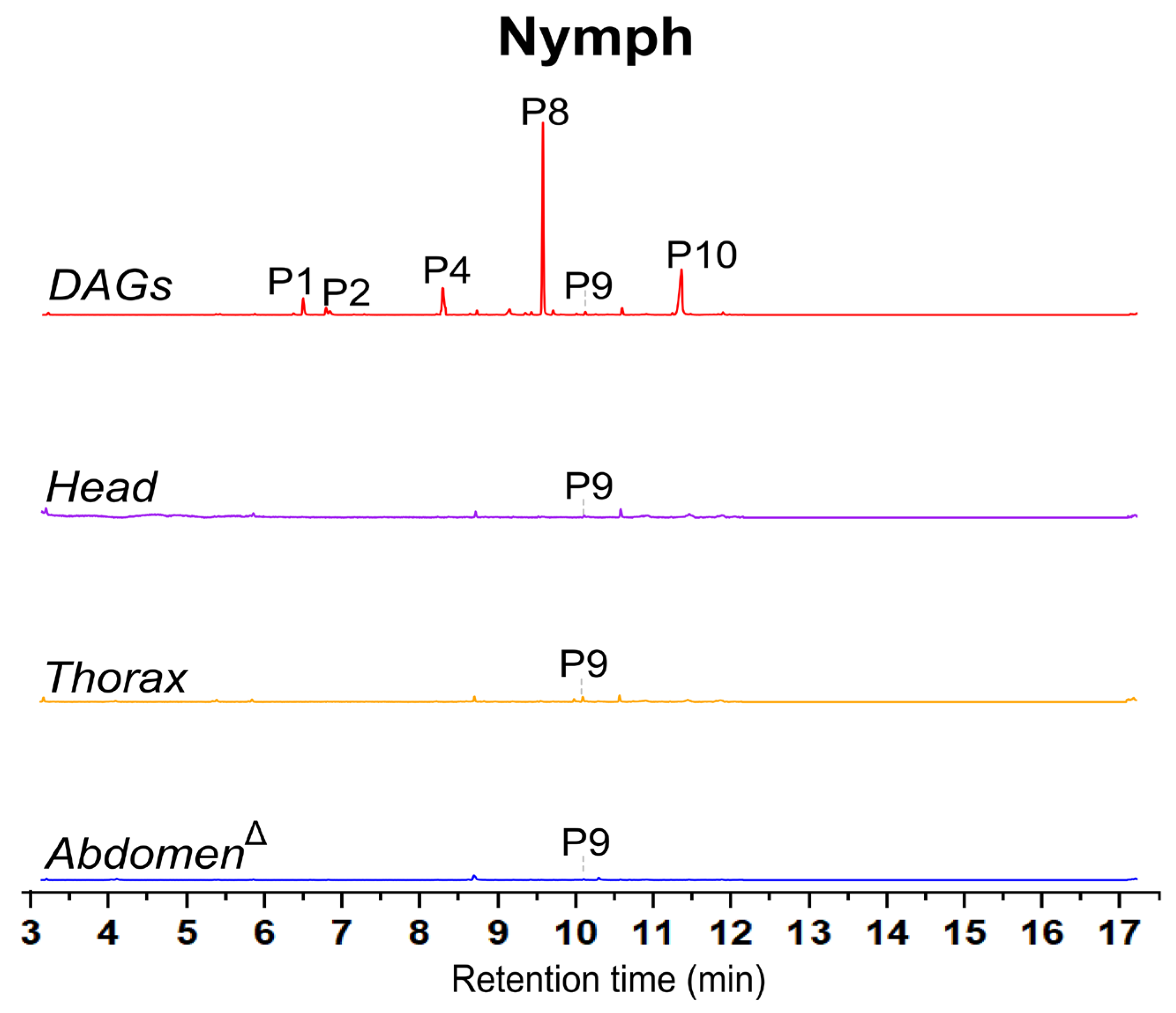
| Compounds | RT (min) | Nymph | Tissue Effect | |||
|---|---|---|---|---|---|---|
| Head | Thorax | DAGs | Abdomen Δ | |||
| (E)-2-Hexenal | 6.55 | n.d. | n.d. | 19 ± 7 | n.d. | - |
| (E)-2-Hexenol | 6.84 | n.d. | n.d. | 7 ± 3 | n.d. | - |
| 4-oxo-(E)-2-hexenal | 8.29 | n.d. | n.d. | 51 ± 6 | n.d. | - |
| (E)-2-Octenal | 9.57 | n.d. | n.d. | 647 ± 169 | n.d. | - |
| Nonanal | 10.11 | 2 ± 0.11 a# | 7 ± 0.30 c | 3 ± 0.41 b | 2 ± 0.20 a | F3,8 = 87.55; p < 0.001 |
| (E)-2-Octenoic acid | 11.30 | n.d. | n.d. | 170 ± 20 | n.d. | - |
| Male | Female | |||||||||
|---|---|---|---|---|---|---|---|---|---|---|
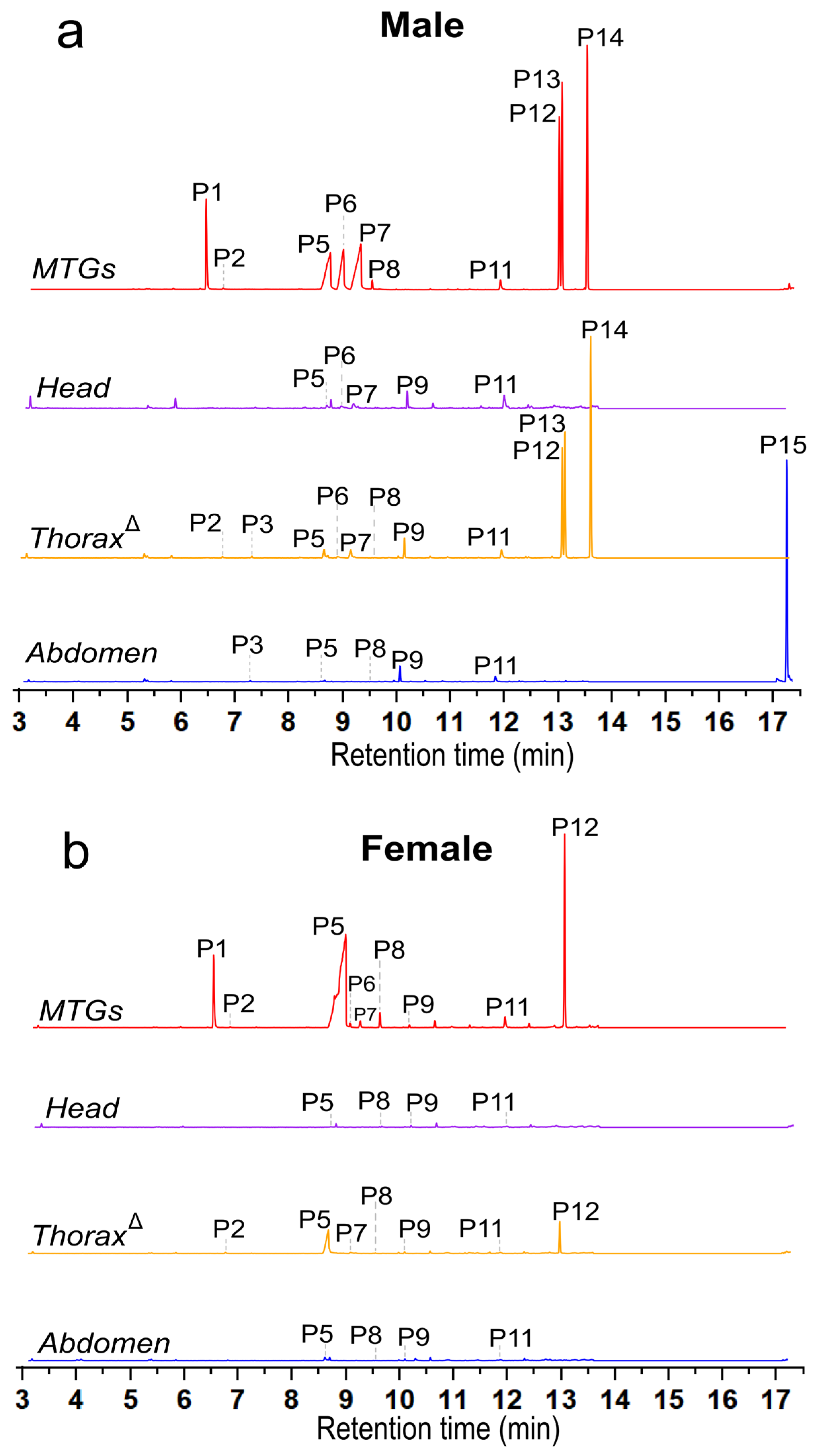
| Compounds | RT (min) | Head | Thorax Δ | MTGs | Abdomen | Head | Thorax Δ | MTGs | Abdomen | Tissue Effect |
| (E)-2-hexenal | 6.55 | n.d. | n.d. | 202 ± 78 a# | n.d. | n.d. | n.d. | 146 ± 44 a | n.d. | F1,4 = 0.09; p = 0.771 |
| (E)-2-hexenol | 6.84 | n.d. | 7 ± 0.5 a | 10 ± 2 a | n.d. | n.d. | 16.25 ± 10.11 a | 3 ± 2 a | n.d. | F3,8 = 1.78; p = 0.228 |
| heptanal | 7.35 | n.d. | 4 ± 1 a | n.d. | 4 ± 3 a | n.d. | n.d. | n.d. | n.d. | F1,4 = 0.34; p = 0.589 |
| hexanoic acid | 8.66 | 8 ± 3 a | 34 ± 5 a | 1839 ± 727 b | 11 ± 4 a | 9 ± 4 a | 349 ± 69 b | 2046 ± 416 b | 11 ± 3 a | F7,16 = 37.58; p < 0.001 |
| (E)-3-hexenoic acid | 8.9 | 3 ± 1 a | 4 ± 2 a | 1111 ± 363 b | n.d. | n.d. | 1 ± 0.23 a | trace | n.d. | F4,10 = 62.59; p < 0.001 |
| (E)-2-hexenoic acid | 9.14 | 13 ± 3 a | 28 ± 12 a | 2108 ± 722 b | n.d. | n.d. | 17 ± 7 a | 68 ± 39 a | n.d. | F4,10 = 17.78; p < 0.001 |
| (E)-2-octenal | 9.57 | n.d. | 2 ± 1 a | 24 ± 1 b | trace | trace | 1.39 ± 0.38 a | 23 ± 5 b | trace | F6,14 = 33.71; p < 0.001 |
| nonanal | 10.11 | 5 ± 2 ab | 35 ± 11 b | 2 ± 1 a | 40 ± 33 ab | 2 ± 0.27 a | 5 ± 0.89 ab | 4 ± 1 ab | 5 ± 1 ab | F7,16 = 4.17; p = 0.009 |
| nonanoic acid | 11.85 | 12 ± 2 ab | 30 ± 7 abc | 101 ± 44 c | 29 ± 15 abc | 6 ± 2 a | 17 ± 7 ab | 34 ± 4 bc | 11 ± 1 ab | F7,16 = 5.30; p < 0.001 |
| E2HH | 12.94 | n.d. | 233 ± 43 a | 647 ± 294 a | n.d. | n.d. | 212 ± 108 a | 447 ± 68 a | n.d. | F3,8 = 0.88; p = 0.488 |
| E2HZ3H | 12.99 | n.d. | 302 ± 53 a | 983 ± 518 a | n.d. | n.d. | n.d. | n.d. | n.d. | F1,4 = 0.53; p = 0.506 |
| E2HE2H | 13.45 | n.d. | 758 ± 202 a | 2274 ± 1375 a | n.d. | n.d. | n.d. | n.d. | n.d. | F1,4 = 1.56; p = 0.293 |
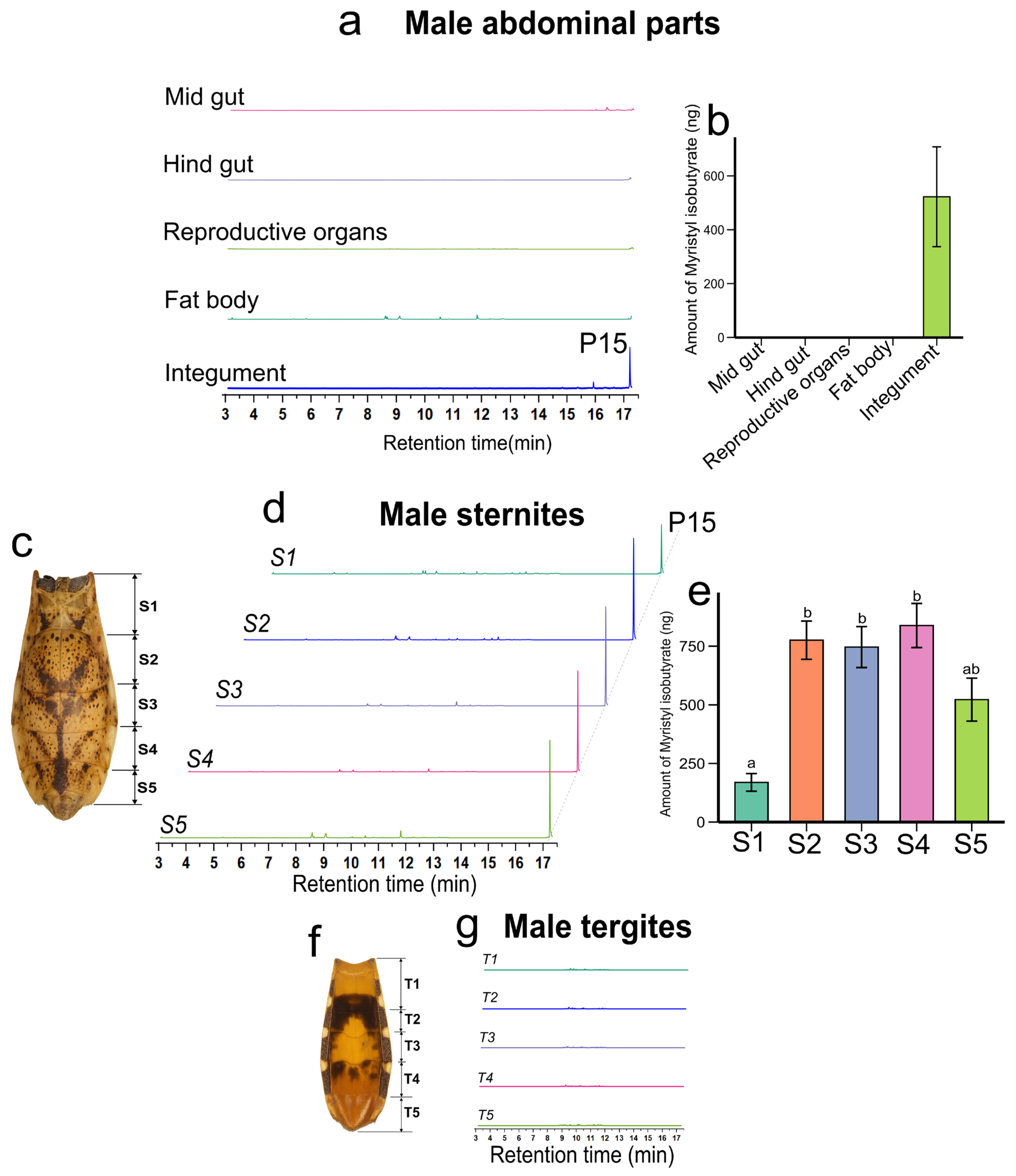
| MI | 17.19 | n.d. | n.d. | n.d. | 2214 ± 436 | n.d. | n.d. | n.d. | n.d. | - |
Disclaimer/Publisher’s Note: The statements, opinions and data contained in all publications are solely those of the individual author(s) and contributor(s) and not of MDPI and/or the editor(s). MDPI and/or the editor(s) disclaim responsibility for any injury to people or property resulting from any ideas, methods, instructions or products referred to in the content. |
© 2026 by the authors. Licensee MDPI, Basel, Switzerland. This article is an open access article distributed under the terms and conditions of the Creative Commons Attribution (CC BY) license.
Share and Cite
Kelehoun, S.T.O.; Peng, L.-Y.; Yang, S.-H.; Wei, L.; Zhang, Y.-N.; Yang, M.-S.; Li, K.; Xu, H. Distinct Exocrine Glands Contribute to the Chemical Polymorphism Across Developmental Stages and Sexes in Riptortus pedestris. Insects 2026, 17, 568. https://doi.org/10.3390/insects17060568
Kelehoun STO, Peng L-Y, Yang S-H, Wei L, Zhang Y-N, Yang M-S, Li K, Xu H. Distinct Exocrine Glands Contribute to the Chemical Polymorphism Across Developmental Stages and Sexes in Riptortus pedestris. Insects. 2026; 17(6):568. https://doi.org/10.3390/insects17060568
Chicago/Turabian StyleKelehoun, Sylvestre T. O., Lian-Ying Peng, Shao-Hang Yang, Lai Wei, Ya-Nan Zhang, Ming-Sheng Yang, Kai Li, and Hao Xu. 2026. "Distinct Exocrine Glands Contribute to the Chemical Polymorphism Across Developmental Stages and Sexes in Riptortus pedestris" Insects 17, no. 6: 568. https://doi.org/10.3390/insects17060568
APA StyleKelehoun, S. T. O., Peng, L.-Y., Yang, S.-H., Wei, L., Zhang, Y.-N., Yang, M.-S., Li, K., & Xu, H. (2026). Distinct Exocrine Glands Contribute to the Chemical Polymorphism Across Developmental Stages and Sexes in Riptortus pedestris. Insects, 17(6), 568. https://doi.org/10.3390/insects17060568