Article

Influence of Different Legume Seeds on the Development, Oviposition, and Digestive Enzyme Activity of Callosobruchus chinensis L. (Coleoptera: Chrysomelidae)


1
School of Pharmacy, Guizhou University of Traditional Chinese Medicine, Guiyang 550025, China
2
Guizhou Provincial Key Laboratory for Rare Animal and Economic Insect of the Mountainous Region, Guizhou Key Laboratory of Agricultural Biosecurity, Guiyang University, Guiyang 550005, China
3
Laboratory of Entomology and Agricultural Zoology, Department of Agriculture, Crop Production and Rural Environment, School of Agricultural Sciences, University of Thessaly, 384 46 Nea Ionia, Greece
*
Authors to whom correspondence should be addressed.
These authors contributed equally to this work.
Insects 2026, 17(6), 556; https://doi.org/10.3390/insects17060556
Submission received: 1 April 2026 / Revised: 21 May 2026 / Accepted: 26 May 2026 / Published: 28 May 2026
(This article belongs to the Section Insect Physiology, Reproduction and Development)

Simple Summary

The cowpea beetle, Callosobruchus chinensis (L.) (Coleoptera: Chrysomelidae), is a major pest of legume seeds. Different food sources will affect the physiological and ecological characteristics of insects. Here, we investigated the population development and digestive enzyme activities of C. chinensis reared on five different legume seeds: Vigna radiata, Pisum sativum, Vigna unguiculata, Vicia faba, and Glycine max. The results showed that C. chinensis had the shortest developmental period, highest adult survival rate, and highest fecundity when fed on V. radiata. For an equal initial number of adults, in the continuous rearing treatments (30, 60, or 90 d, respectively) on these bean seeds, C. chinensis showed a significantly larger population on V. radiata, while the smallest on G. max. In addition, activities of pepsin (PEP) and α-amylase (α-AMS) in C. chinensis were the highest when feeding on V. radiata, but the lowest on G. max. The activity of lipase (LPS) in C. chinensis was the highest when feeding on G. max, while there were no significant differences in the cellulase (CL) activities when fed on different bean seeds. Our results indicate that different food sources significantly influenced the metabolism of C. chinensis, which in turn may affect the population performance of insects. These findings will not only facilitate the accurate prediction of C. chinensis occurrences on different stored bean seeds, but also deepen our understanding of the host adaptation of C. chinensis and related adaptive mechanisms in physiological ecology.

Abstract

In this study, the effects of five bean seeds (Vigna radiata, Pisum sativum, Vigna unguiculata, Vicia faba, and Glycine max) on the development, survival, oviposition, and digestive enzyme activities of C. chinensis were investigated. The duration of C. chinensis development from egg to adult was shortest when reared on V. radiata (26.97 d) and longest on G. max (30.92 d) (p < 0.01). Similarly, the emergence rate of C. chinensis was highest on V. radiata (66.11%) and lowest on G. max (33.89%) (p < 0.01). Significant differences in the fecundity of C. chinensis were also detected, with the highest values on V. radiata (63.36 eggs/female), followed by P. sativum (54.27 eggs/female), V. unguiculata (51.30 eggs/female), V. faba (42.47 eggs/female), and G. max (37.29 eggs/female) (p < 0.01). For an equal initial insect number, after continuous rearing for 30, 60, or 90 d, there were significantly more offspring on V. radiata than on the other species, with the fewest offspring detected on G. max (p < 0.01). Although CL activity (p = 0.33) in C. chinensis did not differ significantly among the different legume species, activities of PEP (p < 0.01) and α-AMS (p < 0.01) in C. chinensis were all highest on V. radiata and lowest on G. max, and activities of LPS (p < 0.01) were highest on G. max and lowest on V. radiata. The differences in population dynamics associated with different bean seeds may be related to the activity of particular digestive enzymes, which play important roles in insect nutrient metabolism and growth. Our results indicated that V. radiata is the most suitable host diet, whereas G. max is the least suitable for the development of C. chinensis.

1. Introduction

The cowpea beetle, Callosobruchus chinensis (L.) (Coleoptera: Bruchidae), a widespread and oligophagous pest of legumes (Leguminosae), causes quantitative and qualitative losses and degradations in seeds [1,2]. It is widely distributed throughout the tropical and subtropical regions of the world [3,4]. The species is an important post-harvest pest of stored grains, such as cowpea, lentil, pea, green gram, and other legumes [5,6]. Damage to stored bean seeds leads to weight loss, low viability of seeds, and low nutritional quality [4,7].
Callosobruchus chinensis lays eggs on the surface of stored grains. The larvae and pupae of C. chinensis live inside of a single grain and cause damage by feeding [6,8]. Stored grains can be lost in a few months due to the relatively rapid development, high reproductive capacity, and continual generations of C. chinensis [4,8]. Unless measures are taken early enough, the infestation by the larvae of this species can be devastating, particularly due to the fact that, as internal feeders, larvae are not much affected by measures that are applied at the external part of the kernel.
Chemical fumigants and insecticides are often used to protect stored grains against C. chinensis during storage; however, these compounds may leave residues on stored grains that eventually will affect the environment, animals and humans [9,10]. Chemical insecticides could lead to the development of resistance in these stored products’ pests, making control more difficult [10,11]. Nevertheless, one of the solutions suggested is the utilization of legume species and genotypes that are affected less by the infestation, a method that is generally known as “varietal resistance”, and has been utilized in the case of several grain species, particularly cereals [12].
Legumes are vital plant-based sources of nutrients, particularly protein, and rank as the second most important food source for humans following cereals. In China, a variety of legume cultivars are widely cultivated and consumed, including Vigna radiata, Pisum sativum, Vigna unguiculata, Vicia faba, and Glycine max (all belonging to the order Fabales and family Fabaceae). In this study, the development, survival, fecundity, and population growth of this pest on these five different stored bean seeds were investigated to explore the host preference and adaptation of C. chinensis. In addition, digestive enzymes were measured to examine the physiological adaptation of C. chinensis to the different legume species. These results improve our understanding of the variation in damage caused by C. chinensis on different stored bean seeds, illustrating its food preferences and providing insights into host adaptation from the perspective of physiological ecology. Furthermore, these data for the population dynamics of C. chinensis on different bean cultivars provide a basis for pest control or improved IPM programs.

2. Materials and Methods

2.1. Insect Rearing

Callosobruchus chinensis was reared in glass jars (5 L) covered with muslin cloth to prevent insect escape and ensure ventilation, as described in our previous studies [13,14]. This species has been cultured in our laboratory (Guizhou Provincial Key Laboratory for Rare Animal and Economic Insect of the Mountainous Region, Guiyang University, Guizhou, China) since 2022 and is maintained on Vigna angularis (Fabales: Fabaceae), with a moisture content of 12–14%. This insect colony was kept in a climate chamber, at 25 ± 1 °C, 65 ± 5% RH, and under a 14: 10 h (light/dark) photoperiod.

2.2. Stored Bean Seeds

Five stored leguminous products, V. radiata, P. sativum, V. unguiculata, V. faba, and G. max (with moisture contents of 10–13%, 12–14%, 10–13%, 10–13%, and 12–14%, respectively), were purchased from the Guiyang Grain Commodity Market (Guiyang City, China) and were kept without pesticides.

2.3. Development of Immature Stages and Emergence Rate of C. chinensis

Groups of 200 C. chinensis (males and females) were placed into glass jars (2.5 L) for oviposition. Each jar contained 20.0 g of one of the five stored bean seeds. After 24 h, C. chinensis adults were removed, and newly laid eggs on the stored materials were carefully transferred into separate Petri dishes (60 mm in diameter, 30 mm in height). Sixty eggs from each stored product culture were checked daily until the emergence of larvae [13,15]. Fresh stored material for rearing was provided. As the larvae and pupae of C. chinensis feed inside of beans, developmental periods were defined as the time until eclosion (i.e., the emergence of C. chinensis adults). The emergence rate of C. chinensis was calculated as the number of emerged adults relative to the initial egg count. There were three replicates for these observations on each stored bean. These investigations were conducted at 25 ± 1 °C, 65 ± 5% RH, and under a 14:10 h (light/dark) photoperiod in a climate chamber.

2.4. Oviposition

Newly emerged C. chinensis adults from each bean seed in the above experiment were used to assess fecundity, according to our previous study [13]. All adults were paired (1 female: 1 male) and were transferred into Petri dishes (6 cm in diameter, 3 cm in height), with one pair per Petri dish, containing one of the five uninfested bean seeds (10.0 g) for oviposition. These paired C. chinensis adults were transferred daily to new Petri dishes containing fresh food materials, and all materials were checked daily to assess egg laying. Fecundity (i.e., the number of eggs laid during the reproductive period) was recorded for each female C. chinensis until death. The offspring were reared to adulthood for sex determination and to calculate the female sex ratio of the offspring. These reproduction assays were conducted with 25 pairs of insects per replicate, with three replicates, for a total of 75 pairs per bean seed.

2.5. Population Performance of C. chinensis

Ten pairs of C. chinensis adults (1–2 days after emergence) were introduced to a jar (2.5 L) containing one of the stored beans (V. radiata, P. sativum, V. unguiculata, V. faba, and G. max) at 200.0 g, using different jars for each bean seed. The jar openings were covered with a 60-mesh gauze to prevent insects from escaping. The number of C. chinensis adults was recorded in the F1, F2, and F3 generations. Generations were based on the eclosion (i.e., the emergence of adult progeny), with one generation in these trials lasting approximately 30 days. For each generation on each sampling date (30, 60, and 90 days), C. chinensis adults were counted to evaluate the increase in the population at each generation. Treatments were replicated three times for each bean species.

2.6. Enzyme Extract Preparation

Enzyme extracts were prepared from C. chinensis fed on each of these five bean seeds. Following our previously described protocols, protein extraction and a total protein quantitative assay were performed (Nanjing Jiancheng Bioengineering Institute, Nanjing, China) [14,16]. In brief, randomly selected C. chinensis adults or larvae (0.1 g per cultivar) were accurately weighed and placed in centrifuge tubes, followed by the addition of 0.9% normal saline at a 1:9 (w/v) ratio. The mixture was ground into a homogenate in an ice-water bath, then centrifuged at 2197× g and 4 °C for 10 min. The supernatant was collected into 1.5 mL tubes and utilized for the determination of enzyme activities in subsequent experiments. Protein concentrations were determined according to the Bradford method using bovine serum albumin as the standard [17].

2.7. Digestive Enzyme Activity Assay

Activities of digestive enzymes were tested following the methods detailed in our previous study using activity assay kits for α-amylase (α-AMS), pepsin (PEP), lipase (LPS), and cellulase (CL), according to the manufacturer’s instructions [14,16]. The activity levels of LPS, α-AMS, CL, and PEP were calculated by measuring the increase in optical density at 420 nm, 660 nm, 550 nm and 270 nm, respectively. The optical density was recorded using a microplate reader. Three repetitions were conducted for each digestive enzyme, and larvae and adults of C. chinensis were tested.

2.8. Statistical Analysis

One-way analyses of variance (ANOVA) followed by Tukey’s honestly significant difference (HSD) tests were used for comparisons of development, survival, oviposition parameters, and digestive enzyme activities in C. chinensis among different stored beans (p < 0.05). All data were checked for normality and homoscedasticity before analyses. Data were analyzed using SPSS software (version 22.0; SPSS, Chicago, IL, USA).

3. Results

3.1. Development

The developmental periods of C. chinensis eggs (F4,10 = 29.28, p < 0.01) and larvae and pupae (F4,10 = 34.75, p < 0.01) differed significantly among the five bean seeds (Table 1). There were also significant differences in the duration of development (egg to adult) (F4,10 = 75.99, p < 0.01) in C. chinensis, with estimates of 26.97 days on V. radiata, 27.82 days on P. sativum, 28.43 days on V. unguiculata, 29.20 days on V. faba, and 30.92 days on G. max.

3.2. Emergence Rate

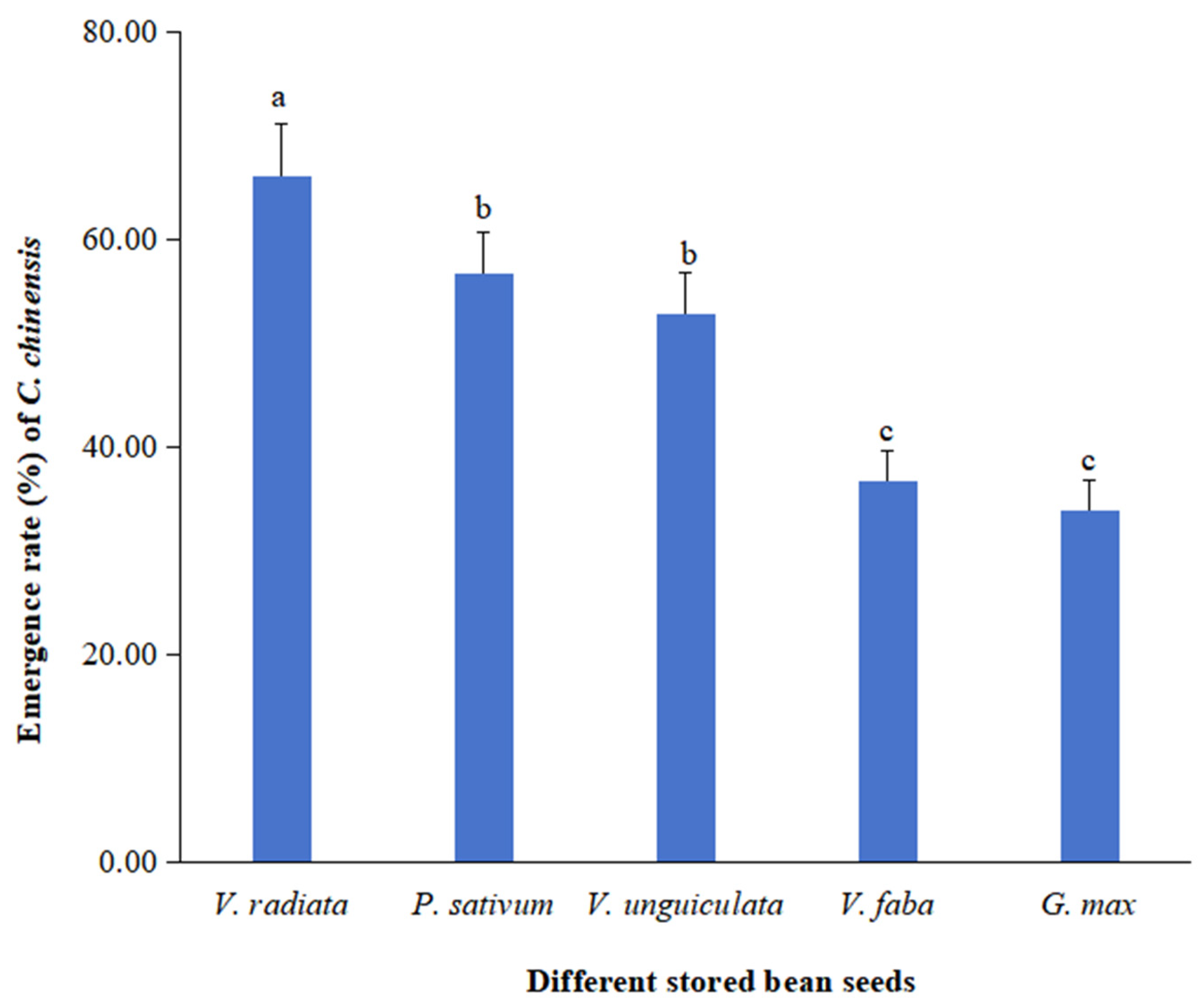
The emergence rate of C. chinensis (egg to adult) (F4,10 = 201.55, p < 0.01) differed significantly among the five selected stored products (Figure 1). C. chinensis adults showed the highest emergence rate (66.11%) on V. radiata, followed by 56.67% on P. sativum and 52.78% on V. unguiculata, 36.67% on V. faba, and 33.89% on G. max.

3.3. Oviposition

The type of bean seed had significant effects on the longevity of adult females (F4,10 = 16.45, p < 0.01) and males (F4,10 = 23.80, p < 0.01) of C. chinensis (Table 2). Fecundity also differed significantly among bean types (F4,10 = 306.96, p < 0.01). The stored beans were ranked, from highest to lowest with respect to the fecundity of C. chinensis, as follows: V. radiata (63.36), P. sativum (54.27), V. unguiculata (51.30), V. faba (42.47), and G. max (37.29). There were significant differences in the oviposition periods of C. chinensis among these five bean seeds (F4,10 = 75.20, p < 0.01), with the longest period on V. radiata (10.98 days) and the lowest on G. max (7.18 days), which was not significantly different from that on V. faba (7.54 days). In addition, the female offspring sex ratio for C. chinensis was highest on V. radiata (0.54), which was not significantly different from those on P. sativum (0.52) and V. unguiculata (0.51). The sex ratio was lowest on G. max (0.43), which was not significantly different from that on V. faba (0.45) (F4,10 = 18.47, p < 0.01).

3.4. Population Performance

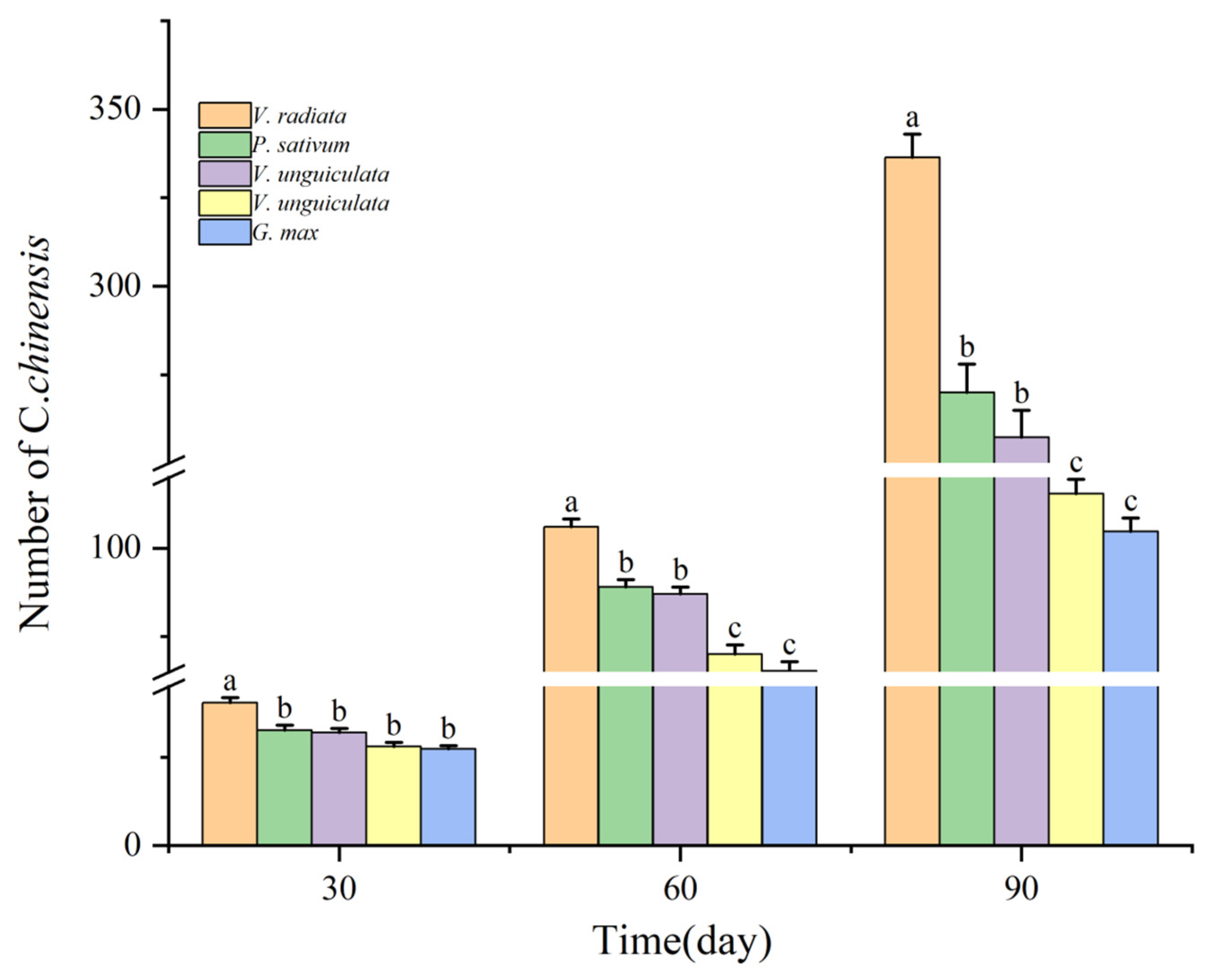
After 30 days, the number of C. chinensis adults was significantly higher on V. radiata (40.33) than on other bean species, and there were no significant differences in the number of C. chinensis adults among the other four stored beans (F4,10 = 17.55, p < 0.01) (Figure 2). Generally, the population sizes on each bean seed were 2.02, 1.63, 1.60, 1.40, and 1.37 times greater than the initial number of C. chinensis on V. radiata, P. sativum, V. unguiculata, V. faba, and G. max, respectively.
After 60 days, there were significant differences in the number of C. chinensis adults among the five stored bean products (F4,10 = 47.75, p < 0.01), with the highest number of 106.00 on V. radiata, followed by P. sativum (89.00), V. unguiculata (87.00), V. faba (70.00), and G. max (65.33). The population sizes on each stored bean species were 5.30, 4.45, 4.35, 3.50, and 3.27 times greater than the initial number of C. chinensis, respectively.
After 90 days, there were significant differences in the number of C. chinensis adults among these stored beans (F4,10 = 264.45, p < 0.01), with the highest number of 336.33 on V. radiata, followed by 270.00 on P. sativum, 257.33 on V. unguiculata, 115.55 on V. faba, and 104.67 on G. max. The population sizes on each stored bean were 16.82, 13.50, 12.87, 5.77, and 5.23 times greater than the initial number of C. chinensis, respectively.

3.5. Digestive Enzyme Activity

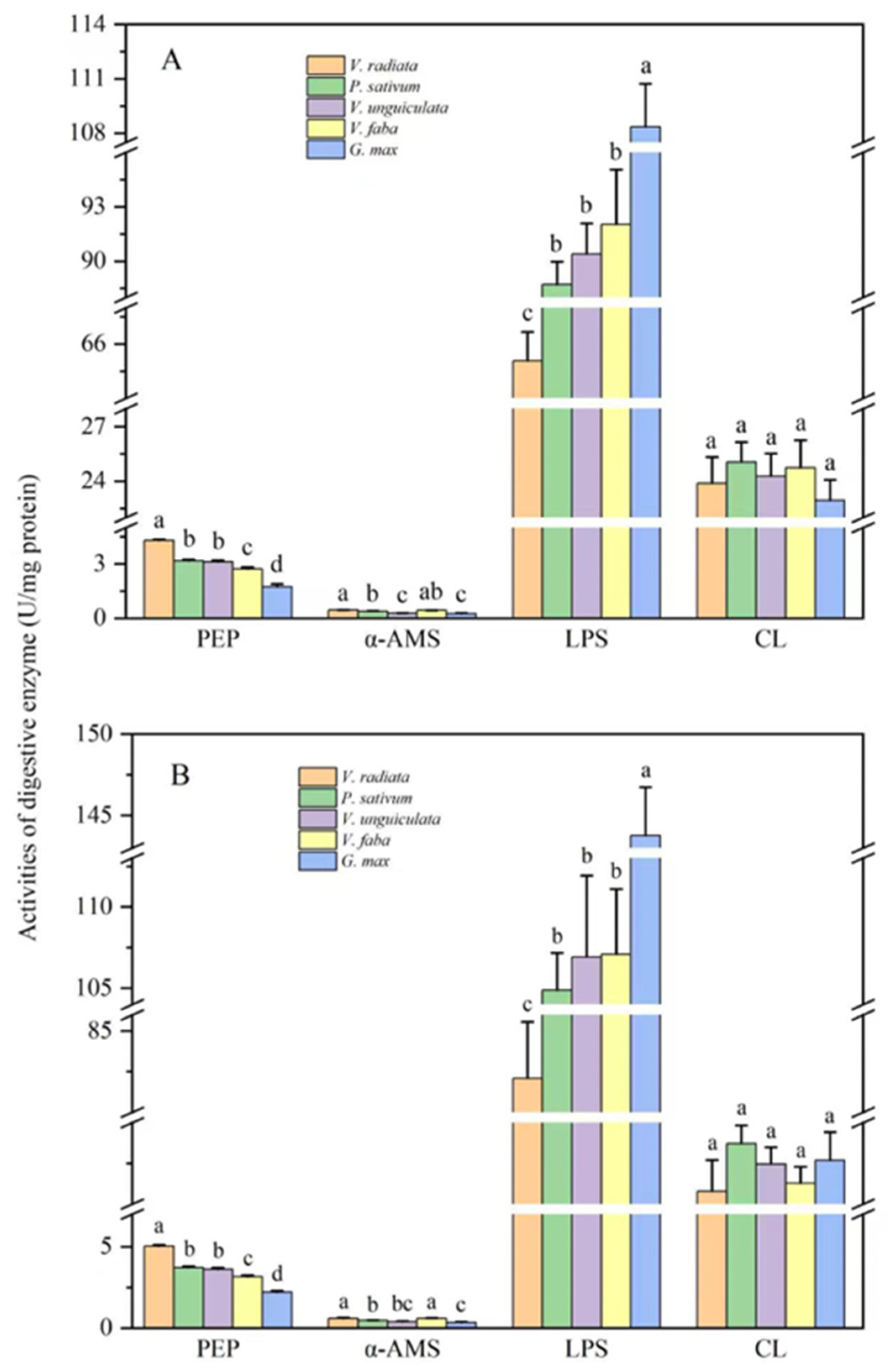
PEP activity in C. chinensis adults differed significantly among bean seeds (F4,10 = 258.67, p < 0.01). PEP activity was highest on V. radiata at 4.30 U/mg∙prot, which was 1.36, 1.38, 1.58, and 2.47 times greater than those on P. sativum, V. unguiculata, V. faba, and G. max, respectively (Figure 3A). α-AMS activity of C. chinensis adults was highest on V. radiata at 0.45 U/mg∙protein, which was not significantly different from that on V. faba (0.43 U/mg∙protein). α-AMS activity was lowest on G. max at 0.26 U/mg∙protein, which was not significantly different from that on V. unguiculata (0.27 U/mg∙protein) (F4,10 = 49.47, p < 0.01). Significant differences in LPS activity were also observed among stored beans, with the highest values on G. max (108.35 U/mg∙protein) and the lowest values on V. radiata (65.07 U/mg∙protein) (F4,10 = 164.91, p < 0.01). There were no significant differences in LPS activity in C. chinensis among the other three stored beans. In addition, no significant differences in CL activity were observed among adult C. chinensis on different stored beans (F4,10 = 1.23, p = 0.36).
In C. chinensis larvae, there were significant differences in the activities of PEP (F4,10 = 378.39, p < 0.01), α-AMS (F4,10 = 41.52, p < 0.01), and LPS (F4,10 = 108.72, p < 0.01), but not in CL (F4,10 = 2.05, p = 0.163), among bean seeds (Figure 3B). In addition, activities of PEP, α-AMS, LPS, and CL were significantly higher in larvae than in adults on each of these five stored beans.

4. Discussion

Previous studies have clearly demonstrated that food source can influence the development, survival, and reproductive characteristics of C. chinensis [4,18,19,20]. In the present study, developmental period, emergence rate, fecundity and population growth differed significantly among the five bean seeds, indicating that C. chinensis poses a higher risk to some stored product commodities than the others. This finding should be carefully taken into account, given that certain members of the stored-product Bruchidae are strongly associated with specific legume species, whereas other species, although still oligophagous, can infest a range of legume hosts [21,22]. In this context, categorizing bruchids according to infestation risk in a single commodity may be misleading, as some of these species may have a wider range of food preferences. For instance, the bean weevil, Acanthoscelides obtectus (F). (Coleoptera: Bruchidae) is commonly associated with common beans, but has been reported from several other legumes [23,24,25]. Hence, the characterization of this species as a “bean weevil” may be falsely perceived as an indication that A. obtectus cannot infest other commodities. Similarly, our results indicate that G. max is the least suitable, but C. chinensis can still develop on all five legume species, indicating a relatively broad capacity for host utilization.
In the present study, at 25 °C, the development period of C. chinensis from egg to adult ranged from 26.97 to 30.92 days on the five selected bean seeds. A similar estimate of 27.01 to 38.2 days was obtained in different V. radiata and V. unguiculata cultivars under 28 °C [4]. The total developmental period (egg to adult) of C. chinensis ranged from 21.8 to 72.7 days under the temperature range of 20~32 °C when fed on V. radiata or V. angularis [26,27]. There is also evidence that humidity affects the development of C. chinensis [20], which is a parameter of major importance in the case of stored product insects [12]. Therefore, additional environmental factors particularly temperature and humidity should be examined to improve prediction of C. chinensis development under realistic storage conditions [4,27,28].
Fecundity of C. chinensis differed significantly among the five stored beans and was highest on V. radiata (63.36 per female) and lowest on G. max (37.29 per female), in agreement with the results of Ma et al. [29] and Hao et al. [30]. In other studies, Ge et al. [31] and Maharjan et al. [28] have reported that C. chinensis lays more eggs in V. unguiculata, C. arietinum, and V. radiata than on other legumes. In addition, the emergence rate and offspring sex ratio of C. chinensis were also higher on these stored products, indicating that V. radiata, V. unguiculata, and C. arietinum are suitable hosts for population growth in C. chinensis. In these previous studies, C. chinensis had a significantly higher net reproductive rate (R0) or intrinsic population increase rate (r) on V. radiata, V. unguiculata and C. arietinum than on other legumes [29,31]. In this study, C. chinensis showed significantly larger population sizes on V. radiata than on the other four stored beans after 30, 60, and 90 d. However, the data reported here correspond to the varieties and genotypes tested in our protocols, and thus, broad generalizations should be avoided, even though clear trends in host suitability were observed.
Host quality influences feeding, development, survival, and oviposition of C. chinensis [4,18,27,31,32]. The protein content is a crucial factor in C. chinensis survival and development because this pest spends the whole immature stage inside the host seed [6,33]. Furthermore, other studies have shown that the degree of damage caused by C. chinensis is positively correlated with the protein and starch contents of stored products and is negatively correlated with the flavonoids, phenol, or tannin content of host diets [33,34,35]. In addition, a higher protein content is beneficial for population growth in C. chinensis, with significant positive correlations between the protein content of the host and the growth index of C. chinensis and negative correlations between these parameters and total phenolic, anthocyanin, and flavonoid contents [36,37]. These nutrients and secondary metabolites contribute to nutrition, and various physiological and biochemical reactions in insects after feeding on these hosts directly affect growth and development [32,35,38]. Future studies should evaluate nutritional composition and secondary metabolites in the same seed lots used for insect bioassays to better clarify their contribution to host suitability and insect performance.
Insects can adapt to different host diets through changes in metabolic processes [15,39,40]. Stored-product bruchids are useful models for studying these adaptations because infestation levels often vary strongly among host seeds [25,41,42]. Digestive enzymes play a crucial role in food digestion, nutrient acquisition, and host utilization [43,44] and may therefore help explain differences in host suitability. In the present study PEP and α-AMS activity levels in C. chinensis were highest on V. radiata and lowest on G. max, consistent with the host suitability ranking observed in the development, fecundity, and population performance assays. This could be attributed to the high nutrient contents (protein and starch) and low secondary metabolite contents (phenols, flavonoids, and anthocyanins) of V. radiata [45], providing better nutritional value through digestion and metabolism via PEP and α-AMS and thereby promoting pest population growth. Although there were no significant differences in CL activity in C. chinensis among bean seeds, LPS activity was highest on G. max and lowest on V. radiata. Overall, these results support the view that variation in digestive enzyme activity is one physiological mechanism underlying host adaptation in C. chinensis.
Physical characteristics of seeds can also influence suitability for insect egg laying. Seed size, moisture content, texture, color, and hardness of seeds are important factors affecting C. chinensis population growth or host resistance [32,33,36,46]. The high levels of secondary metabolites (phenols, anthocyanins, flavonoids, etc.) make some bean seeds unsuitable hosts for C. chinensis [33,34,35,36,37]. In the present study, the selected legumes differed in moisture content, which may have contributed to the observed differences in development, fecundity, and population performance. Further analyses of physical and biochemical properties of the five bean seeds, together with the physiological responses of insects, will aid in comprehensive assessments of the C. chinensis population status and host suitability. Physical or biochemical characteristics of bean seeds associated with resistance to C. chinensis can be exploited for pest control or IPM programs and could provide useful information for the breeding of resistant cultivars against C. chinensis [32,35,36,46].

Author Contributions

Y.C. and C.G.A. conceived the research. T.Z., K.W., R.Y., M.K.S., L.J., X.H. and C.W. conducted the experiments. T.Z., R.Y. and Y.C. analyzed the data and conducted the statistical analyses. Y.C., M.K.S. and C.G.A. wrote the manuscript. All authors have read and agreed to the published version of the manuscript.

Funding

This study was financially supported by the Training Project for High-Level Innovative Talent in Guizhou Province (GCC [2023]074), Guizhou Provincial Science and Technology Project (Qiankexie KJLYRC-[2026] 002), Guizhou Key Laboratory of Agricultural Biosecurity (Qiankehe ZSYS [2025]024), Program for Natural Science Research in Guizhou Education Department (QJJ[2023]024), and National Innovation and Entrepreneurship TrainingbProgram for College Students (202510976665).

Data Availability Statement

The original contributions presented in this study are included in the article. Further inquiries can be directed to the corresponding authors.

Conflicts of Interest

The authors declare no conflicts of interest.

References

  1. Sharma, H.C.; Gowda, C.L.; Stevenson, P.C. Host plant resistance and insect pest management in chickpea. In Chickpea Breeding and Management; Yadav, S.S., Redden, R., Chen, W., Sharma, B., Eds.; C.A.B. International Limited: Oxfordshire, UK, 2007; pp. 520–537. [Google Scholar]
  2. Gbaye, O.A.; Millard, J.C.; Holloway, G.J. Legume type and temperature effects on the toxicity of insecticide to the genus Callosobruchus (Coleoptera: Bruchidae). J. Stored Prod. Res. 2011, 47, 8–12. [Google Scholar] [CrossRef]
  3. Rees, D. Insects of Stored Products; CSIRO Publishing: Canberra, Australia, 2004. [Google Scholar]
  4. Maharjan, R.; Yi, H.; Kim, H.; Yoon, Y.; Jang, Y.; Bae, S. Mung bean (Vigna radiata) cultivars mediated oviposition preference and development of Callosobruchus chinensis (Coleoptera: Chrysomelidae: Bruchinae). Appl. Entomol. Zool. 2018, 53, 55–66. [Google Scholar] [CrossRef]
  5. Southgate, B.J. Biology of the Bruchidae. Annu. Rev. Entomol. 1979, 24, 449–473. [Google Scholar] [CrossRef]
  6. Tuda, M.; Chou, L.Y.; Niyomdham, C.; Buranapanichpan, S.; Tateishi, Y. Ecological factors associated with pest status in Callosobruchus (Coleoptera: Bruchidae): High host specificity of non-pest to Cajaninae (Fabaceae). J. Stored Prod. Res. 2005, 41, 31–45. [Google Scholar] [CrossRef]
  7. Bae, S.D.; Kim, H.J.; Mainali, B.P. Changes in nutritional composition of soybean seed caused by feeding of pentatomid and alydid bugs. J. Econ. Entomol. 2014, 107, 1055–1060. [Google Scholar] [CrossRef] [PubMed]
  8. Kyogoku, D.; Nishida, T. The mechanism of the fecundity reduction in Callosobruchus maculatus caused by Callosobruchus chinensis males. Popul. Ecol. 2013, 55, 87–93. [Google Scholar] [CrossRef]
  9. Isman, M.B. Botanical insecticides, deterrents, and repellents in modern agriculture and an increasingly regulated world. Annu. Rev. Entomol. 2006, 51, 45–66. [Google Scholar] [CrossRef]
  10. Nayak, M.K.; Daglish, G.J.; Phillips, T.W.; Ebert, P.R. Resistance to the fumigant phosphine and its management in insect pests of stored products: A global perspective. Annu. Rev. Entomol. 2020, 65, 333–350. [Google Scholar] [CrossRef]
  11. Jagadeesan, R.; Singarayan, V.T.; Nayak, M.K. A Co-fumigation strategy utilizing reduced rates of phosphine (PH3) and sulfuryl fluoride (SF) to control strongly resistant rusty grain beetle, Cryptolestes ferrugineus (Stephens) (Coleoptera: Laemophloeidae). Pest. Manag. Sci. 2021, 77, 4009–4015. [Google Scholar] [CrossRef]
  12. Athanassiou, C.G.; Arthur, F.H. Importance of stored product insects. In Recent Advances in Stored Product Protection; Springer: Berlin/Heidelberg, Germany, 2018; p. 273. [Google Scholar]
  13. Ren, Y.L.; Wang, T.; Wang, C.; D’Isita, I.; Hu, Q.; Germinara, G.S.; Cao, Y. Population development of Rhyzopertha dominica (F.) (Coleoptera: Bostrichidae) on different stored products. Entomol. Res. 2023, 53, 359–366. [Google Scholar] [CrossRef]
  14. Jian, L.Y.; Yang, Y.P.; Xie, S.H.; Cao, Y. Life table parameters and digestive enzyme activity of Araecerus fasciculatus (Coleoptera: Anthribidae) feeding on different stored products. Insects 2025, 16, 428. [Google Scholar] [CrossRef]
  15. Naseri, B.; Majd-Marani, S. Different cereal grains affect demographic traits and digestive enzyme activity of Rhyzopertha dominica (F.) (Coleoptera: Bostrichidae). J. Stored Prod. Res. 2022, 95, 101898. [Google Scholar] [CrossRef]
  16. Zhang, T.; Hu, Q.Q.; Wang, J.; Chen, L.; Zhang, Y.B.; Shen, M.; Rumbos, C.I.; Li, C.; Athanassiou, C.G.; Cao, Y. The rice cultivar affects the population growth and physiological enzyme activity of Sitophilus oryzae (L.) (Coleoptera: Curculionidae) reared on rice grains. J. Stored Prod. Res. 2023, 104, 102163. [Google Scholar] [CrossRef]
  17. Bradford, M.M. A rapid and sensitive method for the quantitation of microgram quantities of protein utilizing the principle of protein-dye binding. Anal. Biochem. 1976, 72, 248–254. [Google Scholar] [CrossRef] [PubMed]
  18. Desroches, P.; Shazly, E.E.; Mandon, N.; Guc, G.; Huignard, J. Development of Callosobruchus chinensis (L.) and C. maculatus (F.) (Coleoptera: Bruchidae) in seeds of Vicia faba L. differing in their tannin, vicine and convicine contents. J. Stored Prod. Res. 1995, 31, 83–89. [Google Scholar] [CrossRef]
  19. Ahmed, K.S.; Itino, T.; Ichikawa, T. Effects of plant oils on oviposition preference and larval survivorship of Callosobruchus chinensis (Coleoptera: Bruchidae) on azuki bean. Appl. Entomol. Zool. 1999, 34, 547–550. [Google Scholar] [CrossRef][Green Version]
  20. Mainali, B.P.; Kim, H.J.; Park, C.G. Oviposition preference and development of azuki bean weevil Callosobruchus chinensis on five different leguminous seeds. J. Stored Prod. Res. 2015, 61, 97–101. [Google Scholar] [CrossRef]
  21. Delobel, B.; Delobel, A. Dietary specialization in European species groups of seed beetles (Coleoptera: Bruchidae: Bruchinae). Oecologia 2006, 149, 428–443. [Google Scholar] [CrossRef]
  22. Bingham, G.V.; Hagstrum, D.W. Importance of sanitation for stored-product pest management. Insects 2024, 15, 3. [Google Scholar] [CrossRef]
  23. Boonekamp, P.; Dachbrodt-Saaydeh, S.; Sattin, M. Eight principles of integrated pest management. Agron. Sustain. Dev. 2015, 35, 1199–1215. [Google Scholar] [CrossRef]
  24. Haddi, K.; Viteri Jumbo, L.O.; Costa, M.S.; Santos, M.F.; Faroni, L.R.A.; Serro, J.E.; Oliveira, E.E. Changes in the insecticide susceptibility and physiological trade-offs associated with a host change in the bean weevil Acanthoscelides obtectus. J. Pest. Sci. 2018, 91, 459–468. [Google Scholar] [CrossRef]
  25. Savković, U.; Đorđević, M.; Stojković, B. Potential for Acanthoscelides obtectus to adapt to new hosts seen in laboratory selection experiments. Insects 2019, 10, 153. [Google Scholar] [CrossRef]
  26. Ma, X. Influence of Storage Temperature on the Population Development of Callosobruchus chinensis (Coleoptera: Bruchidae). Master’s Thesis, Heilongjiang University, Harbin, China, 2015. [Google Scholar]
  27. Mainali, B.P.; Kim, H.J.; Park, C.G.; Yoon, Y.N.; Lee, Y.H.; Park, I.H.; Kang, H.W.; Bae, S.D. Interactive effects of temperature and relative humidity on oviposition and development of Callosobruchus chinensis (L.) on azuki bean. J. Stored Prod. Res. 2015, 63, 47–50. [Google Scholar] [CrossRef]
  28. Maharjan, R.; Ahn, J.J.; Park, C.G. Effects of temperature on development of the azuki bean weevil, Callosobruchus chinensis (Coleoptera: Bruchidae) on two leguminous seeds. J. Stored Prod. Res. 2017, 72, 90–99. [Google Scholar] [CrossRef]
  29. Ma, X.; Zhang, W.C.; Lu, C.Y.; Zhang, L.X. Selectivity of grain weevil on different food. Chin. Agric. Sci. Bull. 2015, 31, 187–190. [Google Scholar]
  30. Hao, S.J.; Fan, J.F.; Wang, Y.Q.; Fu, S.G.; Zhang, L.X. Development and reproduction of Callosobruchus chinensis in different kinds of beans. Chin. Agric. Sci. Bull. 2017, 33, 138–141. [Google Scholar]
  31. Ge, H.; Liu, C.Y.; Wan, Z.H.; Gu, C.Y. Growth and development of Callosobruchus chinensis L. (Coleoptera: Bruchidae) on different beans. Plant Dis. Pests 2017, 8, 1–3. [Google Scholar]
  32. Eker, T.; Erler, F.; Adak, A.; Imrek, B.; Guven, H.; Tosun, H.S.; Sari, D.; Sari, H.; Upadhyaya, H.D.; Toker, C. Screening of chickpea accessions for resistance against the pulse beetle, Callosobruchus chinensis L. (Coleoptera: Bruchidae). J. Stored Prod. Res. 2018, 76, 51–57. [Google Scholar] [CrossRef]
  33. Khandaitaray, T.; Mishra, P.R.; Satapathy, S.N.; Hosamani, G.B.; Shankar, T.; Badjena, T.; Baral, S.; Soren, L. Biochemical changes of chickpea genotypes before and after infestation of pulse beetle Callosobruchus Chinensis L. (Coleoptera: Bruchidae) during storage. J. Adv. Zool. 2023, 44, 629–637. [Google Scholar]
  34. Deepika, K.L.; Singh, P.S.; Singh, S.K.; Saxena, R.P.N. Biochemical basis of resistance against pulse beetle Callosobruchus chinensis (L.) in stored chickpea genotypes. J. Exp. Zool. 2020, 23, 1175–1180. [Google Scholar]
  35. Sathish, K.; Jaba, J.; Katlam, B.P.; Mishra, S.P. Biochemical components conferring resistance to pigeonpea genotypes against Callosobruchus chinensis (L.) (Coleoptera: Bruchidae) under semitropical storage sonditions. Legume Res. 2024, 47, 2182–2188. [Google Scholar] [CrossRef]
  36. Tripathi, K.; Bhalla, S.; Srinivasan, K.; Prasad, T.V.; Gautam, R.D. Physical and biochemical basis of resistance in cowpea [Vigna unguiculata (L.) walp.] accessions to pulse-beetle Callosobruchus chinensis (L.). Legume Res. 2013, 36, 457–466. [Google Scholar]
  37. Ahmad, M.A.; Agnihotri, M.; Khan, M.S.; Dubey, A.; Prakash, N. Biochemical basis of resistance in chickpea varieties against Callosobruchus chinensis Linn. (Coleoptera: Bruchidae). Legume Res. 2019, 42, 282–286. [Google Scholar] [CrossRef]
  38. Tripathi, K.; Chauhan, S.K.; Gore, P.G.; Prasad, T.V.; Srinivasan, K.; Bhalla, S. Screening of cowpea [Vigna unguiculata (L.) Walp.] accessions against pulse-beetle Callosobruchus chinensis (L.). Legume Res. 2015, 38, 675–680. [Google Scholar]
  39. Petre, B.; Lorrain, C.; Stukenbrock, E.H.; Duplessis, S. Host-specialized transcriptome of plant-associated organisms. Curr. Opin. Plant Biol. 2020, 56, 81–88. [Google Scholar] [CrossRef]
  40. Mansouri, S.M.; Bahram, B.; Bidar, F. Oviposition preference, population growth and digestive enzymatic function of Callosobruchus maculatus (F.) (Coleoptera: Chrysomelidae) on six legume grains. J. Stored Prod. Res. 2022, 99, 102011. [Google Scholar] [CrossRef]
  41. Alvarez, N.; McKey, D.; Hossaert-McKey, M.; Born, C.; Mercier, L.; Betty, B. Ancient and recent evolutionary history of the bruchid beetle, Acanthoscelides obtectus Say, a cosmopolitan pest of beans. Mol. Ecol. 2005, 14, 1015–1024. [Google Scholar] [CrossRef] [PubMed]
  42. Janković-Tomanić, M.; Šešlija Jovanović, D.; Savković, U.; Đorđević, M.; Stojković, B.; Lazarević, J. Host expansion modifies activity of phosphatases in a legume store pest Acanthoscelides obtectus (Say). J. Stored Prod. Res. 2015, 62, 32–35. [Google Scholar] [CrossRef]
  43. Terra, W.R. Evolution of digestive systems of insects. Annu. Rev. Entomol. 1990, 35, 181–200. [Google Scholar] [CrossRef]
  44. Borzoui, E.; Naseri, B.; Nouri-Ganbalani, G. Effects of food quality on biology and physiological traits of Sitotroga cerealella (Lepidoptera: Gelechiidae). J. Econ. Entomol. 2017, 110, 266–273. [Google Scholar]
  45. Hamzei, M.; Golizadeh, A.; Hassanpour, M.; Fathi, S.A.A.; Abedi, Z. Interaction between life history parameters of Callosobruchus maculatus (F.) (Coleoptera: Chrysomelidae) with physical and biochemical properties of legumes species. J. Stored Prod. Res. 2023, 102, 102–111. [Google Scholar] [CrossRef]
  46. Elsawy, H.I.A.; El-Talpanty, D.M.; Mohamed, A.M.; Morsy, A.R. Resistance of some soybean genotypes to Bruchids: Callosobruchus chinensis L. as influenced by different biochemical and seed quality traits. Int. J. Plant Prod. 2024, 15, 153–160. [Google Scholar] [CrossRef]
Figure 1. Emergence rate (%) of C. chinensis raised on different bean seeds. Data are presented as means ± SE. Different letters above bars indicate significant differences among values (Tukey’s test, p < 0.05).
Insects 17 00556 g001
Figure 2. Population size of C. chinensis raised on different bean seeds. Data are presented as means ± SE. Different letters above bars indicate significant differences among values (Tukey’s test, p < 0.05).
Insects 17 00556 g002
Figure 3. Digestive enzyme activities in C. chinensis raised on different bean seeds. Data are presented as means ± SE. Different letters above bars indicate significant differences among values (Tukey’s test, p < 0.05). (A) adults; (B) larvae.
Insects 17 00556 g003
Table 1. Duration (days) of C. chinensis development on different bean seeds.
Bean SeedsEggLarval and PupalEgg to Adult
V. radiata5.83 ± 0.08 d21.27 ± 0.32 d26.97 ± 0.20 d
P. sativum5.90 ± 0.05 cd22.13 ± 0.27 cd27.82 ± 0.15 c
V. unguiculata6.17 ± 0.11 bc22.39 ± 0.30 bc28.43 ± 0.43 bc
V. faba6.26 ± 0.07 b23.08 ± 0.39 b29.20 ± 0.41 b
G. max6.80 ± 0.13 a24.34 ± 0.40 a30.92 ± 0.20 a
Data are presented as the mean ± SE. Different lowercase letters in the same column indicate significant differences (one-way ANOVA followed by Tukey’s HSD test, p < 0.05).
Table 2. Fecundity, offspring sex ratio, and longevity of C. chinensis on different bean seeds.
Bean SeedsOviposition
Days (Day)
Fecundity (Eggs/Female)Sex Ratio (Females/Total Offspring)Longevity of Adults (Day)
FemalesMales
V. radiata10.98 ± 0.35 a63.36 ± 0.97 a0.54 ± 0.01 a15.34 ± 0.36 a14.01 ± 0.25 a
P. sativum9.27 ± 0.28 b54.27 ± 0.86 b0.52 ± 0.01 a13.45 ± 0.66 b13.37 ± 0.39 ab
V. unguiculata8.18 ± 0.16 c51.30 ± 0.69 c0.51 ± 0.02 a13.13 ± 0.46 b12.80 ± 0.26 bc
V. faba7.54 ± 0.37 cd42.47 ± 1.16 d0.45 ± 0.01 b12.16 ± 0.11 bc12.09 ± 0.30 cd
G. max7.18 ± 0.37 d37.29 ± 1.26 e0.43 ± 0.01 b11.13 ± 0.20 c11.61 ± 0.26 d
Data are presented as the mean ± SE. Different lowercase letters in the same column indicate significant differences (one-way ANOVA followed by Tukey’s HSD test, p < 0.05).
Disclaimer/Publisher’s Note: The statements, opinions and data contained in all publications are solely those of the individual author(s) and contributor(s) and not of MDPI and/or the editor(s). MDPI and/or the editor(s) disclaim responsibility for any injury to people or property resulting from any ideas, methods, instructions or products referred to in the content.