Evaluation of Corcyra cephalonica as an Alternative Host for Meteorus pulchricornis


 ,
,
Simple Summary
Abstract
1. Introduction
2. Materials and Methods
2.1. Insects and Rearing Conditions
2.2. Materials and Equipment
2.3. Experimental Design
2.3.1. Selection of Host Instars for Assays
2.3.2. Individual Parasitism Assays
2.3.3. Assessment of Parasitism, Cocooning, and Eclosion
2.3.4. Assessment of Offspring Adult Quality and Subsequent Reproductive Performance
2.4. Statistical Analysis
3. Results
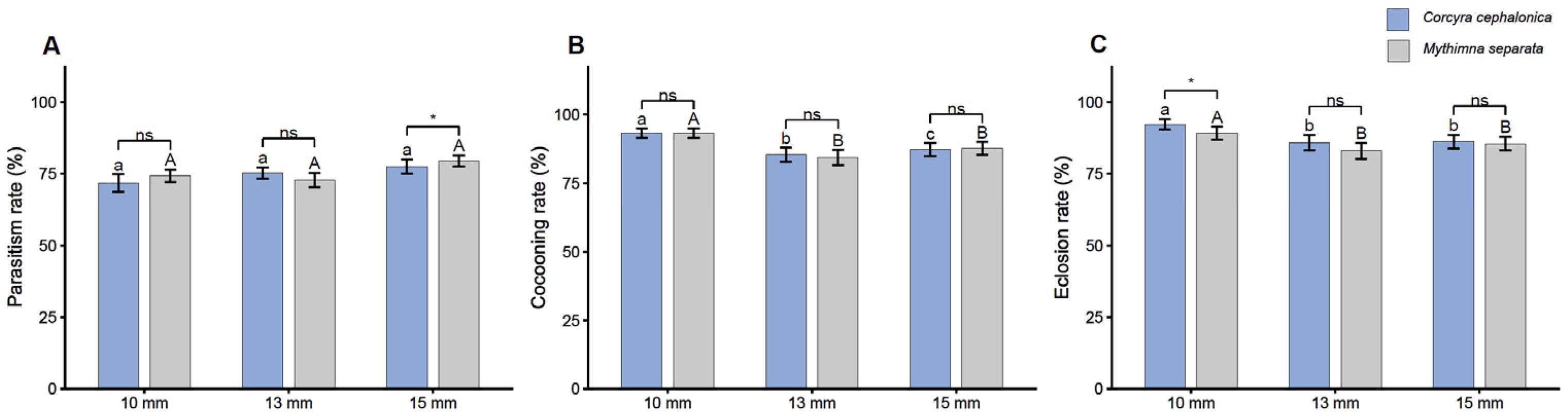
3.1. Effect of Host Body Length on Parasitism, Cocooning, and Eclosion Rates
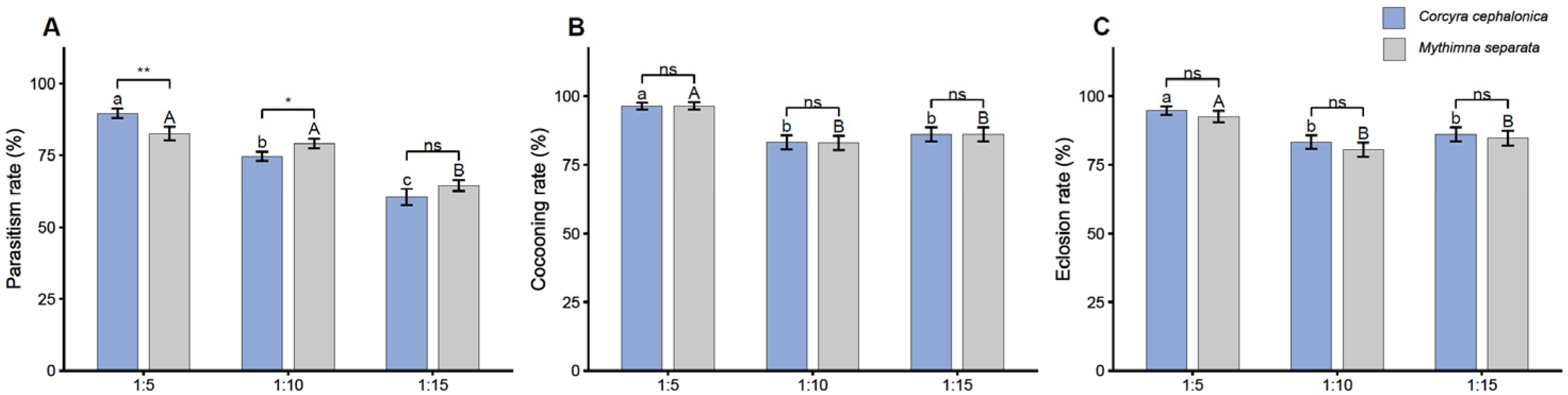
3.2. Effect of Parasitoid–Host Ratio on Parasitism, Cocooning, and Eclosion Rates
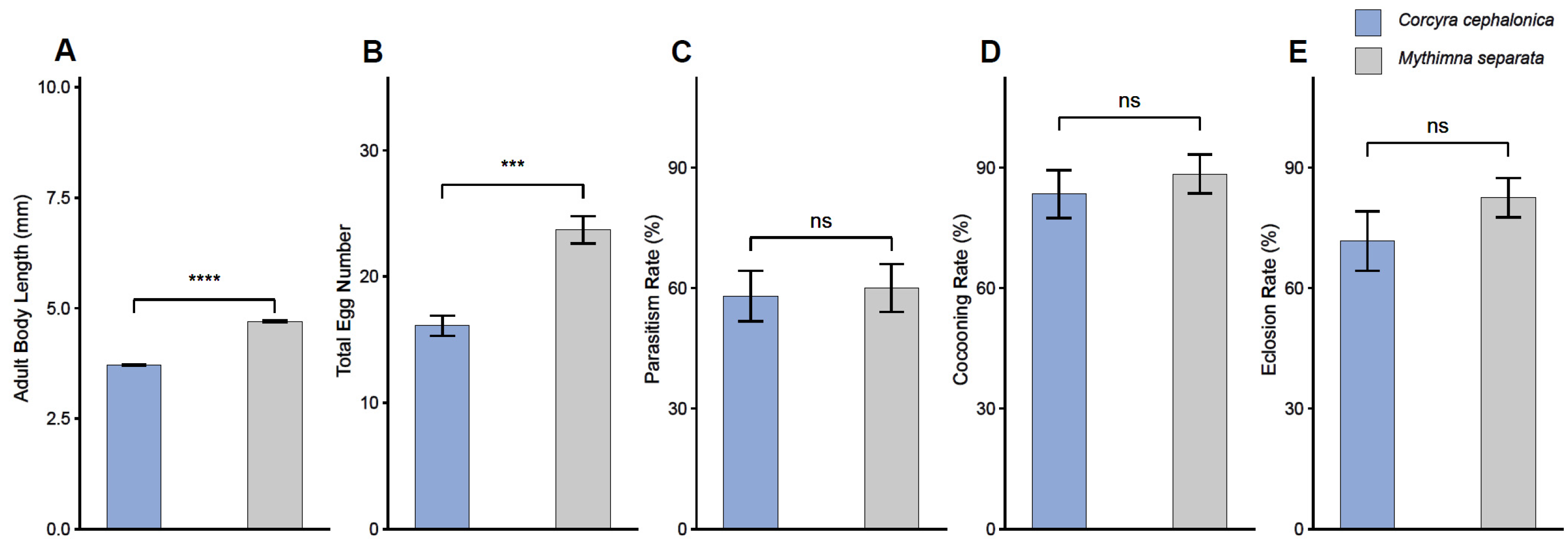
3.3. Quality and Subsequent Reproductive Performance of Offspring Adults from Different Host Origins
4. Discussion
4.1. Host Size as an Operational Criterion
4.2. Parasitoid–Host Ratio and Density Effects
4.3. Offspring Adult Quality and Subsequent Reproductive Performance
4.4. Limitations and Future Directions
Author Contributions
Funding
Data Availability Statement
Conflicts of Interest
References
- Zhou, W.; Arcot, Y.; Medina, R.F.; Bernal, J.; Cisneros-Zevallos, L.; Akbulut, M.E.S. Integrated pest management: An update on the sustainability approach to crop protection. ACS Omega 2024, 9, 41130–41147. [Google Scholar] [CrossRef] [PubMed]
- Heimpel, G.E.; Mills, N.J. Biological Control: Ecology and Applications; Cambridge University Press: Cambridge, UK, 2017. [Google Scholar]
- Li, B.; Duan, Y.; Du, Z.; Wang, X.; Liu, S.; Feng, Z.; Tian, L.; Song, F.; Yang, H.; Cai, W.; et al. Natural selection and genetic diversity maintenance in a parasitic wasp during continuous biological control application. Nat. Commun. 2024, 15, 1379. [Google Scholar] [CrossRef] [PubMed]
- Burke, G.R.; Sharanowski, B.J. Parasitoid wasps. Curr. Biol. 2024, 34, R483–R488. [Google Scholar] [CrossRef]
- Lü, X.; Qiu, R.; He, X.; Li, J. Evaluation of key factors for mass rearing the egg parasitoid Telenomus remus Nixon (Hymenoptera: Scelionidae). CABI Agric. Biosci. 2024, 5, 55. [Google Scholar] [CrossRef]
- Grenier, S.; De Clercq, P. Comparison of artificially vs. naturally reared natural enemies and their potential for use in biological control. In Quality Control and Production of Biological Control Agents: Theory and Testing Procedures; van Lenteren, J.C., Ed.; CABI: Wallingford, UK, 2003; pp. 115–131. [Google Scholar]
- van Lenteren, J.C. The state of commercial augmentative biological control: Plenty of natural enemies, but a frustrating lack of uptake. BioControl 2012, 57, 1–20. [Google Scholar] [CrossRef]
- Shen, Z.; Huang, M.; Tariq, H.; Wei, J.; Kamfwa, K.; Bueno, A.d.F.; Tang, L.; Zang, L. Economics trumps biology: Corcyra cephalonica as the optimal factitious host for cost-effective mass production of Chelonus bifoveolatus, a key parasitoid of Spodoptera frugiperda. Pest Manag. Sci. 2025, 82, 433–441. [Google Scholar] [CrossRef]
- Maeto, K. Phylogenetic relationships and host associations of the subfamily Meteorinae Cresson (Hymenoptera: Braconidae). Jpn. J. Entomol. 1990, 58, 383–396. [Google Scholar]
- Berry, J.A.; Walker, G.P. Meteorus pulchricornis (Wesmael) (Hymenoptera: Braconidae: Euphorinae): An exotic polyphagous parasitoid in New Zealand. N. Z. J. Zool. 2004, 31, 33–44. [Google Scholar] [CrossRef]
- Suzuki, M.; Tanaka, T. Development of Meteorus pulchricornis and regulation of its noctuid host, Pseudaletia separata. J. Insect Physiol. 2007, 53, 1072–1078. [Google Scholar] [CrossRef]
- Maeto, K. Polyphagous koinobiosis: The biology and biocontrol potential of a braconid endoparasitoid of exophytic caterpillars. Appl. Entomol. Zool. 2018, 53, 433–446. [Google Scholar] [CrossRef]
- Chen, Y.; Wang, P.; Shu, X.; Wang, Z.; Chen, X. Morphology and ultrastructure of the female reproductive apparatus of an asexual strain of the endoparasitoid Meteorus pulchricornis (Wesmael) (Hymenoptera: Braconidae). Biology 2023, 12, 713. [Google Scholar] [CrossRef]
- Fujie, S.; Wachi, N.; Umemoto, H.; Maeto, K. Mitochondrial DNA diversity and geographical distribution of sexual and asexual strains of the braconid parasitoid Meteorus pulchricornis. Entomol. Exp. Appl. 2019, 167, 977–985. [Google Scholar] [CrossRef]
- Tsutsui, Y.; Maeto, K.; Hamaguchi, K.; Isaki, Y.; Takami, Y.; Naito, T.; Miura, K. Apomictic parthenogenesis in a parasitoid wasp Meteorus pulchricornis, uncommon in the haplodiploid order Hymenoptera. Bull. Entomol. Res. 2014, 104, 307–313. [Google Scholar] [CrossRef]
- Li, G.J.; Jiang, F.L.; Guo, J.J. Morphology and habits of the rice moth Corcyra cephalonica. Kun Chong Zhi Shi 1982, 18, 18–20. (In Chinese) [Google Scholar]
- Guo, H.-F.; Fang, J.-C.; Zhong, W.-F.; Liu, B.-S. Interactions between Meteorus pulchricornis and Spodoptera exigua multiple nucleopolyhedrovirus. J. Insect Sci. 2013, 13, 12. [Google Scholar] [CrossRef]
- Zhou, J.C.; Meng, L.; Li, B.P. Defensive behaviors of the oriental armyworm Mythimna separata in response to different parasitoid species (Hymenoptera: Braconidae). PeerJ 2017, 5, e3690. [Google Scholar] [CrossRef]
- Nakano, S.; Gau, J.J.; Maeto, K. Host suitability of the Mediterranean flour moth for rearing Meteorus pulchricornis (Hymenoptera: Braconidae), a polyphagous endoparasitoid of pest lepidopteran larvae. Appl. Entomol. Zool. 2018, 53, 291–296. [Google Scholar] [CrossRef]
- Liu, Y.H.; Li, B.P. Effects of Helicoverpa armigera (Noctuidae, Lepidoptera) host stages on some developmental parameters of the uniparental endoparasitoid Meteorus pulchricornis (Braconidae, Hymenoptera). Bull. Entomol. Res. 2008, 98, 109–114. [Google Scholar] [CrossRef] [PubMed]
- Wang, H.P.; Meng, L.; Li, B.P. Effects of feeding frequency and sugar concentrations on lifetime reproductive success of Meteorus pulchricornis (Hymenoptera: Braconidae). Biol. Control 2008, 45, 353–359. [Google Scholar] [CrossRef]
- De Clercq, P. Plants in the rearing of arthropod predators and parasitoids: Benefits, constraints, and alternatives. Curr. Opin. Insect Sci. 2024, 61, 101139. [Google Scholar] [CrossRef]
- Liu, Z.; Huang, L.; Meng, L. Host selection and offspring performance of Meteorus pulchricornis on different host species. Sheng Tai Xue Bao 2010, 29, 1962–1966. (In Chinese) [Google Scholar]
- Chen, W.; Li, Y.; Wang, M.; Mao, J.; Zhang, L. Evaluating the potential of using Spodoptera litura eggs for mass-rearing Telenomus remus, a Promising Egg Parasitoid of Spodoptera frugiperda. Insects 2021, 12, 384. [Google Scholar] [CrossRef] [PubMed]
- Shen, Z.; Chen, Y.-M.; Huang, M.; Tariq, H.; Tang, L.-D.; Wei, J.; Bai, Q.-Y.; Kamfwa, K.; Ramírez-Romero, R.; Monticelli, L.S.; et al. Mass rearing of Chelonus parasitoids with the alternative host Corcyra cephalonica: A promising biocontrol option against fall armyworm Spodoptera frugiperda. Pest Manag. Sci. 2025, 81, 7710–7721. [Google Scholar] [CrossRef] [PubMed]
- DBastiani, E.; Princepe, D.; Marquitti, F.M.D.; Boeger, W.A.; Campião, K.M.; Araujo, S.B.L. Effect of host-switching on the ecological and evolutionary patterns of parasites. Syst. Biol. 2023, 72, 912–924. [Google Scholar] [CrossRef] [PubMed]
- Manjunath, T.M. Rice moth, Corcyra cephalonica (Lepidoptera, Pyralidae)—A boon for biocontrol as a factitious host for mass production of parasitoids and predators. J. Biol. Control 2023, 37, 1–5. [Google Scholar] [CrossRef]
- Queiroz, A.P.; de Freitas Bueno, A.; Pomari-Fernandes, A.; Grande, M.L.M.; Bortolotto, O.C.; da Silva, D.M. Quality control of Telenomus remus (Hymenoptera: Platygastridae) reared on the factitious host Corcyra cephalonica (Lepidoptera: Pyralidae) for successive generations. Bull. Entomol. Res. 2017, 107, 791–798. [Google Scholar] [CrossRef]
- Bernardi, E.B.; Haddad, M.L.; Parra, J.R. Comparison of artificial diets for rearing Corcyra cephalonica (Stainton, 1865) (Lep., Pyralidae) for Trichogramma mass production. Rev. Bras. Biol. 2000, 60, 45–52. [Google Scholar] [CrossRef]
- Vincent, A.; Singh, D.; Mathew, I.L. Corcyra cephalonica: A serious pest of stored products or a factitious host of biocontrol agents? J. Stored Prod. Res. 2021, 94, 101876. [Google Scholar] [CrossRef]
- Gowda, B.G.; Pandi, G.P.; Ullah, F.; Patil, N.B.; Sahu, M.; Adak, T.; Pokhare, S.; Yadav, M.K.; Mahendiran, A.; Mittapelly, P.; et al. Performance of Trichogramma japonicum under field conditions as a function of the factitious host species used for mass rearing. PLoS ONE 2021, 16, e0256246. [Google Scholar] [CrossRef]
- Migiro, L.N.; Gitonga, L.M.; Sithanantham, S. Evaluation of Ephestia kuehniella and Corcyra cephalonica as hosts for mass rearing Trichogramma species nr. Mwanzai and trichogrammatoidea species nr. Lutea. J. Agric. Sci. Technol. 2008, 9, 44–54. [Google Scholar] [CrossRef]
- Nath, A.; Gadratagi, B.G.; Maurya, R.P.; Ullah, F.; Patil, N.B.; Adak, T.; Govindharaj, G.P.P.; Ray, A.; Mahendiran, A.; Desneux, N.; et al. Sublethal phosphine fumigation induces transgenerational hormesis in a factitious host, Corcyra cephalonica. Pest Manag. Sci. 2023, 79, 3548–3558. [Google Scholar] [CrossRef] [PubMed]
- Liu, Y.-H.; Li, B.-P. Developmental interactions between Spodoptera exigua (Noctuidae: Lepidoptera) and its uniparental endoparasitoid, Meteorus pulchricornis (Braconidae: Hymenoptera). Biol. Control 2006, 38, 264–269. [Google Scholar] [CrossRef]
- Harvey, J.A.; Molina, A.C.; Bezemer, T.M.; Malcicka, M. Convergent development of a parasitoid wasp on three host species with differing mass and growth potential. Entomol. Exp. Appl. 2015, 154, 15–22. [Google Scholar] [CrossRef]
- Harvey, J.A.; Sano, T.; Tanaka, T. Differential host growth regulation by the solitary endoparasitoid, Meteorus pulchricornis in two hosts of greatly differing mass. J. Insect Physiol. 2010, 56, 1178–1183. [Google Scholar] [CrossRef] [PubMed]
- Liu, Y.H.; Li, B.P.; Xu, Z.H. Effect of host instar and temperature on fitness-related traits in the solitary endoparasitoid, Meteorus pulchricornis. Phytoparasitica 2013, 41, 209–217. [Google Scholar] [CrossRef]
- Sharma, A.; Sharma, P.L.; Verma, S.C.; Chandel, R.S.; Chandel, V.G.S.; Sharma, D.; Semwal, A.; Sharma, N. The demographic and life table studies of Corcyra cephalonica on different food grains and their impact on population growth parameters and life history traits of indigenous Trichogramma chilonis and T. achaeae. Crop Prot. 2025, 197, 107346. [Google Scholar] [CrossRef]
- Fuester, R.W.; Taylor, P.B.; Peng, H.; Swan, K. Laboratory biology of a uniparental strain of Meteorus pulchricornis (Hymenoptera: Braconidae), An Exotic Larval Parasite of the Gypsy Moth (Lepidoptera: Lymantriidae). Ann. Entomol. Soc. Am. 1993, 86, 298–304. [Google Scholar] [CrossRef]
- Vos, M.; Hemerik, L. Linking foraging behavior to lifetime reproductive success for an insect parasitoid: Adaptation to host distributions. Behav. Ecol. 2003, 14, 236–245. [Google Scholar] [CrossRef]
- Wajnberg, É.; Bernstein, C.; van Alphen, J. (Eds.) Behavioral Ecology of Insect Parasitoids; Wiley-Blackwell: Oxford, UK, 2008. [Google Scholar]
- Clemente, G.; Toledo, J.; Pérez-Lachaud, G.; Valle-Mora, J.F.; Liedo, P.; Montoya, P. Functional response and mutual interference in the parasitoid Coptera haywardi (Oglobin) (Hymenoptera: Diapriidae) attacking Anastrepha ludens (Loew) (Diptera: Tephritidae) pupaet. Bull. Entomol. Res. 2024, 114, 22–29. [Google Scholar] [CrossRef]
- van Lenteren, J.C. (Ed.) Quality Control and Production of Biological Control Agents: Theory and Testing Procedures; CABI: Wallingford, UK, 2003. [Google Scholar]
- Godfray, H.C.J. Parasitoids: Behavioral and Evolutionary Ecology; Princeton University Press: Princeton, NJ, USA, 1994; 473p. [Google Scholar]
- Harvey, J.A. Factors affecting the evolution of development strategies in parasitoid wasps: The importance of functional constraints and incorporating complexity. Entomol. Exp. Appl. 2005, 117, 1–13. [Google Scholar] [CrossRef]
- Papaj, D.R.; Prokopy, R.J. Ecological and evolutionary aspects of learning in phytophagous insects. Annu. Rev. Entomol. 1989, 34, 315–350. [Google Scholar] [CrossRef]
- Mácová, A.; Hoblíková, A.; Hypša, V.; Stanko, M.; Martinů, J.; Kvičerová, J. Mysteries of host switching: Diversification and host specificity in rodent–coccidia associations. Mol. Phylogenet. Evol. 2018, 127, 179–189. [Google Scholar] [CrossRef]
- Nunney, L. Managing captive populations for release: A population-genetic perspective. In Quality Control and Production of Biological Control Agents: Theory and Testing Procedures; van Lenteren, J.C., Ed.; CABI: Wallingford, UK, 2003; pp. 73–87. [Google Scholar]
- Mills, N.J.; Kean, J.M. Behavioral studies, molecular approaches, and modeling: Methodological contributions to biological control success. Biol. Control 2010, 52, 255–262. [Google Scholar] [CrossRef]


Disclaimer/Publisher’s Note: The statements, opinions and data contained in all publications are solely those of the individual author(s) and contributor(s) and not of MDPI and/or the editor(s). MDPI and/or the editor(s) disclaim responsibility for any injury to people or property resulting from any ideas, methods, instructions or products referred to in the content. |
© 2026 by the authors. Licensee MDPI, Basel, Switzerland. This article is an open access article distributed under the terms and conditions of the Creative Commons Attribution (CC BY) license.
Share and Cite
Yan, Y.; Lin, X.; Shi, R.; Shi, P.; Ye, X.; Chen, X.; Shi, A.; Tang, P. Evaluation of Corcyra cephalonica as an Alternative Host for Meteorus pulchricornis. Insects 2026, 17, 518. https://doi.org/10.3390/insects17050518
Yan Y, Lin X, Shi R, Shi P, Ye X, Chen X, Shi A, Tang P. Evaluation of Corcyra cephalonica as an Alternative Host for Meteorus pulchricornis. Insects. 2026; 17(5):518. https://doi.org/10.3390/insects17050518
Chicago/Turabian StyleYan, Yan, Xingyu Lin, Rui Shi, Pingli Shi, Xiqian Ye, Xuexin Chen, Aimin Shi, and Pu Tang. 2026. "Evaluation of Corcyra cephalonica as an Alternative Host for Meteorus pulchricornis" Insects 17, no. 5: 518. https://doi.org/10.3390/insects17050518
APA StyleYan, Y., Lin, X., Shi, R., Shi, P., Ye, X., Chen, X., Shi, A., & Tang, P. (2026). Evaluation of Corcyra cephalonica as an Alternative Host for Meteorus pulchricornis. Insects, 17(5), 518. https://doi.org/10.3390/insects17050518