Article

Realized Heritability and Fitness Costs of Diflubenzuron Resistance in Musca domestica L. (Diptera: Muscidae)

Pesticides and Environmental Toxicology Laboratory, Department of Plant Protection, College of Food and Agricultural Sciences, King Saud University, P.O. Box 2460, Riyadh 11451, Saudi Arabia
*
Authors to whom correspondence should be addressed.
Insects 2026, 17(5), 480; https://doi.org/10.3390/insects17050480
Submission received: 4 March 2026 / Revised: 23 April 2026 / Accepted: 4 May 2026 / Published: 8 May 2026
(This article belongs to the Special Issue Urban Entomology and One Health)

Simple Summary

The house fly (Musca domestica L.) is a cosmopolitan medical pest distributed worldwide. Diflubenzuron, a chitin synthesis-inhibiting insect growth regulator, is commonly used to manage medically important insect pests. In this study, the life-history traits of diflubenzuron-unselected (Diflu-Unsel) and diflubenzuron-selected (Diflu-Sel) house fly strains were evaluated by the age–stage, two-sex life-table approach, which is essential for developing effective resistance management strategies. The results showed that the Diflu-Sel (G46) house fly strain developed 319.935-fold resistance to diflubenzuron after 42 generations of selection, compared with the Diflu-Unsel (G46) strain. Using the lethal concentration 50 (LC50) of diflubenzuron in the Diflu-Unsel (G5) as the parental generation before selection, the realized heritability of diflubenzuron resistance was estimated as 0.054. Larval and pupal development durations, as well as the total preoviposition period, were substantially prolonged in the Diflu-Sel (G46) strain compared with the Diflu-Unsel (G46) strain. However, adult longevity, oviposition period, and adult duration were significantly reduced in the Diflu-Sel (G46) flies compared with the Diflu-Unsel (G46) flies. Fecundity was also markedly reduced in the Diflu-Sel (G46), yielding a relative fitness of 0.39. These findings indicate that field populations of M. domestica can develop resistance to diflubenzuron. However, this resistance may be associated with substantial fitness costs, suggesting that resistance may be manageable. This information provides a foundation for developing integrated resistance management strategies for the house fly.

Abstract

The house fly, Musca domestica L., is a medically important cosmopolitan pest distributed worldwide. Diflubenzuron, a chitin synthesis-inhibiting insect growth regulator, is widely used for the control of medically important insect pests. In this study, the biological and population characteristics of diflubenzuron-unselected (Diflu-Unsel) and diflubenzuron-selected (Diflu-Sel) M. domestica were evaluated using the age–stage, two-sex life-table theory to support resistance management efforts. The results showed that the Diflu-Sel (G46) strain developed 319.935-fold resistance to diflubenzuron after 42 generations of selection compared with the Diflu-Unsel (G46) strain. Using the LC50 of diflubenzuron in the Diflu-Unsel (G5) as the parental generation before selection, the realized heritability (h2) of diflubenzuron resistance was estimated as 0.054. Larval and pupal development durations and the total preoviposition period were significantly prolonged, whereas adult duration, total longevity from egg to adult, oviposition period, and fecundity were significantly reduced in the Diflu-Sel (G46) strain compared with the Diflu-Unsel (G46) strain, resulting in a relative fitness value of 0.39. Population parameters, including the intrinsic rate of increase, finite rate of increase, generation time, doubling time, gross reproductive rate, and net reproductive rate, were significantly lower in the Diflu-Sel (G46) strain than in the Diflu-Unsel (G46) strain. These results demonstrate that resistance to diflubenzuron can evolve in M. domestica but may be accompanied by substantial fitness costs, which may facilitate resistance management. The findings provide valuable insights for designing sustainable diflubenzuron resistance management strategies for M. domestica.

1. Introduction

The house fly, Musca domestica L. (Diptera: Muscidae), a globally distributed pest of livestock and human dwellings, is known to transmit approximately 200 pathogens associated with serious human and animal diseases, including bovine respiratory disease, hepatitis, tuberculosis, avian influenza, diarrhea, poliomyelitis, typhoid fever, and cholera [1,2,3,4,5,6]. Pathogen transmission occurs primarily through direct physical contact with animals, food, and humans [7]. Management strategies for M. domestica include chemical control, sanitation, and biological control. However, chemical insecticides remain the most widely used approach due to their rapid knockdown and high efficacy [2].
Diflubenzuron belongs to the benzoylurea class of insect growth regulators (IGRs) and disrupts chitin biosynthesis, resulting in incomplete molting and lethal developmental abnormalities in insects [8]. It is considered highly selective and exhibits low toxicity to non-target organisms [9]. Diflubenzuron has been widely used in public health and livestock systems for the control of medically important pests, including M. domestica [10,11]. In livestock environments, diflubenzuron is commonly applied by spraying or incorporating it into manure substrates [12,13]. In Saudi Arabia, diflubenzuron is extensively used for controlling medical pests in both human and livestock settings [2,10,14,15]. However, intensive and prolonged use of diflubenzuron has resulted in resistance development, increased control costs, and potential environmental concerns [2,14]. Resistance to diflubenzuron has been reported in Lucilia cuprina (Wiedemann) [16], M. domestica [2], Culex pipiens L. [17,18], and Bovicola ovis (Schrank) [19].
Realized heritability (h2) is a quantitative measure derived from laboratory-imposed selection pressure and is used to predict the extent of genetic variation associated with insecticide resistance in insect pest populations [20,21,22]. Estimating h2 is therefore critical for developing rational resistance management strategies before resistance becomes widespread in field populations. The h2 has been previously estimated for several insecticide-resistant strains of M. domestica [22,23,24,25,26,27,28,29].
Assessing the fitness cost associated with insecticide resistance through laboratory selection experiments is necessary for the development of proactive, effective management strategies [30,31]. Fitness cost affects the rate at which insecticide resistance increases and the occurrence of outbreaks in pest populations [32,33]. In general, insecticide-resistant insects incur higher biological costs and physiological disadvantages, making them less fit than their susceptible counterparts. Even in the absence of insecticide exposure, the emergence and spread of insecticide resistance may be prevented if resistant pests reveal dominant fitness costs [34]. The fitness costs associated with resistance to different insecticides have been evaluated in agricultural and urban pests, including M. domestica [33,34,35,36,37,38,39,40], Aedes aegypti L. [41,42], Plutella xylostella (L.) [43], Leucoptera coffeella (Guérin-Méneville) [44], Dysdercus koenigii (Fabricius) [45,46], Culex quinquefasciatus Say [47], and Spodoptera litura L. [30,48]. The fitness costs linked with resistant alleles may result in resistant pest strains exhibiting disadvantageous physiological and population characteristics relative to insecticide-susceptible pests when insecticides are absent [32,34,49]. This situation can facilitate a reversion from resistance to susceptibility in response to insecticide selection pressure. Understanding this process is therefore critical for effectively managing pest resistance.
An age–stage, two-sex life-table analysis is a widely used and robust protocol for determining the fitness costs of resistance in insecticide-resistant insect pests [50,51]. Previously, Hafez [10] evaluated the risk of diflubenzuron resistance and cross-resistance in diflubenzuron-selected M. domestica after 24 generations of selection. However, the fitness cost of diflubenzuron resistance has not been explored in M. domestica. Therefore, in the current study, we compared the life-history traits of diflubenzuron-selected (Diflu-Sel, G46) and diflubenzuron-unselected (Diflu-Unsel, G46) M. domestica to assess possible fitness costs using the age–stage, two-sex life-table framework. In addition, by using the Diflu-Unsel (G5) as the baseline population, we estimated the realized heritability (h2) of diflubenzuron resistance in the Diflu-Sel (G46) after 42 generations of selection. These findings will inform our understanding of the nature of diflubenzuron resistance and support the development of effective resistance management strategies in M. domestica.

2. Materials and Methods

2.1. Rearing Protocol

Approximately 200 adult M. domestica were collected from a dairy farm in Al-Washlah, Riyadh, Saudi Arabia (24.39° N, 46.66° E), using plastic collection jars (19 × 33 cm). Following collection, adults were transferred to transparent cages (40 × 40 cm) in the laboratory and maintained according to protocols described in our previous studies [2,10]. Adults were provided ad libitum with deionized water via a ~3 cm cotton wick and fed a dry diet consisting of powdered milk (1 g, Almarai Company, Riyadh, Saudi Arabia) and granulated sugar (1 g, Al-Osra Company, Jeddah, Saudi Arabia), supplied separately in plastic Petri dishes (9 cm diameter). The adult diet was replaced every two days.
Larvae were reared on a diet composed of wheat bran (40 g, Second Milling Company, Riyadh, Saudi Arabia), yeast (10 g, S.I. Lesaffre, Marcq-en-Barœul, France), dry milk powder (3 g), and sugar (3 g), mixed with deionized water to form a semi-solid paste. The larval diet was placed in 500 mL plastic cups, which were introduced into the adult cages for oviposition and larval development. Egg-containing cups were removed daily and covered with cloth to prevent larval escape. Once the diet was fully consumed, larvae were transferred to 1000 mL glass beakers containing fresh larval diet. Larvae pupated within the beakers, which were subsequently placed inside the cages to allow adult emergence and continuation of the colony. All developmental stages were maintained at 27° ± 2 °C, 65 ± 5% relative humidity, and a 12:12 h light/dark photoperiod.

2.2. Development of Diflubenzuron-Unselected and Diflubenzuron-Selected M. domestica Strains

The field-collected M. domestica population (G1) was reared in the laboratory for five generations. At the fifth generation (G5), the Diflu-Unsel was bioassayed, and the LC50 for this strain was used as the parental generation before selection to calculate the realized heritability of diflubenzuron resistance in the Diflu-Sel (G46). At G5, the population was divided into two strains: a diflubenzuron-unselected counterpart strain (Diflu-Unsel) and a diflubenzuron-selected strain (Diflu-Sel). The Diflu-Unsel strain was reared for 46 consecutive generations (G1–G46) without chemical exposure and was used to calculate the resistance ratio and compare life-table parameters. The Diflu-Sel strain was subjected to continuous selection with diflubenzuron for 42 generations (G5–G46). Each generation was screened at diflubenzuron concentrations of 0.86–8 mg/L, based on sufficient larval survival (average 50%) to produce the next generation. In each selected generation, approximately 2000 second-instar larvae were exposed to diflubenzuron using a diet-incorporation method as described by Hafez [10]. Adults emerging from surviving pupae were transferred to clean cages to establish the subsequent generation. Both strains were maintained under the same laboratory conditions described above.

2.3. Concentration–Response Bioassays with Diflu-Sel (G46) and Diflu-Unsel (G46) Strains to Determine Resistance Ratio

Diflubenzuron (Diflon® 250 WP, Saudi Delta Company, Riyadh, Saudi Arabia) was used for both laboratory selection and toxicity bioassays. Larval susceptibility to diflubenzuron was evaluated using a diet-incorporation bioassay following previously established methods [2,10]. Five concentrations producing mortality between >0% and <100% were prepared by serial dilution in deionized water. Test concentrations ranged from 0.0078125 to 0.125 mg/L for Diflu-Unsel (G46) and 1 to 16 mg/L for Diflu-Sel (G46).
For each concentration, 72 mL insecticide solution was thoroughly incorporated into the larval diet (wheat bran 20 g, yeast 5 g, dry milk powder 1.5 g, sugar 1.5 g). Each treatment was replicated three times. A total of 150 second-instar larvae were used per bioassay (30 larvae per concentration, 10 larvae per replicate). Control larvae were treated with deionized water only (30 larvae total; 10 per replicate). All treated larvae were maintained under standard laboratory conditions (Section 2.1) until adult emergence. Mortality was recorded after three weeks post-exposure, and pupae that failed to emerge as adults were recorded as dead.

2.4. Realized Heritability (h2) Estimation

The LC50 for the Diflu-Unsel (G5) strain was used to calculate the h2 of diflubenzuron resistance for the Diflu-Sel (G46) strain, and was estimated according to Tabashnik [20]:
h 2 = R S
R’ is the response to selection for diflubenzuron resistance, calculated as follows:
R =   l o g L C 50 D i f l u S e l G 46 log L C 50 D i f l u U n s e l ( G 5 ) N
‘N’ represents the number of generations subjected to selection with diflubenzuron.
S’ is the selection differential, calculated using the following equation:
S = i × σ p
i’ is the selection intensity, calculated according to the following equation [52]:
i   = 1.583 0.0193336 p + 0.0000428 p 2   +   3.65194 / p
p’ is the percentage survival of the Diflu-Sel (G46) strain after 42 generations of selection with diflubenzuron.
σp’ is the phenotypic variance and was assessed by the following equation:
σ p   = [ 0.5 ( I n i t i a l   S l o p e + F i n a l   S l o p e ) ] 1

2.5. Life-Table and Population Trait Assessment

To evaluate the fitness costs associated with diflubenzuron resistance, the G46 generation of both the Diflu-Unsel and Diflu-Sel strains was used to assess life-table and population parameters. A total of 150 newly hatched 1st-instar larvae from each of the Diflu-Unsel and Diflu-Sel strains were randomly selected for the fitness-cost experiment. The experiment for each strain included three replicates, each consisting of 50 larvae.
The experimental larvae were transferred to glass beakers (1000 mL) containing an artificial larval diet. The beakers were tightly wrapped with muslin to prevent larval escape, and larval development through pupation occurred within these containers. Survival rates, larval duration, and pupal duration were recorded throughout development.
To assess fecundity, newly emerged males and females (<24 h old) from each Diflu-Unsel and Diflu-Sel strain were paired individually in plastic jars (15 cm × 11 cm). Each pair was considered a replicate for both strains and was fed the diet described in Section 2.1. After two days of pairing, the larval diet was placed in a Petri dish within each jar to facilitate oviposition.
Petri dishes containing eggs were replaced daily, and eggs were counted using a fine hairbrush. The experiment was conducted under the same controlled laboratory conditions described above. The age–stage, two-sex life-table parameters were calculated using equations previously described in our studies [2,45,46]; a detailed description is provided in Table 1.

2.6. Bioassay and Life-Table Data Analyses

POLO PLUS software Version 1.0 [58] was used for Probit analysis to obtain LC50 values for diflubenzuron, along with their fiducial limits (FLs), chi-square (χ2) values, and slopes ± standard errors (SEs). The following equation was used to calculate the resistance ratio (RR):
R R = L C 50   o f   d i f l u b e n z u r o n   i n   t h e   D i f l u S e l ( G 46 ) L C 50   o f   d i f l u b e n z u r o n   i n   t h e   D i f l u U n s e l ( G 46 )
Confidence limits (CLs, 95%) for RRs were calculated following Robertson et al. [59]. The RRs were considered significantly different when their CLs did not include the value 1.
The TWO-SEX-MSChart Program Version 2019 [60], with 100,000 bootstrap resamplings, was used to estimate the means ± SEs of life-table and population parameters. Differences between Diflu-Sel (G46) and Diflu-Unsel (G46) strains were evaluated using paired bootstrap tests, and parameters were considered significantly different when the confidence intervals (CIs) did not include 0 at p ≤ 0.05 [51,61,62].

3. Results

3.1. Diflubenzuron Resistance in Diflu-Sel M. domestica

Under laboratory conditions, continuous selection of the M. domestica strain with diflubenzuron for 42 generations resulted in a marked increase in resistance (319.935-fold) compared with the Diflu-Unsel (G46) (Table 2).

3.2. Realized Heritability (h2) of Diflubenzuron Resistance

By using the Diflu-Unsel (G5) as the baseline population, the h2 of diflubenzuron resistance was estimated as 0.054 in the Diflu-Sel (G46) (Table 3).

3.3. Developmental Durations and Reproductive Parameters of the Diflu-Unsel (G46) and Diflu-Sel (G46)

The adult preoviposition period (APOP) and female ratio did not differ significantly between Diflu-Sel and Diflu-Unsel. However, the durations of the larval and pupal stages and the total preoviposition period (TPOP) were significantly prolonged in Diflu-Sel compared with Diflu-Unsel. Adult duration, preadult duration, total longevity from egg to adult, and oviposition period were markedly shorter in Diflu-Sel than in Diflu-Unsel. In addition, fecundity was substantially lower in Diflu-Sel than in Diflu-Unsel (Table 4).

3.4. Population Parameters and Relative Fitness of Diflu-Unsel (G46) and Diflu-Sel (G46)

Population parameters, such as intrinsic rate of increase (r), finite rate of increase (λ), generation time (T), doubling time (DT), gross reproduction rate (GRR), and net reproductive rate (R0), were markedly reduced in Diflu-Sel when compared with those of Diflu-Unsel. Compared with Diflu-Unsel, the relative fitness value of Diflu-Sel was 0.39 (Table 5).

3.5. Age–Stage-Specific Survival Rate (sxj), Fecundities (fx, mx), Maternity (lxmx), Life Expectancy (exj), and Reproductive Values (vxj) in Diflu-Sel (G46) and Diflu-Unsel (G46)

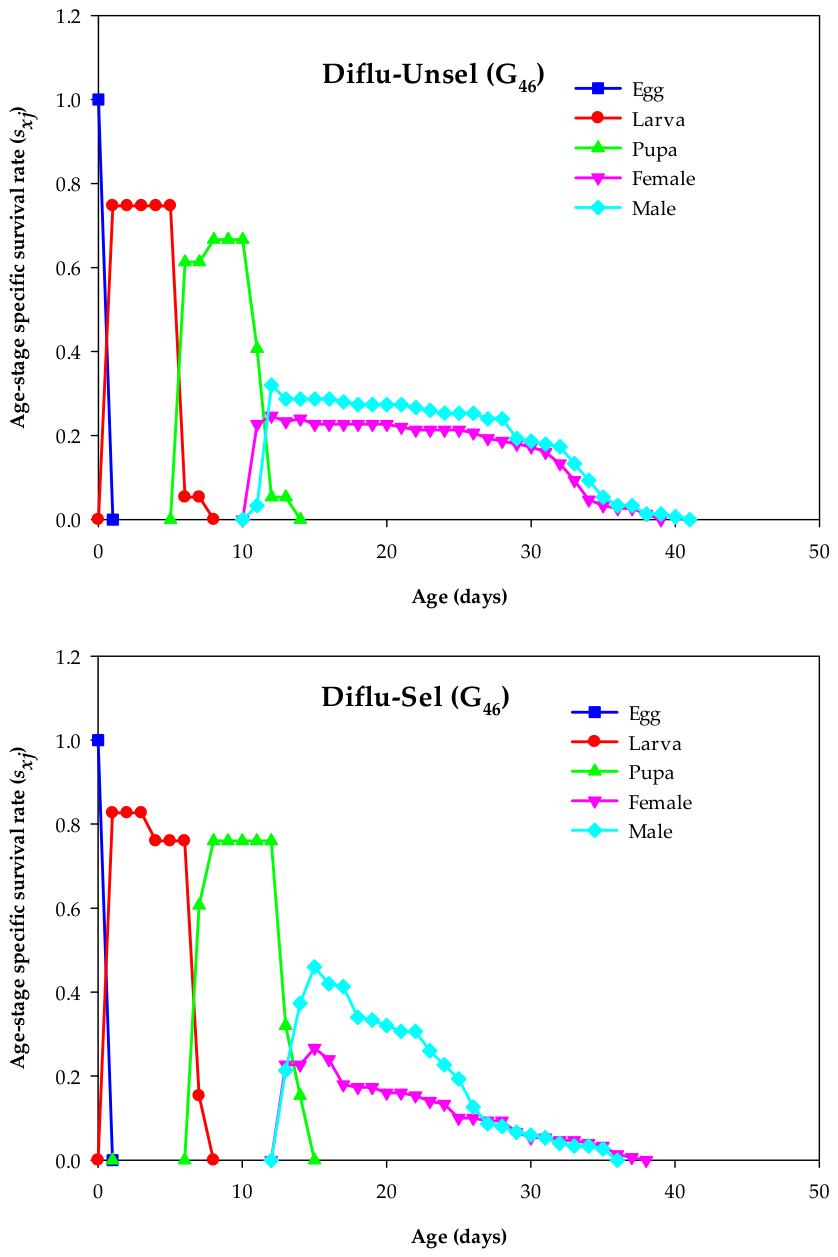
sxj denotes the probability that an individual (as a newly laid egg) survives from the Diflu-Sel and Diflu-Unsel strains to age x and develops to stage j. The maximum sxj value for the eggs did not differ significantly between the Diflu-Unsel and Diflu-Sel. Nevertheless, the maximum sxj values for the larvae (0.83), pupae (0.76), females (0.27), and males (0.46) in the Diflu-Sel were higher than those for the larvae (0.75), pupae (0.67), females (0.25), and males (0.32) in the Diflu-Unsel (Figure 1).
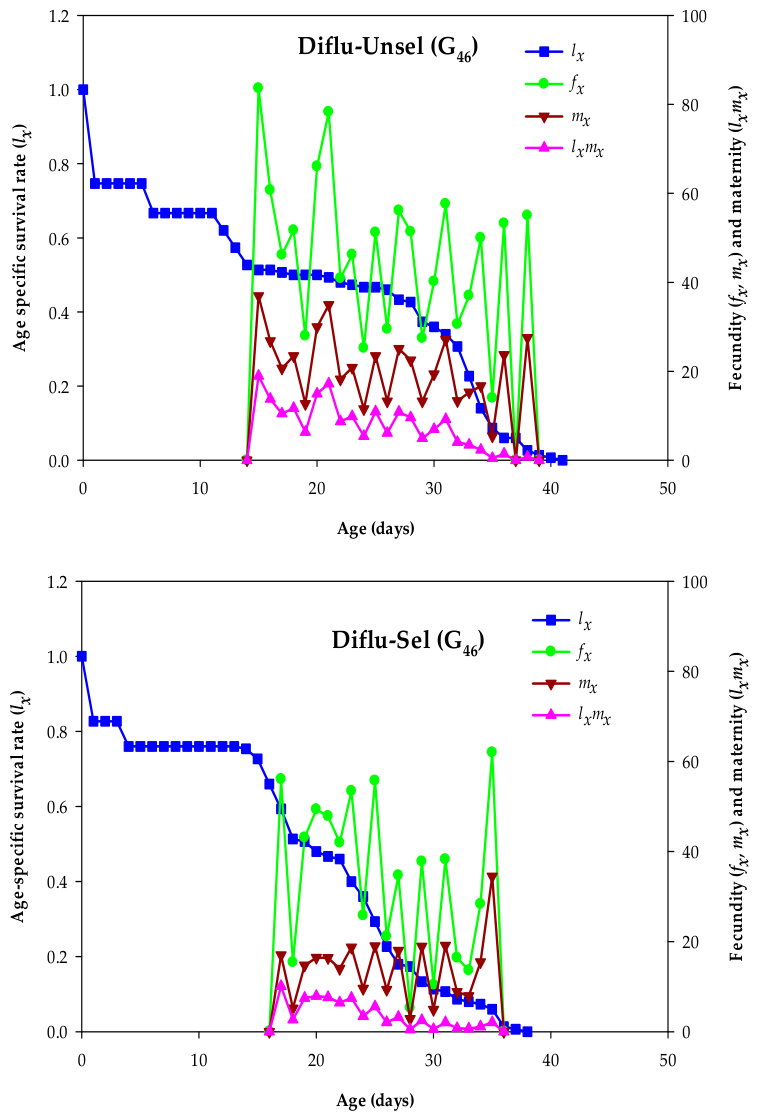
The maximum peak values for lx did not differ substantially between the strains. The highest peaks of fx (62.00 eggs/female/day) and mx (34.44 eggs/female/day) were observed in Diflu-Sel females aged 35 days, which were lower than fx (83.62 eggs/female/day) and mx (36.92 eggs/female/day) in the Diflu-Unsel females aged 15 days. Similarly, the highest peak value for lxmx in the Diflu-Sel females (10.09 offspring/day at 17 days) was significantly lower than lxmx (18.95 offspring/day at 15 days) in the Diflu-Unsel females (Figure 2).
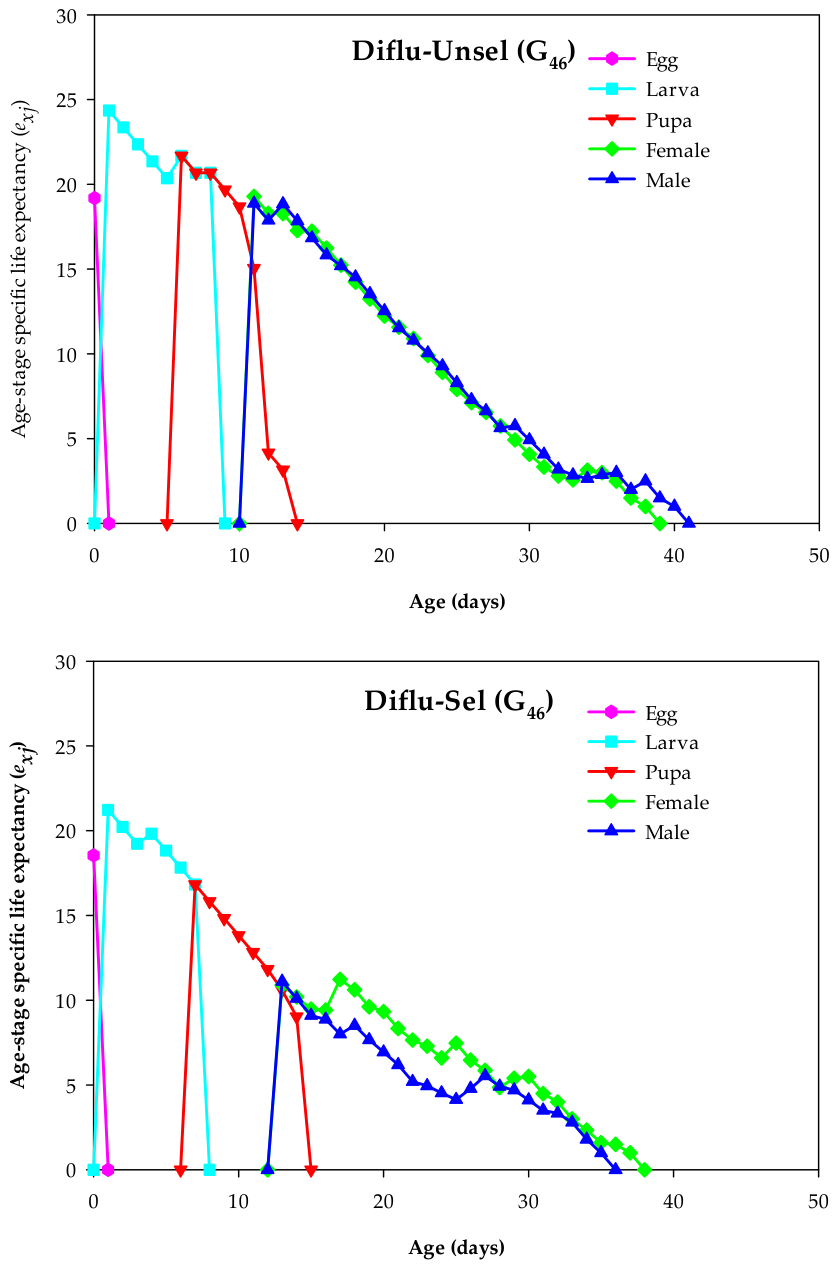
The peak exj values in eggs (18.55 days), larvae (21.23 days), pupae (16.82 days), females (11.22 days), and males (11.10 days) of Diflu-Sel were lower than those in eggs (19.19 days), larvae (24.36 days), pupae (21.68 days), females (19.29 days), and males (18.88 days) of Diflu-Unsel (Figure 3).
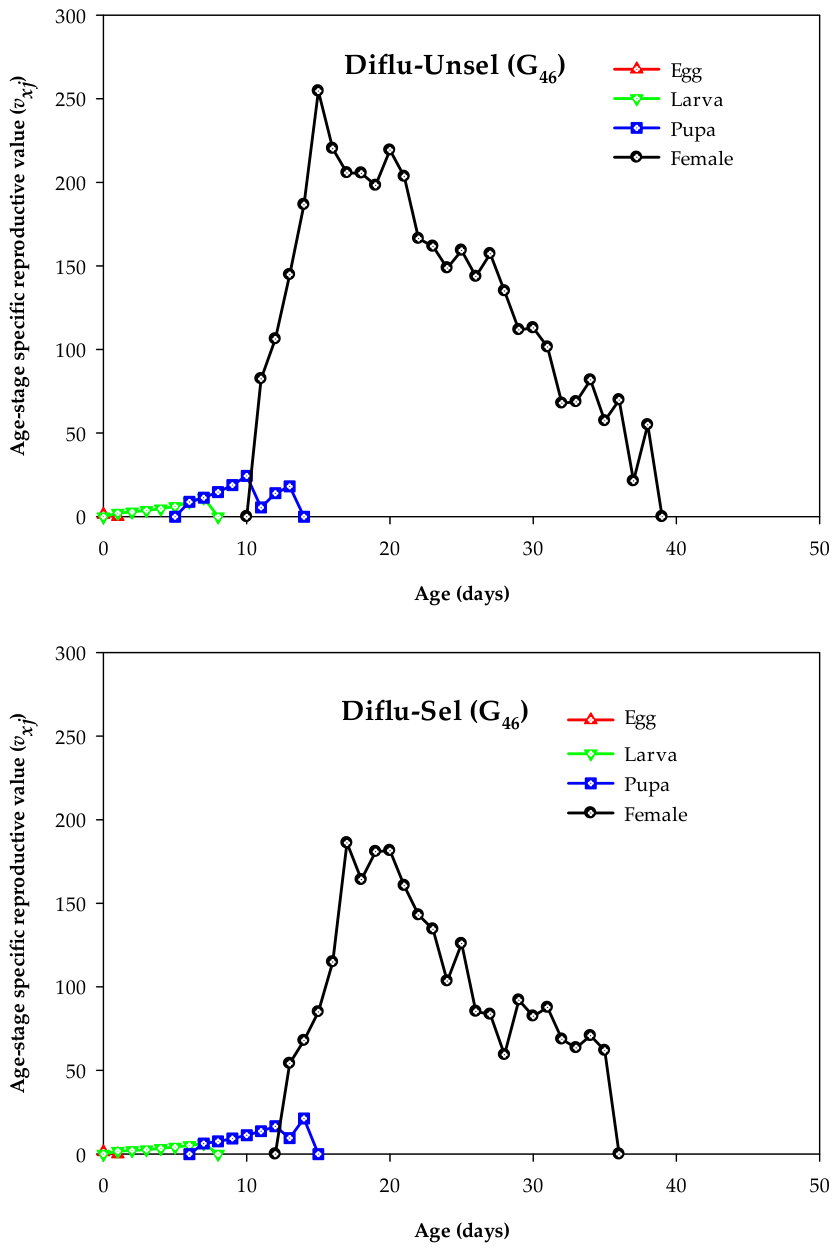
The vxj value of M. domestica, which is used to predict population growth and reproduction rate, was significantly reduced in Diflu-Sel compared to Diflu-Unsel. Upon emergence of M. domestica females, the vxj values reached peaks at ages 15 (254.58 eggs/day) and 17 (186.15 eggs/day) in Diflu-Unsel and Diflu-Sel, respectively (Figure 4).

4. Discussion

Chemical insecticides remain the most effective tools for controlling medically and agriculturally important pests. Therefore, understanding the evolution, fitness costs, and mechanisms of resistance to novel chemical insecticides is vital for establishing rational guidelines for use and application [10,17,30,32]. Biorational insecticides, such as chitin synthesis inhibitors, are considered effective alternatives for managing crop pests and also have significant medical and veterinary relevance. Because of their relatively low mammalian toxicity, these biorational insecticides are generally regarded as safer for public health and the environment than conventional insecticides [2,63,64,65]. The efficacy of biorational insecticides, including diflubenzuron, has been well documented against M. domestica [2,12,13,64,65], Stomoxys calcitrans (L.) [65], Cx. quinquefasciatus [14,66], and Aedes albopictus Skuse [67].
Estimating realized heritability (h2) in accordance with quantitative genetic theory is one of the most reliable approaches for characterizing the evolutionary pattern of insecticide resistance in insect pests resulting from selection experiments [20,23]. In our study, the estimated h2 value for M. domestica after 42 generations of selection with diflubenzuron was 0.054, suggesting that resistance to diflubenzuron in M. domestica is influenced more by environmental factors than by additive genetic variation. Although resistance in the Diflu-Sel (G46) strain increased by ~320-fold in comparison to Diflu-Unsel (G46), the increase in resistance was only 7.5-fold when compared to Diflu-Unsel (G5) [10]. This indicates a slow rate of resistance development, consistent with the low estimated h2 value. Furthermore, the absence of a true laboratory-susceptible reference strain likely led to an underestimation of resistance levels and, consequently, the realized heritability.
Consistent with our findings, low h2 values were reported for resistance to fipronil (h2 = 0.05) [22], lambda-cyhalothrin (h2 = 0.06) [23], methoxyfenozide (h2 = 0.17) [25], and pyriproxyfen (h2 = 0.03) [24] in M. domestica. In contrast, substantially higher h2 values for resistance to spiromesifen (h2 = 0.59), clothianidin (h2 = 0.38), and spinosad (h2 = 0.68) resistance were observed in M. domestica [40,68,69], indicating a strong contribution of additive genetic variation and a potential for resistance evolution alleles under selection pressure. In the present study, the relatively low h2 value suggests a lower initial frequency of resistance alleles. Nevertheless, diflubenzuron should be incorporated into rotational insecticide programs to control M. domestica, delay resistance development, and preserve long-term efficacy.
In general, resistant strains often exhibit developmental and reproductive traits that are disadvantageous relative to susceptible strains [45]. In the present study, the Diflu-Sel strain exhibited a significantly longer larval duration than the Diflu-Unsel strain. Similarly, larval duration was significantly prolonged in fipronil-, cyproflanilide-, and fluxametamide-resistant strains of M. domestica, Chilo suppressalis (Walker), and Spodoptera frugiperda (J. E. Smith), respectively [33,70,71].
Feeding disruption, reduced appetite, altered metabolic processes, physiological developmental imbalance, and enhanced metabolic detoxification may contribute to the prolonged larval stage observed in diflubenzuron-exposed individuals [70,71,72]. However, extended larval development may indirectly enhance field-level management of M. domestica by increasing exposure to natural enemies, such as parasitoids and predators, and by forcing larvae to utilize suboptimal food resources to complete development, thereby reducing growth performance and reproductive output.
Additionally, the Diflu-Sel strain exhibited prolonged pupal and preadult durations, a shorter adult lifespan, reduced total longevity from egg to adult, fewer oviposition days, and lower fecundity than the Diflu-Unsel strain. These findings indicate that the fitness costs associated with diflubenzuron resistance are closely linked to these life-history traits, potentially facilitating resistance management when selection pressure is relaxed or temporarily removed.
In agreement with our results, adverse effects on comparable biological parameters have been reported in various insecticide-resistant strains, including M. domestica [33,37,39,40,73], Ae. aegypti [74], D. koenigii [45,46], Oxycarenus hyalinipennis (A. Costa) [75], S. frugiperda [71], P. xylostella [76], and C. suppressalis [70]. In contrast, egg duration, the adult preoviposition period (APOP), and the female ratio did not differ significantly between the Diflu-Sel and Diflu-Unsel strains of M. domestica.
Selection with diflubenzuron also significantly altered the reproductive and growth potential of M. domestica. Population traits (i.e., r, λ, GRR, and R0) serve as key indicators of the potential reproductive and growth rates of insect pests in a given environment. Alterations in these parameters can disrupt population growth and reproductive performance in resistant individuals [45]. Compared with the Diflu-Unsel strain, the r, λ, R0, and GRR values were markedly reduced, whereas the T and DT values of the Diflu-Sel strain were significantly prolonged. Moreover, the mx, fx, sxj, lxmx, vxj, and exj values were consistently lower for the Diflu-Sel strain than for the Diflu-Unsel strain, indicating that the development of diflubenzuron resistance adversely affected survival and reproductive output in M. domestica. In agreement with our results, significant reductions in r λ, R0, GRR, mx, fx, sxj, lxmx, vxj, and exj values have been reported in other insecticide-resistant pests, including M. domestica [33,34,38], Sitobion miscanthi (Takahashi) [77], D. koenigii [45,46], C. suppressalis [70], and Ostrinia furnacalis (Guenée) [31].
The combined reduction in r, λ, GRR, and R0, together with the prolongation of T and DT, is likely to result in a slower population growth rate of M. domestica following 42 generations of selection with diflubenzuron. In addition, the substantially reduced R0 of the Diflu-Sel strain resulted in a relative fitness value of 0.39. Similarly, reduced relative fitness values have been reported in M. domestica strains treated with fipronil (Rf = 0.13), lambda-cyhalothrin (Rf = 0.26), imidacloprid (Rf = 0.61), pyriproxyfen (Rf = 0.51), methoxyfenozide (Rf = 0.31), chlorantraniliprole (Rf = 0.34), clothianidin (Rf = 0.34), and alpha-cypermethrin (Rf = 0.50) [33,34,35,36,38,39,40,78].
In the present study, the development of diflubenzuron resistance is associated with significant disadvantages in the Diflu-Sel strain, likely reflecting trade-offs in resource and energy allocation. Such developmental and reproductive trade-offs may influence the evolutionary trajectory of resistance. Under continuous diflubenzuron selection pressure, the Diflu-Sel strain appears to require a substantial energetic investment to survive, thereby imposing fitness costs and leading to adverse developmental and reproductive consequences.

5. Conclusions

In conclusion, after 42 generations of selection, Diflu-Sel (G46) M. domestica developed 319.935-fold resistance to diflubenzuron compared with the Diflu-Unsel (G46) strain. Despite this high resistance level, Diflu-Sel (G46) M. domestica incurred substantial fitness and survival costs, as evidenced by less favorable life-history and population parameters relative to Diflu-Unsel (G46) M. domestica. These findings provide important insights for developing effective resistance management strategies targeting diflubenzuron resistance in M. domestica. Our results suggest that temporary withdrawal of diflubenzuron, or its rotational use with other effective new insecticides with different modes of action, may help restore susceptibility and prolong its field efficacy for the sustainable management of M. domestica. Additionally, integrated pest management approaches, including the judicious and limited use of chemical insecticides, biological control measures, and improved sanitation practices in and around livestock facilities and human dwellings, should be incorporated to achieve long-term and effective control of M. domestica.

Author Contributions

Conceptualization, N.A. and A.M.H.; methodology, N.A. and A.M.H.; software, N.A.; validation, N.A. and A.M.H.; formal analysis, N.A.; investigation, N.A. and A.M.H.; resources, A.M.H.; data curation, N.A.; writing—original draft preparation, N.A. and A.M.H.; writing—review and editing, N.A. and A.M.H.; visualization, N.A. and A.M.H.; supervision, A.M.H.; project administration, A.M.H.; funding acquisition, A.M.H. All authors have read and agreed to the published version of the manuscript.

Funding

This research was funded by the Ongoing Research Funding program, (ORF-2026-1197), King Saud University, Riyadh, Saudi Arabia.

Data Availability Statement

The raw data supporting the conclusions of this article will be made available by the authors on request.

Acknowledgments

The authors would like to extend their sincere appreciation to the Ongoing Research Funding program, (ORF-2026-1197), King Saud University, Riyadh, Saudi Arabia, for funding this research. The authors would also like to thank Safwat G. Sabra and Saddam Hussein Tutu for their help in collecting and maintaining house fly populations in the laboratory, as well as for additional laboratory work.

Conflicts of Interest

The authors declare no conflicts of interest.

References

  1. Nayduch, D.; Neupane, S.; Pickens, V.; Purvis, T.; Olds, C. House flies are underappreciated yet important reservoirs and vectors of microbial threats to animal and human health. Microorganisms 2023, 11, 583. [Google Scholar] [CrossRef] [PubMed]
  2. Abbas, N.; Hafez, A.M. Resistance to insect growth regulators and age-stage, two-sex life table in Musca domestica from different dairy facilities. PLoS ONE 2021, 16, e0248693. [Google Scholar] [CrossRef]
  3. Nielsen, A.A.; Skovgard, H.; Stockmarr, A.; Handberg, K.J.; Jorgensen, P.H. Persistence of low-pathogenic avian influenza H5N7 and H7N1 subtypes in house flies (Diptera: Muscidae). J. Med. Entomol. 2011, 48, 608–614. [Google Scholar] [CrossRef][Green Version]
  4. Butler, J.F.; Garcia-Maruniak, A.; Meek, F.; Maruniak, J.E. Wild Florida house flies (Musca domestica) as carriers of pathogenic bacteria. Fla. Entomol. 2010, 93, 218–223. [Google Scholar] [CrossRef]
  5. Nayduch, D.; Burrus, R.G. Flourishing in filth: House fly–microbe interactions across life history. Ann. Entomol. Soc. Am. 2017, 110, 6–18. [Google Scholar] [CrossRef]
  6. Graczyk, T.K.; Knight, R.; Tamang, L. Mechanical transmission of human protozoan parasites by insects. Clin. Microbiol. Rev. 2005, 18, 128–132. [Google Scholar] [CrossRef]
  7. Jacques, B.J.; Bourret, T.J.; Shaffer, J. Role of fly cleaning behavior on carriage of Escherichia coli and Pseudomonas aeruginosa. J. Med. Entomol. 2017, 54, 1712–1717. [Google Scholar] [CrossRef]
  8. Merzendorfer, H. Chitin synthesis inhibitors: Old molecules and new developments. Insect Sci. 2013, 20, 121–138. [Google Scholar] [CrossRef]
  9. Rezende-Teixeira, P.; Dusi, R.G.; Jimenez, P.C.; Espindola, L.S.; Costa-Lotufo, L.V. What can we learn from commercial insecticides? Efficacy, toxicity, environmental impacts, and future developments. Environ. Pollut. 2022, 300, 118983. [Google Scholar] [CrossRef] [PubMed]
  10. Hafez, A.M. Risk assessment of resistance to diflubenzuron in Musca domestica: Realized heritability and cross-resistance to fourteen insecticides from different classes. PLoS ONE 2022, 17, e0268261. [Google Scholar] [CrossRef] [PubMed]
  11. Porretta, D.; Fotakis, E.A.; Mastrantonio, V.; Chaskopoulou, A.; Michaelakis, A.; Kioulos, I.; Weill, M.; Urbanelli, S.; Vontas, J.; Bellini, R. Focal distribution of diflubenzuron resistance mutations in Culex pipiens mosquitoes from Northern Italy. Acta Trop. 2019, 193, 106–112. [Google Scholar] [CrossRef]
  12. Tilak, R.; Verma, A.; Wankhade, U.B. Effectiveness of diflubenzuron in the control of houseflies. J. Vector Borne Dis. 2010, 47, 97. [Google Scholar]
  13. Vazirianzadeh, B.; Jervis, M.A.; Kidd, N.A.C. The effects of oral application of cyromazine and triflumuron on house-fly larvae. J. Arthropod-Borne Dis. 2007, 1, 7–13. [Google Scholar]
  14. Hafez, A.M.; Abbas, N. Insecticide resistance to insect growth regulators, avermectins, spinosyns and diamides in Culex quinquefasciatus in Saudi Arabia. Parasit. Vectors 2021, 14, 558. [Google Scholar] [CrossRef]
  15. Al-Azab, A.M.; Shaalan, E.A. Efficacy of spinosad and flubex against dengue fever vector Aedes aegypti in Jeddah Governorate, Saudi Arabia. Vet. Res. 2018, 3, 15–21. [Google Scholar]
  16. Levot, G.W.; Sales, N. New high level resistance to diflubenzuron detected in the Australian sheep blowfly, Lucilia cuprina (Wiedemann) (Diptera: Calliphorddae). Gen. Appl. Entomol. J. Entomol. Soc. N. S. W. 2002, 31, 43–45. [Google Scholar]
  17. Grigoraki, L.; Puggioli, A.; Mavridis, K.; Douris, V.; Montanari, M.; Bellini, R.; Vontas, J. Striking diflubenzuron resistance in Culex pipiens, the prime vector of West Nile Virus. Sci. Rep. 2017, 7, 11699. [Google Scholar] [CrossRef] [PubMed]
  18. Micocci, M.; Pichler, V.; Serini, P.; Giammarioli, C.; Malandruccolo, C.; Virgillito, C.; Ballardini, M.; Lia, R.P.; Arnoldi, D.; Vettore, S. Widespread distribution of chs-1 mutations associated with resistance to diflubenzuron larvicide in Culex pipiens across Italy, reaching virtual fixation in the venetian lagoon. Insects 2025, 16, 204. [Google Scholar] [CrossRef]
  19. James, P.J.; Cramp, A.P.; Hook, S.E. Resistance to insect growth regulator insecticides in populations of sheep lice as assessed by a moulting disruption assay. Med. Vet. Entomol. 2008, 22, 326–330. [Google Scholar] [CrossRef] [PubMed]
  20. Tabashnik, B.E. Resistance risk assessment: Realized heritability of resistance to Bacillus thuringiensis in diamondback moth (Lepidoptera: Plutellidae), tobacco budworm (Lepidoptera: Noctuidae), and Colorado potato beetle (Coleoptera: Chrysomelidae). J. Econ. Entomol. 1992, 85, 1551–1559. [Google Scholar] [CrossRef]
  21. Jutsum, A.R.; Heaney, S.P.; Perrin, B.M.; Wege, P.J. Pesticide resistance: Assessment of risk and the development and implementation of effective management strategies. Pestic. Sci. 1998, 54, 435–446. [Google Scholar] [CrossRef]
  22. Abbas, N.; Ijaz, M.; Shad, S.A.; Binyameen, M. Assessment of resistance risk to fipronil and cross resistance to other insecticides in the Musca domestica L. (Diptera: Muscidae). Vet. Parasitol. 2016, 223, 71–76. [Google Scholar] [CrossRef]
  23. Abbas, N.; Shad, S.A. Assessment of resistance risk to lambda-cyhalothrin and cross-resistance to four other insecticides in the house fly, Musca domestica L. (Diptera: Muscidae). Parasitol. Res. 2015, 114, 2629–2637. [Google Scholar] [CrossRef]
  24. Shah, R.M.; Abbas, N.; Shad, S.A.; Sial, A.A. Selection, resistance risk assessment, and reversion toward susceptibility of pyriproxyfen in Musca domestica L. Parasitol. Res. 2015, 114, 487–494. [Google Scholar] [CrossRef] [PubMed]
  25. Shah, R.M.; Abbas, N.; Shad, S.A. Assessment of resistance risk in Musca domestica L. (Diptera: Muscidae) to methoxyfenozide. Acta Trop. 2015, 149, 32–37. [Google Scholar] [CrossRef] [PubMed]
  26. Abbas, N.; Khan, H.A.A.; Shad, S.A. Cross-resistance, genetics, and realized heritability of resistance to fipronil in the house fly, Musca domestica (Diptera: Muscidae): A potential vector for disease transmission. Parasitol. Res. 2014, 113, 1343–1352. [Google Scholar] [CrossRef] [PubMed]
  27. Abbas, N.; Khan, H.A.A.; Shad, S.A. Resistance of the house fly Musca domestica (Diptera: Muscidae) to lambda-cyhalothrin: Mode of inheritance, realized heritability, and cross-resistance to other insecticides. Ecotoxicology 2014, 23, 791–801. [Google Scholar] [CrossRef]
  28. Khan, H.; Abbas, N.; Shad, S.A.; Afzal, M.B.S. Genetics and realized heritability of resistance to imidacloprid in a poultry population of house fly, Musca domestica L. (Diptera: Muscidae) from Pakistan. Pestic. Biochem. Physiol. 2014, 114, 38–43. [Google Scholar] [CrossRef]
  29. Abbas, N.; Hafez, A.M. Alpha-cypermethrin resistance in Musca domestica: Resistance instability, realized heritability, risk assessment, and insecticide cross-resistance. Insects 2023, 14, 233. [Google Scholar] [CrossRef]
  30. Abbas, N.; Shad, S.A.; Razaq, M. Fitness cost, cross resistance and realized heritability of resistance to imidacloprid in Spodoptera litura (Lepidoptera: Noctuidae). Pestic. Biochem. Physiol. 2012, 103, 181–188. [Google Scholar] [CrossRef]
  31. Xu, T.; Hu, F.; Yue, R.; Hu, B.; Bi, S.; Tong, Y.; Xu, L. Risk assessment and fitness cost of tetraniliprole resistance in Ostrinia furnacalis (Lepidoptera: Crambidae). Agronomy 2025, 15, 531. [Google Scholar] [CrossRef]
  32. Gassmann, A.J. Fitness costs of resistance and their potential application for insect resistance management. In Insect Resistance Management, 3rd ed.; Onstad, D.W., Knolhoff, L.M., Eds.; Academic Press: Cambridge, MA, USA, 2023; Chapter 14; pp. 465–491. [Google Scholar]
  33. Abbas, N.; Shah, R.M.; Shad, S.A.; Azher, F. Dominant fitness costs of resistance to fipronil in Musca domestica Linnaeus (Diptera: Muscidae). Vet. Parasitol. 2016, 226, 78–82. [Google Scholar] [CrossRef]
  34. Abbas, N.; Shah, R.M.; Shad, S.A.; Iqbal, N.; Razaq, M. Biological trait analysis and stability of lambda-cyhalothrin resistance in the house fly, Musca domestica L. (Diptera: Muscidae). Parasitol. Res. 2016, 115, 2073–2080. [Google Scholar] [CrossRef]
  35. Shah, R.M.; Shad, S.A.; Abbas, N. Mechanism, stability and fitness cost of resistance to pyriproxyfen in the house fly, Musca domestica L. (Diptera: Muscidae). Pestic. Biochem. Physiol. 2015, 119, 67–73. [Google Scholar] [CrossRef] [PubMed]
  36. Shah, R.M.; Shad, S.A.; Abbas, N. Methoxyfenozide resistance of the housefly, Musca domestica L. (Diptera: Muscidae): Cross-resistance patterns, stability and associated fitness costs. Pest Manag. Sci. 2017, 73, 254–261. [Google Scholar] [CrossRef]
  37. Khan, H.A.A. Spinosad resistance affects biological parameters of Musca domestica Linnaeus. Sci. Rep. 2018, 8, 14031. [Google Scholar] [CrossRef]
  38. Hafez, A.M.; Abbas, N. Biological fitness cost, demographic growth characteristics, and resistance mechanism in alpha-Cypermethrin-resistant Musca domestica (Diptera: Muscidae). Biology 2023, 12, 1021. [Google Scholar] [CrossRef]
  39. Abbas, N.; Khan, H.; Shad, S.A. Cross-resistance, stability, and fitness cost of resistance to imidacloprid in Musca domestica L., (Diptera: Muscidae). Parasitol. Res. 2015, 114, 247–255. [Google Scholar] [CrossRef] [PubMed]
  40. Shah, R.M.; Shad, S.A. Inheritance, stability, cross-resistance, and life history parameters of a clothianidin-selected strain of house fly, Musca domestica Linnaeus. Environ. Pollut. 2021, 278, 116880. [Google Scholar] [CrossRef] [PubMed]
  41. Khan, M.A.; Riaz, M.; Kamran, M.; Shad, S.A. Unstable fipronil resistance associated with fitness costs in fipronil-selected Aedes aegypti L. Exp. Parasitol. 2023, 250, 108543. [Google Scholar] [CrossRef]
  42. Gonzalez-Santillan, F.J.; Contreras-Perera, Y.; Davila-Barboza, J.A.; Juache-Villagrana, A.E.; Gutierrez-Rodriguez, S.M.; Ponce-Garcia, G.; Lopez-Monroy, B.; Rodriguez-Sanchez, I.P.; Lenhart, A.E.; Mackenzie-Impoinvil, L. Fitness cost of sequential selection with deltamethrin in Aedes aegypti (Diptera: Culicidae). J. Med. Entomol. 2022, 59, 930–939. [Google Scholar] [CrossRef]
  43. Sun, X.; Wei, R.; Li, L.; Zhu, B.; Liang, P.; Gao, X. Resistance and fitness costs in diamondback moths after selection using broflanilide, a novel meta-diamide insecticide. Insect Sci. 2022, 29, 188–198. [Google Scholar] [CrossRef]
  44. Rocha, E.A.A.; Silva, R.M.; da Silva, B.K.R.; Cruz, C.G.; Fernandes, F.L. Fitness cost and reversion of resistance Leucoptera coffeella (Lepidoptera: Lyonetiidae) to chlorpyrifos. Ecotoxicol. Environ. Saf. 2022, 242, 113831. [Google Scholar] [CrossRef]
  45. Saeed, R.; Abbas, N.; Hafez, A.M. Fitness cost of imidacloprid resistance in the cotton-staining bug, Dysdercus koenigii. Chemosphere 2021, 265, 129118. [Google Scholar] [CrossRef]
  46. Saeed, R.; Abbas, N.; Hafez, A.M. Biological fitness costs in emamectin benzoate-resistant strains of Dysdercus koenigii. Entomol. Gen. 2021, 41, 267–278. [Google Scholar] [CrossRef]
  47. Alam, M.; Waqas Sumra, M.; Ahmad, D.; Shah, R.M.; Binyameen, M.; Ali Shad, S. Selection, realized heritability, and fitness cost associated with dimethoate resistance in a field population of Culex quinquefasciatus (Diptera: Culicidae). J. Econ. Entomol. 2017, 110, 1252–1258. [Google Scholar] [CrossRef]
  48. Abbas, N.; Shad, S.A.; Razaq, M.; Waheed, A.; Aslam, M. Resistance of Spodoptera litura (Lepidoptera: Noctuidae) to profenofos: Relative fitness and cross resistance. Crop Prot. 2014, 58, 49–54. [Google Scholar] [CrossRef]
  49. Kliot, A.; Ghanim, M. Fitness costs associated with insecticide resistance. Pest Manag. Sci. 2012, 68, 1431–1437. [Google Scholar] [CrossRef] [PubMed]
  50. Chi, H.; You, M.; Atlıhan, R.; Smith, C.L.; Kavousi, A.; Özgökçe, M.S.; Güncan, A.; Tuan, S.-J.; Fu, J.-W.; Xu, Y.-Y. Age-stage, two-sex life table: An introduction to theory, data analysis, and application. Entomol. Gen. 2020, 40, 102–123. [Google Scholar] [CrossRef]
  51. Chi, H.; Su, H.-Y. Age-stage, two-sex life tables of Aphidius gifuensis (Ashmead) (Hymenoptera: Braconidae) and its host Myzus persicae (Sulzer) (Homoptera: Aphididae) with mathematical proof of the relationship between female fecundity and the net reproductive rate. Environ. Entomol. 2006, 35, 10–21. [Google Scholar] [CrossRef]
  52. Tabashnik, B.E.; McGaughey, W.H. Resistance risk assessment for single and multiple insecticides: Responses of Indianmeal moth (Lepidoptera: Pyralidae) to Bacillus thuringiensis. J. Econ. Entomol. 1994, 87, 834–841. [Google Scholar] [CrossRef]
  53. Euler, L. Demonstratio theorematis Fermatiani omnem numerum sive integrum sive fractum esse summam quatuor pauciorumve quadratorum. Novi Comment. Acad. Sci. Petropolitanae 1760, 5, 13–58. [Google Scholar]
  54. Lotka, A.J. Studies on the mode of growth of material aggregates. Am. J. Sci. 1907, 24, 199. [Google Scholar] [CrossRef]
  55. Goodman, D. Optimal life histories, optimal notation, and the value of reproductive value. Am. Nat. 1982, 119, 803–823. [Google Scholar] [CrossRef]
  56. Huang, Y.-B.; Chi, H. Assessing the application of the jackknife and bootstrap techniques to the estimation of the variability of the net reproductive rate and gross reproductive rate: A case study in Bactrocera cucurbitae (Coquillett) (Diptera: Tephritidae). J. Agric. For. 2012, 61, 37–45. [Google Scholar]
  57. Tuan, S.J.; Lee, C.C.; Chi, H. Population and damage projection of Spodoptera litura (F.) on peanuts (Arachis hypogaea L.) under different conditions using the age-stage, two-sex life table. Pest Manag. Sci. 2014, 70, 805–813. [Google Scholar] [CrossRef] [PubMed]
  58. POLO for Windows; LeOra Software: Petaluma, CA, USA, 2005.
  59. Robertson, J.L.; Savin, N.; Preisler, H.K.; Russell, R.M. Bioassays with Arthropods; CRC Press: Boca Raton, FL, USA, 2007. [Google Scholar]
  60. Chi, H. TWOSEX-MSChart: A Computer Program for the Age-Stage, Two-Sex Life Table Analysis. 2019. Available online: https://zenodo.org/records/7480305 (accessed on 13 November 2025).
  61. Chi, H. Life-table analysis incorporating both sexes and variable development rates among individuals. Environ. Entomol. 1988, 17, 26–34. [Google Scholar] [CrossRef]
  62. Chi, H.; Yang, T.-C. Two-sex life table and predation rate of Propylaea japonica Thunberg (Coleoptera: Coccinellidae) fed on Myzus persicae (Sulzer) (Homoptera: Aphididae). Environ. Entomol. 2003, 32, 327–333. [Google Scholar] [CrossRef]
  63. Khan, H.A.A.; Akram, W.; Arshad, M.; Hafeez, F. Toxicity and resistance of field collected Musca domestica (Diptera: Muscidae) against insect growth regulator insecticides. Parasitol. Res. 2016, 115, 1385–1390. [Google Scholar] [CrossRef]
  64. Cetin, H.; Erler, F.; Yanikoglu, A. Larvicidal activity of novaluron, a chitin synthesis inhibitor, against the housefly, Musca domestica. J. Insect Sci. 2006, 6, 50. [Google Scholar] [CrossRef]
  65. Donahue, W.A., Jr.; Showler, A.T.; Donahue, M.W.; Vinson, B.E.; Osbrink, W.L.A. Lethal effects of the insect growth regulator cyromazine against three species of filth flies, Musca domestica, Stomoxys calcitrans, and Fannia canicularis (Diptera: Muscidae) in cattle, swine, and chicken manure. J. Econ. Entomol. 2017, 110, 776–782. [Google Scholar]
  66. Shah, R.M.; Alam, M.; Ahmad, D.; Waqas, M.; Ali, Q.; Binyameen, M.; Shad, S.A. Toxicity of 25 synthetic insecticides to the field population of Culex quinquefasciatus Say. Parasitol. Res. 2016, 115, 4345–4351. [Google Scholar] [CrossRef] [PubMed]
  67. Elia-Amira, N.M.R.; Chen, C.D.; Low, V.L.; Lau, K.W.; Haziqah-Rashid, A.; Amelia-Yap, Z.H.; Lee, H.; Sofian-Azirun, M. Statewide efficacy assessment of insect growth regulators against Aedes albopictus (diptera: Culicidae) in Sabah, Malaysia: An alternative control strategy? J. Med. Entomol. 2022, 59, 301–307. [Google Scholar] [CrossRef]
  68. Alam, M.; Shah, R.M.; Shad, S.A.; Binyameen, M. Fitness cost, realized heritability and stability of resistance to spiromesifen in house fly, Musca domestica L. (Diptera: Muscidae). Pestic. Biochem. Physiol. 2020, 168, 104648. [Google Scholar] [CrossRef] [PubMed]
  69. Khan, H.A.A.; Akram, W.; Shad, S.A. Genetics, cross-resistance and mechanism of resistance to spinosad in a field strain of Musca domestica L. (Diptera: Muscidae). Acta Trop. 2014, 130, 148–154. [Google Scholar] [CrossRef] [PubMed]
  70. Zhang, K.; Zhan, E.; Chang, X.; Fouad, E.A.; Zhao, C. Resistance realized heritability and fitness cost of cyproflanilide in rice stem borer, Chilo suppressalis (Lepidoptera: Pyralidae). Agronomy 2024, 14, 2249. [Google Scholar] [CrossRef]
  71. Roy, D.; Biswas, S.; Sarkar, S.; Adhikary, S.; Chakraborty, G.; Sarkar, P.K.; Al-Shuraym, L.A.; Sayed, S.; Gaber, A.; Hossain, A. Risk assessment of fluxametamide resistance and fitness costs in fall armyworm (Spodoptera frugiperda). Toxics 2023, 11, 307. [Google Scholar] [CrossRef]
  72. Hannig, G.T.; Ziegler, M.; Marçon, P.G. Feeding cessation effects of chlorantraniliprole, a new anthranilic diamide insecticide, in comparison with several insecticides in distinct chemical classes and mode-of-action groups. Pest Manag. Sci. 2009, 65, 969–974. [Google Scholar] [CrossRef]
  73. Tang, J.D.; Caprio, M.A.; Sheppard, D.C.; Gaydon, D.M. Genetics and fitness costs of cyromazine resistance in the house fly (Diptera: Muscidae). J. Econ. Entomol. 2002, 95, 1251–1260. [Google Scholar] [CrossRef]
  74. Saingamsook, J.; Yanola, J.; Lumjuan, N.; Walton, C.; Somboon, P. Investigation of relative development and reproductivity fitness cost in three insecticide-resistant strains of Aedes aegypti from Thailand. Insects 2019, 10, 265. [Google Scholar] [CrossRef]
  75. Wazir, S.; Shad, S.A. Development of fipronil resistance, fitness cost, cross-resistance to other insecticides, stability, and risk assessment in Oxycarenus hyalinipennis (Costa). Sci. Total Environ. 2022, 803, 150026. [Google Scholar] [CrossRef] [PubMed]
  76. Bermúdez, N.C.; Pava, N.d.l.; Nascimento, D.V.; Ribeiro, L.M.; Siqueira, H.A.A.; Torres, J.B. Fitness costs in diamondback moth Plutella xylostella (L.) (Lepidoptera: Plutellidae) resistant to lufenuron, A chitin-synthesis inhibitor insecticide. Insects 2024, 15, 856. [Google Scholar] [CrossRef]
  77. Li, X.; Zhu, S.; Li, Q.; Sun, Y.; Wang, Y.; Tian, X.; Ran, X.; Li, X.; Zhang, Y.; Gao, H. Fitness cost of the field-evolved resistance to sulfoxaflor and multi-insecticide resistance of the wheat aphid Sitobion miscanthi (Takahashi). Insects 2023, 14, 75. [Google Scholar] [CrossRef] [PubMed]
  78. Shah, R.M.; Shad, S.A. House fly resistance to chlorantraniliprole: Cross resistance patterns, stability and associated fitness costs. Pest Manag. Sci. 2020, 76, 1866–1873. [Google Scholar] [CrossRef] [PubMed]
Figure 1. Age–stage-specific survival rate (sxj) in the diflubenzuron-selected (Diflu-Sel, G46) and diflubenzuron-unselected (Diflu-Unsel, G46) Musca domestica.
Insects 17 00480 g001
Figure 2. Age-specific survival rate (lx), age–stage-specific female fecundities (fx, mx), and maternity (lxmx) in the diflubenzuron-selected (Diflu-Sel, G46) and diflubenzuron-unselected (Diflu-Unsel, G46) Musca domestica.
Insects 17 00480 g002
Figure 3. Age–stage life expectancy (exj) in the diflubenzuron-selected (Diflu-Sel, G46) and diflubenzuron-unselected (Diflu-Unsel, G46) Musca domestica.
Insects 17 00480 g003
Figure 4. Age–stage reproductive values (vxj) in the diflubenzuron-selected (Diflu-Sel, G46) and diflubenzuron-unselected (Diflu-Unsel, G46) strains of Musca domestica.
Insects 17 00480 g004
Table 1. Description of equations used for estimating population parameters of Musca domestica.
ParameterEquationEquation #Description
Age-specific survival rate (lx) l x = j = 1 m s x j (6)Pooled probability that a newly laid egg will survive to age x. Because lx represents the pooled survival rates of all stages at age x, stage differentiation is not possible.
Age-specific fecundity (mx) m x = j = 1 m s x j f x j j = 1 m s x j (7)Average fecundity of all individuals at age x. fxj is the average fecundity of individuals at age x and stage j, and m is the number of stages.
Net reproductive rate (R0) R 0 = x = 0 l x m x (8)Total number of offspring that an individual can produce during its lifetime.
Intrinsic rate of increase (r) x = 0 e r ( x + 1 ) l x m x = 1 (9)Population growth rate as time approaches infinity, with the population reaching a stable age–stage distribution, calculated by the Euler–Lotka equation [53,54] with age indexing set to zero [55].
Finite rate of increase (λ)λ = er(10)Population size will increase at a rate of λ per time unit.
Mean generation time (T) T = l n R 0 r (11)Length of time that a population requires to increase its size in the stable age–stage distribution to R0-fold.
Life expectancy (exj) e x j =   i = x y = j m s i y (12)Expected duration of time that an individual of age x and stage j will survive after age x. s i y is the probability that an individual of age x and stage j will survive to age i and stage y [51].
Reproductive value (vxj) v x j = e r ( x + 1 ) s x j i = x e r ( i + 1 ) y = j k s i y f i y (13)vxj of an individual at age x and stage j to future offspring [56,57].
Relative fitness (Rf) R f = R 0   o f   D i f l u S e l   ( G 46 ) R 0     o f   D i f l u U n s e l   ( G 46 ) (14)Capability of an individual to survive and reproduce in comparison to other individuals of the same species [30].
Table 2. Resistance levels of Musca domestica selected with diflubenzuron under laboratory conditions.
StrainLC50 (mg/L) a95% FLs bFit of the Probit LineRR (95% CL) c
Slope ± SEχ2dfp
Diflu-Unsel (G46)0.0210.017–0.0262.83 ± 0.411.1330.771
Diflu-Sel (G46)6.8245.193–9.6131.95 ± 0.311.9930.57319.935 (222.690–459.646)
Diflu-Unsel = diflubenzuron-unselected strain; Diflu-Sel = diflubenzuron-selected strain. a Median lethal concentration expressed in milligrams per liter. b Fiducial limits. c Resistance ratio and confidence limits, which were calculated following Robertson et al. [59].
Table 3. Realized heritability (h2) of diflubenzuron resistance in the Diflu-Sel (G46) Musca domestica.
InsecticideInitial LC50 (log) aFinal LC50 (log) aG bR cp di eInitial SlopeFinal Slopeσp fS gh2 h
Diflubenzuron0.905 (−0.04) *6.824 (0.83)420.021500.802.1791.9500.480.390.054
* Published by Hafez [10]. a Initial and final lethal concentration 50 values expressed in mg/L were determined for Diflu-Unsel (G5) and Diflu-Sel (G46), respectively. b Number of generations selected with diflubenzuron; G1–G4 generations were not selected with diflubenzuron. c Selection response. d The average survival during selection. e Selection intensity. f Phenotypic variance. g Selection differential. h Realized heritability of diflubenzuron resistance.
Table 4. Developmental durations and reproductive parameters of the Diflu-Unsel (G46) and Diflu-Sel (G46) strains of M. domestica.
Stage/ParametersDiflu-Unsel
(Mean ± SE)
Diflu-Sel
(Mean ± SE)
95% CI Differencep-Value
LowerUpper
Larva (days)5.16 ± 0.05 b6.20 ± 0.04 a0.911.17<0.0001
Pupa (days)5.55 ± 0.05 b6.41 ± 0.05 a0.721.00<0.0001
Adult (days)18.50 ± 0.81 a10.48 ± 0.61 b6.0410.00<0.0001
Preadult duration (days)11.57 ± 0.06 b13.59 ± 0.07 a1.832.20<0.0001
Total longevity from egg to adult (days)30.07 ± 0.79 a24.06 ± 0.59 b4.087.93<0.0001
Adult preoviposition period (APOP, days)4.54 ± 0.19 a4.35 ± 0.18 a−0.330.700.47
Total preoviposition period (TPOP, days)15.38 ± 0.18 b17.77 ± 0.27 a1.753.03<0.0001
Oviposition period (days)9.06 ± 0.55 a5.92 ± 0.63 b1.514.760.0003
Female ratio (%)0.44 ± 0.05 a0.38 ± 0.05 a−0.080.200.37
Fecundity (eggs produced/female)743.79 ± 69.43 a265.19 ± 45.70 b315.47641.52<0.0001
SE is the standard error, estimated via bootstrapping with 100,000 resamples. CI is the confidence interval. Diflu-Sel and Diflu-Unsel parameter differences were calculated via a paired bootstrap test at p < 0.05. Rows with different letters differ significantly from the Diflu-Unsel mean.
Table 5. Population parameters and relative fitness of the Diflu-Unsel (G46) and Diflu-Sel (G46) strains of M. domestica.
ParametersDiflu-Unsel
(Mean ± SE)
Diflu-Sel
(Mean ± SE)
95% CI Differencep-Value
LowerUpper
Intrinsic rate of increase (r, day−1)0.2535 ± 0.0090 a0.1951 ± 0.0101 b0.03220.08510.0001
Finite rate of increase (λ, day−1)1.2885 ± 0.0115 a1.2154 ± 0.0122 b0.04040.1063<0.0001
Generation time (T, days)20.6689 ± 0.2312 b22.0788 ± 0.3477 a0.58312.21880.001
Doubling time (DT, days)2.7348 ± 0.0989 b3.5528 ± 0.1926 a0.41101.25980.0017
Gross reproduction rate (GRR)481.43 ± 77.46 a270.76 ± 56.97 b21.34399.200.03
Net reproductive rate (R0, offspring per individual)188.43 ± 31.55 a74.25 ± 16.01 b44.77183.510.0014
Relative fitness (Rf)10.39
SE is the standard error, estimated via bootstrapping with 100,000 resamples. CI is the confidence interval. Diflu-Unsel and Diflu-Sel differences were calculated via a paired bootstrap test at p < 0.05. Rows with different letters differ significantly from the Diflu-Unsel strain.
Disclaimer/Publisher’s Note: The statements, opinions and data contained in all publications are solely those of the individual author(s) and contributor(s) and not of MDPI and/or the editor(s). MDPI and/or the editor(s) disclaim responsibility for any injury to people or property resulting from any ideas, methods, instructions or products referred to in the content.