Sublethal Effects of Four Insecticides with Different Modes of Action on Life History, Demography and Host Exploitation by the Egg Parasitoid, Telenomus busseolae


Simple Summary
Abstract
1. Introduction
2. Materials and Methods
2.1. Telenomus busseolae Rearing
2.2. Insecticide Toxicity Bioassay and Lethal Concentration Determination
2.3. Life Table Experiments
2.4. Data Analysis
2.4.1. Life Table and Parasitism Rate Analysis
2.4.2. Population Projections
3. Results
3.1. Lethal Concentrations
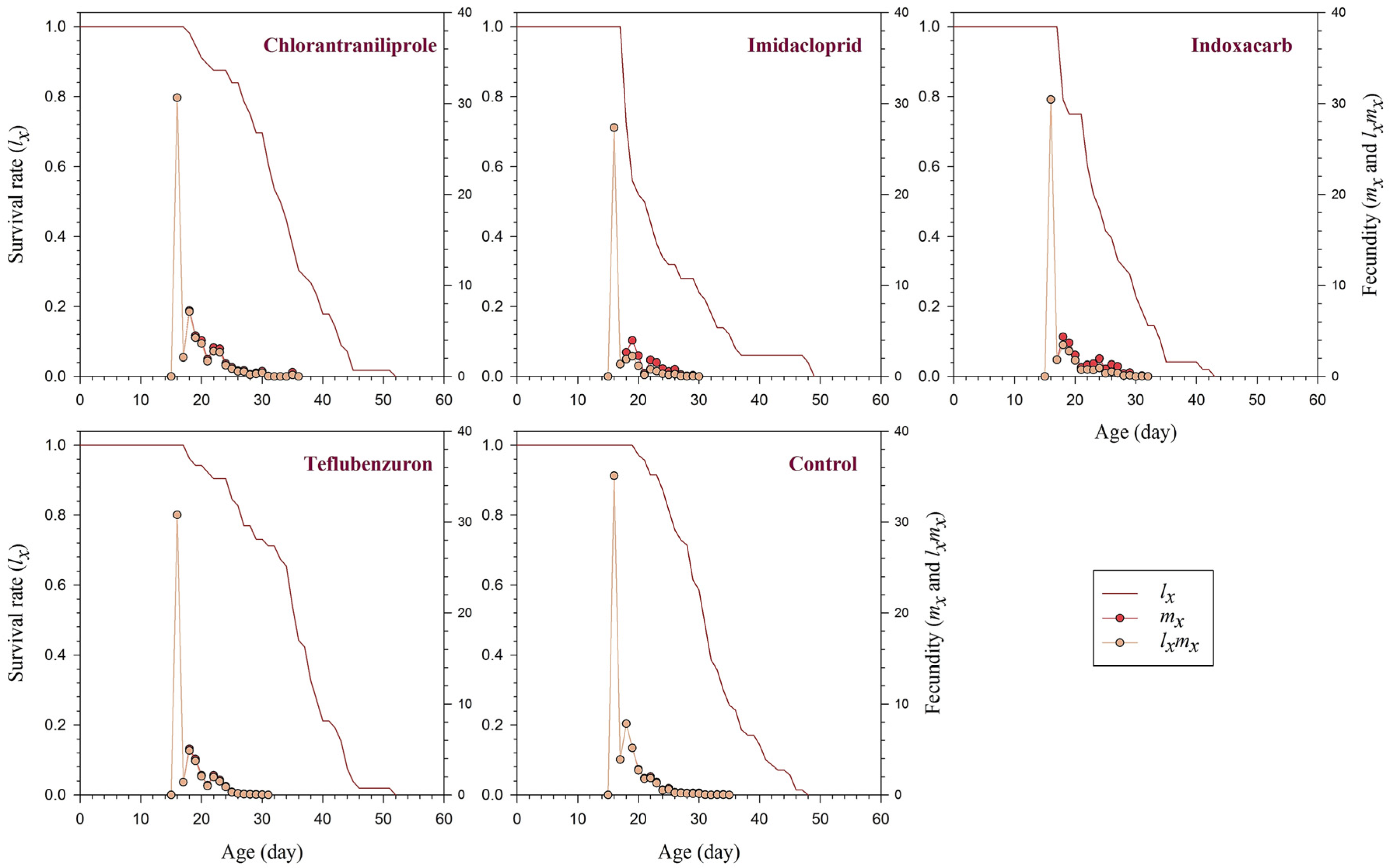
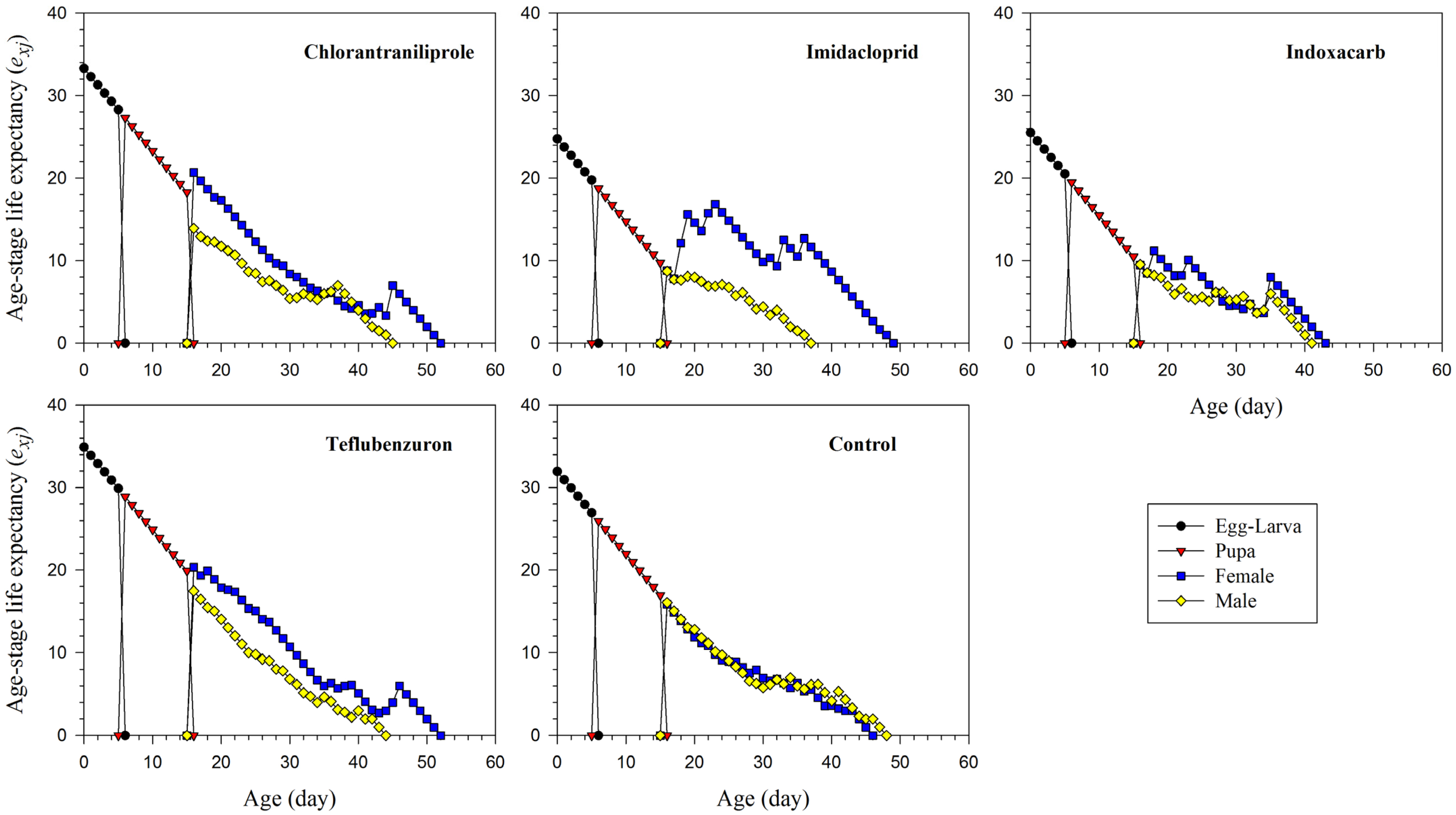
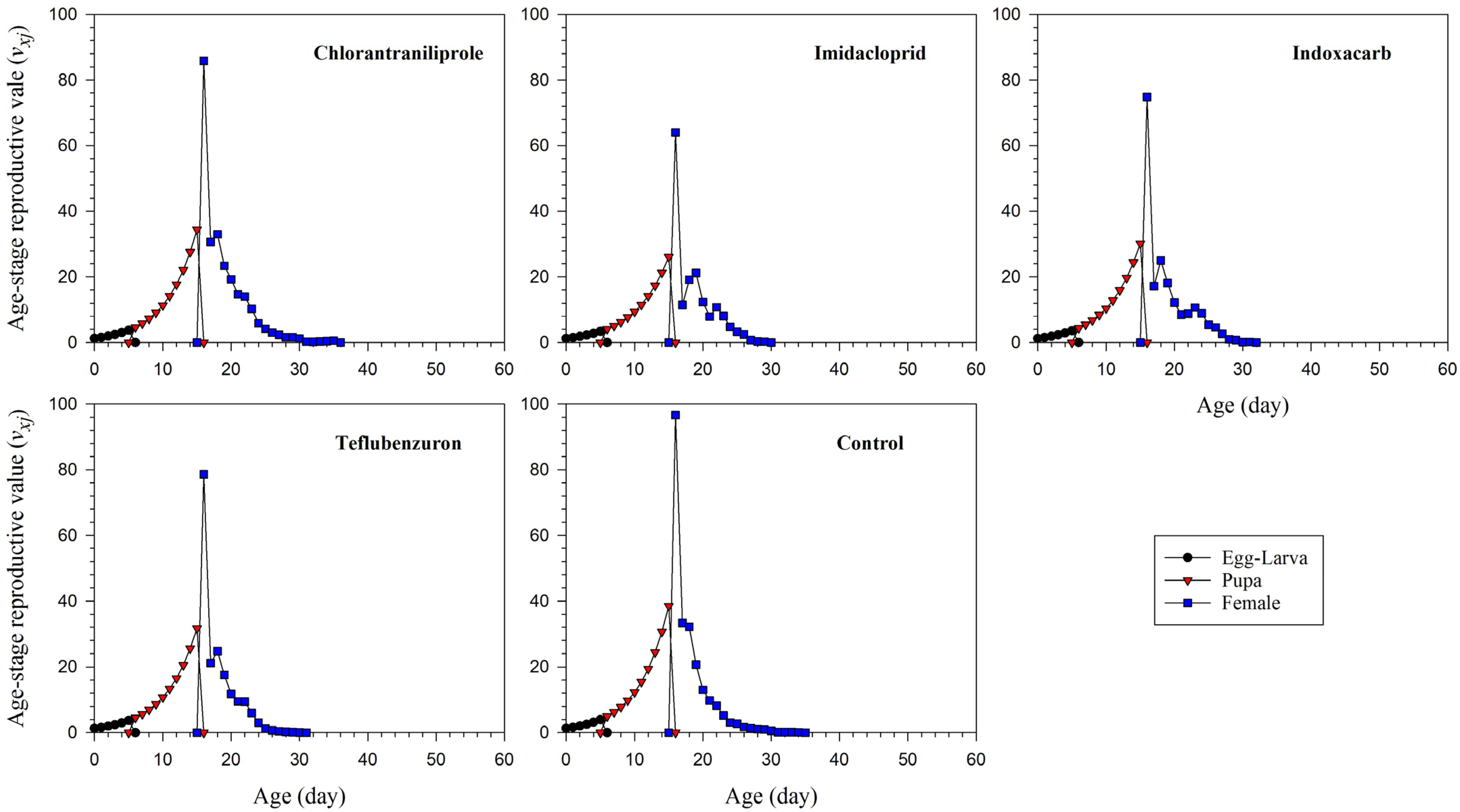
3.2. Effects of Insecticides on Life-History Traits
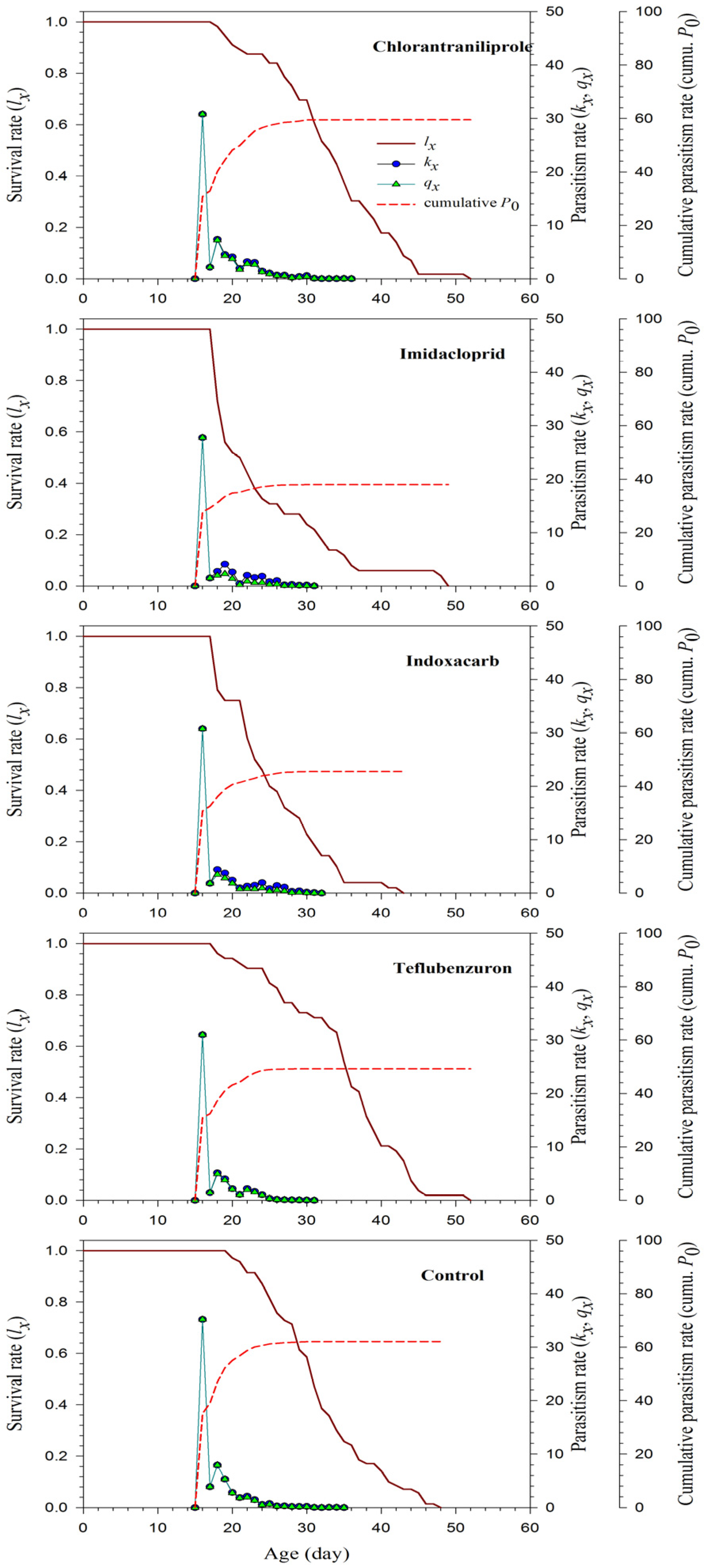
3.3. Host Exploitation Parameters
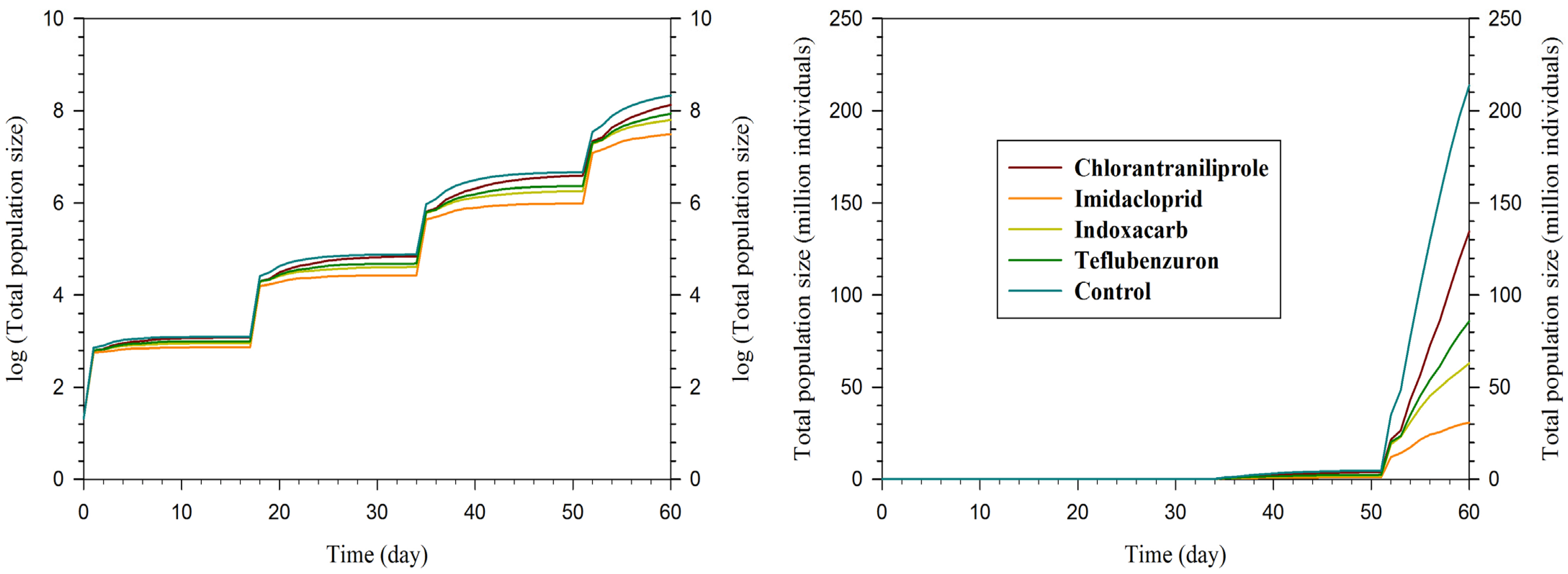
3.4. Population Growth Projection
4. Discussion
Author Contributions
Funding
Data Availability Statement
Acknowledgments
Conflicts of Interest
Appendix A


References
- Tsitsipis, J.A. The corn stalk borer, Sesamia nonagrioides: Forecasting, crop-loss assessment and pest management. In Integrated Crop Protection in Cereals; Cavalloro, R., Sunderland, K.D., Eds.; Balkema: Rotterdam, The Netherlands; Brookfield, WI, USA, 1988; pp. 171–177. [Google Scholar]
- Alexandri, M.; Tsitsipis, J.A. Influence of the egg parasitoid Platytelenomus busseolae (Hym.: Scelionidae) on the population of Sesamia nonagrioides (Lep.: Noctuidae) in Central Greece. Entomophaga 1990, 35, 61–70. [Google Scholar] [CrossRef] [Scilit]
- Bayram, A. Development of Economic Injury Levels for Sesamia nonagrioides Lefebvre (Lepidoptera: Noctuidae) and Some Biological Features of Its Egg Parasitoid Telenomus busseolae (Gahan) (Hymenoptera: Scelionidae). Ph.D. Thesis, Natural and Applied Sciences Institute of Çukurova University, Adana, Turkey, 2003. No. 767. 102p. (In Turkish with English Abstract). [Google Scholar]
- Bayram, A.; Gültekin, A.; Bruce, T.J.; Gezan, S. Factors associated with mortality of the overwintering generation of Sesamia nonagrioides under field conditions. Phytoparasitica 2007, 35, 490–506. [Google Scholar] [CrossRef] [Scilit]
- Avantaggiato, G.; Quaranta, F.; Desiderio, E.; Visconti, A. Fumonisin contamination of maize hybrids visibly damaged by Sesamia. J. Sci. Food Agric. 2003, 83, 13–18. [Google Scholar] [CrossRef] [Scilit]
- Sertkaya, E.; Bayram, A.; Kornosor, S. Natural parasitization rate of Platytelenomus busseolae (Gahan) (Hym.: Scelionidae) and Trichogramma evanescens Westwood (Hym.: Trichogrammatidae) on Sesamia nonagrioides Lef. (Lep.: Noctuidae) and Ostrinia nubilalis Hbn. (Lep.: Pyralidae) eggs and their population developments. In Proceedings of the Fourth Turkish National Congress of Biological Control, Adana, Turkey, 26–29 January 1999; pp. 45–56, (In Turkish with English Abstract). [Google Scholar]
- Kornosor, S.; Sertkaya, E.; Ozpinar, A. Distribution of the egg parasitoid Platytelenomus busseolae (Gahan) (Hym.: Scelionidae) and its effect on the population of Sesamia nonagrioides Lef. (Lep.: Noctuidae) in the Mediterranean region of Turkey. In Fourth International Symposium of Trichogramma and Other Egg Parasitoids; Wajnberg, E., Ed.; Les Colloques de INRA: Paris, France, 1995; No. 73; pp. 193–199. [Google Scholar]
- Bayram, A.; Ozcan, H.; Kornosor, S. Effect of cold storage on the performance of Telenomus busseolae Gahan (Hymenoptera: Scelionidae), an egg parasitoid of Sesamia nonagrioides (Lefebvre) (Lepidoptera: Noctuidae). Biol. Control 2005, 35, 68–77. [Google Scholar] [CrossRef] [Scilit]
- Bayram, A.; Salerno, G.; Conti, E.; Wajnberg, E.; Bin, F.; Kornosor, S. Sex allocation in Telenomus busseolae, a solitary parasitoid of concealed eggs: The influence of host patch size. Entomol. Exp. Appl. 2004, 111, 141–149. [Google Scholar] [CrossRef] [Scilit]
- Bayram, A.; Salerno, G.; Onofri, A.; Conti, E. Sublethal effects of two pyrethroids on biological parameters and behavioral responses to host cues in the egg parasitoid Telenomus busseolae. Biol. Control 2010, 53, 153–160. [Google Scholar] [CrossRef] [Scilit]
- Bayram, A.; Salerno, G.; Onofri, A.; Conti, E. Lethal and sublethal effects of preimaginal treatments with two pyrethroids on the life history of the egg parasitoid Telenomus busseolae. BioControl 2010, 55, 697–710. [Google Scholar] [CrossRef] [Scilit]
- Salerno, G.; Colazza, S.; Conti, E. Sub-lethal effects of deltamethrin on walking behaviour and response to host kairomone of the egg parasitoid Trissolcus basalis. Pest. Manag. Sci. 2002, 58, 663–668. [Google Scholar] [CrossRef] [Scilit] [PubMed]
- Desneux, N.; Wajnberg, E.; Fauvergue, X.; Privet, S.; Kaiser, L. Oviposition behaviour and patch-time allocation in two aphid parasitoids exposed to deltamethrin residues. Entomol. Exp. Appl. 2004, 112, 227–235. [Google Scholar] [CrossRef] [Scilit]
- Desneux, N.; Pham-Delègue, M.-H.; Kaiser, L. Effects of sub-lethal and lethal doses of lambda-cyhalothrin on oviposition experience and host-searching behaviour of a parasitic wasp, Aphidius ervi. Pest. Manag. Sci. 2004, 60, 381–389. [Google Scholar] [CrossRef] [Scilit]
- Desneux, N.; Decourtye, A.; Delpuech, J.-M. The sublethal effects of pesticides on beneficial arthropods. Annu. Rev. Entomol. 2007, 52, 81–106. [Google Scholar] [CrossRef] [Scilit] [PubMed]
- Fouani, J.M.; Wiman, N.G.; Ragozzino, M.; Paul, R.; Walton, V.; Verrastro, V.; Mazzoni, V.; Anfora, G. Dose-response and sublethal effects from insecticide and adjuvant exposure on key behaviors of Trissolcus japonicus. Entomol. Gen. 2024, 3, 633–641. [Google Scholar] [CrossRef] [Scilit]
- Guedes, R.N.C.; Berenbaum, M.R.; Biondi, A.; Desneux, N. The side effects of pesticides on nontarget arthropods. Annu. Rev. Entomol. 2026, 71, 381–403. [Google Scholar] [CrossRef] [Scilit] [PubMed]
- Smilanick, J.M.; Zalom, F.G.; Ehler, L.E. Effect of methamidophos residue on the pentatomid egg parasitoids Trissolcus basalis and T. utahensis (Hymenoptera: Scelionidae). Biol. Control 1996, 6, 193–201. [Google Scholar] [CrossRef] [Scilit]
- Saber, M.; Hejazi, M.J.; Kamali, K.; Moharramipour, S. Lethal and sublethal effects of fenitrothion and deltamethrin residues on the egg parasitoid Trissolcus grandis (Hymenoptera: Scelionidae). J. Econ. Entomol. 2005, 98, 35–40. [Google Scholar] [CrossRef] [Scilit]
- Ranjbar, F.; Reitz, S.; Jalali, M.A.; Ziaaddini, M.; Izadi, H. Lethal and sublethal effects of two commercial insecticides on egg parasitoids (Hymenoptera: Scelionidae) of green stink bugs (Hem: Pentatomidae). J. Econ. Entomol. 2021, 114, 33–39. [Google Scholar] [CrossRef] [Scilit]
- Ribeiro, A.V.; Holle, S.G.; Hutchison, W.D.; Koch, R.L. Lethal and sublethal effects of conventional and organic insecticides on the parasitoid Trissolcus japonicus, a biological control agent for Halyomorpha halys. Front. Insect Sci. 2021, 1, 685755. [Google Scholar] [CrossRef] [Scilit]
- Mele, A.; Ceccato, E.; Simoni, F.; Tirello, P.; Scaccini, D.; Duso, C.; Pozzebon, A. Lethal and sublethal effects of fungicides and plant strengtheners on Trissolcus japonicus and Trissolcus mitsukurii, egg parasitoids of Halyomorpha halys. Ecotoxicol. Environ. Saf. 2025, 304, 119088. [Google Scholar] [CrossRef] [Scilit]
- Turchen, L.M.; Golin, V.; Butnariu, A.R.; Guedes, R.N.C.; Pereira, M.J.B. Lethal and sublethal effects of insecticides on the egg parasitoid Telenomus podisi (Hymenoptera: Platygastridae). J. Econ. Entomol. 2016, 109, 84–92. [Google Scholar] [CrossRef] [Scilit] [PubMed]
- Ogburn, E.C.; Walgenbach, J.F. Effects of insecticides used in organic agriculture on Anastatus reduvii (Hymenoptera: Eupelmidae) and Telenomus podisi (Hymenoptera: Scelionidae), egg parasitoids of pestivorous stink bugs. J. Econ. Entomol. 2018, 112, 108–114. [Google Scholar] [CrossRef] [Scilit]
- Exteckoetter, V.; Oliveira, J.A.D.C.; de Figueiredo, K.G.; de Freitas Bueno, A.; Carvalho, G.A. Side effects of insecticides used in soybean and corn on the egg parasitoid Telenomus remus (Hymenoptera: Scelionidae). Ecotoxicology 2025, 34, 1–10. [Google Scholar] [CrossRef] [Scilit]
- Araújo, M.B.; Rakes, M.; Pasini, R.A.; Bernardi, D.; Grützmacher, A.D. Effect of insecticides on biological attributes of the egg parasitoid Telenomus remus (Hymenoptera: Platygastridae). Biocontrol Sci. Technol. 2022, 32, 877–890. [Google Scholar] [CrossRef] [Scilit]
- Müller, C. Impacts of sublethal insecticide exposure on insects—Facts and knowledge gaps. Basic Appl. Ecol. 2018, 30, 1–10. [Google Scholar] [CrossRef] [Scilit]
- Giacometti, R. Rearing of Sesamia nonagrioides Lefèbvre on a meridic diet (Lepidoptera, Noctuidae). Redia 1995, 78, 19–27. [Google Scholar]
- Finney, D.J. The principles of biological assay. Suppl. J. R. Stat. Soc. 1947, 9, 46–81. [Google Scholar] [CrossRef] [Scilit]
- Preetha, G.; Stanley, J.; Suresh, S.; Kuttalam, S.; Samiyappan, R. Toxicity of selected insecticides to Trichogramma chilonis: Assessing their safety in the rice ecosystem. Phytoparasitica 2009, 37, 209–215. [Google Scholar] [CrossRef] [Scilit]
- Chi, H.; Liu, H. Two new methods for the study of insect population ecology. Bull. Inst. Zool. Acad. Sin. 1985, 24, 225–240. [Google Scholar]
- Chi, H. Life-table analysis incorporating both sexes and variable development rates among individuals. Environ. Entomol. 1988, 17, 26–34. [Google Scholar] [CrossRef] [Scilit]
- Chi, H.; You, M.; Atlıhan, R.; Smith, C.L.; Kavousi, A.; Özgökçe, M.S.; Güncan, A.; Tuan, S.-J.; Fu, J.-W.; Xu, Y.-Y.; et al. Age-stage, two-sex life table: An introduction to theory, data analysis, and application. Entomol. Gen. 2020, 40, 103–124. [Google Scholar] [CrossRef] [Scilit]
- Chi, H.; Güncan, A.; Kavousi, A.; Gharakhani, G.; Atlihan, R.; Özgökçe, M.S.; Shirazi, J.; Amir-Maafi, M.; Maroufpoor, M.; Roya, T.; et al. TWOSEX-MSChart: The key tool for life table research and education. Entomol. Gen. 2022, 42, 845–849. [Google Scholar] [CrossRef] [Scilit]
- Chi, H. TWOSEX-MSChart: A computer program for the age-stage, two-sex life table analysis. Zenodo 2026. [Google Scholar] [CrossRef]
- Huang, Y.-B.; Chi, H. Life tables of Bactrocera cucurbitae (Diptera: Tephritidae): With an invalidation of the jackknife technique. J. Appl. Entomol. 2013, 137, 327–339. [Google Scholar] [CrossRef] [Scilit]
- Wei, M.F.; Chi, H.; Guo, Y.F.; Li, X.W.; Zhao, L.L.; Ma, R.Y. Demography of Cacopsylla chinensis (Hemiptera: Psyllidae) reared on four cultivars of Pyrus bretschneideri (Rosales: Rosaceae) and P. communis pears with estimations of confidence intervals of specific life table statistics. J. Econ. Entomol. 2020, 113, 2343–2353. [Google Scholar] [CrossRef] [Scilit]
- Chi, H.; Yang, T.-C. Two-sex life table and predation rate of Propylaea japonica Thunberg (Coleoptera: Coccinellidae) fed on Myzus persicae (Sulzer) (Homoptera: Aphididae). Environ. Entomol. 2003, 32, 327–333. [Google Scholar] [CrossRef] [Scilit]
- Chi, H. CONSUME-MSChart-setup.rar. Zenodo 2026. [Google Scholar] [CrossRef]
- Farhadi, R.; Allahyari, H.; Chi, H. Life table and predation capacity of Hippodamia variegata (Coleoptera: Coccinellidae) feeding on Aphis fabae (Hemiptera: Aphididae). Biol. Control 2011, 59, 83–89. [Google Scholar] [CrossRef] [Scilit]
- Chi, H. Timing of control based on the stage structure of pest populations: A simulation approach. J. Econ. Entomol. 1990, 83, 1143–1150. [Google Scholar] [CrossRef] [Scilit]
- Chi, H. TIMING-MSChart: A computer program for the population projection based on the age-stage, two-sex life table. Zenodo 2022. [Google Scholar] [CrossRef]
- Olaye, A.C.; Schulthess, F.; Shanower, T.G.; Bosque-Pérez, N.A. Factors influencing the developmental rates and reproductive potentials of Telenomus busseolae (Gahan) [Hym.: Scelionidae], an egg parasitoid of Sesamia calamistis Hampson (Lep.: Noctuidae). Biol. Control 1997, 8, 15–21. [Google Scholar] [CrossRef] [Scilit]
- Whitehorn, P.R.; Cook, N.; Blackburn, C.V.; Gill, S.M.; Green, J.; Shuker, D.M. Sex allocation theory reveals a hidden cost of neonicotinoid exposure in a parasitoid wasp. Proc. Biol. Sci. 2015, 282, 20150389. [Google Scholar] [CrossRef] [Scilit] [PubMed]
- Santos, L.V.; de Lima Alvarez, D.; Santos, L.M.; do Prado, J.C.; de Freitas Bueno, R.C.O.; Hoback, W.W. Selectivity and sub-lethal effect of pesticides on the immature and adult stages of Telenomus podisi (Hymenoptera: Scelionidae). Int. J. Trop. Insect Sci. 2022, 42, 1731–1736. [Google Scholar] [CrossRef] [Scilit]
- Pazini, J.B.; Padilha, A.C.; Cagliari, D.; Bueno, F.A.; Rakes, M.; Zotti, M.J.; Martins, J.F.D.S.; Grützmacher, A.D. Differential impacts of pesticides on Euschistus heros (Hem.: Pentatomidae) and its parasitoid Telenomus podisi (Hym.: Platygastridae). Sci. Rep. 2019, 9, 6544. [Google Scholar] [CrossRef] [Scilit]
- Hamilton, W.D. Extraordinary sex ratios. A sex-ratio theory for sex linkage and inbreeding has new implications in cytogenetics and entomology. Science 1967, 156, 477–488. [Google Scholar] [CrossRef] [Scilit]
- Kamran, M.; Ahmad, M.; Shad, S.A. Anthranilic diamide compatibility with the parasitoid Trichogramma chilonis Ishii (Hymenoptera: Trichogrammatidae): Based on toxicity, two-sex life table and ecological parameters. Crop Prot. 2025, 187, 106979. [Google Scholar] [CrossRef] [Scilit]
- Wang, D.S.; He, Y.R.; Guo, X.L.; Luo, Y.L. Acute toxicities and sublethal effects of some conventional insecticides on Trichogramma chilonis (Hymenoptera: Trichogrammatidae). J. Econ. Entomol. 2012, 105, 1157–1163. [Google Scholar] [CrossRef] [Scilit]
- Majidpour, M.; Maroofpour, N.; Ghane-Jahromi, M.; Guedes, R.N.C. Thiacloprid + deltamethrin on the life-table parameters of the cotton aphid, Aphis gossypii (Hemiptera: Aphididae), and the parasitoid, Aphidius flaviventris (Hymenoptera: Aphelinidae). J. Econ. Entomol. 2020, 113, 2723–2731. [Google Scholar] [CrossRef] [Scilit] [PubMed]
- Guo, M.; Feng, X.; Yang, K.; Wang, L.; Gao, Z.; Li, Y.; Xu, H. Sublethal and transgenerational effects of insecticides used in whitefly control on biological traits of the parasitoid Eretmocerus hayati. Entomol. Gen. 2023, 43, 1061–1069. [Google Scholar] [CrossRef] [Scilit]
- Huang, Y.-Q.; Yang, X.; Bai, Q.-R.; Singh, S.; Tang, L.-D.; Zang, L.-S. Performance of the two parasitoid species, Aphelinus varipes and Lysiphlebia japonica against sugarcane aphid, Melanaphis sacchari. Biol. Control 2024, 194, 105532. [Google Scholar] [CrossRef] [Scilit]



| Active Ingredient | IRAC Classification | Trade Name and Company | Formulation | Active Ingredient (g/L) | Field Rate (mL/L) | Active Ingredient at Field Application Rate (mg a.i./L) | Field-Recommended Concentration (mL/ha) | Bioassay Test Concentrations (mL/L; Serial Dilutions of Field-Rate Solution) |
|---|---|---|---|---|---|---|---|---|
| Insecticides | ||||||||
| Imidacloprid | Neonicotinoid (4A) | Confidor-BAYER | SC | 350 | 1.75 | 612.5 | 350 | 1.75, 0.875, 0.4375, 0.21875, 0.10937 |
| Teflubenzuron | Benzoylurea (15) | Nomolt Super-BASF | SC | 150 | 2 | 300 | 400 | 8, 4, 2, 1, 0.5 |
| Indoxacarb | Oxadiazine (22A) | Invut-ONC CROPSCIENCE | SC | 150 | 1.5 | 225 | 300 | 1.5, 0.75, 0.375, 0.1875, 0.09375 |
| Chlorantraniliprole | Anthranilic Diamide (28) | Coragen-DUPONT | SC | 200 | 0.75 | 150 | 150 | 1.5, 0.75, 0.375, 0.1875, 0.09375 |
| Active İngredient | Exposure Duration (h) | Sample Size (n) | Slope ± SE | LC25 (mL/L) (95% FL) | LC50 (mL/L) (95% FL) | χ2, df, p | The Risk Quotients (RQ) (FRC/LC50 mL/L Basis for the Parasitoid) | RQ (g a.i./ha ÷ LC50 mg a.i./L for the Parasitoid) | Risk Category |
|---|---|---|---|---|---|---|---|---|---|
| Chlorantraniliprole | 24 | 721 | 1.965 ± 0.159 | 0.398 (0.345–0.449) | 0.696 (0.622–0.784) | 11.443, 18, 0.875 | 1.08 | 0.215 | Harmless |
| Imidacloprid | 12 | 962 | 0.499 ± 0.049 | 0.114 (0.078–0.150) | 0.440 (0.366–0.529) | 13.456, 18, 0.764 | 3.98 | 0.796 | Harmless |
| Indoxacarb | 12 | 961 | 1.887 ± 0.136 | 0.421 (0.372–0.469) | 0.754 (0.681–0.841) | 9.514, 18, 0.947 | 1.99 | 0.398 | Harmless |
| Teflubenzuron | 24 | 722 | 1.756 ± 0.143 | 1.868 (1.601–2.129) | 3.493 (3.097–3.976) | 12.302, 18, 0.831 | 0.57 | 0.115 | Harmless |
| Treatments | |||||
|---|---|---|---|---|---|
| Control (Distilled Water (n = 35) | Chlorantraniliprole LC25 (n = 28) | Imidacloprid LC25 (n = 25) | Indoxacarb LC25 (n = 24) | Teflubenzuron LC25 (n = 26) | |
| Fecundity (total) | 123.1 ± 3.63 a | 118.3 ± 5.88 a | 72.9 ± 5.65 c | 89.9 ± 6.30 b | 97.5 ± 7.32 b |
| Fecundity (Female offspring) | 69.8 ± 2.46 a | 53.2 ± 2.93 bc | 49.9 ± 3.14 c | 58.9 ± 1.78 b | 56.7 ± 2.93 bc |
| Fecundity (Male offspring) | 53.2 ± 3.59 ab | 65.1 ± 5.11 a | 23.0 ± 4.55 c | 31.1 ± 5.61 bc | 40.8 ± 6.01 b |
| Net reproductive rate R0 (Female offspring) | 34.9 ± 4.36 a | 26.61 ± 3.83 a | 24.94 ± 3.83 a | 29.43 ± 4.33 a | 28.34 ± 4.19 a |
| Net reproductive rate R0 (Male offspring) | 26.6 ± 3.64 a | 32.5 ± 5.01 a | 11.5 ± 2.78 b | 15.5 ± 3.57 b | 20.4 ± 4.12 ab |
| Net reproductive rate R0 (total) | 61.5 ± 7.45 a | 59.2 ± 8.42 a | 36.4 ± 5.86 b | 44.9 ± 7.22 ab | 48.7 ± 7.66 ab |
| Intrinsic rate of increase (r) | 0.2281 ± 0.0070 a | 0.2211 ± 0.0079 ab | 0.2032 ± 0.0090 b | 0.2130 ± 0.0088 ab | 0.2150 ± 0.008 ab |
| Finite rate of increase λ | 1.2557 ± 0.0087 a | 1.2475 ± 0.0099 ab | 1.2253 ± 0.0119 b | 1.2360 ± 0.0196 ab | 1.2400 ± 0.0109 ab |
| Oviposition days | 8.6 ± 0.55 a | 9.2 ± 0.73 a | 3.7 ± 0.74 c | 5.7 ± 0.90 bc | 6.6 ± 0.75 b |
| Female longevity (day) | 15.9 ± 1.15 b,A | 20.6 ± 1.22 a,A | 8.8 ± 2.08 c,A | 9.4 ± 1.48 c,A | 20.3 ± 1.79 a,A |
| Male longevity (day) | 16.0 ± 1.13 a,A | 13.9 ± 1.39 a,B | 8.7 ± 1.20 b,A | 9.5 ± 1.13 b,A | 17.4 ± 1.19 a,A |
| Emergence (%) * | 98.6 ± 0.61 a | 98.8 ± 0.68 a | 97.0 ± 0.73 a | 98.9 ± 0.7 a | 99.2 ± 0.71 a |
| Sex ratio (female) (%) * | 57.4 ± 2.80 ab | 46.7 ± 3.13 a | 71.0 ± 3.39 c | 72.6 ± 3.31 c | 63.9 ± 3.25 bc |
| Parameters | Treatments | ||||
|---|---|---|---|---|---|
| Control (Distilled Water) | Chlorantriniliprole LC25 | Imidacloprid LC25 | Indoxacarb LC25 | Teflubenzuron LC25 | |
| Net Parasitism Rate, P0 (host/individual) | 62.1 ± 7.60 a | 59.6 ± 8.50 a | 37.9 ± 6.14 b | 45.5 ± 7.33 ab | 49.2 ± 7.76 ab |
| Transformation Rate, Qp (P0/R0) | 1.0090 ± 0.0017 a | 1.0060 ± 0.0035 a | 1.0410 ± 0.0231 a | 1.0120 ± 0.0026 a | 1.0100 ± 0.0029 a |
| Finite Parasitism Rate, ω (host) | 1.5870 ± 0.0220 a | 1.5665 ± 0.0250 a | 1.5384 ± 0.0298 a | 1.5451 ± 0.0277 a | 1.5531 ± 0.0281 a |
| Stable Parasitism Rate, ψ (host) | 1.2637 ± 0.0087 a | 1.2562 ± 0.0101 a | 1.2553 ± 0.0147 a | 1.2494 ± 0.0115 a | 1.2505 ± 0.0118 a |
Disclaimer/Publisher’s Note: The statements, opinions and data contained in all publications are solely those of the individual author(s) and contributor(s) and not of MDPI and/or the editor(s). MDPI and/or the editor(s) disclaim responsibility for any injury to people or property resulting from any ideas, methods, instructions or products referred to in the content. |
© 2026 by the authors. Licensee MDPI, Basel, Switzerland. This article is an open access article distributed under the terms and conditions of the Creative Commons Attribution (CC BY) license.
Share and Cite
Bayram, A.; Doğanlar, O. Sublethal Effects of Four Insecticides with Different Modes of Action on Life History, Demography and Host Exploitation by the Egg Parasitoid, Telenomus busseolae. Insects 2026, 17, 478. https://doi.org/10.3390/insects17050478
Bayram A, Doğanlar O. Sublethal Effects of Four Insecticides with Different Modes of Action on Life History, Demography and Host Exploitation by the Egg Parasitoid, Telenomus busseolae. Insects. 2026; 17(5):478. https://doi.org/10.3390/insects17050478
Chicago/Turabian StyleBayram, Ahmet, and Oğuzhan Doğanlar. 2026. "Sublethal Effects of Four Insecticides with Different Modes of Action on Life History, Demography and Host Exploitation by the Egg Parasitoid, Telenomus busseolae" Insects 17, no. 5: 478. https://doi.org/10.3390/insects17050478
APA StyleBayram, A., & Doğanlar, O. (2026). Sublethal Effects of Four Insecticides with Different Modes of Action on Life History, Demography and Host Exploitation by the Egg Parasitoid, Telenomus busseolae. Insects, 17(5), 478. https://doi.org/10.3390/insects17050478