Article

Assessing the Sylvatic Yellow Fever Vectors in Southern Brazil

by
Sabrina Fernandes Cardoso
1,2,*,
Larissa Akemi Oliveira Kikuti
1,
Andre Akira Gonzaga Yoshikawa
1,
Iara Carolini Pinheiro
1,
João Victor Costa Guesser
1,
Maycon Sebastião Alberto Santos Neves
3,
Dinair Couto-Lima
3,
Renata Rispoli Gatti
2,
Josiane Somariva Prophiro
4,
André Nóbrega Pitaluga
5,6,* and
Luísa Damazio Pitaluga Rona
1,6,*
1
Departamento de Biologia Celular, Embriologia e Genética, Universidade Federal de Santa Catarina, Florianópolis 88037-000, SC, Brazil
2
Secretaria da Saúde do Estado de Santa Catarina, Diretoria de Vigilância Epidemiológica, Florianópolis 88015-130, SC, Brazil
3
Laboratório de Mosquitos Transmissores de Hematozoários, Instituto Oswaldo Cruz, Fundação Oswaldo Cruz, Rio de Janeiro 21040-900, RJ, Brazil
4
Programa de Pós-Graduação em Ciências da Saúde (PPGCS), Universidade do Sul de Santa Catarina (UNISUL), Tubarão 88704-900, SC, Brazil
5
Instituto Oswaldo Cruz, Fundação Oswaldo Cruz-Fiocruz, Rio de Janeiro 21040-900, RJ, Brazil
6
Instituto Nacional de Ciência, Tecnologia e Inovação em Entomologia Molecular, Conselho Nacional de Desenvolvimento Científico e Tecnológico, Rio de Janeiro 21945-970, RJ, Brazil
*
Authors to whom correspondence should be addressed.
Insects 2026, 17(5), 464; https://doi.org/10.3390/insects17050464

Submission received: 6 November 2025 / Revised: 4 December 2025 / Accepted: 12 December 2025 / Published: 30 April 2026

Simple Summary

This study investigated sylvatic mosquito populations in a region of southern Santa Catarina, Brazil, recently affected by a yellow fever outbreak. Yellow fever is a serious mosquito-borne disease that can affect both humans and non-human primates (NHPs). Nearly 4400 mosquitoes from various species were collected, and, for the first time in southern Brazil, natural infection with yellow fever virus (YFV) was detected in Sabethes (Sabethes) albiprivus Theobald, 1903. This finding suggests that Sa. albiprivus may play a previously unrecognised role in maintaining YFV in the environment. The known vector Haemagogus (Conopostegus) leucocelaenus (Dyar & Shannon, 1924) was found in all sampled locations, indicating that it may have been the primary vector responsible for virus transmission in the region. These results enhance our understanding of YFV’s natural transmission cycles and provide new insights into how the virus persists in sylvatic environments. This research contributes to the fields of biology, ecology, and public health by reinforcing the importance of ongoing entomological surveillance and preventive vaccination, both of which are essential for preventing future outbreaks and protecting vulnerable populations.

Abstract

Yellow fever (YF) is an infectious disease caused by the yellow fever virus (YFV), an arbovirus of the Flaviviridae family. It is transmitted through the bite of infected mosquitoes of the Culicidae family and affects both humans and non-human primates (NHPs). This study aimed to investigate the sylvatic Culicidae fauna and the occurrence of natural YFV infection in a microregion of southern Santa Catarina, Brazil, an area recently affected by a sylvatic YF outbreak. Entomological collections were conducted between January and February 2023 in five municipalities with confirmed viral circulation. Natural YFV infection was assessed using RT-LAMP. A total of 4352 female culicids were collected, representing at least 32 species, including several key sylvatic YFV vectors. Haemagogus leucocelaenus was identified in all sampled municipalities, whereas Haemagogus (Haemagogus) janthinomys Dyar, 1921, historically considered the primary vector of sylvatic YFV in Brazil, was not detected. Mosquitoes from the genera Aedes Meigen, 1818; Haemagogus Williston, 1896; Psorophora Robineau-Desvoidy, 1827; and Sabethes Robineau-Desvoidy, 1827 were tested for YFV. Only one pool, composed of Sabethes albiprivus, tested positive, yielding a minimum infection rate (MIR) of 11.6. This is the first record of natural YFV infection in Sa. albiprivus in southern Brazil, and only the third record globally, highlighting its potential role as a secondary vector in maintaining viral circulation in sylvatic environments. Based on species presence and abundance, Hg. leucocelaenus is likely to have acted as the primary YFV vector in the study area. The composition of the culicid fauna, coupled with the detection of YFV in sylvatic vectors, indicates an ongoing epidemiological risk. These findings underscore the need to strengthen entomological surveillance and expand YF vaccination coverage in affected and neighbouring regions.

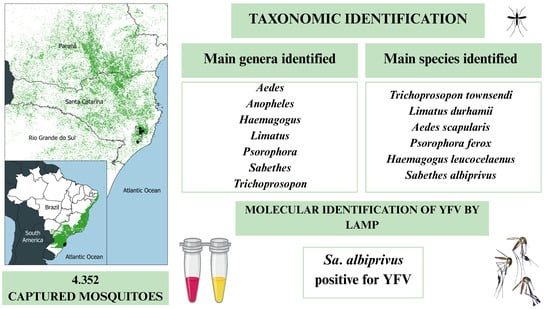
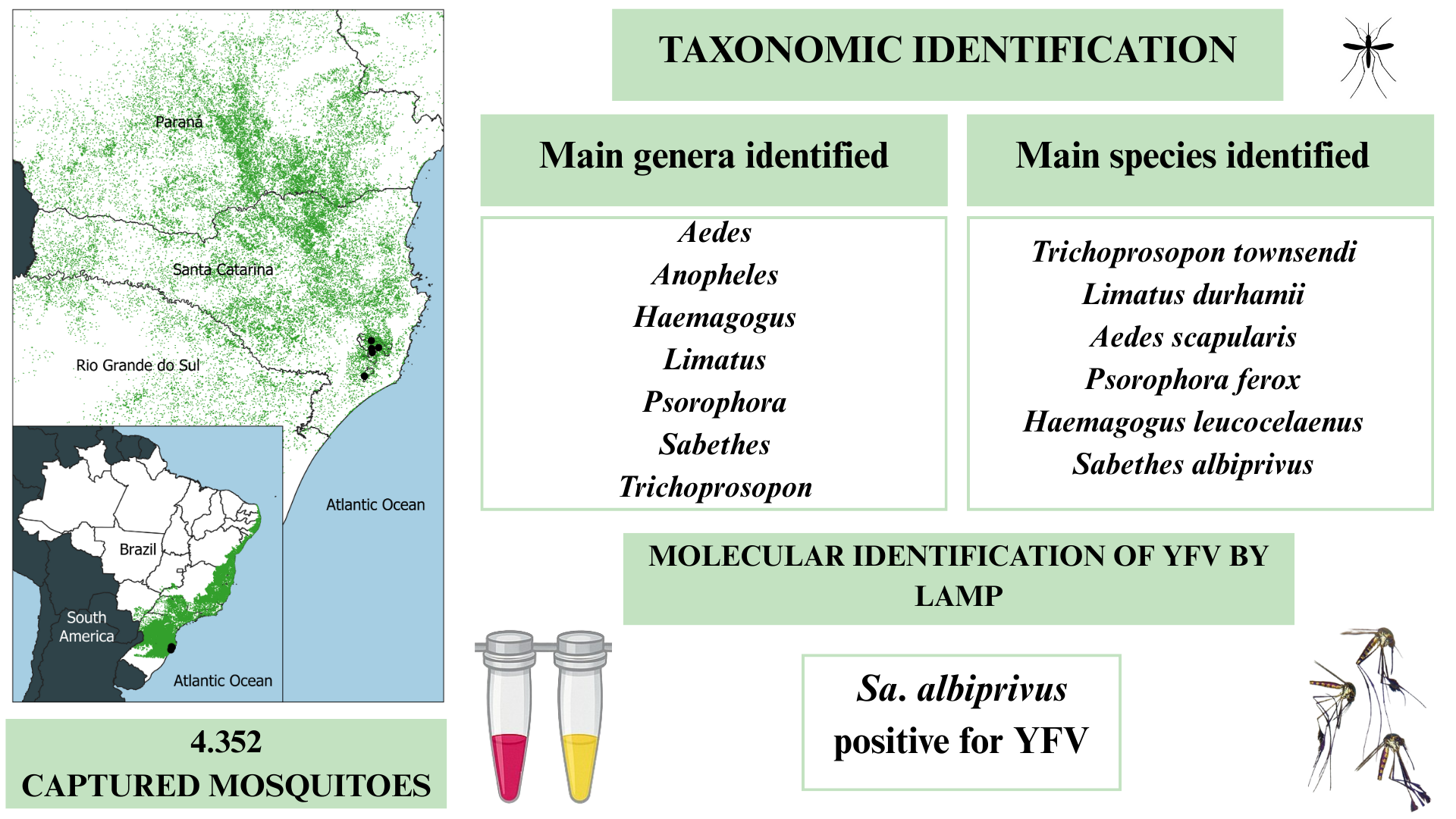
Graphical Abstract

1. Introduction

The Culicidae family comprises a large and widespread group of mosquitoes, including more than 3700 species across 113 genera, found in both temperate and tropical regions worldwide [1]. Approximately 150 of these species are known vectors of human diseases, significantly contributing to global morbidity and mortality. One such disease is yellow fever (YF), caused by the yellow fever virus (YFV) [2,3], a member of the Flaviviridae family and classified under the species Orthoflavivirus flavi [4].
Yellow fever is endemic in sub-Saharan Africa and in Central and South America, with sylvatic transmission also reported in Trinidad in the Caribbean [5], causing thousands of cases and deaths annually in Africa and South America, despite the availability of effective vaccines [6]. In Brazil, YF is classified into two main transmission cycles—sylvatic and urban—which differ significantly in vector species, vertebrate hosts, and geographic distribution [3]. No cases of the urban transmission cycle have been reported in the country since 1942 [6]. However, in 2016, the virus re-emerged, triggering the most severe sylvatic YF outbreak of the past 80 years, affecting both humans and non-human primates (NHPs) [7,8]. The virus initially spread from Venezuela into the Brazilian Amazon, then advanced through the Centre-West and Southeast regions, reaching the Atlantic Forest coastal areas and rapidly extending southward, where it remained active at least until the end of 2021 [8,9].
Aedes (Stegomyia) aegypti (Linnaeus, 1762) is the primary vector responsible for YFV transmission in the urban cycle, while species of the genera Haemagogus Williston, 1896 and Sabethes Robineau-Desvoidy, 1827 transmit the virus in the sylvatic cycle as primary and secondary vectors, respectively [6]. In the Americas, the most important sylvatic vector is Haemagogus (Haemagogus) janthinomys Dyar, 1921, which is widely distributed throughout Brazil [10]. Other Aedes Meigen, 1818 species, beyond Ae. aegypti, have also been found naturally infected with YFV [6,11]. Furthermore, mosquitoes of the genus Psorophora Robineau-Desvoidy, 1827 have been identified as natural hosts of the virus [3,12], indicating their potential role in transmission.
Several studies have examined potential YFV vectors in Brazil [6,13,14,15,16]. However, information on the sylvatic mosquito fauna in Santa Catarina, southern Brazil, remains scarce. This lack of data supports the hypothesis that the main species of the genera Haemagogus and Sabethes, recognised vectors of sylvatic YF in the country, were responsible for spreading the virus in the region. Therefore, this study aimed to identify sylvatic mosquito species in a microregion of southern Santa Catarina recently affected by a sylvatic YF outbreak. In addition, we assessed natural YFV infection in potential vector species to improve understanding of their role in the transmission and spread of the outbreak.

2. Materials and Methods

2.1. Study Area

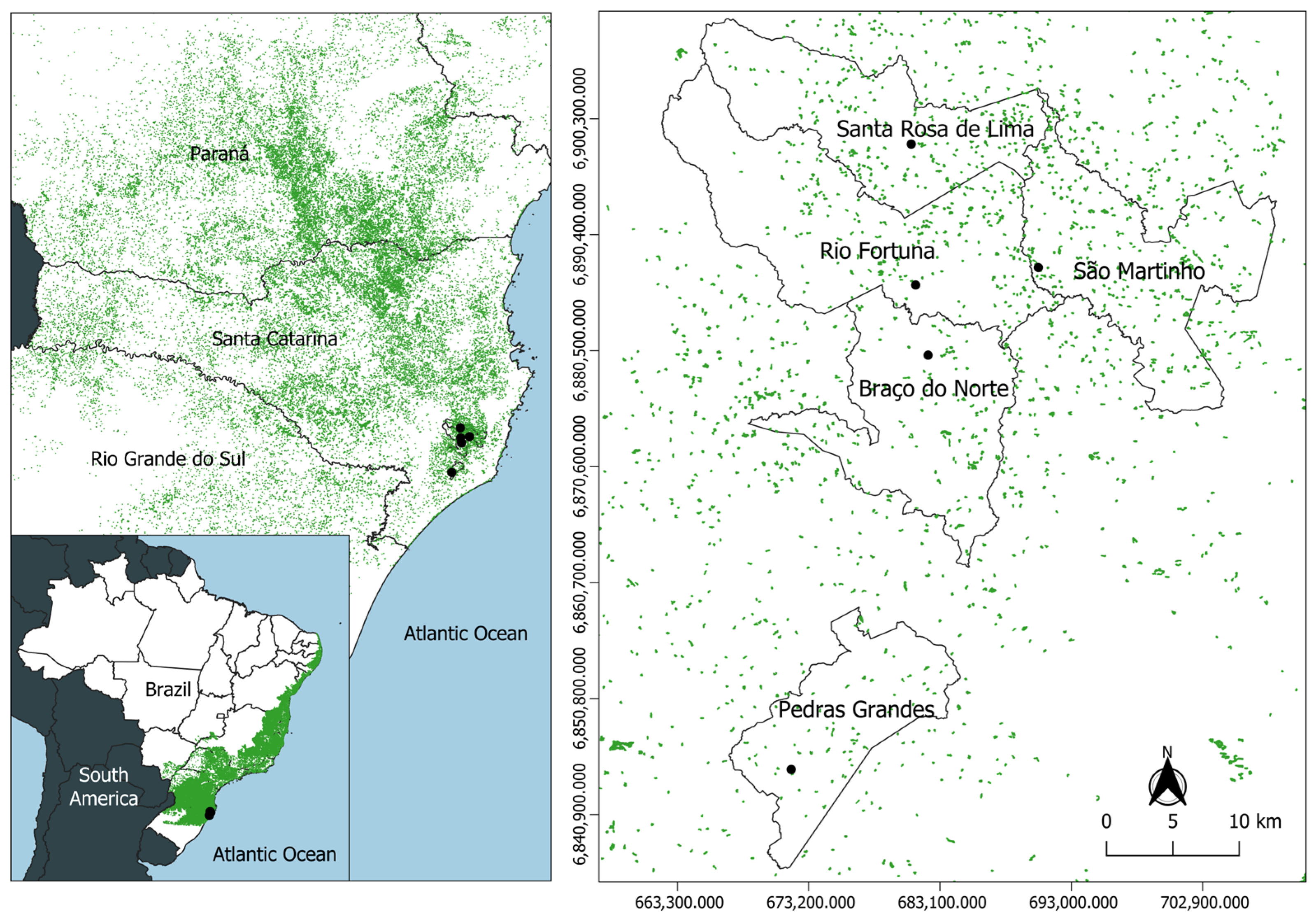
Entomological surveys were conducted in five municipalities within a microregion located in the southern part of Santa Catarina State, Brazil (Figure 1). In February 2021, YFV circulation was confirmed in the region for the first time through the detection of infected NHPs [17]. Consequently, mosquito collections were carried out in 2023 in municipalities with confirmed viral circulation: Santa Rosa de Lima (−28.032639, −49.149684), Rio Fortuna (−28.141177, −49.146304), Braço do Norte (−28.195246, −49.136690), Pedras Grandes (−28.514485, −49.242145), and São Martinho (−28.127728, −49.051721).
The five sampled areas shared similar environmental characteristics, including predominantly dense vegetation, low wind incidence, proximity to water bodies, and the presence of human dwellings along forest edges. The regional climate is classified as tropical temperate, and the remaining forest fragments belong to the Atlantic Forest biome. Historically, this ecosystem has undergone intense exploitation, resulting in largely degraded secondary forests and a highly fragmented landscape with pronounced edge effects [19].
In Santa Rosa de Lima (average altitude: 488 m), collections were conducted in the locality of Rio dos Índios. In Rio Fortuna (average altitude: 363 m), sampling took place in the Rio Otília neighbourhood. In Braço do Norte (average altitude: 238 m), collections were performed in the locality of Riacho Alegre. In São Martinho (average altitude: 353 m), samples were obtained in the Rio Gabiroba neighbourhood. Finally, in Pedras Grandes, the municipality with the lowest average altitude among the five sites (212 m), collections were conducted in the Santo Antônio neighbourhood [19].

2.2. Entomological Collection and Species Identification

Adult female mosquitoes were collected during the summer of 2023, specifically in January and February. Sampling was conducted between 08:00 and 17:00 on three consecutive days in each of the five municipalities. In each of the 15 collections, mosquitoes were captured simultaneously in both the tree canopy and at ground level using an entomological net and a Castro-type oral aspirator. Additionally, four CDC light traps (CDC-LT) baited with CO2 (dry ice) were installed in the canopy. Following collection, specimens were stored and transported on dry ice.
In the laboratory, mosquitoes were morphologically identified using a stereomicroscope (SZX16 Olympus) on a cold surface. Identification to genus and species level was carried out using standard taxonomic keys for culicids [10,20,21,22]. Non-engorged females of the genera Haemagogus, Sabethes, Aedes, and Psorophora were grouped into pools of up to 10 individuals, based on species, genus, and collection site, and stored at −80 °C for subsequent viral detection.

2.3. Standardisation of Viral RNA Extraction

RNA extraction was standardised based on a modified protocol described by Silva et al. [23]. To simulate viral infection, pools of up to 10 mosquitoes were homogenised in 250 µL of nuclease-free water (UltraPure™, Invitrogen, Waltham, MA, USA, cat. no. 10977015) containing 2.5 µL of RNAsecure (Invitrogen, cat. no. AM7006) and spiked with 2.5 µL of total RNA (80 ng/µL) extracted from Vero cells infected with the YFV 17D vaccine strain. After brief centrifugation, 140 µL of the supernatant was used for RNA extraction with the QIAamp Viral RNA Mini Kit (Qiagen, Hilden, Germany, cat. no. 52904), following the manufacturer’s instructions. To validate the RNA extraction, the samples were tested with RT-LAMP assays. Further details about the RT-LAMP assays can be found in the Molecular identification of YFV in mosquitoes section.
The same RNA extraction procedure was applied to mosquito pools, each containing up to 10 individuals from the genera Haemagogus, Sabethes, Aedes, and Psorophora, to detect natural YVF infection.

2.4. Molecular Identification of YFV in Mosquitoes

To detect YFV in captured sylvatic mosquitoes, RNA extracted from mosquito pools was used in a colourimetric RT-LAMP assay performed with the 2X WarmStart Colorimetric LAMP Master Mix kit (New England BioLabs, Ipswich, MA, USA, Protocol M1800). The assay targeted the NS1, NS5, and E genes of the viral genome, using a modified protocol based on Cardoso et al. [17], with an optimised incubation time of 60 min. Results were interpreted visually: a pink colour indicated a negative result, whereas yellow indicated a positive result. Reactions were documented with a smartphone camera. Importantly, the assay’s specificity was validated in the original study [17], which tested for cross-reactivity and found no amplification with other Orthoflavivirus circulating in the region.

2.5. Data Analysis

Quantitative and qualitative analyses of the mosquito fauna were conducted using Microsoft® Excel® (Microsoft 365 MSO: version 2504; Build 16.0.18730.20122). To assess species dominance and distribution, the relative abundance of each species was calculated as the proportion of individuals of a given species relative to the total number of mosquitoes collected.
Assuming that each positive pool contained only one infected mosquito, the minimum infection rate (MIR) for YFV was calculated by dividing the number of positive pools by the total number of mosquitoes of that species tested and multiplying the result by 1000 [6].

3. Results and Discussion

3.1. Abundance and Diversity of Sylvatic Culicid Fauna

This is the first study to survey the sylvatic mosquito fauna in a YF transmission area along the southern coast of Santa Catarina, Brazil. Over the study period, 15 mosquito collections were conducted across five municipalities, yielding 4352 female specimens. At least 32 taxa were identified to species level and 14 to genus level, indicating high species diversity (Table 1). The sample included genera of recognised epidemiological importance, such as Aedes, Anopheles Meigen, 1818, Haemagogus, and Sabethes, highlighting the public health relevance, as vector composition and diversity strongly influence the risk of pathogen transmission [24]. The most frequent species were Trichoprosopon townsendi Stone, 1944—21%, Limatus durhamii Theobald, 1901—9%, Aedes (Ochlerotatus) scapularis (Rondani, 1848)—5% and Psorophora (Janthinosoma) ferox (Von Humboldt, 1819)—4%.
Previous surveys in Atlantic Forest fragments of Santa Catarina reported 33 mosquito species across 14 genera, 10 of which were also detected in the present study, although with differences in composition. These discrepancies likely reflect sampling protocols: the earlier survey included late-afternoon and nocturnal collections, whereas ours was restricted to diurnal sampling. Despite this, Ae. scapularis was among the most abundant species in both studies, indicating consistent dominance over time [25]. Another diurnal survey in the region recorded nine species, four of which—Ae. scapularis, Aedes (Ochlerotatus) serratus (Theobald, 1901), Ps. ferox, and Wyeomyia sp. Theobald, 1901—were also found here [26]. The greater richness observed in the present study is probably due to the larger sampling effort and the use of multiple collection methods, in contrast to previous studies that relied exclusively on manual aspirators for diurnal sampling [25,26]. However, species abundance is influenced not only by the sampling method but also by the availability of nearby breeding sites. Additionally, altitudinal variation can shape microclimatic conditions, which affect mosquito population dynamics.
The mosquito abundance recorded in this study is consistent with the findings of Deus et al. [27], who also reported Wyeomyia and Limatus Theobald, 1901 among the most frequently collected genera in São Paulo State. In our data, Wyeomyia comprised 17% of specimens and was the most abundant genus in Pedras Grandes (284 individuals), while Limatus accounted for 13% and was dominant in São Martinho (462 individuals) (Table 1). These were the second and third most widespread genera observed overall.
Trichoprosopon townsendi was the most abundant species in our study, comprising 21% of all specimens. It was particularly common in Braço do Norte and Rio Fortuna, where 278 and 100 individuals were recorded, respectively. However, this species was not found in the survey by Deus et al. in São Paulo State [27].
In contrast, our findings are consistent with Orlandin et al. [28], who identified Trichoprosopon pallidiventer (Lutz, 1905) as the most abundant species in western Santa Catarina, representing over 59% of nearly 1000 specimens [29]. Trichoprosopon Theobald, 1901 species exploit a wide variety of natural breeding sites, particularly still water rich in organic matter and detritus. Although primarily sylvatic, they also thrive in anthropized environments, often reaching high densities in Atlantic Forest remnants [20]. This adaptability highlights their ecological resilience and ability to establish across diverse habitats [29].
Although there is no evidence of vector competence for YFV, Trichoprosopon mosquitoes have been linked to the transmission of several arboviruses, including Pixuna, Bussuquara, Wyeomyia, Ilhéus, and, more recently, Pirahy virus [20,30]. Further studies are needed to clarify their ecological role and vector potential.
Aedes scapularis, Li. durhamii, and Ps. ferox are frequently reported in high numbers in entomological surveys [6,13]. For instance, a large-scale study conducted in southeastern Brazil, covering the states of Rio de Janeiro, São Paulo, Espírito Santo, and Minas Gerais, identified Ae. scapularis as the most abundant species, representing 19% of more than 15,000 mosquitoes collected [6]. In the same study, Li. durhamii and Ps. ferox ranked as the sixth and the eighth most collected species among over 80 recorded taxa, further highlighting their widespread occurrence. Our findings reflect a similar pattern: Li. durhamii, Ae. scapularis, and Ps. ferox accounted for 9% (383 specimens), 5% (240 specimens), and 4% (187 specimens) of the total catch, respectively, making them the second, third, and fourth most abundant species in our survey.
Aedes scapularis displays eclectic and opportunistic host-seeking behaviour and occurs in both secondary forests and anthropogenically modified habitats [20]. The species is considered epidemiologically relevant, with at least 15 viruses isolated from field-collected specimens [31], including members of the genus Orthoflavivirus [20]. Experimental studies have demonstrated its competence as a vector of YFV [31]. Furthermore, Ae. scapularis has been implicated as a potential vector of YFV in Brazil and Colombia [31], with natural infections reported in populations from Rio de Janeiro and São Paulo [6,32].
Limatus durhamii is a diurnally active mosquito found in forested regions across South and Central America. It has been detected naturally infected with several arboviruses, including members of the genus Orthobunyavirus (family Peribunyaviridae) [33], as well as Zika virus (ZIKV), a member of Orthoflavivirus [34]. Remarkably, Li. durhamii is the most anthropophilic species within the tribe Sabethini, showing a notable ability to persist in human-modified environments [34]. The high number of specimens captured in artificial containers within Atlantic Forest fragments in São Paulo supports its adaptation to anthropized environments [33], which may also explain its presence in our samples from forest areas affected by fragmentation.
Mosquito species that have historically received limited scientific attention may nevertheless possess considerable vector potential, owing to their broad geographical ranges, adaptability to urban habitats, and anthropophilic behaviour [35]. Both Ae. scapularis and Li. durhamii exemplify this, as they are likely to participate in the transmission cycles of multiple arboviruses and should therefore be prioritised in entomological surveillance and vector competence research. Another relevant example is Ps. ferox, a species typically associated with forested habitats but also capable of feeding on humans and other vertebrates in more open environments. Field studies have documented natural infections of Ps. ferox with Rocio virus in Brazil and Venezuelan equine encephalitis virus in North America, both associated with recorded outbreaks [20,35].
Mosquitoes of the genus Haemagogus accounted for 2.4% of all specimens collected (103 individuals), with Haemagogus (Conopostegus) leucocelaenus (Dyar & Shannon, 1924), a primary sylvatic YF vector, representing 2.1% (91 individuals). This species was captured at both canopy and ground levels across all five municipalities (Table S1), but was more frequently found in the canopy, consistent with its primatophilic behaviour and known preference for feeding in the forest canopy [6,36].
The genus Sabethes comprised 5.1% of the total collection (222 individuals). The most frequently encountered species within this group was Sabethes (Sabethes) albiprivus Theobald, 1903, a recognised secondary vector of sylvatic YFV, accounting for 2% of specimens (86 individuals), and recorded in all sampled municipalities. This aligns with the findings of Abreu et al. [6], who reported Sa. albiprivus as comprising 3% of the mosquitoes collected in a similar study conducted in southeastern Brazil.
Mosquitoes of the genus Sabethes are diurnal, wild, and often acrodendrophilous, typically breeding in natural containers [20]. Although commonly associated with the forest canopy, they were observed across multiple vertical strata [15,22].
Arboviruses tend to attract heightened scientific attention during large-scale outbreaks or when linked to atypical or severe clinical outcomes, yet they remain insufficiently characterised under other circumstances, such as endemic circulation. Global environmental change is further accelerating the emergence and spread of these pathogens, raising concerns about novel virus-vector interactions [37]. In this context, continuous entomological surveillance and systematic monitoring are essential for early detection, risk assessment, and prevention of mosquito-borne disease outbreaks.

3.2. Natural Infection of Mosquitoes with Yellow Fever Virus

In Brazil, most YFV isolates from mosquitoes have been obtained from species in the Haemagogus and Sabethes genera. Nevertheless, natural infections have occasionally been reported in Aedes [3,13] and Psorophora species [3,12]. Based on this, we tested specimens from these four genera for YFV using RT-LAMP, and analysing a total of 154 pools (Table 2): 61 Aedes, 29 Haemagogus, 28 Psorophora, and 36 Sabethes.
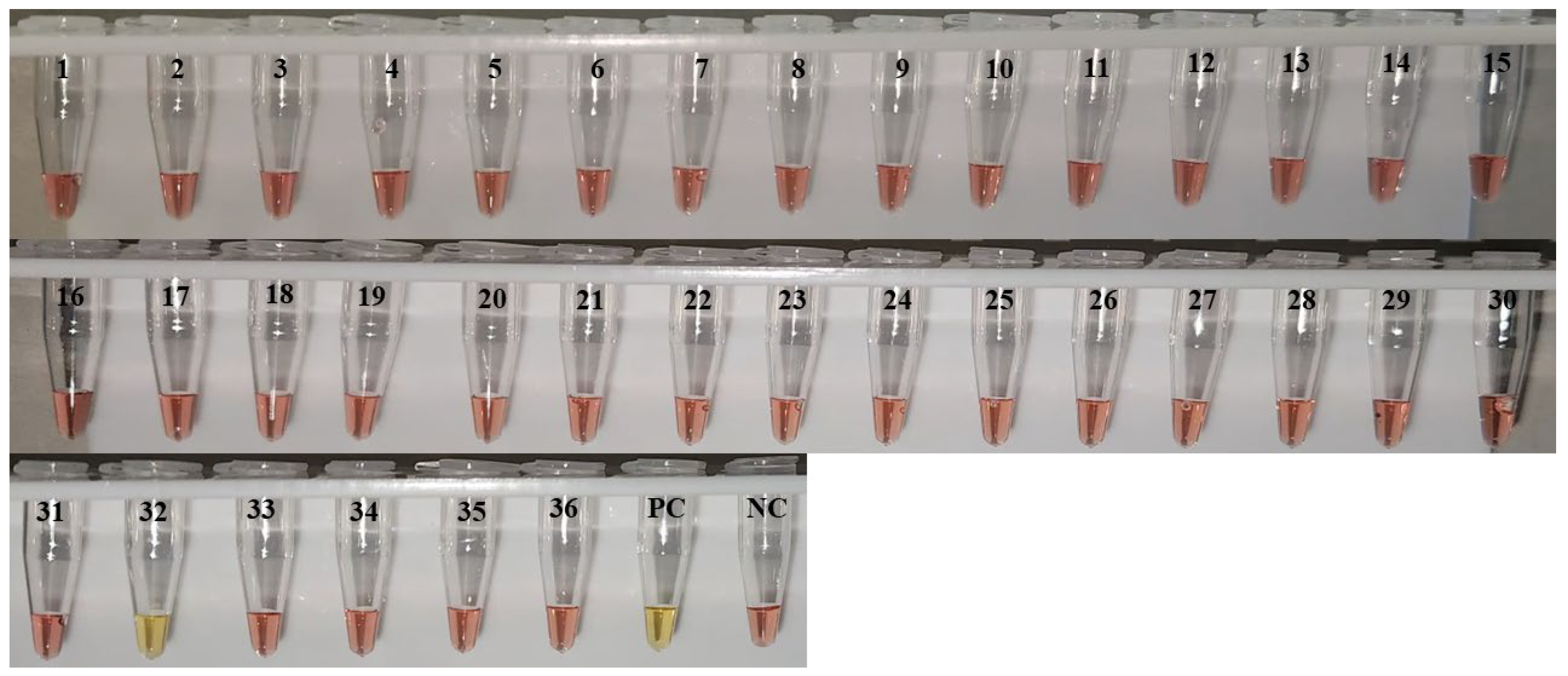
Among the 36 Sabethes pools, only one tested positive for YFV, pool 32, composed of Sa. albiprivus specimens (Figure 2). This result was confirmed by three independent retests (Figure S1). The positive pool contained 10 mosquitoes collected in the municipality of São Martinho, corresponding to a MIR of 11.63. No YFV-infected mosquitoes were detected in the remaining pools, including the 24 pools of Hg. leucocelaenus (Table 2), a species traditionally recognised as a YF vector [13].
Sabethes albiprivus is widely distributed across Brazilian biomes [6,15,38], with confirmed records in the southern states of Paraná [39], Santa Catarina [40], and Rio Grande do Sul [11,16]. YFV-infected individuals have also been reported in Argentina [41] and in Minas Gerais, Brazil [15]. Our study presents the first confirmed natural YFV infection in Sa. albiprivus in southern Brazil, only the second such case in the country and the third globally, highlighting its potential epidemiological importance. In the Brazilian Cerrado, particularly in northern Minas Gerais, Sa. albiprivus has been recognised as a secondary vector, with a MIR of 3.3 [15]. In our study, the recorded MIR of 11.6 is nearly three times higher, suggesting a greater role in YFV circulation in southern Brazil. Its involvement in YFV maintenance and secondary transmission has previously been proposed [6,15], and laboratory studies have confirmed its vector competence [42].
Rezende et al. [43] reported the introduction and permanence of YFV in southeastern Brazil from 2016 to 2018, emphasising that ecological and climatic conditions outside the Amazon Basin, such as those in the Atlantic Forest, can support viral maintenance during interepidemic periods. Our findings align with this, as YFV was detected in 2023, nearly two years after the 2021 sylvatic outbreak, indicating continued circulation despite the absence of active transmission. This persistence likely reflects complex vector-host dynamics and possible hidden transmission cycles that may remain undetected. Overall, the evidence suggests that Sa. albiprivus played a secondary role in YFV transmission and contributed to viral maintenance in the region.
During the 2021 sylvatic YFV outbreak in southern Santa Catarina, NHPs of the genus Alouatta Lacépède, 1799, acted as the main amplifying hosts of YFV and suffered high mortality. Although NHPs are central to the sylvatic transmission cycle, susceptibility differs across species, with some surviving infection and potentially acting as transient reservoirs [44]. The detection of neutralising antibodies in other mammals, including agoutis, porcupines, and anteaters [45], further suggests that these species may act as incidental hosts, potentially expanding the range of mosquito vectors involved.
Although Sa. albiprivus is typically associated with the forest canopy, these mosquitoes also occur across multiple vertical strata, which increases their likelihood of contact with diverse vertebrate hosts [15,22] and thereby facilitates YFV transmission. The ability of YFV to infect several mammalian species and to be transmitted by multiple mosquito taxa likely contributes to its persistence in natural environments [46]. Vertical transmission in mosquitoes may also help maintain the virus during interepidemic periods. However, further research is needed to clarify the role of non-primate mammals and vertical transmission in sustaining the sylvatic YFV cycle. Evidence also suggests that YFV can persist in the Atlantic Forest for at least three consecutive transmission seasons without requiring new introductions [47].
During the last sylvatic YF outbreak in Brazil, Hg. leucocelaenus was considered a primary vector due to its wide distribution, abundance, and high natural infection rates [6]. This species has been detected with YFV in several regions [6,44], including the southern state of Rio Grande do Sul [16]. In our study, 103 Haemagogus specimens were collected, including 91 Hg. leucocelaenus, yet none tested positive for viral RNA, despite their presence across all five sampled municipalities affected by the outbreak in Santa Catarina.
The absence of viral detection in Hg. leucocelaenus may reflect low viral circulation at the time of sampling in the absence of the main amplifying hosts (Alouatta spp.), and low viral loads in mosquitoes. In addition, dilution of genetic material during pool formation, which can reduce sensitivity, especially in pools with low viral loads, may have underestimated the YFV infection rate. Furthermore, the MIR calculation assumes only one infected mosquito per positive pool; therefore, for negative pools, the true infection rate may be higher. Thus, a reported MIR of zero represents only a lower-bound estimate.
The RT-LAMP assay, however, proved to be a reliable tool for detecting YFV in mosquitoes, having been previously optimised through reaction adjustments, validation with varying viral concentrations, and rigorous cross-contamination control [17]. Although the 153 pools tested negative, the collections yielded valuable insights into mosquito activity and dispersal in the region and confirmed residual viral circulation in the secondary vector Sa. albiprivus.
Although Hg. janthinomys is traditionally recognised as the primary sylvatic vector of YFV in Brazil [6,13,20], with a distribution ranging from northern Argentina and southern Brazil to Honduras and Nicaragua [20], both our study and previous surveys [48] reported a pseudo-absence of this species in Santa Catarina. This is noteworthy because Li et al. [48] modelled its environmental suitability and identified Santa Catarina as a highly suitable area for its occurrence. Despite using effective collection methods, including entomological nets and canopy traps baited with CO2 [27], we did not detect Hg. janthinomys in any of our sampling sites. In contrast, Hg. leucocelaenus was consistently collected across the study area. The absence of Hg. janthinomys therefore suggests that Hg. leucocelaenus, together with Sa. albiprivus, may have played a key role in sustaining transmission during the recent YF outbreak in Santa Catarina. Haemagogus leucocelaenus accounted for 2.1% of the total mosquitoes and was detected in all municipalities, comparable in abundance and distribution to Sa. albiprivus, the only species found YFV-positive in this study. Although infection was observed in Sa. albiprivus, the widespread presence and well-documented high vector competence of Hg. leucocelaenus strongly support its role as the primary vector in the region.
The five municipalities surveyed are small, with urban areas directly bordering natural habitats. These regions are characterised by fragmented vegetation linked by ecological corridors, facilitating mosquito movement in search of blood meals [8,20]. The high dispersal capacity of YFV vectors, even in partially deforested landscapes [20], combined with declines in NHP populations due to habitat loss and YF-related mortality, reduces available blood sources and promotes mosquito dispersal [8,14]. This highlights the need for continuous and integrated surveillance capable of detecting silent transmission, even in areas where human cases or epizootics are absent. Under these conditions, the surveyed municipalities represent high-risk areas for YFV transmission. Consequently, widespread yellow fever vaccination campaigns are strongly recommended in these and surrounding regions, given the ongoing circulation of YFV and its sylvatic vectors.

4. Conclusions

This study represents the first survey of sylvatic mosquito fauna with natural YFV infection in the state of Santa Catarina. The detection of naturally infected Sa. albiprivus highlights its role as an important vector in the maintenance and transmission of the virus.
The absence of Hg. janthinomys and the presence of Hg. leucocelaenus suggest a potential change in local vector dynamics, particularly in areas where NHP populations were severely impacted.
Given the continued circulation of the virus and the presence of competent vectors, this study underscores the importance of sustained entomological surveillance and expanded vaccination coverage to prevent future outbreaks in the region.

Supplementary Materials

The following supporting information can be downloaded at: https://www.mdpi.com/article/10.3390/insects17050464/s1, Table S1: Mosquito species captured by municipality. Collection sites: Braço do Norte (BN), Pedras Grandes (PG), Rio Fortuna (RF), São Martinho (SM), Santa Rosa de Lima (SRL). Canopy-level collection: Specimens were captured using CDC-type traps baited with CO2 (CDC), as well as manually using an entomological net and a Castro-type oral aspirator (NET). Ground-level collection: Mosquitoes were manually collected at ground level using an entomological net and a Castro-type oral aspirator.; Figure S1: RT-LAMP assay performed on a Sabethes albiprivus positive pool for YFV. The reaction was performed in triplicate. Reaction temperature: 65 °C; reaction time: 60 min. Yellow indicates a positive result; pink indicates a negative result. R1–R3: replicates 1 to 3. NC: negative control (nuclease-free water); PC: positive control (YFV RNA, vaccine strain 17D).

Author Contributions

S.F.C. drafted the manuscript and collected the mosquito samples. S.F.C., A.N.P., A.A.G.Y., I.C.P., J.V.C.G. and L.D.P.R. contributed to data generation and analysis. Sample processing and molecular analyses were performed by S.F.C., A.A.G.Y., I.C.P., L.A.O.K. and J.V.C.G. Mosquito identification was carried out by L.A.O.K., S.F.C. and M.S.A.S.N., D.C.-L., M.S.A.S.N., R.R.G. and J.S.P. provided essential support with project logistics. A.N.P. and L.D.P.R. contributed to manuscript preparation through critical review and served as the principal investigators, overseeing the study’s design and coordination. All authors have read and agreed to the published version of the manuscript.

Funding

This work was supported by CNPq-INCT-EM, and the Welcome Trust (grant number: 207486/Z/17/Z).

Institutional Review Board Statement

All members of the research team were vaccinated against YFV prior to the commencement of the study. To minimise the risk of exposure to pathogens during fieldwork, the team also wore personal protective equipment, including long-sleeved clothing, caps, and boots.

Data Availability Statement

The datasets used and/or analysed the current study are available from the corresponding author upon reasonable request.

Acknowledgments

We would like to thank the Municipal Health Departments of Santa Rosa de Lima, Rio Fortuna, Braço do Norte, São Martinho, and Pedras Grandes for their support in the entomological collections. We also extend our gratitude to the Department of Microbiology, Immunology, and Parasitology at the Federal University of Santa Catarina (UFSC) for donating YFV RNA (vaccine strain 17D), which was used as a positive control in the experiments.

Conflicts of Interest

The authors declare that they have no competing interests. This paper is part of the Ph.D. thesis of Sabrina Fernandes Cardoso from the Graduate Program of Cell and Developmental Biology (PPGBCD) at the Biological Sciences Center (CCB) at the Federal University of Santa Catarina (UFSC), Florianópolis, Brazil.

Abbreviations

The following abbreviations are used in this manuscript:
NHPNon-human primates
YFVYellow fever virus
YFYellow fever
MMetres
MIRMinimum infection rate
RTReverse transcription
LAMPLoop-mediated isothermal amplification
CDC-LTCDC Light traps
RNARibonucleic acid
ZIKVZika virus
NCNegative control
PCPositive control

References

  1. Harbach, R.E. Culicidae. Mosquito Taxonomic Inventory. 2025. Available online: https://mosquito-taxonomic-inventory.myspecies.info/simpletaxonomy/term/6045 (accessed on 5 April 2025).
  2. Guedes, M.L.P. Culicidae (Diptera) no Brasil: Relações entre enfermidades, distribuição e enfermidades. Oecol. Aust. 2012, 16, 283–296. [Google Scholar] [CrossRef]
  3. Vasconcelos, P.F. Yellow Fever. Rev. Soc. Bras. Med. Trop. 2003, 36, 275–293. [Google Scholar] [CrossRef] [PubMed]
  4. Postler, T.S.; Beer, M.; Blitvich, B.J.; Bukh, J.; de Lamballerie, X.; Drexler, J.F.; Imrie, A.; Kapoor, A.; Karganova, G.G.; Lemey, P.; et al. Renaming of the genus Flavivirus to Orthoflavivirus and extension of binomial species names within the family Flaviviridae. Arch. Virol. 2023, 168, 224. [Google Scholar] [CrossRef] [PubMed]
  5. McArthur, D.B. Emerging Infectious Diseases. Nurs. Clin. N. Am. 2019, 54, 297–311. [Google Scholar] [CrossRef] [PubMed]
  6. Abreu, F.V.S.; Ribeiro, I.P.; Ferreira-de-Brito, A.; Santos, A.A.C.D.; Miranda, R.M.; Bonelly, I.S.; Neves, M.S.A.S.; Bersot, M.I.; Santos, T.P.D.; Gomes, M.Q.; et al. Haemagogus leucocelaenus and Haemagogus janthinomys are the primary vectors in the major yellow fever outbreak in Brazil, 2016–2018. Emerg. Microbes Infect. 2019, 8, 218–231. [Google Scholar] [CrossRef]
  7. Barrett, A.D.T. The reemergence of yellow fever. Science 2018, 31, 847–848. [Google Scholar] [CrossRef]
  8. Possas, C.; Lourenço-de-Oliveira, R.; Tauil, P.L.; Pinheiro, F.P.; Pissinatti, A.; Cunha, R.V.D.; Freire, M.; Martins, R.M.; Homma, A. Yellow fever outbreak in Brazil: The puzzle of rapid viral spread and challenges for immunisation. Mem. Inst. Oswaldo Cruz 2018, 113, e180278. [Google Scholar] [CrossRef]
  9. Giovanetti, M.; Pinotti, F.; Zanluca, C.; Fonseca, V.; Nakase, T.; Koishi, A.C.; Tscha, M.; Soares, G.; Dorl, G.G.; Marques, A.E.M.L.; et al. Genomic epidemiology unveils the dynamics and spatial corridor behind the Yellow Fever virus outbreak in Southern Brazil. Sci. Adv. 2023, 9, eadg9204. [Google Scholar] [CrossRef]
  10. Forattini, O.P. Culicidologia Médica: Identificação, Biologia e Epidemiologia, Volume 2; EDUSP—Editora da Universidade de São Paulo: São Paulo, Brazil, 2002; 864p. [Google Scholar]
  11. Cardoso, J.C.; de Almeida, M.A.; dos Santos, E.; da Fonseca, D.F.; Sallum, M.A.; Noll, C.A.; Monteiro, H.A.; Cruz, A.C.; Carvalho, V.L.; Pinto, E.V.; et al. Yellow fever virus in Haemagogus leucocelaenus and Aedes serratus mosquitoes, southern Brazil, 2008. Emerg. Infect. Dis. 2010, 16, 1918–1924. [Google Scholar] [CrossRef]
  12. Moreno, E.S.; Rocco, I.M.; Bergo, E.S.; Brasil, R.A.; Siciliano, M.M.; Suzuki, A.; Silveira, V.R.; Bisordi, I.; Souza, R.P. Reemergence of yellow fever: Detection of transmission in the State of São Paulo, Brazil, 2008. Rev. Soc. Bras. Med. Trop. 2011, 44, 290–296. [Google Scholar] [CrossRef]
  13. Abreu, F.V.S.; Ferreira-de-Brito, A.; Azevedo, A.S.; Linhares, J.H.R.; de Oliveira Santos, V.; Hime, M.E.; Neves, M.S.A.S.; Yousfi, L.; Ribeiro, I.P.; Santos, A.A.C.D.; et al. Survey on Non-Human Primates and Mosquitoes Does not Provide Evidences of Spillover/Spillback between the Urban and Sylvatic Cycles of Yellow Fever and Zika Viruses Following Severe Outbreaks in Southeast Brazil. Viruses 2020, 12, 364. [Google Scholar] [CrossRef] [PubMed]
  14. Pinheiro, G.G.; Rocha, M.N.; de Oliveira, M.A.; Moreira, L.A.; Andrade, F.J.D. Detection of Yellow Fever Virus in Sylvatic Mosquitoes during Disease Outbreaks of 2017–2018 in Minas Gerais State, Brazil. Insects 2019, 10, 136. [Google Scholar] [CrossRef] [PubMed]
  15. de Oliveira, C.H.; Andrade, M.S.; Campos, F.S.; Cardoso, J.C.; Gonçalves-Dos-Santos, M.E.; Oliveira, R.S.; Aquino-Teixeira, S.M.; Campos, A.A.; Almeida, M.A.; Simonini-Teixeira, D.; et al. Yellow Fever Virus Maintained by Sabethes Mosquitoes during the Dry Season in Cerrado, a Semiarid Region of Brazil, in 2021. Viruses 2023, 15, 757. [Google Scholar] [CrossRef] [PubMed]
  16. Vasconcelos, P.F.; Sperb, A.F.; Monteiro, H.A.; Torres, M.A.; Sousa, M.R.; Vasconcelos, H.B.; Mardini, L.B.; Rodrigues, S.G. Isolations of yellow fever virus from Haemagogus leucocelaenus in Rio Grande do Sul State, Brazil. Trans. R. Soc. Trop. Med. Hyg. 2003, 97, 60–62. [Google Scholar] [CrossRef]
  17. Cardoso, S.F.; Yoshikawa, A.A.G.; Pinheiro, I.C.; Granella, L.W.; Couto-Lima, D.; Neves, M.S.A.S.; Mansur, D.S.; Pitaluga, A.N.; Rona, L.D.P. Development and validation of RT-LAMP for detecting yellow fever virus in non-human primates samples from Brazil. Sci. Rep. 2024, 14, 22520. [Google Scholar] [CrossRef]
  18. QGIS Development Team. QGIS Geographic Information System, Version 3.34; Open-Source Geospatial Foundation. 2023. Available online: https://qgis.org (accessed on 30 April 2025).
  19. Da Silva, D.A.; Pfeifer, M.; Pattison, Z.; Vibrans, A.C. Drivers of leaf area index variation in Brazilian Subtropical Atlantic Forests. For. Ecol. Manag. 2020, 476, 118477. [Google Scholar] [CrossRef]
  20. Consoli, R.; de Oliveira, R. Principais Mosquitos de Importância Sanitária no Brasil; Editora FIOCRUZ: Rio de Janeiro, Brazil, 1994; 228p. [Google Scholar]
  21. Lane, J. Neotropical Culicidade; University of São Paulo Publisher: São Paulo, Brazil, 1953; Volume 1, 550p. [Google Scholar]
  22. Neves, M.S.A.S.; Motta, M.A.; Maciel-DE-Freitas, R.; Xavier, A.D.S.; Loureno-de-Oliveira, R.; Silva-DO-Nascimento, T.F. Illustrated identification key to females of the genus Sabethes Robineau-Desvoidy recorded from Brazil (Diptera: Culicidae), in dichotomous and interactive formats, including an updated list of species and new records for the states. Zootaxa 2024, 5406, 253–287. [Google Scholar] [CrossRef]
  23. Silva, S.J.R.D.; Paiva, M.H.S.; Guedes, D.R.D.; Krokovsky, L.; Melo, F.L.; Silva, M.A.L.D.; Silva, A.D.; Ayres, C.F.J.; Pena, L.J. Development and Validation of Reverse Transcription Loop-Mediated Isothermal Amplification (RT-LAMP) for Rapid Detection of ZIKV in Mosquito Samples from Brazil. Sci. Rep. 2019, 9, 4494. [Google Scholar] [CrossRef]
  24. Keesing, F.; Holt, R.D.; Ostfeld, R.S. Effects of species diversity on disease risk. Ecol. Lett. 2006, 9, 485–498. [Google Scholar] [CrossRef]
  25. Biassi, D.L.; Marcondes, C.B.; Wagner, G.; Muller, G.A. Mosquito species collected in a fragmented of the Atlantic Forest bioma in the southern of Brazil. Int. J. Fauna Biol. Stud. 2015, 2, 35–37. [Google Scholar]
  26. Ferreira-de-Freitas, V.; França, R.M.; Bartholomay, L.C.; Marcondes, C.B. Contribution to the Biodiversity Assessment of Mosquitoes (Diptera: Culicidae) in the Atlantic Forest in Santa Catarina, Brazil. J. Med. Entomol. 2017, 54, 368–376. [Google Scholar] [CrossRef] [PubMed]
  27. Deus, J.T.; Mucci, L.F.; Lucheta, R.S.; Pereira, M.; Bergo, E.S.; de Camargo-Neves, V.L.F. Evaluation of Methods to Collect Diurnal Culicidae (Diptera) at Canopy and Ground Strata, in the Atlantic Forest Biome. Insects 2022, 13, 202. [Google Scholar] [CrossRef] [PubMed]
  28. Orlandin, E.; Santos, E.B.; Piovesan, M.; Favretto, M.A.; Schneeberger, A.H.; Souza, V.O.; Muller, G.A.; Wagner, G. Mosquitoes (Diptera: Culicidae) from crepuscular period in an Atlantic Forest area in Southern Brazil. Braz. J. Biol. 2017, 77, 60–67. [Google Scholar] [CrossRef] [PubMed]
  29. Wilkerson, R.C.; Linton, Y.-M.; Strickman, D. Mosquitoes of the World; Johns Hopkins University Press: Baltimore, MD, USA, 2021; Volumes 1 and 2; 1332p, ISBN 978-1-421438-14-6. [Google Scholar]
  30. Tschá, M.K.; Suzukawa, A.A.; Rodrigues-Luiz, G.F.; da Silva, A.M.; Cataneo, A.H.D.; Mattoso Coelho, G.; Ferreira, A.C.; Soares Medeiros, L.C.; Mansur, D.; Zanluca, C.; et al. Pirahy virus: Identification of a new and potential emerging arbovirus in South Brazil. Virus Evol. 2021, 7, veab105. [Google Scholar] [CrossRef]
  31. Arnell, J. Mosquito Studies (Diptera, Culicidae) XXXIII. A Revision of the Scapularis Group of Aedes. Contrib. Am. Entomol. Inst. 1976, 13, 1–144. [Google Scholar]
  32. Cunha, M.S.; Faria, N.R.; Caleiro, G.S.; Candido, D.S.; Hill, S.C.; Claro, I.M.; da Costa, A.C.; Nogueira, J.S.; Maeda, A.Y.; da Silva, F.G.; et al. Genomic evidence of yellow fever virus in Aedes scapularis, southeastern Brazil, 2016. Acta Trop. 2020, 205, 105390. [Google Scholar] [CrossRef]
  33. Barrio-Nuevo, K.M.; Medeiros-Sousa, A.R.; Evangelista, E.; Ceretti-Junior, W.; Fernandes, A.; De Paula, M.B.; Marrelli, M.T.; Oliveira-Christe, R. Occurrence of Limatus Durhamii in Artificial Containers in Atlantic Forest, São Paulo, Brazil. J. Am. Mosq. Control. Assoc. 2025, 41, 26–29. [Google Scholar] [CrossRef]
  34. Barrio-Nuevo, K.M.; Cunha, M.S.; Luchs, A.; Fernandes, A.; Rocco, I.M.; Mucci, L.F.; de Souza, R.; Medeiros-Sousa, A.R.; Ceretti-Junior, W.; Marrelli, M.T. Detection of Zika and dengue viruses in wild-caught mosquitoes collected during field surveillance in an environmental protection area in São Paulo, Brazil. PLoS ONE 2020, 15, e0227239. [Google Scholar] [CrossRef]
  35. Petersen, V.; Santana, M.; Karina-Costa, M.; Nachbar, J.J.; Martin-Martin, I.; Adelman, Z.N.; Burini, B.C. Aedes (Ochlerotatus) scapularis, Aedes japonicus japonicus, and Aedes (Fredwardsius) vittatus (Diptera: Culicidae): Three Neglected Mosquitoes with Potential Global Health Risks. Insects 2024, 15, 600. [Google Scholar] [CrossRef]
  36. Souza, R.P.; Petrella, S.; Coimbra, T.L.; Maeda, A.Y.; Rocco, I.M.; Bisordi, I.; Silveira, V.R.; Pereira, L.E.; Suzuki, A.; Silva, S.J.; et al. Isolation of yellow fever virus (YFV) from naturally infected Haemagogus (Conopostegus) leucocelaenus (diptera, cukicudae) in São Paulo State, Brazil, 2009. Rev. Inst. Med. Trop. 2011, 53, 133–139. [Google Scholar] [CrossRef]
  37. Chen, B.; Sweeny, A.R.; Wu, V.Y.; Christofferson, R.C.; Ebel, G.; Fagre, A.C.; Gallichotte, E.; Kading, R.C.; Ryan, S.J.; Carlson, C.J. Exploring the Mosquito-Arbovirus Network: A Survey of Vector Competence Experiments. Am. J. Trop. Med. Hyg. 2023, 108, 987–994. [Google Scholar] [CrossRef] [PubMed]
  38. Lira-Vieira, A.R.; Gurgel-Gonçalves, R.; Moreira, I.M.; Yoshizawa, M.A.; Coutinho, M.L.; Prado, P.S.; Souza, J.L.; Chaib, A.J.; Moreira, J.S.; Castro, C.N. Ecological aspects of mosquitoes (Diptera: Culicidae) in the gallery forest of Brasília National Park, Brazil, with an emphasis on potential vectors of yellow fever. Rev. Soc. Bras. Med. Trop. 2013, 46, 566–574. [Google Scholar] [CrossRef] [PubMed]
  39. Guimarães, A.E.; Lopes, C.M.; de Mello, R.P.; Alencar, J. Mosquito (Diptera, Culicidae) ecology in the Iguaçu National Park, Brazil: 1 Habitat distribution. Cad. Saude Publica 2003, 19, 1107–1116. [Google Scholar] [CrossRef] [PubMed]
  40. Müller, G.A.; Kuwabara, E.F.; Duque, J.E.; Navarro-Silva, M.A.; Marcondes, C.B. New records of mosquito species (Diptera: Culicidae) for Santa Catarina and Paraná (Brazil). Biota Neotrop. 2008, 8, 211–218. [Google Scholar] [CrossRef]
  41. Goenaga, S.; Fabbri, C.; Dueñas, J.C.; Gardenal, C.N.; Rossi, G.C.; Calderon, G.; Morales, M.A.; Garcia, J.B.; Enria, D.A.; Levis, S. Isolation of yellow fever virus from mosquitoes in Misiones province, Argentina. Vector Borne Zoonotic Dis. 2012, 12, 986–993. [Google Scholar] [CrossRef]
  42. Couto-Lima, D.; Madec, Y.; Bersot, M.I.; Campos, S.S.; Motta, M.A.; Santos, F.B.D.; Vazeille, M.; Vasconcelos, P.F.D.C.; Lourenço-de-Oliveira, R.; Failloux, A.B. Potential risk of re-emergence of urban transmission of Yellow Fever virus in Brazil facilitated by competent Aedes populations. Sci. Rep. 2017, 7, 4848. [Google Scholar] [CrossRef]
  43. Rezende, I.M.; Sacchetto, L.; De Melo, É.M.; Alves, P.A.; Iani, F.C.M.; Adelino, T.É.R.; Duarte, M.M.; Cury, A.L.F.; Bernardes, A.F.L.; Santos, T.A.; et al. Persistence of Yellow fever virus outside the Amazon Basin, causing epidemics in Southeast Brazil, from 2016 to 2018. PLoS Negl. Trop. Dis. 2018, 12, e0006538. [Google Scholar] [CrossRef]
  44. Baranowski, L.A.; Dias, H.G.; Familiar-Macedo, D.; Sabino-Santos, G.; Herrera, H.M.; Slhessarenko, R.D.; Dos Santos, F.B.; Pauvolid-Corrêa, A. Investigation of Yellow Fever Virus at the Human-Animal Interface after a Zika Virus Outbreak in Midwest Brazil. Microorganisms 2024, 12, 594. [Google Scholar] [CrossRef]
  45. de Thoisy, B.; Dussart, P.; Kazanji, M. Wild terrestrial rainforest mammals as potential reservoirs for flaviviruses (yellow fever, dengue 2 and St Louis encephalitis viruses) in French Guiana. Trans. R. Soc. Trop. Med. Hyg. 2004, 98, 409–412. [Google Scholar] [CrossRef]
  46. Monath, T.P. Yellow fever and dengue-the interactions of virus, vector and host in the re-emergence of epidemic disease. Semin. Virol. 1994, 5, 133–145. [Google Scholar] [CrossRef]
  47. Abreu, F.V.S.; Delatorre, E.; Dos Santos, A.A.C.; Ferreira-de-Brito, A.; de Castro, M.G.; Ribeiro, I.P.; Furtado, N.D.; Vargas, W.P.; Ribeiro, M.S.; Meneguete, P.; et al. Combination of surveillance tools reveals that Yellow Fever virus can remain in the same Atlantic Forest area at least for three transmission seasons. Mem. Inst. Oswaldo Cruz 2019, 114, e190076. [Google Scholar] [CrossRef]
  48. Li, S.L.; Acosta, A.L.; Hill, S.C.; Brady, O.J.; de Almeida, M.A.B.; Cardoso, J.D.C.; Hamlet, A.; Mucci, L.F.; de Deus, J.T.; Iani, F.C.M.; et al. Mapping environmental suitability of Haemagogus and Sabethes spp. mosquitoes to understand sylvatic transmission risk of yellow fever virus in Brazil. PLoS Negl. Trop. Dis. 2022, 16, e0010019. [Google Scholar] [CrossRef]
Figure 1. Geographic distribution of sylvatic mosquito collection sites in municipalities of southern Santa Catarina State, Brazil. The map shows, in green, the fragmented Atlantic Forest cover in Brazil and indicates the location of Santa Catarina State, along with the collection points in each municipality. The map was generated using Quantum GIS (QGIS, version 3.34) [18].
Insects 17 00464 g001
Figure 2. RT-LAMP analysis of mosquito pools from the genus Sabethes. RT-LAMP reactions were performed at 65 °C for 60 min. Yellow indicates positive results; pink indicates negative. Tubes 1–31 and 33–36 correspond to Sabethes pools negative for YFV. Tube 32, which comprised Sa. albiprivus specimens, tested positive for YFV. NC = negative control (nuclease-free water); PC = positive control (YFV RNA, vaccine strain 17D).
Insects 17 00464 g002
Table 1. Adult mosquito species, grouped by genus, collected from January to February 2023 in five municipalities of Santa Catarina State, southern Brazil.
Mosquito SpeciesTotalRelative Abundance %Collection Municipalities a
BNPGRFSMSR
Aedes argyrothorax20.052
Aedes crinifer200.46 1 19
Aedes fluviatilis60.145 1
Aedes fulvithorax10.02 1
Aedes rhyacophilus50.11 23
Aedes scapularis2405.515712832419
Aedes serratus370.85 38215
Aedes terrens410.94257 9
Aedes sp.1333.06268413028
Anopheles cruzii1683.86211417287
Anopheles eiseni10.02 1
Anopheles lutzi50.11 14
Anopheles maculipes20.05 2
Anopheles neivai10.02 1
Anopheles sp.621.424393115
Coquillettidiavenezuelensis10.02 1
Coquillettidiashannoni20.05 1 1
Coquillettidia sp.10.02 1
Culex sp.541.242941236
Haemagogusleucocelaenus912.094488256
Haemagogus sp.120.288211
Johnbelkinia sp.40.093 1
Limatusdurhamii3838.808314360925
Limatusparaensis481.10361920
Limatus sp.57113.12432145462
Mansonia wilsoni20.05 1 1
Mansonia sp.290.67 29
Psorophoraferox1874.3084942754
Psorophoralutzii/amazonica20.05 2
Psorophora sp.290.67 11126
Runchomyia sp.992.277725114
Sabethesalbiprivus861.98251651030
Sabethesaurescens10.02 1
Sabethesidiogenes210.4818 3
Sabethesintermedius601.38306 222
Sabethesmelanonymphe280.6414 1112
Sabethespurpureus30.071 11
Sabethesxhyphydes80.1852 1
Sabethes sp.150.347 17
Shannoniana sp.90.2113 5
Trichoprosopondigitatum711.6311117375
Trichoprosopontownsendi90420.7727813110037520
Trichoprosoponsoaresi120.28 5 25
Trichoprosoponvonplesseni430.995 14 24
Trichoprosopon sp.1052.4115 837
Wyeomyia sp.74717.161662846418350
Nº mosquito total435210092510195851455368
a Collection municipalities: BN: Braço do Norte; PG: Pedras Grandes; RF: Rio Fortuna; SM: São Martinho; SR: Santa Rosa de Lima.
Table 2. Numbers of adult mosquitoes from the genera Sabethes, Haemagogus, Aedes, and Psorophora tested for YFV infection, grouped by the number of pools tested, showing the number of positive pools and the corresponding minimum infection rates (MIR).
Mosquito SpeciesNº MosquitoesPools Tested (Positives)MIR
Sabethesalbiprivus8610 (1)11.63
Sabethesintermedius608 (0)0
Sabethesmelanonymphe275 (0)0
Sabethesidiogenes213 (0)0
Sabethesxhyphydes83 (0)0
Sabethespurpureus33 (0)0
Sabethesaurescens11 (0)0
Sabethes sp.153 (0)0
Haemagogusleucocelaenus9124 (0)0
Haemagogus sp.125 (0)0
Aedes argyrothorax21 (0)0
Aedes crinifer203 (0)0
Aedes fluviatilis62 (0)0
Aedes fulvithorax11 (0)0
Aedes rhyacophilus52 (0)0
Aedes scapularis24026 (0)0
Aedes serratus376 (0)0
Aedes terrens415 (0)0
Aedes sp.13315 (0)0
Psorophoraferox18721 (0)0
Psorophoralutzii/amazonica21 (0)0
Psorophora sp.296 (0)0
Total102715411.63
Disclaimer/Publisher’s Note: The statements, opinions and data contained in all publications are solely those of the individual author(s) and contributor(s) and not of MDPI and/or the editor(s). MDPI and/or the editor(s) disclaim responsibility for any injury to people or property resulting from any ideas, methods, instructions or products referred to in the content.