Article

Gravid Anopheles stephensi Detects Indole for Oviposition Despite the Ablation of Antennae and Maxillary Palps


Biology Department, New Mexico State University, Las Cruces, NM 88003, USA
*
Author to whom correspondence should be addressed.
Insects 2026, 17(4), 377; https://doi.org/10.3390/insects17040377
Submission received: 22 January 2026 / Revised: 20 March 2026 / Accepted: 27 March 2026 / Published: 1 April 2026

Simple Summary

This study explores how female Anopheles stephensi mosquitoes decide where to lay their eggs, a choice that strongly influences mosquito populations and disease transmission. Mosquitoes depend on chemical cues from water sources to find suitable sites. This research aims to understand which scents attract or repel them and which sensory organs detect these cues. First, we showed that mosquitoes were attracted to water associated with early-stage larvae but avoided water from later stages, likely because it signaled poorer conditions for larval growth with the presence of uncharacterized chemicals derived from mosquito larvae and microbes in the water. Then we tested the effect of a single cue, indole, a known oviposition cue. The results showed that gravid mosquitoes exhibit a preference for egg-laying over a wide range of indole concentrations. Removing the mosquitoes’ main olfactory organs, the antennae and maxillary palps, did not eliminate preference for indole, hinting that other sensory parts, such as the legs, may be able to detect indole cues in the context. Corroborating this possibility, the transcripts of the indole-detecting olfactory genes are detected in leg tissues. Overall, the findings shed light on a previously overlooked aspect of mosquito behavior and suggest new ways to disrupt breeding and control mosquito populations, ultimately benefiting public health.

Abstract

Oviposition site selection is critical for mosquito population dynamics. Gravid mosquitoes rely on chemical cues to identify suitable breeding habitats. However, the sensory mechanisms governing this behavior in Anopheles stephensi remain poorly understood. Here, we examined the role of indole, a microbial volatile associated with aquatic environments, in oviposition site choice and assessed the involvement of sensory organs in its detection. In two-choice oviposition assays, water conditioned with first-instar larvae attracted gravid females (OAI = 0.56). In contrast, water from fourth-instar larvae was repellent (OAI = −0.20), consistent with avoidance of suboptimal, resource-depleted habitats. Single indole cue elicited strong oviposition attraction across a broad concentration range (0.5–50 µM), with no clear dose–response relationship. Surgical ablation of antennae and maxillary palps did not abolish indole-mediated preference but significantly reduced behavioral variability, suggesting that these structures modulate, rather than solely mediate, indole detection. Reanalysis of transcriptomes of antennae, maxillary palps, and legs in An. gambiae and An. coluzzii, along with quantitative RT-PCR in An. stephensi revealed the expression of chemosensory genes (including Obp1, Obp13, Obp25, Obp71, Or2, and Or10) in the legs, suggesting a potential role for leg chemosensation in oviposition decisions. These findings underscore the complexity of chemoperception in mosquito habitat assessment.

1. Introduction

Oviposition site selection is a critical stage in the mosquito life cycle, profoundly influencing population dynamics, larval development, and vector-borne disease transmission. Gravid females assess potential breeding habitats with care, aiming to maximize offspring survival while minimizing risks such as predation, desiccation, and resource scarcity. This decision-making process is shaped by a variety of environmental and sensory signals [1,2]. These oviposition decisions play a key role in determining the spatial and temporal distribution of mosquito populations, where even minor environmental characteristics can impact species persistence and pathogen transmission risk. Underpinning this complex behavior is an intricate sensory system, comprising the eyes, antennae, maxillary palps, and legs, that detects and integrates diverse environmental information [3,4,5,6]. The antennae function as the principal olfactory organ, detecting volatile chemical cues over long distances to guide females toward suitable oviposition sites [4]. The maxillary palps assist in short-range odor [7]. Taste sensilla in proboscis, tarsi, and, in some cases, the antenna and palps are responsible for taste cue evaluation [8], while the legs facilitate contact chemosensation, allowing assessment of the site’s chemical makeup upon landing [4]. In the context of oviposition habitat selection, theoretically, through multisensory integration, mosquitoes would refine discrimination among potential habitats, thereby increasing the probability of successful egg deposition. Despite its importance, the functional role of specific sensory appendages in oviposition-site selection remains poorly understood.
Humidity detection is critical for gravid mosquitoes when locating aquatic habitats to lay eggs. In Anopheles gambiae and Aedes aegypti, the ionotropic receptor gene Ir92a, expressed in the antennae, plays a central role in mediating hygrosensation-driven water localization [9]. Chemical signals also significantly influence oviposition choices [10]. Volatile organic compounds such as indole, nonane, geosmin, fatty acids, and microbial metabolites function as attractants or deterrents, providing information about water quality, larval density, and the presence of conspecifics or predators [10]. Among microbial volatiles, indole (an aromatic heterocyclic compound) is particularly notable for its potent biological activity. Along with other volatiles, it guides gravid females in identifying suitable oviposition sites [11,12]. Indole triggers strong electrophysiological responses in the antennal sensilla of An. gambiae [11,13]. It is detected by odorant-binding protein 1 (Obp1) [14], a process that may involve heterodimerization with Obp4 [15]. Odorant receptors Or2 and Or10 appear to function as specific receptors for indole and skatole, respectively [16,17], and share a common ancestral origin across mosquito lineages [18]. Although indole is commonly found in natural oviposition substrates [11,12,19], studies examining its role as a standalone compound in oviposition site selection remain limited.
Over the past decade, the originally Asian malaria vector mosquito, Anopheles stephensi, has invaded and established itself in Africa [20]. Its high vector competence for malaria transmission poses a significant epidemiological concern [21,22]. The chemosensory gene repertoire of this species has been annotated at the genomic level [23,24]. However, oviposition behavior and the associated sensory mechanisms in An. stephensi remain poorly understood. Here, we demonstrate that indole alone acts as an oviposition attractant for gravid An. stephensi mosquitoes. Remarkably, the ablation of antennae and maxillary palps does not impair the indole-induced preference.

2. Materials and Methods

2.1. Mosquitoes

An. stephensi STE2 was acquired from the BEI MR4 repository. The mosquitoes were reared under controlled environmental conditions at 28 °C and 80% relative humidity, with a 12-h light/12-h dark cycle. Blood feeding from mice was used to stimulate egg production. Adult mosquitoes were provided with a 10% sucrose solution. Eggs were transferred to water pans (20 cm × 30 cm × 3.5 cm) containing 1 L of deionized water (DI) and 20 mg of larval diet composed of brewer’s yeast and rodent food pellets in a 1:1 weight ratio.

2.2. Oviposition Activity Index Assay

Female mosquitoes aged 3–5 days were blood-fed on mice. On day 3 (72 h) after blood feeding, 60–70 gravid mosquitoes were released into a cage measuring 100 cm (L) × 50 cm (W) × 50 cm (H) for an oviposition bioassay. Two egg-collecting cups were positioned diagonally within the cage, each containing 200 mL of either control water or substrate water along with a piece of filter paper. The cups were placed approximately 110 cm apart. Replicate experiments were conducted for each substrate. To minimize positional bias, the locations of the cups were switched between replicate experiments. The cups remained in the cage overnight to allow egg laying. Eggs deposited on the filter paper were subsequently counted under a microscope. Oviposition substrate preference was determined by the Oviposition Activity Index (OAI), calculated as OAI = (Ns − Nc)/(Ns + Nc), where Ns represents the number of eggs laid in the substrate cup and Nc the number in the control cup. An OAI of zero (0) indicates no preference for either of the two cups in the cage. An OAI greater than zero indicates a preference for substrate (larval water or indole), whereas an OAI less than zero indicates a preference for DI water control. A substrate with an OAI value between 0 and +1.0 was defined as attractive, whereas a substrate with an OAI value between 0 and −1.0 was defined as deterrent.

2.3. Measurement of Oviposition Response to Larval Water

The oviposition response of gravid mosquitoes to different habitat waters was evaluated using the OAI assay. DI water served as the control. The test substrates consisted of habitat water collected from rearing pans containing either 200 first- or fourth-instar larvae. Water containing first-instar larvae was collected 72 h after egg hatching, while water with fourth-instar larvae was obtained when the larvae had reached the fourth instar stage. Prior to the assays, larvae were removed, and only the habitat water was used as the substrate. The experiment was conducted with 6 biological replicates. First- and fourth-instar water were collected from 6 respective larval pans for the experiments.

2.4. Measurement of Oviposition Response to Indole

Indole was obtained from Sigma-Aldrich. In the OAI assays, oviposition responses were evaluated with freshly prepared indole water at concentrations of 0.1, 0.5, 1, 10, 30, and 50 μM, with DI water as the control. The range of indole concentrations was selected empirically, partially based on a documented observation, in which gravid An. gambiae antennae respond to indole at 1 ng/μL (0.85 μM) measured by electroantennography [11].

2.5. Ablation of Antennae and Maxillary Palps in OAI Assays

We performed surgical ablation of the antennae and maxillary palps (AMP) in gravid mosquitoes. The AMP-ablated individuals were subsequently evaluated using an oviposition attraction index (OAI) assay to assess the role of these sensory structures in oviposition behavior. At 48 h post-bloodmeal (PBM), females underwent AMP ablation and were maintained on 10% sucrose solution until 72 h PBM, at which point their response to 1 µM indole was tested in the OAI assay. Egg-laying was not affected by the ablation; the total number of eggs between the two groups did not differ, as tested by the Mann-Whitney U test (U = 47, p = 0.853). Oviposition behavior was compared between AMP-ablated mosquitoes and intact gravid controls. Both groups were derived from the same rearing cage, and OAI assays were conducted concurrently to reduce potential bias.

2.6. Statistical Analysis of OAI Data

Normality of OAI values was evaluated using the Shapiro–Wilk test. Substrate (larval water or indole) preference was tested using a one-sample t-test. The one-sample t-test determines preference by examining whether the mean OAI of replicates for a substrate (larval water or indole) differs from zero (no preference) when both a substrate and a DI water control are present in the assay cage for gravid mosquitoes to choose from. The differences in variance between ablated and intact controls were assessed using the Levene test [25] and the Fligner–Killeen test [26]. Comparisons of OAI between groups with ablated antennae and maxillary palps and intact controls were conducted using Welch’s t-test, also known as the unequal variances t-test. The Kruskal–Wallis test was used to compare the OAIs across indole concentrations (0.5–50 µM). All statistical analyses were performed at a significance level of α = 0.05.

2.7. RNA Extraction and Quantitative RT-PCR

Total RNA was isolated from antennae, maxillary palps, and legs (comprising the coxa, trochanter, femur, tibia, and tarsus). Tissue samples were homogenized in TRIzol reagent (Invitrogen, Carlsbad, CA, USA), followed by RNA extraction and purification using the Invitrogen PureLink™ RNA Mini Kit according to the manufacturer’s instructions. Genomic DNA was removed using Turbo DNase (Invitrogen). Total RNA concentration was quantified using a Qubit™ 4 Fluorometer (Thermo Fisher Scientific, Waltham, MA, USA). For cDNA synthesis, more than 100 ng of total RNA was used as input. Reverse transcription was performed using the SuperScript™ IV kit (Invitrogen) according to the manufacturer’s protocol. Quantitative PCR was performed using Luna Universal qPCR Master Mix (New England Biolabs, Ipswich, MA, USA) on a CFX thermocycler (Bio-Rad, Hercules, CA, USA), and data were analyzed with CFX Maestro software v2.3 (Bio-Rad). In qRT-PCR data analysis, target gene transcript levels were normalized to the level of the gene encoding the 40S ribosomal protein S29, which was selected for its even expression across the sensory tissues examined in this study. Primer sequences are provided in Table 1.

2.8. Reanalysis of RNA-Seq Datasets

Three previously published RNA-seq datasets profiling the chemosensory transcriptomes of antennae, maxillary palps, and legs [27,28,29] (Table 2) were reanalyzed using the RNA-seq analysis module of the CLC Genomics Workbench v.25 (Qiagen, Hilden, Germany). Anopheles coluzzii [30], originally known as the M molecular form of An. gambiae [31]. The protein-coding genes have nearly identical sequences between An. gambiae and An. coluzzii. Therefore, RNA-seq reads from both species were aligned to the An. gambiae PEST genome reference. Briefly, raw reads were trimmed and then mapped to annotated genes from the PEST genome (VectorBase release 68). Transcripts per million (TPM) values were compared across conditions as described in the original studies.

3. Results

3.1. Oviposition Response to Habitat Water

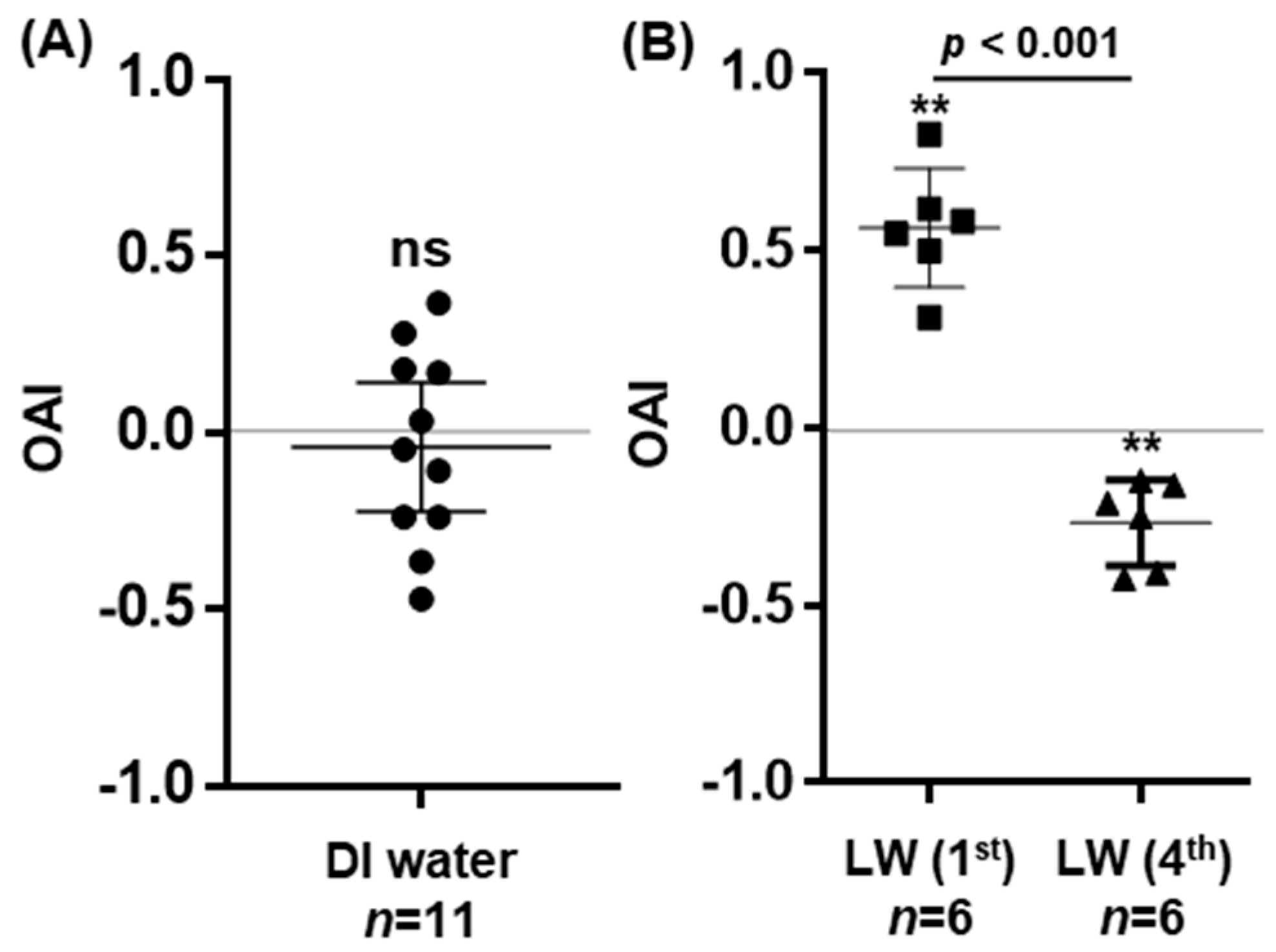
We employed the OAI assay to assess gravid mosquitoes’ preference for different substrates. DI water served as the control. Under conditions with two control water cups present in the assay cage, gravid An. stephensi mosquitoes were expected to exhibit no preference. Consistent with this expectation, the OAI values were randomly distributed across both sides over 11 experimental replicates. The mean OAI was −0.04 (95% CI: −0.22 to 0.14), indicating no preference, which was statistically supported by the one-sample t-test (t = 0.488, p = 0.629), suggesting no inherent bias in the experimental setup and indicating that mosquitoes oviposited equally in both water containers without a preference for either of the DI cups (Figure 1A). Subsequently, we assessed the oviposition preferences of gravid mosquitoes for larval water with first- or fourth-instar larvae, respectively. As illustrated in Figure 1B, water from the first-instar stage was attractive to gravid mosquitoes, yielding an OAI of 0.56 ± 0.07 (M ± SD) with the preference statistically supported by a one-sample t-test (t = 8.244, p < 0.004). In contrast, water from the fourth-instar stage elicited a deterrent effect, with an OAI of −0.20 ± 0.09 (one-sample t-test, t = 8.244, p < 0.004). The different preference between the two larval waters was statistically significant (unpaired t-test, t = 9.857, p < 0.0001), supporting a strong substrate-specific effect on oviposition behavior. This pattern demonstrates the dynamic nature of oviposition cues in the larval habitats.

3.2. Oviposition Response to Indole

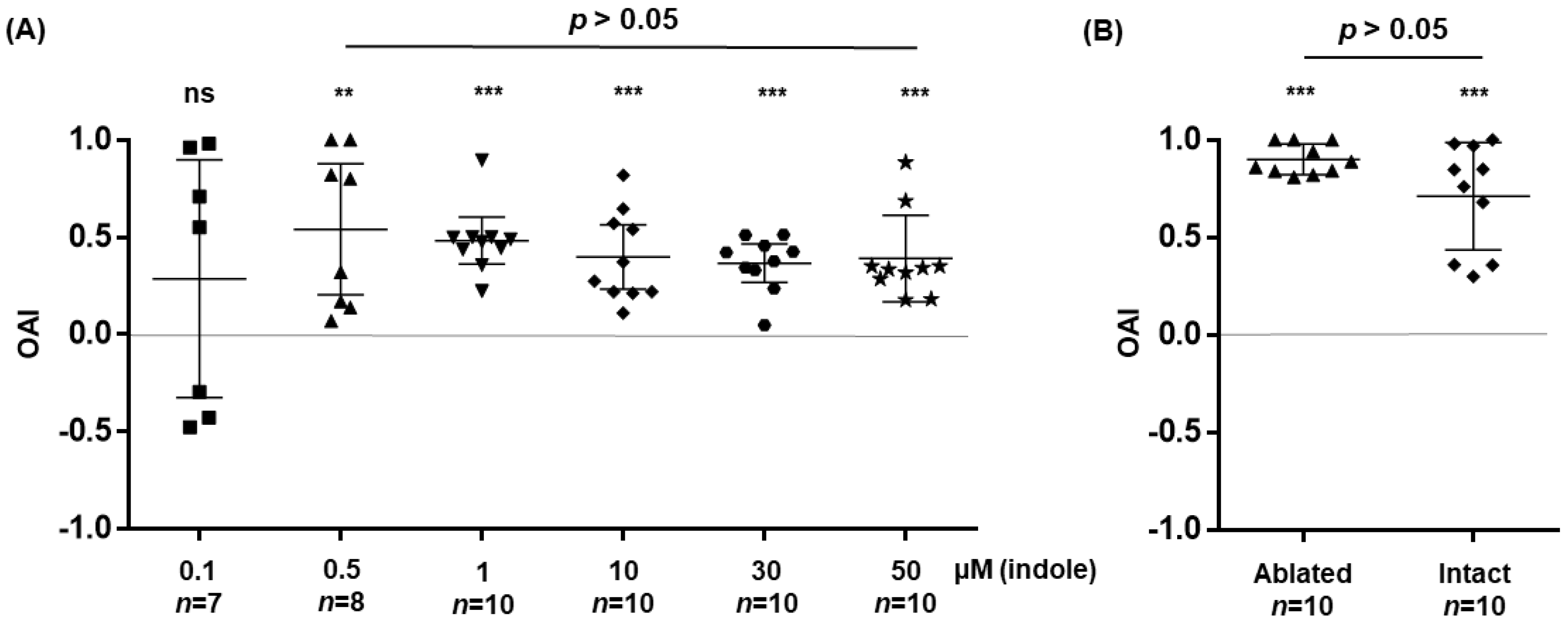
Larval water contains chemical blends derived from mosquitoes and microbial metabolites. It is impractical to tease out olfactory cues that are attractive or deterrent. The oviposition cue indole can be recognized by mosquito Obp1, Obp4, and O2 [14,15,16,17]. We decided to use the OAI assay to assess the influence of indole on oviposition preference in gravid An. stephensi mosquitoes. OAI was measured at six indole concentrations (0.1, 0.5, 1, 10, 30, and 50 μM), with DI water as the control in the two-choice setup. OAIs were displayed in Figure 2A. Gravid mosquitoes consistently laid more eggs in cups containing indole at concentrations of 0.5–50 µM. The preference for indole substrates over DI water was statistically supported by one-sample t-tests in each of the concentrations of 0.5–50 µM (p < 0.007 in 0.5 μM, p < 0.001 in other concentrations). However, no dose-dependent effect was detected across the tested concentrations, as the OAIs were not significantly different, as tested by the Kruskal–Wallis test (KW = 2.713, p = 0.607). The 0.1 µM indole did not induce attraction or deterrence (one-sample t-test, t = 1.145, p = 0.296), indicating that 0.1 µM indole did not affect oviposition in the setup.

3.3. Effect of Antennal and Maxillary Palp Ablation on Oviposition Response

Genes Obp1 and Obp4 are expressed abundantly in the antennae and maxillary palps in An. gambiae [29] and An. coluzzii [27] (see Table S1). To assess the role of these sensory organs in mediating indole preference during oviposition, we surgically removed the antennae and maxillary palps from blood-fed An. stephensi mosquitoes at 48 h PBM. The ablation did not affect egg-laying behavior, as the total number of eggs laid by ablated and intact control mosquitoes did not differ statistically (see Section 2.5). We then evaluated the OAI using 1 μM indole in both ablated and control gravid mosquitoes. As shown in Figure 2B, a preference for indole was detected in both the ablated and intact mosquito cohorts, with statistical support from the one-sample t-test (ablated cohort: t = 36.49, p < 0.001; intact cohort: t = 8.166, p < 0.001). No significant OAI difference was observed between the ablated and intact control mosquitoes (Welch’s t-test, t = 2.097, p = 0.061), indicating that ablation of antennae and maxillary palps did not diminish the overall attraction to indole under this experimental setup. Intriguingly, OAI values in ablated mosquitoes exhibited less variability than those in intact controls (Figure 2B). The mean OAI was numerically higher in ablated females (M ± SD = 0.907 ± 0.027) than in intact females (M ± SD = 0.750 ± 0.087), indicating greater response variability among intact individuals. The heterogeneity in variance between the two groups was confirmed by an F-test (F = 12.440, p = 0.009), as well as by Levene’s test (L = 6.889, p = 0.017) and the Fligner-Killeen test (FK = 5.309, p = 0.021). The markedly narrower distribution of OAI values in the ablated group suggests greater behavioral consistency. Overall, the OAI distribution patterns in Figure 2B indicate that antennae and maxillary palps are dispensable in the indole detection during oviposition.

3.4. Transcriptomic Pattern of Chemosensory Genes in Antennae, Maxillary Palps and Legs

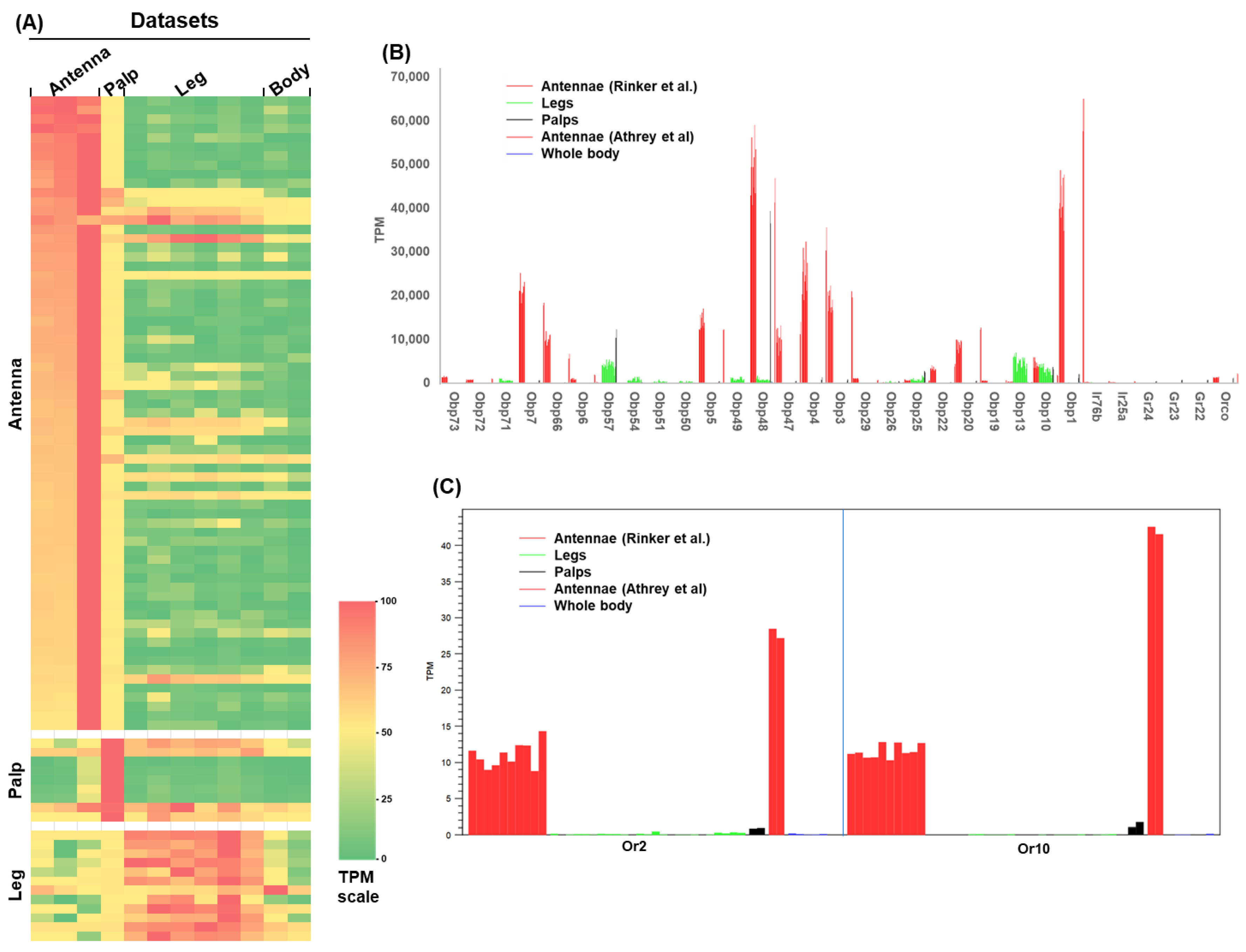
The findings from the above oviposition assays indicate that sensory structures other than the antennae and maxillary palps may be involved in detecting indole during oviposition. However, the role of the legs in habitat selection is poorly understood. It has been proposed that tarsal sensilla may perceive taste signals upon contact with the water surface of the habitat [1,32]. Several chemosensory transcriptome datasets are available from previous studies, including those of An. gambiae antennae [29], An. coluzzii antennae, maxillary palps [27], and legs [28]. To gain insight into the expression patterns of chemosensory genes in the sensory appendages, we compared transcript abundance of the genes encoding odorant-binding proteins, odorant receptors, gustatory receptors, and ionotropic receptors across these organs. We reanalyzed these datasets. Since the datasets were generated in different studies, direct comparison of expression levels may not be appropriate. We therefore normalized the TPM values for each gene by dividing them by the TPM of BTF3 (AGAP006614), which encodes basic transcription factor 3. BTF3 is a conserved transcriptional regulator that acts as a general cofactor for RNA polymerase II [33], indicating its involvement in gene transcription and its suitability as an indicator of general transcriptional activity. Across the datasets, BTF3 exhibited a TPM range of 307–732 (Table S1), which is lower than that of the gene encoding 40S ribosomal protein S7 (AGAP010592; TPM range: 893–3250), a commonly used housekeeping gene in qPCR normalization. After normalization to BTF3 TPM, the maximum normalized TPM value for each gene was set as 100, and all other TPM values were divided by this maximum value to represent relative abundance across organs. If a gene whose average scaled abundance in an organ is greater than 2-fold than in the other two organs, this gene is defined as abundant in this organ. Figure 3 displays a heatmap of relative transcriptional abundances for 92 sensory genes whose original, unnormalized TPM values exceeded 20 in at least one organ. The sensory genes were grouped into three clusters based on their relative abundance: genes with higher expression in antennae, palps, and legs, respectively (Figure 3A). These genes showed organ-abundant expression patterns. For instance, Obp20, Obp47, Obp3 (AGAP001409), Obp7, Obp66, Obp1, Obp4, and Obp5 were predominantly abundant in antennae; Obp48 was abundant in both antennae and palps; Obp57 was abundant in palps and legs. In contrast, Obp13, Obp71, Obp49, and Obp54 were primarily abundant in legs (Figure 3B). Obp genes were expressed at substantially higher levels than odorant receptor (Or), gustatory receptor (Gr), and ionotropic receptor (Ir) genes. Or2 and Or10 were abundantly expressed in antennae and palps (Figure 3C).
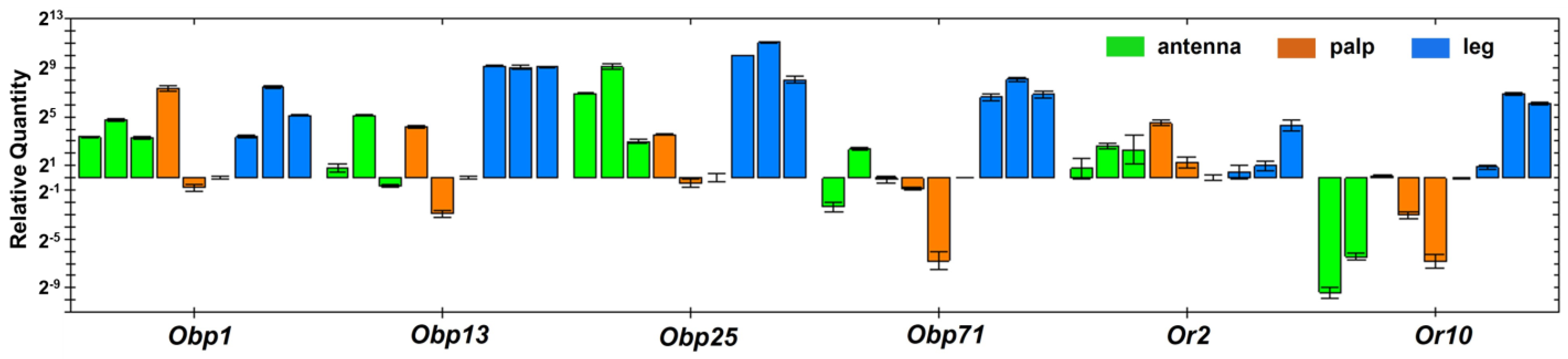
In An. stephensi, the expression profiles of sensory genes have not yet been characterized at the transcriptome level. Using qRT-PCR, we compared the transcript levels of Obp1, Obp13, Obp25, Obp71, Or2, and Or10 across antennae, palps, and legs. As illustrated in Figure 4, the expression levels and reproducibility among three biological replicates for each chemosensory gene are visually summarized. Obp1 was highly expressed in antennae and legs relative to palps, whereas Obp13, Obp25, and Obp71 showed greater abundance in legs than in antennae or palps. Or2 and Or10 belong to the conserved indole-sensitive Or2/Or10 clade [18]. Or2 was detected in all three organs, with considerable variation observed among replicates within each tissue. In contrast, Or10 expression was markedly higher in the legs than in the antennae and palps.

4. Discussion

Oviposition site selection is critical in the mosquito life cycle. Substantial research has been conducted in An. gambiae to identify the cues that gravid mosquitoes detect during oviposition site selection. An. stephensi, originally a malaria vector native to South Asia and the Persian Gulf region, has emerged over the past decade as an invasive, urban-adapted vector that is now well-established and expanding across numerous African countries [34]. The ecology of invasive An. stephensi in Africa has been the subject of recent studies [20]. Nevertheless, knowledge regarding the chemical ecology governing its oviposition behavior remains limited [10,35]. In An. coluzzii, experimental evidence indicates that water conditioned by low-density or early-instar larvae attracts gravid females, whereas water conditioned by high densities and/or later instars (including fourth instars) becomes increasingly repellent. The oviposition index shifts from positive to strongly negative as larval developmental stage and conditioning duration increase [36]. In this study, we found a similar trend in An. stephensi (Figure 1). Gravid females deposit significantly more eggs in cups containing water previously inhabited by first-instar larvae compared to water from fourth-instar larvae, indicating an attraction to cues from early larval stages and a deterrent effect from those of later stages. This attraction to first-instar water is likely due to lower concentrations of larval and microbial metabolites, suggesting reduced competition for resources. In contrast, fourth-instar water may reflect resource depletion, increased oxygen and organic matter consumption. According to Suh et al. (2016), repellent volatile semiochemicals, such as dimethyl disulfide (DMDS), dimethyl trisulfide (DMTS), and 6-methyl-5-hepten-2-one (sulcatone), were detected in water from suboptimal larval habitats [36]. In a pull-push assay, An. gambiae s.l. was attracted to nonane and 2,4-pentanedione (2,4-PD), both found in larval water across stages, but repelled by DMDS and DMTS, which are present predominantly in late-stage larval water [37]. In our experimental setup, metabolites derived from mosquito larvae and associated microorganisms accumulate as larvae develop. Further research is needed to identify the specific chemical compounds responsible for these attractive and repellent effects. Characterization of the dynamic nature of oviposition cues in larval habitats requires further investigation.
Indole and its derivatives are recognized as key infochemicals that, depending on the context, guide mosquitoes in locating and assessing aquatic oviposition sites [10]. Their functions vary by species, concentration, and the surrounding chemical mixture. Both indole and 3-methylindole (skatole) have been identified as volatile compounds associated with oviposition sites [11,19,38,39]. Previous research on chemically mediated oviposition has largely employed assays using water containing bacteria or plant-derived blends [12,40]. In the present study, we examined the influence of indole as a single cue on oviposition behavior to assess its contribution to habitat selection. Indole-containing water attracted mosquitoes to oviposit across a concentration range of 0.5–50 µM. (Figure 2A).
The most striking finding of this study is that surgical removal of the antennae and maxillary palps did not attenuate the oviposition preference mediated by indole (Figure 2B). Although the mean OAI did not differ significantly between ablated and intact mosquitoes, the ablated group showed a stronger preference for indole with a significantly lower index variance. This lower variability implies that inputs from the antennae and maxillary palps may introduce modulatory or even competing sensory signals, thereby increasing behavioral variability rather than being essential for indole detection. The persistent attraction to indole even after removal of the antennae and palps suggests the involvement of additional chemosensory structures, challenging the prevailing view that the antenna is the primary olfactory organ guiding oviposition site selection [11].
Legs emerge as potential candidates for indole detection in this context. Transcriptome reanalysis and qRT-PCR experiments demonstrate that several chemosensory genes, including Obp1, Obp13, Obp25, Obp71, Or2, and Or10, are abundantly or preferentially expressed in the legs (Figure 3 and Figure 4). Notably, Obp1 is an indole-binding Obp [14]. Or2 and Or10 belong to an evolutionarily conserved clade that mediates indole and skatole recognition across Dipteran lineages [18,41]. The detectable expression of Obp1, Or2, and Or10 in the legs, together with the other leg-enriched Obp genes, raises the possibility that tarsal olfactory chemoreception may contribute functionally to habitat evaluation. In the OAI assays, gravid females land on filter paper, bringing their tarsi into near proximity with the indole-containing water surface. Under these experimental conditions, tarsal chemosensory and/or contact-mediated input may complement or even dominate volatile detection, suggesting a multi-organ model for indole detection in An. stephensi. These findings warrant further investigation to test the hypothesis that oviposition site selection involves multiple sensory organs acting redundantly or synergistically in detecting olfactory cues. While antennal detection of long-range cues may guide initial orientation toward breeding sites, close-range or contact-mediated detection by tarsi may finalize the oviposition decision. The persistence of indole preference after antennal ablation implies that other chemosensation structures may be sufficient under these laboratory conditions. Whether this holds in natural settings with greater spatial complexity and competing cues remains to be tested.
In Culex quinquefasciatus, the labrum within the proboscis contributes to short-range detection of 4-ethylphenol (4EP), a compound that modulates both oviposition and blood-feeding behaviors [42]. Notably, the indole receptor Or10 ortholog CqOr21 was also found to be expressed in the proboscis stylet, although the functional role of the proboscis in responding to indole was not examined in that study [42]. In our experimental setup, the proboscis remained intact. Thus, we cannot exclude the possibility that the proboscis participates in indole reception under our conditions.
Overall, this study demonstrates that oviposition chemosensation in An. stephensi involves a system with multiple sensory appendages, implying that the legs and/or other sensory structures may play a previously underappreciated role in habitat selection behavior. From a vector control perspective, clarifying the chemosensory mechanisms underlying oviposition opens avenues for developing attract-and-kill or push–pull strategies targeting gravid mosquitoes [1,2,6]. The ongoing invasive spread of An. stephensi throughout Africa underscores the urgency for interventions tailored to species-specific behavioral traits. Field validation of indole-based oviposition attractants may offer crucial translational insights.

Supplementary Materials

The following supporting information can be downloaded at: https://www.mdpi.com/article/10.3390/insects17040377/s1, Table S1: Scaled TPM heatmap. Table S2: Raw TPM values.

Author Contributions

Conceptualization, J.X.; methodology, J.A., J.X.; formal analysis, J.A., J.X.; writing—original draft preparation, J.A.; writing—editing and finalizing, J.X. All authors have read and agreed to the published version of the manuscript.

Funding

This research received no external funding.

Data Availability Statement

This study used three previously published RNA-seq datasets, which were reanalyzed. The BioProject IDs for these datasets are provided in Table 2.

Acknowledgments

The authors thank the Biology Department, College of Arts and Sciences, New Mexico State University, for its financial support. During the preparation of this manuscript, the authors used Perplexity.ai for organizing the relevant literature. Grammarly was integrated into MS Word while writing to refine grammar, tone, and clarity. The authors have reviewed and edited the output and take full responsibility for the content of this publication.

Conflicts of Interest

The authors declare no conflicts of interest.

Abbreviations

The following abbreviations are used in this manuscript:
ObpOdorant-binding protein
OrOdorant receptor
GrGustatory receptor
IrIonotropic receptor
OAIOviposition activity index
TPMTranscript per million
DIDistill water
LWLarval water
AMPAntenna and maxillary palp
PBMPost blood meal

References

  1. Bentley, M.D.; Day, J.F. Chemical Ecology and Behavioral Aspects of Mosquito Oviposition. Annu. Rev. Entomol. 1989, 34, 401–421. [Google Scholar] [CrossRef]
  2. Day, J.F. Mosquito oviposition behavior and vector control. Insects 2016, 7, 65. [Google Scholar] [CrossRef] [PubMed]
  3. Konopka, J.K.; Task, D.; Afify, A.; Raji, J.; Deibel, K.; Maguire, S.; Lawrence, R.; Potter, C.J. Olfaction in Anopheles mosquitoes. Chem. Senses 2021, 46, bjab021. [Google Scholar] [CrossRef]
  4. Montell, C. The sensory arsenal mosquitoes use to find us. Trends Parasitol. 2025, 41, 591–602. [Google Scholar] [CrossRef]
  5. Wheelwright, M.; Whittle, C.R.; Riabinina, O. Olfactory systems across mosquito species. Cell Tissue Res. 2021, 383, 75–90. [Google Scholar] [CrossRef]
  6. Xiong, S.; Liang, J.; Gao, S.; Liu, Z.; Zheng, H.; Yang, X.; Wang, Y.; Yu, S. The chemosensory world of mosquitoes: Olfactory receptors and their role in blocking mosquito-borne disease transmission. Parasit Vectors 2025, 18, 324. [Google Scholar] [CrossRef] [PubMed]
  7. Lu, T.; Qiu, Y.T.; Wang, G.; Kwon, J.Y.; Rutzler, M.; Kwon, H.W.; Pitts, R.J.; van Loon, J.J.A.; Takken, W.; Carlson, J.R.; et al. Odor Coding in the Maxillary Palp of the Malaria Vector Mosquito Anopheles gambiae. Curr. Biol. 2007, 17, 1533–1544. [Google Scholar] [CrossRef] [PubMed]
  8. Lomelí, A.M.; Dahanukar, A.A. Single-Sensillum Taste Recordings in Mosquitoes. Cold Spring Harb. Protoc. 2024, 2024, pdb.prot108195. [Google Scholar] [CrossRef] [PubMed]
  9. Laursen, W.J.; Budelli, G.; Tang, R.; Chang, E.C.; Busby, R.; Shankar, S.; Gerber, R.; Greppi, C.; Albuquerque, R.; Garrity, P.A. Humidity sensors that alert mosquitoes to nearby hosts and egg-laying sites. Neuron 2023, 111, 874–887.e878. [Google Scholar] [CrossRef]
  10. Mwingira, V.; Mboera, L.E.G.; Dicke, M.; Takken, W. Exploiting the chemical ecology of mosquito oviposition behavior in mosquito surveillance and control: A review. J. Vector Ecol. 2020, 45, 155–179. [Google Scholar] [CrossRef]
  11. Blackwell, A.; Johnson, S.N. Electrophysiological investigation of larval water and potential oviposition chemo-attractants for Anopheles gambiae s.s. Ann. Trop. Med. Parasitol. 2000, 94, 389–398. [Google Scholar] [CrossRef]
  12. Lindh, J.M.; Borg-Karlson, A.K.; Faye, I. Transstadial and horizontal transfer of bacteria within a colony of Anopheles gambiae (Diptera: Culicidae) and oviposition response to bacteria-containing water. Acta Trop. 2008, 107, 242–250. [Google Scholar] [CrossRef]
  13. Meijerink, J.; Braks, M.A.H.; Brack, A.A.; Adam, W.; Dekker, T.; Posthumus, M.A.; Beek, T.A.V.; Loon, J.J.A.V. Identification of olfactory stimulants for Anopheles gambiae from human sweat samples. J. Chem. Ecol. 2000, 26, 1367–1382. [Google Scholar] [CrossRef]
  14. Biessmann, H.; Andronopoulou, E.; Biessmann, M.R.; Douris, V.; Dimitratos, S.D.; Eliopoulos, E.; Guerin, P.M.; Iatrou, K.; Justice, R.W.; Kröber, T.; et al. The Anopheles gambiae odorant binding protein 1 (AgamOBP1) mediates indole recognition in the antennae of female mosquitoes. PLoS ONE 2010, 5, e9471. [Google Scholar] [CrossRef]
  15. Davrazou, F.; Dong, E.; Murphy, E.J.; Johnson, H.T.; Jones, D.N.M. New insights into the mechanism of odorant detection by the malaria-transmitting mosquito Anopheles gambiae. J. Biol. Chem. 2011, 286, 34175–34183. [Google Scholar] [CrossRef] [PubMed]
  16. Carey, A.F.; Wang, G.; Su, C.Y.; Zwiebel, L.J.; Carlson, J.R. Odorant reception in the malaria mosquito Anopheles gambiae. Nature 2010, 464, 66–71. [Google Scholar] [CrossRef] [PubMed]
  17. Wang, G.; Carey, A.F.; Carlson, J.R.; Zwiebel, L.J. Molecular basis of odor coding in the malaria vector mosquito Anopheles gambiae. Proc. Natl. Acad. Sci. USA 2010, 107, 4418–4423. [Google Scholar] [CrossRef] [PubMed]
  18. Bohbot, J.D.; Jones, P.L.; Wang, G.; Pitts, R.J.; Pask, G.M.; Zwiebel, L.J. Conservation of indole responsive odorant receptors in mosquitoes reveals an ancient olfactory trait. Chem. Senses 2011, 36, 149–160. [Google Scholar] [CrossRef]
  19. Lindh, J.M.; Kannaste, A.; Knols, B.G.; Faye, I.; Borg-Karlson, A.K. Oviposition responses of Anopheles gambiae s.s. (Diptera: Culicidae) and identification of volatiles from bacteria-containing solutions. J. Med. Entomol. 2008, 45, 1039–1049. [Google Scholar] [CrossRef]
  20. Zhou, G.; Zhong, D.; Yewhalaw, D.; Yan, G. Anopheles stephensi ecology and control in Africa. Trends Parasitol. 2024, 40, 102–105. [Google Scholar] [CrossRef]
  21. Al-Eryani, S.M.; Irish, S.R.; Carter, T.E.; Lenhart, A.; Aljasari, A.; Montoya, L.F.; Awash, A.A.; Mohammed, E.; Ali, S.; Esmail, M.A.; et al. Public health impact of the spread of Anopheles stephensi in the WHO Eastern Mediterranean Region countries in Horn of Africa and Yemen: Need for integrated vector surveillance and control. Malar. J. 2023, 22, 187. [Google Scholar] [CrossRef] [PubMed]
  22. Takken, W.; Lindsay, S. Increased Threat of Urban Malaria from Anopheles stephensi Mosquitoes, Africa. Emerg. Infect. Dis. 2019, 25, 1431–1433. [Google Scholar] [CrossRef] [PubMed]
  23. Sharma, A.; Dixit, B.; Goyal, B.; Harit, R.; Kumar, J.; Biswas, S.; Goswami, R.; Pandey, K.C.; Emami, S.N.; Chakraborti, S. Olfactory gene dynamics in invasive Indian and non-invasive African malaria vectors at the crossroads of development, infection and resistance. Sci. Rep. 2025, 15, 37696. [Google Scholar] [CrossRef]
  24. Zafar, Z.; Fatima, S.; Bhatti, M.F.; Shah, F.A.; Saud, Z.; Butt, T.M. Odorant Binding Proteins (OBPs) and Odorant Receptors (ORs) of Anopheles stephensi: Identification and comparative insights. PLoS ONE 2022, 17, e0265896. [Google Scholar] [CrossRef]
  25. Levene, H. Robust Tests for Equality of Variances; Olkin, J., Churye, S.G., Hoeffding, W., Madow, W.G., Mann, H.B., Eds.; Stanford University Press: Stanford, CA, USA, 1960. [Google Scholar]
  26. Conover, W.J.; Johnson, M.E.; Johnson, M.M. A comparative study of tests for homogeneity of variances, with applications to the outer continental shelf bidding data. Technometrics 1981, 23, 351–361. [Google Scholar] [CrossRef]
  27. Athrey, G.; Cosme, L.V.; Popkin-Hall, Z.; Pathikonda, S.; Takken, W.; Slotman, M.A. Chemosensory gene expression in olfactory organs of the anthropophilic Anopheles coluzzii and zoophilic Anopheles quadriannulatus. BMC Genom. 2017, 18, 751. [Google Scholar] [CrossRef]
  28. Kefi, M.; Charamis, J.; Balabanidou, V.; Ioannidis, P.; Ranson, H.; Ingham, V.A.; Vontas, J. Transcriptomic analysis of resistance and short-term induction response to pyrethroids, in Anopheles coluzzii legs. BMC Genom. 2021, 22, 891. [Google Scholar] [CrossRef]
  29. Rinker, D.C.; Pitts, R.J.; Zhou, X.; Suh, E.; Rokas, A.; Zwiebel, L.J. Blood meal-induced changes to antennal transcriptome profiles reveal shifts in odor sensitivities in Anopheles gambiae. Proc. Natl. Acad. Sci. USA 2013, 110, 8260–8265. [Google Scholar] [CrossRef]
  30. Coetzee, M.; Hunt, R.H.; Wilkerson, R.; Della Torre, A.; Coulibaly, M.B.; Besansky, N.J. Anopheles coluzzii and Anopheles amharicus, new members of the Anopheles gambiae complex. Zootaxa 2013, 3619, 246–274. [Google Scholar] [CrossRef]
  31. della Torre, A.; Fanello, C.; Akogbeto, M.; Dossou-yovo, J.; Favia, G.; Petrarca, V.; Coluzzi, M. Molecular evidence of incipient speciation within Anopheles gambiae s.s. in West Africa. Insect Mol. Biol. 2001, 10, 9–18. [Google Scholar] [CrossRef] [PubMed]
  32. Baik, L.S.; Carlson, J.R. The mosquito taste system and disease control. Proc. Natl. Acad. Sci. USA 2020, 117, 32848–32856. [Google Scholar] [CrossRef] [PubMed]
  33. Zheng, X.M.; Moncollin, V.; Egly, J.M.; Chambon, P. A general transcription factor forms a stable complex with RNA polymerase B (II). Cell 1987, 50, 361–368. [Google Scholar] [CrossRef] [PubMed]
  34. Dennis, T.P.W.; Sulieman, J.E.; Abdin, M.; Ashine, T.; Asmamaw, Y.; Eyasu, A.; Simma, E.A.; Zemene, E.; Negash, N.; Kochora, A.; et al. The origin, invasion history and resistance architecture of Anopheles stephensi in Africa. bioRxiv 2025. [Google Scholar] [CrossRef]
  35. Sharma, K.R.; Seenivasagan, T.; Rao, A.N.; Ganesan, K.; Agrawal, O.P.; Prakash, S. Mediation of oviposition responses in the malaria mosquito Anopheles stephensi Liston by certain fatty acid esters. Parasitol. Res. 2009, 104, 281–286. [Google Scholar] [CrossRef]
  36. Suh, E.; Choe, D.H.; Saveer, A.M.; Zwiebel, L.J. Suboptimal larval habitats modulate oviposition of the malaria vector mosquito Anopheles coluzzii. PLoS ONE 2016, 11, e0149800. [Google Scholar] [CrossRef]
  37. Schoelitsz, B.; Mwingira, V.; Mboera, L.E.G.; Beijleveld, H.; Koenraadt, C.J.M.; Spitzen, J.; van Loon, J.J.A.; Takken, W. Chemical Mediation of Oviposition by Anopheles Mosquitoes: A Push-Pull System Driven by Volatiles Associated with Larval Stages. J. Chem. Ecol. 2020, 46, 397–409. [Google Scholar] [CrossRef] [PubMed]
  38. Millar, J.G.; Chaney, J.D.; Mulla, M.S. Identification of oviposition attractants for Culex quinquefasciatus from fermented Bermuda grass infusions. J. Am. Mosq. Control Assoc. 1992, 8, 11–17. [Google Scholar]
  39. Syed, Z.; Leal, W.S. Acute olfactory response of Culex mosquitoes to a human- and bird-derived attractant. Proc. Natl. Acad. Sci. USA 2009, 106, 18803–18808. [Google Scholar] [CrossRef]
  40. Ponnusamy, L.; Xu, N.; Böröczky, K.; Apperson, C.S. Oviposition Responses of the Mosquitoes Aedes aegypti and Aedes albopictus to Experimental Plant Infusions in Laboratory Bioassays. J. Chem. Ecol. 2010, 36, 709–719. [Google Scholar] [CrossRef]
  41. Pitts, R.J.; Huff, R.M.; Shih, S.J.; Bohbot, J.D. Identification and functional characterization of olfactory indolergic receptors in Musca domestica. Insect Biochem. Mol. Biol. 2021, 139, 103653. [Google Scholar] [CrossRef]
  42. Choo, Y.M.; Buss, G.K.; Tan, K.; Leal, W.S. Multitasking roles of mosquito labrum in oviposition and blood feeding. Front. Physiol. 2015, 6, 306. [Google Scholar] [CrossRef] [PubMed]
Figure 1. Oviposition preference assays using habitat water (LW). Each data point represents the OAI from a single replicate; each contains 60–70 gravid mosquitoes. The total number of replicates (n) was indicated on the x-axis under the substrate. Mean OAI values are shown with 95% confidence intervals. (A) In assays containing two cups of DI control water, OAI values were randomly distributed, indicating no preference: one-sample t-test, p = 0.629, ns (no significant difference). (B) LW (1st) (First-instar larval water) shows an attractive effect, while LW (4th) (fourth-instar larval water) showed a deterrent effect to gravid mosquitoes. The preference in each assay was statistically tested using the one-sample t-test (p < 0.01, **). The gravid mosquitoes’ preference between the two LW waters was significantly different, as tested by an unpaired t-test (p < 0.001).
Insects 17 00377 g001
Figure 2. Oviposition preference for indole. Each data point corresponds to the OAI from one replicate; each contains 60–70 gravid mosquitoes. The total number of replicates (n) was indicated on the x-axis under the substrate. (A) OAI for indole at various concentrations. (B) Oviposition assays comparing mosquitoes with and without antennae/maxillary palps at 1 µM indole. Preference for indole was tested using the one-sample t-test; ns (no significant difference), ** (p < 0.01), *** (p < 0.001). The OAI between ablated and intact mosquitoes did not differ significantly (Welch’s t-test, p = 0.061). However, the variances of OAI between the cohorts were unequal (Levene’s test, p = 0.017; Fligner-Killeen test, p = 0.021).
Insects 17 00377 g002
Figure 3. Relative transcriptional abundances of chemosensory genes in different sensory organs in An. gambiae and An. coluzzii. (A) The heatmap illustrates the relative abundance of sensory genes (Obp, Or, Gr, and Ir) with TPM values exceeding 20 in at least one dataset. Three gene clusters, each enriched with genes predominantly expressed in the antenna, maxillary palp, and leg, are labeled on the left side. Gene names, original TPM values, and gene function annotation are provided in Tables S1 and S2. The three antenna datasets include sugar-fed (pooled) and blood-fed (pooled) samples of An. gambiae [29], as well as sugar-fed antennae of An. coluzzii [27]. (B,C) TPM profiles of representative genes showing differential expression across replicates of sensory organs. Organs are color-coded for display.
Insects 17 00377 g003
Figure 4. Relative abundance of selected genes in the antennae, palps, and legs measured by qRT-PCR. Three biological replicates were performed for each tissue. Expression levels were normalized to the sample from palp replicate 3. Error bars indicate the variation between two technical replicates on the qPCR plate.
Insects 17 00377 g004
Table 1. PCR Primers.
GeneVectorbase Gene IDForwardReverse
AsOBP13ASTEI20_038550 GACGATGTGGAAGGGTTCGTTCAATGCCATGCTTTTCGGC
AsOBP25ASTEI20_038899 TCTGGATGCGAACGGAAACAGAAGACCTCCCGCGTTACAA
AsOBP71ASTEI20_043657TGACATGATGCGTGAGCTGTCCCGTGGAACTAGCTATGGC
AsOBP1ASTEI20_040727AAAGTGAGGCCACGAGACAGTCCCATCCGAACTTTCGGTG
rpS29ASTEI20_032897GCGTAAATACGGACAGGGCTTGCCGATTTCATTTCAACGC
Or2ASTEI20_033069 TCTACTGGCATGCGAACGAATCGTCGCAACAGTGTGAAGT
Or10ASTEI20_037581GCTGAGGCATCCTACAGTGGCGTTGTGTGCGTACGTTTGT
Table 2. RNA-seq datasets of chemosensory organs.
SpeciesOrganBioProjectPMIDReference
An. gambiaeAntennaPRJNA21507923630291[29]
An. coluzziiLegPRJNA91048934903168[28]
An. coluzziiAntenna, maxillary palpPRJNA40060928938869[27]
Disclaimer/Publisher’s Note: The statements, opinions and data contained in all publications are solely those of the individual author(s) and contributor(s) and not of MDPI and/or the editor(s). MDPI and/or the editor(s) disclaim responsibility for any injury to people or property resulting from any ideas, methods, instructions or products referred to in the content.