Epidemiology, Associated Factors and Implications for Effective Control of Pediculosis Among Primary Schoolgirls in Thailand: A Cross-Sectional Study

 , and
, and
Simple Summary
Abstract
1. Introduction
2. Materials and Methods
2.1. Study Design, Population, and Eligibility Criteria
2.2. Sample-Size Calculation
2.3. Detection of Head Lice
2.4. Data Collection and Measurement
2.5. Statistical Analysis
3. Results
3.1. Study Population and Characteristics
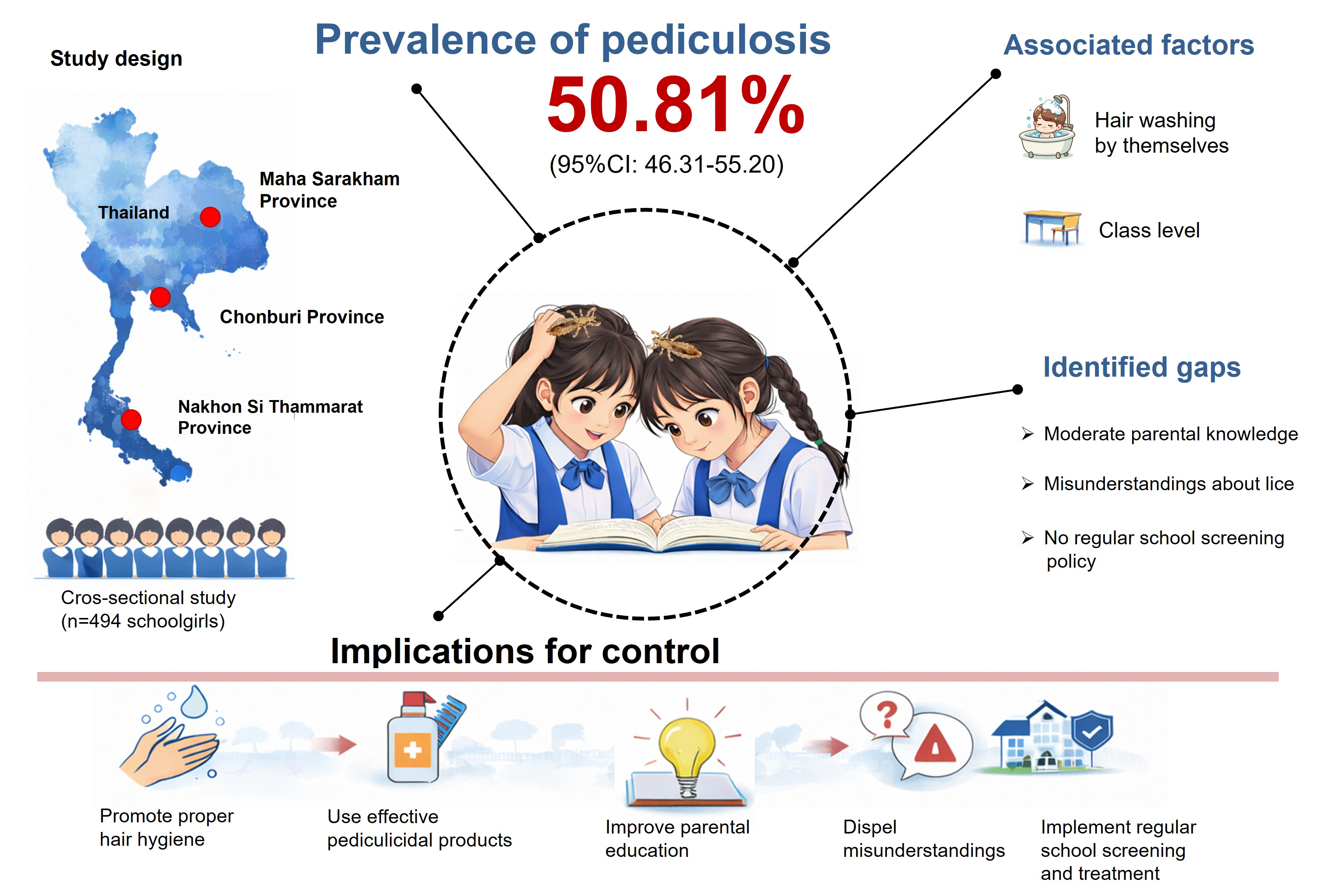
3.2. Prevalence of Pediculosis in Schoolchildren
3.3. Factors Associated with Pediculosis
3.4. Parental Knowledge and Attitudes About Head Lice
3.5. School Health Policy
4. Discussion
4.1. Implications for Effective Control
4.2. Limitations and Future Research
5. Conclusions
Supplementary Materials
Author Contributions
Funding
Institutional Review Board Statement
Informed Consent Statement
Data Availability Statement
Acknowledgments
Conflicts of Interest
References
- Bonilla, D.L.; Durden, L.A.; Eremeeva, M.E.; Dasch, G.A. The biology and taxonomy of head and body lice—implications for louse-borne disease prevention. PLoS Pathog. 2013, 9, e1003724. [Google Scholar] [CrossRef] [Scilit] [PubMed]
- Veracx, A.; Raoult, D. Biology and genetics of human head and body lice. Trends Parasitol. 2012, 28, 563–571. [Google Scholar] [CrossRef] [Scilit] [PubMed]
- Burgess, I.F. Human lice and their control. Annu. Rev. Entomol. 2004, 49, 457–481. [Google Scholar] [CrossRef] [Scilit] [PubMed]
- Light, J.E.; Toups, M.A.; Reed, D.L. What’s in a name: The taxonomic status of human head and body lice. Mol. Phylogenetics Evol. 2008, 47, 1203–1216. [Google Scholar] [CrossRef] [Scilit]
- Hatam-Nahavandi, K.; Ahmadpour, E.; Pashazadeh, F.; Dezhkam, A.; Zarean, M.; Rafiei-Sefiddashti, R.; Salimi-Khorashad, A.; Hosseini-Teshnizi, S.; Hazratian, T.; Otranto, D. Pediculosis capitis among school-age students worldwide as an emerging public health concern: A systematic review and meta-analysis of past five decades. Parasitol. Res. 2020, 119, 3125–3143. [Google Scholar] [CrossRef] [Scilit]
- Falagas, M.E.; Matthaiou, D.K.; Rafailidis, P.I.; Panos, G.; Pappas, G. Worldwide prevalence of head lice. Emerg. Infect. Dis. 2008, 14, 1493–1494. [Google Scholar] [CrossRef] [Scilit]
- Colomba, C.; Scarlata, F.; Di Carlo, P.; Giammanco, A.; Fasciana, T.; Trizzino, M.; Cascio, A. Fourth case of louse-borne relapsing fever in Young Migrant, Sicily, Italy, December 2015. Mini Review Article. Public Health 2016, 139, 22–26. [Google Scholar] [CrossRef] [Scilit]
- Badiaga, S.; Brouqui, P. Human louse-transmitted infectious diseases. Clin. Microbiol. Infect. Off. Publ. Eur. Soc. Clin. Microbiol. Infect. Dis. 2012, 18, 332–337. [Google Scholar] [CrossRef] [Scilit]
- Sunantaraporn, S.; Sanprasert, V.; Pengsakul, T.; Phumee, A.; Boonserm, R.; Tawatsin, A.; Thavara, U.; Siriyasatien, P. Molecular survey of the head louse Pediculus humanus capitis in Thailand and its potential role for transmitting Acinetobacter spp. Parasites Vectors 2015, 8, 127. [Google Scholar] [CrossRef] [Scilit]
- Amanzougaghene, N.; Fenollar, F.; Raoult, D.; Mediannikov, O. Where Are We With Human Lice? A Review of the Current State of Knowledge. Front. Cell. Infect. Microbiol. 2019, 9, 474. [Google Scholar] [CrossRef] [Scilit]
- Toloza, A.C.; Laguna, M.F.; Ortega-Insaurralde, I.; Vassena, C.; Risau-Gusman, S. Insights About Head Lice Transmission From Field Data and Mathematical Modeling. J. Med. Entomol. 2018, 55, 929–937. [Google Scholar] [CrossRef] [Scilit]
- Nolt, D.; Moore, S.; Yan, A.C.; Melnick, L. Head Lice. Pediatrics 2022, 150, e2022059282. [Google Scholar] [CrossRef] [Scilit] [PubMed]
- Mumcuoglu, K.Y.; Pollack, R.J.; Reed, D.L.; Barker, S.C.; Gordon, S.; Toloza, A.C.; Picollo, M.I.; Taylan-Ozkan, A.; Chosidow, O.; Habedank, B.; et al. International recommendations for an effective control of head louse infestations. Int. J. Dermatol. 2021, 60, 272–280. [Google Scholar] [CrossRef] [Scilit] [PubMed]
- Burgess, I.F. Sucking lice and spiracular transpiration: Turning a liability into a benefit and a necessity. J. Exp. Biol. 2022, 225, jeb244041. [Google Scholar] [CrossRef] [Scilit] [PubMed]
- Candy, K.; Brun, S.; Nicolas, P.; Durand, R.; Charrel, R.N.; Izri, A. Do drowning and anoxia kill head lice? Parasite 2018, 25, 8. [Google Scholar] [CrossRef] [Scilit]
- Yingklang, M.; Priprem, A.; Nualkaew, N.; Sungthong, B.; Pinlaor, P.; Pinlaor, S. Biochemical constituents and insecticidal activities of Callistemon viminalis essential oil against adults and eggs of Pediculus humanus capitis (Phthiraptera: Pediculidae). Phytomed. Plus 2022, 2, 100156. [Google Scholar] [CrossRef] [Scilit]
- Karakus, M.; Atici, T.; Karabela, S.N.; Baylan, O.; Limoncu, M.E.; Balcioglu, I.C. Detection of permethrin resistance and phylogenetic clustering of turkish head lice (Pediculus humanus capitis; De Geer, 1767 populations. Acta Trop. 2020, 204, 105362. [Google Scholar] [CrossRef] [Scilit]
- Brownell, N.; Sunantaraporn, S.; Phadungsaksawasdi, K.; Seatamanoch, N.; Kongdachalert, S.; Phumee, A.; Siriyasatien, P. Presence of the knockdown resistance (kdr) mutations in the head lice (Pediculus humanus capitis) collected from primary school children of Thailand. PLoS Negl. Trop. Dis. 2020, 14, e0008955. [Google Scholar] [CrossRef] [Scilit]
- Amanzougaghene, N.; Fenollar, F.; Diatta, G.; Sokhna, C.; Raoult, D.; Mediannikov, O. Mutations in GluCl associated with field ivermectin-resistant head lice from Senegal. Int. J. Antimicrob. Agents 2018, 52, 593–598. [Google Scholar] [CrossRef] [Scilit]
- Hodgdon, H.E.; Yoon, K.S.; Previte, D.J.; Kim, H.J.; Aboelghar, G.E.; Lee, S.H.; Clark, J.M. Determination of knockdown resistance allele frequencies in global human head louse populations using the serial invasive signal amplification reaction. Pest Manag. Sci. 2010, 66, 1031–1040. [Google Scholar] [CrossRef] [Scilit]
- Toloza, A.; Vassena, C.; Gallardo, A.; González-Audino, P.; Picollo, M.I. Epidemiology of Pediculosis capitis in elementary schools of Buenos Aires, Argentina. Parasitol. Res. 2009, 104, 1295–1298. [Google Scholar] [CrossRef] [Scilit] [PubMed]
- Al-Daoody, A.A.K.; Mohammed, A.K.; Jabbary, H.H.M.; Ali, F.A.; Ibrahim, H.A.; Abdullah, K.M.; Mawlud, S.I.; Rahman, S.J. Investigation on prevalence, risk factors, and genetic diversity of Pediculus humanus capitis among primary school children. Cell. Mol. Biol. 2022, 67, 382–389. [Google Scholar] [CrossRef] [Scilit] [PubMed]
- Dagne, H.; Biya, A.A.; Tirfie, A.; Yallew, W.W.; Dagnew, B. Prevalence of Pediculosis capitis and associated factors among schoolchildren in Woreta town, northwest Ethiopia. BMC Res. Notes 2019, 12, 465. [Google Scholar] [CrossRef] [Scilit]
- Kassiri, H.; Mehraghaei, M. Assessment of the prevalence of Pediculosis capitis and related effective features among primary schoolchildren in Ahvaz County, Southwest of Iran. Environ. Sci. Pollut. Res. 2021, 28, 22577–22587. [Google Scholar] [CrossRef] [Scilit] [PubMed]
- Abd El Raheem, T.A.; El Sherbiny, N.A.; Elgameel, A.; El-Sayed, G.A.; Moustafa, N.; Shahen, S. Epidemiological comparative study of Pediculosis capitis among primary school children in Fayoum and Minofiya governorates, Egypt. J. Community Health 2015, 40, 222–226. [Google Scholar] [CrossRef] [Scilit]
- Babazadeh, T.; Kouzekanani, K.; Oliaei, S.; Gaffari-fam, S.; Abbasabad, G.D.; Maleki Chollou, K.; Heidari, S. Assessing the link between head lice infestation and selected cognitive-behavioral factors in a sample of Iranian female adolescents. Heliyon 2020, 6, e03959. [Google Scholar] [CrossRef] [Scilit]
- Soleimani-Ahmadi, M.; Jaberhashemi, S.A.; Zare, M.; Sanei-Dehkordi, A. Prevalence of head lice infestation and pediculicidal effect of permethrine shampoo in primary school girls in a low-income area in southeast of Iran. BMC Dermatol. 2017, 17, 10. [Google Scholar] [CrossRef] [Scilit]
- Heukelbach, J.; Wilcke, T.; Winter, B.; Feldmeier, H. Epidemiology and morbidity of scabies and Pediculosis capitis in resource-poor communities in Brazil. Br. J. Dermatol. 2005, 153, 150–156. [Google Scholar] [CrossRef] [Scilit]
- Thanchomnang, T.; Krittanan, P.; Yangthaworn, K.; Yingklang, M. Treatment failure of over-the-counter pediculicide shampoos in Thai schoolgirls: Evidence of insecticide resistance. Parasitol. Res. 2025, 124, 132. [Google Scholar] [CrossRef] [Scilit]
- Brownell, N.; Sunantaraporn, S.; Seatamanoch, N.; Kumtornrut, C.; Siriyasatien, P. The association between knockdown resistance and treatment outcome of 1% permethrin lotion in head lice infestations in Nonthaburi province, Thailand. Arch. Dermatol. Res. 2024, 316, 684. [Google Scholar] [CrossRef] [Scilit]
- Thavara, U.; Phan-Urai, P.; Malainual, A.; Chansang, C. Pediculosis among schoolchildren in rural areas of Thailand. J. Dep. Med. Sci. 1988, 30, 191–199. [Google Scholar]
- Singhasivanon, O.U.; Lawpoolsri, S.; Mungthin, M.; Yimsamran, S.; Soonthornworasiri, N.; Krudsood, S. Prevalence and Alternative Treatment of Head-Lice Infestation in Rural Thailand: A Community-Based Study. Korean J. Parasitol. 2019, 57, 499–504. [Google Scholar] [CrossRef] [Scilit] [PubMed]
- Ruankham, W.; Winyangkul, P.; Bunchu, N. Prevalence and factors of head lice infestation among primary school students in Northern Thailand. Asian Pac. J. Trop. Dis. 2016, 6, 778–782. [Google Scholar] [CrossRef] [Scilit]
- Kitvatanachai, S.; Kritsiriwutthinan, K.; Taylor, A.; Rhongbutsri, P. Head Lice Infestation in Pre-High School Girls, Lak Hok Suburban Area, Pathum Thani Province, in Central Thailand. J. Parasitol. Res. 2023, 2023, 8420859. [Google Scholar] [CrossRef] [Scilit]
- Rassami, W.; Soonwera, M. Epidemiology of Pediculosis capitis among schoolchildren in the eastern area of Bangkok, Thailand. Asian Pac. J. Trop. Biomed. 2012, 2, 901–904. [Google Scholar] [CrossRef] [Scilit]
- Fisher, M.; Townsend, B.; Harris, P.; Schram, A.; Baum, F. Determinants of health: Overview. In Oxford Textbook of Global Public Health; Detels, R., Karim, Q.A., Baum, F., Li, L., Leyland, A.H., Detels, R., Abdool Karim, Q., Baum, F., Li, L., Eds.; Oxford University Press: Oxford, UK, 2021; pp. 83–92. [Google Scholar]
- Yingklang, M.; Sengthong, C.; Haonon, O.; Dangtakot, R.; Pinlaor, P.; Sota, C.; Pinlaor, S. Effect of a health education program on reduction of pediculosis in school girls at Amphoe Muang, Khon Kaen Province, Thailand. PLoS ONE 2018, 13, e0198599. [Google Scholar] [CrossRef] [Scilit]
- Meister, L.; Ochsendorf, F. Head Lice. Dtsch. Arztebl. Int. 2016, 113, 763–772. [Google Scholar] [CrossRef] [Scilit]
- Sanwang, J.; Maneenin, N.; Jirapornku, C. Factors related to Head Lice Relapsing in Primary School Female Students, Mahasarakham Province. KKU J. Public Health Res. 2020, 14, 80–89. [Google Scholar]
- Buczek, A.; Markowska-Gosik, D.; Widomska, D.; Kawa, I.M. Pediculosis capitis among schoolchildren in urban and rural areas of eastern Poland. Eur. J. Epidemiol. 2004, 19, 491–495. [Google Scholar] [CrossRef] [Scilit]
- Ngamcherdtrakul, P.; Siriboriruk, J.; Annanon, N. Quality of Life among Children with Head Lice; Before and After Treatment. J. Dep. Med. Serv. 2019, 44, 54–61. [Google Scholar]
- Yingklang, M.; Gordon, C.N.; Jaidee, P.H.; Thongpon, P.; Pinlaor, S. Comparative efficacy of chemical and botanical pediculicides in Thailand and 4% dimeticone against head louse, Pediculus humanus capitis. PLoS ONE 2023, 18, e0287616. [Google Scholar] [CrossRef] [Scilit]
- Speare, R.; Harrington, H.; Canyon, D.; Massey, P.D. A systematic literature review of pediculosis due to head lice in the Pacific Island Countries and Territories: What country specific research on head lice is needed? BMC Dermatol. 2014, 14, 11. [Google Scholar] [CrossRef] [Scilit]
- Ziaoddini, A.; Riahi, R.; Heidari-Beni, M.; Ziaoddini, H.; Zamani, S. National and Provincial Prevalence of Pediculus humanus capitis among Urban Students in Iran from 2014 to 2018. J. Res. Health Sci. 2019, 19, e00459. [Google Scholar]
- Kamnuansilpa, P.; Wongthanavasu, S. Grandparents’ Relationships with Grandchildren in Thailand. J. Intergener. Relatsh. 2005, 3, 49–66. [Google Scholar] [CrossRef] [Scilit]
- Ingersoll-Dayton, B.; Punpuing, S.; Tangchonlatip, K.; Yakas, L. Pathways to grandparents’ provision of care in skipped-generation households in Thailand. Ageing Soc. 2018, 38, 1429–1452. [Google Scholar] [CrossRef] [Scilit]
- Gul, U.; Sunantaraporn, S.; Brownell, N.; Siriyasatien, P. High prevalence of knockdown resistance mutations, genetic clade diversity, and detection of Acinetobacter species in head lice (Pediculus humanus capitis) infesting children in a Thai orphanage: A comprehensive survey. Curr. Res. Parasitol. Vector Borne Dis. 2025, 8, 100336. [Google Scholar] [CrossRef] [Scilit]
- Burgess, I.F. Do some families act as a reservoir of head lice in the community? Surveys for prevalence and insecticide resistance suggest this is the case. Parasitol. Res. 2023, 122, 945–952. [Google Scholar] [CrossRef] [Scilit]

| Variables | n | Percentage |
|---|---|---|
| Student class levels | ||
| Kindergarten 1–3 | 64 | 12.96 |
| Elementary grade 1–3 | 176 | 35.63 |
| Elementary grade 4–6 | 254 | 51.41 |
| Religion | ||
| Buddhism | 369 | 74.70 |
| Islam | 125 | 25.30 |
| Length of hair | ||
| Short (Equal shoulders) | 334 | 67.61 |
| Long | 160 | 32.39 |
| Gender of parent/guardian who responded to questionnaire | ||
| Male | 46 | 9.31 |
| Female | 448 | 90.69 |
| Age of parents/guardians (years) | ||
| <30 | 47 | 9.51 |
| 30–39 | 193 | 39.07 |
| 40–49 | 168 | 34.01 |
| 50–59 | 55 | 11.13 |
| ≥60 | 31 | 6.28 |
| Mean ± S.D. (40.77 ± 9.92) | ||
| Status of parents/guardians | ||
| Married | 403 | 81.58 |
| Divorce | 32 | 6.48 |
| Other | 59 | 11.94 |
| Parent’s level of education | ||
| Illiterate | 8 | 1.62 |
| Elementary | 31 | 6.28 |
| Secondary 3 | 192 | 38.87 |
| Secondary 6 | 128 | 25.91 |
| Higher than secondary | 135 | 27.33 |
| Parent’s occupation | ||
| Government official | 14 | 2.84 |
| Agricultural | 57 | 11.56 |
| Retail business | 122 | 24.75 |
| Worker | 225 | 45.64 |
| Other | 75 | 15.21 |
| Income per month (Baht) of the parent completing the questionnaire | ||
| ≥10,000 | 165 | 33.40 |
| <10,000 | 329 | 66.60 |
| Provinces | n | Pediculosis | X2 | p-Value a | |
|---|---|---|---|---|---|
| Yes (%) | No (%) | ||||
| Chonburi | 199 | 62 (31.16) | 137 (68.84) | 54.75 | <0.001 |
| Maha Sarakham | 151 | 89 (58.94) | 62 (41.06) | ||
| Nakhon Si Thammarat | 144 | 100 (69.44) | 44 (30.56) | ||
| All | 494 | 251(50.81) | 243 (49.19) | ||
| Variables | Pediculosis | Crude OR a | Adjusted OR b | 95% CI | p-Value | |
|---|---|---|---|---|---|---|
| Yes (%) | No (%) | |||||
| Student class levels | ||||||
| Kindergarten 1–3 | 10 (15.63) | 54 (84.38) | 1 | |||
| Elementary grade 1–3 | 111 (63.07) | 65 (36.93) | 9.22 | 3.09 | 1.31, 7.29 | 0.010 |
| Elementary grade 4–6 | 130 (51.18) | 124 (48.82) | 5.66 | 1.22 | 0.47, 3.16 | 0.679 |
| Personal hair washing | ||||||
| By parents/guardians | 34 (29.82) | 80 (70.18) | 1 | |||
| By themselves | 217 (57.11) | 163 (42.89) | 3.13 | 2.93 | 1.57, 5.49 | 0.001 |
| History of pediculicide use | ||||||
| No | 107 (42.80) | 143 (57.20) | 1 | |||
| Yes, by chemical | 45 (44.55) | 56 (55.45) | 1.07 | 0.49 | 0.67, 1.94 | 0.874 |
| Yes, by herb | 99 (69.23) | 44 (30.77) | 3.01 | 1.89 | 0.98, 2.81 | 0.059 |
| Parental income per month (baht) | ||||||
| ≥10,000 | 62 (37.58) | 103 (62.42) | 1 | |||
| <10,000 | 189 (57.45) | 140 (42.55) | 2.24 | 1.07 | 0.64, 1.79 | 0.807 |
| Variables | Agree (%) | Disagree (%) |
|---|---|---|
| Head lice are nasty insects. | 466 (94.33) | 31 (6.27) |
| Head lice can cause anemia. | 347 (70.24) | 147 (29.76) |
| Head lice can make children stupid. | 227 (45.95) | 267 (54.05) |
| People infested with head lice are dirty. | 372 (75.30) | 122 (24.70) |
| Head lice should not be treated. | 86 (17.41) | 408 (82.59) |
| Pediculicidal compounds can kill all stages of head lice. | 262 (53.04) | 232 (46.96) |
| Head lice can be transmitted from other children at school. | 459 (92.91) | 35 (7.09) |
| Head lice can be acquired by sharing personal items. | 444 (89.88) | 50 (10.12) |
| Hair washing every day can prevent head louse infestation. | 418 (84.62) | 76 (15.38) |
| Herbal shampoo is more effective for killing head lice than are chemical pediculicide products. | 400 (80.97) | 94 (19.03) |
Disclaimer/Publisher’s Note: The statements, opinions and data contained in all publications are solely those of the individual author(s) and contributor(s) and not of MDPI and/or the editor(s). MDPI and/or the editor(s) disclaim responsibility for any injury to people or property resulting from any ideas, methods, instructions or products referred to in the content. |
© 2026 by the authors. Licensee MDPI, Basel, Switzerland. This article is an open access article distributed under the terms and conditions of the Creative Commons Attribution (CC BY) license.
Share and Cite
Yingklang, M.; Jaidee, P.H.; Janwan, P.; Maleewong, W.; Tran, N.T.D.; Thanchomnang, T. Epidemiology, Associated Factors and Implications for Effective Control of Pediculosis Among Primary Schoolgirls in Thailand: A Cross-Sectional Study. Insects 2026, 17, 413. https://doi.org/10.3390/insects17040413
Yingklang M, Jaidee PH, Janwan P, Maleewong W, Tran NTD, Thanchomnang T. Epidemiology, Associated Factors and Implications for Effective Control of Pediculosis Among Primary Schoolgirls in Thailand: A Cross-Sectional Study. Insects. 2026; 17(4):413. https://doi.org/10.3390/insects17040413
Chicago/Turabian StyleYingklang, Manachai, Patchana Hengboriboonpong Jaidee, Penchom Janwan, Wanchai Maleewong, Na T. D. Tran, and Tongjit Thanchomnang. 2026. "Epidemiology, Associated Factors and Implications for Effective Control of Pediculosis Among Primary Schoolgirls in Thailand: A Cross-Sectional Study" Insects 17, no. 4: 413. https://doi.org/10.3390/insects17040413
APA StyleYingklang, M., Jaidee, P. H., Janwan, P., Maleewong, W., Tran, N. T. D., & Thanchomnang, T. (2026). Epidemiology, Associated Factors and Implications for Effective Control of Pediculosis Among Primary Schoolgirls in Thailand: A Cross-Sectional Study. Insects, 17(4), 413. https://doi.org/10.3390/insects17040413