Diversity Patterns of Insect Assemblages in Tilia cordata Stands in Lithuanian Protected Areas: A Two-Year Study Indicating Modest Support for Pollinator Guilds

 , , and
Simple Summary
Abstract
1. Introduction
2. Materials and Methods
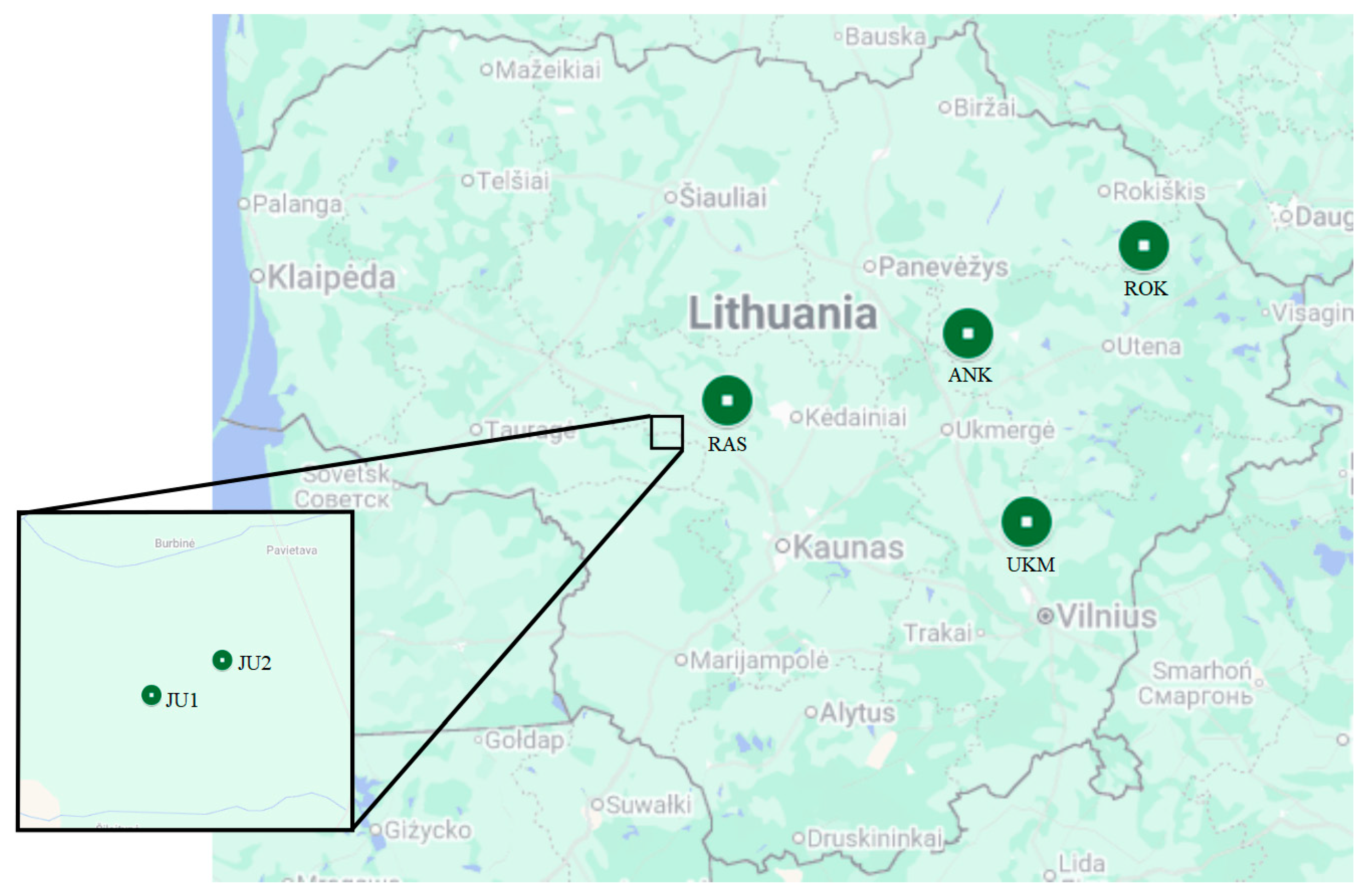
2.1. Study Sites
2.2. Net Sampling
2.3. Sticky Traps
2.4. Insect Identification and Functional Classification
2.5. Statistical Analysis
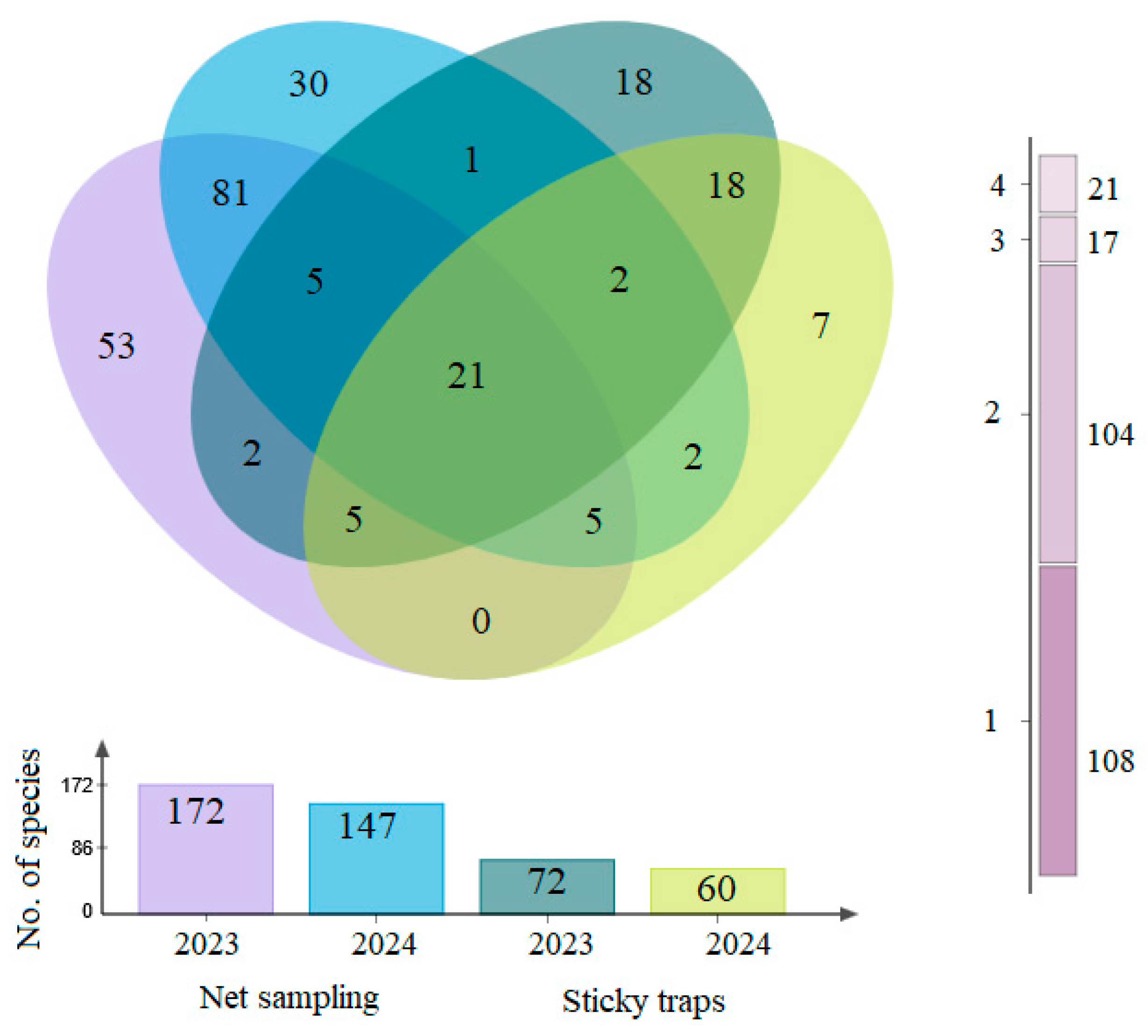
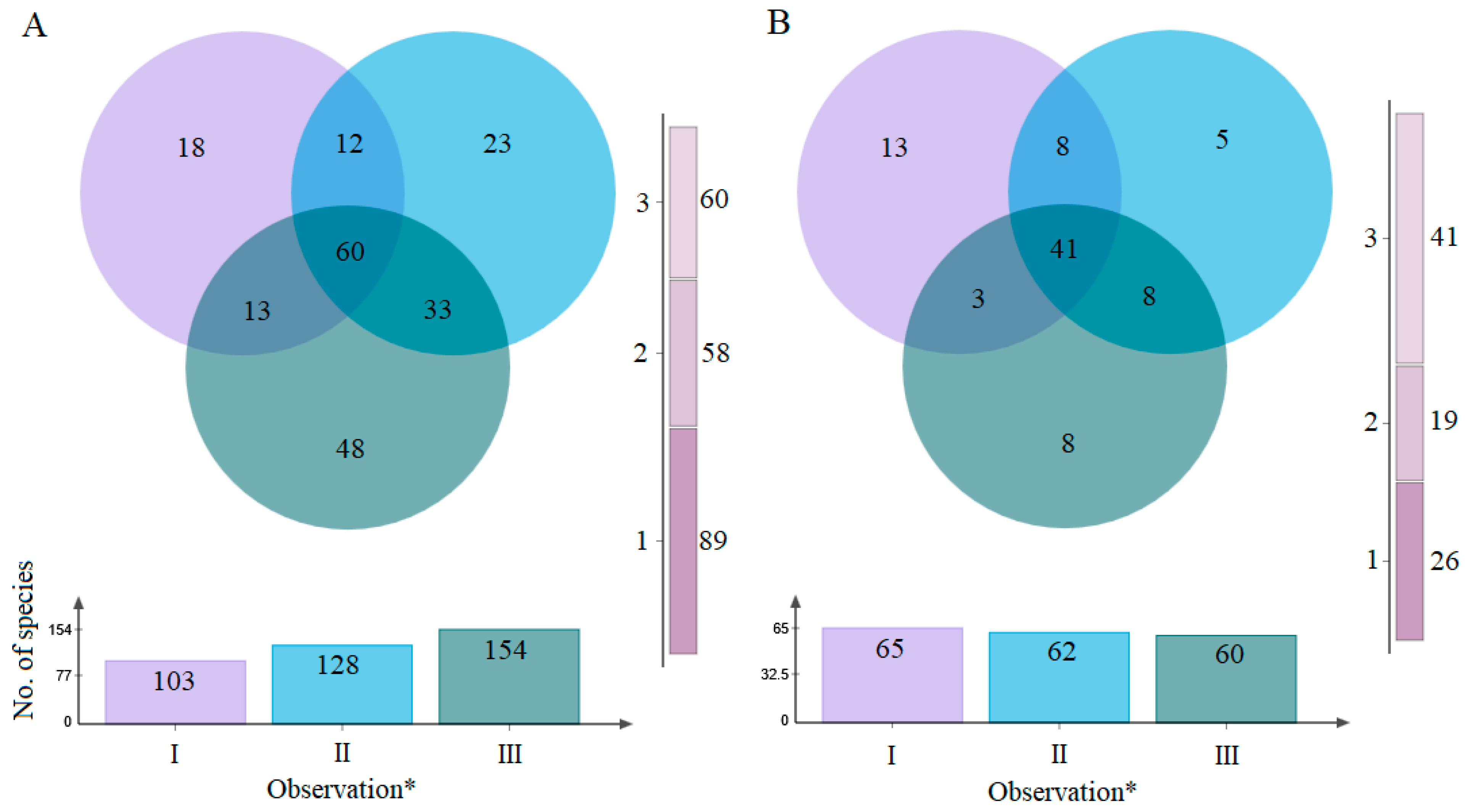
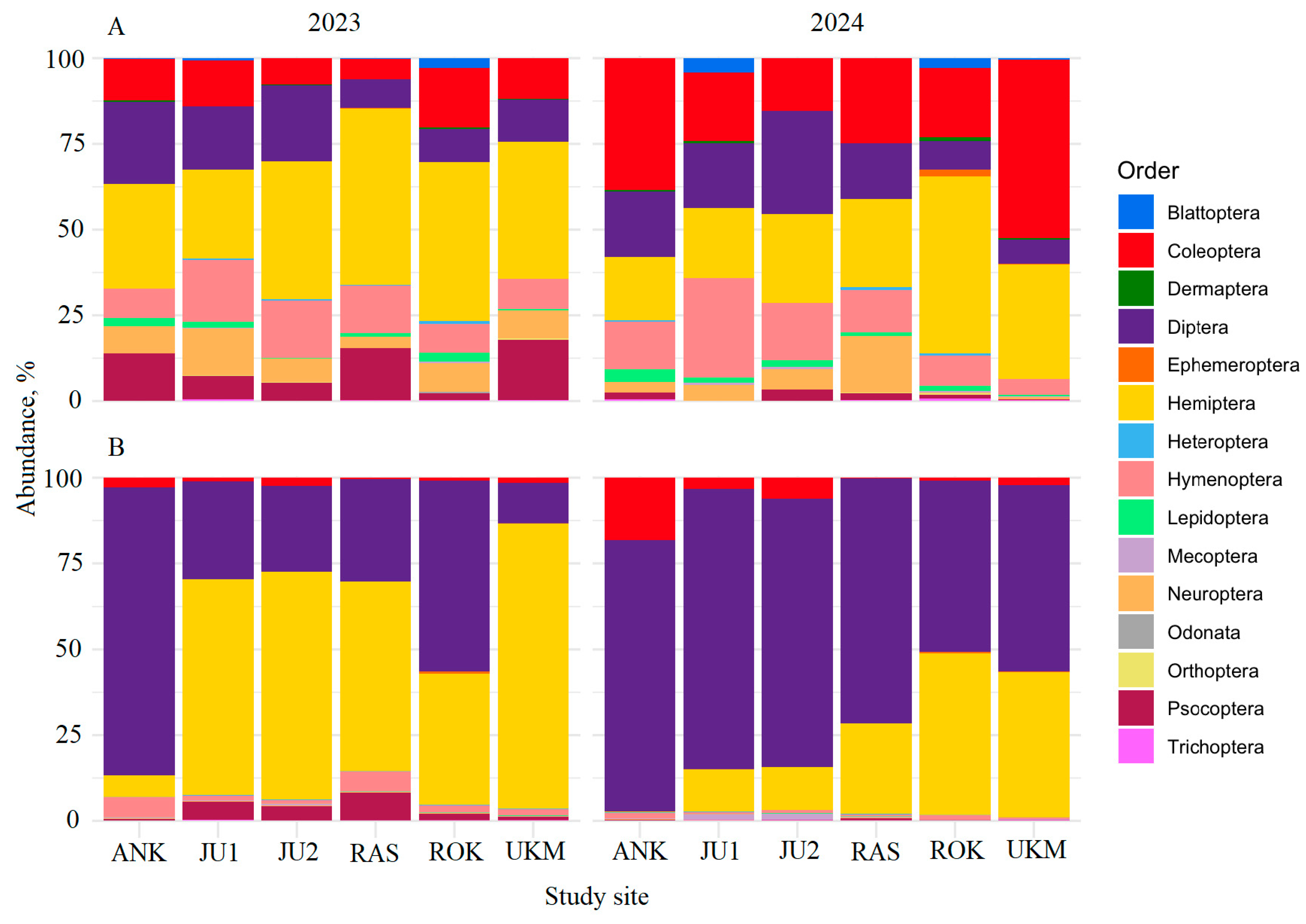
3. Results
4. Discussion
4.1. Methodological Effect on Insect Diversity and Assemblages
4.2. Temporal and Spatial Effects on Insect Assemblage Composition
4.3. Species Richness and Possible Host Association
4.4. Possible Pollination Roles of Recorded Insect Taxa
5. Concluding Remarks
Supplementary Materials
Author Contributions
Funding
Data Availability Statement
Acknowledgments
Conflicts of Interest
References
- Potts, S.G.; Biesmeijer, J.C.; Kremen, C.; Neumann, P.; Schweiger, O.; Kunin, W.E. Global pollinator declines: Trends, impacts and drivers. Trends Ecol. Evol. 2010, 25, 345–353. [Google Scholar] [CrossRef]
- Krishnan, S.; Wiederkehr Guerra, G.; Bertrand, D.; Wertz-Kanounnikoff, S.; Kettle, C.J. The Pollination Services of Forests—A Review of Forest and Landscape Interventions to Enhance Their Cross-Sectoral Benefits; FAO Forestry Working Paper No. 15; FAO & Bioversity International: Rome, Italy, 2020; p. 100. ISBN 978-92-5-132813-2. [Google Scholar]
- Kearns, C.A.; Inouye, D.W.; Waser, N.M. Endangered mutualisms: The conservation of plant–pollinator interactions. Annu. Rev. Ecol. Syst. 1998, 29, 83–112. [Google Scholar]
- Chanda, A.K. Insect Pollinator Diversity and Their Floral Preferences: A Seasonal and Habitat-Wise Analysis of Abundance and Species Richness. Zool. Ecol. 2025, 35, 29–41. [Google Scholar] [CrossRef]
- Biesmeijer, J.C.; Roberts, S.P.M.; Reemer, M.; Ohlemüller, R.; Edwards, M.; Peeters, T.; Schaffers, A.P.; Potts, S.G.; Kleukers, R.; Thomas, C.D.; et al. Parallel declines in pollinators and insect-pollinated plants in Britain and the Netherlands. Science 2006, 313, 351–354. [Google Scholar] [CrossRef]
- Koh, I.; Lonsdorf, E.V.; Williams, N.M.; Brittain, C.; Isaacs, R.; Gibbs, J.; Ricketts, T.H. Modeling the status, trends, and impacts of wild bee abundance in the United States. Proc. Natl. Acad. Sci. USA 2016, 113, 140–145. [Google Scholar] [CrossRef] [PubMed]
- Ashman, T.L.; Knight, T.M.; Steets, J.A.; Amarasekare, P.; Burd, M.; Campbell, D.R.; Dudash, M.R.; Johnston, M.O.; Mazer, S.J.; Mitchell, R.J.; et al. Pollen limitation of plant reproduction: Ecological and evolutionary causes and consequences. Ecology 2004, 8, 2408–2421. [Google Scholar] [CrossRef]
- Ollerton, J.; Winfree, R.; Tarrant, S. How many flowering plants are pollinated by animals? Oikos 2011, 120, 321–326. [Google Scholar] [CrossRef]
- Burd, M. Bateman’s principle and plant reproduction: The role of pollen limitation in fruit and seed set. Bot. Rev. 1994, 60, 83–139. [Google Scholar] [CrossRef]
- Ulyshen, M.D.; Ballare, K.M.; Fettig, C.J.; Rivers, J.W.; Rubyon, J.B. The value of forests to pollinating insects varies with forest structure, composition, and age. Curr. For. Rep. 2024, 10, 322–336. [Google Scholar] [CrossRef]
- Eaton, E.; Caudullo, G.; de Rigo, D. Tilia cordata, Tilia platyphyllos and other limes in Europe: Distribution, habitat, usage and threats. In European Atlas of Forest Tree Species; San-Miguel-Ayanz, J., de Rigo, D., Caudullo, G., Houston Durrant, T., Mauri, A., Eds.; Publications Office of the European Union: Luxembourg, 2016; pp. 184–185. ISBN 978-92-76-17291-8. [Google Scholar]
- Navasaitis, M. Dendrologija; Margi raštai: Vilnius, Lithuania, 2008; pp. 453–456. ISBN 9986-09-286-8. [Google Scholar]
- Free, J.B. The flower constancy of bumblebees. J. Anim. Ecol. 1970, 39, 395–402. [Google Scholar] [CrossRef]
- Anderson, G.J. The pollination biology of Tilia. Am. J. Bot. 1976, 63, 1203–1212. [Google Scholar] [CrossRef]
- Pigott, C.D.; Huntley, J.P. Factors controlling the distribution of Tilia cordata at the northern limit of its geographical limits. III. Nature and causes of seed sterility. New Phytol. 1981, 87, 817–839. [Google Scholar] [CrossRef]
- Konarska, A. Preliminary studies on the structure of sepals and trichomatous nectaries in flowers of Tilia cordata Mill. Acta Sci. Pol. Hortorum Cultus 2013, 12, 63–74. [Google Scholar]
- Lande, C.; Rao, S.; Morre, J.T.; Galindo, G.; Kirby, J.; Reardon, P.N.; King, M.D.; Miettinen, H.M.; Stevens, J.F. Linden (Tilia cordata) associated bumble bee mortality: Metabolomic analysis of nectar and bee muscle. PLoS ONE 2019, 14, e0218406. [Google Scholar] [CrossRef]
- Rader, R.; Bartomeus, I.; Garibaldi, L.A.; Garratt, M.P.D.; Howlett, B.G.; Winfree, R.; Cunningham, S.A.; Mayfield, M.M.; Arthur, A.D.; Andersson, G.K.S.; et al. Non-bee insects are important contributors to global crop pollination. Proc. Natl. Acad. Sci. USA 2016, 113, 146–151. [Google Scholar] [CrossRef]
- Requier, F.; Pérez-Méndez, N.; Andersson, G.K.S.; Blareau, E.; Merle, I.; Garibaldi, L.A. Bee and non-bee pollinator importance for local food security. Trends Ecol. Evol. 2023, 38, 196–205. [Google Scholar] [CrossRef]
- Proctor, M.; Yeo, P.; Lack, A. The Natural History of Pollination; HarperCollins: London, UK, 1996; p. 479. ISBN 000-219906-8. [Google Scholar]
- Muinde, J.; Katumo, D.M. Beyond bees and butterflies: The role of beetles in pollination system. J. Nat. Conserv. 2024, 77, 126523. [Google Scholar] [CrossRef]
- Willmer, P. Pollination and Floral Ecology; Princeton University Press: Princeton, NJ, USA, 2011; p. 832. ISBN 9780691128610. [Google Scholar]
- Macgregor, C.J.; Pocock, M.J.O.; Fox, R.; Evans, D.M. Pollination by nocturnal Lepidoptera, and the effects of light pollution: A review. Ecol. Entomol. 2015, 40, 187–198. [Google Scholar] [CrossRef] [PubMed]
- Borchardt, K.E.; Holthaus, D.; Soto Méndez, P.A.; Toth, A.L. Debunking wasp pollination: Wasps are comparable to bees in terms of plant interactions, body pollen and single-visit pollen deposition. Ecol. Entomol. 2024, 49, 569–584. [Google Scholar] [CrossRef]
- Kleijn, D.; Winfree, R.; Bartomeus, I.; Carvalheiro, L.G.; Henry, M.; Isaacs, R.; Klein, A.M.; Kremen, C.; M’Gonigle, L.K.; Rader, R.; et al. Delivery of crop pollination services is an insufficient argument for wild pollinator conservation. Nat. Commun. 2015, 6, 7414. [Google Scholar] [CrossRef]
- Potts, S.G.; Imperatriz-Fonseca, V.; Ngo, H.T.; Aizen, M.A.; Biesmeijer, J.C.; Breeze, T.D.; Dicks, L.V.; Garibaldi, L.A.; Hill, R.; Settele, J.; et al. Safeguarding pollinators and their values to human well-being. Nature 2016, 540, 220–229. [Google Scholar] [CrossRef] [PubMed]
- Baldock, K.C.R.; Goddard, M.A.; Hicks, D.M.; Kunin, W.E.; Mitschunas, N.; Osgathorpe, L.M.; Potts, S.G.; Robertson, K.M.; Scott, A.V.; Stone, G.N.; et al. Where is the UK’s pollinator biodiversity? The importance of urban areas for flower-visiting insects. Proc. R. Soc. B Biol. Sci. 2015, 282, 20142849. [Google Scholar] [CrossRef]
- Jacquemart, A.L.; Moquet, L.; Ouvrard, P.; Quetin-Leclercq, J.; Hérent, M.F.; Quinet, M. Tilia trees: Toxic or valuable resources for pollinators? Apidologie 2018, 49, 538–550. [Google Scholar] [CrossRef]
- Dmitruk, M.; Denisow, B.; Chrzanowska, E.; Dąbrowska, A.; Bożek, M. Comparison of nectar and pollen resources in various Tilia species. A case study from southern Poland. Trees 2024, 38, 953–967. [Google Scholar] [CrossRef]
- De Jaegere, T.; Hein, S.; Claessens, H. A review of the characteristics of small-leaved lime (Tilia cordata Mill.) and their implications for silviculture in a changing climate. Forests 2016, 7, 56. [Google Scholar] [CrossRef]
- Vaičys, M. Miško dirvožemių klasifikacija. In Lietuvos Dirvožemiai; Mokslas: Vilnius, Lithuania, 2001; pp. 1040–1043. [Google Scholar]
- Karazija, S. Miško tipologija. In Miško Ekologija; Padaiga, V., Stravinskienė, V., Eds.; Enciklopedija: Vilnius, Lithuania, 2008; pp. 220–254. [Google Scholar]
- Ivinskis, P. Lietuvos Drugių (Lepidoptera) Katalogas; Petro ofsetas: Vilnius, Lithuania, 2004. [Google Scholar]
- Ivinskis, P.; Meržijevskis, A.; Rimšaitė, J. Data on new and rare for the Lithuanian fauna species of Coleoptera. In New and Rare for Lithuania Insect Species; Lithuanian Entomological Society: Vilnius, Lithuania, 2009; Volume 21, pp. 45–63. [Google Scholar]
- Tamutis, V.; Tamutė, B.; Ferenca, R. A catalogue of Lithuanian beetles (Insecta: Coleoptera). ZooKeys 2011, 121, 1–494. [Google Scholar] [CrossRef]
- Tamutis, V.; Aleseev, V. A survey of Lepturinae Latreille, 1802 (Coleoptera: Cerambycidae) of the south-eastern Baltic region (Lithuania and the Kaliningrad Region). Biologija 2020, 66, 169–235. [Google Scholar] [CrossRef]
- NatureSpot. Species Library. Available online: https://www.naturespot.org/species_library (accessed on 20 May 2025).
- Insect-Trade. Coleoptera Catalogue. Available online: https://www.insect-trade.eu/index.php?category=coleoptera&eshop=catalogue (accessed on 15 June 2025).
- BugGuide. Insects and Related Arthropods. Available online: https://bugguide.net/node/view/3/bgpage (accessed on 29 December 2024).
- Lynikienė, J.; Gedminas, A.; Marčiulynas, A.; Marčiulynienė, D.; Menkis, A. Can Larix sp. Mill. provide suitable habitats for insects and lichens associated with stems of Picea abies (L.) H. Karst. in Northern Europe? Diversity 2022, 14, 729. [Google Scholar] [CrossRef]
- CABI, 2003–2025 CABI Compendium. A Leading Scientific Knowledge Resource for Environmental and Agricultural Production, Health and Biosecurity. Available online: https://www.cabidigitallibrary.org/doi/10.1079/cabicompendium (accessed on 10 April 2025).
- Shannon, C.E. A mathematical theory of communication. Bell Syst. Tech. J. 1948, 27, 379–423. [Google Scholar]
- Yang, M.; Chen, T.; Liu, Y.X.; Huang, L. Visualizing set relationships: EVenn’s comprehensive approach to Venn diagrams. iMeta 2024, 3, e184. [Google Scholar] [CrossRef]
- Thompson, A.; Frenzel, M.; Schweiger, O.; Musche, M.; Groth, T.; Roberts, S.P.M.; Biesmeijer, J.C.; Kunin, W.E.; Potts, S.G.; Bommarco, R.; et al. Pollinator sampling methods influence community patterns assessments by capturing species with different traits and at different abundances. Ecol. Indic. 2021, 132, 108284. [Google Scholar] [CrossRef]
- Atakan, E.; Pehlivan, S. Attractiveness of various colored sticky traps to some pollinating insects in apple. Turk. J. Zool. 2015, 39, 474–481. [Google Scholar] [CrossRef]
- Roulston, T.H.; Smith, S.A.; Brewster, A.L. A comparison of pan trap and intensive net sampling techniques for documenting a bee (Hymenoptera: Apiformes) fauna. J. Kans. Entomol. Soc. 2007, 80, 179–181. [Google Scholar] [CrossRef]
- Tuell, J.K.; Isaacs, R. Elevated pan traps to monitor bees in flowering crop canopies. Entomol. Exp. Appl. 2009, 131, 93–98. [Google Scholar] [CrossRef]
- Gonçalves, R.B.; Oliveira, P.S. Preliminary results of bowl trapping bees (Hymenoptera, Apoidea) in a southern Brazil forest fragment. J. Insect Biodivers. 2013, 1, 1–9. [Google Scholar] [CrossRef]
- Popic, T.J.; Davila, Y.C.; Wardle, G.M. Evaluation of common methods for sampling invertebrate pollinator assemblages: Net sampling out-performs pan traps. PLoS ONE 2013, 8, e66665. [Google Scholar] [CrossRef] [PubMed]
- Joshi, N.K.; Leslie, T.; Rajotte, E.G.; Kammerer, M.A.; Otieno, M.; Biddinger, D.J. Comparative trapping efficiency to characterize bee abundance, diversity, and community composition in apple orchards. Ann. Entomol. Soc. Am. 2015, 108, 785–799. [Google Scholar] [CrossRef]
- Westphal, C.; Steffan-Dewenter, I.; Tscharntke, T. Mass flowering crops enhance pollinator densities at a landscape scale. Ecol. Lett. 2003, 6, 961–965. [Google Scholar] [CrossRef]
- Grundel, R.; Jean, R.P.; Frohnapple, K.J.; Glowacki, G.A.; Scott, P.E.; Pavlovic, N.B. Floral and nesting resources, habitat structure, and fire influence bee distribution across an open-forest gradient. Ecol. Appl. 2010, 20, 1678–1692. [Google Scholar] [CrossRef]
- McCravy, K.W. A review of sampling and monitoring methods for beneficial arthropods in agroecosystems. Insects 2018, 9, 170. [Google Scholar] [CrossRef]
- Bakker, L.; van der Werf, W.; Bianchi, F.J. Sweep netting samples, but not sticky trap samples, indicate beneficial arthropod abundance is negatively associated with landscape wide insecticide use. J. Appl. Ecol. 2022, 59, 942–952. [Google Scholar] [CrossRef]
- Olesen, J.M.; Bascompte, J.; Elberling, H.; Jordano, P. Temporal dynamics in a pollination network. Ecology 2008, 89, 1573–1582. [Google Scholar] [CrossRef] [PubMed]
- CaraDonna, P.J.; Petry, W.K.; Brennan, R.M.; Cunningham, J.L.; Bronstein, J.L.; Waser, N.M.; Sanders, N.J. Interaction rewiring and the rapid turnover of plant–pollinator networks. Ecol. Lett. 2017, 20, 385–394. [Google Scholar] [CrossRef] [PubMed]
- Waser, N.M.; Chittka, L.; Price, M.V.; Williams, N.M.; Ollerton, J. Generalization in pollination systems, and why it matters. Ecology 1996, 77, 1043–1060. [Google Scholar] [CrossRef]
- Southwood, T.R.E. The number of species of insect associated with various trees. J. Anim. Ecol. 1961, 30, 1–8. [Google Scholar] [CrossRef]
- Blüthgen, N.; Gottsberger, G.; Fiedler, K. Sugar and amino acid composition of ant-attended nectar and honeydew sources from an Australian rainforest. Austral Ecol. 2004, 29, 418–429. [Google Scholar] [CrossRef]
- Stadler, B.; Dixon, A.F.G. Ecology and evolution of aphid–ant interactions. Annu. Rev. Ecol. Evol. Syst. 2005, 36, 345–372. [Google Scholar] [CrossRef]
- Hallmann, C.A.; Sorg, M.; Jongejans, E.; Siepel, H.; Hofland, N.; Schwan, H.; Stenmans, W.; Müller, A.; Sumser, H.; Hörren, T.; et al. More than 75 percent decline over 27 years in total flying insect biomass in protected areas. PLoS ONE 2017, 12, e0185809. [Google Scholar] [CrossRef]
- Seibold, S.; Gossner, M.M.; Simons, N.K.; Blüthgen, N.; Müller, J.; Ambarlı, D.; Ammer, C.; Bauhus, J.; Fischer, M.; Habel, J.C.; et al. Arthropod decline in grasslands and forests is associated with landscape-level drivers. Nature 2019, 574, 671–674. [Google Scholar] [CrossRef]
- Schowalter, T.D. Insect Ecology: An Ecosystem Approach, 5th ed.; Academic Press: London, UK, 2022; p. 942. ISBN 13-978-0323856737. [Google Scholar]
- Orford, K.A.; Vaughan, I.P.; Memmott, J. The forgotten flies: The importance of non-syrphid Diptera as pollinators. Proc. R. Soc. B Biol. Sci. 2015, 282, 20142934. [Google Scholar] [CrossRef]
- Jarillo, E.; Latorre, G.; Fernández-Carrillo, E.; Rodrigo-Gómez, S.; Yela, J.L.; Carmona, M. Insect assemblage and insect–plant relationships in a cultivated guayule (Parthenium argentatum A. Gray) plot in Spain. Insects 2025, 16, 808. [Google Scholar] [CrossRef]
- Altermatt, F. Climatic warming increases voltinism in European butterflies and moths. Proc. R. Soc. B Biol. Sci. 2010, 277, 1281–1287. [Google Scholar] [CrossRef]
- Petanidou, T.; Kallimanis, A.S.; Tzanopoulos, J.; Sgardelis, S.P.; Pantis, J.D. Long-term observation of a pollination network: Fluctuation in species and interactions, relative invariance of network structure and implications for estimates of specialization. Ecol. Lett. 2008, 11, 564–575. [Google Scholar] [CrossRef] [PubMed]
- Forrest, J.; Miller-Rushing, A.J. Toward a synthetic understanding of the role of phenology in ecology and evolution. Philos. Trans. R. Soc. B Biol. Sci. 2010, 365, 3101–3112. [Google Scholar] [CrossRef] [PubMed]
- CaraDonna, P.J.; Iler, A.M.; Inouye, D.W. Shifts in flowering phenology reshape a subalpine plant community. Proc. Natl. Acad. Sci. USA 2014, 111, 4916–4921. [Google Scholar] [CrossRef]
- Lázaro, A.; Hegland, S.J.; Totland, Ø. The relationships between floral traits and specificity of pollination systems in three Scandinavian plant communities. Oecologia 2008, 157, 249–257. [Google Scholar] [CrossRef]
- Baude, M.; Kunin, W.E.; Boatman, N.D.; Conyers, S.; Davies, N.; Gillespie, M.A.K.; Morton, R.D.; Smart, S.M.; Memmott, J. Historical nectar assessment reveals the fall and rise of floral resources in Britain. Nature 2016, 530, 85–88. [Google Scholar] [CrossRef]
- Gossner, M.M.; Lachat, T.; Brunet, J.; Isacsson, G.; Bouget, C.; Brustel, H.; Brandl, R.; Weisser, W.W.; Müller, J. Current near-to-nature forest management effects on functional trait composition of saproxylic beetles in beech forests. Conserv. Biol. 2013, 27, 605–614. [Google Scholar] [CrossRef]
- Bouget, C.; Larrieu, L.; Brin, A. Key features for saproxylic beetle diversity derived from rapid habitat assessment in temperate forests. Ecol. Indic. 2014, 36, 656–664. [Google Scholar] [CrossRef]
- Müller, J.; Brustel, H.; Brin, A.; Bussler, H.; Bouget, C.; Obermaier, E.; Heidinger, I.M.M.; Lachat, T.; Föraster, B.; Horak, J.; et al. Increasing temperature may compensate for lower amounts of dead wood in driving richness of saproxylic beetles. Ecography 2015, 38, 499–509. [Google Scholar] [CrossRef]
- Stork, N.E.; Adis, J.; Didham, R.K. (Eds.) Canopy Arthropods; Chapman & Hall: London, UK, 1997; ISBN 0-412-74900-9. [Google Scholar]
- Ødegaard, F.; Diserud, O.H.; Engen, S.; Aagaard, K. The magnitude of local host specificity for phytophagous insects and its implications for estimates of global species richness. Conserv. Biol. 2000, 14, 1182–1186. [Google Scholar] [CrossRef]
- Schowalter, T.D.; Noriega, J.A.; Tscharntke, T. Insect effects on ecosystem services-Introduction. Basic Appl. Ecol. 2018, 26, 1–7. [Google Scholar] [CrossRef]
- Mazzoni, V.; Cosci, F.; Lucchi, A.; Santini, L. Occurrence of leafhoppers (Auchenorrhyncha, Cicadellidae) in three vineyards of the Pisa district. IOBC Wprs Bull. 2001, 24, 267–272. [Google Scholar]
- Decante, D.; Van Helden, M. Population ecology of Empoasca vitis (Göthe) and Scaphoideus titanus (Ball) in Bordeaux vineyards: Influence of migration and landscape. Crop Prot. 2006, 25, 696–704. [Google Scholar] [CrossRef]
- Morrissey, R.C.; Gauthier, M.M.; Kershaw, J.A., Jr.; Jacobs, D.F.; Seifert, J.R.; Fischer, B.C. Grapevine (Vitis spp.) dynamics in association with manual tending, physiography, and host tree associations in temperate deciduous forests. For. Ecol. Manag. 2009, 257, 1839–1846. [Google Scholar] [CrossRef]
- Dixon, A.F.G. Aphid Ecology: An Optimization Approach, 2nd ed.; Chapman & Hall: London, UK, 1998; p. 300. ISBN 0-412-74180-6. [Google Scholar]
- Raupp, M.J.; Shrewsbury, P.M.; Herms, D.A. Ecology of herbivorous arthropods in urban landscapes. Annu. Rev. Entomol. 2010, 55, 19–38. [Google Scholar] [CrossRef]
- Coeur d’Acier, A.; Pérez Hidalgo, N.; Petrović-Obradović, O. Aphids (Hemiptera, Aphididae). BioRisk 2010, 4, 435–474. [Google Scholar] [CrossRef]
- Free, J.B.; Williams, I.H. The responses of the pollen beetle, Meligethes aeneus, and the seed weevil, Ceuthorhynchus assimilis, to oil-seed rape, Brassica napus, and other plants. J. Appl. Ecol. 1978, 15, 761–774. [Google Scholar] [CrossRef]
- New, T.R. The relative abundance of some British Psocoptera on different species of trees. J. Anim. Ecol. 1970, 39, 521–540. [Google Scholar] [CrossRef]
- Gaimari, S.D.; Silva, V.C. Lauxaniidae (lauxaniid flies). In Manual of Central American Diptera; Brown, B.V., Borkent, A., Cumming, J.M., Wood, D.M., Woodley, N.E., Zumbado, M.A., Eds.; NRC Research Press: Ottawa, ON, Canada, 2010; Volume 2, pp. 971–995. ISBN 978-0-660-19958-0. [Google Scholar]
- Seibold, S.; Bässler, C.; Brandl, R.; Büche, B.; Szallies, A.; Thorn, S.; Ulyshen, M.D.; Seifert, C.L.; Müller, J. Microclimate and habitat heterogeneity as the major drivers of beetle diversity in dead wood. J. Appl. Ecol. 2016, 53, 934–943. [Google Scholar] [CrossRef]
- Leidinger, J.; Seibold, S.; Weisser, W.W.; Lange, M.; Schall, P.; Türke, M.; Gossner, M.M. Effects of forest management on herbivorous insects in temperate Europe. For. Ecol. Manag. 2019, 437, 232–245. [Google Scholar] [CrossRef]
- Saunders, M.E.; Peisley, R.K.; Rader, R.; Luck, G.W. Pollinators, pests, and predators: Recognizing ecological trade-offs in agroecosystems. Ambio 2016, 45, 4–14. [Google Scholar] [CrossRef]
- Jauker, F.; Wolters, V. Hover flies are efficient pollinators of oilseed rape. Oecologia 2008, 156, 819–823. [Google Scholar] [CrossRef] [PubMed]
- Branquart, E.; Hemptinne, J.L. Selectivity in the exploitation of floral resources by hoverflies (Diptera: Syrphinae). Ecography 2000, 23, 732–742. [Google Scholar] [CrossRef][Green Version]
- Rader, R.; Cunningham, S.A.; Howlett, B.G.; Inouye, D.W. Non-bee insects as visitors and pollinators of crops: Biology, ecology, and management. Annu. Rev. Entomol. 2020, 65, 391–407. [Google Scholar] [CrossRef] [PubMed]
- Franzén, M.; Stenmark, M. Exploring biodiversity through the lens of Knautia arvensis pollinators: Knautia pollinator walks as a monitoring method. Insects 2024, 15, 563. [Google Scholar] [CrossRef] [PubMed]
- Brittain, C.; Williams, N.; Kremen, C.; Klein, A.M. Synergistic effects of non-Apis bees and honeybees for pollination services. Proc. R. Soc. B Biol. Sci. 2013, 280, 20122767. [Google Scholar] [CrossRef]
- Kevan, P.G.; Baker, H.G. Insects as flower visitors and pollinators. Annu. Rev. Entomol. 1983, 28, 407–453. [Google Scholar] [CrossRef]
- Ashman, T.L.; King, E.A. Are flower-visiting ants mutualists or antagonists? A study in a gynodioecious wild strawberry. Am. J. Bot. 2005, 92, 891–895. [Google Scholar] [CrossRef]
- Gómez, J.M.; Zamora, R. Pollination by ants: Consequences of the quantitative effects on a mutualistic system. Oecologia 1992, 91, 410–418. [Google Scholar] [CrossRef]
- Gómez, J.M. Effectiveness of ants as pollinators of Lobularia maritima: Effects on main sequential fitness components of the host plant. Oecologia 2000, 122, 90–97. [Google Scholar] [CrossRef]
- Aldrich, J.R.; Zhang, Q.H. Chemical ecology of Neuroptera. Annu. Rev. Entomol. 2016, 61, 197–218. [Google Scholar] [CrossRef]
- McEwen, P.K.; New, T.R.; Whittington, A.E. Lacewings in the Crop Environment; Cambridge University Press: Cambridge, UK, 2001; 546p, ISBN 0-521-77217-6. [Google Scholar]
- Jervis, M.A.; Kidd, N.A.C.; Fitton, M.G.; Huddleston, T.; Dawah, H.A. Flower-visiting by hymenopteran parasitoids. J. Nat. Hist. 1993, 27, 67–105. [Google Scholar] [CrossRef]
- Heimpel, G.E.; Jervis, M.A. Does floral nectar improve biological control by parasitoids. In Plant-Provided Food for Carnivorous Insects: A Protective Mutualism and Its Applications; Wäckers, F.L., van Rijn, P.C.J., Bruin, J., Eds.; Cambridge University Press: Cambridge, UK, 2005; pp. 267–304. ISBN 9780521819411. [Google Scholar]
- Ssymank, A.; Kearns, C.A.; Pape, T.; Thompson, F.C. Pollinating flies (Diptera): A major contribution to plant diversity and agricultural production. Biodiversity 2008, 9, 86–89. [Google Scholar] [CrossRef]
- Peralta, G.; CaraDonna, P.J.; Rakosy, D.; Fründ, J.; Tudanca, M.P.P.; Dormann, C.F.; Traveset, A.; Vázquez, D.P. Predicting plant–pollinator interactions: Concepts, methods, and challenges. Trends Ecol. Evol. 2024, 39, 494–505. [Google Scholar] [CrossRef]
- Tavella, L.; Arzone, A. Comparative morphology of mouth parts of Zyginidia pullula, Empoasca vitis, and Graphocephala fennahi (Homoptera, Auchenorrhyncha). Ital. J. Zool. 1993, 60, 33–39. [Google Scholar] [CrossRef][Green Version]
- Hervé, M.R.; Garcia, N.; Trabalon, M.; Le Ralec, A.; Delourme, R.; Cortesero, A.M. Oviposition behavior of the pollen beetle (Meligethes aeneus): A functional study. J. Insect Behav. 2015, 28, 107–119. [Google Scholar] [CrossRef]
- Lienhard, C.; Smithers, C.N. Psocoptera (Insecta): World Catalogue and Bibliography. 2002. Available online: https://www.cabidigitallibrary.org/doi/full/10.5555/20033104366 (accessed on 20 February 2026).
- Mitchell-Storey, T.; Encinas-Viso, F.; Botti-Anderson, J.; Bennett, J.M. The pollination ecology and mouthpart morphology of a pollen-feeding fly Incurviseta cf. maculifrons (Diptera: Lauxaniidae) in the Australian Alpine. Physiol. Entomol. 2025, 1–12. [Google Scholar] [CrossRef]
- Alcalá Herrera, R.; Fernández Sierra, M.L.; Ruano, F. The suitability of native flowers as pollen sources for Chrysoperla lucasina (Neuroptera: Chrysopidae). PLoS ONE 2020, 15, e0239847. [Google Scholar] [CrossRef]
- Klarin, A.; Ivković, M.; Mičetić Stanković, V. The emergence of the family Scirtidae (Insecta: Coleoptera) in lotic karst habitats: A case study over 15 years. Insects 2024, 15, 226. [Google Scholar] [CrossRef] [PubMed]
- Willemstein, S.C. An Evolutionary Basis for Pollination Ecology; Brill: Leiden, The Netherlands, 2023; Volume 10. [Google Scholar]
- Cho, G.; Burckhardt, D.; Malenovský, I.; Lee, S. The jumping plant-lice of Laos (Hemiptera: Psylloidea). J. Asia Pac. Entomol. 2017, 20, 399–409. [Google Scholar] [CrossRef]
- Wang, D.; Yu, H.; Chen, G. Scent chemistry and pollinators in the holoparasitic plant Cynomorium songaricum (Cynomoriaceae). Plant Biol. 2021, 23, 111–120. [Google Scholar] [CrossRef]
- Stireman, J.O., III; O’Hara, J.E.; Wood, D.M. Tachinidae: Evolution, behavior, and ecology. Annu. Rev. Entomol. 2006, 51, 525–555. [Google Scholar] [CrossRef] [PubMed]
- Socha, R.; Šula, J.; Zemek, R. Feeding behaviour, digestive physiology and lipid content in macropterous females of Pyrrhocoris apterus (L.) (Heteroptera: Pyrrhocoridae). Physiol. Entomol. 1998, 23, 91–96. [Google Scholar] [CrossRef]
- Wheeler, A.G. Biology of the Plant Bugs (Hemiptera: Miridae): Pests, Predators, Opportunists; Cornell University Press: Ithaca, NY, USA, 2001. [Google Scholar]
- Nielson, M.W. The Leafhopper Vectors of Phytopathogenic Viruses: Taxonomy, Biology, and Virus Transmission; U.S. Agricultural Research Service: Washington, DC, USA, 1968.
- Davis, D.R.; Robinson, G.S.; Kristensen, N.P. The Tineoidea and Gracillarioidea. In Handbook of Zoology IV: Lepidoptera, Moths and Butterflies; De Gruyter: Berlin, Germany, 1998; Volume 1, pp. 91–119. [Google Scholar]
- Koçak, E.; Barış, A. Biological parameters of Graphosoma lineatum L. (Heteroptera, Pentatomidae) feeding on seeds of plants from Apiaceae family and suitable food selection. Plant Prot. Bull. 2009, 48, 33–40. [Google Scholar]
- British Bugs. Palomena prasina. Available online: https://www.britishbugs.org.uk/heteroptera/Pentatomidae/palomena_prasina.html (accessed on 5 March 2026).
- Aleksanov, V.V.; Ruchin, A.B.; Shulaev, N.V.; Karmazina, I.O.; Lukiyanov, S.V.; Lobachev, E.A.; Nikolaeva, A.M.; Esin, M.N. Biology of Blattodea and Dermaptera in the continental biogeographical region and adjacent areas of European Russia. Diversity 2025, 17, 66. [Google Scholar] [CrossRef]
- Kovanci, O.B.; Canbulat, S.; Kovanci, B. The brown lacewings (Neuroptera, Hemerobiidae) of northwestern Turkey with new records, their spatio-temporal distribution and harbouring plants. Rev. Bras. Entomol. 2014, 58, 147–156. [Google Scholar] [CrossRef][Green Version]
- Jäch, M.A.; Balke, M. Global diversity of water beetles (Coleoptera) in freshwater. Hydrobiologia 2008, 595, 419–442. [Google Scholar] [CrossRef]
- Mawdsley, J.R. The importance of species of Dasytinae (Coleoptera: Melyridae) as pollinators in western North America. Coleopt. Bull. 2003, 57, 154–160. [Google Scholar] [CrossRef]
- Lundgren, J.G. Nutritional aspects of non-prey foods in predaceous Coccinellidae. Biol. Control 2009, 51, 294–305. [Google Scholar] [CrossRef]
- de Vere, M.W.R.; Gijswijt, M.J. Revision of the European species of Torymus Dalman (Hymenoptera: Torymidae). Zool. Verh. 1998, 317, 1–202. [Google Scholar]
- Beal, D.J.; Adams, A.G.; Cooper, M.L.; Varela, L.G.; Smith, R.J.; Kron, C.R.; Almeida, R.P.P.; Daugherty, M.P. Assessment of nymphal ecology and adult Xylella fastidiosa transmission biology of Aphrophora nr. permutata (Hemiptera: Aphrophoridae) in California vineyards. Environ. Entomol. 2021, 50, 1446–1454. [Google Scholar] [CrossRef]
- Shannon, D.M.; Richardson, N.; Lahondère, C.; Peach, D. Mosquito floral visitation and pollination. Curr. Opin. Insect Sci. 2024, 65, 101230. [Google Scholar] [CrossRef] [PubMed]
- Al-Dobai, S.; Reitz, S.; Sivinski, J. Tachinidae associated with flowering plants. Biol. Control 2012, 61, 230–239. [Google Scholar] [CrossRef]
- Raguso, R.A. Don’t forget the flies: Dipteran diversity and its consequences for floral ecology and evolution. Appl. Entomol. Zool. 2020, 55, 1–7. [Google Scholar] [CrossRef]
- Momose, K. Beetle pollination in tropical rain forests. In Pollination Ecology and the Rain Forest: Sarawak Studies; Springer: New York, NY, USA, 2005; pp. 104–110. [Google Scholar] [CrossRef]
- Nielsen, C.; Vestergaard, S.; Harding, S.; Wolsted, C.; Eilenberg, J. Biological control of Strophosoma spp. (Coleoptera: Curculionidae) in greenery (Abies procera) plantations using Hyphomycetes. Biocontrol Sci. Technol. 2006, 16, 583–598. [Google Scholar] [CrossRef]
- Kanervo, J.; Kozlov, M.V. Diversity and abundance of arboreal psocids (Psocoptera) along latitudinal gradients in northern Europe. Eur. J. Entomol. 2014, 111, 51–58. [Google Scholar] [CrossRef]
- Kölliker, M. Benefits and costs of earwig (Forficula auricularia) family life. Behav. Ecol. Sociobiol. 2007, 61, 1489–1497. [Google Scholar] [CrossRef]
- Kniepert, F.W. Blood-feeding and nectar-feeding in adult Tabanidae (Diptera). Oecologia 1980, 46, 125–129. [Google Scholar] [CrossRef]
- Currah, L.; Ockendon, D.J. Pollination activity by blowflies and honeybees on onions in breeders’ cages. Ann. Appl. Biol. 1984, 105, 167–176. [Google Scholar] [CrossRef]
- NatureSpot. Microcara testacea. Available online: https://www.naturespot.org/species/microcara-testacea (accessed on 5 March 2026).
- Forest Pests. Elasmucha grisea. Available online: https://www.forestpests.eu/pest/elasmucha-grisea (accessed on 5 March 2026).
- NatureSpot. Metylophorus nebulosus. Available online: https://www.naturespot.org/species/metylophorus-nebulosus (accessed on 5 March 2026).
- Fumanal, B.; Martin, J.F.; Sobhian, R.; Blanchet, A.; Bon, M.C. Host range of Ceutorhynchus assimilis (Coleoptera: Curculionidae). Biol. Control 2004, 30, 598–607. [Google Scholar] [CrossRef]
- Claridge, M.F.; Wilson, M.R. Host plant associations, diversity and species–area relationships of mesophyll-feeding leafhoppers of trees and shrubs in Britain. Ecol. Entomol. 1981, 6, 217–238. [Google Scholar] [CrossRef]
- Santos, H.P.; Rost-Roszkowska, M.; Vilimova, J.; Serrão, J.E. Ultrastructure of the midgut in Heteroptera (Hemiptera) with different feeding habits. Protoplasma 2017, 254, 1743–1753. [Google Scholar] [CrossRef] [PubMed]
- Badenes-Perez, F.R.; Johnson, M.T. Ecology and impact of Allorhogas sp. and Apion sp. Biol. Control. 2007, 43, 317–322. [Google Scholar] [CrossRef]
- Schmidt, O. Larval food plants of Australian Larentiinae (Lepidoptera: Geometridae): A review of available data. Biodivers. Data J. 2016, 4, e7938. [Google Scholar] [CrossRef]
- NatureSpot. Cixiidae. Available online: https://www.naturespot.org/family/cixiidae (accessed on 5 March 2026).
- Kobiałka, M.; Świerczewski, D.; Walczak, M.; Urbańczyk, W. Extremely distinct microbial communities in closely related leafhopper subfamilies: Typhlocybinae and Eurymelinae (Cicadellidae, Hemiptera). mSystems 2025, 10, e0060325. [Google Scholar] [CrossRef]
- Koschel, H. Zur Kenntnis der Raubwanze Himacerus apterus F. (Heteroptera, Nabidae). Z. Angew. Entomol. 1971, 68, 113–137. [Google Scholar] [CrossRef]
- Leclerc, L. First Canadian record of Aphrophora salicina (Goeze, 1778) (Hemiptera: Aphrophoridae). Micropubl. Taxon. Nat. Hist. 2024, 24, 1–2. [Google Scholar] [CrossRef]
- Crowley, L.M.; Barclay, M.V.L.; University of Oxford and Wytham Woods Genome Acquisition Lab; Natural History Museum Genome Acquisition Lab; Darwin Tree of Life Barcoding Collective; Wellcome Sanger Institute Tree of Life Programme; Wellcome Sanger Institute Scientific Operations: DNA Pipelines Collective; Tree of Life Core Informatics Collective. The genome sequence of the bishop’s mitre shield bug, Aelia acuminata (Linnaeus, 1758). Wellcome Open Res. 2021, 6, 320. [Google Scholar] [CrossRef]
- Wieczorek, K. Structure of the male reproductive system of Anoecia (Anoecia) corni Fabricius, 1775 (Hemiptera, Aphidoidea), a representative of the family Anoeciidae. Acta Zool. 2008, 89, 163–167. [Google Scholar] [CrossRef]
- Banks, C.J.; Macaulay, E.D.M. The feeding, growth and reproduction of Aphis fabae Scop. on Vicia faba under experimental conditions. Ann. Appl. Biol. 1964, 53, 229–242. [Google Scholar] [CrossRef]
- Nickel, H.; Remane, R. Check list of the planthoppers and leafhoppers of Germany, with notes on food plants, diet width, life cycles, geographic range and conservation status (Hemiptera, Fulgoromorpha and Cicadomorpha). Beitr. Zikadenkd. 2002, 5, 27–64. [Google Scholar]
- Arnscheid, W.R.; Weidlich, M. Psychidae; Brill: Leiden, The Netherlands, 2017; Volume 8. [Google Scholar]
- Krieger, K.A.; Bur, M.T.; Ciborowski, J.J.; Barton, D.R.; Schloesser, D.W. Distribution and abundance of burrowing mayflies (Hexagenia spp.) in Lake Erie, 1997–2005. J. Great Lakes Res. 2007, 33, 20–33. [Google Scholar] [CrossRef]
- NatureSpot. Lagria hirta. Available online: https://www.naturespot.org/species/lagria-hirta (accessed on 5 March 2026).
- Biological Records Centre. Insect–Host Interactions Database. Available online: https://dbif.brc.ac.uk/interactions.aspx (accessed on 10 April 2025).
- Urban, J. Harmful Occurrence of the Oak Flea Beetle Altica quercetorum quercetorum Foudras in the Czech Republic. 1996. Available online: https://www.cabidigitallibrary.org/doi/full/10.5555/19971106591 (accessed on 5 March 2026).
- Papa, G.; Maier, R.; Durazzo, A.; Lucarini, M.; Karabagias, I.K.; Plutino, M.; Bianchetto, E.; Aromolo, R.; Pignatti, G.; Ambrogio, A.; et al. The honey bee Apis mellifera: An insect at the interface between human and ecosystem health. Biology 2022, 11, 233. [Google Scholar] [CrossRef]
- Ramsdale, A.S. Cantharidae Imhoff 1856. In American Beetles; CRC Press: Boca Raton, FL, USA, 2002; Volume 2, pp. 202–218. [Google Scholar]
- Claridge, M.F.; Wilson, M.R. Diversity and distribution patterns of some mesophyll-feeding leaf hoppers of temperate woodland canopy. Ecol. Entomol. 1976, 1, 231–250. [Google Scholar] [CrossRef]
- Otto, C. Behavioural and physiological adaptations to a variable habitat in two species of case-making caddis larvae using different food. Oikos 1983, 41, 188–194. [Google Scholar] [CrossRef]
- Readio, P.A. Studies on the biology of the genus Corizus (Coreidae, Hemiptera). Ann. Entomol. Soc. Am. 1928, 21, 189–201. [Google Scholar] [CrossRef]
- Clifford, C.; Friend, K.; Skipp, S.; Wallace, I.; Natural History Museum Genome Acquisition Lab; Wellcome Sanger Institute Tree of Life Programme; Wellcome Sanger Institute Scientific Operations: DNA Pipelines Collective; Tree of Life Core Informatics Collective; Price, B.W.; Darwin Tree of Life Consortium. The genome sequence of the cinnamon sedge caddisfly, Limnephilus marmoratus (Curtis, 1834). Wellcome Open Res. 2023, 8, 64. [Google Scholar] [CrossRef]
- Wilson, E.O.; Farish, D.J. Predatory behaviour in the ant-like wasp Methocha stygia. Anim. Behav. 1973, 21, 292–295. [Google Scholar] [CrossRef]
- Nyman, T.; Farrell, B.D.; Zinovjev, A.G.; Vikberg, V. Larval habits, host-plant associations, and speciation in nematine sawflies (Hymenoptera: Tenthredinidae). Evolution 2006, 60, 1622–1637. [Google Scholar] [CrossRef]
- Dixon, A.F.G.; Russel, R.J. The effectiveness of Anthocoris nemorum and A. confusus (Hemiptera: Anthocoridae) as predators of the sycamore aphid, Drepanosiphum platanoides. II. Searching behaviour and the incidence of predation in the field. Entomol. Exp. Appl. 1972, 15, 35–50. [Google Scholar] [CrossRef]
- Pisciotta, S.; Raspi, A.; Sajeva, M. First records of pollinators of two co-occurring Mediterranean Apocynaceae. Plant Biosyst. 2011, 145, 141–149. [Google Scholar] [CrossRef]
- Vitali, F.; Fanti, F. Atlas of the Insects of the Grand Duchy of Luxembourg: Coleoptera, Cantharidae; Musée National d’Histoire Naturelle Luxembourg: Luxembourg, 2024. [Google Scholar]
- Berkvens, N.; Bonte, J.; Berkvens, D.; Deforce, K.; Tirry, L.; De Clercq, P. Pollen as an alternative food for Harmonia axyridis. BioControl 2008, 53, 201–210. [Google Scholar] [CrossRef]
- Bylund, H.; Nordlander, G.; Nordenhem, H. Feeding and oviposition rates in the pine weevil Hylobius abietis (Coleoptera: Curculionidae). Bull. Entomol. Res. 2004, 94, 307–317. [Google Scholar] [CrossRef]
- Jones, C.J.; Hogsette, J.A.; Patterson, R.S.; Milne, D.E. Effects of natural saccharide and pollen extract feeding on stable fly (Diptera: Muscidae) longevity. Environ. Entomol. 1985, 14, 223–227. [Google Scholar] [CrossRef]
- British Bugs. Pentatoma rufipes. Available online: https://www.britishbugs.org.uk/heteroptera/Pentatomidae/pentotoma_rufipes.html (accessed on 5 March 2026).
- UK Moths. Proutia betulina. Available online: https://www.ukmoths.org.uk/species/proutia-betulina/ (accessed on 5 March 2026).
- ScienceDirect Topics. Agrilus. Available online: https://www.sciencedirect.com/topics/agricultural-and-biological-sciences/agrilus (accessed on 5 March 2026).
- Schatz, B. Fine scale distribution of pollinator explains the occurrence of the natural orchid hybrid × Orchis bergonii. Écoscience 2006, 13, 111–118. [Google Scholar] [CrossRef]
- Bieńkowski, A.O. Feeding behaviour of leaf beetles (Coleoptera, Chrysomelidae). Entomol. Rev. 2010, 90, 1–10. [Google Scholar] [CrossRef]
- McAlister, E.; Mitchell, R.; Sivell, O.; Webb, J.A. The genome sequence of the square-spot deerfly, Chrysops viduatus (Fabricius, 1794) (Diptera: Tabanidae). Wellcome Open Res. 2025, 10, 650. [Google Scholar] [CrossRef]
- Mironov, V.G. Geometrid moths of the genus Eupithecia Curtis, 1825 (Lepidoptera, Geometridae): Prerequisites and characteristic features of high species diversity. Entomol. Rev. 2014, 94, 105–127. [Google Scholar] [CrossRef]
- Lutovinovas, E.; Kvašinskas, S.; Sidabrienė, G. The hoverflies (Diptera: Syrphidae) of the Žemaitija National Park, North-Western Lithuania. Bull. Lith. Entomol. Soc. 2024, 8, 131–148. [Google Scholar]
- Traylor, C.R.; Ulyshen, M.D.; McHugh, J.V. New host records and a review of deadwood associations for Mordellidae (Coleoptera) in North America. Coleopt. Bull. 2023, 77, 375–381. [Google Scholar] [CrossRef]
- Bodino, N.; Cavalieri, V.; Dongiovanni, C.; Saladini, M.A.; Simonetto, A.; Volani, S.; Plazio, E.; Altamura, G.; Tauro, D.; Gilioli, G.; et al. Spittlebugs of Mediterranean olive groves: Host-plant exploitation throughout the year. Insects 2020, 11, 130. [Google Scholar] [CrossRef]
- Bletchly, J.D.; Varley, G.C. The mouth-parts of the down-looker fly, Rhagio (=Leptis) scolopacea (L.) Diptera, Rhagionidae. Proc. Zool. Soc. Lond. 1955, 125, 779–794. [Google Scholar] [CrossRef]
- Ruchin, A.B.; Egorov, L.V.; Khapugin, A.A. Usage of fermental traps for the study of the species diversity of Coleoptera in open biotopes. Insects 2023, 14, 404. [Google Scholar] [CrossRef]
- Pyrgus. Tettigonia viridissima. Available online: https://www.pyrgus.de/Tettigonia_viridissima_en.html (accessed on 5 March 2026).
- Furlan, L. The biology of Agriotes ustulatus Schäller (Col., Elateridae). I. Adults and oviposition. J. Appl. Entomol. 1996, 120, 269–274. [Google Scholar] [CrossRef]
- Wang, J.; Mu, Y.; Yang, C.; Yang, L.; Zhang, C.; Yu, H.; Chang, Z.; Long, J.; Chen, X. Population growth performance of Arma custos (Fabricius) (Hemiptera: Pentatomidae) at different temperatures. J. Insect Sci. 2022, 22, 12. [Google Scholar] [CrossRef]
- Kanuch, P.; Sliacka, A.; Kristin, A. Habitat conditioned feeding behaviour in Barbitistes constrictus (Orthoptera: Tettigoniidae). Open Life Sci. 2015, 10, 1–6. [Google Scholar] [CrossRef]
- Graham, C.W.; Gould, A.H. Cabbage stem weevil (Ceutorhynchus quadridens) on spring oilseed rape in southern England and its control. Ann. Appl. Biol. 1980, 95, 1–10. [Google Scholar] [CrossRef]
- British Bugs. Coptosoma scutellatum. Available online: https://www.britishbugs.org.uk/heteroptera/Plataspidae/coptosoma_scutellatum.html (accessed on 5 March 2026).
- Urban, J. A contribution to the knowledge of biology and harmfulness of Deporaus betulae (L.) (Coleoptera, Attelabidae). Acta Univ. Agric. Silvic. Mendelianae Brun. 2012, 60, 317–338. [Google Scholar] [CrossRef]
- Krenn, H.W. Feeding mechanisms of adult Lepidoptera: Structure, function, and evolution of the mouthparts. Annu. Rev. Entomol. 2010, 55, 307–327. [Google Scholar] [CrossRef] [PubMed]
- Hokkanen, H. Polymorphism, Parasites, and the Native Area of Nezara viridula (Hemiptera: Pentatomidae); CABI Record No. 19860537768; ScienceOpen, Inc.: Berlin, Germany, 1986. [Google Scholar]
- Bosch, J.; Kemp, W.P. Developing and establishing bee species as crop pollinators: The example of Osmia spp. (Hymenoptera: Megachilidae) and fruit trees. Bull. Entomol. Res. 2002, 92, 3–16. [Google Scholar] [CrossRef] [PubMed]
- NatureSpot. Clay-Coloured Weevil. Available online: https://www.naturespot.org/species/clay-coloured-weevil (accessed on 5 March 2026).
- Knutson, L.; Vala, J.C. Biology of Snail-Killing Sciomyzidae Flies; Cambridge University Press: Cambridge, UK, 2011. [Google Scholar]
- Piper, R.W.; Compton, S.G.; Rasplus, J.Y.; Piry, S. The species status of Cathormiocerus britannicus, an endemic, endangered British weevil. Biol. Conserv. 2001, 101, 9–13. [Google Scholar] [CrossRef]
- Billiald, H.E.; Straw, N.A.; Stewart, A.J.A. Adult fecundity, host plant preferences, field activity and parasitism in the leaf weevil Phyllobius pyri (Coleoptera: Curculionidae). Bull. Entomol. Res. 2010, 100, 303–314. [Google Scholar] [CrossRef]
- Pupedis, R.J. Foraging behavior and food of adult spongilla-flies (Neuroptera: Sisyridae). Ann. Entomol. Soc. Am. 1987, 80, 758–760. [Google Scholar] [CrossRef]
- Vankosky, M.; Dosdall, L.M.; Cárcamo, H.A. Distribution, biology and integrated management of the pea leaf weevil, Sitona lineatus L. (Coleoptera: Curculionidae), with an analysis of research needs. CAB Rev. 2009, 1–18. [Google Scholar] [CrossRef]
- Kolcsár, L.; Dvořák, L.; Beuk, P. New records of Sylvicola (Diptera: Anisopodidae) from Romania. Biodivers. Data J. 2016, 4, e7861. [Google Scholar] [CrossRef]
- Moulet, P.; Ghahari, H.; McPherson, J.E.; Putshkov, P.V.; Brailovsky, H.; Chordas, S.W. Family Coreidae Leach, 1815. In True Bugs (Heteroptera) of the Middle-East; Springer: Singapore, 2024; pp. 1131–1162. [Google Scholar] [CrossRef]
- Crowley, L.M.; University of Oxford and Wytham Woods Genome Acquisition Lab; Darwin Tree of Life Barcoding Collective; Wellcome Sanger Institute Tree of Life Programme; Wellcome Sanger Institute Scientific Operations: DNA Pipelines Collective; Tree of Life Core Informatics collective; Darwin Tree of Life Consortium. The genome sequence of the hazel leaf-roller, Apoderus coryli (Linnaeus, 1758). Wellcome Open Res. 2021, 6, 315. [Google Scholar] [CrossRef]
- Borowiec, L. A World Catalogue of the Cassidinae (Coleoptera: Chrysomelidae); Biologica Silesiae: Wrocław, Poland, 1999. [Google Scholar]
- Baker, R.L. Behavioural interactions and use of feeding areas by nymphs of Coenagrion resolutum (Coenagrionidae: Odonata). Oecologia 1981, 49, 353–358. [Google Scholar] [CrossRef] [PubMed]
- Lindroth, C.H. The Carabidae (Coleoptera) of Fennoscandia and Denmark: Part 2; Brill: Leiden, The Netherlands, 2023; Volume 15. [Google Scholar]
- British Bugs. Dolycoris baccarum. Available online: https://www.britishbugs.org.uk/heteroptera/Pentatomidae/dolycoris_baccarum.html (accessed on 5 March 2026).
- Ajax, R.; Gimah, M. Biology and Life Cycle of Epuraea sp. (Coleoptera: Nitidulidae) in Bottle Gourd Fields. 2025. Available online: https://www.researchgate.net/publication/389875971_Biology_and_Life_Cycle_of_Epuraea_sp_Coleoptera_Nitidulidae_in_Bottle_Gourd_Fields (accessed on 5 March 2026).
- Pyrgus. Eriogaster lanestris. Available online: https://www.pyrgus.de/Eriogaster_lanestris_en.html (accessed on 5 March 2026).
- NatureSpot. Gastrophysa polygoni. Available online: https://www.naturespot.org/species/gastrophysa-polygoni (accessed on 5 March 2026).
- Canard, M. Natural food and feeding habits of lacewings. In Lacewings in the Crop Environment; McEwen, P.K., New, T.R., Whittington, A.E., Eds.; Cambridge University Press: Cambridge, UK, 2001; pp. 116–129. [Google Scholar]
- Sun, Y.X.; Wang, L.; Wei, G.Q.; Qian, C.; Dai, L.S.; Sun, Y.; Abbas, M.N.; Zhu, B.-J.; Liu, C.-L. Characterization of the complete mitochondrial genome of Leucoma salicis (Lepidoptera: Lymantriidae) and comparison with other lepidopteran insects. Sci. Rep. 2016, 6, 39153. [Google Scholar] [CrossRef] [PubMed]
- Ernst, C.; Cappuccino, N.; Arnason, J.T. Potential novel hosts for the lily leaf beetle Lilioceris lilii Scopoli (Coleoptera: Chrysomelidae) in eastern North America. Ecol. Entomol. 2007, 32, 45–52. [Google Scholar] [CrossRef]
- Kolehmainen, J.; Julkunen-Tiitto, R.; Roininen, H.; Tahvanainen, J. Phenolic glucosides as feeding cues for willow-feeding leaf beetles. Entomol. Exp. Appl. 1995, 74, 235–243. [Google Scholar] [CrossRef]
- Beirne, B.P. The Prunus- and Rubus-feeding species of Macropsis (Homoptera: Cicadellidae). Can. Entomol. 1954, 86, 86–90. [Google Scholar] [CrossRef]
- British Bugs. Neides tipularius. Available online: https://www.britishbugs.org.uk/heteroptera/Berytidae/neides_tipularius.html (accessed on 5 March 2026).
- Portillo, H.E.; Pitre, H.N.; Meckenstock, D.H.; Andrews, K.L. Feeding preferences of neonates and late instar larvae of a lepidopterous pest complex (Lepidoptera: Noctuidae) on sorghum, maize, and noncrop vegetation in Honduras. Environ. Entomol. 1996, 25, 589–598. [Google Scholar] [CrossRef]
- Breeding Butterflies. Orgyia antiqua (vapourer moth). Available online: https://breedingbutterflies.com/orgyia-antiqua-vapourer-moth/ (accessed on 10 April 2025).
- Hauser, M.; Woodley, N.E.; Fachin, D.A. Stratiomyidae. In Manual of Afrotropical Diptera. Volume 2: Nematocerous Diptera and Lower Brachycera; Kirk-Spriggs, A.H., Sinclair, B.J., Eds.; Suricata 5; South African National Biodiversity Institute: Pretoria, South Africa, 2017; pp. 919–979. [Google Scholar]
- Çalışkan, H. A new record for Turkish Asilidae (Insecta: Diptera) fauna: Pamponerus germanicus (Linnaeus, 1758). Eskişehir Osmangazi Üniv. Müh. Mimarlık Fak. Derg. 2010, 23, 83–90. [Google Scholar]
- Woodland Trust. Speckled Wood. Available online: https://www.woodlandtrust.org.uk/trees-woods-and-wildlife/animals/butterflies/speckled-wood/ (accessed on 5 March 2026).
- Speight, M.C. Species Accounts of European Syrphidae (Diptera), 2008; Syrph the Net Publications: Dublin, Ireland, 2008. [Google Scholar]
- Dorset Moths. Species Account. Available online: https://dorsetmoths.co.uk/index.php?bf=19990&v=t (accessed on 5 March 2026).
- GBIF. Species Account 1424207. Available online: https://www.gbif.org/species/1424207 (accessed on 5 March 2026).
- Pyrgus. Tetrix subulata. Available online: https://www.pyrgus.de/Tetrix_subulata_en.html (accessed on 5 March 2026).
- GBIF. Species Account 6963241. Available online: https://www.gbif.org/species/6963241 (accessed on 5 March 2026).
- Mochizuki, K.; Kawakita, A. Pollination by fungus gnats and associated floral characteristics in five families of the Japanese flora. Ann. Bot. 2018, 121, 651–663. [Google Scholar] [CrossRef]
- Wäckers, F.L.; Romeis, J.; van Rijn, P. Nectar and pollen feeding by insect herbivores and implications for multitrophic interactions. Annu. Rev. Entomol. 2007, 52, 301–323. [Google Scholar] [CrossRef]
- Li, H.; Chang, H.; Muona, J.; Zhao, Y.; Ren, D. Subfamily Anischiinae (Coleoptera: Eucnemidae) in early Cretaceous of northeast China. Insects 2021, 12, 105. [Google Scholar] [CrossRef] [PubMed]
- Dennis, S.D.; Lavigne, R.J.; Dennis, J.G. Spiders (Araneae) as prey of robber flies (Diptera: Asilidae). J. Entomol. Res. Soc. 2012, 14, 65–76. [Google Scholar]
- de Medeiros, B.A.; Peris, D. The evolution of flower beetles as visitors and pollinators. Annu. Rev. Entomol. 2026, 71, 557–575. [Google Scholar] [CrossRef]
- Morgan, F.D. Bionomics of Siricidae. Annu. Rev. Entomol. 1968, 13, 239–256. [Google Scholar] [CrossRef]
- EPPO. HALTQU Documents. Available online: https://gd.eppo.int/taxon/HALTQU/documents (accessed on 5 March 2026).
- Latreille, P.A. Ptinidae Latreille, 1802. In Handbook of Zoology, Coleoptera, Beetles, Volume 2: Morphology and Systematics (Elateroidea, Bostrichiformia, Cucujiformia Partim); Leschen, R.A.B., Beutel, R.G., Lawrence, J.F., Eds.; De Gruyter: Berlin, Germany, 2010; pp. 217–225. [Google Scholar] [CrossRef]
- Gutowski, J.M.; Hilszczański, J.; Kubisz, D.; Kurzawa, J.; Miłkowski, M.; Mokrzycki, T.; Plewa, R.; Przewoźny, M.; Wełnicki, M. Distribution and host plants of Leiopus nebulosus (L.) and L. linnei Wallin, Nylander et Kvamme (Coleoptera: Cerambycidae) in Poland and neighbouring countries. Pol. J. Entomol. 2010, 79, 271–282. [Google Scholar]
- Dorset Moths. Species Account. Available online: https://dorsetmoths.co.uk/index.php?bf=20510&v=t (accessed on 5 March 2026).
- Suffolk Moths. Species Account. Available online: https://suffolkmoths.co.uk/micros.php?bf=13500&v=t (accessed on 5 March 2026).
- Gratwick, M. Chafer grubs. In Crop Pests in the UK; Gratwick, M., Ed.; Springer: Dordrecht, The Netherlands, 1992. [Google Scholar] [CrossRef]
- Sayers, T.D.J.; Steinbauer, M.J.; Miller, R.E. Visitor or vector? The extent of rove beetle (Coleoptera: Staphylinidae) pollination and floral interactions. Arthropod Plant Interact. 2019, 13, 685–701. [Google Scholar] [CrossRef]



| Site | Geographical Position | GCU Size (ha) | Age (y) | Mean Height (m) | Mean Diameter (cm) | Forest Site Type * | Forest Vegetation Type ** | Tree Species Composition (%) *** |
|---|---|---|---|---|---|---|---|---|
| ANK | 55°32′12.0228″ N, 24°53′ 30.1014″ E | 1.84 | 79 | 27.4 | 28.8 | Lcs | mox | 60T 30P 10B |
| JU1 | 55°10′5.7714″ N, 23°19′45.7134″ E | 3.8 | 138 | 28.3 | 40.0 | Lfp | aeg | 60T 20S10Q 10A |
| JU2 | 55°9′28.6272″ N, 23°19′32.16″ E | 5.32 | 93 | 25.6 | 33.6 | Lfp | aeg | 70T 20F 10S |
| RAS | 55°20′25.029″ N, 23°38′48.1662″ E | 7.23 | 98 | 26.6 | 41.7 | Lds | aeg | 40T 20Q 20B 20S |
| ROK | 55°47′56.331″ N, 25°48′24.8178″ E | 2.87 | 84 | 26.3 | 30.8 | Lds | aeg | 70T 10B 20S |
| UKM | 54°58′5.9118″ N, 25°11′8.7102″ E | 20.23 | 94 | 29.3 | 34.8 | Lds | aeg | 50T 40P 10Q |
| Site | 2023 | 2024 | Both Year | ||||||
|---|---|---|---|---|---|---|---|---|---|
| Relative Abundance, % (No. of Individuals) | Species Richness, % (No. of Species) | Shannon H | Relative Abundance, % (No. of Individuals) | Species Richness, % (No. of Species) | Shannon H | Relative Abundance, % (No. of Individuals) | Species Richness, % (No. of Species) | Shannon H | |
| Net Sampling | |||||||||
| ANK | 18.1 (526) | 39.0 (67) | 3.20 | 22.0 (471) | 43.5 (64) | 3.26 | 19.8 (997) | 48.3 (100) | 3.52 |
| JU1 | 14.7 (427) | 48.3 (83) | 3.57 | 8.9 (190) | 32.7 (48) | 3.24 | 12.2 (617) | 50.7 (105) | 3.75 |
| JU2 | 13.4 (388) | 37.8 (65) | 3.17 | 9.4 (202) | 29.9 (44) | 3.15 | 11.7 (590) | 40.1 (83) | 3.37 |
| RAS | 21.4 (621) | 36.6 (63) | 2.53 | 18.6 (400) | 37.4 (55) | 3.17 | 20.2 (1021) | 44.9 (93) | 3.09 |
| ROK | 17.5 (507) | 50.6 (87) | 3.59 | 12.7 (273) | 39.5 (58) | 3.26 | 15.4 (779) | 51.7 (107) | 3.66 |
| UKM | 14.9 (432) | 40.1 (69) | 3.06 | 28.4 (609) | 41.5 (61) | 2.77 | 20.6 (1041) | 47.8 (99) | 3.30 |
| All sites | 100.0 (2900) | 100.0 (172) | 3.56 | 100.0 (2145) | 100.0 (147) | 3.66 | 100.0 (5045) | 100.0 (207) | 3.81 |
| Year proportion, % | 57.5 | 83.1 | - | 42.5 | 71.0 | - | 100 | 100 | - |
| Sticky traps | |||||||||
| ANK | 12.6 (3129) | 54.2 (39) | 1.52 | 14.6 (2915) | 51.7 (31) | 1.54 | 13.5 (6044) | 55.8 (48) | 1.65 |
| JU1 | 18.3 (4548) | 59.7 (43) | 1.98 | 14.4 (2865) | 61.7 (37) | 2.03 | 16.5 (7413) | 62.8 (54) | 2.29 |
| JU2 | 20.4 (5087) | 59.7 (43) | 1.83 | 14.4 (2876) | 55.0 (33) | 1.83 | 17.8 (7963) | 58.1 (50) | 2.16 |
| RAS | 17.2 (4286) | 56.9 (41) | 1.93 | 18.0 (3596) | 55.0 (33) | 1.45 | 17.6 (7882) | 54.7 (47) | 1.84 |
| ROK | 14.8 (3695) | 51.4 (37) | 1.75 | 16.6 (3315) | 55.0 (33) | 1.80 | 15.6 (7010) | 54.7 (47) | 1.82 |
| UKM | 16.7 (4156) | 62.5 (45) | 1.32 | 22.0 (4383) | 55.0 (33) | 1.58 | 19.0 (8539) | 64.0 (55) | 1.67 |
| All sites | 100.0 (24,901) | 100.0 (72) | 2.06 | 100.0 (19,950) | 100.0 (60) | 1.92 | 100.0 (44,851) | 100.0 (86) | 2.10 |
| Year proportion, % | 55.5 | 83.7 | - | 44.5 | 69.8 | - | 100.0 | 100.0 | - |
| All total | 49,896 (100.0) | 247 (100.0) | |||||||
| Order | Family | Insect Taxa | 2023 | 2024 | Both Year | ||||||
|---|---|---|---|---|---|---|---|---|---|---|---|
| Observation * | |||||||||||
| I | II | III | Total | I | II | III | Total | ||||
| Net Sampling | |||||||||||
| Hemiptera | Cicadellidae | Empoasca vitis | 4.9 | 25.1 | 24.4 | 22.5 | 17.1 | 11.0 | 8.4 | 11.2 | 17.7 |
| Coleoptera | Nitidulidae | Meligethes aeneus | 1.0 | 1.3 | 0.1 | 0.5 | 0.3 | 28.8 | 0.1 | 14.3 | 6.4 |
| Psocoptera | Caeciliusidae | Caecilius flavidus | 27.0 | 4.6 | 9.6 | 9.9 | 3.2 | 0.1 | 0.7 | 0.8 | 6.1 |
| Diptera | Lauxaniidae | Lauxaniidae sp. 1 | 6.2 | 7.2 | 4.1 | 5.2 | 13.3 | 3.5 | 2.1 | 4.8 | 5.0 |
| Hymenoptera | Ichneumonidae | Ichneumonidae sp. 4 | 5.2 | 3.9 | 5.1 | 4.8 | 3.2 | 2.5 | 5.3 | 3.5 | 4.2 |
| Hemiptera | Aphididae | Eucallipterus tiliae | 0.7 | 8.7 | 1.5 | 3.6 | 0.3 | 4.4 | 5.0 | 3.9 | 3.7 |
| Hymenoptera | Campanotidae | Lasius niger | 3.6 | 4.8 | 1.2 | 2.6 | 12.8 | 2.1 | 3.4 | 4.4 | 3.3 |
| Neuroptera | Chrysopidae | Chrysopa perla | 1.0 | 1.3 | 5.8 | 3.9 | - | - | 5.3 | 1.8 | 3.0 |
| Coleoptera | Helodidae | Cyphon padi | 0.7 | 0.3 | 0.1 | 0.2 | 6.1 | 10.5 | 0.6 | 6.4 | 2.9 |
| Neuroptera | Chrysopidae | Chrysopa adspersa | - | 0.1 | 4.5 | 2.7 | - | 0.9 | 7.0 | 2.8 | 2.8 |
| Total of 10 species | 50.2 | 57.3 | 56.4 | 56.0 | 56.3 | 63.7 | 38.0 | 53.9 | 55.1 | ||
| Sticky traps | |||||||||||
| Hemiptera | Cicadellidae | Empoasca vitis | 48.8 | 49.3 | 35.4 | 43.7 | 33.2 | 18.8 | 6.9 | 21.7 | 33.9 |
| Diptera | Mycetophilidae | Mycetophilidae sp. 1 | 15.6 | 17.0 | 17.1 | 16.7 | 39.3 | 45.7 | 40.3 | 41.2 | 27.6 |
| Diptera | Unknown | Diptera sp. 1 | 4.3 | 4.5 | 16.5 | 9.2 | 7.7 | 13.8 | 14.2 | 11.2 | 10.1 |
| Hemiptera | Aphididae | Eucallipterus tiliae | 4.9 | 15.8 | 2.3 | 8.2 | 0.3 | 1.7 | 3.4 | 1.6 | 5.3 |
| Diptera | Muscidae | Musca domestica | 1.7 | 2.4 | 4.3 | 3.0 | 4.5 | 8.0 | 11.3 | 7.4 | 5.0 |
| Diptera | Mycetophilidae | Mycetophilidae sp. 2 | 0.3 | 0.6 | 10.2 | 4.3 | - | - | 13.5 | 4.0 | 4.2 |
| Psocoptera | Caecillidae | Caecilius flavidus | 12.2 | 0.7 | 1.4 | 3.4 | - | 0.1 | 0.5 | 0.2 | 2.0 |
| Coleoptera | Helodidae | Cyphon variabilis | - | - | 0.3 | 0.1 | 5.5 | 3.6 | 0.1 | 3.4 | 1.6 |
| Diptera | Tachinidae | Peleteria sp. 1 | 0.8 | 0.4 | 0.6 | 0.6 | 3.9 | 1.5 | 1.4 | 2.5 | 1.4 |
| Hemiptera | Cicadellidae | Anaceratagallia ribauti | <0.1 | 0.1 | 2.9 | 1.2 | <0.1 | 0.7 | 5.0 | 1.7 | 1.4 |
| Total of 10 species | 88.6 | 90.8 | 90.6 | 90.4 | 94.4 | 93.7 | 94.0 | 96.4 | 94.9 | ||
Disclaimer/Publisher’s Note: The statements, opinions and data contained in all publications are solely those of the individual author(s) and contributor(s) and not of MDPI and/or the editor(s). MDPI and/or the editor(s) disclaim responsibility for any injury to people or property resulting from any ideas, methods, instructions or products referred to in the content. |
© 2026 by the authors. Licensee MDPI, Basel, Switzerland. This article is an open access article distributed under the terms and conditions of the Creative Commons Attribution (CC BY) license.
Share and Cite
Lynikienė, J.; Gedminas, A.; Verbylaitė, R.; Baliuckas, V.; Mishcherikova, V.; Suchockas, V. Diversity Patterns of Insect Assemblages in Tilia cordata Stands in Lithuanian Protected Areas: A Two-Year Study Indicating Modest Support for Pollinator Guilds. Insects 2026, 17, 360. https://doi.org/10.3390/insects17040360
Lynikienė J, Gedminas A, Verbylaitė R, Baliuckas V, Mishcherikova V, Suchockas V. Diversity Patterns of Insect Assemblages in Tilia cordata Stands in Lithuanian Protected Areas: A Two-Year Study Indicating Modest Support for Pollinator Guilds. Insects. 2026; 17(4):360. https://doi.org/10.3390/insects17040360
Chicago/Turabian StyleLynikienė, Jūratė, Artūras Gedminas, Rita Verbylaitė, Virgilijus Baliuckas, Valeriia Mishcherikova, and Vytautas Suchockas. 2026. "Diversity Patterns of Insect Assemblages in Tilia cordata Stands in Lithuanian Protected Areas: A Two-Year Study Indicating Modest Support for Pollinator Guilds" Insects 17, no. 4: 360. https://doi.org/10.3390/insects17040360
APA StyleLynikienė, J., Gedminas, A., Verbylaitė, R., Baliuckas, V., Mishcherikova, V., & Suchockas, V. (2026). Diversity Patterns of Insect Assemblages in Tilia cordata Stands in Lithuanian Protected Areas: A Two-Year Study Indicating Modest Support for Pollinator Guilds. Insects, 17(4), 360. https://doi.org/10.3390/insects17040360