Skip to Content
InsectsInsects
  • Article
  • Open Access

26 February 2026

Resistance to S-Methoprene Correlates with Pyriproxyfen Resistance in Field-Collected Culex pipiens


,
,
and
1
North Shore Mosquito Abatement District, Northfield, IL 60093, USA
2
Northwest Mosquito Abatement District, Wheeling, IL 60007, USA
3
Department of Pathobiological Sciences, University of Wisconsin—Madison, Madison, WI 53706, USA
*
Author to whom correspondence should be addressed.

Simple Summary

The widespread problem of insecticide resistance is making it harder to protect communities from mosquito-borne illnesses like West Nile virus (WNV), forcing mosquito control teams to constantly look for new solutions. This study focused on Culex pipiens mosquitoes, the main vector for WNV in the Chicago area, which have been subjected to the larvicide S-methoprene for many years. We found that all 31 mosquito populations from the Chicago area were highly resistant to S-methoprene. We reasoned that this widespread reduced susceptibility to S-methoprene could predispose mosquitoes to a related larvicide called pyriproxyfen, even in areas where pyriproxyfen had never been used. This phenomenon, known as cross-resistance, means that the strategies currently used to reduce resistance, like rotation between or combining these two products, may not be effective. Applying pyriproxyfen only makes the resistance problem worse, though operational outcomes are unknown. This is the first report of such high levels of resistance to pyriproxyfen being found in mosquitoes. Our findings are an urgent warning to mosquito control programs globally. It is important to monitor resistance more closely and adopt new methods that use different types of chemicals to control mosquito larvae.

Abstract

The increasing prevalence of insecticide resistance threatens the efficacy of Integrated Mosquito Management (IMM) programs, particularly in regions reliant on chemical control for vector-borne disease prevention. Cross-resistance between active ingredients severely complicates essential resistance management strategies like product rotation. The previous literature suggests that laboratory-induced S-methoprene-resistant Culex species may be somewhat cross-resistant to pyriproxyfen, another juvenile hormone analog. This is a critical concern in the Chicago, IL, USA metropolitan area, where pyriproxyfen is used against mosquitoes with reduced susceptibility to S-methoprene. To determine if S-methoprene-resistant Culex pipiens are cross-resistant to pyriproxyfen in nature, we assessed 31 field-collected populations with significant S-methoprene exposure but varying histories of pyriproxyfen use by dose–response bioassays. Culex pipiens from all 31 sites exhibited high resistance to S-methoprene (RR50 > 10), and 84% were at least moderately resistant to pyriproxyfen (RR50 > 5). Reduced susceptibility to pyriproxyfen was confirmed in pyriproxyfen-unexposed populations, demonstrating potential S-methoprene-mediated cross-resistance. The level of S-methoprene resistance and the level of pyriproxyfen exposure significantly correlated with the level of pyriproxyfen resistance. We report the first widespread, high-level pyriproxyfen resistance in any medically significant mosquito species, underscoring the critical need for routine resistance surveillance and the adoption of integrated resistance management tactics utilizing larvicides with distinct modes of action.

1. Introduction

The escalating prevalence of insecticide resistance presents a substantial and growing obstacle to effective mosquito control programs, often rendering established active ingredients and commercial formulations less effective. This problem of insecticide resistance is of considerable public health significance when there are no vaccines or prophylactic treatments available for a mosquito-borne disease; thereby, communities are reliant on mosquito abatement to curb transmission and disease outbreaks. Successful mosquito control relies on a multi-pronged approach, termed integrated mosquito management (IMM), which may include surveillance, community engagement, biological control, larval source reduction, and the targeted application and evaluation of larvicides and adulticides [1]. Larvicides are often a favored chemical control option due to the diverse range of active ingredients with distinct modes of action and varied formulations. Commonly used larvicides, often called biorational for their minimal off-target effects, are generally classified into two groups: microbial agents and insect growth regulators (IGRs).
Some IGRs mimic juvenile hormones, termed juvenile hormone analogs (JHAs), which interrupt successful metamorphosis and result in death when exposed in the larval stage [2,3]. JHAs are highly target-specific [4] and have prolonged residual activity, binding to organic and inorganic materials in larval habitats [5]. As a result, JHAs are widely used in mosquito control programs around the world, particularly in human-made larval habitat sources like stormwater catch basins. In the United States, two JHAs are labeled for use in stormwater catch basins: S-methoprene and pyriproxyfen. S-methoprene was originally labeled for larvicide use in 1975 and has been in widespread use since [6]. In the Chicago, IL region, S-methoprene-based products have been used in stormwater catch basins for 10–20+ years, in the absence of product rotation, to control Culex pipiens and Cx. restuans, the local West Nile virus (WNV) vectors [7]. This history of widespread, continuous, and uninterrupted selective pressure has resulted in significantly reduced susceptibility to S-methoprene in local Cx. pipiens populations [7,8].
Insecticide cross-resistance occurs when a population that has developed resistance to one insecticide subsequently exhibits reduced susceptibility and resistance to other insecticides, even without direct exposure to the latter compounds. Cross-resistance occurs because the underlying resistance mechanism confers protection against multiple insecticides, even insecticides with dissimilar modes of action. Fully characterizing cross-resistance with S-methoprene resistance is essential to IMM programs in the Chicago metropolitan area and other regions where S-methoprene-tolerant mosquitoes are present. In a laboratory-selected strain, S-methoprene-resistant Cx. quinquefasciatus were slightly cross-resistant to spinosad, fipronil, indoxacarb, and pyriproxyfen and highly cross-resistant to Lysinibacillus sphaericus (Ls) [9]. Observations in laboratory strains are not always indicative of what occurs in naturally occurring mosquito populations due to genetic bottlenecks and inbreeding [10]. For example, our investigation in 31 field-collected S-methoprene-resistant Cx. pipiens populations revealed this cross-resistance relationship with Ls may be broadly erroneous outside the laboratory [8]. We reasoned that further investigations are necessary to understand if the cross-resistance observed in this laboratory is present for each of the aforementioned active ingredients. Pyriproxyfen in particular is of interest because it is an IGR with an identical mode of action to S-methoprene and was more recently labeled for mosquito control use, leading to subsequent uptake from mosquito control districts in the Chicago metropolitan area to control S-methoprene-resistant Culex. In the absence of cross-resistance, pyriproxyfen has a long half-life and high binding affinity [5,11], potentially resulting in sublethal concentrations in stormwater catch basins after product applications, leading to decreased susceptibility in mosquitoes and warranting investigation.
To understand the potential for a cross-resistant relationship between S-methoprene and pyriproxyfen in local Cx. pipiens populations, in this study, we aimed to (1) assess resistance to S-methoprene, (2) quantify susceptibility to pyriproxyfen, and (3) determine if resistance to S-methoprene correlated with pyriproxyfen resistance. We evaluated 31 Cx. pipiens populations from two mosquito abatement districts in the Chicago, IL metropolitan area, where S-methoprene tolerance is documented. All populations assessed were collected from areas with a long-term history of S-methoprene use but with varying histories of pyriproxyfen use. We hypothesized that S-methoprene-resistant populations would be cross-resistant to pyriproxyfen, even without prior exposure or selection pressure from pyriproxyfen use. Ultimately, we aimed to determine whether the presence of S-methoprene cross-resistance precludes the use of pyriproxyfen in operational mosquito control programs and how S-methoprene resistance influences resistance management strategies.

2. Materials and Methods

2.1. Collection Sites

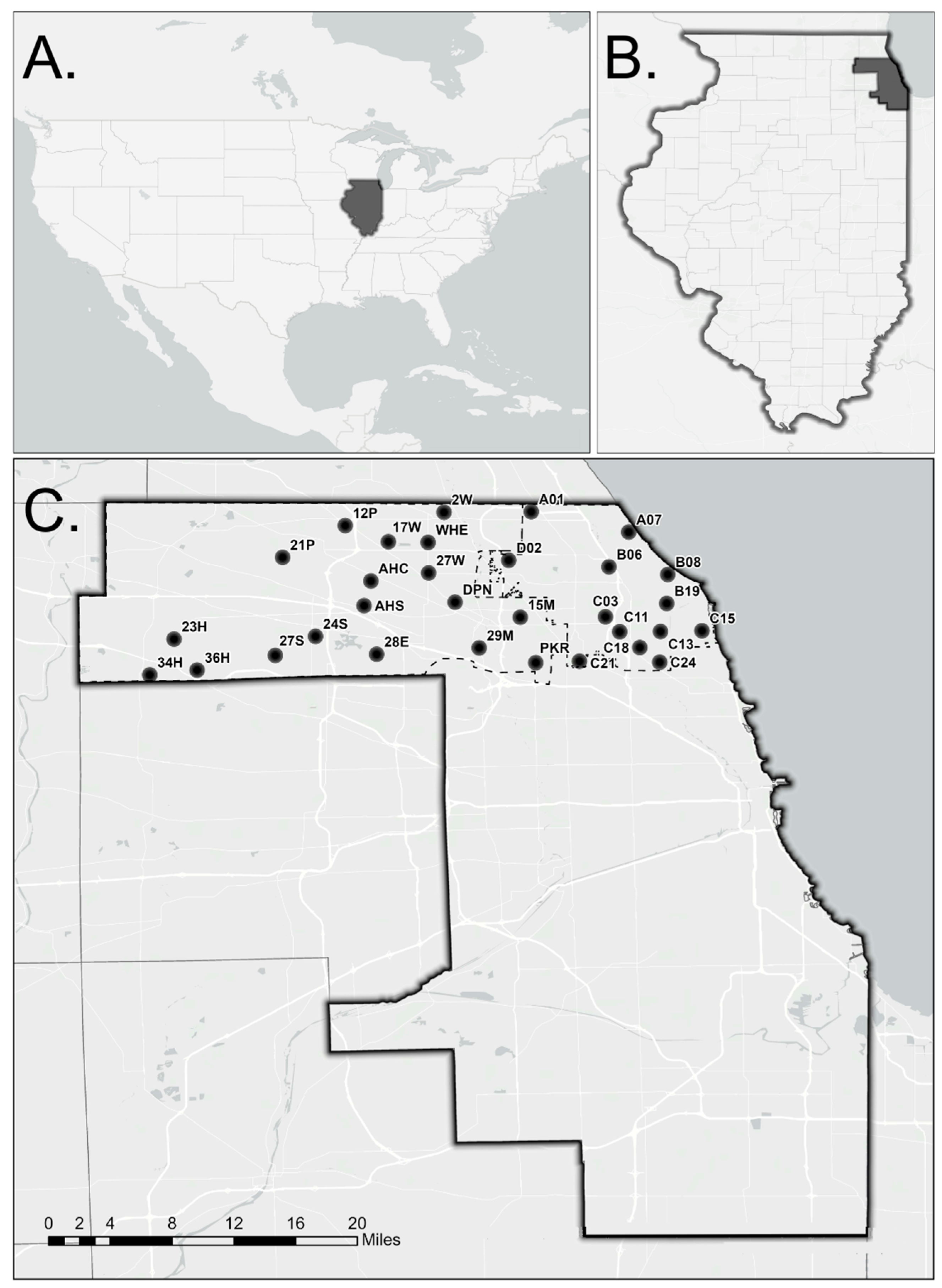
Culex pipiens egg rafts were collected from 31 sites across two mosquito control districts in the north and northwestern suburbs of Chicago, IL, USA (Figure 1, Supplementary Table S1). Each collection site encompassed approximately 2.3 km2 and was separated from other sites by at least 1.6 km. Collection sites in the North Shore Mosquito Abatement District (NSMAD) include Northfield (B06), Northbrook (A01), Glencoe (A07), Glenview (D02), Wilmette (B08), Skokie (C11, C13, C18), Evanston (B19, C15), Morton Grove (C03), Niles (C21), and Lincolnwood (C24). Sites from the Northwest Mosquito Abatement District (NWMAD) include Des Plaines (DPN, 15M, 29M), Elk Grove (28E), Park Ridge (PKR), Bartlett (34H), Hanover Park (36H), Streamwood (23H), Schaumburg (24S, 27S), Arlington Heights (AHC, AHS, 17W), Prospect Heights (27W), Wheeling (WHE, 2W), and Palatine (12P, 21P).
Figure 1. Map of study area. (A) United States of America, highlighting Illinois; (B) Illinois, highlighting Cook County; (C) Collection sites within Cook County. Map created by Austin Robak using Esri basemap data © OpenStreetMap contributors, Esri, under CC BY 4.0 (https://creativecommons.org/licenses/by/4.0/, accessed on 31 October 2025).

2.2. Mosquito Collection and Rearing

Egg rafts were collected from three to five gravid ovitraps per site, baited with an alfalfa pellet infusion. Collections were conducted July through September 2025 (epidemiological weeks 27–39). Each site was sampled one to three times on sequential days until a sufficient quantity of egg rafts was collected. A minimum of 12 egg rafts was required per collection site. Egg rafts were hatched in 6 oz Styrofoam cups (Item 6SJ12, Dart Container Company, Mason, MI, USA) with ~150 mL of tap water. Once mosquitoes developed to the second instar, Cx. pipiens larvae were identified morphologically [12] and pooled by collection site. Other Culex spp. larvae were discarded. Larvae were fed ground TetraMin® tropical fish flakes (Spectrum Pet Brands LLC, Blacksburg, VA, USA) and reared under standard conditions (27 °C, 80% RH, 16:8 light:dark cycle) until they reached late fourth instar.

2.3. Larvicide Bioassays

Laboratory larvicide bioassays were conducted according to previous methods [7,13,14]. Briefly, approximately 20–25 late fourth instar larvae were transferred to a 6 oz styrofoam cup with 100 mL tap water and 100 mg rabbit pellets (Kaytee Specialty Products Inc., Clinton, WI, USA). Technical-grade S-methoprene and pyriproxyfen (Items 33375 and 34175, Sigma-Aldrich, St. Louis, MO, USA) were diluted separately in series with analytical-grade acetone (Item 270725, Sigma-Aldrich, St. Louis, MO, USA) to generate stock solutions. Solutions were stored in borosilicate amber glass at 4 °C and acclimated to room temperature before use. Each field-collected population and susceptible control mosquitoes were subjected to a minimum of three replicates for each concentration and active ingredient tested. When a surplus of larvae was available, additional replicates and/or concentrations were tested. Approximately half of the reared larvae were used in S-methoprene assays, while the other half were used in pyriproxyfen assays, so larvae from the same egg rafts, of presumed similar genetics, were exposed to both active ingredients. In total, each population was exposed to 3–8 replicates of 9–15 concentrations of S-methoprene (Supplementary Tables S2 and S3) and 3–8 replicates of 10–18 concentrations of pyriproxyfen (Supplementary Tables S4 and S5). Final exposure concentrations ranged from 5 × 10⁻⁴ ppb to 5 × 10³ ppb for S-methoprene and 1 × 10⁻⁶ ppb–1 × 10³ ppb for pyriproxyfen. Untreated control cups were implemented in triplicate and in parallel with larvicide-treated cups for all field-collected populations and the susceptible strain. Bioassay cups were covered with a modified lid [7] and maintained under ambient conditions (23 °C, 60% RH) on lab benches to avoid contamination of rearing facilities. Results were recorded after all mosquitoes had either emerged successfully or died. Dead larvae, dead pupae, and incompletely emerged adults were combined in mortality counts, also termed emergence inhibition.

2.4. Analysis

Mortality was corrected with Abbott’s formula [15]. A probit analysis [16,17] was used to calculate LC50 and LC90 values, with 95% confidence intervals, for each population. A Pearson’s χ2 goodness-of-fit test and H (heterogeneity factor) were used to evaluate model fit. Resistance ratios (RRs) were calculated by dividing the LC50 or LC90 of each field-collected population by the respective value for the susceptible strain (COL), resulting in RR50 and RR90 values. Field-collected populations were categorized for resistance intensity as follows: susceptible (RR < 5), moderate resistance (5 < RR < 10), high resistance (10 < RR < 100), and extreme resistance (RR > 100) [7,18]. There are no previously established resistance categories from the WHO for Culex genus mosquitoes; the thresholds for Aedes genus mosquitoes were used [18].
The relationship between S-methoprene and pyriproxyfen resistance was explored with gamma regression with a log link, as the data were not normally distributed, non-negative non-integers, and were over-dispersed. We hypothesized that the level of pyriproxyfen resistance would correlate with the level of S-methoprene resistance and the amount of pyriproxyfen pressure from mosquito control activities. Separate models were created for RR50 and RR90 data sets. The response variable with the pyriproxyfen RR50 or RR90 values. The explanatory variables considered included the S-methoprene RR50 or RR90 values and the number of seasons where all catch basins were treated with pyriproxyfen from each collection site. Model selection was completed by comparing Akaike information criterion (AIC) and Nagelkerke R2 values [19]. All analyses were completed and visualized using R studio, version 4.5.1 (R Development Core Team 2025) with packages ‘ecotox’, ‘MuMIn’, ‘MASS’, and ‘ggplot2’ [20,21,22,23].

3. Results

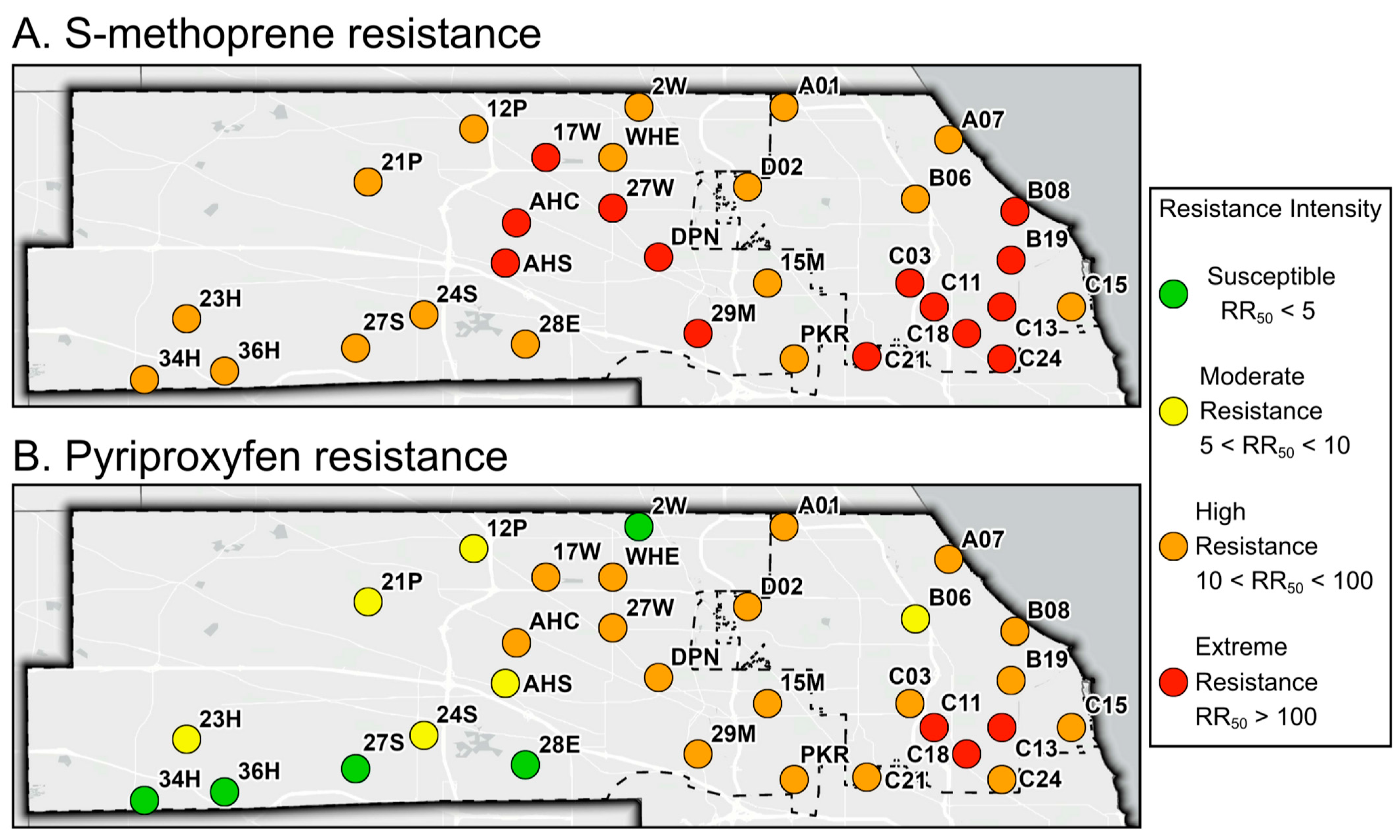
All 31 field-collected Cx. pipiens populations were at least highly resistant (RR50 > 10) to S-methoprene (Figure 2, Supplementary Table S6) [18]. Of these 31 populations, 14 displayed an ‘extreme’ resistance to S-methoprene (RR50 > 100) [7]. When examining the S-methoprene RR90 values, two were susceptible or had low levels of resistance, six were moderately resistant, 17 were highly resistant, and six were extremely resistant (Supplementary Table S6) [7,18]. In total, 26 of the 31 populations studied were at least moderately resistant (RR50 > 5) to pyriproxyfen; specifically, at RR50, five populations were susceptible or had low resistance, six populations were moderately resistant, 17 were highly resistant, and three were extremely resistant (Figure 2 and Supplementary Table S7). Increased susceptibility to pyriproxyfen was observed at RR90, where 16 populations were susceptible or had low resistance, seven were moderately resistant, seven were highly resistant, and one was extremely resistant (Supplementary Table S7). The susceptible control strain of Cx. pipiens was susceptible to both S-methoprene and pyriproxyfen in alignment with previous work with this same colony [7,8], as well as other published literature [10,13,14].
Figure 2. Resistance status of each field-collected Cx. pipiens population to S-methoprene (A) and pyriproxyfen (B) at RR50. Resistance intensity categories according to the WHO [18]. Map created by Austin Robak using Esri basemap data © OpenStreetMap contributors, Esri, under CC BY 4.0 (https://creativecommons.org/licenses/by/4.0/, accessed on 31 October 2025).
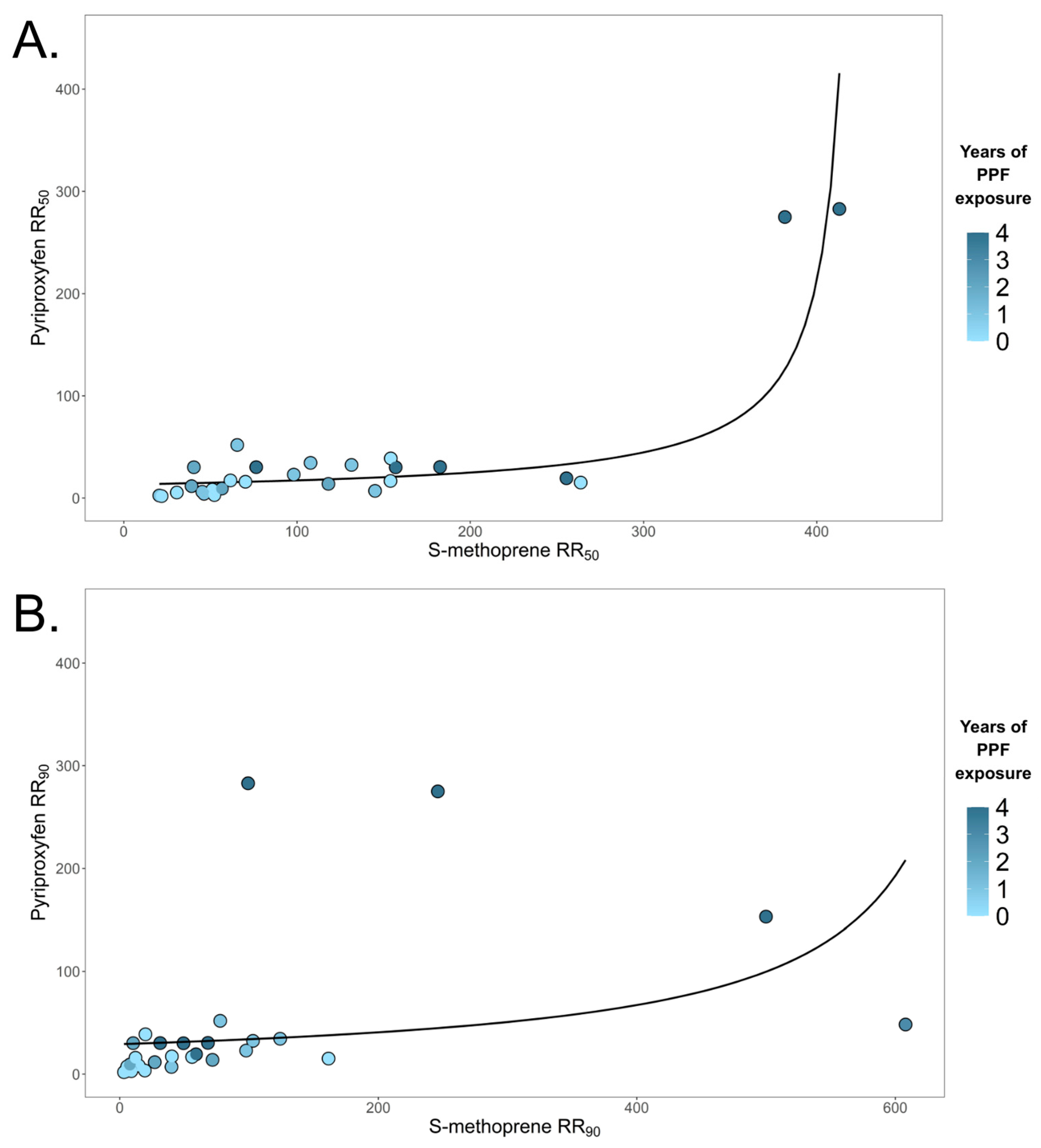
Gamma regression analysis revealed that the level of pyriproxyfen resistance was significantly correlated to both the level of S-methoprene resistance and the number of pyriproxyfen applications made to catch basins at both RR50 and RR90 (Table 1 and Figure 3). Final model selection included both the level of S-methoprene resistance and the number of pyriproxyfen catch basin applications for both models (Supplementary Table S8). The estimates for S-methoprene RR50 were 1.01, indicating that pyriproxyfen resistance increases by 1% per unit increase in S-methoprene resistance. For example, if S-methoprene RR50 is 200, then pyriproxyfen RR50 would be 202. In addition, the number of pyriproxyfen catch basin applications significantly increases pyriproxyfen resistance. Each additional treatment of pyriproxyfen increased the resistance ratio by 25% and 53% at RR50 and RR90, respectively, though this was not significant at RR50. Indeed, all populations that had three to four applications were all highly resistant to pyriproxyfen (RR50 > 10). It is important to remember that the increases in resistance are not linear, as this relationship follows a gamma distribution and estimates are multiplicative.
Table 1. Final gamma regression models for pyriproxyfen resistance. Estimates (exponentiated), 95% confidence intervals (CI), and p-values are reported.
Figure 3. Comparison of resistance to S-methoprene and pyriproxyfen in 31 field-collected populations of Cx. pipiens. (A) Resistance ratios calculated for LC50 values and (B) using LC90 values. Color indicates the number of pyriproxyfen treatments in the collection site. The trend line follows the log-linked gamma regression pyriproxyfen RR~S-methoprene RR.

4. Discussion

In this study, we demonstrated that S-methoprene resistance correlates with pyriproxyfen resistance, indicating a potential cross-resistance relationship. We detected high levels of S-methoprene resistance (RR50 > 10) in all 31 populations studied, of which 26 exhibited pyriproxyfen resistance (RR50 > 5) (Figure 2). Increased levels of S-methoprene resistance ratios resulted in equally increased levels of pyriproxyfen resistance ratios; the incidence rates were equal (Table 1). The number of pyriproxyfen applications was associated with increased levels of pyriproxyfen resistance, but it was not necessary for reduced susceptibility to be present. Indeed, 8 of 11 populations exhibited resistance to pyriproxyfen even though zero applications were made in the area (Figure 2, Supplementary Table S7). However, it is critical to understand that if a population is resistant to S-methoprene, this does not guarantee resistance to pyriproxyfen. For example, five populations that were highly resistant to S-methoprene were not resistant to pyriproxyfen at either RR50 or RR90 (Figure 2, Supplementary Tables S6 and S7). Therefore, if a population is resistant to S-methoprene, it is possible that pyriproxyfen resistance is also present, but it is not guaranteed.
To the best of our knowledge, this is the first report of widespread high levels of resistance to pyriproxyfen in a medically significant mosquito species, though this is not due to a lack of surveillance. Susceptibility to high levels of resistance to pyriproxyfen has been documented in field-collected populations of Aedes species [24,25,26,27,28,29,30,31,32,33,34,35,36], though minimal resistance has been detected in Culex species [24,37,38,39,40]. The highest level of pyriproxyfen resistance reported was in one Ae. aegypti population from California with RR50 value of 38.7 [36]. In the current study, we report 20 populations with at least a high level of resistance (RR50 > 10), with three populations with RR50 values greater than 100 (Figure 2, Supplementary Table S7). Conversely, reduced susceptibility to S-methoprene in Culex species has been reported around the world [13,14,41,42,43,44], including our own investigations [7,8]. With this repeated sampling, many populations from the Chicago region are consistently among the highest reported, exhibiting resistance year after year [7,8].
Cross-resistance between these two active ingredients is not unexpected, as both active ingredients are juvenile hormone analogs (JHAs). Therefore, it can be assumed that the resistance mechanisms evolved to combat one JHA work on others. Although the molecular mechanisms underlying JHA resistance remain poorly characterized, non-specific mechanisms like increased metabolic detoxification and decreased absorption are hypothesized [45,46,47]. Enhanced metabolic detoxification is a compelling resistance mechanism, as many of these Cx. pipiens populations are resistant to a variety of other insecticides, including pyrethroids, organophosphates, and Ls [7,8,48,49,50,51]. This predisposition for broad metabolic activity may be further amplified by the highly organic nature of the urban larval habitats these mosquitoes occupy, pre-selecting for elevated detoxification capacity [52].
It is possible that pyriproxyfen resistance pressures originated from sources outside the activity of mosquito abatement districts. Pyriproxyfen is formulated to control a variety of insect pests in a multitude of habitats. For example, pyriproxyfen can be found in a multitude of general- and restricted-use products to control lepidopteran, coleopteran, blattodean, orthopteran, siphonapteran, and dipteran pests in and around human-made environments. It is possible that these products accidentally end up in catch basins from improper use, runoff, or improper disposal, leading to sublethal exposures. An assortment of household and industrial chemicals, including insecticides, can be found in catch basins, adding additional selection pressures [53].
In this investigation, there were no field-collected Cx. pipiens populations from the Chicago, IL, USA metropolitan area that were susceptible to both S-methoprene and pyriproxyfen, nor were there any populations that were tolerant to pyriproxyfen but susceptible to S-methoprene. It is unclear if reduced susceptibility to only pyriproxyfen would reciprocally cause cross-resistance to S-methoprene, but it is probable based on the resistance mechanisms. Further investigations are needed to understand this potential reciprocal relationship.
The association between resistance ratios observed in laboratory assays and the correlation to real-world commercial product effectiveness remains ambiguous and warrants further investigation. An elevated RR suggests that a population possesses genetically reduced susceptibility to a given active ingredient, which implies a high potential for reduced field efficacy or even control failure, but this assumption may not translate in operational settings. For example, both the NSMAD and the NWMAD continue to use pyriproxyfen in mosquito control operations and have not observed a decrease in effectiveness when applied at full label rates. It is possible that applying pyriproxyfen-based larvicides at lower label rates could result in product failures, but more research is needed to make this determination. Formulated products can be applied at higher rates, depending on the label, to overcome resistance and often contain inert ingredients that increase potency and residual time. Indeed, the LC50 and LC90 doses of pyriproxyfen are much lower than the doses of S-methoprene (Supplementary Tables S6 and S7); thus, resistance can be overcome in the field. In general, if resistance is detected in field-collected mosquito populations, increasing application rates is recommended to reduce sublethal exposures. Further work investigating product effectiveness on resistant populations is necessary to understand the genuine risk of resistance to mosquito control operations and the protection of public health.
Currently, there are no proven methodologies for reducing S-methoprene or pyriproxyfen resistance in mosquitoes. Common resistance management tactics include product rotation with different active ingredients with different modes of action, combining active ingredients, or applying products in a mosaic pattern, allowing for untreated refugia [18]. It is unclear if removing the selection pressure will guarantee increased susceptibility. Despite these unknowns, mosquito control professionals are still tasked with reducing mosquito populations and mitigating the threat of vector-borne disease. Rotation between or combining S-methoprene and pyriproxyfen is an ill-advised tactic to reduce JHA resistance due to cross-resistance and an identical mode of action. Other resistance management techniques, like rotating and combining a JHA with larvicide products with distinct modes of action, like spinosad, Ls, or Bacillus thuringiensis israelensis (Bti), should be effective despite low levels of cross-resistance, but this has yet to be validated.
Overall, we demonstrated that pyriproxyfen cross-resistance may occur in S-methoprene-resistant Cx. pipiens populations, regardless of prior pyriproxyfen exposure, though it is not guaranteed. Understanding larvicide resistance, cross-resistance, and interactions between active ingredients is critical for mosquito control operations to make informed product selection choices and to practice insecticide resistance management. These results underscore the need for routine larvicide resistance surveillance where larvicides are used for mosquito control and for further research in effective resistance management tactics.:

Supplementary Materials

The following supporting information can be downloaded at https://www.mdpi.com/article/10.3390/insects17030241/s1. Table S1: GPS coordinates of ovitraps per collection site. Table S2: Number of replicates per collection site and per concentration of S-methoprene. Susceptible colony mosquitoes are denoted by COL. Untreated controls for mortality correction are listed as ‘control’. Table S3: Raw bioassay mortality data for S-methoprene. Table S4: Number of replicates per collection site and per concentration of pyriproxyfen. Susceptible colony mosquitoes are denoted by COL. Untreated controls for mortality correction are listed as ‘control’. Table S5: Raw bioassay mortality data for pyriproxyfen. Table S6: Summary of S-methoprene dose response data, resistance ratios, and statistical outputs for field-collected Cx. pipiens. Table S7: Summary of pyriproxyfen dose response data, resistance ratios, and statistical outputs for field-collected Cx. pipiens. Table S8: Model selection table.

Author Contributions

Conceptualization, K.L. and M.E.C.; Data Curation, K.L.; Formal Analysis, K.L.; Funding Acquisition, L.C.B. and M.E.C.; Investigation, K.L. and P.I., Methodology, K.L.; Project Administration, K.L.; Resources, K.L., P.I. and M.E.C.; Software, K.L.; Supervision, K.L. and M.E.C.; Validation, K.L., P.I., L.C.B. and M.E.C.; Visualization, K.L.; Writing—Original Draft Preparation, K.L.; Writing—Review and Editing, K.L., P.I., L.C.B. and M.E.C. All authors have read and agreed to the published version of the manuscript.

Funding

This research was generated in part by the Midwest Center of Excellence for Vector-Borne Disease, which is funded by the cooperative agreement U01CK000651 from the Centers for Disease Control and Prevention. The contents are solely the responsibility of the authors and do not necessarily represent the official views of the Centers for Disease Control and Prevention.

Data Availability Statement

The original contributions presented in this study are included in the article/Supplementary Materials. Further inquiries can be directed to the corresponding author.

Acknowledgments

The authors would like to thank Clare Mattingly, Helen Pacheco, and Aster Zeches for assistance in egg collection and rearing; Kathy Vaccaro for supplying susceptible mosquitoes; Cassie Halvorsen for coordination; and Austin Robak for map creation.

Conflicts of Interest

The authors declare no conflicts of interest.

Abbreviations

The following abbreviations are used in this manuscript:
WNVWest Nile virus
IMMIntegrated mosquito management
IGRInsect growth regulator
JHAJuvenile hormone analog
RRResistance ratio
LsLysinibacillus sphaericus
BtiBacillus thuringiensis israelensis
NSMADNorth Shore Mosquito Abatement District
NWMADNorthwest Mosquito Abatement District

References

  1. AMCA. Best Practices for Integrated Mosquito Management; American Mosquito Control Association: Sacramento, CA, USA, 2021. [Google Scholar]
  2. Henrick, C.A.; Staal, G.B.; Siddall, J.B. Alkyl 3,7,11-Trimethyl-2,4-Dodecadienoates, a New Class of Potent Insect Growth Regulators with Juvenile Hormone Activity. J. Agric. Food Chem. 1973, 21, 354–359. [Google Scholar] [CrossRef]
  3. Williams, C.M. Third-Generation Pesticides. Sci. Am. 1967, 217, 13–17. [Google Scholar] [CrossRef]
  4. Charles, J.P.; Iwema, T.; Epa, C.V.; Takaki, K.; Rynes, J.; Jindra, M. Ligand-Binding Properties of a Juvenile Hormone Receptor, Methoprene-Tolerant. Proc. Natl. Acad. Sci. USA 2011, 108, 21128–21133. [Google Scholar] [CrossRef]
  5. Su, T.; Liu, H. The Advantages of Pyriproxyfen, a Juvenile Hormone Mimic, for Mosquito Control. China Trop. Med. 2024, 24, 627–636. [Google Scholar] [CrossRef]
  6. Environmental Protection Agency. June 2001 Update of the March 1991 Methoprene R.E.D. Fact Sheet. Available online: https://archive.epa.gov/pesticides/reregistration/web/pdf/bppd_fs_105401.pdf (accessed on 7 November 2025).
  7. Lopez, K.; Harbison, J.; Irwin, P.; Erkapic, A.; Holub, R.; Blanco, C.; Paskewitz, S.; Clifton, M.; Bartholomay, L. Extreme Resistance to S-Methoprene in Field-Collected Culex pipiens (Diptera: Culicidae) across the Chicago, IL Region. Sci. Rep. 2024, 14, 18001. [Google Scholar] [CrossRef]
  8. Lopez, K.; Irwin, P.; Tomek, M.; Holub, R.; Paskewitz, S.; Bartholomay, L.; Clifton, M. Dual S-Methoprene and Lysinibacillus sphaericus Larvicide Use Leads to Multiple Independent, and Not Cross-Resistance in Culex pipiens. PLoS ONE 2025, 20, e0332621. [Google Scholar] [CrossRef] [PubMed]
  9. Su, T.; Thieme, J.; Cummings, R.; Cheng, M.L.; Brown, M.Q. Cross Resistance in S-Methoprene-Resistant Culex quinquefasciatus (Diptera: Culicidae). J. Med. Entomol. 2021, 58, 398–402. [Google Scholar] [CrossRef] [PubMed]
  10. Clifton, M.; Lopez, K. Assessing Insect Growth Regulator Resistance Using Bioassays: A Systematic Review and Meta-Analysis of Methoprene and Pyriproxyfen Inhibition of Emergence in Three Vector Mosquito Species. Trop. Med. Infect. Dis. 2025, 10, 87. [Google Scholar] [CrossRef]
  11. Sullivan, J.; Goh, K. Environmental Fate and Properties of Pyriproxyfen. J. Pestic. Sci. 2008, 4, 339–350. [Google Scholar] [CrossRef]
  12. Darsie, R.F.; Ward, R.A. Identification and Geographical Distribution of the Mosquitoes of North America, North of Mexico; American Mosquito Control Association: Fresno, CA, USA, 1981. [Google Scholar]
  13. Su, T.; Thieme, J.; Ocegueda, C.; Ball, M.; Cheng, M.L.; Norris, D. Resistance to Lysinibacillus sphaericus and Other Commonly Used Pesticides in Culex pipiens (Diptera: Culicidae) from Chico, California. J. Med. Entomol. 2018, 55, 423–428. [Google Scholar] [CrossRef] [PubMed]
  14. Su, T.; Thieme, J.; White, G.S.; Lura, T.; Mayerle, N.; Faraji, A.; Cheng, M.L.; Brown, M.Q. High Resistance to Bacillus sphaericus and Susceptibility to Other Common Pesticides in Culex pipiens (Diptera: Culicidae) from Salt Lake City, UT. J. Med. Entomol. 2019, 56, 506–513. [Google Scholar] [CrossRef]
  15. Abbott, W.S. A Method of Computing the Effectiveness of an Insecticide. J. Econ. Entomol. 1925, 18, 265–267. [Google Scholar]
  16. Finney, D.J. Probit Analysis; Cambridge University Press: Cambridge, UK, 1971. [Google Scholar]
  17. Robertson, J.L.; Savin, N.E.; Russell, R.M.; Preisler, H.K. Bioassays with Arthropods, 2nd ed.; CRC Press: Boca Raton, FL, USA, 2007. [Google Scholar]
  18. WHO. Monitoring and Managing Insecticide Resistance in Aedes Mosquito Populations: Interim Guidance for Entomologists; World Health Organization: Geneva, Switzerland, 2016. [Google Scholar]
  19. Burnham, K.; Anderson, D. Model Selection and Multimodel Inference, 2nd ed.; Springer: New York, NY, USA, 2002. [Google Scholar]
  20. Barton, K. MuMIn: Multi-Model Inference. Available online: https://cran.r-project.org/web/packages/MuMIn/index.html (accessed on 10 February 2026).
  21. Wickham, H.; Chang, W.; Henry, L.; Pedersen, T.L.; Takahashi, K.; Wilke, C.; Woo, K.; Yutani, H.; Dunnington, D.; van den Brand, T. Ggplot2: Create Elegant Data Visualisations Using the Grammar of Graphics. Available online: https://cran.r-project.org/web/packages/ggplot2/index.html (accessed on 10 February 2026).
  22. Hlina, B. Ecotox: Analysis of Ecotoxicology. Available online: https://cran.r-project.org/web/packages/ecotox/index.html (accessed on 9 February 2026).
  23. Ripley, B.; Venables, B.; Bates, D.M.; Hornik, K.; Gebhardt, A.; Firth, D. MASS: Support Functions and Datasets for Venables and Ripley’s MASS. Available online: https://cran.r-project.org/web/packages/MASS/index.html (accessed on 10 February 2026).
  24. Pocquet, N.; Darriet, F.; Zumbo, B.; Milesi, P.; Thiria, J.; Bernard, V.; Toty, C.; Labbé, P.; Chandre, F. Insecticide Resistance in Disease Vectors from Mayotte: An Opportunity for Integrated Vector Management. Parasit. Vectors 2014, 7, 299. [Google Scholar] [PubMed]
  25. Lin, L.Q.; Chen, Y.H.; Tian, Y.F.; Chen, Y.S.; Zheng, Z.Y.; Wu, J.X.; Hu, F.; Wu, C.; Xie, L.H. Study on the Cross-Resistance of Aedes albopictus (Skuse) (Diptera: Culicidae) to Deltamethrin and Pyriproxyfen. Parasit. Vectors 2024, 17, 403. [Google Scholar] [CrossRef] [PubMed]
  26. Marcombe, S.; Chonephetsarath, S.; Thammavong, P.; Brey, P.T. Alternative Insecticides for Larval Control of the Dengue Vector Aedes aegypti in Lao PDR: Insecticide Resistance and Semi-Field Trial Study. Parasit. Vectors 2018, 11, 616. [Google Scholar] [CrossRef] [PubMed]
  27. Marcombe, S.; Farajollahi, A.; Healy, S.P.; Clark, G.G.; Fonseca, D.M. Insecticide Resistance Status of United States Populations of Aedes albopictus and Mechanisms Involved. PLoS ONE 2014, 9, e101992. [Google Scholar] [CrossRef]
  28. Campos, K.B.; Alomar, A.A.; Eastmond, B.H.; Obara, M.T.; Dias, L.d.S.; Rahman, R.U.; Alto, B.W. Assessment of Insecticide Resistance of Aedes aegypti (Diptera: Culicidae) Populations to Insect Growth Regulator Pyriproxyfen, in the Northeast Region of Brazil. J. Vector Ecol. 2023, 48, 12–18. [Google Scholar] [CrossRef]
  29. Campos, K.B.; Martins, A.J.; de Melo Rodovalho, C.; Bellinato, D.F.; dos Santos Dias, L.; da Graça Macoris, M.D.L.; Andrighetti, M.T.M.; Lima, J.B.P.; Obara, M.T. Assessment of the Susceptibility Status of Aedes aegypti (Diptera: Culicidae) Populations to Pyriproxyfen and Malathion in a Nation-Wide Monitoring of Insecticide Resistance Performed in Brazil from 2017 to 2018. Parasit. Vectors 2020, 13, 531. [Google Scholar] [CrossRef]
  30. Andrighetti, M.T.M.; Cerone, F.; Rigueti, M.; Galvani, K.C.; Lourdes Da, M.D.; Macoris, G. Effect of Pyriproxyfen in Aedes aegypti Populations with Different Levels of Susceptibility to the Organophosphate Temephos. Dengue Bull. 2008, 32, 186–198. [Google Scholar]
  31. Lau, K.W.; Chen, C.D.; Lee, H.L.; Low, V.L.; Sofian-Azirun, M. Bioefficacy of Insect Growth Regulators against Aedes albopictus (Diptera: Culicidea) from Sarawak, Malaysia: A Statewide Survey. J. Econ. Entomol. 2018, 111, 1388–1394. [Google Scholar] [CrossRef]
  32. Elia-Amira, N.M.R.; Chen, C.D.; Low, V.L.; Lau, K.W.; Haziqah-Rashid, A.; Amelia-Yap, Z.H.; Lee, H.L.; Sofian-Azirun, M. Statewide Efficacy Assessment of Insect Growth Regulators Against Aedes albopictus (Diptera: Culicidae) in Sabah, Malaysia: An Alternative Control Strategy? J. Med. Entomol. 2022, 59, 301–307. [Google Scholar] [CrossRef]
  33. Leyva, Y.R.; Coto, M.M.R.; Lazcano, J.A.B.; Pérez Insueta, O.; Sánchez Valdés, L. Eficacia del Pyriproxyfeno para el Control de Aedes (S) aegypti (Diptera: Culicidae) en Cepas con Diferentes Niveles de Resistencia a Temefos. Rev. Cubana Med. Trop. 2010, 62, 224–229. [Google Scholar]
  34. María Del Carmen, M.; Zavala, T.; María, D.C.; Rodríguez, M.; Yanelys, M.; Leyva, R.; Juan, C.; Lazcano, A.B. Evaluation of Temephos and Pyriproxifen against Aedes aegypti (Diptera: Culicidae) from Guayaquil, Ecuador. Rev. Cubana Med. Trop. 2014, 66, 71–83. [Google Scholar]
  35. Moura, L.; Nadai, B.L.d.; Corbi, J.J. One Does Not Simply Apply Larvicides: Aedes aegypti from Araraquara (Brazil) Has Reduced Susceptibility to Pyriproxyfen. Vet. Parasitol. Reg. Stud. Rep. 2023, 41, 100875. [Google Scholar] [CrossRef] [PubMed]
  36. Su, T.; Thieme, J.; Lura, T.; Cheng, M.L.; Brown, M.Q. Susceptibility Profile of Aedes aegypti L. (Diptera: Culicidae) from Montclair, California, to Commonly Used Pesticides, with Note on Resistance to Pyriproxyfen. J. Med. Entomol. 2019, 56, 1047–1054. [Google Scholar] [CrossRef] [PubMed]
  37. Kawada, H.; Kohamma, T.; Aba, Y. Larvicidal Activity of Water-Soluble Granular Formulation of the Insect Growth Regulator, Pyriproxyfen, against Culex Mosquitoes. Jpn. J. Environ. Entomol. 1994, 6, 68–77. [Google Scholar]
  38. Kono, Y.; Omata-Iwabuchi, K.; Takahashi, M. Changes in Susceptibility to Pyriproxyfen, a JH Mimic, during Late Larval and Early Pupal Stages of Culex pipiens molestus. Med. Entomol. Zool. 1997, 48, 85–89. [Google Scholar] [CrossRef]
  39. Kasai, S.; Shono, T.; Komagata, O.; Tsuda, Y.; Kobayashi, M.; Motoki, M.; Kashima, I.; Tanikawa, T.; Yoshida, M.; Tanaka, I.; et al. Insecticide Resistance in Potential Vector Mosquitoes for West Nile Virus in Japan. J. Med. Entomol. 2007, 44, 822–829. [Google Scholar] [CrossRef]
  40. Su, X.; Guo, Y.; Deng, J.; Xu, J.; Zhou, G.; Zhou, T.; Li, Y.; Zhong, D.; Kong, L.; Wang, X.; et al. Fast Emerging Insecticide Resistance in Aedes albopictus in Guangzhou, China: Alarm to the Dengue Epidemic. PLoS Negl. Trop. Dis. 2019, 13, e0007665. [Google Scholar] [CrossRef] [PubMed]
  41. Vasquez, M.I.; Violaris, M.; Hadjivassilis, A.; Wirth, M.C. Susceptibility of Culex pipiens (Diptera: Culicidae) Field Populations in Cyprus to Conventional Organic Insecticides, Bacillus thuringiensis Subsp. israelensis, and Methoprene. J. Med. Entomol. 2009, 46, 881–887. [Google Scholar] [CrossRef] [PubMed]
  42. Burtis, J.C.; Poggi, J.D.; McMillan, J.R.; Crans, S.C.; Campbell, S.R.; Isenberg, A.; Pulver, J.; Casey, P.; White, K.; Zondag, C.; et al. NEVBD Pesticide Resistance Monitoring Network: Establishing a Centralized Network to Increase Regional Capacity for Pesticide Resistance Detection and Monitoring. J. Med. Entomol. 2021, 58, 787–797. [Google Scholar] [CrossRef] [PubMed]
  43. Paul, A.; Harrington, L.C.; Zhang, L.; Scott, J.G. Insecticide Resistance in Culex pipiens from New York. J. Am. Mosq. Control Assoc. 2005, 21, 305–309. [Google Scholar] [CrossRef]
  44. Lehane, Á.; Baxter, L.; Martin, E.; Angelico, J.; Fell, V.; Peh, A.; Burtis, J.C.; Harrington, L.C. Insecticide Resistance across the Northeast and Mid-Atlantic United States: Results from 6 Years of Monitoring (2019–2024). J. Med. Entomol. 2025, 63, tjaf171. [Google Scholar] [CrossRef]
  45. Brown, T.M.; Hooper, G.H.S. Metabolic Detoxication as a Mechanism of Methoprene Resistance in Culex pipiens pipiens. Pestic. Biochem. Physiol. 1979, 12, 79–86. [Google Scholar] [CrossRef]
  46. Brown, T.; Brown, A. Accumulation and Distribution of Methoprene in Resistant Culex pipiens pipiens Larvae. Entomol. Exp. Appl. 1980, 27, 11–22. [Google Scholar] [CrossRef]
  47. Yunta, C.; Grisales, N.; Nász, S.; Hemmings, K.; Pignatelli, P.; Voice, M.; Ranson, H.; Paine, M.J.I. Pyriproxyfen Is Metabolized by P450s Associated with Pyrethroid Resistance in An. Gambiae. Insect Biochem. Mol. Biol. 2016, 78, 50–57. [Google Scholar] [CrossRef] [PubMed]
  48. Dubie, T.R.; Bartholomay, L.; Clifton, M.; Walker, E.D. Variation in Susceptibility to Permethrin in Culex pipiens and Culex restuans Populations in the Great Lakes Region of the United States. J. Am. Mosq. Control Assoc. 2022, 38, 188–197. [Google Scholar] [CrossRef] [PubMed]
  49. Burgess, E.R.; Lopez, K.; Irwin, P.; Jaeger, C.P.; Estep, A.S. Assessing Pyrethroid Resistance Status in the Culex pipiens Complex (Diptera: Culicidae) from the Northwest Suburbs of Chicago, Illinois Using Cox Regression of Bottle Bioassays and Other Detection Tools. PLoS ONE 2022, 17, e0268205. [Google Scholar] [CrossRef]
  50. Lopez, K.; Irwin, P.; Bartlett, D.; Kukla, C.; Paskewitz, S.; Bartholomay, L. A Multi-Assay Assessment of Insecticide Resistance in Culex pipiens (Diptera: Culicidae) Informs a Decision-Making Framework. PLoS ONE 2025, 20, e0324194. [Google Scholar] [CrossRef]
  51. Noel, K.R.; Kim, C.H.; Stone, C.M. Mechanistic Evidence of Widespread Insecticide Resistance among the Illinois West Nile Virus Vectors Culex pipiens and Culex restuans. Sci. Rep. 2025, 15, 22806. [Google Scholar] [CrossRef]
  52. Haba, Y.; Korlević, P.; McAlister, E.; Lawniczak, M.K.N.; Schumer, M.; Rose, N.H.; McBride, C.S. Ancient Origin of an Urban Underground Mosquito. Science 2025, 390, eady4515. [Google Scholar] [CrossRef] [PubMed]
  53. Masoner, J.R.; Kolpin, D.W.; Cozzarelli, I.M.; Barber, L.B.; Burden, D.S.; Foreman, W.T.; Forshay, K.J.; Furlong, E.T.; Groves, J.F.; Hladik, M.L.; et al. Urban Stormwater: An Overlooked Pathway of Extensive Mixed Contaminants to Surface and Groundwaters in the United States. Environ. Sci. Technol. 2019, 53, 10070–10081. [Google Scholar] [CrossRef] [PubMed]
Disclaimer/Publisher’s Note: The statements, opinions and data contained in all publications are solely those of the individual author(s) and contributor(s) and not of MDPI and/or the editor(s). MDPI and/or the editor(s) disclaim responsibility for any injury to people or property resulting from any ideas, methods, instructions or products referred to in the content.

Article Metrics

Citations

Article Access Statistics

Multiple requests from the same IP address are counted as one view.