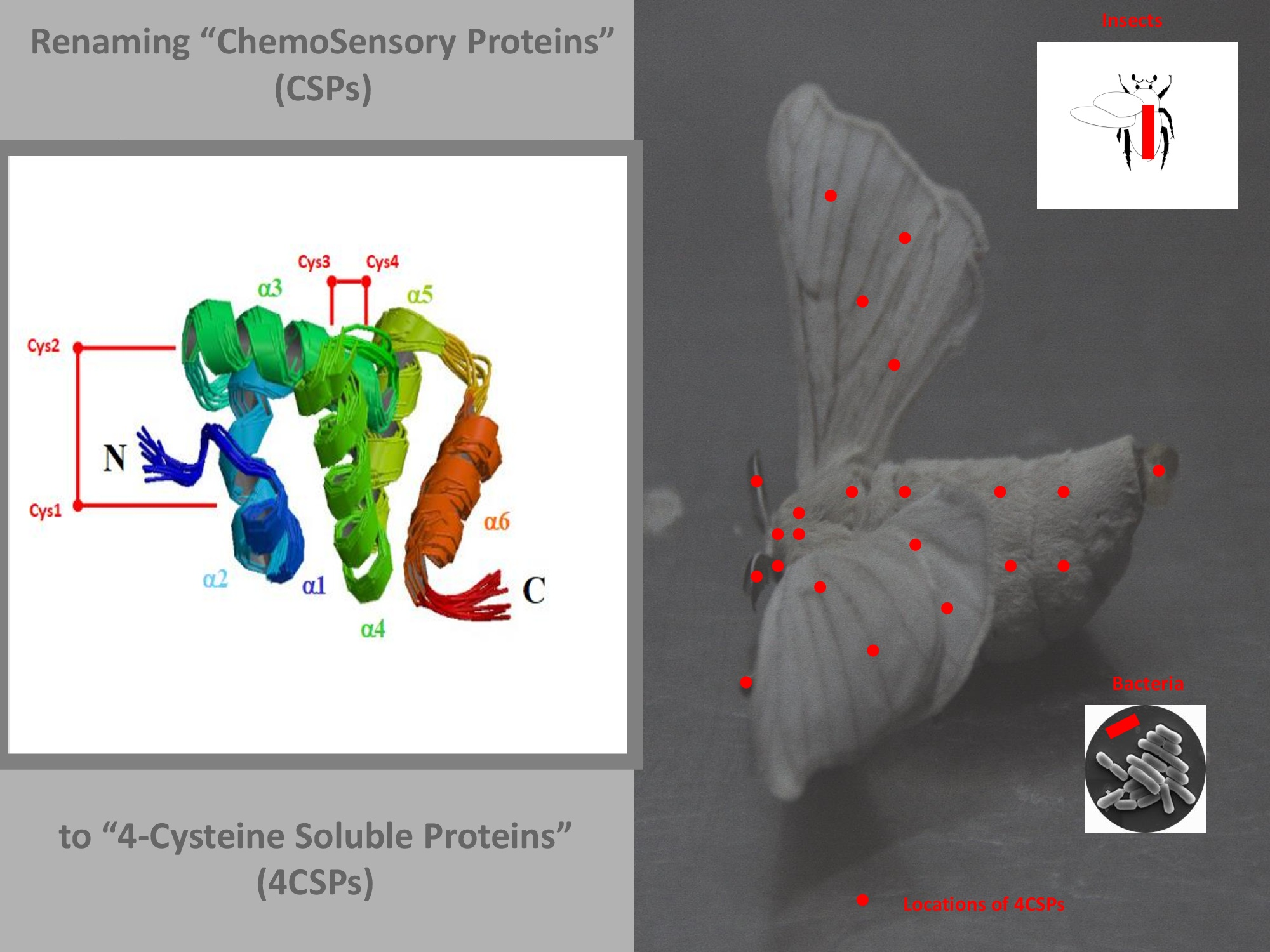
Renaming the ‘OS-D/CSP’ Family (Part 1): ‘4-Cysteine Soluble Proteins’ (4CSPs)—Molecular Nomenclature, Structure, Expression, Evolution, Tissue-Distribution, and Pleiotropy



Simple Summary
Abstract
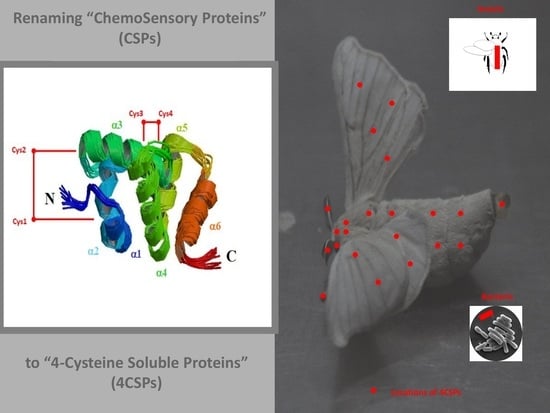
1. Introduction
2. CSP: An Example of Research-Study Spin or Interpretation Bias
3. History of the Discovery of “4CSPs” and Their Pleiotropic Functions
4. Broad Survey and Analysis of 4CSPs in Insects and Hexapods
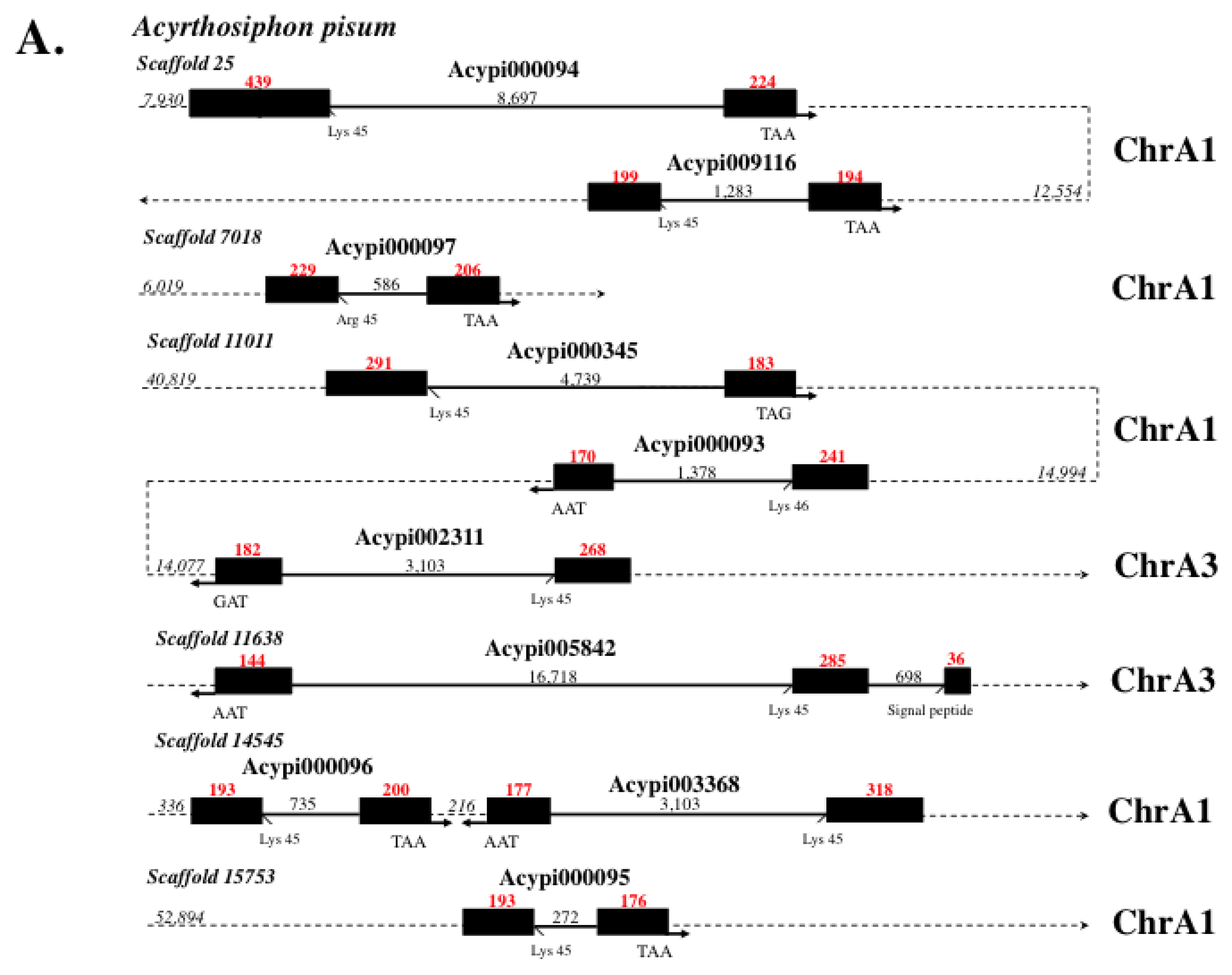
4.1. Molecular Evidence of RNA Editing
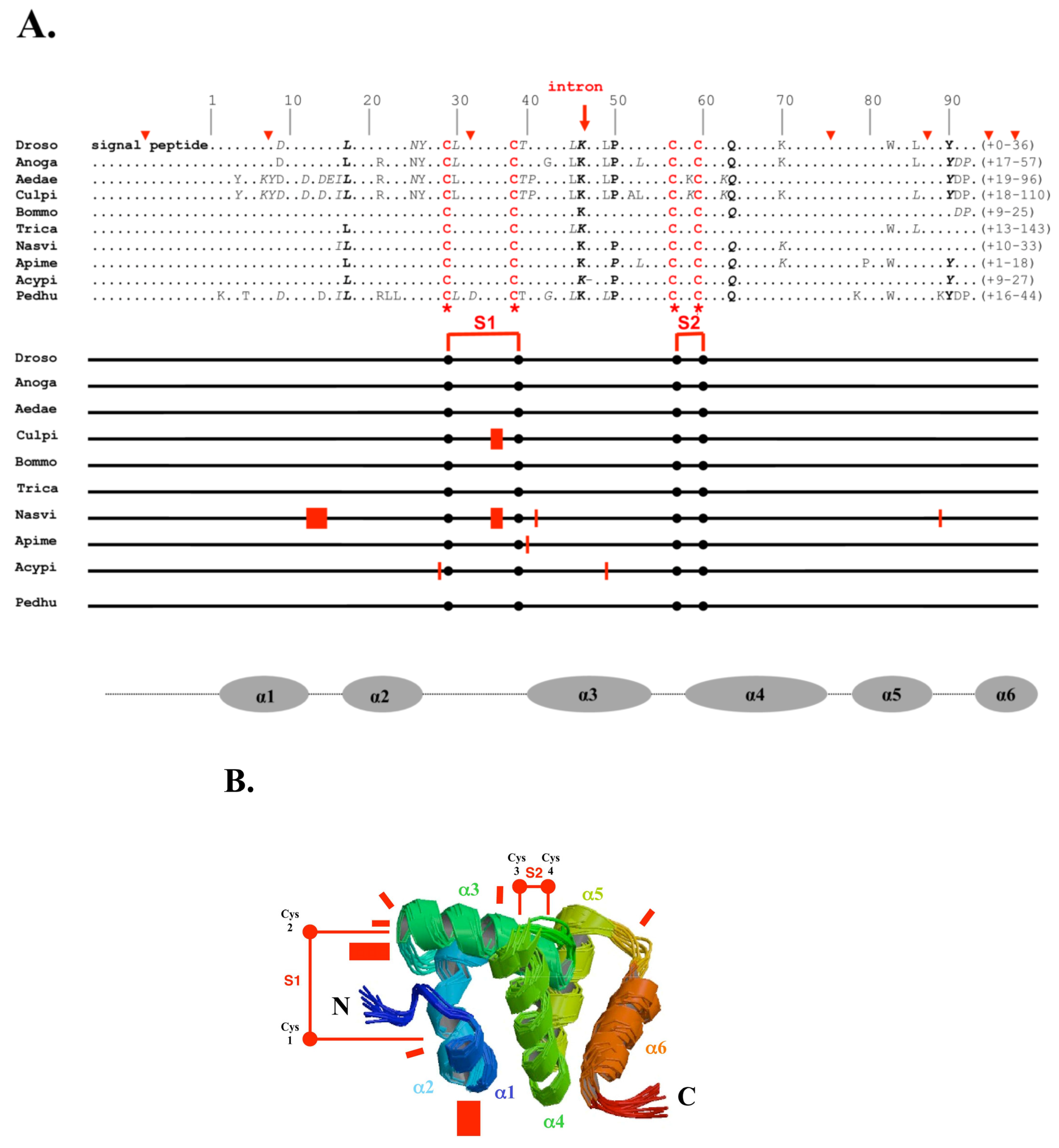
4.2. Comparing 4CSP Sequences from Several Taxa
4.3. Proof of Relatedness Between 4CSP, Thap1, and PAN-1 Families
4.4. 4CSP Evolution for the Appearance of Novel Phenotypes
5. The Evolutionary Trajectory of 4CSPs
6. Existence of 4CSPs Outside Insects and Hexapods
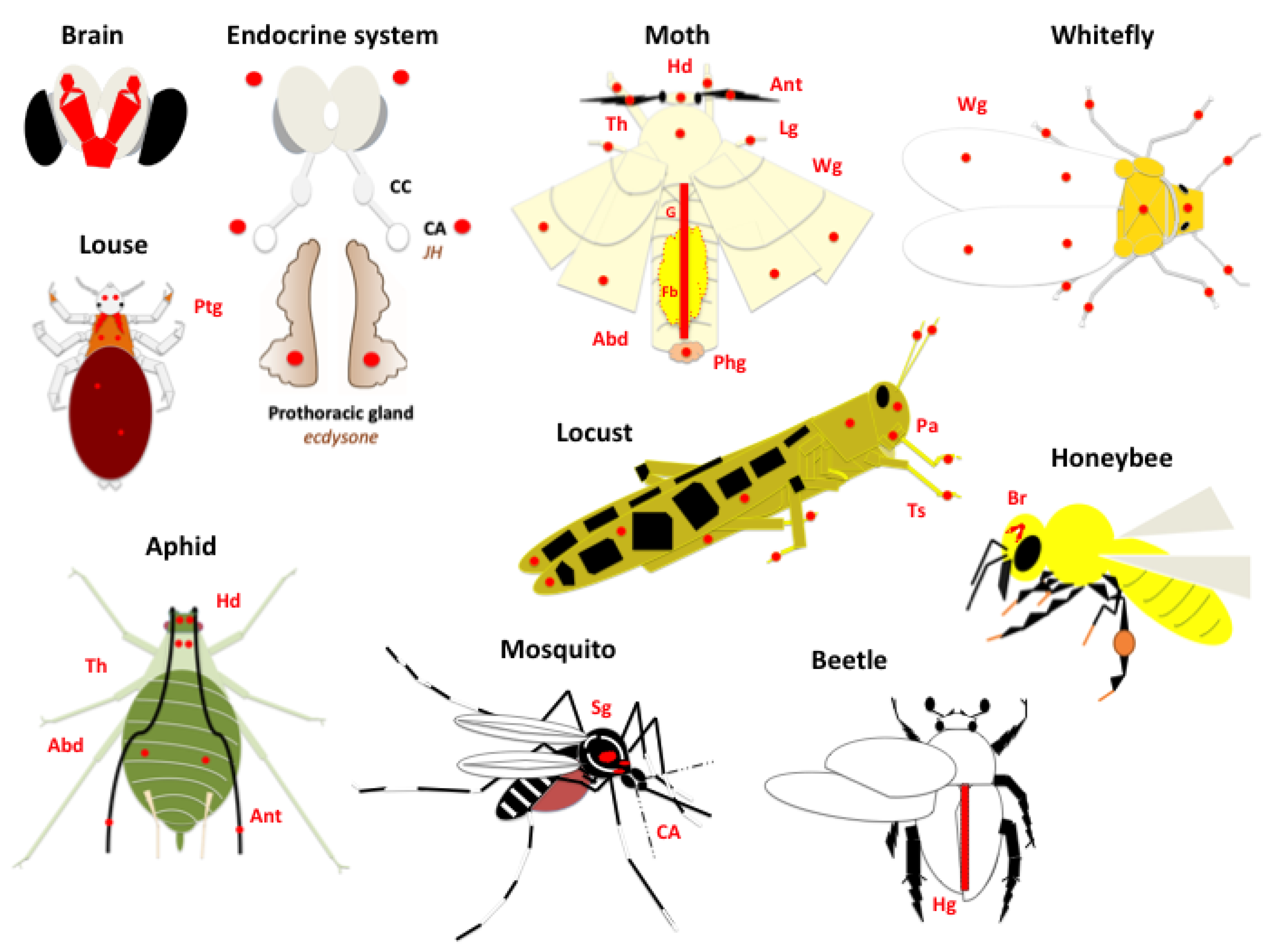
7. Expression Profiling in Organisms, Development, and Tissues
8. To Design the “OS-D/CSP” Pfam Domain, New Terminology Is Needed: Structure or Function?

| Name | Organism | Authors | Year | Reference |
|---|---|---|---|---|
| Lipoclistin | Insects | Steinbrecht | 2003 | [146] |
| LA-BP | Bemta | Liu et al. | 2016 | [52] |
| Phenyl-BP | Bemta | Liu et al. | 2016 | [52] |
| Lipid-BP | Bemta | Liu et al. | 2020 | [53] |
| JHRP | Aedae | Picimbon | 2020 | [18] |
| Mucin module | Aedae | Liu et al. | 2026 | [14] |
| TIF module | Aedae | Liu et al. | 2026 | [14] |
| ASRP module | Aedae | Liu et al. | 2026 | [14] |
| NPCP module | Aedae | Liu et al. | 2026 | [14] |
| 4CSP * | Insects, crustaceans, and microbes | Liu et al. | 2026 | [This reference] |
9. Concluding Remarks
Supplementary Materials
Author Contributions
Funding
Data Availability Statement
Acknowledgments
Conflicts of Interest
Abbreviations
| A10 | Antennal protein A10 |
| 4-C | 4-Cysteine |
| 4CSP | 4-Cysteine Soluble Protein (“CSP/OS-D”) |
| 6CSP | 6-Cysteine Soluble Protein (“OBP”) |
| Acypi | Acyrthosiphum pisum (pea aphid) |
| Aedae | Aedes aegypti (dengue yellow fever mosquito) |
| Anoga | Anopheles gambiae (malaria mosquito) |
| Allergen Tha p 1 | IgE-binding protein (15 kDa) and major allergen of pine processionary caterpillar (Thaumetopoea pityocampa, Thapi)—variant 1.0101 |
| Apime | Apis mellifera (honeybee) |
| ASRP | Actin skeleton regulatory protein |
| BEAST | Bayesian evolutionary analysis sampling trees |
| BLASTp | Protein BLAST |
| Bommo | Bombyx mori (silkworm moth) |
| Bemta-CSP1 | Bemisia tabaci “Chemosensory Protein”-1 (LA-binding protein) |
| CA | Corpora allata |
| CBP | Chemical Binding Proteins |
| CC | Corpora cardiaca |
| CHC | Cuticular hydrocarbons |
| Che | Chemotaxis proteins (histidine kinases) |
| CheA, CheB | Chemosensory proteins-A, Chemosensory proteins-B (Drosophila) |
| Chisu | Chilo suppressalis |
| CNS | Central nervous system |
| CRLPB | Chemical sense-related lipophilic ligand binding proteins (Drosophila) |
| CSP | ChemoSensory protein |
| CSP | Clostridium difficile spore germination protease |
| CSP | Cold Shock Protein |
| Culpi | Culex pipiens (common house mosquito) |
| CX3C | 3 amino acids (X) between two cysteine residues |
| Cys | Cysteine |
| Drome | Drosophila melanogaster (fruit fly) |
| Droso | Drosophila species |
| EA | Elaidic acid |
| Ebsp | Ejaculatory bulb-specific protein |
| EST | Expressed Sequence Tag |
| FA | Fatty acid |
| GR | Gustatory receptor |
| GTP | Guanosine triphosphate |
| Holob | Holotrichia oblita |
| IgE | immunoglobulin E |
| IQ-Tree | Phylogenetic inference using maximum likelihood software package |
| JH | Juvenile hormone |
| JHRP | Juvenile hormone-related protein |
| KAIKO | Silkworm genome database (2009) |
| Ki | Inhibitory constant |
| LA | Linoleic acid (C18:2) |
| LCH | Long chain hydrocarbon |
| Locmi | Locusta migratoria (migratory locust) |
| LRR | Leucine-rich repeat protein complex |
| Manse | Manduca sexta (tobacco hornworm, sphinx moth) |
| MCP | Methyl-accepting chemotaxis protein |
| MOLPHY | Molecular Phylogenetics program package |
| MP | Maximum parsimony |
| Mp10 | Myzpe p10-like protein |
| MRCH | Melanization and Reddish Coloration Hormone |
| MYRF | Myelin regulatory factor |
| Myzpe | Myzus persicae (green peach aphid) |
| Nasvi | Nasonia vitripennis (parasitoid jewel wasp) |
| NMR | Nuclear magnetic resonance |
| NPCP | Nuclear pore complex protein |
| NPN | 1-N-phenylnaphthylamine |
| OBP | Odorant-binding protein |
| OR | Olfactory receptor |
| ORCO | Conserved Odorant Receptor type (Co-receptor) |
| OS-D | Olfactory Specific-type D protein |
| p10 | Peram 10 kDa protein from regenerating legs |
| PAN | Hexameric ATPase complex |
| PAN-1 | Protein encoded by the pan-1 gene in the nematode Caenorhabditis elegans |
| PAUP | Phylogenetic analysis using parsimony |
| PBAN | Pheromone Biosynthetic Activating Neuropeptide |
| PCR | Polymerase chain reaction |
| Pedhu | Pediculus humanus humanus (human body louse) |
| Peram | Periplaneta americana (American cockroach) |
| PBP | Pheromone-binding protein |
| PebIII | Protein from ejaculatory bulb-type 3 |
| Phk | Pherokine (hemolymph protein) |
| Ras | Family of GTPases derived from rat sarcoma virus |
| Rho | Family of GTPases, family of small (~21 kDa) signaling G proteins, subfamily of the Ras superfamily |
| RhoGAP | Rho GTPase-activating protein, regulator of the Rho-related protein family, crucial in many cellular processes, motility, contractility, growth, differentiation, and development |
| Rippe | Riptortis pedestrus |
| RNAi | RNA interference |
| Rt-PCR | Real-time polymerase chain reaction |
| SAP | Sensory appendage protein |
| SCH | Short chain hydrocarbon |
| Schgr | Schistocerca gregaria (desert locust) |
| SDS | Sodium dodecyl-sulfate |
| SilkDB | Silkworm Knowledgebase |
| SRP | Signal recognition particle |
| TIF | Transcription initiation factor |
| Trica | Tribolium castaneum (red flour beetle) |
| UPGMA | Unweighted pair group method with arithmetic mean |
| VAC | Volatile carboxylic acid |
| VOC | Volatile organic compound |
| Y-organ | Paired glands that secrete ecdysteroids in crustaceans |
References
- Hoffmann, K.H.; Meyerinng-Vos, M.; Lorenz, M.W. Allatostatins and allatotropins: Is the regulation of corpora allata activity their primary function? Eur. J. Entomol. 1999, 96, 255–266. [Google Scholar]
- Vogt, R.G.; Riddiford, L.M. Pheromone binding and inactivation by moth antennae. Nature 1981, 293, 161–163. [Google Scholar] [CrossRef] [Scilit]
- Picimbon, J.F.; Leal, W.S. Olfactory soluble proteins of cockroaches. Insect Biochem. Mol. Biol. 1999, 30, 973–978. [Google Scholar] [CrossRef] [Scilit]
- Angeli, S.; Ceron, F.; Scaloni, A.; Monti, M.; Monteforti, G.; Minnocci, A.; Petacchi, R.; Pelosi, P. Purification, structural characterization, cloning and immunocytochemical localization of chemoreception proteins from Schistocerca gregaria. Eur. J. Biochem. 1999, 262, 745–754. [Google Scholar] [CrossRef] [Scilit] [PubMed]
- Picimbon, J.F. Chemosensory perireceptors of insects. Med. Sci. 2002, 18, 1089–1094. [Google Scholar]
- Picimbon, J.F. Biochemistry and evolution of CSP and OBP proteins. In Insect Pheromone Biochemistry and Molecular Biology, the Biosynthesis and Detection of Pheromones and Plant Volatiles; Blomquist, G.J., Vogt, R.G., Eds.; Elsevier Academic Press: London, UK; San Diego, CA, USA, 2003; pp. 539–566. [Google Scholar]
- Lartigue, A.; Campanacci, V.; Roussel, A.; Larsson, A.M.; Jones, T.A.; Tegoni, M.; Cambillau, C. X-ray structure and ligand binding study of a moth chemosensory protein. J. Biol. Chem. 2002, 277, 32094–32098. [Google Scholar] [CrossRef] [Scilit]
- Jansen, S.; Zídek, L.; Löfstedt, C.; Picimbon, J.F.; Sklenar, V. 1H, 13C, and 15N resonance assignment of Bombyx mori chemosensory protein 1 (BmorCSP1). J. Biomol. NMR 2006, 36, 47. [Google Scholar] [CrossRef] [Scilit] [PubMed]
- Jansen, S.; Chmelik, J.; Zídek, L.; Padrta, P.; Novak, P.; Zdrahal, Z.; Picimbon, J.F.; Löfstedt, C.; Sklenar, V. Structure of Bombyx mori Chemosensory Protein 1 in solution. Arch. Insect Biochem. Physiol. 2007, 66, 135–145. [Google Scholar] [CrossRef] [Scilit]
- Tomaselli, S.; Crescenzi, O.; Sanfelice, D.; Ab, E.; Wechsel-Berger, R.; Angeli, S.; Scaloni, A.; Boelens, R.; Tancredi, T.; Pelosi, P.; et al. Solution structure of a chemosensory protein from the desert locust Schistocerca gregaria. Biochemistry 2006, 45, 1606–1613. [Google Scholar] [CrossRef] [Scilit]
- Jia, Q.; Zeng, H.; Zhang, J.; Gao, S.; Xiao, N.; Tang, J.; Dong, X.; Xie, W. The crystal structure of the Spodoptera litura Chemosensory Protein CSP8. Insects 2021, 12, 602. [Google Scholar] [CrossRef] [Scilit]
- Campanacci, V.; Lartigue, A.; Hällberg, B.M.; Jones, T.A.; Giuici-Orticoni, M.T.; Tegoni, M.; Cambillau, C. Moth chemosensory protein exhibits drastic conformational changes and cooperativity on ligand binding. Proc. Natl. Acad. Sci. USA 2003, 100, 5069–5074. [Google Scholar] [CrossRef] [Scilit]
- Mosbah, A.; Campanacci, V.; Lartigue, A.; Tegoni, M.; Cambillau, C.; Darbon, H. Solution structure of a chemosensory protein from the moth Mamestra brassicae. Biochem. J. 2003, 369, 39–44. [Google Scholar] [CrossRef] [Scilit]
- Liu, G.; Sun, B.; Fan, W.; Yue, S.; He, Q.; Picimbon, J.F. Renaming the ‘OS-D/CSP’ family (Part 2): ‘4-Cysteine Soluble Proteins’ (4CSPs)—Intracellular functions. Insects, 2026; submitted.
- Picimbon, J.F.; Dietrich, K.; Angeli, S.; Scaloni, A.; Krieger, J.; Breer, H.; Pelosi, P. Purification and molecular cloning of chemosensory proteins from Bombyx mori. Arch. Insect Biochem. Physiol. 2000, 44, 120–129. [Google Scholar] [CrossRef] [Scilit]
- Picimbon, J.F.; Dietrich, K.; Krieger, J.; Breer, H. Identity and expression pattern of chemosensory proteins in Heliothis virescens (Lepidoptera, Noctuidae). Insect Biochem. Mol. Biol. 2001, 31, 1173–1181. [Google Scholar] [CrossRef] [Scilit] [PubMed]
- Wanner, K.W.; Isman, M.B.; Feng, Q.; Plettner, E.; Theilmann, D.A. Developmental expression patterns of four chemosensory protein genes from the Eastern spruce budworm, Choristoneura fumiferana. Insect Mol. Biol. 2005, 14, 289–300. [Google Scholar] [CrossRef] [Scilit]
- Picimbon, J.F. Chapter three—Bioinformatic, genomic and evolutionary analysis of genes: A case study in Dipteran CSPs. Methods Enzymol. 2020, 642, 35–79. [Google Scholar]
- Picimbon, J.F.; Dietrich, K.; Breer, H.; Krieger, J. Chemosensory proteins of Locusta migratoria (Orthoptera: Acrididae). Insect Biochem. Mol. Biol. 2000, 30, 233–241. [Google Scholar] [CrossRef] [Scilit] [PubMed]
- Guo, W.; Wang, X.; Ma, Z.; Xue, L.; Han, J.; Yu, D.; Kang, L. CSP and Takeout genes modulate the switch between attraction and repulsion during behavioral phase change in the migratory locust. PLoS Genet. 2011, 7, e1001291. [Google Scholar] [CrossRef] [Scilit] [PubMed]
- Martín-Blázquez, R.; Chen, B.; Kang, L.; Bakkali, M. Evolution, expression and association of the chemosensory protein genes with the outbreak phase of the two main pest locusts. Sci. Rep. 2018, 7, 6653. [Google Scholar] [CrossRef] [Scilit]
- Xuan, N.; Guo, X.; Xie, H.Y.; Lou, Q.N.; Bo, L.X.; Liu, G.; Picimbon, J.F. Increased expression of CSP and CYP genes in adult silkworm females exposed to avermectins. Insect Sci. 2015, 22, 203–219. [Google Scholar] [CrossRef] [Scilit] [PubMed]
- Ban, L.; Scaloni, A.; Brandazza, A.; Angeli, S.; Zhang, Y.; Pelosi, P. Chemosensory proteins of Locusta migratoria. Insect Mol. Biol. 2003, 12, 125–134. [Google Scholar] [CrossRef] [Scilit]
- Terrado, M.; Pinnelli, G.R.; Sanes, J.; Plettner, E. Binding interactions, structure-activity relationships and blend effects in pheromone and host olfactory detection of herbivorous Lepidoptera. In Olfactory Concepts of Insect Control-Alternative to Insecticides; Picimbon, J.F., Ed.; Springer Nature AG: Cham, Switzerland, 2019; Volume 2, pp. 265–310. [Google Scholar]
- Mocz, G.; Ross, J.A. Fluorescence techniques in analysis of protein-ligand interactions. Methods Mol. Biol. 2013, 1008, 169–210. [Google Scholar]
- Xuan, N.; Bu, X.; Liu, Y.Y.; Yang, X.; Liu, G.; Fan, Z.X.; Bi, Y.P.; Yang, L.Q.; Lu, Q.N.; Rajashekar, B.; et al. Molecular evidence of RNA editing in the Bombyx chemosensory protein family. PLoS ONE 2014, 9, e86932. [Google Scholar] [CrossRef] [Scilit] [PubMed]
- Picimbon, J.F. Evolution of protein physical structures in insect chemosensory systems. In Olfactory Concepts of Insect Control-Alternative to Insecticides; Picimbon, J.F., Ed.; Springer Nature AG: Cham, Switzerland, 2019; Volume 2, pp. 231–263. [Google Scholar]
- Sun, H.; Guan, L.; Feng, H.; Yin, J.; Cao, Y.; Xi, J.; Li, K. Functional characterization of chemosensory proteins in the scarab beetle, Holotrichia oblita Falderman (Coleoptera: Scarabaeida). PLoS ONE 2014, 9, e107059. [Google Scholar]
- Khuhro, S.A.; Yan, Q.; Liao, H.; Zhu, G.H.; Sun, J.B.; Dong, S.L. Expression profile and functional characterization suggesting the involvement of three chemosensory proteins in perception of host plant volatiles in Chilo suppressalis (Lepidoptera: Pyralidae). J. Insect Sci. 2018, 18, 6. [Google Scholar] [CrossRef] [Scilit]
- Li, Z.; Dai, L.; Chu, H.; Fu, D.; Sun, Y.; Chen, H. Identification, expression patterns, and functional characterization of chemosensory proteins in Dendroctonus armandi (Coleoptera: Curculionidae: Scolytinae). Front. Physiol. 2018, 9, 291. [Google Scholar] [CrossRef] [Scilit]
- Yang, Y.; Hua, D.; Zhu, J.; Wang, F.; Zhang, Y. Chemosensory protein 4 is required for Bradysia odoriphaga to be olfactory attracted to sulfur compounds from Chinese chives. Front. Physiol. 2022, 13, 989601. [Google Scholar] [CrossRef] [Scilit]
- Yin, M.Z.; Li, J.Q.; Liu, Q.; Ma, S.; Hu, Z.Z.; Liu, X.Z.; Wang, C.W.; Yao, W.C.; Zhu, X.Y.; Wang, Y.Y.; et al. Binding properties of chemosensory protein 12 in Riptortus pedestris to aggregation pheromone (E)-2-hexenyl (Z)-3-hexenoate. Pest. Biochem. Physiol. 2023, 194, 105513. [Google Scholar] [CrossRef] [Scilit] [PubMed]
- Liu, Q.; Yin, M.Z.; Ma, S.; Gu, N.; Qian, L.F.; Zhang, Y.N.; Li, X.M. Ligand-binding properties of chemosensory protein 1 in Callosobruchus chinensis to mung bean volatiles. Pest. Biochem. Physiol. 2023, 192, 105394. [Google Scholar] [CrossRef] [Scilit]
- Li, J.B.; Liu, Q.; Ma, S.; Wang, Y.Y.; Liu, X.Z.; Wang, C.W.; Wang, D.J.; Hu, Z.Z.; Gan, J.W.; Zhu, X.Y.; et al. Binding properties of chemosensory protein 4 in Riptortus pedestris to aggregation pheromones. Pest. Biochem. Physiol. 2024, 201, 105874. [Google Scholar] [CrossRef] [Scilit] [PubMed]
- Jiang, J.; Xue, J.; Yu, M.; Jiang, X.; Cheng, Y.; Wang, H.; Liu, Y.; Dou, W.; Fan, J.; Chan, J. Molecular caracterization of chemosensory protein genes (CSP) genes and the involvement of AgifCSP5 in the perception of host location in the aphid parasitoid Aphidius gifuensis. Int. J. Mol. Sci. 2024, 25, 6392. [Google Scholar] [CrossRef] [Scilit]
- Zhao, S.H.; Yue, Y.; Gao, Q.; Yu, R.T.; Yang, Z.H.; Zhou, N.; Xu, G.L. Identification and expression profilies of chemosensory genes in the antennal transcriptome of Protaetia brevitarsis (Coleoptera: Scarabaeidae). Insects 2025, 16, 607. [Google Scholar] [CrossRef] [Scilit]
- Shin, H.S.; Ryu, T.H.; Kwon, H.R.; Seo, M.J.; Yu, Y.M.; Yasunaga-Aoki, C.; Youn, Y.N. Aggregation pheromone secretion change of Riptortus pedrestis (Hemiptera: Alydidae) depending on diet. J. Pac. Agr. Kyushu Univ. 2015, 60, 357–362. [Google Scholar]
- Li, S.; Picimbon, J.F.; Ji, S.; Kan, Y.; Chuanling, Q.; Zhou, J.J.; Pelosi, P. Multiple functions of an odorant-binding protein in the mosquito Aedes aegypti. Biochem. Biophys. Res. Commun. 2008, 372, 464–468. [Google Scholar] [CrossRef] [Scilit]
- Wang, F.E.; Delannay, C.; Goindin, D.; Deng, L.; Guan, S.; Lu, X.; Fouque, F.; Vega-Rúa, A.; Picimbon, J.F. Cartography of odor chemicals in the dengue vector mosquito (Aedes aegypti L., Diptera/Culicidae). Sci. Rep. 2019, 9, 8510. [Google Scholar] [CrossRef] [Scilit]
- Guo, X.; Xuan, N.; Liu, G.; Xie, H.; Lou, Q.; Arnaud, P.; Offmann, B.; Picimbon, J.F. An expanded survey of the moth PBP/GOBP clade in Bombyx mori: New insight into expression and functional roles. Front. Physiol. 2021, 12, 712593. [Google Scholar] [CrossRef] [Scilit] [PubMed]
- Liu, G.; Xuan, N.; Chu, D.; Xie, H.Y.; Fan, Z.X.; Bi, Y.P.; Picimbon, J.F.; Qin, Y.C.; Zhong, S.T.; Li, Y.F.; et al. Biotype expression and insecticide response of Bemisia tabaci chemosensory protein-1. Arch. Insect Biochem. Physiol. 2014, 85, 137–151. [Google Scholar] [CrossRef] [Scilit]
- Sabatier, L.; Jouanguy, E.; Dostert, C.; Zachary, D.; Dimarcq, J.L.; Bulet, P.; Imler, J.C. Pherokine-2 and -3: Two Drosophila molecules related to pheromone/odor-binding proteins induced by viral and bacterial infections. Eur. J. Biol. 2003, 270, 3398–3407. [Google Scholar] [CrossRef] [Scilit] [PubMed]
- Einhorn, E.; Imler, J.L. Insect immunity; from systemic to chemosensory organs protection. In Olfactory Concepts of Insect Control-Alternative to Insecticides; Picimbon, J.F., Ed.; Springer Nature AG: Cham, Switzerland, 2019; Volume 2, pp. 205–229. [Google Scholar]
- Oduol, F.; Xu, J.; Niare, O.; Natajaran, R.; Vernick, K.D. Genes identified by an expression screen of the vector mosquito Anopheles gambiae display differential molecular immune response to malaria parasites and bacteria. Proc. Natl. Acad. Sci. USA 2000, 97, 11397–11402. [Google Scholar] [CrossRef] [Scilit]
- Sim, S.; Ramirez, J.L.; Dimopoulos, G. Dengue virus infection of the Aedes aegypti salivary gland and chemosensory apparatus induces genes that modulate infection and blood-feeding behavior. PLoS Pathog. 2012, 8, e1002631. [Google Scholar] [CrossRef] [Scilit]
- Hou, C.X.; Qin, G.X.; Liu, T.; Mei, X.L.; Li, B.; Shen, Z.Y.; Guo, X.J. Differentially expressed genes in the cuticle and hemolymph of the silkworm, Bombyx mori, injected with the fungus Beauvaria bassiana. J. Insect Sci. 2013, 13, 138. [Google Scholar] [CrossRef] [Scilit]
- Carr, A.L.; Rinker, D.C.; Dong, Y.; Dimopoulos, G.; Zwiebel, L.J. Transcriptome profiles of Anopheles gambiae harboring natural low-level Plasmodium infection reveal advantages for the mosquito. Sci. Rep. 2021, 11, 22578. [Google Scholar] [CrossRef] [Scilit]
- Li, Y.; Zhang, Y.; Xiang, Y.; Chen, D.; Hu, J.; Liu, F. Comparative transcriptome analysis of chemoreception organs of Laodelphax striatellus in response to rice stripe virus infection. Int. J. Mol. Sci. 2021, 22, 10299. [Google Scholar] [CrossRef] [Scilit]
- Traverso, L.; Latorre Estivalis, J.M.; da Rocha Fernandes, G.; Fronza, G.; Lobbia, P.; Mougabure Cueto, G.; Ons, S. Transcriptomic modulation in response to an intoxication with deltamethrin in a population of Triatoma infestans with low resistance to pyrethroids. PLoS Negl. Trop. Dis. 2022, 16, e0010060. [Google Scholar] [CrossRef] [Scilit]
- Wang, H.; Zhao, R.; Gao, J.; Xiao, X.; Yin, X.; Hu, S.; Zhang, Y.; Liang, P.; Gu, S. Two cuticle-enriched chemosensory proteins confer multi-insecticide resistance in Spodoptera frugiperda. Int. J. Biol. Macromol. 2024, 266, 130941. [Google Scholar] [CrossRef] [Scilit]
- Kordaczuk, J.; Sułek, M.; Mak, P.; Frączek, A.; Wojda, I. Chemosensory protein 16 has an immune function and participates in host-pathogen interaction in Galleria mellonella infected with Pseudomonas entomophila. Virulence 2025, 16, 2471367. [Google Scholar] [CrossRef] [Scilit]
- Liu, G.; Ma, H.M.; Xie, Y.N.; Xuan, N.; Guo, X.; Fan, Z.X.; Rajashekar, B.; Arnaud, P.; Offmann, B.; Picimbon, J.F. Biotype characterization, developmental profiling, insecticide response and binding property of Bemisia tabaci chemosensory proteins: Role of CSP in insect defense. PLoS ONE 2016, 11, e0154706. [Google Scholar] [CrossRef] [Scilit]
- Liu, G.; Xuan, N.; Rajashekar, B.; Arnaud, P.; Offmann, B.; Picimbon, J.F. Comprehensive history of CSP genes: Evolution, phylogenetic distribution, and functions. Genes 2020, 11, 413. [Google Scholar] [CrossRef] [Scilit]
- Nomura, A.; Kawasaki, K.; Kubo, T.; Natori, S. Purification and localization of p10, a novel protein that increases in nymphal regenerating legs of Periplaneta americana (American cockroach). Int. J. Dev. Biol. 1992, 36, 391–398. [Google Scholar] [CrossRef] [Scilit]
- Pikielny, C.W.; Hasan, G.; Rouyer, F.; Rosbach, M. Members of a family of Drosophila putative odorant-binding proteins are expressed in different subsets of olfactory hairs. Neuron 1994, 12, 35–49. [Google Scholar] [CrossRef] [Scilit]
- McKenna, M.P.; Hekmat-Scafe, D.S.; Gaines, P.; Carlson, J.R. Putative Drosophila pheromone-binding-proteins expressed in a subregion of the olfactory system. J. Biol. Chem. 1994, 269, 16340–16347. [Google Scholar] [CrossRef] [Scilit]
- Dyanov, H.M.; Dzitoeva, S.G. Method for attachment of microscopic preparations on glass for in situ hybridization, PRINS and in situ PCR studies. Biotechniques 1995, 18, 822–824. [Google Scholar]
- Robertson, H.M.; Martos, R.; Sears, C.R.; Todres, E.Z.; Walden, K.K.; Nardi, J.B. Diversity of odourant binding proteins revealed by an expressed sequence tag project on male Manduca sexta moth antennae. Insect Mol. Biol. 1999, 8, 501–518. [Google Scholar] [CrossRef] [Scilit]
- Bos, J.I.; Prince, D.; Pitino, M.; Maffei, M.E.; Win, J.; Hogenhout, S.A. A functional genomics approach identifies candidate effectors from the aphid species Myzus persicae (green peach aphid). PLoS Genet. 2010, 6, e1001210. [Google Scholar] [CrossRef] [Scilit]
- Liu, G.; Yue, S.; Rajashekar, B.; Picimbon, J.F. Expression of chemosensory protein (CSP) structures in Pediculus humanus corporis and Acinetobacter baumannii. SOJ Microbiol. Infect. Dis. 2019, 7, 1–17. [Google Scholar] [CrossRef] [Scilit]
- Picimbon, J.F. Molecular phylogeny of “Chemosensory Proteins” in bacteria and crustaceans: CSP as an extremely ancient gene. J. Mol. Evol. 2026. [Google Scholar] [CrossRef] [Scilit]
- Xuan, N.; Rajashekar, B.; Kasvandik, S.; Picimbon, J.F. Structural components of chemosensory protein mutations in the silkworm moth, Bombyx mori. Agri Gene 2016, 2, 53–58. [Google Scholar] [CrossRef] [Scilit]
- Xuan, N.; Rajashekar, B.; Picimbon, J.F. DNA and RNA-dependent polymerization in editing of Bombyx chemosensory protein (CSP) gene family. Agri Gene 2019, 12, 100087. [Google Scholar] [CrossRef] [Scilit]
- Moneo, I.; Vega, J.M.; Caballero, M.L.; Vega, J.; Alday, E. Isolation and characterization of Tha p 1, a major allergen from the pine processionary caterpillar Thaumetopoea pityocampa. Allergy 2003, 58, 34–37. [Google Scholar] [CrossRef] [Scilit]
- Cartwright, H.N.; Humphries, J.A.; Smith, L.G. PAN1: A receptor-like protein that promotes polarization of an asymmetric cell division in maize. Science 2009, 323, 649–651. [Google Scholar] [CrossRef] [Scilit]
- Humphries, J.A.; Vejlupkova, Z.; Luo, A.; Meeley, R.B.; Sylvester, A.W.; Fowler, J.E.; Smith, L.G. ROP GTPases act with the receptor-like protein PAN1 to polarize asymmetric cell division in maize. Plant Cell 2011, 23, 2273–2284. [Google Scholar] [CrossRef] [Scilit]
- Bradford, M.K.; Whitworth, K.; Wendland, B. Pan1 regulates transitions between stages of clathrin-mediated endocytosis. Mol. Biol. Cell 2015, 26, 1371–1385. [Google Scholar] [CrossRef] [Scilit]
- Gissendanner, C.R.; Kelley, T.D. The C. elegans gene pan-1 encodes novel transmembrane and cytoplasmic leucine-rich repeat proteins and promotes molting and the larva to adult transition. BMC Dev. Biol. 2013, 13, 21. [Google Scholar] [CrossRef] [Scilit]
- Xia, S.L.; Li, M.; Chen, B.; Wang, C.; Yan, Y.H.; Dong, M.Q.; Qi, Y.B. The LRR-TM protein PAN-1 interacts with MYRF to promote its nuclear translocation in synaptic remodeling. eLife 2021, 10, e67628. [Google Scholar] [CrossRef] [Scilit]
- Singh, S.S.; Mittal, A.M.; Chepurwar, S.; Gupta, N. Olfactory systems in insects: Similarities and differences between species. In Olfactory Concepts of Insect Control-Alternative to Insecticides; Picimbon, J.F., Ed.; Springer Nature AG: Cham, Switzerland, 2019; Volume 2, pp. 29–48. [Google Scholar]
- Breer, H.; Fleischer, J.; Pregitzer, P.; Krieger, J. Molecular mechanisms of insect olfaction: Olfactory receptors. In Olfactory Concepts of Insect Control-Alternative to Insecticides; Picimbon, J.F., Ed.; Springer Nature AG: Cham, Switzerland, 2019; Volume 2, pp. 93–114. [Google Scholar]
- Almeida, E.A.B.; Bossert, S.; Danforth, B.N.; Porto, D.S.; Freitas, F.V.; Davis, C.C.; Murray, E.A.; Blaimer, B.B.; Spasojevic, T.; Ströher, P.R.; et al. The evolutionary history of bees in time and space. Curr. Biol. 2023, 33, 3409–3422.e6. [Google Scholar] [CrossRef] [Scilit]
- Reed, D.L.; Smith, V.S.; Hammond, S.L.; Rogers, A.R.; Clayton, D.H. Genetic analysis of lice supports direct contact between modern and archaic humans. PLoS Biol. 2004, 2, e340. [Google Scholar] [CrossRef] [Scilit]
- Tamura, K.; Subramanian, S.; Kumar, S. Temporal patterns of fruit fly (Drosophila) evolution revealed by mutation clocks. Mol. Biol. Evol. 2004, 21, 36–44. [Google Scholar] [CrossRef] [Scilit]
- Guo, S.; Kim, J. Molecular evolution of Drosophila odorant receptor-genes. Mol. Biol. Evol. 2007, 24, 1198–1207. [Google Scholar] [CrossRef] [Scilit]
- Blomquist, G.J.; Tittiger, C.; Jurenka, R. Cuticular hydrocarbons and pheromones of arthropods. In Oils and Lipids: Diversity, Origin, Chemistry and Fate; Hydrocarbons, Handbook of Hydrocarbon and Lipid Microbiology; Wilkes, H., Ed.; Springer: Cham, Switzerland, 2018; pp. 1–32. [Google Scholar]
- Davis, J.S.; Pearcy, M.J.; Yew, J.Y.; Moyle, L.C. A shift to shorter cuticular hydrocarbons accompanies sexual isolation among Drosophila americana group population. Evol. Lett. 2021, 5, 521–540. [Google Scholar] [CrossRef] [Scilit]
- Ha, T.S.; Smith, D.P. A pheromone receptor mediates 11-cis-vaccenyl acetate-induced responses in Drosophila. J. Neurosci. 2006, 26, 8727–8733. [Google Scholar] [CrossRef] [Scilit]
- Lebreton, S.; Borrero-Echeverry, F.; Gonzales, F.; Solum, M.; Wallin, E.A.; Hedenström, E.; Hansson, B.S.; Gustavsson, A.L.; Bengtsson, M.; Birgersson, G.; et al. A Drosophila female pheromone elicits species-specific long-range attraction via an olfactory channel with dual specificity for sex and food. BMC Biol. 2017, 15, 88. [Google Scholar] [CrossRef] [Scilit]
- Starostina, E.; Xu, A.; Lin, H.; Pikielny, C.W. A Drosophila protein family implicated in pheromone perception is related to Tay-Sachs GM2-activator protein. J. Biol. Chem. 2009, 284, 585–594. [Google Scholar] [CrossRef] [Scilit]
- Pikielny, C.W. Drosophila CheB proteins involved in gustatory detection of pheromones are related to human neurodegeneration factor. Vitam. Horm. 2010, 83, 273–287. [Google Scholar]
- Shang, J.; Tang, G.; Yang, J.; Lu, M.; Wang, C.Z.; Wang, C. Sensing of a spore surface protein by a Drosophila chemosensory protein induces behavioral defense against fungal parasitic infections. Curr. Biol. 2023, 99, 276–286. [Google Scholar] [CrossRef] [Scilit]
- Bontonou, G.; Saint-Leandre, B.; Kafle, T.; Baticle, T.; Hassan, A.; Sánchez-Alcañiz, J.A.; Arguello, J.R. Evolution of chemosensory tissues and cells across ecologically diverse Drosophilids. Nat. Commun. 2024, 15, 1047. [Google Scholar] [CrossRef] [Scilit]
- Maleszka, J.; Forêt, S.; Saint, R.; Maleszka, R. RNAi-induced phenotypes suggest a novel role for a chemosensory protein CSP5 in the development of embryonic integument in the honeybee (Apis mellifera). Dev. Genes Evol. 2007, 217, 189–196. [Google Scholar] [CrossRef] [Scilit]
- Mayack, B.K. Modeling disruption of Apis mellifera (honey bee) odorant-binding protein function with high-affinity binders. J. Mol. Recognit. 2023, 36, e3008. [Google Scholar] [CrossRef] [Scilit]
- Briand, L.; Swasdipan, N.; Nespoulous, C.; Bézirard, V.; Blon, F.; Huet, J.C.; Ebert, P.; Pernollet, J.C. Characterization of a chemosensory protein (ASP3c) from honeybee (Apis mellifera L.) as a brood pheromone carrier. Eur. J. Biochem. 2002, 269, 4586–4596. [Google Scholar] [CrossRef] [Scilit]
- Wanner, K.W.; Nichols, A.S.; Walden, K.K.; Brockmann, A.; Luetje, C.W.; Robertson, H.M. A honey bee odorant receptor for the queen substance 9-oxo-2-decenoic acid. Proc. Natl. Acad. Sci. USA 2007, 104, 14383–14388. [Google Scholar] [CrossRef] [Scilit]
- Pesenti, M.E.; Spinelli, S.; Bézirard, V.; Briand, L.; Pernollet, J.C.; Campanacci, V.; Tegoni, M.; Cambillau, C. Queen bee pheromone binding protein pH-induced domain swapping favors pheromone release. J. Mol. Biol. 2009, 390, 981–990. [Google Scholar] [CrossRef] [Scilit]
- Li, H.; Lou, B.; Cheng, J.; Gao, Q. The chemosensory protein of Chinese honeybee, Apis cerana cerana: Molecular cloning of cDNA, immunocytochemical localization and expression. Chinese Sci. Bull. 2007, 52, 1355–1364. [Google Scholar] [CrossRef] [Scilit]
- Spealman, P.; Burrelli, J.; Gresham, D. Inverted duplicate DNA sequences increase translocation rates through sequencing nanopores resulting in reduced base calling accuracy. Nucleic Acids Res. 2020, 48, 4940–4945. [Google Scholar] [CrossRef] [Scilit]
- Chau, L.M.; Goodisman, M.A.D. Gene duplication and the evolution of phenotypic diversity in insect societies. Evolution 2017, 71, 2871–2884. [Google Scholar] [CrossRef] [Scilit]
- Wellenreuther, M.; Bernatchez, L. Eco-evolutionary genomics of chromosomal inversions. Trends Ecol. Evol. 2018, 33, 427–440. [Google Scholar] [CrossRef] [Scilit]
- Gloss, A.D.; Abbot, P.; Whiteman, N.K. How interactions with plant chemicals shape insect genomes. Curr. Opin. Insect Sci. 2019, 36, 149–156. [Google Scholar] [CrossRef] [Scilit]
- Nosil, P.; Soria-Carrasco, V.; Villoutreix, R.; De-la-Mora, M.; de Carvaho, C.F.; Parchman, T.; Feder, J.L.; Gompert, Z. Complex evolutionary processes maintain an ancient chromosomal inversion. Proc. Natl. Acad. Sci. USA 2023, 120, e2300673120. [Google Scholar] [CrossRef] [Scilit]
- Ding, W.; Li, X.; Zhang, J.; Ji, M.; Zhang, M.; Zhong, X.; Cao, Y.; Liu, X.; Li, C.; Xiao, C.; et al. Adaptive functions of structural variants in human brain development. Science 2024, 10, eadl4600. [Google Scholar] [CrossRef] [Scilit]
- Jin, P.; Zhu, B.; Jia, Y.; Zhang, Y.; Wang, W.; Shen, Y.; Zhong, Y.; Zheng, Y.; Wang, Y.; Tong, Y.; et al. Single-cell transcriptomics reveals the brain evolution of web-building spiders. Nat. Ecol. Evol. 2023, 7, 2125–2142. [Google Scholar] [CrossRef] [Scilit]
- Christmas, M.J.; Wallberg, A.; Bunikis, I.; Olsson, A.; Wallerman, O.; Webster, M.T. Chromosomal inversions associated with environmental adaptation in honeybees. Mol Ecol. 2019, 28, 1358–1374. [Google Scholar] [CrossRef] [Scilit]
- Duan, Y.; Dou, S.; Porath, H.T.; Huang, J.; Eisenberg, E.; Lu, J. A-to-I RNA editing in honeybees shows signals of adaptation and convergent evolution. iScience 2021, 24, 101983. [Google Scholar] [CrossRef] [Scilit] [PubMed]
- Jones, B.M.; Rao, V.D.; Gernat, T.; Jagla, T.; Cash-Ahmed, A.C.; Rubin, B.E.; Comi, T.J.; Bhogale, S.; Husain, S.S.; Blatti, C.; et al. Individual differences in honey bee behavior enabled by plasticity in brain gene regulatory networks. eLife 2020, 9, e62850. [Google Scholar] [CrossRef] [Scilit] [PubMed]
- Pyenson, B.C.; Huisken, J.L.; Gupta, N.; Rehan, S.M. The brain atlas of a subsocial bee reflects that of eusocial Hymenoptera. Genes Brain Behav. 2024, 23, e70007. [Google Scholar] [CrossRef] [Scilit] [PubMed]
- Ozaki, K.; Utoguchi, A.; Yamada, A.; Yoshikawa, H. Identification and genomic structure of chemosensory proteins (CSP) and odorant binding proteins (OBP) genes expressed in foreleg tarsi of the swallowtail butterfly Papilio xuthus. Insect Biochem. Mol. Biol. 2008, 38, 969–976. [Google Scholar] [CrossRef] [Scilit] [PubMed]
- Kulmuni, J.; Wurm, Y.; Pamilo, P. Comparative genomics of chemosensory protein genes reveals rapid evolution and positive selection in ant-specific duplicates. Heredity 2013, 110, 538–547. [Google Scholar] [CrossRef] [Scilit]
- Liu, G.; Arnaud, P.; Offmann, B.; Picimbon, J.F. Genotyping and bio-sensing chemosensory proteins in insects. Sensors 2017, 17, 1801. [Google Scholar] [CrossRef] [Scilit]
- Mei, T.; Fu, W.B.; Li, B.; He, Z.B.; Chen, B. Comparative genomics of chemosensory protein genes (CSPs) in twenty-two mosquito species (Diptera: Culicidae): Identification, characterization, and evolution. PLoS ONE 2018, 13, e0190412. [Google Scholar] [CrossRef] [Scilit]
- Blobel, G. Protein targeting (Nobel lecture). ChemBioChem 2000, 1, 86–102. [Google Scholar] [CrossRef]
- Matlin, K.S. The strange case of the signal recognition particle. Nat. Rev. Mol. Cell Biol. 2002, 3, 538–542. [Google Scholar] [CrossRef] [Scilit]
- Doudna, J.A.; Batey, R.T. Structural insights into the signal recognition particle. Annu. Rev. Biochem. 2004, 73, 539–557. [Google Scholar] [CrossRef] [Scilit]
- Jin, X.; Brandazza, A.; Navarrini, A.; Ban, L.; Zhang, S.; Steinbrecht, R.A.; Zhang, L.; Pelosi, P. Expression and immunolocalization of odorant-binding and chemosensory proteins in locusts. Cell. Mol. Life Sci. 2005, 62, 1156–1166. [Google Scholar] [CrossRef] [Scilit]
- Steinbrecht, R.A.; Ozaki, M.; Ziegelberger, G. Immunocytochemical localization of pheromone-binding protein in moth antennae. Cell Tissue Res. 1992, 270, 287–302. [Google Scholar] [CrossRef] [Scilit]
- Liu, G.; Ma, H.M.; Xie, H.Y.; Xuan, N.; Picimbon, J.F. Sequence variation of Bemisia tabaci Chemosensory protein 2 in cryptic species B and Q: New DNA markers for whitefly recognition. Gene 2016, 576, 284–291. [Google Scholar] [CrossRef] [Scilit] [PubMed]
- Misof, B.; Liu, S.; Meusemann, K.; Peters, R.S.; Donath, A.; Mayer, C.; Frandsen, P.B.; Ware, J.; Flouri, T.; Beutel, R.G.; et al. Phylogenomics resolves the timing and pattern of insect evolution. Science 2014, 346, 763–767. [Google Scholar] [CrossRef] [Scilit] [PubMed]
- Ertas, B.; von Reumont, B.M.; Wägele, J.W.; Misof, B.; Burmester, T. Hemocyanin suggests a close relationship of Remipeda and Hexapoda. Mol. Biol. Evol. 2009, 26, 2711–2718. [Google Scholar] [CrossRef] [Scilit]
- Siveter, D.J.; Briggs, D.E.G.; Siveter, D.J.; Sutton, M.D. Preserved appendages in a Silurian binodicope: Implications for the evolutionary history of ostracod crustaceans. Biol. Lett. 2024, 20, 20240097. [Google Scholar] [CrossRef] [Scilit]
- Honson, N.S.; Gong, Y.; Plettner, E. Structure and function of insect Odorant and Pheromone-Binding Proteins (OBPs and PBPs) and Chemosensory-Specific Proteins (CSPs). In Chemical Ecology and Phytochemistry of Forest Ecosystems; Romeo, J.T., Ed.; Elsevier Ltd.: Oxford, UK, 2005; pp. 227–268. [Google Scholar]
- Zhu, J.; Iovinella, I.; Dani, F.R.; Pelosi, P.; Wang, G. Chemosensory proteins: A versatile binding family. In Olfactory Concepts of Insect Control-Alternative to Insecticides; Picimbon, J.F., Ed.; Springer Nature AG: Cham, Switzerland, 2019; Volume 2, pp. 147–169. [Google Scholar]
- Pino, J.; Godoy, R.; Venthur, H.; Larama, G.; Quiroz, A.; Mutis, A. Identification and ligand binding of a chemosensory protein from sea louse Caligus rogercresseyi (Crustacea: Copepoda). Comp. Biochem. Physiol. B Biochem. Mol. Biol. 2023, 265, 110830. [Google Scholar] [CrossRef] [Scilit]
- Skottene, E.; Tarrant, A.M.; Altin, D.; Olsen, R.E.; Choquet, M.; Kvile, K.Ø. Lipid metabolism in Calanus finmarchicus is sensitive to variations in predation risk and food availability. Sci. Rep. 2020, 10, 22322. [Google Scholar] [CrossRef] [Scilit] [PubMed]
- Salah Ud-Din, A.I.M.; Roujeinikova, A. Methyl-accepting chemotaxis proteins: A core sensing element in prokaryotes and archaea. Cell. Mol. Life Sci. 2017, 74, 3293–3303. [Google Scholar] [CrossRef] [Scilit]
- Baker, M.D.; Wolanin, P.W.; Stock, J.B. Systems biology of bacterial chemotaxis. Curr. Opin. Microbiol. 2006, 9, 187–192. [Google Scholar] [CrossRef] [Scilit]
- Xu, X.; Li, H.; Qi, X.; Chen, Y.; Qin, Y.; Zheng, J.; Jiang, X. cheA, cheB, cheR, cheV, and cheY are involved in regulating the adhesion of Vibrio harveyi. Front. Cell. Infect. Microbiol. 2021, 10, 591751. [Google Scholar] [CrossRef] [Scilit]
- Galperin, M.Y. Sensory transduction in bacteria. In Encyclopedia of Microbiology, 3rd ed.; Schaechter, M., Ed.; Academic Press: New York, NY, USA, 2009; pp. 447–463. [Google Scholar]
- Stock, A.; Chen, T.; Welsh, D.; Stock, J. CheA protein, a central regulator of bacterial chemotaxis, belongs to a family of proteins that control gene expression in response to changing environmental conditions. Proc. Natl. Acad. Sci. USA 1988, 85, 1403–1407. [Google Scholar] [CrossRef] [Scilit]
- Huang, Z.; Pan, X.; Xu, N.; Guo, M. Bacterial chemotaxis coupling protein: Structure, function and diversity. Microbiol. Res. 2019, 219, 40–48. [Google Scholar] [CrossRef] [Scilit]
- Perkin, L.C.; Friesen, K.S.; Flinn, P.W.; Oppert, B. Venom gland components of the ectoparasitoid wasp, Anisopteromalus calandrae. J. Venom Res. 2015, 6, 19–37. [Google Scholar]
- Celorio-Mancera Mde, L.; Sundmalm, S.M.; Vogel, H.; Rutishauser, D.; Ytterberg, A.J.; Zubarv, R.A.; Janz, N. Chemosensory proteins, major salivary factors in caterpillar mandibular glands. Insect Biochem. Mol. Biol. 2012, 42, 796–805. [Google Scholar] [CrossRef] [Scilit]
- González-Caballero, N.; Valenzuela, J.G.; Ribeiro, J.M.C.; Cuervo, P.; Brazil, R.P. Transcriptome exploration of the sex pheromone gland of Lutzomyia longipalpis (Diptera: Psychodidae: Phlebotominae). Parasit. Vectors 2013, 6, 56. [Google Scholar] [CrossRef] [Scilit]
- Liu, Y.L.; Guo, H.; Huang, L.Q.; Pelosi, P.; Wang, C.Z. Unique function of a chemosensory protein in the proboscis of two Helicoverpa species. J. Exp. Biol. 2014, 217, 1821–1826. [Google Scholar] [CrossRef] [Scilit]
- Zhu, J.; Iovinella, I.; Dani, F.R.; Liu, Y.L.; Huang, L.Q.; Liu, Y.; Wang, C.Z.; Pelosi, P.; Wang, G. Conserved chemosensory proteins in the proboscis and eyes of Lepidoptera. Int. J. Biol. Sci. 2016, 12, 1394–1404. [Google Scholar] [CrossRef] [Scilit]
- Ma, C.; Cui, S.; Tian, Z.; Zhang, Y.; Chen, G.; Gao, X.; Tian, Z.; Chen, H.; Guo, J.; Zhou, Z. OcomCSP12, a chemosensory protein expressed specifically by ovary, mediates reproduction in Ophraella communa (Coleoptera: Chrysomelidae). Front. Physiol. 2019, 10, 1290. [Google Scholar] [CrossRef] [Scilit]
- Mita, K.; Morimyo, M.; Okano, K.; Koike, Y.; Nohata, J.; Kawasaki, H.; Kadono-Okuda, K.; Yamamoto, K.; Suzuki, M.G.; Shimada, T.; et al. The construction of an EST database for Bombyx mori and its application. Proc. Natl. Acad. Sci. USA 2003, 104, 14121–14126. [Google Scholar] [CrossRef] [Scilit]
- Wang, J.; Xia, Q.; He, X.; Dai, M.; Ruan, J.; Chen, J.; Yu, G.; Yuan, H.; Hu, Y.; Li, R.; et al. SilkDB: A knowledgebase for silkworm biology and genomics. Nucleic Acids Res. 2005, 33, D399–D402. [Google Scholar] [CrossRef] [Scilit]
- Wang, L.; Wang, S.; Li, Y.; Paradesi, M.S.R.; Brown, S.J. BeetleBase: The model organism database for Tribolium castaneum. Nucleic Acids Res. 2007, 35, D476–D479. [Google Scholar] [CrossRef] [Scilit]
- Lawson, D.; Arensburger, P.; Atkinson, P.; Besansky, N.J.; Bruggner, R.V.; Butler, R.; Campbell, K.S.; Christophides, G.K.; Christley, S.; Dialynas, E.; et al. VectorBase: A data resource for invertebrate genomics. Nucleic Acids Res. 2009, 37, D583–D587. [Google Scholar] [CrossRef] [Scilit] [PubMed]
- Tweedie, S.; Ashburner, M.; Falls, K.; Leyland, P.; McQuilton, P.; Marygold, S.; Millburn, G.; Osumi-Sutherland, D.; Schroeder, A.; Seal, R.; et al. FlyBase: Enhancing Drosophila Gene Ontology annotations. Nucleic Acids Res. 2009, 37, D555–D559. [Google Scholar] [CrossRef] [Scilit] [PubMed]
- Walsh, A.T.; Triant, D.A.; Le Tourneau, J.J.; Shamimuzzaman, M.; Elsik, C.G. Hymenoptera Genome Database: New genomes and annotation datasets for imrpoved enrichment and orthologue analysis. Nucleic Acids Res. 2022, 50, D1032–D1039. [Google Scholar] [CrossRef] [Scilit] [PubMed]
- Pedra, J.H.; Brandt, A.; Li, H.M.; Westerman, R.; Romero-Serverson, J.; Pollack, R.J.; Murdock, L.L.; Pittendrigh, B.R. Transcriptome identification of putative genes involved in protein catabolism and innate immune response in human body louse (Pediculicidae: Pediculus humanus). Insect Biochem. Mol. Biol. 2003, 33, 1135–1143. [Google Scholar] [CrossRef] [Scilit]
- Kirkness, E.F.; Haas, B.J.; Sun, W.; Braig, H.R.; Perotti, M.A.; Clark, J.M.; Lee, S.H.; Robertson, H.M.; Kennedy, R.C.; Elhaik, E.; et al. Genome sequences of the human body louse and its primary endosymbiont provide insights into the permanent parasitic life. Proc. Natl Acad. Sci. USA 2010, 107, 12168–12173. [Google Scholar] [CrossRef] [Scilit]
- Pittendrigh, B.R.; Clark, J.M.; Lee, S.H.; Yoon, K.S.; Sun, W.; Steele, L.D.; Seong, K.M. Body lice: From the genome project to functional genomics and reverse genetics. In Short Views on Insect Genomics and Proteomics, Entomology in Focus; Raman, C., Goldsmith, M., Agunbiade, T., Eds.; Springer: Cham, Switzerland, 2015; pp. 1–18. [Google Scholar]
- Gauthier, J.P.; Legeai, F.; Zasadzinski, A.; Rispe, C.; Tagu, D. AphidBase: A database for aphid genomic resources. Bioinformatics 2007, 23, 783–784. [Google Scholar] [CrossRef] [Scilit]
- Shigenobu, S.; Richards, S.; Cree, A.G.; Morioka, M.; Fukatsu, T.; Kudo, T.; Miyagishima, S.; Gibbs, R.A.; Stern, D.L.; Nakabashi, A. A full-length cDNA resource for the pea aphid, Acyrtosiphon pisum. Insect Mol. Biol. 2010, 19, 23–31. [Google Scholar] [CrossRef] [Scilit]
- Ollivier, M.; Legeai, F.; Rispe, C. Comparative analysis of the Acyrthosiphon pisum genome and expressed sequence tag-based gene sets from other aphid species. Insect Mol. Biol. 2019, 19, 33–45. [Google Scholar] [CrossRef] [Scilit]
- Ingham, V.A.; Anthousi, A.; Douris, V.; Harding, N.J.; Lycett, G.; Morris, M.; Vontas, J.; Ranson, H. A sensory appendage protein protects malaria vectors from pyrethroids. Nature 2020, 577, 376–380. [Google Scholar] [CrossRef] [Scilit]
- Diez-Hermano, S.; Ganfornina, M.D.; Skerra, A.; Guttiérez, G.; Sanchez, D. An evolutionary perspective of the lipocalin protein family. Front. Physiol. 2021, 12, 718983. [Google Scholar] [CrossRef] [Scilit] [PubMed]
- Kevorkian, Y.; Shen, A. Revisiting the role of Csp family proteins in regulating Clostridium difficile spore germination. J. Bacteriol. 2017, 199, 10–1128. [Google Scholar] [CrossRef] [Scilit]
- Keto-Timonen, R.; Hietala, N.; Palonen, E.; Hakakorpi, A.; Lindström, M.; Korkeala, H. Cold Shock Proteins: A mini-review with special emphasis on Csp-family of enteropathogenic Yersinia. Front. Microbiol. 2016, 7, 1151. [Google Scholar] [CrossRef] [Scilit]
- Steinbrecht, R.A. What can we learn from localizing lipoclistins? In Proceedings of the European Symposium For Insect Taste and Olfaction (ESITO VIII) 2003, Harstad, Norway, 2–7 July 2003. [Google Scholar]
- Steinbrecht, R.A. Fine structure immunocytochemistry—An important tool for research on odorant-binding proteins. Methods Enzymol. 2020, 642, 259–278. [Google Scholar]
- Novak, A.; Goyal, N.; Gronostajski, R.M. Four conserved cysteine residues are required for the DNA binding activity of nuclear factor I. J. Biol. Chem. 1992, 267, 12986–12990. [Google Scholar] [CrossRef] [Scilit]
- Shimasaki, T.; Ohtsuka, H.; Naito, C.; Azuma, K.; Tenno, T.; Hiroaki, H.; Murakami, H.; Aiba, H. Ecl1 is a zinc-binding protein involved in the zinc-limitation-dependent extension of chronological life span in fission yeast. Mol. Genet. Genom. 2017, 292, 475–481. [Google Scholar] [CrossRef] [Scilit] [PubMed]
- Miller, M.C.; Mayo, K.H. Chemokines from a structural perspective. Int. J. Mol. Sci. 2017, 18, 2088. [Google Scholar] [CrossRef] [Scilit] [PubMed]
- Hughes, C.E.; Nibbs, R.J.B. A guide to chemokines and their receptors. FEBS J. 2018, 285, 2944–2971. [Google Scholar] [CrossRef] [Scilit]
- Hekmat-Scafe, D.S.; Scafe, C.R.; McKinney, A.J.; Tanouye, M.A. Genome-wide analysis of the odorant-binding protein gene family in Drosophila melanogaster. Genome Res. 2002, 12, 1357–1369. [Google Scholar] [CrossRef] [Scilit]
- Xu, A.; Park, S.K.; D’Mello, S.; Kim, E.; Wang, Q.; Pikielny, C.W. Novel genes expressed in subsets of chemosensory sensilla on the front legs of male Drosophila melanogaster. Cell Tissue Res. 2002, 307, 381–392. [Google Scholar] [CrossRef] [Scilit] [PubMed]
- Park, S.K.; Mann, K.J.; Lin, H.; Starostina, E.; Kolski-Andreaco, A.; Pikielny, C.W. A Drosophila protein specific to pheromone-sensing gustatory hairs delays males’ copulation attempts. Curr. Biol. 2006, 16, 1154–1159. [Google Scholar] [CrossRef] [Scilit] [PubMed]
- Ozaki, M. Odorant-binding proteins in taste systems: Putative roles in taste sensation and behavior. In Olfactory Concepts of Insect Control-Alternative to Insecticides; Picimbon, J.F., Ed.; Springer Nature AG: Cham, Switzerland, 2019; Volume 2, pp. 187–204. [Google Scholar]



| Name | Organism | Authors | Year | Reference |
|---|---|---|---|---|
| p10 | Peram | Nomura et al. | 1992 | [54] |
| A10 | Drome | Pikielny et al. | 1994 | [55] |
| OS-D | Drome | McKenna et al. | 1994 | [56] |
| Ebsp-3/PebIII | Drome | Dyanov et al. | 1995 | [57] |
| Pam | Peram | Picimbon & Leal | 1999 | [3] |
| CSP | Schgr | Angeli et al. | 1999 | [4] |
| SAP | Manse | Robertson et al. | 1999 | [58] |
| Pherokine | Drome | Sabatier et al. | 2003 | [42] |
| Mp10 | Myzpe | Bos et al. | 2010 | [59] |
Disclaimer/Publisher’s Note: The statements, opinions and data contained in all publications are solely those of the individual author(s) and contributor(s) and not of MDPI and/or the editor(s). MDPI and/or the editor(s) disclaim responsibility for any injury to people or property resulting from any ideas, methods, instructions or products referred to in the content. |
© 2026 by the authors. Licensee MDPI, Basel, Switzerland. This article is an open access article distributed under the terms and conditions of the Creative Commons Attribution (CC BY) license.
Share and Cite
Liu, G.; Sun, B.; Fan, W.; Yue, S.; He, Q.; Picimbon, J.-F. Renaming the ‘OS-D/CSP’ Family (Part 1): ‘4-Cysteine Soluble Proteins’ (4CSPs)—Molecular Nomenclature, Structure, Expression, Evolution, Tissue-Distribution, and Pleiotropy. Insects 2026, 17, 202. https://doi.org/10.3390/insects17020202
Liu G, Sun B, Fan W, Yue S, He Q, Picimbon J-F. Renaming the ‘OS-D/CSP’ Family (Part 1): ‘4-Cysteine Soluble Proteins’ (4CSPs)—Molecular Nomenclature, Structure, Expression, Evolution, Tissue-Distribution, and Pleiotropy. Insects. 2026; 17(2):202. https://doi.org/10.3390/insects17020202
Chicago/Turabian StyleLiu, Guoxia, Botong Sun, Wei Fan, Shousong Yue, Qiuxia He, and Jean-François Picimbon. 2026. "Renaming the ‘OS-D/CSP’ Family (Part 1): ‘4-Cysteine Soluble Proteins’ (4CSPs)—Molecular Nomenclature, Structure, Expression, Evolution, Tissue-Distribution, and Pleiotropy" Insects 17, no. 2: 202. https://doi.org/10.3390/insects17020202
APA StyleLiu, G., Sun, B., Fan, W., Yue, S., He, Q., & Picimbon, J.-F. (2026). Renaming the ‘OS-D/CSP’ Family (Part 1): ‘4-Cysteine Soluble Proteins’ (4CSPs)—Molecular Nomenclature, Structure, Expression, Evolution, Tissue-Distribution, and Pleiotropy. Insects, 17(2), 202. https://doi.org/10.3390/insects17020202