Flower-Visiting Insect Diversity Within Buckwheat Crops: An Underutilized Crop for Sustainable Economic Livelihoods

Simple Summary
Abstract
1. Introduction
2. Materials and Methods
2.1. Study Sites
2.2. Insect Sampling
2.3. Insect Pollination Effects on Buckwheat Yield
2.4. Pollination Contribution on Income, Production and Nutritional Value from Buckwheat
2.5. Data Analysis
2.5.1. Insect Diversity Comparison Among Sites
2.5.2. Buckwheat Yield Comparison Among the Treatments
3. Results
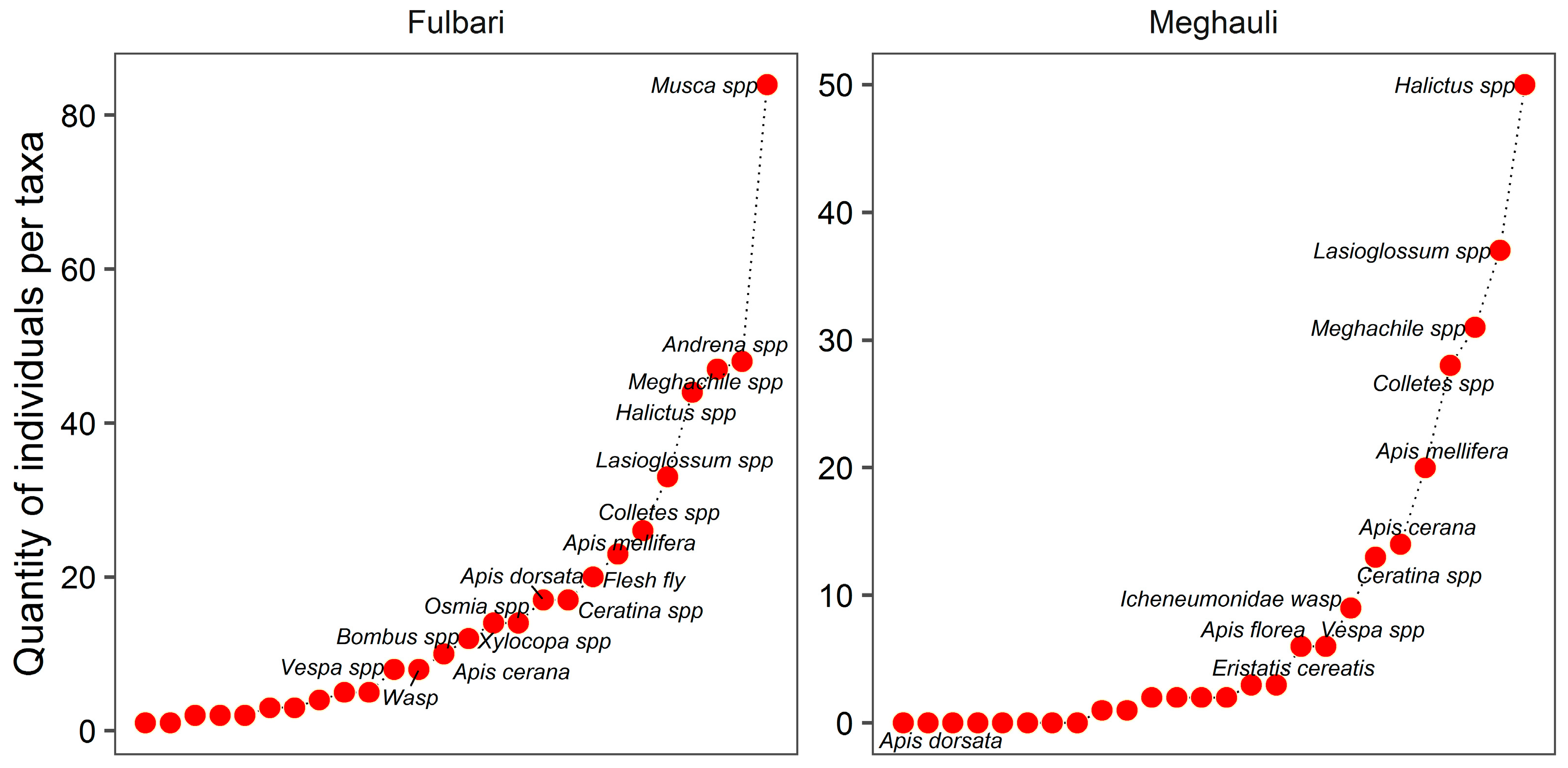
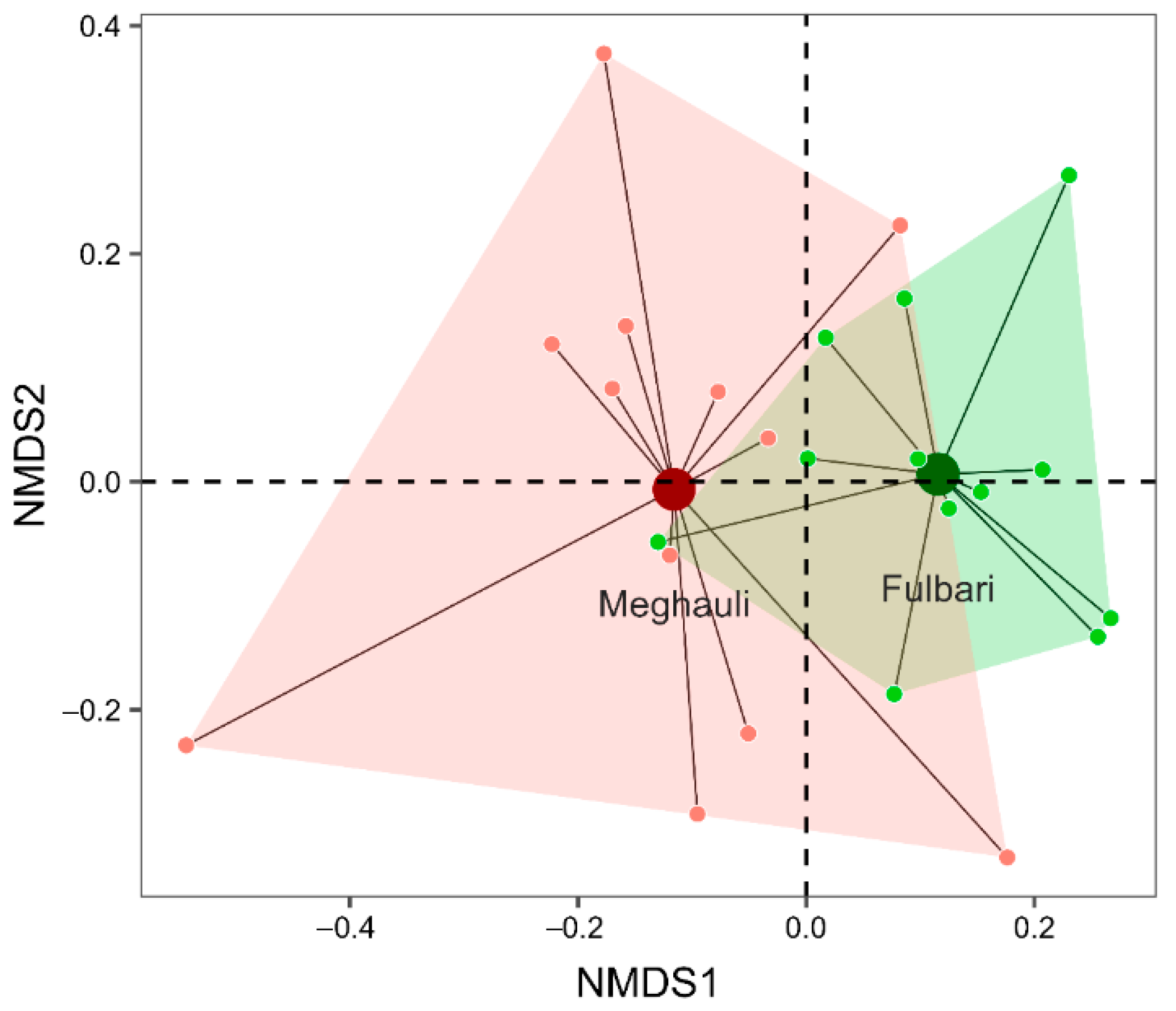
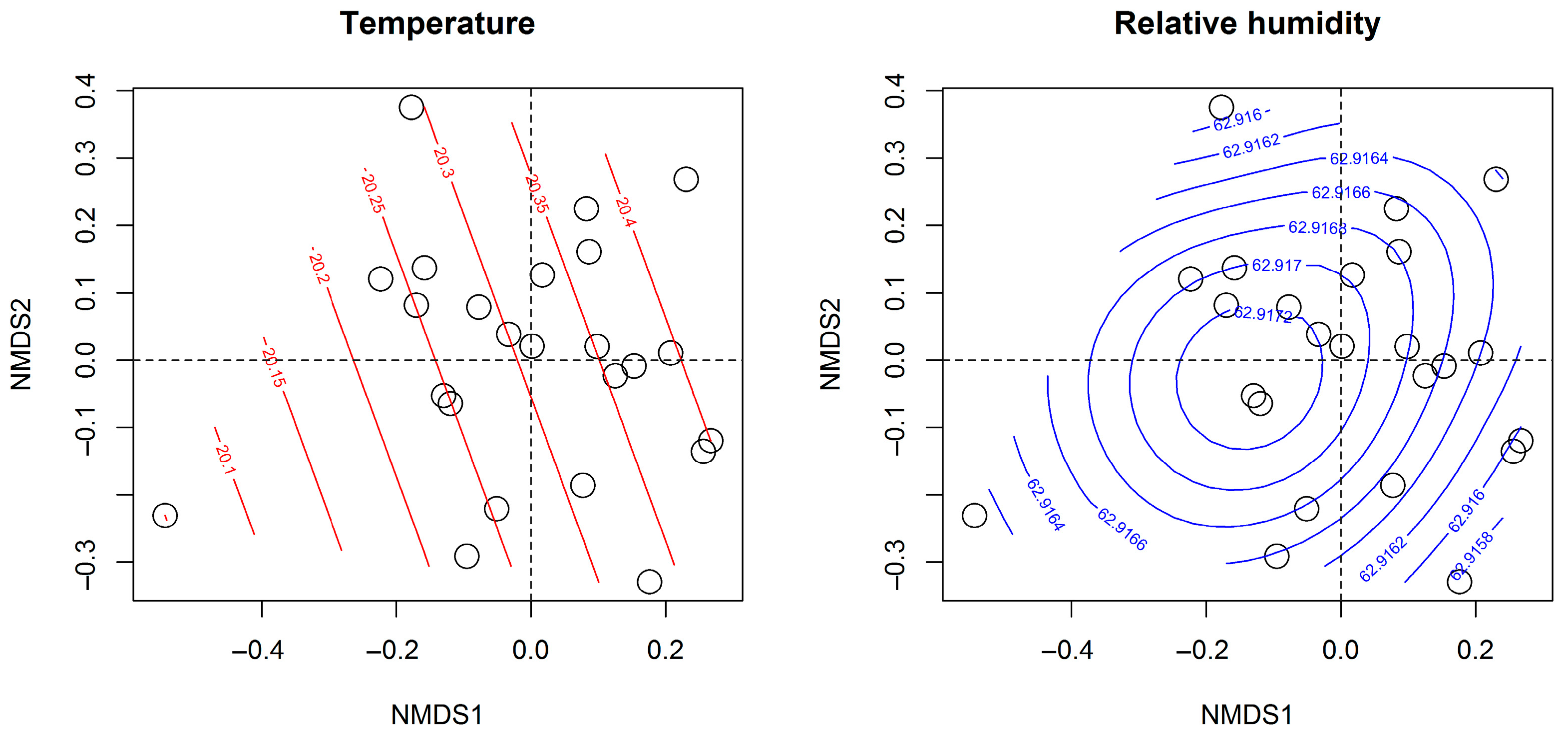
3.1. Flower Visiting Insects Diversity
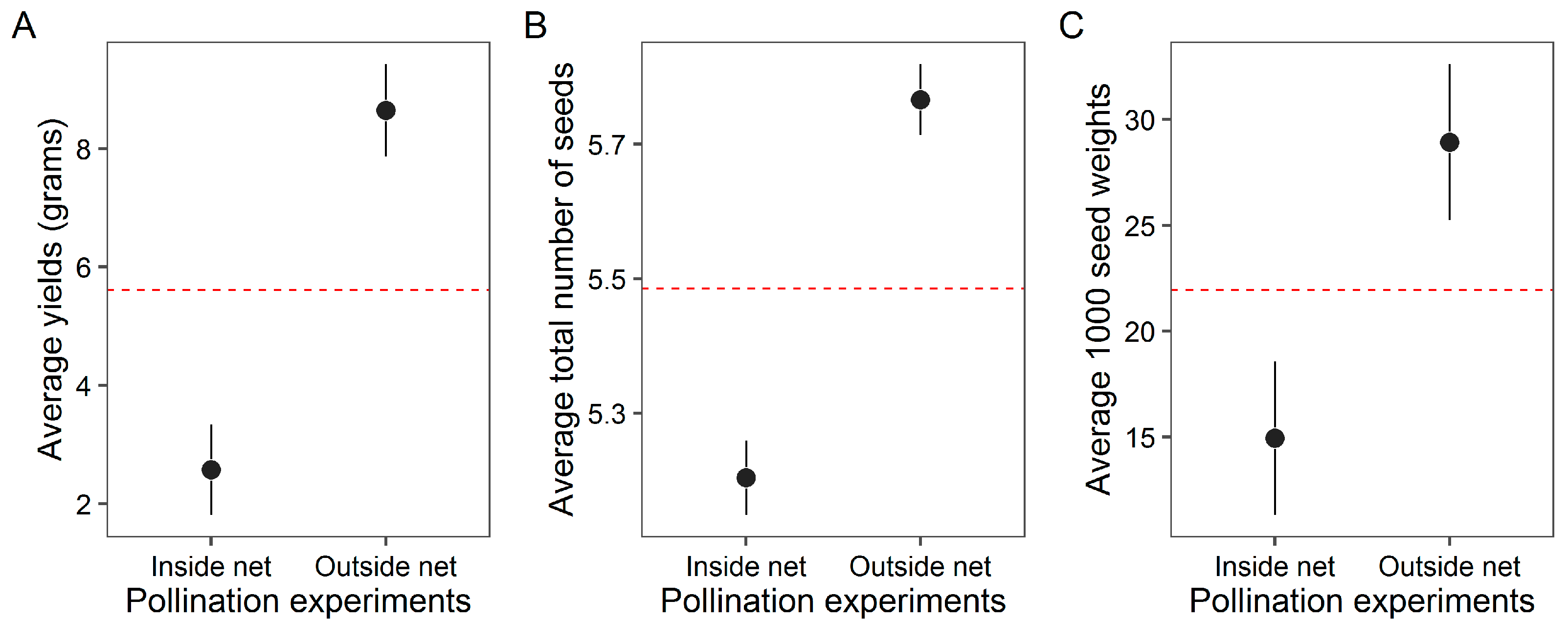
3.2. Crop Productivity and the Role of Flower-Visiting Insects
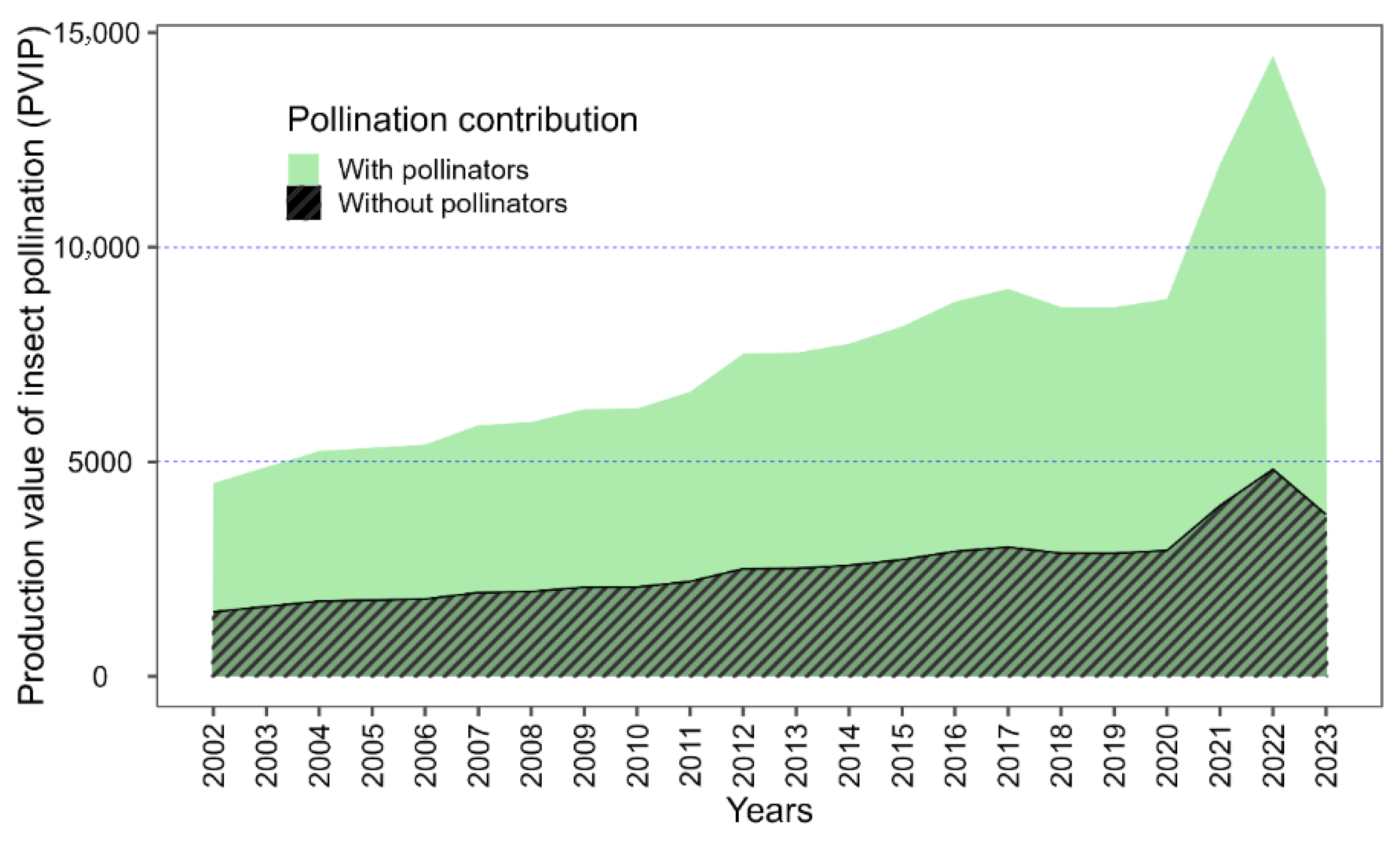
3.3. Economic and Nutritional Contribution of Pollination
4. Discussion
5. Conclusions
Author Contributions
Funding
Data Availability Statement
Acknowledgments
Conflicts of Interest
References
- Smutka, L.; Steininger, M.; Miffek, O. World agricultural production and consumption. AGRIS On-Line Pap. Econ. Inform. 2009, 1, 3–12. [Google Scholar] [CrossRef]
- Wegren, S.K.; Elvestad, C. Russia’s food self-sufficiency and food security: An assessment. Post-Communist Econ. 2018, 30, 565–587. [Google Scholar] [CrossRef] [Scilit]
- Raza, A.; Razzaq, A.; Mehmood, S.S.; Zou, X.; Zhang, X.; Lv, Y.; Xu, J. Impact of Climate Change on Crops Adaptation and Strategies to Tackle Its Outcome: A Review. Plants 2019, 8, 34. [Google Scholar] [CrossRef] [Scilit] [PubMed]
- Seppelt, R.; Klotz, S.; Peiter, E.; Volk, M. Agriculture and food security under a changing climate: An underestimated challenge. iScience 2022, 25, 105551. [Google Scholar] [CrossRef] [Scilit] [PubMed]
- Garibaldi, L.A.; Carvalheiro, L.G.; Vaissière, B.E.; Gemmill-Herren, B.; Hipólito, J.; Freitas, B.M.; Ngo, H.T.; Azzu, N.; Sáez, A.; Åström, J.; et al. Mutually beneficial pollinator diversity and crop yield outcomes in small and large farms. Science 2016, 351, 388–391. [Google Scholar] [CrossRef] [Scilit]
- Breeze, T.D.; Bailey, A.P.; Balcombe, K.G.; Potts, S.G. Pollination services in the UK: How important are honeybees? Agric. Ecosyst. Environ. 2011, 142, 137–143. [Google Scholar] [CrossRef] [Scilit]
- Klein, A.-M.; Vaissière, B.E.; Cane, J.H.; Steffan-Dewenter, I.; Cunningham, S.A.; Kremen, C.; Tscharntke, T. Importance of pollinators in changing landscapes for world crops. Proc. R. Soc. B Biol. Sci. 2007, 274, 303–313. [Google Scholar] [CrossRef] [Scilit]
- Potts, S.G. The Assessment Report on Pollinators, Pollination and Food Production: Summary for Policymakers; Secretariat of the Intergovernmental Science-Policy Platform on Biodiversity and Ecosystem Services: Bonn, Germany, 2016; ISBN 978-92-807-3568-0. [Google Scholar]
- Aizen, M.A.; Aguiar, S.; Biesmeijer, J.C.; Garibaldi, L.A.; Inouye, D.W.; Jung, C.; Martins, D.J.; Medel, R.; Morales, C.L.; Ngo, H.; et al. Global agricultural productivity is threatened by increasing pollinator dependence without a parallel increase in crop diversification. Glob. Change Biol. 2019, 25, 3516–3527. [Google Scholar] [CrossRef] [Scilit]
- Hristov, P.; Neov, B.; Shumkova, R.; Palova, N. Significance of Apoidea as Main Pollinators. Ecological and Economic Impact and Implications for Human Nutrition. Diversity 2020, 12, 280. [Google Scholar] [CrossRef] [Scilit]
- Goulson, D.; Nicholls, E.; Botías, C.; Rotheray, E.L. Bee declines driven by combined stress from parasites, pesticides, and lack of flowers. Science 2015, 347, 1255957. [Google Scholar] [CrossRef] [Scilit]
- Paudel, Y.P.; Mackereth, R.; Hanley, R.; Qin, W. Honey Bees (Apis mellifera L.) and Pollination Issues: Current status, impacts and potential drivers of decline. J. Agric. Sci. 2015, 7, 93–109. [Google Scholar] [CrossRef] [Scilit]
- Kluser, S.; Peduzzi, P. Global Pollinator Decline: A Litterature Review; UNEP/GRID Europe: Geneva, Switzerland, 2007. [Google Scholar]
- FAO. The State of Food and Agriculture 2024—Value-Driven Transformation of Agrifood Systems; FAO: Rome, Italy, 2024. [Google Scholar] [CrossRef] [Scilit]
- Luitel, D.R.; Siwakoti, M.; Jha, P.K.; Jha, A.K.; Krakauer, N. An Overview: Distribution, Production, and Diversity of Local Landraces of Buckwheat in Nepal. Adv. Agric. 2017, 2017, 2738045. [Google Scholar] [CrossRef] [Scilit]
- Giménez-Bastida, J.A.; Zieliński, H. Buckwheat as a Functional Food and Its Effects on Health. J. Agric. Food Chem. 2015, 63, 7896–7913. [Google Scholar] [CrossRef] [Scilit]
- Li, J.; Yang, P.; Yang, Q.; Gong, X.; Ma, H.; Dang, K.; Chen, G.; Gao, X.; Feng, B. Analysis of Flavonoid Metabolites in Buckwheat Leaves Using UPLC-ESI-MS/MS. Molecules 2019, 24, 1310. [Google Scholar] [CrossRef] [Scilit]
- Sanchez, A.; Schuster, T.M.; Burke, J.M.; Kron, K.A. Taxonomy of Polygonoideae (Polygonaceae): A new tribal classification. TAXON 2011, 60, 151–160. [Google Scholar] [CrossRef] [Scilit]
- Rocha-Amador, O.G.; Gallegos-Infante, J.A.; Huang, Q.; Rocha-Guzman, N.E.; Moreno-Jimenez, M.R.; Gonzalez-Laredo, R.F. Influence of Commercial Saturated Monoglyceride, Mono-/Diglycerides Mixtures, Vegetable Oil, Stirring Speed, and Temperature on the Physical Properties of Organogels. Int. J. Food Sci. 2014, 2014, 513641. [Google Scholar] [CrossRef] [Scilit]
- Taki, H.; Okabe, K.; Makino, S.; Yamaura, Y.; Sueyoshi, M. Contribution of small insects to pollination of common buckwheat, a distylous crop. Ann. Appl. Biol. 2009, 155, 121–129. [Google Scholar] [CrossRef] [Scilit]
- Akter, M.; Hossain, M.; Rahman, S.; Banu, M.; Akhtar, M. Insect Diversity and Pollination Effect on Buckwheat (Fagopyrum Esculentum) Yield. J. Biodivers. Conserv. Bioresour. Manag. 2023, 9, 109–118. [Google Scholar] [CrossRef] [Scilit]
- Khalifa, S.A.M.; Elshafiey, E.H.; Shetaia, A.A.; El-Wahed, A.A.A.; Algethami, A.F.; Musharraf, S.G.; AlAjmi, M.F.; Zhao, C.; Masry, S.H.D.; Abdel-Daim, M.M.; et al. Overview of Bee Pollination and Its Economic Value for Crop Production. Insects 2021, 12, 688. [Google Scholar] [CrossRef] [Scilit]
- Timberlake, T.P.; Cirtwill, A.R.; Sapkota, S.; Bhusal, D.R.; Devkota, K.; Karki, R.; Joshi, D.; Saville, N.M.; Kortsch, S.; Baral, S.; et al. Agricultural specialisation increases the vulnerability of pollination services for smallholder farmers. J. Appl. Ecol. 2024, 61, 2123–2134. [Google Scholar] [CrossRef] [Scilit]
- Dhakal, S.C.; Regmi, P.P.; Thapa, R.B.; Sah, S.K.; Khatri-Chhetri, D.B. Profitability and resource use efficiency of buckwheat (Fagopyrum esculentum Moench) production in Chitwan District, Nepal. J. Agric. Environ. 2015, 16, 120–131. [Google Scholar] [CrossRef] [Scilit]
- Ne’eman, G.; Jürgens, A.; Newstrom-Lloyd, L.; Potts, S.G.; Dafni, A. A framework for comparing pollinator performance: Effectiveness and efficiency. Biol. Rev. 2010, 85, 435–451. [Google Scholar] [CrossRef] [Scilit]
- Tuell, J.K.; Isaacs, R. Elevated pan traps to monitor bees in flowering crop canopies. Entomol. Exp. Appl. 2009, 131, 93–98. [Google Scholar] [CrossRef] [Scilit]
- Gill, K.A.; O’Neal, M.E. Survey of Soybean Insect Pollinators: Community Identification and Sampling Method Analysis. Environ. Entomol. 2015, 44, 488–498. [Google Scholar] [CrossRef] [Scilit]
- Boyer, K.J.; Fragoso, F.P.; Dieterich Mabin, M.E.; Brunet, J. Netting and Pan Traps Fail to Identify the Pollinator Guild of an Agricultural Crop. Sci. Rep. 2020, 10, 13819. [Google Scholar] [CrossRef] [Scilit] [PubMed]
- Droege, S.; Tepedino, V.J.; Lebuhn, G.; Link, W.; Minckley, R.L.; Chen, Q.; Conrad, C. Spatial patterns of bee captures in North American bowl trapping surveys. Insect Conserv. Divers. 2010, 3, 15–23. [Google Scholar] [CrossRef] [Scilit]
- Ihaka, R.; Gentleman, R. R: A Language for Data Analysis and Graphics. J. Comput. Graph. Stat. 1996, 5, 299–314. [Google Scholar] [CrossRef] [Scilit]
- R Development Core Team. A Language and Environment for Statistical Computing: Reference Index; R Foundation for Statistical Computing: Vienna, Austria, 2020. [Google Scholar]
- Oksanen, J.; Simpson, G.L.; Blanchet, F.G.; Kindt, R.; Legendre, P.; Minchin, P.R.; O’Hara, R.B.; Solymos, P.; Stevens, M.H.H.; Szoecs, E.; et al. Vegan: Community Ecology Package, Version 2.7-2; 2001. Available online: https://doi.org/10.32614/CRAN.package.vegan (accessed on 1 December 2025).
- Bates, D.; Maechler, M.; Bolker, B.; Walker, S. lme4: Linear Mixed-Effects Models Using “Eigen” and S4, Version 1.1-38; 2003. Available online: https://doi.org/10.32614/CRAN.package.lme4 (accessed on 1 December 2025).
- Miller, J.C. Insect natural history, multi-species interactions and biodiversity in ecosystems. Biodivers. Conserv. 1993, 2, 233–241. [Google Scholar] [CrossRef] [Scilit]
- Brockerhoff, E.G.; Barbaro, L.; Castagneyrol, B.; Forrester, D.I.; Gardiner, B.; González-Olabarria, J.R.; Lyver, P.O.; Meurisse, N.; Oxbrough, A.; Taki, H.; et al. Forest biodiversity, ecosystem functioning and the provision of ecosystem services. Biodivers. Conserv. 2017, 26, 3005–3035. [Google Scholar] [CrossRef] [Scilit]
- Jankielsohn, A. The Importance of Insects in Agricultural Ecosystems. Adv. Entomol. 2018, 6, 62–73. [Google Scholar] [CrossRef]
- Belovsky, G.E.; Slade, J.B. Insect herbivory accelerates nutrient cycling and increases plant production. Proc. Natl. Acad. Sci. USA 2000, 97, 14412–14417. [Google Scholar] [CrossRef] [Scilit]
- Bagyaraj, D.J.; Nethravathi, C.J.; Nitin, K.S. Soil Biodiversity and Arthropods: Role in Soil Fertility. In Economic and Ecological Significance of Arthropods in Diversified Ecosystems; Chakravarthy, A.K., Sridhara, S., Eds.; Springer: Singapore, 2016; pp. 17–51. ISBN 978-981-10-1523-6. [Google Scholar]
- Polacco, J.C. Ecological Aspects of Nitrogen Metabolism in Plants, 1st ed.; John Wiley & Sons, Incorporated: Hoboken, NJ, USA, 2011; ISBN 978-0-8138-1649-4. [Google Scholar]
- Perfectti, F.; Gómez, J.M.; Bosch, J. The functional consequences of diversity in plant–pollinator interactions. Oikos 2009, 118, 1430–1440. [Google Scholar] [CrossRef] [Scilit]
- Shackelford, G.; Steward, P.R.; Benton, T.G.; Kunin, W.E.; Potts, S.G.; Biesmeijer, J.C.; Sait, S.M. Comparison of pollinators and natural enemies: A meta-analysis of landscape and local effects on abundance and richness in crops. Biol. Rev. 2013, 88, 1002–1021. [Google Scholar] [CrossRef] [Scilit]
- Bartomeus, I.; Potts, S.G.; Steffan-Dewenter, I.; Vaissière, B.E.; Woyciechowski, M.; Krewenka, K.M.; Tscheulin, T.; Roberts, S.P.M.; Szentgyörgyi, H.; Westphal, C.; et al. Contribution of insect pollinators to crop yield and quality varies with agricultural intensification. PeerJ 2014, 2, e328. [Google Scholar] [CrossRef] [Scilit]
- Devkota, K.; Rijal, P.; Fernando Dos Santos, C. The Use of Honeybee Hives May Boost Yields of Some Crops in Nepal. Psyche J. Entomol. 2021, 2021, 8876388. [Google Scholar] [CrossRef] [Scilit]
- Weisser, W.W.; Siemann, E. The Various Effects of Insects on Ecosystem Functioning. In Insects and Ecosystem Function; Weisser, W.W., Siemann, E., Eds.; Ecological Studies; Springer: Berlin, Heidelberg, 2008; Volume 173, pp. 3–24. ISBN 978-3-540-74003-2. [Google Scholar]
- Crist, T.; Peters, V. Landscape and Local Controls of Insect Biodiversity in Conservation Grasslands: Implications for the Conservation of Ecosystem Service Providers in Agricultural Environments. Land 2014, 3, 693–718. [Google Scholar] [CrossRef] [Scilit]
- Van Der Plas, F. Biodiversity and ecosystem functioning in naturally assembled communities. Biol. Rev. 2019, 94, 1220–1245. [Google Scholar] [CrossRef] [Scilit]
- Devkota, K.; Dos Santos, C.F.; Ferreira, A.B.; Timberlake, T.P. Assessing the Economic and Nutritional Value of Pollination Services in Nepal. Sci. Rep. 2024, 14, 25037. [Google Scholar] [CrossRef] [Scilit]



| Taxa | Abundance | Individual Contribution | Cumulative Contribution | |
|---|---|---|---|---|
| Fulbari vs. Meghauli | ||||
| 1. Musca spp. | 84 | 0 | 0.13 | 0.13 |
| 2. Megachile spp. | 47 | 31 | 0.06 | 0.19 |
| 3. Lasioglossum spp. | 33 | 37 | 0.06 | 0.25 |
| 4. Apis mellifera | 23 | 20 | 0.07 | 0.32 |
| 5. Sarcophagidae | 20 | 2 | 0.06 | 0.38 |
| 6. Halictus spp. | 44 | 50 | 0.06 | 0.44 |
| 7. Apis dorsata | 17 | 0 | 0.05 | 0.49 |
| 8. Apis cerana | 10 | 14 | 0.05 | 0.54 |
| 9. Colletes spp. | 26 | 28 | 0.05 | 0.59 |
| 10. Osmia spp. | 14 | 0 | 0.04 | 0.63 |
| 11. Andrena spp. | 48 | 0 | 0.05 | 0.68 |
| 12. Ceratina spp. | 17 | 13 | 0.04 | 0.72 |
| 47% = average dissimilarity between both sites | ||||
Disclaimer/Publisher’s Note: The statements, opinions and data contained in all publications are solely those of the individual author(s) and contributor(s) and not of MDPI and/or the editor(s). MDPI and/or the editor(s) disclaim responsibility for any injury to people or property resulting from any ideas, methods, instructions or products referred to in the content. |
© 2026 by the authors. Licensee MDPI, Basel, Switzerland. This article is an open access article distributed under the terms and conditions of the Creative Commons Attribution (CC BY) license.
Share and Cite
Devkota, K.; Rijal, P.; dos Santos, C.F. Flower-Visiting Insect Diversity Within Buckwheat Crops: An Underutilized Crop for Sustainable Economic Livelihoods. Insects 2026, 17, 200. https://doi.org/10.3390/insects17020200
Devkota K, Rijal P, dos Santos CF. Flower-Visiting Insect Diversity Within Buckwheat Crops: An Underutilized Crop for Sustainable Economic Livelihoods. Insects. 2026; 17(2):200. https://doi.org/10.3390/insects17020200
Chicago/Turabian StyleDevkota, Kedar, Prashant Rijal, and Charles Fernando dos Santos. 2026. "Flower-Visiting Insect Diversity Within Buckwheat Crops: An Underutilized Crop for Sustainable Economic Livelihoods" Insects 17, no. 2: 200. https://doi.org/10.3390/insects17020200
APA StyleDevkota, K., Rijal, P., & dos Santos, C. F. (2026). Flower-Visiting Insect Diversity Within Buckwheat Crops: An Underutilized Crop for Sustainable Economic Livelihoods. Insects, 17(2), 200. https://doi.org/10.3390/insects17020200