Honey Bees Reduce Pollen Viability While Foraging

 ,
,
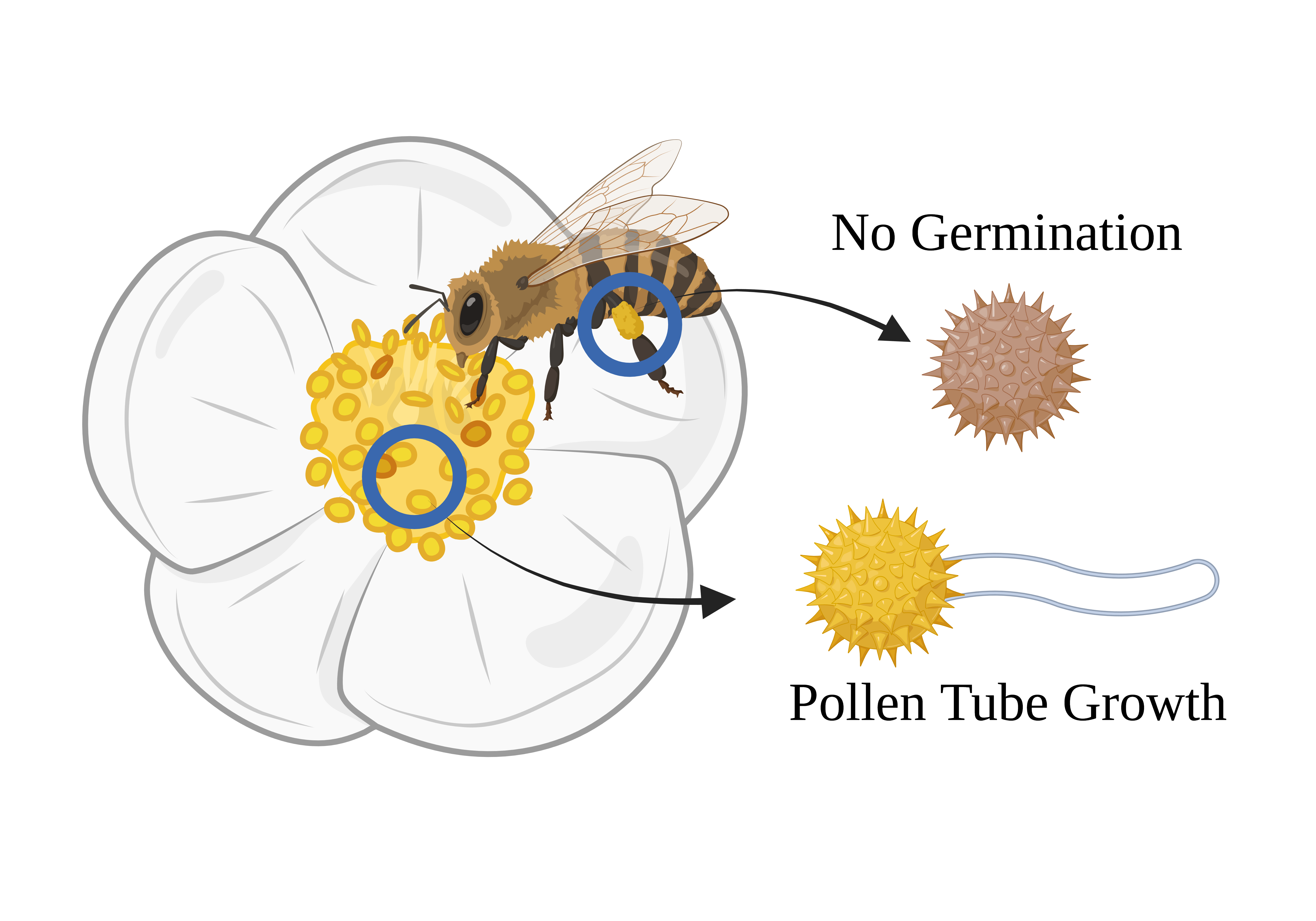
Simple Summary
Abstract
1. Introduction
2. Materials and Methods
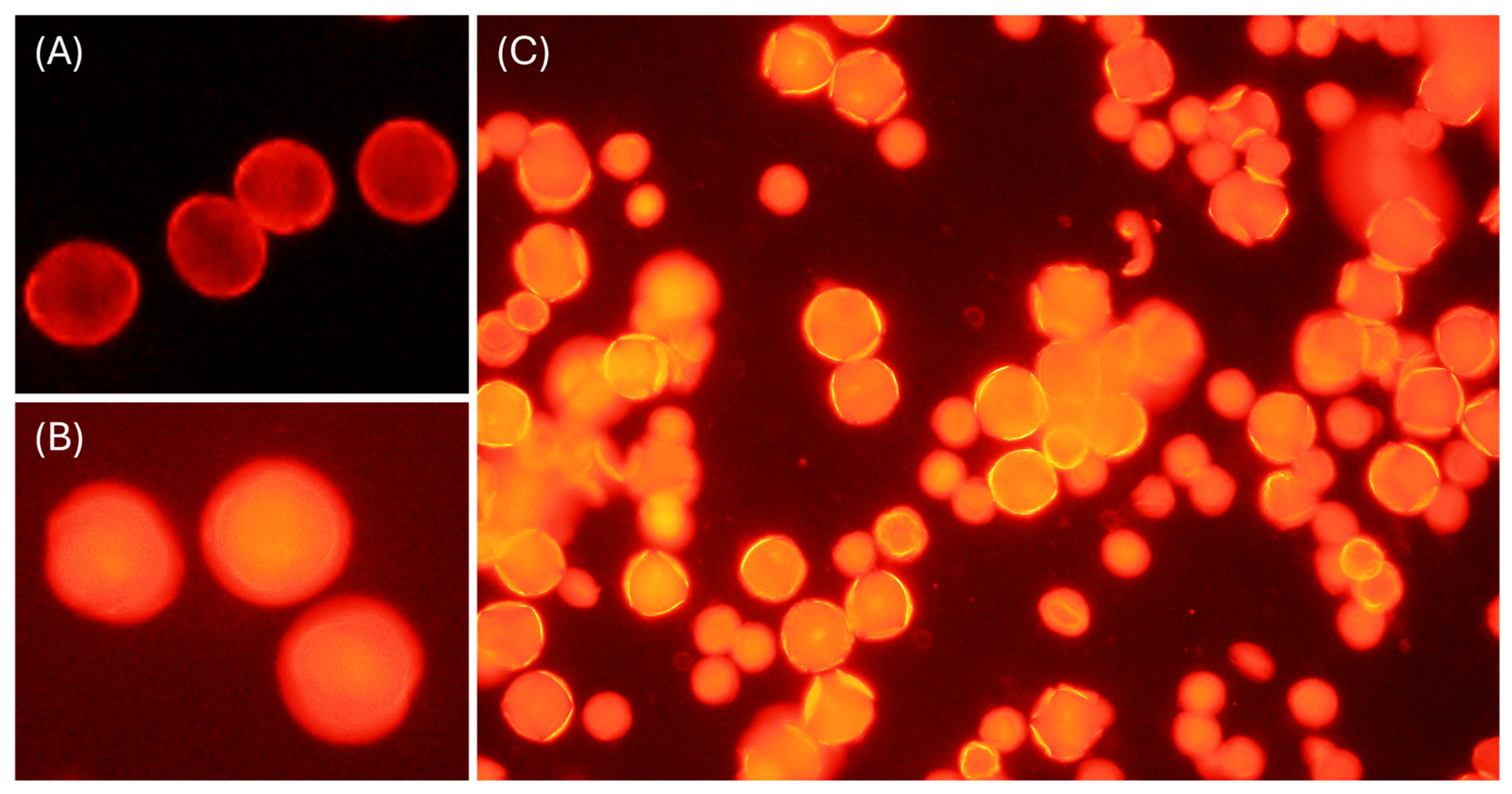
2.1. Measurement of Pollen Viability
2.2. Site Description and Collections
2.3. Development of Germination Media
2.4. Treatments and Culturing
2.5. Statistical Analyses
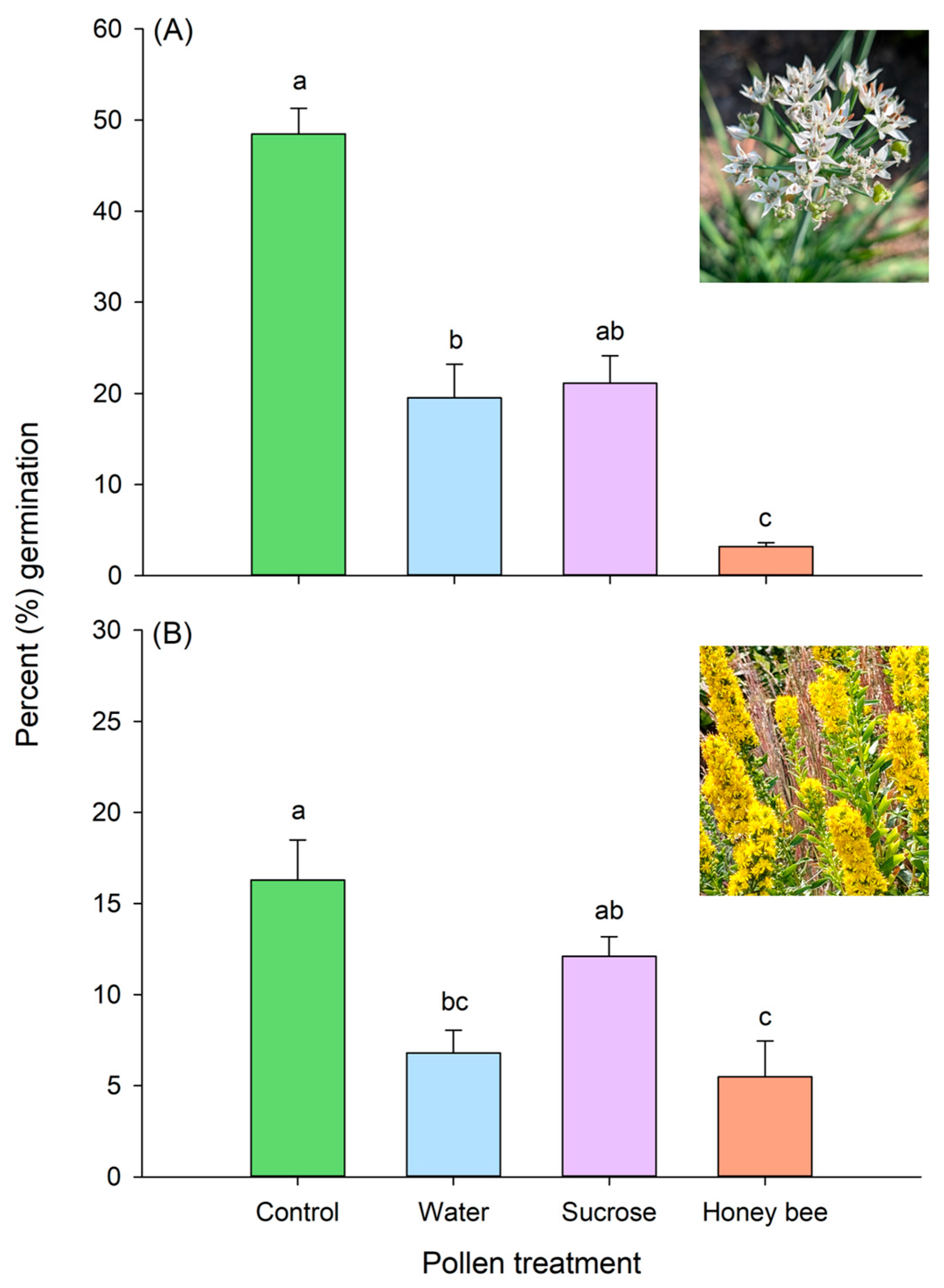
3. Results
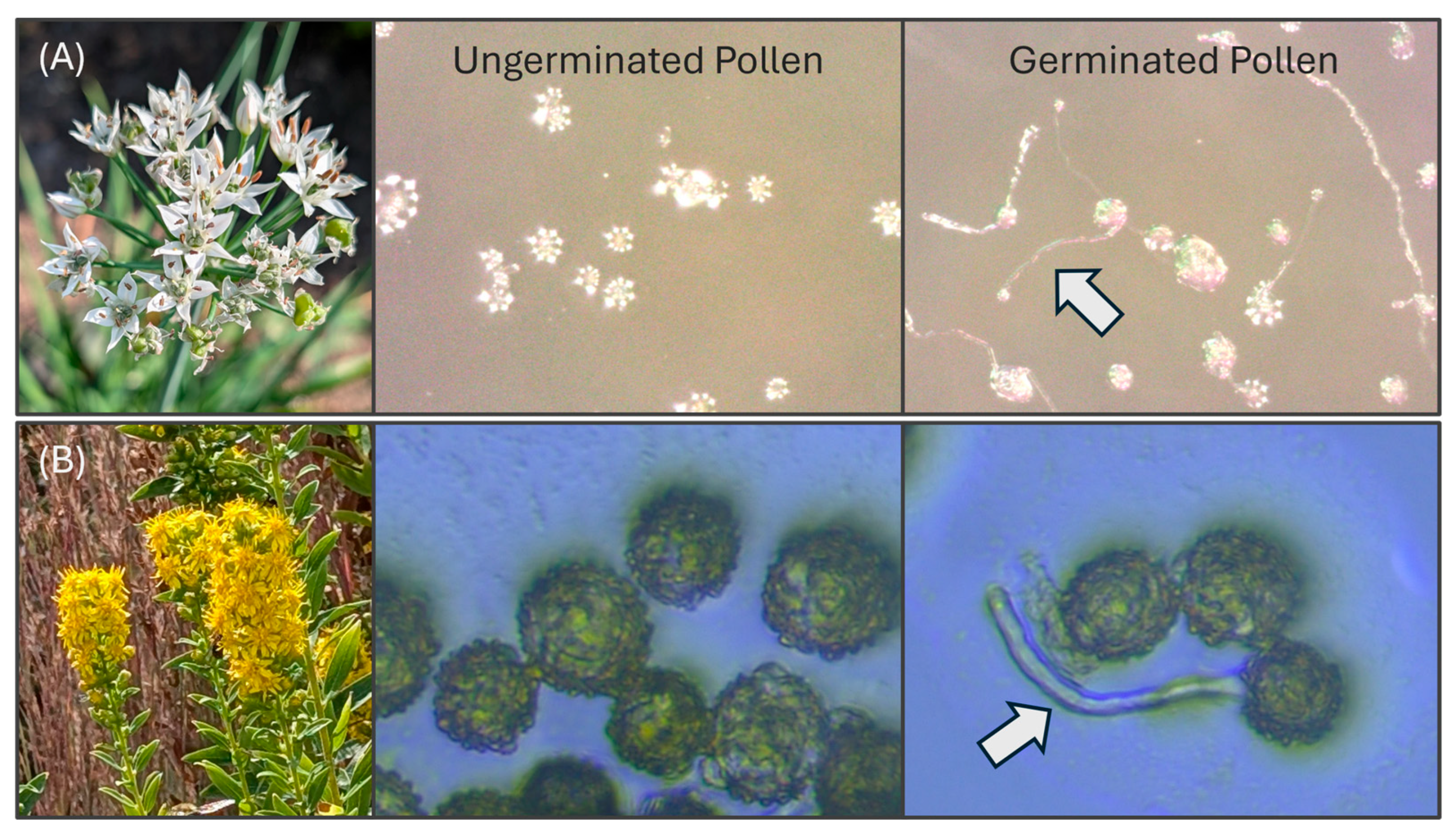
4. Discussion
5. Conclusions
Author Contributions
Funding
Data Availability Statement
Acknowledgments
Conflicts of Interest
Appendix A

| 0.5× Boron | 1× Boron | 1.5× Boron | |
|---|---|---|---|
| 0.5× Calcium | #1: 0.007% CaCl2, 0.012% Ca(NO3)2, 0.005% H3BO3, 0.025% MgSO4, 18% Sucrose, 0.5% Agar | #2: 0.007% CaCl2, 0.012% Ca(NO3)2, 0.01% H3BO3, 0.025% MgSO4, 18% Sucrose, 0.5% Agar | #3: 0.007% CaCl2, 0.012% Ca(NO3)2, 0.015% H3BO3, 0.025% MgSO4, 18% Sucrose, 0.5% Agar |
| 1× Calcium | #4: 0.015% CaCl2, 0.024% Ca(NO3)2, 0.005% H3BO3, 0.025% MgSO4, 18% Sucrose, 0.5% Agar | #5: 0.015% CaCl2, 0.024% Ca(NO3)2, 0.01% H3BO3, 0.025% MgSO4, 18% Sucrose, 0.5% Agar | #6: 0.015% CaCl2, 0.024% Ca(NO3)2, 0.015% H3BO3, 0.025% MgSO4, 18% Sucrose, 0.5% Agar |
| 1.5× Calcium | #7: 0.022% CaCl2, 0.035% Ca(NO3)2, 0.005% H3BO3, 0.025% MgSO4, 18% Sucrose, 0.5% Agar | #8: 0.022% CaCl2, 0.035% Ca(NO3)2, 0.01% H3BO3, 0.025% MgSO4, 18% Sucrose, 0.5% Agar | #9: 0.022% CaCl2, 0.035% Ca(NO3)2, 0.015% H3BO3, 0.025% MgSO4, 18% Sucrose, 0.5% Agar |
| PGM Recipe # | Anethum graveolens | Lavendula augustifolia | Daucus carota | Gentiana alba | Solidago rigida | Phlox spp. |
|---|---|---|---|---|---|---|
| 1 | 1.9% | 0% | 0% | 0% | 1.4% | 0% |
| 2 | 0% | 13% | 2.3% | 0% | 0% | 0% |
| 3 | 0% | 30% | 1.6% | 0% | 0% | 4% |
| 4 | 0% | 10% | 0% | 1.8% | 1.6% | 5.6% |
| 5 | 3.4% | 12.2% | 1.2% | 0% | 0% | 1.6% |
| 6 | 0% | 8.7% | 1.6% | 0% | 4.1% | 0% |
| 7 | 0% | 5.3% | 0% | 0% | 0% | 1.8% |
| 8 | 0% | 19% | 0% | 0% | 0% | 6.2% |
| 9 | 2.1% | 14.3% | 0% | 0% | 0% | 3.8% |
| 0.5× H3BO3 | 1× H3BO3 | 2× H3BO3 | |
|---|---|---|---|
| 1× Sucrose | #10: 10% Sucrose, 0.005% H3BO3, 0.066% CaCl2 * H2O, 0.005% KH2SO4, 0.5% Agar | #11: 10% Sucrose, 0.01% H3BO3, 0.066% CaCl2 * H2O, 0.005% KH2SO4, 0.5% Agar | #12: 10% Sucrose, 0.02% H3BO3, 0.066% CaCl2 * H2O, 0.005% KH2SO4, 0.5% Agar |
| 1.5× Sucrose | #13: 15% Sucrose, 0.005% H3BO3, 0.066% CaCl2 * H2O, 0.005% KH2SO4, 0.5% Agar | #14: 15% Sucrose, 0.01% H3BO3, 0.066% CaCl2 * H2O, 0.005% KH2SO4, 0.5% Agar | #15: 15% Sucrose, 0.02% H3BO3, 0.066% CaCl2 * H2O, 0.005% KH2SO4, 0.5% Agar |
| 2× Sucrose | #16: 20% Sucrose, 0.005% H3BO3, 0.066% CaCl2 * H2O, 0.005% KH2SO4, 0.5% Agar | #17: 20% Sucrose, 0.01% H3BO3, 0.066% CaCl2 * H2O, 0.005% KH2SO4, 0.5% Agar | #18: 20% Sucrose, 0.02% H3BO3, 0.066% CaCl2 * H2O, 0.005% KH2SO4, 0.5% Agar |
| PGM Recipe # | Allium tuberosum | Solidago rigida | Hylotelephium telephium | Helianthus strumosus |
|---|---|---|---|---|
| 10 | 50% | 14.7% | 51% | 6.7% |
| 11 | 52% | 12.7% | 52.6% | 7.3% |
| 12 | 16.67% | 22.7% | 28% | 9.3% |
| 13 | 57.3% | 20.7% | 53.3% | 17.3% |
| 14 | 36% | 19.3% | 44.7% | 10.7% |
| 15 | 40.7% | 18% | 52.7% | 20.7% |
| 16 | 38% | 42% | 17.3% | 14% |
| 17 | 56.7% | 27.3% | 31.3% | 20% |
| 18 | 33.3% | 30% | 0% | 33.3% |
References
- Harder, L.D.; Johnson, S.D. Beyond Pollen: Ovule Ratios: Evolutionary Consequences of Pollinator Dependence and Pollination Efficiency for Pollen and Ovule Production in Angiosperms. Am. J. Bot. 2023, 110, e16177. [Google Scholar] [CrossRef]
- McCarren, S.; Midgley, J.J.; Coetzee, A.; Johnson, S.D. Pollen Transfer Efficiency in Erica Depends on Type of Pollinator. PhytoKeys 2024, 244, 237–248. [Google Scholar] [CrossRef]
- Schlindwein, C.; Wittmann, D.; Martins, C.F.; Hamm, A.; Siqueira, J.A.; Schiffler, D.; Machado, I.C. Pollination of Campanula rapunculus L. (Campanulaceae): How Much Pollen Flows into Pollination and into Reproduction of Oligolectic Pollinators? Plant Syst. Evol. 2005, 250, 147–156. [Google Scholar] [CrossRef]
- Steffan, S.A.; Dharampal, P.S.; Kueneman, J.G.; Keller, A.; Argueta-Guzmán, M.P.; McFrederick, Q.S.; Buchmann, S.L.; Vannette, R.L.; Edlund, A.F.; Mezera, C.C.; et al. Microbes, the ‘Silent Third Partners’ of Bee–Angiosperm Mutualisms. Trends Ecol. Evol. 2024, 39, 65–77. [Google Scholar] [CrossRef]
- Gilliam, M. Microbiology of pollen and bee bread: The yeasts. Apidologie 1979, 10, 43–53. [Google Scholar] [CrossRef]
- Edlund, A.F.; Swanson, R.; Preuss, D. Pollen and Stigma Structure and Function: The Role of Diversity in Pollination. Plant Cell 2004, 16, S84–S97. [Google Scholar] [CrossRef]
- Amador, G.J.; Matherne, M.; Waller, D.; Mathews, M.; Gorb, S.N.; Hu, D.L. Honey Bee Hairs and Pollenkitt Are Essential for Pollen Capture and Removal. Bioinspir. Biomim. 2017, 12, 026015. [Google Scholar] [CrossRef] [PubMed]
- Thorp, R.W. Structural, Behavioral, and Physiological Adaptations of Bees (Apoidea) for Collecting Pollen. Ann. Mo. Bot. Gard. 1979, 66, 788–812. [Google Scholar] [CrossRef]
- Bakour, M.; Fernandes, Â.; Barros, L.; Sokovic, M.; Ferreira, I.C.F.R.; Badiaa, L. Bee Bread as a Functional Product: Chemical Composition and Bioactive Properties. LWT 2019, 109, 276–282. [Google Scholar] [CrossRef]
- Vásquez, A.; Olofsson, T.C. The Lactic Acid Bacteria Involved in the Production of Bee Pollen and Bee Bread. J. Apic. Res. 2009, 48, 189–195. [Google Scholar] [CrossRef]
- Dharampal, P.S.; Carlson, C.; Currie, C.R.; Steffan, S.A. Pollen-Borne Microbes Shape Bee Fitness. Proc. R. Soc. B Biol. Sci. 2019, 286, 20182894. [Google Scholar] [CrossRef]
- Steffan, S.A.; Dharampal, P.S.; Danforth, B.N.; Gaines-Day, H.R.; Takizawa, Y.; Chikaraishi, Y. Omnivory in Bees: Elevated Trophic Positions among All Major Bee Families. Am. Nat. 2019, 194, 414–421. [Google Scholar] [CrossRef] [PubMed]
- Gilliam, M. Identification and Roles of Non-Pathogenic Microflora Associated with Honey Bees. FEMS Microbiol. Lett. 1997, 155, 1–10. [Google Scholar] [CrossRef]
- Kraai, A. How Long Do Honey-Bees Carry Germinable Pollen on Them? Euphytica 1962, 11, 53–56. [Google Scholar] [CrossRef]
- Kendall, D.A. The Viability and Compatibility of Pollen on Insects Visiting Apple Blossom. J. Appl. Ecol. 1973, 10, 847–853. [Google Scholar] [CrossRef]
- Beekman, M.; Ratnieks, F.L.W. Long-Range Foraging by the Honey-Bee, Apis mellifera L. Funct. Ecol. 2000, 14, 490–496. [Google Scholar] [CrossRef]
- Thorp, R.W. The Collection of Pollen by Bees. Plant Syst. Evol. 2000, 222, 211–223. [Google Scholar] [CrossRef]
- Milne, C.P., Jr.; Pries, K.J. Honeybees with Larger Corbiculae Carry Larger Pollen Pellets. J. Apic. Res. 1986, 25, 53–54. [Google Scholar] [CrossRef]
- Parker, A.J.; Tran, J.L.; Ison, J.L.; Bai, J.D.K.; Weis, A.E.; Thomson, J.D. Pollen Packing Affects the Function of Pollen on Corbiculate Bees but Not Non-Corbiculate Bees. Arthropod-Plant Interact. 2015, 9, 197–203. [Google Scholar] [CrossRef]
- Alexander, M.P. Differential Staining of Aborted and Nonaborted Pollen. Stain. Technol. 1969, 44, 117–122. [Google Scholar] [CrossRef]
- Atlagić, J.; Terzić, S.; Marjanović-Jeromela, A. Staining and Fluorescent Microscopy Methods for Pollen Viability Determination in Sunflower and Other Plant Species. Ind. Crops Prod. 2012, 35, 88–91. [Google Scholar] [CrossRef]
- Dafni, A.; Firmage, D. Pollen Viability and Longevity: Practical, Ecological and Evolutionary Implications. In Pollen and Pollination; Dafni, A., Hesse, M., Pacini, E., Eds.; Springer: Vienna, Austria, 2000; pp. 113–132. ISBN 978-3-7091-6306-1. [Google Scholar]
- Kakani, V.G.; Reddy, K.R.; Koti, S.; Wallace, T.P.; Prasad, P.V.V.; Reddy, V.R.; Zhao, D. Differences in in Vitro Pollen Germination and Pollen Tube Growth of Cotton Cultivars in Response to High Temperature. Ann. Bot. 2005, 96, 59–67. [Google Scholar] [CrossRef] [PubMed]
- Tushabe, D.; Rosbakh, S. A Compendium of in Vitro Germination Media for Pollen Research. Front. Plant Sci. 2021, 12, 709945. [Google Scholar] [CrossRef]
- Fayos, O.; Echávarri, B.; Vallés, M.P.; Mallor, C.; Garcés-Claver, A.; Castillo, A.M. A Simple and Efficient Method for Onion Pollen Preservation: Germination, Dehydration, Storage Conditions, and Seed Production. Sci. Hortic. 2022, 305, 111358. [Google Scholar] [CrossRef]
- Guo, S.L.; Jiang, H.W.; Fang, F.; Chen, G.Q. Influences of Herbicides, Uprooting and Use as Cut Flowers on Sexual Reproduction of Solidago canadensis. Weed Res. 2009, 49, 291–299. [Google Scholar] [CrossRef]
- Lin, Y.H.; Lin, M.Z.; Chen, Y.Q.; Tian, H.Q. Isolation of Male and Female Gametes, Zygotes and Proembryos of Leek (Allium Tuberosum Roxb). Zygote 2020, 28, 278–285. [Google Scholar] [CrossRef]
- Jander, R. Grooming and Pollen Manipulation in Bees (Apoidea): The Nature and Evolution of Movements Involving the Foreleg. Physiol. Entomol. 1976, 1, 179–194. [Google Scholar] [CrossRef]
- Parker, G.A.; Baker, R.R.; Smith, V.G.F. The Origin and Evolution of Gamete Dimorphism and the Male-Female Phenomenon. J. Theor. Biol. 1972, 36, 529–553. [Google Scholar] [CrossRef] [PubMed]
- Yang, J.-N. Cooperation and the Evolution of Anisogamy. J. Theor. Biol. 2010, 264, 24–36. [Google Scholar] [CrossRef]

Disclaimer/Publisher’s Note: The statements, opinions and data contained in all publications are solely those of the individual author(s) and contributor(s) and not of MDPI and/or the editor(s). MDPI and/or the editor(s) disclaim responsibility for any injury to people or property resulting from any ideas, methods, instructions or products referred to in the content. |
© 2026 by the authors. Licensee MDPI, Basel, Switzerland. This article is an open access article distributed under the terms and conditions of the Creative Commons Attribution (CC BY) license.
Share and Cite
Kurtt, A.C.; de la Torre, F.; Edlund, A.F.; Zalapa, J.E.; Steffan, S.A. Honey Bees Reduce Pollen Viability While Foraging. Insects 2026, 17, 199. https://doi.org/10.3390/insects17020199
Kurtt AC, de la Torre F, Edlund AF, Zalapa JE, Steffan SA. Honey Bees Reduce Pollen Viability While Foraging. Insects. 2026; 17(2):199. https://doi.org/10.3390/insects17020199
Chicago/Turabian StyleKurtt, Alex C., Fernando de la Torre, Anna F. Edlund, Juan E. Zalapa, and Shawn A. Steffan. 2026. "Honey Bees Reduce Pollen Viability While Foraging" Insects 17, no. 2: 199. https://doi.org/10.3390/insects17020199
APA StyleKurtt, A. C., de la Torre, F., Edlund, A. F., Zalapa, J. E., & Steffan, S. A. (2026). Honey Bees Reduce Pollen Viability While Foraging. Insects, 17(2), 199. https://doi.org/10.3390/insects17020199