Evaluating the Direct and Indirect Toxicity of Nine Insecticides on an Important Predatory Natural Enemy in Rice Fields

Simple Summary
Abstract
1. Introduction
2. Materials and Methods
2.1. Predators and Prey
2.2. Insecticides
2.3. Methodology for Bioassay
2.3.1. Toxicity Bioassay of Insecticides to Predators
2.3.2. Indirect Effects of Insecticides on the Predatory Activity of Predators
2.4. Statistical Analysis
3. Results
3.1. Direct Toxicity of Insecticides to Predators
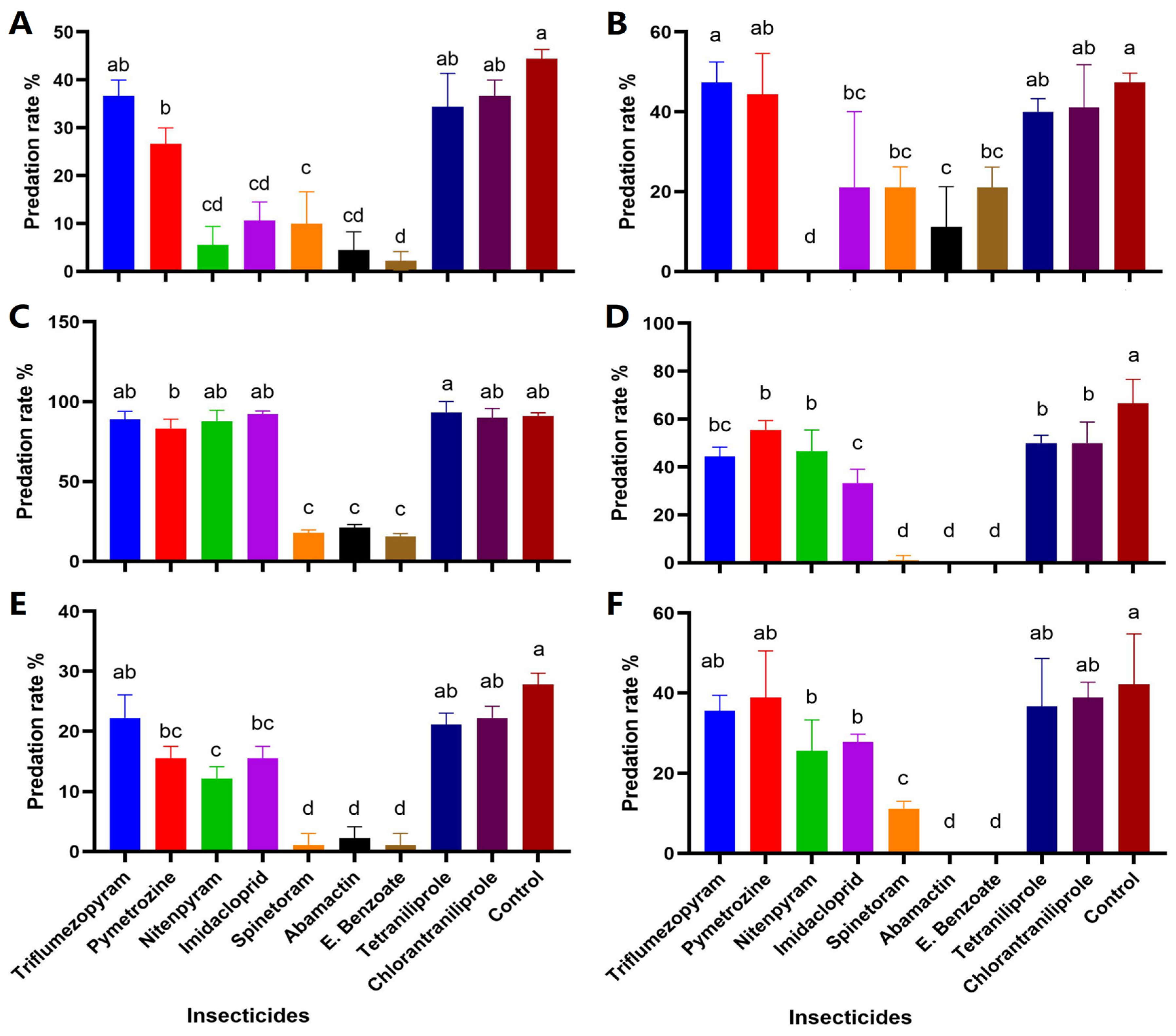
3.2. Effects of Insecticides on Predatory Activity
3.3. LC50 and Risk Assessment of Harmful Insecticides to Predators
4. Discussion
5. Conclusions
Author Contributions
Funding
Institutional Review Board Statement
Informed Consent Statement
Data Availability Statement
Conflicts of Interest
References
- Chauhan, B.; Jabran, K.; Mahajan, G. Rice Production Worldwide; Springer: Cham, Switzerland, 2017. [Google Scholar]
- Vaesen, K.; Gilliams, S.; Nackaerts, K.; Coppin, P. Ground-measured spectral signatures as indicators of ground cover and leaf area index: The case of paddy rice. Field Crops Res. 2001, 69, 13–25. [Google Scholar] [CrossRef]
- Lou, Y.-G.; Zhang, G.-R.; Zhang, W.-Q.; Hu, Y.; Zhang, J. Biological control of rice insect pests in China. Biol. Control 2013, 67, 8–20. [Google Scholar] [CrossRef]
- Khush, G.S.; Brar, D. Genetics of resistance to insects in crop plants. Adv. Agron. 1991, 45, 223–274. [Google Scholar]
- Israel, P.; Abraham, T. Techniques for assessing crop losses caused by rice stem borers in tropical areas. In The Major Insect Pests of the Rice Plant; The Johns Hopkins Press: Baltimore, MD, USA, 1967; pp. 265–275. [Google Scholar]
- Pathak, M. Ecology of common insect pests of rice. Annu. Rev. Entomol. 1968, 13, 257–294. [Google Scholar] [CrossRef]
- Bashir, K.; Husnain, T.; Fatima, T.; Latif, Z.; Aks Mehdi, S.; Riazuddin, S. Field evaluation and risk assessment of transgenic indica basmati rice. Mol. Breed. 2004, 13, 301–312. [Google Scholar] [CrossRef]
- Padmavathi Ch, P.C.; Gururaj Katti, G.K.; Padmakumari, A.; Pasalu, I. Comparative bionomics of leaf folders, Cnaphalocrocis medinalis Guenee and Marasmia patnalis Bradley in rice. Entomon 2006, 31, 251–258. [Google Scholar]
- Hajjar, M.J.; Ahmed, N.; Alhudaib, K.A.; Ullah, H. Integrated insect pest management techniques for rice. Sustainability 2023, 15, 4499. [Google Scholar] [CrossRef]
- Endo, S.; Tsurumachi, M. Insecticide Susceptibility of the Brown Planthopper and the White-backed Planthopper Collected from Southeast Asia. J. Pestic. Sci. 2001, 26, 82–86. [Google Scholar] [CrossRef]
- Matsumura, M.; Takeuchi, H.; Satoh, M.; Sanada-Morimura, S.; Otuka, A.; Watanabe, T.; Van Thanh, D. Species-specific insecticide resistance to imidacloprid and fipronil in the rice planthoppers Nilaparvata lugens and Sogatella furcifera in East and South-east Asia. Pest Manag. Sci. 2008, 64, 1115–1121. [Google Scholar] [CrossRef]
- Ruberson, J.; Nemoto, H.; Hirose, Y. Chapter 11-Pesticides and conservation of natural enemies in pest management. In Conservation Biological Control; Barbosa, P., Ed.; Academic Press: San Diego, CA, USA, 1998; pp. 207–220. [Google Scholar]
- Way, M.J.; Heong, K.L. The role of biodiversity in the dynamics and management of insect pests of tropical irrigated rice—A review. Bull. Entomol. Res. 1994, 84, 567–587. [Google Scholar] [CrossRef]
- Kousika, J.; Kuttalam, S.; Kumar, M.G. Evaluation on the effect of tetraniliprole 20 SC, a new chemistry of pyridine derivative to the rice arthropod biodiversity. Entomol. Zool. Stud. 2017, 5, 133–143. [Google Scholar]
- Ooi, P.; Shepard, B. Predators and parasitoids of rice insect pests. In Biology and Management of Rice Insects; Wiley Eastern Ltd.: New Delhi, India, 1994; pp. 585–612. [Google Scholar]
- Fu, Q.; He, J.; Lu, Z.; Barrion, A. Identification and Utilization of Natural Enemies of Rice Pests in China; Zhejiang Science Technology Publishing Press: HangZhou, China, 2021; pp. 500–503. [Google Scholar]
- Huang, D.; Li, Z.; Hou, Y. Natural enemies of rice insect pests and their protection and utilization. In Proceedings of the Theory and Practition of Food Safety, the 4th Annual Conference of the Association for Science and Technology of Fujian Province, Fuzhou, China, 4 July 2004; pp. 245–251. [Google Scholar]
- Wang, H.; Yan, H.; Yang, H. Preliminary studies on the community structure of paddy field spiders in China. Acta Arachol. Sin. 1999, 8, 95–105. [Google Scholar]
- Arpitha, K. Safeguarding beneficial fauna while managing pests using insecticides in rice ecosystems. Int. J. Adv. Biochem. Res. 2024, 8, 08–12. [Google Scholar] [CrossRef]
- Rahaman, M.M.; Stout, M.J. Comparative Efficacies of Next-Generation Insecticides Against Yellow Stem Borer and Their Effects on Natural Enemies in Rice Ecosystem. Rice Sci. 2019, 26, 157–166. [Google Scholar] [CrossRef]
- Sun, D.; Su, J.; Shen, J.; Xu, J. Safety evaluation of insecticides to Cyrtohinus lividipennis (Reuter) (Hemiptera: Miridae), a predator of Nilaparvata lugens (Stål) (Homoptera: Delphacidae). Sci. Agric. Sin. 2008, 41, 1995–2002. [Google Scholar]
- Al-Kherb, W. Field efficacy of some neonicotinoid insecticides on whitefly Bemicia tabaci (Homoptera: Aleyrodidae) and its natural enemies in cucumber and tomato plants in Al-Qassim region, KSA. J. Entomol. 2011, 8, 429–439. [Google Scholar] [CrossRef]
- Chen, Y.; Zheng, X.; Liu, J.; Wei, H.; Chen, Y.; Su, X.; Zhang, J. Appraisal of the impact of three insecticides on the principal rice pests and their predators in China. Fla. Entomol. 2016, 99, 210–220. [Google Scholar] [CrossRef]
- Tanaka, K.; Endo, S.; Kazano, H. Toxicity of insecticides to predators of rice planthoppers: Spiders, the mirid bug and the dryinid wasp. Appl. Entomol. Zool. 2000, 35, 177–187. [Google Scholar] [CrossRef]
- Sun, S.; Hu, R.; Zhang, C. Pest control practices, information sources, and correct pesticide use: Evidence from rice production in China. Ecol. Indic. 2021, 129, 107895. [Google Scholar] [CrossRef]
- Bass, C.; Denholm, I.; Williamson, M.S.; Nauen, R. The global status of insect resistance to neonicotinoid insecticides. Pestic. Biochem. Physiol. 2015, 121, 78–87. [Google Scholar] [CrossRef]
- He, Y.P.; Gao, C.F.; Chen, W.M.; Huang, L.Q.; Zhou, W.J.; Liu, X.G.; Shen, J.L.; Zhu, Y.C. Comparison of dose responses and resistance ratios in four populations of the rice stem borer, Chilo suppressalis (Lepidoptera: Pyralidae), to 20 insecticides. Pest Manag. Sci. 2008, 64, 308–315. [Google Scholar] [CrossRef]
- Iqbal, S. Insect, Pest and Disease Management in Rice; Austin Publication: Irving, TX, USA, 2020; Volume 85. [Google Scholar]
- Zhu, J.; Li, Y.; Jiang, H.; Liu, C.; Lu, W.; Dai, W.; Xu, J.; Liu, F. Selective toxicity of the mesoionic insecticide, triflumezopyrim, to rice planthoppers and beneficial arthropods. Ecotoxicology 2018, 27, 411–419. [Google Scholar] [CrossRef]
- Ashtari, S. Toxicity of tetraniliprole, chlorantraniliprole, lufenuron and thiocyclam insecticides on Trichogramma brassicae Bezdenko and T. evanescens Westwood (Hymenoptera: Trichogrammatidae) under laboratory and semi-field conditions. Plant Prot. 2022, 45, 91–103. [Google Scholar]
- Zhang, Z.; Wang, Y.; Zhao, Y.; Li, B.; Lin, J.; Zhang, X.; Liu, F.; Mu, W. Nitenpyram seed treatment effectively controls against the mirid bug Apolygus lucorum in cotton seedlings. Sci. Rep. 2017, 7, 8573. [Google Scholar] [CrossRef]
- Kousika, J.; Kuttalam, S. Evaluation of tetraniliprole 200 sc against american serpentine leaf miner Liriomyza trifolii (Burgess) and its impact on natural enemies in Tomato. Pestic. Res. J. 2020, 32, 165. [Google Scholar] [CrossRef]
- Fernandes, M.E.; Alves, F.M.; Pereira, R.C.; Aquino, L.A.; Fernandes, F.L.; Zanuncio, J.C. Lethal and sublethal effects of seven insecticides on three beneficial insects in laboratory assays and field trials. Chemosphere 2016, 156, 45–55. [Google Scholar] [CrossRef]
- Pustika, A.B.; Kobarsih, M.; Indrasari, S.D.; Widyayanti, S.; Anshori, A.; Purwaningsih, H.; Yolanda, K. Population Dynamic of Brown Plant Hopper, Predators and Neutral Insects in Irrigated Rice of Yogyakarta after Insecticides Application. IOP Conf. Ser. Earth Environ. Sci. 2023, 1177, 012020. [Google Scholar] [CrossRef]
- Zhang, X.; Xu, Q.; Lu, W.; Liu, F. Sublethal effects of four synthetic insecticides on the generalist predator Cyrtorhinus lividipennis. J. Pest Sci. 2015, 88, 383–392. [Google Scholar] [CrossRef]
- Khan, M.M.; Hafeez, M.; Elgizawy, K.; Wang, H.; Zhao, J.; Cai, W.; Ma, W.; Hua, H. Sublethal effects of chlorantraniliprole on Paederus fuscipes (Staphylinidae: Coleoptera), a general predator in paddle field. Environ. Pollut. 2021, 291, 118171. [Google Scholar] [CrossRef]
- Wang, D. Sublethal Effects of Several Commonly Used Insecticides on Water Tarantulas in Paddy Fields; Master Yangzhou University: Yangzhou, China, 2012. [Google Scholar]
- Pramesty, A.; Wisanggeni, C.; Ramdhani, M.Z. The effect of insecticide concentration on the active ingredient mixture Nitenpyram+ Pimetrozin on the intensity of attack by brown stem planthoppers (Nilaparvata lugens) on rice plants (Oriza sativa L.) INPARI 32 cultivar. Devot. J. Res. Community Serv. 2023, 4, 2049–2057. [Google Scholar] [CrossRef]
- Zhang, J.; Hu, L.; Ling, S.; Liu, J.; Chen, H.; Zhang, R. Toxic Effects of Nitenpyram on the Brown Planthopper, Nilaparvata lugens (Stål) (Homoptera: Delphacidae). J. Entomol. Sci. 2010, 45, 220–226. [Google Scholar] [CrossRef]
- Lu, W.; Xu, Q.; Zhu, J.; Liu, C.; Ge, L.; Yang, G.; Liu, F. Inductions of reproduction and population growth in the generalist predator Cyrtorhinus lividipennis (Hemiptera: Miridae) exposed to sublethal concentrations of insecticides. Pest Manag. Sci. 2017, 73, 1709–1718. [Google Scholar] [CrossRef] [PubMed]
- Bong, L.-J.; Neoh, K.-B.; Jaal, Z.; Lee, C.-Y. Contact toxicity and residual effects of selected insecticides against the adult Paederus fuscipes (Coleoptera: Staphylinidae). J. Econ. Entomol. 2013, 106, 2530–2540. [Google Scholar] [CrossRef] [PubMed][Green Version]
- Yang, Y.; Wang, D.; Zhu, M. Study on the effects of eight pesticides on small black spiders in Cordyceps in cotton fields. Jiangsu Pestic. 1997, 47, 17–19. [Google Scholar]
- Joseph, R.A.; Premila, K.; Nisha, V.; Rajendran, S.; Mohan, S.S. Safety of neem products to tetragnathid spiders in rice ecosystem. J. Biopestic. 2010, 3, 88. [Google Scholar]
- Wang, Y.; Zhang, Y.; Wu, X.; Lu, X.; Lu, S.; Yan, C. The effects of several pesticides on the control of gray planthoppers and rice longitudinal leaf borers and the lethality of spiders. Acta Agric. Shanghai 2009, 25, 147–150. [Google Scholar]
- Cloyd, R.A.; Herrick, N.J. Effects of pesticides on the survival of rove beetle (Coleoptera: Staphylinidae) and insidious flower bug (Hemiptera: Anthocoridae) adults. J. Econ. Entomol. 2018, 111, 78–88. [Google Scholar] [CrossRef]
- Biondi, A.; Veerle, M.; Smagghe, G.; Viñuela, E.; Zappalà, L.; Desneux, N. Non-target impact of spinosyns on beneficial arthropods, a review. Pest Manag. Sci. 2012, 68, 1523–1536. [Google Scholar] [CrossRef]
- Niedobová, J.; Ouředníčková, J.; Hamřík, T.; Mészáros, M.; Skalsky, M. Sublethal and lethal effects of different residues of spinosad on Pardosa spiders. Ann. Appl. Biol. 2022, 181, 225–234. [Google Scholar] [CrossRef]
- Baehaki, S.; Surahmat, E.; Susetyo, A.; Senn, R. Safety selected insecticides to predators and egg parasitoids of planthoppers in rice ecosystem. Am. J. Eng. Res. 2017, 6, 174–182. [Google Scholar]
- Khan, M.M.; Nawaz, M.; Hua, H.; Cai, W.; Zhao, J. Lethal and sublethal effects of emamectin benzoate on the rove beetle, Paederus fuscipes, a non-target predator of rice brown planthopper, Nilaparvata lugens. Ecotoxicol. Environ. Saf. 2018, 165, 19–24. [Google Scholar] [CrossRef]
- Zhang, H.; He, K.; Shi, Q.; Zhou, S. Study on the effects of methylaminoavermectin benzoate on spider populations in rice fields. Hubei Plant Prot. 2009, 44, 28–30. [Google Scholar]
- Hafiz, T.M.; Yaqoob, R.; Naseem, S.; Sherawat, S.; Zahra, K. Effects of Insecticides on Predatory performance of Spiders. Biologia 2015, 61, 127–131. [Google Scholar]
- Chen, B.; Wen, L.; Zhao, J.; Liang, H.; Jiao, X. Indoor risk assessment of seven commonly used pesticides in paddy fields against the P. eudoidor. J. Plant Prot. 2017, 44, 1059–1060. [Google Scholar]
- Roach, S.; Moore, R. Effects of abamectin on Phidippus audax (Hentz) (Araneae: Salticidae) When ingested from prey1. J. Entomol. Sci. 1988, 23, 112–116. [Google Scholar] [CrossRef]
- Lin, Y.; Zhou, X.; Bi, S.; Zou, Y.; Ma, F.; Cheng, X.; Ke, L.; Yang, L.; Guo, H. The predatory natural enemies of three species of planthoppers in the middle paddy field and the effects of pesticides on natural enemies. Chin. J. Ecol. 2013, 33, 2189–2199. [Google Scholar]
- Pfeifer, K. Abamectin Avert Prescription Treatment 310; US Environmental Protection Agency: San Francisco, CA, USA, 1993.


| Insecticides | Target Pests | Manufacturers | Concentration (a.i.%) | Field-Recommended Dosage (g a.i ha−1) |
|---|---|---|---|---|
| Triflumezopyrim SC | Rice plant hoppers | Corteva (China) Investment Co., Ltd., Shanghai, China | 10 | 15–24 |
| Pymetrozine WP | Rice plant hoppers | Hebei Veyong Biochemical Co., Ltd., Shijiazhuang, China | 50 | 90–150 |
| Nitenpyram WDG | Rice plant hoppers | Shaanxi Huarong Kaiwei Biological Co., Ltd., Xi’an, China | 30 | 90–112.5 |
| Imidacloprid WP | Rice plant hoppers | Bayer Crop Science (China) Co., Ltd., Hangzhou, China | 10 | 15–30 |
| Spinetoram WDG | Stem borer, Leaf folder | Sino-Agri Leading (Tianjin) Agrochemical Co., Ltd., Tianjin, China | 25 | 15–56.25 |
| Avermectin EC | Stem borer, Leaf folder | Hebei Zhongbao Green Crop Technology Co., Ltd., Langfang, China | 5 | 9–15 |
| Emamectin benzoate WDG | Stem borers | Hebei Zhongbao Green Crop Technology Co., Ltd., Langfang, China | 5 | 7.5–15 |
| Tetraniliprole SC | Stem borers | Bayer Crop Science (China) Co., Ltd., Hangzhou, China | 20 | 21–30 |
| Chlorentraniliprole SC | Stem borers | FMC (China) Investment Co., Ltd., Shanghai, China | 20 | 15–30 |
| Insecticide | Field Rec. Dose (g a.i ha−1) | Cyrtorhinus lividipennis | Paederus fuscipes | ||
|---|---|---|---|---|---|
| Mortality (%) (Mean ± SD) | Toxic Impact (IOBC Category) | Mortality (%) (Mean ± SD) | Toxic Impact (IOBC Category) | ||
| Triflumezopyrim | 24.00 | 6.0 ± 5.5 | Category 1 | 4.0 ± 5.5 | Category 1 |
| Pymetrozine | 150.00 | 16.0 ± 8.9 | Category 1 | 12.0 ± 8.4 | Category 1 |
| Nitenpyram | 112.50 | 100.0 ± 0.0 | Category 4 | 100.0 ± 0.0 | Category 4 |
| Imidacloprid | 30.00 | 100.0 ± 0.0 | Category 4 | 12.0 ± 16.4 | Category 1 |
| Spinetoram | 56.25 | 100.0 ± 0.0 | Category 4 | 22.0 ± 13.0 | Category 1 |
| Avermectin | 15.00 | 100.0 ± 0.0 | Category 4 | 20.0 ± 7.1 | Category 1 |
| Emamectin benzoate | 15.00 | 100.0 ± 0.0 | Category 4 | 24.0 ± 11.4 | Category 1 |
| Tetraniliprole | 30.00 | 8.0 ± 4.5 | Category 1 | 6.0 ± 8.9 | Category 1 |
| Chlorentraniliprole | 30.00 | 10.0 ± 7.1 | Category 1 | 8.0 ± 4.5 | Category 1 |
| Control | 00.00 | 2.0 ± 4.47 | Category 1 | 0.0 ± 0.0 | Category 1 |
| Treatment | Field Rec. Dose (g a.i ha−1) | Tetragnatha maxillosa | Mendoza cancestrinnii | Pardosa pseudoannulata | Ummeliata insecticeps | ||||
|---|---|---|---|---|---|---|---|---|---|
| Mortality (%) (Mean ± SD) | Toxic Impact (IOBC Category) | Mortality (%) (Mean ± SD) | Toxic Impact (IOBC Category) | Mortality (%) (Mean ± SD) | Toxic Impact (IOBC Category) | Mortality (%) (Mean ± SD) | Toxic Impact (IOBC Category) | ||
| Triflumezopyrim | 24.00 | 4.0 ± 5.5 | Category 1 | 6.0 ± 13.4 | Category 1 | 2.0 ± 4.5 | Category 1 | 8.0 ± 8.4 | Category 1 |
| Pymetrozine | 150.00 | 12.0 ± 4.5 | Category 1 | 10.0 ± 7.1 | Category 1 | 12.0 ± 10.9 | Category 1 | 16.0 ± 5.5 | Category 1 |
| Nitenpyram | 112.50 | 8.0 ± 8.4 | Category 1 | 8.0 ± 4.5 | Category 1 | 14.0 ± 11.4 | Category 1 | 12.0 ± 4.5 | Category 1 |
| Imidacloprid | 30.00 | 10.0 ± 12.2 | Category 1 | 12.0 ± 13.0 | Category 1 | 10.0 ± 7.1 | Category 1 | 14.0 ± 11.4 | Category 1 |
| Spinetoram | 56.25 | 30.0 ± 7.1 | Category 1 | 24.0 ± 15.2 | Category 1 | 26.0 ± 8.9 | Category 1 | 100.0 ± 0.0 | Category 4 |
| Avermectin | 15.00 | 100.0 ± 0.0 | Category 4 | 100.0 ± 0.0 | Category 4 | 100.0 ± 0.0 | Category 4 | 100.0 ± 0.0 | Category 4 |
| Emamectin benzoate | 15.00 | 100.0 ± 0.0 | Category 4 | 100.0 ± 0.0 | Category 4 | 100.0 ± 0.0 | Category 4 | 100.0 ± 0.0 | Category 4 |
| Tetraniliprole | 30.00 | 6.0 ± 8.9 | Category 1 | 4.0 ± 8.9 | Category 1 | 8.0 ± 4.5 | Category 1 | 8.0 ± 10.9 | Category 1 |
| Chlorentraniliprole | 30.00 | 8.0 ± 13.0 | Category 1 | 8.0 ± 10.9 | Category 1 | 6.0 ± 8.9 | Category 1 | 10.0 ± 7.1 | Category 1 |
| Control | 00.00 | 0.0 ± 0.0 | Category 1 | 0.0 ± 0.0 | Category 1 | 0.0 ± 0.0 | Category 1 | 2.0 ± 4.5 | Category 1 |
| Predator’s Name | Insecticide | Slope ± SD | LC50 (mg/L) | 95% Confidence Interval | X2 (df) | p Value (Sig.) | Safety Factor | Risk Level |
|---|---|---|---|---|---|---|---|---|
| Cyrtorhinus lividipennis | Spinetoram | 3.28 ± 0.43 | 3.59 | 2.95–4.36 | 6.98 (13) | 0.972 | 0.02–0.03 | Extremely high risk |
| Imidacloprid | 2.99 ± 0.39 | 14.75 | 12.02–18.11 | 7.00 (13) | 0.902 | 0.22–0.44 | High risky | |
| Avermectin | 1.94 ± 0.31 | 3.76 | 2.66–4.94 | 11.72 (13) | 0.550 | 0.11–0.18 | High risky | |
| Emamectin benzoate | 1.56 ± 0.23 | 2.50 | 1.74–3.39 | 10.98 (16) | 0.810 | 0.07–0.15 | High risky | |
| Nitenpyram | 2.20 ± 0.35 | 30.79 | 22.21–39.71 | 3.76 (13) | 0.993 | 0.12–0.15 | High risky | |
| Paederus fuscipes | Nitenpyram | 3.02 ± 0.40 | 52.71 | 42.91–64.50 | 13.01 (13) | 0.447 | 0.21–0.26 | High risky |
| Pardosa pseudoannulata | Avermectin | 2.09 ± 0.31 | 5.87 | 4.50–7.63 | 10.99 (13) | 0.612 | 0.17–0.29 | High risky |
| E. Benzoate | 1.57 ± 0.23 | 4.86 | 3.56–6.66 | 19.66 (16) | 0.24 | 0.14–0.29 | High risky | |
| Mendoza cancestrinnii | Avermectin | 1.96 ± 0.31 | 12.87 | 8.73–19.09 | 19.46 (13) | 0.11 | 0.38–0.64 | Medium to High risk |
| E. Benzoate | 1.87 ± 0.24 | 9.42 | 7.20–12.40 | 14.35 (16) | 0.572 | 0.28–0.56 | Medium to High risk | |
| Tetragnatha maxillosa | Avermectin | 3.14 ± 0.41 | 5.98 | 4.90–7.30 | 6.43 (13) | 0.928 | 0.17–0.29 | High risky |
| E. Benzoate | 1.73 ± 0.29 | 4.37 | 3.09–5.88 | 9.81 (13) | 0.709 | 0.13–0.26 | High risky | |
| Ummeliata insecticeps | Avermectin | 1.98 ± 0.25 | 0.28 | 0.21–0.36 | 19.06 (16) | 0.265 | 0.008–0.014 | Extremely high risk |
| E. Benzoate | 1.28 ± 0.19 | 0.16 | 0.10–0.23 | 9.37 (16) | 0.897 | 0.004–0.009 | Extremely high risk | |
| Spinetoram | 2.28 ± 0.28 | 10.18 | 8.02–12.86 | 4.93 (16) | 0.996 | 0.081–0.101 | High risky |
Disclaimer/Publisher’s Note: The statements, opinions and data contained in all publications are solely those of the individual author(s) and contributor(s) and not of MDPI and/or the editor(s). MDPI and/or the editor(s) disclaim responsibility for any injury to people or property resulting from any ideas, methods, instructions or products referred to in the content. |
© 2026 by the authors. Licensee MDPI, Basel, Switzerland. This article is an open access article distributed under the terms and conditions of the Creative Commons Attribution (CC BY) license.
Share and Cite
Hussain, M.; He, J.; Wei, Q.; Lai, F.; Wan, P.; Fu, Q. Evaluating the Direct and Indirect Toxicity of Nine Insecticides on an Important Predatory Natural Enemy in Rice Fields. Insects 2026, 17, 187. https://doi.org/10.3390/insects17020187
Hussain M, He J, Wei Q, Lai F, Wan P, Fu Q. Evaluating the Direct and Indirect Toxicity of Nine Insecticides on an Important Predatory Natural Enemy in Rice Fields. Insects. 2026; 17(2):187. https://doi.org/10.3390/insects17020187
Chicago/Turabian StyleHussain, Mubashar, Jiachun He, Qi Wei, Fengxiang Lai, Pinjun Wan, and Qiang Fu. 2026. "Evaluating the Direct and Indirect Toxicity of Nine Insecticides on an Important Predatory Natural Enemy in Rice Fields" Insects 17, no. 2: 187. https://doi.org/10.3390/insects17020187
APA StyleHussain, M., He, J., Wei, Q., Lai, F., Wan, P., & Fu, Q. (2026). Evaluating the Direct and Indirect Toxicity of Nine Insecticides on an Important Predatory Natural Enemy in Rice Fields. Insects, 17(2), 187. https://doi.org/10.3390/insects17020187