Seasonal Dynamics, Botanical Origin, and Yield of Apis mellifera Propolis in the Mexican Altiplano: Influence of Precipitation, Phenology, and Harvesting Methods

 , , ,
, , ,
Simple Summary
Abstract
1. Introduction
2. Materials and Methods
2.1. Study Area and Experimental Apiaries
2.2. Colony Selection, Standardization, and Experimental Design
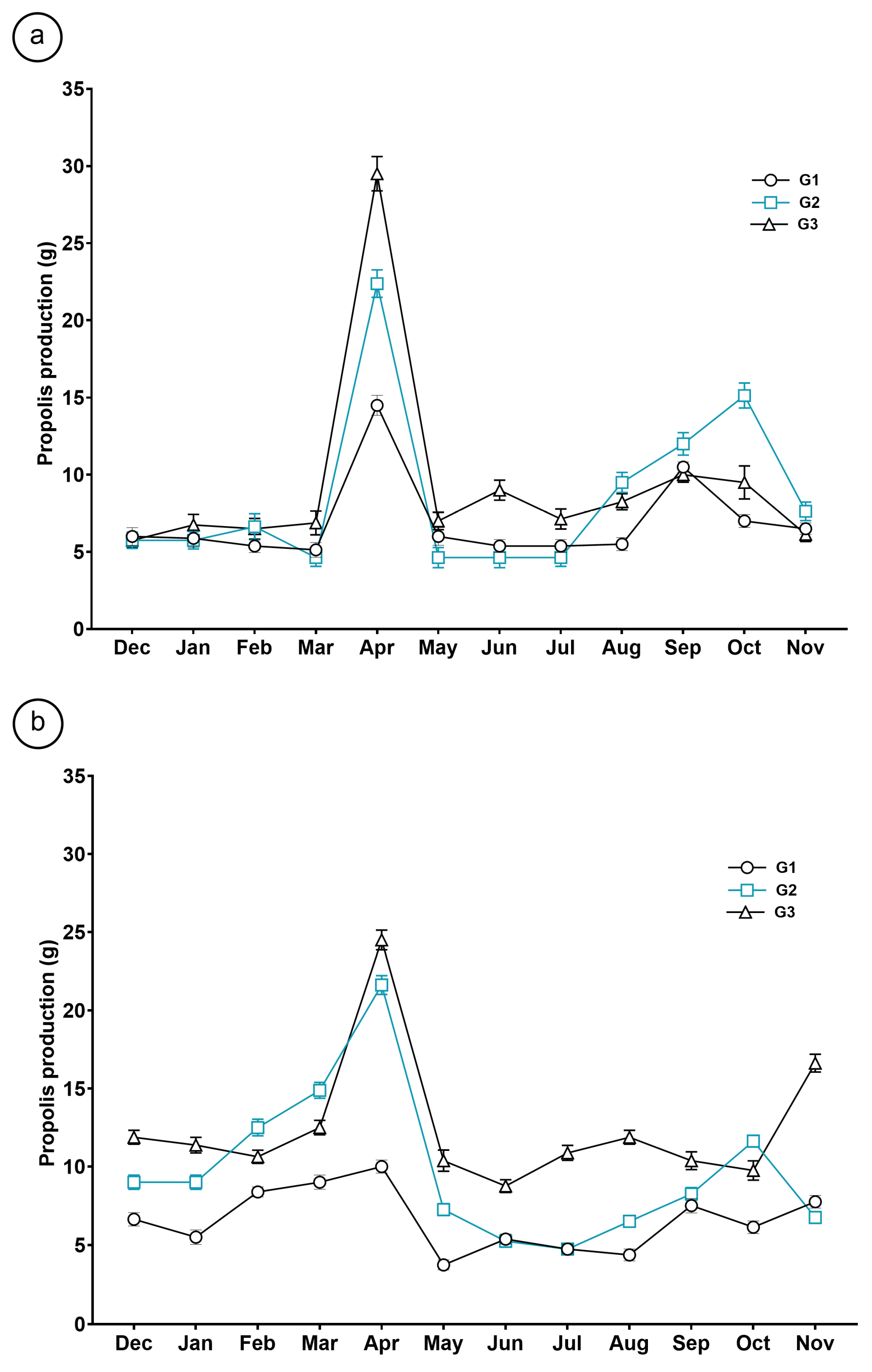
- Method 1: Polyurethane collectors [15]
- ▪
- Group 1 (G1): Black high-density polyurethane slotted grid collector (slots measuring 2.0 mm × 35.0 mm; 2.0-mm-thick crossbars).
- ▪
- Group 2 (G2): Beige high-density polyurethane slotted grid collector (slots measuring 2.0 mm × 35.0 mm; 2.0-mm-thick crossbars).
- Method 2: Flexible mosquito net [15]
- ▪
- Group 3 (G3): Flexible thermoformed polyethylene mesh (openings measuring 1.0 mm × 1.0 mm; 0.5-mm-diameter filament).
2.3. Propolis Harvesting and Palynological Analysis
2.4. Statistical Analysis
- Yijkl represents the harvested propolis weight (g);
- μ is the overall intercept;
- Mi is the fixed effect of the harvesting method (i = G1, G2, G3);
- Aj is the fixed effect of the apiary (j = P-25, CEA);
- Sk is the fixed effect of the season (k = dry, rainy);
- Tl is the fixed effect of sampling month (l = 1, …, 12);
- (M × S)ik and (M × A)ij are the fixed interaction terms;
- uj(m) is the random intercept of colony m nested within apiary j;
- εijkl is the residual error.
3. Results
3.1. Palynological Spectrum and Phenological Calendar
3.2. Propolis Biomass Yield and Collector Performance
3.3. Phenological Synchronization
3.4. Precipitation Dynamics and Correlation
4. Discussion
5. Conclusions
Author Contributions
Funding
Data Availability Statement
Acknowledgments
Conflicts of Interest
References
- Alcivar-Saldaña, J.J.; Rodriguez-Monroy, M.A.; Canales-Martinez, M.M. Current Knowledge of the Melliferous Florae in Mexico Using Methodologies to Understand Bee–Plant–Human Interactions. Appl. Sci. 2023, 13, 8591. [Google Scholar] [CrossRef] [Scilit]
- Alcivar-Saldaña, J.J.; Rodriguez-Monroy, M.A.; Carrillo-Miranda, L.; Canales-Martinez, M.M. Botanical Origin and Biological Properties of Honey and Propolis from Cuautitlán, State of Mexico, Mexico. Antioxidants 2024, 13, 874. [Google Scholar] [CrossRef] [Scilit] [PubMed]
- Simone-Finstrom, M.; Spivak, M. Propolis and bee health: The natural history and significance of resin use by honey bees. Apidologie 2010, 41, 295–311. [Google Scholar] [CrossRef] [Scilit]
- Diaz Gamez, M.A. Evaluation of Three Techniques for Harvesting Propolis in Langstroth-Type Hives in the Municipality of Coatepeque, Department of Quetzaltenango. Ph.D. Thesis, Universidad de San Carlos de Guatemala, Guatemala City, Guatemala, 2011. [Google Scholar]
- Bankova, V. Chemical diversity of propolis and the problem of standardization. J. Ethnopharmacol. 2005, 100, 114–117. [Google Scholar] [CrossRef] [Scilit] [PubMed]
- Bankova, V.S.; de Castro, S.L.; Marcucci, M.C. Propolis: Recent advances in chemistry and plant origin. Apidologie 2000, 31, 3–15. [Google Scholar] [CrossRef] [Scilit]
- Souza, E.A.; Zaluski, R.; Veiga, N.; Orsi, R.O. Effects of seasonal variations and collection methods on the mineral composition of propolis from Apis mellifera Linnaeus beehives. Braz. J. Biol. 2016, 76, 396–401. [Google Scholar] [CrossRef] [Scilit] [PubMed]
- Teixeira, E.W.; Message, D.; Negri, G.; Salatino, A.; Stringheta, P.C. Seasonal Variation, Chemical Composition and Antioxidant Activity of Brazilian Propolis Samples. Evid. Based Complement. Altern. Med. 2010, 7, 307–315. [Google Scholar] [CrossRef] [Scilit] [PubMed]
- Bastos, E.M.; Santana, R.A.; Calaça-Costa, A.G.; Thiago, P.S. Interaction between Apis mellifera L. and Baccharis dracunculifolia DC, that favours green propolis production in Minas Gerais. Braz. J. Biol. 2011, 71, 727–734. [Google Scholar] [CrossRef] [Scilit] [PubMed]
- CONAGUA. Rainy Season and Tropical Cyclones. Government of Mexico. Available online: https://www.gob.mx/conagua/ (accessed on 22 March 2026).
- García, E. Modifications to the Köppen Climate Classification System; Institute of Geography, UNAM: Mexico City, Mexico, 2004. [Google Scholar]
- UNAM. Institutional Development Plan of the Faculty of Higher Studies Cuautitlán; National Autonomous University of Mexico: Mexico City, Mexico, 2022. [Google Scholar]
- INEGI. Digital Map of Mexico V6.1. National Institute of Statistics and Geography. Geography: Aguascalientes, Mexico, 2026. Available online: https://www.inegi.org.mx/temas/mapadigital/ (accessed on 22 March 2026).
- Alcivar-Saldaña, J.J.; Rodriguez-Monroy, M.A.; Aguirre-Gómez, A.; Carrillo-Miranda, L.; Velasco-Bejarano, B.; Canales-Martinez, M.M. Determination of the Botanical Origin and Physicochemical Properties of a Propolis Sample Through an Integrated Methodology. Antioxidants 2024, 13, 1412. [Google Scholar] [CrossRef] [Scilit] [PubMed]
- NOM-003-SAG/GAN-2017; Propolis, Production and Specifications for Processing. Official Journal of the Federation; Secretariat of Agriculture, Livestock, Rural Development, Fisheries and Food: Mexico City, Mexico, 2017.
- Austin, D.F. Ipomoea. In Flora of Ecuador; University of Gothenburg: Gothenburg, Sweden, 1991. [Google Scholar]
- Berg, C.C.; Corner, E.J.H. Moraceae. In Flora Malesiana; National Herbarium Netherlands: Leiden, The Netherlands, 2005. [Google Scholar]
- Brooker, M.I.H.; Kleinig, D.A. Field Guide to Eucalyptus; Bloomings Books: Melbourne, Australia, 2006. [Google Scholar]
- CONABIO. Species Fact Sheets. National Commission for the Knowledge and Use of Biodiversity, Mexico. Available online: http://www.conabio.gob.mx (accessed on 22 March 2026).
- Correll, D.S.; Johnston, M.C. Manual of the Vascular Plants of Texas; Texas Research Foundation: Renner, TX, USA, 1970. [Google Scholar]
- Craven, L.A. New combinations in Melaleuca. Novon 2006, 16, 468–475. [Google Scholar] [CrossRef] [Scilit]
- Espinosa-García, F.J.; Sarukhán, J. Manual of Weeds of the Valley of Mexico; UNAM: Mexico City, Mexico, 1997. [Google Scholar]
- FAO. Traditional Food Plants; Food and Agriculture Organization of the United Nations: Rome, Italy, 1988. [Google Scholar]
- Farjon, A. A Monograph of Cupressaceae and Sciadopitys; Royal Botanic Gardens, Kew: Richmond, UK, 2005. [Google Scholar]
- Flora of Australia Editorial Committee. Flora of Australia; CSIRO Publishing: Melbourne, Australia, 2001; Volume 11A, p. 19. [Google Scholar]
- Flora of China Editorial Committee. Flora of China; Science Press: Beijing, China, 2005; Volume 5, p. 15. [Google Scholar]
- Flora of North America Editorial Committee. Flora of North America North of Mexico; Oxford University Press: New York, NY, USA, 2006; Volume 2–26. [Google Scholar]
- Flora Europaea Editorial Committee. Flora Europaea; Cambridge University Press: Cambridge, UK, 2006; Volume 1–4. [Google Scholar]
- Font Quer, P. Dictionary of Botany; Ediciones Península: Barcelona, Spain, 2001. [Google Scholar]
- Gómez-Campo, C. Biology of Brassica Coenospecies; Elsevier: Amsterdam, The Netherlands, 1999. [Google Scholar]
- Holm, L.G.; Plucknett, D.L.; Pancho, J.V.; Herberger, J.P. The World’s Worst Weeds: Distribution and Biology; University Press of Hawaii: Honolulu, HI, USA, 1977. [Google Scholar]
- Irish, M.; Irish, G. Agaves, Yuccas, and Related Plants: A Gardener’s Guide; Timber Press: Portland, OR, USA, 2000. [Google Scholar]
- Lira-Saade, R. Cucurbitaceae. In Flora del Bajío y de Regiones Adyacentes; Instituto de Ecología A.C.: Pátzcuaro, Mexico, 1995. [Google Scholar]
- Martínez, M. The Medicinal Plants of Mexico; Ediciones Botas: Mexico City, Mexico, 1989. [Google Scholar]
- Moreno, N.P. Illustrated Botanical Glossary; National Institute for Research on Biotic Resources: Xalapa, Mexico, 1984. [Google Scholar]
- Pennington, T.D.; Sarukhán, J. Tropical Trees of Mexico: Manual for the Identification of the Main Species; UNAM: Mexico City, Mexico, 2005. [Google Scholar]
- Raven, P.H.; Evert, R.F.; Eichhorn, S.E. Biology of Plants; W.H. Freeman and Company: New York, NY, USA, 2005. [Google Scholar]
- Rzedowski, J. Vegetation of Mexico; CONABIO: Mexico City, Mexico, 2006. [Google Scholar]
- Rzedowski, J.; Guevara-Féfer, F. Burseraceae. In Flora del Bajío y de Regiones Adyacentes; Instituto de Ecología A.C.: Pátzcuaro, Mexico, 1992. [Google Scholar]
- Rzedowski, J.; Rzedowski, G.C. Phanerogamic Flora of the Valley of Mexico; Instituto de Ecología A.C.: Pátzcuaro, Mexico, 2005. [Google Scholar]
- Stewart-Wade, S.M.; Neumann, S.; Collins, L.L.; Boland, G.J. The biology of Canadian weeds: 117. Taraxacum officinale G.H. Weber ex Wiggers. Can. J. Plant Sci. 2002, 82, 825–853. [Google Scholar] [CrossRef] [Scilit]
- Vibrans, H. (Ed.) Weeds of Mexico; CONABIO: Mexico City, Mexico, 2009. [Google Scholar]
- Wagner, W.L.; Hoch, P.C.; Raven, P.H. Revised classification of the Onagraceae. Syst. Bot. Monogr. 2007, 83, 1–240. [Google Scholar] [CrossRef] [Scilit] [PubMed]
- Barth, O.M. Melissopalynology in Brazil: A review. Sci. Agric. 2004, 61, 342–350. [Google Scholar] [CrossRef] [Scilit]
- Park, Y.K.; Alencar, S.M.; Aguiar, C.L. Botanical Origin and Chemical Composition of Brazilian Propolis. J. Agric. Food Chem. 2002, 50, 2502–2506. [Google Scholar] [CrossRef] [Scilit] [PubMed]
- Bankova, V.; Bertelli, D.; Borba, R.; Conti, B.J.; da Silva Cunha, I.B.; Danert, C.; Eberlin, M.N.; Falcão, S.I.; Isla, M.I.; Nieva Moreno, M.I.; et al. Standard methods for Apis mellifera propolis research. J. Apic. Res. 2019, 58, 1–49. [Google Scholar] [CrossRef] [Scilit]
- Mărghitaş, L.A.; Dezmirean, D.S.; Bobiş, O. Important Developments in Romanian Propolis Research. Evid. Based Complement. Altern. Med. 2013, 159392. [Google Scholar] [CrossRef] [Scilit] [PubMed]
- Borba, R.S.; Klyczek, K.K.; Mogen, K.L.; Spivak, M. Seasonal benefits of a natural propolis envelope to honey bee immunity and colony health. J. Exp. Biol. 2015, 218, 3689–3699. [Google Scholar] [CrossRef] [Scilit] [PubMed]
- Seeley, T.D. The Wisdom of the Hive: The Social Physiology of Honey Bee Colonies; Harvard University Press: Cambridge, MA, USA, 2009. [Google Scholar]
- Ghisalberti, E.L. Propolis: A Review. Bee World 1979, 60, 59–84. [Google Scholar] [CrossRef] [Scilit]
- Ribeiro Pereira, G.C.O.; Barchuk, A.R.; do Valle Teixeira, I.R. Environmental factors influencing propolis production by the honey bee Apis mellifera in Minas Gerais state, Brazil. J. Apic. Res. 2009, 48, 176–180. [Google Scholar] [CrossRef] [Scilit]
- Sforcin, J.M. Propolis and the immune system: A review. J. Ethnopharmacol. 2007, 113, 1–14. [Google Scholar] [CrossRef] [Scilit] [PubMed]

| Calendar of Phenological Cycles of the Propolis-Producing Vegetation | |||||||||||||||||||||||||||
|---|---|---|---|---|---|---|---|---|---|---|---|---|---|---|---|---|---|---|---|---|---|---|---|---|---|---|---|
| Family | Genus | Species | Type | Dry Season | Rainy Season | ||||||||||||||||||||||
| D | J | F | M | A | M | J | J | A | S | O | N | ||||||||||||||||
| Altingiaceae | Liquidambar | Liquidambar styraciflua var. mexicana (Oerst.) J.L.Thomas | Deciduous tree | ||||||||||||||||||||||||
| Amaranthaceae | Amaranthus | Amaranthus hybridus L. | Annual herb | ||||||||||||||||||||||||
| Anacardiaceae | Schinus | Schinus molle L. | Evergreen tree | ||||||||||||||||||||||||
| Asparagaceae | Yucca | Yucca elephantipes Regel | Evergreen shrub | ||||||||||||||||||||||||
| Asteraceae | Baccharis | Baccharis salicina Torr. & A. Gray | Evergreen shrub | ||||||||||||||||||||||||
| Bidens | Bidens aurea (Aiton) Sherff | Rhizomatous perennial herb | |||||||||||||||||||||||||
| Bidens odorata Cav. | Annual herb | ||||||||||||||||||||||||||
| Bidens pilosa L. | Annual herb | ||||||||||||||||||||||||||
| Galinsoga | Galinsoga parviflora Cav. | Annual herb | |||||||||||||||||||||||||
| Helminthotheca | Helminthotheca echioides (L.) Holub | Annual/Biennial herb | |||||||||||||||||||||||||
| Simsia | Simsia amplexicaulis (Cav.) Pers. | Perennial herb | |||||||||||||||||||||||||
| Taraxacum | Taraxacum campylodes G.E.Haglund | Perennial herb | |||||||||||||||||||||||||
| Tithonia | Tithonia tubaeformis (Jacq.) Cass. | Perennial shrub/Robust perennial herb | |||||||||||||||||||||||||
| Viguiera | Viguiera excelsa (Willd.) Benth. & Hook.f. | Perennial shrub | |||||||||||||||||||||||||
| Brassicaceae | Brassica | Brassica rapa L. | Annual/Biennial herb | ||||||||||||||||||||||||
| Raphanus | Raphanus raphanistrum L. | Annual herb | |||||||||||||||||||||||||
| Sisymbrium | Sisymbrium irio L. | Annual herb | |||||||||||||||||||||||||
| Burseraceae | Bursera | Deciduous shrub | |||||||||||||||||||||||||
| Convolvulaceae | Ipomoea | Ipomoea purpurea (L.) Roth | Annual climber (vine) | ||||||||||||||||||||||||
| Cucurbitaceae | Sicyos | Sicyos deppei G.Don | Annual climber (vine) | ||||||||||||||||||||||||
| Cupressaceae | Cupressus | Cupressus lusitanica Mill. | Evergreen tree | ||||||||||||||||||||||||
| Euphorbiaceae | Ricinus | Ricinus communis L. | Perennial shrub | ||||||||||||||||||||||||
| Fabaceae | Acacia | Acacia retinodes Schltdl. | Evergreen tree | ||||||||||||||||||||||||
| Malvaceae | Sphaeralcea | Sphaeralcea angustifolia (Cav.) G.Don | Perennial herb/Subshrub | ||||||||||||||||||||||||
| Moraceae | Ficus | Ficus retusa L. | Evergreen tree | ||||||||||||||||||||||||
| Myrtaceae | Eucalyptus | Eucalyptus globulus Labill. | Evergreen tree | ||||||||||||||||||||||||
| Melaleuca | Melaleuca citrina (Curtis) Dum.Cours. | Evergreen tree/Shrub | |||||||||||||||||||||||||
| Oleaceae | Fraxinus | Fraxinus uhdei (Wenz.) Lingelsh. | Evergreen/Semi-deciduous tree | ||||||||||||||||||||||||
| Ligustrum | Ligustrum japonicum Thunb. | Evergreen shrub | |||||||||||||||||||||||||
| Onagraceae | Oenothera | Oenothera elata Kunth | Biennial/Perennial herb | ||||||||||||||||||||||||
| Oenothera rosea L’Hér. ex Aiton | Perennial herb | ||||||||||||||||||||||||||
| Pinaceae | Pinus | Evergreen tree | |||||||||||||||||||||||||
| Poaceae | Zea | Zea mays L. | Annual herb | ||||||||||||||||||||||||
| Polemoniaceae | Loeselia | Loeselia mexicana (Lam.) Brand | Herb/Subshrub | ||||||||||||||||||||||||
| Polygonaceae | Persicaria | Persicaria hydropiperoides (Michx.) Small | Perennial herb | ||||||||||||||||||||||||
| Persicaria lapathifolia (L.) Delarbre | Annual herb | ||||||||||||||||||||||||||
| Resedaceae | Reseda | Reseda luteola L. | Biennial herb | ||||||||||||||||||||||||
| Rosa | Rosa canina L. | Deciduous shrub | |||||||||||||||||||||||||
| Salicaceae | Populus | Deciduous tree | |||||||||||||||||||||||||
| Solanaceae | Jaltomata | Jaltomata procumbens (Cav.) J.L.Gentry | Perennial herb | ||||||||||||||||||||||||
| Nicotiana | Nicotiana glauca Graham | Evergreen shrub | |||||||||||||||||||||||||
| Solanum | Solanum elaeagnifolium Cav. | Rhizomatous perennial herb | |||||||||||||||||||||||||
 | |||||||||||||||||||||||||||
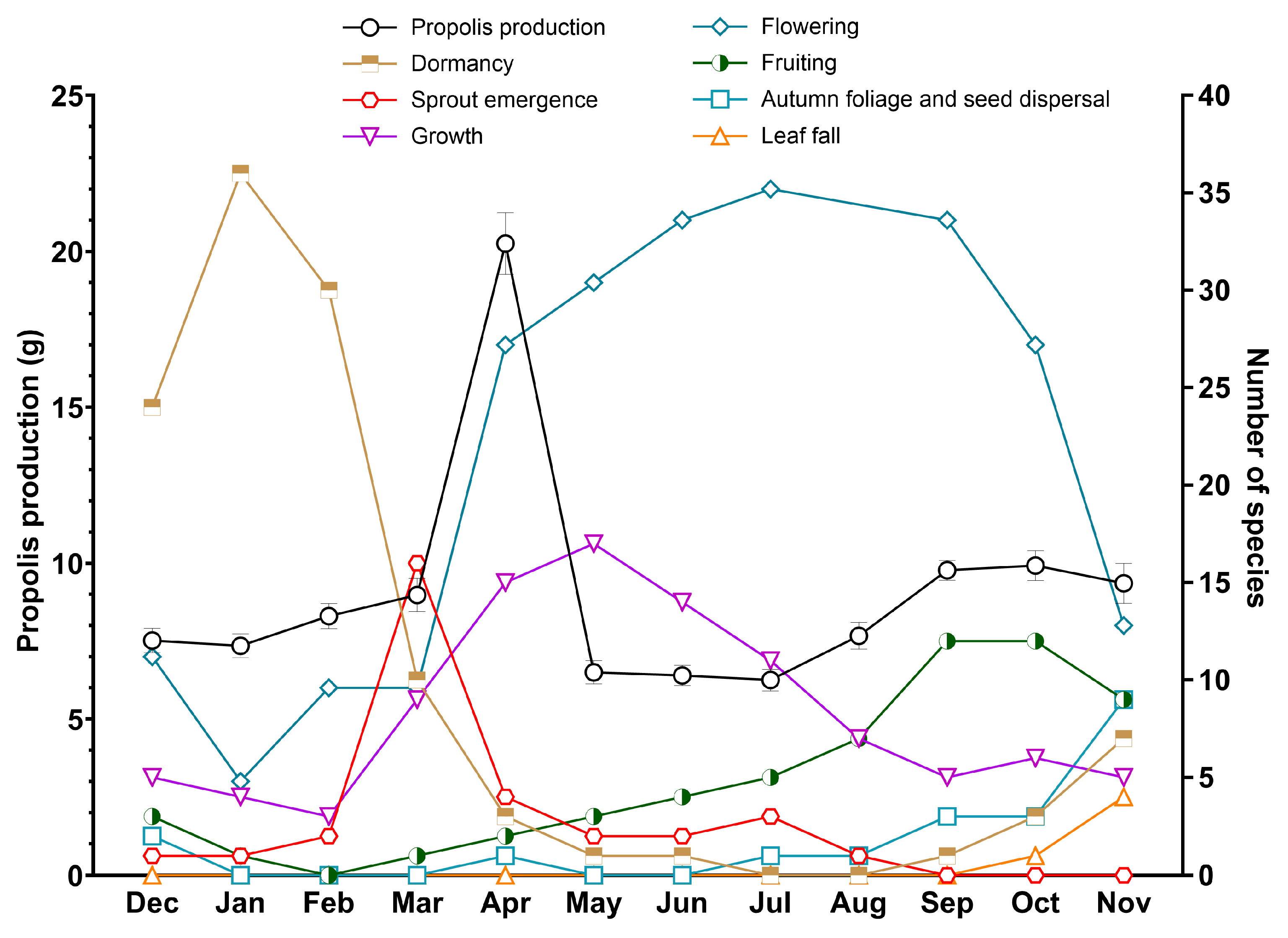
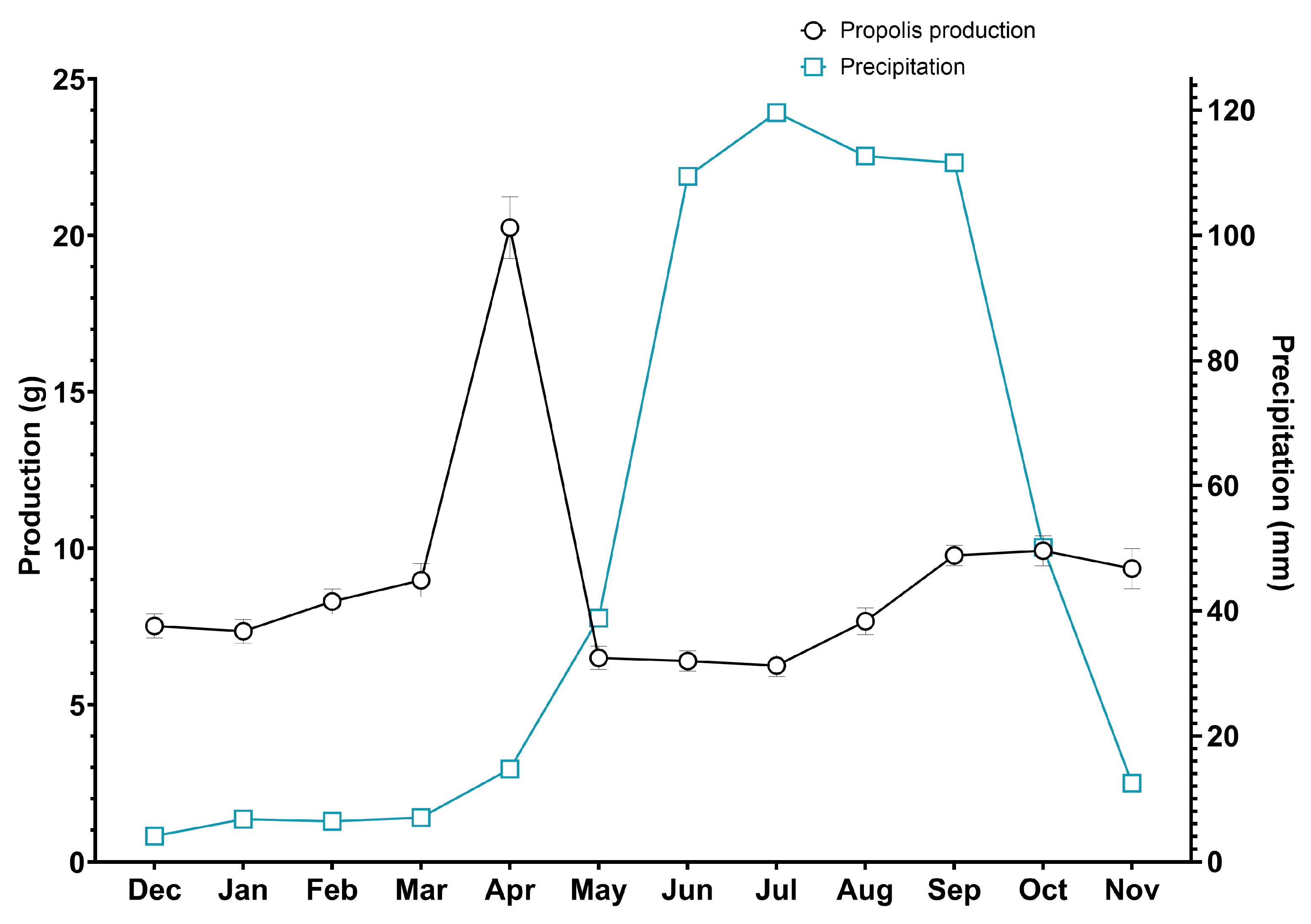
| Monthly Propolis Yield | ||||||
|---|---|---|---|---|---|---|
| Month | Monthly Mean (g) | SE (±) | Month Effect | Mean Precipitation (mm) | Dominant Phenological Phase | Biological Behavior of the Colony |
| DEC | 7.52 | 0.78 | −1.5 | 4 | Vegetative dormancy | Reduced foraging and winter cluster formation [1,2] |
| JAN | 7.35 | 0.69 | −1.67 | 6.5 | Vegetative dormancy | Passive thermal maintenance of the brood nest [1,2] |
| FEB | 8.3 | 0.74 | −0.72 | 6.2 | Swollen buds/Transition | Initiation of spring orientation/scouting flights |
| MAR | 8.98 | 0.81 | −0.04 | 7 | Shoot emergence | Sanitization and conditioning of the brood area [1,2] |
| APR | 20.25 | 1.85 | 11.23 | 14.5 | Massive vegetative bud burst | Primary peak: Intensive resin foraging on buds [1,2] |
| MAY | 6.5 | 0.58 | −2.52 | 37 | Onset of mass flowering | Foraging shift to nectar/pollen (opportunity cost) [1,2] |
| JUN | 6.4 | 0.52 | −2.62 | 105 | Peak flowering/Wet season | Rainfall flight restriction; nutritional prioritization [1,2] |
| JUL | 6.25 | 0.54 | −2.77 | 115 | Fruiting/Peak rainfall | Resin dilution and exudate wash-off [1,2] |
| AUG | 7.67 | 0.68 | −1.35 | 108 | Late fruiting | Gradual resumption of bark resin collection [1,2] |
| SEP | 9.77 | 0.61 | 0.75 | 107 | Early defoliation | Foraging on deciduous trees; draft sealing [1,2] |
| OCT | 9.92 | 0.73 | 0.9 | 49 | Leaf senescence/Seed set | Secondary peak: Social immune envelope expansion [1,2] |
| NOV | 9.35 | 0.95 | 0.33 | 12 | Dormancy/Flowering cessation | Final hive entrance draft sealing and nest architecture [1,2] |
Disclaimer/Publisher’s Note: The statements, opinions and data contained in all publications are solely those of the individual author(s) and contributor(s) and not of MDPI and/or the editor(s). MDPI and/or the editor(s) disclaim responsibility for any injury to people or property resulting from any ideas, methods, instructions or products referred to in the content. |
© 2026 by the authors. Licensee MDPI, Basel, Switzerland. This article is an open access article distributed under the terms and conditions of the Creative Commons Attribution (CC BY) license.
Share and Cite
Alcivar-Saldaña, J.J.; Rodriguez-Monroy, M.A.; Corona-Gómez, L.; Díaz-Sánchez, V.M.; González-Toimil, M.A.; Garcia-Cedillo, N.; Canales-Martinez, M.M. Seasonal Dynamics, Botanical Origin, and Yield of Apis mellifera Propolis in the Mexican Altiplano: Influence of Precipitation, Phenology, and Harvesting Methods. Insects 2026, 17, 1013. https://doi.org/10.3390/insects17101013
Alcivar-Saldaña JJ, Rodriguez-Monroy MA, Corona-Gómez L, Díaz-Sánchez VM, González-Toimil MA, Garcia-Cedillo N, Canales-Martinez MM. Seasonal Dynamics, Botanical Origin, and Yield of Apis mellifera Propolis in the Mexican Altiplano: Influence of Precipitation, Phenology, and Harvesting Methods. Insects. 2026; 17(10):1013. https://doi.org/10.3390/insects17101013
Chicago/Turabian StyleAlcivar-Saldaña, Jose Juan, Marco Aurelio Rodriguez-Monroy, Lysett Corona-Gómez, Víctor Manuel Díaz-Sánchez, Manuel Andrés González-Toimil, Noe Garcia-Cedillo, and Maria Margarita Canales-Martinez. 2026. "Seasonal Dynamics, Botanical Origin, and Yield of Apis mellifera Propolis in the Mexican Altiplano: Influence of Precipitation, Phenology, and Harvesting Methods" Insects 17, no. 10: 1013. https://doi.org/10.3390/insects17101013
APA StyleAlcivar-Saldaña, J. J., Rodriguez-Monroy, M. A., Corona-Gómez, L., Díaz-Sánchez, V. M., González-Toimil, M. A., Garcia-Cedillo, N., & Canales-Martinez, M. M. (2026). Seasonal Dynamics, Botanical Origin, and Yield of Apis mellifera Propolis in the Mexican Altiplano: Influence of Precipitation, Phenology, and Harvesting Methods. Insects, 17(10), 1013. https://doi.org/10.3390/insects17101013