Caste-Dependent Interspecific Tolerance Permits Alien Reproductives to Reproduce Within Host Colonies in Reticulitermes Termites Under Laboratory Conditions


Simple Summary
Abstract
1. Introduction
2. Materials and Methods
2.1. Termite Collection and Species Identification
2.2. Experimental Setup and Neotenic Differentiation
2.3. Interspecific Introduction Assays
2.4. Behavioral Observations and Survival Monitoring
2.5. Reproductive Assessment and Parentage Verification
2.6. Statistical Analysis
3. Results
3.1. Caste-Dependent Aggression and Survival of Introduced Termites
3.2. Behavioral Integration and Social Care Toward Alien Reproductives
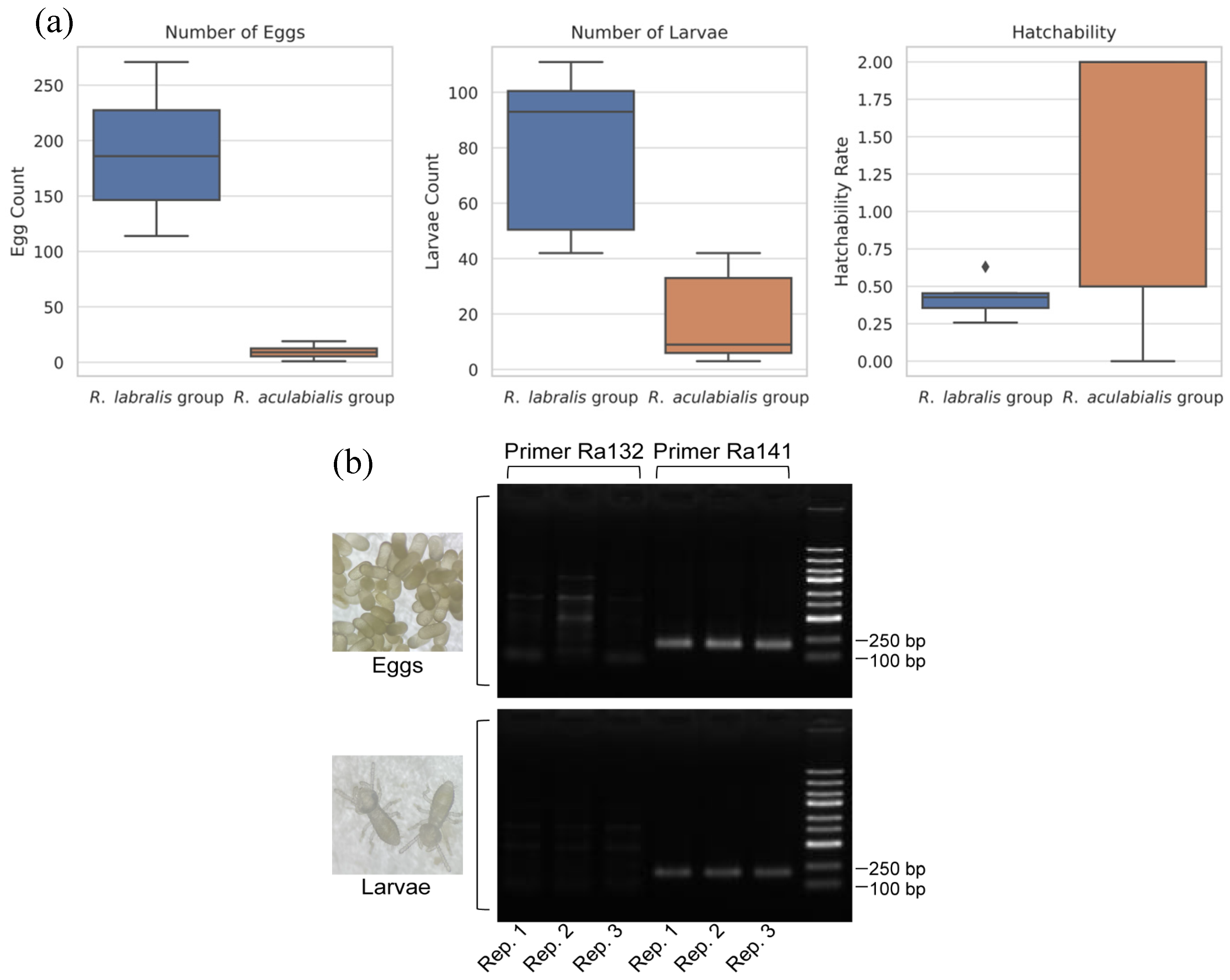
3.3. Reproductive Success and Parentage Verification of the Brood
4. Discussion
5. Conclusions
Supplementary Materials
Author Contributions
Funding
Data Availability Statement
Acknowledgments
Conflicts of Interest
References
- Clément, J.-L.; Bagnères, A.-G. Nestmate recognition in termites. In Pheromone Communication in Social Insects; CRC Press: Boca Raton, FL, USA, 2019; pp. 126–155. [Google Scholar]
- van Zweden, J.S.; d’Ettorre, P. Nestmate recognition in social insects and the role of hydrocarbons. In Insect Hydrocarbons: Biology, Biochemistry and Chemical Ecology; Cambridge University Press: Cambridge, UK, 2010; Volume 11, pp. 222–243. [Google Scholar]
- Thorne, B.; Haverty, M. Review of inter colony, intraspecific, and interspecific agonism in termites. Sociobiology 1991, 19, 115–145. [Google Scholar]
- Kaib, M.; Jmhasly, P.; Wilfert, L.; Durka, W.; Franke, S.; Francke, W.; Leuthold, R.H.; Brandl, R. Cuticular hydrocarbons and aggression in the termite Macrotermes subhyalinus. J. Chem. Ecol. 2004, 30, 365–385. [Google Scholar] [CrossRef] [Scilit]
- Eggleton, P. An introduction to termites: Biology, taxonomy and functional morphology. In Biology of Termites: A Modern Synthesis; Springer: Berlin/Heidelberg, Germany, 2010; pp. 1–26. [Google Scholar]
- Deheer, C.J.; Vargo, E.L. Strong mitochondrial DNA similarity but low relatedness at microsatellite loci among families within fused colonies of the termite Reticulitermes flavipes. Insectes Sociaux 2008, 55, 190–199. [Google Scholar] [CrossRef] [Scilit]
- Cristaldo, P.F.; DeSouza, O.; Krasulova, J.; Jirošová, A.; Kutalová, K.; Lima, E.R.; Šobotník, J.; Sillam-Dusses, D. Mutual use of trail-following chemical cues by a termite host and its inquiline. PLoS ONE 2014, 9, e85315. [Google Scholar] [CrossRef] [Scilit] [PubMed]
- Perdereau, E.; Bagnères, A.-G.; Dupont, S.; Dedeine, F. High occurrence of colony fusion in a European population of the American termite Reticulitermes flavipes. Insectes Sociaux 2010, 57, 393–402. [Google Scholar] [CrossRef] [Scilit]
- Rabeling, C. Social parasitism. In Encyclopedia of Social Insects; Springer International Publishing: Cham, Switzerland, 2021; pp. 836–858. [Google Scholar]
- Lenoir, A.; d’Ettorre, P.; Errard, C.; Hefetz, A. Chemical ecology and social parasitism in ants. Annu. Rev. Entomol. 2001, 46, 573–599. [Google Scholar] [CrossRef] [Scilit] [PubMed]
- Borowiec, M.L.; Cover, S.P.; Rabeling, C. The evolution of social parasitism in Formica ants revealed by a global phylogeny. Proc. Natl. Acad. Sci. USA 2021, 118, e2026029118. [Google Scholar] [CrossRef] [Scilit] [PubMed]
- Helanterä, H. Pathways to parasitic strategies in ants. Proc. Natl. Acad. Sci. USA 2021, 118, e2115607118. [Google Scholar] [CrossRef] [Scilit]
- Korb, J. Termites. Curr. Biol. 2007, 17, R995–R999. [Google Scholar] [CrossRef] [Scilit]
- Howard, K.J.; Thorne, B.L. Eusocial evolution in termites and Hymenoptera. In Biology of Termites: A Modern Synthesis; Springer: Berlin/Heidelberg, Germany, 2010; pp. 97–132. [Google Scholar]
- Emery, C. Uber den Ursprung der dulotischen, parasitischen und myrekophilen Ameisen. Biol. Cent. 1909, 29, 352–362. [Google Scholar]
- Lowe, R.M.; Ward, S.A.; Crozier, R.H. The evolution of parasites from their hosts: Intra–and interspecific parasitism and Emery’s rule. Proc. R. Soc. Lond. Ser. B Biol. Sci. 2002, 269, 1301–1305. [Google Scholar] [CrossRef] [Scilit]
- Mitaka, Y.; Akino, T. A review of termite pheromones: Multifaceted, context-dependent, and rational chemical communications. Front. Ecol. Evol. 2021, 8, 595614. [Google Scholar] [CrossRef] [Scilit]
- Funaro, C.F.; Böröczky, K.; Vargo, E.L.; Schal, C. Identification of a queen and king recognition pheromone in the subterranean termite Reticulitermes flavipes. Proc. Natl. Acad. Sci. USA 2018, 115, 3888–3893. [Google Scholar] [CrossRef] [Scilit]
- Vargo, E.; Henderson, G. Identification of polymorphic microsatellite loci in the Formosan subterranean termite Coptotermes formosanus Shiraki. Mol. Ecol. 2000, 9, 1935–1938. [Google Scholar] [CrossRef] [Scilit]
- Dang, Y.-L.; Zhang, H.-G.; Meng, Y.-F.; Zhang, M.; Zhao, S.; You, P.; Su, X.-H.; Xing, L.-X. Isolation and characterization of polymorphic microsatellite markers for two Subterranean termites. Sociobiology 2017, 64, 352–355. [Google Scholar] [CrossRef] [Scilit]
- Liebig, J.; Eliyahu, D.; Brent, C.S. Cuticular hydrocarbon profiles indicate reproductive status in the termite Zootermopsis nevadensis. Behav. Ecol. Sociobiol. 2009, 63, 1799–1807. [Google Scholar] [CrossRef] [Scilit]
- Funaro, C.F.; Schal, C.; Vargo, E.L. Queen and king recognition in the subterranean termite, Reticulitermes flavipes: Evidence for royal recognition pheromones. PLoS ONE 2019, 14, e0209810. [Google Scholar] [CrossRef] [Scilit]
- Dettner, K.; Liepert, C. Chemical mimicry and camouflage. Annu. Rev. Entomol. 1994, 39, 129–154. [Google Scholar] [CrossRef]
- Brandt, M.; Foitzik, S.; Fischer-Blass, B.; Heinze, J. The coevolutionary dynamics of obligate ant social parasite systems–between prudence and antagonism. Biol. Rev. 2005, 80, 251–267. [Google Scholar] [CrossRef] [Scilit]
- Jirošová, A.; Sillam-Dussès, D.; Kyjaková, P.; Kalinová, B.; Dolejšová, K.; Jančařík, A.; Majer, P.; Cristaldo, P.F.; Hanus, R. Smells like home: Chemically mediated co-habitation of two termite species in a single nest. J. Chem. Ecol. 2016, 42, 1070–1081. [Google Scholar] [CrossRef] [Scilit] [PubMed]
- Cervo, R. Polistes wasps and their social parasites: An overview. Ann. Zool. Fenn. 2006, 43, 531–549. [Google Scholar]
- Konrad, M.; Pull, C.D.; Metzler, S.; Seif, K.; Naderlinger, E.; Grasse, A.V.; Cremer, S. Ants avoid superinfections by performing risk-adjusted sanitary care. Proc. Natl. Acad. Sci. USA 2018, 115, 2782–2787. [Google Scholar] [CrossRef] [Scilit]
- Liu, L.; Wang, W.; Liu, Y.; Sun, P.; Lei, C.; Huang, Q. The influence of allogrooming behavior on individual innate immunity in the subterranean termite Reticulitermes chinensis (Isoptera: Rhinotermitidae). J. Insect Sci. 2019, 19, 6. [Google Scholar] [CrossRef] [Scilit] [PubMed]
- Huang, Q.Y.; Wang, W.P.; Mo, R.Y.; Lei, C.L. Studies on feeding and trophallaxis in the subterranean termite Odontotermes formosanus using rubidium chloride. Entomol. Exp. Appl. 2008, 129, 210–215. [Google Scholar] [CrossRef] [Scilit]
- Johnson, B.R.; van Wilgenburg, E.; Tsutsui, N.D. Nestmate recognition in social insects: Overcoming physiological constraints with collective decision making. Behav. Ecol. Sociobiol. 2011, 65, 935–944. [Google Scholar] [CrossRef] [Scilit]
- Schmid-Hempel, P. Parasites and their social hosts. Trends Parasitol. 2017, 33, 453–462. [Google Scholar] [CrossRef] [Scilit]
- Clemente, L.O. Termite Inquilinism: Proximate Mechanisms Mediating Coexistence; Universidade Federal de Viçosa: Viçosa, Brazil, 2023. [Google Scholar]
- Buschinger, A. Evolution of social parasitism in ants. Trends Ecol. Evol. 1986, 1, 155–160. [Google Scholar] [CrossRef] [Scilit]
- Iwai, H.; Kurihara, Y.; Kono, N.; Tomita, M.; Arakawa, K. The evidence of temporary social parasitism by Polyrhachis lamellidens (Hymenoptera, Formicidae) in a Camponotus obscuripes colony (Hymenoptera, Formicidae). Insectes Sociaux 2021, 68, 375–382. [Google Scholar] [CrossRef] [Scilit]
- Degueldre, F.; Mardulyn, P.; Kuhn, A.; Pinel, A.; Karaman, C.; Lebas, C.; Schifani, E.; Bračko, G.; Wagner, H.C.; Kiran, K. Evolutionary history of inquiline social parasitism in Plagiolepis ants. Mol. Phylogenetics Evol. 2021, 155, 107016. [Google Scholar] [CrossRef] [Scilit]
- Wcislo, W.T. Behavioral environments and evolutionary change. Annu. Rev. Ecol. Syst. 1989, 20, 137–169. [Google Scholar] [CrossRef]
- Dronnet, S.; Bagnères, A.G.; Juba, T.R.; Vargo, E.L. Polymorphic microsatellite loci in the European subterranean termite, Reticulitermes santonensis Feytaud. Mol. Ecol. Notes 2004, 4, 127–129. [Google Scholar] [CrossRef] [Scilit]
- Miura, T.; Roisin, Y.; Matsumoto, T. Molecular phylogeny and biogeography of the nasute termite genus Nasutitermes (Isoptera: Termitidae) in the Pacific tropics. Mol. Phylogenetics Evol. 2000, 17, 1–10. [Google Scholar] [CrossRef] [Scilit] [PubMed]
- Simon, C.; Frati, F.; Beckenbach, A.; Crespi, B.; Liu, H.; Flook, P. Evolution, weighting, and phylogenetic utility of mitochondrial gene sequences and a compilation of conserved polymerase chain reaction primers. Ann. Entomol. Soc. Am. 1994, 87, 651–701. [Google Scholar] [CrossRef] [Scilit]


Disclaimer/Publisher’s Note: The statements, opinions and data contained in all publications are solely those of the individual author(s) and contributor(s) and not of MDPI and/or the editor(s). MDPI and/or the editor(s) disclaim responsibility for any injury to people or property resulting from any ideas, methods, instructions or products referred to in the content. |
© 2026 by the authors. Licensee MDPI, Basel, Switzerland. This article is an open access article distributed under the terms and conditions of the Creative Commons Attribution (CC BY) license.
Share and Cite
Bai, Z.-D.; Dong, Y.-N.; Sillam-Dussès, D.; Wang, R.-W. Caste-Dependent Interspecific Tolerance Permits Alien Reproductives to Reproduce Within Host Colonies in Reticulitermes Termites Under Laboratory Conditions. Insects 2026, 17, 76. https://doi.org/10.3390/insects17010076
Bai Z-D, Dong Y-N, Sillam-Dussès D, Wang R-W. Caste-Dependent Interspecific Tolerance Permits Alien Reproductives to Reproduce Within Host Colonies in Reticulitermes Termites Under Laboratory Conditions. Insects. 2026; 17(1):76. https://doi.org/10.3390/insects17010076
Chicago/Turabian StyleBai, Zhuang-Dong, Ya-Nan Dong, David Sillam-Dussès, and Rui-Wu Wang. 2026. "Caste-Dependent Interspecific Tolerance Permits Alien Reproductives to Reproduce Within Host Colonies in Reticulitermes Termites Under Laboratory Conditions" Insects 17, no. 1: 76. https://doi.org/10.3390/insects17010076
APA StyleBai, Z.-D., Dong, Y.-N., Sillam-Dussès, D., & Wang, R.-W. (2026). Caste-Dependent Interspecific Tolerance Permits Alien Reproductives to Reproduce Within Host Colonies in Reticulitermes Termites Under Laboratory Conditions. Insects, 17(1), 76. https://doi.org/10.3390/insects17010076