Impact of Integrated Control Interventions on Sandfly Populations in Human and Canine Visceral Leishmaniasis Control in Araçatuba, State of São Paulo, Brazil

 , ,
, ,
Simple Summary
Abstract
1. Introduction
2. Materials and Methods
2.1. Ethical Statement
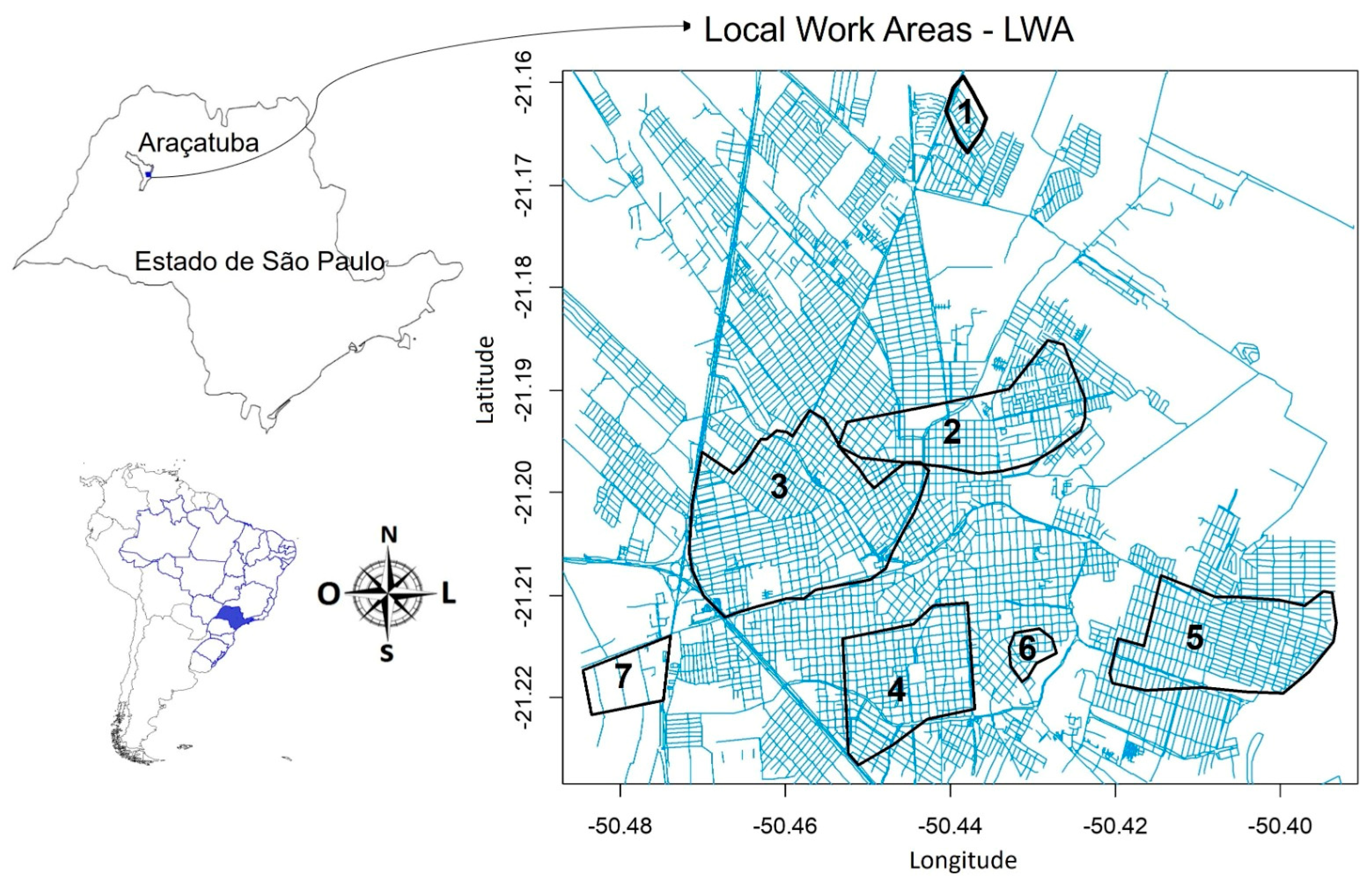
2.2. Study Area
2.3. Intervention Strategy
2.4. Educational Action
2.5. Environmental Management
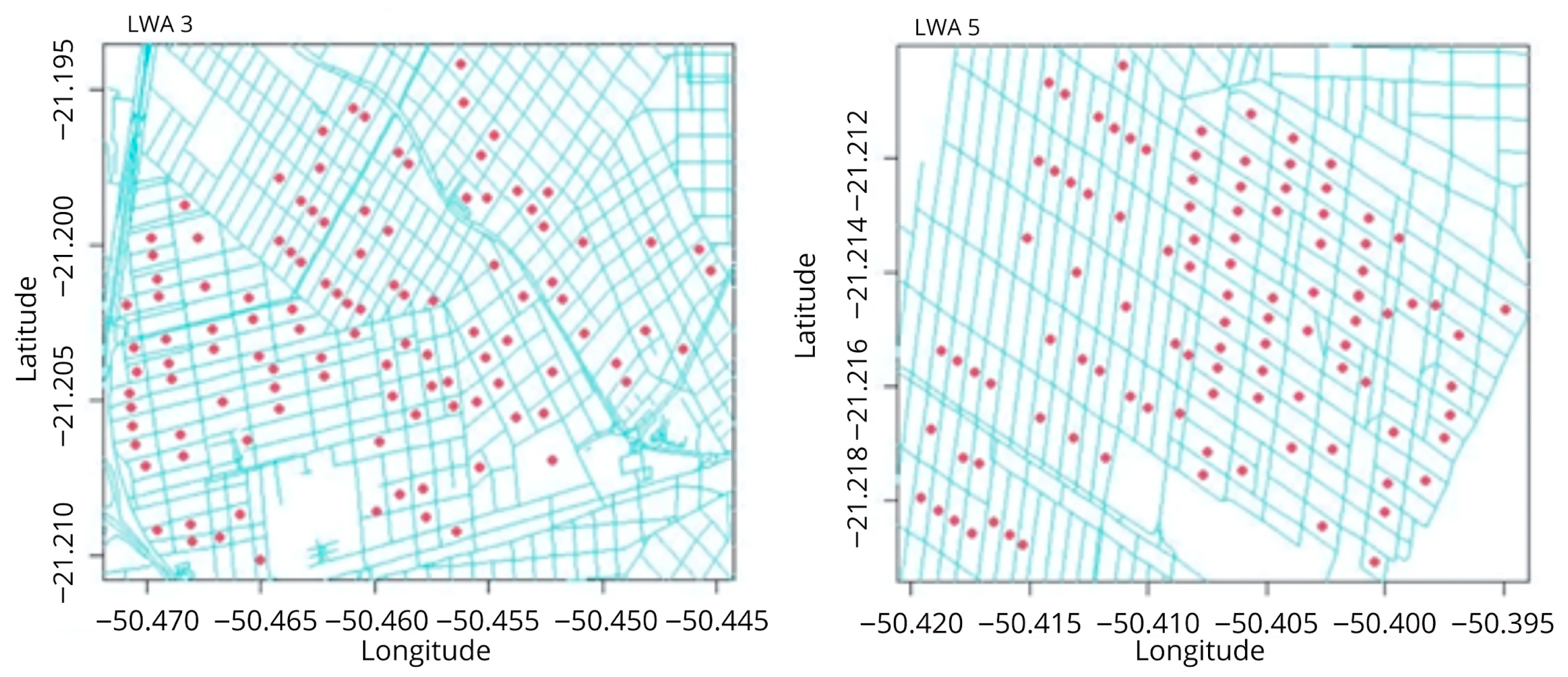
2.6. Entomological Survey
2.7. Canine Epidemiological Survey
2.8. Statistical Analysis
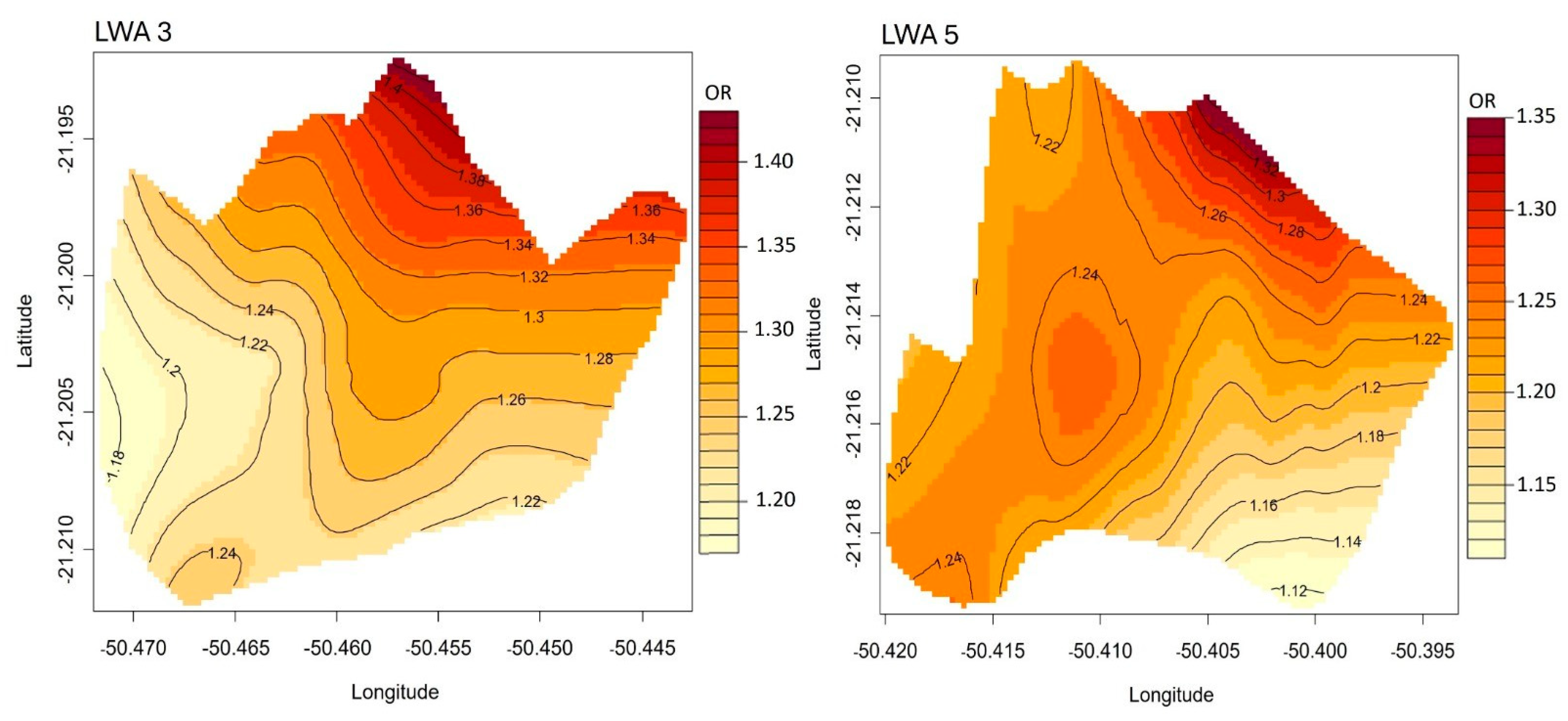
3. Results
4. Discussion
5. Conclusions
Author Contributions
Funding
Data Availability Statement
Acknowledgments
Conflicts of Interest
References
- Akhoundi, M.; Kuhls, K.; Cannet, A.; Votýpka, J.; Marty, P.; Delaunay, P.; Sereno, D. A Historical Overview of the Classification, Evolution, and Dispersion of Leishmania Parasites and Sandflies. PLoS Neglected Trop. Dis. 2016, 10, e0004349. [Google Scholar] [CrossRef]
- Montalvo, A.M.; Alba, A.; Fraga, J.; Marzoa, A.; Torres, C.; Muskus, C. Improving the sensitivity of an hsp20-based PCR for genus detection of Leishmania parasites in cutaneous clinical samples: A proof of concept. Parasitol. Res. 2020, 119, 345–349. [Google Scholar] [CrossRef] [PubMed]
- Schwabl, P.; Boité, M.C.; Bussotti, G.; Jacobs, A.; Andersson, B.; Moreira, O.; Freitas-Mesquita, A.L.; Meyer-Fernandes, J.R.; Telleria, E.L.; Traub-Csekö, Y.; et al. Colonization and genetic diversification processes of Leishmania infantum in the Americas. Commun. Biol. 2021, 4, 139. [Google Scholar] [CrossRef]
- WHO. Leishmaniasis. World Health Organization: Internet. 2021. Available online: https://www.who.int/publications/i/item/who-wer9745-575-590 (accessed on 23 July 2024).
- Maia, C.; Cristóvão, J.; Pereira, A.; Kostalova, T.; Lestinova, T.; Sumova, P.; Volf, P.; Campino, L. Monitoring Leishmania infection and exposure to Phlebotomus perniciosus using minimal and non-invasive canine samples. Parasites Vectors 2020, 13, 119. [Google Scholar] [CrossRef] [PubMed]
- Baneth, G.; Koutinas, A.F.; Solano-Gallego, L.; Bourdeau, P.; Ferrer, L. Canine leishmaniosis—New concepts and insights on an expanding zoonosis: Part one. Trends Parasitol. 2008, 24, 324–330. [Google Scholar] [CrossRef] [PubMed]
- Martín-Sánchez, J.; Rodríguez-Granger, J.; Morillas-Márquez, F.; Merino-Espinosa, G.; Sampedro, A.; Aliaga, L.; Corpas-López, V.; Tercedor-Sánchez, J.; Aneiros-Fernández, J.; Acedo-Sánchez, C.; et al. Leishmaniasis due to Leishmania infantum: Integration of human, animal and environmental data through a One Health approach. Transbound. Emerg. Dis. 2020, 67, 2423–2434. [Google Scholar] [CrossRef]
- Alves, G.B.; de Oliveira, T.C.B.; Rodas, L.C.; Rozza, D.B.; Nakamura, A.A.; Ferrari, E.D.; da Silva, D.R.R.; Santos, G.M.D.; Calemes, E.B.; Requena, K.A.M.L.; et al. Efficacy of imidacloprid/flumethrin collar in preventing canine leishmaniosis in Brazil. Transbound. Emerg. Dis. 2022, 69, e2302–e2311. [Google Scholar] [CrossRef]
- CVE. Centro de Vigilância Epidemiológica. São Paulo, Casos Confirmados de Leishmaniose Visceral Segundo LPI e ano de Notificação, Estado de São Paulo, 2017 a 2025. Secretaria de Estado da Saúde, Editor. Available online: https://www.saude.sp.gov.br/resources/cve-centro-de-vigilancia-epidemiologica/areas-de-vigilancia/doencas-de-transmissao-por-vetores-e-zoonoses/dados/leish/lv2017a2025_lpi.pdf (accessed on 5 November 2025).
- Zuben, A.P.; Donalísio, M.R. Dificuldades na execução das diretrizes do Programa de Vigilância e Controle da Leishmaniose Visceral em grandes municípios brasileiros [Dificulties in implementing the guidelines of the Brazilian Visceral Leishmaniasis Control Program in large cities]. Cad. Saude Publica 2016, 32, S0102-311X2016000600401. (In Portuguese) [Google Scholar] [CrossRef]
- Matsumoto, P.S.S.; Flores, E.F.; Barbosa, J.S.; Pessoto, U.C.; Tolezano, J.E.; Hiramoto, R.M.; Taniguchi, H.H.; Guimarães, R.B. The path of canine visceral leishmaniasis versus the path of Center for Zoonoses Control: Contributions of spatial analysis to health. Cad. Saude Publica 2022, 38, e00272020. [Google Scholar] [CrossRef]
- Lara-Silva, F.O.; Michalsky, É.M.; Fortes-Dias, C.L.; Fiuza, V.O.; Pessanha, J.E.; Regina-Silva, S.; de Avelar, D.M.; Silva, M.A.; Lima, A.C.; da Costa, A.J.; et al. Epidemiological aspects of vector, parasite, and domestic reservoir in areas of recent transmission and no reported human cases of visceral leishmaniasis in Brazil. Acta Trop. 2015, 148, 128–136. [Google Scholar] [CrossRef]
- IBGE, Instituto Brasileiro de Geografia e Estatística. Cidades. 2024. Available online: https://cidades.ibge.gov.br/ (accessed on 23 July 2024).
- Brasil, Nota Técnica n. 5/2021-CGZV/DEIDT/SVS/MS, Ministério da Saúde, Secretaria de Vigilância em Saúde, Departamento de Imunização e Doenças Transmissíveis, Coordenação-Geral de Vigilância de Zoonoses e Doenças de Transmissão Vetorial., Editor; Ministério da Saúde: Brasília, DF, Brazil. 2021. Available online: https://www.gov.br/saude/pt-br/centrais-de-conteudo/publicacoes/notas-tecnicas/2021/nota-tecnica-no-5-2021-cgzv-deidt-svs-ms.pdf/view (accessed on 5 November 2025).
- Galati, E.A.B. Classificação de phlebotominae. In Flebotomíneos no Brasil; Lainson, R., Rangel, E.F., Eds.; Fiocruz: Rio de Janeiro, Brazil, 2003; pp. 23–52. [Google Scholar]
- Brasil, Ministério da Saúde. Secretaria de Vigilância em Saúde. Departamento de Vigilância Epidemiológica. Manual de Vigilância e Controle da Leishmaniose Visceral. Série A. Normas e Manuais Técnicos. 2006. Available online: https://bvsms.saude.gov.br/bvs/publicacoes/manual_vigilancia_controle_leishmaniose_visceral.pdf (accessed on 7 November 2025).
- Hastie, T.J.; Tibshirani, R.J. Generalized Additive Models. Monographs on Statistics and Applied Probability; Chapman & Hall: London, UK, 1990; Volume 43, p. 335. [Google Scholar]
- Hastie, T.J. Package ‘gam’: Generalized Additive Models, R package version 1.20; R Foundation for Statistical Computing: Vienna, Austria, 2018; Volume 1, p. 16. [Google Scholar]
- Rigby, R.A.; Stasinopoulos, D.M. Generalized additive models for location, scale and shape. J. R. Stat. Soc. Ser. C Appl. Stat. 2005, 54, 507–554. [Google Scholar] [CrossRef]
- Rangel, O.; Perpetuo Sampaio, S.M.; Colebrusco Rodas, L.A.C.R.; Leonetti Coutinho, T. Análise da População de Lutzomyia longipalpis com dados de Contagem e de Classes de Abundância em Municípios com e sem Transmissão da Leishmaniose Visceral no Estado de São Paulo. Bepa [Internet] 2018. Volume 15, pp. 1–9. Available online: https://periodicos.saude.sp.gov.br/BEPA182/article/view/37772 (accessed on 5 November 2025).
- R Development Core Team. R: A Language and Environment for Statistical Computing; R Foundation, Ed.; R Foundation for Statistical Computing: Vienna, Austria, 2015. [Google Scholar]
- Teles, A.P.S.; Herrera, H.M.; Ayres, F.M.; Brazuna, J.C.M.; Abreu, U.G.P. Fatores de risco associados à ocorrência da leishmaniose visceral na área urbana do município de Campo Grande/MS. Hygeia 2015, 11, 35–48. Available online: https://www.alice.cnptia.embrapa.br/alice/bitstream/doc/1032924/1/urbano2015.pdf (accessed on 7 November 2025). [CrossRef]
- Bertollo, D.M.B. Leishmaniose Visceral: História Epidemiológica na Região de São José do Rio Preto, Estado de São Paulo, no período de 2008 a 2019. Bepa [Internet] 2021. Volume 18, pp. 13–30. Available online: https://periodicos.saude.sp.gov.br/BEPA182/article/view/37267 (accessed on 7 November 2025).
- Young, R.L.; Weinberg, J.; Vieira, V.; Ozonoff, A.; Webster, T.F. A power comparison of generalized additive models and the spatial scan statistic in a case-control setting. Int. J. Health Geogr. 2010, 9, 37. [Google Scholar] [CrossRef] [PubMed]
- Werneck, G.L. Visceral leishmaniasis in Brazil: Rationale and concerns related to reservoir control. Rev. Saude Publica 2014, 48, 851–856. [Google Scholar] [CrossRef] [PubMed]
- Rocha, M.F.; Michalsky, É.M.; de Oliveira Lara-Silva, F.; Valadão, J.L.; França-Silva, J.C.; Pinheiro, L.C.; de Sousa, J.F.; dos Santos, R.C.; Soares, M.D.; Fortes-Dias, C.L.; et al. Dogs with divergent serology for visceral leishmaniasis as sources of Leishmania infection for Lutzomyia longipalpis phlebotomine sand flies—An observational study in an endemic area in Brazil. PLoS Neglected Trop. Dis. 2020, 14, e0008079. [Google Scholar] [CrossRef]
- Sevá, A.P.; Ovallos, F.G.; Amaku, M.; Carrillo, E.; Moreno, J.; Galati, E.A.; Lopes, E.G.; Soares, R.M.; Ferreira, F. Canine-Based Strategies for Prevention and Control of Visceral Leishmaniasis in Brazil. PLoS ONE 2016, 11, e0160058. [Google Scholar] [CrossRef]
- Brito, V.N.; Almeida, A.B.; Nakazato, L.; Duarte, R.; Souza, C.O.; Sousa, V.R. Phlebotomine fauna, natural infection rate and feeding habits of Lutzomyia cruzi in Jaciara, state of Mato Grosso, Brazil. Mem. Inst. Oswaldo Cruz 2014, 109, 899–904. [Google Scholar] [CrossRef]
- Ávila, I.R.; de Araújo, G.R.; Barbosa, D.S.; Bezerra, J.M.T. Occurrence of human visceral leishmaniasis in the Central-West region of Brazil: A systematic review. Acta Trop. 2023, 237, 106707. [Google Scholar] [CrossRef]
- Oliveira, E.F.; Casaril, A.E.; Fernandes, C.E.; Paranhos Filho, A.C.; Gamarra, R.M.; Ribeiro, A.L.M.; Brazil, R.P.; Oliveira, A.G. Monthly Distribution of Phlebotomine Sand Flies, and Biotic and Abiotic Factors Associated with Their Abundance in a Leishmaniasis-Endemic Area. PLoS ONE 2016, 11, e0165155. [Google Scholar] [CrossRef]
- Galvis-Ovallos, F.; Casanova, C.; Sevá, A.P.; Galati, E.A.B. Ecological parameters of the (S)-9-methylgermacrene-B population of the Lutzomyia longipalpis complex in a visceral leishmaniasis area in São Paulo state, Brazil. Parasites Vectors 2017, 10, 269. [Google Scholar] [CrossRef]
- Lara-Silva, F.O.; Michalsky, E.M.; Fortes-Dias, C.L.; Fiuza, V.O.P.; Dias, E.S. Evaluation of chemical spraying and environmental management efficacy in areas with minor previous application of integrated control actions for visceral leishmaniasis in Brazil. Acta Trop. 2017, 176, 109–113. [Google Scholar] [CrossRef]
- Costa, D.N.; Codeço, C.T.; Silva, M.A.; Werneck, G.L. Culling dogs in scenarios of imperfect control: Realistic impact on the prevalence of canine visceral leishmaniasis. PLoS Neglected Trop. Dis. 2013, 7, e2355. [Google Scholar] [CrossRef]
- Grimaldi, G.; Teva, A.; dos-Santos, C.B.; Santos, F.N.; Pinto, I.D.; Fux, B.; Leite, G.R.; Falqueto, A. Field trial of efficacy of the Leish-tec® vaccine against canine leishmaniasis caused by Leishmania infantum in an endemic area with high transmission rates. PLoS ONE 2017, 12, e0185438. [Google Scholar] [CrossRef] [PubMed]
- Tolezano, J.E.; Matsumoto, P.S.S.; Taniguchi, H.H.; Bertollo, D.M.B.; Pierre, M.K.; Barbosa, J.E.R.; Guerra, J.M.; Fernandes, N.C.C.A.; Figueiredo, E.M.; Esteves, E.S., Jr.; et al. Avaliação da efetividade do uso de coleiras impregnadas com deltametrina no controle da leishmaniose visceral no município de Votuporanga, Estado de São Paulo, Brasil, 2014–2016. Rev. Inst. Adolfo Lutz 2018, 77, 1–10. [Google Scholar] [CrossRef]
- Ligda, P.; Gizzarelli, M.; Kostopoulou, D.; Foglia Manzillo, V.; Saratsis, A.; Saratsi, K.; Michler, S.; Ringeisen, H.; Boegel, A.; Schunack, B.; et al. Determination of the effect of collars containing 10% w/w imidacloprid and 4.5% w/w flumethrin (Seresto®) on the incidence of Leishmania and other canine vector-borne pathogen infections in Greece. Parasites Vectors 2023, 16, 89. [Google Scholar] [CrossRef] [PubMed]
- Otranto, D.; Paradies, P.; Lia, R.P.; Latrofa, M.S.; Testini, G.; Cantacessi, C.; Mencke, N.; Galli, G.; Capelli, G.; Stanneck, D. Efficacy of a combination of 10% imidacloprid/50% permethrin for the prevention of leishmaniasis in kennelled dogs in an endemic area. Vet. Parasitol. 2007, 144, 270–278. [Google Scholar] [CrossRef]
- Brianti, E.; Gaglio, G.; Napoli, E.; Falsone, L.; Prudente, C.; Solari Basano, F.; Latrofa, M.S.; Tarallo, V.D.; Dantas-Torres, F.; Capelli, G.; et al. Efficacy of a slow-release imidacloprid (10%)/flumethrin (4.5%) collar for the prevention of canine leishmaniosis. Parasites Vectors 2014, 7, 327. [Google Scholar] [CrossRef]
- Otranto, D.; Dantas-Torres, F.; de Caprariis, D.; Di Paola, G.; Tarallo, V.D.; Latrofa, M.S.; Lia, R.P.; Annoscia, G.; Breitshwerdt, E.B.; Cantacessi, C.; et al. Prevention of canine leishmaniosis in a hyper-endemic area using a combination of 10% imidacloprid/4.5% flumethrin. PLoS ONE 2013, 8, e56374. [Google Scholar] [CrossRef]



| Area/LWA | Canine Samples | Env. Management | Number of Human Cases | Houses | |||||
|---|---|---|---|---|---|---|---|---|---|
| Number | Collected | Positive | (%) | Management Guidance | (%) | Visited Dwellings | Worked | (%) | |
| 1 | 150 | 14 | 9.3% | 214 | 85.2% | 2 | 432 | 251 | 58.1% |
| 2 | 93 | 15 | 16.1% | 135 | 90.6% | 3 | 194 | 149 | 76.8% |
| 3 | 1421 | 200 | 14.1% | 2602 | 99.1% | 2 | 4388 | 2625 | 59.8% |
| 4 | 51 | 0 | 0% | 174 | 89.6% | 1 | 286 | 194 | 67.8% |
| 5 | 1522 | 205 | 13.5% | 3498 | 90.6% | 4 | 8042 | 3,86 | 48.0% |
| 6 | 128 | 12 | 9.4% | 1277 | 98.3% | 0 | 2494 | 1299 | 52.1% |
| 7 | 43 | 3 | 7.0% | 34 | 91.8% | 1 | 69 | 37 | 53.6% |
| Total | 3408 | 449 | 13.2% | 7934 | 94.2% | 13 | 15,905 | 8415 | 52.9% |
| Variable | Coefficient | Standard error | RPcl | Confidence Interval | |
|---|---|---|---|---|---|
| Intercept | −1.8761 * | 0.0291 | 0.1532 | 0.1447 | 0.1622 |
| 2007 to 2015 | 1 | ||||
| 2016 to 2018 | −0.3635 * | 0.0515 | 0.6952 | 0.6285 | 0.7690 |
| 2019 to 2021 | 0.3522 * | 0.0782 | 1.4222 | 1.2202 | 1.6576 |
| LWA5 | −0.0567 | 0.1841 | 0.9449 | 0.6587 | 1.3554 |
Disclaimer/Publisher’s Note: The statements, opinions and data contained in all publications are solely those of the individual author(s) and contributor(s) and not of MDPI and/or the editor(s). MDPI and/or the editor(s) disclaim responsibility for any injury to people or property resulting from any ideas, methods, instructions or products referred to in the content. |
© 2026 by the authors. Licensee MDPI, Basel, Switzerland. This article is an open access article distributed under the terms and conditions of the Creative Commons Attribution (CC BY) license.
Share and Cite
Luz-Requena, K.A.M.; Suto, T.M.T.; Rangel, O.; Stringheta, R.C.L.d.L.; Santos-Doni, T.R.; Rodas, L.A.C.; Bresciani, K.D.S. Impact of Integrated Control Interventions on Sandfly Populations in Human and Canine Visceral Leishmaniasis Control in Araçatuba, State of São Paulo, Brazil. Insects 2026, 17, 125. https://doi.org/10.3390/insects17010125
Luz-Requena KAM, Suto TMT, Rangel O, Stringheta RCLdL, Santos-Doni TR, Rodas LAC, Bresciani KDS. Impact of Integrated Control Interventions on Sandfly Populations in Human and Canine Visceral Leishmaniasis Control in Araçatuba, State of São Paulo, Brazil. Insects. 2026; 17(1):125. https://doi.org/10.3390/insects17010125
Chicago/Turabian StyleLuz-Requena, Keuryn Alessandra Mira, Tania Mara Tomiko Suto, Osias Rangel, Regina Célia Loverdi de Lima Stringheta, Thais Rabelo Santos-Doni, Lilian Aparecida Colebrusco Rodas, and Katia Denise Saraiva Bresciani. 2026. "Impact of Integrated Control Interventions on Sandfly Populations in Human and Canine Visceral Leishmaniasis Control in Araçatuba, State of São Paulo, Brazil" Insects 17, no. 1: 125. https://doi.org/10.3390/insects17010125
APA StyleLuz-Requena, K. A. M., Suto, T. M. T., Rangel, O., Stringheta, R. C. L. d. L., Santos-Doni, T. R., Rodas, L. A. C., & Bresciani, K. D. S. (2026). Impact of Integrated Control Interventions on Sandfly Populations in Human and Canine Visceral Leishmaniasis Control in Araçatuba, State of São Paulo, Brazil. Insects, 17(1), 125. https://doi.org/10.3390/insects17010125