



Selected Essential Oils Act as Repellents Against the House Cricket, Acheta domesticus

Simple Summary
Abstract
1. Introduction
2. Materials and Methods
2.1. Insect Rearing and Maintenance
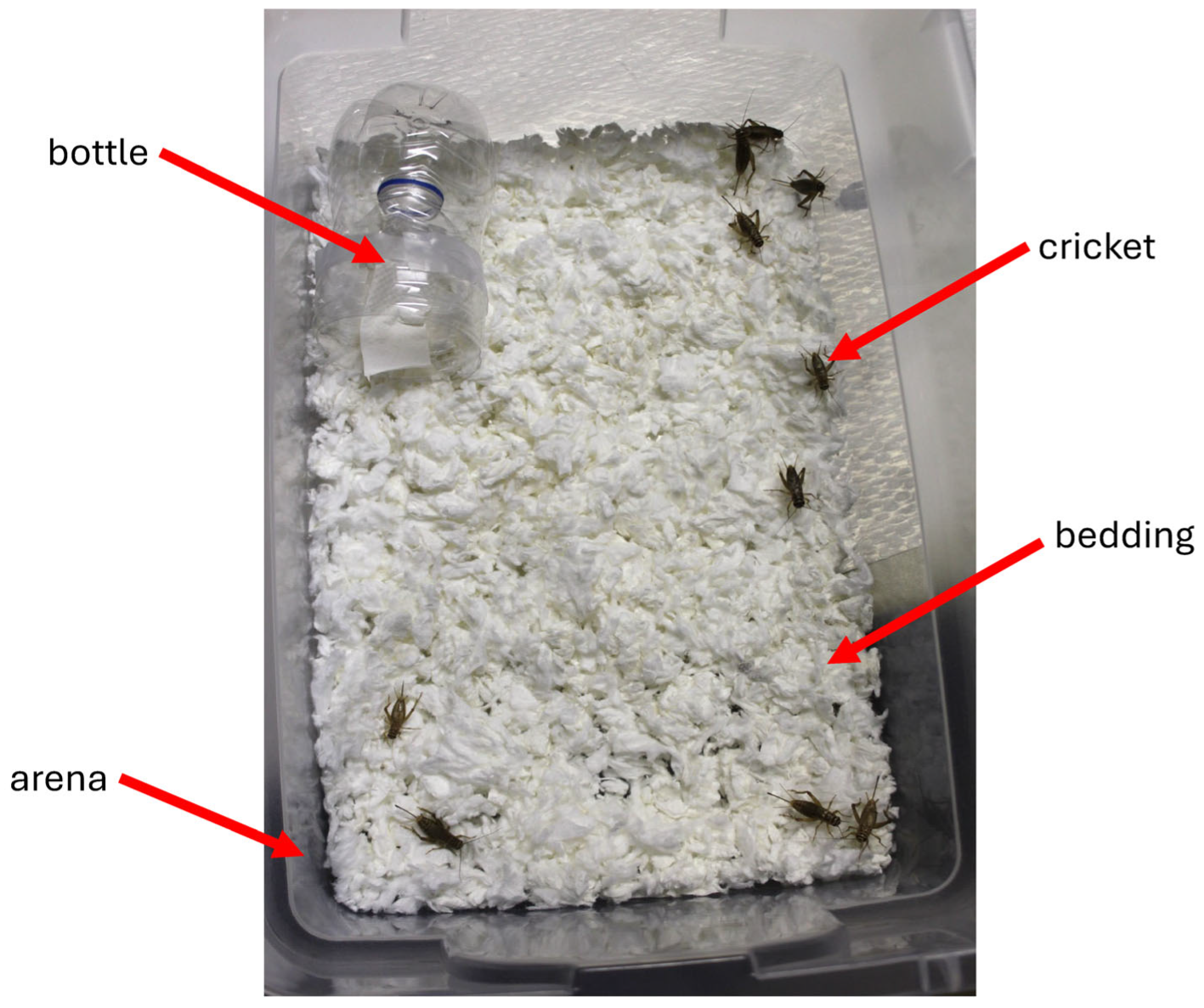
2.2. Repellency Bioassay
2.3. Statistical Analyses
2.4. Chemicals and Reagents
3. Results
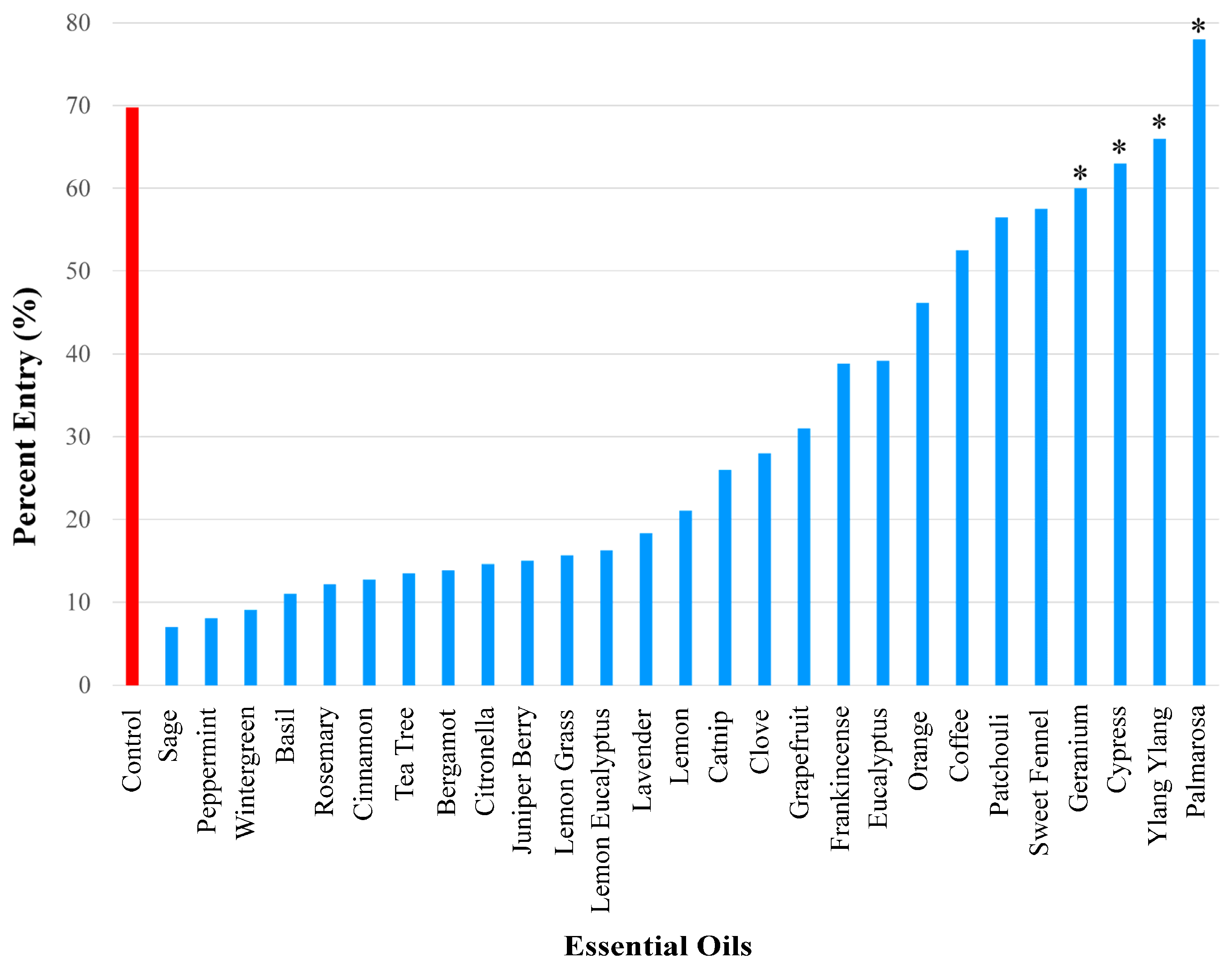
3.1. Essential Oils as Repellent Compounds
3.2. Essential Oils Eliciting Strong Repellent Responses
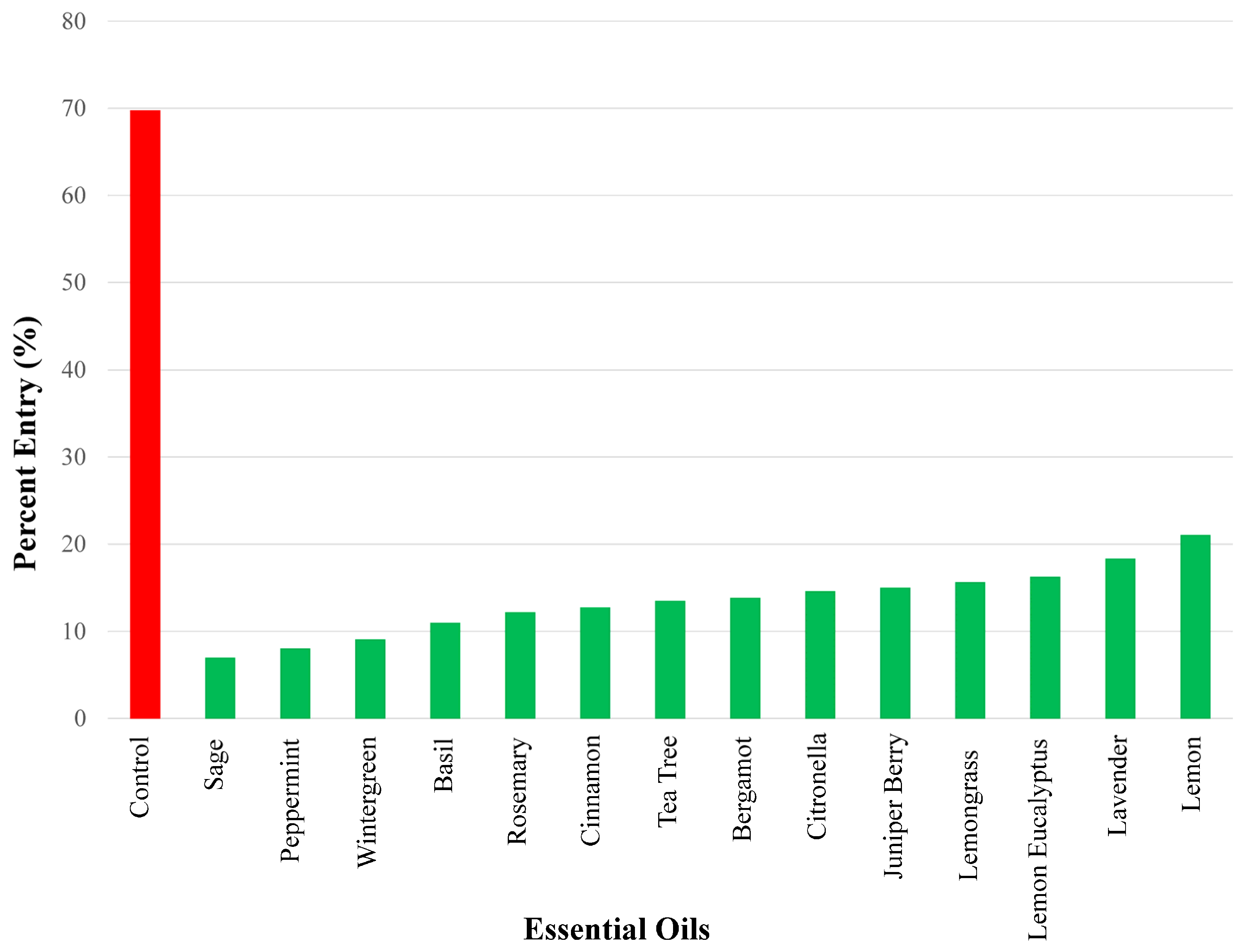
3.3. Essential Oils Eliciting Medium Repellent Responses
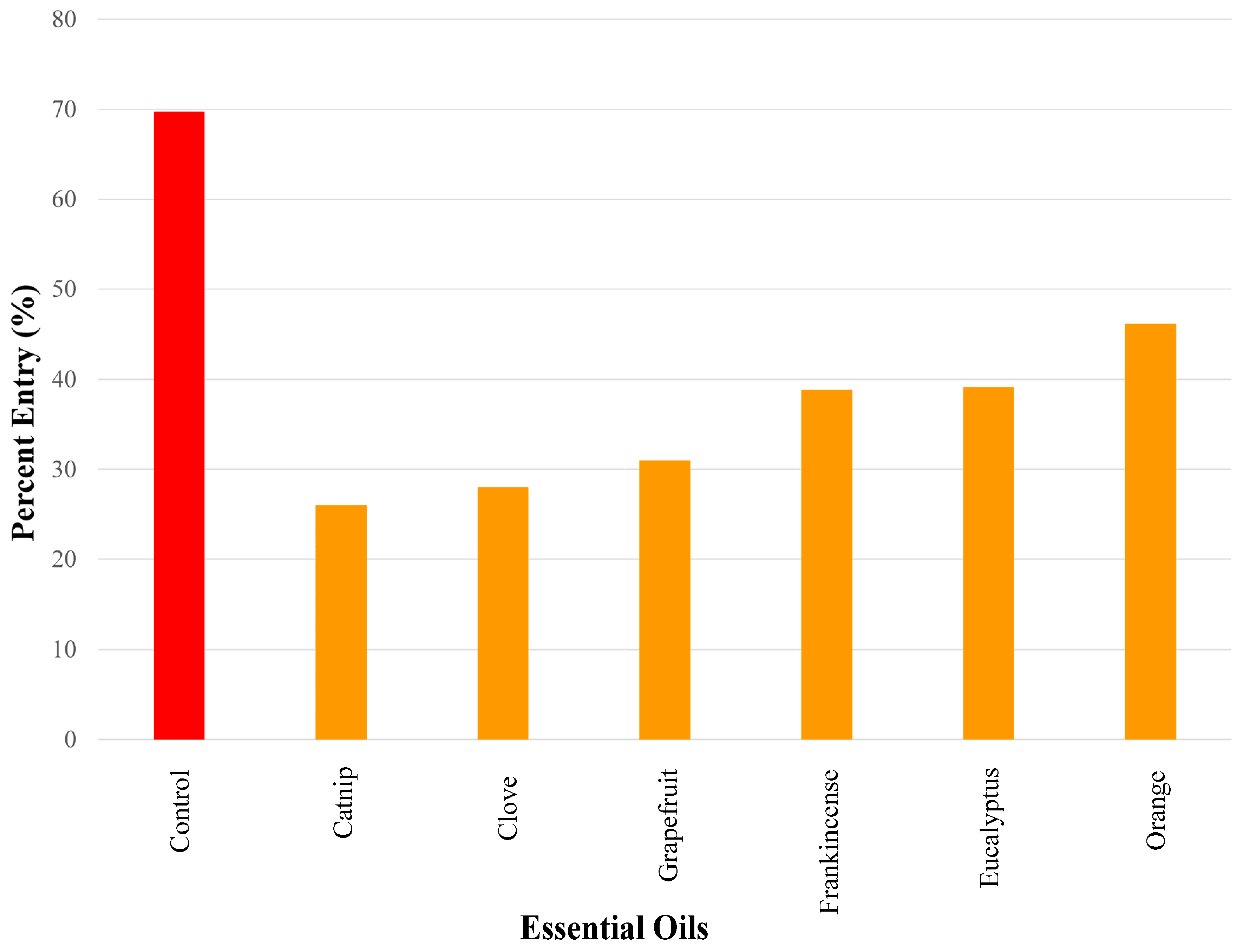
3.4. Essential Oils Eliciting Weak Repellent Responses
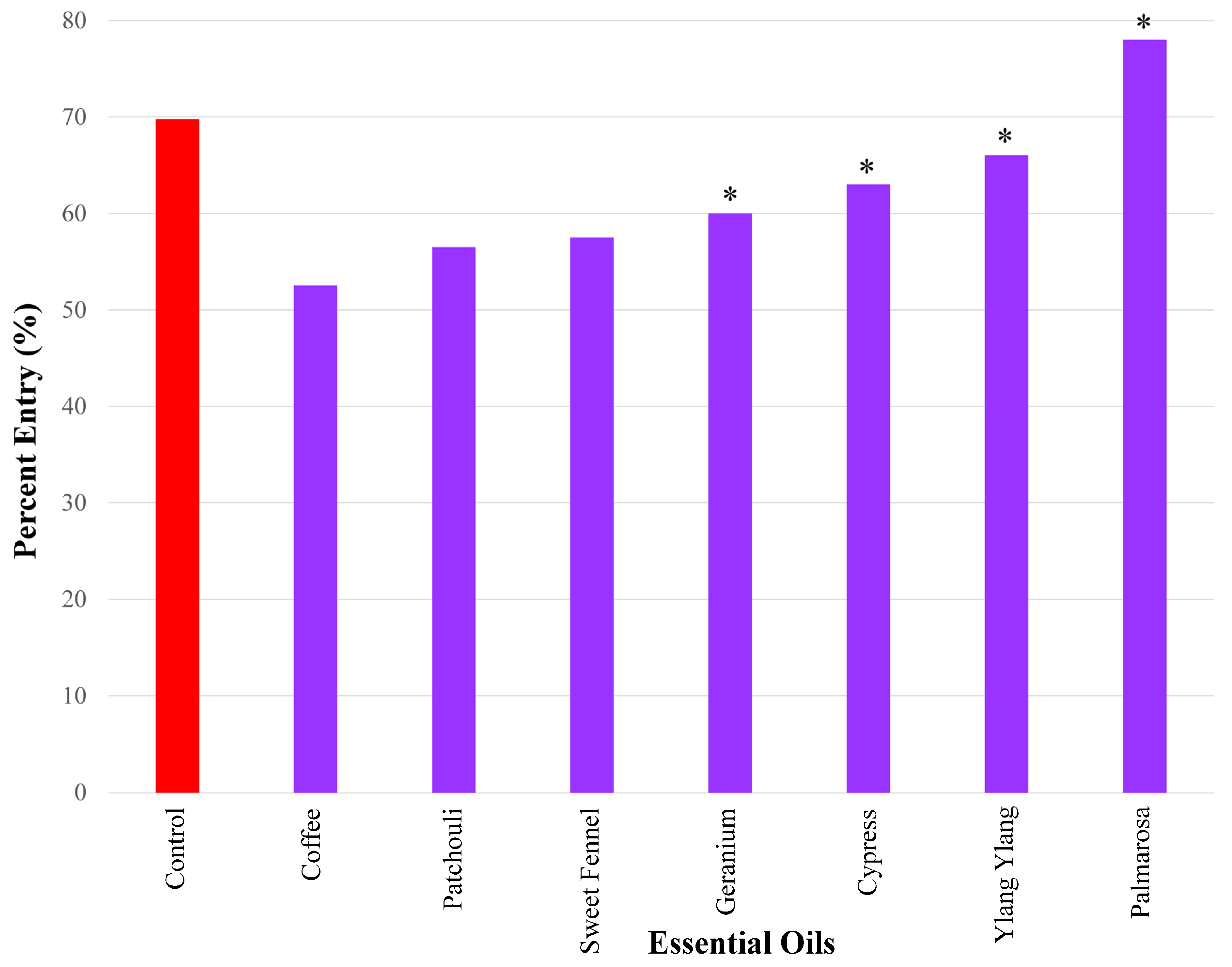
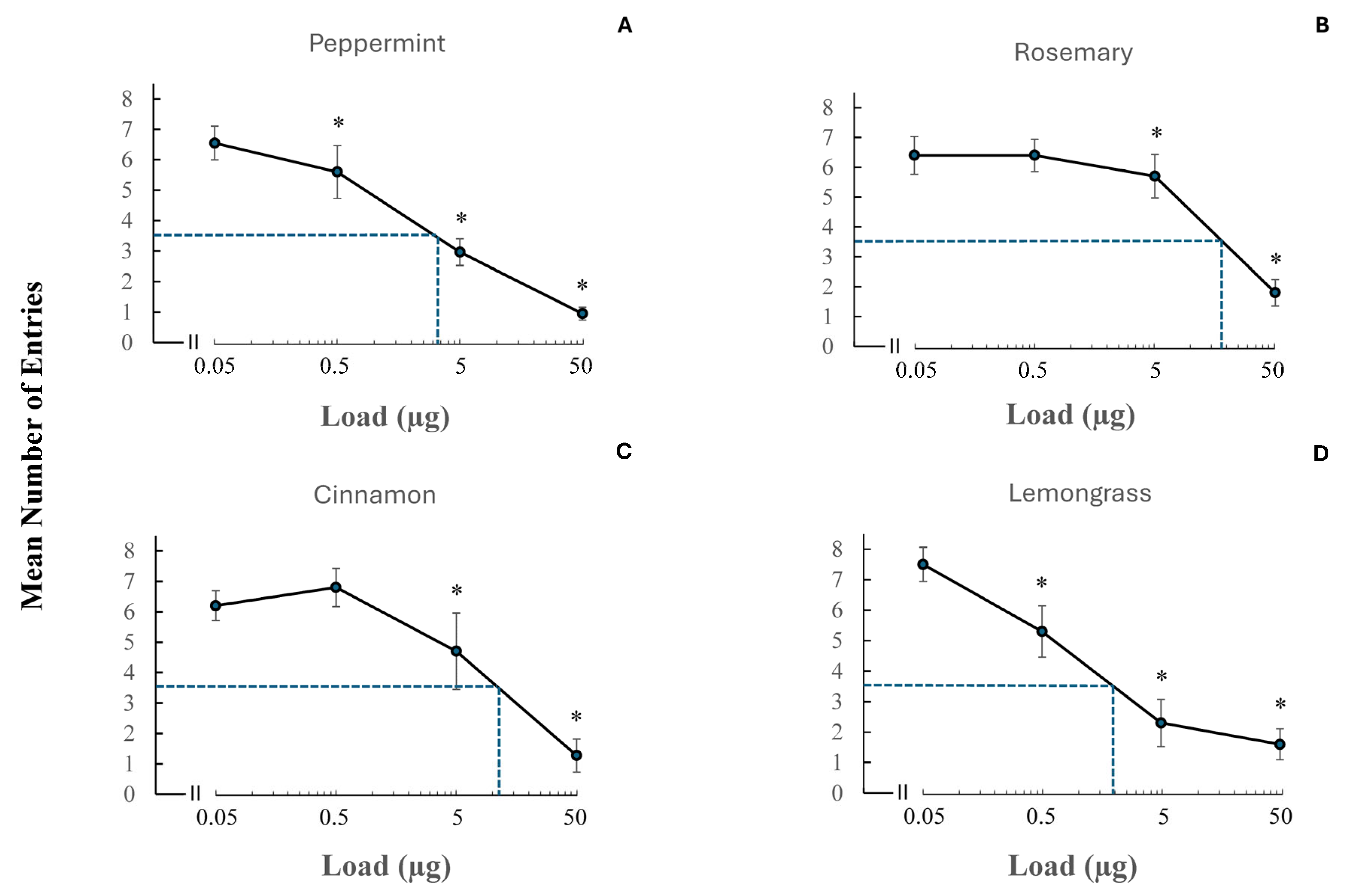
3.5. Dose–Response Curves
4. Discussion
5. Conclusions
Author Contributions
Funding
Data Availability Statement
Acknowledgments
Conflicts of Interest
Abbreviations
| IR3535 | Ethyl butylacetylaminopropionate) |
| DEET | N,N-Diethyl-meta-toluamide |
| RT | Repellency threshold |
| RD50 value | Concentration at 50% of the population of insects in the test group were repelled |
| GABA | Gamma-aminobutyric acid |
References
- SLU, Swedish University of Agricultural Sciences; Department of Biomedical Sciences and Veterinary Public Health, Sweden; Fernandez-Cassi, X.; Supeanu, A.; Jansson, A.; Boqvist, S.; Vagsholm, I. Novel foods: A risk profile for the house cricket (Acheta domesticus). EFSA J. 2018, 16, e16082. [Google Scholar] [CrossRef]
- Kulessa, A.K.; Balzani, P.; Soto, I.; Toutain, M.; Haubrock, P.J.; Kouba, A. Assessing the potential phytosanitary threat of the house cricket Acheta domesticus. Sci. Total Environ. 2024, 917, 170376. [Google Scholar] [CrossRef] [PubMed]
- Parkman, J.; Frank, J. Integrated pest management of pest mole crickets with emphasis on the southeastern USA. Integr. Pest Manag. Rev. 1999, 4, 39–52. [Google Scholar] [CrossRef]
- Green, K.K.; Stenberg, J.A.; Lankinen, Å. Making sense of Integrated Pest Management (IPM) in the light of evolution. Evol. Appl. 2020, 13, 1791–1805. [Google Scholar] [CrossRef] [PubMed] [PubMed Central]
- Pandey, A. Method of Pest Control in Insects. Encyclopedia. Available online: https://encyclopedia.pub/entry/48983 (accessed on 29 December 2025).
- Ebeling, W. Urban Entomology; University of California, Division of Agricultural Sciences: Oakland, CA, USA, 1975; 695p. [Google Scholar]
- Isman, M.B. Botanical insecticides, deterrents, and repellents in modern agriculture and an increasingly regulated world. Annu. Rev. Entomol. 2006, 51, 45–66. [Google Scholar] [CrossRef] [PubMed]
- Snyder, D.E.; Meyer, J.; Zimmermann, A.G.; Qiao, M.; Gissendanner, S.J.; Cruthers, L.R.; Slone, R.L.; Young, D.R. Preliminary Studies on the Effectiveness of the Novel Pulicide, Spinosad, for the Treatment and Control of Fleas on Dogs. Vet. Parasitol. 2007, 150, 345–351. [Google Scholar] [CrossRef]
- Matsumura, F. Toxicology of Insecticides, 2nd ed.; Springer: Durham, NC, USA, 2010. [Google Scholar]
- Gupta, A.; Baker, C.; Wang, H.; Targa, N.; Pfefferkorn, A.; Tielemans, E. Target Animal Safety Evaluation of a Novel Topical 909 Combination of Esafoxolaner, Eprinomectin and Praziquantel for Cats. Parasite 2021, 28, 18. [Google Scholar] [CrossRef]
- Allen, N. How to Get Rid of Crickets in Your House. Better Homes & Gardens. 2025. Available online: https://www.bhg.com/how-to-get-rid-of-crickets-in-the-house-8610165 (accessed on 24 December 2025).
- Srour, K.J.M.; Shields, V.D.C.; Dickens, J.C. Morphological and neurophysiological characterization of olfactory sensory organs in the house cricket. Experimental Biology. FASEB J. 2011, 25, 1048.4. [Google Scholar] [CrossRef]
- Shields, V.D.; Hildebrand, J.G. Recent advances in insect olfaction, specifically regarding the morphology and sensory physiology of antennal sensilla of the female sphinx moth Manduca sexta. Microsc. Res. Tech. 2001, 55, 307–329. [Google Scholar] [CrossRef] [PubMed] [PubMed Central]
- Miresmailli, S.; Isman, M.B. Botanical Insecticides Inspired by Plant–Herbivore Chemical Interactions. Trends Plant Sci. 2014, 19, 29–35. [Google Scholar] [CrossRef]
- Bakkali, F.; Averbeck, S.; Averbeck, D.; Idaomar, M. Biological Effects of Essential Oils—A Review. Food Chem. Toxicol. 2008, 46, 446–475. [Google Scholar] [CrossRef]
- Bruneton, J. Pharmacognosy: Phytochemistry, Medicinal Plants; Editions Médicales; Intercept Ltd.: Southampton, UK, 2008. [Google Scholar]
- Wang, Q.; Xu, P.; Sanchez, S.; Duran, P.; Andreazza, F.; Isaacs, R.; Dong, K. Behavioral and physiological responses of Drosophila melanogaster and D. suzukii to volatiles from plant essential oils. Pest Manag. Sci. 2021, 77, 3698–3705. [Google Scholar] [CrossRef] [PubMed]
- Afify, A.; Potter, C.J. Insect repellents mediate species-specific olfactory behaviours in mosquitoes. Malar. J. 2020, 19, 127. [Google Scholar] [CrossRef] [PubMed] [PubMed Central]
- Wińska, K.; Mączka, W.; Łyczko, J.; Grabarczyk, M.; Czubaszek, A.; Szumny, A. Essential Oils as Antimicrobial Agents—Myth or Real Alternative? Molecules 2019, 24, 2130. [Google Scholar] [CrossRef] [PubMed]
- Kamaraj, C.; Satish Kumar, R.C.; Al-Ghanim, K.A.; Nicoletti, M.; Sathiyamoorthy, V.; Sarvesh, S.; Ragavendran, C.; Govindarajan, M. Novel Essential Oils Blend as a Repellent and Toxic Agent against Disease-Transmitting Mosquitoes. Toxics 2023, 11, 517. [Google Scholar] [CrossRef] [PubMed] [PubMed Central]
- Hazarika, H.; Krishnatreyya, H. Technological Advancements in Mosquito Repellents: Challenges and Opportunities in Plant-Based Repellents. Acta Parasitol. 2025, 70, 117. [Google Scholar] [CrossRef] [PubMed]
- Yadav, D.K.; Rathee, S.; Sharma, V.; Patil, U.K. A Comprehensive Review on Insect Repellent Agents: Medicinal Plants and Synthetic Compounds. Anti-Inflamm. Anti-Allergy Agents Med. Chem. 2024, 24, 84–102. [Google Scholar] [CrossRef]
- Debboun, M.; Frances, S.P.; Strickman, D. (Eds.) Insect Repellents: Principles, Methods, and Uses, 1st ed.; CRC Press: Boca Raton, FL, USA, 2006. [Google Scholar] [CrossRef]
- Nerio, L.S.; Olivero-Verbel, J.; Stashenko, E. Repellent activity of essential oils: A review. Bioresour. Technol. 2010, 101, 372–378. [Google Scholar] [CrossRef]
- Pavela, R. History, Presence and Perspective of Using Plant Extracts as Commercial Botanical Insecticides and Farm Products for Protection against Insects—A Review. Plant Prot. Sci. 2016, 52, 229–241. [Google Scholar] [CrossRef]
- AromaWeb. 1997–2025. Available online: https://www.aromaweb.com/essential-oils/bergamot-essential-oil.php (accessed on 24 December 2025).
- Buchbauer, G. (Ed.) Handbook of Essential Oils: Science, Technology, and Applications, 3rd ed.; CRC Press: Boca Raton, FL, USA, 2024; ISBN 9780367504021. [Google Scholar]
- PubChem. Available online: https://pubchem.ncbi.nlm.nih.gov/ (accessed on 24 December 2025).
- Carroll, S.P.; Loye, J. PMD, a registered botanical mosquito repellent with deet-like efficacy. J. Am. Mosq. Control Assoc. 2006, 22, 507–514. [Google Scholar] [CrossRef] [PubMed]
- Müller, G.C.; Junnila, A.; Butler, J.; Kravchenko, V.D.; Revay, E.E.; Weiss, R.W.; Schlein, Y. Efficacy of the botanical repellents geraniol, linalool, and citronella against mosquitoes. J. Vector Ecol. 2009, 34, 2–8. [Google Scholar] [CrossRef] [PubMed]
- Sritabutra, D.; Soonwera, M. Repellent activity of herbal essential oils against Aedes aegypti (Linn.) and Culex quinquefasciatus (Say.). Asian Pac. J. Trop. Dis. 2013, 3, 271–276. [Google Scholar] [CrossRef] [PubMed Central]
- Wu, W.; Yang, Y.; Feng, Y.; Ren, X.; Li, Y.; Li, W.; Huang, J.; Kong, L.; Chen, X.; Lin, Z.; et al. Study of the Repellent Activity of 60 Essential Oils and Their Main Constituents against Aedes albopictus, and Nano-Formulation Development. Insects 2022, 13, 1077. [Google Scholar] [CrossRef] [PubMed] [PubMed Central]
- Noosidum, A.; Chareonviriyaphap, T.; Chandrapatya, A. Synergistic repellent and irritant effect of combined essential oils on Aedes aegypti (L.) mosquitoes. J. Vector Ecol. 2014, 39, 298–305. [Google Scholar] [CrossRef] [PubMed]
- Chaiphongpachara, T.; Laojun, S. Comparative efficacy of commercial ylang-ylang (Cananga odorata) essential oils from India and Thailand against larval Aedes aegypti (L.) (Diptera: Culicidae). J. Adv. Vet. Anim. Res. 2020, 7, 391–396. [Google Scholar] [CrossRef] [PubMed] [PubMed Central]
- Iqbal, S.; Khan, F.A.; Haris, A.; Mozūratis, R.; Binyameen, M.; Azeem, M. Essential oils of four wild plants inhibit the blood seeking behaviour of female Aedes aegytpi. Exp. Parasitol. 2023, 244, 108424. [Google Scholar] [CrossRef]
- Jaenson, T.G.; Pålsson, K.; Borg-Karlson, A.K. Evaluation of extracts and oils of mosquito (Diptera: Culicidae) repellent plants from Sweden and Guinea-Bissau. J. Med. Entomol. 2006, 43, 113–119. [Google Scholar] [CrossRef] [PubMed]
- Haris, A.; Azeem, M.; Abbas, M.G.; Mumtaz, M.; Mozūratis, R.; Binyameen, M. Prolonged Repellent Activity of Plant Essential Oils against Dengue Vector, Aedes aegypti. Molecules 2023, 28, 1351. [Google Scholar] [CrossRef]
- Caballero-Gallardo, K.; Olivero-Verbel, J.; Stashenko, E. Repellency and toxicity of essential oils from Cymbopogon martinii, Cymbopogon flexuosus and Lippia origanoides cultivated in Colombia against Tribolium castaneum. J. Stored Prod. Res. 2012, 50, 62–65. [Google Scholar] [CrossRef]
- Kumar, S.; Wahab, N.; Warikoo, R. Bioefficacy of Mentha piperita essential oil against dengue fever mosquito Aedes aegypti L. Asian Pac. J. Trop. Biomed. 2011, 1, 85–88. [Google Scholar] [CrossRef] [PubMed] [PubMed Central]
- Sutthanont, N.; Sudsawang, M.; Phanpoowong, T.; Sriwichai, P.; Ruangsittichai, J.; Rotejanaprasert, C.; Srisawat, R. Effectiveness of Herbal Essential Oils as Single and Combined Repellents against Aedes aegypti, Anopheles dirus and Culex quinquefasciatus (Diptera: Culicidae). Insects 2022, 13, 658. [Google Scholar] [CrossRef] [PubMed] [PubMed Central]
- Bedini, S.; Guarino, S.; Echeverria, M.C.; Flamini, G.; Ascrizzi, R.; Loni, A.; Conti, B. Allium sativum, Rosmarinus officinalis, and Salvia officinalis Essential Oils: A Spiced Shield against Blowflies. Insects 2020, 11, 143. [Google Scholar] [CrossRef] [PubMed] [PubMed Central]
- Batume, C.; Mulongo, I.M.; Ludlow, R.; Ssebaale, J.; Randerson, P.; A Pickett, J.; Mukisa, I.M.; Scofield, S. Evaluating repellence properties of catnip essential oil against the mosquito species Aedes aegypti using a Y-tube olfactometer. Sci. Rep. 2024, 14, 2269. [Google Scholar] [CrossRef] [PubMed]
- Gokulakrishnan, J.; Kuppusamy, E.; Shanmugam, D.; Appavu, A.; Kaliyamoorthi, K. Pupicidal and repellent activities of Pogostemon cablin essential oil chemical compounds against medically important human vector mosquitoes. Asian Pac. J. Trop. Dis. 2013, 3, 26–31. [Google Scholar] [CrossRef]
- Reichert, W.; Ejercito, J.; Guda, T.; Dong, X.; Wu, Q.; Ray, A.; Simon, J.E. Repellency Assessment of Nepeta cataria Essential Oils and Isolated Nepetalactones on Aedes aegypti. Sci. Rep. 2019, 9, 1524. [Google Scholar] [CrossRef] [PubMed] [PubMed Central]
- Luker, H.A.; Salas, K.R.; Esmaeili, D.; Holguin, F.O.; Bendzus-Mendoza, H.; Hansen, I.A. Repellent efficacy of 20 essential oils on Aedes aegypti mosquitoes and Ixodes scapularis ticks in contact-repellency assays. Sci. Rep. 2023, 13, 1705. [Google Scholar] [CrossRef]
- Barbosa, L.C.A.; Filomeno, C.A.; Teixeira, R.R. Chemical variability and biological activities of Eucalyptus spp. essential oils. Molecules 2016, 21, 1671. [Google Scholar] [CrossRef]
- Carroll, J.F.; Tabanca, N.; Kramer, M.; Elejalde, N.M.; Wedge, D.E.; Bernier, U.R.; Coy, M.; Becel, J.J.; Demirci, B.; Husnu, K.; et al. Essential oils of Cupressus funebris, Juniperus communis and J. chinensis (Cupressaceae) as repellents against ticks (Acari: Ixodidae) and mosquitoes (Diptera: Culicidae) and as toxicants against mosquitoes. J. Vector Ecol. 2011, 36, 258–268. [Google Scholar] [CrossRef]
- Su, X.L.; Huang, Z.C.; Chen, L.; Chen, D.Y.; Zhao, D.X.; Zeng, Z.J. Active Components of 16 Essential Oils and Their Fumigation Effects on Galleria mellonella (Lepidoptera: Pyralidae). Insects 2024, 15, 977. [Google Scholar] [CrossRef] [PubMed] [PubMed Central]
- Metayi, M.H.; Abd El-Naby, S.S.; El-Habal, N.A.; Fahmy, H.H.; Abdou, M.S.; Ali, B.; Abdel-Rheim, K.H.; Abdel-Megeed, A. Omani Frankincense nanoemulsion formulation efficacy and its latent effects on biological aspects of the spiny bollworm Earias insulana (Boisd.). Front. Physiol. 2022, 13, 1001136. [Google Scholar] [CrossRef] [PubMed] [PubMed Central]
- Wiwit, A.; Zulfikar; Sitepu, F.Y. The effectiveness of arabica coffee (Coffea arabica L) grounds on mortality and growth of Aedes aegypti Larva. Int. J. Mosq. Res. 2019, 6, 34–37. [Google Scholar]
- Ahmed, H.A.; Nassrallah, A.A.; Abdel-Raheem, M.A.; Elbehery, H.H. Lemon peel essential oil and its nano-formulation to control Agrotis ipsilon (Lepidoptera: Noctuidae). Sci. Rep. 2023, 13, 17922. [Google Scholar] [CrossRef] [PubMed] [PubMed Central]
- Ugwu, F.S.O.; Chime, C.D. Repellence of Aedes aegypti with oils from Citrus sinensis and Citrus paradisi fruit peelsi from Nsukka. Bio-Res. 2023, 21, 2099–2112. [Google Scholar] [CrossRef]
- Sarma, R.; Adhikari, K.; Mahanta, S.; Khanikor, B. Insecticidal activities of Citrus aurantifolia essential oil against Aedes aegypti (Diptera: Culicidae). Toxicol. Rep. 2019, 6, 1091–1096. [Google Scholar] [CrossRef]
- Fernando, S.S.S.T.; Jayasooriya, R.G.P.T.; Samarakoon, K.W.; Wijegunawardana, N.D.A.D.; Alahakoon, S.B. Citrus-Based Bio-Insect Repellents-A Review on Historical and Emerging Trends in Utilizing Phytochemicals of Citrus Plants. J. Toxicol. 2024, 2024, 6179226. [Google Scholar] [CrossRef] [PubMed] [PubMed Central]
- Corrêa, E.J.A.; Carvalho, F.C.; de Castro Oliveira, J.A.; Bertolucci, S.K.V.; Scotti, M.T.; Silveira, C.H.; Guedes, F.C.; Melo, J.O.F.; de Melo-Minardi, R.C.; de Lima, L.H.F. Elucidating the Molecular Mechanisms of Essential Oils’ Insecticidal Action Using a Novel Cheminformatics Protocol. Sci. Rep. 2023, 13, 4598. [Google Scholar] [CrossRef]
- Jankowska, M.; Rogalska, J.; Wyszkowska, J.; Stankiewicz, M. Molecular Targets for Components of Essential Oils in the Insect Nervous System—A Review. Molecules 2017, 23, 34. [Google Scholar] [CrossRef]
- Liu, X.; Cao, A.; Yan, D.; Ouyang, C.; Wang, Q.; Li, Y. Overview of Mechanisms and Uses of Biopesticides. Int. J. Pest Manag. 2021, 67, 65–72. [Google Scholar] [CrossRef]
- Popescu, I.E.; Gostin, I.N.; Blidar, C.F. An Overview of the Mechanisms of Action and Administration Technologies of the Essential Oils Used as Green Insecticides. Agri. Eng. 2024, 6, 1195–1217. [Google Scholar] [CrossRef]

| Plant Family | Essential Oils Included |
|---|---|
| Annonaceae | Ylang ylang |
| Apiaceae | Sweet fennel |
| Burseraceae | Frankincense |
| Cupressaceae | Juniper berry, Cypress |
| Ericaceae | Wintergreen |
| Geraniaceae | Geranium |
| Lauraceae | Cinnamon |
| Lamiaceae | Sage, Peppermint, Basil, Rosemary, Lavender, Catnip, Patchouli |
| Myrtaceae | Tea tree, Lemon eucalyptus, Clove, Eucalyptus |
| Poaceae | Citronella, Lemongrass, Palmarosa |
| Rubiaceae | Coffee |
| Rutaceae | Bergamot, Lemon, Grapefruit, Orange |
| Essential Oils | Monoterpenes/Oids | Diterpenes/Oids | Sesquiterpenes/Oids | Aromatics (Phenylpropanoids, Phenolic Acids, Benzenoids) | Major Constituents |
|---|---|---|---|---|---|
| Basil | √ | - | minor | √ | Monoterpenoid alcohols (linalool), phenylpropanoids (estragole, eugenol) |
| Bergamot | √ | - | - | - | Monoterpenoid esters (linalyl acetate), monoterpenoid alcohols (linalool), coumarins (non volatile) |
| Catnip | √ (Iridoids) | - | - | - | Iridoids (monoterpenoid lactones, nepetalactone) |
| Cinnamon | - | - | - | √ | Phenylpropanoid aldehydes (cinnamaldehyde) |
| Citronella | √ | - | minor | - | Monoterpenoid aldehydes (citronellal), monoterpenoid alcohols (citronellol, geraniol), monoterpenoid esters |
| Clove | - | - | √ | √ | Phenylpropanoid phenols (eugenol), phenylpropanoid esters (eugenyl acetate), sesquiterpenes (β-caryophyllene) |
| Coffee | minor | √ | - | √ | Diterpenes (cafestol, kahweol), phenolic acid components as well |
| Cypress | √ | - | √ | - | Monoterpenes (α-pinene), sesquiterpenoid alcohols (cedrol) |
| Eucalyptus | √ | - | - | - | Monoterpenoid oxides (1,8-cineole) |
| Frankincense | √ | √ | √ | - | Monoterpenes + sesquiterpenes, resin contains diterpenes (boswellic acids) |
| Geranium | √ | - | minor | - | Monoterpenoid alcohols (citronellol, geraniol), monoterpenoid esters |
| Grapefruit | √ | - | minor | - | Monoterpenes (limonene), sesquiterpenoid ketones (nootkatone), monoterpenoid aldehydes |
| Juniper berry | √ | - | √ | - | Monoterpenes (α-pinene), sesquiterpenes (β-caryophyllene) |
| Lavender | √ | - | - | - | Monoterpenoid esters (linalyl acetate), monoterpenoid alcohols (linalool) |
| Lemon | √ | - | - | - | Monoterpenes (limonene), monoterpenoid aldehydes (citral, small %) |
| Lemon eucalyptus | √ | - | - | - | Monoterpenoid aldehydes (citronellal), monoterpenoid alcohols (citronellol) |
| Lemongrass | √ | - | minor | - | Monoterpenoid aldehydes (citral), monoterpenoid alcohols (geraniol) |
| Orange | √ | - | - | - | Monoterpenes (limonene) |
| Palmarosa | √ | - | - | - | Monoterpenoid alcohols (geraniol), monoterpenoid esters |
| Patchouli | - | - | √ | - | Sesquiterpenoid alcohols (patchoulol) |
| Peppermint | √ | - | - | - | Monoterpenoid alcohols (menthol), monoterpenoid ketones (menthone), monoterpenoid esters |
| Rosemary | √ | - | minor | - | Monoterpenoid oxides (1,8-cineole), monoterpenoid ketones (camphor), monoterpenes (α-pinene) |
| Sage | √ | - | - | - | Monoterpenoid ketones (thujone, camphor) |
| Sweet fennel | - | - | - | √ | Phenylpropanoid ethers (anethole) |
| Tea tree | √ | - | minor | - | Monoterpenoid alcohols (terpinen-4-ol), monoterpenes, minor sesquiterpenes |
| Wintergreen | - | - | - | √ | Phenylpropanoid esters/phenolic acid esters (methyl salicylate) |
| Ylang ylang | √ | - | √ | √ | Monoterpenonid alcohols (linalool), sesquiterpenes (β-caryophyllene), esters (benzyl acetate) |
| Odor Category | Essential Oils |
|---|---|
| Camphor-like | Basil, Rosemary, Tea tree, Sage, Lemon eucalyptus |
| Minty | Peppermint, Wintergreen |
| Floral (sweet) | Lavender, Bergamot |
| Citrus | Lemon, Lemongrass, Citronella |
| Spicy (woody) | Cinnamon |
| Pine-like | Juniper berry |
Disclaimer/Publisher’s Note: The statements, opinions and data contained in all publications are solely those of the individual author(s) and contributor(s) and not of MDPI and/or the editor(s). MDPI and/or the editor(s) disclaim responsibility for any injury to people or property resulting from any ideas, methods, instructions or products referred to in the content. |
© 2026 by the authors. Licensee MDPI, Basel, Switzerland. This article is an open access article distributed under the terms and conditions of the Creative Commons Attribution (CC BY) license.
Share and Cite
Heinbockel, T.K.; Alzyoud, R.O.; Raheel, S.; Shields, V.D.C. Selected Essential Oils Act as Repellents Against the House Cricket, Acheta domesticus. Insects 2026, 17, 106. https://doi.org/10.3390/insects17010106
Heinbockel TK, Alzyoud RO, Raheel S, Shields VDC. Selected Essential Oils Act as Repellents Against the House Cricket, Acheta domesticus. Insects. 2026; 17(1):106. https://doi.org/10.3390/insects17010106
Chicago/Turabian StyleHeinbockel, Torben K., Rasha O. Alzyoud, Shazia Raheel, and Vonnie D. C. Shields. 2026. "Selected Essential Oils Act as Repellents Against the House Cricket, Acheta domesticus" Insects 17, no. 1: 106. https://doi.org/10.3390/insects17010106
APA StyleHeinbockel, T. K., Alzyoud, R. O., Raheel, S., & Shields, V. D. C. (2026). Selected Essential Oils Act as Repellents Against the House Cricket, Acheta domesticus. Insects, 17(1), 106. https://doi.org/10.3390/insects17010106

