Evaluation of Different Attractants for Monitoring and Mass Trapping of Rhagoletis batava (Hering) in Organic Sea Buckthorn Plantations

 , ,
, ,  , and
, and 
Simple Summary
Abstract
1. Introduction
2. Materials and Methods
2.1. Location of Trials
2.2. Characteristics of Traps and Attractants
2.2.1. Traps
2.2.2. Attractants
- (1)
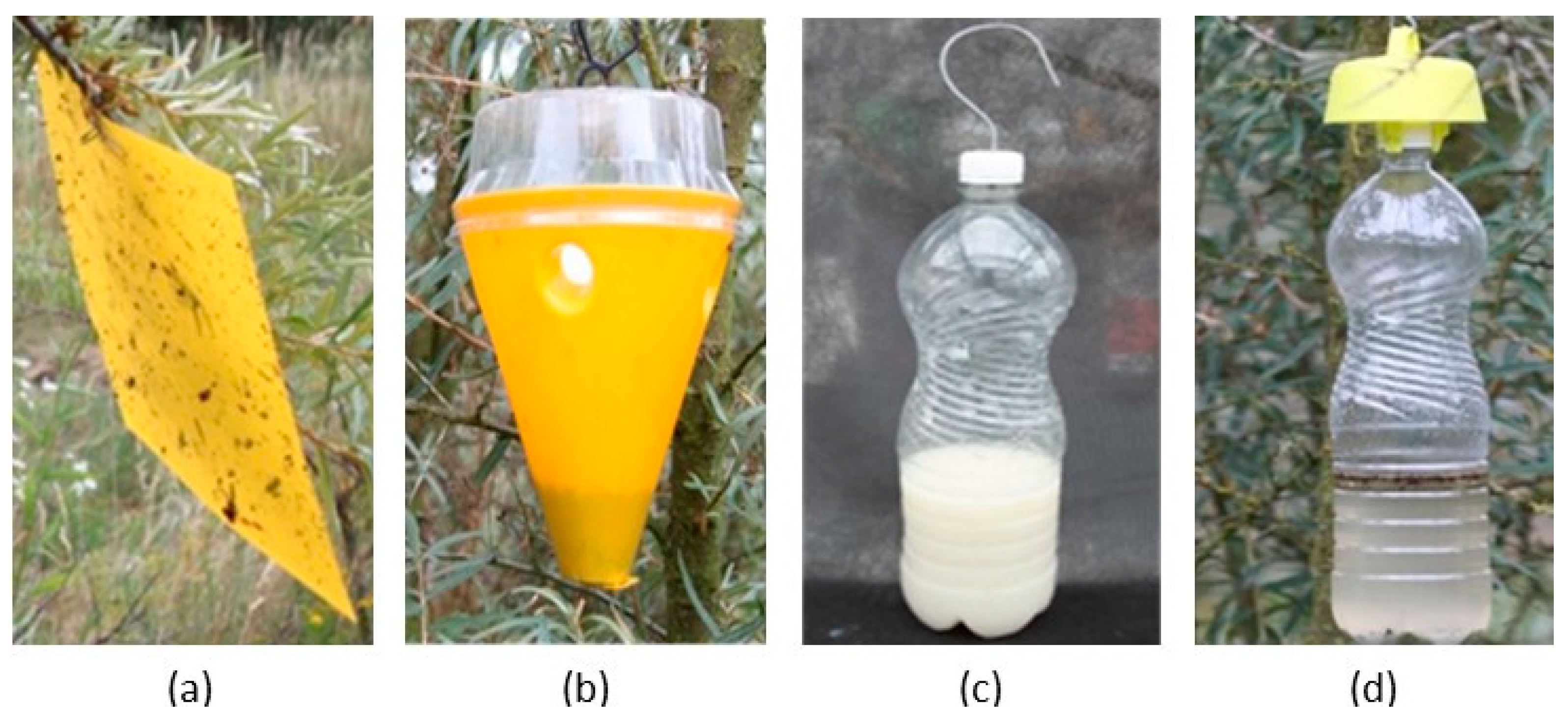
- A commercial attractant dedicated to the capture of Ceratitis capitata flies (C.C.)—(Probodelt, Amposta, Spain);
- (2)
- A 4% aqueous solution of ammonium phosphate fertilizer with 18:20 N:P content (N) of about 0.5 L/bottle;
- (3)
- A 4% aqueous solution of ammonia with the addition of European anchovy (Engraulis encrasicolus) in the amount of 1 piece/1 trap (AS);
- (4)
- An aqueous solution of 2.2 g/L of sucrose to which 10 g of bread yeast (RD) was added;
- (5)
- A proprietary hydroalcoholic solution in a specially prepared ampoule composed of ammonium acetate and trimethylamine hydrochloride, with the addition of putrescine dihydrochloride and ammonium carbonate—concentration/type A2 (BCHM Miśkiewicz, Warsaw, Poland) (A2);
- (6)
- A proprietary hydroalcoholic solution with the same compounds used for attractant 5, but with a different concentration (BCHM Miśkiewicz, Warsaw, Poland) (A3).
2.3. Evaluation of the Trap Efficacy
2.4. Statistical Analysis
3. Results
3.1. Preliminary Screening of Traps and Attractants
3.2. Mass Trapping
3.3. Assessing the Relation Between Trapped Flies and Damaged Fruits
4. Discussion
5. Conclusions
Author Contributions
Funding
Data Availability Statement
Acknowledgments
Conflicts of Interest
Abbreviations
| SD | Standard Deviation |
| SEM | Standard Error of the Mean |
References
- Guliyev, B.V.; Gul, M.; Yildirim, A. Hippophae rhamnoides L.: Chromatographic methods to determine chemical composition, use in traditional medicine and pharmacological effects. J. Chromatogr. B 2004, 812, 291–307. [Google Scholar] [CrossRef]
- Suryakumar, G.; Gupta, A. Medicinal and therapeutic potential of Sea buckthorn (Hippophae rhamnoides L.). J. Ethnopharmacol. 2011, 138, 268–278. [Google Scholar] [CrossRef] [PubMed]
- Olas, B. Sea buckthorn as a source of important bioactive compounds in cardiovascular diseases. Food Chem. Toxicol. 2016, 97, 199–204. [Google Scholar] [CrossRef]
- Sadowska, B.; Budzyńska, A.; Stochmal, A.; Żuchowski, J.; Różalska, B. Novel properties of Hippophae rhamnoides L. twig and leaf extracts-anti-virulence action and synergy with antifungals studied in vitro on Candida spp. model. Microb. Pathog. 2017, 107, 372–379. [Google Scholar] [CrossRef] [PubMed]
- Tkacz, K.; Wojdyło, A.; Turkiewicz, I.P.; Bobak, Ł.; Nowicka, P. Anti-Oxidant and Anti-Enzymatic Activities of Sea Buckthorn (Hippophaë rhamnoides L.) Fruits Modulated by Chemical Components. Antioxidants 2019, 8, 618. [Google Scholar] [CrossRef]
- Mihal, M.; Roychoudhury, S.; Sirotkin, A.V.; Kolesarova, A. Sea buckthorn, its bioactive constituents, and mechanism of action: Potential application in female reproduction. Front. Endocrinol. 2023, 14, 124430. [Google Scholar] [CrossRef]
- Dąbrowski, G.; Czaplicki, S.; Szustak, M.; Cichońska, E.; Gendaszewska-Darmach, E.; Konopka, I. Composition of flesh lipids and oleosome yield optimization of selected sea buckthorn (Hippophae rhamnoides L.) cultivars grown in Poland. Food Chem. 2022, 369, 130921. [Google Scholar] [CrossRef]
- Wen, P.; Zhao, P.; Qin, G.; Tang, S.; Li, B.; Zhang, J.; Peng, L. Genotoxicity and teratogenicity of seabuckthorn (Hippophae rhamnoides L.) berry oil. Drug Chem. Toxicol. 2020, 43, 391–397. [Google Scholar] [CrossRef] [PubMed]
- Chen, A.; Feng, X.; Dorjsuren, B.; Chimedtseren, C.; Damda, T.-A.; Zhang, C. Traditional food, modern food and nutritional value of Sea buckthorn (Hippophae rhamnoides L.): A review. J. Future Foods 2023, 3, 191–205. [Google Scholar] [CrossRef]
- Daniel, C. Experiences of integrated management of European Cherry Fruit Fly (Rhagoletis cerasi) and how to utilize this knowledge for Sea Buckthorn Fly (Rhagoletis batava). In Producing Sea Buckthorn of High Quality, Proceedings of the 3rd European Workshop on Sea Buckthorn (EuroWorkS2014), Naantali, Finland, 14–16 October 2014; Natural Resources Institute Finland: Naantali, Finland, 2015; pp. 21–30. [Google Scholar]
- Tartanus, M.; Malusá, E.; Danelski, W. Monitoring of fruit pests in organic soft fruits plantations and testing of biocontrol agents. In Proceedings of the 9th International IOBC/WPRS Workshop on Integrated Plant Protection of Soft Fruits, Riga, Latvia, 5–7 September 2018; p. 22. [Google Scholar]
- Tartanus, M.; Malusá, E.; Furmańczyk, E.M. Nasionnice zagrożeniem nie tylko dla wiśni i czereśni. In Proceedings of the 61 Ogólnopolska Konferencja Ochrony Roślin Sadowniczych “2020–Międzynarodowym Rokiem Zdrowia Roślin”, Skierniewice, Poland, 4 February 2020. [Google Scholar]
- Stalažs, A.; Balalaikins, M. Country checklist of Rhagoletis Loew (diptera: Tephritidae) for Europe, with focus on R. batava and its recent range expansion. Proc. Latv. Acad. Sci. Sect. B 2017, 71, 103–110. [Google Scholar] [CrossRef]
- Stalažs, A.; Dēķena, D.; Zukure, I. Atraktanta izmantošanas iespējas smiltsērkšķu raibspārnmušu (Rhagoletis batava) pievilināšanā. Prof. Dārzkopība 2023, 18, 23–31. [Google Scholar]
- Shamanskaya, L.D. Bioecology of the sea-buckthorn fly (Rhagoletis batava obscuriosa Kol.) and pest control treatment in Altai. Nat. Resour. Bioecon. Stud. 2015, 31, 7–20. [Google Scholar]
- Aleknavičius, D. Rhagoletis batava Hering (Diptera, Tephritidae) Chemoekologijos Bruožai. Ph.D. Thesis, Vilniaus Universitetas, Vilnius, Lithuania, 2019; p. 87. [Google Scholar]
- Daniel, C.; Grunder, J. Integrated Management of European Cherry Fruit Fly Rhagoletis cerasi (L.): Situation in Switzerland and Europe. Insects 2012, 3, 956–988. [Google Scholar] [CrossRef]
- Danelski, W. Limiting the numbers of cherry fruits fly (Rhagoletis cerasi L.) by selected non-chemical methods in organic cherry cultivation. Zagadnienia Doradz. Rol. 2024, 4, 80–94. [Google Scholar]
- Bartosik, M.; Broniarek-Niemiec, A.; Bryk, H.; Buler, Z.; Głos, H.; Hołdaj, M.; Lisek, J.; Masny, S.; Michalecka, M.; Miszczak, A.; et al. Program Ochrony Roślin Sadowniczych; Viridia: Warszawa, Poland, 2025; pp. 1–269. [Google Scholar]
- Yee, W.L. Evaluation of yellow rectangle traps coated with hot melt pressure sensitive adhesive and sticky gel against Rhagoletis indifferens (Diptera: Tephritidae). J. Econ. Entomol. 2011, 104, 909–919. [Google Scholar] [CrossRef]
- Aleknavičius, D.; Būda, V. Trapping peculiarities, flight and mating dynamics of sea buckhorn fruit fly (Rhagoletis batava) in Lithuania. Zemdirbyste 2019, 106, 81–86. [Google Scholar] [CrossRef]
- Nojima, S.; Linn, C., Jr.; Roelfs, W. Identification of host fruit volatiles from flowering dogwood (Cornus florida) attractive to dogwood-origin Rhagoletis pomonella flies. J. Chem. Ecol. 2003, 29, 2347–2357. [Google Scholar] [CrossRef] [PubMed]
- Grodner, J.; Świech, K.; Rozpara, E.; Danelski, W. Food attractant to control the population of Rhagoletis cerasi L. (Diptera: Tephritidae) and its use in organic cherry orchard in Poland. J. Res. Appl. Agric. Eng. 2016, 61, 167–172. [Google Scholar]
- Tóth, M.; Lerche, S.; Holz, U.; Kerber, A.; Henning, R.; Voigt, E.; Kelemen, D. Addition of synthetic feeding attractant increases catches of Rhagoletis batava Hering and Carpomyia schineri Loew. in fluorescent yellow sticky traps. Acta Phytopathol. Entomol. Hung. 2016, 51, 69–76. [Google Scholar] [CrossRef]
- Abbott, W.S. A method of computing the effectiveness of an insecticide. J. Econ. Entomol. 1925, 18, 265–267. [Google Scholar] [CrossRef]
- Nairy, K.S.; Rao, K.A. Tests of coefficients of variation of normal population. Commun. Stat. Simul. Comput. 2003, 32, 641–661. [Google Scholar] [CrossRef]
- Moskalets, T.; Moskalets, V.; Grynyk, I.; Shevchuk, I. Sea Buckthorn Fly, manifestations of its turn and control in agrocenoses of buckthorn. Quar. Plant Prot. 2021, 2, 12–18. [Google Scholar] [CrossRef]
- Ovruski, S.; Aluja, M.; Sivinski, J.; Wharton, R. Hymenopteran parasitoids on fruit-infesting Tephritidae (Diptera) in Latin America and the southern United States: Diversity, distribution, taxonomic status and their use in fruit by biological control. Int. Pest Manag. Rev. 2000, 5, 81–107. [Google Scholar] [CrossRef]
- Aluja, M.; Sivinski, J.; Rull, J.; Hodgson, P.J. Behavior and predation of fruit fly larvae (Anastrepha spp.) (Diptera: Tephritidae) after exiting fruit in four types of habitats in tropical Veracruz, Mexico. Environ. Entomol. 2005, 34, 1507–1515. [Google Scholar] [CrossRef]
- Lezama-Gutiérrez, R.; Trujillo-de-la-Cruz, A.; Molina-Ochoa, J.; Rebolledo-Domínguez, O.; Pescador, A.R.; López-Edwards, M.; Aluja, M. Virulence of Metarhizium anisopliae (Deuteromycotina: Hyphomycetes) on Anastrepha ludens (Diptera: Tephritidae): Laboratory and field trials. J. Econ. Entomol. 2000, 93, 1080–1084. [Google Scholar] [CrossRef]
- Aluja, M.; Celedonio-Hurtado, H.; Liedo, P.; Cabrera, M.; Castillo, F.; Guillén, J.; Rios, E. Seasonal Population Fluctuations and Ecological Implications for Management of Anastrepha Fruit Flies (Diptera: Tephritidae) in Commercial Mango Orchards in Southern Mexico. J. Econ. Entomol. 1996, 89, 654–667. [Google Scholar] [CrossRef]
- Papadopoulos, N.T.; Katsoyannos, B.I.; Carey, J.R.; Kouloussis, N.A. Seasonal and annual occurrence of the Mediterranean fruit fly (Diptera: Tephritidae) in northern Greece. Ann. Entomol. Soc. Am. 2001, 94, 41–50. [Google Scholar] [CrossRef]
- Yonow, T.; Zalucki, M.P.; Sutherst, R.W.; Dominiak, B.C.; Maywald, G.F.; Maelzer, D.A.; Kriticos, D.J. Modelling the population dynamics of the Queensland fruit by, Bactrocera (Dacus) tryoni: A cohort-based approach incorporating the effects of weather. Ecol. Model. 2004, 173, 9–30. [Google Scholar] [CrossRef]
- Özdem, A.; Kılınçer, N. The effectiveness of the trap types and lures used for mass trapping to control cherry fruit fly [Rhagoletis cerasi (L., 1758)] (Diptera: Tephritidae). Mun. Ent. Zool. 2009, 4, 371–377. [Google Scholar]
- González-Núñez, M.; Cobos, G.; Sánchez-Ramos, I. Evaluation of Mass Trapping Devices for the Control of the European Cherry Fruit Fly [Rhagoletis cerasi (L.)]. Horticulturae 2022, 8, 869. [Google Scholar] [CrossRef]
- Ganie, S.A.; Rehman, S.A.; Nisar, T.; Paray, M.A.; Bano, P.; Khurshid, R. Fruit fly management and control strategies: A review. Biopestic. Int. 2022, 18, 89–100. Available online: https://connectjournals.com/02196.2022.18.89 (accessed on 12 February 2025).
- Dominiak, B.C.; Ekman, J.H. The rise and demise of control options for fruit fly in Australia. Crop Prot. 2013, 51, 57–67. [Google Scholar] [CrossRef]
- Boulahia-Kheder, S. Advancements in management of major fruit flies (Diptera: Tephritidae) in North Africa and future challenges: A review. J. Appl. Entomol. 2021, 145, 939–957. [Google Scholar] [CrossRef]
- He, Y.; Xu, Y.; Chen, X. Biology, Ecology and Management of Tephritid Fruit Flies in China: A Review. Insects 2023, 14, 196. [Google Scholar] [CrossRef]
- Koul, O.; Cuperus, G.W.; Elliot, N.C. (Eds.) Area-Wide Pest Management: Theory and Implementation; CAB International: Wallingford, UK, 2008; 572p. [Google Scholar]
- Navarro-Llopis, V.; Primo, J.; Vacas, S. Efficacy of attract-and-kill devices for the control of Ceratitis capitata. Pest Manag. Sci. 2013, 69, 478–482. [Google Scholar] [CrossRef]
- Navarro-Llopis, V.; Vacas, S. Mass trapping for fruit fly control. In Trapping and the Detection, Control, and Regulation of Tephritid Fruit Flies; Shelly, T., Epsky, N., Jang, E., Reyes-Flores, J., Vargas, R., Eds.; Springer: Dordrecht, The Netherlands, 2014; pp. 513–555. [Google Scholar] [CrossRef]
- Yee, W.L. Efficacies of Rhagoletis cerasi (Diptera: Tephritidae) traps and ammonium lures for western cherry fruit fly. J. Insect Sci. 2018, 18, 14. [Google Scholar] [CrossRef] [PubMed]
- Zhao, B.; Cheng, T.M.; Li, S.S.; Su, Z.; Wei, J.R. Attractants for Rhagoletis batava obseuriosa, a Fruit Fly Pest of Sea Buckthorn. Int. J. Pest Manag. 2018, 65, 324–331. [Google Scholar] [CrossRef]
- Martínez-Ferrer, M.T.; Campos, J.M.; Fibla, J.M. Field efficacy of Ceratitis capitata (Diptera: Tephritidae) mass trapping technique on clementine groves in Spain. J. Appl. Entomol. 2012, 136, 181–190. [Google Scholar] [CrossRef]
- Alemany, A.; Miranda, M.A.; Alonso, R.; Martin-Escorza, C. Efficacy of C. capitata (Wied) (Diptera: Tephritidae) female mass trapping. Edge-effect and pest multiplier role of unmanaged fruit host. Bol. San. Veg. Plagas 2004, 30, 255–264. [Google Scholar]
- Lucas-Espadas, A.; Hermosilla-Cerón, A. Eficacia de Ceratrap y otros atrayentes y mosqueros, en el control de mosca de fruta (Ceratitis capitata) en uva de mesa. Agrícola Vergel 2008, 319, 304–310. [Google Scholar]
- Broumas, T.; Haniotakis, G.; Liaropoulos, C.; Tomazou, T.; Ragoussis, N. The efficacy of improved form of the mass-trapping method for the control of the olive fruit fly, Bactrocea oleae (Gmelin) (Dipt., Tephritidae): Pilot-scale feasibility studies. J. Appl. Entomol. 2002, 126, 217–223. [Google Scholar] [CrossRef]
- de los Santos-Ramos, M.; Hernández-Pérez, R.; Cerdà-Subirachs, J.J.; Nieves-Ordaz, F.; Torres-Santillán, J.A.; Bello-Rivera, A.; Leal-García, D.F. An environmentally friendly alternative (MS2®-CeraTrap®) for control of fruit flies in Mexico. J. Food Agric. Environ. 2011, 9, 926–927. [Google Scholar]
- OECD. Farm Management Practices to Foster Green Growth; OECD Green Growth Studies; OECD Publishing: Paris, France, 2016; 164p. [Google Scholar] [CrossRef]



| Type of Trap + (Attractant) $ | Average Number of Damaged Fruits * [%] | ||
|---|---|---|---|
| 2018 | 2019 | 2020 | |
| T (none) | 92.7 ± 7.9 b | - | - |
| Bn + (N) | 77.8 ± 11.8 a | - | - |
| B + (AS) | 85.2 ± 5.7 a | - | - |
| B + (N) | 94.7 ± 7.4 b | - | - |
| C + (C.C.) | 98.7 ± 2.0 bc | 41.5 ± 6.7 a | 52.2 ± 17.3 a |
| Control (without traps) | 100.0 ± 0.0 c | 81.5 ± 3.1 b | 92.3 ± 5.6 b |
| F(df1, df2) | F(5, 30) = 11.377 | F(1, 10) = 177.117 | F(1, 10) = 33.321 |
| p-value | p < 0.001 | p < 0.001 | p < 0.001 |
| ŋ2 | ŋ2 = 0.655 | ŋ2 = 0.946 | ŋ2 = 0.769 |
| Mean ± SD | 91.5 ± 10.0 | 61.5 ± 20.6 | 72.2 ± 23.2 |
| CV | 11.0 | 33.4 | 32.2 |
| Type of Trap + (Attractant) $ | Average Number of Damaged Fruits * [%] | |||
|---|---|---|---|---|
| 2019 | 2020 | 2021 | 2022 | |
| Przezmark II | ||||
| C + (C.C.) | 67.2 ± 5.7 a | 49.8 ± 26.4 a | 21.8 ± 2.6 a | 20.3 ± 2.8 a |
| B + (N) | 70.3 ± 5.8 a | 73.8 ± 7.3 b | 20.8 ± 4.9 a | 24.0 ± 2.5 a |
| Control (without traps) | 99.5 ± 0.8 b | 95.0 ± 1.9 c | 72.0 ± 12.4 b | 48.3 ± 6.6 b |
| F(df1, df2) | F(2, 15) = 148.467 | F(2, 15) = 15.396 | F(2, 15) = 62.607 | F(2, 15) = 72.997 |
| p-value | p < 0.001 | p < 0.001 | p < 0.001 | p < 0.001 |
| ŋ2 | ŋ2 = 0.952 | ŋ2 = 0.672 | ŋ2 = 0.893 | ŋ2 = 0.907 |
| Mean ± SD | 79.0 ± 15.2 | 72.9 ± 23.5 | 38.3 ± 25.0 | 30.9 ± 13.0 |
| CV | 19.2 | 32.2 | 65.4 | 42.3 |
| Pereszczówka | ||||
| C + (C.C.) | 41.0 ± 2.3 a | 3.3 ± 3.3 a | 4.0 ± 1.9 a | 7.0 ± 7.2 a |
| B + (N) | 59.3 ± 5.6 b | 3.2 ± 2.0 a | 4.0 ± 3.0 a | 12.7 ± 7.5 ab |
| Control (without traps) | 75.2 ± 6.4 c | 15.8 ± 3.6 b | 16.7 ± 3.7 b | 22.5 ± 3.7 b |
| F(df1, df2) | F(2, 15) = 61.783 | F(2, 15) = 21.497 | F(2, 15) = 20.214 | F(2, 15) = 6.580 |
| p-value | p < 0.001 | p < 0.001 | p < 0.001 | p < 0.01 |
| ŋ2 | ŋ2 = 0.892 | ŋ2 = 0.741 | ŋ2 = 0.729 | ŋ2 = 0.467 |
| Mean ± SD | 58.5 ± 14.7 | 7.4 ± 6.5 | 8.2 ± 6.6 | 14.0 ± 8.6 |
| CV | 25.1 | 88.0 | 79.8 | 61.5 |
| Type of Trap $ + (Attractant) | Average Number of Damaged Fruits * [%] | |
|---|---|---|
| Pereszczówka | Przezmark I | |
| B + (N) | 7.0 ± 7.4 a | 20.3 ± 2.5 ab |
| C + (C.C.) | 12.7 ± 7.2 ab | 24.0 ± 2.8 b |
| B + (N + RD) | 11.0 ± 1.7 ab | 15.3 ± 3.8 a |
| B + (N + A2) | 14.5 ± 3.0 bc | 28.3 ± 5.8 b |
| B + (N + A3) | 7.7 ± 3.3 a | 26.0 ± 7.5 b |
| B + (RD) | 15.7 ± 2.5 bc | 35.0 ± 5.8 c |
| B + (RD + A3) | 4.5 ± 1.9 a | 28.3 ± 6.4 b |
| B + (RD + A2) | 7.0 ± 0.6 a | 26.0 ± 3.5 b |
| Control (without traps) | 22.5 ± 3.7 c | 48.3 ± 6.6 d |
| F(df1, df2) | F(8, 45) = 7.5692 | F(8, 45) = 18.271 |
| p-value | p < 0.001 | p < 0.001 |
| ŋ2 | ŋ2 = 0.574 | ŋ2 = 0.765 |
| Mean ± SD | 11.4 ± 6.5 | 27.2 ± 10.2 |
| CV | 57.2 | 47.7 |
| Type of Trap + (Attractant) $ | Sample Size (N) ** | Spearman’s R Coefficient | Value of the t-Statistic t (n − 2) | Probability Value (p) |
|---|---|---|---|---|
| C + (C.C.) | 16 | 0.76 * | 4.32 | 0.0007 |
| B + (N) | 24 | 0.66 * | 4.06 | 0.0005 |
| B + (RD) | 6 | 0.54 | 1.29 | 0.2657 |
| B + (N + RD) | Too small sample size | |||
| T | ||||
Disclaimer/Publisher’s Note: The statements, opinions and data contained in all publications are solely those of the individual author(s) and contributor(s) and not of MDPI and/or the editor(s). MDPI and/or the editor(s) disclaim responsibility for any injury to people or property resulting from any ideas, methods, instructions or products referred to in the content. |
© 2025 by the authors. Licensee MDPI, Basel, Switzerland. This article is an open access article distributed under the terms and conditions of the Creative Commons Attribution (CC BY) license (https://creativecommons.org/licenses/by/4.0/).
Share and Cite
Tartanus, M.; Danelski, W.; Furmańczyk, E.M.; El Meziane, A.; Malusà, E. Evaluation of Different Attractants for Monitoring and Mass Trapping of Rhagoletis batava (Hering) in Organic Sea Buckthorn Plantations. Insects 2025, 16, 1248. https://doi.org/10.3390/insects16121248
Tartanus M, Danelski W, Furmańczyk EM, El Meziane A, Malusà E. Evaluation of Different Attractants for Monitoring and Mass Trapping of Rhagoletis batava (Hering) in Organic Sea Buckthorn Plantations. Insects. 2025; 16(12):1248. https://doi.org/10.3390/insects16121248
Chicago/Turabian StyleTartanus, Małgorzata, Witold Danelski, Ewa Maria Furmańczyk, Aya El Meziane, and Eligio Malusà. 2025. "Evaluation of Different Attractants for Monitoring and Mass Trapping of Rhagoletis batava (Hering) in Organic Sea Buckthorn Plantations" Insects 16, no. 12: 1248. https://doi.org/10.3390/insects16121248
APA StyleTartanus, M., Danelski, W., Furmańczyk, E. M., El Meziane, A., & Malusà, E. (2025). Evaluation of Different Attractants for Monitoring and Mass Trapping of Rhagoletis batava (Hering) in Organic Sea Buckthorn Plantations. Insects, 16(12), 1248. https://doi.org/10.3390/insects16121248