Article

Predicted Global Redistribution of Lagria nigricollis (Coleoptera: Tenebrionidae) Under Future Climate Change


The Key Laboratory of Southwest China Wildlife Resources Conservation of the Ministry of Education, College of Life Sciences, China West Normal University, Nanchong 637009, China
*
Author to whom correspondence should be addressed.
Insects 2025, 16(12), 1227; https://doi.org/10.3390/insects16121227
Submission received: 9 October 2025 / Revised: 30 November 2025 / Accepted: 1 December 2025 / Published: 3 December 2025

Simple Summary

Climate change has significantly impacted species diversity and distribution. However, research on its effects on the distribution of Tenebrionidae species remains limited. Lagria nigricollis Hope, 1843, an important member of Tenebrionidae, is widely distributed in East Asia. The adults of this species feed on the leaves of mulberry, locust, and maple trees, and are considered forest pests. This study utilizes the maximum entropy (MaxEnt) model to assess the potential impact of future climate change (2041–2060, and 2061–2080) on the distribution of L. nigricollis under three socioeconomic pathways (SSP1-2.6, SSP2-4.5, and SSP5-8.5). The results suggest that the suitable areas for L. nigricollis are currently located in China (North China, Central China, and Northeast China), the Korean Peninsula, and Japan. In the 2050s and 2070s, the suitable areas are expected to expand and shift northward. At present, the primary management regions for this species are located in China (Northern China, Central China, and Northeast China), the Korean Peninsula, and Japan (Kyushu, Shikoku, and southern Honshu).

Abstract

Lagria nigricollis (Coleoptera: Tenebrionidae) is a forest pest, widely distributed in East Asia. The impact of climate change on its distribution is currently unknown. To better understand how the geographic distribution of this species responds to future climate change, this study employed the MaxEnt model, integrating 21 environmental variables, to explore changes in its distribution range under different climate scenarios. The results indicated that the average area under the receiver operating characteristic curve (AUC) of the MaxEnt model across different periods is 0.991, demonstrating the reliability of the model’s predictions. The precipitation of the warmest quarter (bio18) and the temperature seasonality (bio04) were the most important environmental variables. Under current conditions, the suitable areas for L. nigricollis are mainly located in China (North China and Central China), the Korean Peninsula, and Japan (Kyushu, Shikoku, and the southern part of Honshu). In the 2050s and 2070s, suitable areas are expected to expand under three socioeconomic pathways, which are 1.08–1.33 times larger than they are currently. The expanded areas are mainly located in the northern part of the current suitable regions. The centroids of suitable areas will shift northward under future climate conditions. To limit the northward expansion of this species, primary control regions will focus on China (the junction of Inner Mongolia–Xinjiang and Northern China), Russia (the southeastern part of the Far Eastern Federal District), and Japan (Hokkaido). The results of this study provide a scientific basis for the forest pest control and distribution prediction of Lagria nigricollis.

1. Introduction

Global warming is one of the major scientific challenges facing ecosystems worldwide, and it has had a significant impact on biodiversity [1]. The rapid changes in climate and habitat loss have profoundly affected species distribution and the maintenance of biodiversity [2,3]. For forest ecosystems, climate-driven shifts in pest species distributions have become a critical concern, posing significant risks to forest health and sustainable forestry production.
The family Tenebrionidae is species-rich, with 11 subfamilies and approximately 30,000 species, making it one of the largest families in Coleoptera. Its feeding habits are diverse, including mycophagy, herbivory, omnivory, and carnivory. Some species in this family are considered pests due to their direct or indirect economic impact [4]. Lagria nigricollis Hope, 1843 is an important member of Tenebrionidae. It is a forest pest, with adults feeding on the leaves of various trees such as mulberry and locust, causing leaf damage, hindering tree growth, and making the trees more susceptible to secondary pests and diseases. This poses a significant threat to forestry production and forest ecosystem health [5]. Global warming may lead to the expansion and shift in its suitable distribution range, intensifying the risk of damage. Therefore, studying the evolution of this species’ distribution patterns under climate change can provide scientific support for precise pest control and disaster prediction, which is of significant practical value for ensuring the safety of forestry resources and maintaining ecological balance.
Species distribution models (SDMs) have emerged to study the relationships between species distribution and environmental variables. Several models have been proposed and widely applied in ecology, evolution, conservation, invasive-species management, and other fields [6,7,8,9,10], including Maximum Entropy (MaxEnt) Modeling [11], ENphylo [12], the Bioclimate Analysis and Prediction System (BIOCLIM) [13], and CLIMEX [14], among others. Compared to other models, MaxEnt offers high simulation accuracy and is less sensitive to sample size, performing especially well in cases with small sample sizes [15,16,17]. Therefore, it is widely used to predict the potential distribution areas of animals and plants [18,19,20,21,22]. However, this species is widely distributed in East Asia [23,24]. Studies on this species are currently at the taxonomic stage [23,24,25]. However, no research has been conducted on the impact of climate change on its distribution range. In Tenebrionidae, only one species, Luprops orientalis (Motschulsky, 1868), has been reported to have a relationship between its geographic distribution and climatic factors [26]. This severely hinders the understanding of the adaptive patterns of tenebrionid species in response to climate change.
To explore the impact of climate change on the distribution of Lagria nigricollis, this study used MaxEnt modeling, combined with 21 environmental variables, to predict the changes in its suitable habitat under climate change. This species has a broad distribution, and studying the effects of climate change on its suitable habitat is crucial for better understanding how widely distributed tenebrionid species respond to future climate change.

2. Materials and Methods

2.1. Obtaining and Processing Occurrence Data

The occurrence data of Lagria nigricollis were obtained from the Global Biodiversity Information Facility (GBIF, https://www.gbif.org/, accessed on 10 July 2025) [27], the China National Knowledge Infrastructure (CNKI, https://www.cnki.net/, accessed on 23 July 2025), and the National Animal Collection Resource Center (http://museum.ioz.ac.cn/, accessed on 23 July 2025). To ensure data quality and the reliability of model predictions, this study processed the data based on SDM. Firstly, occurrence data recorded only at the provincial, autonomous region, or county level (without latitude and longitude) were excluded, as such vague data can affect the accuracy of SDMs [28]. Secondly, duplicate points were manually removed using Microsoft Excel, with latitude and longitude coordinates as the core criteria for determination. And redundant distribution points within the same grid were removed using ArcGIS v10.2. Finally, ENMTools v1.1.5 software was used for further screening. Based on a 2.5 arc-minute environmental data resolution, a 5 km spatial buffer distance was set. Representative points within the clustered areas were retained according to the principle of “maximizing environmental heterogeneity,” effectively eliminating issues such as model performance overestimation, misjudgment of variable importance, and prediction bias caused by spatial clustering effects. After these steps, 234 initial points were retained, and ultimately, 185 high-quality distribution records were obtained for suitable habitat prediction (Figure 1).

2.2. Environmental Variables

Compared to other variables, bioclimatic and soil variables are the more important factors affecting SDMs [29]. There were 21 environmental variables used for MaxEnt modeling, including bioclimate variables, elevation, global land cover type, and vegetation. The bioclimate variables were obtained from WorldClim (http://www.worldclim.org/, accessed on 27 July 2025), with a 2.5 arc-minute spatial resolution, which was chosen based on the strong dispersal capacity of Lagria nigricollis. The global land cover type v3 and vegetation v2 were downloaded from GitHub (https://globalmaps.github.io/, accessed on 27 July 2025) [30]. The elevation data was downloaded from EarthEnv (https://www.earthenv.org/, accessed on 27 July 2025), with coverage of about 91% of the globe [31]. The environmental variables include both current (1970–2000) and future (2041–2060, 2061–2080) climate projections. The future projections were obtained from the BCC-CSM2-MR model within the framework of the Coupled Model Intercomparison Project Phase 6 (CMIP6) [32,33]. This model has demonstrated high simulation accuracy for the East Asia region and is capable of accurately capturing key climatic features. The processing workflow is as follows: the NetCDF raw data from the BCC-CSM2-MR model were parsed, target variables were extracted, and invalid values were handled. Spatial resolution was unified through bilinear interpolation, and the data were aggregated to an annual scale. Outliers were detected and corrected using the boxplot method. After Z-score normalization, the data were output in ASCII format suitable for the MaxEnt modeling. Three shared socioeconomic pathways (SSPs) were selected for modeling: the low-emission scenario (SSP1-2.6), the intermediate-emission scenario (SSP2-4.5), and the high-emission scenario (SSP5-8.5). Specifically, SSP1-2.6 represents a sustainable development pathway with rapid emission reduction to achieve net-zero greenhouse gas (GHG) emissions by the end of the century. SSP2-4.5 reflects a middle-of-the-road development trajectory, with GHG emissions peaking around mid-century and stabilizing thereafter. SSP5-8.5 corresponds to a fossil fuel-intensive development pathway with continuous growth in GHG emissions, resulting in the highest radiative forcing by 2100.
A Pearson correlation analysis was conducted on the environmental variables to avoid errors from high autocorrelation (Figure S1), with only the most strongly correlated variable removed for groups with |r| > 0.85. The environmental variables were then filtered using PCA transformation. Finally, 10 variables were selected for the modeling test (Table 1), and their contributions to the climate suitability model were determined using Worthington’s method [34]. This method is a widely used quantitative tool for evaluating variable importance in ecological niche modeling. It calculates the relative contribution of each environmental variable by sequentially excluding individual variables and measuring the degree of subsequent model performance degradation.

2.3. Modeling Methods

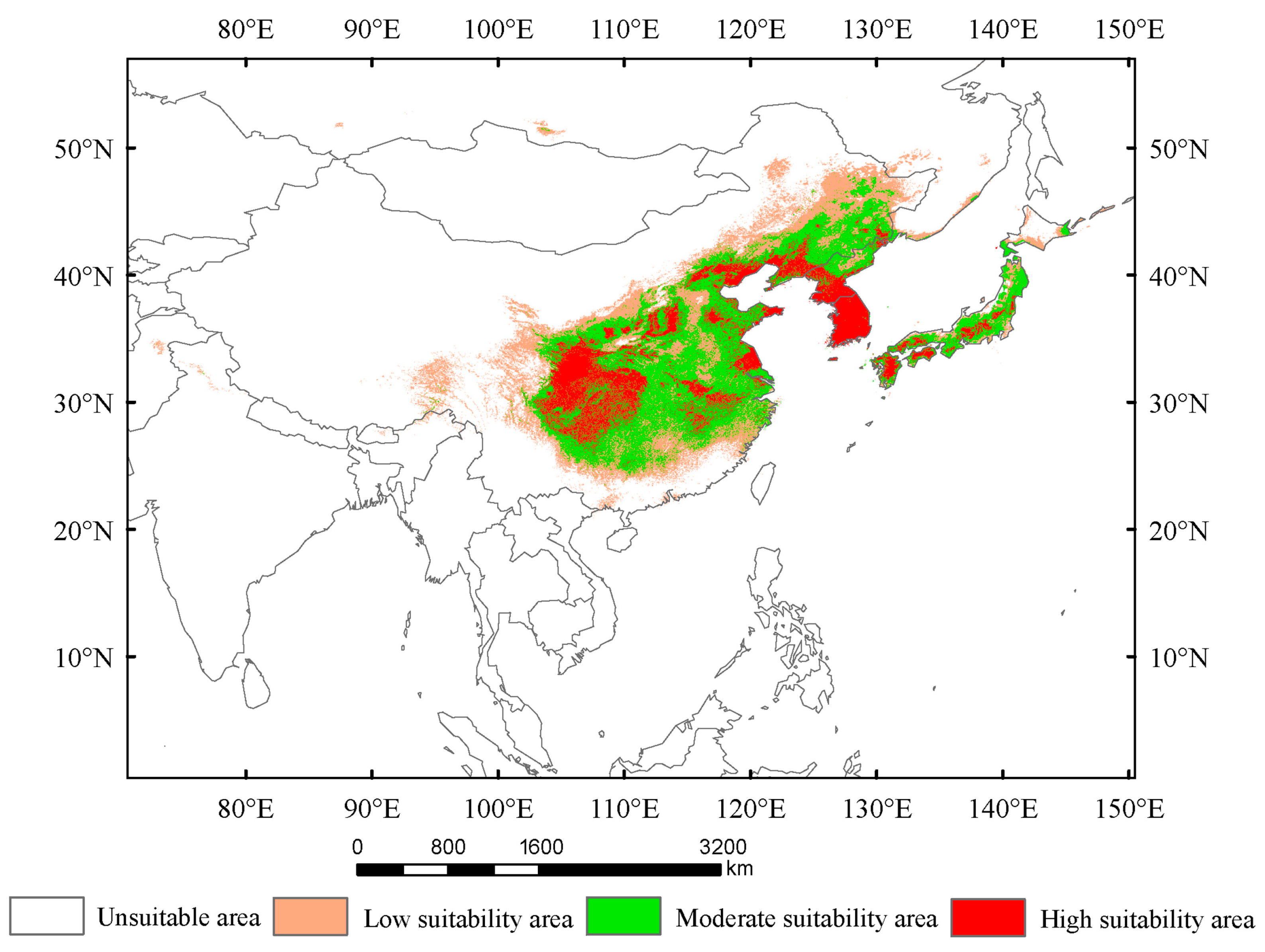
The MaxEnt v3.4.1 and ArcGIS v10.2 were used to construct and analyze potentially suitable areas for L. nigricollis. Model calibration for the 10 selected environmental variables was performed using kuenm in R v4.3.2, with the regularization multiplier set from 0.5 to 4 in 0.5 increments [35]. The core significance of setting the regularization multiplier range from 0.5 to 4.0 with a step size of 0.5 lies in balancing model complexity and data fitting. A multiplier that is too small may lead to overfitting, while one that is too large could result in underfitting. The 0.5–4.0 range, combined with a step size of 0.5, allows for a comprehensive exploration of the potential optimal parameter range, ensuring the reliability of the model. The MaxEnt model was run with the following parameters: iterations: 500, background points: 10,000, and replicates: 10, with bootstrap chosen as the resampling method for the replicates. In this program, 75% of the distribution points were utilized for model construction, while 25% were reserved for model testing [36]. For the MaxEnt model, the receiver operating characteristic (ROC) curve and area under the curve (AUC) were employed to assess the predictive capability and accuracy (Figure S2), respectively. The omission rate and AICc were used to evaluate the model performance and complexity. The centroid of suitable areas refers to the spatial center of a species’ suitable habitats, and its migration reflects the overall trend of changes in suitable areas. The coordinates of the centroid are calculated in ArcGIS by using the distribution probability of grid cells as weights. The Jenks natural breaks classification and calculated suitable areas were conducted in ArcGIS v10.2. The suitable areas of L. nigricollis were divided into four groups: 0–0.094 representing unsuitable area, 0.095–0.203 representing low-suitability area, 0.204–0.403 representing moderate-suitability area, and 0.404–1 representing high-suitability area. To verify the reliability of the classification thresholds, this study compares the thresholds (0.095, 0.204, 0.404) with actual species distribution records: areas with a probability <0.095 showed no occurrence points, while the distribution point percentages for low, medium, and high suitability areas are 8.3%, 31.7%, and 60.0%, respectively. This threshold classification aligns closely with the species’ survival preferences.

3. Results

3.1. Evaluation of the MaxEnt Model and Dominant Environmental Variables

The lowest value of AICc is approximately 3261, and the omission rate at 5% is 0.05 in this study. The value of AUC is also one of the most important indicators for the Maxent model. After training the data of Lagria nigricollis 10 times, the average value of AUC is 0.991 and the standard deviation is 0.001 (Figure S3), indicating that the predictive capability and accuracy of the MaxEnt model are excellent.
The Jackknife method was used to evaluate the importance of environmental variables. The contribution and permutation importance of 10 environmental variables were provided (Table 1). For the contributions of each factor to the model, the top four contributors were the precipitation of the warmest quarter (bio18), the temperature seasonality (bio04), the precipitation seasonality (bio15), and the mean temperature of the coldest quarter (bio11), with contribution rates of 60.7%, 25.1%, 5%, and 4.7%, respectively. According to the permutation importance, bio18, bio11, and bio4 were the dominant factors, with rates of 55.4%, 29.8% and 7.4%, respectively.
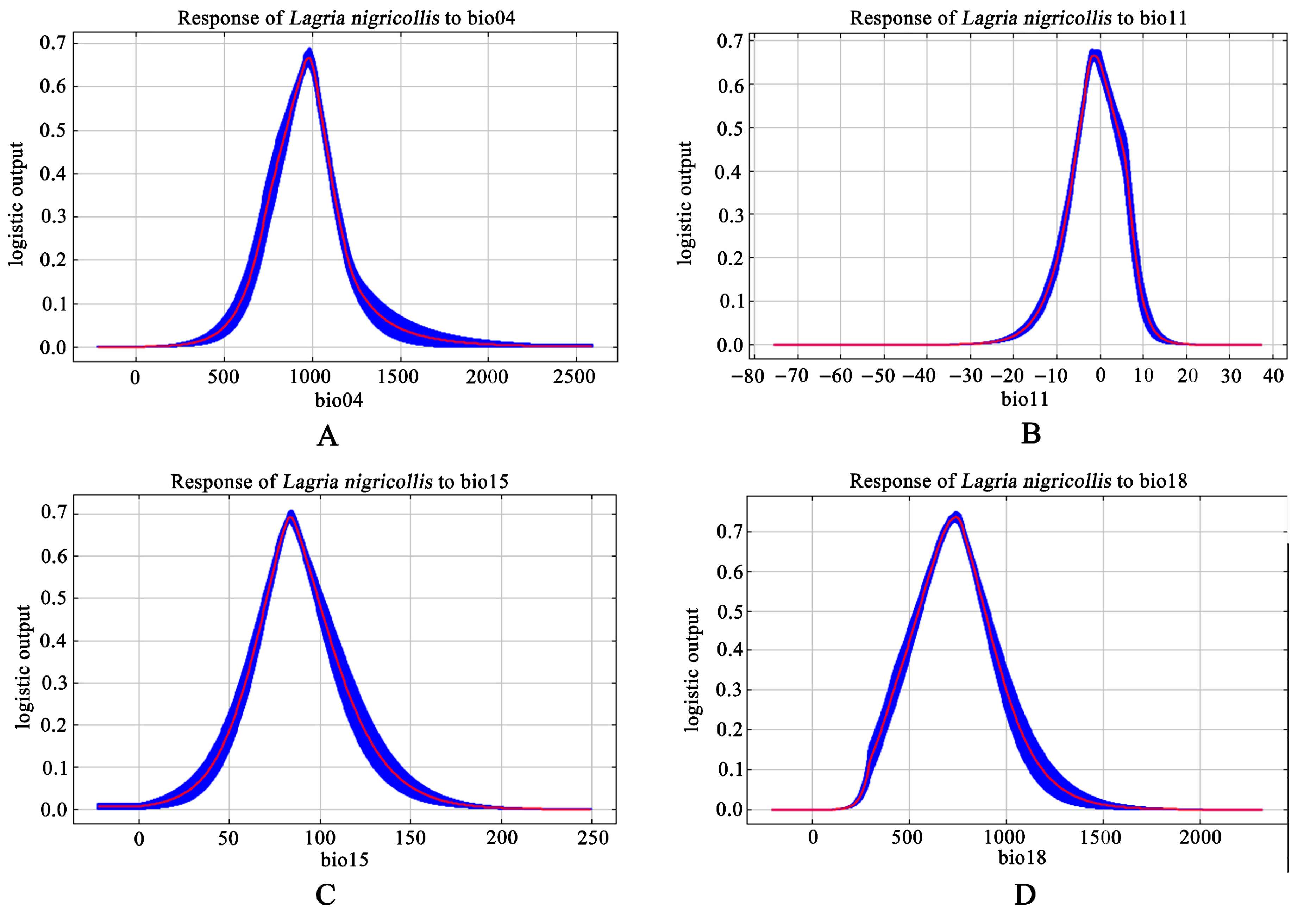
The response curve intuitively represents the relationship between the environmental variable and the potential distribution probability of Lagria nigricollis (Figure 2). For bio18, when the precipitation of the warmest quarter is 736.11 mm, the potential distribution probability of L. nigricollis reaches its maximum value of 0.75. For bio04, when the standard deviation of temperature seasonality is 983.33, the potential distribution probability reaches its maximum value of 0.66. For bio15, when the standard deviation of precipitation seasonality is 80.64, the potential distribution probability reaches its maximum value of 0.77. For bio11, when the mean temperature of the coldest quarter is −1.72 °C, the potential distribution probability reaches its maximum value of 0.66.

3.2. Suitability Area Under Current Condition

Under current climatic conditions, the total suitable areas of Lagria nigricollis are approximately 3.78 × 10⁶ km2, which includes high-, moderate-, and low-suitability areas (Figure 3). The high-suitability areas cover approximately 8.44 × 10⁵ km2, mainly located in China (North China, Central China), the Korean Peninsula (southern North Korea, South Korea), and Japan (Kyushu, Shikoku, and southern Honshu). The moderate-suitability areas cover approximately 1.64 × 10⁶ km2, mainly concentrated in China (North China, Central China, and Northeast China), the Korean Peninsula (Northern North Korea), and Japan (Kyushu, Shikoku, Honshu, and a small part of southern Hokkaido). The low-suitability areas cover approximately 1.29 × 10⁶ km2, primarily concentrated in China, with small fragments occurring in North Korea, Japan and Russia.

3.3. Suitable Area Under Future Climate Change

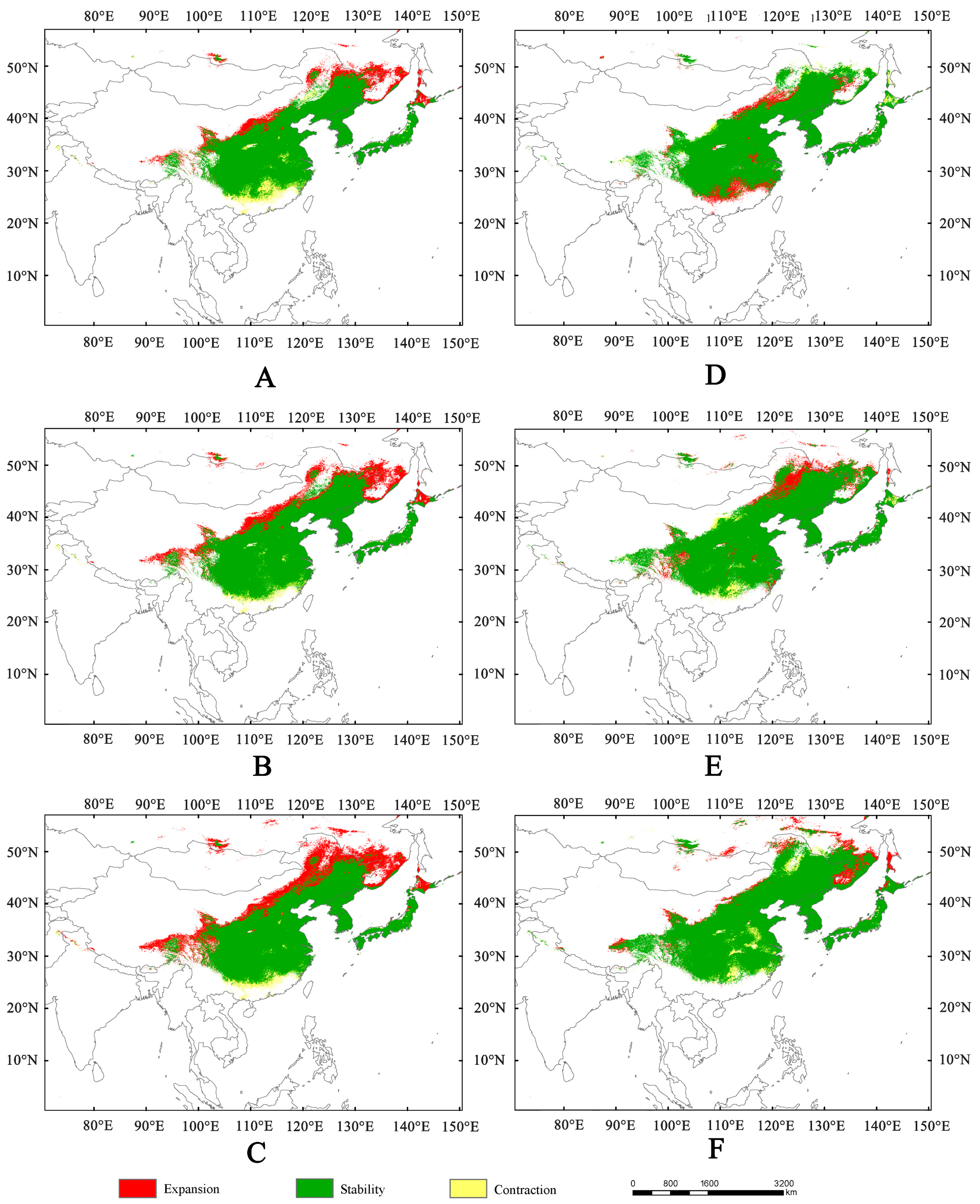
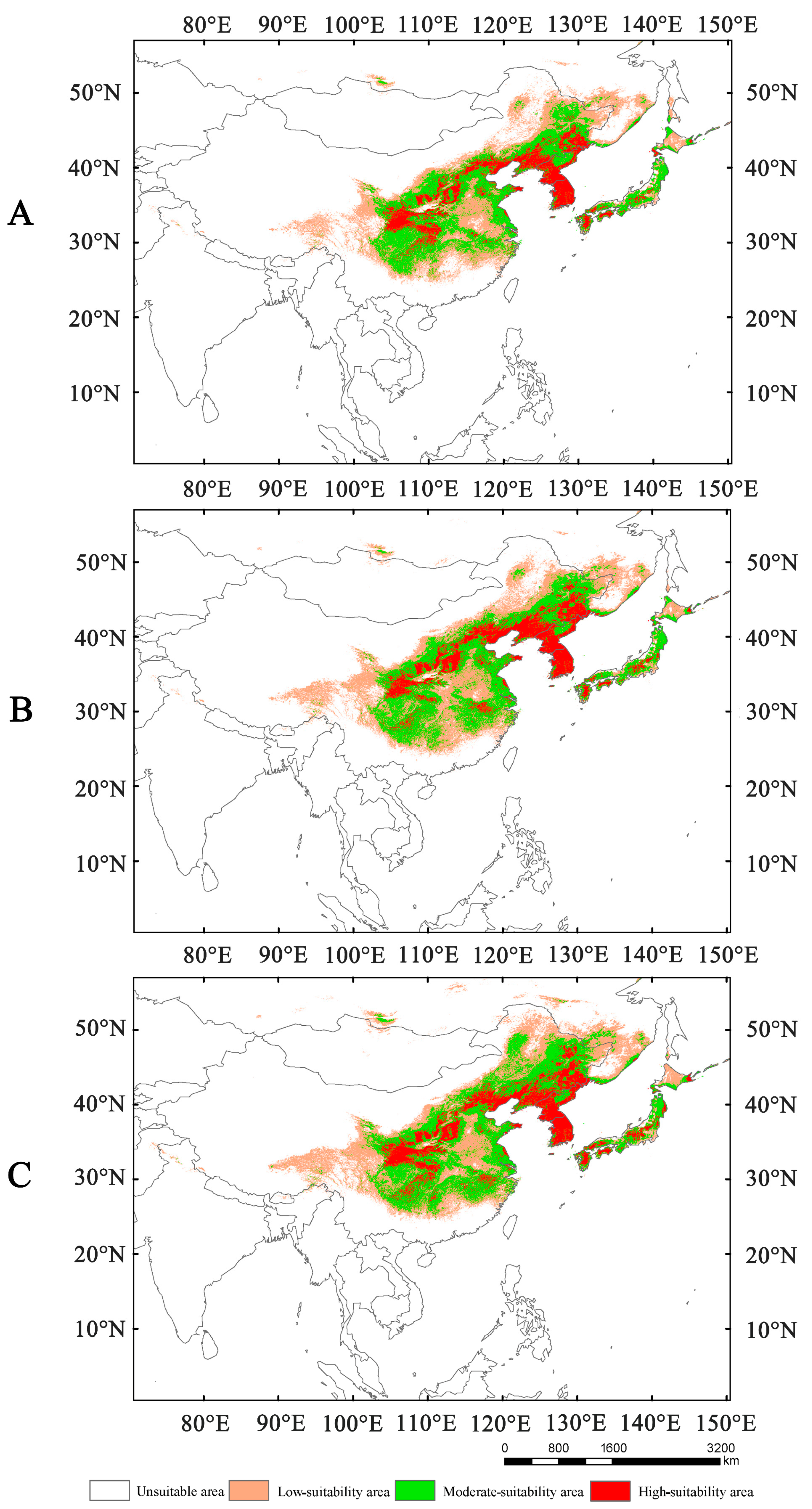
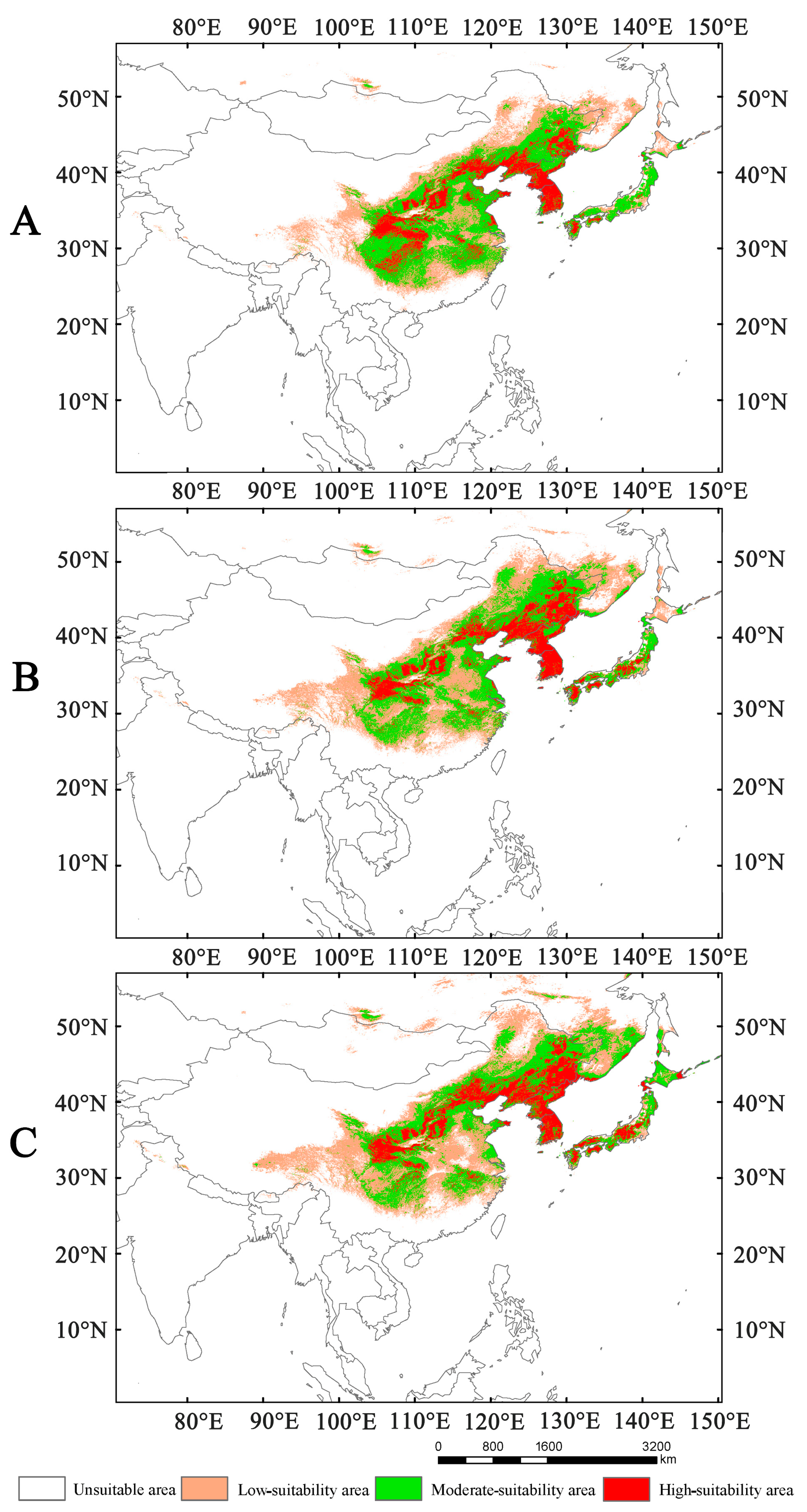
Compared to the current potential distribution, the suitable areas for Lagria nigricollis are projected to expand in the 2050s and 2070s (Table S1). In the 2050s, the suitable areas under SSP1-2.6, SSP2-4.5, and SSP5-8.5 are approximately 4.08 × 10⁶ km2, 4.42 × 10⁶ km2, and 4.88× 10⁶ km2, respectively (Figure 4). During this period, high-, moderate-, and low-suitability areas will expand, alongside increasing levels of greenhouse gas emissions. In 2070s, the suitability areas under SSP1-2.6, SSP2-4.5, and SSP5-8.5 are approximately 4.29 × 10⁶ km2, 4.65 × 10⁶ km2, and 5.03 × 10⁶ km2, respectively (Figure 5). In both the 2050s and 2070s, the suitability areas for L. nigricollis show the greatest increase under SSP5-8.5. In the 2050s, the expanded suitable areas are mainly located in the Hengduan Mountains, the junction of the Inner Mongolian region with North China and Northeast China, the southeast of Russia, and the Hokkaido of Japan (Figure 6). In the 2070s, the location of expanded suitable areas changes significantly, but they are primarily concentrated in the northern part of the suitable areas (Figure 6).

3.4. Shift in the Centroids

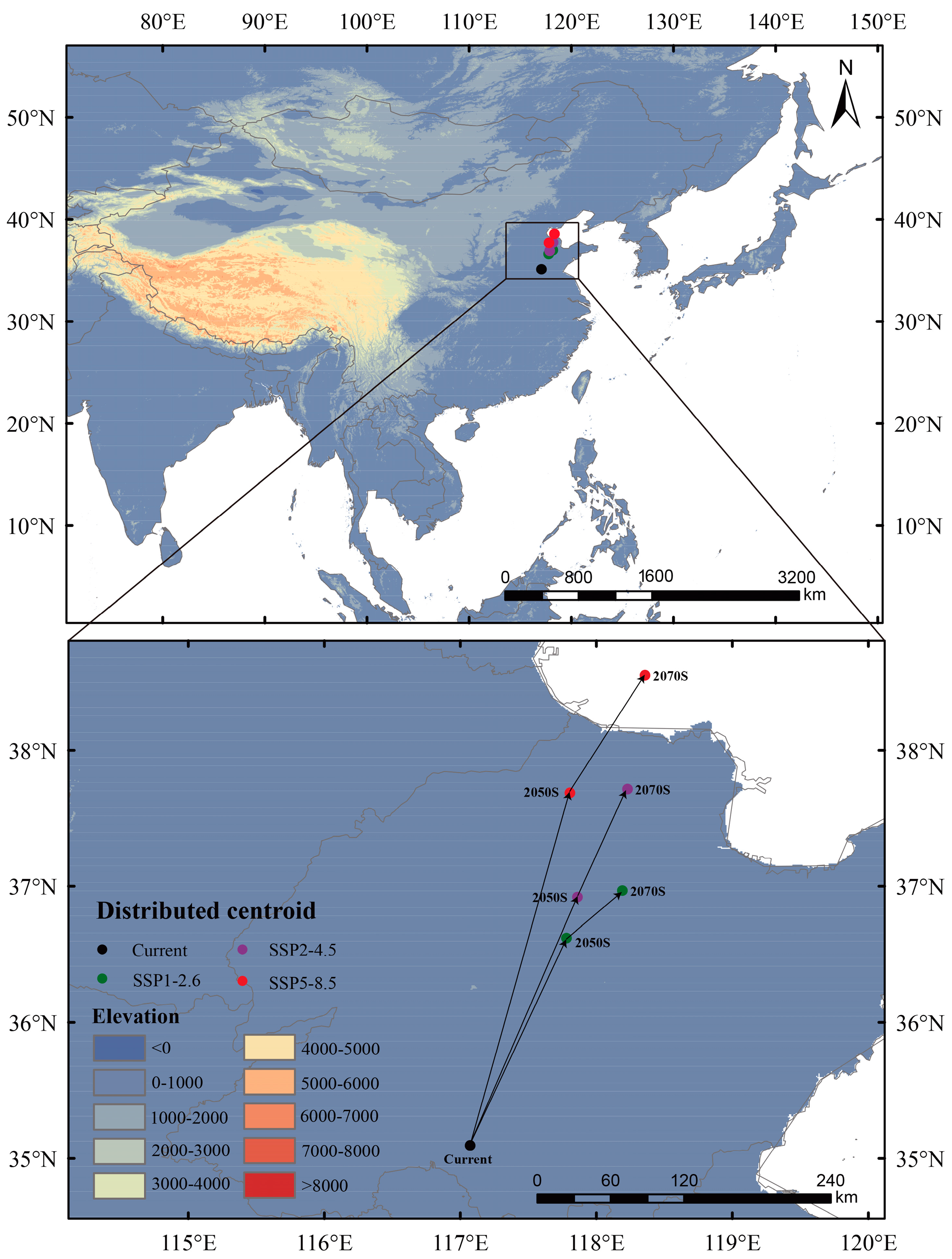
The centroid of the suitable area will shift with the changes in its distribution. Under current climate conditions, the centroid is located in Yutai County (117.07198° E, 35.09453° N) of Shandong Province, China. In the 2050s and 2070s, the centroids of future suitable areas will shift to the northwest under future climate scenarios (Figure 7). During the same period, the migration distance of the centroid under SSP5-8.5 is the farthest, compared to those under SSP1-2.6 and SSP2-4.5.

4. Discussion

The MaxEnt model has been widely used to explore the impact of future climate change on the distribution of insects [37,38,39,40,41]. These research findings have important guiding implications for the prevention and control of future invasive species [37,38,39] and the conservation of rare insects [10,42,43]. For this model, the values of AUC, AICc, and omission rate are three key indicators used to assess the model’s accuracy and complexity. In this study, the high values of these two indicators suggested that the accuracy of the prediction results is very high and that the model fits the data well.
For the environmental variables, bioclimatic and soil factors significantly influence species distribution at a large spatial scale [29]. In this study, the bioclimatic variables, bio18 and bio04, are the most important factors influencing the suitable area of Lagria nigricollis, with contribution values significantly higher than those of other variables. This may be due to changes in temperature and precipitation affecting the food source of L. nigricollis, thereby influencing its distribution. Regarding soil variables, the contribution of global land cover type is greater than that of elevation and global vegetation, which may be due to the survival of this species being largely constrained by host plants [40]. The precipitation simulation bias of the BCC-CSM2-MR may interfere with the contribution analysis of key variables such as bio18, thereby affecting the assessment of suitable area expansion and migration trends. Additionally, if there is sampling bias in the species occurrence data, it may lead to deviations in the estimation of suitable ranges, particularly affecting prediction accuracy in the marginal areas.
The impact of future climate change on the suitable areas of species is inconsistent [44]. Some studies suggest that the suitable areas of insects will expand [40,45,46,47,48], while others indicate that they will shrink [10,49,50]. Currently, studies using models to explore how Tenebrionidae species respond to climate change are limited, with one species, Luprops orientalis, being reported [26]. The results of that study suggested that the suitable areas for Luprops orientalis would expand under future climate conditions compared to current conditions.
In this study, the suitable areas of Lagria nigricollis under future climate conditions are significantly larger than those under current conditions. Whether in the 2050s or the 2070s, the suitable areas for L. nigricollis will gradually expand as the level of greenhouse gas emissions increases. This is inconsistent with the known results for Luprops orientalis in the subfamily Lagriinae: in the 2070s, the suitable area of L. orientalis is projected to decrease as greenhouse gas emissions increase [26]. As the suitable areas expand northward, the risk of damage to host plants such as mulberry and locust trees in northern regions may increase. Therefore, it is recommended to establish host plant monitoring plots within the suitable areas and deploy pheromone traps for more effective prevention and control. The suitable areas of Lagria nigricollis will shift northward under future climate conditions, aligning with the results of most studies [38,51,52]. Given the above, the specific impact on the suitable areas of reported tenebrionid species under future climate change remains inconsistent. Therefore, to better understand how Tenebrionidae species respond to climate change, more species should be studied through modeling.
Based on the locations of highly suitable areas for Lagria nigricollis under current climate conditions, the main management regions for this species are concentrated in China (Sichuan, Guizhou, Chongqing, Hubei, Hunan, Gansu, Shaanxi, Shanxi, Hebei, Liaoning, Jiangsu, Anhui, Jiangxi), the Korean Peninsula, and Japan (Kyushu, Shikoku, and the southern part of Honshu) (Figure 3). In the future, to prevent the northward spread of this species, the main control regions will be concentrated in China (the junction of the Inner Mongolia–Xinjiang and Northern China regions), Russia (southeastern Far Eastern Federal District), and Japan (Hokkaido) (Figure 6).
For the results of this study, the authors acknowledge that the model did not incorporate dispersal mechanisms or biotic interactions, both of which may influence the species’ distribution. Furthermore, the distribution of host plants and land use factors was not fully accounted for, which may result in incomplete or less accurate predictions.

5. Conclusions

The results of potentially suitable habitats for Lagria nigricollis indicate that the precipitation of the warmest quarter and the temperature seasonality are the two most important environmental variables influencing the distribution of L. nigricollis. Under current climate conditions, the highly suitable areas for this species are located in China (Sichuan, Guizhou, Chongqing, Hubei, Hunan, Gansu, Shaanxi, Shanxi, Hebei, Liaoning, Jiangsu, Anhui, and Jiangxi), the Korean Peninsula, and Japan (Kyushu, Shikoku, and southern Honshu). In the 2050s and 2070s, the suitable areas will expand and shift northward under SSP1-2.6, SSP2-4.5, and SSP5-8.5, becoming 1.08–1.33 times larger than they are currently.

Supplementary Materials

The following supporting information can be downloaded at https://www.mdpi.com/article/10.3390/insects16121227/s1, Table S1: Statistical analysis of the changes in suitable area under different scenarios; Figure S1: Pearson correlation analysis of environmental variables; Figure S2: The Jackknife test of variables’ importance for the Lagria nigricollis using MaxEnt model; Figure S3: The ROC curve for predicting the potential distribution range of L. nigricollis based on the MaxEnt model.

Author Contributions

Conceptualization, A.S. and Z.W.; methodology, Z.W. and M.Z.; software, Z.W. and Y.L.; validation, Y.L. and F.L.; formal analysis, Z.W., J.W., and Y.L.; data curation, Z.W. and M.Z.; writing—original draft preparation, M.Z. and F.L.; writing—review and editing, J.W., A.S., and Z.W.; supervision, A.S.; funding acquisition, A.S., H.F., and Z.W. All authors have read and agreed to the published version of the manuscript.

Funding

This work was supported by the Natural Science Foundation of Sichuan Province (Grant No. 2023NSFSC0208, 2024NSFSC0076, and 2025NSFSC2117).

Data Availability Statement

The original contributions presented in this study are included in the article/Supplementary Material. Further inquiries can be directed to the corresponding author.

Acknowledgments

We thank Yingying Li (China West Normal University) for collecting occurrence data for this study.

Conflicts of Interest

The authors declare no conflicts of interest.

Abbreviations

The following abbreviations are used in this manuscript:
SDMsspecies distribution models
L. nigricollisLagria nigricollis
MaxEntmaximum entropy
ROCreceiver operating characteristic
AUCarea under the curve

References

  1. Pecl, G.T.; Araújo, M.B.; Bell, J.D.; Blanchard, J.; Bonebrake, T.C.; Chen, I.C.; Clark, T.D.; Colwell, R.K.; Danielsen, F.; Evengård, B.; et al. Biodiversity redistribution under climate change: Impacts on ecosystems and human well-being. Science 2017, 355, eaai9214. [Google Scholar] [CrossRef]
  2. Urban, M.C. Accelerating extinction risk from climate change. Science 2015, 348, 571–573. [Google Scholar] [CrossRef]
  3. Storch, D.; Šímová, I.; Smyčka, J.; Bohdalková, E.; Toszogyova, A.; Okie, J.G. Biodiversity dynamics in the Anthropocene: How human activities change equilibria of species richness. Ecography 2022, 4, e05778. [Google Scholar] [CrossRef]
  4. Ren, G.D.; Li, X. Advances in classification of the storage tenebrionid beetles in the world. J. Hebei Univ. (Nat. Sci.) 2020, 40, 49–56. [Google Scholar]
  5. Gao, R.T.; Li, J.H.; Wang, Z.S.; Rao, G.D. Pest Investigation and control in Olea europaea. For. Sci. Technol. China 2018, 2018, 32–35. [Google Scholar] [CrossRef]
  6. Ge, X.Z.; He, S.Y.; Zhu, C.Y.; Wang, T.; Xu, Z.C.; Zong, S.X. Projecting the current and future potential global distribution of Hyphantria cunea (Lepidoptera: Arctiidae) using CLIMEX. Pest Manag. Sci. 2019, 75, 160–169. [Google Scholar] [CrossRef] [PubMed]
  7. Corsi, F.; Dupre, E.; Boitani, L. A large-scale model of wolf’ distribution in Italy for conservation planning. Conserv. Biol. 1999, 13, 150–159. [Google Scholar] [CrossRef]
  8. Peterson, A.T.; Soberon, J.; Sanchez-Cordero, V. Conservatism of ecological niches in evolutionary time. Science 1999, 285, 1265–1267. [Google Scholar] [CrossRef]
  9. Wang, S.Y.; Lu, Y.Y.; Han, M.Y.; Li, L.L.; He, P.; Shi, A.M.; Bai, M. Using MaxEnt model to predict the potential distribution of three potentially invasive scarab beetles in China. Insects 2023, 14, 239. [Google Scholar] [CrossRef] [PubMed]
  10. Yu, Y.L.; Li, Z.Q. Predicting the Potential Distribution of Cheirotonus jansoni (Coleoptera: Scarabaeidae) Under Climate Change. Insects 2024, 15, 1012. [Google Scholar] [CrossRef]
  11. Phillips, S.J.; Anderson, R.P.; Schapire, R.E. Maximum entropy modeling of species geographic distributions. Ecol. Model. 2006, 190, 231–259. [Google Scholar] [CrossRef]
  12. Mondanaro, A.; Di Febbraro, M.; Castiglione, S.; Melchionna, M.; Serio, C.; Girardi, G.; Belfiore, A.M.; Raia, P. ENphylo: A new method to model the distribution of extremely rare species. Methods Ecol. Evol. 2023, 14, 911–922. [Google Scholar] [CrossRef]
  13. Booth, T.H.; Nix, H.A.; Busby, J.R.; Hutchinson, M.F. BIOCLIM: The first species distribution modelling package, its early applications and relevance to most current MaxEnt studies. Divers. Distrib. 2014, 20, 1–9. [Google Scholar] [CrossRef]
  14. Sutherst, R.W.; Maywald, G.F. A climate-envelope model for assessing the distribution and abundance of an insect pest in a changing climate. Environ. Entomol. 1999, 28, 1045–1059. [Google Scholar]
  15. Townsend, P.A.; Papes, M.; Eaton, M. Transferability and model evaluation in ecological niche modeling; a comparison of GARP and MaxEnt. Ecography 2007, 30, 550–560. [Google Scholar] [CrossRef]
  16. Merow, C.; Smith, M.J.; Silander, A. A practical guide to Maxent for modeling species’ distributions: What it does, and why inputs and settings matter. Ecography 2013, 36, 1058–1069. [Google Scholar] [CrossRef]
  17. Phillips, S.J.; Anderson, R.P.; Dudík, M.; Schapire, R.E.; Blair, M.E. Opening the black box: An open-source release of MaxEnt. Ecography 2017, 40, 887–893. [Google Scholar] [CrossRef]
  18. Hasan, E.L.; Gorman, K.B.; Coletti, H.A.; Konar, B. Species distribution modeling of northern sea otters (Enhydra lutris kenyoni) in a data-limited ecosystem. Ecol. Evol. 2024, 14, e11118. [Google Scholar] [CrossRef]
  19. Sun, X.; Long, Z.X.; Jia, J.B. A multi-scale Maxent approach to model habitat suitability for the giant pandas in the Qionglai mountain, China. Glob. Ecol. Conserv. 2021, 30, e01766. [Google Scholar] [CrossRef]
  20. Wei, J.; Gao, G.; Wei, J.F. Potential global distribution of Daktulosphaira vitifoliae under climate change based on MaxEnt. Insects 2021, 12, 347. [Google Scholar] [CrossRef]
  21. He, Y.L.; Ma, J.M.; Chen, G.S. Potential geographical distribution and its multi-factor analysis of Pinus massoniana in China based on the MaxEnt model. Ecol. Indic. 2023, 154, 110790. [Google Scholar] [CrossRef]
  22. Wei, B.; Wang, R.L.; Hou, K.; Wang, X.Y.; Wu, W. Predicting the current and future cultivation regions of Carthamus tinctorius L. using MaxEnt model under climate change in China. Glob. Ecol. Conserv. 2018, 16, e00477. [Google Scholar] [CrossRef]
  23. Merkl, O. On taxonomy, nomenclature, and distribution of some Palaearctic Lagriini, with description of a new species from Taiwan (Coleoptera: Tenebrionidae). Acta Zool. Acad. Sci. Hung. 2004, 50, 283–305. [Google Scholar]
  24. Shi, A.M.; Pan, Y.S.; Li, Y.C. A redescription of Lagria nigricollis Hope, 1843 (Coleoptera: Tenebrionidae: Lagriini). Entomotaxonomia 2010, 32, 88–90. [Google Scholar]
  25. Zhou, Y.; Chen, B. A study on the genus Lagria from China with one new species and new distributional records (Coleoptera: Lagriinae). Zootaxa 2023, 5254, 413–424. [Google Scholar] [CrossRef]
  26. Wang, J.Q.; Wang, S.Y.; Li, Y.C.; Ding, S.M.; Wei, Z.H.; Shi, A.M.; Yang, D. Distribution pattern and change prediction of Luprops orientalis (Coleoptera: Tenebrionidae) suitable area in East Asia under climate change. Insects 2025, 16, 626. [Google Scholar] [CrossRef]
  27. GBIF Occurrence Download. Available online: https://doi.org/10.15468/dl.r7amzt (accessed on 10 June 2025).
  28. Koo, K.S.; Lee, K.-H.; Lee, D.; Jiang, Y. Impact of obscured data on species distribution models. Conserv. Biol. 2025, 39, e70050. [Google Scholar] [CrossRef]
  29. Wei, J.F.; Peng, L.F.; He, Z.Q.; Lu, Y.; Wang, F. Potential distribution of two invasive pineapple pests under climate change. Pest. Manag. Sci. 2020, 76, 1652–1663. [Google Scholar] [CrossRef] [PubMed]
  30. Kobayashi, T.; Tateishi, R.; Alsaaideh, B.; Sharma, R.C.; Wakaizumi, T.; Miyamoto, D.; Bai, X.; Long, B.D.; Gegentana, G.; Maitiniyazi, A. Production of global land cover data–GLCNMO2013. J. Geogr. Geol. 2017, 9, 1–15. [Google Scholar] [CrossRef]
  31. Robinson, N.; Regetz, J.; Guralnick, R.P. EarthEnv-DEM90: A nearly-global, void-free, multi-scale smoothed, 90m digital elevation model from fused ASTER and SRTM data. ISPRS J. Photogramm. Remote Sens. 2014, 87, 57–67. [Google Scholar] [CrossRef]
  32. Eyring, V.; Bony, S.; Meehl, G.A.; Senior, C.A.; Stevens, B.; Stouffer, R.J.; Taylor, K.E. Overview of the coupled model intercomparison project phase 6 (CMIP6) experimental design and organization. Geosci. Model Dev. 2016, 9, 1937–1958. [Google Scholar] [CrossRef]
  33. Riahi, K. The shared socioeconomic pathways and their energy, land use, and greenhouse gas emissions implications: An overview. Glob. Environ. Change 2017, 42, 153–168. [Google Scholar] [CrossRef]
  34. Worthington, T.A.; Zhang, T.; Logue, D.R.; Mittelstet, A.R.; Brewer, S.K. Landscape and flow metrics affecting the distribution of a federally-threatened fish: Improving management, model fit, and model transferability. Ecol. Model. 2016, 342, 1–18. [Google Scholar] [CrossRef]
  35. Muscarella, R.; Galante, P.J.; Soley-Guardia, M.; Boria, R.A.; Kass, J.M.; Uriarte, M.; Anderson, R.P. ENMeval: An R package for conducting spatially independent evaluations and estimating optimal model complexity for Maxent ecological niche models. Methods Ecol. Evol. 2014, 5, 1198–1205. [Google Scholar] [CrossRef]
  36. Yan, H.; Feng, L.; Zhao, Y.; Feng, L.; Di, W.; Zhu, C. Prediction of the Spatial Distribution of Alternanthera philoxeroides in China Based on ArcGIS and MaxEnt. Glob. Ecol. Conserv. 2020, 21, e00856. [Google Scholar] [CrossRef]
  37. Baek, S.; Kim, M.J.; Lee, J.H. Current and future distribution of Ricania shantungensis (Hemiptera: Ricaniidae) in Korea: Application of spatial analysis to select relevant environmental variables for MaxEnt and CLIMEX modeling. Forests 2019, 10, 490. [Google Scholar] [CrossRef]
  38. Tang, J.H.; Li, J.H.; Lu, H.; Lu, F.P.; Lu, B.Q. Potential distribution of an invasive pest, Euplatypus parallelus, in China as predicted by Maxent. Pest Manag. Sci. 2019, 75, 1630–1637. [Google Scholar] [CrossRef]
  39. Zhao, Z.X.; Yang, L.; Chen, X.S. Globally suitable areas for Lycorma delicatula based on an optimized MaxEnt model. Ecol. Evol. 2024, 14, e70252. [Google Scholar] [CrossRef]
  40. Zhang, Y.; Yang, H.; Jiamahate, A.; Yang, H.; Cao, L.; Dang, Y.; Lu, Z.; Yang, Z.; Bozorov, T.A.; Wang, X. Potential Ecological Distribution of the Beetle Agrilus mali Matsumura (Coleoptera: Buprestidae) in China under Three Climate Change Scenarios, with Consequences for Commercial and Wild Apple Forests. Biology 2024, 13, 803. [Google Scholar] [CrossRef]
  41. Karuppannasamy, A.; Azrag, A.G.A.; Vellingiri, G.; Kennedy, J.S.; Ganapati, P.S.; Subramanian, S.; Venkatasamy, B. Forecasting the future of Fall armyworm Spodoptera frugiperda (J. E. Smith) (Lepidoptera: Noctuidae) in India using ecological niche model. Int. J. Biometeorol. 2024, 68, 1871–1884. [Google Scholar] [CrossRef] [PubMed]
  42. Syfert, M.M.; Joppa, L.; Smith, M.J.; Coomes, D.A.; Bachman, S.P.; Brummitt, N.A. Using species distribution models to inform IUCN Red List assessments. Biol. Conserv. 2014, 177, 174–184. [Google Scholar] [CrossRef]
  43. Hu, S.J.; Xing, D.H.; Gong, Z.X.; Hu, J.M. Projecting suitability and climate vulnerability of Bhutanitis thaidina (Blanchard) (Lepidoptera: Papilionidae) with conservation implications. Sci. Rep. 2019, 9, 15384. [Google Scholar] [CrossRef]
  44. Kwon, T.-S.; Lee, C.M.; Kim, S.-S. Prediction of abundance of beetles according to climate warming in South Korea. J. Asia-Pac. Biodivers. 2015, 8, 7–30. [Google Scholar] [CrossRef]
  45. Fu, C.; Wen, X.Y.; Huang, T.T.; Wang, Y.L.; Liu, X.; Jiang, N.; Wang, R.L.; Zhao, J.P. Comparison of GARP and MaxEnt in modeling current and future geographic distribution of Ceracris nigricornis Walker (Acrididae, Orthoptera) in China. Ecol. Evol. 2024, 14, e70439. [Google Scholar] [CrossRef]
  46. Zhao, Z.X.; Feng, X.L.; Wang, Y.J.; Zhou, Z.X.; Zhang, Y.B. Potential suitability areas of Sitobion miscanthi in China based on the MaxEnt model: Implications for management. Crop Prot. 2024, 183, 106755. [Google Scholar] [CrossRef]
  47. Hong, J.; Lee, M.; Kim, Y.; Lee, Y.S.; Wee, J.; Park, J.J.; Lee, W.K.; Song, Y.; Cho, K. Potential range shift of a long-distance migratory rice pest, Nilaparvata lugens, under climate change. Sci. Rep. 2024, 14, 11531. [Google Scholar] [CrossRef]
  48. Aidoo, O.F.; Souza, P.G.C.; da Silva, R.S.; Santana, P.A.; Picanco, M.C.; Kyerematen, R.; Sètamou, M.; Elkesi, S.; Borgemeister, C. Climate-induced range shifts of invasive species (Diaphorina citri Kuwayama). Pest Manag. Sci. 2022, 78, 2534–2549. [Google Scholar] [CrossRef] [PubMed]
  49. Poloni, R.; Iannella, M.; Fusco, G.; Fattorini, S. Conservation biogeography of high-altitude longhorn beetles under climate change. Insect Conserv. Diver. 2022, 15, 429–444. [Google Scholar] [CrossRef]
  50. Zhao, Z.X.; Yang, L.; Long, J.K.; Chang, Z.M.; Chen, X.S. Predicting suitable areas for Metcalfa pruinosa (Hemiptera: Flatidae) under climate change and implications for management. J. Insect Sci. 2024, 24, 7. [Google Scholar] [CrossRef]
  51. Yang, M.S.; Wang, Y.; Ding, W.L.; Li, H.H.; Zhang, A.B. Predicting habitat suitability for the soybean pod borer Leguminivora glycinivorella (Matsumura) using optimized MaxEnt models with multiple variables. J. Econ. Entomol. 2024, 117, 1796–1808. [Google Scholar] [CrossRef] [PubMed]
  52. Ullah, F.; Zhang, Y.; Gul, H.; Hafeez, M.; Desneux, N.; Qin, Y.J. Potential economic impact of Bactrocera dorsalis on Chinese citrus based on simulated geographical distribution with MaxEnt and CLIMEX models. Entomol. Gen. 2023, 43, 821–830. [Google Scholar] [CrossRef]
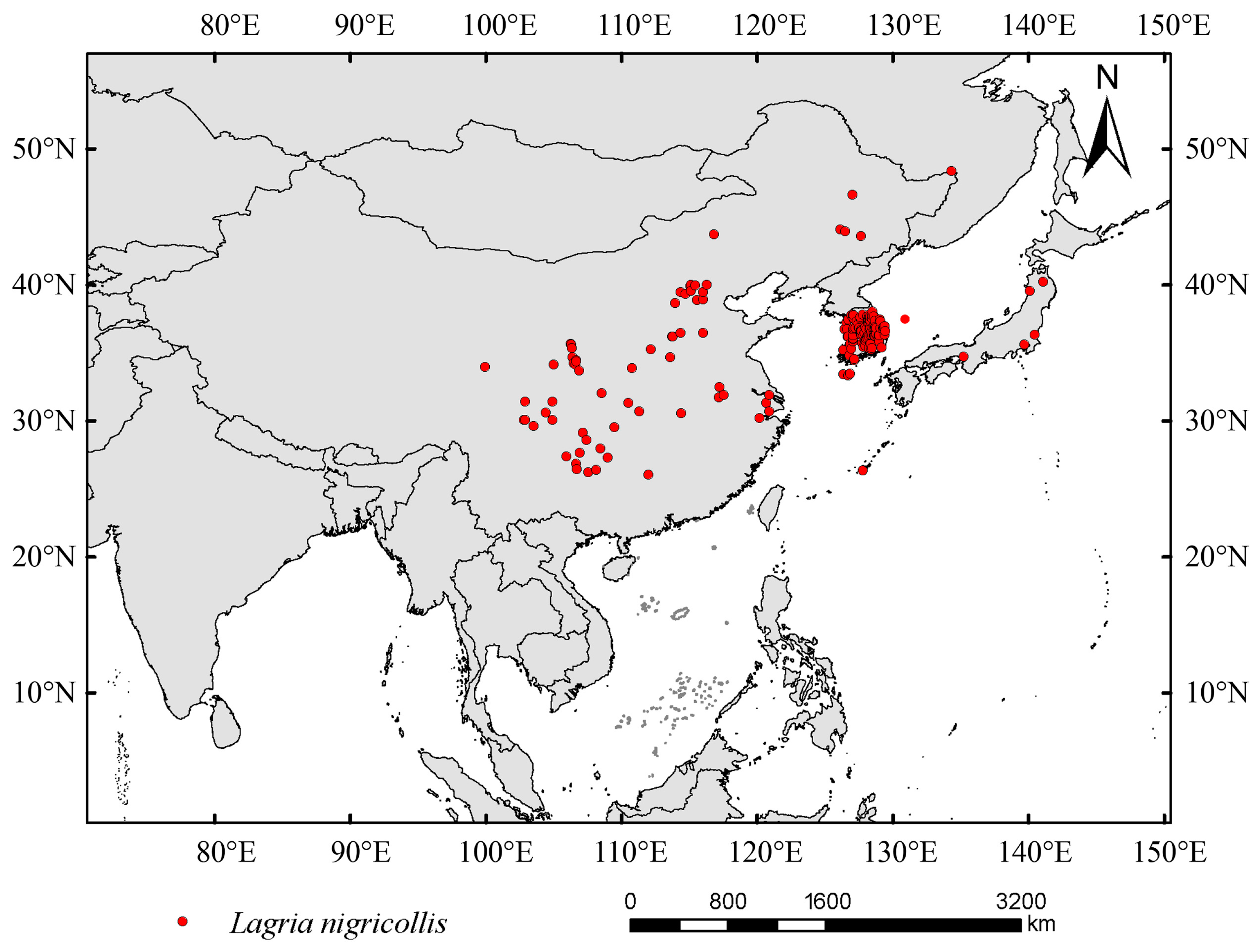
Figure 1. The distribution of Lagria nigricollis.
Insects 16 01227 g001
Figure 2. Response curves of the four major environmental variables important for Lagria nigricollis.
Insects 16 01227 g002
Figure 3. The suitable areas of Lagria nigricollis under current climate conditions.
Insects 16 01227 g003
Figure 4. The suitable areas of Lagria nigricollis under SSP1-2.6 (A), SSP2-4.5 (B), and SSP5-8.5 (C) in the 2050s.
Insects 16 01227 g004
Figure 5. The suitable areas of Lagria nigricollis under SSP1-2.6 (A), SSP2-4.5 (B), and SSP5-8.5 (C) in the 2070s.
Insects 16 01227 g005
Figure 6. Changes in suitable areas for Lagria nigricollis in the 2050s and 2070s. (A) Changes in the suitable area under SSP1-2.6 in the 2050s, compared to the current suitable area. (B) Changes in the suitable area under SSP2-4.5 in the 2050s, compared to the current suitable area. (C) Changes in the suitable area under SSP5-8.5 in the 2050s, compared to the current suitable area. (D) Changes in the suitable area under SSP1-2.6 in the 2070s, compared to that in the 2050s. (E) Changes in the suitable area under SSP2-4.5 in the 2070s, compared to that in the 2050s. (F) Changes in the suitable area under SSP5-8.5 in the 2070s, compared to that in the 2050s.
Insects 16 01227 g006
Figure 7. Shift in the centroids of suitable habitats for Lagria nigricollis under various climate scenarios.
Insects 16 01227 g007
Table 1. The selected 10 environmental variables were used for the MaxEnt model.
VariableDescriptionContribution (100%)Permutation Importance (100%)
bio18Precipitation of the warmest quarter60.755.4
bio04Temperature seasonality25.17.4
bio15Precipitation seasonality51.4
bio11Mean temperature of coldest quarter4.729.8
bio19Precipitation of the coldest quarter1.51.2
gm-lcLand cover type1.40.4
bio02Mean daily temperature range0.71.4
bio08Mean temperature of the wettest quarter0.52.4
elevElevation0.30.5
gm-veGlobal land vegetation0.10.1
Disclaimer/Publisher’s Note: The statements, opinions and data contained in all publications are solely those of the individual author(s) and contributor(s) and not of MDPI and/or the editor(s). MDPI and/or the editor(s) disclaim responsibility for any injury to people or property resulting from any ideas, methods, instructions or products referred to in the content.